
Strictly Confidential
IV. Economics
1. Spotlight on Keynesian Economics
October 20, 1947
Its Significance
Fifty years ago, an exuberant American people knew little and cared less about economics. They understood, however, the virtues of economic freedom, and this understanding was shared by the economists, who supplemented common sense with sharper tools of analysis.
At present, economics seems to be the number one American and world problem. The newspapers are filled with complex discussions of the budget, wages and prices, foreign loans, and production. Present-day economists greatly add to the confusion of the public. The eminent Professor X says that his plan is the only cure for world economic evils; the equally eminent Professor Y claims that this is nonsense—so whirls the merry-go-round.
However, one school of thought—the Keynesian—has succeeded in capturing the great majority of economists. Keynesian economics—proudly proclaiming itself as “modern,” though with its roots deep in medieval and mercantilist thought—offers itself to the world as the panacea for our economic troubles. Keynesians claim, with supreme confidence, that they have “discovered” what determines the volume of employment at any given time. They assert that unemployment can be readily cured through governmental deficit spending, and that inflation can be checked by means of government tax surpluses.
With great intellectual arrogance, Keynesians brush aside all opposition as being “reactionary,” “old-fashioned,” etc. They are extremely boastful of having gained the allegiance of all the young economists—a claim that has, unfortunately, a good deal of truth. Keynesian thinking has flourished in the New Deal, in the statements of President Truman, his Council of Economic Advisers, Henry Wallace, labor unions, most of the press, all foreign governments and United Nations committees, and, to a surprising extent, among “enlightened businessmen” of the Committee for Economic Development variety.
Against this onslaught, many sincere liberal-minded citizens have been swayed by the Keynesians—particularly by their argument that the wide governmental intervention they advocate will “solve the problem of unemployment.” The most dismaying aspect of the situation is that the Keynesian arguments have not been countered effectively by the liberal economists, who have generally been helpless in the tidal wave. Liberal economists have confined their attacks to the political program of the Keynesians—they have not dealt adequately with the economic theory on which this program is based. As a result, the Keynesians’ claim that their program will ensure full employment has largely gone unchallenged.
The reason for this weakness on the part of liberal economists is understandable. They were brought up on “neoclassical economics,” which is grounded on careful analysis of economic realities and based on the actions of individual units in the economic system. The Keynesian theory is based on a model of the economic system—a model that drastically oversimplifies reality and yet is extremely complex because of its abstract and mathematical nature. For this reason, liberal economists found themselves confused and bewildered by this “new” economics. Since Keynesians were the only economists equipped to discuss their system, they were easily able to convince the younger economists and students of its superiority.
To launch a successful counterattack against the Keynesian invasion, therefore, requires more than righteous indignation toward the proposals for government action in the Keynesian program. It requires a well-informed citizenry who thoroughly understand the Keynesian theory itself, with its numerous fallacies, unrealistic assumptions, and faulty concepts. For this reason it will be necessary to tread a difficult path through a complex maze of technical jargon in order to examine the Keynesian model in some detail.
Another difficulty in the task of examining Keynesianism is the sharp difference of opinion between various branches of the movement. All shades of Keynesians, however, agree in sharing a common attitude towards the function of the State, and all accept the Keynesian model as a basis for analyzing the economic situation.
All Keynesians conceive of the State as a great potential reservoir of benefits, ready to be tapped. The prime concern for the Keynesian is to decide on economic policy—what should be the economic ends of the State and what means should the State adopt to achieve them? The State is, of course, always synonymous with “we”: What should “we” do to insure full employment? is a favorite query. (Whether the “we” refers to the “people” or to the Keynesians themselves is never quite made clear.)
In medieval and early modern times, the ancestors of the Keynesians who advocated similar policies also proclaimed that the State could do no wrong. At that time, the king and his nobles were the rulers of the State. Now we have the dubious privilege of periodically choosing our rulers from two sets of power-thirsty aspirants. That makes it a “democracy.”32 So, the rulers of the State, being “democratically elected” and therefore representing the “people,” are allegedly entitled to control the economic system and coerce, cajole, “influence,” and redistribute the wealth of their reluctant subjects.
A recent important illustration of Keynesian political thinking was the Truman message vetoing income tax reduction. The main reason for the veto was that high taxes are necessary to “check inflation,” since a “boom” period calls for a budget surplus to “drain off excess purchasing power.”
Superficially, this argument seems convincing, and it is supported by almost all economists, including many non-Keynesian conservatives. They are all very proud of the fact that they are opposing the “politically easy” route of reducing taxes in the interests of scientific truth, national welfare, and the “fight against inflation.”
It is necessary, however, to analyze the problem more closely. What is the essence of inflation? It consists of rising prices—some prices rising more rapidly than others.33 What is a price? It is a sum of money (general purchasing power) paid voluntarily by one individual to another in exchange for a definite service rendered by the second individual to the first. This service may be in the form of a tangible commodity or an intangible benefit.
On the other hand, what is a tax? A tax is the coercive expropriation of the property of an individual by the rulers of the State. The rulers use this property for whatever purposes they desire—usually the rulers will distribute it in such a manner as to ensure their continuance in office, i.e., by subsidizing favored groups. In addition, the rulers decide which individuals will pay the taxes—the decision consisting of expropriating the property of groups disliked by the rulers.
A price, therefore, is a free act of voluntary exchange between two individuals, both of whom benefit by the exchange (else the exchange would not be made!). A tax is a compulsory act of expropriation, with no benefit accruing to the individual (unless he happens to be on the receiving end of property expropriated by the State from someone else).
In the light of this distinction, advocating high taxes to prevent high prices is similar to a highway robber assuring the victim that his robbery is checking inflation, since the robber doesn’t intend on spending the money for quite some time or that the robber might use it to repay his own debts. When will the American people wake up to the realization that robbery only benefits the robber, and that the edict “thou shalt not steal” applies to rulers (and Keynesians) as well as to anybody else?
The Model Explained
The Keynesian theory (or model) highly oversimplifies the real world by dealing with a few large aggregates, lumping together the activity of all individuals in a nation.
The basic concept used is aggregate national income, which is defined as equal to the money value of the national output of goods and services during a given time period. It is also equal to the aggregate of income received by individuals during the period (including undistributed corporate profits).
Now, the fundamental equation of the Keynesian system is aggregate income = aggregate expenditures. The only way any individual can receive any money income is for some other individual to spend an equal sum. Conversely, every act of expenditure by an individual results in an equivalent money income for someone else. This is obviously, and always, true. Mr. Smith spends one dollar in Mr. Jones’s grocery—this act results in one dollar of income for Mr. Jones. Mr. Smith receives his annual income as a result of an act of expenditure by the XYZ Company; the XYZ Company receives its annual income as a result of expenditures made by all its customers, etc. In every case, expenditures, and only expenditures, can create money income.
Aggregate expenditures are classified into two basic types: (1) final expenditure for goods and services that have been produced during the period equals consumption, and (2) expenditure on the means of production of these goods equals investment. Thus, money income is created by decisions to spend, consisting of consumption decisions and investment decisions.
Now, an individual, upon receiving his income, divides it between consumption and saving. Saving, in the Keynesian system, is defined simply as not spending on consumption. A fundamental Keynesian tenet is that, for any particular level of aggregate income, there is a certain definite, predictable amount that will be consumed and a definite amount that will be saved. This relationship between aggregate income and consumption is considered to be stable, fixed by the habits of consumers. In the mathematical Keynesian jargon, aggregate consumption (and therefore aggregate savings) is a stable, passive function of income (the famous consumption function). For example, we shall use the consumption function: consumption = 90 percent of income. (This is a highly simplified function, but it serves to illustrate the basic principles of the Keynesian model.) In this case, the savings function would be savings = 10 percent of income.
Consumption expenditures are, therefore, passively determined by the level of national income. Investment expenditures, however, are, according to the Keynesians, effected independently of the national income. At this stage, what determines investment is not important—the crucial point is that it is determined independently of the income level.
We have left out two factors that also determine the level of expenditures. If exports are greater than imports, the total amount of expenditures in a country is increased, hence national income increases. Also, a government budget deficit increases aggregate expenditures and income (provided that other types of expenditure can be assumed to be constant). Setting aside the foreign trade problem, it is obvious that government deficits or surpluses are, like investment, decided independently of the level of national income.
Thus, income = independent expenditures34 + passive consumption expenditures. Using our illustrative consumption function, income = independent expenditures + 90 percent of income. Now, by simple arithmetic, income equals ten times independent expenditures. For every increase in independent expenditures, there will be a ten-fold increase in income. Similarly, a decrease in independent expenditures will lead to a ten-fold drop in income. This “multiplier” effect on income will be achieved by any type of independent expenditure—whether private investment or government deficit. Thus, in the Keynesian model, government deficits and private investment have the same economic effect.
Let us now examine in detail the process whereby an equilibrium income is determined in the Keynesian model. The equilibrium level is the level at which national income tends to settle.
Let us assume that aggregate income = 100, consumption = 90, savings = 10, and investment = 10. Also assume that there is no government deficit or surplus. For the Keynesians, this situation is a position of equilibrium—income tends to remain at 100. A position of equilibrium is reached because both main groups in the economy—business firms and consumers—are satisfied. Business firms, in the aggregate, pay out 100. Of this 100, 10 is invested in capital and 90 is paid out while producing consumers’ goods. Aggregate business firms expect this 90 to be returned to them through the sale of consumers’ goods. The consumers fulfill the expectations of business firms by dividing the income of 100 into consuming 90 and saving 10. Thus, aggregate business firms are just satisfied with the situation, and aggregate consumers are satisfied because they are consuming 90 percent of their income and saving 10 percent.
Now, let independent expenditures increase to 20, either because of an increase in private investment or because of a government deficit. Now, income payments to consumers are 90 + 20 = 110. Consumers, receiving 110, will wish to consume 90 percent of it, or 99, and save 11. Now, business firms, who had expected a consumption of 90, are pleasantly surprised to see consumers bidding up prices and reducing merchants’ stocks in an effort to consume 99. As a result, business firms expand their output of consumer goods to 99 and pay out 99 + 20 = 119, expecting a return of 99 in consumption sales. But again they are pleasantly surprised, since consumers will wish to spend 90 percent of 119, or 107. This process of expansion continues until income is again equal to ten times investment—when consumption is again equal to 90 percent of income. The point will be reached when income = 200, investment = 20, consumption = 180, and saving = 20.
It is important to notice that equilibrium was reached in both cases when aggregate investment = aggregate saving. The above equilibrium process can be described in terms of saving and investment: When investment is greater than saving, the economy expands and national income rises until aggregate saving equals aggregate investment. Similarly, the economy contracts if investment is less than saving, until they are again equal.
Note that two very important things must remain constant in order that equilibrium be reached. The consumption function (and therefore the savings function) is assumed to be constant throughout while the level of investment is constant at least until equilibrium is reached. The question now arises: what is so important about aggregate money income that it should be the continual focus of attention? Before this question can be answered, it is necessary to make certain assumptions.
Assume that the following things be considered as given (or constant): the existing state of all techniques, the existing efficiency, quantity, and distribution of all labor, the existing quantity and quality of all equipment, the existing distribution of national income, the existing structure of relative prices, the existing money wage rates(!), and the existing structure of consumer tastes, natural resources, and economic and political institutions.
Then, given these assumptions, for every level of national money income, there corresponds a unique, definite volume of employment. The higher the national income, the greater will be the volume of employment, until a state of “full employment” is reached. (We can define full employment as simply a very low level of unemployment.) After the full-employment level is reached, a higher money income will represent only a rise in prices, with no rise in physical output (real income) and employment.
Summing up the above model, known as the Keynesian theory of underemployment equilibrium: To each level of national income there corresponds a unique level of employment. There is, therefore, a certain level of income to which corresponds a state of full employment, without a great rise in prices. An income below this “full-employment” income will signify large-scale unemployment; an income above will mean large price inflation.
The level of income, in a private enterprise system, is determined by the level of independent investment expenditures and consumption expenditures that are a passive function of the income level. The resulting level of income will tend to settle at the point where aggregate investment equals aggregate saving.
Now (and here is the grand Keynesian climax), there is no reason whatsoever to assume that this equilibrium level of income determined in the free market will coincide with the “full-employment” income level—it may be more or less.
This is the model of the private economy accepted by all Keynesians. The State, assert the Keynesians, has the responsibility of keeping the economic system at the “full-employment” income level, since “we” cannot depend on the private economy to do so.
The Keynesian model furnishes the means by which the State can fulfill this task. Since government deficits have the same effects on income as does private investment, all that the State must do is to estimate the expected equilibrium income level of the private economy. If it is below the “full-employment” level, the State can engage in deficit spending until the desired income level is reached. Similarly, if it is above the desired level, the State can engage in budget surpluses through high taxes. The State, if it so desires, can also stimulate or discourage private investment or consumption via taxes and subsidies, or impose tariffs if it desires to create an export surplus. The favorite Keynesian prescription for stimulating consumption is progressive income taxation, since the “rich” do most of the saving. The favorite method of “encouraging private investment” is to subsidize “progressive” and “enlightened” industrialists as against “Tory big business.”
The Model Criticized
We remember that for the Keynesian model to be valid, the two basic determinants of income, namely, the consumption function and independent investment, must remain constant long enough for the equilibrium of income to be reached and maintained. At the very least, it must be possible for these two variables to remain constant, even if they are not generally constant in actuality. The core of the basic fallacy of the Keynesian system is, however, that it is impossible for these variables to remain constant for the required length of time.
We recall that when income = 100, consumption = 90, savings = 10, and investment = 10, the system is supposed to be in equilibrium, because the aggregate expectations of business firms and the public are fulfilled. In the aggregate, both groups are just satisfied with the situation, so that there is allegedly no tendency for the income level to change. But aggregates are meaningful only in the world of arithmetic, not in the real world. Business firms may receive in the aggregate just what they had expected; but this does not mean that any single firm is necessarily in an equilibrium position. Business firms do not make earnings in the aggregate. Some firms may be making windfall profits, while others may be making unexpected losses. Regardless of the fact that, in the aggregate, these profits and losses may cancel each other, each firm will have to make its own adjustments to its own particular experience. This adjustment will vary widely from firm to firm and industry to industry. In this situation, the level of investment cannot remain at 10, and the consumption function will not remain fixed, so that the level of income must change. Nothing in the Keynesian system, however, can tell us how far or in what direction any of these variables will move.
Similarly, in the Keynesian theory of the adjustment process toward the level of equilibrium, if aggregate investment is greater than aggregate saving, the economy is supposed to expand toward the level of income where aggregate saving equals aggregate investment. In the very process of expansion, however, the consumption (and savings) function cannot remain constant. Windfall profits will be distributed unevenly (and in an unknown fashion) among the numerous business firms, thus leading to varying types of adjustments. These adjustments may lead to an unknown increase in the volume of investment. Also, under the impetus of expansion, new firms will enter the economic system, thus changing the level of investment.
In addition, as income expands, the distribution of income among individuals in the economic system necessarily changes. It is an important fact, usually overlooked, that the Keynesian assumption of a rigid consumption function assumes a given distribution of income. Therefore, the change in the distribution of income will cause change of unknown direction and magnitude in the consumption function. Furthermore, the undoubted emergence of capital gains will change the consumption function.
Thus, since the basic Keynesian determinants of income—the consumption function and the level of investment—cannot remain constant, they cannot determine any equilibrium level of income, even approximately. There is no point toward which income will move or at which it will tend to remain. All we can say is that there will be a complex movement in the variables of an unknown direction and degree.
This failure of the Keynesian model is a direct result of misleading aggregative concepts. Consumption is not just a function of income; it depends, in a complex fashion, on the level of past income, expected future income, the phase of the business cycle, the length of the time period under discussion, on prices of commodities, on capital gains or losses, and on the cash balances of consumers.
Furthermore, the breakdown of the economic system into a few aggregates assumes that these aggregates are independent of each other, that they are determined independently and can change independently. This overlooks the great amount of interdependence and interaction among the aggregates. Thus, saving is not independent of investment; most of it, particularly business saving, is made in anticipation of future investment. Therefore, a change in the prospects for profitable investment will have a great influence on the savings function, and hence on the consumption function. Similarly, investment is influenced by the level of income, by the expected course of future income, by anticipated consumption, and by the flow of savings. For example, a fall in savings will mean a cut in the funds available for investment, thus restricting investment.
A further illustration of the fallacy of aggregates is the Keynesian assumption that the State can simply add or subtract its expenditures from that of the private economy. This assumes that private investment decisions remain constant, unaffected by government deficits or surpluses. There is no basis whatsoever for this assumption. In addition, progressive income taxation, which is designed to encourage consumption, is assumed to have no effect on private investment. This cannot be true, since, as we have already noted, a restriction of savings will reduce investment.
Thus, aggregative economics is a drastic misrepresentation of reality. The aggregates are merely an arithmetic cloak over the real world, where multitudes of firms and individuals react and interact in a highly complex manner. The alleged “basic determinants” of the Keynesian system are themselves determined by complex interactions within and between these aggregates.
Our analysis is confirmed by the fact that the Keynesians have been completely unsuccessful in their attempts to establish an actual, stable consumption function. Statistics bear out the fact that the consumption function shifts considerably with the month of the year, the phase of the business cycle, and over the long run. Consumer habits have definitely changed over the years. In the short run, a change in family income will only lead to a change in consumption after a lag of a certain period of time. In other cases, changes in consumption may be induced by expected changes in income (e.g., consumer credit). This instability of the consumption function eliminates the possibility of any validity of the Keynesian model.
Still another fundamental fallacy in the Keynesian system is the assumed unique relation between income and employment. This relation depends, as we have noted above, upon the assumption that techniques, the quantity and quality of equipment, and the efficiency and wage rate of labor are fixed. This assumption leaves out factors of basic importance in economic life and can only be true over an extremely short period. Keynesians, however, attempt to use this relation over long periods as a basis for predicting the volume of employment. One direct result was the Keynesian fiasco of predicting eight million unemployed after the end of the war.
The most important device that insures the unique relation between income and employment is the assumption of constant money wage rates. This means that in the Keynesian model, an increase in expenditures can only increase employment if money wage rates do not rise. In other words, employment can only increase if real wage rates fall (wage rates relative to prices and to profits). Also, there cannot be an equilibrium level of large-scale unemployment in the Keynesian model unless money wage rates are rigid and are not free to fall.
This result is extremely interesting, since classical economists have always maintained that employment will only increase if real wage rates fall, and that large-scale unemployment can only persist if wage rates are prevented from falling by monopolistic interference in the labor market. Both Keynesians and liberal economists recognize that money wage rates, particularly since the advent of the New Deal, are no longer free to fall, due to monopolistic governmental and trade-union control of the labor market.
Keynesians would remedy this situation by deceiving unions into accepting lower real wage rates, while prices and profits rise via government deficit spending. They propose to accomplish this feat by relying on trade-union ignorance, coupled with frequent appeals to a “sense of responsibility by the labor leadership.” In these days when unions emit cries of anguish and threaten to strike at every sign of higher prices or larger profits, such an attitude is incredibly naive. Far from having a sense of responsibility, the aim of most unions seems to be wage rates that increase rapidly and continuously, lower prices, and nonexistent profits.
It is evident that the liberal solution of reestablishing a freely competitive labor market through the elimination of union monopolies and governmental interference is an essential requisite for the rapid disappearance of unemployment as it arises in the economic system.
Keynesians, particularly those who are rabid partisans of the “liberal-labor movement,” attempt to refute this solution by contending that cuts in money wage rates would not lead to a reduction of unemployment. They claim that wage incomes would be reduced, thereby reducing consumer demand, and lowering prices, leaving real wage rates at their previous level.
This argument rests on a confusion between wage rates and wage incomes. A reduction in money wage rates, particularly in industries where wage rates have been most rigid, will lead immediately to an increase in hours worked and the number of men employed. (Of course, the amount of the increase will vary from industry to industry.) In this way, the total payroll is increased, thus increasing wage incomes and consumer demand. A fall in money wage rates will have an especially favorable employment effect in the construction and capital-goods industries. It is just these industries that now have the strongest unions.
Furthermore, if wage incomes are reduced, then the incomes of entrepreneurs and others will be increased and total “purchasing power” in the community will not decline.
The “Mature Economy”
It is important to recall that Keynesianism was born and was able to capture its widespread following under the impetus of the Great Depression of the thirties, a depression unique in its length and severity, and, especially, in the persistence of large-scale unemployment. It was its attempt to furnish an explanation for the events of the thirties that gained Keynesianism its popular following. Using a model with assumptions that restrict its application to a very short period of time, and completely fallacious in its dependence on simple aggregates, all Keynesians confidently ordered government deficits as the cure.
In interpreting the significance of the Depression, however, Keynesians part company. “Moderates” maintain that it was simply a severe depression in the familiar round of business cycles. “Radical” Keynesians, headed by Professor Hansen of Harvard, assert that the thirties ushered in an era in the United States of “secular (long-run) stagnation.” They claim that the American economy is now mature, that opportunities for investment and expansion are largely ended, so that the level of investment expenditures can be expected to remain at a permanently low level, at a level too low to ever provide full employment. The cure for this situation, according to the Keynes-Hansenites, is a permanent government program of deficit expenditures on long-range projects, and heavy progressive income taxation to permanently increase consumption and discourage savings.
Where the Hansen stagnation thesis goes beyond the Keynesian model is in its attempt to explain the determinants of the level of investment. Investment is supposed to be determined by the “extent of investment opportunities” that are, in turn, determined by (1) technological improvement, (2) the rate of population growth, and (3) the opening of new territory. The Hansenites go on to draw a gloomy picture of private investment opportunities in the modern world.
The decade of the thirties was the first in American history with a decline in population growth, and there is no new territory to develop—the “frontier” is closed. Consequently, we can rely only on technological progress to provide investment opportunities, opportunities that have to be much greater than in the past to “make up” for the unfavorable changes in the other two factors. As for technological progress, that too is slowing down. After all, the railroads have already been built and the automobile industry has reached maturity. Whatever minor improvements there might be will probably be withheld by “reactionary monopolists,” etc.
Let us examine each of Hansen’s alleged determinants of investment. The gloom concerning the lack of new lands to develop—the vanishing of the “frontier”—can be dispelled quickly. The frontier disappeared in 1890 without appreciably affecting the rapid progress and prosperity of America; obviously it can be no source of trouble now. This is borne out by the fact that, since 1890, investment per head in the older sections of America has been greater than in the recent frontier sections.
It is difficult to see how a decline in population growth can adversely affect investment. Population growth does not provide an independent source of investment opportunity. A fall in the rate of population growth can only affect investment adversely if:
- All the wants of existing consumers are completely satisfied. In that case, population growth would be the only additional source of consumer demand. This situation clearly does not exist; there are an infinite number of unsatisfied wants.
- The decline would lead to reduced consumer demand. There is no reason why this should be the case. Will not families use the money that they otherwise would have spent on their children for other types of expenditures?
In particular, Hansen claims that the catastrophic drop in construction in the thirties was caused by the decline in population growth, which reduced the demand for new housing. The relevant factor in this connection, however, is the rate of growth in the number of families; this did not decline in the thirties. Furthermore, Manhattan has had a declining total population (not merely the rate of growth) since 1911, yet in the 1920s Manhattan had the biggest residential building boom in its history.
Finally, if our malady is underpopulation, why has no one suggested subsidizing immigration to cure unemployment? This would have the same effect as a rise in the rate of growth of population. The fact that not even Hansen has suggested this solution is a final demonstration of the absurdity of the “population growth” argument.
The third factor, technological progress, is certainly an important one; it is one of the main dynamic features of a free economy. Technological progress, however, is a decidedly favorable factor. It is proceeding now at a faster rate than ever before, with industries spending unprecedented sums on research and development of new techniques. New industries loom on the horizon. Certainly there is every reason to be exuberant rather than gloomy about the possibilities of technological progress.
So much for the threat of the mature economy. We have seen that of the three alleged determinants of investment, only one is relevant, and its prospects are very favorable. The Hansen mature economy thesis is at least as worthless an explanation of economic reality as the rest of the Keynesian apparatus.
So ends our lengthy analysis of the most successful and pernicious hoax in the history of economic thought—Keynesianism. All of Keynesian thinking is a tissue of distortions, fallacies, and drastically unrealistic assumptions. The vicious political effects of the Keynesian program have only been briefly considered. They are only too obvious: the rulers of the State engaging in direct robbery through “progressive” taxation, creating and spending new money in competition with individuals, directing investment, “influencing” consumption—the State all-powerful, the individual helpless and throttled under the yoke. All this is in the name of “saving free enterprise.” (Rare is the Keynesian who admits to being a socialist.) This is the price we are asked to pay in order to put a completely fallacious theory into effect!
The problem of the explanation of the Great Depression, however, still remains. It is a problem that needs thorough and careful investigation; in this context we can only indicate briefly what appear to be promising lines of inquiry. Here are some of the facts: during the decade of the thirties, new investment fell sharply (particularly in construction); consumer expenditures rose; tariffs were at a record high; unemployment remained at an abnormally high level throughout the decade; commodity prices fell; wage rates rose (particularly in construction); income taxes rose greatly and became much more sharply progressive; strikes and trade-union membership increased greatly, especially in the capital-goods industries. There was also a huge growth of federal bureaucracy, burdensome “social legislation,” and the extremely hostile antibusiness attitude of the New Deal government.
These facts indicate that the Depression was not the result of an economy that had suddenly become “mature,” but of the policies of the New Deal. A free economy cannot successfully function under the constant attacks of a coercive police power. Investment is not decided according to some mystical “opportunity.” It is determined by the prospects for profit and the prospects of keeping that profit. Prospects for profit depend on costs being low in relation to expected prices, and the prospects for retaining the profit depend on the lowest possible level of taxation. The effect of the New Deal was to drastically increase costs through building up a monopoly union movement, which led directly to increasing wage rates (even when prices were low and falling) and to lowered efficiency via “make-work,” slowdowns, strikes, seniority rules, etc. Security of property was jeopardized by the continual onslaughts of the New Deal government, especially by the confiscatory taxation that dried up the needed flow of savings and left no incentive to invest productively the savings that remained. These savings, instead, found their way into purchasing government bonds to finance all types of boondoggling projects.
Economic well-being, therefore, as well as the basic principles of morality and justice, lead to the same necessary political goal: the reestablishment of the security of private property from all forms of coercion, without which there can be no individual freedom and no lasting economic prosperity and progress.
2. Fisher’s Equation of Exchange: A Critique
October 1952
I
Fisher describes the chief purpose of his work35 as “the causes determining the purchasing power of money.” Money is a generally acceptable medium of exchange, and purchasing power is rightly defined as the “quantity of other goods which a given quantity of goods will buy.” He explains that the lower the prices of goods, the larger will be the quantities that can be bought by a given amount of money, and therefore the larger the purchasing power of money. Vice versa if the prices of goods rise. This is correct; but then comes this flagrant non sequitur: “In short, the purchasing power of money is the reciprocal of the level of prices; so that the study of the purchasing power of money is identical with the study of price levels.”
From then on, Fisher proceeds to investigate the causes of the “price level.” Thus, by a simple “in short,” Fisher has leaped from the real world of an array of individual prices for an innumerable list of concrete goods, into the misleading fiction of a “price level,” without discussing the grave difficulties that any such concept faces. The fallacy of the “price level” concept will be treated further below.
The “price level” is allegedly caused by three aggregative concepts: the quantity of money in circulation, its velocity of circulation (the average number of times in a period that money is exchanged for goods), and the total volume of goods bought for money. These are related by the famous equation of exchange: MV = PT. This equation of exchange is built up by Fisher in the following way: first, suppose an individual exchange transaction. Smith buys 10 pounds of sugar for 7 cents a pound. An exchange has been made, Smith giving up 70 cents to Jones, and Jones transferring 10 pounds of sugar to Smith.
From this fact, Fisher somehow deduces that “10 pounds of sugar have been regarded as equal to 70 cents, and this fact may be expressed thus: 70 cents = 10 pounds of sugar multiplied by 7 cents a pound.” This offhand assumption of equality is not self-evident, as Fisher apparently assumes, but a tangle of fallacy and irrelevance. Thus, who has regarded the 10 pounds of sugar as equal to the 70 cents? Certainly not Smith, the buyer of the sugar. He bought the sugar precisely because he considered the two quantities as unequal; to him the value of the sugar was greater than the value of the 70 cents and that is why he made the exchange. On the other hand, Jones, the seller of the sugar, made the exchange precisely because the values of the two goods were unequal in the opposite direction, i.e., he valued the cents more than he did the sugar. There is thus never any equality of values in an exchange; on the contrary, there is a reverse double inequality of values on the part of the two participants.
The assumption that an exchange presumes some sort of equality has been the bugaboo of economic theory since Aristotle and it is surprising that Fisher, an exponent of the subjective theory of value in many respects, falls into the ancient trap. Thus, there is certainly no equality of values between the two goods, or, in this case, between the money and the good. Is there an equality in anything else, and can Fisher be redeemed by finding such an equality? Obviously not; there is no equality in weight, length, or any other magnitude. But to Fisher, the equation represents an equality in value between the “money side” and the “goods side”; thus Fisher states,
The total money paid is equal in value to the total value of the goods bought. The equation thus has a money side and a goods side. The money side is the total money paid.... The goods side is made up of the products of the quantities of goods exchanged multiplied by their respective prices.
We have seen, however, that even for the individual exchange, and setting aside the holistic problem of referring to “total exchanges,” there is no such equality that tells us anything about the facts of economic life. There is no “value of money” side equaling a “value of goods” side. The equal sign is an illegitimate one in Fisher’s equation.
How then do we account for the general acceptance of the equal sign and the equation? The answer is that, mathematically, the equation is of course an obvious truism:
70 cents = 10 pounds of sugar × 7 cents per pound of sugar
In other words, 70 cents = 70 cents. But this truism conveys to us no knowledge of economic fact whatsoever. Indeed, it is possible to discover an endless number of such equations, on which esoteric articles could be published. Thus:

+ 70 cents – number of students in a class.
Then, we could say that the causal factors determining the quantity or money are: the number of grains of sand, the number of students per grain of sand, and the quantity of money. Thus, what we have in Fisher’s equation is two money sides, one identical with the other. To say that such an equation is not very enlightening is self-evident. All that his equation tells us about economic life is that the total money received in a transaction is equal to the total money given up in a transaction—surely an uninteresting truism.
Let us reconsider on the basis of the determinants of price, since that is the center of interest. Fisher’s equation of exchange for an individual transaction can be rearranged as follows:

Fisher considers that this equation yields the significant information that the price is determined by the total money spent divided by the total supply of goods sold. Actually, of course, the equation, as an equation, tells us nothing about the determinants of price; thus, we could set up an equally truistic equation:

This equation is just as mathematically true as the other, and, on Fisher’s own mathematical grounds, we could argue cogently that Fisher has “left out the important wheat price in the equation.” We could easily add innumerable equations with an infinite number of complex factors to “determine” price.
The only knowledge we have of the determinants of price is the knowledge deduced logically from the axioms of praxeology. This will give us our theory of the determinants of price; reliance on mathematics can at best only translate our previous knowledge into a relatively unintelligible form—or, at worst, it misleads the reader, as in the present case. The price of the sugar transaction may be made to equal any number of truistic equations; but it is determined by the supply and demand of the participants, in turn governed by the utility of the two quantities of goods on the value scales of the participants in the exchange. This is the fruitful approach in economic theory, not the sterile mathematical one.
If we consider the equation of exchange as revealing the determinants of price, we find that Fisher must be implying that the determinants are the “70 cents” and the “10 pounds of sugar.” It should be clear that, if we are interested in causal determinants, things cannot determine prices. Things, whether pieces of money or pieces of sugar or pieces of anything else, can never act—they cannot set prices or supply-and-demand schedules. All this can only be done by human action—only individual actors can decide whether or not to buy, only their value scales determine prices. It is this profound mistake that is at the root of the fallacies of the Fisherine equation of exchange—that human action is abstracted out of the picture, and things are assumed to be in control of economic life. Thus, either the equation of exchange is a trivial truism—in which case it is no better than a million other such truistic equations and holds no place in science, which rests on simplicity and economy of methods—or else it is supposed to convey some important truths about economics and determination of prices.
In this case, it makes the profound error of substituting for correct logical analysis of causes based on human action misleading assumptions based on an absence of human action and action by things instead. At best, the Fisher equation is superfluous and trivial; at worst, it is wrong and misleading. Fisher himself thought it conveyed important causal truths and proved this by use of the trivial truisms.
II
Thus, Fisher’s equation of exchange is seen to be a pernicious one even for the individual transaction. How much more so when he extends it to the “economy as a whole”? For Fisher, as in the other parts of his theory, this is also a simple step. “The equation of exchange is simply the sum of the equations involved in all individual exchanges” in a time period. Let us now, for the sake of argument, assume that there is nothing wrong with Fisher’s individual equations, and consider his “summing up” to bring about the total equation for the economy as a whole. Let us also abstract from the statistical difficulties in discovering the magnitudes for any given historical situation. Let us look at several individual transactions that Fisher tries to build into a total equation of exchange:
- exchanges 70 cents for 10 pounds of sugar.
- exchanges 10 dollars for 1 hat.
- exchanges 60 cents for 1 pound of butter.
- exchanges 500 dollars for 1 television set.
What is the “equation of exchange” for the community of four? Obviously there is no problem in summing up the total amount of money spent: $511.30. But what about the other side of the equation? Of course, if we wish to be meaninglessly truistic, we could simply write $511.30 on the other side of the equation, without any laborious building up at all. But if we merely do this, there seems to be no point in the whole procedure. Furthermore, Fisher wants to get at the determination of prices, or “the price level,” so that he cannot rest content at this trivial stage. Yet, he continues on the truistic level:
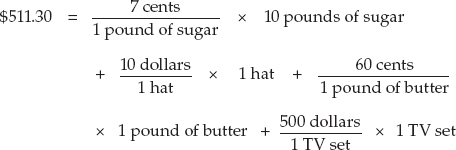
This is what Fisher does, and this is still the same trivial truism that total money spent equals total money spent. This triviality is not redeemed by referring to the quantities in the parentheses as p × Q, p′ × Q′ etc., with each p referring to a price and each Q referring to the quantity of a good, so that:
E = Total money spent = pQ + p′Q′ + p″Q″, etc. Writing the equation in this symbolic form does not add to its value.
Fisher, attempting to find the causes of the determination of the price level, has to proceed further to try to discover the determinants by means of this equation. We have already seen that, even for the individual transaction, the equation p = E/Q (price equals total money spent divided by quantity of good sold—the price of sugar equation in Fisherine symbolic form) is only a trivial truism and is erroneous when one tries to use it to analyze the determinants of price.
How much worse is Fisher’s attempt to arrive at such an equation for the whole community and to use this to arrive at the determinants of a mythical “price level”? For simplicity’s sake, let us take simply the two transactions of A and B, for the sugar and the hat. Total money spent, E, clearly equals $10.70, which of course equals total money received, pQ + p′Q′. But Fisher is looking for an equation to explain the price level; therefore he uses the concept of an “average price level,” P, and a total quantity of goods sold, T, such that E is supposed to equal PT. But the transition from the trivial truism E = Σ pQ + p′Q′... to the equation E = PT cannot be made as blithely as Fisher believes. Indeed, if we are interested in the explanation of economic life, it cannot be made at all.
For example, for the two transactions (or for the four), what is T? How can 10 pounds of sugar be added to 1 hat or to 1 pound of butter to arrive at T? Obviously, no such addition can be performed, and therefore Fisher’s holistic T, total physical quantity of goods exchanged, is a meaningless concept and cannot be used in scientific analysis. If T is a meaningless concept, then P must be also, since the two presumably vary inversely if E remains constant. And what, indeed, is P? Here, we have a whole array of prices, 7 cents a pound, $10 a hat, etc. What is the price level? Clearly, there is no price level here; there are only individual prices of specific goods.
But, here, error is likely to persist. Cannot prices in some way be “averaged” to give us a working definition of a price level? This is Fisher’s solution. Prices of the various goods are in some way averaged to arrive at P, then P = E/T and all that remains is the difficult “statistical” task of arriving at T. The concept of an average for prices is a common fallacy. It is easy to demonstrate that prices can never be averaged for different commodities; we shall use a simple average for our example, but it will be seen that the same conclusion applies to any sort of “weighted average” such as recommended by Fisher or by anyone else.
What is an average? Reflection will show that for several things to be averaged together, they must first be totaled. In order to be thus added together, the things must have some unit in common, and it must be this unit that is being added. Only similar units can be added together. Thus, if one object is 10 yards long, a second is 15 yards long, and a third 20 yards long, we may obtain an average length of 15 yards. Now, money prices are in terms of ratios of units: cents per sugar, cents per hat, cents per butter, etc. Suppose we take the first two prices:

Can these two prices be averaged in any way? Can we add 1,000 and 7 together, get 1,007 cents, and divide by something to get a price level? Obviously not. Simple algebra demonstrates that the only way to add the ratios in terms of cents (certainly there is no other unit available) is as follows:

Obviously, neither the numerator nor the denominator makes sense; the units are incommensurable.
Fisher’s more complicated concept of a weighted average, with the prices weighted by the quantities of goods sold, solves the problem of units in the numerator but not in the denominator:
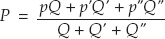
Thus, any form of averaged price-level concept involves the adding or multiplying of the quantities of completely different units of goods, such as butter, hats, sugar, etc., and is therefore meaningless and illegitimate. Even pounds of sugar and pounds of butter cannot be added together, in this equation, because they are two different goods and their valuation is completely different. And if one is tempted to use poundage as the common unit of quantity, what is the weight in pounds of a concert, or a medical or legal service?
It is evident that PT, in the total equation of exchange, is a completely fallacious concept. Whereas the equation E = pQ for an individual transaction is at least a trivial truism, although not very enlightening on causation, the equation E = PT for the whole society is a false one. Neither P nor T can be defined meaningfully, which would be necessary to giving any validity to this equation. We are left only with E = pQ + p′Q′, etc., which only gives us the useless truism, E = E.
Since the P concept is completely fallacious, it is obvious that Fisher’s use of the equation to reveal the determinants of prices is fallacious. He states that if E doubles, and T remains the same, P (the price level) must double. On the holistic level, this is not even a truism; it is false, false because neither P nor T can be meaningfully defined. All we can say is that when E doubles, E doubles. For the individual transaction, the equation is at least meaningful; if a man spends $1.40 on 10 pounds of sugar, it is obvious that the price has doubled from 7 cents to 14 cents a pound. Still, this is only a mathematical truism, which tells us little of the causal forces at work. But Fisher never attempted to use his equation to explain the determinants of individual prices; he recognized that the logical analysis of supply and demand is far superior here. He used only the holistic equation, which he felt explained the determinants of the price level, and was uniquely adapted to such an explanation. Yet the holistic equation is false, and the price level remains pure myth, an undefinable concept.36
3. Note on the Infant-Industry Argument
(date unknown)
The “infant industry” argument has been considered as the only justifiable ground for a protective tariff by many “neoclassical” economists. The substance of the argument was clearly stated by one of its most noted exponents, Professor F.W. Taussig:
The argument is that while the price of the protected article is temporarily raised by the duty, eventually it is lowered. Competition sets in... and brings a lower price in the end.... [T]his reduction in domestic price comes only with the lapse of time. At the outset the domestic producer has difficulties, and cannot meet foreign competition. In the end he learns how to produce to best advantage, and then can bring the article to market as cheaply as the foreigner, even more cheaply.37
Thus, older competitors are alleged to have historically acquired skill and capital that enable them to outcompete any new “infant” rivals. Wise protection of the government for the new firms will, in the long run, promote, rather than hinder, competition.
The troublesome question arises; if long-run prospects in the new industry are so promising, why does private enterprise, ever on the lookout for profitable investment opportunities, persistently fail to enter the new field? Such unwillingness to invest signifies that such investment would be uneconomic, i.e., would waste capital and labor that might otherwise be invested in satisfying more urgent wants of consumers.
An infant industry will be established if the superiority of the new location outweighs the economic disadvantages of abandoning already-existing, nontransferable capital goods in the older plants. If that is the case, then the new industry will compete successfully with the old without benefit of special governmental protection. If the superiorities do not balance the disadvantages, then government protection constitutes a subsidy causing a wastage of scarce factors of production. Labor and capital (including land) is wastefully expended in building new plants, when an existing plant could have been used more economically. Consumers are forced to pay a subsidy for a wastage of goods needed to serve their wants. This does not imply that if, at one time, an infant industry is unprofitable on the free market, and hence uneconomic, that such will always be the case. In many instances, the new location becomes superior after a portion of the existing capital goods in the old plants has been allowed to wear away.
Protectionist economic historians are under pains to assert that no important infant industry can be established without substantial tariff protection against entrenched foreign competition. The high degree of tariff protection in the greater part of the history of the United States, has made this preeminent industrial country a favorite “proof” of the infant-industry argument.
Ironically, it is the United States that provides the most striking illustrations of the fallaciousness of the infant-industry doctrine. Within its vast borders, the United States offers an example of one of the world’s largest free-trade areas. The frequent regional shifts in American industries provide numerous examples of birth and growth of infant industries, and decline of old, established industries. One of the most striking examples is that of the cotton textile industry.
One of America’s important industries, cotton textiles were manufactured almost exclusively in New England from 1812 to 1880. During that period, there were practically no textile plants in the cotton-growing areas of the South. In 1880, the cotton textile industry began to grow rapidly in the South, rising at a far greater rate than the industry in the “entrenched” New England area, despite absence of special protection. By 1925, half of the country’s cotton textile production occurred in the South. In the early 1920s, moreover, cotton textile production in New England began a sharp absolute decline as well, so that, at present, the South produces approximately three-fourths of the country’s cotton textiles, and the New England area less than one-fourth.38
Another striking example of a regional shift is the clothing industry, which was highly concentrated in New York City and Chicago (close to the retail markets) until the 1921 depression. At that time, under the pressure of union-maintained wage rates and work rules in the face of falling prices, the clothing industry moved with great rapidity to disperse in rural areas. Other important shifts have been the relative dispersal of steelmaking from the Pittsburgh area, the growth of coal mining in West Virginia, airplane manufacturing in California, etc.
Logically, the “infant industry” argument must apply to interlocal and regional as well as national trade, and failure to apply it to those areas is one of the reasons for the persistence of this point of view. Logically extended, the argument would imply that it is difficult or impossible for any firm to exist and grow against the competition of existing firms in the industry, wherever located. Illustrations of this growth, and of decay of old firms, however, are innumerable, particularly in the United States. That, in many instances, a firm with almost no capital can successfully outcompete a firm with existing “entrenched” capital need only be demonstrated by the case of the lowly peddler, who is legally banned or restricted at the instance of his rivals throughout the world.
Historical Appendix
It is ironic that the American cotton textile industry provides a major example of the growth of an unprotected infant industry, for the infant-industry argument first came into prominence precisely in connection with this industry. Although the infant-industry argument has been traced back to mid-seventeenth-century England,39 it was first widely used after the War of 1812 in America. During the war, when foreign trade had practically ceased, American capital turned to investment in domestic manufactures, particularly cotton textiles in New England and the Mid-Atlantic states. After 1815, these new firms had to compete with established English and East Indian competition. The protectionists first appeared in force upon the American scene, urging that the new industry must be protected in its infant stages. Mathew Carey, Philadelphia printer, brought the argument into prominence, and he exerted great influence on young Friedrich List, who was later to become the infant-industry argument’s best-known advocate.40
4. Report on Ronald Coase Lectures
July 16, 1957
Mr. Kenneth S. Templeton
Dear Ken:
The lectures by Professor Ronald H. Coase on Radio, Television, and the Press are an excellent piece of work, which I would recommend most heartily.
Lecture 1, on the general principles of freedom of the press, is a superb piece of work—crackling with wit, keen insight, and libertarian doctrine—which I would advise everyone to read in toto. Note Coase’s points:
- That under planning, government, if it cannot force labor directly, must use exhortation and condemn any public criticism as subversive
- That experts in an industry threatened with nationalization must keep silent or lose their jobs once they are nationalized—so that more and more the only criticism of the socialist program is by the remote and ill-informed
- His keen discussions of the bureaucrat
The tyranny of the U.S. Post Office is exquisitely set forth.
One thing, I must confess, gave me particularly keen pleasure: the unfrocking of Professor Jules Backman of NYU as a “right-winger.” Backman is deftly exposed for what he is: a kept economist who has no firm principles at all.
Coase’s point about government housing and its inevitable results is excellent—he shows its effect on free speech and freedom generally. He notes the de Jouvenel-Director position that intellectuals are pro-free speech and anti-free enterprise because of their vested interests.
Finally, after showing that a loss of free enterprise will also eliminate free speech, he says, “If we had to sacrifice either economic freedom or political freedom... it is in the general interest that political freedom should be abandoned rather than economic freedom. For most people it is more important to preserve the market than to preserve democracy.”
Lecture 2 is also excellent—and comes out magnificently for private property in air frequencies. Coase shows that the problems of “unrestricted competition” that are supposed to result from laissez-faire were actually the result of not granting private property rights in air channels. Unfortunately, Coase hedges a bit at the end, but this detracts little from his bold statement of basic libertarian principle. There is a hint that Coase may favor antitrust laws, but this again detracts very little from his overall position here. Once again, the wit sparkles, and leftist arguments are skewered with aplomb and dispatch.
Lecture 3 carries on Coase’s fine work with an argument for subscription TV. Coase is too harsh on the present commercial TV system when he claims that it injures consumer satisfaction. But certainly he shows conclusively the damage involved in the FCC’s prevention of freedom for subscription TV. The socialistic arguments against permitting subscription TV are skewered neatly. (If commercial TV is distortive at present, it is undoubtedly due to the suppression of subscription TV.)
Lectures 4 and 5 apply his previously developed principles to the British scene. Lecture 4 reveals the development and the philosophy of the BBC, and the personality of the guiding genius of the BBC is deftly pointed up as the prototype of the arrogant bureaucrat. The dictatorial philosophy of the BBC is very neatly demonstrated. Lecture 5 is the story of competition at last emerging in British television. A high standard of wit and insight is retained throughout. Thus, there was the anti-commercial TV argument of Miss Margery Fry, who “suggests that competition, apparently in any field, is undesirable. Miss Fry pointed out that when several ladies are competing for the attentions of a gentleman, ‘they are not likely to compete with the noblest sides of their nature’.” And we are left with the optimistic note that the new commercial TV seems to be succeeding and out-drawing the BBC.
In sum, Coase’s lectures are a splendid affair, and I am looking forward with enthusiasm to his final research on the matter. I hope that the final publication will not water down the “radical” spirit of these lectures too much.
The Ronald Coase Lectures
Professor Coase’s lectures are excellent. Essentially he repeats his previous set of lectures on the post office, radio, and television, and is squarely for private enterprise and freedom in each of these fields. He shows that the post office originated in government thought control attempts and that the government still continues to censor and suppress communications it does not like.
He shows how both the high-cost and the low-cost consumers of postal service suffer from the uniform rate, which functions as a subsidy to the high-cost areas. Coase realizes that government control and censorship of radio and TV is as indefensible as government control of the press. The fallacy behind the argument that government must allocate limited radio wave frequencies is exploded. And Coase is particularly fine in making clear that private individuals should be able to own wave-frequencies in the same absolute sense as they can own land.
He defends the informative and even creative functions of advertising, and attacks any government regulation in this field, ending this section with a caustic statement that political propaganda is far worse, and consistently so, than any business propaganda in advertising. Coase has a keen analysis of why subscription TV would be preferable ideally to present-day TV, but the real proof would have to be in the marketability: if the present setup is more economical, then it is the most preferable. Coase, unfortunately, fails to see this adequately. Coaseh as good defenses of subscription TV against the leftists who complain that TV viewing would no longer be free.
Coase’s other errors: he concedes that advertising by business can be “wasteful,” if not informative or in error on estimating profits; he overstresses the problems involved in allocating owned frequencies to broadcasters; he worries about the international problems, without considering that, since frequencies are regional and waves lose their power after a certain range, there is no reason why absolute ownership over frequencies cannot be granted over their possible range of broadcast, or, rather over the range at which the first user is actually making the broadcast.
There are a lot of merits in the summary of Coase’s first, general lecture on government and the economy: the dangers to liberty of government planning, as well as to economic freedom; the inevitable moral corruption and self-righteousness of government officials—and of left-wing intellectuals.
Yet despite all this, at the beginning of his lectures Coase reveals grave collectivist deviations in his thinking. He admits frankly that “he was not opposed to State intervention in the economic “system.” A modern free-enterprise system, Coase believes, requires a highly developed legal system to settle contracts and disputes. Fine, if he defines it properly, but he then goes further: to call a corporation a “creature of law,” which it is not de facto, and to say, wrongly, that “individuals, left to themselves, would act without proper regard for the effects of their actions on others,” and this includes not only violence, but “a wide variety of harmful acts” which the government must punish, “including those that have the effect of making the economic system less competitive.” But since the State can and has defined almost any act as reducing competition, this opens the gates for tyranny, or, as Coase admits, “a very considerable regulation of business by the State.”
5. Review of Lawrence Abbott, Quality and Competition and Anthony Scott, Natural Resources: The Economics of Conservation
July 21, 1958
Mr. Kenneth S. Templeton
William Volker Fund
Dear Ken:
Lawrence Abbott’s Quality and Competition41 and Anthony Scott’s Natural Resources: The Economics of Conservation42 are two of the best economics works I have read in many a year. They are both delightful, and it will be a great day if every book you sent me were of comparable quality.
Abbott’s book is a masterpiece and displays fine theoretical acumen coupled with ability to get down to essentials and avoid all the mathematical mumbo-jumbo—a rarity these days. Abbott attacks neoclassical competition theory in such a way as to bring him very close to the Austrian position without knowing it. Abbott shows that quality competition is not only not a poor substitute for price competition, as modern theorists proclaim, but an essential to what he calls “complete competition,” which combines price and quality competition, so that it is really a deficiency when quality competition is absent. He also follows Hayek and J.M. Clark in stressing competition as a dynamic process and not as a set of static equilibrium conditions. Further, he takes the extremely good step of stressing that the only real block to competition is restraint of the market, rather than “too few firms,” “too large a share of the market,” etc.
He stresses the value for competition of brand names, advertising (to satisfy consumer wants more fully and give them more information), diversity of product. In short, his emphasis is not on some arbitrary concept of “pure” or “perfect” competition, as in the case of most modern theorists (and where diversity, advertising, etc. are considered “monopolistic”), but on free competition, on the freedom of entry into a field or industry and the absence of institutional restraints. Unfortunately, Abbott considers voluntary cartels restraints along with government monopolization and interference, but his attitude is so infinitely better than almost all of his colleagues in the field that there is no point of caviling here.
There are many gems scattered throughout the book. Completely original is Abbott’s ingenious definition of quality competition. Before this, economists, including myself, have thought that theory need not account specially for quality because a different quality good for the same price is equivalent to a different price for the same good. A different quality would, further, be simply treated as a different good for most purposes, as the same good for others. Up till now, no one has been able to distinguish theoretically between a different quality and a different good. Abbott furnishes an excellent distinction based upon the thesis that the same good satisfies the same want, so that there can be quality variations within the same want. This is consonant with the Austrian tradition and is an innovation within it. Further, as Abbott points out, using this stress on class of wants, he can show (in the Austrian tradition) that a greater variety of goods or an increasing standard of living fulfills more wants, or fulfills them with greater precision and accuracy than before. He also distinguishes usefully between “horizontal,” “vertical,” and “innovatory” differences in quality (a “vertical” difference is one that would be agreed upon by everyone—a soap that cleans better, etc.—and a “horizontal” caters to different tastes: different colored ties, etc.)
I am not prepared to say how fruitful Abbott’s distinction will turn out to be, particularly in the development of economic theory, where my hunch is that current Austrianism will do well enough without tacking on Abbott’s “quality models” to the price models of current theory. But this is no matter; the important parts of the book are not the attempt to build up a new equilibrium theory, but in his excellent insights into the nature of competition, his new approach to quality, and his approach to Austrianism in the course of his attack on current fallacies. His attacks on monopolistic and pure competition theory are excellent. His discussion of innovation theory is better than Schumpeter’s. All in all, this is a fine book, and the author is definitely worth pursuing.
Anthony Scott’s book also deserves the warmest praise. Here is a great book on conservation, theoretical and yet covering the crucial factual details for each important country and natural resource. Here is a definitive blast, at long last, at the conservation hokum. Scott shows that there need be no worries, on the free market, about excess depletion, because any resource will be preserved so that its capital value will be taken into consideration, and this will be the capitalized value of expected future returns. Nobody ravages a forest if he also owns that forest and is interested in its capital value. The key then, as Scott sees, is that private ownership should rule in natural resources, for if the resource is unowned, then surely it will be ravaged.
Scott also sees that many current cases of “ravaging” are due to the fact that there is no “unitization” of the resource; i.e., the resource should be owned as a technological unit. This implies first-user ownership, say, of a whole-unit oil pool or fishery. Numerous anticonservation arguments are included. Scott shows that forests should be privately owned; wildlife should be converted into private property, etc.
In practical politics, Scott hints that he would go very slowly, etc., but the whole brunt of his argument really cuts in our favor, even though the volume has all the wariness of conclusion (and the bad writing) of a PhD thesis.
Scott, as the outstanding anticonservationist that I know of, is definitely worth investigating.
6. On the Definition of Money
April 1959
The recent excellent articles by Gordon W. McKinley and Donald Shelby highlight the importance of a still unresolved problem: the proper definition of money.43 When McKinley likened the argument that savings deposits (in contrast to demand deposits) are only money “substitutes” to the old doctrine that demand deposits are themselves substitutes rather than true money, he touched briefly on a highly important point in the elusive problem of defining “money.” Nowadays, it is simply and casually accepted by all economists that demand deposits are part—and the largest part—of the money supply. Yet the reasons for this acceptance have been forgotten and, in the process, important insights into money have been foregone.
For it should not be forgotten that demand deposits are only money so long as the bank is considered safe; let the bank be thought in imminent danger of failure, and a bank run develop, and then its demand deposits will no longer be readily accepted at par, and will no longer function as part of the money supply. This truth is obscured nowadays because of the public faith that the FDIC will protect any bank from runs; but it was well known before 1933, when bank runs were often heavy and even endemic. Furthermore, in the pre-Civil War days when all banks printed their own notes, the notes often circulated at great discounts. This was especially true beyond the home areas, where people did not have full confidence in the bank’s ability to redeem.
This dependence of the moneyness of demand deposits on public confidence is not a function of the gold standard; it is true today as well (or would be in the absence of the FDIC). The point is that whether the ultimate standard—the ultimate money—is gold or paper, demand deposits of commercial banks are not that standard; they are only redeemable in standard cash. In the strict and narrow sense, only the ultimate money, that which is not redeemable in something else, is truly money.
To confine the term “money” thus to legal tender would be a cogent definition, but not a very useful one. It would not be useful because such money-substitutes as demand deposits play the role of money in the economic system: they act as would an increase in money in their effects on the economy. They do so precisely because people believe that they do stand for money, that they are redeemable in cash. As long as people continue to believe this, they are willing to exchange demand deposits, or to hold them in their cash balances, as absolutely equivalent to money. Both are equivalent “dollars.” Thus, demand deposits may be considered, so long as they are thus equivalent, as part of “money” in the broader sense.
But what of such assets as savings deposits? Those who would confine money-in-the-broader-sense to demand deposits assert that the two are uniquely different: that the latter are used as media of exchange while savings deposits are not. But this difference, while important in many respects, is not at all decisive here. For here we have only a difference in the form in which money is kept. Suppose, for example, that through some cultural quirk, everyone in the country decided that they would not use their five-dollar bills in exchange. They would only use their ten- and one-dollar bills, and keep their cash balances in fives. As a result, the five-dollar bills would tend to circulate far more slowly than the other bills. Now suppose that, when a man wants to reduce his cash balance, he may not spend his five-dollar bill directly; he goes to a bank and exchanges it for five one-dollar bills, which he proceeds to trade. In this hypothetical situation, the status of the five-dollar bill would be exactly the same as the savings deposit today. The five-dollar bill—like the savings deposit—would never be used as a direct medium of exchange; and, again like the savings deposit, it could only be used as a medium at one remove: the holder must go to a bank and exchange it for that type of money which will serve as a medium. Yet would anyone say that the five-dollar bill is not part of the money supply? But if it is, we must also say that the savings deposit is likewise part of any broader definition of money that includes demand deposits.
In short, a savings deposit is money of a different form than demand deposits. It circulates more slowly, and more of people’s long-term cash balances are held in this form; and yet, whenever the holder wishes to use it as a medium, he simply goes to his bank and obtains the demand deposit. Or, indeed, he may just as readily obtain cash directly, as he could with a demand deposit.
Those who stress the use of demand deposits as direct media forget why they are media in the first place: because they are generally regarded as redeemable at par for cash—the original medium. But then are not any assets, likewise redeemable at par, also part of the money supply? If so, then savings deposits, both in commercial and savings banks, must be considered as part of the money supply because they are redeemable at par. And, furthermore, so must we consider savings-and-loan shares, which the savings-and-loan association promises to redeem at par.44 But McKinley and other writers who have argued persuasively for the inclusion of savings deposits and savings-and-loan shares in money have neglected other assets: notably, government savings bonds and the cash-surrender values of life insurance. Government savings bonds, with their fixed guarantee of redeemability in cash, certainly are just as much money as savings deposits. To be precise, of the nonmarketable Treasury liabilities, savings bonds, savings notes, and Series A investment bonds (redeemable in cash whereas Series B bonds are not), must be treated as part of the money supply.45 Marketable securities, like all other assets, are exchangeable for money, but only at varying and nonfixed rates, and are therefore not money but “goods.” And this is true even for short-term government bonds, which are highly liquid and can function as “near-money” substitutes for part of a person’s cash balance; for they are only exchangeable for money at the market risk. There is no fixed, guaranteed relationship, and therefore they cannot be perfect substitutes for money, i.e., money itself.
It is also a radical step to include cash surrender values of life insurance policies as part of the money supply. And yet, they too are balances that may be redeemed at any time, by promise of the life insurance company, that the policyholder cancels his policy. Like savings deposits, savings and loan shares, and savings bonds, they are considered by individuals as cash, and are valued as assets firmly at their cash value.46 If savings deposits are accepted as part of the money supply, even though not directly used as media, then there is no cogent criterion for keeping out savings bonds and cash surrender values.47 Yet those many economists who include savings deposits in the money supply have not yet pushed their logic to its final conclusion.48
Much has been made of the legal permission to require notice for redeeming savings deposits and the other assets mentioned above. Yet everyone recognizes the economic fact that this provision is merely a dead letter; if notices were ever enforced, the bank would soon fail, as the enforcement would be considered by all as a sign of impending insolvency.49 And the permitted notice requirements for the other assets are much shorter than the legal thirty days for savings deposits: life insurance surrender values and Series E savings bonds being practically immediate.
Neither is it permissible to distinguish between demand deposits and the other assets on the grounds that demand deposits do not pay interest. In the first place, commercial banks did pay interest on demand deposits until 1933, when the practice was outlawed.50 And secondly, life insurance policies also do not obtain interest on the cash surrender values for the policyholder.
Thus, economists have a choice: they may either adopt the coherent but inexpedient definition of “money” as the narrow supply of legal tender; or, if they broaden their definition to include perfect money-substitutes, they should proceed onward to include all such assets, as outlined above.
Even if we adopt the latter course, however, we must still recognize the particularly strategic role of demand deposits as the direct medium. Here the analyses by McKinley and Shelby of the inverted money pyramids come into play. While savings banks, life insurance companies, etc. add to the money supply, they also keep the great bulk of their reserves in demand deposits rather than in cash, precisely because demand deposits are in such preponderant use as a direct medium. When we add up the total money supply outstanding in the hands of the public, then, we must not only deduct the cash reserves of the commercial banks, we must also deduct the demand-deposit reserves of these other money creators.51 And because these institutions keep their reserves in demand deposits, the Federal Reserve System, as the above authors have pointed out, exerts much greater control over them than purely legal considerations would lead us to believe.
7. Review of John Chamberlain, The Roots of Capitalism
July 5, 1959
Dr. Ivan R. Bierly
William Volker Fund
Dear Ivan:
John Chamberlain’s The Roots of Capitalism52 is divisible into two parts: the prologue and chapters 1–3, which deal with political philosophy and its history, and the remainder (chapters 4–12 and the epilogue), which deal with economics. When I had finished reading the first three chapters, I thought that this was going to be one of the best introductions to libertarianism and capitalism—to the whole complex of history, political philosophy, and economics that makes up the libertarian picture—that had ever been published. When I finished reading the entire book, I realized that this book essentially fails. Since the excellent political chapters constitute only one-fourth of the book, they cannot offset the thundering failure of John’s economic chapters, which are the meat of the book.53
First, as to the beginning chapters, they are an excellent guide to the historical and political backgrounds of libertarianism and capitalism. One particularly fine thing about them is that they approach history in a truly libertarian manner: it is anti-George III, pro-Leveller, pro-Locke, pro-smuggling in England, etc. This is particularly welcome because this sort of historiographic attitude has been unfortunately passé on the Right for quite some time—especially ever since Russell Kirk has befogged the political philosophy of our time. The current fashion has been to be pro-Metternich, pro-Tory, anti-Leveller, and pro-Stuart, etc., and the prevalence of this fashion makes John’s approach all the more refreshing.
Another excellent quality is John’s grounding himself on natural rights of the individual, on natural and common law, on property right, and on the preeminent importance of man’s freedom of choice. And John rejects the current fashionable deprecation of the Magna Carta, and rightly defends John Locke’s libertarian credentials against the interpretations of Bertrand de Jouvenel and Willmoore Kendall.
Some of the other good points in these first chapters: they show the planning propensities of George III, the fact that the road network built in eighteenth-century England was privately owned, the libertarian implications of the Ten Commandments, and a brief slap at the Sixteenth Amendment.
In these first chapters, there are just two important errors made by Chamberlain. One is in overly excusing the statist restrictions and dictations of the feudal system on the ground that they were somehow necessary because the “Christian Order” was in a “state of siege” against the heathens without: this is the old fallacy of using a vague foreign threat as an excuse for all manner of domestic tyranny. The second is Chamberlain’s gratuitous and jejune use of Locke to try to justify a policy of outlawing the Communist Party. Not only is this a vulgar use of history, it is also a whopping non sequitur: for if Locke’s constitution did not grant any group the “liberty of attempting to coerce others to its beliefs,” this does not simply mean outlawing Communists, but, presumably, any socialist group, even if “democratic.”
But now for the bulk of the book. What, precisely, is the failure of Chamberlain’s economics? I think, basically and profoundly, it is a failure to understand economics and economic theory. And since the bulk of this book deals with economics and economic theory, this failure is disastrous for the impact of the book as a whole.
Before getting to the content of these chapters, a word should be said about the organization. Chamberlain is, of course, a superb stylist, and this is true in everything he writes. But the organization of a book reflects one’s understanding of the subject matter and is not a question of style; and here, already, Chamberlain is poor.
The organization of the economic chapters is slipshod. After discussing contract, Chamberlain suddenly talks of unionism, and then he goes back to Ricardo and Malthus. Next, suddenly, Chamberlain devotes a whole chapter of his book to the rather unimportant Robert Owen, and then another whole chapter to the also unimportant Francis Amasa Walker. Suddenly, we find ourselves dealing with Henry Ford, and then we are up discussing the modern question of monopolistic competition (in the only really good economic chapter, by the way), then back to unions and on to Keynesianism. And that’s it!
The allocation of space is inchoate and peculiar. There is not one word, for example, about the great flowering of American capitalism in the late nineteenth century, about the whole problem of the robber barons. Not one word, while a couple of chapters are devoted to Robert Owen and Francis Amasa Walker. There is almost no mention of Karl Marx, which is almost as incredible, and none of Veblen until the epilogue, when Veblen suddenly pops up, as if by afterthought.
This extremely poor organization reflects Chamberlain’s lack of understanding of economics, as we shall now see. The basic problem, I believe, is this: Chamberlain absolutely fails to understand the nature and the importance of economic law. To Chamberlain, all economic science—and not just the Ricardians whom Chamberlain criticizes at excessive length—is “static,” “gloomy,” repressive. Chamberlain somehow thinks of all economics as gloomy and European, and thinks of the achievement of American capitalism as “refuting these gloomy laws by the dynamic technological breakthroughs of our practical men.” Now this is absolute nonsense, and yet again and again Chamberlain returns to the theme of scoffing at the “iron” laws of economists, and of the saga of how American technology and mass production was supposed to have shown the world how to conquer these laws. Actually, the two are unrelated; economic laws are not “refuted” by technological improvement or capitalist development.
It is because of this flouting of economics that Chamberlain devotes so much time to Owen and Henry Ford; to Chamberlain, they somehow founded modern capitalism because they showed that what employers should do is to give their employees high wages; this will increase their efficiency, or as with Robert Owen, give them welfare programs and do the same. Now, this, as a general principle, is nonsense; the payment of wages is not up to the employers, who are guided by market laws and pay market wages. Any welfare payment of the Owen variety simply comes out of the wage the employer would have paid; which means the worker gets less money and more “medical benefits” from his employer. And to go further and to imply, as Chamberlain does, that the reason European capitalism never developed is because the other employers were not as humanitarian and farsighted as Owen, is pure mythology. For the same reason, Chamberlain overvalues and distorts Henry Ford’s achievement; Henry Ford was not the founder of American capitalism or of some great new economic principle.
Chamberlain’s paeans to Robert Owen as manufacturer are sheer romantic absurdity and display profound ignorance of economics: Owen, he said, gave “tangible proof that money could be made... without grinding the faces of the poor”—obviously implying that all the other manufacturers of the day were so grinding; Owen “went into the coal business to keep his employees from being gouged on fuel” (gouged by whom?); “he offered medical attention to all”; Owen knew—again in contrast to other manufacturers—“that there was no long-term profit in the sheer exploitation of one’s help.” Owen’s good gray father-in-law was one of the first industrialists who “chose to flout... the ‘iron law of wages’.” Owen anticipated “modern ‘consumer capitalism’”—whatever that is supposed to mean: when didn’t a market economy rest on consumer demands?
One of the great “iron” bogeys of Chamberlain, which he deals with almost continually in this book, is the terrible bleak “wages-fund theory.” Hence, his enthusiasm, expressed at length, for Henry Ford, who like Owen “walked boldly up to the ghost [the wages-fund theory] and proved its insubstantiality.”
“It was Henry Ford’s decision to pay $5 a day without raising the price of his car that proved the wage fund and the other preconceptions of British economics had little to do with industrial realities in a dynamic world.” Chamberlain doesn’t seem to realize that a businessman’s actions of this sort cannot refute an economic theory like the wages-fund theory; they are two orders of discourse.
Chamberlain fails utterly to realize that the whole point of economics rests on an analysis of scarcity: the fact that means are scarce (and always will be), in relation to human ends. In his bog of fallacy, Chamberlain says this: “Always, before Eli Whitney and Frederick Taylor and Henry Ford, the world struggled with scarcity. And when economics ceased to be wholly a matter of the deployment of scarce means...” it is now, because of Whitney and Taylor and Ford, based on “contrived fecundity” rather than “contrived scarcity.” Rarely have more critical fallacies been packed into so short a space: economics has, still does, and will continue to be wholly concerned with “scarcity,” and so will the world, notwithstanding Whitney, Taylor, Ford, or whatever other heroes Chamberlain dredges up. Here again, we see Chamberlain’s fatal lack of understanding of what economic science is all about, and his naïve belief that economic principles can somehow be refuted by some dynamic new manufacturer.
Another example of Chamberlain’s failure at economics is his discussion of rent theory as if it were somehow up to the landlord how much rent he will charge, and that rents depend solely on the landlord’s humanitarian or miserly traits. That there is a market and market prices for rents, and therefore that there are economic principles determining these prices, is completely overlooked.
It will be noted, incidentally, that while Chamberlain is of course severe on Robert Owen’s later communal utopias, he says nothing of his hero Henry Ford’s persistent penchant for cranky funny-money.
For quite a while I was puzzled about the problem of why Chamberlain singles out, among all the economists, only the rather obscure and not too important Francis Amasa Walker for praise—indeed, for rhapsodic eulogy. He mentions a few times the Austrians J.B. Clark and Ludwig von Mises, but only very perfunctorily and ritualistically. Almost his entire enthusiasm for economists is poured out for Walker. But, in the context of the book as a whole, the reason seems clear: Walker was the first American to be critical of the wages-fund theory. He was also the first to stress entrepreneurship, but it is clear that the paeans are referred mainly to his attack on the wages-fund theory.
And the grandiloquent title to this chapter, “Prometheus Unbound,” is to be explained as part of Chamberlain’s eternal war against “iron” economic laws, for Walker was supposed to have destroyed the hated (by Chamberlain) wages-fund theory. Actually, the singling out of Francis Amasa Walker of all the economists for lengthy eulogizing is impermissible. Walker’s theory of entrepreneurship and profit was interesting, but hardly deserves mention when the author omits the equally important, or better, theories of Böhm-Bawerk, J.B. Clark, Frank Knight, and Ludwig von Mises, or, for that matter, of the German von Mangoldt.
We come now to Chamberlain’s bête noire, the wages-fund theory. It would come as an enormous shock to John, I’m afraid, but actually the wages theory was substantially correct, despite its crudities. Walker and Chamberlain to the contrary, it is not refuted by the productivity theory of wages—again, the two explain different things. The wages-fund theory explains the aggregate amount of money wages at any given time. It is correct that, at any given time, there is a certain fixed capital fund, determined by saving and investment, from which employers can pay wages, and the old classical “iron” law that union pressure for wage increase can only reduce the amount of wages paid to workers elsewhere in the economy, is also substantially correct.
The productivity theory of wages explains, in the first place, each individual’s wage, rather than the wage level in general; and, second, it explains his real wage, how much output the worker will receive for his wages. The wages-fund theory explains the money wage received by the average worker. Actually, the wages-fund theory is a crude one, it should be called a wage-and-rent fund, etc., but the essence of it is correct, as Böhm-Bawerk and Wicksell point out. Needless to say, Böhm-Bawerk is hardly mentioned in this volume, and Wicksell not at all.
Furthermore, Walker’s statement of wage theory was a highly crude one; he did not really have a good statement of marginal productivity theory; that was left, in America, to J.B. Clark.
And finally, one would never know from Chamberlain’s rhapsodic discussion that Walker, while quite conservative, was a bitter opponent of laissez-faire.
In the light of all this, it seems to me sheer presumption for Chamberlain to criticize textbooks in the history of economic thought for underrating Francis Amasa Walker. Such a charge is hardly viable coming from someone with Chamberlain’s lack of economic knowledge.
Chamberlain’s other leading error in economic theory is his critique of Keynesianism, which occupies the last chapter of the work. This is a very weak, fumbling critique, giving away a large part of the case, making hardly any dent in the Keynesian structure. Chamberlain concedes a good bit of the Keynesian case: that inflation is really just as good as a cut in wages, economically, which is not true; that liquidity preference and hoarding really may be a generator of depression, which is untrue; and that a failure of consumer demand may be a cause of depression, also untrue.
Chamberlain also has the colossal effrontery to try to modify a Mises critique of Keynes, saying that when Mises says that Keynes is dead wrong, this is true—but only for the long run. But, Chamberlain warns, Keynes may be right for the short run, and the long run may even be Keynes’s by a series of cumulative short-run troubles. Here again, Chamberlain is wrong, period, and it seems to me effrontery for someone with as little grasp of economic theory as Chamberlain has to presume to correct an economist like Mises.
At the end, Chamberlain simply throws up his hands and admits that he doesn’t know whether Keynes is right or wrong economically, but he is certainly wrong politically, because the government will never check inflation in a boom enough to make “cyclical compensatory spending” work.
Thus, Chamberlain: “an honest commentator must admit that there are analytical phases of the General Theory that are hard to laugh off. Given enough cumulative short-term failures of Say’s Law,” etc. And: “The whole of Keynes [sic] General Theory remains in the realm of logical deduction from premises that may or may not be true.” And: “From the standpoint of pure economics his analyses of the failure of demand in a depression era... do have a general correspondence with the ‘feel’ of the facts.”
Enough of Chamberlain’s utter failure as an economist. We now turn to several grave politico-economic errors and biases displayed by Chamberlain in this book. The worst and most persistent is on trade unions. Again and again, Chamberlain identifies the only aspect of trade unions that he deems “coercive” as the closed shop. The closed shop, he maintains, interferes with a worker’s “freedom of choice.”
Actually, while we may abhor the closed shop, it does not interfere with a worker’s freedom of choice, unless we assume, as Chamberlain tacitly does, that any loss of a job is “coercion,” or “interference with freedom.” Actually, the important question is the employer’s freedom of choice, for he is the fellow who is paying out his money for certain tasks, and therefore he should have the right to set whatever terms of employment he wishes; he should, therefore, have the right to insist on workers belonging to a closed shop if he should be perhaps foolish enough to want to.
The critical problems about unions are (a) their habitual use of violence, (b) their nature as parasitic organizations, and (c) their monopoly privileging through the Wagner Act. Yet, oddly enough, Chamberlain not once mentions union penchants for violence and not once mentions such grants to unions of monopoly privileges as the Wagner Act.
Furthermore, he attacks the old-style management opposition to all unionism. This opposition was actually cogent and proper, because unions can only be trouble-making, production-lowering organizations. But instead, Chamberlain bitterly criticizes the “old habit of union baiting,” which Chamberlain wrongly considers “interference with workers’ freedom of contract.” He criticizes employers calling federal troops to break strikes, without once considering why such troops were even considered necessary: no troops ever forced any strikers to work! So what did they do? Obviously, their only function was to protect employer property and personnel, to protect strikebreakers from the characteristic goon-squad violence of organized labor. The troops were, then, perfectly called for. Yet Chamberlain’s reference to violence in labor disputes is to attack management!
Because British labor unions have never stressed the closed shop, Chamberlain’s exclusive emphasis on the closed shop as the only union evil actually leads him to praise the British unions, the mainstay of the British Labour Party, as being somehow conservative and devoted to collective bargaining contracts. (Actually, Chamberlain also does not see that collective bargaining “contracts” are not true contracts in the libertarian-law sense, for (1) they do not specifically agree to transfer property—just to set a certain wage or terms should any property be transferred; and (2) the workers’ end of the “contract” is invalid, anyway, because workers cannot be forced to keep working against their will.) Chamberlain’s weakness for labor unions also leads him to say that Philip Murray was tending away from left-wing unionism.
Thus, Chamberlain’s outrageously weak attitude toward unionism leads him to make such statements as the following:
the English union man has always returned to his Ernie Bevin... the English worker has lived in the tradition of John Locke.... Possibly the willingness to compromise that has characterized English and Swedish big ownership has enabled labor in the two enlightened North European countries to have faith in the possibilities of the contractual way.
This in two countries that have gone the farthest down the road to welfare socialism and Labour Party activity! And the comparison between Ernie Bevin and John Locke is peculiarly inapt, to say the least.
Chamberlain also wrongly stigmatizes the “yellow dog” contract as “coercion,” and equivalent to a closed shop. But perhaps Chamberlain’s worst and most outrageous statement on the union question is the following:
If management should return to the old habit of union baiting, which amounts to an attempted interference with a worker’s freedom of contract, or if it refuses to bargain with open unions on an above-board basis, then we shall get the universal closed shop or a condition of chaos and industrial slavery....
In either case the state must walk in.... In the case of chaos and industrial slavery the state must intervene to guarantee social security to the underdog. (It must go far beyond such things as minimum wage laws and forced unemployment payments, which are themselves minor and absorbable infringements of free contract.)
Aside from the fact that minimum wage laws and unemployment insurance are not simply minor and absorbable, Chamberlain has gone to the length of pure leftist demagogy here by characterizing a system where employers determinedly refuse to have anything to do with unions as “chaos and industrial slavery,” requiring massive state intervention and guarantees. This sort of statement in any book would be cause for chastisement—but in a book by a purported libertarian?
There are other important political aberrations and biases in the book. Chamberlain comes out flatly in favor of the SEC; he also declares that railroad rebates to oil companies, etc., were political. He says that there must be a minimum amount of interference of political power with social power and uses as his bolstering argument the hoary old fallacy about the necessity for traffic regulations, which Mises so brilliantly exploded in Human Action (anyone who owns the roads must regulate them, so if private enterprise owned the roads, etc.).
He also looks too benignly toward consumer cooperatives, at one point saying that they may be called for “to protect living standards.” This is nonsense; a consumer cooperative (1) is an inefficient form of business enterprise; and (2) the actual movement has boasted of trying to replace capitalist enterprise. None of these salient points are mentioned by Chamberlain.
Chamberlain’s discussion of the problem of monopoly, competition, and “monopolistic competition” in chapters 9 and also 10 are the only really valuable parts of the economic sections of the book. There is much excellent material here. And yet, while Chamberlain says that “in the days of the classical economists ‘monopoly’ had a clear and simple reference: it was what happened when the state gave an individual or a trading company the sole right to exploit a given market. Monopoly was a grant of privilege by government,” he inconsistently, in several places, praises the Sherman Act as a combater of monopoly. He also misconceives the common law, by repeating the old error that the Sherman Act “elevated the common-law tradition to federal dignity”—a myth exploded five years ago by William Letwin. And this flowery rapture: “the Sherman Antitrust Act continues to work its overall watchdog magic.” Magic, indeed!
Turning to the concrete political problems of our day, what does Chamberlain approve? He overly praises the West German recovery and its neoliberalism, for while giving the West Germans their just due, he also says that the “government has still been able... to behave in a generally humane way.” Also, these resurgent “true liberals” of Western Europe are hardly “true” but much diluted.
Finally, in his proposal as to what to do next in America, Chamberlain actually comes out and says that a gradual dismantling of the welfare state would be better than none at all. It is perhaps true that a gradual dismantling would be better than no dismantling at all, but to say that it is better than rapid dismantling is to give away a good part of the case against the welfare state, and to concede short-run practicality to the collectivists as he halfway conceded it to Keynes. In actual fact, libertarianism, laissez-faire, is more practical in the short as well as in the long run. And yet, Chamberlain concludes by first praising the Committee for Economic Development plan for the federal government to compensate marginal farmers out of tax funds while they are learning new trades, and goes on: “Some of them [methods of returning to voluntary action] would require the temporary continuation of government aid”; otherwise, as he indicated in another place, rapid removal is “brutal.” (Contrast this attitude with an excellent leaflet once written by Leonard E. Read: I’d Push the Button.)
I think I have demonstrated why John Chamberlain’s book must be set down as a flat failure, despite the good intentions of the author, and despite some valuable material. (If it be perhaps objected that not every writer can be expected to be a knowledgeable economist, the answer of course is that nobody forces him to write about economic problems.) It is a token of the intellectual failure of our time that the failure of this book will not be made known in any of our “right-wing” journals of opinion, for apparently it is felt that if an author is a certified right-winger and member of the club, then his book receives an automatic rave review by some other club member—in many cases, a reviewer who hardly needs to read the book before grinding out his formula review. (Left-wing reviewers will not assess the book properly either, if they discuss it at all, for they will simply attack it as too procapitalist.)
While this situation is, I suppose, understandable among a Right that considers itself in perpetual battle and therefore never to criticize one of “their own” in public, this is a most unfortunate situation. For not only does it betray the truth, which is the ultimate value for which the Right is supposed to be battling, but it is not even “practical” in the long run. A knowledgeable and open-minded economist who reads, let us say, a typical rave review of the Chamberlain book in some right-wing journal, or by some rightist, and then proceeds to read the book and discover its true lack of worth, will, after that, have little respect for either the reviewer or the magazine.
8. Letter on Henry Hazlitt and Keynes
July 18, 1959
Dr. Ivan R. Bierly
William Volker Fund
Dear Ivan:
In a forthcoming review of Henry Hazlitt’s The Failure of the “New Economics” in National Review, I write that this is the best book on economics to be published since Mises’s Human Action, ten years ago. I do not think this an exaggeration. Exempting reprinted books, such as Mises’s Theory of Money and Credit or the Böhm-Bawerk volumes, what book can compete with this one? (Mises’s Theory and History and Hayek’s Counter-Revolution of Science are more philosophical or epistemological than straight economics.) Abbott’s Quality and Competition, Bauer’s two books on underdeveloped countries (that does not include Bauer and Yamey’s book) all are impressive, but they cannot come close to Hazlitt for the accolade.
Frankly, I didn’t realize that Henry had it in him. I always knew that he was an excellent journalist, and that he faithfully applied Misesian principles to his journalistic work, a difficult task in itself. And I knew that his Great Idea [Time Will Run Back] was a highly underrated work, and because cast in novel form, didn’t get the recognition that its acute discussion of economic principles deserved. Still, I did not realize that Henry would be so fine on the highest scholarly levels, as he has here shown himself to be. This is, in short, an excellent work, at long last providing us with a minute, bit-by-bit, and yet also overall critique and demolition of the Keynesian heresy. There is no hesitation here, no namby-pamby ritualism about how “Keynes, despite his many errors, really contributed a great deal, etc.” Keynes contributed only mischief, fallacy, and obfuscation, and Hazlitt is courageous enough to call a spade a spade.
This was a grueling but vitally important job, this cleansing of the Augean stables, and Hazlitt deserves the highest commendation for the job he has done. There are few other economists who really could have done it, for to do it requires thorough grounding and thorough knowledge in Misesian principles, and this Hazlitt has and uses. No Chicago economist, for example, could have done this job adequately, sharing, as the Chicagoans do, many of the Keynesian errors and lacking the “Austrian” insights.
I went through this book with great and particular care, with the General Theory at my elbow, looking for flaws, but could find none. Oh, there were various places where I would have preferred further elaborations or differences in emphases, but this is true of any reader about any book. Hazlitt differs from the Misesian pure time-preference theory of interest to some extent, although by the end of his discussion he has ingeniously worked around to agreeing pretty much with Mises there, and he tends to dilute Austrianism with Walrasian concepts, but these were so inconsequential in this book that we can definitely say that there are no important errors in the work. In contrast, there are a great many virtues overall, and also minute critiques of the various aspects of the Keynesian system and of its political implications, a dissection of the fallacies of mathematical economics, etc.
Some may say (and I understand that Buchanan said something like this in his review) that an analysis of Keynesianism is not important nowadays. It is true that Keynesianism is not seemingly a hot issue today, although even here Hazlitt shows how Keynesianism is at the root of the current national income and “economics of growth” analyses. But, on the other hand, the real reason why Keynesianism is not a hot issue is because it has been so thoroughly accepted, especially by the so-called “conservative” side in the political debate. It is unquestioned by any prominent conservative or business magazine: let the first sign of depression appear on the horizon, and the sure way to cure it is to have government deficit spending and inflation. Nobody believes in a balanced budget during depressed times anymore. This is the measure of the mass and intellectual acceptance of Keynesianism. And, as a matter of fact, the Chicago economists like Buchanan have the very neo-Keynesian virus in them. So let it never be said that Henry’s book is not important or timely. It should be read by every economist or everyone interested in fundamental economic problems. It is worthy of National Book Foundation or any other form of distribution.
I worked 20 hours on this book—a rather long time relative to others, but, as I say, I wanted to exercise particular care with this one.
All the best.
9. Business Advocacy of Government Intervention
November 1959
To: Robbie
From: Murray
The NRA, with its proposal for a virtual national compulsory cartelization of American industry, was perhaps the most ambitious plan in American history—certainly the most ambitious in peacetime—to end the competitive system and to substitute for it a giant system of regulated and enforced monopolies or cartels, somewhat similar to fascism. It had its inception in September of 1931, when Gerard Swope, head of General Electric, unveiled his Swope Plan in a speech before the National Electrical Manufacturers Association. Every industry would be mobilized into trade associations, under federal control, which would regulate and stabilize prices and production, and prescribe codes of trade practices. Overall, these associations and the federal government, aided by a joint administration of management and employees representing the nation’s industry, would “coordinate production and consumption.” Swope had first unveiled his plan, six months before, to his colleague and fellow “enlightened” businessman, Owen D. Young, chairman of General Electric, who had heartily approved. The fellow industrialists, softened up by Swope and Young beforehand, heartily approved the plan, which became front-page news all over the country.
One of the most enthusiastic supporters of the Swope Plan was Henry I. Harriman, head of the New England Power Company, and at this time president of the U.S. Chamber of Commerce. In his report on the Swope and similar plans, as head of the chamber’s Committee on the Continuity of Business and Employment, Harriman wrote, “We have left the period of extreme individualism.... Business prosperity and employment will be best maintained by an intelligently planned business structure.”
With business organized through trade associations and headed overall by a National Economic Council, any dissenting businessmen will “be treated like any maverick—They’ll be roped, and branded, and made to run with the herd.” Under Harriman’s sponsorship, the U.S. Chamber of Commerce, in its December 1931 meeting, endorsed the Swope Plan by a large majority.
President Nicholas Murray Butler of Columbia University hailed the plan as an “example of constructive leadership.” Wallace B. Donham, dean of the Harvard School of Business and influential in business circles, cited the success of the Soviet Union as demonstrating the value and necessity of a “general plan for American business.” (Nicholas Murray Butler also considered Soviet Russia to have the “vast advantage of a plan.”) Paul Mazur, of Lehman Brothers, referred to the “tragic lack of planning” in the capitalist system. Rudolph Spreckels, president of the Sugar Institute, urged governmental allocation to each company of its proper share of market demand. Ralph E. Flanders, then head of the Jones and Lamson Machine Company, called for fulfillment of the great “vision” of a new stage of government planning of the nation’s economy.
One of the Swope Plan’s leading boosters was J. George Frederick, who helped Swope publish and edit Gerard Swope, The Swope Plan54 and then followed it up with a lengthy praise of planning in general and the Swope Plan in particular, along with business comments upon it, in J. George Frederick, Readings in Economic Planning.55 Frederick called for compulsory business membership in, and obedience to, the rules of their trade associations, and believed that such trade-association government, with its return to a guild system, would eliminate the wasteful and destructive competition of irresponsible cranks. “A broader social control over economics is inevitable,” he declared. Similar plans were concocted by another “enlightened” businessman, Henry S. Dennison, president of the Dennison Manufacturing Company, who had his own “five-year plan” for the American economy, with industry to be fully brought under trade-association rule by the second year. Benjamin A. Javits had also had a plan similar to the Swope Plan as early as 1930. Commenting favorably on the Swope Plan was Charles F. Abbott, director of the American Institute of Steel Construction. Abbott declared,
The Swope Plan can be called a measure of public safety.... We cannot have in this country much longer irresponsible, ill-informed, stubborn and non-cooperating individualism.... The Swope Plan, seen in its ultimate simplicity is not one whit different in principle from the traffic cop... an industrial traffic officer—“Constitutional” liberty to do as you please is “violated” by the traffic regulations but... they become binding even upon the blustering individual who claims his right to do as he pleases.
A.W. Robertson, chairman of the board of Westinghouse Electric, supported the plan, but more moderately, saying that the “spirit of cooperation” the plan called for would undoubtedly benefit the economy. The president of the National Association of Manufacturers not only supported the Swope Plan, but wanted to go further in forcing all firms to join the regulated trade associations, including those employing below fifty people (which the Swope Plan had excluded). Magnus W. Alexander, president of the National Industrial Conference Board, backed the plan. And H.S. Person, managing director of the Taylor Society, snorted, “we expect the greatest enterprise of all, industry as a whole, to get along without a definite plan.”
Specific industries also had their individual plans within the overall framework. The Associated General Contractors of America, in 1931, called for a governmental licensing of contractors. And C.E. Bockus, president of the National Coal Association, in an article called “The Cost of Overproduction in the Bituminous Mining Industry,” declared that the “precise need of the [coal] industry is the right to secure, by cooperative action, the continuous adjustment of the production of bituminous coal to the existing demand for it, thereby discouraging wasteful methods of production and consumption.... The European method of meeting this situation is through the establishment of cartels.”56
One of the most important supporters of the compulsory cartelization idea was Bernard M. Baruch, Wall Street financier and perennial “elder statesman.” As early as 1925, Baruch, inspired by his experience as chief economic mobilizer in World War I, had conceived of a great economy of trusts, regulated and run by a federal commission. In the spring of 1930, Baruch proposed to the Boston Chamber of Commerce a “Supreme Court of Industry.”57 It might also be pointed out that Swope’s younger brother, Herbert Bayard Swope, was Baruch’s closest confidant.
Herbert Hoover had been leaning in this direction ever since his stint as secretary of commerce in the 1920s, and liked to pepper his speeches with vague but disquieting talk about interindustry “cooperation” and “elimination of waste.” To his eternal credit, however, Hoover was horrified at this scheme, and, despite the concerted business pressure upon him, turned it down cold. In a note, sending the Swope Plan to his attorney general for comment, and published much later in his memoirs, Hoover wrote about the plan:
The plan provides for the mobilization of each variety of industry and business into trade associations, to be legalized by the government and authorized to “stabilize prices and control distribution.” There is no stabilization of prices without price fixing and control of distribution. This feature at once becomes the organization of gigantic trusts such as have never been dreamed of in the history of the world. This is the creation of a series of complete monopolies over the American people... if such a thing were ever done, it means the decay of American industry from the day this scheme is born, because one cannot stabilize prices without restricting production and protecting obsolete plants and inferior management. It is the most gigantic proposal of monopoly ever made in this country.
And the pressures on Hoover were severe indeed. Hoover relates that Henry I. Harriman warned him that if he persisted in opposing the Swope Plan, the business world would support Franklin D. Roosevelt for president, because Roosevelt had agreed to adopt the plan! (And adopt it he did!) Truly, Virgil Jordan, economist for the National Industrial Conference Board, was right when he wrote at the time (with approval) that the world of business was ready for an “economic Mussolini”—and they could hardly have picked a better candidate than FDR.
The whole Swope-Harriman movement was summed up well by one of the most radical and socialistic of the brain trusters, Rexford Guy Tugwell, who has recently written of Swope, Harriman, and the rest that they
believed that more organization was needed in American industry, more planning, more attempt to estimate needs and set production goals. From this they argued that... investment to secure the needed investment could be encouraged. They did not stress the reverse, that other investments ought to be prohibited, but that was inherent in the argument. All this was, so far, in accord with the thought of the collectivists in Franklin’s brain trust [e.g., Tugwell] who tended to think of the economy in organic terms.58
When the New Deal arrived, Gerard Swope was called the only industrialist among the FDR brain trusters. Swope helped write the final draft of the National Industrial Recovery Act, and then stayed in Washington to help run the NRA. As a member of the industrial advisory board of the NRA, Swope took part in a famous joint meeting of the industrial and labor advisory boards in June 1933, which hammered out an agreement, setting a minimum wage and a maximum work week for all of industry. Swope was also one of the three industry representatives on the early National Labor Board.
In the meanwhile, Henry I. Harriman turned up as a leader in the agricultural brain trust that put over the AAA and also helped write the NRA. Chosen head of the NRA was General Hugh S. Johnson, a friend of Swope’s and an old disciple of Bernard Baruch. When Johnson was removed from his post, Baruch himself was offered the job of head of the NRA, but turned it down. And Johnson’s old colleague George Peek, another Baruch disciple, was named head of the AAA. Baruch, it might be pointed out, paid part of Johnson’s salary while the latter was in office.
With the draft of the NRA still in the works, President Roosevelt hinted on April 12 about a forthcoming plan to secure “the regulation of production, or, to put it better, the prevention of foolish overproduction.” When the U.S. Chamber of Commerce met in Washington in early May, FDR called on business to work with government “to prevent over-production, to prevent unfair wages, to eliminate improper working conditions.” The businessmen were highly enthusiastic; twenty-seven out of the forty-nine speakers urged more government direction of industry. Paul W. Litchfield of Goodyear Tire and Rubber said, “we must make substantial concessions to what we have in the past classified as the more radical school of thought.” In his second fireside chat, on May 7, FDR heralded a “partnership in planning” between government and business. When the NRA bill passed on June 13, FDR said that the bill “is a challenge to industry which has long insisted that, given the right to act in unison, it could do much for the general good which has hitherto been unlawful. From today it has that right.”
General Johnson assured industry that he was not planning to control them; “It is industrial self-government that I am interested in. The function of this act is not to run out and control an industry, but for that industry to come to this table and offer its ideas as to what it thinks should be done.”
Johnson used all possible propaganda devices to induce employers and firms to sign the NRA codes and receive the Blue Eagle, symbol of cooperation. Donald Richberg trumpeted to business:
There is no choice presented to American business between intelligently planned and controlled industrial operations and a return to the gold-plated anarchy that masqueraded as “rugged individualism.”... Unless industry is sufficiently socialized by its private owners and managers so that great essential industries are operated under public obligation appropriate to the public interest in them, the advance of political control over private industry is inevitable.
In adhering to the NRA, business was forced to accept collective bargaining and wage and labor codes, but expected to raise prices and restrict production in the time-honored manner of cartels. Thus, the National Association of Manufacturers drew up a model industry code that called for the assignment of production quotas to firms by the code authorities; and the trade associations wanted outright price-fixing powers for their industry.
On June 23, business had forced Johnson to agree that industrial codes could include agreements not to sell below the costs of production.
Because of business pressure, many industrial codes included techniques for industrial price control: various forms of minimum-price injunctions, as well as production quotas and other industrial self-controls over production. In the latter class were maximum hours of machine operation, imposed restrictions on the amount of new plant or equipment, refusal of entry of a new firm where the industry decided that “overcapacity” existed, or the maintenance of maximum ratios of output to inventory. The business community, despite these extensive cartelizations, clamored for more.
Ralph Flanders declared that the legislators and administrators could not really be blamed for the price fixing and production quotas of the NRA. “It was our businessmen who were most thoroughly sold on the idea that recovery and prosperity depended on the restraint of competition.”
Harold Ickes has noted that “such price-fixing and production control regulations as found their way into the codes, got there almost exclusively at the demand of businessmen themselves.”
The NRA itself said that “none of the more restrictive provisions approved remotely approached the stringency of proposals which were offered, demanded and battled for by a large number of industrial groups of fully representative character.”
The code authorities, in each industry, were fully bossed by industry. They represented the trade association and had no labor or public members. The NRA delegated its powers over prices and production to these trade associations.
By the fall and winter of 1933 disillusion with the NRA was beginning to set in. William Randolph Hearst called it “absolute state socialism,” and Walter Lippmann denounced its “bureaucratic control” and “excessive centralization.” There were widespread evasions of the codes and breakdowns of the code system. Yet, business, generally, was simply angry at the pro-labor union codes and wanted the cartelizing turned over completely from government to organized business—but with government, of course, to provide the enforcing arm. By November, Gerard Swope now proposed that the NRA be replaced by a National Chamber of Commerce and Industry, headed by the U.S. Chamber of Commerce, which would replace the NRA as the superorganizer and overseer of trade associations.
Prices, under the spur of the NRA, as well as inflation, rose steadily, but before there was any true recovery or much reduction of unemployment. Criticism for monopoly began to mount against the NRA and its price-fixing, price-raising policies. In vain, the NRA held hearings on its price policy in January 1934, headed by Arthur D. Whiteside of Dun and Bradstreet, one of the outstanding champions of NRA price fixing.
The most persistent and knowledgeable attacker on the national scene was Senator Gerald P. Nye. To meet his criticisms, the president set up a National Recovery Review Board in March 1934, with most of the members nominated by Nye, to survey the NRA’s possible tendency toward monopoly. The staff was headed by Lowell B. Mason, recently a member of the Federal Trade Commission, and then as now an opponent of both monopoly and government intervention. Under Mason’s guidance, the board delivered a scathing report in May, attacking the NRA as a promoter of monopoly. Donald Richberg, of the NRA, angrily accused the board members of being “philosophic anarchists.” John L. Lewis, of the NRA’s Labor Advisory Board, blasted the board for getting its information from “irresponsible malcontents, sweatshop employers and business interests which had lost special privileges.” But Gerald Nye continued to press his attack in the Senate, and George Terborgh’s report for the Brookings Institution in March, Price Control Devices in NRA Codes, shook some confidence in the NRA.
After the end of the Johnson regime, in the fall of 1934, the NRA began to move to relaxing the codes and the price-fixing provisions. On this struggle, Arthur M. Schlesinger, Jr. observes with some justice,
For it was the businessmen who wished to turn their backs on the free market and set up a system of price and production control; and it was the New Dealers who opposed them at every turn and tried to move toward a functioning price system and a free market. If the business image of NRA had prevailed, the result would very likely have been in time to put the private economic collectivism thus created under detailed public regulation and thereby bring into existence the very bureaucratic regimentation which business accused the New Deal of seeking for itself.59
As late as January 1935, the NRA held a series of price hearings, and 90 percent of the two thousand businessmen that testified insisted on monopolistic price control by the NRA. George A. Sloan of the Cotton Textile Institute said bitterly that if the NRA were to end price fixing, it “might as well turn us back to 1932 and go home.”
Despite the mounting criticisms of the NRA, the public cooling of ardor, and troubles of evasion by small-business concerns, organized business, as well as organized labor, enthusiastically supported renewal of the NRA when time for renewal came in mid-1935. To William Green, of the American Federation of Labor, “it is unthinkable on the part of labor that we should go back, after having taken such a forward step in economic planning.” The United States Chamber of Commerce voted for continuing the NRA by a four-to-one margin; and the influential Business Advisory Council of the Department of Commerce was nearly unanimous for the NRA.60
10. Review of Lionel Robbins, The Great Depression
November 14, 1959
Dr. Ivan R. Bierly
William Volker Fund
Dear Ivan:
Lionel Robbins’s The Great Depression is one of the great economic works of our time.61 Its greatness lies not so much in originality of economic thought, as in the application of the best economic thought to the explanation of the cataclysmic phenomena of the Great Depression. This is unquestionably the best work published on the Great Depression.
At the time that Robbins wrote this work, he was perhaps the second most eminent follower of Ludwig von Mises (Hayek being the first). To his work, Robbins brought a clarity and polish of style that I believe to be unequalled among any economists, past or present. Robbins is the premier economic stylist.
In this brief, clear, but extremely meaty book, Robbins sets forth first the Misesian theory of business cycles and then applies it to the events of the 1920s and 1930s. We see how bank credit expansion in the United States, Great Britain, and other countries drove the civilized world into a great depression.62
Then Robbins shows how the various nations took measures to counteract and cushion the depression that could only make it worse: propping up unsound, shaky business positions; inflating credit; expanding public works; keeping up wage rates (e.g., Hoover and his White House conferences)—all things that prolonged the necessary depression adjustments and profoundly aggravated the catastrophe. Robbins is particularly bitter about the wave of tariffs, exchange controls, quotas, etc. that prolonged crises, set nation against nation, and fragmented the international division of labor.
And this is not all. Robbins also sets the European scene in the context of the disruptions of the largely free market brought about by World War I; the statization, unionization, and cartelization of the economy that the war brought about; the dislocation of industrial investment and agricultural overproduction brought about by war demand, etc. And above all, the gold standard of pre-World War I, that truly international money, was disrupted and never really brought back again. Robbins shows the tragedy of this, and defends the gold standard vigorously against charges that it “broke down” in 1929. He shows that the U.S. inflation in 1927 and 1928 when it was losing gold, and Britain’s cavalierly going off gold when its bank discount rate was as low as 41/2 percent, was in flagrant violation of the “rules” of the gold standard (as was Britain’s persistent inflationism in the 1920s).
Robbins also has excellent sections demonstrating the Misesian point that one intervention leads inexorably to another intervention or else repeal of the original policy. He also has a critique of the idea of central planning and a fine summation of the Misesian demonstration that socialist economies cannot calculate. Almost every important relevant point is touched upon and handled in unexceptionable fashion. Thus, Robbins, touching on the monopoly question, shows that the only really important monopolies are those created and fostered by governments. He has not the timefor a rigorous demonstration of this, but his apercus are important, stimulating, and sound. Robbins sums up his book in this superb passage:
It has been the object... to show that if recovery is to be maintained and future progress assured, there must be a more or less complete reversal of contemporary tendencies of governmental regulation of enterprise. The aim of governmental policy in regard to industry must be to create a field in which the forces of enterprise and the disposal of resources are once more allowed to be governed by the market.
But what is this but the restoration of capitalism? And is not the restoration of capitalism the restoration of the causes of depression?
If the analysis of this essay is correct, the answer is unequivocal. The conditions of recovery which have been stated do indeed involve the restoration of what has been called capitalism. But the slump was not due to these conditions. On the contrary, it was due to their negation. It was due to monetary mismanagement and State intervention operating in a milieu in which the essential strength of capitalism had already been sapped by war and by policy. Ever since the outbreak of war in 1914, the whole tendency of policy has been away from that system, which in spite of the persistence of feudal obstacles and the unprecedented multiplication of the people, produced that enormous increase of wealth per head.... Whether that increase will be resumed, or whether, after perhaps some recovery, we shall be plunged anew into depression and the chaos of planning and restrictionism—that is the issue which depends on our willingness to reverse this tendency.
The Great Depression, in short, is a brilliant work that should be read by every economist. It is not at all outdated. It deserves the widest possible distribution, and would be indeed a fitting companion to Hazlitt’s The Fallacies of the New Economics, that refutation of the other great explanation of the Depression—the Keynesian.
11. Review of Lionel Robbins, Robert Torrens and the Evolution of Classical Economics
October 14, 1960
Dr. Ivan R. Bierly
William Volker Fund
Dear Ivan:
There is no questioning the considerable merit in Lionel Robbins’s Robert Torrens and the Evolution of Classical Economics.63 The scholarship is first rate and very thorough; the style is, as usual with Robbins, excellent; and Robert Torrens is resuscitated as a classical economist of considerably more merit and originality than was generally known. Robbins notes Torrens’s various improvements on Ricardian theorems and with approval; notable is Torrens’s pioneering in the insight that value cannot, in the nature of the case, be measured, and also in the rejection of the labor theory of value.
The most notable chapter in the book is Robbins’s exposition of Torrens’s great contributions to the development of the currency principle and critique of Banking School doctrines, including the development of the 100 percent gold doctrine, and the hints of anticipation of Wicksell-Mises views on money and interest. Also, Robbins shows that Torrens, of all the currency theorists, was alive to the essential identity of bank deposits with bank notes as money—although he unfortunately did not carry this insight over into policy recommendations. Here, while Robbins generally approves Torrens’s position, he makes two mistakes: (1) in criticizing Torrens for overlooking the important functions of the Bank of England in being a “lender of last resort” to bail out banks in trouble; and (2) in attributing originality to Torrens’s recognition of bank deposits as being money. Here, Robbins suffers from British insularity, since he overlooks the many Americans who arrived at a correct position over twenty years before Torrens.
To some extent in the general theory chapter, and certainly in the money and banking chapter, then, this book is of considerable interest and merit. On the other hand, the two latter chapters—“The Theory of Colonization” and “The Theory of Commercial Policy”—are very disappointing, not only because Robbins joins Torrens in the errors and fallacies that dominated his discussion of these issues, but also because Robbins gives such a commanding position and emphasis to Torrens’s views in these particular areas. Here, in these two fields, Robbins says repeatedly, Torrens made his most important contribution to economics.
Torrens’s—and Robbins’s—position in these last two chapters is, essentially, a repudiation of the position of nineteenth-century liberalism, and of the insight that individual and social interests are always harmonized by the free-market processes. In the colonizing chapter, Robbins hails Torrens’s conversion to the fallacies and statist views of E.G. Wakefield, which (a) reversed the older liberal scorn at governmental colonization and enthusiastically favored colonization, imperial preference, etc., and (b) advocated—in the name of the common laborer, note—the artificial restriction of free land in the colonies.
It is one thing to fall into the Turner error and attribute to the existence of free land all the glories “colonial” civilization (the United States, Australia, etc.); it is, however, an equal error to go to the other extreme (as did Wakefield, Torrens, and even, to some extent, Robbins) and denounce the existence of the boon of free land as evil and oppressive of the worker, because it delays the processes of concentration of population and of industrialization.64 But this is to fall into the very error that the “underdeveloped countries” are making now: of putting industrialization of their particular area as the prime desideratum for prosperity.
Overall industrialization is fine and important for prosperity; but this hardly means that every area of the globe—or, therefore, every country—must be industrialized. On the contrary, it was and is better for, say, Australia to concentrate its resources on its abundant land and agriculture, and then to exchange these agricultural products for imported manufactures, than to try to industrialize itself. Only the market can decide which resources do what; and to put artificial burdens on superior land, to make it artificially expensive, is a cruel penalty on the average worker. Robbins has an easy time—too easy—in disposing of Marx’s bitter strictures against Wakefield (who also partially defended slavery, by the way, and is almost defended here by Robbins), but while Marx is clearly wrong in his detailed analysis, I must say that I find his moral indignation at Wakefield’s proposals sounder than Robbins’s sophisticated defense.
Furthermore, Robbins seems to believe that Torrens’s repudiation of Say’s Law and adoption of the “Keynesian” or “Hansenian” view that depressions are caused by oversaving—by saving that can’t find profitable outlets—is a great contribution to economic thought. Robbins apparently refuses to realize that this is a fallacy through and through.
Furthermore, while he recognizes that Torrens’s commercial ventures in colonization in S. Australia colored his pamphlets and made them more propagandistic, Robbins fails to see how much and how thoroughly Torrens’s economic interests weakened his analytic capacities in economic theory. It is obvious that this theory of oversaving and “economic glut”—this repudiation of his own previous adherence to Say’s Law—was caused by Torrens’s desire to find a good argument for encouraging colonization and foreign investment of capital: he found it in the supposedly depressant falling rate of profit at home, which leads to a search for foreign outlets abroad. This fallacious argument led eventually to many pernicious results: specifically, to the Brooks Adams type of championing of American imperialism in the late nineteenth century, and, conversely, to Lenin’s explanation of the causes of this imperialism. Thus, both sides were to feed on the same mischievous fallacy.
Finally, in the commercial policy chapter, Robbins devotes himself, at length, to hailing Torrens’s desertion of the cause of unilateral free trade and his adoption of the principle of reciprocity—all because of his discovery of the “terms of trade” argument for tariffs, which Robbins takes so seriously as to make up virtually the entire chapter. Yet this is surely a fallacious argument; the tariff is essentially a “negative railroad”—an artificial imposition of transport costs—and, if we take the methodological-individualist point of view, it is clear that a tariff can only benefit a few “monopolists” at the expense of the bulk of the consumers in the area.
We thus see that, despite the numerous merits of the volume, a great deal of it is used to demonstrate—supposedly—the weaknesses and failings of the free market in harmonizing individual and social interests, and therefore where government action must “correct” the free market: specifically, in the areas of colonization (governmental), of imposing an artificial scarcity on land, and of protective tariffs—and there is also a strong implication that Keynesian measures would be required in a depression, since Torrens is hailed for his pre-Keynesian doctrine. I would have to say, therefore, that overall, Robbins’s book is not sound enough for National Book Foundation distribution.
12. Untitled Letter Critical of Chicago School Economics
February 3, 1960
Dr. Ivan R. Bierly
William Volker Fund
Dear Ivan:
I must say that the more I read the general, all-around works of the “Chicago School” of economics, the less I am impressed.
A good example of the approach of this school is Clark Lee Allen, James M. Buchanan, and Marshall R. Colberg, Prices, Income, and Public Policy.65 As you will see, I was impressed neither by the technical economic analysis nor by the more politico-economic sections.
Let us take the broader or more “political” sections first. First it must be said that on the two great foci of attack on the free-market economy by left-wingers—the Keynesian problem of “cyclical instability” and unemployment, and the alleged problems of “monopoly,”—Allen, Buchanan, and Colberg take up the hue and cry against the market with the rest of the “pack.” Oh, very gently and very moderately, compared to most other textbooks, it is true; but still the essence of the charges is there, and the case has been given away.
In the “national income” field, the authors enlist themselves wholeheartedly as what we may call “moderate Keynesians.” The crucial thing here is that they accept the fundamental Keynesian point and accept it blithely as above discussion: that the free market, left to itself, has no mechanism for keeping its aggregate self in balance, for avoiding business cycles, depressions, unemployment, etc. Government, then, must step in to regulate the system: to keep the price level stable, to pump in money in depressions in order to cure unemployment, to tighten up money in booms. Government is considered the natural and indispensable regulator. The free market has no way of keeping national income high enough or savings and investment in balance. Thus, the fundamental Keynesian point has been conceded.
It is true that surrounding this hard core, the authors put in “conservative” modifiers: they prefer the government to use monetary policy in its contracyclical efforts rather than fiscal policy, and they even hint the latest Friedman line that they might prefer automatic monetary rules to managed, discretionary monetary policy. But while an improvement over most textbooks, this is not good enough. The authors, in the usual Chicago tradition, show themselves completely ignorant of the Misesian theory of the business cycle, and loftily dismiss the gold standard as hardly worthy of note—never even considering that they might find the monetary automaticity they are seeking in the gold-coin standard. But the most important flaw is their conceding the fundamental Keynesian point.
The authors worry a lot, also, about monopoly. Of course, they think that monopoly can abound on the free market—we cannot expect any economist to take the revolutionary step of denying that proposition. But they can be condemned for not even getting as realistic about the market as Chamberlin or, from another direction, Lawrence Abbott, whose seminal book is ignored by these authors as well as everyone else. In fact, the authors cling to the absurd and dangerous Chicago model of “perfect” or “pure” competition, which they persist in considering the normative ideal.
Of course, empirically, they overlaid this terrible flaw with some good remarks: indicating that they believe that the most important empirical instances of monopoly power are caused by government intervention, attacking the fair-trade laws, etc. But these good qualifiers are hardly enough to save the day. On the contrary, what the authors do is to say: Well yes, we admit that the whole market is interlarded with “monopoly power,” and this is unfortunate but really unimportant, except that.... And here, the authors feel free to engage in sudden hit-and-run attacks on cases which they, for some reason, feel are important instances of monopoly power that should be busted or regulated by government. Thus, the authors are strong for the antitrust laws, and want to see them strengthened further and enforced more stringently. They have the gall to call the decision outlawing basing-point pricing a great “victory for society,” and they endorse the FTC’s desire to get the power to enjoin any mergers in advance. Using the “perfect competition” model, the authors also show great hostility toward the alleged great “wastes” of advertising.
The authors are pretty good in criticizing the “monopoly power” of unions, but here again their case is greatly weakened by their conceding validity to the absurd and fallacious “problem of monopsony,” which somehow makes out employers to be as inherently monopolistic as unions. They also concede that “natural monopolies,” such as public utilities, have to be regulated by government, even though they point out, very well, many of the pitfalls and inconsistencies inherent in public utility regulation. But the force of the latter are, once again, vitiated by their concession to the opponents of freedom of their fundamental point: that public utilities simply have to be regulated by government.
The authors also endorse all the fallacious arguments for government action such as the “collective good” argument and the free-rider, or external-benefits, argument. Thus, they endorse public education because of the alleged long-run benefits to everyone, which people are too shortsighted to pay for voluntarily. On the theory of exchange rates, they are good as far as they go in pointing to the functions of the free exchange market and the perils of exchange control, but they seem to be completely ignorant of the purchasing-power-parity explanation of the determinants, on the free market, of what makes the exchange rates what they are.
On foreign aid and underdeveloped countries, they are surprisingly poor and weak, their section on underdeveloped countries saying very little and including none of the Bauer insights, and actually endorsing both the economics and politics of foreign aid to these countries.
Rather than multiply examples of flaws further, I think it important to emphasize that this book brings home as few have done to me how much can go wrong if one’s philosophical approach—one’s epistemology—is all wrong. At the root of almost all the troubles of the book lies the weak, confused, and inconsistent positivism: the willingness to use false assumptions if their “predictive value” seems to be of some use. It is this crippling positivist willingness to let anything slip by, to not be rigorous about one’s theory because “the assumptions don’t have to be true or realistic anyway,” that permeates and ruins this book.
For example, the authors are keen enough, in the monopoly sections, to sense that there in something very wrong with the whole current theory of monopoly, that it is even impossible to define monopoly cogently, or define monopoly of a commodity. But while they see these things, they never do anything about it, or start from there to construct an economics that will stand up—because they are thoroughly misled by their positivist attitude of “well, this might be a useful tool for some purposes.” Hence their clinging to the absurd “ideal” of perfect competition, etc.—and in many other ways.
This same grave philosophical confusion permits them to suddenly slip their own ethical judgments into the book, undefended and practically unannounced. Suddenly, they say that the outlawing of basing-point pricing was a great “social victory”—I said that this was gall because they had never bothered to construct or present a cogent ethical system on which to make such a remark. Similarly, they feel free, while cloaking themselves in the robes of scientists, to say suddenly that of course there has to be compulsory egalitarian-ism, with the government enforcing some equality through taxes and subsidies. Why? Simply because it seems evident to them that a little more equality would be better, and that we can’t let the weak be “liquidated.”
And they have even the further colossal gall to denounce “price discrimination” (e.g., doctors charging more to the rich than to the poor) because it is, for some reason, terribly unethical for private people to engage in their own strictly voluntary redistribution of wealth. Apparently, and they say so explicitly, it is only legitimate for the government to effect this redistribution by coercion. This ethical nonsense they don’t feel they have to defend; it appears self-evident to them. It is this kind of slipshod, unphilosophic, sophomoric “ethics” that is again typical of the Chicago School in action.
The pervading positivist epistemology pervades the technical economic analysis as well. The usual fashionable jargon of the “short-run” cost curves of the firm, etc. are used, despite the recognition by the authors that it is all rather arbitrary; this they brush aside with the retort that it can have some “predictive value.” The term that I think best describes the shoddiness and eclecticism induced by this philosophic approach is “irresponsibility.” For if a theory or analysis doesn’t have to be strictly true or coherently united to other theory, then almost anything goes—all to be justified with “predictive value” or some other such excuse.
Happily, I can illustrate what I mean in a little exchange of letters that I had last week with Jim Buchanan about one minor piece of technical analysis in this book. I was appalled by the construction of a so-called “fixed demand” curve, which was clearly thrown in so as to have something geometrically symmetric with the standard, and perfectly proper, fixed-supply curve for the immediate market. The authors said that a fixed, vertical demand curve is illustrated by the government’s demand for soldiers, and that if not enough people volunteer, the government will draft the rest. Now this is pure nonsense, since drafting cannot be illustrated by a demand curve. But what struck me is that even on the authors’ own terms, the analysis is nonsense, since, if say the government wants 100,000 men in the army and its “demand curve” is therefore vertical at this amount, but if so many people are 4-F or exempt that only 60,000 can possibly be hired or drafted, we then have a vertical supply and vertical demand curve which never intersect. On the authors’ own premises, then, no one would be in the army, which is clearly absurd.
So I wrote to Jim Buchanan asking him to clear up this point, and saying that maybe I was overlooking the happy and obvious solution. What interests us here, as revelatory of Buchanan’s philosophical irresponsibility, was his reply. The reply conceded my point in full. Yes, his model does lead to absurd conclusions. Here is Buchanan’s justification:
Your letter points up the limitations of applying too literally many of our analytical tools. You are quite right in saying that the solution... under your assumptions is absurd. But this is really the same in all of those cases in which we make rather extreme assumptions.... At best, the fixed demand and fixed supply models are useful in that they isolate certain forces, and in few cases, the models themselves are useful for predictive purposes.
He goes on to say that he tried to find a case of fixed demand as a counterpart to the usual fixed supply case, and could only think of the draft example as remotely suitable.
Now, it seems to me that this kind of philosophy, this positivistic approach to economic theory, corrupts it, if I may use so strong a term, at the very core, and that no theory of lasting merit can emerge from this sort of cauldron. And this book of Allen, Buchanan, and Colberg is a particularly clear example of how this positivistic “corruption” ruins almost every key section of the book.
13. Review of Benjamin Anderson, The Value of Money
January 20, 1960
Dr. Ivan R. Bierly
William Volker Fund
Dear Ivan:
While there are many interesting points and facets in Benjamin M. Anderson’s The Value of Money, I would emphatically advise against adopting it for National Book Foundation distribution.66 The trouble is that, in relation to the two central themes of the book, the marginal utility theory of value and the quantity theory of money, Anderson comes down squarely and emphatically on the wrong side. He is determinedly opposed to the Austrian utility theory and attempts to replace it with a vague “social value” theory—and with flagrant lack of success. And the bulk of this large work is devoted to a bitter, detailed attack on the quantity theory of money, which, while incomplete in itself, is the groundwork for any correct theory of money.
In his value theory, Anderson hopelessly aligns himself with such social deterministic sociologists as Charles H. Cooley and with John Dewey. In his critique of the quantity theory, Anderson makes much shrewd headway against the mechanical, mathematical type of quantity theory, or “equation of exchange,” expounded by Irving Fisher, but these valuable passages are marred, overall, by Anderson’s hostility to the quantity theory itself. He therefore, after stoutly and erroneously maintaining that “money is capital,” concludes that the quantity theorists are wrong in thinking that, in the long run at least, it doesn’t matter for business activity how much or how little money there is in society; in attacking this truth, Anderson has to align himself with the inflationists, in maintaining that the American gold discoveries stimulated the growth of capitalism, that inflation can stimulate trade, etc.
It is certainly impossible therefore, to recommend a work whose central themes are emphatically on the wrong side of the issues, regardless of what useful points are made against the Fisher version of monetary theory during the discussion. And certainly his contentions that prices can be “active” in determining the other factors in the equation of exchange, instead of passively determined by them, are simply absurd. All in all, I must conclude that Anderson was simply not a very good or insightful economic theorist, especially when he went beyond technical banking matters and delved into general economic theory.
14. Review of Colin Clark, Growthmanship
April 4, 1961
Dr. Ivan Bierly
William Volker Fund
Dear Ivan:
To make a proper evaluation of Colin Clark’s Growthmanship,67 it is first necessary to go into a little background on the central theme of Clark’s pamphlet: the role of capital investment in economic development. Ludwig Mises has always maintained that the one important item in raising the living standards of the undeveloped countries—the crucial item—is an increase in the quantity of per-capita capital invested, and he has attacked interventionist schemes of many sorts for interfering with the possibility of an increase in capital. In recent years, however, “right-wing” economists (e.g., Peter Bauer, and now especially Colin Clark) have pooh-poohed the role of capital investment in development, and have increasingly emphasized the point that other factors (e.g., the labor force, the laws of the country, cultural factors, and technological improvement) are more important. The reason for this change in “conservative” economic doctrine is this: within the last twenty years, socialist and interventionist economists have, themselves, adopted the idea that capital investment is the crucial desideratum for the “underdeveloped countries.”
What has happened is this: the leftist economists, in appropriating the Misesian-classical emphasis on increase of capital, have absorbed into the concept of “capital” government “investment” expenditures! The syllogism on the Left has now become something like this:
- Yes, we agree that the reason Ruritania has not been “growing” faster is that it has not saved and invested enough;
- Therefore, since we want more rapid growth, government must tax people and itself make the investments, thus forcing a more rapid pace of development (e.g., as in Soviet Russia).
Hence, the reaction among “conservative” economists to deprecate the roles of capital investment.
Mises, in short, left a gap, permitting an “end-run” by his opposition. The point is that Mises never dealt with the problem of government “investment,” probably because he pooh-poohs the whole idea. But this omission has left an important gap in the Misesian armor. For when Mises says “capital,” he obviously means private capital. Private capital does not neglect such “other factors” as entrepreneurial spirit, laws of the country (security of property, for example), etc.; for private capital investment is the resultant of conditions brought about by the favorable conjunction of such cultural factors. But since Mises never thought of capital as being anything but private, he put the crucial development factor as “investment” without mentioning the other points. The Left was therefore able to appropriate his and other economists’ emphasis on “investment” by applying it to government “investment,” thereby omitting these other implicit factors.
The proper reaction to this would have been to point out (a) that government expenditure is not properly “investment” at all, (b) that it is misallocation of funds that consumers and savers would have spent elsewhere, (c) that investment is only investment if it leads to its proper goal: consumption goods. Since the forced saving of socialist countries leads only to glorification of the rulers via what Clark well terms “conspicuous production” or “conspicuous investment,” this is not really investment at all; and (d) that government investment is misallocation because investment (as Lachmann pointed out in his Capital and Its Structure) is not a mere aggregate quantity, but a subtle, interrelated, fitted network of finely meshed parts. In a free market, governed by the price system, we can take, as a shorthand, the total quantity of investment, because the market sees to it that the various parts are finely meshed and harmonized. But when government “invests,” there is no such mechanism to insure harmony, and the result is gigantic malinvestments, and failure of the parts to mesh.
In short, the proper counterattack against the Left should have been to point out that government expenditure is not really “capital,” but is actually—via taxes, controls, misallocations, etc.—destructive of the potential capital of a country. But, unfortunately, the current conservatives, while pointing out some of the above factors to a limited extent, have “overreacted” by deprecating the very role of capital itself. For while it is true that entrepreneurial spirit, correct laws, etc. are vital to economic development, they exercise their influence through capital investment and not instead of, or apart from, such investment. They are ultimate factors lying behind the degree of saving and productive capital investment that is made in a country. The unfortunate error of the current conservative economists is to fail to realize this and to think of these other factors as competing with capital in importance.
Colin Clark’s pamphlet, to return to the main theme, is particularly unfortunate example of this error. For virtually the entire last half of his pamphlet is taken up with such depredation of capital. This error is considerably compounded by Clark’s unfortunate penchant for statistical measurement and econometric methods. While he has many interesting and useful things to say in the course of presenting his sheaf of statistical estimates (e.g., his deprecation of the uses made by the Left of capital-output ratios and his discussion of governmentally induced malinvestment in British electricity, coal, railroads, and agriculture), Clark’s tabulations are fundamentally either questionable or erroneous.
For example, his attempts at general, aggregate measures of “capital-output ratios” are heroically oversimplified; furthermore, and more grave, he presents statistical estimates of how much increased output was “caused by” capital and how much by other factors, such as skill, enterprise, etc. There is, of course, no way to separate these factors conceptually, let alone statistically. This grievous error, which underlies his statistical presentation, is compounded by his evident view that “capital” has a “marginal product” which he can estimate. Actually, as Fetter and Mises have shown, “capital” has no marginal-value product—only capital goods. The acme of the absurdity in Clark’s approach is seen in his favorable report of the Norwegian Dr. Aukrust:
With no additions to capital at all... “human factors,” i.e., better knowledge, organization, skill, effort, education, enterprise, etc., sufficed to raise productivity at the rate of 1.8 percent per year. A one percent addition to the labor force, all other things being equal, would only raise national product by ¾ percent; and a one percent addition to capital stock by only 0.2 percent.68
Now this arrant nonsense has only emerged because, for Clark as for many other econometricians, statistics and mathematics (in this case, multiple correlation and variance analysis) has replaced economics.
The reason why Clark’s error here must loom so large in an analysis of his paper is that it plays so large a role there. This, as I’ve said, is his central theme, and his statistics take up a good portion of the work. Some of the other points against government investment are mentioned, and they are good ones, but many of them are simply quotes from Bauer’s booklet on India, and the interested reader can read Bauer’s American Enterprise Association pamphlet on India without the need of specially importing and distributing Clark’s pamphlet into this country.
A second grave flaw in the pamphlet is its poor organization. A brief pamphlet should be systematic, and above all clear; this one is turgid, disorganized, unsystematic, and wanders all over the lot—not only with little order, but also wandering into various digressions and crotchets of Clark’s. In a larger work, such digressions would be charming and perhaps informative; in the very narrow space of this pamphlet, it simply throws the balance of the work askew. Thus, Clark wastes precious space in a detailed statistical account of the prospects for nuclear electrical power in Britain, even though it is completely irrelevant to his discussion. And while Clark has many interesting and keen criticisms to make of the “growth theorists,” it is essentially and overall weak.
Clark, for example, omits most of the really important criticisms he might have made of Walt Rostow’s theory. He isn’t really sharp on the “capital-output ratio,” for, after all, he uses it himself. And he fails to level the most important criticisms he might have made of the neo-Keynesian “growthmen” because, after all, Clark too is a Keynesian, as he makes clear—though of the “moderate” variety. He believes that Keynes was perfectly correct for the 1930s—though not for now. But the problem here is not only that Clark is wrong on depression and unemployment problems, but that, being Keynesian himself, he doesn’t have the proper understanding of Keynesian errors to permit him to make a truly outstanding critique of the very “growthmen” that he opposes. Contrast his weak discussion, for example, with the really fundamental theoretical critique of these same “growth models” by Leland Yeager, in his “Some Questions on Growth Economics,” American Economic Review (1954), an article about which Clark makes no mention.
It is because of these important errors and flaws in the Clark pamphlet that I would, despite the numerous valid insights and points he makes, recommend against any widespread distribution by the fund of Growthmanship in this country.
15. Competition and the Economists
May 1961
To: Robbie
From: Murray
To Adam Smith and to his successors, “competition” was not a term defined with mathematical precision; it meant, generally, “free competition,” i.e., competition unhampered by governmental grants of exclusive privilege. And “monopoly” tended to mean such grants of governmental privilege.
To Adam Smith, for example, “competition” was used in the common-sense way that businessmen use it: to mean rivalry between two or more independent persons or firms. “Free competition” meant absence of grants of exclusive privilege, freedom of trade and freedom of entry into occupations; “monopolies” meant grants of exclusive privilege.
When Smith used the term “competition,” for example, he used it to describe the competition among buyers, which bids prices up when demand exceeds supply, or the competition of sellers, which bids prices down when supply is greater than demand.69
When Smith referred to the evils of restraining competition, he referred to “the exclusive privileges of corporations... [and] an incorporated trade.” Smith was describing the guild and licensing regulations of European towns.70 That by “monopoly” Smith meant governmental grants of exclusive privilege may be seen in the following passage:
A monopoly granted either to an individual or to a trading company has the same effect as a secret.... The monopolists, by keeping the market constantly under-stocked... sell their commodities much above the natural price... the price of free competition....
The exclusive privilege of corporations, statutes of and apprenticeship, and all those laws which restrain, in particular employments, the competition to a smaller number than might go into them, have the same tendency, though in a less degree. They are a sort of enlarged monopolies, and may frequently... in whole classes of employments keep up the market price of particular commodities above the natural price.... Such enhancements of the market price may last as long as the regulations of police which give occasion to them.71
Smith’s one important—and unfortunate—deviation from this view is his tendency to view land as a “monopoly” because the total supply of land in the society is more or less fixed.
Ricardo had virtually nothing to add to Smith’s treatment. He said nothing at all explicitly about competition; and his reference to monopoly was only in two or three places, and there closely followed the Smith position. There are several pages of attack on the British colonial monopolies—grants of exclusive privilege such as the British East India Company, which Smith had attacked vigorously;72 also continued, and unfortunately sharpened, the other tendency of Smith to dub as “monopoly” a fixed supply, also indicating land: “Commodities are only at a monopoly price when by no possible device their quantity can be augmented...”73
Of the role of free competition among the classical economists, Gide and Rist write,
their program includes liberty to choose one’s employment, free competition, free trade beyond as well as within the frontiers of a single country, free banks, and a competitive rate of interest; and on the negative side it implies resistance to all State intervention wherever the necessity for it cannot be clearly demonstrated.... In the opinion of Classical writers, free competition was the sovereign natural law.... It secured cheapness for the consumer, and stimulated progress generally because of the rivalry it aroused among producers. Justice was assured for all, and equality attained, for the constant pursuit of profits merely resulted in reducing them to the level of cost of production. The Dictionnaire d’Economie Politique of 1852, which may perhaps be considered the code of Classic political economy, expressed the opinion that competition is to the industrial world what the sun is to the physical.74
John Stuart Mill continued in the same tradition. To him, too, “monopoly”—the opposite of competition—was artificial grants of exclusive privilege:
The usual instrument for producing artificial dearness [by government] is monopoly. To confer a monopoly upon a producer or dealer, or upon a set of producers or dealers not too numerous to combine, is to give them the power of levying any amount of taxation on the public, for their individual benefit, which will not make the public forgo the use of the commodity. When the sharers in the monopoly are so numerous and so widely scattered that they are prevented from combining, the evil is considerably less: but even then the competition is not so active among a limited as among an unlimited number.... The mere exclusion of foreigners, from a branch of industry open to the free competition of every native, has been known, even in England, to render that branch a conspicuous exception to the general industrial energy of the country.... In addition to the tax levied for the profit, real or imaginary, of the monopolists, the consumer thus pays an additional tax for their laziness and incapacity.75
Mill, however, extended the discussion of monopoly beyond such “artificial” monopoly, to what he called “natural monopoly,” which consisted of two categories: the familiar “land monopoly” caused by the fixed supply of land; and the “natural monopoly” of especially unique ability or skill of a laborer. In both cases, the “monopoly” gave rise to a “rent” income.
Amidst this general posture of classical economics, two classical economists deviated—in unfortunate ways—from this tradition, broadening the view of the pervasiveness of monopoly in the economic system. One was Nassau W. Senior. Senior anticipated the much later “monopolistic competition” theorists by seeing monopoly and monopoly elements everywhere. To Senior, if a commodity was not produced under strictly “equal conditions,” monopoly, or elements of monopoly, appeared. Senior recognized that such “equal conditions” appeared vary rarely. Senior was particularly ardent in pressing for the idea of a “land monopoly”; not only was land a monopoly, but every product into which land entered as a factor of production partook of a “monopoly” element—and this, of course, meant virtually every product.
Nassau Senior divided his concepts of monopolies into four classes: where one product is more efficient than another, and can thus produce at lower costs and sell at lower prices; fixed natural products (rare wines); patents and copyrights; and the “great monopoly of land.”
Haney comments on Senior’s theory:
The weakness of defining monopoly in negative terms, as being the absence of equal competition, is apparent. Perfectly equal competition is rare, and elements of differential advantage abound on all hands, so that such a definition would make monopoly the rule. The essential error of Senior’s position, however, lies in the confusion of differential advantage with control over supply. The one is price-determined; the other price-determining.76
The other classical economist who widened the definition of monopoly was the last of the classicists: John E. Cairnes. In the first place, while the other classicists tended to define free competition as the system that, in the long run, leads to prices being equal to the costs of production, Cairnes defined the result—prices equaling costs of production—as free competition. Hence, Cairnes began the fatal modern propensity for defining the ideal of competition, not as the process that, in the long run, tends toward a certain equilibrium position, but as the equilibrium condition itself. Since the equilibrium position is never really reached, then a position such as Cairnes’s, regarding all deviations from that equilibrium position as having elements of “monopoly,” tends to brand the whole market economy as having elements of monopoly, as falling short of the ideal, etc.
The other unfortunate widening by Cairnes of the monopoly concept, was to expand on Mill’s hint about monopoly of ability; extra skill and extra training of laborers, according to Cairnes, gave them a “monopoly,” and therefore gave to higher-wage laborers a “monopoly return.” (Classical economists always grouped productive factors: such as “labor,” “land,” etc. together, and tried to arrive at theories of pricing and distribution on this aggregate basis. Therefore the classicists had no real means of handling the pricing of individual labor or land or capital services of specific goods, or the “distribution” of income accruing to them. Cairnes’s theory was an attempt praiseworthy in this sense, to break down this lumped mass factor “labor” into more realistic components. But, unfortunately, he termed the differentials in skills “monopoly.”) Cairnes also dubbed the different groups of skills among laborers, “non-competing groups,” i.e., that laborers only competed among themselves within each group, and not between groups.
It is important to realize that the various wings of socialists, during the nineteenth century, never accused the free-market capitalist system of being “monopolist” or “monopolistic.” Instead, they agreed with the classical economists that the market economy was competitive; their strictures and attacks were directed elsewhere. In fact, they often attacked competition itself, as being wicked: Sismondi, the utopians, the Fabians, etc. Karl Marx not only agreed that capitalism was competitive, but the Marxian iron laws of labor, of labor theory of value, of equalization of profit rates, etc. built upon classical foundations, all assumed the workings of competition. It was only much later, at the turn of the twentieth century, that Lenin and other later Marxists coined the doctrines of “monopoly capitalism,” of monopoly capitalism leading to imperialism, etc.
Meanwhile, unheralded and unrecognized at the time, the French mathematician Augustin Cournot, founded not only mathematical economics but also modern monopoly and perfect-competition theories, in his Principes in 1838. To make things easy for using the calculus in dealing with profits, revenues, and costs of a business firm, Cournot defined competition as that situation where price does not vary with the quantity of the good produced: i.e., where the demand curve for the firm is horizontal, or “perfectly elastic.” Not only did Cournot thus found the basic axiom of perfect competition theory, he also believed that such a condition only obtains where the number of firms is large, and that when firms are fewer, “oligopoly” ensues. Cournot worked out a theory of “duopoly.”
Thus, with Cournot, the seeds of modern perfect-competition and monopolistic-competition theories were already set, as well as modern mathematical economics: “competition” only occurs when the demand curve for the firm is horizontal; this takes place only when the number of firms in the industry is very large; a smaller number leads to “monopolistic” situations of “oligopoly,” etc. Of course, a single firm in an industry, where the demand curve is of course falling, Cournot defined as a “monopoly.”
The year 1871 marked the publication of three independent works which were to overthrow the classical era and inaugurate the neoclassical. One, by the founder of modern mathematical economics, was the Elements of the Swiss economist, Léon Walras. While Walras brought back Cournot, and Cournot’s definition of monopoly as a single seller of a good, with price higher than cost of production, the emphasis in Walras was completely different.
As Walras put it, “Cournot... makes the transition from the case of a single monopolist to that of two monopolists, and, finally, from monopoly to unlimited competition. I have preferred, for my part, to start with unlimited competition as the general case, and then to work towards monopoly as a special case.”77
Walras, in short, saw “free competition” as the ruling case, and monopoly as isolated, special cases of single sellers. Furthermore, Walras, while politically something of a Henry Georgist in favor of land nationalization, in economic theory deplored the idea of the classicists that land is a “monopoly,” simply because it had a fixed or limited quantity. As Walras noted, “all productive services are limited in quantity.... When the meaning of the term monopoly is broadened to this extent, so that it includes everything, it means nothing.”78
Carl Menger, the second neoclassical pioneer, founder of the Austrian School, regarded competition and monopoly in much the same way. The economy in general was characterized by competition; “monopoly,” in contrast, referred to cases of single sellers. Not being a believer in mathematical economies, Menger was even less tempted than Walras to succumb to the Cournot propositions. While Menger was imprecise in defining “single sellers,” the examples he used were those of grants of exclusive privilege by government: the British East India Company, the medieval guilds. Menger’s great disciple, Eugen von Böhm-Bawerk, didn’t discuss problems of monopoly, and in so doing, implied that the economic system was generally competitive.
Of the neoclassicists, it was the Englishman, William Stanley Jevons, Theory of Political Economy, who propelled economic thought in the direction of “perfect competition,” as compared to the plain classical and neoclassical view of “competition” or “free competition.” For Jevons, “perfectly free competition” implied not only absence of price discrimination (which Walras also discussed), but also a large number of buyers and sellers in each industry.
Approaching the view of perfect competition (Jevons was also a mathematical economist, by the way), Jevons defined such a case as “a single trader... must buy and sell at the current prices, which he cannot in an appreciable degree affect.” To Jevons, also, a “perfect market” implied “perfect knowledge of the conditions of supply and demand, and the consequent ratio of exchange” on the part of “all traders.”79, Jevons, while carrying on this Cournot tradition and giving it the name of “perfect,” did not carry it through consistently. For he realized, in the preface to his second edition, that since all goods are, in a sense, unique, that (in this sense) “[p]roperty is only another name for monopoly.” Therefore, Jevons saw that in the overall market economy “monopoly [as he defined it] is limited by competition, and no owner, whether of labour, land, or capital, can, theoretically speaking, obtain a larger share of produce for it than what other owners of exactly the same kind of property are willing to accept.”80
Jevons, however, had been the first to give a rigorous definition of “perfect competition.” Continuing in this path was the English mathematical economist, Francis Y. Edgeworth, Mathematical Psychics (1881). Edgeworth pressed on to more rigorous definitions, anticipating the modern position: perfect competition involved, Edgeworth maintained, an indefinitely large number of firms and complete divisibility of the product. The enormous influence of mathematics on Edgeworth’s definition can be indicated from this passage:
A perfect field of competition professes in addition certain properties peculiarly favourable to mathematical calculation; namely, a certain indefinite multiplicity and dividedness, analogous to that infinity and infinitesimality which facilitate so large a portion of Mathematical Physics (consider the theory of Atoms, and all applications of the Differential Calculus).81
Alfred Marshall, on this as in on so many other issues, was an eclectic tangle of confusions and inconsistencies, varying in his editions of his Principles (1st ed., 1890). There were two basic and conflicting strains in Marshall here. On the one hand, he had a position close to the classicists: considering free competition as a broad relationship holding throughout the market, and not feeling the need to make the definition of competition narrow and rigorous. In fact, he expressly attacked the doctrine of “perfect competition” in his eighth edition, and said that a negatively sloping demand curve to a firm was compatible with competition. The term “monopoly” was used but not precisely defined, but presumably referred to a single seller of a commodity.
On the “perfect knowledge” assumption in perfect competition, Marshall was properly caustic:
we do not assume that competition is perfect. Perfect competition requires a perfect knowledge of the state of the market.... [I]t would be an altogether unreasonable assumption to make.... The older economists, in constant contact as they were with the actual facts of business life, must have known this well enough; but, partly because the term “free competition” had become almost a catchword... they often seemed to imply that they did assume this perfect knowledge.82
On the other hand, Marshall, too, was influenced by mathematical economists to some degree, and therefore by Cournot. In the third edition of his Principles, he introduced the Cournot idea that the horizontal demand curve for the firm was the ruling fact in the economy, and that the falling demand curve was the exception. Here was the disastrous concession that perfect competition, or pure competition (the horizontal demand curve), while perhaps not necessary to the whole economy or even ideal, was the ruling case in the economy. This position appeared particularly in Marshall’s famous Mathematical Appendix, which was heavily influenced by Cournot.83 Also, Marshall made other concessions about various alleged deviations from the optimum in the free market, due to such things as “external economies” and “external diseconomies.”
In 1899, the preeminent American neoclassical economist, John Bates Clark, published his Distribution of Wealth. Clark added more restrictions and unrealities to the Edgeworth definition of perfect competition. To the other requirements he added that labor and capital must be absolutely mobile; “perfect mobility” of factors had now become another requisite of “perfect competition.” The Jevons-Edgeworth tradition of “perfect competition” as competition was further developed by the mathematical economist (American) Henry Ludwell Moore, who in a journal article in 1905–06, asserted that the influence of any one producer on price must be negligible, and also declared that no competitor must have to take into account the actions of any other competitor—another condition of perfect competition.
While John Bates Clark added to the development of the model of “perfect competition,” he was the reverse of an advocate of using perfect competition as a measure and yardstick for the real economy. For Clark postulated, in the tradition of the classical economists, perfect competition as the final equilibrium point of the “static state”; he did not make the mistake of believing that perfect competition is, or should be, ruling in the actual, “dynamic” economic world. In his view of the real world, in fact, Clark was squarely in the classical-neoclassical tradition: he saw monopoly as only a single seller, and therefore he saw “competition” as the predominant fact of our economic system. Clark worked out his position on these “dynamic” problems, in his The Control of Trusts,84 and his Essentials of Economic Theory.85 Professor Shorey Peterson notes that
Clark wrote prior to that unfortunate usage by which all that is not pure competition is labeled monopoly. By monopoly he meant unified control of a market, and by competition, in this context, “healthful rivalry in serving the public.”86
Clark saw the advantages that could come from mergers and large firms:
A vast corporation that is not a true monopoly may be eminently progressive. If it still has to fear rivals, actual or potential, it is under the same kind of pressure that acts upon the independent producer—pressure to economize labor. It may be able to make even greater progress than a smaller corporation could make Consolidation without monopoly is favorable to progress.87
Even if an industry consists of a single company, Clark, while considering the situation dangerous, could also see definite advantages of rule by the market. For here Clark saw the enormous importance of potential competition:
The price may conceivably be a normal one. It may stand not much above the cost of production to the monopoly itself. If it does so, it is because a higher price would invite competition. The great company prefers to sell all the goods that are required at a moderate price rather than to invite rivals into its territory. This is monopoly in form but not in fact, for it is shorn of its injurious power; and the thing that holds it firmly in check is potential competition.... Since the first trusts were formed the efficiency of potential competition has been so constantly displayed that there is no danger that this regulator of prices will ever be disregarded.88
We see that Clark, building on the classical-neoclassical traditions, can be considered a founder of the modern doctrine of “workable competition,” brought forth by his son John Maurice Clark in 1940, and highly influential since World War II.
Neither did Clark worry about the so-called problem of “oligopoly.” He believed that “competition usually would, in fact, survive and be extremely effective” among just a few competitors, until or unless they formed a union with each other.89
Alfred Marshall, in his almost totally neglected applied economics work, Industry and Trade (London, 1919) virtually anticipated all the significant developments since, by (a) first agreeing with the perfect competition people that “competition” can be defined as perfect; but then (b) saying that the real economic world is shot through with “monopoly” elements—but that this is a good thing (thus anticipating the final position of E.H. Chamberlin over thirty years later). This imprecise form of competition Marshall saw as perfectly proper. As for monopolies:
Absolute monopolies are of little importance in modern business as compared with those which are “conditional,” or “provisional”... [and the latter keep their position only if] they do not put prices much above the levels necessary to cover their outlays with normal profits.
Marshall also stressed the importance of potential competition, as well as the interindustry competition of substitutes: “a man of sound judgment... will keep a watchful eye on sources of possible competition, direct and indirect.”90
In the meanwhile, while Clark and Marshall were contributing to the classical-neoclassical “workable competition”/“free competition” tradition, as well as giving some concessions to the perfect competition group, the perfect competition doctrine was moving ahead. Alfred Marshall’s most famous pupil, Arthur C. Pigou, insisted on perfect mobility and divisibility as part of the “perfect competition” ideal, and attacked the real world for its immobility and indivisibility.91 Pigou also elaborated greatly on a few hints of Marshall’s to coin elaborate doctrines of the failures of the free market in meeting “marginal social costs”—but this is a different field of inquiry. However, even Pigou did not believe that perfect—or what he called “simple”—competition, was technically feasible and therefore really ideal.92
We come finally to the culprit who drew all the elements together of what had previously been described as “perfect competition” and welded these elements into a fully analyzed whole. He also extended many of the most important of these elements and set forth a full-fledged theory of competition solely as “perfect competition.” This culprit was Frank H. Knight, in his famous first book, Risk, Uncertainty, and Profit?93 The whole of Risk, Uncertainty, and Profit is analyzed in terms of perfect competition, and perfect competition most rigorously defined. And, particularly important, whereas J.B. Clark had believed the concept of “perfect competition” applicable only to the static world of equilibrium and did not therefore think it a gauge for the real world, Frank Knight believed that the model was applicable as a gauge for the real world—that this was the only sense in which economists could use, analyze, and justify the very concept of “competition.” Knight’s competition involved complete foresight, perfect mobility, costless change, all elements—products and factors—continuously variable, and infinitely divisible. Demand curves were given and known to all, and exchange instantaneous and costless. Numbers were large, with demand curves to each firm horizontal.
It was this Frank Knight-type of theory—this use of the perfect competition model to describe the real world of the American economy—that Chamberlin reacted against in 1933. Chamberlin said, in effect, Right, “competition” means perfect (or rather pure competition—all the above conditions without “perfect knowledge”). But, in that case, Chamberlin declared, it is absurd to keep using this model—as Knight and the others were doing—to describe the real world of business, which emphatically does not operate in anything like this way. Therefore, we must realize that the economy is not competitive, that it is shot through with elements of monopoly. The left-wing Chamberlinians (which partially included Chamberlin himself) used this as a beautiful handle to combine with the Marxists and other critics of business to denounce the whole capitalist system as “monopolistic,” and therefore no longer explainable by economic theory. Henry Simons and the other students of Frank Knight during the 1930s advocated breaking up big business into atomized units that would be more nearly “perfect.”
Finally, as I have indicated, the forgotten tradition of the neoclassical, roughly workable, free-entry concept of “competition” was revived by J.M. Clark and others after World War II. The Chicago School, while considerably mellowed since the 1930s, still uses the “perfect competition” model as the ideal and as the explanatory theory, and therefore still hankers, in many of its members, for rigorous trust busting. Chamberlin himself, realizing that perfect or pure competition is the ideal, is fighting his way toward a theory of “workable competition,” but has to do so in the trap of his own terminology. As J.M. Clark once chided Chamberlin, Why call this good, workable market economy “monopolistic,” when it should better—and more palatably—be called “competitive”?94

