
Requiem for Marx
4. Marxism, Method, and Mercantilism
David Osterfeld
Scientific truth is always a paradox, if judged by every-day experience, which catches only the delusive appearance of things.
Karl Marx (1973b, p. 42)
Part I
Exposition
A unifying theme throughout the work of Karl Marx is the concern for penetrating to the nature or essence of things. In fact science, as defined by Marx, is precisely the method, or tool, which enables one to distinguish between form and reality, to separate the superstructural “veil” from the “hidden social essence” of the economic base (see, e.g., Marx 1970, pp. 205–217; McMurtry 1978, pp. 75 and 81; and Sowell 1985, pp. 18–21).
It would not be too much to say that, directly or indirectly, the entire corpus of Marx’s wide-ranging work had but a single goal: understanding the nature or essence of the capitalist system. As E. J. Hobsbawm (p. 20) has put it, “Marx concentrated his energies on the study of capitalism, and he dealt with the rest of history in varying degrees of detail, but mainly in so far as it bore on the origins and development of capitalism.” (See, also, Mandel 1971, p. 21; and Lowenthal 1984, pp. 32–33.) It is the thesis of this paper that even though it constituted the principle focus of his work, it is precisely in his analysis of capitalism, or the bourgeois mode of production, that Marx here more than anywhere else failed to distinguish appearance from reality. That is, it is precisely in his analysis of capitalism that Marx’s failure to follow his own definition of science is most conspicuous. It will also be argued that it is because of this failure that his analysis of the capitalist mode of production is laced with confusions and that his critique of capitalism is fundamentally misdirected.
Marx’s Taxonomy of Socio-Economic Systems
In order to appreciate the magnitude of Marx’s misdiagnosis a brief sketch of his taxonomy of socio-economic systems is necessary.
In his now famous statement in the “Preface” to his Contribution to a Critique of Political Economy (1970, p. 21) Marx wrote that “In broad outline, the Asiatic, ancient, feudal and modern bourgeois modes of production may be designated as marking progress in the economic development of society. The bourgeois mode of production,” he adds, “is the last antagonistic form of the social process of production.” This is a seemingly clear-cut statement of the universal historical succession of four socio-economic epochs, and many, including both supporters (e.g., Lenin 1967, vol. 1, pp. 42, 54–90; Leontyev 1968, pp. 24–52. And see Kiernan 1983, p. 459.) and critics (e.g., Popper 1966, pp. 81–88; Hook 1955, pp. 36–39; and Bober 1948) have interpreted it as such. In fact, in Pre-Capitalist Economic Formations (or the Formen), the work which, as Hobsbawm observes (p. 10), constitutes Marx’s “most systematic attempt to grapple with the problem of historical evolution,” it is clear that Marx is not referring to historically necessary or even to chronologically successive periods but to analytically distinct economic systems. Marx presented what is primarily a typology of socio-economic systems, based not so much on any theory as on his historical observations, and in which some are “higher” or more “progressive” not in the sense that they are necessarily later, historically, but that they are further removed from the primitive or original state of man “as a generic being, a tribal being, a herd animal” (Marx 1964, p. 96). Or, to state the same thing in reverse order, socio-economic systems are, to Marx, more or less progressive to the extent that they emancipate the human species from the grip of nature, thereby permitting the increasing individualization of man (Marx 1964, pp. 96–97; Hobsbawm 1964, pp. 36–37; McMurtry 1978, pp. 19–53). “Exchange itself,” says Marx, “is a major agent of this individualization. It makes the herd animal superfluous and dissolves it” (Marx 1964, p. 96). Since capitalism is defined by Marx in terms of “commodity production,” i.e., a system in which production and consumption of goods are separated by an intervening exchange, “capitalism” is the most “extreme case” of individualization and therefore the most “progressive” of all historical systems. The problem, however, is that because of the “dehumanized social mechanism” embedded in the nature of this mode of production, the process of individualization under capitalism is “outside and hostile to the individual” (Hobsbawm 1964, pp. 14–15), and appears as “total alienation” (Marx 1964, p. 85).
The number of socio-economic formations underwent almost continuous revision in the work of Marx and Engels. These revisions were a product both of the particular task at hand as well as Marx and Engels’ evaluations and re-evaluations of their on-going historical investigations. Thus, while the “Preface” lists four “antagonistic” historical epochs, The Communist Manifesto mentions only three, omitting the Asiatic. The primary reason for the omission appears to be that between 1848 when The Communist Manifesto was first published, and the publication of the “Preface” in 1859, the historical work of Marx and Engels led them to the discovery of an additional historical socio-economic system. And in the 1857 Pre-Capitalist Economic Formations Marx presents in varying degrees of detail six modes of production. One, primitive communism or the Archaic mode, is harmonious, and five, the Asiatic, the Germanic, the Slavonic, the ancient and the feudal systems, are antagonistic. And finally, in the Critique of the Gotha Programme (1972a, pp. 14–18) in 1874 Marx presents two non-historical or future economic formations: the Socialist or lower phase of what Marx terms the modern form of the Archaic type (in Marx, Engels and Lenin on Scientific Communism 1967, p. 66,) and the higher or Communistic phase.
The result is that over a span of 25 years Marx and Engels present a total of nine different socio-economic systems or formations, three of which, the Archaic, the Socialist and the Communistic systems, are harmonious, and six, the Asiatic, the Germanic, the Slavonic, the ancient, the feudal and the capitalistic, are antagonistic. Since in The Communist Manifesto (1969, p. 57) Marx and Engels define history in terms of the presence of class struggles, it follows that the Archaic formation would represent pre-history while Socialism and Communism would fall into the post-historical phase. All except two, Socialism and Communism, are historically extant modes. The presentation of two, the Germanic and the Slavonic, and particularly the latter, are highly abstract and sketchy and there is some question whether Marx regarded them as fully distinct economic formations. It is worthy of note that in his Anti-Dühring (1972a) and The Origin of the Family, Private Property and the State (1942), Engels omits any reference to the Asiatic mode, which would thereby return the taxonomy to the three “antagonistic” systems enunciated in The Communist Manifesto.
These formations are summarized as follows:
1. Primitive Communism or the Archaic Mode. Marx believes that this formation dominates “at the dawn of all civilized races” (Bober 1948, p. 47). Since the “form of ownership is tribal ownership” there is as yet neither private property nor class differences. It is a primitive hunting, gathering and fishing economy, and its division of labor, therefore, is “still very elementary” (Bober 1947, pp. 7–13). Its production is so meager that its members live on the verge of starvation and the principle of distribution is highly egalitarian. Man at this stage is “a tribal being, a herd being” (1964, p. 96). He identifies completely with the community. He “had not yet severed the umbilical cord that unites him with his fellow men in a primitive tribal community” (Marx 1906 p. 91). Individualization, as already noted, is a product of history.
2. The Asiatic Mode. In this mode the self-sufficient village communes remain and thus there is no buying and selling or market relationships. However, due to conquest or agreement made in order to secure such economic necessities as irrigation, there emerges “the despotic government suspended above the small communities.” The state or despot is the “landlord,” the “sole proprietor,” the real owner, while the actual communities are merely the “hereditary possessors” (Marx 1964, p. 69). A result of this merger of the economic and political functions is that ground-rents and taxes coincide (Lichtheim 1973b, p. 153). A major difference between the Asiatic and the later ancient systems is that the former is characterized by “general slavery” while “private slavery” prevails in the latter. Finally, Marx believes that “the Asiatic form necessarily survives longest and most stubbornly” precisely because of the absence of private property and thus of internal conflict (Marx 1964, p. 83; Turner 1983, p. 33; Hobsbawm 1964, p. 34).
3. The Ancient Mode. This form is characterized by “slaveholding,” i.e., the private ownership of slaves, and the emergence of cities during Greco-Roman times. Since the exploitation endemic in slavery allows the ruling elite the leisure to indulge in philosophy, art and other pursuits Engels characterizes it as an enormous step forward. Without slavery, he writes (1972a, p. 200), there would be “no Greek state, no Greek art, and science; without slavery, no Roman Empire. But without Hellenism and the Roman Empire as a basis, no modern Europe.” And ultimately, therefore, “we are entitled to say: Without the slavery of antiquity, no modern socialism.” With the emergence of private property and exchange, class antagonisms begin to develop.
4. The Germanic and Slavonic Modes. Neither of these forms were very well developed by Marx. The locus of the Germanic mode is neither the commune nor the city but the “household.” It is predominately agricultural and highly individualistic. Each “individual household contains an entire economy, forming as it does an independent center of production.” Since each household is “separated by long distances” “the community therefore appears as an association, not as any union, as an agreement, whose independent subjects are landowners, and not as a unity” (Marx 1964, pp. 77–80). While the Germanic mode is individualistic, the self-sufficiency of the household keeps exchange to a minimum. The Slavonic mode is communal. Marx merely refers to it as “communal production” which “had been introduced and transmitted by conquering tribes.” It apparently has affinities with the Asiatic or Oriental mode since Marx refers to “the oriental form, modified by the Slavs,” although the modifications are not specified (Marx 1964, pp. 88, 97). It seems likely, however, that the chief difference is that the Slavonic mode lacks the “stubbornness” or resistance to change of the Asiatic, but the reasons for this are not made clear. Unfortunately, it is not developed further either in the Formen or in Marx’s other writings. In something of an understatement Hobsbawm refers to the “somewhat shadowy” (p. 32) state in which Marx left it.
5. The Feudal Mode. While “antiquity started out from the town” says Marx, the feudal system of the Middle Ages “started out from the country. The different starting-point was determined by the sparseness of the population at that time, which was scattered over a large area” mainly as a result of invading conquerors (Marx 1964, p. 125). The new rulers distributed land to their retinue and these new landowners, or lords, then parcelled land out to the dispossessed and desperate peasants who in turn fell under the legal domination of the lords, i.e., they were enslaved. What emerged were self-sufficient manors or fiefdoms. The remaining independent peasants according to Leontyev (pp. 37–38), “produced predominantly for their own consumption and exchange was only accidental. The feudal lord also rarely resorted to trade: almost everything he needed for his upkeep and that of his family and retinue was produced by the labor of the serfs.” The serf would usually work three days a week on his lord’s estate; the rest of the time he was “free” to work his own plot. “The hierarchical system of land ownership, and the armed bodies of retainers associated with it, gave the nobility power over the serfs.” The result was the non-working owning class, the lords, “standing over [and] against . . . the enserfed small peasantry” (Marx 1964, p. 125). Exploitation and class antagonisms were clear for all to see.
6. The Capitalist Mode. In volume 3 of Capital Marx describes capitalism as “distinguished from the outset by two characteristic features. First it produces its products as commodities. . . . The second distinctive feature of the capitalist mode of production is the production of surplus value [profit] as the direct aim and determining motive of production” (Roberts and Stephenson 1973, p. 10). Commodity production, as noted earlier, is characterized by the separation of production and consumption by an intervening exchange. In Capital (1906, p. 94) Marx writes that capitalism is that “mode of production in which the product takes the form of a commodity, or is produced directly for exchange.” And in the Grundrisse he says that a commodity, “is a pure element of exchange” (Marx 1971, p. 59. Also see Marx 1970, p. 27). Capitalism is therefore characterized as that mode of production in which goods are produced for sale on the market with the aim of making a profit. Commodity production implies both private property and a division of labor. Another significant characteristic of capitalism is that while the worker is “free” or “nominally free” his survival depends on him selling his “labor power,” i.e., his capacity or time for work, to the owners of the means of production. Thus, under capitalism labor itself, or “labor power,” becomes a commodity. This is unique to capitalism. In previous societies products were bought and sold; only under capitalism is labor power bought and sold (see, e.g., Marx 1971, pp. 111–12). Consequently, while in more primitive modes of production “exploitation [was] veiled by religious and political illusions” under capitalism it is “naked, shameless, direct brutal exploitation” (Marx 1964, p. 62). Although exchange was present in varying degrees in more primitive modes of production, it is only under capitalism that the commodity form becomes dominant (Marx 1909, p. 94; Leontyev 1968, pp. 45–6). Finally, it is with capitalism, with its giant factories and immense productive capacities, that the material conditions indispensable for the transition to Socialism are developed.
7. The Socialist and Communist Modes. Although Marx used the terms Socialism and Communism interchangeably and referred to the lower and higher stages of the Post-Historical mode of production, it has become conventional to refer to the lower stage as socialism and the higher as communism. The defining characteristic of both socialism and communism is the absence of commodity production. Marx writes (1972a, p. 14) that “with the cooperative society based on common ownership of the means of production producers do not exchange their products.” And Engels says (1972b, pp. 72–75) that “With the seizing of the means of production production of commodities is done away with. . . . Socialized production upon a predetermined plan becomes henceforth possible.” The principle difference between socialism and communism is that during the process of reorganizing the economic structure of society some shortages will remain. Thus, the principle of distribution under socialism must be to each according to his work. Some will therefore be richer than others. However, once the reorganization has been completed, and labor has become not drudgery but “life’s prime want,” all shortages will have been overcome, at which point “society inscribes on its banners: From each according to his ability, to each according to his needs” (Marx 1972a, pp. 15–17).
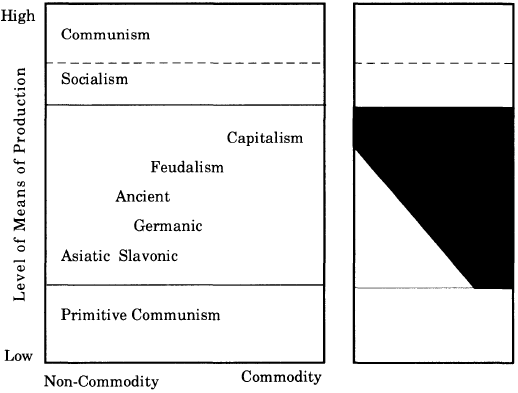
According to Marx’s taxonomy (see figure 1), primitive communism is the universal original stage of mankind. It is characterized by the absence of private property and class conflict. There are at least four possible routes out of primitive communism, the Asiatic, the ancient, the Germanic and the Slavonic. In each of these one can see the seeds of class antagonisms. They appear to be more obvious in the ancient than the other three, however. Private property, commodity production and, thus, class antagonisms are more developed in the feudal mode than the ancient and they reach their apex in the capitalist mode where even “labor power” becomes a commodity. Socialism and communism are modes of production characterized by the absence of commodity production, private property and thus class antagonisms.
The point is that Marx was primarily an organizational theorist (Roberts and Stephenson 1973). As such he was concerned with distinguishing between and cataloguing different socio-economic systems or organizations. According to Marx, this could not be done by relying on some “abstract formula” or “the universal passport of a general historico-philosophical theory,” (Selsam 1970, p. 71) but only by immersing oneself in the details of history. The question is whether the economic organization of a given society is sufficiently distinct to characterize it as a separate socio-economic system. Thus, the various economic formations are a product not so much of any elaborate abstract theory but of historical investigation, analysis and comparison. His conclusions in this area were always open, tentative and subject to modification, to addition and subtraction, in light of new historical evidence. As V. G. Kiernan has phrased it (p. 458), Marx
Figure 1
Marx’s Taxonomy
| Modes of Production | Degree of Class Antagonisms1 |
 |
|
2Shaded area = class antagonisms
was seeking to identify all possible types of productive systems, rather than to arrange them in order, or to explain how one had been supplemented by another, [emphasis added]
Marx’s Theories of History
Karl Marx had three interrelated but distinguishable theories of history: the theory of historical materialism, what I will call the theory of historical progressivity, and the theory of historical inevitability. Each will be dealt with in turn.
The Theory of Historical Materialism
The theory of historical materialism posits two things: (1) that the ideological superstructure is determined by the economic base and (2) that within the economic base the relations of production are determined by the level of the forces or means of production. Thus, any change in the level of the forces of production will create tension or conflict between the forces and relations of production. The result will be “an era of social revolution” leading to “the transformation of the whole immense superstructure,” i.e., the emergence of a new mode of production (see Marx 1970, pp. 20–21; Marx 1906, p. 96 n). It should be clear that the general theory of historical materialism is in no way affected by Marx’s revisions of his socio-economic taxonomy. The number of socio-economic systems is irrelevant to the process by which changes in the mode of production occur.
There is, however, a great deal of controversy regarding the exact status of the theory of historical materialism. Some have argued that it is an empirical theory which can be verified by recourse to historical data, while others have denied that the theory makes claims about specific historical events and cannot, therefore, be either confirmed or falsified by the use the historical data. And it must be acknowledged that the writings of Marx and Engels seem to leave room for either interpretation.
Taking the latter position, Hobsbawm argues that the theory, “requires only that there should be a succession of modes of production, though not necessarily any particular modes, and perhaps not in any particular predetermined order.” Marx thought, he continues, “that he could distinguish a certain number of socio-economic formations and a certain succession. But if he had been mistaken in his observations, or if these had been based on partial and therefore misleading information, the general theory of historical materialism would remain unaffected” (pp. 19–20. Also see Dunn 1982, p. 5; Sowell 1985, pp. 56–58; and Shaw 1983, pp. 206–10, esp., pp. 209–10). That is, the theory is trying to explain the basic or essential cause of the “succession of modes of production.” As such, it is actually ahistorical since it posits a relationship between the forces and relations of production, in particular, and the base and the superstructure, in general, but does not necessitate any particular order in the secession of periods or modes of production. One must distinguish, therefore, between the theory, on the one hand, and the historical data on the other. Both Marx and Engels were fully aware of the complexity of history. History, they tell us, rarely repeats itself and “when repetitions occur they never arise under exactly the same circumstances” (Engels 1972a, p. 99). History contains no “eternal,” “final and ultimate truths,” and “anyone who sets out in this field to hunt down . . . truths which are pure or absolutely immutable, will bring home but little, apart from platitudes and commonplaces of the sorriest kind” (Engels 1972a, p. 100). The materialist conception of history “is above all a guide to study,” Engels said, “not a lever for construction” (Selsam 1970, p. 71). In a 1877 letter Marx objected to interpreting his work as “a historico-philosophical theory of the general path imposed by fate on all peoples regardless of their historical circumstances” (Bober 1948, p. 41). And in his 1890 letter to Joseph Bloch (Selsam 1970, pp. 76–79), Engels, in particular, warned against viewing “the economic element as the only determining one.” That, he says, is “meaningless, abstract and absurd.” “There are,” he continues, “innumerable intersecting forces, an infinite series of parallelograms of forces which give rise to one resultant—the historical event.” “The economic situation is the basis,” he writes,
but the various elements in the superstructure—political forms of the class struggle and its consequences, constitutions established by the victorious class after successful battle, etc.—forms of law—and then even the reflexes of all these actual struggles in the brains of the combatants: political, legal, philosophical theories, religious ideas and their further development into systems of dogma—also exercise their influence upon the course of the historical struggles and in many cases preponderate in determining their form. There is an interaction of all these elements in which, amid all the endless host of accidents (i.e., of things and events, whose inner connection is so remote or so impossible to prove that we regard it as absent and can neglect it) the economic movement finally asserts itself as necessary.
Given that any historical event is the product of an “infinite” number of conflicting forces including such things as wars and such accidents of nature as earthquakes, droughts, and even plagues, all of which may seriously affect the level of the means of production, and since it is also possible for the superstructure not only to interact with but actually dominate, at least for a time, the economic base, it follows that (1) one should not expect to find a “mechanistic” or unilinear succession of historical epochs characterized by such things as increasing complexity and productivity and the potential for increasingly greater genuine freedom and individualization, and (2) the validity of the general theory of historical materialism can be neither confirmed nor falsified by recourse to the historical data.
On the other hand, beginning with The German Ideology in 1846, both Marx and Engels repeatedly emphasized that the theory of historical materialism was an “empirical theory.” “The premises from which we begin are not arbitrary ones, not dogmas, but real premises. . . . These premises can thus be verified in a purely empirical way” (1947, p. 6). Marx and Engels do not deny that man thinks and acts. In fact, they believed that ideas can have tremendous consequences. Their argument is that the source of all thought and action lies in the material base, and in particular, in each individual’s relationship to the means of production. “The production of ideas, of conceptions, of consciousness,” they write, (1947, pp. 13–16)
is at first directly interwoven with the material activity and the material intercourse of men, the language of real life. Conceiving, thinking, the mental intercourse of men, appear at this stage as the direct efflux of their material behavior. The same applies to mental production as expressed in the language of the politics, laws, morality, religion, metaphysics of a people. Men are producers of their conceptions, ideas, etc.—real, active men, as they are conditioned by a definite development of their productive forces and of the intercourse corresponding to these, up to its furthest forms. . . . That is to say, we do not set out from what men say, imagine, conceive, nor from men as narrated, thought of, imagined, conceived, in order to arrive at men in the flesh. We set out from real, active men, and on the basis of their real life process we demonstrate the development of the ideological reflexes and echoes of this life process. The phantoms formed in the human brain are also, necessarily, sublimates of their material life process, which is empirically verifiable and bound to material premises. Morality, religion, metaphysics, all the rest of ideology and their corresponding forms of consciousness, thus no longer retain the semblance of independence.
The contradiction between the claim that historical materialism is an empirically verifiable or at least testable theory on the one hand and the denial that it can ever be either confirmed or falsified by historical data on the other is, I believe, only apparent, and stems from a confusion between two related but distinct aspects of the theory: the process by which ideas emerge, on the one hand, and the particular succession of the modes of production, on the other. Marx and Engels believed not merely that the former was empirically verifiable but that they had, in fact, verified it. It is sometimes accorded in their writing the status of a “law.” But they seem to regard the latter—the succession of the modes of production—as so complicated by other, accidental factors, as to preclude empirical testability.
While ideas are accorded a certain independence, Marxism holds that “ultimately,” or in the “final” analysis, they are traceable to the material base. Thus, thought Y may occur to individual A because of his relationship to the means of production. But thought Y may, in turn, cause individual B to think thought Z, which, in its turn, may “react back on” the economic base. Thus, the material base is, “ultimately,” the sole source of all ideas. It follows that with detailed historical analysis one should be able to trace the history of any idea back to the material base. Consequently, one should also find a definite correspondence between the thought and action occurring in a particular historical period and its mode of production. Marx and Engels, as already noted, claimed that this “law of human development” had been empirically verified (Selsam 1970, p. 30). Similarly, the argument that the relations of production are “ultimately” determined by the level of the means of production, though far more complex, is also, at least in principle, “empirically testable.”
It is this general derivation of ideas and the “ultimate” correspondence of the means to the relations of production that, I believe, Marx and Engels generally meant when referring to historical materialism. And if that is the case, then they regarded the theory of historical materialism as an empirically testable theory.
The Theory of Historical Progressivity
It is true, of course, that Marx viewed his general theory as having a vitally important role in enabling him to understand and predict the general course of history. But this “historical determinism” should not be confused with the theory of historical materialism. That is, even if the economic base “determines” ideas, it does not follow that the course of history is likewise determined. Historical determinism is not part of the theory of historical materialism, itself, but is derivable from the theory when an additional premise—that over time new machinery and methods of production will be introduced—is included. Since these would not be employed unless they expanded output, it follows that, other things remaining equal, the productivity of the means of production must continually increase over time. Thus, each successive mode of production must be more productive than its predecessor. And that means that historical evolution must be the story of the increasing control of man over nature, and thus the increasing potential for genuine freedom and individualization. The result is a unilinear or “mechanistic” view of history, and there are passages in the writings of Marx and Engels that lend support to this interpretation. For example, in the Poverty of Philosophy Marx writes (Sowell 1985 p. 56) that “the hand-mill gives you society with the feudal lords, the steam-mill, the industrial capitalist.”
This quotation, and others like it, are a result of Marx’s penchant for summarizing lengthy and complex analyses with what Sowell (1985, p. 56) calls “epigrammatic expressions.” Since it is impossible to condense such complex analyses into single sentences these epigrams too often distort rather than accurately depict Marx’s positions. Although Engels’ statements were less “epigrammatic” than Marx’s, there are passages which, when taken out of context, can be quite misleading. For example, in his “Afterword” to Soziales aus Russland,” he writes (Marx, Engels and Lenin 1967, pp. 217–19) that “It is historically impossible for a lower stage of economic development to resolve the riddles and conflicts that have sprung up, in a much higher stage.” Taken by itself this gives the impression that Engels’ view of history was mechanistic. However, two pages prior to this he refers to the possibility of some countries “skipping the whole capitalist period,” and in the page following the quotation he states that it is possible for some countries to “undertake a shortened process of development.” Elsewhere, Marx and Engels acknowledge the possibility of at least temporary regressions of some societies as well as more or less permanent stagnation of others.
But however one accounts for their more “mechanistic” statements, it is clear that neither Marx nor Engels subscribed to a unilinear or “mechanistic” view of history. For example, in 1853 Marx wrote (Selsam 1970, pp. 138–43) that Indian society had stagnated for centuries. It was, he said, “based on a sort of equilibrium.” The real question was “not whether the English had a right to conquer India” but which country would conquer it. Marx clearly preferred the English. England “has to fulfill a double mission in India: one destructive, and the other regenerative—the annihilation of old Asiatic society, and the laying the material foundations of Western society in Asia.” By breaking up the “self-sufficient inertia of the villages,” and linking them together through transportation and trade, the English bourgeoisie, according to Marx, will enable India to move directly from an Asiatic to a capitalist society.
And Marx writes that because of the “permanent condition” of war in Spain the “towns lost their medieval power without gaining modern importance.” They “have vegetated in a state of continuous decay.” The result is that Spain had regressed from a feudal to an “Asiatic form of government.” Moreover, Marx seems to imply that it is possible for a new revolution to propel Spain directly to socialism (Selsam 1970, pp. 146–48).
While originally believing that it was feudal, as early as 1853 Marx and Engels began describing Russia as “Asiatic,” “Semi-Asiatic” or “Oriental.” And in a letter to Vera Zasulich in 1885 (Selsam 1970, pp. 175–76) Engels describes Russia as a society “where every stage of social development is represented, from the primitive commune to modern large-scale industry and high finance. . . .” Karl Wittfogel (p. 492) summarizes Marx’s position as follows:
The Mongol conquest destroyed Russia’s proto-feudal society by compelling the Muscovite Tsars to “tartarize” Muscovy. The Tatar Khans and their Russian agents combined the ruthless expansion of despotic power with an internal system of “enslavement.” According to this interpretation, the Mongols introduced the two-pronged policy; the early Tsars implemented it in Muscovy; Peter the Great “generalized” it. And in Marx’s time Russia’s political attitude was in substance what it had been at the end of the Mongol period.
In short, the Mongol conquest forced Russia to regress from a feudal to an Asiatic or semi-Asiatic status. It is noteworthy that, despite its Asiatic status, both Marx and Engels believed that late-nineteenth century Russia was on the brink of a socialist revolution. In 1877 Marx wrote that Russia is “on the threshold of an upheaval,” and in 1875 Engels wrote that “There is no doubt that Russia is on the eve of a revolution.” There is also no doubt that the revolution they were referring to was the socialist revolution (see, e.g., Bober 1948, pp. 41–43).
The theory of historical progressivity is clearly not an empirical theory. It is what may be called a “pure” or “axiomatic theory,” i.e., a theory of what would happen if other things remained equal. But, as Marx and Engels make abundantly clear, other things rarely, if ever, remain equal. There are simply too many other factors—“accidents”—that can affect the means of production for any empirical predictions to be derived from the theory. Thus, while the theory may indicate a trend toward progress it clearly does not rule out either periods of stagnation or actual regressions. Nor does it require that any society must go through all the various socio-economic stages or to go through them in any particular order.
The Theory of Historical Inevitability
Finally, there is what may be termed the theory of historical inevitability. While neither Marx nor Engels appear to have subscribed to a mechanistic, unilinear view of the course of history, it is abundantly clear that both thought that history had a predetermined goal. Although one could not predict the exact time or place of its arrival, the triumph of socialism was “inevitable.” In Capital (1906, p. 897) Marx says that socialism must come “with the inexorability of a law of nature.” And in the Communist Manifesto (1969, p. 79) Marx and Engels write that “Its [the bourgeoisie’s] fall and the victory of the proletariat are equally inevitable.” And their writings contain many other, similar, statements regarding the inevitable triumph of socialism (see, e.g., Engels 1972a, pp. 311–25; and 1972b, pp. 54–75.)
While these statements may well represent the triumph of desire over common sense, there is a certain logic to them. Capitalism, which was the dominant mode of production in Europe, had an innate tendency to become universal. And since capitalism was beset by insoluble internal contradictions its demise, including that of the ruling bourgeois class, was inevitable. Since the only remaining class would be the proletariat, which Marx assumed was naturally predisposed to socialism, it follows that the triumph of socialism was “inevitable.” This conclusion, it is worth noting, was derived from neither the theory of historical materialism nor the theory of historical progressivity, but was, rather, a questionable deduction from Marx’s detailed economic analysis of the capitalist mode of production.
It is important to point out that there can be no historical regression from socialism since, (1) socialism is a harmonious mode of production and would therefore eliminate the incentives for war and (2) productivity under this mode of production would be so vast that it would be able to weather any natural catastrophe. Thus, the triumph of socialism is not only inevitable, it is also irreversible.
Conclusions
Marx’s historical outlook has been presented in some detail. It is both complex and sophisticated. First, Marx was intent upon presenting a taxonomy which would include “all possible” socio-economic systems. His list in the “Preface” is best interpreted not as a list of necessary, chronological stages but as part of his on-going work on this taxonomy. Second, Marx’s historical work can actually be broken down into three distinct theories. The theory of historical materialism, which claims (1) that all ideas are derived, at least “ultimately,” from the economic base, and (2) that the relations of production are determined by the level of the means of production, is an empirical theory. The theory of historical progressivity, which claims that what may be called the “natural course of history” is for each successive mode of production to be more productive than its predecessor, is an example of a “pure” or “axiomatic” theory which can be neither confirmed nor falsified by the historical data since there are too many “accidental” factors which cannot be taken into account and may, at least temporarily, override the natural course of events. And finally, there is the theory of historical inevitability which claims that capitalism must, “with the inexorability of a law of nature” collapse and that socialism is its inevitable successor.
Part II
Analysis
The second part of this paper will analyze both Marx’s taxonomy and his method of analyzing history. The latter will be dealt with first.
Method of Historical Analysis
Empirical Theory
Marx claims that his theory of historical materialism is an empirical theory. “The phantoms of the human brain,” he says in his Economic and Philosophical Manuscripts (Bottomore and Rubel 1961, p. 75) “are necessary sublimates of men’s material life-process, which can be empirically established, and which is bound to material preconditions.” “The production of ideas, conceptions and consciousness” he says, “is a direct emanation of their [men’s] material behavior.” And in his “Preface” (1970, pp. 20–21) he says that the “relations of production correspond to a definite stage of development of their material productive forces”; that “definite forms of social consciousness,” i.e., the superstructure, “correspond” to “the economic structure of society”: that “with the change in the economic foundation the entire immense superstructure is more or less rapidly transformed.” And in The German Ideology (1947, p. 6) Marx and Engels write that what individuals are “coincides with their production . . . The nature of individuals thus depends on the material conditions determining their production.”
This theory has, they claim, been empirically confirmed. Marx, says Engels, “had proved” it and he calls it a “law of human development” (Selsam 1970, p. 30). Lenin refers to it is a law that is “without exception” and claims that “the latest discoveries of natural science . . . have been a remarkable confirmation” of it. The numerous attempts by its “enemies” to “refute” it, he says have invariably failed (Lenin 1967, vol 1., pp. 13, 41–42).
a. The Problem of Definition. Terms such as “correspond,” and “coincide” imply a precise, perhaps even quantifiable, relationship between the base and superstructure. This, in turn, demands a precise understanding of the elements or components to which the relationship corresponds. It is, after all, impossible to determine the empirical validity of a relationship if one is unsure of such things as the meaning and scope of the principle factors constituting that relationship. But Marx, as even his most ardent supporters acknowledge, never provided a definition of such terms as “economic” “material productive forces,” “economic base,” “superstructure,” “class,” etc. As the Marxist writer, McMurtry observes (p. 72),
Although this category of relations of production/economic structure seems thus the theoretical linchpin of all Marx’s analysis, its precise meaning has been a matter of unresolved controversy for more than a century. Marx, himself, as with all the basic categories of his Weltanschauung, never proffers a definition.
Interestingly, McMurtry defends this imprecision on the grounds that Marx’s “usage is so rich and elliptical” (p. 72). Moreover, he argues that this does not undermine its claim to scientific status. For example, Marx’s argument that the superstructure must correspond to the economic base means that those superstructural or ideological phenomena that are not “fit,” i.e., do not correspond to the base, will, in Darwinian fashion, be eliminated. This means that for Marx, as for Darwin, “empirical enquiry into the relevant concrete circumstances is required to generate a judgement of what in fact will be selected, or selected out, in the ‘struggle for life’” (pp. 163–64). Whether or not “Marx’s theory of social selection” is “homologous” to Darwin’s “theory of natural selection” is debatable. It is also irrelevant. For even if Darwin’s concepts are, as imprecise as Marx’s, this does not thereby render Marx’s theories scientific. It merely calls into question the scientific status of Darwin’s theory.3
In fact, McMurtry confuses universal laws with specific conditions. A causal explanation or prediction of the type Marx makes regarding such things as the relationship between the base and superstructure, requires two premises: (1) a universal law and (2) a statement of specific conditions. The universal law must be clearly formulated and the formulation must include the conditions under which the law would hold. Thus, “empirical enquiry into the concrete circumstances” cannot be used to establish the scope of the law. On the contrary it is the law which determines what the “relevant concrete circumstances” are. If one doesn’t know the scope of the law then there is no way to ascertain what the “relevant concrete circumstances are.” The problem here has less to do with Darwin’s theory of natural selection than with Toynbee’s theory of the life cycle of civilizations. As Popper (1956, p. 27n) points out, “of nearly every theory it can be said that it agrees with many facts.” In “Professor Toynbee’s allegedly empirical investigations of what he calls ‘species civilization’ . . . he seems to overlook the fact that he classifies as civilizations only such entities as conform to his a priori belief in life cycles.” He then finds that he has provided empirical confirmation for his theory that all societies follow a particular “life cycle.” That is, instead of testing the theory by reference to the facts, the facts are “selected in light of the very theories they are supposed to test.” It is similar for Marx. Since one does not know the scope or domain of any of his relevant concepts, McMurtry’s claim that “reliable predictions or explanations can be deduced” from “empirical enquiry into the relevant concrete circumstances” can only mean that those superstructural elements that “survive” must correspond to the current level of the base; those that are eliminated, it follows, do not correspond. The lack of conceptual rigor renders the theory non-falsifiable and thus empirically non-scientific. This is demonstrated by McMurtry’s own example.
What, he asks (p. 172), of those societies such as the Soviet Union “where Marxist-led revolutions have apparently broken the capitalist economic form,” but have not resulted in even “a proximate end to man’s domination of man”? McMurtry gives several explanations designed to reconcile this with Marxian principles. First, the socialist revolution was supposed to take place in “historically advanced” societies. Since countries such as the Soviet Union and the Peoples’ Republic of China are not advanced, “they simply fall outside the referential range of Marx’s claim.” Furthermore, “what has gone on in these societies prior to their material qualification as historically advanced societies—for example, ‘forced collectivization’ and ‘consumer deprivation’,” may “appear to involve human domination” but in fact “it is not really human domination at all, but domination by material needs.” And finally, even if the party and state office holders do, in fact, dominate and exploit the citizenry in such societies, this is not, as it may appear on the surface, an example of “a preeminent ruling-class superstructure suspended, so to speak, in the air, with no underlying ruling-class economic infrastructure as its ‘foundation’” (p. 176). Rather, it is a case of “office ownership.” The profit or surplus value “belongs to an office as subject-owner; but as [the office] must be occupied by a person it is this person occupant who, qua occupant, receives the unearned benefits” (pp. 178–79). Thus, what appears to be a case of the superstructure dominating the base, and thus a refutation of Marx’s theory, is, according to McMurtry, upon closer examination a confirmation of the theory that the base determines the superstructure.
Surely this is not only a classic case of selecting facts in light of the theory they are supposed to test but of taking imprecise concepts and stretching them so that they “fit the facts” and thus “confirm” the theory. The result is literally to render what is supposed to be an “empirical theory” immune from any empirical test. Other examples of “nonfalsifiability” are found in Marx’s writings. For example, revolutions will be successful, he says, when the “objective material conditions are correct.” But since the “objective material conditions,” correct or otherwise, are never specified we only know whether or not they are correct by observing whether or not the revolution succeeded.
It is clear that if Marx’s claim that the theory of historical materialism is an empirical theory is to be taken seriously, the concepts must be defined much more rigorously.
b. The Meaning of “Economic”. Sidney Hook (p. 20) observes that the term “economic” is used by Marx in at least four different senses: (1) “it is sometimes used to characterize motives, like a desire for wealth or money”; (2) it “sometimes refers to the presence or absence of land and raw materials . . . necessary for production;” (3) “more often it means the techniques, forces, and powers of production, including not only tools and instruments but skills and know-how,” and (4) “what Marx calls the mode of economic production or the “social relations of production.”
c. The Source of Ideas. In order to examine Marx’s claim that the theory of historical materialism is empirically verifiable one must know what Marx meant by the term “economic.” Since ideas are “produced” by, or “reflexes and echoes” of the base, and since human nature, itself, is, according to Marx, “conditioned” by the base, it is clear that in saying that the economic base determines the superstructure Marx cannot have in mind category (1). This is so since motives are part of the superstructure and thus derived from the base. It is clear that in saying that the base refers to the “totality” of all economic relations Marx is using the term “economic” in its broadest sense. This would include both the forces and the relations of production or categories (2), (3) and (4). The means of production “determine” the “relations of production.” And the “totality” or “sum total of these relations of production . . . constitute the economic structure of society on which rises a legal and political superstructure” (1970, p. 21).
There is an obvious problem here. Marx says that the “totality” of “the social relations of production constitutes the economic structure of society,” and that the relations of production include property relations which, he says, are a “legal” relationship. This seems to make law a part of the economic base. Yet, he also states that from the economic base “arises a legal and political superstructure,” thereby making law and politics not part of the base but part of the superstructure. Similarly, Marx says that ideas and knowledge are reflexes or echoes of the base. Yet he also claims not merely that the ideological superstructure reacts upon or has an impact on the base, but that ideas are part of the base, that they are in fact, a “material productive force.” In the Grundrisse (Bottomore and Rubel 1961, p. 91), for example, Marx writes that:
Nature constructs no machines, no locomotives, railways, electric telegraphs, self-acting mules, etc. . . . They are the product of human industry, natural materials transformed into instruments of human domination of Nature, or of its activity in Nature. They are instruments of the human brain created by the human hand; they are the materialized power of knowledge. The development of fixed capital indicates the extent to which general social knowledge has become a direct force of production, and thus the extent to which the conditions of the social life process have been brought under control of the general intellect and reconstructed in accordance with it. [emphasis supplied]
I simply don’t know any other way to read this statement than that ideas and knowledge are a material productive force and thus part of the economic base. For Marx, legal and political relations are seen as part of the base; at other times they are viewed as part of the superstructure. At times ideas are referred to as reflexes and echoes the “material productive forces”; at other times they are viewed as an essential part of the “material productive forces.” In short, the Marxian categories of base and superstructure simply do not meet the basic scientific criteria of being exhaustive and mutually exclusive. If there is virtually nothing that is not, or cannot at times be, a material productive force, if the “economic base” is so broad and fluid as to include practically anything, then the claim that the base determines the superstructure becomes an empty tautology: whatever influences the “superstructure” is, ipso facto part of the “economic base.” Once again, a theory that claims to be empirical is constructed in such a way as to render it immune from the results of any empirical test.
Finally, it should be noted in passing that if ideas are the product of the material base and as the base changes ideas must likewise change, this means that any theory can “occupy only a transitory place in the eternal flux of facts and ideas.” But this would mean that Marx’s ideas, too, are no more than a product of the material base at a given point in time and are therefore destined to be replaced by other theories as the material base changes. Thus, “Marx’s theory of relativity devours his own theories, the theory of relativity included” (Bober 1948, p. 381).
d. The Forces and Relations of Production. A second aspect of the theory of historical materialism is that the relations of production, category (4) in Hook, are “determined” by the forces of production, categories (2) and (3) in Hook. These terms, though not rigorously defined, are far more clear than the general term “economic.” Since the forces of production are essentially the tools man uses, McMurtry is correct in referring to Marx as a “technological determinist” (pp. 188–239). It is clear that Marx regards the forces of production as the linchpin of his entire system. Changes in the forces of production produce “corresponding” changes in “the whole immense superstructure,” although there may well be a lag time between the change in the former and the change in the latter. Changes in the forces of production, Marx says, “can be determined with the precision of natural science” (1970, p. 21). This and other similar statements, clearly imply that changes in the forces of production can be measured. Thus, one should be able to say that a 10% change in the forces of production will, at least “ultimately,” result in a “corresponding” change in means of production. McMurtry (pp. 191–92) takes precisely this position. “The relations of production/economic structure correspond to a definite stage of development of the forces of production,” he writes, “insofar as the units of effective ownership involved in the former correspond in scale to the units of technological integration involved in the latter” [emphasis in original].
The obvious question is how do we determine what, say, a “unit of effective ownership” is? Do we ascertain the number of factory owners in the society and divide that by, say, the square root of the number of arrests made for violation of laws protecting private property? And how do we determine what a “unit of technological integration” is? Do we calculate the average number of proletarians employed per factory and subtract from that number the average cubic feet of factory space? And would a single “unit of the forces of production” “correspond” to a single “unit of the relations of production”? Or would it be two units or even ten units? And how could we ever know? And what does it mean to say that the relations of production will “ultimately” “correspond” to the forces of production? Does “ultimately” mean two weeks, six months, or several decades? This is nothing more than meaningless, “scientistic” jargon.
e. The Mode of Production. Marx believed that there were several distinct modes of production or socio-economic systems and that each of these had specific “laws of motion” by which their “movements” were governed. Marx derided the “vulgar bourgeois economists” for believing that the laws of the capitalist system were “eternal” and writes (1970, pp. 188–90) that economists such as Smith and Ricardo made the mistake of dealing with “man as posited by nature,” i.e., a constant, when in fact they were dealing with “the individual. . . as an historical result,” as he has evolved. Thus, he says, “When we speak of production we always have in mind production at a definite stage of development.” And Leontyev writes (p. 233) that “with the transition from capitalism to socialism the economic laws of socialism replace the economic laws of capitalism.” But Marx does not deny that there are regularities that transcend particular systems (1970, p. 190):
It might be thought therefore that, in order to speak of production at all we must . . . declare from the very beginning that we are examining one particular historical period, as for instance modern bourgeois production. . . . All periods of production, however, have certain features in common: they have certain common categories. Some elements are found in all epochs, others are common to a few epochs. The most modern period and the most ancient period will have certain categories in common. Production without them is inconceivable. But . . . it is necessary to distinguish those definitions which apply to production in general, in order not to overlook the essential differences existing despite the unity that follows from the very fact that the subject, mankind, and the object, nature, are the same. For instance, on the failure to perceive this fact depends the entire wisdom of modern economists who prove the eternity and harmony of existing social relations.
Now it is obvious that due to the variability of social conditions, of customs, cultures, etc., results we might expect, which were formed on the basis of experience in our own culture or historical period, would not coincide with the results we would get in another culture or historical period. But this does not mean that the “laws” have changed. It merely means either that the conditions under which the law applies are not present or that the scope of the law is not as broad as was originally thought and that one must therefore revise the law by narrowing the conditions under which it applies. Thus, the law would still be universal, i.e., valid whenever the conditions to which it applies are present. For example, although those laws regarding such things as the division of labor, rent and market exchange might be universally valid, they would be irrelevant to Robinson Crusoe since the conditions under which they hold simply do not exist in such a situation.
Marx does not deny this. However, since he is primarily interested in the laws peculiar to the various modes of production and since he regularly derides the bourgeois economists for believing that the “laws of the capitalist system” are universal, we are entitled to know which “laws” have universal status and which are confined to the particular mode of production. This cannot be done a priori. It would entail taking each “law” and examining whether the specific conditions under which a law holds are present in each mode of production. One could conclude that the “laws” of one mode of production are not relevant for another mode only if the specific conditions under which the law would apply are completely absent in the latter. Marx never attempted such a feat. He simply concluded that the laws of the capitalist system, i.e., the laws of the market, were specific to that mode of production.
The basis for this conclusion seems to come from Marx’s view of human nature. Marx maintains that (1) man does have a nature but that (2) it is modified by the particular mode of production (McMurtry 1978, p. 20). According to Marx, man is, by his nature, industrious and creative. When the bourgeois form of production is “peeled away,” says Marx (1964, pp. 84–45; also see Marx, 1973a, p.112–14) one sees that it is in the nature of man to produce, and to produce creatively. As McMurtry puts it (p. 26), “For Marx, then, Man the Producer is, in the end, Man the Artist.” But man’s nature is modified by history. All modes of production will stimulate the development of some aspects of man’s nature while blocking the development of others. But capitalism seriously distorts human nature. “Political economy starts with the fact of private property,” Marx says (1973a, p. 107), and thereby “sets in motion” “greed and the war amongst the greedy—competition” [emphasis in original]. Thus, greed and competition are not natural to man; they are, rather, a product of modes of production based on private property, in particular, capitalism.
The interesting thing about this analysis is how does Marx know what human nature really is? He derides bourgeois economists for postulating the existence of “the individual,” a Robinson Crusoe. “Production by a solitary individual outside society . . . is preposterous.” Man, “in the most literal sense,” he says, is a “social animal.” But if human nature is modified by the society in which he lives, and if the notion of a pristine man living “outside society” is “preposterous,” how can Marx ever know what “human nature in general,” i.e., human nature unmodified by society, really is? Since Marx provides no answer to this question, his belief that man is, by nature, productive and creative is no more than an assertion.
But it is certainly a convenient one. For the assertion that human nature changes as the means of production change, allows him to conclude, a priori, that “the laws of the capitalist mode of production” are not relevant to other modes of production since the conditions under which they would apply, i.e, a human nature in which greed and competition dominate, are not present. But this should be easy to test. One of the laws of the capitalist system is that a shortage of a good will, other things being equal, cause its price to rise. A corollary of this is that if the price of a good is held below the market price, a shortage will result. The historical evidence clearly shows that this is exactly what happened in ancient China and Rome, in feudal France and even in socialist Russia after the 1917 revolution. Similarly, “bourgeois economics” maintains that debasing the currency or increasing the supply of money will cause prices to rise. Again, the empirical evidence shows that this is precisely what happened in ancient Rome, in feudal France, in capitalistic United States, and, again, in socialist Russia.4 Finally, it might be noted that, contrary to Marx’s assertion, recent studies of non-capitalist village life strongly suggest that human nature, for all practical purposes, is constant (see, e.g., Popkin 1979; Mosher 1983).
f. Conclusion. Joseph Schumpeter (p. 10) called Marx’s theory of history “one of the greatest individual achievements of sociology to this day.” If this is an exaggeration, it is not much of one. The theory is breathtakingly bold in its attempt to integrate economics, sociology, politics, the natural sciences and even the arts into a single over-arching conceptual framework. It is not, however, a “scientific” theory, much less a “law of historical development.” It is fertile ground for empirical research. But much depends on the ability to recast Marx’s concepts into empirically falsifiable terms without doing injustice to the richness of his ideas. It is worthy of note in this context that the massive quantities of technology imported into many Third World countries since World War II did little or nothing to stimulate economic development. Since this suggests that economic development is more a product of culture, of the way people think, than vice versa, it is in direct contradiction to what at least appears to be the Marxian position (Sowell 1885, p. 208).
Moreover, Marx’s dissatisfaction with Hegel’s Idealism and the notion of the “spontaneous generation” of ideas is, I believe, well founded. The notion that anything can occur without a cause is, after all, inconceivable to the human mind (Mises 1969c, pp. 76–78). But Marx’s attempt to trace back all ideas to the “material productive forces” must be pronounced a failure. It is clear that man is influenced by his material environment, but there is no reason why the material environment must be the sole, or even the “ultimate,” source of all ideas.
Axiomatic Theory
Marx’s theory of historical progressivity was classified as an axiomatic or “pure” theory. Beginning from certain assumptions Marx tried to deduce logically the “natural” course of history using the ceteris paribus, or other things remaining equal, qualifier. The independent variable is the state of technology which, Marx assumes, would constantly improve. From this it follows logically, he believes, that technological advancement would continually revolutionize the relations of production thereby moving society “inexorably” along the path of history from the ancient to the feudal to the capitalist and finally into the socialist/communist modes of production.
a. The “Ceteribus Paribus” Device. Marx’s use of the ceteribus paribus device has a long tradition in the social sciences in general and economics in particular. It is, of course, the principle means for approximating the methods of the natural sciences. In the natural sciences extraneous data can be artificially excluded, thereby isolating the factors to be examined. This is usually not possible in the social sciences. The ceteribus paribus device is a method of mentally isolating the relevant factors, thereby allowing the social scientist to use the “laboratory of the mind” to conduct mental experiments by envisioning how a change in one factor would affect a second factor. Thus, the ceteribus paribus device allows the social scientist to approximate the laboratory experiments in the natural sciences by the use of the laboratory of the mind.
The procedure is that one stipulates certain assumptions from which certain theorems are then deduced. If the assumptions are correct and the deductions are properly drawn, then the theory must be correct. The theory allows one to simplify reality, thereby separating “appearances” from “essences.” As the theory is further refined, more and more of the restrictive assumptions are lifted, moving the model closer to “reality.” It is important to note that an axiomatic theory cannot be falsified by empirical data. If the assumptions are correct, the only question is whether or not the historical conditions correspond to the conditions for which the theory would apply (see, e.g., Marx 1970, pp. 205–14; Mises 1962, pp. 1–9, 44).
This is the procedure used, at times, by Marx and it is remarkably similar, in intent at least, to the “pure theory” of Carl Menger (see, Hutchison, pp. 15–37) and especially the praxeological method of Ludwig von Mises (see, e.g., Mises 1966, pp. 1–142. Also see Rothbard 1970a, pp. 1–66; 1973, pp. 311–42; and Lachman 1951, pp. 412–27). The principle difference is that while Mises’s assumptions, such as the action axiom, are a priori, Marx’s are not. An a priori assumption is a “self-evident proposition” (Mises 1962, p. 4; Rothbard 1957, p. 315) and thus “not empirically falsifiable.” A priori assumptions are not categories that are tested by recourse to human action. On the contrary, such categories are logically prior to, and therefore enable us to understand and explain, human action.
Marx, however, believed that his assumptions were in fact, a priori, or at least very close to it. “The premises from which we begin,” write Marx and Engels, “are not arbitrary ones . . . but real premises from which abstraction can only be made in the imagination . . . The first premise of all human history is, of course, the existence of living human conditions.” From this it follows that “men can be distinguished from animals . . . as soon as they begin to produce their means of subsistence.” “The way in which men produce their means of subsistence depends first of all on the nature of the actual means they find in existence and have to reproduce.” They conclude that “the nature of individuals thus depends on the material conditions determining their production” (1946, p. 6). As Engels put it (Selsam 1970, p. 35), “men must first of all eat, drink, have clothing and shelter, therefore must work, before they can fight for domination, pursue politics, religion, philosophy, etc.” Thus, the content of the latter is a product of the process of the former.
It is indisputable that there could be no human history in the absence of human beings. That proposition would therefore have the character of an a priori assumption. But it is difficult to see what conclusions must necessarily flow from it. For example, it in no way seems to be a logically necessary deduction from this that man’s nature “depends on the material conditions determining their production.” This may be the case but it is not an a priori but an empirical assumption. It is not an assumption whose truth is self-evident but, on the contrary, one that must be established, empirically or logically. To treat it as axiomatic and thus to assume its validity, as does Marx, is simply to assume the very thing most in need of demonstration.
Marx’s second major assumption is that of the inevitability of technological progress. Now Marx does not argue that technological progress is inevitable. Rather it is that, for purposes of analysis, such complicating factors as war and natural disasters, which can disrupt this process, are temporarily excluded. But the question is: does the exclusion of these factors render technological advance inevitable? I think the answer has to be no. First, Marx does not adequately explain the process by which technological inventions are made. His argument is that when historical conditions call for a new tool or machine, that need will prompt individuals to devote their energies to this task. That the inventions will be made is, for Marx, inevitable. As he puts it in the “Preface” (1970, p. 21), “Mankind thus inevitably sets for itself only such tasks as it is able to solve, since closer examination will always show that the problem itself arises only when the material conditions for its solution are already present.” But even if one grants that this is the case (which I, by no means, do), the real question is: how are the efforts of the relevant individuals, for example, the scientists and inventors, directed into the areas where the new machines or tools are needed? “Bourgeois economists” deal with this problem by recourse to the entrepreneur. But, as Schumpeter points out (p. 32), Marx, has no place for the entrepreneur in his mechanistic view of the capitalist mode of production, where the same things are simply produced in ever expanding quantities. Thus, Marx has no way to link scientific and technological advances to economic needs. Scientific and technological advances may occur but, under Marx’s view of capitalism, it is purely a fortuitive coincidence if they coincide with economic needs. The only thing Marx can say is that mankind needs them and therefore mankind invents them.
Second, and related to the first, is the question of resource depletion. Resources are depleted in the course of economic development. Instead of inevitable economic progress wouldn’t it be more plausible to assume that economic progress would continue up to the point that resources became depleted, after which would follow a period of economic deterioration? Interestingly, this is the position taken by Ricardo, from whom Marx acquired much if not most of his economics (Schumpeter 1975, pp. 35–37). Ricardo believed that growing resource scarcity would cause prices to continually rise. But for Marx the essential problem for capitalism is that precisely because it is so productive the quantity of goods produced exceed the quantity demanded. Thus, the capitalists must continually lower their prices, thereby driving each other out of business. The possibility of resource depletion never seems to occur to Marx. Technological, and correspondingly economic, advances are assumed to go on indefinitely. This is not to say that resource depletion is inevitable, only that it is an inevitable consequence of the Marxian position. For example, if a resource is defined as something that is found in nature that we know how to use, it follows that knowledge is at least as important as the substance itself. And if one’s view of the economic process leaves room for the entrepreneur to channel the energies of scientists and technicians into the areas where resources are becoming scarce, then man has the ability not merely to find additional resources but actually to create resources as we need them, i.e., to find uses for previously useless substances. Thus, there is then no inherent reason to believe that resources will become scarce over time (Simon 1981; Simon and Kahn 1984; and Osterfeld 1985). But by excluding the entrepreneur Marx is unable to offer any reason why resource depletion will not occur.
Finally, Marx does not deal with the affect of political policies and social attitudes. Scientific advance, and the development of knowledge in general, is a social enterprise. As Popper says (1957, pp. 154–64), “Science, and more especially scientific progress, are the results not of isolated efforts but of the free competition of thought. For science needs ever more competition between hypotheses and ever more rigorous tests. . . . Ultimately, progress depends very largely on political factors: on political institutions that safeguard freedom of thought.” Interestingly, the ruling class in any particular period is tenaciously trying to hold on to its position. The principle means by which it does so is to use the state to crush resistance and to prevent the emergence of dangerous ideas. Yet, Marx does not take into consideration that an environment so hostile to free thought would impede the development of science and retard, or even reverse, technological advances. For Marx, the march of science takes on the character of inevitability.
In brief, while Marx believes that his assumptions are a priori they are in fact empirical, and empirical assumptions of very questionable validity.
The next question is: even granting his assumptions, is the theory of historical progressivity logically deduced from those premises? Again, the answer is clearly no. Marx argues that, other things remaining equal, technological advance will produce a succession of modes of production and that each successive mode will be more productive than its predecessor. Thus, the ancient period logically flows from the Asiatic, the feudal from the ancient, etc. But neither Marx nor Engels deduce the transition from primitive communism to the ancient period from any changes in the material productive forces in that period. In The Origin of the Family, Private Property and the State, Engels explains the demise of primitive communism by such factors as the emergence of private property and the decline of the importance of the family. Although he does refer to the discovery of iron during this period and the significant number of industrial achievements, he does not link this change in the technological base directly to changes in the relations of production. He merely says (1942, p. 146) that as “herds began to pass into private property, exchange between individuals became more common.” As to the question how and why individual ownership of herds emerged, Engels simply says “we know nothing” (p. 167). The problem here is that one appears to have a change in the relations of production that is independent of any change in the forces of production. And while he refers to the emergence of slavery during this period it is not at all clear why this necessarily or logically flows from primitive communism. He simply says that as the work to be done increased, “new labor forces were needed.” Therefore, “prisoners of war were turned into slaves” (p. 147). Why they weren’t enserfed or even paid wages is not explained.
Nor does there seem to be any logically necessary reason why ancient slavery should give way to medieval feudalism. Feudalism, by nearly all accounts, was not the consequence of class antagonisms between the owners and the slaves, but a product of a historically unique set of events. In particular, it was a result of the barbarian invasions which scattered the population of Europe across the continent. And the related insecurity caused by the wars forced the independent farmers, and the artisan refugees of the cities under attack, to seek protection in exchange for work. The outcome was the emergence of largely self-sufficient manors and the distinction between lords and serfs. This type of socio-economic system, as Marx himself noted, did not occur anywhere else in the world. There is, Bober observes (p. 54), no reason for a “slave mode of production [to] inevitably produce circumstances which must result in feudalism.”
The transition from feudalism to capitalism is equally troublesome for Marx. For one thing the collapse of feudalism was essentially completed during the fifteenth century which means that it occurred at least a “century before the beginnings of capitalism” (Rosenberg and Birdzell 1986, p. 103). One cannot use historical data to refute an axiomatic theory. But it does raise a significant analytical problem. Marx was aware of “the 100 years hiatus” between the fall of feudalism and the rise of capitalism. He attempted to account for this hiatus by the tactical maneuver of what he called “simple commodity production,” a system in which products are produced for exchange but it is exchange for subsistence and not for profit, and there is little capital accumulation. The problem with this explanation is that Marx makes it quite clear that the means of production have not yet changed (Bober 1948, p. 60). The technological revolution lay a century or more in the future. But this means that, as in the transition from primitive communism, the change in the relations of production is autonomous. It is not caused by a previous change in the means of production. In fact, it is reasonable to believe that, if anything, the change in the means of production is, itself, a result of the earlier change in the relations of production. Thus, in his attempt to extricate himself from the problem of the “100 year hiatus” Marx reverses the causal relationship stipulated by his own theory.
Marx’s attempt to derive logically the emergence of socialism from the fall of capitalism is no more successful. First, there is no reason why the proletariat should be the only class contending with the bourgeoisie for power. What, for example, of the so-called “managerial class” which, to use Marxist terminology, has “grown in the womb” of the capitalist system? There may well be other possibilities.5 The point is that even on strictly Marxian grounds there is no reason why there can be only two classes, the bourgeoisie and the proletariat. And if that is the case there is no reason why the proletariat must accede to power with the collapse of the bourgeoisie.
But there is a much more serious problem with Marx’s analysis. Even if one grants Marx’s economic argument that capitalism must collapse, and even if one also grants his argument, derived from the labor theory of value, that the proletariat would fare much better under socialism than under capitalism, it is simply a non sequitur to conclude that the proletariat would therefore fight for socialism. Capitalism, according to Marx, causes the greedy, competitive and self-interested aspects of man’s nature to dominate. The question is: even if proletarians would benefit from a socialist system, why would they fight for it? Assuming there are thousands or even millions of proletarians it would be reasonable for the individual proletarian to reason that his individual contribution would not affect the outcome of the revolution. He would therefore maximize his own utility by not participating in the revolution since he would then avoid any possibility of injury or even death yet, since he was a proletarian, he would still receive all the benefits of a successful proletarian revolution. But if all proletarians thought in this way, and there is no reason why they would not, the proletarian revolution would never occur (Olson 1977, pp. 98–110). The problem of establishing a socialist system is identical. Why would the victors in the revolution want to establish a classless society based on cooperation rather than competition and exploitation? They were, after all, born and bred in a society that molded their nature to be greedy, competitive and self-interested. Marx’s only route out of this dilemma is to assume that the individual proletarians will place the interest of their class as a whole above their own self-interests, i.e., become a “class for itself,” which means that he must assume a change in human nature prior to the revolution and the establishment of the socialist mode of production. But the change in human nature, according to his own theory, is supposed to be a result of, and therefore follow, the change in the mode of production, not precede it. In brief, Marx’s attempt to show, on strictly logical grounds, that socialism must follow capitalism simply does not succeed.
On a more general level it is interesting to note that as Marx lifts the ceteris paribus assumptions, thereby moving it closer to “reality” his theory becomes less and less deterministic. And in the end he refers to societies that have attained an equilibrium within a particular mode of production, i.e., they have ceased to progress, and to other societies that, for one reason or another, have actually regressed to a more primitive mode.
Marx’s theory of historical progressivity makes extensive use of the ceteris paribus device to mentally isolate the factors being examined. It purports to be based on certain self-evident premises and proceed by strictly logical deductions to the conclusion that each successive mode of production must be more productive than its predecessor. But it was shown that its premises were neither a priori or self-evident, nor were they empirically verified. It was also shown that the steps in the theory were not logically necessary deductions from the premises and, in some cases, they were actually inconsistent with those premises. Marx may therefore be considered a quasi-praxeologist or, perhaps more accurately, an unsuccessful practitioner of the praxeological method.
Inevitability
The last of Marx’s historical theories is his theory of historical inevitability, which claims that the triumph of socialism is inevitable. The strictly logical flaws in Marx’s argument that socialism must succeed capitalism were dealt with above. But there are additional reasons why Marx cannot claim that socialism is inevitable. First is the question of knowledge. Marx believes that technological advancement is inevitable. But since technological advancement assumes a prior advancement of scientific knowledge Marx must also assume that the advancement of knowledge is inevitable. But, as Popper notes (1957, pp. ix-xi), it is logically impossible to predict what inventions or discoveries will be made in the future since to do so would require that one already possesses that knowledge. As Popper puts it, “if there is such a thing as growing human knowledge, then we cannot anticipate today what we shall know only tomorrow.” This means that Marx cannot scientifically predict that socialism must come or that capitalism must fall since to do so rules out the possibility of some discovery or invention that would, for example, avert the alleged Law of the Tendency for the Rate of Profit to Fall. Capitalism, according to Marx, has solved the problem of production but not the problem of distribution. But why isn’t it possible, even on Marxian grounds, for someone to discover a solution to the problem of distribution while keeping the capitalistic relations of production essentially intact? Certainly this is not a logical impossibility. “Profit-sharing” is just one possibility that comes to mind. No doubt there are others. The point is not that “profit-sharing” is the solution or that a solution will necessarily be found. It is simply that Marx has not been able to show that a solution is logically inconceivable and thus cannot eliminate the possibility that a solution will be found.
The second problem is that Marx cannot claim that socialism is inevitable because he specifically acknowledges that accidents such as wars and natural disasters can do, and in fact have actually done, so much damage to the means of production as to prevent advancement to a higher mode of production or even to cause regression to a more primitive mode. Isn’t it possible on strictly Marxian grounds, therefore, for the proletarian revolution to cause so much damage to the means of production that it not only makes the transition to socialism impossible but actually causes society to revert to a more primitive mode of production. But if one cannot rule out this possibility then one cannot maintain that the triumph of socialism is “inexorable.”
Finally, it should be pointed out that Marx’s non-teleological view of the historical process is incompatible with his teleological belief in history’s final destination.
Part III
Marx’s Taxonomy
Capitalism
Turning to Marx’s taxonomy it will be recalled that his objective was to present “all possible” modes of production, although his continual revisions suggest that he was not fully satisfied that he had achieved that goal. But what is rather curious is that while he makes numerous hair-splitting distinctions between the various non-commodity modes of production, there is, for Marx, only a single commodity mode: capitalism. Commodity production was defined by Marx as production separated from consumption by an intervening exchange. And capitalism was a system, in fact the only system, in which commodity production was the dominant mode. Since exchange presupposed private property and the goal of exchange was profit, capitalism was viewed by Marx as a socio-economic system based on private property and the free or unrestricted exchange of goods and services, including labor, with the goal of making a profit. Marx says, for example (1969, p. 84), that by capitalism, or “the bourgeois conditions of production” is meant “free trade, free selling and buying.”
Mercantilism
This definition of capitalism in terms of the free or unhampered market is unobjectionable. But surely it is not the sole form of commodity production. It is certainly possible to conceive of a society in which relations are organized around the market, in which buying and selling permeate the society, but in which that buying and selling is restricted, or hampered, by government rules and regulations. This is not merely a logical possibility. It is a historical reality. In the seventeenth and eighteenth century England, and especially France, were notorious for the extent of their regulations. The government of England, as a matter of course, established numerous legal monopolies such as the East India Company. Competition with such companies was strictly forbidden. The American colonists, for example, were forbidden to enter numerous occupations which were reserved for inhabitants of the Mother country. Trade with “outside” countries such as France was likewise prohibited. In France, a government decree in 1666 mandated that
Henceforth the fabrics of Dijon and Selangey are to contain 1,408 threads . . ., neither more nor less. At Auxerre, Avallon, and two other manufacturing towns, the threads are to number 1,376; at Chatillon, 1,216. Any cloth found to be objectionable is to be pilloried. If it is found three times objectionable, the merchant is to be pilloried. (Heilbroner 1972, p. 21)
Even in the supposedly laissez faire United States of the early-nineteenth-century government regulations, including the grant of monopolies, was far more extensive than is commonly thought. “We cannot pass the bounds of the city,” complained New York locofoco leader William Leggett,
without paying tribute to monopoly; our bread, our meat, our vegetables, our fuel, all pay tribute to monopolists. Not a road can be opened, not a bridge can be built, not a canal can be dug, but a charter of exclusive privileges must be granted to the purpose. . . . The bargaining and trucking away chartered privileges is the whole business of lawmakers.
The type of economic system characterized by such extensive government interventionism is generally referred to as mercantilism. Jacob Viner (p. 439), for example, defines mercantilism as “a doctrine of extensive state regulation of economic activity in the interest of the national economy.” It was, he continues, “in sharp contrast with the later laissez faire doctrine.” Heilbroner (p. 37) says that mercantilism is the doctrine that, by linking national power with national wealth, concluded that the focus of government policy was “how to create ever more and more wealth by assisting the rising merchant class in the furtherance of its tasks.” And since it “was generally admitted that unless the poor were poor they could not be counted upon to do an honest day’s toil without asking for exorbitant wages,” the related problem of government policy, says Heilbroner, became “how to keep the poor poor.” And Rothbard (1964, p. 146) defines mercantilism as “the use of economic regulation and intervention by the state to create special privileges for the favored groups of merchants and businessmen.”
In brief, capitalism is generally defined in terms of free trade and the absence of government intervention. Mercantilism is defined in terms of highly restricted trade and extensive government regulation of economic activity. The question is: is this difference enough to justify viewing mercantilism as a distinct mode of production. Marx was certainly aware of mercantilism and it is clear that he did not think so. He describes mercantilism (1964, p. 130) as a strictly transitional phase on the road to capitalism. Perhaps it is not surprising, therefore, that mercantilism is never even mentioned in either the massive Dictionary of Marxist Thought (Bottomore 1983) or the almost equally massive An Encyclopedic Dictionary of Marxism, Socialism and Communism (Wilczynski 1981). What needs to be done is to contrast the operations of capitalism with those of mercantilism to see if there are any significant differences.
Capitalism and Mercantilism Compared
a. Exchange: Free Versus Restricted. Since values are subjective, any voluntary, or free, exchange will take place only when each participant expects to benefit, “The very fact that an exchange takes place,” writes Professor Rothbard, “demonstrates that both parties benefit (or more strictly expect to benefit) from the exchange.” And, since the free market is nothing more than “the array of all voluntary exchange that takes place in the world,” and since “every exchange demonstrates a unanimity of benefit for both parties concerned, we must conclude that,” provided all major externalities have been internalized, as they would be in a world of universal private property, “the free market benefits all its participants” (1956, p. 250. Also see Mises 1966, p. 744).
It is true, of course, that businesses go bankrupt, expected profits from investments do not always materialize and proffered exchanges are sometimes rejected. But the claim is that free exchange enables individuals to maximize their utility ex ante. This is certainly consistent with bankruptcy, unprofitable investments, the purchase of losing lottery tickets, etc. This can be easily demonstrated. Assume that one has a .5 percent chance of having an investment yield a profit and a .5 percent chance of suffering a loss. If the individual believed that the profit would increase his future utility more than a loss would decrease it, the discounted present value of that investment would be positive. This means that, regardless of the actual outcome, the decision to invest would increase one’s utility ex ante even if it proved to be a mistaken choice and reduced it ex post.
The situation is similar for rejected offers. If one’s offer to exchange is rejected his actual or real-world utility plane remains unchanged. What has happened is that his hoped-for increase in utility did not materialize; that is, his actual utility plane is lower than his hoped-for or desired utility plane. Of course, there must always be a discrepancy between one’s actual and one’s desired utility. If this were not the case, if everyone’s desires were completely satisfied, all action would cease, for any action, by definition, would then entail a reduction in utility (Mises 1966, pp, 13–14).
Put differently, the free market operates to increase every individual’s actual utility plane. To complain of a discrepancy between actual and desired utility is simply to complain that one’s desires have not been fully satisfied. But this complaint reduces itself to the rather mundane observation more is better than less, that abundance is better than scarcity. But scarcity, like uncertainty, is an ineradicable element of nature that is independent of any particular economic system.
But if the market maximizes individual and, by extension, social utility, if all parties to a free exchange must benefit, it follows that government restrictions on, and prohibitions of, certain types of exchange must reduce at least one and perhaps all parties’ utility to below what it would have been on the unhampered market. This is not to say that no one can benefit. Obviously, the restriction will benefit some individuals, at least in the short run, while hurting others. Thus, in contrast to capitalism, in which any exchange implies a mutuality of benefit, mercantilism is a system of exchange in which one party benefits at the expense of the other party or parties. Put differently, since interpersonal comparisons of utility cannot be made, one can only discuss utility in a cardinal sense. This means that since exchange under capitalism is voluntary and therefore that both parties must benefit, capitalist exchange can be described as positive-sum. In contrast, since, under mercantilism, at least one party to the exchange must be coerced, mercantilist exchange can be described as zero-sum. In fact, when one also includes exchanges that would have been made in the absence of mercantilist restrictions it is quite possible that the result is actually negative-sum, i.e., that more individuals are harmed by the restrictions on exchange than are benefitted by it (Osterfeld 1988, pp. 79–92. Also see Rothbard, 1970b, p. 194).
In brief, exchange under mercantilism differs significantly from exchange under capitalism.
b. Profit: Economic Versus Political. Since profits are a subset of exchange, there is no fundamental difference between the two. The free market is not a profit system but a profit and loss system. Profits are earned by those who are able to satisfy consumers’ desires better and more cheaply than others; losses are suffered by those who fail to serve the consumers. This means that far from profits being obtained at the expense of the consumers, the reverse is true: the more one serves the consumers the more profit he will earn.
Profits, as Mises has noted (1969b, p. 119) are never normal. They are an indication of maladjustment, of a difference between the actual allocation of resources and the allocation that would prevail if the wishes of the consumers were satisfied to the fullest extent possible. Those entrepreneurs who are the first to spot and act on the maladjustment are the ones who earn profit. And they earn profit because their actions serve to remove the maladjustment. Those who fail to spot the maladjustment suffer losses. And if they continue to suffer losses they will go bankrupt and their capital will be transferred to others who are more adept at perceiving maladjustments. This can be easily demonstrated. Assume that the market is in equilibrium. Also assume that a new technological breakthrough has enabled the production of a new commodity highly valued by consumers. The production of the commodity, however, requires the use of factor A. Those entrepreneurs who perceive this new profit opportunity will begin to bid for the factor. The increased competition for the available supply of A will cause its price to rise, forcing some of the users of A to curtail their purchases. But who will be the ones forced to curtail their purchases? Clearly, it will be those employers of A who are receiving the least remuneration for their product from the consumers, i.e., those who are employing A in its least productive area. In this way units of factor A are channeled from uses that the consumers value less highly into uses that they value more highly. But further, the rise in the price and therefore the profit margins of A will encourage other entrepreneurs, also anxious to make profits, to expand the supply of A.
In short, “the only means to acquire wealth and to preserve it, in an economy not adulterated by government-made privileges and restrictions,” Mises observed (1969a, p. 535), “is to serve the consumers in the best and cheapest way.” As soon as the entrepreneurs fail to do so consumers will take their business elsewhere. It is precisely the constant threat of loss that insures that entrepreneurs remain responsive to the needs of consumers.
It is much different under a mercantilist system characterized by extensive government regulations and restrictions including tariffs, subsidies, licensing restrictions and legal monopolies. By granting such privileges to those groups favored by government, others are forced to engage in activities they consider less desirable than those they would have undertaken. Moreover, freed from competition, and thus the need to serve the consumers, the politically favored groups are able to turn out shoddy merchandise at high prices. Thus, the privileged groups are able to benefit themselves at the expense of the rest of society. Finally, since government interference distorts the operations of the market it must necessarily misallocate resources. Since this will lower output, the long run effect is to hurt everyone, even, in many cases, the initial beneficiaries of the privileges, by reducing their standards of living to below what they would have been on the free market.
But isn’t it possible for a monopoly to emerge from the free market and then to use its position to exploit consumers? It is at least conceivable for a monopoly to emerge on the unhampered market. But the only way for this to happen is for a firm to have continually served consumers far better than any of its competitors. If it would then decide to take advantage of its new-found monopolistic position by raising prices and reducing quality, it would immediately attract competitors anxious to take advantage of the new profit opportunities, thereby forcing the would-be monopoly to reduce its prices. The case of oil is just one example. Aside from Standard Oil’s unsuccessful attempt to monopolize the market in the late nineteenth century, there were numerous attempts in the early twentieth century to cartelize the domestic oil market. But these voluntary agreements, without exception, failed. In fact, by 1933 the price of crude oil had fallen to $.25 a barrel. It was only when the national government, with the passage of the National Recovery Act in 1933 and the Transportation of Petroleum Products Act in 1935, established a national Petroleum Code whose enforcement arm was such state agencies as the Texas Railroad Commission and Oklahoma’s Corporation Commission, that cartellization of the oil industry became effective. Since the effectiveness of the cartel was directly dependent on intervention by the government, the cartel was no longer voluntary but coercive (see Osterfeld 1987). What is important is that this is not unique to the oil industry. On the contrary, it has been the monotonous story of all attempts to obtain “monopolistic profits” on the unhampered market (see Armantano 1972; Kolko 1967; Osterfeld 1976).
Because it is a profit and loss system profits, under capitalism, are directly correlated with service to consumers. In contrast, because of the network of restrictions and regulations which reduces or even eliminates competition, mercantilism is essentially a profit system, only. The possibility of loss is substantially reduced. But the price of this reduction is that firms no longer need to concern themselves with satisfying consumers. Thus, in contrast to capitalism which correlates profits with consumers’ satisfaction, profits under mercantilism are at the expense of the consumers. Put differently, the source of profits under capitalism is the market; the source of profits under mercantilism is the government.
c. Wages: Free Versus Restricted. Since wages, like profits, are a particular type of exchange, the general principles governing exchange apply here as well. Wage rates on the unhampered market do not depend on the individual worker’s “productivity,” but on the marginal productivity of labor. And the marginal productivity of labor is a product of savings, on the one hand, which creates additional capital and, on the other, entrepreneurial activity which directs this additional capital into the production of those goods and services most urgently desired by consumers (Mises 1969b, p. 125). Wages rise because, in order to take advantage of new profit opportunities provided by additional capital entrepreneurs must bid workers away from their current positions. As Mises has noted (1956, pp. 88–89), there are many jobs in which the “productivity” of the worker has remained unchanged for centuries. Those of the barber, the butler and certain types of agricultural work are cases in point. Yet, he observes,
the wage rates earned by all such workers are today much higher than they were in the past. They are higher because they are determined by the marginal productivity of labor. The employer of a butler withholds this man from employment in a factory and must therefore pay the equivalent of the increase in output which the additional employment of one man in a factory would bring about. It is not any merit on the part of the butler that causes this rise in his wages, but the fact that the increase in capital invested surpasses the increase in the number of hands.
Far from the profits of the entrepreneur or the capitalist being obtained at the expense of the worker the opposite is true. Wages increase because, in order to capitalize on profit opportunities, entrepreneurs must bid against one another in order to acquire and retain the workers they need. The irony is that while profits disappear as soon as the maladjustment is corrected, the rise in wages tends to be permanent.
But in an interventionist system like mercantilism government policy, as noted, is designed to keep wages low, to keep the poor poor and the rich rich. Wage controls, licensing restrictions, legal monopolies and the like, restrict the opportunities open to workers, thereby reducing the demand for labor. The reduced demand, in turn, reduces the wages that workers can command. Moreover, the distortions induced by the intervention of the government impedes the ability of the entrepreneurs to direct capital into its most productive uses. Since this inefficiency restricts the overall productivity of the economy, it thereby harms practically all members of society, workers in particular. Thus, while wages under capitalism are closely correlated with profits, profits under mercantilism are obtained largely at the expense not only of consumers but workers as well.
d. Class Relations: Harmony Versus Conflict. A distinction must be made between class and caste. A class is characterized by movement between economic and social groups; a caste is characterized by the absence of such movement. One born into a caste is destined to remain in that caste for life.
It is clear that capitalism is a class system. Those born into a particular class do not always remain in that class. On the free market “rich men become poor men and poor men rich” (Mises 1969c, p. 114). But the only way to become and remain wealthy under capitalism is to serve others. The genius of the market is precisely that it is able to correlate service with wealth. The more valuable one’s service, the wealthier one becomes. The entrepreneur must offer goods and services that consumers want to buy at prices that they are willing to pay. Failure to do this will result in the loss of customers and, ultimately, bankruptcy. But he must also offer wages that are high enough to attract and keep the workers he needs to produce those goods and services. Failure to do so will mean the eventual loss of workers to other entrepreneurs and therefore a reduction in the quantity or quality of his goods and services. Once again, the ultimate result is bankruptcy. Similarly, the market can also make poor people rich. There is nothing to prevent any individual from saving or even borrowing enough to invest in an existing business or opening a business of his own. This is not to say that success is either easy or guaranteed. Most businesses fail, at least in the long run. But so long as one is able to provide products that consumers wish to buy, the business will prosper and grow. Individuals such as Carnegie, Rockefeller and Ford, to name but a few, all came from humble beginnings. In fact, the vast majority of immigrants to the relatively capitalistic United States were penniless upon their arrival. This was a strictly temporary phase. After adjusting to American life, which usually meant adjusting to the shock of moving from a rural to an urban environment, these individuals, and even entire ethnic and racial groups such as the Jews, the Chinese, the Italians and the West Indian blacks, to name but a few, began to ascend the economic ladder, their places at the bottom being taken by succeeding generations of immigrants. Thus, while there is a permanent “bottom twenty percent” the individual occupants of that category are constantly changing (Sowell 1981).
Under capitalism entrepreneurs compete against one another to see who best can serve the consumers. The effect of this competition is to reduce the prices of the final goods and services. Likewise, they compete against one another to obtain the labor services they require. This competition forces wage rates up. Similarly, consumers compete against one another driving the prices of goods and services up, and workers compete against one another for the available jobs, thereby reducing the remuneration to labor. It is clear that while there is competition within economic classes there is harmony between them.
Finally, it should be noted that while there is movement between classes, the efficient allocation of resources insures economic improvement which benefits all economic classes.
In short, far from a socially stratified society, capitalism is characterized by constant movement between classes, the general rise in the absolute position of all classes and class harmony.
In contrast since, under mercantilism, the class favored by government is freed from competition and the threat of economic loss, not only is it able to secure government privileges which render its socio-economic position virtually unassailable but, in the process, to benefit itself at the expense of the rest of society. It is able to maintain its position at the top of the economic ladder by obtaining political or government privileges which have the effect of insuring that those at the bottom of the ladder remain there. Conflict between economic groups is the inevitable result. As Mises has put it (1978, pp. 3–4),
Under the free market the manufacturers of shoes are simply competitors. They can be welded together into a group with solidarity of interests only when privilege supervenes, e.g., a tariff on shoes or a law discriminating against them for the benefit of some other people. . . . Our age is full of serious conflicts of economic interests. But these conflicts are not inherent in the operation of the unhampered capitalist economy. They are the necessary outcome of government policies interfering with the operation of the market. . . . They are brought about by the fact that mankind has gone back to group privileges and thereby to a new caste system.
While the free market is characterized by the long run harmony of interests of all citizens, mercantilism is a system characterized by caste conflict and group antagonisms. As Mises has tersely put it (1979, p. 7), “The belief that there prevails an irreconcilable conflict of group interests is age-old. It was the essential proposition, of mercantilist doctrine. . . . mercantilism was the philosophy of war.”
d. Conclusion. Marx did not distinguish between mercantilism and capitalism. But if the foregoing is at all correct, then the differences between capitalism and mercantilism are far greater than those between many of Marx’s own non-commodity modes of production. It is fair to say, therefore, that Marx’s taxonomy should have included mercantilism as a distinct mode of production. And this inclusion, as will be seen, has serious ramifications for Marx’s entire socio-political analysis.
Capitalism, Mercantilism and Marxism
a. The Economic and the Sociological Definitions. Marx’s definition of capitalism in terms of “commodity production,” or the production of goods and services, including labor, for sale on the market may be termed his explicit or formal definition. But Marx also had an implicit definition of capitalism. According to this definition capitalism is a socio-economic system characterized by conflict between the bourgeoisie, the owners of the means of production, and the proletariat, the non-owners, and in which the bourgeoisie constitutes the dominant, or ruling class. The formal, explicit definition may be termed the economic definition while the latter, implicit definition may be called his sociological definition.
That Marx subscribed to the sociological definition is beyond doubt. For example, Marx and Engels write (1969, pp. 57–59) that
the history of all hitherto existing society is the history of class struggles. Freeman and slave, patrician and plebeian, lord and serf, guildmaster and journeyman, in a word, oppressor and oppressed, all stood in constant opposition to one another. . . . Our epoch, the epoch of the bourgeoisie has simplified the class antagonisms. Society as a whole is more and more splitting up into two great classes directly facing each other: bourgeoisie and proletariat.
The bourgeoisie is invariably referred to as “the ruling class” (e.g., p. 74) and as having “got the upper hand” (p. 61).
While it is not clear whether Marx realized that he had two distinct definitions of capitalism, what is clear is that, if he did, he did not see any incompatibility between them, for he slips back and forth between the two without warning. References to “free trade,” and the freedom to buy and sell, are interspersed among references to tariffs, price and wage controls and other forms of government interventions. Marx even refers at one point (1906, p. 809) to government policies which “compelled” reluctant workers to “sell” their “labor-power” “voluntarily.” He saw no incompatibility between slavery and capitalism (1972b), and this in spite of the fact that he clearly recognizes that for the market process to work labor must be mobile or “free,” as he frequently but sarcastically refers to it. Marx also recognized that capitalism is not possible in the absence of private property (see, e.g., Marx 1969, pp. 81–82). Yet, he did not see any incompatibility between private ownership on the one hand and government censorship on the other (Marx 1974b).
But the two definitions are not at all compatible. By the logic of the economic definition the more things are handled on the market, the less exchange is subject to restrictions, the more capitalistic the society. The economic definition, therefore, not only proscribes government interference for the benefit of the proletariat but government interference for the benefit of the bourgeoisie as well. Thus, Marx’s economic definition makes capitalism incompatible with the interventionist state. On the other hand, Marx’s sociological definition, the maintenance of the bourgeoisie in power, is not only compatible with the interventionist state, it requires it. For Marx argued that the market process, free competition among the capitalists, would reduce and ultimately eliminate the “rate of profit.”6 And this, in turn, means that the capitalist “ruling class” could maintain its position in the socio-economic hierarchy only by acquiring control of the state, for it would have to use the state to control the market in order to preserve, as much and for as long as possible, the “rate of profit.” In short, Marx had two definitions of capitalism: an economic definition which is incompatible with the interventionist state and a sociological definition which requires such a state. The key question is: from which of the two definitions are Marx’s key conclusions, such as the inevitability of a ruling class, class conflict, the source of profits and the impossibility of wages rising above the subsistence level, derived?
b. Marx’s View of the Capitalist Process. Marx’s account of the origin and early development of capitalism sheds a great deal of light on this question.
For Marx a landmark event was the enclosure movement of the fifteenth and sixteenth centuries. The rise in the price of wool provided the impetus for the “transformation of arable land into sheep-walks” (1906, pp. 789–90). The profit-hungry capitalistic landowners wanted to expand their landholding for pasturage. The government, now in the hands of the bourgeoisie, passed legislation enabling the favored members of the new ruling class to force off their land without compensation the “free peasant proprietors,” i.e., those owning small plots. In this way the countryside was depopulated for the sake of the wool industry. Those who refused to leave their land “were systematically hunted and rooted out. Their villages,” says Marx, “were destroyed and burnt, and all their fields turned to pasturage. British soldiers enforced this eviction” (p. 802). Further, in order to keep wage rates low, the dispossessed “were forbidden to emigrate from the country.” They were driven “by force to Glasgow and other manufacturing cities” (p. 801).
In the cities laws were passed stipulating that “if anyone refuses to work he shall be condemned as a slave to the person who has denounced him as an idler. The master shall feed his slave on bread and water, weak broth and such refuse meat as he thinks fit. He has the right to force him to do any work, no matter how disgusting, with whip and chains” (p. 806). But since “the demand for wage-labor grew rapidly,” says Marx, wages began to rise. To prevent this labor-statutes were passed which mandated “the compulsory extension of the working-day.” Other legislation established maximum wages. “A maximum of wages is dictated by the State,” says Marx, “but on no account a minimum.” Employers paying in excess of the maximum received 10 days imprisonment, while those accepting them were sentenced to 21 days (pp. 810–11). Laws against “coalitions of workers” were imposed as were laws permitting “ear-clipping and branding of ‘those no one was willing to take into service.’” Thus, Marx summarizes, “were the agricultural people first forcibly expropriated from the soil, driven from their homes, turned into vagabonds, and then whipped, branded, tortured by laws grotesquely terrible, into the discipline necessary for the wage system” (p. 809). It was, he concludes (p. 814) “the disgraceful action of the state which employed the police to accelerate the accumulation of capital for increasing the degree of exploitation of labor.”
“The state,” Marx writes in A Contribution to a Critique of Political Economy (1970 p. 214), “is the epitome of bourgeois society.” In The Communist Manifesto Marx and Engels refer (1969, p. 61) to the state as nothing more than “a committee for handling the affairs of the whole bourgeoisie.” The state, according to Capital (1906, pp. 838–48) is used by the capitalist as a battering-ram to knock down obstacles to foreign markets as well as an iron gate to keep foreign capitalists from entering the domestic markets. In brief, the state, according to Marx, is used by the bourgeoisie for “regulating wages, imposing protective duties, forcing sale of labor power, funding capitalist ventures, waging imperialist wars, and prosecuting dissidents.” Simply put, it “adjusts whatever requires adjusting to perpetuate the ruling class’s monopoly of ownership and extraction of surplus value” (McMurtry 1978, p. 105).
I am not concerned with whether Marx’s account is historically accurate, but with the nature of the process as he describes it. It is abundantly clear that this account has precious little to do with “free trade, free buying and selling.” It has little to do with the market. It is an account of how the bourgeoisie, by its use of the state, was able to entrench itself in power and institutionalize its economic and political position by recourse to naked force. It is an account of how the bourgeoisie relied not on the market but on the state to keep itself wealthy by keeping the poor poor. What Marx is using here is not his formal economic definition but his implicit sociological definition.
c. Wages, Profits and Class Conflict. Marx, as Schumpeter points out (p. 18), looks on classes as separated by an unbridgeable gulf. He assumes a “water-tight division between people who (together with their descendants) are supposed to be capitalists once and for all and others who (together with their descendants) are supposed to be proletarians once and for all.” This is, as Schumpeter observes, “utterly unrealistic” in historical fact because the “salient point about social classes is the incessant rise and fall of individual families into and out of the upper strata.” But it is also not derivable from Marx’s own formal, economic definition of capitalism.
Marx acknowledged that “if capital is growing rapidly, wages may rise” (Arnhart 1987, p. 320). He also recognized (1972b, p. 23) that wages were high in the capitalistic United States, even despite “the wave of immigration from Europe [which] throws men on the labor market there more rapidly than the wave of immigration to the west can wash them away.” And, according to Marx’s own account of the origin of capitalism, wages were beginning to rise in Europe because of competition among the capitalists for available labor. This process was reversed by the intervention of the state. But what is important is that Marx can give no convincing reason why, on the free market, wages cannot rise above the subsistence level. And if this is the case he cannot provide any reason why there cannot be movement not only down but also up the economic ladder. If the market is free and wages begin to rise above the subsistence level why isn’t it possible for some workers to save some of their income and either individually or in combination with others, invest their savings or use them to open a small business? And if that is the case, why isn’t it possible for that small business to grow into a large business? Marx never considers this a possibility. But it can be regarded as impossible only if it is assumed that, to prevent the increased competition which would force prices down, thereby jeopardizing both the economic and the political positions of the ruling class, the bourgeoisie would turn to their “executive committee,” the state, to impose whatever measures were necessary to quash the challenge to their position. According to Marx’s account of the early days of capitalism, this is precisely what the bourgeoisie did. Thus, Marx is forced to abandon his explicit, economic, definition and rely on his implicit, sociological definition in order to obtain the conclusion he wants.
What is significant about this is that it means that, even on Marxian assumptions, the source of class conflict is not the market but the state. On occasion Marx refers, as already noted, to the shortage of laborers and the consequent rise in wages. This is a market relationship. Employers would only pay higher wages because they, like the workers accepting the higher pay, gain from the exchange. It is a voluntary exchange for the mutual benefit of both parties. But the rise, says Marx, is prevented and wages are forced back down not by the process of the market but by the intervention of the state. In The Communist Manifesto Marx and Engels note (1969, p. 73) that the “organization of the proletarians into a class . . . is continually being upset by the competition among workers themselves.“ And in Capital Marx says that the competition between capitalists forces them to lower prices, thereby driving each other out of business. “One capitalist always kills many” (1906, p. 836). Thus, even according to Marx it is competition between workers on the market that reduces wages, thereby benefitting the capitalists. But it is competition between capitalists on the market that not only reduces prices for the benefit of the consumers but raises wages for the benefit of the workers. Clearly, if there is conflict it is not conflict between classes but rather within classes. There is cooperation, or harmony, between classes. And, even on Marxian grounds, this intra-class competition is transformed into conflict between classes only through the intervention of the state. Once again, Marx can arrive at his desired conclusion that class conflict is endemic in capitalism only by resorting to his implicit definition.
Finally, it should be noted that Marx maintains that a class is only “really” a class when it is conscious of its existence, i.e., “when it carries on a common battle against another class” (Ossowski 1973b, p. 84 n). Perhaps the supreme irony is that since, according to Marx’s own analysis, there is no means on the free market to prevent movement between classes, and since, again using the logic of Marx’s own analysis, the free market is characterized by harmony between classes, this means that, according to Marx’s own comments about the nature of classes, free market capitalism would have to be classified as a “classless society.”
In brief, not only is Marx unable to derive any of his key conclusions—subsistence wages, permanent classes, (or, more accurately, castes), class conflict, or even, given his belief that free competition forces the rate of profit to fall, profits—from his formal economic definition, his economic definition leads to the opposite conclusions: rising wages, movement between classes, class harmony and mutually beneficial exchange. Thus, although Marx formally defines capitalism in terms of the free market, which proscribes government intervention, he in fact relies for his analysis almost entirely on his implicit, sociological definition which requires massive state intervention. It is precisely this intervention which is the source, even on Marxian grounds, for his key conclusions regarding the nature of the capitalist system.
Conclusion
Science, according to Marx, is the tool which enables one to distinguish appearance from reality, the superficial from the essence. Marx prided himself on his ability to distinguish surface appearances from their underlying essences. Yet nowhere more than in his analysis of capitalism is Marx’s failure to live up to his own view of science more conspicuous. For Marx, mercantilism, like capitalism, was based on exchange relationships, on buying and selling. Because of his inability to penetrate beneath these surface appearances he was unable to perceive that there was a fundamental difference between free and restricted exchange; he was unable to distinguish between the effects of the market process, itself, and the effects of government imposed restrictions on that process. The result of this failure is nothing short of astounding. His fabled “contradictions of capitalism” are not contradictions but, for the most part, confusions stemming from his own incompatible definitions of capitalism. But, more importantly, Marx’s sociological definition is identical to what is normally meant by mercantilism. This means that Marx’s critique of capitalism is not a critique of capitalism at all. It is a critique of mercantilism. In fact, Marx devoted his entire life to critiquing under the name of capitalism precisely what Adam Smith and other early English and French classical liberals criticized under the name of mercantilism almost a century before.
References
Armantano, D. T. The Myths of Antitrust. New Rochelle, New York: Arlington House, 1972.
Arnhart, Larry. Political Questions: Political Philosophy from Plato to Rawls. New York: Macmillan, 1987.
Bober, M. M. Karl Marx’s Interpretation of History. New York: Norton, 1948.
Bottomore, Tom. “Introduction,” 1973a. In Karl Marx. Tom Bottomore, ed. New York: Spectrum, 1973, pp. 1—42.
———. Ed. Karl Marx. New York: Spectrum, 1973b.
———. Ed. A Dictionary of Marxist Thought. Cambridge: Harvard University Press, 1983.
Bottomore, Tom and Maximillien Rubel, eds. Karl Marx, Selected Writings in Sociology and Social Philosophy. London: Watts, 1961.
Dobb, Maurice. Soviet Economic Development Since 1917. New York: International Publishers, 1948.
Dunn, Stephen. The Fall and Rise of the Asiatic Mode of Production. London: Routledge and Kegan Paul, 1982.
Engels, Frederick. The Origin of the Family, Private Property and the State. New York: International Publishers, 1942.
———. Anti-Dühring. New York: International Publishers, 1972a.
———. Socialism: Utopian and Scientific. New York: International Publishers, 1972b.
Farbman, Michael. Bolshevism in Retreat. London: Collin’s, 1937.
Hayek, F. A. Studies in Philosophy, Politics and Economics. New York: Simon and Schuster, 1969.
Heilbroner, Robert. The Worldly Philosophers. New York: Simon and Schuster, 1972.
Himmelwait, Susan. “Mode of Production.” In A Dictionary of Marxist Thought. Tom Bottomore, ed. Cambridge: Harvard University Press, 1983 pp. 335–37.
Hobsbawm, E. J. “Introduction.” In Pre-Capitalist Economic Foundations. Karl Marx. New York: Publishers, 1964, pp. 9–65.
Hofstadter, Richard. The American Political Tradition. New York: Vintage, 1948.
Hook, Sidney. Marx and the Marxists. New York: Van Nostrand, 1955.
Hutchison, T. W. “Some Themes from Investigations into Method.” In Carl Menger and the Austrian School of Economics. J. R. Hicks and W. Weber, eds. London: Oxford University Press, 1973, pp. 15–37.
Kiernan, V. G. “Stages of Development.” In A Dictionary of Marxist Thought. Tom Bottomore, ed. Cambridge: Harvard University Press, 1983, pp. 458–60.
Kolko, Gabriel. The Triumph of Conservatism. Chicago: Quadrangle, 1967.
Lachmann, Ludwig. “The Science of Human Action.” Economica. (November, 1951): 412–27.
Lacy, Mary. “Food Control During Forty-Six Centuries.” Address Before the Agricultural History Society. Washington, D. C, March 16, 1922.
Lenin, V. I. Selected Works, 3 vol. New York: International Publishers, 1967.
Leontyev, L. A Short Course of Political Economy. Moscow: Progress Publishers, 1968.
Lichtheim, George. “Marx and the Asiatic Mode of Production,” In Karl Marx. Tom Bottomore, ed. Cambridge: Harvard University Press, 1973, pp. 151–71.
Lowenthal, Richard. “Karl Marx: Scholar, Prophet, Politician.” En-counter (1984): 31–38.
Mandel, Ernest. The Foundation of the Economic Thought of Karl Marx. New York: Monthly Review Press, 1971.
Marx, Karl. Capital, Vol. 1. New York: Modern Library, 1906.
———. Pre-Capitalist Economic Formations. New York: International Publishers, 1964.
———. A Contribution to the Critique of Political Economy. Moscow: Progress Publishers, 1970.
———. The Grundrisse. New York: Harper and Row, 1971.
———. Critique of the Gotha Programme. Peking: Foreign Language Press, 1972a.
———. On America and the Civil War. New York: McGraw-Hill, 1972b.
———. The Economic and Philosophic Manuscripts. New York: International Publishers, 1973a.
———. Wages, Price and Profit. Peking: Foreign Language Press, 1973b.
———. Capital, Vol. III. New York: International Publishers, 1974a.
———. On Freedom of the Press and Censorship. New York: McGraw-Hill, 1974b.
Marx, Karl and Frederick Engels. The German Ideology. New York: International Publishers, 1947.
. The Communist Manifesto. New York: Washington Square Press, 1969.
Marx, Engels and Lenin on Scientific Communism. Moscow: Progress Publishers, 1967.
McMurtry, John. The Structure of Marx’s World-View. Princeton: Princeton University Press, 1978.
Mises, Ludwig von. The Anti-Capitalistic Mentality. New York: Van Nostrand, 1956.
———. The Ultimate Foundation of Economic Science. New York: Van Nostrand, 1962.
.Human Action. Chicago: Henry Regnery, 1966.
———. Socialism: An Economic and Sociological Analysis. London: Jonathan Cape, 1969a.
———. Planning For Freedom. South Holland, Ill.: Libertarian Press, 1969b.
———. Theory and History. New Rochelle: Arlington House, 1969c.
———. The Clash of Group Interests and Other Essays. New York: Center for Libertarian Studies, 1978.
Mosher, Stephen. Broken Earth. New York: Free Press, 1983.
Olson, Mancur. The Logic of Collective Action. Cambridge: Harvard University Press, 1977.
Ossowski, Stanislaw. “The Marxian Synthesis.” In Karl Marx. Tom Bottomore, ed. New York: Spectrum, 1973, pp. 79–92.
Osterfeld, David. “The Free Market and the ‘Tyranny of Wealth’.” The Freeman. December 1976, pp. 749–56.
———. “Resources, People and the NeoMalthusian Fallacy.” Cato Journal. (Spring/Summer 1985): 967–102.
———. “Voluntary and Coercive Cartels: The Case of Oil.” The Freeman. November 1987, pp. 415–25.
———. ‘“Social Utility’ and Government Transfers of Wealth: An Austrian Perspective.” Review of Austrian Economics. Vol. 2 (1988): 78–96.
Popkin, Samuel. The Rational Peasant. Berkeley: University of California Press, 1979.
Popper, Karl. The Poverty of Historicism. London: Routledge and Kegan Paul, 1957.
. The Open Society and Its Enemies, Vol. 2. Hegel and Marx. Princeton University Press, 1966.
Rosenberg, Nathan and Birdzell, L. E. How the West Grew Rich. New York: Basic Books, 1986.
Roberts, Paul and Stephenson, Matthew. Marx’s Theory of Exchange Alienation and Crisis. Stanford, Calif.: Hoover Institution Press, 1973.
Rothbard, Murray N. “Toward a Reconstruction of Utility and Welfare Economics.” In On Freedom and Free Enterprise. Mary Sennholz, ed. Princeton: Van Nostrand, 1956, pp. 224–49.
———. “In Defense of ‘Extreme Apriorism’.” Southern Economic Review (January 1957): 314–20.
———. “Money, the State, and Modern Mercantilism. In Central Planning and Neomercantilism. Helmut Schoeck and James Wiggins, eds. New York: Van Nostrand, 1964, pp. 138–54.
———. Man, Economy, and State. Los Angeles: Nash, 1970a.
———. Power and Market. Menlo Park, Calif.: Institute for Humane Studies, 1970b.
———. “Praxeology and the Method of Economics.” In Phenomenology and the Social Sciences. Maurice Natanson, ed. Evanston, Ill.: Northwestern University Press, 1973, Vol. II, pp. 311–42.
Selsam, Howard, Goldway, David, and Maltel, Harry, eds. Dynamics of Social Change, A Reader in Marxist Social Science. New York: International Publishers, 1970.
Shaw, William. “Mode of Production,” In A Dictionary of Marxist Thought. Tom Bottomore, ed. Cambridge: Harvard University Press, 1983, pp.335–37.
Schumpeter, Joseph. Capitalism Socialism and Democracy. New York: Harper and Row, 1975.
Simon, Julian. The Ultimate Resource. Princeton: University of Princeton Press, 1981.
Simon, Julian and Kahn, Herman, eds. The Resourceful Earth. New York: Basil Blackwell, 1984.
Sowell, Thomas. Ethnic America. New York: Basic, 1981.
———. Marxism: Philosophy and Economics. New York: William Morrow, 1985.
Turner, Ryan. “Asiatic Society.” In A Dictionary of Marxist Thought. Tom Bottomore, ed. Cambridge: Harvard University Press, 1983, pp. 32–36
Viner, Jacob. “Mercantilist Thought.” International Encyclopedia of the Social Sciences. New York: Macmillan, 1968, Vol. 4, pp. 435–43.
White, A. D. Fiat Money Inflation in France. Caldwell, Idaho: Caxton, 1969.
Wilczynski, Joseph. An Encyclopedic Dictionary of Marxism, Socialism and Communism. London: Macmillan, 1981.
Wittfogel, Karl. “The Marxist View of Russian Society and Revolution.” World Politics (July 1960): 487–508.
_________________
7A very different interpretation of Darwin’s Theory of Natural Selection can be found in Hayek, pp. 31–33.
8On China see Lacy 1922; on Rome see Mises 1966, pp. 767–69; on France see White 1969; on Russia see Farbman 1937 and Dobb 1948.
9Karl Popper argues that, on strictly Marxian assumptions, there could be not just two but as many as seven distinct classes in existence during the capitalist period. See Popper (1966, p. 148).
10Marx denied that his “law of the tendency of the rate of profit to fall” logically entailed the elimination of profit. He argued that the decline in profit per unit would be offset by economic expansion. Thus, a fall in the profit rate is not logically incompatible with an increase in the “absolute mass” of profit. (See Marx 1974a, p. 216.)
I am not particularly impressed by this line of argument. Marx believed that competition would force prices to be reduced to their cost of production, thereby eliminating profit. It is clear that since (1) costs must eventually reach a point below which they cannot fall—theoretically, the ultimate end-point would be zero, and (2) Marx can give no reason why prices will not fall to this level, there is no reason, on Marxian grounds, to believe that “absolute profit” will increase even as the “rate of profit” declines.
It is true that one can construct a mathematical schedule in which falling prices approach the cost of production only asymptomatically, and in such a way that the decline in the rate of profit is more than offset by increases in the volume sold, so that absolute profit increases simultaneously with the decline in the rate of profit. This is what Marx had in mind as can be seen by citing his own example in volume III of Capital (1974, p. 217):
| Period | Capital Investment | Profit | Rate of Profit |
| t-1 | 6 | 2 | 33.3% |
| t-2 | 18 | 3 | 16.7% |
These figures give Marx’s argument a seeming plausibility, but only because he terminates his illustration at this point. Its absurdity becomes immediately apparent as soon as one projects this process further into the future: |
|||
| t-3 | 50 | 4 | 8.0% |
| t-4 | 125 | 5 | 4.0% |
| t-5 | 300 | 6 | 2.3% |
| t-6 | 700 | 7 | 1.0% |
| t-7 | 1,600 | 8 | .5% |
| . | |||
| . | |||
| t-n | 1,777,000 | 17 | 1/1000% |
Clearly, any attempt to salvage Marx’s attempt to reconcile the falling rate of profit with increasing absolute profit breaks down for not only does it require a rate of economic growth that is out of touch with reality, but a degree of economic irrationality on the part of the capitalists that borders on the absurd. For example, to increase their profits by a mere 15 units they must increase their investment by about 1,777,000 units.
- 1*Shaded area = class antagonisms
- 2Degree of ClassAntagonisms*
- 3For more on the comprehensive system see Alexander Solzhenitsyn, Mikhail Agursky, et al., From Under the Rubble (Boston: Little, Brown, and Company, 1974); Erik von Kuehnelt-Leddihn, Leftism: From de Sade and Marx to Hitler and Marcuse (New Rochelle, N.Y.: Arlington House: 1974; 2nd edition, Regnery, 1990); Paul Hollander, The Many Faces of Socialism (New Brunswick, N.J.: Transaction, 1983); David Conway, A Farewell to Marx: An Outline and Appraisal of His Theories (New York: Viking Penguin, 1987).
- 4Paul Craig Roberts, in the Wall Street Journal, June 28,1989.
- 5See Martin Malia, “From Under the Rubble, What?”, in Problems of Communism, January-April 1992; Peter Rutland, The Myth of the Plan (La Salle, Ill.: Open Court, 1985).
- 6A striking example of Western infatuation with Soviet socialism is Sidney and Beatrice Webb, Soviet Communism: A New Civilization? (New York: Charles Scribner’s Sons, 1936).
- 7In the Soviet Union, Marxism was not thought to be just an economic theory. It pretended to be the universal explanation of nature, life, and society. It was also a deadly weapon to be wielded against personal enemies. As in the case of Sergei Vavilov who was starved to death for violating Marxism because he adhered to the science of genetics, “a false science invented by the Catholic monk Mendel.” In the name of Marxism, the death toll reached 100 million, the rivers of blood flowed from Russia to Kampuchea, from China to Czechoslovakia.
- 8The failure of socialism in Russia, and the enormous suffering and hardship of people in all socialist countries, is a powerful warning against socialism, statism, and interventionism in the West. “We should all be thankful to the Soviets,” says Paul Craig Roberts, “because they have proved conclusively that socialism doesn’t work. No one can say they didn’t have enough power or enough bureaucracy or enough planners or they didn’t go far enough.”
- 9In contrast to the West, where Marxist tenets were doctrines of a counter religion, few in the Soviet Union truly believed in the official ideology: not the state managers, not the professors, not the journalists. It was not necessary that they do so, for Marxism was a means of political rent seeking and of coercive control, not a body of ideas held to by honest men.
- 10The Soviet Union is now gone, as are the huge statues of Marx and Lenin that littered the East, and the good reputation of their systems of thought. This collection of articles is the Requiem for Marx and the social and economic systems created in his name. As with any funeral service, we look back on the life of Marxian ideas. But unlike the ordinary funeral, we are not looking back fondly, for Marxism is as good an example of the maxim that “ideas have consequences” as can be found. It does not speak well of the intellectual class that no body of ideas attracted a greater following in this century.

