
Prices and Production
Lecture 2: The Conditions of Equilibrium between the Production of Consumers’ Goods and the Production of Producers’ Goods
LECTURE 2
The Conditions of Equilibrium between the Production of Consumers’Goods and the Production of Producers’ GoodsThe question of how far, and in what manner, an increase of currency tends to increase capital appears to us so very important, as fully to warrant our attempt to explain it. ... It is not the quantity of the circulating medium which produces the effects here described, but the different distribution of it... on every fresh issue of notes... a larger proportion falls into the hands of those who consume and produce, and a smaller proportion into the hands of those who only consume.
T.R. Malthus Edinburgh Review 17 (1811): 363 et seq.
(1) Before we can attempt to understand the influence of price on the amount of goods produced, we must know the nature of the immediate causes of a variation of industrial output. Simple as this question may at first appear, contemporary theory offers at least three explanations.
(2) First of these, we may take the view that the main causes of variations of industrial output are to be found in changes in the willingness of individuals to expand effort. I mention this first, because it is probably the theory which has at present the greatest number of adherents in this country. That this point of view is so widely accepted in England is probably due to the fact that a comparatively great number of economists here are still under the influence of “real cost” theories of value which make this type of explanation of any change in the total value of output the natural one. Mr. D.H. Robertson’s stimulating book on Banking Policy and the Price Level provides, perhaps, the best example of reasoning based on this assumption. Yet I do not think that this assumption is at all justified by our common experience; it is a highly artificial assumption to which I would only be willing to resort when all other explanations had failed. But its correctness is a question of fact, and I shall make no attempt to refute it directly. I shall only try to show that there are other ways of accounting for changes in industrial output which seem less artificial.
(3) The second type of explanation is the one which “explains” variations of production simply by the changes of the amount of factors of production used. In my opinion this is no explanation at all. It depends essentially upon a specious appeal to facts. Starting from the existence of unused resources of all kinds, known to us in daily experience, it regards any increase of output simply as the consequence of bringing more unused factors into use, and any diminution of output as the consequence of more resources becoming idle. Now, that any such change in the amount of resources employed implies a corresponding change in output is, of course, beyond question. But it is not true that the existence of unused resources is a necessary condition for an increase of output, nor are we entitled to take such a situation as a starting point for theoretical analysis. If we want to explain fluctuations of production, we have to give a complete explanation. Of course this does not mean that we have to start for that purpose ab ovo with an explanation of the whole economic process. But it does mean that we have to start where general economic theory stops; that is to say, at a condition of equilibrium when no unused resources exist. The existence of such unused resources is itself a fact which needs explanation. It is not explained by static analysis and, accordingly, we are not entitled to take it for granted. For this reason I cannot agree that Professor Wesley Mitchell is justified when he states that he considers it no part of his task “to determine how the fact of cyclical oscillations in economic activity can be reconciled with the general theory of equilibrium, or how that theory can be reconciled with facts.”39 On the contrary, it is my conviction that if we want to explain economic phenomena at all, we have no means available but to build on the foundations given by the concept of a tendency toward an equilibrium. For it is this concept alone which permits us to explain fundamental phenomena like the determination of prices or incomes, an understanding of which is essential to any explanation of fluctuation of production. If we are to proceed systematically, therefore, we must start with a situation which is already sufficiently explained by the general body of economic theory. And the only situation which satisfies this criterion is the situation in which all available resources are employed. The existence of unused resources must be one of the main objects of our explanation.40
(4) To start from the assumption of equilibrium has a further advantage. For in this way we are compelled to pay more attention to causes of changes in the industrial output whose importance might otherwise be underestimated. I refer to changes in the methods of using the existing resources. Changes in the direction given to the existing productive forces are not only the main cause of fluctuations of the output of individual industries; the output of industry as a whole may also be increased or decreased to an enormous extent by changes in the use made of existing resources. Here we have the third of the contemporary explanations of fluctuations which I referred to at the beginning of the lecture. What I have here in mind are not changes in the methods of production made possible by the progress of technical knowledge, but the increase of output made possible by a transition to more capitalistic methods of production, or, what is the same thing, by organizing production so that, at any given moment, the available resources are employed for the satisfaction of the needs of a future more distant than before. It is to this effect of a transition to more or less “roundabout” methods of production that I wish particularly to direct your attention. For, in my opinion, it is only by an analysis of this phenomenon that in the end we can show how a situation can be created in which it is temporarily impossible to employ all available resources.
The processes involved in any such transition from a less to a more capitalistic form of production are of such a complicated nature that it is only possible to visualize them clearly if we start from highly simplified assumptions and work through gradually to a situation more like reality. For the purpose of these lectures, I shall divide this investigation into two parts. Today I shall confine myself to a consideration of the conditions under which an equilibrium between the production of producers’ goods and the production of consumers’ goods is established, and the relation of this equilibrium to the flow of money; I reserve for the next lecture a more detailed explanation of the working of the price mechanism during the period of transition, and of the relation between changes in the price system and the rate of interest.
(5) My first task is to define the precise meaning of certain terms. The term production I shall always use in its widest possible sense, that is to say, all processes necessary to bring goods into the hands of the consumer. When I mean land and labor, I shall speak of original means of production. When I use the phrase factors of production without further qualification this will cover capital also, that is to say this term will include all factors from which we derive income in the form of wages, rent, and interest. When I use the expression producers’ goods, I shall be designating all goods existing at any moment which are not consumers’ goods, that is to say, all goods which are directly or indirectly used in the production of consumers’ goods including, therefore, the original means of production, as well as instrumental goods and all kinds of unfinished goods. Producers’goods which are not original means of production, but which come between the original means of production and consumers’ goods, I shall call intermediate products. None of these distinctions coincides with the customary distinction between durable and nondurable goods, which I do not need for my present purpose. I shall, however, have to use this distinction and to add a new one, which stands in some relation to it, in my next lecture.
(6) I have already pointed out that it is an essential feature of our modern, “capitalistic,” system of production that at any moment a far larger proportion of the available original means of production is employed to provide consumers’ goods for some more or less distant future than is used for the satisfaction of immediate needs. The raison d’être of this way of organizing production is, of course, that by lengthening the production process we are able to obtain a greater quantity of consumers’ goods out of a given quantity of original means of production. It is not necessary for my present purpose to enter at any length into an explanation of this increase of productivity by roundabout methods of production. It is enough to state that within practical limits we may increase the output of consumers’ goods from a given quantity of original means of production indefinitely, provided we are willing to wait long enough for the product. The thing which is of main interest for us is that any such change from a method of production of any given duration to a method which takes more or less time implies quite definite changes in the organization of production, or, as I shall call this particular aspect of organization, to distinguish it from other more familiar aspects, changes in the structure of production. In order to get a clear view of what is actually implied by these changes in the structure of production it is useful to employ a schematic representation.41 For this purpose, I find it convenient to represent the successive applications of the original means of production which are needed to bring forth the output of consumers’ goods accruing at any moment of time, by the hypotenuse of a right-angled triangle, such as the triangle in Fig. 1.
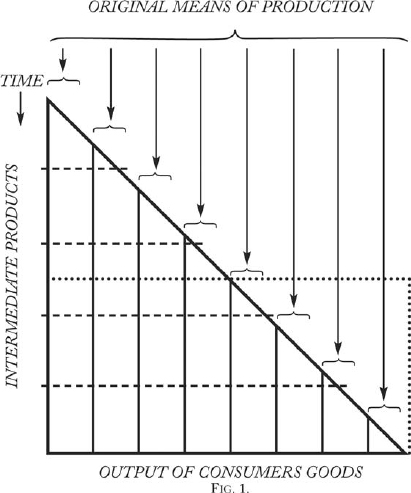
The value of these original means of production is expressed by the horizontal projection of the hypotenuse, while the vertical dimension, measured in arbitrary periods from the top to the bottom, expresses the progress of time, so that the inclination of the line representing the amount of original means of production used means that these original means of production are expended continuously during the whole process of production. The bottom of the triangle represents the value of the current output of consumers’ goods. The area of the triangle thus shows the totality of the successive stages through which the several units of original means of production pass before they become ripe for consumption. It also shows the total amount of intermediate products which must exist at any moment of time in order to secure a continuous output of consumers’ goods. For this reason we may conceive of this diagram not only as representing the successive stages of the production of the output of any given moment of time, but also as representing the processes of production going on simultaneously in a stationary society. To use a happy phrase of J.B. Clark’s, it gives a picture of the “synchronized process of production.”42,43
Now it should be clear without further explanation that the proportion between the amount of intermediate products (represented by the area of the triangle) which is necessary at any moment of time to secure a continuous output of a given quantity of consumers’goods, and the amount of that output,44 must grow with the length of the roundabout process of production. As the average time interval between the application of the original means of production and the completion of the consumers’ goods increases, production becomes more capitalistic, and vice versa. In the case we are contemplating, in which the original means of production are applied at a constant rate throughout the whole process of production, this average time is exactly half as long as the time which elapses between the application of the first unit of original means of production and the completion of the process. Accordingly, the total amount of intermediate products may also be represented by a rectangle half as high as the triangle, as indicated by the dotted line in the diagram. The areas of the two figures are necessarily equal, and it sometimes assists the eye to have a rectangle instead of a triangle when we have to judge the relative magnitude represented by the area of the figure. Furthermore, it should be noticed that, as the figure represents values and not physical production, the surplus return obtained by the roundabout methods of production is not represented in the diagram. In this lecture I have intentionally neglected interest. We shall have to take that into consideration next time; until then we may assume that the intermediate products remain the property of the owners of the original means of production until they have matured into consumers’ goods and are sold to consumers. Interest is then received by the owners of the original means of production together with wages and rent.
(7) A perfectly continuous process of this sort is somewhat unwieldy for theoretical purposes: moreover such an assumption is not perhaps sufficiently realistic. It would be open to us to deal with the difficulties by the aid of higher mathematics. But I, personally, prefer to make it amenable to a simpler method by dividing the continuous process into distinct periods, and by substituting for the concept of a continuous flow the assumption that goods move intermittently in equal intervals from one stage of production to the next. In this way, in my view, the loss in precision is more than compensated by the gain in lucidity.
Probably the simplest method of transforming the picture of the continuous process into a picture of what happens in a given period is to make cross sections through our first figure at intervals corresponding to the periods chosen, and to imagine observers being posted at each of these cross cuts who watch and note down the amount of goods flowing by. If we put these cross sections, as indicated by the broken lines in Fig. 1, at the end of each period, and represent the amount of goods passing these lines of division in a period by a rectangle of corresponding size, we get the new illustration of the same process given in Fig. 2.
It is convenient for the purposes of exposition to count only that part of the total process of production which is completed during one of these periods, as a separate stage of production. Each of the successive shaded blocks in the diagram will then represent the product of the corresponding stage of production as it is passed on to the next while the differences in the length of the successive blocks correspond to the amount of original means of production used in the succeeding stage. The white block at the bottom represents the output of consumers’ goods during the period. In a stationary state, which is still the only state I am considering, this output of consumers’ goods is necessarily equal to the total income from the factors of production used, and is exchanged for this income. The proportion of the white area to the shaded area, in this diagram 40:80 or 1:2, expresses the proportion between the output of consumers’ goods and the output of intermediate products (or between the amount of consumption and the amount of new and renewed investment during any period of time).
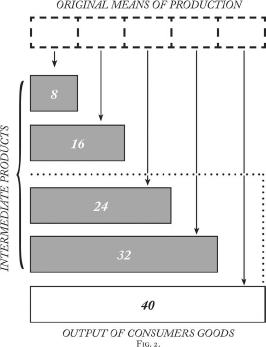
So far, I have used this schematic illustration of the process of production only to represent the movements of goods. It is just as legitimate to use it as an illustration of the movement of money. While goods move downward from the top to the bottom of our diagram, we have to conceive of money moving in the opposite direction, being paid first for consumers’ goods and thence moving upward until, after a varying number of intermediary movements, it is paid out as income to the owners of the factors of production, who in turn use it to buy consumers’ goods. But in order to trace the relation between actual money payments, or the proportional quantities of money used in the different stages of production, and the movements of goods, we need a definite assumption in regard to the division of the total process among different firms, which alone makes an exchange of goods against money necessary. For this does not by any means necessarily coincide with our division into separate stages of production of equal length. I shall begin with the simplest assumption, that these two divisions do coincide, that is to say that goods moving toward consumption do change hands against money in equal intervals which correspond to our unit production periods.
In such a case, the proportion of money spent for consumers’ goods and money spent for intermediate products is equal to the proportion between the total demand for consumers’ goods and the total demand for the intermediate products necessary for their continuous production; and this, in turn, must correspond, in a state of equilibrium, to the proportion between the output of consumers’ goods during a period of time and the output of intermediate products of all earlier stages during the same period. Given the assumptions we are making, all these proportions are accordingly equally expressed by the proportion between the area of the white rectangle and the total shaded area. It will be noticed that the same device of the dotted line as was used in the earlier figure is employed to facilitate the comparison of the two areas. The dotted rectangle shows that, in the kind of production represented by Fig. 2, which actually takes four successive stages, the average length of the roundabout process is only two stages, and the amount of intermediate products is therefore twice as great as the output of customers’ goods.
(8) Now if we adopt this method of approach, certain fundamental facts at once become clear. The first fact which emerges is that the amount of money spent on producers’ goods during any period of time may be far greater than the amount spent for consumers’ goods during the same period. It has been computed, indeed, that in the United States, payments for consumers’ goods amount only to about one-twelfth of the payments made for producers’ goods of all kinds.45 Nevertheless, this fact has not only very often been overlooked, it was even expressly denied by no less an authority than Adam Smith. According to Smith: “The value of goods circulated between the different dealers never can exceed the value of those circulated between dealers and consumers; whatever is bought by the dealer being ultimately destined to be sold to the consumers.”46 This proposition clearly rests upon a mistaken inference from the fact that the total expenditure made in production must be covered by the return from the sale of the ultimate products; but it remained unrefuted, and quite recently in our own day it has formed the foundation of some very erroneous doctrines.47 The solution of the difficulty is, of course, that most goods are exchanged several times against money before they are sold to the consumer, and on the average exactly as many times as often as the total amount spent for producers’ goods is larger than the amount spent for consumers’ goods.
Another point which is of great importance for what follows, and which, while often overlooked in current discussion,48 is quite obvious if we look at our diagram, is the fact that what is generally called the capital equipment of society—the total of intermediate products in our diagram—is not a magnitude which, once it is brought into existence, will necessarily last forever independently of human decisions. Quite the contrary: whether the structure of production remains the same depends entirely upon whether entrepreneurs find it profitable to reinvest the usual proportion of the return from the sale of the product of their respective stages of production in turning out intermediate goods of the same sort. Whether this is profitable, again, depends upon the prices obtained for the product of this particular stage of production on the one hand and on the prices paid for the original means of production and for the intermediate products taken from the preceding stage of production on the other. The continuance of the existing degree of capitalistic organization depends, accordingly, on the prices paid and obtained for the product of each stage of production; and these prices are, therefore, a very real and important factor in determining the direction of production.
The same fundamental fact may be described in a slightly different way. The money stream which the entrepreneur representing any stage of production receives at any given moment is always composed of net income which he may use for consumption without disturbing the existing method of production, and of parts which he must continuously reinvest. But it depends entirely upon him whether he redistributes his total money receipts in the same proportions as before. And the main factor influencing his decisions will be the magnitude of the profits he hopes to derive from the production of his particular intermediate product.
(9) And now at last we are ready to commence to discuss the main problem of this lecture, the problem of how a transition from less to more capitalistic methods of production, or vice versa, is actually brought about, and what conditions must be fulfilled in order that a new equilibrium may be reached. The first question can be answered immediately: a transition to more (or less) capitalistic methods of production will take place if the total demand for producers’ goods (expressed in money) increases (or decreases) relatively to the demand for consumers’ goods. This may come about in one of two ways: either as a result of changes in the volume of voluntary saving (or its opposite), or as a result of a change in the quantity of money which alters the funds at the disposal of the entrepreneurs for the purchase of producers’ goods. Let us first consider the case of changes in voluntary saving, that is, simple shifts of demand between consumers’ goods and producers’ goods.49
As a starting point, we may take the situation depicted in Fig. 2, and suppose that consumers save and invest an amount of money equivalent to one-fourth of their income of one period. We may assume further that these savings are made continuously, exactly as they can be used for building up the new process of production. The proportion of the demand for consumers’ goods to the demand for intermediate products will then ultimately be changed from 40:80 to 30:90, or 1:2 to 1:3. The additional amounts of money available for the purchase of intermediate products must now be so applied that the output of consumers’ goods may be sold for the reduced sum of thirty now available for that purpose. It should now be sufficiently clear that this will only be the case if the average length of the roundabout processes of production and, therefore, in our instance, also the number of successive stages of production, is increased in the same proportion as the demand for intermediate products has increased relatively to the demand for consumers’ goods, i.e., from an average of two to an average of three (or from an actual number of four to an actual number of six) stages of production. When the transition is completed, the structure of production will have changed from that shown in Fig. 2 to the one shown in Fig. 3. (It should be remembered that the relative magnitudes in the two figures are values expressed in money and not physical quantities, that the amount of original means of production used has remained the same, and that the amount of money in circulation and its velocity of circulation are also supposed to remain unchanged.)
If we compare the two diagrams, we see at once that the nature of the change consists in a stretching of the money stream flowing from the consumers’ goods to the original means of production. It has, so to speak, become longer and narrower. Its breadth at the bottom stage, which measures the amount of money spent during a period of time on consumers’ goods and, at the same time, the amount of money received as income in payment for the use of the factors of production, has permanently decreased from forty to thirty. This means that the price of a unit of the factors of production, the total amount of which (if we neglect the increase of capital) has remained the same, will fall in the same proportion, and the price of a unit of consumers’ goods, the output of which has increased as a consequence of the more capitalistic methods of production, will fall in still greater proportion. The amount of money spent in each of the later stages of production has also decreased, while the amount used in the earlier stages has increased, and the total spent on intermediate products has increased also because of the addition of a new stage of production.50
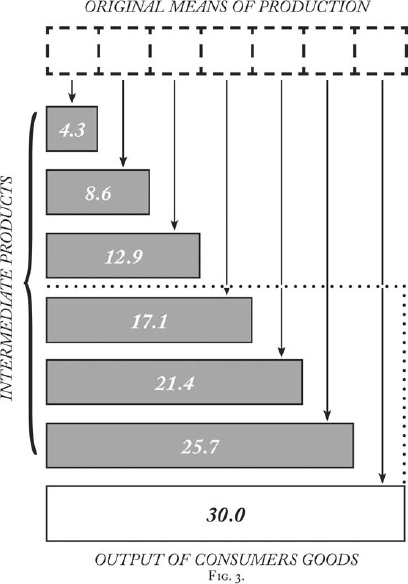
Now it should be clear that to this change in the distribution of the amounts of money spent in the different stages of production there will correspond a similar change in the distribution of the total amount of goods existing at any moment. It should also be clear that the effect thus realized—given the assumptions we are making—is one which fulfills the object of saving and investing, and is identical with the effect which would have been produced if the savings were made in kind instead of in money. Whether it has been brought about in the most expeditious way, and whether the price changes which follow from our assumptions provide a suitable stimulus to the readjustment are not questions with which we need concern ourselves at this juncture. Our present purpose is fulfilled if we have established that, under the assumptions we have made, the initial variation in the proportional demand for consumers’ goods and for intermediate products, respectively, becomes permanent, that a new equilibrium may establish itself on this basis, and that the fact that the amount of money remains unchanged, in spite of the increase of the output of consumers’ goods and of the still greater increase of the total turnover of goods of all kinds and stages, offers no fundamental difficulties to such an increase of production, since total expenditure on the factors of production, or total costs, will still be covered by the sums received out of the sales of consumers’ goods.
But now the question arises: does this remain true if we drop the assumptions that the amount of money remains unchanged and that, during the process of production, the intermediate products are exchanged against money at equal intervals of time?
(10) Let us begin by investigating the effects of a change in the amount of money in circulation. It will be sufficient if we investigate only the case most frequently to be encountered in practice: the case of an increase of money in the form of credits granted to producers. Again we shall find it convenient to start from the situation depicted in Fig. 2 and to suppose that the same change in the proportion between the demand for consumers’ goods and the demand for intermediate products, which in the earlier instance was supposed to be produced by voluntary saving, is now caused by the granting of additional credits to producers. For this purpose, the producers must receive an amount of forty in additional money. As will be seen from Fig. 4, the changes in the structure of production, which will be necessary in order to find employment for the additional means which have become available, will exactly correspond to the changes brought about by saving. The total services of the original means of production will now be expended in six instead of in four periods; the total value of intermediate goods produced in the different stages during a period will have grown to three times instead of twice as large as the value of consumers’ goods produced during the same period; and the output of each stage of production, including the final one, measured in physical units will accordingly be exactly as great as in the case represented in Fig. 3. The only difference at first apparent is that the money values of these goods have grown by one-third compared with the situation depicted in Fig. 3.
There is, however, another and far more important difference which will become apparent only with the lapse of time. When a change in the structure of production was brought about by saving, we were justified in assuming that the changed distribution of demand between consumers’ goods and producers’ goods would remain permanent, since it was the effect of voluntary decisions on the part of individuals. Only because a number of individuals had decided to spend a smaller share of their total money receipts on consumption and a larger share on production was there any change in the structure of production. And since, after the change had been completed, these persons would get a greater proportion of the increased total real income, they would have no reason again to increase the proportion of their money receipts spent for consumption.51 There would accordingly exist no inherent cause for a return to the old proportions.
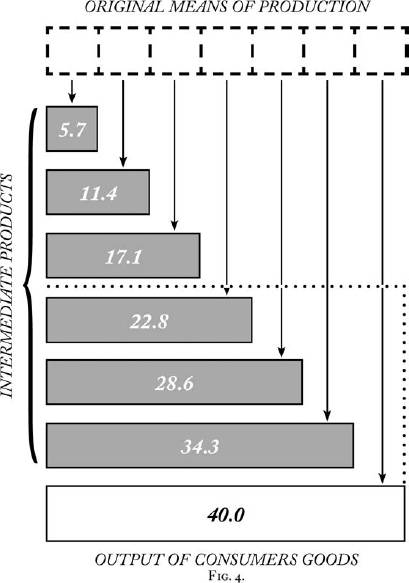
In the same way, in the case we are now considering, the use of a larger proportion of the original means of production for the manufacture of intermediate products can only be brought about by a retrenchment of consumption. But now this sacrifice is not voluntary, and is not made by those who will reap the benefit from the new investments. It is made by consumers in general who, because of the increased competition from the entrepreneurs who have received the additional money, are forced to forgo part of what they used to consume. It comes about not because they want to consume less, but because they get fewer goods for their money income. There can be no doubt that, if their money receipts should rise again, they would immediately attempt to expand consumption to the usual proportion. We shall see in the next lecture why, in time, their receipts will rise as a consequence of the increase of money in circulation. For the moment, let us assume that this happens. But if it does, then at once the money stream will be redistributed between consumptive and productive uses according to the wishes of the individual concerned, and the artificial distribution, due to the injection of the new money, will, partly at any rate, be reversed. If we assume that the old proportions are adhered to, then the structure of production too will have to return to the old proportion, as shown in Fig. 5. That is to say production will become less capitalistic, and that part of the new capital which was sunk in equipment adapted only to the more capitalistic processes will be lost. We shall see in the next lecture that such a transition to less capitalistic methods of production necessarily takes the form of an economic crisis.
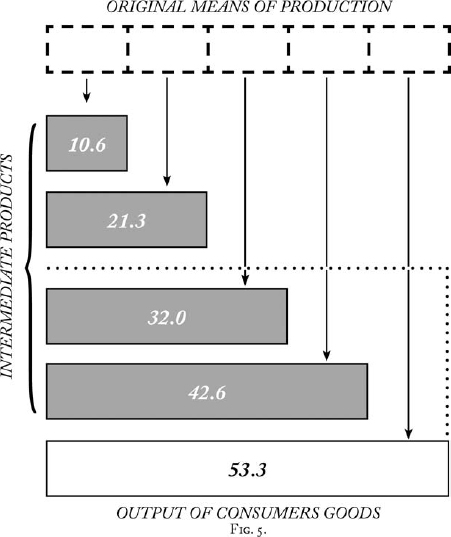
But it is not necessary that the proportion between the demand for consumers’ goods and the demand for intermediate products should return exactly to its former dimensions as soon as the injection of new money ceases. Insofar as the entrepreneurs have already succeeded, with the help of the additional money, in completing the new processes of longer duration,52 they will, perhaps, receive increased money returns for their output, which will put them in a position to continue the new processes, i.e., to expend permanently a larger share of their money receipts upon intermediate products without reducing their own consumption. It is only in consequence of the price changes caused by the increased demand for consumers’ goods that, as we shall see, these processes too become unprofitable.
But for the producers who work on a process where the transition to longer roundabout processes is not yet completed when the amount of money ceases to increase the situation is different. They have spent the additional money which put them in a position to increase their demand for producers’ goods and in consequence it has become consumers’ income; they will, therefore, no longer be able to claim a larger share of the available producers’ goods, and they will accordingly have to abandon the attempt to change over to more capitalistic methods of production.
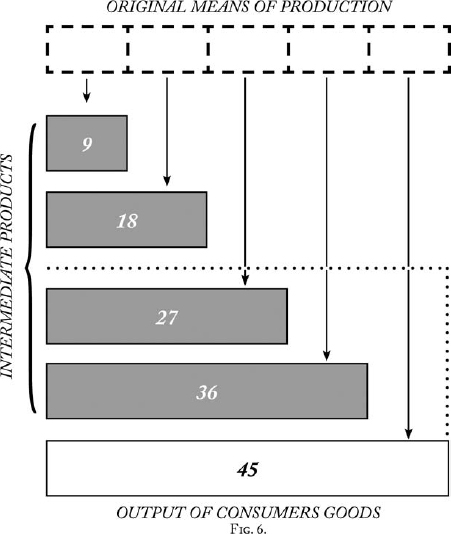
(11) All this becomes easier to follow if we consider the simpler case in which an increase in demand for consumers’ goods of this sort is brought about directly by additional money given to consumers. In recent years, in the United States, Messrs. Foster and Catchings have urged that, in order to make possible the sale of an increased amount of consumers’ goods produced with the help of new savings, consumers must receive a proportionately larger money income. What would happen if their proposals were carried out? If we start with the situation which would establish itself as a consequence of new savings if the amount of money remained unchanged (as shown in Fig. 3), and then assume that consumers receive an additional amount of money sufficient to compensate for the relative increase of the demand for intermediate products caused by the savings (i.e., an amount of 15) and spend it on consumers’ goods, we get a situation in which the proportion between the demand for consumers’ goods, and the demand for producers’ goods, which, in consequence of the new savings, had changed from 40:80 to 30:90 or from 1:2 to 1:3 would again be reduced to 45:90 or 1:2. That this would mean a return to the less capitalistic structure of production which existed before the new savings were made, and that the only effect of such an increase of consumers’ money incomes would be to frustrate the effect of saving follows clearly from Fig. 6. (The difference from the original situation depicted in Fig. 2 is again only a difference in money values and not a difference in the physical quantities of goods produced or in their distribution to the different stages of production.)
(12) It is now time to leave this subject and to pass on to the last problem with which I have to deal in this lecture. I wish now to drop the second of my original assumptions, the assumption, namely, that, during the process of production, the intermediate products are exchanged against money between the firms at successive stages of production in equal intervals. Instead of this very artificial assumption, we may consider two possible alternatives: we may suppose (a) that in any line of production the whole process is completed by a single firm, so that no other money payments take place than the payments for consumers’ goods and the payments for the use of the factors of production: or we may suppose (b) that exchanges of intermediate products take place, but at very irregular intervals, so that in some parts of the process the goods remain for several periods of time in the possession of one and the same firm, while in other parts of the process they are exchanged once or several times during each period.
(13) (a) Let us consider first the case in which the whole process of production in any line of production is completed by a single firm. Once again we may use Fig. 1 to illustrate what happens. In this case the base of the triangle represents the total payments for consumers’ goods and the hypotenuse (or, more correctly, its horizontal projection) represents the amounts of money paid for the original means of production used. No other payments would be made, and any amount of money received from the sale of consumers’goods could immediately be spent for the original means of production. It is of fundamental importance to remember that we can assume only that any single line of production is in this way integrated into one big firm. It would be entirely inappropriate in this connection to suppose that the production of all goods is concentrated in one enterprise. For, if this were the case, of course the manager of this firm could, like the economic dictator of a communistic society, arbitrarily decide what part of the available means of production should be applied to the production of consumers’ goods and what part to the production of producers’ goods. There would exist for him no reason to borrow and, for individuals, no opportunity to invest savings. Only if different firms compete for the available means of production will saving and investing in the ordinary sense of the words take place, and it is therefore such a situation which we must make the starting point of our investigation.
Now, if any of these integrated industries decides to save and invest part of its profits in order to introduce more capitalistic methods of production, it must not immediately pay out the sums saved for the original means of production. As the transition to more capitalistic methods of production means that it will be longer until the consumers’ goods produced by the new process are ready, the firm will need the sums saved to pay wages, etc., during the interval of time between the sale of the last goods produced by the old process, and the getting ready of the first goods produced by the new process. So that, during the whole period of transition, it must pay out less to consumers than it receives in order to be able to bridge the gap at the end of this period, when it has nothing to sell but has to continue to pay wages and rent. Only when the new product comes on the market and there is no need for further saving will it again currently pay out all its receipts.
In this case, therefore, the demand for consumers’ goods, as expressed in money, will be only temporarily reduced, while in the case where the process of production was divided between a number of independent stages of equal length, the reduction of the amount available for the purchase of consumers’ goods was a permanent one. In the present case, the prices of the consumers’ goods will, accordingly, fall only in inverse proportion as their quantity has increased, while the total paid as income for the use of the factors of production will remain the same. These conclusions are, however, only provisional as they do not take account of the relative position of the one firm considered to all other firms which will certainly be affected by a change of relative prices and interest rates which are necessarily connected with such a process. Unfortunately, these influences are too complicated to allow for treatment within the scope of these lectures, and I must ask you, therefore, to suspend judgment upon the ultimate effects of the price changes which will take place under these conditions.
But there is one point to which I must particularly direct your attention. The reason in this case why the unchanged amount of money used in production remains sufficient, in spite of the fact that a larger amount of intermediate products now exists, whereas in the former case, the use of an increased amount of intermediate products required the use of an increased quantity of money is this: in the former case the intermediate products passed from one stage of production to the next by an exchange against money. But in the present case this exchange is replaced by internal barter, which makes money unnecessary. Of course, our division of the continuous process of production into separate stages of equal length is entirely arbitrary: it would be just as natural to divide it into stages of different lengths and then speak of these stages as exhibiting so many more or less instances of internal barter. But the procedure which has been adopted serves to bring out a concept, which I shall need in a later lecture, the concept of the relative volume of the flow of goods during any period of time, as compared with the amount of goods exchanged against money in the same period. If we divide the path traversed by the elements of any good from the first expenditure of original means of production until it gets in the hands of the final consumer into unit periods, and then measure the quantities of goods which pass each of these lines of division during a period of time, we secure a comparatively simple measure of the flow of goods without having recourse to higher mathematics. Thus, we may say that, in the instance we have been considering, money has become more efficient in moving goods, in the sense that a given amount of exchanges against money has now become sufficient to make possible the movement of a greater volume53 of goods than before.
(14) (b) Perhaps this somewhat difficult concept becomes more intelligible if I illustrate it by supposing that two of the independent firms which we have supposed to represent the successive stages of production in our Figs. 2 and 6 are combined into one firm. This is the second of the alternative possibilities I set out to consider. Once this has happened, the passage of the intermediate products from the one to the next stage of production will take place without money payments being necessary, and the flow of goods from the moment they enter the earlier of the two stages until they leave the later will be effected by so much less money. A corresponding amount of money will thus be released and may be used for other purposes. The reverse effect will, of course, be witnessed if the two firms separate again. An increased amount of money payments will be required to effect the same movement of goods and the proportion of money payments to the flow of goods advancing toward consumption will have increased.
(15) Unfortunately, all names which might be used to designate this kind of monetary effectiveness have already been appropriated for designating different concepts of the velocity of money. Until somebody finds a fitting term, therefore, we shall have to speak somewhat clumsily of the proportion between the amount of goods exchanged against money and the total flow of goods or of the proportion of the total movements of goods which is effected by exchange against money.
Now this proportion must on no account be confused with the proportion of the volume of money payments to the physical volume of trade. The proportion I have in mind may remain the same while the volume of trade increases relatively to the total of money payments and the price level falls, if only the same proportion of the total flow of goods is exchanged against money, and it may change though the proportion of the total of money payments to the physical volume of trade remains the same. It is, therefore, not necessarily influenced either by changes in the amount of money or by changes in the physical volume of trade; it depends only upon whether, in certain phases of the process of production, goods do or do not change hands.
So far I have illustrated this concept only by instances from the sphere of production. It may be applied also to the sphere of consumption. Here, too, sometimes a larger and sometimes a smaller share of the total output of consumers’ goods is exchanged for money before it is consumed. Accordingly, here, too, we may speak about the proportion which the total output of consumers’goods in a period of time bears to the output which is sold for money. And this proportion may be different in the different stages of production. But in its effect upon the structure of production, the efficiency of a given amount of money spent in any stage of production (including the last stage—consumption) is determined by the proportion in that stage; and any change in that proportion has the same effects as an alteration in the amount of money spent in this particular stage of production.
So much for the complications which arise when we drop the assumption that production is carried on in independent stages of equal length. It has been necessary to discuss them here at some length in order to clear the way for an investigation, into which I wish to enter in the last lecture, in connection with the arguments for and against an elastic money supply. But for the tasks which I shall have to face tomorrow, it will be expedient again to make use of the simplest assumption and to suppose that production is carried on in independent stages of equal length, as we did in our schematic representations, and that this proportion is not only the same in all stages of production, but also that it remains constant over time.

