
Prices and Production
Capital and Industrial Fluctuations: A Reply to a Criticism
APPENDIX
Capital and Industrial Fluctuations: A Reply to a Criticism84A sympathetic criticism of the kind to which the views of the present author have been subjected by Messrs. Hansen and Tout in a recent issue of Econometrica85 offers a welcome opportunity of clearing up some points upon which I have obviously not yet been sufficiently explicit. The critical comments of the two authors are mostly directed against points where real difficulties present themselves; and while I think I can answer their main objections, it is probable that I can do so more profitably by means of a further systematic development of my thesis than by wasting time on the comparatively unimportant discussion of whether these developments were already implied in my earlier statements, or whether the interpretation put upon these by Messrs. Hansen and Tout can or cannot be justified from the admittedly sketchy and incomplete exposition in the preceding lectures.
Messrs. Hansen and Tout have stated my theory in the following series of propositions:
Thesis Number 1. That depression is brought about by a shrinkage in the structure of production (i.e., a shortening of the capitalistic process). In Hayek’s view, the phenomenon of depression is a shrinkage in the structure of production. Dynamic forces may bring about various effects on economic life, but unless they have the specific effect of shortening the process of production, depression will not follow therefrom. Nor does depression ever assume any other form than that of a shrinkage in the structure of production. In short, depression may be defined as a shortening of the capitalistic process of production.
Thesis Number 2. The leading cause (there are, however, others) which brings about, either directly or indirectly, a shortening in the process of production, is the phenomenon of forced saving.
Thesis Number 3. An elongation of the process of production caused by voluntary saving tends to remain intact; or at least, there is no inherent reason why such an elongation must necessarily be followed by a shrinkage in the structure of production.
An increase in voluntary saving would cause an enlarged demand for producers’ goods in relation to consumers’ goods, and this would raise the prices of goods in the higher stages of production in relation to those of the lower stages. The consequent narrowing of the price margins or, in other words, the lower rate of interest, would thus make possible a permanent elongation of the process of production.
Thesis Number 4. A lengthening of the process of production caused by forced saving (the money supply not having been held neutral) cannot possibly be permanently maintained, but must necessarily be followed by a shortening in the process of production.
An increase in money supply (bank credit) made available to entrepreneurs would cause an increase in the demand for producers’ goods in relation to consumers’ goods, and this would raise the prices of goods of the higher order in relation to those of the lower order. The consequent elongation of the process of production could not, however, be maintained, because a reversal in the price relationship of higher and lower order goods would appear as soon as the money supply ceased to increase owing to the fact that spending and saving habits had not changed. Thus, a shrinkage in the artificially elongated process of production would inevitably occur.
Thesis Number 5. An increase in consumer demand occasioned by an increase in the supply of money (over and above what may be necessary to hold money neutral) inevitably brings about a shortening in the process of production, and so causes depression.
An increased supply of money made available directly to consumers would cause an increase in the demand for consumers’ goods in relation to producers’ goods, and would thus raise the prices of goods of the lower order in relation to those of the higher order, and this would inevitably bring about a shortening in the process of production.
Thesis Number 6. That excessive public expenditures and taxation, by increasing the ratio of spending to saving, will force a shortening in the process of production and so cause prolonged depression or business stagnation.
An increase in spending would cause an increased demand for consumers’ goods in relation to producers’ goods, and this would raise the prices of goods in the lower order in relation to those of the higher order. The consequent widening of the price margins between the lower and higher order goods, or, in other words, a higher rate of interest, would, therefore, bring about a shortening of the process of production.
Thesis Number 7. That the supply of money should be kept constant, except for such increases and decreases as may be necessary (1) to offset changes in the velocity of circulation, (2) to counteract such changes in the coefficient of money transactions as are occasioned by the amalgamation of firms, and the like, and (3) to provide for any changes in non-monetary means of payment, such as book credit, that may be taking place. (A distinction is thus made between a “constant” money supply and a “neutral” money supply.)
Thesis Number 8. That any change in money supply (other than that necessary to hold money neutral) is harmful because it necessarily brings about, eventually, a shortening in the process of production, (a) If the increased money supply goes to entrepreneurs, the process of production is first elongated, but, subsequently, necessarily shortened, returning to its previous status, or to a still shorter process. (b) If the increased money goes first to consumers, the shortening of the process of production takes place at once, and the process remains permanently shortened.
Thesis Number 9. That an increase in production and trade forms no justification for an increase in bank credit.
Thesis Number 10. That a period of depression should not be counteracted by any inflation of the money supply, though, in theory, there is the possibility that during the acute stages of the crisis, while the capitalistic structure is tending to shrink more than will ultimately prove necessary, a nicely regulated increase might prove beneficial. The impossibility of such skilful management makes this an unimportant exception.
I
With one exception, I fully agree that this formulation of my views is a fair and accurate summary of my position. Even the unimportant exception is probably only a slip of the pen, and is satisfactorily cleared up in the later discussion. But, as it may have confused some readers, I should like to emphasize at the outset that I should never say, as stated in thesis number 2, that forced saving can ever directly bring about a shortening of the process of production. Forced saving means essentially a lengthening of the process of production and the crucial point is that, in my view, it is these elongations which are likely to be partly or wholly reversed as soon as the cause of the forced saving disappears.
The first major difficulty which Messrs. Hansen and Tout discuss is connected with what they call my thesis number 1, namely, that the phenomenon of depression is equivalent to a shrinkage of the structure of production. Their difficulty here seems to me to turn on the distinction between a completed and an uncompleted structure, which I have probably failed to make sufficiently clear, and which is closely connected with the distinction between the effects of mere fluctuations in the rate of saving (or, more correctly, in the rate of investment) and the peculiar instability of capital created by means of forced saving. The best way of making these distinctions clear is probably to start with a general discussion of the effects of fluctuations in the means available for investment on the structure of production in general, and on the profitableness of the early stages in particular. From this discussion it will, I think, appear that, contrary to the opinion of Messrs. Hansen and Tout, it is not the mere fluctuations in the rate of investment which tend to make the earlier stages unprofitable but only, on the one hand, particularly violent fluctuations of this sort, and, on the other, fluctuations which make the net investment negative. Finally, concluding this part of the discussion, it will appear that, in the case of “forced savings,” it is not only impossible to keep the rate of investment constant, but that there will exist, as a necessary consequence of the “forced saving,” strong forces which tend to make the rate of investment negative.
II
Any lengthening of the process of production can only be completed over a period of time corresponding to the interval between the moment when the factors which are being shifted to an earlier stage are being invested, and the moment when their product matures. If the new, longer process is to be completed and maintained, this requires not only that the investment in the earlier stage must be constantly maintained, but also (except in a few rare cases, like the aging of wine and the growing of trees) that further complementary investments must be made in the later stages.
From this it follows that, in any progressive society, the particular forms in which investments are being made are determined by the expectation that, for some time to come, a similar stream of funds for investment will be forthcoming; and that, at any moment of time, only a fraction of the funds available for new investment will be used to start new processes, while the rest will be required to complete the processes already under way. On the simplifying assumption that the total length of the marginal processes which are made possible by an increase in the supply of investable funds, is always greater than the total length of any process already used, this situation can be represented by the following diagram. The curvilinear86 triangle ABC represents, in the same way as the triangle I have used in the preceding lectures, the stock of capital belonging to processes already completed. (The area of the curvilinear triangle AB’C’ shows the stock of capital before the additions were begun.) The fully drawn stripes, beginning between C and D, represent incomplete processes started at different moments in the past—and now in different stages of completion. The part of these stripes which is dotted represents the additional investment which is required to complete the processes. During every successive period of investment, part of the fund available will be used to start new processes, part to advance processes which are already under way, and part to complete the most advanced processes.
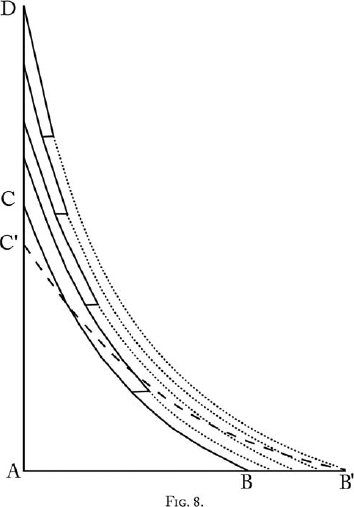
If at any moment savings fall by no more than had previously been used to start new processes, the completion of the processes already under way will not be endangered. And since, at any moment, some of the unfinished processes will be completed, the amount of saving may continually fall off at a certain rate, and may reach zero at the moment when all the processes under way are completed. There is, therefore, at any moment, a maximum rate at which the rate of saving may fall off, without interfering with the new processes already started. It is only when the decrease in saving is faster than this rate, at which the need for capital for the purpose of completing processes under way decreases, that the incomplete structure cannot be completed and some of the investments made in the earlier stages have to be abandoned.
Such an abandonment of early stages will, of course, mean that the average period for which the current supply of original factors is being invested, is shortened even if, at the same time, a good deal of investment in new forms in later stages is taking place. In this case, however, investment in new forms need not mean net investment, since the losses on the abandoned earlier stages have to be offset against it.
III
It is only another way of stating the same conclusions if one says that the total demand for producers’ goods will fall off in consequence of a decrease in the demand for new producers’ goods only if the latter declines faster than the replacement demand increases, in consequence of the preceding growth of the stock of producers’ goods. And this brings me to a discussion of the famous argument according to which any increase in the demand for productive equipment must lead to surplus capacity of plant producing that equipment, as soon as the demand for it ceases to increase. Although this is rarely recognized, this is a typical instance where an expansion of an earlier stage of production can be maintained only if the further increase of capital makes it possible to complete the structure by adequate increases of capital in the later stages.87
From the very outset, it is important in this connection carefully to avoid a confusion which arises from the failure to distinguish between fluctuations in the demand for productive equipment of a particular industry, which arise from fluctuations in the demand for the product of that industry, and fluctuations in the demand for new producers’ goods in general, which are connected with fluctuations in the supply of funds available for new investment. Here I am mainly concerned with the latter type of fluctuation. How far what is to be said about this particular case is also applicable to the former depends upon the degree to which the concrete capital equipment in earlier stages is specialized to the production of equipment for a particular industry, or whether it can be more generally used. On this question of fact, I can only refer to an interesting article which was recently published by Mr. Seltzer,88 who seems to show that the mobility of capital in this sense is far greater than is commonly supposed. Some other considerations on this point can be more appropriately discussed after I have dealt with the first type of fluctuation.
At first, therefore, I shall assume that the increase in investment is due to an increase in the supply of capital, and that the plant required to provide the new equipment is not adapted to the requirements of one industry only, but can be used fairly widely. The question then is whether, on the expectation of a continued growth of capital at about the same rate, it will appear profitable to expand the plant in the industries producing that equipment to a point where any decline in the current supply of new capital will make full use of that plant unprofitable.
The answer to this question is simply this: as long as the supply of capital does not decrease by more than the amount which has so far been used to construct the new plant89 making that equipment, there is no reason why the demand for new equipment should fall off. In other words, the effect of a decrease in saving will simply be that the beginning of new roundabout processes will be stopped but, if the decrease does not exceed a certain rate, there is no reason why the already existing plant should not be continuously used to add to the equipment in later stages. And as the replacement demand due to earlier additions to this equipment will continue to rise, the supply of new savings may even continue to fall at a certain rate without affecting the employment of the plant producing this equipment. The situation is, therefore, completely analogous to the case of fluctuations in the rate of saving already discussed: it need not have any harmful effects, so long as the decline in the rate of saving does not exceed the amount, which will permit the processes already begun to be completed.
IV
The confusion on this point seems to result from a very common mistake—that of applying what is true of a single industry to industry as a whole. While, of course, the relative magnitude of the demand for equipment for a particular industry will depend upon the demand for the product of that industry, it is certainly not true to say that the demand for capital goods in general is directly determined by the magnitude of the demand for consumers’ goods. While it is true that some contemporary economists have come so much under the influence of the under-consumptionist fallacy that they are prepared to say that the savings will never lead to a corresponding increase in investment, because they involve a decline in the demand for consumers’ goods, and are therefore only a harmful and undesirable phenomenon, I certainly need not discuss this with economists who accept as much of my fundamental position as do Messrs. Hansen and Tout. But, if one accepts the proposition that the magnitude of the total demand for producers’ goods is not a simple derivative of the demand for consumers’ goods, but that any given demand for consumers’ goods can lead to methods of production involving very different demands for producers’ goods, and that the particular method of production chosen will depend upon the proportion of the total wealth not required for immediate consumption, then we must certainly take the fluctuations in the supply of free capital, and not the fluctuations in the demand for consumers’ goods, as the starting point for this kind of analysis.
There is, therefore, no reason to suppose that a general increase in the demand for new capital goods, which is due to an increase in the supply of saving, must lead to a decrease in the demand for capital goods, as soon as the rate of saving begins to decline. And since I am still abstracting from the case where investment is financed by the creation of credit (“forced saving”) or any other purely monetary changes, it is difficult to see what factors can affect the total demand for new capital goods, other than the supply of savings. Only if we assume that changes in the rate of interest which can be earned on new capital lead to hoarding or dishoarding, would a new cause of change be introduced. But this is one of the cases of monetary changes in the demand for consumers’ goods which I shall have to discuss later on.
On this point, my argument so far amounts to this: that insofar as we abstract from monetary changes, the demand for consumers’ goods can only change inversely with the demand for producers’ goods, and in consequence, so far from having a cumulative effect in the same direction as the latter, will tend to offset it in the opposite direction.
There is, however, still the case of mere shifts of demand between different kinds of consumers’ goods, which of course will have some effect on the demand for particular kinds of capital goods. An unexpected shift of this kind will undoubtedly have the effect that provision made for the supply of new equipment in the industry from which demand has turned away, will now prove excessive or, in other words, it will now become unprofitable to complete the longer processes in the expected way. But the total demand for new equipment will not be changed, and whether the equipment-producing plant already in existence will continue to be used or whether a new plant will have to be built, will depend upon the technical considerations already mentioned.
V
So much for the pure or barter theory of the subject (in the sense of the usual assumption of theory that money exists to facilitate exchange but exercises no determining influence on the course of things or, in other words, remains neutral—an assumption which is almost always made though not expressed in these terms). The discussion of the active influence which may be exercised by money in this connection is best begun with the peculiar effect of forced savings, which will lead us to another of the points of discussion, namely, the effect of monetary changes on the demand for consumers’ goods. For the peculiar characteristic of forced saving, which distinguishes its effects from those of voluntary saving, is simply that it leads necessarily to an increase in the means available for the purchase of consumers’ goods. For this reason, my thesis number 4 about the impermanence of capital accumulated by forced saving is directly bound up with my thesis number 5 as to the effects of a direct increase in the monetary demand for consumers’ goods, which Messrs. Hansen and Tout, quite consistently, also reject.
The reason why forced saving will always lead to a subsequent increase in the money available for the purchase of consumers’ goods, is fairly obvious and will probably not be contested. Entrepreneurs are in this case enabled to attract factors of production from later to earlier stages, not by a corresponding transfer of funds from consumers’ to producers’ goods, but by additional money handed to them. This means that they will bid up the prices of these factors without there being a corresponding fall in the prices of other factors. Total money income will therefore increase, and this increase will in turn lead to an increase in the amount of money expended on consumers’ goods. This increase in the expenditure on consumers’ goods will necessarily follow in time upon the increase in the demand for factors. This lag will mean that, for some time after the demand for factors (or producers’ goods) has ceased to increase (or when its rate of increase begins to slow down), the demand for consumers’ goods will continue to increase at a faster rate; and so long as the increase in the demand for producers’ goods is slowing down—and for some time afterwards—the monetary proportion between the demand for producers’ goods and the demand for consumers’ goods will change in favor of the latter.
The question turns, therefore, upon the effect of such a relative increase in the monetary demand for consumers’ goods. The reply, in the particular case in question, however, is simplified, in comparison with the general problem, because, on our assumptions, two relevant points are given. We have in this particular case to assume that: (a) since it is the situation at the end of a boom, there are no unemployed resources, and (b) since the rate of credit expansion for productive purposes tends to be slowed down in spite of a continued rise in the monetary demand for consumers’ goods, we cannot assume that the continued rise in this demand will lead to a renewed credit expansion. The much more difficult case of an increase in the monetary demand for consumers’ goods, where these assumptions do not necessarily hold, as well as the problem why the rate of credit expansion cannot be sufficiently high to avoid this type of reaction, will be considered later on.
The relative rise in the price of consumers’ goods will not only improve the competitive position of their producers on the market for original factors, but will also make it profitable for these to increase their output by the more rapid, even if more expensive, method of employing relatively more labor (original factors) in proportion to capital. And while their demand for all the nonspecific factors of production (which can also be used in the latest stages of production) will continue to drive up the prices of these factors, the prices of the intermediate products specific to earlier stages of production will tend to fall relatively to their costs. And since the effect of this will not only tend to increase cumulatively toward the earlier stages but will also cause a shift of free capital toward the more profitable earlier stages, it is easy to see how more and more of the earlier stages will tend to become unprofitable, until unemployment finally arises and leads to a fall in the prices of the original factors of production as well as in the prices of consumers’ goods.
VI
Before I turn to the aspects of the situation where unemployed factors and unused lending capacity of all banks exist, and where perhaps delay in making the necessary adjustments has led to prolonged unprofitability causing deflation and a rapid general fall of prices, a little more must be said about the rate of credit expansion which would have to continue uninterruptedly if a reaction of the kind just discussed is to be avoided.
Hansen and Tout merely speak of a steady rate of credit expansion as a sufficient condition for a continuous and undisturbed rate of capital growth. I am not quite sure what “steady” means in this context. But if it refers, as is probably the case, to a constant rate of increase in the total media of circulation, I think it can be shown that this is not sufficient to maintain a constant rate of forced saving; while it seems that any attempt to make the rate of credit expansion great enough to secure a constant rate of forced saving will inevitably be frustrated by counteracting forces which come into operation as soon as the process of inflation exceeds a certain speed.
A constant rate of forced saving (i.e., investment in excess of voluntary saving) requires a rate of credit expansion which will enable the producers of intermediate products, during each successive unit of time, to compete successfully with the producers of consumers’ goods90 for constant additional quantities of the original factors of production. But as the competing demand from the producers of consumers’ goods rises (in terms of money) in consequence of, and in proportion to, the preceding increase of expenditure on the factors of production (income), an increase of credit which is to enable the producers of intermediate products to attract additional original factors, will have to be, not only absolutely but even relatively, greater than the last increase which is now reflected in the increased demand for consumers’ goods. Even in order to attract only as great a proportion of the original factors, i.e., in order merely to maintain the already existing capital, every new increase would have to be proportional to the last increase, i.e., credit would have to expand progressively at a constant rate. But in order to bring about constant additions to capital, it would have to do more: it would have to increase at a constantly increasing rate. The rate at which this rate of increase must increase would be dependent upon the time lag between the first expenditure of the additional money on the factors of production and the re-expenditure of the income so created on consumers’ goods.
It is true that in the preceding lectures I have not only discussed in detail what rate of credit expansion is required to maintain a given rate of forced saving, but have simply assumed that that rate—whatever it was—could not be permanently maintained for institutional reasons, such as traditional banking policies or the operation of the gold standard. But I think it can be shown without great difficulty that even if these obstacles to credit expansion were absent, such a policy would, sooner or later, inevitably lead to a rapid and progressive rise in prices which, in addition to its other undesirable effects, would set up movements which would soon counteract, and finally more than offset, the “forced saving.”
That it is impossible, either for a simple progressive increase of credit which only helps to maintain, and does not add to, the already existing “forced saving,” or for an increase in credit at an increasing rate, to continue for a considerable time without causing a rise in prices, results from the fact that in neither case have we reason to assume that the increase in the supply of consumers’ goods will keep pace with the increase in the flow of money coming on to the market for consumers’ goods. Insofar as, in the second case, the credit expansion leads to an ultimate increase in the output of consumers’ goods, this increase will lag considerably and increasingly (as the period of production increases) behind the increase in the demand for them. But whether the prices of consumers’ goods will rise faster or slower, all other prices, and particularly the prices of the original factors of production, will rise even faster. It is only a question of time when this general and progressive rise of prices becomes very rapid. My argument is not that such a development is inevitable once a policy of credit expansion is embarked upon, but that it has to be carried to that point if a certain result—a constant rate of forced saving, or maintenance without the help of voluntary saving of capital accumulated by forced saving—is to be achieved.
Once this stage is reached, such a policy will soon begin to defeat its own ends. While the mechanism of forced saving continues to operate, the general rise in prices will make it increasingly more difficult, and finally practically impossible, for entrepreneurs to maintain their existing capital intact. Paper profits will be computed and consumed, the failure to reproduce the existing capital will become quantitatively more and more important, and will finally exceed the additions made by forced saving.
It is important in this connection to remember that the entrepreneur necessarily and inevitably thinks of his capital in terms of money, and that, under changing conditions, he has no other way of thinking of its quantity than in value terms, which practically means in terms of money. But even if, for a time, he resists the temptation of paper profits (and experience teaches us that this is extremely unlikely) and computes his costs in terms of some index number, the rate of depreciation has only to become fast enough, and such an expedient will be ineffective. And since the gist of my argument is that, for the purpose under discussion, the rate of credit expansion and depreciation has to increase at an increasing rate, it will in time reach any desired magnitude.
VII
For these reasons, it seems to me that the hope of Messrs. Hansen and Tout based on a steady rate of forced saving is illusory. Whether there may not exist conditions under which temporary forced saving may take place without the evil consequences of a crisis, is quite another matter. That this will be possible only if the rate of forced saving is comparatively small, is probably obvious. Another condition which we already know is that the fluctuations in investment to which it gives rise keep well within the limits we have described. In another place,91 I have tried to show that, if these conditions are combined with a third, namely, the presence of a relatively high rate of voluntary saving, which provides the means of taking over, as it were, the real capital which has been created but cannot be maintained by means of forced saving, the loss of this capital may be avoided. But in this case, the only one I know where such a loss will be avoided, the forced saving will only mean an anticipation but no net increase of the circulation of capital, because it can only be maintained if an equivalent amount of saving is to be forthcoming later. For this reason, I am even more doubtful than before whether forced saving can ever be a blessing as Messrs. Hansen and Tout think. This is quite irrespective of the question whether there is any sense in which the economist can legitimately say (as I have occasionally said myself) that such decisions made against the will of those concerned may be “beneficial.” But that touches the much wider problem of whether we possess any gauge by which to measure the satisfaction derived by those concerned, except their own preferences, shown in their decisions—a question which I cannot even begin to discuss here.
8
It will be impossible within the compass of this article to discuss the further points made by Messrs. Hansen and Tout in the same orbit as those more fundamental problems already taken up. Particularly, the next and very important point as to the effect of an expansion of consumers’ demand at a time when the productive forces are not fully employed, and banks are in a position to expand credits to producers, could be answered completely only in connection with a fully developed theory of the process going on during a depression. But, if it be assumed that these two conditions exist as a consequence of a preceding crisis (and a definite assumption as regards the reason why these conditions exist is essential for any answer), and if the explanation of the crisis which I have just discussed is accepted, it is difficult to see how the same phenomenon, which has brought about the crisis, i.e., the rise in the relative demand for consumers’ goods, should also be the cure for it. The scarcity of capital, which, of course, is nothing else but the relatively high price of consumers’ goods, could only be enhanced by giving the consumers more money to spend on final products. At least so long as there are no further monetary complications, particularly so long as it is not assumed that the expectation of a further fall in prices has led to hoarding, I see no way of getting over this difficulty. But before I proceed to the relation between these secondary monetary complications, and the underlying real maladjustments which have caused it, I must try to clear away what seems to me to be a confusion which has led Messrs. Hansen and Tout to apply their denial of the capital-destroying effect of additions to consumers’ credits not only to the peculiar situation of an advanced depression but also generally.
The essence of the confusion on this point seems to me to lie in the contrast which my critics try to establish in several places between what they call “nominal” changes in the relative monetary demand for consumers’ goods and producers’ goods, and the “real changes in the demand for consumers’ goods occasioned by a fundamental modification in time preference for present and future goods.” It seems to me that to assume that this rate of time preference can have any effect other than through the relative demand for these two classes of goods, or can have any immediate effects different from those of any other cause affecting that relative demand, is an attempt to establish a purely mystical connection. The mere fact that even without a monetary change, any change in the distribution of the command over existing resources will under a given set of individual time preferences lead to quite different proportions between capital and income, should suffice to make this quite clear.92
Nor can I see how the two authors can combine their acceptance of the idea that forced saving can be brought about by monetary causes, without a change in the rate of time preference, with a general denial that monetary causes may also lead to “forced dis-saving.” In principle, any change in the relative demand for the two categories of goods, whether brought about by actual shifts of monetary demand from one to the other, or merely by unilateral increases or decreases without corresponding changes on the other side, will tend to lead to corresponding changes in the relative amounts produced. The differences between these two cases (a shift and a unilateral change) are, first, that the shift of an amount of money from the demand for consumers’ goods to the demand for producers’ goods changes the proportion between the two much more effectively than a mere unilateral increase or decrease by the same amount; and, second, that the changes in the quantity of money, which are implied in the second type of change, will lead to further changes which may counteract or offset the tendency created by the change in relative demand. This will be particularly true if a change in relative demand is accompanied by an absolute reduction in demand and if, at the same time, costs (i.e., the prices of the original factors of production) are rigid. In this case, deflationary tendencies are likely to set in, which may more than counterbalance the effect of the changed relative demand. But, in spite of these further complications which seem likely to arise, the principle seems to me to be true, and to comprise even what seems to Messrs. Hansen and Tout a reductio ad absurdum of the argument, namely that a unilateral decrease in the demand for consumers’ goods may lead to a lengthening of the structure of production. Although I fully admit that, because of the probable complications, this case is very unlikely to materialize, I do not think that it is entirely impractical. Would Messrs. Hansen and Tout deny that, e.g., increased hoarding on the part of a class of very small rentiers who reduced their consumption of agricultural products, might not lead, via the reduction of wages, first in agriculture and then generally, to an increase in the real quantity of labor corresponding to a constant amount of money invested in industry, and therefore of capital?
IX
The analysis of this and similar cases would help to bring out an important distinction which Messrs. Hansen and Tout tend to overlook: the distinction between the tendencies set up directly by a given monetary change, and the effects of the further monetary changes which may, and perhaps even probably will, but need not, be induced by this first change. A sharp dividing line is the more necessary here since the tendency in current discussions is either to take these secondary monetary changes for granted, without ever mentioning them, or to fail to demonstrate why, and under what conditions, they should follow the first change.
These considerations bring me back to the problem of the relation between the demand for consumers’ goods and the prices of capital goods. I should not deny that there may be conditions where, e.g., the expectation of a general price fall has led to extensive hoarding, and where any change in this expectation may lead to such dishoarding of funds available for investment as to outbalance the initial effect of the increase in the demand for consumers’ goods.93 Nor is it inconceivable that a similar situation may prevail as regards bank lending. There can also be no doubt that, in connection with these secondary monetary complications, general price movements, apart from the changes in relative prices, will be of the greatest importance, and that anything which stops or reverses the general price movement may lead to induced monetary changes, the effect of which on the demand for consumers’ goods, and producers’ goods, may be stronger than the initial change in the quantity of money.
But one has to be careful not to fall into the error apparently made by Messrs. Hansen and Tout—that of assuming that, in all cases, where the prices of consumers’ goods and producers’ goods move in the same direction (e.g., upward), this may not be accompanied by changes in their relative height, which would produce exactly the same effect as if there were no general price movement. Their general proposition that changes in the relative prices of consumers’ goods and producers’ goods will not have the same effect when they are accompanied by a universal movement in the same direction as when they find expression in an absolute movement in different direction, is only true under the following assumptions: (1) that the expected general price movement is relatively great compared with the relative price changes; (2) that, at the same time, the general movement does not exceed the limits beyond which—as experience has shown at least in cases of considerable inflation—costs begin to move more rapidly than prices; (3) that money rates of interest do not adapt themselves to the expected rate of general price change.94
Further, it is necessary to be careful to make clear the special assumptions under which these further complications are likely to arise. The deflationary tendencies, which are assumed to exist in most of the reasoning of the kind discussed, are not a necessary consequence of any crisis and depression, but are probably due to resistances to the necessary readjustments, caused by rigidity of prices, the existence of long term contracts, etc., I am far from underrating the importance of these phenomena. What I am pleading for is only that, for analytical purposes, these tendencies should carefully be kept separate and not confused with one another. Only in this way can we hope ultimately to unravel the tangle of different forces at work during a depression, and to arrive at that detailed explanation of the depression which I cannot even attempt here. But to deny the existence of certain tendencies merely because they are likely to be counteracted by others, does not seem to me to be a promising procedure.
X
The objections raised by Messrs. Hansen and Tout to what they call my theses 7, 8, 9, and 10, are partly based on arguments which I have already discussed and partly introduce further complications which any program of practical policy has to face and which I admit I have not investigated sufficiently. But it is obviously impossible to develop my ideas further, in this connection, or to try to make good these deficiencies here.
There are only two more points upon which I wish to touch. The first is that the concept of neutral money was meant in the first place to be an instrument of theoretical analysis and not necessarily a tool of practical policy. Its purpose was to bring out clearly the conditions under which we could expect the economic process in a money economy to correspond perfectly to the picture drawn by the theory of equilibrium and, incidentally, to show what we should have to consider as the peculiar active effects caused by monetary changes. In a sense, of course, this would also set up an ideal of policy. But it is by no means inconceivable that considerations other than the direct monetary influences on prices, such as the existence of long term contracts in fixed sums of money, the rigidity of prices, and such like institutional factors, may make such an attempt entirely impracticable, because it would set up frictions of a new kind. In that case, the task of monetary policy would be to find a workable compromise between the different incompatible aims. But, in this case, one would have to be clear that certain important determining and disturbing influences arising from monetary causes would remain in existence, and that we should always have to remain conscious of this fact. Or, in other words, that even under the best practicable monetary system, the self-equilibrating mechanism of prices might be seriously disturbed by monetary causes.
The second point is that up to 1927, I should indeed have expected that—because during the preceding boom period prices did not rise but rather tended to fall—the subsequent depression would be very mild.
But, as is well known, in that year an entirely unprecedented action was taken by the American monetary authorities, which makes it impossible to compare the effects of the boom on the subsequent depression with any previous experience. The authorities succeeded, by means of an easy-money policy, inaugurated as soon as the symptoms of an impending reaction were noticed, in prolonging the boom for two years beyond what would otherwise have been its natural end. And when the crisis finally occurred, for almost two more years, deliberate attempts were made to prevent, by all conceivable means, the normal process of liquidation. It seems to me that these facts have had a far greater influence on the character of the depression than the developments up to 1927, which from all we know, might instead have led to a comparatively mild depression in and after 1927.

