
The Menace of the Herd, or Procrustes at Large
Part Iii
A) The Germanies B) The United States
I
THE GERMAN SCENE
Spiritual interests were here concerned. Neither Dante (nor Nicholas of Cusa) envisaged an absolute monarchy in the terms of James I or Louis XIV. Dante says: Upright governments have liberty as their aim, that men may live for themselves; citizens do not exist for the sake of the consuls, nor a people for a king, but conversely consuls for the sake of citizens and a king for his people (De Monarchia, I, 12). Nicholas of Cusa takes the same stand. Tyranny was abhorrent to both of them.
Yet just as the Pope was not a purely spiritual ruler the office of the Holy Roman Emperor had also its spiritual aspects. The Church has never officially abolished the prayer in the Good Friday “Mass” for the Holy Roman Emperor, a prayer, which would also be found in missals printed in the United States, China, or Ireland. It runs as follows:
“Let us also pray for our Most Christian Emperor N.N. that God, Our Lord may give him power over all barbaric nations so that we may live in peace.
“All powerful, eternal God, in thy hands are the powers of all and the laws of all kingdoms; look down with benevolence on the Roman Empire so that the Heathens confident in their violence may be suppressed by Thy right hand.”
The legal as well as the physical descendant of the Roman Emperors is Otto, Archduke of Austria.
Another revindication of the universal and all-European character of the Germanies can be found in Constantin Frantz’ Deutschland und der Föderalismus (Stuttgart-Berlin, 1921), the great standard work of German anti-centralism. Frantz emphasized not unduly the absolute interconnection of German inner politics (and the structural struggles of the Germanies) with the fate of the rest of Europe. This interdependence, he writes, has “been demonstrated by history ad nauseam.” The events after 1933 (and specially after 1938) have not disproved the views of the Great Seer.
“Reason is directly opposed to faith and one ought to let it be; in believers it should be killed and buried” (Erlanger Ausgabe, XLIV, 158).
“You must abandon your reason, know nothing of it, annihilate it completely or you will never enter heaven. You must leave reason to itself, for it is the born enemy of faith. . . .
“There is nothing so contrary to faith as law and reason. You must conquer them if you would reach beatitude” (Tischreden. Weimarer Ausgabe, VI, 6718).
“So the Bohemian should be a relative of the Prussian? — Yes, that is so. Masaryk can go on anathemizing the Prussian, can go on condemning and discarding the Prussian Spirit and Prussian way of thinking. The East-Elbian Prussian is blood of his blood and even in his innermost being very nearly related to him.” — Rudolf Nadolny, Germanisierung Oder Slawisierung (Berlin: 1928), Otto Stollberg Verlag, pp. 203–204.
“The Huguenots, already in the first generation presented 14.4 per cent of the government officials (not counting employees) and in the second generation 22.5 per cent. This increase continued. . . . In the sphere of defense an influence can therefore hardly be denied. Generally this influence was unavoidable — the Huguenots soon formed one third of the Prussian officers corps.” The descendants of these Huguenots, he adds, today number several millions. Frederick the Great alludes to their part in transforming Prussia into a commercial-industrial-bureaucratic state (cf. his Denkwürdigkeiten).
Werner Hegemann writes in Entlarvte Geschichte: “It was Luther who turned the princes into popes and made coarse tools for the state out of the delicate bonds of religion” and later: “Luther declared: Authorities have been given by God the power to drive, beat, throttle, hang, burn, behead and torture the mob in order to be feared. As pigs and wild animals have to be driven and forced so authority has to enforce the fulfillment of its laws.”
Treitschke wrote in Historische und Politische Aufsätze (Dresden, 1933): “The immoral teaching of long-suffering obedience sucked the marrow of will from the bones of the Lutherans.” Which is not surprising if we remember how Luther worshiped princely authority when he wrote in his notorious: Wider the räuberischen und mörderischen Rotten der Bauern (“Against the robbing and murderous hords of the peasants”): “So strange are these times that a prince can gain heaven by shedding blood more than by praying.”
These words could have been written on June 30, 1934, by the Völkischer Beobachter.
“We Germans, regarding ourselves as a people, could derive little pleasure from this king, none has done us so much harm not only apparently but in reality.” — Ernst Moritz Arndt, Geist der Zeit.
The conservative Prussian Constantin Frantz was deeply shocked and perturbed by Bismarck’s policy. He wrote in his Abfertigung der nationalliberalen Presse nebst einer höchst nöthigen Belehrung über den Ultramontanismus (Leipzig, 1873, pp. 54–55) that never has so fatal a blow been dealt against the monarchical principle since 1789 as the Prussian action of 1866. Its consequences, he prophesized, would first be felt in Germany, but later in the whole world.
An excellent modern book on this subject is S. D. Stirk, The Prussian Spirit, London, 1941.
German centralism and herdism generated and enforced by the French Revolution slowly crushed German personalism and federalism, which were after all closely interrelated manifestations of the traditional German spirit. Says Denis de Rougemont in an article “Gedanken über den Föderalismus” in the Swiss bimonthly Mass und Wert (Zürich, March-April, 1940): “The Philosophy of the ‘Person’ is the only one which can be taken seriously into consideration by the federalist idea. . . . Both, individualism and collectivism, result finally in the adoption and veneration of the centralistic Einheitsstaat (uniformistic State). . . . If one lets the masses act as masses then they will inevitably establish totalitarian systems. But ‘persons’ (such as we have defined them) will necessarily favor the federalistic types of political organizations.”
The connection between Catholicism, Federalism (in the European sense which has a connotation opposite to the American concept) and the Habsburgian tradition in the Germanies, is set forth in the book of the German Socialist Dr. Arthur Rosenberg, Die Entstehung der Deutschen Republik, 1871–1918, Berlin, 1930, pp. 18–20. (Trans, by Ian Morrow, London-New York, 1931.)
Uniformity is postulated by Hitler in Mein Kampf (Munich, 1939, p. 44) and attacked by Donoso Cortés in his Oeuvres (III, Paris, 1858, p. 540).
See also the connection between anticentralism and monarchism in France under the third republic as described by Carlton J. H. Hayes, A Generation of Materialism (New York, 1941, pp. 279, 280).
“Therefore the centralization of economic and political forces which absorbs local life and develops in the wake of the doctrinary liberal policy can hardly lead to a healthy national and liberal life.”
From the Manifesto of the Prussian Conservatives, 1856, contained in Grundzüge der konservativen Politik, Berlin, 1856.
175 Cf. Liberal centralism is well described by Carlton J. H. Hayes in his A Generation of Materialism, New York, 1941, pp. 82–83.
“But the foundation stone of the Second Reich was laid by frenchified princelets, accepting French subsidies, and stolid, merry petits bourgeois who for the sake of practical advantages broke up German unity. The Second Reich could not boast of Nördlingen, Zenta, St. Gotthard or Aspern, it only had the shame of Königgätz and the tragedy of the Marne. The Second Reich had an Emperor who allowed his hands to be kissed while Francis Joseph washed the feet of twelve old beggars every Maundy Thursday. The Second Reich had no minstrels, no Nibelungen saga, no Rembrandt or Angelus Silesius, it only had Wildenbruch, Sudermann, flannel underwear and leg-of-mutton sleeves. It had no Roswitha von Gandersheim, Abraham a Sancta Clara, no Seuse, no Tauler, Albertus Magnus or Eckehardt, no mysticism and no depth — it was a country of commercial advisers, banks, barracks, stickups and the Hofbräu-style, it was ungodly and dusty, un-German and middle-class, tense and trashy to the nth degree. For culture can only be born from the whole, not from the partial, divided and heretical lumps; whatever German culture there is has grown inside or very near to the Church. Even Schiller and Goethe, Wagner and Bach, Lucas Cranach and Max Scheler worked in the shadow of the Church. The German spirit is occidental, the occidental spirit is Catholic — everything else is an imposture on German culture.”
We have seen clearly what sort of decision National Socialism made. The Nazi character of the Weimar Republic has been clearly recognized by Sir Charles Petrie who writes: “As for the Treaty of Versailles itself, one of its greatest weaknesses was that the Allies, in opposition to their own interests, carried the work of Bismarck to its logical conclusion and completed the unification of Germany. The strongest centrifugal force which ruled the various kingdoms and duchies, and which were always restive under the tutelage of Berlin were the local dynasties; yet, as we have seen, the German people were deliberately encouraged to overthrow their ruling houses, to many of which they were deeply attached, as the price of peace, and so the last obstacle to a unified Reich was removed by those most concerned in its retention. Once the dynasties had gone there was no reason for the continued existence of their former dominions as separate units, and so the way was cleared for that complete Prussianization of Germany, which was to be the outstanding accomplishment of the Nazi regime.” — Twenty Years’ Armistice and After, London, 1940, p. 21.
That the nineteenth century with its “progressive” ideas wrought havoc in the Germanies is also admitted by Peter Viereck who accuses nationalism and capitalism for the decadence and suicide of true German culture. He writes: “Under these 360 semi-independent princelings [of the Holy Roman Empire in 1806] life was easy-going, static, unadventurous. A cultured aristocracy flourished with gentlemanly inefficiency. The economic standards of living were low from our viewpoint, but really high compared with those of the earlier seventeenth century. From this mellow atmosphere, so rich with accumulated tradition, ripened the very finest fruits of German culture. Even the pettiest courts vied at attracting creative intellects. The court of the tiny Duchy of Weimar was simultaneously graced by Goethe, Schiller, Wieland, Jean Paul, and Herder. This is more cultural greatness in a feeble state of a few square miles than the whole modern German state and most modern power states can boast.
“This fruitful but overripe culture was the product of the creative idleness of upper-middle-class humanists dependent on aristocratic patronage from above. The patronage was forthcoming because some of the courts — enough of them to keep any Goethe or Humboldt from being slave to economic needs — were models of taste and urbane discrimination. All this was swept away by the awakening of nationalism and capitalism in the new bourgeoisie. The Germanies, the land of musicians and poets, was step by step replaced by a unified centralized Germany, a land of far greater political power and far greater economic prosperity and yet in one sense far less great.” — Peter Viereck, Metapolitics, New York, 1941, pp. 54–55.
There is a Nazi version to that in the vision of Die Nacht der langen Messer.
Cf. Robert Michels, Zur Soziologie des Parteiwesens in der Modernen Democratie, Leipzig, 1911, p. 86.
Needless to say that the “leader” is not a trained expert.
“Now, apparently, many men are again feeling homesick for the herd. They devote themselves passionately to whatever there is left in them of the sheep. They want to march through life together, along the collective path, shoulder to shoulder, wool rubbing wool, and the head down. This is the reason why so many European peoples are looking for a shepherd and a sheep dog.” — José Ortega y Gasset, Invertebrate Spain (Amer. edit.), trans, by Mildred Adams, New York, 1937, p. 170.
Further reference material:
On the German Soul:
Baron Friedrich von Hügel, LL.D., The German Soul and the Great War, reprint from The Quest, Vol. I, No. 3, April, 1915.
Bogislaw von Selchow, Der unendliche Kreis, Leipzig, 1935, pp. 342–343.
The National Socialists and the First Reich:
Alfred Rosenberg, “Gegen Warnung und Fälschung” in Der Völkische Beobachter, Dec. 8, 1933.
On Luther and Free Will:
Martin Luther, De Servo Arbitrio.
The Lutheran Cyclopaedia, New York, 1899, pp. 186-187.
On the spirit of the Holy Roman Empire:
Ricarda Huch, Stein, der Erwecker des Reichsgedankens, Berlin, 1932, pp. 5–9.
On German Conservativism:
See the depressingly optimistic article in the Ring (Prussian, ultraconservative weekly) from January 6, 1933, entitled: “The Victory of Prussian Conservativism over the Hitler Movement.”
The number of December 8, 1932, carries a long advertisement of the Schocken Publishing Cömpany, specialized in Jewish religious books.
On Frederick II of Prussia:
See the two brilliant books of Werner Hegemann: Fredericus oder das Königsopfer and Das Jugendbuch des grossen Königs (Both, Dresden, Jacob Hegner).
On Dr. Brüning’s efforts to restore the monarchy in Germany:
John J. Wheeler-Bennett, Hindenburg, the Wooden Titan, London, 1936, pp. 339, 335–368.
II
NATIONAL SOCIALISM
“Since 1689 we have had, for all effective purposes, a single party in control of the state. It has been divided, no doubt, into two wings. It has differed within itself upon matters like the pace of change and the direction of change. Its quarrels . . . have always, so to say, been family quarrels in which there has been ample room for compromise. . . . Members of either wing could cross to the other without any alteration of the fundamental doctrine.” — Harold Laski, op. cit., p. 83.
184 The situation in America is similar yet the conditions on the Continent are radically different.
“In order to have a parliamentary government the supposition is that the parties, in spite of their differences, are quite closely related. In America this is true of the democratic and republican parties. As the two names show, there is no essential difference between them. The one is more unionistic, the other more federalistic. In England we have the Whigs and the Tories, now called the Liberals and the Conservatives. The differences are so slight that very frequently one party has adopted a plank from the other party platform. Both parties together once banished the Stuart kings and the election reform of 1867 was made by the Conservatives. Such parties can easily alternate in the administration of the state without throwing it out of equilibrium.
“It is not possible, however, to have parties alternate which are so diametrically opposed to one another that the one is monarchical and the other republican. If France were again to have a monarchically disposed majority which should reintroduce a kingdom, and then after a succession of years a republican majority should come and introduce a republic again, and so on in changing alternations, the state would be ruined.” — Hans Delbrück, Government and the Will of the People, trans. by Roy S. MacElwee (New York: Oxford U. Press, 1923), p. 101.
ELECTIONS FOR THE REICHSTAG
(Representatives: One for 60,000 Votes)
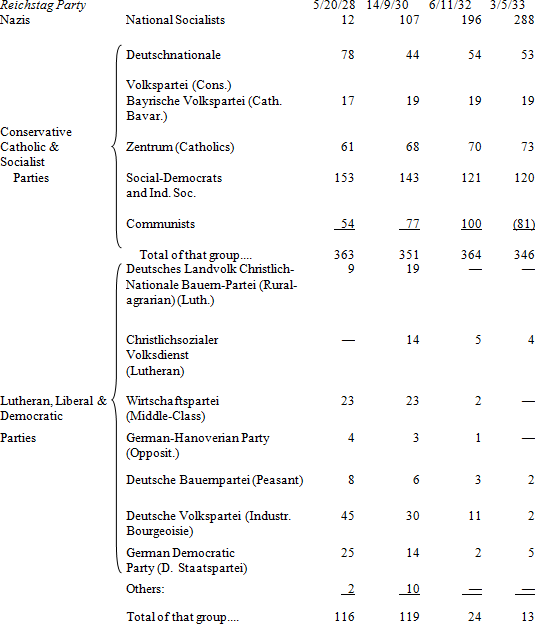
This tabulation makes it quite evident that the large bulk of the democratic and liberal voters became successively National Socialists while the other non-Nazi parties were able to preserve the loyalty of their voters as late as March, 1933. The downfall of German parties was prophesied by Constantin Frantz in his Die Quelle alles Übels (1863).
“The kings of old felt their responsible power to have been received from God, whereas the modern plebiscitarian dictator rules by the grace of the people. Their responsibility is toward the people which one has to treat alternatively with sugar and whip, with shrewdness and brutality. The ‘contract’ with God is of another nature.”
“Pusillanimous whiners and howlers! Avoid religious questions! Give first attention to getting rich and powerful! The cowards cannot see that if we do not solve our more intimate problems, we are not powerful and rich and cannot become so. I repeat it: our country will have no agriculture, no industries, no commerce, no roads that would lead whither it were well to go, until we attain and hold to our own Christianity, our quixotic kind of Christianity. We shall not have a rich exterior life, until we kindle in the hearts of our people the fires of eternal disquietudes. It is impossible to be rich while living a lie, and the lie is, for our spirit, our daily bread.” — Miguel de Unamuno, The Life of Don Quixote and Sancho, trans, by Homer P. Earle (New York: Alfred A. Knopf, 1927), p. 293.
See T. S. Eliot in “The Idea of a Christian Society.” New York, 1940, p. 69.
And on April 13 he wrote to Preen: “It has for some time been clear to me that the world is driving toward an alternative between complete democracy and absolute, lawless despotism; the latter, of course, would not be exercised by dynasties which are much too soft-hearted but by professedly republican military commands. But one does not yet like to picture a world whose rulers entirely disregard law, comfort, enriching labor and industry, credit, etc., and therefore can rule brutally.”
“The German is often a moral creature, the Germans never; and it is the Germans who count.”
“Within a short while from the time of Tacitus two further facts about the Germans became notorious, and have never varied since. The first was that they were out for ever more and more living space — the unlimited Lebensraum that they claim today For example, seventeen hundred years ago they were busy occupying Rumania (sic).
“These fierce characteristics showed themselves to the full in the Thirty Years’ war of the seventeenth century in the first phase of which Bohemia was overrun, and the Czech population subjected to a persecution almost equal to that of 1939. In this war the German commander Tilly distinguished himself by the sack of Magdeburg in which 30,000 people were butchered, rather less than were butchered at Rotterdam this year.”
(Czechs and Germans alike were persecuted. Victors were Austrians. Tilly never ordered the sack of Magdeburg. Tilly was Fleming. Tilly’s army was largely non-German. Magdeburgians were all Germans.)
Catherine the Great was a Prussian.
There are frequent citations of Latin authors. His Lordship always forgets that the Saxons and Angles left the Germanies 600 years after Caesar and Tacitus, in quest of more Lebensraum. The comic aspect of the booklet lies in the fact that Lord Vansittart (von Sittart) is of German origin. (See Burke’s Landed Gentry.)
Further reference material:
On the modern Lutheran, etatistic mentality:
Friedrich Gogarten, Wider die Ächtung der Autorität, Jena, 1931.
On the “democratic” character of National Socialism:
Père Ducatillon, O.P., La guerre, cette revolution, New York, 1941, pp. 32–33. There this author cites in support of this view an article by J. T. Delos in La vie intellectuelle, Oct. 10, 1938.
On the implications of the fact that the National Socialists won through the ballot:
J. P. Mayer, Alexis de Tocqueville, New York, 1940, p. 203.
On National Socialism in general:
Rohan d’O. Butler, The Roots of National-Socialism, New York, 1942. The author belongs to the “ethnological” school which deducts N.S. from the German character. In his appendix, p. 300 ff., he brings a bibliography which he acknowledges to be rather limited. Of all the authors he quotes (the total number is 58) there are only six Catholics of whom two are French analysts. Yet the total percentage of Catholics of the German Nation is almost fifty. It shows clearly where the roots of National Socialism are to be found.
On the independence of freedom from parliaments:
Ernst Troeltsch, Die Bedeutung des Protestantismus für die Entstehung der modernen Welt, München, 1911, p. 102.
On the participation of school teachers in the National-Socialist movement:
Franz Neumann, Behemoth, New York, 1942, pp. 377, 379. On the class structure of the N. S. Party: p. 399. (Workers, 35 per cent; Lower Middle Class, 51 per cent; peasants, 7 per cent; higher middle class and aristocracy, 7 per cent.) On the identification of the “Nation” with the “Leader,” Ibidem, p. 469. Quoting Gottfried Neesse, Führergewalt, Tübingen, 1940.
On Max Weber’s prophecy of Nazism:
Max Weber, Grundriss der Sozialökonomik III, Tübingen, 1922, p. 156.
On National Socialism and Prussiandom:
Carl Dyrssen, Die Botschaft des Ostens, Breslau, 1932, p. 186. (“Der National-sozialismus 1st die Urform des Preussentums.”)
Rosenberg and the “Syllabus” of Pope Pius IX:
Alfred Rosenberg. Mythus des XX. Jahrhunderts, München, 1932, p. 467. (“Die entehrendste Urkunde aller Zeiten.”)
On National Socialism and Scientism:
See: the great attack of Martin Bormann (the successor of Hess as deputy leader against Christianity as an unscientific superstition, recorded by the (London) Tablet, February 28, 1942, p. 110.
On the impossibility of a sound, modern parliamentarian life:
Carl Schmitt, Die geistesgeschichtliche Lage des heutigen Parlamentarismus, 1926, p. 9.
On the menace of a coming totalitarian terror:
Jacob Burckhardt, Weltgeschichtliche Betrachtungen, Berlin, 1905, pp. 171, 181.
On the evolution of “liberalism” to totalitarianism:
Styepan Trophimovitch, the old “liberal” reading a nihilistic book:
“It’s true that the author’s basic idea is correct, but that only makes the situation worse. It’s our own idea, no doubt; we were those who first sowed the seed and watched over it; indeed, they could have hardly said something new, after we had spoken. But, good Lord! Just look how they express themselves, how they distort and mutilate the truth! Were these really the final conclusions we were striving for? One can hardly recognize the original idea in that stuff!” (F. M. Dostoyevski, The Possessed.)
III
MATER AMERICAE
“This is what the barons meant by their famous demand in Magna Charta for every man to be judged by his peers. They insisted that the royal judges were not their peers but only servants of the crown, and their demands in this respect were reactionary proposals which might have been fatal to liberty as we conceive it.
“There is nothing about trial by jury or no taxation without representation in Magna Charta. Legally, the villeins, who were the bulk of the nation, remained after Magna Charta as before in the position of a man’s ox or his horse, except that there was no law for the prevention of cruelty to animals.”
It would appear from this that the case for Magna Charta as the basis of democracy breaks down. — Gideon Clark, Democracy in the Dock.
Durnovo, an ultraconservative, was hostile to the panslavist, herdist war party. The Russian Conservatives did not in the least cherish the idea of a holy war in favor of the Karagjorgjevićs and the French democracy.
“The Principal Allied Powers consider that the restoration of a dynasty which represented in the eyes of its subjects a system of oppression and domination over other races, in alliance with Germany, would be incompatible with the achievements of the war in liberating peoples hitherto enslaved, as well with the principle for which the war was engaged.” — From C. A. Macartney’s Hungary.
The same illiterate crowd reversed its whole policy one hour before the Anschluss; too late, of course, to influence the inexorable flux of events. The Progressivists had then the privilege to wage another war in order to create a Europe either resembling their fatal error of 1919 or even to “undo” all treaties of 1919 and to go back to 1914.
Yet as we see the republican-aristocratic-plutocratic principles carried the more conservative whigs further than they intended. Hilaire Belloc sees in monarchy a bulwark against plutocracy and that theme is well presented by Robert MacNair Wilson in his Monarchy or Money-Power.
“For one who spent in Paris the greater part of his six months which succeeded the armistice an occasional visit to London was a strange experience. England still stands outside Europe. Europe’s voiceless tremors do not reach her. Europe is apart and England is not of her flesh and body. But Europe is solid with herself. France, Germany, Italy, Austria, and Holland, Rumania and Russia and Poland throb together, they have rocked together in a war, which we, in spite of our enormous contributions and sacrifices (like though in a less degree than America), economically stood outside, and they may fall together.
IV
THE AMERICAN SCENE
On page 17 of this work are the following lines, sung during the Revolution:
If Gallic Papists have the right
To worship their own way
Then farewell to the liberties
Of poor America.
Also a part of John Trumbull’s “McFingal” is quoted where George III is accused in the following terms:
Struck bargains with the Romish churches
Infallibility to purchase.
Set wide for Popery the door.
Made friends with Babel’s scarlet whore.
St. Robert Bellarmine’s political thought differs strongly from modern or classic democratic ideas. His attack against the absolutistic tendencies of James I do not make him a “democrat.” He concedes that a people without government has the right to choose a government: the best form of government in his eyes is nevertheless a monarchy with certain checks. The people has surrendered its sovereignty and transferred it to the king. (Potestas populi . . . donec eam in regem aliquem transtulit.) See also his Apologia 13, op. t, XII. The monarchy is thus for him “the best and outstanding form of government (Optimum et praestantisimum regimen). Democracy on the other hand is deterrimum regimen. He attacked Calvin bitterly for his republican tendencies. The check on a monarch he considered merely utilius (more expedient). The ideal monarch for him was a person qui omnibus imperat ac nulli subiiciatur.
See also Père Joseph de la Servière, S.J., “Les idées politiques du Cardinal Bellarmin.” Revue des questions historiques. Tôme xxxvii–xxxviii, who calls St. Robert Bellarmine: “résolumment Monarchiste.”
St. Robert Bellarmine said very clearly in De Ecclesiastica Monarchia I, that:
Propter naturae humanae corruptionem utilius esse censemus hominibus hoc tempore (!) monarchiam temperatam ex aristocratia et democratia.
Hoc tempore clearly means the period in which he lived and which still stood under the deep impression of the reformation and its caesaropapism. When the saint extolls the “democratic” element in the election of crowned heads he cites immediately the modus of election of the Holy Roman Emperors by the princely electors, a process which can hardly be called “democratic” (in Recognitio Libri Tertii de Laicis). He also says explicitly in De Laicis VII:
“To be ruled by a superior is not contrary however to human liberty, dignity and equality. Only the despot offends thus . . . even in the state of innocence there would have been political subjection, there would have been a difference of sexes, faculties and power; therefore an order of precedence and subjection. Among the angels there is a hierarchy of order with precedence and succession; why not among men? Therefore it is not contrary to liberty, nor humiliating to the dignity of man to be ruled by his legitimate superiors. . . . There is a difference between political subjection and servile subjection.
St. Robert Bellarmine’s Apologia was finally dedicated to the Emperor Rudolf II. and the idea expressed in Chapter XIII of his De Potestate Papae in Rebus Temporalibus, that the Pope might depose a Catholic “prince” (Emperor, King, President) for grave reasons and order the people to elect somebody else would surely not gain the full admiration of, let us say, Mexican, Peruvian, or Chilean progressive democrats.
Thomas Jefferson had furthermore nothing but bitter contempt for the Society of Jesus as such, of which Bellarmine was a member. In a letter to John Adams, replying to his predecessor’s charges against the Society (“If there ever was a body of men who merited eternal damnation on earth and in hell, it is this Society of Loyola’s”), he wrote: “Like you I disapprove of the restauration of the Jesuits, for it means a step backwards from light into darkness.” (Quot. by René Fülöp-Miller, The Power and Secret of the Jesuits.)
Thus we can hardly expect Jefferson to have willfully copied the basis of the American Constitution from one of the representants of Darkness. The efforts to prove the contrary remind one of the painful impression which the copy of the Magna Charta at the New York World’s Fair left in one’s mind. According to eyewitnesses it was exhibited under a transparent inscription “Democracy.”
“We spend more money than any other nation in the world to get an inferior product. The democracy of our education consists of the regimentation of all students, no matter what their degree of proficiency, upon a single level, which must of necessity be low if it concerns itself only with those needs of the best students which are common to the worst.”
Professor Virginius Dabney (University of Virginia) in an essay on “Spurious Democracy” states:
“The malady is doubtless due to numerous causes. But perhaps a certain conception of ‘democracy’ underlies more than one of them. The notion that one man is just as good as another and perhaps a little better has something to do with it. . . . One curse of American life is the subordination of quality to quantity. Our educational system would be much better if there were fewer but better schools and colleges, fewer but better paid teachers in the schools, fewer but better paid professors in the universities with only half the number of students.”
Not less outspoken is President Robert Maynard Hutchins of the University of Chicago who wrote the following cruel words:
“Since our students have lived up to our expectations, we have succeeded in postponing maturity to a date undreamed of in the Middle Ages, or ever in Europe today. The American college senior is two or three years less grown up than his French or British contemporary. In ability to use his mother tongue and the other instruments of intellectual operation he does not at all compare with them. — “Education for Freedom,” Harpers Magazine, October, 1941. On the educational crisis in the modern world see P. Sorokin, Social and Cultural Dynamics, IV, pp. 259 ff.
“The students in many colleges, such as the one described by Waller, are motivated by a strong desire to rise in their social status. That is the only reason some of them are in college. It is therefore important to ‘date’ with students of the opposite sex who stand as high as possible in the social scale. Fraternities and sororities add explicitness to this scale and intensity to the struggle. Students near the ‘top’ have more invitations and social opportunities than they can handle. Those near the ‘bottom’ are often deprived of companionship, because, if they still have hopes of climbing, they dare not too often or openly admit their low status by dating with someone recognized as inferior. The misfits, the unattractive, the unpopular do not pair off as easily or frequently as do the attractive and popular.” — Plan for Marriage, by Joseph Kirk Folsom, Editor.
See also: Willard Waller, “The Rating and Dating Complex,” American Sociological Review, 22:727–734 (1937).
“For the Spaniards the Jewish problem has never been a racial one and will never be. It is an exclusively religious question.” — Ernesto Ximenez Caballero, in an article in Anti-Europea, specially devoted to the race question.
A fuller account about the history of lynching can be found in Frank Shay’s excellent book: Judge Lynch, his first 100 years (New York, 1938). The unspeakable horror these pages conjure bear hardly the printer’s ink. The details of the lynching are of an obscenity which surpass human imagination (pp. 96, pp. 104–116). Three cases deserve special mentioning; the expectant Negro mother who was “carved up,” Dan Davis the Texan Negro who shouted from the stake: “I wish some of you gentlemen would be Christian enough to cut my throat” (p. 118) and the attorney of Colorado County (Texas) who declared: “I don’t call the citizens who executed the Negroes (aged 15 and 16) a mob. I consider their act an expression of the will of the people.” Ochlocratic sentiments are seldom expressed so neatly!
This could certainly not happen in a progressive, Calvinistic country.
Cf. also Letters from a Chinese Official, Anonymous, New York, 1912, p. 45.
V
THE AMERICAN TRAGEDY
Sigrid Undset, herself a Catholic convert is even more outspoken in her condemnation of Catholic Puritanism in America. Cf. her Men, Women and Places, New York, 1939, p. 108.
A valid criticism of Catholic-American étroitesse has been made by Father Victor Dillard, S.J., in “Jeunesse Catholique en Amérique,” Études, April 5, 1940.
| Cardinal Newman | Fr. W. Orchard | Alfred Noyes |
| Cardinal Wiseman | T. S. Gregory | A. J. Cronin |
| Cardinal Manning | Douglas Jerrold | Francis Thompson |
| Baron von Hügel | Bernard Wall | Coventry Patmore |
| Lord Acton | Christopher Dawson | D. B. Wyndham Lewis |
| G. K. Chesterton | Christopher Hollis | J. B. Morton |
| Maurice Baring | Douglas Woodruff | Bede Jarrett, O.P. |
| Evelyn Waugh | Eric Gill | Algernon Cecil |
| R. H. Benson | Arnold Lunn | Deathbed converts: |
| Sheila Kaye-Smith | Hilaire Belloc | Oscar Wilde |
| Compton Mackenzie | Wilfrid Ward | Frank Harris |
| Graham Greene | C. C. Martindale, S.J. | |
| E. I. Watkin | Ronald Knox |
A characteristic representative of this group is the bimonthly The Protestant (formerly Protestant Digest) which combines enthusiastic pro-Bolshevism with furious anti-Catholicism.
The hostility of the Puritans and Protestant extremists, all forerunners of our capitalistic system against phantasy and its products, was simply unbelievable. Not only did they view with mistrust the theater but also the novel and ‘fiction’ in general had to suffer. (There is still a fair amount of contempt for the writer and reader of ‘fiction,’ which the German calls Romane — implying the romantic element in that product of art.) The Reverend Richard Baxter (middle of the seventeenth century) wrote in his Christian Directory, Ch. VIII, Part 6, a passionate attack against novels.
Even Orestes Brownson was affected by his Protestant environment. See Works XIX, pp. 225, 226.
This tallies with Anatole France’s criticism of the aesthetic deficiencies of the Third Republic. (See J. J. Brousson, Anatole France en pantouffles, Paris, 1924, p. 67.)
Cf. Alain Locke from Howard University in a lecture: “Pluralism and Intellectual Democracy” at the Conference on Science, Philosophy, and Religion, September, 1941.

