
The Menace of the Herd, or Procrustes at Large
III. The Bourgeois and Capitalism
“The true nature of the Reformation is not found in its intention but in its result. Modern democracy is the child of the Reformation and not of the reformers. Of the latter, inconsistency is the chief characteristic.” — G. P. Gooch, English Democratic Ideas in the Seventeenth Century.
The antimonarchical feelings are only the latest phase of this movement against hierarchical forms. Even Diderot, the French encyclopedist, harbored royalist feelings. Once he saw during a visit in Copenhagen the King of Denmark throwing his hat into the air. One of his subjects caught it. “How happy this man must have been!” our famous liberal wrote with a sigh, “to get hold, even for a moment, of the headgear of his beloved monarch.” Yet the hatred against the aristos was already strong and grew even stronger once the bourgeoisie was mixing in the salons with the Parisian nobility. Nearness does not always create love. The Prussians are loathed in Bavaria and the Bavarians are liked in Prussia because there are Prussian tourists in Bavaria but no Bavarian tourists in Prussia.
Toward the end of the eighteenth century the back of the bourgeoisie was stiffened sufficiently by its increase in wealth. The decades preceding the French Revolution are characterized by financial worries of the government but it would be wrong to reach therefore unfavorable conclusions as to the financial status of the middle classes. There was general well-being and the number of nouxeaux riches had increased considerably.1
During the Middle Ages only the Jews were permitted to take interest. St. Thomas Aquinas agreed with Aristotle that taking of interest was usury and the Church acted accordingly. The lender, however, was permitted to take compensation for the gain he would forego, the loss he would encounter, the risk he would run, or whatever other external title their might be. But the Reformers, who either thought that they had to liberate a suffering humanity from the shackles of a terrorizing Church or believed that they had to give some compensations in return for their own brutal regimentation, permitted the charging of interest; thus the formation of modern capitalism was promoted.
Luther was naturally more successful if we measure the damage he has done by mere numbers, but Jean Cauvin was undoubtedly the more radical fighter who left the marks of his ideas all over the world. His theocratic city state of Geneva had still a few aristocratic traits, but its soul was already essentially ochlocratic and bourgeois. At the time of his death we find a highly developed middle-class civilization and culture of a capitalistic and semirepublican character in the countries of the Rhine valley — in Switzerland, in the Palatinate, in Alsace, in Holland — but a similar process under the same accelerating influence can also be observed in districts further away: in southern France, in the British Isles, and in eastern Hungary. Apart from a few poets we see these followers of Calvin contributing very little to the arts and letters. They lacked painters, musicians, architects of originality; hilarity was for them suspect and their humor was limited. In their political activities they displayed strange and disquieting tendencies; in North America they brought the Indians, with the help of bullets, whisky, and infected blankets, almost to a vanishing point. In England they led the first great attack against the institution of monarchy in Christian history, in Ireland they displayed their homicidal talents in the most brutal type of warfare, in South Africa they established republics in which the institution of slavery survived till the threshold of the twentieth century, in Hungary they allied themselves with the pagan Turks and in Japan with the Shintoists against the Catholics.2 Two hundred years after their first appearance they controlled, together with the Lutherans, almost all of Europe’s new civilization with the exception of France where the Huguenot leaven had already done its work. The Lutherans remained superior in number, but as semirevolutionaries they remained in the shadow of the disciples of Calvin. And last not least, it is Calvinistic theology which finds its clear expression in the Thirty-Nine Articles of the Church of England. It would be fatally erroneous to be misled in the psychological evaluation of the British State Churches by the aesthetic proclivities of its pseudo-Catholic ritualism.
These comparisons, so unfavorable for those who adhered to the traditional religious form of Europe, were pragmatically fair. It took the Catholics with their lack of ambition and their frankly quixotic character a good long time to wake up and to realize that they were in a new and non-Christian world where the stock exchange, the gun factory, and the technological institute counted more than singing, painting, praying, and daydreaming. And when it was found out that mineral wealth, having become of paramount importance after the Industrial Revolution, was largely under the control of Protestant nations, it seemed that Calvin’s God had rewarded liberally the industrious disciples of the Old Testament.
The Catholic nations, ill adjusted to modern conditions, were furthermore hampered in their development by a bitter fight between darkest reaction and dirtiest anticlericalism, while there was nothing but harmony, cooperation, and understanding between state, religion, science, philosophy, and society in the Protestant world. Religion was a loyal servant of the state, the “national” churches in turn were controlled by benevolent kings or princes, and religion made every possible and impossible concession to “scientific” innovations or social tendencies. The Protestant-democratic principle of compromise and the lack of an all-comprising philosophy (a Weltanschauung, the Germans would say) relieved almost every tension; a British peer, a German Geheimrat, a Swedish officer, or a Danish editor could be freemasons, members of conservative parties, Protestant church patrons, Darwinian evolutionists, militarists, and monarchists in one and the same person. The Scandinavian kings were almost without exception freemasons; ministers denied the divinity of Christ, “conservatives” admired Voltaire.3
In Catholic countries the situation was entirely different and the issues stood out in brutal clearness. The cry Écrasez l’Infame! was never forgotten or dead; the Camorra and the Carbonari, the Los-von-Rom movement, the Galilei circles of the Hungarian universities, and the Grand Orient of Paris worked in full blast; the names of Combes, Waldeck-Rousseau, Weckerle, Renan, Mazzini, Briand, Schönerer, and Ferrer were in the ears of everybody. The Lutherans and Calvinists besieged the Church from the outside, the Eastern Schism sent its Pan-Slav cavalry into attack, and the most diverse enemies of the Church burrowed from the inside. Even the exterior front line against the Church was made up from the most heterogeneous elements. Not only Dostoyevski and Clémenceau, Briand and Renan could be found in the opposite trenches, but also Albert Pike and the Russian Emperor, Bebel, and the Archbishop of Uppsala, Jewish intellectuals and Prussian army officers. For the Nationalists the Church was an organization of international conspirators, for the Marxists, opium for the people based on metaphysical superstition, for certain “conservatives,” an inimical foreign power ultra monies, for the neo-Liberals an enemy of progress, for the Pravoslavs a materialistic heresy. There were capitalists who considered the Church to be an agent of socialism, thanks to the encyclicals of Leo XIII, and Socialists who visualized her as a protagonist of some sort of capitalist feudalism. One must make the concession that this common hatred against the Church had also a positive aspect; it united the Occident in a common goal and thus it created a focal point which the West had not possessed since the Reformation.
Money was certainly a means of the ochlocratic middle classes to fight their victorious battles against the First and Second Estates, and this is one of the reasons why democratism and capitalism had such a fine tradition of intimate cooperation in the past. In spite of its hideous excesses and its fundamental amorality, there is a certain debt of gratitude we owe to capitalism. Due to its Manchesterian background and its anarchic tendencies it created a diverting chaos which saved a certain amount of liberty for the nineteenth century. On account of the intellectual muddle caused by the forerunners and epigones of the French Revolution we see capitalism infecting even ochlocracy with its liberalistic conceptions. In spite of the ominous beginning with the guillotine and such blood curdling performances as could be rendered in print by “private” publications only,4 humanity had the rare privilege of witnessing the development of ochlocracy and capitalism tempered and mellowed by the dying beams of the setting sun of liberalism.
Ochlocracy in the nineteenth century was indeed sweet and persuasive and capitalism helped it to spread its ideology by advertising and propaganda. Freedom, menaced by such honest radicals as Robespierre and eighty years later by La Cecilia, seemed to be restored forever. The masses in their naive enthusiasm and optimism were still far from seeing the demoniacal qualities inherent in either majoritarianism or in the rule of the machines. Capitalism and “democracy” shared the technics of the art of persuasion; they are both essentially anthropocentric in this pretentious going to the public, as well as in their undignified, megaphonical appeal to the herd. Yet there is more than just accidental coincidence in the sharing of the methodical approach between ochlocracy and the two forms of capitalism; “liberal” private capitalism and socialist state capitalism.
The opposition against universal suffrage in a country stands in inverse ratio to the strength of the middle class. Yet the bourgeois does not mind extending the franchise in case there is a tendency on the part of the peasant to become an agrarian bourgeois (a “farmer”) or of the worker to reach middle-class standards with the help of higher wages. The bourgeois wants to “increase” his class. As a matter of fact he stands ideally for the one-class state like the Communist; the only difference is that the orthodox (“continental”) Communist in his more apocalyptic craving wants to level everybody to zero whereas the middle class ochlocrats dream of making the average man the iron norm. Thus the terror of mediocrity comes into conflict with the terror of inferiority.
The more moderate socialists (the bourgeoisized Marxist) contributed nevertheless more to the establishment of universal suffrage on the European continent than the “democrats” themselves. The larger the proletariat in a given country, the more probable the chance that it could reach its goal within the framework of democratic parliamentarianism through its sheer weight of numbers. But the larger the proletariat, the more it became infected with bourgeois political ideas. The smaller a proletariat, the less hope it had to gain power through universal suffrage and the more radical it became. This is the reason we saw communist revolutions in Russia, Hungary, and Bavaria but not in England or Belgium.
There is another point of contact between democratism and industrial capitalism and that is the superstitious belief in “progress.” The essence of modern capitalism is not slavery of the antique pattern but the possession of the expensive tools of production by a small plutocratic group which controls frequently also the tools of persuasion. The technical development is more responsible than anything else for the depreciation of individual labor (the “hands”) and the enormous increase of the importance of tools. Modern ochlocracy needs “crowds” and the old hierarchic and personal societies were hammered into shapeless masses by the two great products of “progress” — the megalopolis and the factory. “Progress” is (a) a collectivistic and (b) a purely urban ideal which evolutionism tried in a certain sense to apply to nature.
“Progress” is intrinsically connected with the time element, yet medieval man (like every deeply religious man) was eschatologically static. To him time was a relative conception because his center — God — stood at the same distance to the year 1300 B.C. as to the year A.D. 1300.
A further common sphere between modern democratism and the technological-financial systems of mass production lies in the aforementioned collectivism. There used to be once the dominating idea of “Christendom,” but this was far from being collectivistic in character as it contained two hierarchic principles: the visible one from beggar to Pope and the invisible one from sinner to saint. “Humanity” as such scarcely existed as a living principle in the Middle Ages because man had in regard to eternity no collective existence. Individuals sacrificed themselves for their families, their manorial lords, kings, cities, rights, privileges, religion, their beloved Church or the woman they loved, in fact, for everything or anybody to which or to whom they had a personal relationship. The anonymous sand-heap “humanity” was unknown to medieval man and even the concept of the “nation” was not equivalent to a gray mass of unilingual citizens but was looked upon as a hierarchy of complicated structure. Sanctity as well as heroism were problems of the individual. And in the end brother Death broke each soul from its earthly connections and presented it naked, sinful, and entirely alone to the Eternal Judge. The collective singular “humanity” was only created after the Reformation as a living unit. The relationship between personalism on the one hand, and individualism and collectivism on the other, takes roughly the following form.
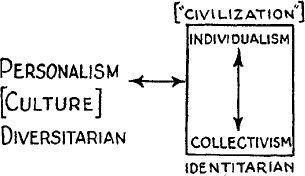
Personalism has naturally an inner affinity with culture, while individualism and collectivism are inwardly akin to civilization. Culture is practically always personal; with the exception of the cinema and the ballet there is no collective art, no collective original creation. A sculpture, a picture may be the expression of somebody’s personality, a dynamo may represent the outcome of thought or intellectual effort, but it never is the manifestation of that greater complexity — the soul.
And while personalism and creative diversity is essentially human, the animals can appreciate the products of civilization. A cat will never be able to distinguish (in the artistic sense) two different paintings or sculptures, but a room provided with central heating, or a frankfurter, will have a definite meaning for her. The trend from personalism to individualism and collectivism is in more than one way a decline, a lowering to the mere physical existence of the beast.
Democratistic culture and civilization lowered them to the unhierarchic sand heap but, paradoxically, did not bring them any nearer to each other. The thought of a common creator and a common origin can alone unite human beings and it is possible to see the practical application of this truth in any religious and patriarchal (or patriarchally religious) society. In the hierarchic Tyrol, people are much nearer to each other than in “democratic” New York, and even the Albanian practising his vendetta is more good neighborly than the inhabitant of modern Berlin or Stockholm. The elevation of “mankind” to an eschatological end simply resulted in an incoherent atomism which means loneliness-in-the-mass. And that is exactly the democratistic destiny or destiny in the megalopolis which is essentially and teletically the same thing.
It is logical that racing has gained such popularity in all countries tainted with the mass spirit. America and England prefer horses and greyhounds; France, bicycles; Scandinavia, men. A Persian shah, representant of a more medieval world than ours, once was taken to the races in a place near Vienna by Emperor Francis Joseph. He asked for an explanation of the rules, but when this was given to him he remarked in deep illusionment: “Well, one of the horses must be the first!”
The enthusiasm of certain Americans and Germans for statistics springs from the same source. The spirit of competition between individuals is still a survival from the good, old days when the middle classes raced against the First and Second Estates. Their ancient weapon, money, later becomes the bone of contention between individuals. Capitalism has a stake in this growing envy, for material goods and money becomes thus the stimulant of all early bourgeois and ochlocratic civilization made up not of human beings but of homines oeconomici, “customers.” This envy, directed toward money, is naturally an envy for quantity and not for quality. (The essence of technological capitalism is after all mass production and not craftsmanship.) It is needless to emphasize that this new materialistic, ochlocratic envy is more formidable in its vehemence and bitterness than anything witnessed before. There is also envy in a hierarchical society, envy between the sections of society as well as envy between men in identical stations of life, but the principle of equality puts everybody in a state of egalitarian expectation. To be inferior to anybody else implies almost an elementary insufficiency. The egalitarian can simply not accept or consent to such a situation and his only possible answer is a chain of desperate efforts to overcome the inferiority. If these efforts meet with failure the despair may grow into suicide or revolt.
Yet even peasants and workers have cooperated with the middle classes in the advancement of ochlocratic ideas if the culture of their country happened to be essentially bourgeois. We find the bourgeois peasant in some Protestant-Calvinistic cultures, as, for instance, in Switzerland, Holland, England, and in the greater part of the United States. It is symptomatic that there is little peasant pride and peasant consciousness in Hungary which has a large Calvinistic minority; here the peasant considers it almost an insult to be called by his real name, preferring kisgazda (small economist) to paraszt (peasant). We are here faced with the same phenomenon as in England and in the United States, but one has to add in all fairness that the Anglo-American farmer is definitely not a peasant. In England he is a middle-class proletarian tenant, who seldom dwells on his own ground. The English farmer became a landless pauper during the unlimited rule of money in the eighteenth century and he has never recovered his old free position. His American colleague is frequently an estate speculator whose “village” is not in the least a village, but, as Spengler says, a scattered bit of “fragmentary megalopolis.” There was a large number of farmers in the West who planted and tilled a certain land, used it to the point of exhaustion, cut all the timber, and afterward sold the valueless soil.
The genuine European peasant never thinks about increasing his wealth; he is deeply rooted in the soil and timeless. Just like the proletarian he works in order to live and not the other way round. He stands nearer to nature than the bourgeois, but he is neither an animist, nor a pantheist, and least of all a deist. None of these philosophies attract him because he is near to nature. He fells trees and knows that they are not animated by any spirits, he moves the corn and is well aware that it is the wind whispering in the stalks and not the souls of the dead. In spite of the fact that his strong imagination is focused on his inner world, he is realistic and dry cut. All natural things are near to him — they are to him undemoniacal and transparent. Birth, death, love, illness, and sex are to him the fundamental facts of life. But the dweller of the cities uprooted from his usual artificial surroundings gets drunk like Rousseau when left alone with the forces of nature, the Urgewalten der Natur, which remind him of eternity and his finiteness.
The worker, usually of peasant stock, resembles in some respects the peasant. He is usually blind to the demoniacal aspects of modern technique because he is the builder of the machines. He may, like Heinrich Lersch and Alphons Petzoldt, develop a religious poetry with the machine as a background but he will never worship dynamos after the fashion of a déraciné bourgeoisie in the days of early Bolshevism.8 Worship of nature or machines are typical for urban middle-class groups, who profess the tendency to substitute these for God; the peasant or worker will rarely fall for such aberrations. Yet all this does not exclude the danger that the machine overpowers the worker in a physical or characteriological sense.
The worker is nevertheless, like the peasant, at least in Europe, not a member of a dynamic class. As long as he has not been permeated by the spirit of the middle classes he demands nothing more than the life minimum and above that he shows little hunger for possession. The peasant usually wants only land for land’s sake but not as a means of a higher standard of living. The worker can therefore only be aroused to revolt by the ambitious bourgeois or if his living standard is pressed below the minimum. If this is the case, the physical side of man dominates the scene. We shall not forget that sanctity cannot be achieved without bodily existence, that spiritual love alone does not create progeny, that St. Thomas Aquinas not only justified “stealing” in case of extreme need but almost orders it, for it is then no longer “theft.” It is the exercise of a prior right. Exceeding this natural affirmation of material, ontological existence, the dynamite of a poeticized and intellectualized philosophy of life has to intervene in order to intoxicate the workers and to send them to the barricades.
The modern bourgeois is dynamic per se and the totalitarian leaders of the twentieth century were shrewd enough to switch his personal restlessness and his individualist spirit of competition to the collectivistic, nationalistic plane. Today we can witness the equally disgusting and even more poisonous struggle of urbanized nations struggling desperately for “equal standards of living” amongst themselves.
Cradle and home of the bourgeois spirit is nevertheless the town, the city, and more than anything else the megalopolis. Yet how can we define the “city”? And what is a village? And where is the dividing line between a city and a village? The number of the inhabitants is certainly not the criterion, for we know of villages in Hungary with forty, fifty, and even sixty thousand inhabitants. To a large extent it is therefore the occupation of its residents which causally determines the character of a settlement. The village lives in closest contact with the land, the inhabitants are mostly peasants who work on their fields, meadows, pastures, and woods; homework is only supplementary. Except for the looms and dairies, the village has no collective working places, no factories, and no offices. It lacks a proletariat (apart from a few paupers) and an intelligentsia, with a few necessary exceptions such as the priest, doctor, and teacher.
The villager meets nature intimately in the settlement; nature with all her laws and seasons determines the life, rhythm, and breathing of the village. The villager-peasant is a child of the stars, the winds, the clouds, the earth, the rivers. All these are for him concrete and important realities. Yet the essence of the city is pneumatic ghostliness. The factual and pragmatic occupations gradually vanished in the cities; factories replaced shoemakers, carpenters, tailors, blacksmiths, locksmiths, dyers, and painters. The artisan who could concentrate all his personal taste and talent into a door lock or a pointed shoe had to make room for a mechanically creating industrial proletarian, who day after day at certain intervals presses a certain handle or places consecutively five thousand screws on a running board in deadly monotony. The proletarianized factory worker is a comparatively new appearance (or rather: reappearance) in the picture of the city. In the superindustrialized modern world he is, in spite of his concrete work, no longer a realist — as, for instance, a mechanic in a repair shop — but a daydreamer, a sentimentalist, with nerves often weakened by the torture of monotonous routine, and therefore he “explodes” from time to time under external influences. He no longer masters his tools — the machines — but is mastered by them.
The men who truly carry on the tradition of the inventive manual laborer, the craftsmen, are the different “repairers” and “menders” who have hitherto escaped the domination of machinery and monotony. Among these we find not only the cobbler or the glass repairer, the watch “maker” or the garage mechanic, but also the surgeon. They have to work, it is true, on a basic material which may be fabricated, but they have nevertheless to face individual “damages” and they have to use their analytical as well as synthetic mind in order to cope with individually different situations. Tailors and chefs de cuisine occupy an even higher level of independence and personal work; they belong actually to that tiny aristocracy of people still privileged by fate to exercise in connection with their daily work the finest human faculty — creativeness. They are thus still permitted to share, in a feeble, human way, in the great divine process of personal creation whose eternal source is God himself.9
The large masses of white-collar workers occupy themselves almost exclusively with paper. Gold vanishes, the merchandise remains out of sight, trains are codified in timetables, countries are transformed into maps, human lives are transfigured into biographies, trade as well as morality is represented by statistics and numbers. Thus we arrive at our present-day urban civilization which is nothing but an agglomeration of files, checks, letters of credit, books of law, receipts, affidavits, stamps, balance sheets, and mortgage deeds. And this mountain of paper in turn is served by clerks, accountants, lawyers, civil servants, magistrates, diplomats, stenotypists, brokers, cashiers, and notaries. Today we already know of employees in the big naphtha-syndicates who never so much as saw a gallon of crude oil, who never dipped their fingers into that soft, sweetish-smelling product of Mother Earth; we have also men in the great agricultural companies who would not know the difference between a rye field and a wheat field. The expression déraciné is only too adequate for the urban middle class.
The painter makes room for the photographer, the stage director for the film producer. Everything is imitation and multiplication. A phantomlike, colorless, two-dimensional picture of Greta Garbo is seen in 300 editions over five continents on the same evening; a single human voice resounds from millions of radio sets, and another one, chained to a black rubber record, is forced out of thousands of gramophones. It is always quantity and not quality to which importance is attached, and there is the desperate tendency to make everything available to everybody. Nobody should have the right to pride himself on being the sole possessor of a specific thing. “Democracy” in its first stages is intrinsically a struggle against privileges and later democratism continues this bitter, depersonalizing struggle against everybody and anybody with the help of the demoniacal magic of technique. One single female being can rouse the yearnings of millions of men, smiling at them from 5000 screens, “belonging” to them all, and the car, designed by a small group of engineers and built by thousands of workers, spreads over all the world in millions of identical copies. Everything for everybody! This clearly shows that the demands of communism (or rather “commonism”) can already be found in its nuclear form in ochlocratic technicism.
With the decline of the influence of monks, peasants, aristocrats, and craftsmen the mystic gown of Europe falls and the bourgeois civilization of “common sense” and “sober-mindedness” begins its sinister triumph. A great outcry for general and public education can be heard and instead of sticking to the hierarchic principle in the most aristocratic of all domains — intellectual education — a whole corollary of compromises with the mass spirit were made in this field; education became thus finally nothing but another factor of leveling applanation side by side with industrialism. Ochlocracy needs (as we shall see later on) a most mediocre general education adjusted to the majority of intellectual capacities; an ochlocratic education should be just intensive enough to turn man into a civilized creature without giving him any special values or sublimate him into a bearer of culture. It is necessary that the citizens are intelligent enough to understand the constitution of their country; they must look up to it in awe and respect. A strong spirit of analytical criticism in a thorough ochlocracy might finally endanger the very existence of this written basic document through a series of amendments or plebiscites. Subjects on the other side can indulge in an extreme criticism which after all hardly affects the state of affairs of an absolute or a patriarchal monarchy. This is also the reason that there were numerous professors in Austrian state universities under Francis Joseph or in Spanish state-universities under Alphons XIII who from every possible point of view opposed the existing order violently.
It shall be borne in mind that ochlocratic control was fairly strong in the European universities of the nineteenth century; while ochlocracy made a special point of eliminating illiterates, they put their clercs into the universities which rapidly lost their former influence. The original thinkers of the nineteenth and twentieth centuries, whether fallacious or not in their doctrines, rarely were university professors; neither Nietzsche nor de Tocqueville, Schopenhauer, Bernhart, Spengler or Hello, Kierkegaard, von Hügel or de Maistre were ever honored with a chair, and Kant had to be content with a teaching position in a girls’ high school.
There were few people in Europe or in America who understood this issue so clearly as the late Hungarian Minister of Education Count Kuno Klebelsberg, who unfortunately died at a relatively early age. Allowed a rather moderate budget he was faced with the decision either to eliminate the remaining nine per cent of illiterates in his country or to create an intellectual as well as spiritual élite by establishing Hungarian colleges in Vienna, Berlin, and Rome. He decided in favor of the latter proposal. The Hungarian press attacked him violently but he remained firm, very well aware that in our democratistic civilization millions learn to read and to write without ever making positive use of their knowledge.10
The superstitious belief that rudimentary knowledge of a few truths enables the average individual to understand intuitively the major problems around us seduced the ochlocrats the world over to spend huge sums for mass education. This intellectual optimism of the ochlocrats has ended in a spending orgy in educational matters without parallel; nobody after all would be worse off if the whole lot of detective novels, sex stories, tepid magazines, spicy reviews, and sport pages remained unread. A reading-writing education as such has benefited nobody, has elated nobody spiritually or culturally. There is no need to go to the other extreme and to believe that the knowledge of the three R’s is basically destructive, but nothing is more stupid or irrealistic than to judge the level of other countries by the number of illiterates. Accepting such standards one has to put Latvia higher than France, or the Germanies of 1890 higher than the German World of 1810. Imperial Russia had a far larger percentage of illiterates than the American Middle West yet she produced such men as Dostoyevski, Myerezhkovski, Vyereshtshagin, Tolstoy, Tshaykovski, Solovyov, Pushkin, Rimsky-Korsakov, Turgenyev, Skryabin, Mendeleyev, and Mussorgsky.
The peasant is hated or idolized by the bourgeois; the worker, on whom he equally depends is more often venerated than despised (as Spengler points out in his Hour of Decision), the aristocrat is made a semigod or dragged through the filth by the penny press, the priest encounters either servility from petty, clerical parties, or volleys of hatred from the pulpits of Universities and the rostrum of Parliaments. The military of old was specially hated as an agglomeration of proletarians in rags and aristocrats, and the episcopal palaces where the sons of counts and peasants resided in turns were hardly more popular with the half-educated bourgeois.
The personal mystery of medieval man has been largely destroyed by capitalistic technicism and bourgeois scientism. There was always something mystical in personal creation as well as a “secret” in manual, artistic skills; convents and monasteries jealously kept the secret of their liquors; craftsmen had their secrets and so had doctors, alchemists, astrologers, and pharmacists in their more or less dark trades. Mystics, hermits, midwives, cooks, and violin builders harbored their secrets. Nature was full of unpenetrable mysteries and strange events; the scarcity of written documents furthered the growth of sagas, folklore, and legends. But not only man, nature, and life had their mysteries; even today we speak of the mysteries of the Rosary, of the Mass. In the Armenian Rite of the Catholic Church a veil is spread between the altar and audience during the Consecration of the Host. These mysteries on the other hand, personal as they might be, were far from creating walls between human beings who were by them not less magnetically attracted than by distance. Bodies are mutually attracted by nearness, knowledge, and pleasure but souls by distance, mystery, and suffering.
Democratism has always been hostile toward mysteries, and in its technical as well as personal definition it is based entirely on “publicity.” The wonderful, great distances are made cheap in relation to time, money, and effort; liners, planes, and sightseeing buses explore them pitilessly. The reporters, these retrievers of the press, have their noses wherever anything dark, unexplained, or unknown is left; professors cut up animals, human beings, plants, and minerals into microscopic slices; nudism spreads, telescopes pierce the sky, X rays lay open our insides, magazines of popular science inundate the countryside, and writers as well as psychiatrists specialize in “souls.” Along comes the Salvation Army, Moral Rearmament, and “Domestic Courts” on the radio with public confessions; autobiographies fill the bookstores, films for sexual enlightenment show the act of birth — everything should be known to everybody. In the end everybody really does know something about everything, but this half-knowledge is neither wisdom nor knowledge. It has only an inflating effect, like undigested bread, and gives pains in the stomach. It makes people vain, irreverent, and self-content.
One might add that bourgeois civilization also has its “secrets,” but these mystères bourgeoises seem to be detached from quality, they are entirely subordinated to the principle of quantity. This mystery of size and number is not mystical but magical, not angelic but demoniacal. We have to remember the first Great City and its citizens — Babylon and its horrible tower, this dreadful pagan attempt to penetrate the Secret of God with the help of accumulated material.13 On the other side of this civilization we see paper. Its essence is quantitative agglomeration and paper ghostliness and in its geocentric fatality it has no other ultimate goal but to dominate the masses, to bind them, to suspend their judgment, to hold them, to charm, to depersonalize, to mystify them. Instead of mysteries we have mystagogy. Instead of the substance, the long, menacing shadows provided by the last rays of a setting sun.
________________
14 Thanks to the Commercial treaty of 1788 (the Eden-Act) imports and exports reached an all time high in the 12 months before the revolution — a record which could only be broken in the nineteenth century.
15 It ought never to be forgotten that the Turks in their desperate onslaughts against the Austrians were usually supported by Magyar Calvinist auxiliary troops led by Transylvanian officers. Emmeric Thököly headed a large contingent of Calvinists at the last Turkish siege of Vienna in 1683. Had Vienna fallen Europe might have become Mohammedan. The two great fatalistic religions of the Prophets of Geneva and Mecca seemed to have attracted each other.
The Dutch intrigues against the Jesuits in Japan were not less significant; their suggestions to the Shōgun that the Catholics in general and Jesuits in particular were outlawed “all over the world” on account of their hostility toward organized government, resulted in an atrocious persecution. The Catholics finally made their last stand in the fortress of Shimabara where 10,000 of them — men, women, and children — defended themselves with heroic courage. The Shōgun, unable to take the stronghold had to apply for help to the Dutch who lent him their guns which alone were able to destroy the walls. The inhabitants were all massacred but the sons of Calvin in return for their service received a monopoly in trade.
16 France frequently had Protestant presidents or prime ministers. Imperial Russia permitted only Schismatics and Protestants in the higher ranks of the army and the civil service. The head of the Protestant (Lutheran) Church in Russia was the Russian Emperor himself. Catholics belonged to an intrinsically “unpatriotic” religion; in spite of the greater theological affinities between Catholicism and Pravoslavism, no Catholic could get a rank higher than that of a colonel (and the corresponding one in state officialdom).
Similar discriminations are still enforced in such “democracies” as, for instance, Sweden, where no Catholic can become a State Minister. This attitude should be compared with that of Italy which frequently had non-Catholics in high offices. (Sidney Sonnino, for instance, was a Jew, son of a Levantine Jew and an English mother.) Rome had for many years, in the person of Signor Nathan, a Jewish mayor.
17 See Cabanès and Nass: La Névrose Révolutionnaire. Paris, 1924, p. 85 ff.
18 Er lügt wie gedruckt.
19 It is interesting to note that many people attacked the textbooks of Professor Rugg of Teachers’ College as “subversive” because they contain a total condemnation of advertising. (See numerous letters sent to the New York Journal and American by its readers during the years 1939–1940.)
20 The old German Center Party consisted largely of Catholic trade-unionists led by aristocrats.
21 Cf. René Fülöp-Miller’s Führer, Schwärmer und Rebellen, München, 1934, pp. 343–345.
22 Most large factories have an infinitesimally small aristocracy of privileged men who are still allowed to work with their phantasy and their intellect like the designers of engines or automobile bodies. There is a slightly larger gentry of toolmakers and managers. The middle class layer of white-collar workers and salesman can boast of little creative opportunity while the large mass of “proletarians” see truly in the propagation of the race — and not in their daily monotonous service to machinery — their only (though steadily shrinking) creative activity.
23 It is interesting to note that compulsory education was introduced in most European states when the liberal tradition was still comparatively strong. It must be said in praise of England that education was only made compulsory in the nineties, at a time when basically most conservative countries (with less liberal traditions) had already yielded to the ochlocratic-terroristic poison.
Arbitrary compulsory education is after all a flagrant curtailment of parental rights and at least as “totalitarian” as conscription. Yet practically nobody dared to contradict the sacrifices made to the idol of “education” and few people sensed that compulsory elementary education was a great step in the direction of totalitarianism which in time intervened in every region of human existence. True, the father’s right is not violated by compulsory education in so far as a certain degree of education is reasonably deemed necessary by the State for citizenship, to be administered in the school of the father’s choice, provided that school is not subversive in its nature. But the supreme rule is that the child belongs to the parent and not to the State.
24 A pertinent article on this subject had been written by Erik v. Kuehnelt-Leddihn in Colosseum (June, 1935) under the title: “Catholicism and the Bourgeois.”
25 The official and full name of the National-Socialist Party in Germany is Nationalsozialistische Deutsche Arbeiterpartei — National Socialist German Workers Party . . . all that in spite of its typical bourgeois structure and following. Yet in the word Arbeiterpartei was a good deal of the magnetism which carried this party from victory to victory. People were simply tired and disgusted to belong to the middle class. In the public meetings the men are usually still addressed: Arbeiter der Stirne und der Faust — “Workers of the forehead and the fist” (white-collar and manual workers). There seem to be few poetical aspects connected with the middle class. It must not be forgotten that the red flag of the National Socialists is nothing but another concession to the morbid fancies of the bourgeois who aspires to be a “simple proletarian.”
26 It shall be remembered that the first to be mentioned in the Sacred Scriptures as a builder of cities was at the same time the first murderer — Cain. (Gen. 4:17.)
- 1* See the letter of Mr. William S. Bennet, prominently displayed in the New York Times, Apr. 5, 1942.
- 2* Apart from the fact that we rather borrow our terminology from the Fathers of the Constitution than from radio commentators or the speakers at women’s clubs.
- 3* About its confusion with liberty see the text concerning liberalism.
- 4* Charles A. and Mary R. Beard wrote: “As was said afterwards, the founders of the Republic in general, whether Federalist or Republican, feared democracy more than they feared original sin.” (America in Midpassage, New York, 1939, Vol. III, p. 922.) About the use of the word democratic between 1865 and the close of the century, see p. 923 of the same book.
- 8* Cf. Stringfellow Barr’s article “Ourselves Again” in Tomorrow, Oct., 1942. Condensed reprint in the Catholic Digest, Nov., 1942. This essay of the president of St. John’s, Annapolis, not only evaluates democracy correctly, but also gives an outline of Hitler’s democratic background.
- 9* Democratic rights for school children have been postulated by the disciples of John Dewey, while David Lloyd George demanded in all earnestness plebiscites for the Central African jungles (in a public speech on Jan. 5, 1918).
- 10* About the problem of “democracy” in relation to the popular representation in the United States. See pp. 247–248.
- 13* By federalism we clearly understand a tendency which is the very opposite of federalism in the American sense. We have to distinguish between centralism, federalism, and separatism; centralism wants the whole concentration of power in a single body, federalism demands a division of power with a marked influence of local administration, separatism recognizes local power only and stands thus clearly for the dissolution of the state into independent parts.
- 14TO PUT in its right light and scientific context the technical word democracy is naturally our first task. Representative government as established in the United States is not synonymous with democracy. The Founding Fathers established a republic (res publica, politéia), not a democracy. And many of the Founders of the Constitution of this country have repeatedly emphasized this fact in so many words. Some of the best American minds have again and again called attention to this important fact and have protested loudly against the use of the term democracy for the fundamental laws of their country, which they respect and by which they abide.*
- 15We see, then, from the plurality of present-day connotations of democracy that it would be thoroughly unjustified to use the term “democracy” in any other sense than in the classical and universal one.* We may well agree that the mischief started by uneducated popularizers has already reached such proportions that a Hercules is needed to clean this Augian stable of popular misconceptions, false labels, and mispresented ideologies. Even some of the more intelligent writers have become a prey to popular pressure, and as modern intellectuals do not lead the masses any more, but follow them and subordinate their ideas and language to the demands of the market, the confusion has now reached its climax.
- 16Today democracy is confused with liberalism,* freedom, and prosperity alike.
- 17“Democracy” as an ideal of the Founding Fathers is equally denied by W. H. Hamilton and D. Adair in The Power to Govern (New York, 1937, p. 158). It must also be borne in mind that the protest against calling the Constitution democratic comes from historians of all groups, yet while Rightists praise lack of “democracy” in the Constitution, “Leftists” like Charles Beard* and H. Rugg are prone to condemn it outright.
- 18We have said before that it is difficult to find the exact reasons for the growing popularity of the word democracy and democratic taken from a dead language which is thoroughly nonunderstandable to 999 out of 1000 Americans. The decline of classical education in favor of progressive “self-realization” has favored the increased use of wrong labels. It is deplorable that even Catholics have become victims of this chaos in verbiage. They have naturally “their” democracy, the Leftists have “another one,”* and even Conservatives indulge in the worship of a thing called “democracy” with a thoroughly different content. The only way out would be to discard the label completely, restore it brutally to its pristine meaning, and to call the things hitherto covered by the label with their proper names.
- 19In order to denote the classical interpretation of democracy as well as its cultural concomitant we have chosen to use the word ochlocracy and — as its adjective — ochlocratic.* The Greeks used this expression strictly in the sense of mob rule, regardless whether these mobs created majorities or minorities. The selection is not a very happy one, and the reader is reminded that we understand under “mob” not the “lower classes,” but just the vast masses of inferior people which can be found everywhere; these products of a soulless culture and civilization who in their terrifying mediocrity are neither fish nor flesh, have neither face nor expression, neither wisdom nor knowledge, piety nor enthusiasm, faith nor charity, hatred nor love, those who go neither with the angels nor the devils and because of their lukewarmness will be spat out by our Lord on the day of reckoning.
- 20It is almost in the strictly classical sense of the Greek word ochlocracy, to which reference has just been made, that the United States Army Military Manual* defines democracy in Section IX, Lesson 9, on “Representative Government.” Having first described autocracy as resulting in “arbitrariness, tyranny, and oppression,” it goes on to what it considers the opposite extreme:
- 21While many may consider the government established by the Founding Fathers as a constitutional democracy, it is clear that no such idea entered into the mind of those from whom Americans derive their form of government, nor did these men give coloring to such an interpretation by their own actions.*
- 22We must furthermore always bear in mind that equality presupposes the perpetual application of force; equality after all is an unnatural condition — it is just as unnatural as a completely straight line, a geometrical plain, a perfect circle, distilled water, etc. It needs the intervention of human agencies who have to curtail and to stem the natural growth and development sometimes in the most brutal and cynical way. Docteur Guillotin, Procrustes, the mythological Hellenic bandit, and the magistrate of Strasbourg who decided during the French Revolution to demolish the tower of the medieval cathedral because it was higher than the surrounding houses, belong all to the same category. Dostoyevski, in his Possessed, has predicted accurately how an egalitarian superdemocracy would function. The Soviets have fulfilled this prophecy to the letter.
- 23The confusion about the alleged harmony between modern ochlocracy and Catholicism is largely due to a great deal of wishful thinking, misunderstood patriotism, and the ambiguous elasticity of certain technical terms. Let us take, for instance, the word equality. How frequently do we hear responsible Catholics talking glibly about the equality of human beings! Maritain has warned all about the indiscriminate use of this term and he proposed to use the expression Unité du genre humain. Gustave Thibon has not only taken egalitarianism severely to task but he has also pointed out that the efforts to create equality have engendered at the same time the most violent inequalities. All those who by their free will or their disposition are unable to conform to the prescribed standards of equality — and there will always be such a minority — will after the efforts of leveling stand out more distinctly than in a nonuniform society. These are then usually the “traitors” who do not “play the game” and must be executed, exiled, or weeded out like the aristos under Robespierre, the burzhuys under Lenin, or the Jews under Adolf Hitler.
- 24The confusion about the alleged harmony between modern ochlocracy and Catholicism is largely due to a great deal of wishful thinking, misunderstood patriotism, and the ambiguous elasticity of certain technical terms. Let us take, for instance, the word equality. How frequently do we hear responsible Catholics talking glibly about the equality of human beings! Maritain has warned all about the indiscriminate use of this term and he proposed to use the expression Unité du genre humain. Gustave Thibon has not only taken egalitarianism severely to task but he has also pointed out that the efforts to create equality have engendered at the same time the most violent inequalities. All those who by their free will or their disposition are unable to conform to the prescribed standards of equality — and there will always be such a minority — will after the efforts of leveling stand out more distinctly than in a nonuniform society. These are then usually the “traitors” who do not “play the game” and must be executed, exiled, or weeded out like the aristos under Robespierre, the burzhuys under Lenin, or the Jews under Adolf Hitler.
- 25It must furthermore be borne in mind that equality stands for monotony and not for harmony. A harmonious melody can only be established by different unidentical musical tones. These tones must be assembled and have to follow in a certain sequence; otherwise they will result in chaos and not in melody. Human society presupposes such an inequality and unity. Thibon has seen very clearly this issue which can only be solved in the sign of love.
- 26“It consists in purifying and organizing the inequalities from the point of view of a deeper equality, or, to put it more precisely, in making inequality serve unity. But this unity, what else is it but love and what is love without God.”

