
Leftism
13. Real Liberalism
Another grave, this time semantic misunderstanding between America and Europe lies in the concept of liberalism. In Europe the significance of this term has also undergone several changes, but its essential meaning always has been kept. In the United States today the word “liberalism” has a content diametrically opposed to its etymology, and to its original sense as understood not only in Europe but also in Latin America, Australia, New Zealand, the Soviet Union, Southern Asia, and Japan. In its process of deformation the idea of liberalism has suffered nowhere more than in the United States, although a certain degenerative process of this term also has taken place in Britain. The liberalism preached by the Whigs at the beginning of the last century, the liberalism of Palmerston, of Asquith, of Lloyd George, and the younger Churchill, and obviously that of Mr. Acland-Hood—each have somewhat different meanings.
Let us look at the verbal meaning. The root is liber (“free”). The term liberalis (and liberalitas) implies generosity in intellectual and material matters. The sentence “he gave liberally” means that the person in question gave with both hands. In this sense liberality is an “aristocratic” virtue. An illiberal person is avaricious, petty-minded, tight-fisted, self-centered. Up to the beginning of the Nineteenth century the word “liberal” figured neither in politics nor really in economics.
We explained the political content of the term in Chapter V. While democracy answers the question as to who should rule, liberalism deals with the problem how government should be exercised. The answer liberalism gives is that regardless of who rules, government must be exercised in such a way that each individual, each citizen enjoys the widest personal liberty still compatible with the common good. Yet in spite of the fact that the “common good” can be wilfully interpreted in the narrowest way, it is clear that liberalism rightly understood stands essentially for freedom.
As far as our research goes, the first time this term was used in a political sense was in the year 1812, and the “place of action”—not unnaturally—was Spain, a nation famous for its individualism, its inordinate sense of liberty, its strong anarchical drives. The supporters of the Constitution of Cádiz were called los liberales and their opponents (among them the Apostólicos) were nicknamed los serviles. Yet even at this very early stage of the game a certain amount of misunderstanding had crept into the use of this term inasmuch as the Constitution of Cadiz also had democratic features while the majority of the Apostólicos had federalistic (local rights) leanings which became even more marked when the Carlist Wars broke out and the Liberals rallied around Queen Isabel II who also enjoyed the aid of enthusiastic British volunteers.
It took several years for this nomenclature to make its appearance in England. Southey used it for the first time in 1816 and, significantly enough, employed the Spanish form, speaking of “our liberates.” Sir Walter Scott, soon afterward, copied it from the French, referring to the liberals as libéraux. In the early 1830s, when after the reforms of Sir Robert Peel the new parties emerged, the Whigs became the Liberals and the Tories the Conservatives. This evolution was not surprising. Whigs and Tories were both “aristocratic” parties (as we have pointed out in Chapter VII), but the Whigs were more genuinely aristocratic in that they saw in the king a mere primus inter pares, whereas the Tories were the party of the aulic nobility fawning in a rather unaristocratic way upon the monarch. (At least this is the way the Whigs saw it.)
In other words, there is in all genuine aristocracies a certain republican undercurrent: The typical aristocratic state is always an open or a disguised oligarchic republic. This is borne out by Venice and Genoa on one side, and the Polish Commonwealth and Britain after 1688 on the other. The classic ally of the monarch is not the nobility or the clergy, but the burgher class. Only with the French Revolution do we see a radical and tragic change.
Thus the idea of liberalism existed well before 1812. During the eighteenth century an economic school was in the ascendancy (particularly in Britain and in the Netherlands) which, without straining our semantics, can be styled preliberal because it still did not use the liberal label. We are referring here to the Manchester School whose philosophical (or theological) roots were deep in the soil of deism. God, the Great Architect, had created the world nearly perfect. All evils were due to human intervention which upset the Divine plan. This could easily happen because this deist God had withdrawn from His creation: Neither priestcraft nor white magic, neither prayers nor other incantations moved Him any longer. It was up to man to work out his own salvation, i.e., his terrestrial happiness by interfering as little as possible (or, preferably, not at all) with a universe existing in a preestablished harmony which rested on divine laws. If state and society never intervened in commerce and industry, these would automatically flourish, while all artificial limitations, rules or regulations—for instance, guilds, labor laws, tariffs, currency reforms, etc.—would bring about the downfall of prosperity.
Many of these early liberals were not lovers of freedom besides being Christians but took their political inspiration either directly from Scripture or from theology. As we can see, it was their “religious anthropology,” their picture of man which invited or forced them to walk the road of liberalism. Man has an immortal soul, man has a personality, man is not an accident of blind forces of nature, man needs freedom because God wants him not only to develop his personality in the right direction but also to live a moral life, freely (but rightly!) choosing between good and evil.
From the aforementioned it is obvious that the religious aspect of early liberalism was more strongly developed among Catholics, Eastern Orthodox, and those supporters of the Reformation faiths who had broken with the strict views of the Reformers, who were “Erasmian” and Zwinglian rather than Calvinistic or Lutheran. Among the names we have mentioned we do not find a single supporter of what is loosely called “Protestant orthodoxy.” Calvin and Luther certainly were not liberals in the decadent American sense, but they were not “libertarians” either. “Libertarianism,” that is to say true liberalism, in the Reformation faiths makes itself felt only in the Eighteenth century as a result of the impact of the Enlightenment and of rationalism, both late descendants of the Renaissance and therefore alien in themselves to the spirit of the Reformation. The man in the street, to be sure, more often than not associates the Enlightenment, rationalism, and individualism with the “Protestant” outlook, if not with the Reformed religions. He knows nothing about the 180-degree turn the bulk of the Reformed faiths took 200 years ago, nor has he taken much notice of the return of a number of Reformed theologians to the orthodoxy of the Sixteenth century, a relatively recent development which, so far, has not had the time (or the chance) to affect the faith of the masses.
Precisely because the early liberals were “idealists” in the narrow sense of the term, because their background was aristocratic or patrician, because they were intellectuals of a high order, without exception educated in the classics, because they founded their demand for freedom on religious and philosophical principles, they were not friendly toward democracy. As a matter of fact, most of them could frankly be styled antidemocrats. This, however, is often not fully realized by those interested in the history of ideas. Acton’s remark to Bishop Creighton in a letter addressed to him in 1887, “Power tends to corrupt, and absolute power corrupts absolutely,” is frequently cited by well-meaning democrats who forget (or do not know) that Acton, quite an antidemocrat himself, would have applied this formula to parliaments or popular majorities without batting an eye. The mere fact that de Tocqueville wrote a standard work called Democracy in America, foretelling a further extension of democracy on a worldwide scale, has made him an apologist in the eyes of so many an American. But de Tocqueville was much too clever to believe that, with the coming upsurge of democracy, political history and its e very-changing forms would come to an end. He realized, we can be sure, that the world would outlive the democratic age, which he did not like at all. Yet he wrote in such a detached way that one has to read carefully between the lines. The man who, disgusted by the July Revolution of 1830, had left France for a United States, then under its first Democratic administration, was not a democrat. But, let us admit that even a few of his more intelligent readers were not quite sure where he actually stood. When once asked peremptorily about his convictions, he replied:
Not all the early liberals were safe at all times in the face of the temptations of democracy which, as we have pointed out, has a paradisiacal character and all the lure of a “clear but false idea.” One has only to bear in mind that even Acton leaned temporarily toward democracy and that Constant de Rebecque also had a great moment of weakness when this brilliant essayist and politician suddenly decided to collaborate with Napoleon during his Hundred Days. And yet nobody had written a better and more scathing analysis of the democratic French Revolution and the Bonapartist dictatorship than the early liberal Benjamin Constant during his exile. These things, unfortunately, do happen. Still, the early liberals are certainly nondemocrats or antidemocrats whereas their successors, the old liberals, had usually a philosophical and ideological outlook which predisposed them to view democracy in more positive terms. The main reason for this state of affairs is the strongly “agnostic” bent of the old liberals.
Genuine liberals always wanted freedom. It is, however, precisely this quest for freedom which in certain minds started the idea that every firm conviction, every strong affirmation automatically results in intolerance. As we have pointed out in Chapter IV, the possibility of a truly convinced man’s intolerance (and “illiberality”) exists: It is a hurdle, a temptation he has to overcome. Those, however, who do not believe in absolute truth or in the human ability to attain truth, are naturally not tolerant but merely indifferent. Still the confusion between tolerance and indifference hardly bothered many old liberals who thought they could “play safe” by preaching a basically agnostic attitude (to use the word in a much wider than merely theological sense) and by waging a real intellectual and political crusade against all who believed in absolutes. These were decried as “dogmatists.” Such an attitude, as could be expected, put the old liberals all too frequently in opposition to Christianity and especially to Christian orthodoxy of any denomination.
It is precisely this leaning towards “agnosticism” which facilitated the old liberals’ armistice or even alliance with democracy. Democracy—as democratism—is an ideology, though in its simpler form it can also be seen purely as a system, as a mere procedure for “producing,” i.e., for selecting, a government. A democratic constitution offers a frame into which a picture can be fitted through the voting process. It is the majority vote which usually determines the character of the picture. Now, according to standard democratic doctrine—there are a few others—every full citizen has the right not only to vote, but also to organize a party or to propose local candidates. The guardians of the democratic constitution have to adopt a neutral position toward all candidates, all parties, all ideas represented. One man is as good as any other man, one opinion as good as any other, all men and all opinions are invited to participate in the race, and he who wins numerically gets the prize. Democracy as an abstract principle has to insist on fair play, must express no preferences, and thus also has to give a “break” to parties which would put an end to the democratic order. If 51 percent or, better still, two-thirds of a people vote one or several antidemocratic parties into power, the end of democracy is at hand. In other words, democracy can commit suicide democratically.
This quandary, this dilemma of democracy appears in many parts of the world. Italian law gives democratic rights to Communists but not to Fascists. (The M.S.I, is not exactly the successor of the old Fascist party.) In Argentina the real Peronists could not run for office either. (They might actually have won as much as a good one-third of the votes in free elections.) In short, democracy often distinguishes undemocratically between supporters of its own ideology and its adversaries—whereby the totalitarian aspects of democracy, perhaps tragically and unavoidably, become manifest.
An ideal democracy does not discriminate. Fearful of violent dissent which rends asunder the fabric of state and society, it not only tries to be neutral but knowingly-unknowingly considers an “agnostic” attitude to be the natural lubricant for the democratic process. Precisely here we find the golden bridge between old liberalism and democracy. People in a democracy should have tenuous party affiliations: Their convictions should not be too well grounded and their loyalties ought to be superficial. Otherwise they might always vote in the same way. A happy democracy of a liberal character where freedom survives, rests on change, however, not permanance. The citizens should be in the mood to switch their votes and individuals, parties, and party leaders should always be ready to engage in compromise, in fifty-fifty arrangements which are the lifeblood of parliamentarianism. (Here one should not overlook the coalition cabinets on the Continent which—in contrast to the Anglo-American world—are the rule and not the exception.)
Democracy and old liberalism have something else in common. They share the optimistic Roussellian view of man. Man is basically good and wise; let him act according to his whims, his desires, his intuitions, and everything will be all right. The good people will prevail—almost automatically. In this attitude democracy is far from Calvin and the argument that it really has its historic roots in Calvinist synods (the Synod of Dordrecht has been named as a conspicuous example) becomes somewhat questionable. Of course the term “good” implies a value judgment. The true agnostic would be rather inclined to say, “Man is as he is; you prefer him to act this way and I that way, and that is where we are.” Such would be the position of the grandfather of democracy, the Marquis de Sade. Still, whatever the formulation, democracy and old liberalism give a basically unqualified “yes” to man, though not to each individual man. In this respect, needless to say, old liberalism shows that it has its roots in preliberalism rather than in early liberalism. The fear of “interference” is very highly developed in the first and third stage of genuine liberalism. Here again the deist and subtly pantheistic attitude of the Manchester School and Adam Smith comes to the fore. Democracy as an ideology maintains that if one voted after mature reflection and in an “unfettered” way, the relatively best decision could be made and progress thereby assured.
“A million eyes see better than a single pair!”
This, however, as we all know, is certainly not borne out by the facts. Such belief is a fetish of the democratist, a magic formula which, as history teaches, sometimes works and sometimes doesn’t. For reasons we shall give elsewhere, it will work less and less as time goes on last but not least because the “Information Explosion” has brought us confusion and bewilderment rather than enlightenment and balance. To know facts still does not mean to know how to weigh evidence.
The democratic optimism as to man, his nature, and the entire universe also animated the old liberals who, to be sure, unlike certain democrats, always insisted that man needs first to be educated. (We guardedly said “certain democrats” because there are many people who seem enchanted if elections are held in African jungles where the illiterates are gently guided by the choice of animal symbols. Knowledge and maturity are undemocratic principles! The vast majority of democrats, however, still believe that literacy is a prerequisite for the vote—the new American “voting rights” bill notwithstanding!—and that a free press and witty radio commentators can do the trick.)
This emphasis on education in an intellectual and a moral sense has definitely an elitarian character. Just like the preliberals, the old liberals thought that the sum total of all enlightened self-interests would, in a mysterious harmony, automatically make for happiness and a life of plenty, that especially in the field of economics this would lead to abundance and the survival of the fittest. These in turn, by their pull and their shining example would raise general levels. Half truths, one can say, are optimistic exaggerations. Still, the old liberal stand caused infinitely fewer tragedies than the opposite errors of the leftist gnostics (in the sense Eric Voegelin uses this term) and of the red “Monasticists” whom we have mentioned earlier.
Given all these alliances and connections it is not surprising that old liberalism became illiberal. If one is solemnly convinced that all strong stands, all firm affirmations, all orthodoxy, all absolutes in thought are evil, then indeed one becomes inclined to show hostility to all representatives of “absolutism” (religious, political, philosophical, or otherwise) and, if one had the chance, to persecute them methodically and mercilessly. Since the old liberals in the second half of the Nineteenth century and also frequently in the early Twentieth century had, thanks to the property qualifications for voting, great parliamentary power, they could also abuse it. Owing to their intellectual appeal they had a near monopoly in the universities and acquired an iron grip on the press, the theater, and the entire intellectual life. Thus they could painfully discriminate against their conservative and Christian opponents. The Holy American Illiberal Inquisition, as we see, had a forerunner.
Actually the old liberals were responsible for their own decline around the end of the century. In Austria the introduction of the one-man-one-vote principle in 1907 was a great blow to them. Their anticlericalism led to a rather well-organized Catholic opposition which astounded and dismayed the old liberal leadership. It is obvious that the Church did not at all like the idea of descending into the political arena and competing with other secular ideologies. It was the (inofficially Catholic) Center party which defeated Bismarck and made him eat humble pie. These Catholic parties, after all, had the allegiance of a good cross-section of the people—peasants, craftsmen, shopkeepers, professional men, intellectuals, and the nobility. (The evangelicals could not found a similar party because they were already doctrinally too much allied with old liberalism and/or nationalism.) All the troubles the old liberals had caused in marriage and school legislation, all the laws they had enacted which were alien to the spirit of the Church (compulsory civil marriage, as an example) now boomeranged against them.
By the outbreak of World War I old liberalism found itself in a very grave crisis. It remained entrenched in certain intellectual strongholds, but it was totally beaten in the field of power politics. The liberal parties on the Continent had been decimated: What remained were specific positions in the universities and the still sizable liberal press, which had become a middle-of-the-road institution promising (not always truthfully) “objectivity” to its readers. In the practical political sphere, however, it no longer could “deliver the goods.” This startling phenomenon could be observed all over Europe. Papers such as the Frankfurter Zeitung, the Corriere della Sera, Le Temps, Die Neue Freie Presse, or De Algemeene Handelsblad still held their leading position, but they ceased to affect elections. Deeply allied with nationalism, the old liberals could not take an independent line in World War I either. Among the Allies they were tied to the war interest, felt that they had a real stake in it and naively hoped that the murderous struggle would foster their cause. Among the Central Powers old liberalism was haunted by the thought that its followers were better entrenched in the Allied camp. And when it came to the Paris Peace Conference, Western old liberals were among the most fanatic supporters of a “hard peace,” thus contributing to the rise of National Socialism in Germany, while in Central Europe they tended to blame their old governments for the beginning and the end of the war and thereby invited the wrath of the totalitarian nationalists, who denounced them as traitorous collaborators with the West. Whatever they did, they did wrong, which is not so surprising in the light of the fact that they had completely parted with absolutes and played politics “by ear.” History does not honor mere goodwill or good intentions.
Professor Eduard Heimann, a German “Religious Socialist,” wrote very correctly during World War II:
This antiliberal trauma remained for a long time a very potent force in orthodox Christianity (not only in the Catholic Church!) and when neoliberalism developed in the 1930s and 1940s it was often difficult to persuade freedom-loving Christian thinkers that this new phase of liberalism differed in many important and even decisive ways from its immediate predecessor, because the word “liberal” created a mental block among many devout Christians.
The term neoliberalism, denoting the fourth phase of liberalism, hardly appears before the end of World War II. When in 1946 a remnant of liberal scholars met at the Mont-Pèlerin Hotel near the northern shores of Lake Geneva to coordinate their forces and form an organization, it soon became apparent that a certain fission had taken place in and outside the domain of economics. There were now, mostly in central Europe, thinkers who viewed the problem of liberty in a different light than the men who belonged to a somewhat older generation and in many ways could have been called their teachers. (Almost all of them, to be sure, as far as economics go, had been inspired by Ludwig von Mises.) But in matters of economics these newer lights were less radical in their outlook and they admitted curbs on mammothism and colossalism to preserve competition. They thought that the state had a right and even a duty to correct possible abuses of economic freedom—just as we give to a mature person a driving license and the right to travel wherever he wants but still make him submit to traffic laws. Yet probably more important than this change was the reappraisal of religion, especially of Christianity. Many of the neoliberals declared that it is not sufficient to prove that “liberty delivers the goods,” that freedom is more agreeable or more productive than slavery. There must be philosophical and even theological reasons why liberty must be achieved, fostered, preserved. One of the neoliberals, perhaps the one best known in the United States, the late Professor Wilhelm Röpke, maintained that even if it could be proved to him that a planned and collective economy is materially superior to a free one, he would still, in an “ascetic” spirit, prefer the latter. Under these circumstances sacrifices of a material order would have to be made to preserve the dignity of man. From such views we can deduct that the neoliberals had, in a certain way, a greater affinity with the early liberals than with their immediate predecessors. Interested in economic problems, they refused, however, to make a fetish of economics and they tried to integrate their economic views into a metaphysical humanism. The great early liberal thinkers, from de Tocqueville to Burckhardt, were seriously studied by new liberals who in many cases were professing Christians.
Alexander Rüstow is famous not only for his essay on Manchesterism but mainly for his stupendous three-volume Ortsbestimmung der Gegenwart. Like all other neoliberals, Rüstow (who died in 1964) always refused to deal with economics in an isolated way, detached from all the other disciplines. His book, whose title in English, literally translated, means “Location of the Present” offers us a sweeping historical view of one of our last polyhistors, a work in some ways more impressive than Toynbee’s A Study of History. Today, however, the use of any language other than English is a grave handicap to worldwide fame. Jacob Burckhardt (orbiit 1897), for instance, was unknown in the English-speaking world until the middle of World War II, and even Max Weber gained only posthumous recognition in America. Very little, indeed, is known in the United States or even in Britain about the conservative authors of the Continent.
Professor Goetz Briefs, another eminent star in the galaxy of neoliberal thinkers, has been living in the United States ever since the earliest days of Nazism and was for a long time professor at Georgetown University. Originally he came from the school loosely identified as “Catholic Social Thought,” the tradition emanating from Ketteler and Vogelsang. He started as professor at the Technische Hochschule in Berlin-Charlottenburg and is a prolific writer. In recent years he has occupied himself with the problem of trade unions acting as a state within a state and developing here and there into a real menace to a free society—and even to democracy.
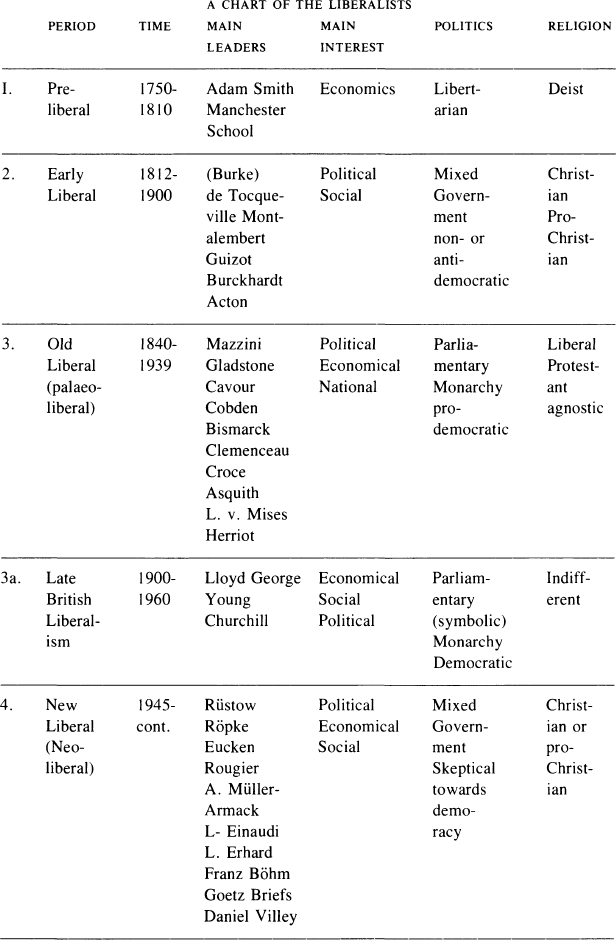
NB. Obviously, a man such as Cobden might also figure as a late preliberal, Edmund Burke as an early conservative. We have omitted American names deliberately.
Recapitulating the four phases of genuine liberalism, it might be helpful to make a tabulation which (permitting for certain simplifications) would roughly look like the table on page 200.
Realizing, however, that European new liberals and modern conservatives often have become practically indistinguishable from each other, we cannot help remembering how different the situation is in the United States—not in fact but purely from the point of view of current labels. Indeed, we have before us two problems to be solved: first, to find out how it happened that liberalism in the United States evolved into the very opposite of what it set out to be—if it did “evolve”!—(thereby morally forfeiting the right to call itself “liberal”), and second, later on, to analyze what conservatism, old and new, really stands for or, at least, ought to stand for.

