
Gold and the Gold Standard
Chapter VII: The Balance Sheet of the Gold Standard—Its Merits and Defects
The Balance Sheet of the Gold Standard—Its Merits and Defects
Gold is tried with a touchstone, and men by gold._CHILON, 560 B.C.
Up to this point our study of gold money and the gold standard has been concerned chiefly with history and fundamental principles. We have been looking at the past. Let us now turn to the future, and consider the principal merits and defects of the gold standard as a monetary standard for the postwar world—a very mundane sort of world, not Utopia.
MERITS OF THE GOLD STANDARD
Its Essentials Easily Understood
The first merit of the gold standard, as compared with other standards now competing with it for place in the monetary world, is its simplicity. In its essentials the gold standard is easily understood. The unit of value is a fixed quantity of a universally known commodity, which the people of the world, both primitive and advanced, have used as money for thousands of years. In a democracy it is highly important that the public shall understand their money. An old proverb says, “The people distrust what they do not understand.” By this criterion, compare the gold standard with any of the numerous “price-index-number-managed-paper-money standards” now before the public.
High Public Confidence in Gold
Closely related to this merit of simplicity, is a second, that of possessing the confidence of the public. The instinct for gold is found among all peoples, savage and civilized, throughout history. Gold is today, as it has been for centuries, the most widely treasured and the most highly marketable commodity in the world. The familiar lines of Thomas Hood tell the story:
Gold! Gold! Gold! Gold!
Bright and yellow, hard and cold,
Molten, graven, hammer’d, and roll’d;
Heavy to get, and light to hold :
Hoarded, barter’d, bought, and sold,
Stolen, borrow’d, squander’d, doled:
Spurn’d by the young, but hugg’d by the old
To the very verge of the churchyard mould;
Price of many a crime untold :
Gold! Gold! Gold! Gold!
Good or bad a thousand-fold!
The value of an ounce of gold, in terms of its purchasing power over commodities in the United States during the half decade 1936 to 1940, was greater than for any other quinquennium covered by our American price-index numbers dating back to 1801. This is true, moreover, despite the fact that the large world production of gold since 1929 is equal to the world’s total known stock of monetary gold in 1923—the accumulation of the ages. No other kind of currency system in a distracted postwar world will so quickly restore the confidence of the public as a true gold standard. Can there be any question what the verdict would be, if you should put to a popular vote in the United States today the question : In what kind of dollar would you prefer to have your social security and your government bonds payable, a gold-standard dollar or a managed paper-money standard dollar? Gold does not need to be guaranteed. Everywhere it is accepted as final payment. Charles Dickens’s phrase as good as gold means “the very best,” the world over.
Its Highly Automatic Character, Calling for Little Political Management
The typical gold standard prior to 1914 was highly automatic. Gold flowed freely in international trade from the places where it was cheap to the places where it was dear, always seeking to maintain its international-value level, with free coinage in a large part of the world and with widespread interconvertibility on demand with other kinds of currency. Normally, man’s interference with the automatic functioning of the gold standard prior to the First World War was small and was limited chiefly to the manipulation of discount rates by central banks and to a small amount of open-market operations.
The resort, moreover, to these means of “keeping under control” the international movement of gold frequently did more harm than good. The highly automatic character of the prewar gold standard was one of its great virtues. “We have gold,” says an old proverb, “because we cannot trust Governments.”
This distrust of government and politics in American monetary affairs has been deep and widespread for many years, and for very good reasons. Our record in this field has been bad, as have been the records of many other countries, notably those in Latin America and the Near East. Witness the blundering way in which our Congress handled American bimetallism from 1791 to the Civil War,1 Jackson’s war with the Second United States Bank, and our subsequent sad experiences with the bank notes of the wildcat banks. Witness our 17 years’ experience with inconvertible greenbacks from 1862 to 1879, our unfortunate silver legislation of 1878 and 1890, and the absurd and highly expensive silver policies of Franklin D. Roosevelt’s administrations.2 Witness, further, the petition signed by 85 members of Congress in 1933 to President Roosevelt, asking him to appoint Father Coughlin as economic adviser to the United States delegates at the World Monetary and Economic Conference in London, and the subsequent jettisoning of that Conference by the President in the interest of the ill-fated Warren gold purchase plan. Witness the Thomas amendment of 1933, with its numerous monetary heresies, including the revival of long-discredited greenbackism.
With a record like this behind them, is it surprising that the American people have more confidence in a fundamentally automatic monetary system, that functions for the most part in accordance with nature’s economic laws, than in highly managed systems that function chiefly according to the laws and judgment of politically conditioned men ?
An International Standard
A fourth merit of the gold standard is its international character, a merit of great importance for the postwar period, when internationalism will be struggling for dominance over narrow nationalism.
Under the gold standard, although each country determines for itself the size of its monetary unit,3 the standard itself in every country is gold. Prices are quoted in terms of gold and gold passes freely from country to country in making international payments. On the other hand, paper-money standards are essentially national or, at best, regional standards. Under them each country not only determines the size of its own unit of value, but also its own particular standard of value, which, under most current plans, would consist of the value of a group of selected commodities, as that value was expressed in its own index numbers of commodity prices. These prices would of necessity be weighted according to the relative importance of the different commodities in each nation’s own economic life. Both the commodities and the prices would be different for different countries, and so would be the methods of managing the standard and the successes or failures of the management. In this management, the monetary authorities would be continually subjected to political and fiscal pressures. All this means that managed paper-money standards would tend to become highly nationalistic standards. But such nationalism in monetary standards would bring into the functioning of international trade and finance many obstacles and much uncertainty.
In this connection, the present generation seems to be largely ignorant of the international monetary problems that most concerned its immediate predecessor. I mean those problems connected with trade and finance between countries on the gold standard and countries on other standards, such as the silver standard in China, India, and Mexico, and the paper-money standards of many Latin-American countries. The silver-standard countries presented serious problems, which were studied extensively by many financial commissions, practically all of which recommended as the only practical solution the replacement of the silver standard by the gold standard, with the result that, prior to the First World War, the silver standard had practically disappeared from the world. China was the only important exception, and China herself then contemplated the early adoption of the gold standard. Similar difficulties forced numerous managed paper-money standard countries also to adopt a gold standard.4
The difficulties resulting from the existence of different standards in different countries—e.g., the gold standard, the silver standard, and many different paper-money standards—were numerous; but the most serious of them related to trade and finance. Briefly stated, these difficulties were as follows.
Trade. When a country’s currency depreciates in terms of the currency of other countries with which it carries on trade, the depreciation acts like a bounty on exports and a tariff on imports.5 If, for example, it were the dollar that was depreciating in terms of the pound sterling, both commodity prices in the United States and the exchange rate in New York on London (i.e., the dollar price of a pound sterling) would rise; but, since the exchange rate would be a much more sensitive price than the prices of most commodities, this rate would rise much faster than most commodity prices. This would mean that, while the American exporter to England would presumably be receiving the same sterling prices in England for his exports, he would be able to sell his sterling bills in New York for a continually increasing number of dollars to the pound, which would add proportionately to his profits and thereby stimulate exports to England.
On the other hand, this same depreciation of the dollar in terms of the pound would increase the cost of our imports from England. English prices would presumably be the same, while it would cost the importer in this country an ever-increasing number of American dollars to buy a pound sterling. Meanwhile, the prices of British goods would not have risen in the United States proportionately to the rise in the sterling exchange rate, so that the importer’s profits would be reduced.
In the course of time, increasing exports from the United States to England and decreasing imports into the United States from England, with the corresponding price adjustments and gold movements, would restore equilibrium, and our inflationary bounty on exports and inflationary tariff on imports would disappear. They would, however, not disappear so long as the dollar should continue to depreciate in terms of sterling.
These artificially stimulated American exports would come into competition with the same or similar products in England and elsewhere abroad, where they would be looked upon as instances of “exchange dumping,” and would cause resentment and fighting back in the form of countervailing duties and other trade restrictions. If the exchange dumping were carried far, it might well lead to competitive currency debasements.6
International Finance. Similar to the difficulties imposed upon international trade by nationalistic monetary standards, are the difficulties such standards impose on international finance both public and private.
If either the government or the people of a nation on one standard of money should borrow from a country on another standard, with the debt payable principal and interest in the money of the creditor country, serious exchange risks would be involved. When the home country’s money depreciates in terms of the money of the creditor country, whether it be on a gold, a silver, or a paper-money standard, prices, wages, and taxes do not rise proportionately to the rise in the debt charges.7
This is the principal reason why after the First World War there were so many defaults on international obligations. It was the principal reason, to take another type of example, why, a half century ago, British India decided to give up the8 silver standard and to go over to the gold standard. Every year India had heavy payments to make in England—the so-called home charges. These payments were on a gold basis; most of them were comparatively fixed. They covered such items as interest and annuities on the gold debt; salaries, pensions, and leave-of-absence allowances of British employees in the Indian service working in India or of employees who had returned to England from India and were there paid on a gold basis; purchases of supplies in England for the Indian service; and other expenses incurred for Indian governmental establishments. The total of these home charges for 1892 was computed at £16 million. Concerning the Indian financial situation, Sir David Barbour, financial member of the Council of the Viceroy of India, in a public statement made in 1893 said9:
The immediate cause of our financial difficulties, and the cause which, by comparison and for the time being, dwarfs all others, is the fall in the gold value of silver, which . . . has added to the Indian expenditure in two years more than four crores10 of rupees.. . . Our financial position for the coming year is at the mercy of exchange, and of those who have it in their power to affect in any way the price of silver. If we budget for the present deficit of Rx. 1,595,100, and exchange rises one penny [to the rupee], we shall have a surplus; if it falls a penny, we shall have a deficit of more than three crores; if we impose taxation to the extent of one and a half crores of rupees, a turn of the wheel may require us to impose further taxation of not less magnitude; another return, and we may find that no taxation at all was required.
Stability of Gold
Another advantage of the international gold standard is the stable value of gold, a subject previously discussed.11 For the 94 years of the world’s experience with an organized and full-fledged gold-coin standard, from the first adoption of such a standard by England in 1821 to its breakdown there in 1914 during the First World War, gold proved to be more stable in value than any other commodity.12
WHOLESALE PRICES IN ENGLAND DURING THE YEARS OF THE GOLD STANDARD13 (1913 = 100)
| Year | Index number | Year | Index number | Year | Index number |
| 1821 | 126 | 1855 | 119 | 1889 | 85 |
| 1822 | 123 | 1856 | 119 | 1890 | 85 |
| 1823 | 122 | 1857 | 124 | 1891 | 85 |
| 1824 | 114 | 1858 | 107 | 1892 | 80 |
| 1825 | 127 | 1859 | 111 | 1893 | 80 |
| 1826 | 111 | 1860 | 116 | 1894 | 74 |
| 1827 | 109 | 1861 | 115 | 1895 | 73 |
| 1828 | 105 | 1862 | 119 | 1896 | 72 |
| 1829 | 101 | 1863 | 121 | 1897 | 73 |
| 1830 | 100 | 1864 | 124 | 1898 | 75 |
| 1831 | 102 | 1865 | 119 | 1899 | 80 |
| 1832 | 101 | 1866 | 120 | 1900 | 88 |
| 1833 | 105 | 1867 | 118 | 1901 | 82 |
| 1834 | 105 | 1868 | 116 | 1902 | 81 |
| 1835 | 108 | 1869 | 115 | 1903 | 81 |
| 1836 | 121 | 1870 | 113 | 1904 | 82 |
| 1837 | 110 | 1871 | 118 | 1905 | 85 |
| 1838 | 112 | 1872 | 128 | 1906 | 91 |
| 1839 | 120 | 1873 | 131 | 1907 | 94 |
| 1840 | 116 | 1874 | 120 | 1908 | 86 |
| 1841 | 111 | 1875 | 113 | 1909 | 87 |
| 1842 | 101 | 1876 | 112 | 1910 | 92 |
| 1843 | 93 | 1877 | 111 | 1911 | 94 |
| 1844 | 94 | 1878 | 102 | 1912 | 100 |
| 1845 | 95 | 1879 | 98 | 1913 | 100 |
| 1846 | 95 | 1880 | 104 | 1914 | 100 |
| 1847 | 100 | 1881 | 100 | ||
| 1848 | 91 | 1882 | 99 | 192514 | 157 |
| 1849 | 86 | 1883 | 96 | 1926 | 148 |
| 1850 | 91 | 1884 | 89 | 1927 | 142 |
| 1851 | 88 | 1885 | 85 | 1928 | 140 |
| 1852 | 92 | 1886 | 81 | 1929 | 137 |
| 1853 | 112 | 1887 | 80 | 1930 | 120 |
| 1854 | 120 | 1888 | 82 | 193115 | 103 |
The story of the value stability of gold as expressed in its purchasing power during the years of the gold standard in England and the United States is shown in the tables and charts on pages 189-194.16
For 19 of the 94 years ending in 1914 the British index number was between 95 and 105, and for 33 of them it stood between 90 and 110. For 5 different years (viz., 1830, 1847, 1912, 1913, and 1914) it stood at 100. The range was from a high of 126 in 1821 to a low of 72 in 1896.
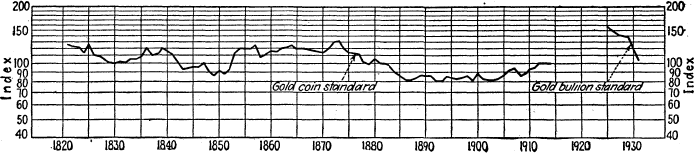
CHART 3.—Wholesale prices in England during years of gold-coin standard, 1821 to 1914, and years of gold bullion standard, 1925 to 1931. (1913 = 100)
In only 14 years of the 94 did the index number fall below 80 or rise above 120.
PRICES IN THE UNITED STATES DURING THE YEARS OF THE GOLD STANDARD, PRIOR TO ENTRY INTO THE FIRST WORLD WAR (1913 = 100)
| Year | Wholesale prices | General prices17 | Year | Wholesale prices | General prices18 |
| 1879 | 88 | 71 | 1899 | 75 | 74 |
| 1880 | 98 | 76 | 1900 | 80 | 76 |
| 1881 | 101 | 79 | 1901 | 79 | 77 |
| 1882 | 106 | 81 | 1902 | 84 | 79 |
| 1883 | 99 | 79 | 1903 | 85 | 80 |
| 1884 | 91 | 76 | 1904 | 86 | 81 |
| 1885 | 83 | 73 | 1905 | 86 | 82 |
| 1886 | 80 | 72 | 1906 | 89 | 85 |
| 1887 | 83 | 73 | 1907 | 93 | 89 |
| 1888 | 84 | 75 | 1908 | 90 | 89 |
| 1889 | 80 | 74 | 1909 | 97 | 93 |
| 1890 | 81 | 75 | 1910 | 101 | 96 |
| 1891 | 80 | 76 | 1911 | 93 | 96 |
| 1892 | 75 | 74 | 1912 | 99 | 99 |
| 1893 | 76 | 75 | 1913 | 100 | 100 |
| 1894 | 69 | 71 | 1914 | 98 | 100 |
| 1895 | 70 | 71 | 1915 | 100 | 103 |
| 1896 | 67 | 71 | 1916 | 122 | 117 |
| 1897 | 67 | 71 | 1917 | 16519 | 13620 |
| 1898 | 69 | 71 |
During the 36 years of the prewar gold standard in the United States (1879 to 1914), the index number was between 95 and 105 for 8 years, and between 90 and 110 for 12 years. The range was from a high of 105 (in 1882) to a low of 69 (in 1874). In only 11 of the 36 years was the index number below 80.
Although this record of gold-standard prices covering nearly a century is far from a record of perfect stability, it is not a bad record. There is nothing that remotely equals it, as far as I know, in any managed paper-money experience.
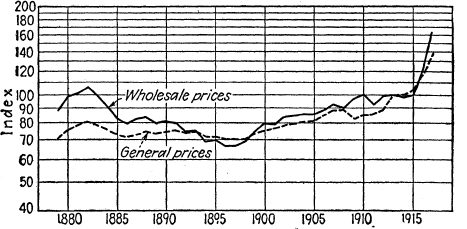
CHART 4.—Prices in the United States during the years of the gold standard prior to entry into the First World War. (1913 = 100)
Lord Keynes, who in recent years has been one of the world’s most vigorous critics of the gold standard, said in 1923, referring to England’s experience with the gold standard during the nineteenth century and the early twentieth:
. . . the remarkable feature of this long period was the relative stability of the price level. Approximately the same level of price ruled in or about the years 1826, 1841, 1855, 1862, 1867, 1871, and 1915. Prices were also level in the years 1844, 1881, and 1914. If we call the index number of these latter years 100, we find that for the period of close on a century from 1826 to the outbreak of war, the maximum fluctuation in either direction was 30 points, the index number never rising above 130 and never falling below 70. No wonder that we came to believe in the stability of money contracts over a long period....1
PRICES IN THE UNITED STATES DURING THE YEARS OF THE GOLD STANDARD21 AFTER THE FIRST WORLD WAR (1913 = 10022)
| Year | Wholesale price index number | General price index number | Year | Wholesale price index number | General price index number |
| 191923 | 206 | 173 | 1931 | 105 | 150 |
| 1920 | 221 | 193 | 1932 | 93 | 132 |
| 1921 | 140 | 163 | 193324 | 87 | 129 |
| 1922 | 139 | 158 | 193425 | 108 | 137 |
| 1923 | 144 | 165 | 1935 | 115 | 145 |
| 1924 | 141 | 166 | 1936 | 116 | 154 |
| 1925 | 148 | 170 | 193726 | ||
| 1926 | 143 | 171 | 193827 | 112 | 15428 |
| 1927 | 137 | 171 | 1939 | 110 | |
| 1928 | 139 | 176 | 1940 | 113 | |
| 1929 | 137 | 179 | 1941 | 125 | |
| 1930 | 124 | 168 | 1942 | 142 | |
| 1943 | 148 |
DEFECTS OF THE GOLD STANDARD
The gold standard is far from being a perfect monetary standard. Although many of the charges brought against it by its opponents are either untenable or of little weight, some of them are important.
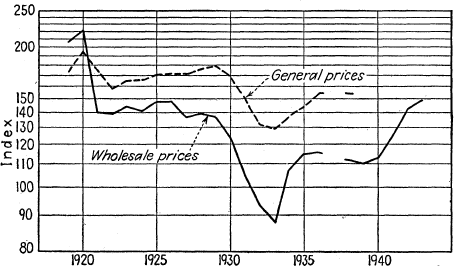
CHART 5.—Prices in the United States during the years of the gold standard after the First World War. (1913 = 100)
A Creature of Blind Natural Forces
The first defect is that under the gold standard, as under every other metallic standard, the value of the monetary unit is largely a creature of blind natural forces. As has been previously pointed out,29 the unit is not a fixed value but the value of a fixed weight of gold, and this value is the resultant of the interaction of the forces of demand and supply. Whatever the future may bring forth, we must recognize that, down to the present time, man has not made much progress in bringing these forces under control. Gold production is carried on by private enterprise in the quest of profit and without any conscious regard on the part of producers for the public’s great monetary need of keeping the value of gold stable. The mines for substantial periods of time may pour large amounts of new gold on the market—as they did at the time of the California and Australian gold discoveries of the middle of the last century, and at the time of the great South African outpourings of gold for a couple of decades prior to the First World War—although the gold-standard nations of the world are suffering at the time from gold inflation. And the mines may be reducing their production of gold at times when these nations are suffering from gold deflation, as from the early seventies to the early nineties of the last century. In time, these evils correct themselves, but time is the essence and much hardship may be caused during the readjustment process. The public is, therefore, alternately in fear of a gold glut and of a gold famine.
Instability in Value
The second weakness of the gold standard—virtually a phase of the one just discussed—is the instability in the value of gold. In the interests of equity in relations between debtors and creditors and of a stable economy, the value of the monetary unit should not vary much from year to year or from decade to decade. But, as we have seen,30 the value of gold does vary materially. A change in the purchasing power of the dollar in a given year, as in the United States in 1921, when it rose 10 per cent, or in 1937, when it fell 7 per cent, is serious; and more serious still is a continuous depreciation or appreciation over a period of years, as for the periods 1896 to 1910 and 1882 to 1886, respectively.
Rigidity
A third weakness, which is closely related to the two just mentioned but more questionable, is the rigidity of the unit of value. Under the gold standard, the unit of value cannot be easily changed as a means of adapting a national economy to the business cycle, to secular changes in the business world, and to the occasional violent disturbance. In order to obtain the advantages of a largely automatic monetary system and of stable foreign-exchange rates, a gold-standard nation must forego the privilege of manipulating its monetary unit to any considerable degree,
Expensiveness
Expensiveness is a fourth defect of the gold standard. In this connection, Adam Smith’s statements are familiar.31 Speaking of the use of bank notes, as media of exchange, he said :
The substitution of paper in the room of gold and silver money, replaces a very expensive instrument of commerce with one much less costly, and sometimes equally convenient.. . . The gold and silver money which circulates in any country may very properly be compared to a highway, which, while it circulates and carries to market all the grass and corn of the country, produces itself not a single pile of either. The judicious operations of banking, by producing, if I may be allowed so violent a metaphor, a sort of wagon way, through the air; enables the country to convert, as it were, a great part of its highways into good pastures and corn fields, and thereby to increase very considerably the annual produce of its land and labour.
The principal expense of a gold-standard currency-may be measured by the interest, at the Government’s long-time current rate, on the average amount of gold that the nation keeps in use for monetary purposes. At this writing (December 31, 1943), the United States’ stock of monetary gold is, roughly, $22 billion—admittedly, much more than we now need. At 2½ per cent interest, the annual cost of this gold would be $550 million. Other costs incident to the gold standard are probably considerably less than they would be for a highly managed paper-money standard. Costs for abrasion, coinage, storage, and the necessary transportation in modern times are small, and the system itself being highly automatic calls for a minimum of managerial expense. The gold-bullion and gold-exchange standards, as we have seen32, are much less expensive than the gold-coin standard. On the other hand, the expenses of engraving and printing paper money, and of the high-quality paper itself that is required, calling as it does for frequent renewals by reason of wear and tear and obsolescence, and the higher cost of currency management, are substantial items in the cost of a managed paper-money system.
Essentially a Sterling Standard Prior to 1914
Another common criticism of the gold standard is that, although it worked well during the nineteenth century, while it was “essentially a sterling standard “controlled by one great central money market, London, it was unable to function after London lost her supremacy to New York following the First World War. Thereafter, London was a losing competitor with New York for first place, but, it was argued, the New York market had neither the organization nor the experience for taking over the new responsibility. Prior to 1914, New York’s financial “hinterland” had been mainly the United States, while London’s had been the world.33
BY WAY OF REJOINDER
The replies that advocates of the gold standard would make to the criticisms just stated have already been made evident to a great extent to the reader, in previous discussions in this book. The rejoinders called for here, therefore, may be brief.
That the value of the monetary unit under the gold standard is controlled largely by blind natural forces and that it is not as stable as it ought to be are valid charges. Here the natural retort is the ad hominem argument. Managed paper-money standards are controlled by human forces of a volatile, emotional, and highly political character, and experience has shown that such standards, whatever they may have been in theory, have in fact been very unstable standards—much more unstable than the gold standard. It is unfair to condemn the gold standard of actual experience for not measuring up to a visionary’s blueprint of a managed paper-money standard.34 There is undoubtedly opportunity for improving both the gold standard and the various kinds of managed paper-money standards, by study, experimentation, and international cooperation. Experimentation, however, with a highly complex and delicate organism like money, which is enormously “affected with public welfare,” is fraught with great danger. Public policy here should be a matter of feeling one’s way cautiously. This can best be done by starting from the time-tested gold standard.
In answer to the criticism that the gold standard is very rigid, the advocates of that standard say that this is more frequently a merit than a defect. It provides the monetary unit with a strong defense against fiscal and political exploitation. Managed paper-money standards are too pliable. They may not break, but how they can bend!
As to the argument that a gold standard is more expensive than a managed paper-money standard, the obvious reply is that a good monetary standard is so vital to the welfare of a nation that it justifies the payment of a good price, and that managed paper-money standards, all things considered, have usually in the end proved to be very expensive to the public. Furthermore, much can doubtless be done to make the gold standard of the future less expensive than was the usual gold-coin standard of the past.
As to the claim that the gold standard had become essentially a sterling standard and could not function after London lost its supremacy as the world’s central money market, I believe that the distinction is one without a significant difference. The British gold standard was a true gold-coin standard down to 1914; after 1914 there was very little British gold standard, and that little was so weakly established as to be no reasonable guide for the future.
For generations prior to the First World War there was free coinage of gold in England, and English money of all kinds could be readily converted into gold at par by the public on demand. One could always change his bank notes for gold and his gold for bank notes. There was free and unlimited coinage of gold at the British mint, so that sovereigns could be obtained by anyone in unlimited quantities for gold bullion at any time at the mint or at the Bank of England, without appreciable charge; while gold coins could be transformed into gold bullion by the simple process of melting. There was a free market for gold within the country, and there were no restrictions on the exportation or importation of the yellow metal.
All kinds of money, therefore, were readily interconvertible with gold coin and gold bullion on demand, and there was a free market for the gold. This meant that a £5 note could not be worth less nor more than 5 sovereigns, and that an ounce of standard gold in the form of sovereigns and an ounce in the form of bars could never differ appreciably in value. It, therefore, meant that changes in the world’s value of gold communicated themselves quickly to British money. If a sovereign became worth appreciably more in England than its gold content of 113 grains of fine gold, gold bullion flowed to England and was coined into sovereigns, thereby increasing the supply of British gold coins; and if a full-weight sovereign in England became worth appreciably less than its pure-gold content of 113 grains, sovereigns were exported as bullion or melted down and transformed into gold bars for export or for merchandise uses, thereby decreasing the supply of gold coins in the British circulation.
This was the gold standard and it was also the “sterling standard.” Fundamentally and viewed over any considerable length of time, they were the same thing. The short-time market, of course, was continually showing small aberrations from the norm—frictional points, as it were, in the functioning of the gold-standard machinery. Then, with the return to gold in 1925, the situation changed materially. The gold-coin standard gave place to the gold-bullion standard and there was much more monetary management.35
With the return to peace after the present war, the position of New York vis-à-vis London, in world financial affairs, will be relatively much stronger than after the First World War. America will be much more international-minded than it was then; will be, relatively to England, in a stronger creditor position in the world’s markets; and will have a banking system better organized for international business and provided with a much more experienced international banking personnel. The world will be a smaller world. If New York needs to take the leadership, she will be in a strong position to take it. We may hope, however, and expect that after the war there will be a much higher degree of international cooperation in monetary affairs than there has ever been before, and that this will be particularly true for the United States and the British Empire.
NO FAIR TEST OF THE INTERNATIONAL
GOLD STANDARD SINCE 1914
The experiences of the world since 1914 throw very little light on the subject of the international gold standard. For this there are two reasons: (1) The world has had only a very limited experience with the international gold standard since 1914, and (2) nearly all the experience it has had has been with new forms of the gold standard established by financially weak governments in a very unstable postwar and wartime world.
The gold standard everywhere broke down during the First World War; and, with the exception of the United States, which returned to gold in 1918, there was no substantial return to gold until after the middle twenties. England did not return to gold until the summer of 1925, and did not complete her legislation for the return until July, 1928; Italy and Poland returned in 1927; and Sweden, in 1930. On this subject Brown says:36 “In the history of the international gold standard 1928-1929 is a landmark because it was the only year during which that standard was almost universally in effect in countries not traditionally attached to silver.” But, these were the years in which the world crisis began in Australia and Germany and Belgium.37 It struck the United States in the stock-market crash of October, 1929, and soon led to the breakdown of all the recently established gold-standard systems of the world, those of Argentina, Austria, and Uruguay having broken as early as December, 1929.38
The Gold Standard in the United States, 1918 to 1933
The only important country having the gold standard throughout the decade of the twenties was the United States; and this country, after the great shock of the 1920 to 1921 postwar price adjustment39 to gold, experienced for the 9 years, 1921 to 1929, one of the most stable commodity price levels40 that the nation ever enjoyed. For these years our wholesale price-index numbers (on the 1926 base) were as follows:
| 1921 | 98 | 1925 | 103 |
| 1922 | 97 | 1926 | 100 |
| 1923 | 101 | 1927 | 95 |
| 1924 | 98 | 1928 | 97 |
| 1929 | 95 |
There is no need of offering evidence in support of the second point, viz., that the postwar gold standards established in most countries were weak types of the gold standard and were put into operation under very unfavorable financial conditions. These facts are everywhere recognized. Practically all these standards were gold-bullion and gold-exchange standards, as contrasted with the stronger gold-coin standard of prewar days. Nearly all the leading nations of the world had, financially speaking, been bled white by the war and found themselves under the necessity of resorting to rigid economy, high taxation, and extensive borrowing from abroad, notably from the United States. On returning to the gold basis, they perforce tried to get along with the minimum possible gold reserves, but the times were such that a restoration of confidence in the currency required higher reserves than under normal conditions. The temptation was great for governments to resort to monetary and credit inflation for fiscal purposes. This policy, whenever extensively adopted—as it was widely—broke down the gold standard as it would have broken down any other stable money standard.
After the early thirties, the gold standard, for the second time in approximately a third of a century, was wiped off the map. It has been partially restored only in the United States and a few minor countries. The international gold standard has now for a number of years ceased to exist, and no useful conclusions concerning its merits or defects can be drawn either from America’s present peculiar, nationalistic, administrative gold-bullion standard or from the pegged and unpegged managed paper-money standards existing elsewhere in the world.
SELECTED BIBLIOGRAPHY
ANDERSON, BENJAMIN M.: International Currency—Gold Versus Bancor or Unitas, Chamber of Commerce of the State of New York, New York, 1944.
BROWN, WILLIAM ADAMS, JR.: The International Gold Standard Reinterpreted 1914-1934. 2 vols., National Bureau of Economic Research, Inc., New York, 1940.
Cunliffe Committee: Committee on Currency and Foreign Exchanges, First Interim Report, His Majesty’s Stationery Office, London, 1918.
———: Committee on Currency and Foreign Exchanges, Report, His Majesty’s Stationery Office, London: 1918.
FISHER, IRVING: The Purchasing Power of Money, The Macmillan Company, New York, 1911.
———: The Money Illusion, Adelphi Company, New York; 1928.
———: Future of the Gold Standard, in John Parke Young’s European Currency and Finance, vol. I, Government Printing Office, Washington, D.C., 1925.
GRAHAM, FRANK D., and CHARLES R. WHITTLESEY: Golden Avalanche, Princeton University Press, Princeton, N.J., 1939.
KEMMERER, EDWIN WALTER: Gold and the Gold Standard, Proceedings of the American Philosophical Society, vol. LXXI (1932).
———: Our Present Gold Problem, Hugh W. Long and Company, Jersey City, 1940.
———: High Spots in the Case for a Return to the International Gold Standard, The Economists’ National Committee on Monetary Policy, New York, 1943.
———: The A B C of the Federal Reserve System, 11th ed., Princeton University Press, Princeton, N.J., 1938.
———: Money—The Principles of Money and Their Exemplification in Outstanding Chapters of Monetary History, The Macmillan Company, New York, 1935.
———: Modern Currency Reforms (with Bibliography), The Macmillan Company, New York, 1916.
KEYNES, LORD JOHN MAYNARD: A Treatise on Money, vol. II, The Applied Theory of Money, Harcourt, Brace and Company, New York, 1930.
———: A Tract on Monetary Reform, Macmillan & Company, Ltd., London, 1923.
———: Essays in Persuasion, Harcourt, Brace and Company, New York, 1930.
League of Nations: Interim Report of the Gold Delegation of the Financial Committee, Geneva, 1930.
———: Second Interim Report, Geneva, 1931.
———: Report of the Gold Delegation of the Financial Committee, Geneva, 1932.
Macmillan Committee: Committee on Finance and Industry, Report, and Minutes of Evidence, 3 vols., His Majesty’s Stationery Office, London, 1931.
PALYI, MELCHIOR: Monetary Chaos and Gold, University of Chicago Press, Chicago, 1934.
Royal Institute of International Affairs: The International Gold Problem, Oxford University Press, London, 1931.
SPAHR, WALTER E. : The Case for the Gold Standard, Economists’ National Committee on Monetary Policy, New York, 1940.
WHITTLESEY, CHARLES RAYMOND: International Monetary Issues, McGraw-Hill Book Company, Inc., New York, 1937.
YOUNG, JOHN PARKE: European Currency and Finance, vol. I, Government Printing Office, Washington, D.C., 1925.
41 Cf. pp. 74-79.
42 See CAROTHERS, NEIL, Silver—A Senate Racket, North American Review, January, 1932; also, Kemmerer on Money», pp. 122-140, and Kemmerer, Money, pp. 375-391.
43 It is to be hoped that in the postwar decisions on this subject there will be friendly international counsel and cooperation. Cf. pp. 210, 212, 221 and 222.
44 On the subject of the adoption of the gold standard by silver-standard countries, see the reports of the Herschell Committee and the Fowler Committee for India, those of the Mexican Currency Commission of 1903 to 1909 for Mexico, and the 1903 and 1904 reports of the United States Commission on International Exchange for these and other countries. These reports and other bibliographical material on the subject are listed in my Modern Currency Reforms, which is devoted largely to a study of replacing the silver standard by the gold standard.
I can speak with firsthand experience on the subject of the difficulties experienced by silver-standard and paper-money standard countries, since I acted as financial adviser to two silver-standard countries and 11 managed paper-money standard countries in the transformation of their currencies to a gold-standard basis.
45 On this general subject see Edwin Walter Kemmerer, Money, pp. 142-153, and Modern Currency Reforms, pp. 488-494, and passim.
46 A striking example of how a depreciating monetary unit affects trade was cited many years ago by the British Consul General at Hakodate, Japan. “In 1892, Hakodate advertised for tenders for 1,500 tons of water-pipes and the contract was secured by a British firm, the tender being four guineas a ton.. . . At the price of silver four guineas cost Hakodate 28 silver dollars. In 1893 there came the greatest fall in the price of silver, the fall of last year [1908] only excepted. In 1894, Hakodate again advertised for 1,500 tons of pipes to complete her water system. The same English firm tendered, and this time at four sovereigns per ton. But because of the great fall in exchange it now required $40 [silver] to buy four sovereigns, or in other words, it required 40 per cent more of Hakodate’s silver money to buy 5 per cent less of our gold money. Under these altered conditions Hakodate refused all the tenders; she erected her own iron works, and when last heard from was busy exporting her pipes to China and India.”—Moreton Frewen, Silver and Our Trade with Asia, an address published by the Canadian Branch of the Fair Exchange League, P. O. Box 393, Ottawa, Canada.
47 Of course, in the case of a depreciation of the creditor country’s monetary-unit, the opposite is the case. As a matter of fact, however, the currencies of debtor countries are much more likely to depreciate than are those of creditor countries. The debtor countries are usually weaker financially.
48 Herschell Committee, Report, Section 5. (See Kemmerer, Modern Currency Reforms.)
49 A crore is 10 million.
50 See pp. 140-141.
51 For a comparison with silver, see Kemmerer, Money, p. 375.
52 The period covered is 1821 to August 1, 1914, and April, 1925, to September, 1931.
53 The gold standard was reestablished in April, 1925. Figures cover 9 months, April to December.
54 The gold standard was suspended September 21, 1931. Figures cover 9 months, January to September.
55 For England the figures are those given by John Parke Young in European Currency and Finance, vol. I., p. 450, which were adjusted to a 1913 base. From 1821 to 1849 they were computed from the price data compiled by N. J. Silberling; and from 1850 to 1914 they are based on the Sauerbeck index numbers. Subsequent figures are those of the Board of Trade.
For the United States, the figures for wholesale prices are those of the Bureau of Labor Statistics adjusted to a 1913 base, and the figures for general prices (which cover-wholes ale prices, retail prices, security prices, and rents) are those compiled by the Federal Reserve Bank of New York.
56 General prices cover commodity prices at wholesale, wage payments, elements of cost of living and rents. See Carl Snyder, A New Index of the General Price Level from 1875, Journal of the American Statistical Association, June, 1924.
57 The United States virtually suspended the gold standard as of September 10, 1917, when the President’s proclamation of September 7 became effective, placing rigid restrictions upon the exportation of gold. The figure here given for 1917, therefore, covers only the period from January through August.
58 The term gold standard is used in the sense described on pages 134-138. The periods covered are from June 30, 1919, the date of the discontinuance of the wartime embargo on the exportation of gold, to March 6, 1933, the beginning of the nation’s “bank holiday” under the President’s proclamation of that date; and from January 30,1934, the date when the Gold Reserve Act of 1934 became effective, to the present time (except for the period December 21, 1936, to April 14, 1938, when the government was sterilizing gold imports). See Kemmerer, The A B C of the Federal Reserve System, 11th ed., pp. 257-261.
59 Figures have been converted to a 1913 base in order to make them easily comparable with those of the preceding two tables.
60 For the period July to December.
61 For the period January to February.
62 For the period February to December.
63 Not a gold-standard year, since the gold-import sterilization plan was in operation throughout the year.
64 For the period May to December.
65 This general price index number was not continued after 1938.
66 KEYNES, LORD JOHN MAYNARD, A Tract on Monetary Reform, pp. 11 and 12.
67 See p. 139.
68 See pp. 89-91 and 188-194.
69 SMITH, ADAM, The Wealth of Nations, Bk. II, pp. 292 and 325.
70 See pp. 160-161, 170-171 and 174-175.
71 William Adams Brown makes much of this argument in his meticulous study The International Gold Standard Reinterpreted.
72 Elihu Root once said: “All my life people have been coming to me with plans to make over society and its institutions. Many of these plans have seemed to me good. Some of them have been excellent. All of them have had one fatal defect. They have assumed that human nature would behave in a certain way. If it would behave in that way almost any of these plans would work, but if human nature would behave in that way not any of the plans would be necessary, for in that case society and its institutions would naturally reform themselves to perfection.”
73 There is “a myth widely current,” says B. M. Anderson, that prior to 1914, “the world was on the sterling standard rather than the gold standard, that London controlled the gold standard and that it was only super-human wisdom in London which made it work. The doctrin adds that when New York became the center after 1918, the gold standard failed, because New York lacked London’s wisdom. Now the fact is that pre-war London had far less control and responsibility prior to 1914 than New York did after 1918, and that policy played a much smaller role in the earlier period. There were many gold standard money markets competing with London for gold prior to 1914, several of them very powerful, as New York, Berlin, and Paris, and many others of real influence, as Amsterdam, Vienna, Switzerland, the Scandinavian countries, and Japan. These all steadied one another. All would pull gold away from any country that was over-expanding credit, and force it to pull up....
“I want to see a real gold standard world again, with several powerful money-centers competing for gold, and holding one another in check....” International Currency—Gold Versus Bancor or Unitas. p. 16.
74 BROWN, WILLIAM ADAMS, JR., The International Gold Standard Reinterpreted 1914-1934, Vol. II, p. 773.
75 See League of Nations, The Course and Phases of the World Economic Depression, p. 109.
76 See pp. 120-121.
77 From June, 1920, to June, 1921, wholesale prices in the United States fell 44 per cent, and general prices fell 19 per cent.
78 During this period there were wide fluctuations in the prices of securities.
- 1For a brief discussion of the origin, nature, and definition of money, see Edwin Walter Kemmerer, Money, pp. 3-16.
- 2Cf. RIDGEWAY, WILLIAM, The Origin of Metallic Currency and Weight Standards, pp. 57-58.
- 3“If a man have destroyed the eye of a freedman, or have broken the bone of a freedman, he shall pay one mina of silver” (§198). “If a doctor have operated . . . he shall receive ten shekels of silver” (§215). “The wage of an artisan . . . five Sĕ of silver, of a brickmaker . . . five Sĕ.. . . ”(§274).
- 4obviously, it is impracticable in a book such as this to do more than to touch briefly on the more elementary facts and principles. Where important controversial questions are involved, the best we can do is to follow a highly responsible recent authority and to refer the reader to the selected bibliography at the end of the chapter, in which a number of the principal studies (some of them containing extensive bibliographies) are cited.
- 5Like the names of many other monetary units of later times (i.e., pound, peso, lira), the mina and the shekel were originally concepts of weight. The mina was an ancient Babylonian unit of weight, and shekel (Hebrew, shegal) meant “to weigh” and equaled of a mina.
- 6DUBBERSTEIN, W. H., Comparative Prices in Later Babylonia, American Journal of Semitic Languages and Literatures, January, 1939, pp. 20ff.
- 7Pictures of a number of these very early coins, including one of a gold coin of Croesus, are given by William Atherton DuPuy in The Geography of Money, The National Geographic Magazine, December, 1927, pp. 744-768.
- 8BURNS, op. cit., p. 160.
- 9The principle of Gresham’s law appears to have been known in ancient Greece. Aristophanes, writing about 405 B.C., said in Frogs, “In our Republic bad citizens are preferred to good. Just as bad money circulates while good money disappears.” For a brief explanation of Gresham’s law, see pp. 135-136, note.
- 10RIDGE WAY, op. cit., pp. 204-205.
- 11For an interesting discussion of the cow unit in different countries and its influence in determining coined units of value, ancient and modern, see Ridgeway, op. cit., pp. 112-115 and 124-154.
- 12CARLILE, WILLIAM WARRAND, The Evolution of Modern Money, p. 31.
- 13The history of the Roman as is both intriguing and controversial. Concerning it there is a voluminous literature.
- 14BURNS, A. R., Money and Monetary Policy in Early Times p. 157.
- 15BULLOCK, CHARLES JESSE, Economic Essays, p. 508.
- 16GAIUS PLINIUS SECUNDUS, Historia Naturalis, Bk. XXXIII, 3.13.
- 17It is interesting to note that our word money has its origin in early Roman times. Money then was coined in a temple of Juno on Capitoline Hill in Rome. One of Juno’s many names was Moneta, a word cognate with Latin monete (to warn). Moneta was guardian of finances (as well as the protector of the female sex). Our words money and mint are cognate with Moneta.
- 18It is interesting to note that our word money has its origin in early Roman times. Money then was coined in a temple of Juno on Capitoline Hill in Rome. One of Juno’s many names was Moneta, a word cognate with Latin monete (to warn). Moneta was guardian of finances (as well as the protector of the female sex). Our words money and mint are cognate with Moneta.
- 19RIDGEWAY, op. cit., p. 339.
- 20RIDGEWAY, op. cit., p. 339.
- 21MATTINGLY, HAROLD, The First Age of Roman Coinage, Journal of Roman Studies, Vol. 19, pp. 20 and 23.
- 22Cf. pp. 128-130.
- 23RIDGEWAY, in Sir John Edwin Sandys’s A Companion to Latin Studies, p. 441.
- 24ROSTOVTZEEF, M., The Social and Economic History of the Hellenistic World, p. 1291.
- 25KENYON, op. ciu, p. 1.
- 26Not a gold-standard year, since the gold-import sterilization plan was in operation throughout the year.
- 27For the period May to December.
- 28This general price index number was not continued after 1938.
- 29The Roman pound contained 12 ounces and the ounce was divided into 24 scruples. It is usually equated with 5,057 grains Troy. See Louis C. West, Gold and Silver Coin Standards in the Roman Empire, Numismatic Notes and Monographs, No. 4 (1941), pp. 6 and 34.
- 30Ibid., p. 17.
- 31BURNS, op. cit., p. 151.
- 32These gold coins were probably not rated as so many silver denarii, but were bought and sold at market prices. “The aureus of Julius Caesar of ¼ pound . . . is the direct predecessor of the imperial aureus of Augustus, which was tariffed at 25 denarii.”—Mattingly, Roman Coins, p. 25.
- 33MATTINGLY, HAROLD, Roman Coins, pp. 18 and 27.
- 34Cf. pp. 135-136, and KEMMERER, Modern Currency Reforms, pp. 329-330.
- 35BURNS, op, cit., p. 154.
- 36JACOBS, WILLIAM, An Historical Inquiry into the Production and Consumption of the Precious Metals, vol. I. See, also, Walker, Francis A., Inter’ national Bimetallism, pp. 16-24.
- 37MATTINGLY, Roman Coins, pp. 5-6.
- 38Ibid., p. 24.
- 39Ibid., p. 447.
- 40See p. 29, note; also, RIDGEWAY, in Sandys, op. cit., pp. 451-452.
- 41The gold standard in its “orthodox form” is a product of the nineteenth century. Its roots, however, go deep into the past. This chapter will explore briefly this early history of gold as money, i.e., as a commonly accepted medium of exchange.
- 42Gold, by reason of its beauty, its world-wide distribution, the facility with which it could be obtained from the streams by crude methods of “panning,” and the ease with which it could be “worked,” probably had a wider use as a medium of exchange in very ancient times, and among primitive peoples in modern times, than any other metal.
- 43The earliest references I have been able to find in recorded history to the use of one of the precious metals as a medium of exchange—in these cases, passing by weight—are in the Code of Hammurabi, King of Babylon. They refer to silver in about the year 1870 B.C.
- 44Thanks to the careful studies made by classical scholars over many generations, we know today much more about the money of classical times than the ancients knew. There are, however, many gaps in the chronology of the coins that have come down to us, and the story that these coins tell is far from complete. It is still full of controversial questions concerning which the modern literature is voluminous, but progress in their solution is being, made continually.
- 45The earliest references I have been able to find in recorded history to the use of one of the precious metals as a medium of exchange—in these cases, passing by weight—are in the Code of Hammurabi, King of Babylon. They refer to silver in about the year 1870 B.C.
- 46Coinage was originally of the nature of a seal or hallmark punched on a nugget of metal as a guarantee of its quality or its weight. The beginnings of coinage appear to have been made in the countries of the eastern Mediterranean early in the eighth century B.C. Sennacherib, King of Assyria (705-681 B.C.), said, “I built a form of clay and poured bronze into it as in making half-shekel pieces.”
- 47I have in my possession a gold daric, one of the oldest and most famous gold coins in history. It is made of almost pure gold and is about the weight of our late American $5 gold piece. It looks like a roughly molded gold nugget and bears a crude stamp of an archer with his bow and spear. The coin was made during the reign of Darius the Great of Persia, about 500 years before Christ. Only about two generations before this, in the reign of Croesus, which began 561 B.C., there circulated in Asia Minor the coins of which Herodotus said, “The Lydians were the first people, so far as I know, to adopt a gold and silver coinage.”
- 48The first gold coin to circulate in Hellas proper was the aforementioned Persian daric or stater (meaning “to weigh”), which weighed about 130 grains and which enjoyed an extensive circulation for several centuries. It was never debased and was “practically the only gold coin for about 200 years, as well in Asia Minor and the mainland of Greece as in the Persian Empire.” It was known in Palestine during Biblical times.
- 49Many of the early coins were made of electrum—a natural alloy, consisting of about three parts of gold to one part of silver, which was found abundantly in Lydia and which caused that country to be known as the land of gold. Because of the difficulty in separating the gold from the silver, the ancients regarded electrum almost as a distinct metal. Early coins of pure gold in Asia Minor were probably made from placer gold obtained from the valley of the Oxus or from the Ural Mountains. The electrum coins were ancient examples of what in modern times is called symmetallism.
- 50In Homeric times values in Greece were reckoned in terms of the cow. According to Ridgeway, “. . . weighing was first invented for traffic in gold, and since the weight-unit of gold is found regularly to be the value of a cow or ox . . . the unit of weight is ultimately derived from the value in gold of a cow.” Our English word pecuniary, which is derived from the Latin pecus, meaning “cattle,” is a monument to this development. Copper was early used as money. The first oboi was apparently a copper spike or skewer, six of which made a drachma, meaning “handful.”
- 51In Homeric times values in Greece were reckoned in terms of the cow. According to Ridgeway, “. . . weighing was first invented for traffic in gold, and since the weight-unit of gold is found regularly to be the value of a cow or ox . . . the unit of weight is ultimately derived from the value in gold of a cow.” Our English word pecuniary, which is derived from the Latin pecus, meaning “cattle,” is a monument to this development. Copper was early used as money. The first oboi was apparently a copper spike or skewer, six of which made a drachma, meaning “handful.”
- 52In the Greek world there were, on occasions, official ratings of the coins of one metal in terms of those of the others. Ratings were changed from time to time and recoinages were made, to prevent a cheaper or overrated metal from driving out of circulation a dearer or underrated one, under the force of what we now call Gresham’s law.
- 53In those early times, gold coins and silver coins circulated for several centuries under a dual standard. Gold gained in importance at the time of Alexander the Great, under the stimulus furnished by the large amount of gold produced in his Pangean mines.
- 54About the beginning of the fourth century B.C., we find a case of monetary debasement suggestive of our American debasement of 1933 to 1934. Dionysius, Tyrant of Syracuse, who had borrowed heavily from his citizens and was being hard pressed for repayment, directed that all the coins in the city should be brought to him, under penalty of death. He then restamped the coins and gave to each drachma the value of two drachmas. By this debasement he was enabled to pay off the original loan and, at the same time, repay the money that he had ordered to be brought to the mint.
- 55Bronze Money. In Italy, as elsewhere, one of the first forms of metallic money consisted of unstamped bullion. But here, unlike the situation in some other places, where gold was readily available, the first metal to circulate was bronze. Originally, the bronze circulated in the form of a rough lump (aes rude), the lumps varying in weight, shape, and size, and bearing no stamp. Later it was hammered into the form of a bar, known as an as (meaning “unit”) in order to give it a convenient form for bartering the metal, which was in demand for the making of tools, weapons, and utensils. As time went on, the conventional length of this bar became a foot (the length of a man’s foot), which, with the conventional diameter, gave the bar a convenient weight of about 1 pound. The bar was later marked off into 12 thumbs, or inches. Since these bars (asses) varied considerably in weight, the custom gradually developed of passing them by weight instead of by tale. The weight of metal then became the important consideration, and the unit of value became the pound of bronze, the as libralis, while the 12 thumb divisions, or inches, became 12 ounces.
- 56Weighing bronze was, however, inconvenient, and the practice developed toward the close of the regal period of placing upon the asses an authoritative stamp certifying their weight, so that again they could pass by count. There are early records of 2-pound bars and also of bars of ½ and ¼ pound. The earliest coin marks on the bars that we have preserved are crude drawings of animals. According to Pliny, “King Servius first stamped bronze.. . . It was stamped with the impressions of animals, whence it was termed pecunia ...”
- 57Early in the fourth century B.C., the silver coinage of Rhodes was supplemented by an issue of gold staters, and this double issue of gold and silver continued unbroken until after the death of Alexander the Great in 323 B.C.
- 58Long after the as libralis ceased to circulate, it was used as a unit of account, in terms of which people thought and expressed monetary values even when payments were actually made in the standard silver money. In contracts then it appears to have been called the as grave, to distinguish it from the current as.
- 59About the beginning of the fourth century B.C., we find a case of monetary debasement suggestive of our American debasement of 1933 to 1934. Dionysius, Tyrant of Syracuse, who had borrowed heavily from his citizens and was being hard pressed for repayment, directed that all the coins in the city should be brought to him, under penalty of death. He then restamped the coins and gave to each drachma the value of two drachmas. By this debasement he was enabled to pay off the original loan and, at the same time, repay the money that he had ordered to be brought to the mint.
- 60Bronze Money. In Italy, as elsewhere, one of the first forms of metallic money consisted of unstamped bullion. But here, unlike the situation in some other places, where gold was readily available, the first metal to circulate was bronze. Originally, the bronze circulated in the form of a rough lump (aes rude), the lumps varying in weight, shape, and size, and bearing no stamp. Later it was hammered into the form of a bar, known as an as (meaning “unit”) in order to give it a convenient form for bartering the metal, which was in demand for the making of tools, weapons, and utensils. As time went on, the conventional length of this bar became a foot (the length of a man’s foot), which, with the conventional diameter, gave the bar a convenient weight of about 1 pound. The bar was later marked off into 12 thumbs, or inches. Since these bars (asses) varied considerably in weight, the custom gradually developed of passing them by weight instead of by tale. The weight of metal then became the important consideration, and the unit of value became the pound of bronze, the as libralis, while the 12 thumb divisions, or inches, became 12 ounces.
- 61Shortly after the death of Alexander, the unified Attic monetary system, which prevailed throughout most of his empire, began to disintegrate. Concerning what followed, down to the time of the conquest of the Greek world by the Romans, M. Rostovtzeef says : [Alexander’s] successors continued his coinage but each for himself in his own name: Coinage was one of the signs and symbols of political independence, it was a powerful instrument of political influence and propaganda, and it yielded a substantial revenue. With the further disintegration of his empire, coinage became ever more diversified, each sovereign State, whether a monarchy or a city, minting its own money.
- 62Even for those early days in Britain there is evidence of debasements of gold coins. These British coins varied in weight from about 120 grains to 84 grains, gradually becoming lighter as time went on.
- 631937
- 641938
- 65 154
- 66Silver Money. Silver in the form of ingots and of foreign coins, notably those of the Greeks, Etruscans, and Sicilians, circulated in Italy during part of the bronze-standard period just described. According to Mattingly, the aes grave of Rome and Italy, which we have previously mentioned, represented “only a short stage of transition from the early use of uncoined bronze as a measure of value, to the Greek use of silver money . . . ” Rome, learning the use of silver and of token bronze from the Greeks of southern Italy, was led to give at least the form of a coinage to the bronze that she was accustomed to use for trading with the Italian peoples.
- 67Bronze Money. In Italy, as elsewhere, one of the first forms of metallic money consisted of unstamped bullion. But here, unlike the situation in some other places, where gold was readily available, the first metal to circulate was bronze. Originally, the bronze circulated in the form of a rough lump (aes rude), the lumps varying in weight, shape, and size, and bearing no stamp. Later it was hammered into the form of a bar, known as an as (meaning “unit”) in order to give it a convenient form for bartering the metal, which was in demand for the making of tools, weapons, and utensils. As time went on, the conventional length of this bar became a foot (the length of a man’s foot), which, with the conventional diameter, gave the bar a convenient weight of about 1 pound. The bar was later marked off into 12 thumbs, or inches. Since these bars (asses) varied considerably in weight, the custom gradually developed of passing them by weight instead of by tale. The weight of metal then became the important consideration, and the unit of value became the pound of bronze, the as libralis, while the 12 thumb divisions, or inches, became 12 ounces.
- 68In the year 217 B.C. the as was reduced to a standard of 1 ounce and was retariffed at the rate of 16 instead of 10 to the denarius, while the denarius itself was debased. About the beginning of the second century B.C., “the Roman coinage enters on a long period of quiet and orderly movement with little of external change to mark it.” This situation continued during the early centuries of the Empire, during which, however, silver met increasing competition from gold. The yellow metal finally superseded silver as the dominant standard, just as silver had previously superseded bronze. To this story we shall now turn.
- 69Contemporaneously with the circulation of bronze and silver in Rome and other Italian cities during early times, there was a circulation by weight of gold in the form of nuggets and of foreign coins. This gold was used principally in the larger transactions. Although destined ultimately to supplant both bronze and silver as the basic monetary metal, gold was in this territory the least important of the three, prior to the beginning of the Christian Era. Evidence that there was a substantial circulation of gold as early as the fourth century B.C. is found in the fact that there was a law at that time requiring that a certain tax be paid in gold.
- 70No further gold coins were minted by Rome for over a century and a half, until the time of the Roman conquests under the great generals Sulla, Pompey, and Julius Caesar. These generals in the field issued the gold coins under authority of the government at Rome. Much of the metal for making them came to the generals in the form of loot, and many of the coins in turn probably went to the soldiers as rewards. Sulla coined an aureus (meaning gold) of 168 grains and later one of 140 grains. Pompey continued coining it at 140 grains. Julius Caesar reduced it to 126 grains. After his death the Senate authorized the ordinary moneyers to coin gold, but coining at Rome was soon superseded by the provincial issues of the triumvirs and their subordinates.
- 71The as of bronze, which developed as a commodity-money unit of value very early in Roman history and was first coined about 300 B.C., played an important part in that history for centuries. According to Mattingly, “The bronze coinage was paramount from the beginnings down to c. 245 B.C.. . . ”While from 245 B.C. to 217 B.C. it played an equally important part with silver, after 217 B.C. silver dominated, and during the second century the bronze coinage became increasingly subsidiary.
- 72When, as a result of debasements, coins of different weights were in circulation together in sufficient quantities, Gresham’s law operated, and the lighter weight coins drove the heavier ones out of circulation. A person who could discharge a debt with the same number of lightweight aurei as of heavyweight ones, naturally paid it with the lightweight ones and kept or melted down the heavier ones. Likewise, when the market prices of commodities were the same whether payments were made in lightweight coins or in heavyweight ones, the purchaser would pay with the lightweight ones. It was merely a case of buying in the cheaper market. To the extent that the merchants and others in selling goods made allowance for the differences in the weight of the coins by quoting lower prices when payment was to be made in the heavier coins, a dual standard developed and standard coins of different weights then circulated side by side.
- 73Augustus gave gold a place above silver. He reduced the aureus from the 126-grains weight given it by Julius Caesar to 122.9 grains. “Gold and silver are both struck almost pure [at a ratio of 12½ to 1]. . . . Brass and copper are struck much more carelessly . . . , i.e., not on ä carefully adjusted weight for each piece, but at so many to the pound.” From Augustus to Nero the system was not changed, but the weight of the aureus was gradually reduced administratively, with an accompanyng reduction in the denarius. From the reign of Nero through the reign of Diocletian, the monetary situation throughout the Empire was confused and debasements were common. The reigns of Claudius and Nero witnessed much counterfeiting and a wide circulation of privately made tokens, which were usually of lead. Diocletian made two reductions in the weight of the aureus in the year 312, and Constantine the Great put through a monetary reform that fixed the gold content of the aureus at about 70 grains, representing a debasement of approximately 38 per cent since the time of Nero. Thereafter, until the Empire in the West came to its end in 476, gold apparently grew in relative importance and was the imperial money par excellence, although the silver denarius and its fractions continued to hold a high place in the business of the Empire.
- 74The third factor was that the supply of the precious metals available for money declined in a large part of Europe during the Dark Ages. Widespread looting of occupied territories during the wars of the early Christian Era and subsequently by the conquering Germanic peoples of the North had scattered widely and thinly the accumulated gold and silver treasure of classical times. The yields of the gold and silver mines also declined, partly because the mines were bled white by tenant operators who were little concerned with the conservation of the mines’ resources, partly because most of the labor in the mines was inefficient convict and slave labor, and partly because there was destruction and looting of the mines by the invading barbarians.
- 75It was inevitable that this clumsy coinage should soon give way to the more convenient silver. Accordingly, during the course of the Pyrrhic War, Rome struck her first silver coins, didrachmas (double drachmas) and rare divisions of the didrachma. After defeating Pyrrhus and getting control of all southern Italy, shortly before the First Punic War, the Romans obtained there large supplies of silver, which they used in part for the Roman silver coin that was struck in Campania. This coin was the denarius (meaning “every ten”), and was probably equivalent to a didrachma. It was rated at 10 asses and divided into four parts, called sestertii. Although this silver coinage in Rome itself was struck about 268 B.C., it was not until about a half century later that silver became the dominant standard and the sestertius replaced the as as the unit of reckoning.
- 76It was inevitable that this clumsy coinage should soon give way to the more convenient silver. Accordingly, during the course of the Pyrrhic War, Rome struck her first silver coins, didrachmas (double drachmas) and rare divisions of the didrachma. After defeating Pyrrhus and getting control of all southern Italy, shortly before the First Punic War, the Romans obtained there large supplies of silver, which they used in part for the Roman silver coin that was struck in Campania. This coin was the denarius (meaning “every ten”), and was probably equivalent to a didrachma. It was rated at 10 asses and divided into four parts, called sestertii. Although this silver coinage in Rome itself was struck about 268 B.C., it was not until about a half century later that silver became the dominant standard and the sestertius replaced the as as the unit of reckoning.
- 77Summing up this development, Ridgeway says:
- 78Coinage in Europe during the early Middle Ages was practically limited to silver and copper, except for a temporary minting of gold in the Carolingian period. Silver provided the principal currency of western Europe. The aureus of Constantine, however, continued to circulate until the downfall of the Eastern Empire in 1453, and from this gold unit various coinages of mediaeval and modern Europe were descended.

