
Gold and the Gold Standard
Chapter III: Gold Money and the Gold Standard in the United States Prior to the First World War
Gold Money and the Gold Standard in the United States Prior to the First World War
American life storms about us daily and is slow to find a tongue.—RALPH WALDO EMERSON.
Gold monometallism did not actually exist in America until 1879. Nonetheless, from the beginning of European settlements here, gold, at least to some extent, has always served as basic money. Our experience with it may be divided into four periods : (1) the period prior to the National Mint Act of 1792, roughly, the preconstitutional period, during which only a scattering of gold money circulated in the country, along with many silver and copper coins and with large amounts of inconvertible paper money; (2) the period of bimetallism, from 1792 to the long suspension of specie payment at the end of 1861 (omitting the brief suspension from 1814 to 1817); (3) the period of the greenback standard, from 1862 through 1878, during which the only circulation of gold money of consequence was a limited amount on the Pacific Coast, although gold performed secondary monetary functions elsewhere; (4) the period of the gold standard, from the resumption of specie payments in 1879 to the First World War.
THE PRECONSTITUTIONAL PERIOD
The Colonial Period
Gold money circulated in North America to a small extent from early in the seventeenth century, along with many varieties of the more abundant Spanish milled dollars and their fractions, some other foreign coins, and a few locally minted silver and copper coins. Gold money, however, did not play an important role in America prior to the national period.
No gold was minted in America in this early period, and there was no gold-mining industry. Gold coins were brought into the colonies by migrants from the homelands; and some gold came in from England, France, Holland, Spanish countries, and especially the West Indies, as a result of trade with them. Inasmuch as these gold coins were of widely varying denominations and were often greatly underweight, by reason of having been clipped, scraped, or otherwise tampered with, they passed by weight and not by count.
The information that has come down to us concerning this early gold money is meager. A few items culled from various sources will suggest the broad outlines of the picture.
During the seventeenth century, the Portuguese found placer gold in Brazil and carried large quantities of it to Portugal, whence it moved by trade routes to other parts of the world, including America.1 According to Crosby,2 the old English gold nobles and marks were sometimes made use of, at least by name, in the colonies between 1645 and 1690. Chalmers says3 that prior to 1704 gold coins in the American colonies “were of rare occurrence and were regarded as counters rather than as real money.” During the eighteenth century gold replaced silver as the dominant metallic standard in the English West Indies, which received much gold from Portuguese and Spanish sources and also some from the American colonies, by offering ratings giving preference to gold over silver.4
A British law of 1750 mentions a number of gold coins as circulating in Massachusetts Bay Colony, including British guineas, crowns, and half crowns, and the double and single Johannes and moidore of Portugal. In 1752 Massachusetts treasury bonds were made payable in silver or gold, at a fixed ratio of equivalence, and gold coins were current in the province. A large amount of gold was shipped in 1758 from England to Massachusetts in payment of subsidies voted by Parliament; and 4 years later the Massachusetts legislature declared that “gold is now become by far the greatest part of the medium of trade in this Province.”5
The Period of the Revolution and the Confederation
In 1776 the Continental Congress appointed a committee to examine
. . . the value of the several species of Gold and Silver Coins, current in these Colonies, and the proportions they ought to bear to Spanish milled dollars.
Shortly afterward, following the recommendation of this committee, it was
Resolved, That the several Gold and Silver Coins passing in the said Colonies shall be received into the public treasury of the Continent, and paid out in exchange for bills emitted by the authority of Congress, when the same shall become due, at rates set down in the following table.6
It was further resolved that
. . . whoever shall offer, demand, or receive more in said bills for any Gold or Silver Coins or bullion, than at the rates aforesaid, or more of said bills for any lands houses goods wares or merchandise than the nominal sums at which the same might be purchased of the same person with Gold or Silver, every such person ought to be deemed an enemy to the liberties of these Colonies and treated accordingly ...
Robert Morris, in his coinage scheme proposed in 1782, said:7
. . . where coins are so numerous [as they are now in America] that the knowledge of them is a kind of science, the lower order of citizens are constantly injured by those, who carry on the business of debasing, sweating, clipping, counterfeiting, and the like . . . Experience has already told us, that the advantage of Gold as a coin, is in this country very considerably diminished; for every distinct piece must be weighed before it can be safely received.
Coinage Plans Proposed. Between the end of the colonial period, July 4, 1776, and the beginning of the national government, April 30, 1789, several coinage plans for the new nation were proposed.
In 1782 Robert Morris, who was Superintendent of Finance in the Confederation from 1781 to 1784, recommended to the Congress a new coinage scheme. Morris believed that bimetallism would not work and that, for a single standard, silver was preferable to gold. He said:
Gold is more valuable than Silver, and so far must have the preference, but it is from that very circumstance the more exposed to fraudulent practices. Its value rendering it more portable is an advantage, but it is an advantage, which paper possesses in a much greater degree, and of consequence the commercial nation of England has had recourse to paper for the purposes of its Trade; although the mass of circulating Coins is Gold. It will always be in our power to carry a paper circulation to every proper extent. There can be no doubt, therefore, that our money standard ought to be affixed to Silver.
At the time that Robert Morris made his recommendation to Congress, Thomas Jefferson prepared a memorandum on the subject, which was likewise sent to Congress.8 Jefferson favored basing the monetary unit on the value of the Spanish milled dollar, with which the public was thoroughly familiar, and adopting a bimetallic system. “It is not impossible,” he said, “that 15 for 1 may be found an eligible proportion. I state it however as conjectural only.”
The Continental Congress received, on May 13, 1785, the report of its Grand Committee on the Money Unit, which recommended a bimetallic system with a monetary unit equivalent in value to the existing Spanish milled dollar (estimated at 362 grains of fine silver), a gold-silver ratio of 15 to 1, and monetary denominations based on the decimal system. The Congress took the committee’s report under consideration about 2 months later and, by unanimous vote, resolved merely that the monetary unit should be one dollar, that the smallest coin should be made of copper, of which 200 should pass for one dollar, and that the several pieces should increase in a decimal ratio.
In the following year, on April 8, the Board of the Treasury, consisting of Samuel Osgood and Walter Livingston, proposed to the Congress a coinage system. Their reports, which were threefold, recommended the silver equivalent of the Spanish milled dollar as the monetary unit, the coinage of standard coins of both silver and gold, and the decimal system of denominations. Congress responded on August 8, 1786, to the board’s recommendation by a resolution offering a detailed coinage plan.9 It provided that the monetary unit should be a dollar consisting of 375.64 grains of fine silver, that there should be a decimal system of coins, running from one mill to ten dollars, that the coins below a dime should be made of copper, that those from a dime to a dollar should be made of silver, and that there should be two gold coins. With reference to the latter, the resolution provided that one coin should contain 246.268 grains of fine gold, equal to $10; that it should be stamped with the impression of the American eagle, and be called an eagle. The other should contain 123.134 grains of fine gold, should be equal to $5, should be stamped in like manner, and be called a half eagle. The gold-silver ratio here recommended was approximately 15.25 to 1.
Although an ordinance was passed by the Continental Congress on October 16, authorizing the establishment of a mint and the coinage of gold, silver, and copper coins, nothing was accomplished in this direction until after the new national government was established.
A National Currency Established
Metallic Money and the Constitution, With the ratification of the Constitution, the national government was given power “to coin money, regulate the value thereof, and of foreign coin and fix the standard of weights and measure.” This power was made exclusive by the provision that “no state shall . . . coin money; emit bills of credit; make anything but gold and silver coin a tender in payment of debts.” The records of the Constitutional Convention and of the debate over the adoption of the Constitution show that there was practically no controversy over the provisions of the Constitution relating to coinage. They were everywhere taken for granted.
Our constitutional fathers were familiar with the fact that over many centuries the kings and other potentates of Europe had followed the practice of debasing the coins of the realm so as to make seigniorage profits for themselves or their governments. Adam Smith, in his Wealth of Nations10 published in 1776 and widely read in this country during the years immediately following, had said, giving many historical examples:
When national debts have once been accumulated to a certain degree, there is scarce, I believe, a single instance of their having been fairly and completely paid. The liberation of the public revenue, if it has ever been brought about at all, has always been brought about by a bankruptcy; sometimes by an avowed one, but always by a real one, though frequently by a pretended payment.
The raising of the denomination of the coin has been the most usual expedient by which a real public bankruptcy has been disguised under the appearance of a pretended payment. . . .
The honour of a state is surely very poorly provided for, when in order to cover the disgrace of a real bankruptcy, it has recourse to a juggling trick of this kind, so easily seen through, and at the same time so extremely pernicious.
Almost all states, however, ancient as well as modern, when reduced to this necessity have, upon some occasions, played this very juggling trick ...
By means of such expedients the coin of, I believe, all nations has been gradually reduced more and more below its original value, and the same nominal sum has been gradually brought to contain a smaller and smaller quantity of silver.
The men who gave us our Constitution were fearful of placing excessive monetary powers in the hands of the executive, and therefore wisely placed the authority to regulate the value of the nation’s money in the hands of Congress.
Hamilton’s Report on the Mint. The House of Representatives, on April 15, 1790, passed a resolution ordering the Secretary of the Treasury to prepare and report to the House a plan for the establishment of a national mint.
In response to this resolution, Alexander Hamilton submitted to the House, on April 28,1791, his Report on the Mint—a report that showed a remarkable understanding of the principles of monetary science. After a broad discussion of the question of a proper coinage policy for the new nation, Hamilton undertook to answer six questions concerning the coinage. Only the first two of them demand much attention in this study of gold money,11 viz., (1) “What ought to be the nature of the money unit of the United States?” and (2) “What the proportion between gold and silver, if coins of both metals are to be established?”
The Dollar Recommended as the Monetary Unit.
Before answering the question of what the money unit ought to be, Hamilton undertook to answer the question, What is the money unit? He did so on the sound theory that the new unit ought, if practicable, to have a value very close to that of the existing one, so as to avoid disturbances in prices and wages and in the relations between debtors and creditors. He concluded that, although the pound was the unit in the money of account of all the states, the dollar was best entitled to be considered as the unit in the coins.
He then considered the fine-silver content of the principal Spanish dollars in circulation, concluding that the more ancient and more valuable dollars were not then to be found and “that the mass of those generally current is composed of the newest and most inferior kinds.” He decided that the present unit was somewhere between a dollar of about 368 grains of fine silver and one of about 374 grains.
Approaching the problem from another angle, he found the market ratio of gold to silver to be approximately 15 to 1. Multiplying the fine-gold equivalent of the dollar, viz., 24¾ grains, by 15, he arrived at 371¼ grains of silver for the dollar—almost exactly the average of the fine-silver weights of Spanish dollars of the two more recent issues.
Hamilton in Favor of Bimetallism. The next question considered was whether the new coinage system should be silver monometallism, gold monometallism, or bimetallism. Up to that time, he said, the suggestions and proceedings had had for their object the annexing of the future money unit “emphatically to the silver dollar.” Despite these prevailing ideas, however, he declared himself as “upon the whole, strongly inclined to the opinion, that a preference ought to be given to neither of the metals for the money unit,” and that, “perhaps, if either were to be preferred, it ought to be gold rather than silver.” “Gold,” he said, “may, perhaps, in certain services, be said to have greater stability than silver; as, being of superior value, less liberties have been taken with it, in the regulations of different countries.”
The value of gold, he thought, was less likely than that of silver to be influenced by the circumstances of commercial demand; and the revolutions that might take place in the comparative values of gold and silver in the future, he believed, would be more likely to be due to changes in the value of silver than in that of gold. However, these advantages of gold over silver he did not consider sufficient to justify the use of gold alone as a standard metal, and he concluded that “upon the whole, it seems to be most advisable . . . not to attach the unit exclusively to either of the metals; because this cannot be done effectually, without destroying the office and character of one of them as money, and reducing it to the situation of a mere merchandise . . . ”
The use of the two metals as standard money, he thought, would also be of advantage in the development of the country’s foreign trade, since “it is often, in the course of trade, as desirable to possess the kind of money, as the kind of commodities best adapted to a foreign market.”
Hamilton then took up a study of what should be a proper mint ratio between gold and silver under his proposed bimetallic system. He recognized that the mint ratio should conform as nearly as possible to the market ratio in the leading markets of the world, and that, if a mint ratio materially different from the market ratio should be established, the overvalued metal would drive the undervalued metal out of circulation. After a lengthy discussion of the ratio question, he concluded, with some hesitation, that, all things considered, the best ratio to adopt would be 15 to 1.
On this basis Hamilton concluded “that the unit, in the coins of the United States, ought to correspond with 24 grains and ¾ of a grain of pure gold, and with 371 grains and ¼ of a grain of pure silver, each answering to a dollar in the money of account” Following the British practice, he favored making both gold and silver coins  fine. He recommended the decimal system of notation. Six denominations of coins were recommended to begin with; viz., gold pieces of ten dollars and of one dollar, silver pieces of one dollar and of ten cents, and copper pieces of one cent and of a half cent.
The question of whether a mint should impose a charge for the coining of gold and silver brought to it Hamilton discussed, reaching the conclusion that
under an impression that a small difference between the value of the coin and the mint price of bullion, is the least exceptionable expedient for restraining the melting down, or exportation of the former, and not perceiving that if it be a very moderate one, it can be hurtful in other respects—the Secretary is inclined to an experiment of one-half per cent on each of the metals.
As to foreign coins, Hamilton said the discontinuance of their circulation was a necessary part of the system contemplated for the new national coinage. He recommended, however, that the foreign coins should be “suffered to circulate, precisely upon their present footing, for one year after the mint shall have commenced its operations,” and that thereafter their demonetization should be gradually extended over a period of 2 years. It may be noted here, parenthetically, that foreign coins were not actually retired from circulation until about 65 years later.12
GOLD IN THE BIMETALLIC SYSTEM, 1792 TO 1861
The Mint Act of 1792. On April 2, 1792, after a debate that was concerned chiefly with the questions whether a representation of President Washington should be stamped on the new gold coin, or an emblem of liberty with the word Liberty, and whether an eagle should be stamped on the reverse side of the coin,13 the Senate standing for the representation of Washington and the House for the emblem of liberty. The House won, and the mint bill became law. In all important respects, save two, the Mint Act followed the recommendations of Hamilton’s report. The two exceptions were (1) the adoption of a slightly different fineness for the silver coins (viz., 0.89240 instead of 0.91667)14 and (2) the denominations of the coin to be minted. The act provided for all the denominations recommended by Hamilton except the gold dollar, but added gold pieces of five dollars and two dollars and a half, and silver pieces of fifty cents, twenty-five cents and five cents, thereby departing from the almost strictly decimal system of denominations recommended by Hamilton.
The copper cent and half-cent pieces authorized by the Mint Act and the subsequent act of May 8, 1792, carried practically their full value in their copper content, just as the gold and silver coins carried practically their full values in their weight of the respective metals.15 Debasement of coins or embezzlement of metals by officers or employees of the mint was declared to be a felony and was punishable by death.
This law created in the United States a bimetallic system. Under it two kinds of standard money were linked together and both enjoyed exactly the same privileges under the law. Coins of both gold and silver were unlimited legal tender and were accepted in unlimited quantities by the government in payment of all taxes and other government dues. Both metals were coined at the mint on the same terms for persons taking them there for coinage, at the official ratio of 15 to l.16 This meant that, for a given weight of pure metal, fifteen times as many dollars of gold coins would be minted and paid back to the persons who brought gold as for the person who brought silver. In other words, for making money an ounce of gold was treated as worth fifteen times as much as an ounce of silver.
Gold Undervalued, 1792 to 1834
On July 31, 1792, the cornerstone was laid for a building in Philadelphia to be used as a mint—the first building to be erected by the new national government for public purposes. The work of coinage began in 1792 with the minting of a small amount of silver and copper coins. Gold coins were first struck in 1795.
The 15 to 1 ratio recommended by Hamilton and adopted in the Mint Act was at the time very close to the market ratio. This ratio, however, soon rose substantially above 15 to 1, and (with a few slight interruptions) remained at the higher level until 1833. From the year 1795, when the first United States gold coins were struck, to the end of 1833, the average of the 39 annual commercial ratios was 15.6 to 1.
This meant that, at the mint, gold was undervalued and silver was overvalued, as compared with the prices of the two metals prevailing in the bullion market, and also as compared with the coinage ratio of bimetallic France, which, from 1803 through 1833, was nominally 15½ to 1, but actually, when allowance was made for the coinage charges, was 15.69 to 1. The result of our low gold-silver ratio was that we got silver, which we overvalued, while gold, which we undervalued, went to France and elsewhere. The following chart gives a picture of what happened.
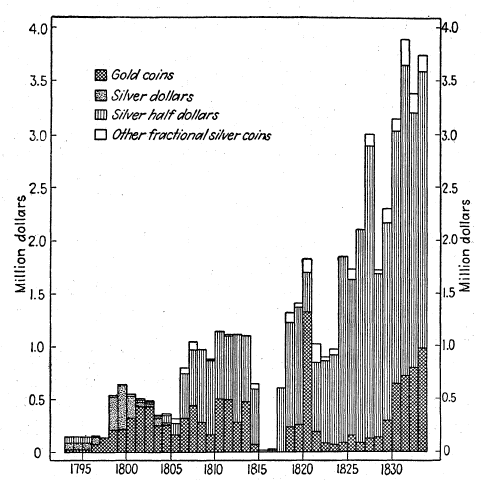
CHART 1.—Coinage of gold and silver at the United States Mint, 1793 to 1833. (Reproduced from Kemmerer, Money, page 337.)
At least some gold was coined in every year from 1795 to 1833 (except 1816 and 1817). During this period of 39 years, the United States minted approximately $15.5 million of gold coin, of which about two-thirds consisted of half eagles, slightly over 22 per cent consisted of eagles, and approximately 10 per cent consisted of quarter eagles. Throughout the period, silver predominated over gold in. the country’s circulation, and this predominance was pronounced between 1821 and 1833, when the circulation of gold coin in the country was very small.17
Since no silver dollars were coined after 1806 and only about $1.3 million before that year, during this entire period the half dollar served as the principal coin of the country. Of a total silver coinage from 1793 through 1833, amounting to $36.3 million, $33.0 million, or 90.9 per cent, consisted of half dollars.18 All fractional silver coins throughout this period of American bimetallism were full weight, i.e., a dollar in fractional coins contained the same amount of silver as a silver dollar.
American Silver Coins Forced Out of Circulation by Defective Foreign Silver Coins. Just as, during the greater part of this first period of American bimetallism, the silver coins, overvalued by the mint ratio of 15 to 1, were driving out of circulation on a large scale the undervalued gold coins, so, under the force of Gresham’s law, were the badly worn, clipped, and otherwise defective foreign silver coins forcing out of circulation large amounts of the newly minted American silver coins.
The first of the coins to go was the silver dollar. Although it contained slightly less silver than an unworn Spanish milled dollar of more recent date, it contained more silver than the defective Spanish dollars usually found in circulation. The new American silver dollars were, therefore, quickly picked up and sent by trade channels to the West Indies, where they were popular by reason of their brightness and were readily exchanged for the heavier Spanish dollars that were in circulation there. These were then brought to the United States and put into circulation after some of the silver had been abstracted from them by clipping, scraping, boring, and sweating. The coinage of silver dollars was practically discontinued in 1805, not to be renewed until 1840.19
In the first third of the nineteenth century, therefore, both gold and silver coins were standard money, but silver strongly predominated under the newly established bimetallic standard. Our supply of coins was meager and their condition was unsatisfactory. There were few gold coins in active circulation and practically no American silver dollars. There were a substantial number of American half dollars, a few quarters and dimes, and an occasional half dime. A large proportion of the coins in circulation consisted of clipped and badly worn foreign coins, especially coins of Spanish origin.
Agitation for Monometallism
By 1830, many thoughtful people were convinced that bimetallism would not work and that a system of monometallism should be adopted. A striking example of this attitude is found in the letters and reports of S. D. Ingham, who was Secretary of the Treasury during the first 2 years of Andrew Jackson’s administration. In a report to the Senate under the date of May 4, 1830, Ingham said:20
The proposition that there can be but one standard in fact is self-evident. The option of Governments charged with this duty is therefore between having property measured sometimes by gold and sometimes by silver, and selecting that metal which is best adapted to the purpose for the only standard.. . . The values of gold and silver, compared with each other, . . . are liable to fluctuations, resulting from the operations of human enterprise, the political convulsions of nations, and from the laws of nature, which can neither be anticipated, controlled nor averted.. . . A simple and certain remedy is within the reach of all. This remedy is to be found in the establishment of one standard measure of property only.
Although many at that time favored replacing bimetallism by a single standard, there was much difference of opinion as to whether that standard should be gold or silver. Secretary Ingham himself favored the silver standard. He said21 that “the standard measure of property should be made of a metal sufficiently abundant to enter into general circulation, determining values in small as well as large transactions.” In a country like the United States, where most of the transactions of any size were performed by means of paper money, he thought that the absence of gold coins from circulation would not be a serious inconvenience. He pointed out that we had had long experience with a currency in which there was only a small amount of gold coin, but that we had had very little experience with a currency in which there was a dearth of silver coins. The inconvenience of the former, he said, had been slight but that of the latter would be serious. He thought that, if our silver coins should be drained off, their value would be supplied not by gold, but by small bank notes and tokens—“the worst species of paper currency.”22
In opposition to the silver monometallists, advocates of the gold standard held that gold was preferable to silver as the standard money metal. They maintained that it was more stable in value and that, under a gold-standard system, silver could be kept in circulation in adequate quantities by the expedient of restricting the coinage of silver and of making silver coins token money with limited legal tender. They pointed to the success of the gold standard in England, with its token silver coinage, and to the desirability of our having a standard conforming to that of the country with which we carried on our largest trade.
The arguments of the gold monometallists were strengthened by the fact that, about that time, some gold discoveries were made in Georgia and North Carolina, which created in those sections special and local interests favorable to gold.
Bimetallism Continued
Nonetheless, the majority of thinking people still favored bimetallism, which appeared to them to be succeeding in France and which they believed had not been given a fair trial in the United States.
It had long been recognized that the mint ratio of 15 to 1 adopted by the United States in 1792 had soon thereafter fallen below the market ratio and also below the mint ratio of France. Agitation in favor of raising our mint ratio in order to restore our gold circulation became increasingly strong after 1828. A select committee of the House of Representatives, on the subject of the relative values of the gold and silver coins of the United States, made a report to the House on February 2, 1821, favoring an increase of our mint ratio to about 15.6 to 1. The committee found that23 gold coins, both foreign and of the United States, had, in great measure, disappeared; and, from the best calculation that could be made, there was reason to fear they would be wholly driven from circulation. There was no longer any doubt, they said, but that the gold coins of the United States were by our laws rated at a value lower than that in almost any other country, in comparison with that of silver.
Secretary of the Treasury Ingham made a long report to the Senate on May 4, 1830, on the question of the desirability of changing the ratio.24 He said that, if bimetallism were to be continued and an effort made to restore gold to the circulation, probably the best ratio to adopt would be 15.625 to 1. The C. P. White Committee of the House, although preferring a single silver standard and desiring that gold coins, if they were placed in circulation at all, should be treated as subsidiary money, advocated in two reports the ratio of 15.625 to 1.
Despite all the reasons favorable to this ratio, which conformed closely to the French ratio, Congress hurriedly passed a law on June 28, 1834, adopting a ratio of 16.002 to 1. There was no explanation of this sudden change in its attitude. From a ratio unduly favorable to silver, Congress now suddenly jumped to the other extreme and adopted one unduly favorable to gold. The two reasons most commonly advanced were (1) that it was designed to help the gold-mining industry then developing in the southern slopes of the Allegheny Mountains, and (2) that it would help drive out of circulation the notes of the Second Bank of the United States—an institution which at that time was meeting the vigorous opposition of President Jackson.
The legislation of this period left the pure-silver content of our silver coins unchanged. It effected the change in the gold-silver ratio by reducing the gross weight of a dollar of gold coin from 27 grains to 25.8 grains, and the pure-gold content from 24.75 grains to 23.2 grains. Each denomination of new gold coin, therefore, was given a gold content about 6.7 per cent less than under the old law. The new gold coins were given a millesimal fineness of 0.8992. This proved to be inconvenient to the mint and was accordingly raised by law to 0.900 in 1837. The change increased the pure-gold content of a dollar of gold coin from 23.2 grains to 23.22 grains—a gold content that was retained as long as gold coins were minted in the United States.
Since 1837, all our gold and silver coins (except the three-cent silver piece for a brief period)25 have been 0.900 fine. The change in the gold coins made by the act of 1837 reduced the gold-silver value ratio at the mint from 16.002 to 1, established by the act of 1834, to 15.9884 to 1.
The act of 1834 made the old gold coins receivable in all payments at the rate of 94.8 cents per pennyweight, which was their bullion value in terms of the new gold coin, and at which value they were retired from circulation.
A reduction of 6.7 per cent in the amount of pure gold in a dollar of United States gold coin at most later periods in our history would have meant a substantial debasement of the currency. This was not the case, however, in 1834 to 1837, because at that time very few United States gold coins had been in circulation for over a decade and these few had commonly borne a premium. Persons contracting debts, therefore, contemplated payment of them in United States silver coins or Spanish silver coins or in their equivalents in bank notes, and the legislation of 1834 and 1837 did not change the silver content of these coins. The act of 1837 also discontinued all coinage charges.
How the New Ratio Worked
From the enactment of the coinage laws of 1834 and 1837 to the suspension of specie payment at the end of 1861, our new mint ratio ruled above the world-market ratio and above the bimetallic ratio prevailing in France. After 1850, moreover, the greatly increased world production of gold resulting from the discoveries of gold in California and Australia increased this differential substantially.
With such an overvaluation of gold at our mint, it was inevitable that gold coinage should heavily predominate over silver coinage and that gold should tend strongly to drive silver out of circulation —particularly, the larger silver coins, which were those least abraded and relatively the least expensive to collect. Chart 2 shows what happened from 1834 until the suspension of specie payments at the end of 1861.26
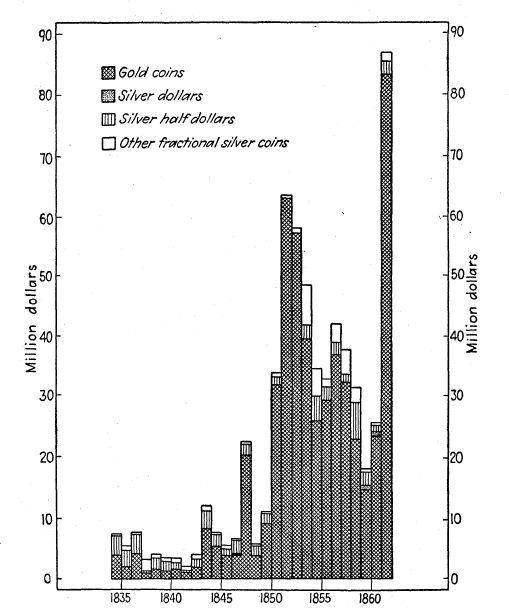
CHART 2.—Coinage of gold and silver at the United States Mint, 1834–1861.
From 1834 to 1852 (the last complete year before fractional silver coins were made fiduciary), the total coinage of gold was $225 million and that of full-weight silver coins (i.e., all silver coins except the three-cent pieces of 1851 and 1852)27 was $41.2 million, making the gold coinage approximately $5.50 to each dollar of silver coinage. Although there was a considerable coinage of silver nearly every year from 1834 to 1850, after 1850 the coinage of full-weight silver coins became negligible. The great bulk of the silver coins minted during the years 1834 to 1852 were half dollars (as it had been prior to 1834). Out of a total silver coinage of $41,200,000, during this period, silver dollars amounted to only $1,067,000. The coinage of quarters, dimes, and half dimes was much larger than during the preceding period.
Prior to 1850, the value ratio of gold to silver was not sufficiently below 16 to 1 to give a very large premium on silver coins—the premium having ruled most of the time in the neighborhood of 1 per cent. While this premium led to the rapid disappearance from circulation of the few silver dollars that were minted and of some of the half dollars, it was not sufficient to cover the cost of collecting and shipping fractional coins of denominations lower than fifty cents on any considerable scale and to yield a fair profit on the transaction. Down to about 1850, therefore, the supply of fractional silver money, although it was often not adequate, was still not deficient enough to cause the public serious inconvenience. Much of the fractional money, however, during those years was in bad condition.
Under the influence of the great flood of gold poured onto the world’s markets from the newly discovered gold fields of California and Australia, the value ratio of gold to silver fell rapidly during the period 1848 to 1859, and this meant an increasing premium on silver coins. For example, while the ratio of 15.85 to 1, prevailing in 1848, was equivalent to a premium of 0.8 per cent on American silver coins, the ratio of 15.33, prevailing in 1853, was equivalent to a premium of 4.3 per cent. Not only did the receipts of silver at the mint fall off rapidly, but the silver in circulation began to disappear, at first the half dollars and then the smaller denominations. Everywhere the public were protesting against the scarcity of small change.
Various measures were adopted to meet the situation. In 1849 the government began to coin $1 gold pieces, and from then until 1862 it coined approximately $19 million of these pieces. In 1854, $3 gold pieces began to be minted and the coinage of two and a half dollar gold pieces was greatly increased after 1849. Bank notes for fractional parts of a dollar were put into circulation, also bank notes for odd amounts, such as $1.25, $1.50, and $1.75. There were, besides, privately issued notes and coins. In the country districts we find an increasing resort by the public to “sharp change” or “cut money,” viz., Spanish dollars cut into quarters, eighths, and sixteenths. Bank notes also were torn into halves and quarters, and these fractional parts of notes were popularly dubbed rags.
At this time there was introduced into circulation the 3-cent silver piece,28 a coin of historical significance because it was the first American fiduciary, or token, silver coin. It was authorized by the act of March 3, 1851, which reduced the rate of letter postage in the United States from 5 cents to 3 cents. This 3-cent piece was to weigh 12⅜ grains gross and to be 0.750 fine—all our other gold and silver coins, as previously noted, were 0.900 fine. This gave 33⅓ 3-cent pieces the same gross weight as a dollar of our other silver coins, but a pure-silver content 16⅔ per cent less. The difference was ample to protect the 3-cent piece from the melting pot and from exportation. Its legal-tender quality was limited to 30 cents, and it was, therefore, the first American silver coin to have its legal-tender quality limited.
England had permanently made her silver coins fiduciary money with limited legal tender in 1816, and the matter of the desirability of our reducing the silver content of our fractional silver coins and treating them as subsidiary money had been discussed in official circles from time to time for at least a generation. A number of bills containing carefully worked-out plans to this effect had been at different times introduced in Congress. It was with the small beginning represented by this 3-cent piece, however, in 1851, motivated in part by a desire to have a coin of a denomination convenient for the purchase of postage stamps at the new letter rate, that fiduciary, or token, silver coinage was inaugurated in the United States. These 3-cent pieces were coined in large quantities during the years 1851 to 1853.
By 1853, the inconveniences to the public arising from the scarcity of fractional money had become so great that Congress was forced to take further action to provide the country with an adequate supply of coins for change. It did so by the law of February 21, 1853, which closed the mint to the free coinage of silver in fractional denominations, reduced the weight of all fractional silver coins (except the 3-cent piece), and limited the legal-tender quality of these coins to $5. The reduction in weight thus effected gave our silver coins a fine-silver content approximately 7.6 per cent less to the dollar than the silver dollar itself.29
During the next 8 years the coinage of fractional silver coins was large and their reduced weights gave them adequate protection from the melting pot.30
By 1860, we had in the United States a generous supply of gold coin. We had got rid of our foreign coins and were well provided with fractional silver. At this juncture, however, the country found itself in the cataclysm of a civil war. The banks suspended specie payments on December 30, 1861, government legal-tender issues were soon resorted to, and both gold and silver coins were largely driven out of circulation, except in a few parts of the Far West, notably California and Oregon. The country was on a paper-money standard, the so-called greenback standard, until January 1, 1879. Then the resumption of specie payment placed the country firmly on a system of gold monometallism, viz., the single gold standard, on the basis of a law enacted in 1873.
Since the subject of this book is gold money and the gold standard, the history of the nation’s 17 years with the greenback standard31 will not be told.
BIMETALLISM LEGALLY DISCONTINUED IN 1873
In 1873 Congress carried through a much-needed revision and codification of our mint and coinage laws. This codification act, it should be emphasized, was passed in the greenback period, when there were in circulation very few silver coins and when the greenback dollar was worth only about 88 cents in terms of the gold or the silver dollar. Moreover, from 1806 through 1872, the total coinage of silver dollars had been only approximately $6.25 million. Of this sum, only $3.5 million had been coined since the suspension of specie payments in 1861, and nearly all these coins had been exported to the Orient in connection with our foreign trade. This meant that in 1873 the American public were not very familiar with the American silver dollar and took little or no interest in its domestic circulation. When, therefore, Congress in codifying our coinage laws omitted from the list of coins the standard silver dollar, the action aroused no public attention. It was looked upon merely as a legal acceptance of an existing fact.
The law meant, however, that the free coinage of silver was legally discontinued,32 and, although the nation continued to be on a de facto paper-money standard for 7 years longer, and although the standard silver dollar, like all the gold coins, retained the quality of being unlimited legal tender, it ceased to be standard money. In effect, therefore, legal bimetallism, which had existed since the Mint Act of 1792, was abolished and, when the nation returned to a specie basis, January 1, 1879, it found itself on a de facto monometallic gold standard, with gold as the only metal enjoying the privilege of free coinage.
In the meantime, France and the other members of the Latin union had given up bimetallism, and there no longer existed anywhere in the world a truly bimetallic standard.
Many bimetallists later argued that the dropping of the standard silver dollar from our list of coins in 1873 was a surreptitious and even fraudulent discontinuance of bimetallism, and they dubbed this action the crime of 1873. The evidence does not support this charge,33 although it is no credit to the intelligence of Congress in monetary matters that its members should have enacted legislation of such important future consequences without realizing what they were doing.
THE BEGINNING OF A DE FACTO GOLD STANDARD
It has just been shown how the legislation of 1873, which discontinued the coinage of the little-known American silver dollar during the greenback-standard period, created a situation in which a return to a specie basis would place the country on the gold standard. Two years later the passage of the Resumption Act, to become effective January 1, 1879, by providing for the return of specie payments, implemented the coming metallic-money standard, which was to be gold monometallism.
The pertinent features of the Resumption Act were (1) a provision that, on and after January 1, 1879, the Secretary of the Treasury should “redeem, in coin, the United States legal-tender notes then outstanding on their presentation for redemption, at the office of the Assistant Treasurer of the United States in the City of New York, in sums of not less than fifty dollars . . . ”; (2) a provision authorizing the Secretary of the Treasury, in order to provide the specie required for such redemption, “to use any surplus revenue, from time to time, in the Treasury, . . . and to issue, . . . at not less than par, in coin,” certain kinds of United States bonds that had been authorized by previous legislation; (3) a provision imposing upon the Secretary of the Treasury the duty of withdrawing from circulation the greenbacks outstanding, in excess of $300 million,34 to the amount of 80 per cent of the new issues of national bank notes,35
The Secretary, within the broad limits of the Resumption Act, was to work out plans for bringing about resumption on the scheduled date.
Obviously, under the law as passed and the conditions prevailing, the only form of specie in which resumption could be made was gold. Silver no longer enjoyed the free-coinage privilege and there was no silver money circulating that was unlimited legal tender. There was, moreover, comparatively little gold coin, and most of what was actually circulating was on the Pacific Coast. To obtain the gold coin required for resumption, therefore, the Secretary was forced to sell bonds abroad—a policy that brought on him much unmerited public criticism. John Sherman, when he became Secretary of the Treasury in 1877, under President Hayes, initiated a vigorous policy of accumulating gold reserves.
There was much public opposition to the Resumption Act, largely on the part of people who feared that it would unduly reduce the country’s supply of money. Congress, ultimately forced by public opinion to make concessions to this inflationary sentiment, passed a law on May 31, 1878, prohibiting a further reduction in the greenback circulation. This gave the country a permanent greenback issue of $347 million, which it retains to this day.
Secretary Sherman believed that the lowest gold reserve consistent with safety with which the country would be able to resume specie payments, was 40 per cent, or about $138 million. By January 1, 1879, he had accumulated $133 million. About two-thirds of this came from the sale of bonds and one-third from surplus revenue. Under his strong policy, the gold value of the greenbacks slowly but surely advanced, and 2 weeks before January 1, when resumption began, they were quoted at par.
THE GOLD STANDARD IN OPERATION, 1879 TO 1914
For the 36 years from 1879 to the outbreak of the First World War, the American gold standard functioned well and in a normal way, except for some compromising silver legislation and for a considerable appreciation in the value of gold during the first half of the period. These difficulties will be considered briefly before we describe the otherwise satisfactory functioning of the new gold-standard system.
Declining Commodity Prices
From the early eighties until a few years before the end of the century, commodity prices in the United States tended downward, as is shown by the following table:
PRICES IN THE UNITED STATES, 1879 TO 1900
1879 = 100
| Year | Wholesale prices, Bureau of Labor Statistics | General prices,36 Federal Reserve Bank, New York |
| 1879 | 100 | 100 |
| 1880 | 112 | 107 |
| 1881 | 115 | 111 |
| 1882 | 121 | 114 |
| 1883 | 112 | 111 |
| 1884 | 103 | 107 |
| 1885 | 95 | 103 |
| 1886 | 91 | 101 |
| 1887 | 94 | 103 |
| 1888 | 96 | 106 |
| 1889 | 91 | 104 |
| 1890 | 92 | 106 |
| 1891 | 91 | 107 |
| 1892 | 85 | 104 |
| 1893 | 87 | 106 |
| 1894 | 77 | 101 |
| 1895 | 79 | 101 |
| 1896 | 76 | 100 |
| 1897 | 76 | 100 |
| 1898 | 79 | 100 |
| 1899 | 85 | 104 |
| 1900 | 91 | 107 |
This downward trend of commodity prices in the United States under the gold standard was paralleled by similar trends in other gold-standard countries, including England, Germany, and France. In the United States, moreover, it followed the long period of falling prices (1865 to 1878) accompanying the deflating back to gold parity of our greenback standard. While commodity prices in gold-standard countries were thus tending downward, the price of silver was falling and the market gold-silver ratio, which for centuries had ruled in the neighborhood of from 14 to 1 to 16 to 1, rose from 15.93 to 1, in 1873, to 18.39 to 1, in 1879, and to 34.20 to 1, in 1897.
Bimetallists’ Criticisms of Gold Standard
During about 20 years of political agitation on the money question, the bimetallists and others interested in silver stressed the evil effects of falling prices and blamed them largely on the discontinuance of bimetallism. They argued that the shift of many leading countries of the world to the gold standard from bimetallism since the early seventies had placed an increasingly heavy monetary demand on gold, while greatly decreasing the monetary demand for silver and destroying its erstwhile unlimited market at the mints. The resulting decline in commodity prices in gold-standard countries, they held, was having many harmful effects, among which they stressed the following.
Falling prices, so they said, meant an increasing value or purchasing power of the money unit in which all debts were payable, and this imposed a continually increasing burden upon the debtor classes, particularly the farmers, who were receiving progressively lower prices for their products and paying their mortgage debts in a dollar of ever-increasing value.
Continually falling prices, they further pointed out, exercised a depressing influence on business, causing unemployment and financial crises, and they argued that the readoption of bimetallism would, by bringing silver to the assistance of gold as a standard money metal, increase the money supply and thereby stop falling prices.
Another argument advanced by bimetallists against the substitution of gold monometallism for bimetallism was that it had broken down the so-called nexus between countries on different metallic money standards. As long as some countries were on a bimetallic standard, with the unlimited coinage of both gold and silver at a fixed mint ratio, the fluctuation would be very slight in the gold price of silver in gold-standard countries and in the silver price of gold in silver-standard countries. Foreign exchange rates, therefore, among countries on all three standards—bimetallic, gold, and silver—would be stable, as they were prior to 1873.
Since discontinuance of bimetallism, it was said, all this had been changed. The nexus between gold and silver was broken and each metal had gone its own way. There was thenceforth no limit to the possible variation in exchange rates between a gold-standard country and a silver-standard country. This brought a large new element of risk and speculation in foreign trade between countries on different metallic standards. It was an obstacle to the development of trade between gold- and silver-standard countries, as well as to the flow of funds for investment between such countries.
In Defense of the Gold Standard
The strongest arguments offered by the gold monometallists against the giving up of the gold standard and a return to bimetallism were the following: (1) Bimetallism had been tried in many countries for centuries and had always failed. As a result of such failures, it had been given up everywhere and, after 1874, there did not exist a single bimetallic country in the world. (2) No single country like the United States was strong enough alone to maintain a fixed gold-silver ratio as required by bimetallism, and this was overwhelmingly true for a low ratio like 16 to 1, then advocated by most bimetallists. The gold-standard advocates argued further that experience had shown that an effective agreement for international bimetallism on the part of a sufficient number of strong countries was politically impossible. (3) Silver was too bulky and inconvenient to be a standard metal under modern conditions. (4) Increased production of gold and increasing use of bank notes and bank-deposit currency, by economizing the use of gold, would soon stop the decline in prices—”the importance of which bimetallists greatly exaggerated.” (5) The argument for bimetallism based on the need of a fixed par of exchange among gold- and silver-standard countries was rapidly losing its weight, by reason of the facts that most of the advanced countries of the world were already on a gold standard, while in most of the few remaining silver-standard countries there were strong movements in favor of the adoption of the gold standard.
In spite of many vigorous efforts to obtain an international bimetallic agreement among leading countries37—efforts extending over an entire generation and strongly favored by important interests in the leading countries of the world—no such agreement was ever obtained. Proposals such as that of William Jennings Bryan for national bimetallism never had much scientific standing anywhere.
“Doing Something for Silver”
Although the American gold standard held its own against advocates of a restoration of bimetallism, it was compelled to make concessions to “the silver group,’’ a group consisting chiefly of international bimetallists, national bimetallists of the Bryan type, and people who had special interests in the silver industry itself, particularly in our half dozen principal silver-producing states.
The Bland-Allison Act. The first important concession to the silver group was the Bland-Allison Act, which was passed in 1878, shortly before the resumption of specie payments, and which was in operation until it was replaced by the Sherman Purchase Act of 1890.
For our purposes the kernel of the Bland-Allison Act was the provision for the coinage of standard silver dollars out of silver to be purchased at the market price by the Secretary of the Treasury in amounts of “not less than two million dollars’ worth per month, nor more than four million dollars’ worth per month, and cause the same to be coined monthly, as fast as so purchased, into such dollars . . . “Any holder of the silver dollars authorized by the act was permitted to deposit them with the Treasurer or any assistant treasurer of the United States and receive for them silver certificates of not less than $10 each. The coin deposited for or representing the certificates had to be retained in the Treasury for the redemption of the certificates, which were receivable for customs, taxes, and all public dues, and, when so received, might be reissued.
During the entire period in which the Bland-Allison Act was in operation, the Secretary of the Treasury, in the exercise of his option to buy not less than $2 million nor more than $4 million worth of silver each month, kept close to the minimum figure. Throughout the period, however, despite the artificial demands for silver created by these purchases, the gold price of silver declined almost continually. For the years 1878 to 1889, inclusive, the coinage of standard silver dollars amounted to $345 million. These silver dollars, however, were not popular in most parts of the country. The public, finding them cumbersome and inconvenient, called them cart wheels. They accumulated in the banks, and the public returned them in large quantities to the government in the payment of taxes and other government dues.
Their circulation “by proxy” was facilitated by the use of silver certificates, particularly those of the lower denominations, which were authorized by the law of 1886. By July 1, 1890, the circulation of silver dollars was only $56 million, while that of the certificates was $298 million.
In a personal letter to James A. Garfield, under date of July 19, 1880, Secretary Sherman said, “The silver law threatens to produce within a year or so a single silver standard . . . I could at any moment, by issuing silver freely, bring a crisis.”38
The Sherman Purchase Act of 1890. During the later eighties, interest in the silver purchases under the Bland-Allison Act was quiescent, since the new silver certificates that were being put into circulation were for a time readily absorbed, thanks to the business prosperity and to a declining national bank-note circulation. However, William Windom, President Harrison’s first Secretary of the Treasury, unexpectedly pushed the subject prominently into public attention by recommending in his first annual report to the President a new silver-coinage plan supplementing the Bland-Allison Act, which he wished to have continued. Although this plan was never adopted, it became the basis of the Sherman Silver Purchase Act of 1890, which in that year replaced the Bland-Allison Act.
The new act was a compromise between the demands of the extreme bimetallists and those of the gold monometallists. The three principal provisions of this act were: (1) The Secretary of the Treasury was required to purchase silver bullion to the amount of 4,500,000 ounces each month, or such part of that sum as might be offered at a price not greater than $1 for the amount of silver contained in a silver dollar, i.e., about 77 per cent of an ounce; and to pay for the silver so bought by the issuance of a new kind of money called treasury notes. It will be observed that when the price of silver declined the volume of treasury notes issued also declined, and when it rose the volume of treasury notes increased; whereas, under the Bland-Allison Act, which required the monthly purchase of not less than $2 million worth of silver nor more than $4 million worth, when the price of silver declined the amount of silver purchased for coinage into silver dollars rose, and when the price rose the volume purchased declined. (2) The treasury notes were made “redeemable on demand, in coin,” and the law provided that, when so redeemed, they might be reissued. The redemption provision of the law is noteworthy in the light of subsequent developments. It was that
upon demand of the holder of any of the Treasury notes herein provided for the Secretary of the Treasury shall, under such regulations as he may prescribe, redeem such notes in gold or silver .coin, at his discretion, it being the established policy of the United States to maintain the two metals on a parity with each other upon the present legal ratio, or such ratio as may be provided by law.
(3) Unlike the silver certificates of the Bland-Allison Act, the treasury notes were made unlimited legal tender.
From the enactment of the Sherman law in July, 1890, to its repeal in October, 1894, the government bought 169 million ounces of silver, in payment for which it issued $156 million treasury notes.
During most of this time, the United States and a great part of Europe were suffering from a business depression. It was not a time in which the country could easily absorb substantial increases in its monetary circulation. The public, which was skeptical about the soundness of these new treasury notes—backed, as they were, by silver that had been depreciating for years in terms of gold—discriminated against them in favor of gold. In other words, in accordance with Gresham’s law, the public held back the better money and passed on to others the poorer money. Furthermore, as money became relatively redundant through the pumping into circulation of these huge supplies of treasury notes, foreign-exchange rates advanced to the gold-export point, and gold, which had a good foreign market, went abroad, while American fiduciary money, including the treasury notes, stayed at home.
According to Dewey,39
Before the passage of the Sherman Act nine-tenths or more of the customs receipts at the New York custom house were paid in gold and gold certificates; in the summer of 1891 the proportion of gold and gold certificates fell as low as 12 per cent; and in September, 1892, to less than 4 per cent. The use of United States notes and treasury notes of 1890 correspondingly increased.
The Sherman Purchase Act, it will be recalled, required the Secretary of the Treasury to redeem the treasury notes “in gold or silver coin at his discretion.” The Secretary, however, always redeemed the notes, as he was legally obliged to redeem the United States notes, on demand in gold. For the first 4 months of 1893, redemption amounted to over $50 million, as compared with less than $2¼ million in the corresponding months of 1892. By April, 1893, the gold reserve in the Treasury had fallen below the conventional $100 million limit. The number of commercial failures in the country increased 50 per cent in 1893 over the preceding year, and the total liabilities were three times as large as in 1892. The situation became so bad that the businessmen of the country began to urge strongly the calling of a special session of Congress for the purpose of repealing the Sherman Purchase Act.
President Cleveland, who during his previous administration had been a strong opponent of the heavy coinage of silver required by the Bland-Allison Act, was from the beginning of his second administration also outspoken in his opposition to the Sherman Purchase Act. On June 30, 1893, 4 days after the closing of the Indian mints to the free coinage of silver, he called for an extraordinary session of Congress, to be convened on August 7. The day after Congress opened, he sent to it a vigorous call for the repeal of the Sherman Purchase Act and for other legislation that would “put beyond all doubt or mistake the intention and the ability of the Government to fulfill its pecuniary obligations in money universally recognized by all civilized countries.” In explaining the breakdown of confidence resulting from the heavy silver purchases, he said:
Between the 1st day of July, 1890, and the 15th day of July, 1893, the gold coin and bullion in our Treasury decreased more than $132,000,000, while during the same period the silver coin and bullion in the Treasury increased more than $147,000,-000. Unless Government bonds are to be constantly sold to replenish our exhausted gold, only to be again exhausted, it is apparent that the operation of the silver purchase law leads in the direction of the entire substitution of silver for gold in the Government Treasury, and that this must be followed by the payment of all Government obligations in depreciated silver.
This, he pointed out, would constitute an abandonment of the gold standard.
The fight for repeal of the Sherman Purchase Act was a hard one, but the President won, and on October 30, 1893, the repeal law was passed. Not until 2 years later, however, and after four bond issues had been made by the government to maintain the gold standard through continually replenishing the gold reserve, and not until after the second defeat of William Jennings Bryan for the presidency on the issue of “16 to 1 national bimetallism,” did the nation emerge from the crisis and find its gold standard again secure.
The Gold Standard Act of 1900
This security was clinched by the Gold Standard Act of 1900, which provided a definitive legal recognition and a further implementation of a gold standard that had been in operation since January 1, 1879.
There were two important provisions of this act, viz., that
[1] the dollar consisting of twenty-five and eight-tenths grains of gold, nine-tenths fine . . . shall be the standard unit of value, and all forms of money issued or coined by the United States shall be maintained at a parity of value with this standard, and it shall be the duty of the Secretary of the Treasury to maintain such parity.. . . [2] United States notes, and Treasury notes . . . when presented to the Treasury for redemption, shall be redeemed in gold coin, . . . and in order to secure the prompt and certain redemption of such notes as herein provided it shall be the duty of the Secretary of the Treasury to set apart in the Treasury a reserve fund of one hundred and fifty million dollars in gold coin and bullion, which fund shall be used for such redemption purposes only, and whenever and as often as any of said notes shall be redeemed from said fund it shall be the duty of the Secretary of the Treasury to use said notes so redeemed to restore and maintain such reserve fund ...
Aside from the long but successful struggle with silver that the American gold standard waged for its existence during the first half of its life prior to 1914, and aside from the appreciation of gold during this period, the outstanding facts of the gold-standard period may be described in a few words. There was a moderate depreciation in the value of gold from 1896 to 1914, expressed in corresponding advances in commodity prices. This depreciation was due in part to (1) the rapid expansion of bank-deposit and bank-note currency, which served as substitutes for gold in hand-to-hand circulation and as a mechanism for making existing gold supplies more efficient, and to (2) the great increase in the world’s supply of monetary gold coming chiefly from the newly discovered gold deposits in South Africa. Between 1896 and 1914, the world’s reported annual production of gold increased from $203 million to $408 million, or by 101 per cent. During the same 18 years, in the United States, wholesale commodity prices rose 46 per cent and general prices rose 41 per cent.
Throughout these years of gold-standard orthodoxy the coinage of gold at American mints was both free and gratuitous. Anyone could take gold to the mints and obtain in exchange its full value in gold coins, without charge for the process of coinage, and be held only for charges adequate to cover the expenses incurred in the “refining and partage” of the bullion.
From 1879 to 1914, gold was coined in substantial quantities every year, the total for the period by denominations having been as follows:
COINAGE OF GOLD AT UNITED STATES MINTS, 1879 TO 191440
| Denomination | Amount | Percentage |
| $20 | $2,537,977,000 | 69.00 |
| 10 | 472,658,000 | 12.79 |
| 5 | 661,495,000 | 17.78 |
| 3 | 72,402 | |
| 2.50 | 15,059,692 | 0.41 |
| 1 | 818,312 | 0.02 |
| $3,678,080,406 | 100.00 |
Throughout the period, the exportation and importation of gold were free of tariff and other trade restrictions in the United States, and every year there was a substantial movement of gold in both directions. Gold always enjoyed the privileges of being unlimited legal tender and acceptable for all taxes and other government dues. In practice, all other kinds of lawful money, both notes and coins, usually were easily exchangeable for gold at par.
Gold money circulated to a considerable extent in the form of gold certificates, or “yellowbacks,” which originated with a law of 1863, authorizing the Secretary of the Treasury to issue them against deposits at par of gold coin and bullion, the gold so deposited for or representing the certificates to be retained 100 per cent in the Treasury for the payment of the certificates on demand. While the certificates were true money and circulated freely, they partook of the nature of warehouse receipts. The gold belonged to the owner of the certificate and “it circulated by proxy” in the form of the certificate. During this period, gold certificates were not legal tender. Their circulation amounted to about $15 million in 1879, $131 million in 1890, $201 million in 1900, and $1,026 million in 1914.
The unit of value, as we have seen, was the gold dollar containing 23.22 grains of pure gold. Inasmuch as there are 480 grains of gold in an ounce, an ounce of gold could be coined into $20.67 of United States gold coin. Since we had free coinage of gold, anyone could take pure gold bullion in any quantity to an American mint and have it minted into gold coin, receiving for each ounce $20.67 (less certain petty charges for assaying, refining, partage, etc.,), while anyone melting down American gold coins of full weight could get an ounce of pure gold out of every $20.67 worth of gold coin melted. Thus in the United States at that time, to say that an ounce of gold was worth $20.67 was like saying that a foot was 12 inches long; $20.67 was, in reality, an ounce of pure gold put up in the form of money.
There were in circulation in the country in 1914 about $3.4 billion of money, of which about $1.6 billion consisted of gold and gold certificates, while the balance consisted of various kinds of paper money and of coins of silver, nickel, and copper, which the national government was obliged to maintain at a parity with gold. About 90 per cent, however, of the country’s total business, amounting to many hundreds of billions of dollars annually, was performed by bank deposits circulating by means of bank checks, “deposit currency.” Yet the value of every dollar of our paper currency, the value of all our coins, and the value of our enormous volume of deposit currency were expressed in terms of the value of a gold dollar, viz., the value of 23.22 grains of gold. Anything that affected the value of gold in the world’s gold market affected the value of the gold dollar, in which this tremendous amount of business was being done and in terms of which all our prices, wages, and debts were expressed and paid.
SELECTED BIBLIOGRAPHY
ANDREW, A. PIATT: Statistics for the United States 1867-1909, National Monetary Commission, Government Printing Office, Washington, D.C., 1910.
BRUCE, P. A.: Economic History of Virginia, The Macmillan Company, New York, 1907.
BULLOCK, CHARLES J.: Essays on the Monetary History of the United States, The Macmillan Company, New York, 1900.
CHALMERS, ROBERT: A History of Currency in the British Colonies, Eyre and Spottiswoode, London, 1893.
CAROTHERS, NEIL: Fractional Money, John Wiley & Sons, Inc., New York, 1930.
CROSBY, S. S.: Early Coins of America, Estes and Lauriat, Boston, 1878.
DAVIS, A. M. : Currency and Banking in the Province of Massachusetts Bay, American Economic Association, Evanston, 111., 1901.
DEL MAR, A.: A History of the Precious Metals, George Bell and Sons, London, 1880.
DE KNIGHT, WILLIAM F.: History of the Currency of the Country and of the Loans of the United States from the Earliest Period to June 30, 1900, Government Printing Office, Washington, D.C., 1900.
Director of the Mint: Annual Reports, Government Printing Office, Washington, D.C., passim.
DEWEY, DAVIS R. : Financial History of the United States, 10th ed., Longmans, Green and Company, New York, 1928.
EVANS, GEORGE G.: Illustrated History of the United States Mint, George G. Evans, Philadelphia, 1891.
FELT, J. B. : An Historical Account of Massachusetts Currency, Perkins and Marvin, Boston, 1839.
HICKCOX, J. H.: Historical Account of American Coinage, Author, Albany, N. Y., 1858.
International Monetary Conference: held in Paris in August, 1878 . . . Senate Eexcutive Document 58, Forty-fifth Congress, Third Session, Government Printing Office, Washington, D.C., 1879.
———: held at Brussels in 1892, Government Printing Office, Washington, D.C., 1893.
KEMMERER, EDWIN WALTER: Money—The Principles of Money and Their Exemplification in Outstanding Chapters of Monetary History, The Macmillan Company, New York, 1935.
Monetary Commission of the Indianapolis Convention: Report, University of Chicago Press, Chicago, 1898.
LAUGHLIN, J. LAWRENCE: A History of Bimetallism in the United States, D. Appleton-Century Company, Inc., New York, 1881.
MITCHELL, WESLEY CLAIR: Gold, Prices, and Wages under the Greenback Standard, University of California Press, Berkeley, 1908.
——— A History of Greenbacks, University of Chicago Press, Chicago, 1903.
MOSES, BERNARD: Legal Tender Notes in California, Quarterly Journal of Economics, vol. VII, 1893.
NOYES, A. D.: Forty Years of American Finance, G. P. Putnam’s Sons, (Knickerbocker Press), New York, 1909.
RUSSELL, HENRY B.: International Monetary Conferences, Their Purpose, Character and Results, Harper & Brothers, New York, 1898.
STEWART, F. H.: History of the First United States Mint, privately printed, Camden, N. J., 1924.
SUMNER, WILLIAM GRAHAM: A History of American Currency, Henry Holt and Company, Inc., New York, 1874.
–––––The Spanish Dollar and the Colonial Shilling, American Historical Review, vol. Ill, 1898.
WALKER, FRANCIS A. : Discussions in Economics and Statistics, ed. by Davis R. Dewey, 2 vols., Henry Holt and Company, Inc., New York, 1899.
———: International Bimetallism, Henry Holt and Company, Inc., New York, 1897.
WATSON, DAVID K.: History of American Coinage, G. P. Putnam’s Sons (Knickerbocker Press), New York, 1899.
WHITE, HORACE: Money and Banking, 5th ed., Ginn and Company, Boston, 1914.
YOUNG, JOHN PARKE: European Currency and Finance, 2 vols., Government Printing Office, Washington, D.C., 1925.
41 DEL MAR, A., A History of the Previous Metals, p. 336; also Charles J. Bullock, Monetary History of the United States, pp. 13–14.
42 CROSBY, S. S., Early Coins of America, p. 30.
43 CHALMERS, ROBERT, A History of Currency in the British Colonies, p. 10.
44International Monetary Conference of 1878, Report, pp. 418–419.
45 Cf. Bullock, op. cit., p. 26; also, William G. Sumner, A History of American Currency, p. 41.
46 The table gives rates for 12 different gold coins of British, French, Portuguese, and Spanish origin. International Monetary Conference, op. cit., pp. 421–422.
47 International Monetary Conference, 1878, pp. 426–427.
48 Ibid., pp. 437–443.
49Ibid., pp. 450–541.
50 SMITH, ADAM, The Wealth of Nations, Bk. V, Chap. III.
51 The other four questions were (3) “What the proportion and composition of alloy in each kind ?” (4) “Whether the expense of coinage shall be defrayed by the Government, or out of the material itself?” (5) “What shall be the number, denominations, sizes, and devices of the coins?” (6) “Whether foreign coins shall be permitted to be current or not; if the former, at what rate, and for what period?”
52 KEMMERER, EDWIN WALTER, Money, pp. 355–356; also Neil Carothers, Fractional Money, p. 78.
53 EVANS, GEORGE G., History of the United States Mint and American Coinage, p. 15.
54 The object of this departure from Hamilton’s recommendation was to make the amount of alloy in the silver dollar such that, when added to the 371¼ grains of pure silver in the dollar, it would give the coin a gross weight of 416 grains—the estimated approximate gross weight of the Spanish milled dollars then in circulation.
55 See CAROTHERS, op. cit, pp. 64–65.
56 For the first 3 years, the director of the mint (contrary to law) put 374¾ grains of pure silver in a dollar of silver coin instead of 371¼ grains, as provided in the law, thereby making the effective ratio 15.14 to 1 instead of 15 to 1. The correct ratio was put into effect in November, 1795.
57 England’s return to specie payment in 1821, with her adoption of gold monometallism, was an important cause of our large gold exportation beginning in that year.
58 KEMMERER, op. cit., pp. 337, 340, and 341; also, Carothers, op. cit., pp. 75–76.
59 Between 1806 and 1839, inclusive, the only silver dollars coined were, in 1805, $321; in 1836, $1,000; and in 1839, $300.
60 See International Monetary Conference, op. cit., pp. 577 and 578.
61 International Monetary Conference, op. cit., p. 578.
62 Ibid., p. 577.
63 Finance Reports, vol. III, pp. 660–661.
64 See International Monetary Conference, op. cit., pp. 558–662.
65 See pp. 81–82.
66 See KEMMERER, op. cit., p. 352.
67 Cf. pp. 81–82.
68 See CAROTHERS, op. cit., pp. 108, 109, and 111.
69 Ten days later, Congress changed the silver content of the 3-cent piece so as to bring it into conformity with that of our other fractional silver coins.
70 From the Mint Act of 1792 until after the middle of the nineteenth century, Spanish and Mexican coins had continued in circulation. Although the circulation of Mexican dollars was now small, that of Spanish fractional coins of the denomination of 25 cents, 12½ cents, and 6¼ cents was still large. These coins continued to be a confusing element in our monetary system, and the problem of getting rid of them was a difficult one for the government. The problem was finally solved by an act of February 21, 1857, which removed the legal-tender quality from all foreign coins that still possessed it and provided new methods for the withdrawal of these coins from circulation. This act, coming at a time when our new fractional coins were being provided in abundance, soon drove the foreign coins into the Treasury, whence they were sent to the mint for recoinage into American money.
71The reader interested in the history of the greenback standard will find it briefly narrated in Chap. XII of my book, Money.
72 The law did provide for the coinage of a larger sized silver dollar (420 grains, as against 412½ grains in the standard silver dollar), called the trade dollar and intended for use in our Oriental trade. Its legal-tender quality was limited to $5, like that of our fractional silver coins. The free-coinage privilege, which it was given in 1873, was taken from it 3 years later, as was likewise its legal-tender privilege. Most of these trade dollars were exported from the country, and those remaining were retired from circulation in 1887. See David K. Watson, History of American Coinage, Chap. XVII.
73 See LAUGHLIN, J. LAWRENCE, A History of Bimetallism in the United States, pp. 92–105, and WATSON, op. cit., Chaps. VIII and IX.
74 In January, 1875, there were in circulation $382 million of greenbacks and $352 million of national bank notes.
75 Inasmuch as the National Bank Law of that time required national banks in the principal cities to maintain a reserve of 25 per cent of lawful money against their national bank notes and required the banks in other cities to maintain a reserve of 15 per cent, it was reasoned that the above-mentioned 80 per cent limit would keep the net circulation of greenbacks and national bank notes combined about where it was.
76 “General prices” covers a weighted composite of wholesale prices, retail prices, security prices, and rents. (See p. 191, note.)
77 See RUSSELL, HENRY B., International Monetary Conferences, Their Purpose, Character and Results.
78 Quoted by A. D. Noyes in Forty Years of American Finance, p. 74.
79 DEWEY, DAVIS R., Financial History of the United States, pp. 443-444.
80 Computed from annual data given in the Director of the Mint’s Annual Report, 1942, p. 69.
- 1For a brief discussion of the origin, nature, and definition of money, see Edwin Walter Kemmerer, Money, pp. 3-16.
- 2Cf. RIDGEWAY, WILLIAM, The Origin of Metallic Currency and Weight Standards, pp. 57-58.
- 3For an interesting discussion of the cow unit in different countries and its influence in determining coined units of value, ancient and modern, see Ridgeway, op. cit., pp. 112-115 and 124-154.
- 4CARLILE, WILLIAM WARRAND, The Evolution of Modern Money, p. 31.
- 5“If a man have destroyed the eye of a freedman, or have broken the bone of a freedman, he shall pay one mina of silver” (§198). “If a doctor have operated . . . he shall receive ten shekels of silver” (§215). “The wage of an artisan . . . five Sĕ of silver, of a brickmaker . . . five Sĕ.. . . ”(§274).
- 6Like the names of many other monetary units of later times (i.e., pound, peso, lira), the mina and the shekel were originally concepts of weight. The mina was an ancient Babylonian unit of weight, and shekel (Hebrew, shegal) meant “to weigh” and equaled of a mina.
- 7obviously, it is impracticable in a book such as this to do more than to touch briefly on the more elementary facts and principles. Where important controversial questions are involved, the best we can do is to follow a highly responsible recent authority and to refer the reader to the selected bibliography at the end of the chapter, in which a number of the principal studies (some of them containing extensive bibliographies) are cited.
- 8DUBBERSTEIN, W. H., Comparative Prices in Later Babylonia, American Journal of Semitic Languages and Literatures, January, 1939, pp. 20ff.
- 9Pictures of a number of these very early coins, including one of a gold coin of Croesus, are given by William Atherton DuPuy in The Geography of Money, The National Geographic Magazine, December, 1927, pp. 744-768.
- 10BURNS, op. cit., p. 160.
- 11The principle of Gresham’s law appears to have been known in ancient Greece. Aristophanes, writing about 405 B.C., said in Frogs, “In our Republic bad citizens are preferred to good. Just as bad money circulates while good money disappears.” For a brief explanation of Gresham’s law, see pp. 135-136, note.
- 12The history of the Roman as is both intriguing and controversial. Concerning it there is a voluminous literature.
- 13RIDGE WAY, op. cit., pp. 204-205.
- 14BULLOCK, CHARLES JESSE, Economic Essays, p. 508.
- 15GAIUS PLINIUS SECUNDUS, Historia Naturalis, Bk. XXXIII, 3.13.
- 16BURNS, A. R., Money and Monetary Policy in Early Times p. 157.
- 17It is interesting to note that our word money has its origin in early Roman times. Money then was coined in a temple of Juno on Capitoline Hill in Rome. One of Juno’s many names was Moneta, a word cognate with Latin monete (to warn). Moneta was guardian of finances (as well as the protector of the female sex). Our words money and mint are cognate with Moneta.
- 18RIDGEWAY, op. cit., p. 339.
- 19MATTINGLY, HAROLD, The First Age of Roman Coinage, Journal of Roman Studies, Vol. 19, pp. 20 and 23.
- 20Ibid., p. 17.
- 21BURNS, op. cit., p. 151.
- 22Cf. pp. 128-130.
- 23These gold coins were probably not rated as so many silver denarii, but were bought and sold at market prices. “The aureus of Julius Caesar of ¼ pound . . . is the direct predecessor of the imperial aureus of Augustus, which was tariffed at 25 denarii.”—Mattingly, Roman Coins, p. 25.
- 24Cf. pp. 135-136, and KEMMERER, Modern Currency Reforms, pp. 329-330.
- 25BURNS, op, cit., p. 154.
- 26JACOBS, WILLIAM, An Historical Inquiry into the Production and Consumption of the Precious Metals, vol. I. See, also, Walker, Francis A., Inter’ national Bimetallism, pp. 16-24.
- 27The Roman pound contained 12 ounces and the ounce was divided into 24 scruples. It is usually equated with 5,057 grains Troy. See Louis C. West, Gold and Silver Coin Standards in the Roman Empire, Numismatic Notes and Monographs, No. 4 (1941), pp. 6 and 34.
- 28See p. 29, note; also, RIDGEWAY, in Sandys, op. cit., pp. 451-452.
- 29SILBERLING, NORMAN J., British Prices and British Cycles, 1779-1850, The Review of Economic Statistics, Supplement, 1923.
- 30For the interesting story of the changing ratings of the “guinea” in terms of silver, following down the progressive debasements of the silver coins from 1670 through the coinage reform of John Locke in 1698 and that of Sir Isaac Newton in 1717, when the guinea was rated at 21 shillings, where it remained until 1816, see Guinea in Palgrave’s Dictionary of Political Economy.
- 31See pp. 188–194.
- 32MATTINGLY, HAROLD, Roman Coins, pp. 18 and 27.
- 33See LAUGHLIN, J. LAWRENCE, A History of Bimetallism in the United States, pp. 92–105, and WATSON, op. cit., Chaps. VIII and IX.
- 34In January, 1875, there were in circulation $382 million of greenbacks and $352 million of national bank notes.
- 35MATTINGLY, Roman Coins, pp. 5-6.
- 36“General prices” covers a weighted composite of wholesale prices, retail prices, security prices, and rents. (See p. 191, note.)
- 37See RUSSELL, HENRY B., International Monetary Conferences, Their Purpose, Character and Results.
- 38Quoted by A. D. Noyes in Forty Years of American Finance, p. 74.
- 39DEWEY, DAVIS R., Financial History of the United States, pp. 443-444.
- 40Computed from annual data given in the Director of the Mint’s Annual Report, 1942, p. 69.
- 41The gold standard in its “orthodox form” is a product of the nineteenth century. Its roots, however, go deep into the past. This chapter will explore briefly this early history of gold as money, i.e., as a commonly accepted medium of exchange.
- 42Gold, by reason of its beauty, its world-wide distribution, the facility with which it could be obtained from the streams by crude methods of “panning,” and the ease with which it could be “worked,” probably had a wider use as a medium of exchange in very ancient times, and among primitive peoples in modern times, than any other metal.
- 43In Homeric times values in Greece were reckoned in terms of the cow. According to Ridgeway, “. . . weighing was first invented for traffic in gold, and since the weight-unit of gold is found regularly to be the value of a cow or ox . . . the unit of weight is ultimately derived from the value in gold of a cow.” Our English word pecuniary, which is derived from the Latin pecus, meaning “cattle,” is a monument to this development. Copper was early used as money. The first oboi was apparently a copper spike or skewer, six of which made a drachma, meaning “handful.”
- 44In Homeric times values in Greece were reckoned in terms of the cow. According to Ridgeway, “. . . weighing was first invented for traffic in gold, and since the weight-unit of gold is found regularly to be the value of a cow or ox . . . the unit of weight is ultimately derived from the value in gold of a cow.” Our English word pecuniary, which is derived from the Latin pecus, meaning “cattle,” is a monument to this development. Copper was early used as money. The first oboi was apparently a copper spike or skewer, six of which made a drachma, meaning “handful.”
- 45The earliest references I have been able to find in recorded history to the use of one of the precious metals as a medium of exchange—in these cases, passing by weight—are in the Code of Hammurabi, King of Babylon. They refer to silver in about the year 1870 B.C.
- 46The earliest references I have been able to find in recorded history to the use of one of the precious metals as a medium of exchange—in these cases, passing by weight—are in the Code of Hammurabi, King of Babylon. They refer to silver in about the year 1870 B.C.
- 47Thanks to the careful studies made by classical scholars over many generations, we know today much more about the money of classical times than the ancients knew. There are, however, many gaps in the chronology of the coins that have come down to us, and the story that these coins tell is far from complete. It is still full of controversial questions concerning which the modern literature is voluminous, but progress in their solution is being, made continually.
- 48Coinage was originally of the nature of a seal or hallmark punched on a nugget of metal as a guarantee of its quality or its weight. The beginnings of coinage appear to have been made in the countries of the eastern Mediterranean early in the eighth century B.C. Sennacherib, King of Assyria (705-681 B.C.), said, “I built a form of clay and poured bronze into it as in making half-shekel pieces.”
- 49I have in my possession a gold daric, one of the oldest and most famous gold coins in history. It is made of almost pure gold and is about the weight of our late American $5 gold piece. It looks like a roughly molded gold nugget and bears a crude stamp of an archer with his bow and spear. The coin was made during the reign of Darius the Great of Persia, about 500 years before Christ. Only about two generations before this, in the reign of Croesus, which began 561 B.C., there circulated in Asia Minor the coins of which Herodotus said, “The Lydians were the first people, so far as I know, to adopt a gold and silver coinage.”
- 50The first gold coin to circulate in Hellas proper was the aforementioned Persian daric or stater (meaning “to weigh”), which weighed about 130 grains and which enjoyed an extensive circulation for several centuries. It was never debased and was “practically the only gold coin for about 200 years, as well in Asia Minor and the mainland of Greece as in the Persian Empire.” It was known in Palestine during Biblical times.
- 51In the Greek world there were, on occasions, official ratings of the coins of one metal in terms of those of the others. Ratings were changed from time to time and recoinages were made, to prevent a cheaper or overrated metal from driving out of circulation a dearer or underrated one, under the force of what we now call Gresham’s law.
- 52Bronze Money. In Italy, as elsewhere, one of the first forms of metallic money consisted of unstamped bullion. But here, unlike the situation in some other places, where gold was readily available, the first metal to circulate was bronze. Originally, the bronze circulated in the form of a rough lump (aes rude), the lumps varying in weight, shape, and size, and bearing no stamp. Later it was hammered into the form of a bar, known as an as (meaning “unit”) in order to give it a convenient form for bartering the metal, which was in demand for the making of tools, weapons, and utensils. As time went on, the conventional length of this bar became a foot (the length of a man’s foot), which, with the conventional diameter, gave the bar a convenient weight of about 1 pound. The bar was later marked off into 12 thumbs, or inches. Since these bars (asses) varied considerably in weight, the custom gradually developed of passing them by weight instead of by tale. The weight of metal then became the important consideration, and the unit of value became the pound of bronze, the as libralis, while the 12 thumb divisions, or inches, became 12 ounces.
- 53Many of the early coins were made of electrum—a natural alloy, consisting of about three parts of gold to one part of silver, which was found abundantly in Lydia and which caused that country to be known as the land of gold. Because of the difficulty in separating the gold from the silver, the ancients regarded electrum almost as a distinct metal. Early coins of pure gold in Asia Minor were probably made from placer gold obtained from the valley of the Oxus or from the Ural Mountains. The electrum coins were ancient examples of what in modern times is called symmetallism.
- 54About the beginning of the fourth century B.C., we find a case of monetary debasement suggestive of our American debasement of 1933 to 1934. Dionysius, Tyrant of Syracuse, who had borrowed heavily from his citizens and was being hard pressed for repayment, directed that all the coins in the city should be brought to him, under penalty of death. He then restamped the coins and gave to each drachma the value of two drachmas. By this debasement he was enabled to pay off the original loan and, at the same time, repay the money that he had ordered to be brought to the mint.
- 55Weighing bronze was, however, inconvenient, and the practice developed toward the close of the regal period of placing upon the asses an authoritative stamp certifying their weight, so that again they could pass by count. There are early records of 2-pound bars and also of bars of ½ and ¼ pound. The earliest coin marks on the bars that we have preserved are crude drawings of animals. According to Pliny, “King Servius first stamped bronze.. . . It was stamped with the impressions of animals, whence it was termed pecunia ...”
- 56In those early times, gold coins and silver coins circulated for several centuries under a dual standard. Gold gained in importance at the time of Alexander the Great, under the stimulus furnished by the large amount of gold produced in his Pangean mines.
- 57Long after the as libralis ceased to circulate, it was used as a unit of account, in terms of which people thought and expressed monetary values even when payments were actually made in the standard silver money. In contracts then it appears to have been called the as grave, to distinguish it from the current as.
- 58Early in the fourth century B.C., the silver coinage of Rhodes was supplemented by an issue of gold staters, and this double issue of gold and silver continued unbroken until after the death of Alexander the Great in 323 B.C.
- 59Silver Money. Silver in the form of ingots and of foreign coins, notably those of the Greeks, Etruscans, and Sicilians, circulated in Italy during part of the bronze-standard period just described. According to Mattingly, the aes grave of Rome and Italy, which we have previously mentioned, represented “only a short stage of transition from the early use of uncoined bronze as a measure of value, to the Greek use of silver money . . . ” Rome, learning the use of silver and of token bronze from the Greeks of southern Italy, was led to give at least the form of a coinage to the bronze that she was accustomed to use for trading with the Italian peoples.
- 60In the year 217 B.C. the as was reduced to a standard of 1 ounce and was retariffed at the rate of 16 instead of 10 to the denarius, while the denarius itself was debased. About the beginning of the second century B.C., “the Roman coinage enters on a long period of quiet and orderly movement with little of external change to mark it.” This situation continued during the early centuries of the Empire, during which, however, silver met increasing competition from gold. The yellow metal finally superseded silver as the dominant standard, just as silver had previously superseded bronze. To this story we shall now turn.
- 61Contemporaneously with the circulation of bronze and silver in Rome and other Italian cities during early times, there was a circulation by weight of gold in the form of nuggets and of foreign coins. This gold was used principally in the larger transactions. Although destined ultimately to supplant both bronze and silver as the basic monetary metal, gold was in this territory the least important of the three, prior to the beginning of the Christian Era. Evidence that there was a substantial circulation of gold as early as the fourth century B.C. is found in the fact that there was a law at that time requiring that a certain tax be paid in gold.
- 62About the beginning of the fourth century B.C., we find a case of monetary debasement suggestive of our American debasement of 1933 to 1934. Dionysius, Tyrant of Syracuse, who had borrowed heavily from his citizens and was being hard pressed for repayment, directed that all the coins in the city should be brought to him, under penalty of death. He then restamped the coins and gave to each drachma the value of two drachmas. By this debasement he was enabled to pay off the original loan and, at the same time, repay the money that he had ordered to be brought to the mint.
- 63No further gold coins were minted by Rome for over a century and a half, until the time of the Roman conquests under the great generals Sulla, Pompey, and Julius Caesar. These generals in the field issued the gold coins under authority of the government at Rome. Much of the metal for making them came to the generals in the form of loot, and many of the coins in turn probably went to the soldiers as rewards. Sulla coined an aureus (meaning gold) of 168 grains and later one of 140 grains. Pompey continued coining it at 140 grains. Julius Caesar reduced it to 126 grains. After his death the Senate authorized the ordinary moneyers to coin gold, but coining at Rome was soon superseded by the provincial issues of the triumvirs and their subordinates.
- 64When, as a result of debasements, coins of different weights were in circulation together in sufficient quantities, Gresham’s law operated, and the lighter weight coins drove the heavier ones out of circulation. A person who could discharge a debt with the same number of lightweight aurei as of heavyweight ones, naturally paid it with the lightweight ones and kept or melted down the heavier ones. Likewise, when the market prices of commodities were the same whether payments were made in lightweight coins or in heavyweight ones, the purchaser would pay with the lightweight ones. It was merely a case of buying in the cheaper market. To the extent that the merchants and others in selling goods made allowance for the differences in the weight of the coins by quoting lower prices when payment was to be made in the heavier coins, a dual standard developed and standard coins of different weights then circulated side by side.
- 65Augustus gave gold a place above silver. He reduced the aureus from the 126-grains weight given it by Julius Caesar to 122.9 grains. “Gold and silver are both struck almost pure [at a ratio of 12½ to 1]. . . . Brass and copper are struck much more carelessly . . . , i.e., not on ä carefully adjusted weight for each piece, but at so many to the pound.” From Augustus to Nero the system was not changed, but the weight of the aureus was gradually reduced administratively, with an accompanyng reduction in the denarius. From the reign of Nero through the reign of Diocletian, the monetary situation throughout the Empire was confused and debasements were common. The reigns of Claudius and Nero witnessed much counterfeiting and a wide circulation of privately made tokens, which were usually of lead. Diocletian made two reductions in the weight of the aureus in the year 312, and Constantine the Great put through a monetary reform that fixed the gold content of the aureus at about 70 grains, representing a debasement of approximately 38 per cent since the time of Nero. Thereafter, until the Empire in the West came to its end in 476, gold apparently grew in relative importance and was the imperial money par excellence, although the silver denarius and its fractions continued to hold a high place in the business of the Empire.
- 66The third factor was that the supply of the precious metals available for money declined in a large part of Europe during the Dark Ages. Widespread looting of occupied territories during the wars of the early Christian Era and subsequently by the conquering Germanic peoples of the North had scattered widely and thinly the accumulated gold and silver treasure of classical times. The yields of the gold and silver mines also declined, partly because the mines were bled white by tenant operators who were little concerned with the conservation of the mines’ resources, partly because most of the labor in the mines was inefficient convict and slave labor, and partly because there was destruction and looting of the mines by the invading barbarians.
- 67Bronze Money. In Italy, as elsewhere, one of the first forms of metallic money consisted of unstamped bullion. But here, unlike the situation in some other places, where gold was readily available, the first metal to circulate was bronze. Originally, the bronze circulated in the form of a rough lump (aes rude), the lumps varying in weight, shape, and size, and bearing no stamp. Later it was hammered into the form of a bar, known as an as (meaning “unit”) in order to give it a convenient form for bartering the metal, which was in demand for the making of tools, weapons, and utensils. As time went on, the conventional length of this bar became a foot (the length of a man’s foot), which, with the conventional diameter, gave the bar a convenient weight of about 1 pound. The bar was later marked off into 12 thumbs, or inches. Since these bars (asses) varied considerably in weight, the custom gradually developed of passing them by weight instead of by tale. The weight of metal then became the important consideration, and the unit of value became the pound of bronze, the as libralis, while the 12 thumb divisions, or inches, became 12 ounces.
- 68Coinage in Europe during the early Middle Ages was practically limited to silver and copper, except for a temporary minting of gold in the Carolingian period. Silver provided the principal currency of western Europe. The aureus of Constantine, however, continued to circulate until the downfall of the Eastern Empire in 1453, and from this gold unit various coinages of mediaeval and modern Europe were descended.
- 69During the period of the suspension, the bank note depreciated to a maximum discount of approximately 27 per cent in terms of gold in 1813, and then, after 1815, rapidly rose toward par. Commodity prices in England had risen about 40 per cent by 1814 and then had declined.
- 70Although gold coins of 20 shillings had been coined as early as 1489 and “sovereigns” had been minted from time to time in the past, dating back as early as 1485, during this long period the sovereign had been of comparatively little importance. For about a century and a half the guinea had been England’s most important gold coin. An act of 1817 now replaced the guinea and its gold fractions by a new sovereign (and a half sovereign) representing 20 shillings to the sovereign and containing 123.27 grains of standard gold ( fine), i.e., 113.00 grains of fine gold.
- 71On the basis of the legislation of 1816 and 1817, England’s gold standard functioned after the return to specie payments in 1821 until the outbreak of the First World War, in 1914. Throughout this long period of 93 years, specie payments in gold were maintained, there was free coinage of gold, and the yellow metal moved out of England and into England without legal restrictions, going out when exchange reached the gold-export point and coming in when it reached the gold-import point. The system was highly automatic. There were no important changes in Britain’s monetary standard for these three generations, except those incident to changes in the value or purchasing power of gold itself—a subject that will be discussed later. There were many significant developments in the nation’s banking and credit systems, notably those centering in the Peal Act of 1844, but these developments do not fall within the scope of this book.
- 72The as of bronze, which developed as a commodity-money unit of value very early in Roman history and was first coined about 300 B.C., played an important part in that history for centuries. According to Mattingly, “The bronze coinage was paramount from the beginnings down to c. 245 B.C.. . . ”While from 245 B.C. to 217 B.C. it played an equally important part with silver, after 217 B.C. silver dominated, and during the second century the bronze coinage became increasingly subsidiary.
- 73Many bimetallists later argued that the dropping of the standard silver dollar from our list of coins in 1873 was a surreptitious and even fraudulent discontinuance of bimetallism, and they dubbed this action the crime of 1873. The evidence does not support this charge, although it is no credit to the intelligence of Congress in monetary matters that its members should have enacted legislation of such important future consequences without realizing what they were doing.
- 74The pertinent features of the Resumption Act were (1) a provision that, on and after January 1, 1879, the Secretary of the Treasury should “redeem, in coin, the United States legal-tender notes then outstanding on their presentation for redemption, at the office of the Assistant Treasurer of the United States in the City of New York, in sums of not less than fifty dollars . . . ”; (2) a provision authorizing the Secretary of the Treasury, in order to provide the specie required for such redemption, “to use any surplus revenue, from time to time, in the Treasury, . . . and to issue, . . . at not less than par, in coin,” certain kinds of United States bonds that had been authorized by previous legislation; (3) a provision imposing upon the Secretary of the Treasury the duty of withdrawing from circulation the greenbacks outstanding, in excess of $300 million, to the amount of 80 per cent of the new issues of national bank notes,
- 75It was inevitable that this clumsy coinage should soon give way to the more convenient silver. Accordingly, during the course of the Pyrrhic War, Rome struck her first silver coins, didrachmas (double drachmas) and rare divisions of the didrachma. After defeating Pyrrhus and getting control of all southern Italy, shortly before the First Punic War, the Romans obtained there large supplies of silver, which they used in part for the Roman silver coin that was struck in Campania. This coin was the denarius (meaning “every ten”), and was probably equivalent to a didrachma. It was rated at 10 asses and divided into four parts, called sestertii. Although this silver coinage in Rome itself was struck about 268 B.C., it was not until about a half century later that silver became the dominant standard and the sestertius replaced the as as the unit of reckoning.
- 76General prices, Federal Reserve Bank, New York
- 77In spite of many vigorous efforts to obtain an international bimetallic agreement among leading countries—efforts extending over an entire generation and strongly favored by important interests in the leading countries of the world—no such agreement was ever obtained. Proposals such as that of William Jennings Bryan for national bimetallism never had much scientific standing anywhere.
- 78In a personal letter to James A. Garfield, under date of July 19, 1880, Secretary Sherman said, “The silver law threatens to produce within a year or so a single silver standard . . . I could at any moment, by issuing silver freely, bring a crisis.”
- 79According to Dewey,
- 80COINAGE OF GOLD AT UNITED STATES MINTS, 1879 TO 1914

