
Economics of the Free Society
Notes
Price, on a free market, is stabilized only when it has reached a point at which supply and demand are equal. It follows at once that every variation from this equilibrium point acts on supply or on demand in such a way that the price oscillates around the equilibrium point. A diagrammatic representation of this mechanism (in its simplest form) will help us to grasp the relationships involved:
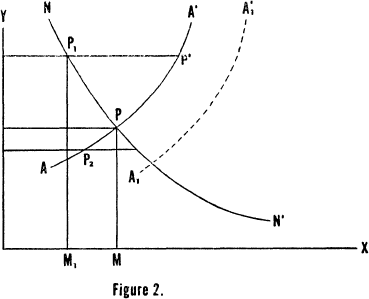
In this diagram, the unit quantities of a good are inscribed on the X axis while the monetary units are inscribed on the Y axis. The curve NN—called the demand curve—indicates which amounts of a given commodity would be demanded at different possible prices. This curve is, of course, arbitrarily drawn, but it shows us that the amount demanded tends to fall when the price rises and decreases when the price falls. Correspondingly, the curve AA’—called the supply curve—indicates that supply increases with rising and decreases with falling prices. If we let P denote the point at which the two curves intersect, then the equilibrium price, according to our elementary axiom, is PM. We may establish the truth of this proposition by employing a sort of indirect geometrical proof in which we suppose that a higher price obtains (for example, we may suppose that price lies at the point P1M1). From our diagram it is clear at once that this price is untenable, since there will now be an excess of supply over demand (P1P1) which will depress the price until it has fallen back to the point P. The same principle applies if we suppose a case in which the price is at a point below P (e.g., at P2). Hence, it follows that in the long run no other price than the price PM is tenable.
The above diagram ought to be engraved on the memory since it provides an easy and exact demonstration of the simultaneous interplay of supply, demand and price. It shows, moreover, with especial clarity, that supply and demand should never be regarded independently of price; that, on the contrary, every price is, other things being equal, related to specific aggregate amounts of supply and demand. This is what we have referred to in the text as the supply schedule and the demand schedule. Changing conditions (e.g., fashion changes on the demand side, technological progress on the supply side) can, of course, cause supply and demand schedules to change. In this case we must bring about a shift of either the supply curve or of the demand curve. Assume that the market of interest is the market for electric light bulbs and assume further that a new process of manufacture has brought about a reduction in the costs of these bulbs. We shall find that we should have to substitute a new supply curve for the old (e.g., A1A’1). The new equilibrium price will be found to lie at some point lower than the previous one.
The form of demonstration selected here goes back to Alfred Marshall whose Principles of Economics (8th ed.; London, 1922) is indispensable for a thorough study of the interrelationships which we have sketched in outline only. See also: H. D. Henderson, Supply and Demand (New York, 1922); E. Barone, Principi di economia politica (ist ed.; Rome, 1908); George J. Stigler, The Theory of Price (2nd ed.; New York, 1953); H. von Stackleberg, Grundlagen der theoretischen Volkswirtschaftslehre (Berne, 1948); W. Krelle, Preistheorie (1961). The Marshall study gives us a glimpse of the theoretical difficulties encountered in any careful analysis of the theory of market equilibrium. One of these difficulties, perhaps the greatest, caused Marshall himself no little trouble and has even in recent times continued to be a point of intense interest to economists. The difficulty emerges when account is taken of “time”—a factor which in economic analysis is all too easily neglected. Where the time factor is included, it will be found that while one set of consequences may be yielded in the short run, another, perhaps very different set will be yielded in the long run. As the example of the automobile shows, an increase in demand over a long period can cause a fall in prices due to the fact that, in accordance with the law of mass production, it results in a shifting of the supply curve towards the right.
The slopes of the supply and demand curves also reflect the degree of elasticity of supply and demand. The less is the amount of slope of the curve, the greater, in both cases, is the elasticity. The particular problems connected with these concepts, which are as important as they are interesting, have received increasing attention in the literature. Cf. Henry Schultz, Statistical Laws of Demand and Supply (Chicago, 1928); G. F. Warren and F. A. Pearson, Interrelationships of Supply and Price (Ithaca, N.Y., 1928); J. Marschak, Elastizität der Nachfrage (1931). The concept of elasticity obviously opens up a fertile field for statistical mathematics, and there is every reason for continuing to follow progress in this field with the closest attention (e.g., the calculation of exact coefficients of elasticity for individual commodities). If it is planned to increase the amount of a consumption tax or of a tariff, to reduce railroad rates or to enact some similar measure, it is generally desirable to have a precise idea of the elasticity of demand in the given case in order to evaluate the possible consequences. To be sure, it should not be forgotten that in the matter of elasticity coefficients we are dealing with historical, and hence changing data, and not with constant magnitudes. On these matters, see L. von Mises, Human Action (New Haven, 1949), pp. 347-354, a book which takes a decided and, we may add, justified stand on the issues in question and simultaneously warns of the misuses of mathematical methods in economics.
It may prove helpful, in trying to grasp the meaning of King’s rule, to dwell for a moment on a highly simplified economic situation. Let us suppose that in a given year wheat is harvested to a total of 100,000 bushels and that at the price of $1.00 per bushel it yields a total income of $100,000. Suppose further that in the following year the harvest reaches 125,000 bushels. Will total income be the same, higher, or lower? It is clear that this depends solely upon the elasticity of demand for wheat. If elasticity is such that demand increases in exactly the same proportion in which the price falls (unitary elasticity) total income, where price is $.80 per bushel, will again be $100,000. But let us now suppose that the coefficient of elasticity for wheat is less than 1. Then the total income yielded by the new harvest will be less than the amount received for the previous year’s harvest. At a price of $.70 per bushel total receipts would amount to only $87,500. This does not necessarily mean that the farmers will be worse off for it is still required to know what the costs per unit would be for a more abundant harvest. It can be supposed in any event that in not a few instances farmers stand to gain less from an abundant harvest than from a poor one. Cf. W. Röpke, “Das Agrar-problem der Vereinigten Staaten II, “Archiv für Sozialwissenschaft, Vol. 59, 1928, pp. 96 ff.
We must proceed, cautiously, however, in attempting to make practical use of King’s rule in the field of agricultural policy. In the first place, we should keep in mind that this rule applies only to grains. In the case of refined as distinct from raw agricultural products, the coefficient of elasticity of demand is higher (unity and above). This means that, for example, in a period of declining prices (or rising consumer incomes) the prospects for increased sale of butter and similar products may be considered good. There is little cause to fear over-production if the farmer is given the opportunity of obtaining inexpensive cattle feed and, in consequence, finds himself able to get by with a lower price for his butter. The results of over-production may be additionally offset by economic policy aimed at raising the income of the consumers (and thus incidentally favoring the production of the refined agricultural products). In the middle European countries where the production of refined agricultural goods, due to the proximity of markets, enjoys a natural advantage over the production of staple foods (grains), a rational agricultural policy will consist above all in a policy of lowering tariffs on grains. From such a policy, the following will result: (1) cheapening of the costs of production for the refined agricultural products; (2) increase in the amount of consumer income available for such products; (3) fall in the price of the refined commodities and to this extent a sensible improvement in the urban food supply; (4) contracting of advantageous trade agreements, improvement of the situation of the export industries, and increase of consumer incomes; (5) specific improvement of the small agricultural unit (peasant holding)1 and, since the production of refined agricultural products requires an especially intensive application of labor, an increase of employment opportunities in agriculture. On these questions see: W. Röpke, German Commercial Policy (London, 1934); W. Röpke, International Economic Disintegration, op. cit.; W. Röpke, The Social Crisis of Our Time (Chicago, 1950); W. Röpke, Civitas Humana (London, 1948); W. Röpke, International Order and Economic Integration (Dordrecht, Holland, 1959).
Here again the decisive relationships are best demonstrated with the aid of a diagram. As previously, we inscribe on the X axis the units of quantity, and on the Y axis units of money, and we suppose NN’ to be the curve of demand for a given monopolized commodity.
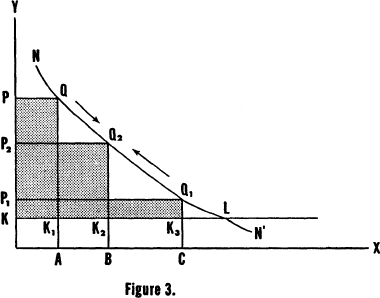
Moreover, we assume that the monopolist’s costs of production per unit remain the same, regardless of the amount of production (constant costs). We designate this cost behavior by the straight line KL. The monopolist will naturally choose a price situated somewhere above OK. But where? Which of the many possible prices will he choose? Should he choose too high a price, he will, as we can see from our diagram, be able to sell only the quantity OA. The whole of his gain will be inscribed in the rectangle PKK1Q. If, on the other hand, he wishes to sell a large quantity, e.g., the amount OC, it is evident that he will have to lower his price to OP1 In this case his gain is PKK3Q1. Clearly, the monopolist has chosen in this case too low a price. He will now proceed to experiment until he has arrived at the price OP2, at which the product of the quantity sold times profit per unit attains its maximum. This is shown in the rectangle P2KK2Q2. The reader is free to vary the diagram to take account of rising or falling unit costs or different degrees of elasticity. In this way, he can chart for himself the relationships we have dwelt on in the text.
The richly complicated theory of monopoly price belongs to one of the most intensively developed sectors of modern economics. It is a field which is especially suited to mathematical analysis (Pantaleoni, Edgeworth, Pigou, Stackelberg, et al). An excellent survey of the subject of monopolistic price differentiation will be found in the monograph of my student Kurt Michalski, Das Prinzip der Preisdifferenzierung (Marburger sozialökonomische Forschungen, No. 1, 1932). See also: R. Bordaz, Coûts constants et prix multiples (Paris, 1942).
Perfect competition may be precisely defined as that situation which obtains when demand for the output of each producer is perfectly elastic. Otherwise expressed, under perfect competition no producer can ask more than another without risking the loss of all his customers; should he demand less than other producers, they would lose all their patronage to him. These being the prerequisites of perfect competition, it is understandable how rarely such a market situation occurs. In most cases, competition is in fact more or less imperfect. The ensuing problems are just those which have been most searchingly analyzed in recent economic literature. In particular, there has been much attention given to the importance of advertising as a cause of “imperfect (monopolistic) competition.” See especially: E. Chamberlin, The Theory of Monopolistic Competition (Cambridge [Mass.], 1933); J. Robinson, The Economics of Imperfect Competition (London, 1933); R. Triffin, Monopolistic Competition and General Equilibrium (Cambridge [Mass.], 1940); A. Kozlik, “Monopol oder Monopolistische Konkurrenz?” Zeitschrift für Schweizerische Statistik und Volkswirtschaft, 1941; H. von Stackelberg, op. cit.; W. Fellner, Competition Among the Few (New York, 1950); Monopoly and Competition and their Regulation, ed. W. H. Chamberlin (London, 1953); F. Machlup, The Economics of Sellers’ Competition (Baltimore, 1952).
To the list of the evils of monopoly already cited we can add still others to which reference will be made in a later chapter. At the same time, we ought not to lose sight of the fact that in a restricted number of cases monopoly is economically superior to competition. We refer here to those enterprises termed “public utilities.” Such enterprises have a twofold character: on the one hand they serve to provide the public with goods and services of vital importance (electricity, gas, water, railroads, streetcars, busses, postal services, etc.); on the other, the very essence of these enterprises is such that to permit the establishment of competing units would be uneconomical, if not also technically impossible in view of the large amounts of capital involved as well as the complicated network of property rights which public utilities require (e.g., the underground conduits for wires and cables required by the telephone company).
The politico-economic problem of public utilities resides in the fact that while their monopoly character is more or less unavoidable, it is at the same time particularly dangerous since these enterprises serve to satisfy urgent (i.e., inelastic) public needs. For the solution of this problem there are two possibilities: either we allow the public utilities to exist as private enterprises, though still requiring them to submit to governmental regulation, or we establish in their place official state or community monopolies. Which of the two solutions would be the more purposeful can be determined only with difficulty, since much depends on the special circumstances obtaining in each country and on the particular type of public utility in question. The experience of the United States, where the system of regulated private monopoly prevails, has shown that efficacious supervision is difficult to realize and may well involve serious inconveniences. The over-all disadvantages of state-managed enterprises, on the other hand, argue against the system of state monopolies. (We may note, however, that it is precisely in the case of [publicly operated] public utilities that management is subjected to a salutary scrutiny. The enterprises in question are daily and hourly in intimate and sensitive contact with the public. It is the prestige of the state or of the community which is at stake when complaints are directed against the public utilities of overcharging or poor service, while a well-administered public utility may prove to a particularly effective advertisement of the virtues of public ownership of enterprise.)
Price formation in joint production is interesting from a theoretical standpoint for it is one of those cases in which the classical economists had already been forced to recognize the impossibility of explaining price behavior by means of a cost-of-production theory and the necessity of returning to the concept of demand for such an explanation. It was Marshall who undertook the first thorough investigation of the problem.
In the text, it was assumed that the quantitative ratio obtaining as between a pair of jointly produced commodities is determined by the technical peculiarities of the productive process in question. However, we find frequent instances in which this proportion can be changed by the producers, for example, by the breeding of sheep for wool instead of for meat and vice versa. In these cases, there is a perceptible loosening of the link that binds the jointly produced commodities together. Cf. Henderson, op. cit., Chapter V.
The practical importance of joint production is very great and is in the way of becoming even more so. We see its significance with especial clarity in agriculture (Cf. H. Marquardt, Die Ausrichtung der Landwirtschaflichen Produktion an den Preisen (Jena, 1934). Indeed, even the different floors of an apartment house can, save the top floor,2 be considered as jointly produced goods. Here, too, the production costs of one floor cannot be distinguished from the production costs of another, with the result that rents are graduated according to the intensity of demand, the first floors (“beletage”) generally getting more.
International trade has always occupied a large place in economic theory. Even as far back as the classical period, it was a well-developed branch of economic science, its aim being the investigation of those special characteristics of the economic process which derive from the nature of international trade (the conquest of distance, the relative immobility of the factors of production, the differences in monetary systems, political factors, etc.). Much attention has been devoted to analysis of the monetary factors, as we have indicated above (Chapter V, Note 10). In addition to the books mentioned there, see: G. Haberler, Theory of International Trade (London, 1950); G. Haberler, article “Aussenhandel,” Handwörterbuch der Sozialwissenschaften, 1954; B. Ohlin, Interregional and International Trade (Cambridge [Mass.], 1933), deals especially with the problem of foreign trade as a special case of the general economic problem of distance; W. Beveridge, et al, Tariffs: The Case Examined (London, 1931), a very instructive combination of theoretical and practical problems; J. W. Angell, The Theory of International Prices (Cambridge [Mass.], 1926), a thorough treatment of the monetary aspects; R. F. Harrod, International Economics (London, 1939); P. T. Ellsworth, The International Economy (New York, 1950); W. Röpke, International Economic Disintegration, op. cit.; W. Röpke, International Order and Economic Integration, op. cit. Outside of what may be said to fall into the category of simple denunciations or invective, the attempts (made in these books) to overthrow classical theory are surprisingly rare. Most such attempts amount merely to corrections, greater or lesser as the case may be, of classical theory. A case in point is Friedrich List’s National System of Political Economy (1841) which was said to have had the merit of effectively combating, from an historical and evolutionary standpoint, the “long run” formulae of the classical economists. In fact, List’s work represented only an important stage in the perfecting of classical theory. A more recent and more radical attempt of this sort is that of M. Manoilesco, Théorie du protectionnisme et de l’échange international (Paris, 1929), effectively criticized by B. Ohlin in “Protection and Non-Competing Groups,” Weltwirtschaftliches Archiv, Vol. 33, January 1931. Those who oppose to the pure theory of foreign trade politicomilitary arguments will find they are forcing an open door. Adam Smith long since assigned a preeminent place to such arguments. One can subscribe fully to the scientific theory of foreign trade and still take sides for a closed economy; in such case one has at least the advantage of being perfectly aware of the “costs” involved. Most of the attacks against economic theory in general, and against the theory of foreign trade in particular, stem from nothing else than a fear of clarity: the attackers try by the sheer loudness of their polemics to give the impression that their arguments are weighty.
Taking a closer look we find that foreign trade procures the following advantages: (1) Certain products are obtainable only by means of foreign trade, viz., those which do not exist inside the country or which can be produced there only at enormous cost (e.g., the greater part of the industrial raw materials used in Europe’s industrialized regions). (2) Foreign trade provides us with goods which, though it may be economically possible to produce them at home, will cost us still more than if we imported them from abroad. Hence, it is preferable to import such goods in exchange for those products which can be produced more economically at home. (3) In the distribution of goods through space and time foreign trade acts as a compensatory mechanism by means of which an international balance is established as between the several national markets, thus putting an end to a situation (of frequent occurrence in former times) in which surpluses prevailed in one country and famine in another. It is a sort of escape valve which assures a practically constant “atmospheric pressure,” a kind of insurance against the enormous fluctuations to which, otherwise, economic life—were it subject only to the influence of harvests—would be exposed. How important this function is, becomes clear when the mechanism of the world economy breaks down. (4) Foreign trade is an effective antidote to the monopolistic hardening of the arteries of the several national economies, for it subjects the attempts of business units to “coalesce” to the pressure of foreign competition, thus tending to prevent a degeneration of our economic system through “capitalist” exploitation.
Each country participates in these advantages of foreign trade. Naturally, this does not exclude the possibility of one country having a numerical gain greater than that of another country; that is determined by the ratio of export to import prices or, by what amounts to the same thing, the quantity of imports which can be had for a given quantity of exports (the “real ratio of exchange,” Taussig’s “barter terms of trade”). How important this concept is, is shown by the example of such countries as National Socialist Germany where, thanks to export subsidies on the one hand and the increased price of raw materials (resulting from clearing and compensation agreements) on the other, the barter terms of trade underwent substantial deterioration. The “undervaluation” of a country’s currency on the world’s exchanges has the same effect. There can be no doubt but that the terms of trade is an important factor in national prosperity.
The interrelationships which we sought to clarify in our discussion of Israel’s economy are usually considered as deriving from the law of comparative costs, first formulated by Ricardo in his Principles of Political Economy and Taxation, Chapter VII. Strict interpretation of his (in its general outlines still accepted) concept gives rise to difficulties, as shown by the more recent literature on the subject. These difficulties, however, in no way affect the essential truth of the law. It is to be observed that it is also as applicable within a country in which there are regions possessing different economic characteristics as it is between different countries. Thus, conditions of production in eastern Germany were certainly more unfavorable, under almost every head, than in western Germany, a fact which in no way prevented both halves of the country from enjoying the benefits of a close economic relationship, unencumbered by any internal tariff walls. No doubt eastern Germany, in order to be able to compete with other suppliers, had to content itself with a lower wage level, but it cannot be denied that if it had erected a customs barrier against western Germany, it would have placed itself in an even worse position. In spite of the almost complete economic inferiority of eastern Germany, both East and West were mutually advantaged by the resulting division of labor, the East limiting itself to that branch of production in which it could best meet competition, namely, agriculture.
____________
3 The German is bäuerliche Wirtschaft. Literally translated this means “peasant economy.” But the author writes in his International Economic Disintegration (3rd ed.; London, 1959) : “I am fully aware that the word ‘peasant,’ having clearly disparaging connotations, is no real equivalent to the French word ‘paysan’ or the German word ‘Bauer.’ Other terms which have been suggested to the author by his Anglo-Saxon friends—like ‘agricultural freeholder’ or ‘farmer yeoman’—sound too artificial and labored. The only possibility left, then, would seem to be to retain the word ‘peasant/ and to ask the Anglo-Saxon reader to forget for the moment its pejorative sense until a better term is suggested.”—Translator’s Note.
4In Switzerland, and formerly in Germany, the top floor is used as a storeroom.—Translator’s Note.
- 1* The German is bäuerliche Wirtschaft. Literally translated this means “peasant economy.” But the author writes in his International Economic Disintegration (3rd ed.; London, 1959) : “I am fully aware that the word ‘peasant,’ having clearly disparaging connotations, is no real equivalent to the French word ‘paysan’ or the German word ‘Bauer.’ Other terms which have been suggested to the author by his Anglo-Saxon friends—like ‘agricultural freeholder’ or ‘farmer yeoman’—sound too artificial and labored. The only possibility left, then, would seem to be to retain the word ‘peasant/ and to ask the Anglo-Saxon reader to forget for the moment its pejorative sense until a better term is suggested.”—Translator’s Note.
- 2*In Switzerland, and formerly in Germany, the top floor is used as a storeroom.—Translator’s Note.
- 3We must proceed, cautiously, however, in attempting to make practical use of King’s rule in the field of agricultural policy. In the first place, we should keep in mind that this rule applies only to grains. In the case of refined as distinct from raw agricultural products, the coefficient of elasticity of demand is higher (unity and above). This means that, for example, in a period of declining prices (or rising consumer incomes) the prospects for increased sale of butter and similar products may be considered good. There is little cause to fear over-production if the farmer is given the opportunity of obtaining inexpensive cattle feed and, in consequence, finds himself able to get by with a lower price for his butter. The results of over-production may be additionally offset by economic policy aimed at raising the income of the consumers (and thus incidentally favoring the production of the refined agricultural products). In the middle European countries where the production of refined agricultural goods, due to the proximity of markets, enjoys a natural advantage over the production of staple foods (grains), a rational agricultural policy will consist above all in a policy of lowering tariffs on grains. From such a policy, the following will result: (1) cheapening of the costs of production for the refined agricultural products; (2) increase in the amount of consumer income available for such products; (3) fall in the price of the refined commodities and to this extent a sensible improvement in the urban food supply; (4) contracting of advantageous trade agreements, improvement of the situation of the export industries, and increase of consumer incomes; (5) specific improvement of the small agricultural unit (peasant holding)* and, since the production of refined agricultural products requires an especially intensive application of labor, an increase of employment opportunities in agriculture. On these questions see: W. Röpke, German Commercial Policy (London, 1934); W. Röpke, International Economic Disintegration, op. cit.; W. Röpke, The Social Crisis of Our Time (Chicago, 1950); W. Röpke, Civitas Humana (London, 1948); W. Röpke, International Order and Economic Integration (Dordrecht, Holland, 1959).
- 4The practical importance of joint production is very great and is in the way of becoming even more so. We see its significance with especial clarity in agriculture (Cf. H. Marquardt, Die Ausrichtung der Landwirtschaflichen Produktion an den Preisen (Jena, 1934). Indeed, even the different floors of an apartment house can, save the top floor,* be considered as jointly produced goods. Here, too, the production costs of one floor cannot be distinguished from the production costs of another, with the result that rents are graduated according to the intensity of demand, the first floors (“beletage”) generally getting more.

