
Economics of the Free Society
Notes
Calculation of the national income is an uncertain procedure at best; even greater uncertainty enters into the calculation of national wealth. It must be emphasized, to begin with, that we lack any really accurate means of evaluating those items of the national wealth for which there are no markets. At what figure should the streets and canals be assessed? To evaluate them on the basis of their costs of construction would be incorrect inasmuch as their final value to the community may have no relation to these original costs. But there is a further fundamental difficulty here and a highly instructive one. If, as the result of some natural disaster, a country’s supply of water is suddenly and drastically diminished, water would figure as an item in the national wealth even though in real terms the country would have suffered an impoverishment. These few observations may serve to show the minimal value of calculations respecting the national wealth. Cf. Colin Clark, National Income and Outlay (London, 1937); Colin Clark, The Conditions of Economic Progress (2nd ed.; London, 1950); J. R. Hicks, The Social Framework (2nd ed.; Oxford, 1952); see also the literature listed under Note 5.
The word speculation has such unpleasant connotations that most people have great difficulty in associating it with any useful function. To properly evaluate the role of speculation, however, we have only to reflect on the fact that, given the uncertainty of the future, there is a speculative element in every economic act. Every undertaking involves the assumption of risks and an element of gambling and a businessman is, at bottom, only a specialist in the weighing of probabilities. The fact that certain individuals make a profession of computing future risks manifests merely the usefulness of the division of labor. Just as the merchant relieves the manufacturer of the specific functions of merchanting, so the speculator relieves him of the risks of speculation. In this connection see: W. Röpke, article “Spekulation,” Handwörterbuch der Staatswissenschaften (4th ed.); F. H. Knight, Risk, Uncertainty, and Profit (Boston, New York, 1921). The above literature also examines the circumstances in which speculation is unproductive and even harmful (as is popularly held to be the case, in an unjustified generalization, with respect to all speculative activity). Speculation may be effectively controlled by ensuring that speculators are provided with as few opportunities as possible of engaging in parasitic business practices. Thus, the evils of the black market, which are common to all command-type economies, could be far more effectively combated by reestablishing a free economy than by police interventions. A particularly serious view must be taken of speculation in urban real estate. Speculation of this type may be curbed by purposeful city planning, by a forward-looking land policy, by taxation, and by the adoption of certain legal measures. Here we encounter the special characteristics of land rent which we have reserved for discussion in another place (pp. 195 ff.). Cf. H. Sieber, “Die Bodenspekulation und ihre Bekämpfungsmöglichkeiten,” Wirtschaft und Recht, No. 2, 1957. On stock exchange speculation see: A Hunold, Die schweizerischen Effektenbörsen (Zurich, 1949); F. W. Hirst, The Stock Exchange (London, 1949).
A proposal that merits consideration is one made by Franz Oppenheimer (for the first time in his Theorie der reinen und politischen Oekonomie (Berlin, 1910) to employ the expressions “production” and “distribution” in the technical senses illustrated in our text. The term “production” would then be equally applicable not only to the production of material goods (primary production, manufacturing) but to trade, transportation, and other activities as well.
For further clarification of the economic interrelationships discussed in the text, consult the diagram shown below. Cf. C. Bresciani-Turroni, Economic Policy for the Thinking Man (London, 1952), Chapter II. See also J. R. Hicks, The Social Framework, op. cit., and the literature listed under Note 5.
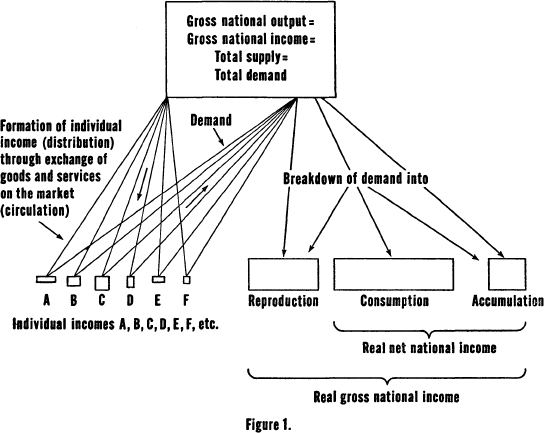
From the voluminous literature in this field may be mentioned: Wilhelm Krelle, Volkswirtschaftliche Gesamtrechnung (no date); Erich Schneider, Einführung in die Wirtschaftstheorie, I. Teil, Theorie des Wirtschaftskreislaufs (8th ed., 1960); Werner Hofmann, Die volkswirtschaftliche Gesamtrechnung (1954); H. C. Edey-A. T. Peacock, National Income and Social Accounting (London, 1954). A special type of macroeconomics is the “input-output” analysis developed by the American economist Wassily Leon tief (The Structure of the American Economy [New York, 1953]) which seeks to measure the flows of commodities entering and leaving the process of production.
For the limits and problems of the macroeconomic approach, see: W. Röpke, A Humane Economy, op. cit., p. 252 ff.; F. Machlup, Der Wettstreit zwischen Mikro- und Makrotheorien in der Nationalökonomie (1960); S. Schoeffler, The Failures of Economics: A Diagnostic Study (Cambridge [Mass.], 1955).
For further discussion and literature see my book International Order and Economic Integration, op. cit., pp. 194 ff. See also my article “Zahlungsbilanz und Nationalreichtum” in W. Röpke, Gegen die Brandung (2nd ed.; Zurich, 1959) pp. 306 ff.
One of the most important of latter-day theorists has written: “La nature n’est autre chose qu’un grand bazar à prix fixes ou bien une série de machines automatiques. Voulez-vous du charbon, du fer, des fruits, de la viande? Vous pouvez avoir tout ce que vous voulez; vous n’avez qu’à passer à la caisse, c’est-à-dire, vous n’avez qu’à vous soumettre aux conditions, aux prix fixes qu’elle réclame” (M. Pantaleoni, Du caraclère logique des différences d’opinions qui séparent les économistes [Geneva, 1897], P. 34)
It is well known that a shortage of one type of labor (or of professionally trained individuals) can persist simultaneously with an oversupply of another type. The transition from one category (of labor) to another is extraordinarily difficult, as much for one who has already been trained for a certain occupation as for his children. The several categories of labor thus form groups among whom competition is more or less frustrated (“noncompeting groups” in the terminology of J. E. Cairnes, Some Leading Principles of Political Economy [London, 1874]).
We have to do here with a problem which was the leading concern of the economists of the last century and which is once again the center of a lively controversy. Among the most recent books on this subject the following deserve to be noted: F. A. von Hayek, Prices and Production (2nd ed.; London, 1949); W. Eucken, Kapitaltheoretische Untersuchungen (1934); R. v. Strigl, Kapital und Produktion (Vienna, 1934); J. R. Hicks, Value and Capital (London, 1939).
The formation of capital can follow several modes as suggested by the following scheme (W. Röpke, Die Theorie der Kapitalbildung [1929]):
I. Capital formation in a natural economy, termed also the direct formation of capital. Here capital is formed without resort to the detour of money. Example: the farmer who makes his own plough. Similarly illustrative of the formation of capital in a natural economy is the farmer who refrains from selling his young animals and instead raises them to maturity in order to increase the number of his own livestock. Thus, even in the contemporary money economy, this method continues to play an important role in the domain of agriculture. For the rest, however, capital formation at the present time takes place indirectly, i.e., by the detour of money.
II. Capital formation in a money economy:
(1) Formation of capital through saving, i.e., some portions of income are voluntarily set aside and put at the disposal of the capital market. This is and remains the principal method of capital formation in the free world.
(2) Formation of capital by the entrepreneur which occurs when profits accruing from operations within the firm are used for the purchase of new equipment (“self-financing”, corporate saving).
(3) Formation of capital through fiscal policy, e.g., the state may divert taxes to the construction of factories, the building of railroads, etc. In contrast to the preceding, there is an element of compulsion involved in this mode of capital formation (“fiscal forced saving”).
(4) Bank formation of capital which is a consequence of the banks’ power to create credit. The process involved is the following: when the banking system grants additional credits to businessmen for the construction of factories, the general demand for goods is increased, but without a corresponding increase in supply. The result is a more or less perceptible rise in prices (boom). This compels consumers to restrict their consumption. As before, the restriction of consumption necessary to the formation of capital has occurred, but with this difference, that it takes place “from behind” as it were, and compulsorily (“monetary forced saving”). With the development of the modern banking system, this type of capital formation has become extremely important.
That the expansion of credit is an act of violence to the economy which, after the initial boom, is avenged in the crisis and depression which follow, is a fundamental part of all theories of the business cycle. Thus, the last world crisis (1929-32) was preceded by a gigantic expansion of credit in the economically advanced countries. Further discussion of this subject will be found in the special chapter reserved for it (Chapter VIII).
The relationships involved in this law may be roughly set forth: if we let k stand for the cost of production per unit of output, p for the quantity of output, g for fixed (general) costs, and s for variable (special) costs, the following equation holds:

But since the variable costs (s) per unit of output remain the same regardless of the quantity of output, the costs per unit (k) must constantly diminish as the quantity of output (p) increases, since in this case the quotient will become constantly smaller. Hence, unit costs approach, asymptotically, variable costs. In reality, the relationships involved are considerably more complex than this. Thus, the assumption that the variable costs (per unit of output) remain constant will rarely be realized; more often, in fact, variable costs will be found to have a slightly degressive character. We must be especially on guard against accepting the law of mass production as one of limitless application. There are several circumstances which put effective limits to its use, sooner or later. In the case of the washing machine, for example, it is clear that if the volume of laundry is continually increased, the original washing machine will no longer suffice, so that a new and larger machine must be procured. But there are obviously limits to the dimensions which such a machine can assume in the ordinary household. In this case, too, then, there exists an optimum. Where this optimum lies for each of several different sizes of machine can be determined only by technical investigation. Probably, it lies at a lower level, on the average, than most people think. Also, with the increasing size of operations, other difficulties appear which raise costs. Chief among these are the increasing cumbersomeness of the coordinating and supervising functions of management and the increasing need for ever greater uniformity of operations. On these matters, see E. A. G. Robinson, The Structure of Competitive Industry (London, 1935); Colin Clark, The Conditions of Economic Progress, op. cit.
For the rest, we must be careful not to confuse the law of mass production with the law of diminishing returns. The widely held opinion that industry falls under the law of increasing returns and agriculture under that of decreasing returns ignores the fact that we are here contrasting two wholly different things. The extremely complex interrelationships involved in these phenomena hold a large place in recent (cost) theory. The reader who desires a thorough understanding of these matters should consult P. H. Wicksteed, The Common Sense of Political Economy, Vol. 2 (London, 1933); pp. 527 ff. See also: F. X. Weiss, article “Abnehmender Ertrag,” Handwörterbuch der Staatswissenschaften (4th ed.); O. Morgenstern, “Offene Probleme der Kosten- und Ertragstheorie,” Zeitschrift für Nationökonomie, March 1931; J. M. Clark, Studies in the Economics of Overhead Costs (Chicago, 1923); E. Schneider, Theorie der Produktion (Vienna, 1934); H. v. Stackelberg, Grundlagen einer reinen Kostentheorie (Vienna, 1932).

