
The Economics of the Colour Bar
8. The ‘Civilised Labour’ Era
DURING the First World War, the white miners’ union1 had succeeded in enforcing wage-rate increases many times larger than those obtained by the unorganised Africans. But the position of the latter had in some respects improved because, through the emergency, they had been permitted to undertake semi-skilled work especially as drill-sharpeners. This opportunity for a small proportion of Africans mitigated the increased costs of mining gold, the price of which rose to a premium after the war for a short period only. When it was obvious that the sterling price of gold would return to its standard level, the mine-owners naturally attempted to retain Africans in semi-skilled tasks and tried further to obtain some relaxation of other wasteful provisions enforced through regulations under the 1911 Colour Bar Act. They asked for a ratio of 10.5 Africans to 1 White; but the labour union demanded 3.5 to 1. A disastrous strike followed in 1922. The miners were supported by a general strike on the Rand,2 which developed into virtually an armed uprising. Those who revolted were mainly Afrikaners, but as always the extremists of the Left were experts in the art of fishing in troubled waters. W. H. Andrews, who was shortly to become Secretary of the Communist Party in South Africa, played a leading role in this fight for white privilege. The revolt was crushed but powerful publicity had been given to the notion that the Whites were fighting against capitalist exploiters for the preservation of their traditional and rightful economic supremacy. In that sense, the strike, which has been called the ‘colour bar strike’, was a victory for Andrews and those who called themselves socialists.
At the time of the strike, the overwhelming majority of the white miners (foremen or artisans, as distinct from executives) were Afrikaners from the Transvaal and the Orange Free State, and their anti-colour indoctrination had been fruitfully exploited from the first by the Marxist-indoctrinated inspirers and leaders of the insurrection, such as Andrews. The result was a great boost to the South African Labour Party, which was modelled more or less on its British counterpart and was on the best terms with the British trade-union movement. In 1924, largely through the impact upon White opinion of the 1922 strike, it obtained the chance of sharing in government through a coalition formed with the Nationalist Party, a socialistically-orientated party3 representing Afrikaners who accepted the principle of White supremacy and non-White subjection. Without this active co-operation of a typically British sort of Socialist party to form a Labour-Nationalist ‘Pact’, the era which introduced the most serious forms of colour injustice might never have emerged.
Although Labour politicians may be accused of sacrificing their ideals in the lust for office and the unions of perverting the movement to racist ends, they were enthusiastically supported by the great majority of the adherents of the Labour Party. Moreover, the laws they used most successfully to keep the non-Whites in economic inferiority were of a kind which, as I shall be showing, are praised by collectivist thinking everywhere.
THE MINES AND WORKS ACT, 1926
The Nationalist-Labour ‘Pact’ Government introduced early the second ‘Colour Bar Act’ – the Mines and Works Act of 1926 – to satisfy the demands of the 1922 strikers. This was probably the most honest and most drastic piece of colour bar legislation which the world has ever experienced, just as the ‘civilised labour policy’ – which they inaugurated immediately on attaining power – was probably the most dishonest and yet most effective plan for enforcing a colour bar the world has ever experienced.
It is unnecessary to discuss the details of the Mines and Works Act of 1926. In brief, it established the legality of the colour bars imposed by regulations under the 1911 Act. These regulations had been challenged in the Courts so as to render the position obscure, and the effect of the Act was to entrench more unequivocally the barriers against African advancement.
But in spite of this open perpetuation of exclusiveness it was, in my judgment, a less serious barrier to the non-Whites than those introduced through the fine sounding ‘civilised labour policy’. Worked out jointly by the (mainly Afrikaans-speaking) Nationalists and the (mainly English-speaking) Socialists, this policy was represented as an attempt to protect ‘civilised’ or ‘European’ standards. It differed from the Mines and Works Act in that it imposed no overt colour bar and could therefore be approved by those who felt that Socialism implies some sort of equality. Yet, above all, its protagonists could argue that their object was solely to preserve a tolerable standard of living, ‘from the usual European standpoint’, for all who had achieved a civilised way of life, no matter what their colour.
AIMS OF THE ‘CIVILISED LABOUR POLICY’
Now if the preservation of existing standards had been genuinely the aim, it would have represented an objective which I myself have always actively and explicity advocated. No one has insisted more strongly than I on the importance of honouring ‘established expectations’ in a good society;4 provided that this does not create a permanent barrier to equality of opportunity.
Had the aim gone no further than ensuring that the average absolute standards of the Whites then living did not decline – that is, if the object had been that of preventing any ‘levelling down’ whilst permitting a ‘levelling up’—there would have been much to be said for it. The growth of the national income by allowing the entry of the non-Whites into better remunerated and more productive industrial employments would then have raised non-white standards relatively to those of Whites. But state intervention was used not simply to prevent a fall in the standards of the Whites. It was used also to ensure the maintenance of relative white standards – an insistence upon special privilege of the kind that labour unions everywhere frequently defend as ‘differentials’. Consequently there has been far less ‘levelling up’ since 1924 (in spite of an enormous increase in real national income) than the unhampered market would have achieved. The failure of non-Whites to share more liberally in this internal progress constitutes the major source of colour injustice in all its forms.5
The ‘civilised labour policy’ was shrewdly built on a recognition of the following realities:
(a)that there already existed a powerful prejudice on the part of white employees against working side by side with Coloureds or Africans unless the latter were subordinates;
(b)that the educational facilities and sociological background of the non-Whites were markedly inferior;6
(c)that insistence on the standard rate could, in the light of the above factors, effectively but unobtrusively keep the non-Whites out of the Whites’ preserves – an insight which led the Labour Party to make ‘the rate for the job’ the foundation of the new policy;
(d)that recourse to the apprenticeship system would not only exclude the majority of non-Whites from qualification in the trades covered, because few could attain the educational standard laid down, but also exclude this few by reason of the composition of the boards of selection;
(e)that employers’ representatives on the apprenticeship boards would be led by their natural wish for collaboration with the labour representatives in excluding from skilled operations such non-Whites (chiefly Coloured) as were able to acquire the legally enacted educational grades;
(f)that even where educational and sociological factors and the prejudices of white employees were not powerful hindrances to the profitable employment of non-Whites, the insistence (under the Factories Act) upon separate facilities would often make their employment impossibly expensive in established industries;
(g)that the labour union movement was already operating on the principle of the ‘closed shop’;
(h)that the application of this principle would reinforce the other devices which were excluding non-Whites from the better paid employments.
THE ‘RATE FOR THE JOB’
The ‘rate for the job’ was the vital principle in the most powerful yet most subtle colour bar that has ever operated. Equal pay for equal work (i.e., for identical outputs of a given quality) is a result of the neutrality of the free non-discriminatory market. It is no method of achieving such a market. When the standard wage-rate is forced above the free market level (whether through legal enactment or the strike threat), thereby reducing the output which can be produced profitably, it must have the effect of preventing the entry of subordinate races or classes into the protected field or of actually excluding them from it.7 This has been by far the most effective method of preserving white privileges, largely because it can be represented as non-discriminatory. Whereas some of the policies of the Labour-Nationalist Pact amounted to blatant discrimination (such as the deliberate dismissal of non-Whites in order to employ Whites in government service), the effects of the ‘civilised labour’ restraints have been far more important. They have rendered much more formidable those restraints imposed by custom and prejudice that have debarred non-Whites from avenues of economic advancement. They have, indeed, had a more unjust impact than ‘influx control’ and ‘job reservation’ under apartheid.
The group that has suffered most by the barring of non-Whites from the better economic opportunities has been the Coloured people, who make up about one-tenth of the total population of the Republic. In an article I published in 1938 I referred to certain aspects of the ‘civilised labour policy’ as ‘an insuperable obstacle to the achievement of Coloured aspirations’. But although this assertion remains true,8 I had not perceived in 1937 the extent to which entrepreneurial ingenuity was then surmounting some of the obstacles and, through providing better opportunities for the Coloureds and Africans, permitting the standards of all races to rise.9
In spite of the economic injustices suffered by the Coloured people, they have little right to moral indignation against their white comrades, because they themselves have likewise sought to exclude the competition of Africans who have enjoyed even less privilege and power than themselves.10 Their feelings are perfectly natural. Did not Josiah Tucker remark, in the 18th century, that ‘all men would be monopolists if they could.’ We are here concerned, however, not with the human failings which have led to race injustices but with the types of social organisation which permit and buttress these injustices. The lesson of history, explained by classical economic analysis, is that disinterested market pressures, under the profit-seeking inducement, provide the only objective, systematic discipline that would dissolve traditional barriers and offer opportunities irrespective of race or colour.
COLOUR BAR LEGISLATION
I shall make no attempt to give a comprehensive and balanced summary of the legislation through which the ‘civilised labour policy’ was enacted; for I shall be concerned solely with its relationship to ‘injustice’, real or imagined, between one race or colour and another.
This policy relied upon the Factories Act of 1918, the Apprenticeship Act of 1922 and the Industrial Conciliation Act of 1924, which preceded the Nationalist-Labour Pact. The new policy aimed at reinforcing the powers of discrimination which were latent in the former Acts.
Much of the content of the Factories Act (of 1918) satisfied the ‘liberal’ criterion of serving the collective (as distinct from the sectional) interest. But it was an example of discriminatory state intervention in so far as it conferred arbitrary power on the Minister of Labour to withdraw some exemptions from customs-duties on raw materials. Exemption could be withdrawn if, in the Minister’s opinion, ‘satisfactory labour conditions’ were not being maintained; and factory inspectors under the Department of Labour made it clear that ‘unsatisfactory’ was interpreted to mean employing non-Whites when Whites were available. The Act required also that there should be separate facilities for the white and non-white races in such things as toilets, rest-rooms, canteens, etc., and although the original purpose was separation rather than economic discrimination, the architects of the ‘civilised labour policy’ perceived full well that the increased costs of employing non-Whites in firms in which they had not previously been employed, combined with other legislative provisions, would have the effect of excluding many of them from industrial employment.
The Apprenticeship Act (of 1922) was genuinely believed by many, including some well-meaning educationists who helped draft it, to have had the purpose of encouraging white youths to acquire industrial skills. In practice, the Act has probably had the opposite effect. Certainly, administered in the spirit of the ‘civilised labour policy’, it has assisted in reserving the better-remunerated employments for the Whites, but in such a way that it has weakened the incentive for self-improvement among them. Thus, whilst it developed facilities for training in technical colleges and made attendance compulsory for apprentices, it never insisted upon them passing the examinations in order to qualify. Consequently, the majority have never treated seriously the expensive facilities provided; they become journeymen merely by the passage of time. The only material amendment in this respect, introduced in 1963, has the effect of delaying by one year the period of qualification of apprentices who do not pass the examinations, although whilst waiting passively for qualifications they will be paid 70 per cent of the journeyman’s wage, a policy the Minister of Labour described as ‘tough’.
The Wage Act of 1925 was aimed at easing the Poor White problem and preserving white civilisation by restricting competition from non-Whites. It did so through applying the principle of the standard rate to spheres of employment where no labour unions had then been formed – the very avenues through which the entrepreneurial search for cheap labour was tending most directly to raise relative non-white standards. The wording of the original Wage Act was explicit in excluding discrimination on grounds of race or colour, but its sponsors made it quite obvious that they were trying to protect the higher civilisation from the competition of the lower civilisation, and dragged in such red herrings as the prevention of ‘sweating’, and the need to encourage efficiency by higher earnings. Subsequent amendments, however, made the discriminatory objective more explicit. The Wage Board concentrated, for many years after its establishment under the Act, upon employments where Whites were in actual or potential competition with the Coloureds or Indians. That is, they did not bother about the remuneration of work performed by non-Whites in which there was virtually no competition with Whites. With few exceptions, it was only after the amendment of the Act in 1937 that typically Coloured spheres of employment were directly covered.
Whatever the original intentions, the Act has come to serve as a protection not only of relatively unskilled white labour against non-Whites, but (since 1937) of Coloured and Asiatics against the Africans; for the industrial boom caused by the quiet speeding up of racial economic integration in the 1930s created rapidly growing opportunities of industrial employment, first for Coloured women and later for Coloured men and Indians.11 Today the majority of those covered by the Act are the non-Whites other than Africans, and it has protected the former at the expense of slowing down the rate of progress of the latter.12
Under the Industrial Conciliation Act (of 1924) industrial councils are established, made up of representatives of employers’ associations and of labour unions. Together they negotiate wage-rates, hours of labour and fringe benefits. Any agreement may then obtain (and in practice almost automatically obtains) approval of the Minister of Labour. It then has the force of law; and the Minister may order its provisions to apply to employers and employees in the same or cognate industries who have not been parties to the agreement, in any areas, at his discretion. During the period of such agreements, strikes or lock-outs about matters which the industrial councils have determined are illegal; and for other matters of dispute there are provisions, similar to those common elsewhere, for conciliation and arbitration. White, Coloured and Indian (‘Asiatic’) employees are covered by the Act but Africans are excluded. Broadly speaking, Africans have no rights under it.
This Act appeared superficially to have as its principal objective the laudable aim of preventing further outbreaks of violence such as occurred during the 1922 strike. Since its passage, South Africa has experienced an industrial peace many other countries might envy. But this success has been because, since 1924, the political power of the Whites has been used to secure the subservience of the non-Whites without strike action. The superficial effect of the Act has been to reduce the power of the labour unions and the relative absence of strikes may suggest that members have become apathetic and that officials have lost their militancy. This, however, is an illusion. Through the virtually automatic conferring of the force of law upon agreements reached, the effective ability of the unions to protect the privileges of their members has been magnified.
The associated managements have combined with the labour representatives to create a joint monopoly under which the two parties provide mutual protection for one another against competition.13 This protection can ultimately be effected only through the exclusion of labour and other resources from employment where their contributions to the community’s real income could have been largest. Yet it seems directly to benefit the joint monopolists. For instance, it makes things easy for managements in ‘maintaining good industrial relations’; and because all firms represented agree to the same wage-rates and conditions, there is no increase in the competitive burden of costs.
Such complacency is, however, based on a static view of the economic process. The ‘employers’ representatives’ who have accepted the system have failed to realise that the demand for the product of any one industry is a function of non-competing output; in other words, since all industries are covered by one or other form of wage legislation, they have all been restricting the real demand for one another’s products. The tempo of development has been much slower than would have resulted from the raising of aggregate industrial earnings through the employment of larger numbers of non-Whites.
Originally, the Act was effective in protecting the Whites at the expense of opportunities of advancement for Coloureds and Indians. It seemed to be unnecessary to worry about competition with Africans in the industries in which labour was organised until the 1930s, when already there were signs of extensive entrepreneurial circumvention of the ‘civilised labour policy’. In 1930 it was deemed expedient to include an amendment to ensure that, in those very rare instances where Africans came to be employed in any type of work to which an industrial council agreement applied, they should be paid the agreed remuneration and receive the agreed benefits. If the African leaders had understood the working of the economic system, they would have seen in this condition not a right but an injustice to their people.
The Industrial Conciliation Act appears, on the whole, to have favoured the Whites in a grossly unfair manner, especially in occupations dominated by the Whites when it was passed in the early 1920s. But it would be wrong to suppose that all industrial councils have represented white employees alone, or have been dominated by them. In the new industries such as clothing which emerged in the 1930s (through entrepreneurial avoidance of the spirit and aims of the ‘civilised labour policy’), the Coloured employees came to be strongly represented; and in industries where the labour unions are dominated by Coloureds, the incentive to bring Africans into semi-skilled occupations seems to have been weakened.14 On the other hand, the organisation of the Coloureds through industrial councils may have had the effect (before job reservation in 1956 and 1959) of protecting them not only against the potential competition of Africans but also against moves to oust them from their existing channels of employment for the benefit of Whites.15
EFFECTS ON EMPLOYMENT, EFFICIENCY AND TRAINING
Returning now to the ‘civilised labour policy’ as a whole, we can see that because the methods adopted were not fully understood, some of the classes intended to benefit were sometimes harmed. In the years immediately following its introduction the direct beneficiaries were the established white artisan classes, whilst the minimum wage and apprenticeship legislation excluded not only poorer non-Whites from contributing more to the common pool of output but also the Poor Whites (mainly Afrikaners). The latter, also, were prevented from discounting their initial inferiority in literacy and general adaptation to urban pursuits. Indeed, as I have pointed out, the Poor White problem was ‘solved’ only when entrepreneurial ingenuities, stimulated by world events which enhanced prospective profits from the more productive use of labour resources, succeeded in avoiding the intentions of legislation and bringing about a measure of racial integration in industry.
It goes without saying that all these restrictions on the market determination of the form of employment and remuneration have depressed labour efficiency as a whole. ‘Civilised labour’ restraints have forced the employment of unsuitable people in the protected fields. They have entailed an enormous waste of potential talent of the non-Whites. They have caused the overcrowding and unjust cheapening of the occupations to which the non-Whites have been confined. They have vitiated the efficiency of the non-Whites by destroying incentives for self-improvement and training under ‘the rate for the job’. And they have weakened incentives to efficiency on the part of the Whites who have been feather-bedded.
By comparison, the initial disadvantages of the non-Whites due to home background and lack of resources for investment in their own education have in themselves been a minor hindrance to their progress. It will generally pay private enterprise to see that education, both general and technical, is made available where openings for the employment of the attributes and skills acquired are not likely to be suppressed.16 But powerful custom or prejudice, collusive action and legal enactment, by closing potential avenues of employment may destroy the motive for investment in human capital. Indeed, it will be wasteful for the state, for business concerns or for parents to devote resources to training and equally pointless for individuals to devote their energies and limited incomes to such purposes. But there would have been an irresistibly strong demand for developing the industrial usefulness of the Coloureds if it had not been for fears that any such move would have encountered other legislative steps to render unusable the skills so developed. The profit motive is powerful; but when it is likely to be overruled by legislation or regulation its power to serve the community is hamstrung.
EFFECT OF LEGISLATION ON AFRICANS
We must briefly refer in this context to the effects upon the Africans. About the time that the Wage Act was passed, the Economic and Wage Commission of 1925 forecast that the consequence of standard rate enforcement was likely to be the exclusion of Africans. It had indeed been the hope of the Labour Party that, through the Wage Act and the Industrial Conciliation Act, African labour could be kept permanently out of the industrial system. This time the force of profit-seeking incentives proved more powerful than legislation, and (as we shall see) the attempt to segregate the Africans from the modern world and confine them to primitive tribalism in the reserves, or to labouring work on the farms and mines, was far from successful. It barred them only from semi-skilled and skilled employments and not from work classed as unskilled.
Of course, there were sincere supporters of the ‘civilised labour policy’ who believed it would truly raise the Coloureds and Africans to the white man’s standards,17 and equally sincere opponents who objected to it for precisely this reason. Thus, some of the most effective parliamentary criticism of the Wage Act (from the parliamentary Opposition – then the ‘South African Party’) arose from the belief that it would have its claimed effects and raise the earnings of the non-Whites, thus disturbing the existing non-white subservience. Other Opposition members believed (equally fallaciously) that employers could afford to pay high wage-rates to Whites because of the economies achieved in paying low wage-rates to non-Whites; and they opposed the Wage Act because they thought it might be used to raise Coloured and African wage-rates and hence ultimately reduce the earnings of Whites.
The ‘civilised labour policy’ was not more sharply criticised abroad because it was in full concord with developments that were coming to be welcomed by well-meaning idealists in all countries. In most countries governments were seeking, under pressures through the voting system, directly or indirectly, permanently to enrich political majorities at the expense of political minorities. They believed that it was possible, through the fixing of standard wage-rates, to transfer income permanently from investors as a whole to employees as a whole; and many believed, falsely but sincerely, that this would bring about a permanent transfer of income from rich to poor.
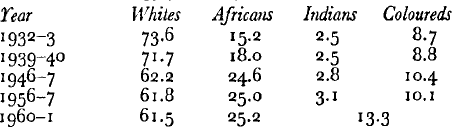
Through the stereotypes so formed, such feelings of economic injustice as exist in South Africa tend to be directed not only against the law and administration which have openly or deviously denied opportunities to those of the wrong skin pigmentation, but also against the abstraction called ‘capitalism’. Thus indignation and resentments are apt to be aimed against the very forces that have, in themselves, exerted the only effective pressures towards the economic uplift of the underprivileged races. For political action by the Coloureds and Africans has been wholly impotent, whereas entrepreneurs have (as we shall see in the following Chapter) often been shrewd enough to find ways of surmounting the chief barriers (i.e., the Wage Act, the Industrial Conciliation Act and the Apprenticeship Act). Despite being allowed relatively little scope, the profit incentive has been the chief source of the dissolution of colour injustices and hence must be accorded the main credit for the remarkable rise in South Africa’s national income since the 1930s. The non-Whites have nearly all shared in the benefits – the Africans (largely because they had no effective labour unions) proportionately more than any other group (see Table below) until ‘economic planning’ in the form of ‘influx control’ (discussed in Chapter 15) began, after the Second World War, to exclude them from opportunities which would normally have been available.
PROPORTION OF AGGREGATE SALARIES AND WAGES PAID TO EACH RACE IN PRIVATE INDUSTRY IN THE REPUBLIC OF SOUTH AFRICA18
19The South African Industrial Federation.
20The IWW pattern is again obvious.
21See Chapter 5, pp. 43–4.
22For instance, this principle of honouring ‘established expectations’ formed a major thesis in Plan for Reconstruction, published in 1943. I argued that, in the dissolution of economic privileges in countries of homogeneous population like the United Kingdom, it was essential to do so in such a manner that the privileges were dissolved gradually, because innocent people had planned or adjusted their lives to a society in which these privileges existed. See also Economists and the Public (1936), Chapter XXI.
23For if the earnings and living standards of the Coloureds, Indians and Africans had risen more rapidly, it would have been easier for them to achieve greater equality of respect (see Chapter 3, p. 29) and increasingly difficult to withhold from them a more appropriate share in political power.
24These initial disadvantages have been partly due to over-indulgence by many in cheap liquor and even the use of an easily (though illegally) obtainable drug known as ‘dagga’. But already rising industrial opportunities have been accompanied by a marked improvement in habits and behaviour.
25The gradual complete exclusion, by means of the standard rate, of women compositors (type-setters) who at one time were widely employed in that craft in Britain, is an interesting illustration. See S. and B. Webb, Industrial Democracy, pp. 488, 500, 504–5.
26For instance, in 1960–61 less than a thousand Coloureds were indentured in the Western Cape out of a total of over 13,000. Yet last century there had been more Coloured than White artisans in the Cape. Coloured apprentices are now confined almost entirely to building and furniture. If a trend started recently under ‘job reservation’ continues, they may be gradually ousted from the building industry. (See Chapter 13, p. 118.)
27See Chapter 9.
28See below, pp. 77–8, and Chapter 17, p. 172.
29Indian women were, by a strong tradition of their own race, for some time excluded from the opportunities which would otherwise have been open to them. They are now beginning to accept employment in industry.
30See above, p.73.
31See my Theory of Collective Bargaining, pp. 133 et seq.
32The Coloured labour unions have tended to be dominated by leaders from the extreme Left.
33See Chapter 11, pp. 105–6.
34I am not suggesting that it is not an appropriate function of the state to finance education, both general and technical.
35In part this idea was based on the fallacy that rapacious employers could exploit the non-Whites because their ‘needs’ were less than those of the Whites.
36This Table may, unless qualified, leave a wrong impression. Average earnings (salaries and wages) per head of Africans, as a proportion of the average earnings of Whites, rose steadily from 12% in 1933–4 to 24.7% in 1946–7. After that year, mainly because of “influx control”, a bigger proportion of Africans than the free market would have determined, found employment in less productive and less well paid areas. Hence, the percentage of African to white earnings per head fell steadily to 18% in 1958–9. Since then it has recovered to 18.5% in 1960–1.
- 1The system has recently been changed. Any African may now choose whether he wishes to be subject to tribal or Portuguese law. If he chooses the latter, he has the right to vote (whatever that means in a dictatorship) but he then becomes liable to taxation.
- 2Inter-marriage is a crime in South Africa. It is officially encouraged in Mozambique.
- 3The present government of the Republic of South Africa deny that this is the purpose of apartheid (separate development). I propose, however, to show why that must be the consequence of their policy.
- 4See Bibliography, p. 183.
- 5There are of course politicians who seek to exacerbate colour resentments solely because they think it will help them in their manœuvring for power. I am not writing for them. They and their henchmen will misrepresent and reject my thesis because it may hamper the achievement of their ambitions.
- 6In Natal there was some possibility of non-Whites qualifying for the franchise but only a handful did, in fact, qualify.
- 7Cape Times, 20 August, 1937. The exchange ceased on 31 August, 1937.
- 8In fairness I should add that, since the fall of the coalition and the outbreak of the war, the Cape Times has been the most influential outlet in South Africa for the consistent and persistent expression of enlightened opinion.
- 9They have since been represented in Parliament, not on a common roll, but by four white members. Indians now have no representation. But Coloured and Indians together exceed the Afrikaners in number.
- 10Cape Times, 13 May, 1963.
- 11See Chapter 17, pp. 158–160.
- 12Wilson and Mafeje, op. cit., p. 148.
- 13In more general and less misleading terms, this has meant seeking the achievement of each economic objective with a minimum sacrifice of alternative objectives. If every entrepreneur were able to pay the lowest wage-rates needed to acquire labour in the free market, not only would the dispersion of wage-rates between low and high levels be reduced to a minimum but the aggregate flow of wages would be maximised. Moreover, there is no reason to believe that, through such an economising of labour, the proportion of wages to other incomes in the division of the value of the product would be reduced.
- 14The Coloured labour unions have tended to be dominated by leaders from the extreme Left.
- 15See Chapter 11, pp. 105–6.
- 16I am not suggesting that it is not an appropriate function of the state to finance education, both general and technical.
- 17In part this idea was based on the fallacy that rapacious employers could exploit the non-Whites because their ‘needs’ were less than those of the Whites.
- 18This Table may, unless qualified, leave a wrong impression. Average earnings (salaries and wages) per head of Africans, as a proportion of the average earnings of Whites, rose steadily from 12% in 1933–4 to 24.7% in 1946–7. After that year, mainly because of “influx control”, a bigger proportion of Africans than the free market would have determined, found employment in less productive and less well paid areas. Hence, the percentage of African to white earnings per head fell steadily to 18% in 1958–9. Since then it has recovered to 18.5% in 1960–1.
- 19Some injustices may be due more to class barriers than to colour barriers. For instance, there is much resentment felt against Portugal as an intransigent colonial power. But no legally enacted colour bars exist in any Portuguese territory; and a South African who crosses into Mozambique is at once struck by the wholly different attitude, at least superficially, towards colour. Yet the overwhelming majority of the Africans of Mozambique are extremely poor. Some critics conclude that Portugal maintains a de facto if not a legal colour bar. But there are approximately an equal number of Whites and non-Whites with ‘assimilado’ status (that is, who have achieved both literacy and the ability to live at defined civilised standards) who have long enjoyed absolute equality of rights before the law. Yet only 160,000 out of the population of 6.6 million enjoy this status and only 5 per cent of the non-white assimilados are Africans (the rest are Indians and half-castes). If the evident backwardness of the masses is caused by deliberate policy rather than by unrestrained population growth and a paucity of natural resources, there is certainly cause for complaints of class injustice, but not of colour injustice. But educated and responsible non-Whites are not subjected, in the Portuguese territories, to the indignities and humiliations they suffer in South Africa.
- 20Some injustices may be due more to class barriers than to colour barriers. For instance, there is much resentment felt against Portugal as an intransigent colonial power. But no legally enacted colour bars exist in any Portuguese territory; and a South African who crosses into Mozambique is at once struck by the wholly different attitude, at least superficially, towards colour. Yet the overwhelming majority of the Africans of Mozambique are extremely poor. Some critics conclude that Portugal maintains a de facto if not a legal colour bar. But there are approximately an equal number of Whites and non-Whites with ‘assimilado’ status (that is, who have achieved both literacy and the ability to live at defined civilised standards) who have long enjoyed absolute equality of rights before the law. Yet only 160,000 out of the population of 6.6 million enjoy this status and only 5 per cent of the non-white assimilados are Africans (the rest are Indians and half-castes). If the evident backwardness of the masses is caused by deliberate policy rather than by unrestrained population growth and a paucity of natural resources, there is certainly cause for complaints of class injustice, but not of colour injustice. But educated and responsible non-Whites are not subjected, in the Portuguese territories, to the indignities and humiliations they suffer in South Africa.
- 21I shall illustrate my thesis almost entirely by reference to experience in the Republic of South Africa where I have been living whilst my ideas were forming. But the lessons learned from a study of colour bars, apartheid and other manifestations of colour prejudice in South Africa, are of direct relevance wherever skin pigmentation or other racial characteristics serve as a principle for confining individuals to any sort of economic or social inferiority.
- 22Without attempting a comprehensive account of colour relations – economic, social or political – in South Africa, I shall try to identify (a) the forces that have tended to dissolve the economic and social inferiority of the non-white classes, and (b) the opposing forces – constituting the injustice – that have tended, deliberately or otherwise, to perpetuate this inferiority. In the final Chapter I shall sum up what I hope the reader himself will have gathered from the facts and interpretations presented about the nature of these forces.
- 23Now my interpretations of the facts will amount to a criticism of the thinking – not the sincerity – of many of the more vociferous of those who campaign, with tenacity and courage, against colour injustices. I shall, on the whole, be questioning the insight and wisdom of people with no axe to grind – the vastly more numerous disinterested opponents of racial discrimination. It is ideas and stereotypes, not aims and purposes, which I shall be challenging.
- 24Of the four colonies merged, it was in the Cape alone that the non-Whites had any sort of effective political rights; and in order to get the consent of the Cape for unification it had been essential that there should appear to be no risk of these rights being removed. Moreover, the entrenched clauses (which were believed to eliminate the risk) were probably an equally necessary condition for the acceptance of the South Africa Act (which constituted the South African Act of Union) by the British Parliament. Indeed, in the debate on the Act British statesmen confidently expressed the view that the ‘liberalism’ of the Cape would gradually spread to the other provinces. But the march of time belied this faith and proved the entrenchments to be quite ineffective.
- 25But the South African government in the middle and late 1930s was an unholy and uneasy coalition, and if the liberal-minded members of the coalition had raised the issue it would have threatened cabinet unity. Indeed, when I myself tried to arouse public opinion in 1937 by referring to the manner in which the public had been misled, I was strongly attacked by the Cape Times (in a controversy which went into several issues) for irresponsibility. I had charged that we had carelessly ‘torn up our Constitution’. But no steps to rectify the position were taken, or even seriously considered.
- 26But the South African government in the middle and late 1930s was an unholy and uneasy coalition, and if the liberal-minded members of the coalition had raised the issue it would have threatened cabinet unity. Indeed, when I myself tried to arouse public opinion in 1937 by referring to the manner in which the public had been misled, I was strongly attacked by the Cape Times (in a controversy which went into several issues) for irresponsibility. I had charged that we had carelessly ‘torn up our Constitution’. But no steps to rectify the position were taken, or even seriously considered.
- 27When the Afrikaner Nationalists eventually obtained the upper hand, in 1948, they immediately took steps to prove that the Constitution had been torn up. By various manœuvres, which included an attack on the judiciary, an attempt to transform Parliament into a High Court, and finally packing the Senate with their own representatives, they secured the two-thirds majority needed for the abolition of the existing non-white voting rights. Far from the ‘liberalism’ of the Cape having spread to the rest of South Africa, as the British Parliament had been led to expect before Union, the Transvaal and the Orange Free State traditions of ‘no equality in church or state’ had been forced on the whole community, and the Coloureds had been deprived of a political status they had held for a century. Of course, political representation of a minority is no guarantee of economic justice for that minority. The Minister of Coloured Affairs argued recently in defence of the abolition of the political rights which the coloured people had enjoyed, that these rights had left 80 per cent of them ‘backward and poor, with leaders deserting them and trying to gain admission to the white masses’. But their removal from the common roll has been felt as a humiliating deprivation of status.
- 28When the Afrikaner Nationalists eventually obtained the upper hand, in 1948, they immediately took steps to prove that the Constitution had been torn up. By various manœuvres, which included an attack on the judiciary, an attempt to transform Parliament into a High Court, and finally packing the Senate with their own representatives, they secured the two-thirds majority needed for the abolition of the existing non-white voting rights. Far from the ‘liberalism’ of the Cape having spread to the rest of South Africa, as the British Parliament had been led to expect before Union, the Transvaal and the Orange Free State traditions of ‘no equality in church or state’ had been forced on the whole community, and the Coloureds had been deprived of a political status they had held for a century. Of course, political representation of a minority is no guarantee of economic justice for that minority. The Minister of Coloured Affairs argued recently in defence of the abolition of the political rights which the coloured people had enjoyed, that these rights had left 80 per cent of them ‘backward and poor, with leaders deserting them and trying to gain admission to the white masses’. But their removal from the common roll has been felt as a humiliating deprivation of status.
- 29If policy had been to encourage the investment of private capital in the reserves, however, the scant natural resources of these areas would have been more rapidly and intensively developed; and again the material benefits would have been largest among the Africans themselves. But the sociological consequences of the rising standards of living – the inevitable weakening of tribal customs and tradition – would not have been welcomed either by the South African Government or by the chiefs. And one of the principal objects of recent policy has been the prevention of any such developments. Thus, in recently granting some measure of local autonomy (so-called ‘self-government’) to the Transkei, the necessity to protect the Africans from the ‘wolves’, the white capitalists, has been emphasised by spokesmen for apartheid. There is a familiar, contemporary ring about the catch-phrases used to justify a policy which permits only such forms of material progress as the state finds expedient. Yet in curbing the profit incentive to investment (and in causing therefore a slowing down of the material advancement of the Africans), apartheid has warded off the emergence of a situation which is, on the whole, regarded as unjust. That is, it has (within the reserves) prevented a minority of Whites or foreign investors from becoming the owners of a large part of the physical resources which provide employment for Blacks.
- 30A serious difficulty confronted in any attempt to interpret experience of race relations arises out of a tendency for resentments aroused by unquestionable injustices, as I have defined them, to be directed against wholly innocent parties, through whose agency unjust discriminations happen to be applied. For instance, Africans are apt to blame the officials whose duty it is to enforce the pass laws or influx control for the decisions required by those controls or laws. Again, ‘when fares are raised or transport inadequate . . . the crews are liable to be treated as scapegoats’. Equally irrationally, the Africans tend to blame ‘employers’ for the relatively low wage-rates they can command rather than the legal enactments (such as the Wage and Industrial Conciliation Acts), social institutions (such as labour unions), or the customs which are responsible.
- 31Those who have said that capitalists want to maintain a supply of ‘cheap docile labour’ misconceive the interests of entrepreneurs. Certainly the co-ordination of complex activities demands ‘discipline’, and there may be no harm in describing willingness to accept entrepreneurial commands (themselves subject to the stern discipline of the market) as ‘docility’. But it does not mean passivity in face of injustice, which is what is usually implied. In a competitive society, entrepreneurs have every incentive to produce at least-cost, which means acquiring the services of people as well as of physical agents as cheaply as possible.
- 32The Industrial Conciliation Act appears, on the whole, to have favoured the Whites in a grossly unfair manner, especially in occupations dominated by the Whites when it was passed in the early 1920s. But it would be wrong to suppose that all industrial councils have represented white employees alone, or have been dominated by them. In the new industries such as clothing which emerged in the 1930s (through entrepreneurial avoidance of the spirit and aims of the ‘civilised labour policy’), the Coloured employees came to be strongly represented; and in industries where the labour unions are dominated by Coloureds, the incentive to bring Africans into semi-skilled occupations seems to have been weakened. On the other hand, the organisation of the Coloureds through industrial councils may have had the effect (before job reservation in 1956 and 1959) of protecting them not only against the potential competition of Africans but also against moves to oust them from their existing channels of employment for the benefit of Whites.
- 33The Industrial Conciliation Act appears, on the whole, to have favoured the Whites in a grossly unfair manner, especially in occupations dominated by the Whites when it was passed in the early 1920s. But it would be wrong to suppose that all industrial councils have represented white employees alone, or have been dominated by them. In the new industries such as clothing which emerged in the 1930s (through entrepreneurial avoidance of the spirit and aims of the ‘civilised labour policy’), the Coloured employees came to be strongly represented; and in industries where the labour unions are dominated by Coloureds, the incentive to bring Africans into semi-skilled occupations seems to have been weakened. On the other hand, the organisation of the Coloureds through industrial councils may have had the effect (before job reservation in 1956 and 1959) of protecting them not only against the potential competition of Africans but also against moves to oust them from their existing channels of employment for the benefit of Whites.
- 34By comparison, the initial disadvantages of the non-Whites due to home background and lack of resources for investment in their own education have in themselves been a minor hindrance to their progress. It will generally pay private enterprise to see that education, both general and technical, is made available where openings for the employment of the attributes and skills acquired are not likely to be suppressed. But powerful custom or prejudice, collusive action and legal enactment, by closing potential avenues of employment may destroy the motive for investment in human capital. Indeed, it will be wasteful for the state, for business concerns or for parents to devote resources to training and equally pointless for individuals to devote their energies and limited incomes to such purposes. But there would have been an irresistibly strong demand for developing the industrial usefulness of the Coloureds if it had not been for fears that any such move would have encountered other legislative steps to render unusable the skills so developed. The profit motive is powerful; but when it is likely to be overruled by legislation or regulation its power to serve the community is hamstrung.
- 35Of course, there were sincere supporters of the ‘civilised labour policy’ who believed it would truly raise the Coloureds and Africans to the white man’s standards, and equally sincere opponents who objected to it for precisely this reason. Thus, some of the most effective parliamentary criticism of the Wage Act (from the parliamentary Opposition – then the ‘South African Party’) arose from the belief that it would have its claimed effects and raise the earnings of the non-Whites, thus disturbing the existing non-white subservience. Other Opposition members believed (equally fallaciously) that employers could afford to pay high wage-rates to Whites because of the economies achieved in paying low wage-rates to non-Whites; and they opposed the Wage Act because they thought it might be used to raise Coloured and African wage-rates and hence ultimately reduce the earnings of Whites.
- 36PROPORTION OF AGGREGATE SALARIES AND WAGES PAID TO EACH RACE IN PRIVATE INDUSTRY IN THE REPUBLIC OF SOUTH AFRICA

