
Denationalisation of Money: The Argument Refined
XIII. Which Value of Money?
Strictly speaking, in a scientific sense, there is no such thing as a perfectly stable value of money—or of anything else. Value is a relationship, a rate of equivalence, or, as W. S. Jevons said, ‘an indirect mode of expressing a ratio’,1 which can be stated only by naming the quantity of one object that is valued equally with the ‘equivalent’ quantity of another object. Two objects may keep a constant relative value in terms of each other, but unless we specify the other, the statement that the value of something is unchanged has no definite meaning.
What we mean when we habitually but carelessly use such expressions as ‘Beer is more stable in value than beetroot’ (and this is the most we can ever assert with any meaning) is that the relative value of beer, or its rate of exchange, tends to remain more stable with a larger number of other goods or over longer periods, than is true of beetroot and many other goods. For ordinary goods or services we have in mind in the first instance usually their relation to money. When we apply the term ‘value’ to money itself what is meant is that the price of most commodities will not tend to change predominantly in one direction, or will change only little, over short periods.
‘A stable value of money’
But some prices always change on a free market. We will sometimes feel that the value of money has remained approximately constant although many prices have changed, and at other times that the value of money has definitely decreased or increased, although the prices of only a few important commodities have changed but all in the same direction. What then do we call, in a world of constantly changing individual prices, a stable value of money?
In a rough sense it is of course fairly obvious that the command over commodities in general conferred by a sum of money has decreased if it brings a smaller amount of most of them and more of only a few of them. It is then sensible to say that the command over commodities has remained about the same if these two changes in command over commodities, just balance. But for our purposes we need, of course, a more precise definition of ‘a stable value of money’ and a more exact definition of the benefits we expect from it.
Balancing errors
As we have seen, the chief disturbances which changes in the value of money will cause operate through the effects on contracts for deferred payments and on the use of money units as the basis of calculation and accounting. Decisions in both have to cope with the unalterable truth that for the individual the future movement of most prices is unpredictable (because they serve as signals of events of most of which he cannot know). The resulting risk can best be reduced by basing calculations on expectations of future prices from which current prices are quite as likely to deviate in the one direction as in the other by any given percentage. This median value of probable future changes will be correctly estimated only if it is zero and thus coincides with the probable behaviour of the large number of prices that are fairly rigid or sluggish (chiefly public utility rates but also the prices of most branded articles, goods sold by mail order houses, and the like).
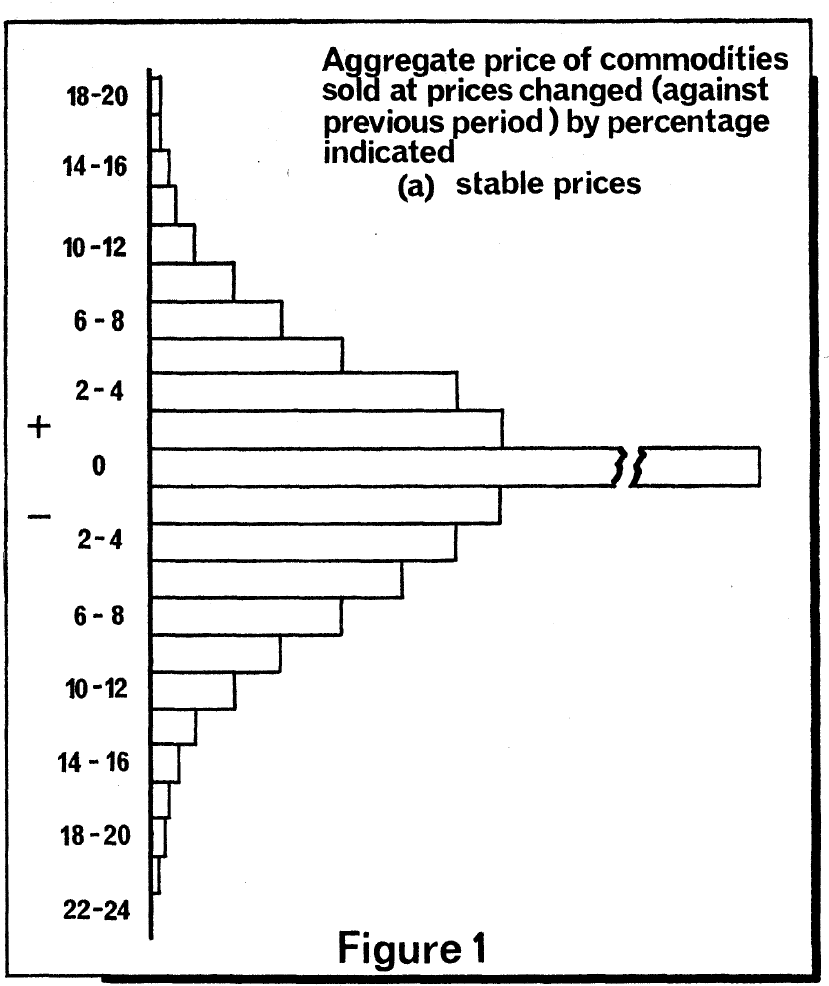
The position is best illustrated by two diagrams. If the value of money is so regulated that an appropriate average of prices is kept constant, the probabilities of future price movements with which all planning of future activities will have to cope can be represented as in Figure I. Though in this case the unpredictability of particular future prices, inevitable in a functioning market economy, remains, the fairly high long-run chances are that for people in general the effects of the unforeseen price changes will just about cancel out. They will at least not cause a general error of expectations in one direction but on the whole make fairly successful calculations based on the assumption of the continuance of prices (where no better information is available).
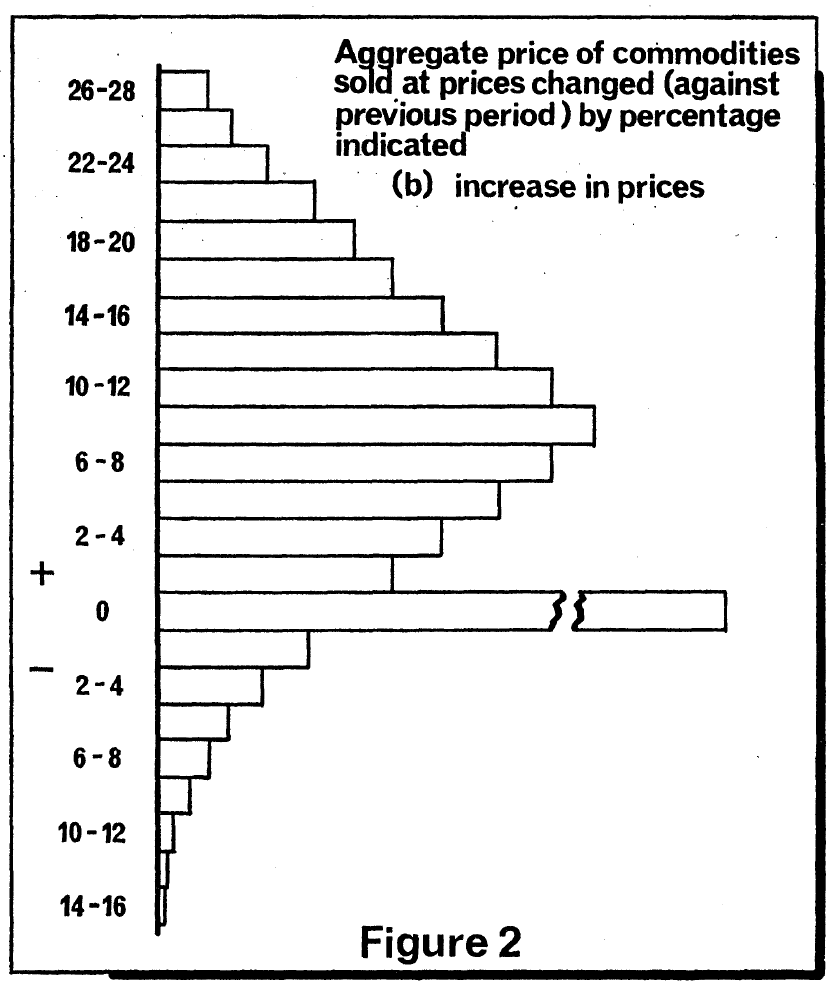
Where the divergent movement of individual prices results in a rise in the average of all prices, it will look somewhat as in Figure 2.
Since the individual enterprise will have as little foundation for correctly foreseeing the median of all the movements as for predicting the movements of individual prices, it could also not base its calculations and decisions on a known median from which individual movements of prices were as likely to diverge in the one direction as in the other. Successful calculations, or effective capital and cost accounting, would then become impossible. People would more and more wish for a unit of account whose value moved more closely together with the general trend, and might even be driven to use as the unit of account something that could not be used as a medium of exchange.2
Criteria of choice
These skewed shifts of the distribution of price changes to one side of constancy which changes in the quantity of money may cause, and the resulting difficulty of foresight, calculation and accounting, must not be confused with the merely temporary changes in the structure of relative prices the same process also brings about which will cause misdirections of production. We shall have to consider (Section XVII) how a stabilisation of the value of money will also substantially prevent those misdirections of production which later inevitably lead to reversals of the process of growth, the loss of much investment, and periods of unemployment. We shall argue that this would be one of the chief benefits of a stable currency. But it is hardly possible to argue that the users of money will for this reason select a currency with a stable value. This is an effect they are not likely to perceive and take into account in their individual decision of what money to use—although the observation of the smooth course of business in regions using a stable currency may induce the people of other regions to prefer a similar currency. The individual also could not protect himself against this effect by himself using a stable currency, because the structure of relative prices will be the same in terms of the different concurrent currencies and those distortions cannot therefore be avoided so long as side by side with stable currencies fluctuating currencies are used to a significant extent.
The reason why people will tend to prefer a currency with a value stable in terms of commodities will thus be that it will help them to minimise the effects of the unavoidable uncertainty about price movements because the effect of errors in opposite directions will tend to cancel each other out. This cancelling will not take place if the median around which the deviation of individual prices clusters is not zero but some unknown magnitude. Even if we agree that the stable money people will prefer to use will be such that they expect the individual prices in which they are chiefly interested to be as likely to increase in terms of it as to decrease, this does not yet tell us which price level most people will want to see constant. Different people or enterprises will evidently be interested in the prices of different commodities. And the aggregate prices of different collections of commodities would of course move differently.
Effectiveness for accounting again decisive
While one probably is at first again inclined to think in terms of retail prices or cost of living, and even most individual consumers might prefer a money stable in these terms, it is not likely that an extensive circulation could be built up for a currency so regulated. The cost of living differs from place to place and is apt to change at varying rates. Business would certainly prefer a money acceptable over wide regions. What would be most important for calculation and accounting in each enterprise (and therefore for the efficient use of resources), relying on the general stability of prices rather than its specialised knowledge of a particular market, would be the prices of widely traded products such as raw materials, agricultural foodstuffs and certain standardised semi-finished industrial products. They have the further advantage that they are traded on regular markets, their prices are promptly reported and, at least with raw materials, are particularly sensitive and would therefore make it possible by early action to forestall tendencies towards general price movements (which often show themselves in such commodities first).
*
Indeed it may well be that a regulation of the issue which directly aimed at stabilising raw material prices might result in a greater stability even of the prices of consumers’ goods than a management which aimed directly at the latter object. The considerable lag which experience has shown to prevail between changes in the quantity of money and changes in the price level of consumers’ goods may indeed mean that, if adjustment of circulation were postponed until the effects of an excess or shortage of the issue showed itself in changes in the prices of consumers’ goods, quite noticeable changes in their prices could not be avoided ; while, in the case of raw materials, where this lag seems to be shorter, an earlier warning would make prompter precautionary measures possible. **
Wage- and salary-earners would probably also discover that it was advantageous to conclude collective bargains in average raw material prices or a similar magnitude, which would secure for earners of fixed incomes an automatic share in an increase of industrial productivity. (The underdeveloped countries would also prefer an international currency that gave raw materials in general an increasing purchasing power over industrial products—though they are likely to spoil the possibility by insisting on the stabilisation of individual raw material prices.) I hope, at any rate, that this will be the predominant choice because a currency stable in terms of raw material prices is probably also the nearest approach we can hope to achieve to one conducive to stability of general economic activity.
Wholesale commodity prices as standard of value for currencies over international regions
My expectation would be that, at least for large regions much exceeding present national territories, people would agree on a standard set of wholesale prices of commodities to treat as the standard of value in which they would prefer to have their currencies kept constant. A few banks that had established wide circulation by accommodating this preference, and issued currencies of different denominations but with roughly constant rates of exchange with one another, might continue to try and refine the precise composition of the standard ‘basket’ of commodities whose price they tried to keep constant in their currency.3 But this practice would not cause substantial fluctuations in the relative values of the chief currencies circulating in the region. Regions with different compositions of the currencies in circulation would, of course, overlap, and currencies whose value was based chiefly on commodities important for one way of life, or for one group of predominant industries, might fluctuate relatively more against others but yet retain their distinct clientele among people with particular occupations and habits.
______________
4 W. S. Jevons [34], p. 11. Cf. also ibid., p. 68: ‘Value merely expresses the essentially variable ratio in which two commodities exchange, so that there is no reason to suppose that any substance does for two days together retain the same value.’
5 The curve representing the dispersion of price changes by showing the percentage of all sales effected at one period at prices increased or decreased compared with an earlier period would, of course, if drawn on a logarithmic scale, have the same shape whether we used money or any commodity as the measure of price. If we used as standard the commodity whose price had fallen more than that of any other, all price changes would merely appear as increases, but an increase of the relative price compared with that of another would still be shown as, say, a 50 per cent increase, whatever measure we used. We would probably obtain a curve of the general shape of a normal (Gaussian) curve of error—the, so far as we could have predicted, accidental deviations from the mode on either side just offsetting each other and becoming less numerous as the deviations increase. (Most price changes will be due to a shifting of demand with corresponding falls of some prices and rises of others; and relatively small transfers of this kind seem likely to be more frequent than large ones.) In terms of a money with stable value in this sense, the price of the commodities represented by the mode would then be unchanged, while the amount of transactions taking place at prices increased or decreased by a certain percentage would just balance each other. This will minimise errors, not necessarily of particular individuals, but in the aggregate. And though no practicable index number can fully achieve what we have assumed, a close approximation to the effect ought to be possible.
6 Indeed emulation would probably lead them to refine the technique for maintaining maximum stability to a point far beyond any practical advantage.
- 1In the Second Edition, Professor Hayek notes that it was not among those duties that Adam Smith said fell to the state (page 33).
- 2The Times, 15 April, 1976.
- 3See [31]. Numbers in square brackets will throughout refer to the Bibliography at the end of the Paper (pp. 138-144).
- 4It has long been a common belief among economists since the classical thinkers of the 18th century that one of the most important functions of government was to create a monetary mechanism and to issue money. The debates among economists have been on how far governments have performed this function efficiently and on the means of increasing or decreasing the power of government over the supply of money. But the general assumption has been that government had to control monetary policy and that each country had to have its own structure of monetary units.
- 5Professor Hayek’s Hobart Special comes at a time when, after pre-war monetary blunders said to have precipitated the 1929-32 Great Depression, nearly a third of a century of post-war ‘monetary management’ (or mis-management) by government, and when attempts at international management have hardly been more successful, economists are again looking to means of taking money out of the control of government altogether. In Hobart Paper 69 (Gold or Paper?) Professor E. Victor Morgan and Mrs Morgan re-examine the breakdown of monetary management since the war and re-assess the case for reestablishing a link between currency and gold. Some months ago Mr Peter Jay, the Economics Editor of The Times, proposed a Currency Commission. Both of these approaches reflect the anxiety to reduce or remove the power of politicians over the supply of money and will seem to younger economists and to new generations in finance, commerce, industry and teaching to be radical departures from post-war economic thinking. Professor Hayek’s proposal that the supply of money be put into the market-place along with other goods and services is even more revolutionary: he is arguing that the attempt for the past 50 years to depend on benevolence in government to manage money has failed and that the solution must lie in the self-interest of monetary agencies that will suffer by losing their livelihood if they do not supply currencies that users will find dependable and stable. Professor Hayek’s Hobart Special, and the works of other economists who are trying to evolve methods of ‘taking money out of polities’, should stimulate economists and non-economists alike to re-examine the first principles of the control of money if civilised society is to continue.
- 6In my despair about the hopelessness of finding a politically feasible solution to what is technically the simplest possible problem, namely to stop inflation, I threw out in a lecture delivered about a year ago a somewhat startling suggestion, the further pursuit of which has opened quite unexpected new horizons. I could not resist pursuing the idea further, since the task of preventing inflation has always seemed to me to be of the greatest importance, not only because of the harm and suffering major inflations cause, but also because I have long been convinced that even mild inflations ultimately produce the recurring depressions and unemployment which have been a justified grievance against the free enterprise system and must be prevented if a free society is to survive.

