
Denationalisation of Money: The Argument Refined
V. The Mystique of Legal Tender
The first misconception concerns the concept of ‘legal tender’. It is not of much significance for our purposes, but is widely believed to explain or justify government monopoly in the issue of money. The first shocked response to the proposal here discussed is usually ‘But there must be a legal tender’, as if this notion proved the necessity for a single government-issued money believed indispensable for the daily conduct of business.
In its strictly legal meaning, ‘legal tender’ signifies no more than a kind of money a creditor cannot refuse in discharge of a debt due to him in the money issued by government.1 Even so, it is significant that the term has no authoritative definition in English statute law.2 Elsewhere it simply refers to the means of discharging a debt contracted in terms of the money issued by government or due under an order of a court. In so far as government possesses the monopoly of issuing money and uses it to establish one kind of money, it must probably also have power to say by what kind of objects debts expressed in its currency can be discharged. But that means neither that all money need be legal tender, nor even that all objects given by the law the attribute of legal tender need to be money. (There are historical instances in which creditors have been compelled by courts to accept commodities such as tobacco, which could hardly be called money, in discharge of their claims for money.3)
The superstition disproved by spontaneous money
The term ‘legal tender’ has, however, in popular imagination come to be surrounded by a penumbra of vague ideas about the supposed necessity for the state to provide money. This is a survival of the medieval idea that it is the state which somehow confers value on money it otherwise would not possess. And this, in turn, is true only to the very limited extent that government can force us to accept whatever it wishes in place of what we have contracted for; in this sense it can give the substitute the same value for the debtor as the original object of the contract. But the superstition that it is necessary for government (usually called the ‘state’ to make it sound better) to declare what is to be money, as if it had created the money which could not exist without it, probably originated in the naive belief that such a tool as money must have been ‘invented’ and given to us by some original inventor. This belief has been wholly displaced by our understanding of the spontaneous generation of such undesigned institutions by a process of social evolution of which money has since become the prime paradigm (law, language and morals being the other main instances). When the medieval doctrine of the valor impositus was in this century revived by the much admired German Professor Knapp it prepared the way for a policy which in 1923 carried the German Mark down to 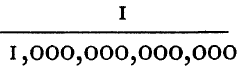 of its former value!
Private money preferred
There certainly can be and has been money, even very satisfactory money, without government doing anything about it, though it has rarely been allowed to exist for long.4 But a lesson is to be learned from the report of a Dutch author about China a hundred years ago who observed of the paper money then current in that part of the world that ‘because it is not legal tender and because it is no concern of the State it is generally accepted as money’.5 We owe it to governments that within given national territories today in general only one kind of money is universally accepted. But whether this is desirable, or whether people could not, if they understood the advantage, get a much better kind of money without all the to-do about legal tender, is an open question. Moreover, a ‘legal means of payment’ (gesetzliches Zahlungsmittel) need not be specifically designated by a law. It is sufficient if the law enables the judge to decide in what sort of money a particular debt can be discharged.
The commonsense of the matter was put very clearly 80 years ago by a distinguished defender of a liberal economic policy, the lawyer, statistician and high civil servant Lord Farrer. In a paper written in 18956 he contended that if nations
‘make nothing else but the standard unit [of value they have adopted] legal tender, there is no need and no room for the operation of any special law of legal tender. The ordinary law of contract does all that is necessary without any law giving special function to particular forms of currency. We have adopted a gold sovereign as our unit, or standard of value. If I promised to pay 100 sovereigns, it needs no special currency law of legal tender to say that I am bound to pay 100 sovereigns, and that, if required to pay the 100 sovereigns, I cannot discharge the obligation by anything else.’.
And he concludes, after examining typical applications of the legal tender conception, that
‘Looking to the above cases of the use or abuse of the law of legal tender other than the last [i.e. that of subsidiary coins] we see that they possess one character in common—viz. that the law in all of them enables a debtor to pay and requires a creditor to receive something different from that which their contract contemplated. In fact it is a forced and unnatural construction put upon the dealings of men by arbitrary power’.7
To this he adds a few lines later that ‘any Law of Legal Tender is in its own nature “suspect” ’.8
Legal tender creates uncertainty
The truth is indeed that legal tender is simply a legal device to force people to accept in fulfilment of a contract something they never intended when they made the contract. It becomes thus, in certain circumstances, a factor that intensifies the uncertainty of dealings and consists, as Lord Farrer also remarked in the same context,
‘in substituting for the free operation of voluntary contract, and a law which simply enforces the performance of such contracts, an artificial construction of contracts such as would never occur to the parties unless forced upon them by an arbitrary law’.
All this is well illustrated by the historical occasion when the expression ‘legal tender’ became widely known and treated as a definition of money. In the notorious ‘legal tender cases’, fought before the Supreme Court of the United States after the Civil War, the issue was whether creditors must accept at par current dollars in settlement of their claims for money they had lent when the dollar had a much higher value.9 The same problem arose even more acutely at the end of the great European inflations after the First World War when, even in the extreme case of the German Mark, the principle ‘Mark is Mark’ was enforced until the end—although later some efforts were made to offer limited compensation to the worst sufferers.10
Taxes and contracts
A government must of course be free to determine in what currency taxes are to be paid and to make contracts in any currency it chooses (in this way it can support a currency it issues or wants to favour), but there is no reason why it should not accept other units of accounting as the basis of the assessment of taxes. In non-contractual payments such as damages or compensations for torts, the courts would have to decide the currency in which they have to be paid, and might for this purpose have to develop new rules; but there should be no need for special legislation.
There is a real difficulty if a government-issued currency is replaced by another because the government has disappeared as a result of conquest, revolution, or the break-up of a nation. In that event the government taking over will usually make legal provisions about the treatment of private contracts expressed in terms of the vanished currency. If a private issuing bank ceased to operate and was unable to redeem its issue, this currency would presumably become valueless and the holders would have no enforceable claim for compensation. But the courts may decide that in such a case contracts between third parties in terms of that currency, concluded when there was reason to expect it to be stable, would have to be fulfilled in some other currency that came to the nearest presumed intention of the parties to the contract.
______________
11 Nussbaum [50], Mann [41] and Breckinridge [6].
12 Mann [41], p. 38. On the other hand, the refusal until recently of English Courts to give judgement for paying in any other currency than the pound sterling has made this aspect of legal tender particularly influential in England. But this is likely to change after a recent decision (Miliangos v. George Frank Textiles Ltd [1975]) established that an English Court can give judgement in a foreign currency on a money claim in a foreign currency, so that, for instance, it is now possible in England to enforce a claim from a sale in Swiss francs. (Financial Times, 6 November, 1975: the report is reproduced in F. A. Hayek [31], pp. 45-6).
13 Nussbaum [50], pp. 54-5.
14 Occasional attempts by the authorities of commercial cities to provide a money of at least a constant metallic content, such as the establishment of the Bank of Amsterdam, were for long periods fairly successful and their money used far beyond the national boundaries. But even in these cases the authorities sooner or later abused their quasi-monopoly positions. The Bank of Amsterdam was a state agency which people had to use for certain purposes and its money even as exclusive legal tender for payments above a certain amount. Nor was it available for ordinary small transactions or local business beyond the city limits. The same is roughly true of the similar experiments of Venice, Genoa, Hamburg and Nuremberg.
15 Willem Vissering [61].
16 Lord Farrer [17], p. 43.
17 Ibid., p. 45. The locus classicus on this subject from which I undoubtedly derived my views on it, though I had forgotten this when I wrote the First Edition of this Paper, is Carl Menger’s discussion in 1892 [43a] of legal tender under the even more appropriate equivalent German term Zwangskurs. See pp. 98-106 of the reprint, especially p. 101, where the Zwangskurs is described as ‘eine Massrege1, die in der überwiegenden Zahl der Fälle den Zweck hat, gegen den Willen der Bevöklerung, zumindest durch einen Missbrauch der Münzhoheit oder des Notenregals entstandene pathologische (also exceptionelle[?]) Formen von Umlaufsmitteln, durch einen Missbrauch der Justizhoheit dem Verkehr aufzudrängen oder in demselben zu erhalten’; and p. 104 where Menger describes it as ‘ein auf die Forderungsberechtigten geübter gesetzlicher Zwang, bei Summenschulden (bisweilen auch bei Schulden anderer Art) solche Geldsorten als Zahlung anzunehmen, welche dem ausdrücklich oder stillschweigend vereinbarten Inhalte der Forderungen nicht entsprechen, oder dieselben sich zu einem Wert aufdrangen zu lassen, der ihrem Wert im freien Verkehr nicht entspricht’. Especially interesting also is the first footnote on p. 102 in which Menger points out that there had been fairly general agreement on this among the liberal economists of the first half of the 19th century, while during the second half of that century, through the influence of the (presumably German) lawyers, the economists were led erroneously to regard legal tender as an attribute of perfect money.
18 Ibid., p. 47.
19 Cf. Nussbaum [50], pp. 586-592.
20 In Austria after 1922 the name ‘Schumpeter’ had become almost a curse word among ordinary people, referring to the principle that ‘Krone is Krone’, because the economist J. A. Schumpeter, during his short tenure as Minister of Finance, had put his name to an order of council, merely spelling out what was undoubtedly valid law, namely that debts incurred in crowns when they had a higher value could be repaid in depreciated crowns, ultimately worth only a 15,000th part of their original value.
- 1Nussbaum [50], Mann [41] and Breckinridge [6].
- 2Mann [41], p. 38. On the other hand, the refusal until recently of English Courts to give judgement for paying in any other currency than the pound sterling has made this aspect of legal tender particularly influential in England. But this is likely to change after a recent decision (Miliangos v. George Frank Textiles Ltd [1975]) established that an English Court can give judgement in a foreign currency on a money claim in a foreign currency, so that, for instance, it is now possible in England to enforce a claim from a sale in Swiss francs. (Financial Times, 6 November, 1975: the report is reproduced in F. A. Hayek [31], pp. 45-6).
- 3Nussbaum [50], pp. 54-5.
- 4Occasional attempts by the authorities of commercial cities to provide a money of at least a constant metallic content, such as the establishment of the Bank of Amsterdam, were for long periods fairly successful and their money used far beyond the national boundaries. But even in these cases the authorities sooner or later abused their quasi-monopoly positions. The Bank of Amsterdam was a state agency which people had to use for certain purposes and its money even as exclusive legal tender for payments above a certain amount. Nor was it available for ordinary small transactions or local business beyond the city limits. The same is roughly true of the similar experiments of Venice, Genoa, Hamburg and Nuremberg.
- 5Willem Vissering [61].
- 6Lord Farrer [17], p. 43.
- 7Ibid., p. 45. The locus classicus on this subject from which I undoubtedly derived my views on it, though I had forgotten this when I wrote the First Edition of this Paper, is Carl Menger’s discussion in 1892 [43a] of legal tender under the even more appropriate equivalent German term Zwangskurs. See pp. 98-106 of the reprint, especially p. 101, where the Zwangskurs is described as ‘eine Massrege1, die in der überwiegenden Zahl der Fälle den Zweck hat, gegen den Willen der Bevöklerung, zumindest durch einen Missbrauch der Münzhoheit oder des Notenregals entstandene pathologische (also exceptionelle[?]) Formen von Umlaufsmitteln, durch einen Missbrauch der Justizhoheit dem Verkehr aufzudrängen oder in demselben zu erhalten’; and p. 104 where Menger describes it as ‘ein auf die Forderungsberechtigten geübter gesetzlicher Zwang, bei Summenschulden (bisweilen auch bei Schulden anderer Art) solche Geldsorten als Zahlung anzunehmen, welche dem ausdrücklich oder stillschweigend vereinbarten Inhalte der Forderungen nicht entsprechen, oder dieselben sich zu einem Wert aufdrangen zu lassen, der ihrem Wert im freien Verkehr nicht entspricht’. Especially interesting also is the first footnote on p. 102 in which Menger points out that there had been fairly general agreement on this among the liberal economists of the first half of the 19th century, while during the second half of that century, through the influence of the (presumably German) lawyers, the economists were led erroneously to regard legal tender as an attribute of perfect money.
- 8Ibid., p. 47.
- 9Cf. Nussbaum [50], pp. 586-592.
- 10In Austria after 1922 the name ‘Schumpeter’ had become almost a curse word among ordinary people, referring to the principle that ‘Krone is Krone’, because the economist J. A. Schumpeter, during his short tenure as Minister of Finance, had put his name to an order of council, merely spelling out what was undoubtedly valid law, namely that debts incurred in crowns when they had a higher value could be repaid in depreciated crowns, ultimately worth only a 15,000th part of their original value.
- 11In its strictly legal meaning, ‘legal tender’ signifies no more than a kind of money a creditor cannot refuse in discharge of a debt due to him in the money issued by government. Even so, it is significant that the term has no authoritative definition in English statute law. Elsewhere it simply refers to the means of discharging a debt contracted in terms of the money issued by government or due under an order of a court. In so far as government possesses the monopoly of issuing money and uses it to establish one kind of money, it must probably also have power to say by what kind of objects debts expressed in its currency can be discharged. But that means neither that all money need be legal tender, nor even that all objects given by the law the attribute of legal tender need to be money. (There are historical instances in which creditors have been compelled by courts to accept commodities such as tobacco, which could hardly be called money, in discharge of their claims for money.)
- 12In its strictly legal meaning, ‘legal tender’ signifies no more than a kind of money a creditor cannot refuse in discharge of a debt due to him in the money issued by government. Even so, it is significant that the term has no authoritative definition in English statute law. Elsewhere it simply refers to the means of discharging a debt contracted in terms of the money issued by government or due under an order of a court. In so far as government possesses the monopoly of issuing money and uses it to establish one kind of money, it must probably also have power to say by what kind of objects debts expressed in its currency can be discharged. But that means neither that all money need be legal tender, nor even that all objects given by the law the attribute of legal tender need to be money. (There are historical instances in which creditors have been compelled by courts to accept commodities such as tobacco, which could hardly be called money, in discharge of their claims for money.)
- 13In its strictly legal meaning, ‘legal tender’ signifies no more than a kind of money a creditor cannot refuse in discharge of a debt due to him in the money issued by government. Even so, it is significant that the term has no authoritative definition in English statute law. Elsewhere it simply refers to the means of discharging a debt contracted in terms of the money issued by government or due under an order of a court. In so far as government possesses the monopoly of issuing money and uses it to establish one kind of money, it must probably also have power to say by what kind of objects debts expressed in its currency can be discharged. But that means neither that all money need be legal tender, nor even that all objects given by the law the attribute of legal tender need to be money. (There are historical instances in which creditors have been compelled by courts to accept commodities such as tobacco, which could hardly be called money, in discharge of their claims for money.)
- 14There certainly can be and has been money, even very satisfactory money, without government doing anything about it, though it has rarely been allowed to exist for long. But a lesson is to be learned from the report of a Dutch author about China a hundred years ago who observed of the paper money then current in that part of the world that ‘because it is not legal tender and because it is no concern of the State it is generally accepted as money’. We owe it to governments that within given national territories today in general only one kind of money is universally accepted. But whether this is desirable, or whether people could not, if they understood the advantage, get a much better kind of money without all the to-do about legal tender, is an open question. Moreover, a ‘legal means of payment’ (gesetzliches Zahlungsmittel) need not be specifically designated by a law. It is sufficient if the law enables the judge to decide in what sort of money a particular debt can be discharged.
- 15There certainly can be and has been money, even very satisfactory money, without government doing anything about it, though it has rarely been allowed to exist for long. But a lesson is to be learned from the report of a Dutch author about China a hundred years ago who observed of the paper money then current in that part of the world that ‘because it is not legal tender and because it is no concern of the State it is generally accepted as money’. We owe it to governments that within given national territories today in general only one kind of money is universally accepted. But whether this is desirable, or whether people could not, if they understood the advantage, get a much better kind of money without all the to-do about legal tender, is an open question. Moreover, a ‘legal means of payment’ (gesetzliches Zahlungsmittel) need not be specifically designated by a law. It is sufficient if the law enables the judge to decide in what sort of money a particular debt can be discharged.
- 16The commonsense of the matter was put very clearly 80 years ago by a distinguished defender of a liberal economic policy, the lawyer, statistician and high civil servant Lord Farrer. In a paper written in 1895 he contended that if nations
- 17‘Looking to the above cases of the use or abuse of the law of legal tender other than the last [i.e. that of subsidiary coins] we see that they possess one character in common—viz. that the law in all of them enables a debtor to pay and requires a creditor to receive something different from that which their contract contemplated. In fact it is a forced and unnatural construction put upon the dealings of men by arbitrary power’.
- 18To this he adds a few lines later that ‘any Law of Legal Tender is in its own nature “suspect” ’.
- 19All this is well illustrated by the historical occasion when the expression ‘legal tender’ became widely known and treated as a definition of money. In the notorious ‘legal tender cases’, fought before the Supreme Court of the United States after the Civil War, the issue was whether creditors must accept at par current dollars in settlement of their claims for money they had lent when the dollar had a much higher value. The same problem arose even more acutely at the end of the great European inflations after the First World War when, even in the extreme case of the German Mark, the principle ‘Mark is Mark’ was enforced until the end—although later some efforts were made to offer limited compensation to the worst sufferers.
- 20All this is well illustrated by the historical occasion when the expression ‘legal tender’ became widely known and treated as a definition of money. In the notorious ‘legal tender cases’, fought before the Supreme Court of the United States after the Civil War, the issue was whether creditors must accept at par current dollars in settlement of their claims for money they had lent when the dollar had a much higher value. The same problem arose even more acutely at the end of the great European inflations after the First World War when, even in the extreme case of the German Mark, the principle ‘Mark is Mark’ was enforced until the end—although later some efforts were made to offer limited compensation to the worst sufferers.

