
Business Tides
Wage-Price Go-Round
January 4, 1960
Reluctant as this column is to engage in prophecy, it is not taking much risk in predicting that when a settlement of the steel strike does come, it will be inflationary.
Even before the strike began the steelworkers were the highest-paid major group of workers in industry, receiving an average of $3.10 an hour compared with average factory earnings of $2.23. The companies have already offered a three-year contract which they estimate will bring the steelworkers an additional increase of 33 cents an hour over the full period; even the union, which turned down the offer, concedes that it meant at least a 24-cent increase. The final settlement will surely not be lower.
But this means an inflationary increase. Because the steelworkers are already far ahead of the procession, the new gain is certain to let loose a tremendous wave of demands for another round of wage increases.
All this does not necessarily mean that the company managements were foolish to put up a fight. They had every reason to think, at the beginning, that their resistance would have the support of public opinion and of the Administration. They were not merely encouraged, but practically enjoined, not to make an “inflationary” wage settlement. They knew what the opposition would be to another price increase. They knew they would lose further markets to foreign producers.
‘NEUTRAL’ GOVERNMENT
As the strike dragged on, the government remained ostensibly “neutral.” It refused to “interfere.” Certainly it did not, as under Mr. Truman, interfere directly on the side of the strikers. But Mr. Eisenhower began to declare that he was losing patience; he rebuked both sides for not coming to an agreement. As he did this even after the companies had made an inflationary offer, the only logical conclusion was that he expected them to make a still more inflationary offer, if necessary, to persuade McDonald to accept; otherwise he would have expressed his displeasure with the union alone.
And all the time he, his officials, and Congress utterly ignored the fact that the Federal government had been tipping the scales in favor of the strikers from the beginning, through the operation of existing laws. The Taft-Hartley-Wagner Act set up the machinery under which the steelworkers’ union was created, and under which it became the official exclusive bargaining agency for the employees. It set up the requirement that the employers must continue to “bargain” with McDonald no matter how unreasonable his demands or his attitude. It made it in effect impossible for the companies to treat the strikers as having quit their jobs and peaceably to hire other workers to take their place, either on the old terms and conditions or on new ones. And the Norris-LaGuardia Act, plus the absence of local law enforcement, removed from the companies protection against the intimidation of mass picketing and the threat of violence.
IN SPITE OF THEM
Without this intervention by the Federal government (an intervention built in for a quarter-century) it is highly improbable that there would have been a 116-day steel strike for such extravagant demands, or even an industrywide steel union powerful enough to choke off the nation’s steel supply at will.
All this is ignored by the Stevensons and Rockefellers who now call for compulsory arbitration. What they are in effect proposing is that if the unions cannot get what they want even with the legislative scales heavily tipped in their favor, a government body should step in and order the employers to pay more. Theoretically, of course, the workers could be ordered to resume work for less than they could obtain from a continued refusal to work (which would be a violation of their basic liberties), but as the proposal comes from the professional “friends” of labor, it is obvious that they do not seriously expect this result. They merely expect additional pressure on the employer.
So we seem to be in for another round of inflation. But Administration officials and congressmen will all talk as if this had nothing to do with the policies they pursued or advocated, but had come about in spite of everything they had done to stop it. 
January 11, 1960
Three weeks ago I discussed here the proposal of Roy L. Reierson of the Bankers Trust Co. of New York that we eliminate the present 25 percent gold-reserve requirement against Federal Reserve notes and deposits. Because of limitations of space, I could not do full justice to that proposal. I believe Reierson’s solution is wrong. But he has had the clear-sightedness and courage to call attention to the problem.
The problem, to restate it, is this. Though our gold reserve still stands at about $19.5 billion, more than half of this must be held as a reserve against liabilities. About $12 billion in gold is required to be held as a 25 percent reserve against $48 billion of Federal Reserve notes and deposits. This leaves available only $7.5 billion of “free” gold against some $19 billion short-term dollar balances held by foreigners (including $3 billion held by international institutions).
Foreigners, says Reierson, measure our gold losses not against our total stock of gold but against our very much smaller amount of free gold. This may lead to fears that, if this “free gold” is exhausted, we will be compelled to stop making gold available for international settlement, and thus devalue. His suggested remedy is that we either reduce or eliminate our present 25 percent gold-reserve requirement entirely, to assure foreigners that the whole amount would be available to them.
NO SOLUTION
I do not think this step would provide any real solution. It would drop the last vestige of a domestic gold standard. It would keep the dollar temporarily good for foreigners at the cost of undermining permanently its value for Americans. If foreigners withdrew all their present short-term balances in gold, it would leave Americans with no gold backing for their dollars at all. The proposal turns the perfectly sound principle that gold convertibility ought not to discriminate against foreigners into the untenable proposition that it ought to discriminate against Americans.
And even so it would give only temporary assurance to foreigners unless accompanied by unmistakable evidence of the determination on the part of our government to halt our inflation immediately. With the gold-reserve requirement entirely removed, this assurance would have to take the form of an act of Congress, forbidding any further increase in the supply of money and bank credit. This in turn could only be achieved by not allowing any bank to increase the total of its loans and investments—which means that it could not make any new loan until an equivalent old loan had been repaid.
In the present inflationary mood of Washington, such a proposal would be dismissed as unthinkable.
STRINGENCY NEEDED
But no solution of the problem is possible unless the inflation is halted, by whatever means. Instead of eliminating the gold-reserve requirement entirely, it ought to be restored immediately to the pre-1945 level of 35 to 40 percent—preferably to a flat 40 percent against both notes and deposits. But as the reserve has already been allowed to fall to this level, this too would mean that no further increase could be allowed in money and bank credit until our gold holdings themselves increased.
Even if we hope to remain merely on our present for-foreigners-only gold standard, we must continue to let gold, if demanded, flow out. On this point Reierson is right. But if we hope to keep our foreign creditors from demanding gold, if we mean to protect the integrity of the dollar, if we intend to prevent devaluation, we must stop the further expansion of money and bank credit by one method or another.
If this takes the form of “orthodox” measures, those orthodox measures must be stringent. The budget must be immediately balanced. (Renewed promises of a balance in the sweet by-and-by are no longer enough.) Congress must repeal the legislative ceiling of 4½ percent on long-term government bonds. Interest rates must be raised to the point where they cease to encourage further expansion of credit.
The future of the dollar depends on whether we have the stomach for such decisions.
January 18, 1960
As this department two weeks ago predicted, and as it took no great clairvoyance to predict, the steel strike has finally been settled by a grossly inflationary wage increase. Continuing its mood of crystal-gazing, this department predicts that the victory for the steel union will let loose a tremendous wave of demands for another round of wage increases throughout industry; that employers for the most part will be compelled to yield to these demands; that the Federal Reserve authorities will be pressured into further expansion of money and credit to make the wage increases supportable, and that neither the Administration nor Congress will do anything in the slightest degree effective to halt the consequent inflation.
Never has this department more ardently wished that its predictions would turn out to be laughably wrong. But let us look at the facts.
If there was any will to resist inflation, the steel strike was the ideal test case. Steel wages even before the strike averaged $3.10 an hour. This was already 87 cents an hour higher than the average wage paid in manufacturing. It was already the highest wage paid to any major group in manufacturing. There was no question of “catching up with the procession.” The steelworkers were already way ahead of the procession.
CARDS WERE STACKED
These were among the reasons, in addition to loss of markets to foreign competitors, that led the steel companies to resist a further substantial wage increase. In addition, they were under ostensible pressure from the Administration not to grant an “inflationary” wage increase.
But as the strike wore on, it became more and more evident that the companies were engaged in a losing battle. Ostensibly, the government was “neutral”; it refused to “interfere”; it kept “hands off”; it left everything to “free collective bargaining.” But all the time, it was in fact interfering, through the operation of the Norris-LaGuardia and Wagner-Taft-Hartley acts, on the side of the strikers. All the time the union maintained intimidatory picket lines, the constant threat of violence, in case any company should try to resume production and to hire other workers. And all the time the Administration and Congress remained completely oblivious of this situation, and talked as if bargaining were really free on both sides.
It is true that Mr. Eisenhower finally resorted to the strike-injunction provisions of the Taft-Hartley Act, but both before and after he had done so he declared that he was losing patience, and rebuked both sides for not coming to an agreement. As he did this even after the companies had made an inflationary offer, they could only conclude that he expected them to make a still more inflationary offer to buy a settlement. Otherwise they faced a resumption of the strike, with threats in the background of compulsory arbitration or even seizure.
TOUGH NEXTTIME
The companies will now no doubt be roundly abused by some for having uselessly and expensively held out, and by others for finally yielding so much. And certainly the package increase of 39 cents an hour that they were forced to yield over a thirty-month period is far more costly than the settlement they might have obtained by offering more last June to avert a strike. But before we condemn the company managements we would do well to weigh the mounting pressures against them.
Only three nights before the steel settlement, New York City, already losing millions of dollars on its city- owned and -operated bus and subway lines, averted a strike only by offering an increase of 40 cents an hour over a two-year period. The private bus lines were forced to settle for an increase of 36 cents an hour. Immediately after the settlement Mayor Wagner announced that the people of the city were “sick and tired of . . . this terrible ordeal every year or every second year . . . I don’t propose to let it happen again.”
The politicians are always going to be terribly tough next time, but always capitulate, or force private industry to capitulate, this time. They have built up, by their own laws and appeasements, a Frankenstein monster they no longer dare to oppose.
January 25, 1960
Though the steel companies, as one of their spokesmen admitted, certainly “took a hell of a licking,” it does not follow that labor won. It will take years for the strikers, even with their new gains, to make up their losses during 116 days of idleness. And as the union which forced a thumping increase on top of wage rates already higher than in any other manufacturing industry also refused to permit employers to effect any savings by discarding wasteful work rules, the settlement must adversely affect employment in the long run. As Roger Blough, chairman of United States Steel, pointed out, the settlement “can certainly weaken further their [the workers’] ability to compete in the market place against the workers in steel mills abroad, as the gap between wage costs on opposite sides of the ocean continues to widen.”
As for other workers, the purchasing power of their wages will be cut by a new spiral of inflation. The price at which the Administration bought off the steel strike was a hundred new strikes, unless a new national round of inflationary wage increases is granted. The great problem now is how we can limit the damage done.
DON’T ACT NOW
Yet this—the most important domestic problem now before the Administration—was dismissed in the President’s long annual message with a perfunctory mention. The inflationary implications were belittled. We were told that we must depend “primarily upon the common sense of the responsible individuals,” and should “encourage regular discussions between management and labor outside the bargaining table.” In other words, the government should do nothing.
Toward any meaningful reform of our labor laws, this Administration, like its predecessors and its Democratic opponents, has developed a masterly logic of inaction. Don’t legislate during a strike, because then it is too late to affect that strike, and any such legislation would be hasty and ill-considered. Don’t legislate after a strike has been settled, because there is no longer any urgency. Don’t legislate in an election year (i.e., every second year) because such legislation will be “political” and bad. Don’t legislate until we see how the Landrum-Griffin Act (obviously ineffective on nationwide strikes) is going to work out.
We come to the paradox that nobody attempts to solve the problem precisely because it has become so serious. The politician dares not make proposals that might incur the vengeance of the union leaders at the polls. The employer fears to press suggestions that would antagonize his union workers or arouse the resentment of their leaders.
UNION INTIMIDATION
But the greatest obstacle to reform is the confusion and division even in the ranks of those determined to face the problem. Some ask for compulsory arbitration, failing to see that this must lead into general wage-and-price fixing. Some want to seize the companies and force them to pay what the unions ask, oblivious of the violation of private-property rights and the consequent demoralizing effects on industry and employment. Some demand making the unions subject to “antimonopoly” laws, but fail to specify what these would permit or forbid. Some want to limit the size of unions, but are vague about the limits or how their proposal would be enforced.
And all the time the central evil is ignored. This is union violence, or union intimidation through mass picketing. It was this that made the nationwide steel strike effective. It was this that made it inevitable that McDonald would win. For throughout the strike no steel company dared to try to operate. And this irresponsible union power will continue until a company is in a position to say to strikers: “Unless you are back by Monday morning, you will be considered as having quit your job, and you will be replaced.” Until a company management is in a position to say that without being haled before a labor board, until it can seek immediate relief in the courts from irreparable damage, and until it can depend on local police action to prevent mass picketing and keep the peace, the labor-union bosses will continue to have the economy at their mercy.
February 1, 1960
Word Inflation: The verbal inflation in the budget has increased at an even faster rate than the dollar inflation. The signed part of the President’s message, preceding the hundreds of itemized tables, runs to 78 pages. The Budget Message six years ago ran to only fourteen pages. The increase in wordage is 457 percent, compared with an increase of annual estimated dollar expenditure of 24 percent. The comparison is not frivolous. Good government and good policy depend on the extent of public interest and understanding. Public interest and understanding are encouraged by clarity and brevity, discouraged by prolixity. The significant facts can be buried under mountains of detail. I am not yet ready to put it forward as Hazlitt’s Law, but I suspect that the number of people who read a message varies inversely as the square of its length.
How Good a Guess? The President estimates that expenditures in the fiscal year 1961 will be $79.8 billion and receipts $84 billion, leaving a surplus of $4.2 billion. How likely is that surplus? It is not to be achieved by any cut in expenditures, which are estimated at $1.4 billion more than in the current fiscal year, but by an increase, from practically the same taxes, of $5.4 billion in revenues compared with the current fiscal year and of $15.7 billion compared with the fiscal year ended last June 30. Such an increase of 23 percent in two years would be improbable without substantial inflation; but this would mean correspondingly increased costs, which are not allowed for in the expenditure estimates.
Comparisons with the last full fiscal year, 1959, are not encouraging. For that year the President predicted a surplus of nearly half a billion. But expenditures were $6.8 billion more than he estimated and receipts $6.1 billion less, so 1959 ended with a deficit of $12.4 billion. If the same absolute error were now made for 1961, we would end, not with a surplus of $4.2 billion. but with a deficit of $8.7 billion. The 1959 error was abnormally large. But even for the fiscal year 1958 Mr. Eisenhower predicted a budget surplus of $1.8 billion and we ended with a deficit of $2.8 billion—i.e., $4.6 billion worse than the forecast. His present surplus estimate hardly justifies a Democratic spending spree.
Cost Comparisons: Even when we take the budget at face value, it is the biggest expenditure Mr. Eisenhower has ever proposed. This is not the result of proposed increased spending on defense. On the contrary, “major national security” expenditures, at $45.6 billion, would be less than in 1959 or in the current fiscal year. The new budget contains the highest nondefense expenditures ever recommended. These total $34.2 billion, compared with $31.2 billion recommended for 1960 and $28.1 billion for 1959 (though both increased in actuality), and with actual non-defense expenditures of $27.8 billion in 1958, $25 billion in 1957, and $20.9 billion in 1954. In brief, non-defense expenditures alone are $13 billion greater than in 1954.
Nor does even this tell the full truth about the 1961 budget. When social security and trust-fund operations are counted in, expenditures for 1961 will not be $79.8 billion but $96.3 billion. Total nondefense and welfare spending, at $50.3 billion, will actually exceed defense spending by $5 billion.
Debt Management: Congress will be irresponsible if it does not heed the President’s request for immediate removal of the 42-year-old 4¼ percent limitation on interest rates on government securities maturing after five years. Such long-term securities can no longer be sold at that rate. The ceiling is highly inflationary, as it forces the government to offer short-term securities acquired by commercial banks. As the government must pay around 5 percent even on these, the ceiling on long-terms actually raises its interest costs.
Item Veto: The President is to be congratulated for again asking authority to veto individual items in appropriation bills. He points out that 41 state governors now have such item veto authority. It is a minimum requirement for fiscal responsibility. The only real question is whether it goes far enough.
February 8, 1960
The President’s annual Economic Report has come a long way since the days of Leon Keyserling. It is lucid, readable, informative, and conservative in tone. It pays more than lip service to the need for a balanced budget and to the merits of “a free society, free political institutions, and a free economy.” It rightly insists that “we grow only by investing more and producing more, not simply by spending more.” Many of its specific recommendations—such as the removal of the 4¼ percent interest-rate ceiling on new long-term Federal bonds—are urgently necessary.
The report is also able to point out that though inflation continued in 1959, the rate of inflation decreased. The money supply (as measured by demand deposits plus currency) grew by only one-half of 1 percent in 1959, compared with 4 percent during 1958. The consumer price index rose from 123.7 at the end of 1958 to only 125.6 at the end of 1959. The wholesale price index actually fell during the year from 119.2 to 118.8.
Yet the latest Economic Report leaves one with the same doubts as have its predecessors concerning the wisdom of the Employment Act of 1946. That act declares (though with elaborate bows to “free competitive enterprise”) that “it is the continuing policy and responsibility of the Federal government . . . to promote maximum employment, production, and purchasing power.”
DOUBTS ON 1946 LAW
It has not been proved that the act has done any particular good. Thus, though the present report boasts of the great advances made in employment, income, and output in the fourteen years since the passage of the Employment Act, it also concedes that “the annual increase of 3.2 percent in total national output” in this period “is roughly equivalent to the long-term average reached in our previous history.”
But the act, by its emphasis on maximum employment and “purchasing power,” and its silence concerning prices, has given added stimulus to inflation. It is not mere coincidence that since 1946, when the act was passed, the money supply has increased 32 percent and consumer prices have risen 50 percent. This inflation has made the miracle of “economic growth” seem much greater than it is. We boast of our gross national product of 1959 of $479 billion; but if this had been calculated at the 1939 price level, it would have been only $205 billion—not half as impressive.
Moreover, by holding that employment, production, and purchasing power are the “responsibility” of the Federal government, the Employment Act of 1946 has provided an excuse for hundreds of “programs,” handouts, and interventions, and a steady expansion of Federal control. Is it really the province of government to increase employment, output, and purchasing power? Or is not its chief business, rather, to keep out of the way?
RESPONSIBILITY
Its true function is to maintain peace, order, and justice; to protect life and property; to refrain from burdensome and inequitable taxation; to remove the punitive laws and deterrents that previous governments have imposed. Its function is to permit and preserve a sound currency. When it fails to do this, it must bear sole responsibility for the failure.
If it properly fulfills its own responsibilities, it will not need to lecture the people to take “appropriate private actions, especially with respect to profits and wages.” If it did not grant labor unions special monopoly privileges, the power of intimidation and of paralyzing the economy, it would not need to declare piously and futilely that unions should not “threaten to paralyze our entire economy.” And it need not declare that “price reductions warranted by especially rapid productivity gains must be a normal and frequent feature of our economy.” If the government itself will refrain from monetary inflation, these price reductions are precisely what will occur. A fair field for competition will bring down production costs and prices with them.
The greatest profits will go to those who either bring down production costs the most, or improve products the fastest. The free market can settle these relationships better than the most learned government economists.
February 15, 1960
Sixteen years ago, in a short but very important book, The Road to Serfdom, F.A. Hayek sought a modern restatement of the great issue between liberty and authority. Now, pushing his researches further, he has produced a monumental work of 570 pages, The Constitution of Liberty (University of Chicago Press. $7.50), exploring the philosophical foundations of freedom with a thoroughness, scholarship, rigor of reasoning, and precision of statement rarely equaled and never surpassed. It is one of the great political works of our time.
It is difficult, within the limits of this space, to convey an adequate idea of the book’s scope and contents. Part I is concerned with the meaning and value of freedom. As Abraham Lincoln pointed out, “The world has never had a good definition of the word ‘liberty.’ We all declare for liberty; but in using the same word, we do not all mean the same thing.” Hayek analyzes the many ambiguities of the word, but uses it to describe “the state in which a man is not subject to coercion by the arbitrary will of another or others.” He examines the goals and methods—legal, political, economic, educational—that restrict or threaten this liberty, as well as the ideals and measures most likely to promote and maximize it. In the course of this examination, the goal of Liberty is compared with that of Equality, Majority Rule, and Democracy to determine to what extent they are compatible and, when not, which must have priority. Democracy, he concludes, though “probably the best method of achieving certain ends,” is “not an end in itself.”
THE RULE OF LAW
In Part II, Hayek considers the relation of freedom to the law, and presents an illuminating historical survey of the slow growth of safeguards to individual liberty. Among these he stresses the importance of a written constitution, of federalism, limited government powers, division of powers, and judicial review.
Most of all he stresses the importance of the Rule of Law. By this he means the absence of arbitrariness, privilege, and discrimination. The law must apply to all, and not merely to particular persons or groups. It must be certain. It must consist in the enforcement of known rules. These rules must be general and abstract rather than specific and concrete. They must be prospective in their application and not retrospective. They must be so clear that court decisions are predictable. The case for the ideal of the rule of law, for its certainty, generality, and equality, is presented with unanswerable force. But Hayek is compelled to point out in a final chapter of this section how, under the influence of legal positivism, socialism, and the drive toward a welfare state, the ideal of the rule of law has been declining.
CREEPING BUREAUCRACY
The final section consists of eight chapters in which Hayek shows what the effects have been—on labor and employment, social security, taxation, money, housing and town planning, agriculture, and education—of the decline of the rule of law and personal liberty in the pursuit of the goals of socialism, welfare-statism, redistribution, “full employment,” and inflation.
This is a series of masterly discussions which unfortunately cannot be reviewed in detail here. I must confess some disappointment in one or two of them. His chapter on “The Monetary Framework,” for example, though it contains a brilliant analysis of inflation, seems to violate his own declared principles when it suggests that a restoration of the gold standard is neither practicable nor desirable, and even expresses doubt about the wisdom of tying down the monetary managers by “rigid rules” instead of depending on their discretion.
Yet these chapters in general are distinguished as much for their courage as for their intellectual penetration. No one has pointed out more clearly the dangers now facing us from inflation, paralyzing “progressive” taxation, coercive labor unions, the ever-increasing dominance of government in education, and a social-service bureaucracy with far-reaching arbitrary powers. Hayek’s book is the twentieth-century successor to John Stuart Mill’s essay, On Liberty, and the contemporary legal-political counterpart of Ludwig von Mises’s economic treatise, Human Action.
February 22, 1960
According to Edwin L. Dale, Jr. on the front page of The New York Times of Feb. 7, “a new ‘great debate’ is raging” in Washington at the luncheon table and over the after-dinner coffee and brandy, and you’d be surprised to learn what it is about. Its “single idea” is that “the basic trouble with American society is that we devote too much of our resources to increasing an already affluent volume of private consumption, and too little to public services of all kinds.” In sum: “There is something wrong with a country that has bigger and better tailfins at the same time that it has a second-best defense posture, a worsening slum problem, dirty rivers and streams, inadequate health services, and wretched underfinancing of education.”
Before we take up the “single idea” we might go once over lightly a few of these detailed charges. Our defense ought to be as adequate as we can make it; but mere spending is not the whole answer. As for health services, both private and public, we are spending more on them than ever before in human history. The same is true of education. If the education of our children is wretched, it is not because we don’t pay enough for it. The real complaint in the foregoing paragraph is that people choose to spend their own money on automobiles instead of on better housing.
STILL MORE SOCIALISM
The single idea of this so-called great debate, to restate it in plainer words, is that we do not have enough socialism and ought to have still more; that annual Federal expenditures at the rate of $96 billion are not enough and ought to be enormously larger; that the tax burden ought to be still more crushing; that it isn’t enough to confiscate up to 91 percent of man’s income, the government ought to grab what is left; that the enormous Federal bureaucracy ought to be still further expanded; that people should not be allowed to spend the money they earn on the things they want, but on the things that the Lippmanns and Galbraiths think is good for them.
Paradoxically, the same people who are assumed to be incompetent individually to know how to spend their earnings are assumed to be competent collectively, as voters, to decide how the incomes of everybody else should be spent.
What a still greater tax burden will do to incentives and to the productivity of enterprise is a question that the welfare-state zealots do not consider. Production, they assume, increases automatically, regardless of incentives, the right of a man to buy what he wants or to keep what he earns, or the rewards to saving, risk- taking, or capital investment.
If Washington dinner parties are toying with the idea of a still deeper plunge into socialism, welfare-statism, bureaucratic rule, spending and taxing, their attention should be called to a few real problems. I suggest that the following subjects for possible great debates are being neglected:
1—The effects of continuous deficit financing and of continuously expanding government spending—particularly on nondefense items.
2—The effect of progressive income taxes rising to 91 percent, of corporate income taxes of 52 percent, and of the capital-gains tax in its present form, in reducing incentives and production and sometimes even reducing revenues.
3—The effect of our foreign-aid program in subsidizing foreign socialism, making enemies rather than friends, upsetting our balance of payments, and bringing increased taxes or deficits at home.
4—The effect of farm price-support subsidies in increasing taxes or bringing deficits, raising the cost of foodstuffs for city workers and rewarding people for not producing.
5—The constantly growing social-security program and our ability to carry the burden.
6—The growth of a huge bureaucracy with a vested interest in perpetuating foreign aid, expanding social security, etc.
7—The uncontrolled power of nationwide labor unions to paralyze industry and force continuous inflationary settlements.
8—The danger under present conditions of retaining the 4¼ percent government-bond-interest ceiling.
9—The threat to our gold reserves.
10—The mounting threat to the integrity of the dollar.
February 29, 1960
Former President Hoover has pointed out that Marxist thinking infects us and has even “got frozen” into the Eisenhower Administration. Senator Goldwater pleads with his Republican colleagues, in Human Events, to offer the American voter a clear-cut alternative to “the paternalistic superstate with its ever-increasing spending and its ever-increasing taxation and its ever- increasing interference in the life of the individual.” But Arthur Krock points out in the New York Times that the President’s sympathetic “consideration” of proposals for free hospital and nursing care of elderly citizens, to be paid for out of Federal revenues, is another Republican step toward the welfare state. The voters, he concludes, “will find it difficult to detect a basic ideological distinction between the two major parties.”
At present there is hardly a major field in which the voter can detect a significant party difference. Let us run through a list.
Social Security: All the social-security increases of the last seven years have been bipartisan. The President himself has insisted on bigger and longer unemployment benefits. True, there is a small party difference regarding the Senate’s $1.8 billion aid-to-education bill, providing funds for both school construction and teachers’ salaries.
Farm Subsidies: The farm price support fiasco has become a national disgrace. In his message to Congress of Feb. 9, the President pointed out that $3.5 billion of Federal funds are tied up in wheat alone (a crop which provides only 6 percent of cash receipts from sales of farm products). It is costing the government $1.5 million a day, or more than $1,000 a minute, just to store the wheat surpluses created by its own price policies. But the President does not dare to suggest termination of the program. He expresses a mild hope that price supports will be more “realistic” and controls fewer. He advocates an even greater “soil bank”—60 million acres.
Foreign Aid: Though this program was Democratic and Trumanic in origin, Mr. Eisenhower now pleads for more “economic” foreign aid than even Democrats seem willing to give. Most of this will go to subsidize socialistic programs (as in India) which can only slow down rather than accelerate economic progress in the receiving countries.
Spending: Average annual Federal nondefense expenditures, seven Truman years (1947–53), $23.7 billion; average seven Eisenhower years (1954–60), $27.3 billion. The President has asked for repeal of the legislative ceiling of 4¼ percent on long-term bonds, a ceiling which can now have dangerous inflationary consequences. A Democratic Congress has refused to act. But Mr. Eisenhower has certainly been less insistent than the situation warrants.
Labor: The Administration admonished the steel companies not to grant an inflationary wage increase; encouraged them to hold out during a costly 116-day strike; finally intervened in behalf of an inflationary wage settlement; yet did nothing and is doing nothing to revise laws that empower industrywide unions to choke off production until their demands are met.
Hostility to Business: The Administration charged 29 big oil companies with conspiracy to fix prices. A Federal District judge has now acquitted the companies, declaring that the evidence submitted by the government did not “rise above the level of suspicion.”
Communism: To the ideological warfare daily conducted against a free economic and political system by Communistic propaganda, the Administration has made feeble, sporadic, and apologetic replies. Even when, at our doorstep, Cuba expropriates American property and insults us, our government makes only a weak-kneed and perfunctory protest, and continues to subsidize Cuban sugar imports.
True zealots for the welfare state will prefer to have it run by original New Dealers. Unless traditional Republicans are made aware between now and November of a real party difference, they will do what so many did in 1948—sit on their hands.
March 7, 1960
Every January, since the passage of the Budget and Accounting Act of 1921, the President has been required to submit to Congress an estimate of the Federal government’s expenditures and receipts during the next fiscal year. But the results have seldom corresponded with his estimates. In 1959, for example, actual expenditures were $6.8 billion more than his estimate and receipts $6.1 billion less.
The extent of these errors was unusual. What has not been unusual has been the tendency of expenditures to exceed the incumbent President’s estimates year after year for the simple reason that the President in fact lacks the power to control the budget.
SET UP FOR SPENDERS
Today the President, House, and Senate can all compete against each other in recommending or appropriating money to favored projects or groups. It is difficult to fix responsibility for the resulting extravagance or budget deficits. The strongest arguments against the wastes in farm subsidies, veterans pensions, foreign aid, or other programs are impotent against a system that seems precisely set up to favor the spenders.
We urgently need a responsible budget system in which the President and Congress are encouraged to compete with each other in economy rather than extravagance. This is not a utopian dream. Such a responsible budget system has existed for years in Great Britain. It has long prevailed in many of our own states. President Eisenhower, who asked in his Budget Message this year for power to veto individual items in appropriation bills, pointed out that the governors of 41 states now have this power.
But to attain a truly responsible budget system, the President should be granted even more power than this. He should have the power not only to veto any individual item in an appropriation bill, but any increase in any item beyond the amount first proposed by him in his Budget Message or in any special message. If Congress wishes to increase any appropriation beyond his recommendation, or to make any appropriation not recommended by him at all, it should be constitutionally required to do so in a separate bill subject to his veto.
There would be nothing extraordinary or unprecedented in such a grant of power. It is almost precisely what is required in the constitutions of some of the states.
In New York, for example, the governor’s annual budget must not only give estimated expenditures and revenues for the next fiscal year, but must be accompanied by a bill or bills containing all the proposed appropriations and any proposed new taxes. The legislature (I quote the state constitution) “may not alter an appropriation bill submitted by the governor except to strike out or reduce items therein. . . .” Further: “Neither house of the legislature shall consider any other bill making an appropriation until all the appropriation bills submitted by the governor shall have been finally acted on by both houses. . . .” If the legislature wishes to add any appropriation, it must do so by separate items or bills “each for a single object or purpose” which “shall be subject to the governor’s approval.” And the New York constitution gives the governor explicit power to do what the President cannot do—veto individual items in appropriation bills.
STOP, LOOK, LISTEN
The late Senator Vandenberg, in advocating such power for the President in 1936, wrote in The Saturday Evening Post: “The item veto does not give the President one single additional, affirmative power. He cannot start anything as a result. He can only stop something long enough to focus the attention of the country on it, and long enough to force two-thirds of the House and Senate to agree to it in spite of him and his reasons, if they should persist in their adverse judgments. Its only harm, if any, would lie in the temporary delay while Congress and the country stop, look, and listen.”
The basic principle to be followed to attain a responsible budget system is clear. It is to reduce the power of either Congress or the President to spend without restraint and to increase the power of both Congress and the President to limit the spending of the other.
March 14, 1960
What is the truth about national defense? Are we spending enough on it? Are we spending it on the right things? When the experts contradict each other, whom are we to believe? Shall we dismiss all the criticisms of our defense program as inspired merely by partisan politics? Shall we put our faith implicitly in the President’s judgment?
It is hard to find confident answers to all these questions. Few people can seriously believe that the President would deliberately mislead the American people on a question crucial to our very survival. But the question remains whether he himself correctly estimates all the military possibilities, or whether he has not been misled into unwarranted optimism or placidity. Certainly, even when we have made allowance for the criticism inspired by partisanship or a drive for bigger appropriations for someone’s pet project, we cannot dismiss all the criticism as either interested or uninformed. Too much of it has come from sources that compel respect, both for their motives and for their knowledge.
ERRORS INEVITABLE
Part of the problem arises because no one mind has all the answers. Because of military secrecy, few of us are in a position to know even our own war capabilities; yet military secrecy is indispensable. Even the experts often do not know precisely where they stand. Will their next test missile firing, for example, be a success? And if the difficulties of estimating even our own capabilities are so enormous, what is to be said about our ability to estimate correctly the capabilities of the Russians? As errors are inevitable, they should be on the side of overestimating Russia’s capabilities and underestimating our own.
The testimony of some of the experts is not reassuring. Oskar Morgenstern, in his recent book, The Question of National Defense, comes to the grim conclusion that “the probability of a large thermonuclear war occurring appears to be significantly larger than the probability of its not occurring.” More than a year ago Albert Wohlstetter, in a sobering article in Foreign Affairs (January 1959) on “The Delicate Balance of Terror,” underlined the crucial difference between the capability of striking by surprise and the capability of retaliating after being attacked between a “strike-first” and a “strike-second” capability. Deterrence is extremely difficult. It is not enough, but it is indispensable. “Almost everybody,” Wohlstetter added, “seems concerned with the need to relax tension. However, relaxation of tension, which everyone thinks is good, is not easily distinguished from relaxing one’s guard, which almost everyone thinks is bad. . . . To be tense where there is danger is only rational.”
NONDEFENSE WASTE
None of this means that we must simply surrender to the spenders and the inflationists. Defense is not measured by dollars spent but by weapons and safeguards provided. Suppose we find we ought to spend as much as $3 billion more on certain weapons in 1961. It by no means follows that we must add this to present total spending, or even to total military spending. New weapons nearly always make old weapons obsolete. Obsolete weapons and ways of spending can be discontinued. In any case, tremendous slashes are possible in nondefense spending, which is $13 billion higher for 1961 than it was in 1954.
It is an easy patriotism that demands higher defense spending financed by budget deficits. This is merely to advocate that defense should be paid for by the invisible but no less real tax known as inflation. It is almost as easy to demand higher total spending financed by higher taxes, and to say with seeming courage that “we” must make greater sacrifices. This glosses over the question of who is to make the sacrifices. Our present tax system rests on the principle that it is precisely the most productive persons in the community who must be penalized the most. This principle obviously slows down economic growth. How about asking those who receive heavy subsidies for not planting crops, say, or others with vested interests in government handouts, to make the sacrifices? Are some of those who loudly demand more spending on armaments courageous enough to slash nondefense waste?
March 21, 1960
For months Fidel Castro and his so-called government, in addition to waging a reign of terror at home, have been vilifying the United States, ostentatiously making deals with the Russians, seizing American property, and arresting American citizens. Our own government, in return, has not only restricted itself till now to a few perfunctory protests, but has continued to subsidize the Cuban economy.
The manner of this subsidy is complex. The United States assigns quotas to foreign suppliers of sugar. Omitting the special case of the Philippines, Cuba is allotted 96 percent of these foreign imports, and all other foreign countries together only 4 percent. With a quota of 3,120,000 tons this year, Cuba supplies a third of United States consumption, and receives a price of about 2 cents a pound above the world market. The differential is worth about $150 million to Cuba this year.
The actions and slanders of Castro and his lieutenants reveal how little gratitude or good will we have got in return. Major Guevara, president of Cuba’s National Bank, says that the premium the U.S. pays for Cuban sugar amounts to “economic enslavement.” Presumably the highly publicized deal that Cuba made to sell Soviet Russia some sugar at 2.78 cents a pound (about half the more than 5 cents paid by us and even below the world price of 3 cents) was a step toward economic liberation.
EMERGENCY POWERS
Our own next step ought to be clear. Congress should immediately empower the President (whether he asks for the power or not) to reduce or terminate the Cuban sugar quota at his discretion, to stop paying anything above the world price to Cuba, or to raise the (now preferential) duty on sugar imported from Cuba to whatever figure he considered appropriate. These discretionary powers might be granted, say, for a period of a year. They would not necessarily result in any change in the sugar situation. But armed with these discretionary bargaining powers the President and Secretary of State would be able to negotiate with Castro more realistically and flexibly concerning his slanders and his seizures of American property. They would be able promptly to retaliate against hostile actions or promptly to reward more friendly actions. This they cannot do under the present rigid fixed-term quantitative quota system.
Such a grant of temporary discretionary powers vis- à-vis Cuba ought to be kept separate from the question of what the permanent revision should be of the Sugar Act, which expires at the end of this year. So far as that act is concerned, what is required is not a readjustment of quotas but a complete reappraisal of policy. The present complicated quota system goes back to the Jones-Costigan Act of 1934, followed by the Sugar Acts of 1937 and 1948, and the amendments and extensions of 1952 and 1956.
COBWEB OF QUOTAS
There is hardly a pernicious economic or legal principle that is not embodied in these laws. The Secretary of Agriculture must determine each year the quantity of sugar “needed to meet the requirements of consumers.” He must divide the U.S. sugar market among domestic and foreign supplying areas by the use of quotas. He must allot these quotas among individual domestic producers. He must levy a tax on the processing of sugar cane and sugar beets and use the proceeds to make payments to producers to compensate them for adjusting production to marketing quotas. He must prescribe an “equitable” division of sugar returns among processors, growers, and farm workers.
The result is an economic regimentation and complicated nightmare of controls unparalleled even in the rest of our farm program. It involves rigid and discriminatory treatment of all foreign exporting nations, tends to breed resentment in all except the most favored, Cuba and is now treated scornfully in Cuba itself. This is a heavy price to pay to subsidize a combined domestic beet and cane production equal to only about one fourth, and a domestic cane production equal to only about one-fifteenth, of our total sugar consumption.
It is high time to start extricating ourselves from the whole fantastic sugar quota program.
March 28, 1960
A subcommittee of the House, in reporting on a 40,000 mile study mission around the world has concluded that the U.S. foreign-aid program is attempting to underwrite too many projects, some of them grandiose and too costly, and that money spent on foreign aid is a growing strain on this country. Many previous committees and observers have come to the same conclusions. Yet it is significant that this latest report, like its predecessors, accepts as a matter of course the principle of government-to-government foreign economic aid. This is why such aid not only continues but grows, under ever-different names, with no stopping point in sight. In Newsweek of Nov. 16 last I discussed the proliferation of agencies and of postwar foreign loans and grants totaling some $70 billion.
For the next fiscal year the President has asked Congress to provide $4.2 billion in foreign aid, of which $2 billion would be military and the rest “economic” assistance. It is proper that the request should be divided in this way. Military aid can be justified in principle. It is clearly needed in Korea and Taiwan, which have demonstrated their own willingness to resist aggression. But this does not mean that any aid called military should be immune from challenge. Much of it becomes extremely dubious when 50 recipients are involved.
DO WE GET DEFENSE?
Moreover, American aid that goes to make up a budget deficit ostensibly caused by military expenditures of the recipient may in fact be paying for larger nondefense expenditures than otherwise. When American taxpayers pay for any category of Ruritania’s expenditures, Ruritanians have that much more of their own resources left to spend on something else. This substitutability of resources (unless we undertake to control every item of a foreign government’s expenditures and taxes!) is ignored by the administrators of foreign aid, “military” or “economic,” when they solemnly approve hundreds of special “projects.”
Though the President’s foreign-aid message of Feb. 16 contained some 5,000 words, he did not find space to specify there how many nations and governments the American taxpayer was aiding or being asked to aid, how much we had already spent on this program, how much it was going to cost in future, and when it was going to stop, if ever. Instead, Congress was told in sweeping generalities that it is somehow the duty of the American taxpayer “to raise the standards of living of millions of human beings” all over the world, and that government economic aid is the way to do it.
SUPPORTING SOCIALISM
Both propositions are doubtful. To undertake to lift the living standards in every backward nation, especially with no control over the policies of that nation, is to assume a bottomless and endless responsibility. And government aid retards, instead of promoting, true economic progress.
The situation was bad enough when we gave aid to a score of nations, on the plea of “no strings attached,” regardless of whether or not they dissipated that aid in “directed” economies and in socialization. We now explicitly endorse socialized planning. We apparently even make it a condition of eligibility for aid. In his message of Feb. 16 Mr. Eisenhower spoke approvingly of “an expanded and accelerated program of economic reform and development” for Nationalist China. In a speech in Puerto Rico on March 4 he said that though “the United States alone” should not develop “a so-called master plan for the raising of living standards through the hemisphere . . . each nation of Latin America . . . must analyze its own human and material resources and develop a program of action with priorities assigned. Then national and international credit agencies should stand ready to be of assistance in making the program a reality.”
The dirigistic and socialistic assumptions underlying the foreign-aid program are daily becoming more unmistakable. The sponsors of the program have completely forgotten, if they ever knew, that the soundest economic growth, either at home or abroad, comes when private capital, protected from arbitrary seizure or harassment, is free to flow to the enterprises that best promise to meet consumer demand.
April 4, 1960
Because the Landrum-Griffin bill, in the form in which it passed the House, contained some unexpected curbs on labor-union power, many conservatives hailed its final passage as a great victory. But Sylvester Petro, professor of law at New York University, in the most realistic analysis that I have yet seen, contends in the National Review of March 26 that the new law “fails to remove existing shortcomings in labor relations or to alleviate even the more glaring defects in labor legislation.”
Few persons seem to realize how important the changes were—“all for the worse”—in the bill that emerged from the conference committee of the House and Senate. Those changes were apparently made at the suggestion and insistence primarily of Senator Kennedy and his legal advisers, principally Prof. Archibald Cox of the Harvard Law School. Professor Petro thinks it appropriate to call what emerged “The Kennedy- Landrum-Griffin Law,” a name which he shortens to K-L-G.
BAD LEGISLATION
It is, of course, impossible here to discuss all the details of K-L-G, but Petro finds it, on the whole, bad legislation, both in terms of what it does and what it does not do.
It is legal in most states for unions to force employers to agree to closed shop and union-shop contracts; K-L-G secures the right of unions to exercise these restraints. By a perversion of the majority-rule principle, unions have the privilege of putting themselves forward as exclusive bargaining representatives even for unwilling employees. The minority are denied the right to make their own employment contracts. The exclusive bargaining principle is a special privilege which unions alone enjoy. K-L-G accepts this principle.
In the recent Albert Lea strike of Minnesota, Governor Freeman closed a plant until the courts intervened because a union was resorting to violence against workers who were crossing its pickets in order to go to work. “This kind of privileged crime,” writes Petro, “can only be coped with when we take the honest and courageous step of prohibiting all mass picketing, by applying existing laws against coercive picketing.” K-L-G says nothing about this.
K-L-G does nothing, either, to curb the so-called pre-emption doctrine, contributed by the Supreme Court, which practically holds that, because Congress has “pre-empted” the field, the states no longer have the power to regulate labor relations within their own boundaries. And K-L-G is an ineffectual counter to anti-injunction laws “which make it almost impossible for persons seriously injured by unlawful union conduct to secure the immediate injunctive relief which is in many cases the only relief that is of any use at all.”
PICKETS AND BOYCOTTS
K-L-G devotes a great deal of complicated language to picketing and boycotts. Yet instead of prohibiting “stranger-picketing,” which is generally conceded to be coercive, it explicitly authorizes it under certain conditions for 29 days. K-L-G reverses “one of the healthiest and most significant principles of the Taft-Hartley Act.” This was the declaration that permanently replaced strikers were not eligible to vote in future representation elections in the units in which they were no longer employed. Under K-L-G, replaced strikers can vote for a year after the strike has been called. K-L-G, finally, by dealing in detail with the internal affairs of unions, establishes the dangerous principle of Federal supervision of private associations.
What should have been done instead of passage of the Kennedy-Landrum-Griffin Law is clear. On the one hand, there should have been removal of the special privileges given to trade unions by present law. On the other hand, there should have been enforcement of the basic laws of the land against union violence and coercion.
But because of the new law, the politicians can pretend that at least something has been done toward solving the labor problem, and can ignore that embarrassing issue completely in an election year while busily discussing “civil rights,” subsidies for Federal school construction, and medical aid for elderly voters.
April 11, 1960
In the last two or three months there has been a sharp fall in interest rates. As a result it is being frequently said in Washington and in press that the U.S. Treasury’s efforts to get Congress to remove the statutory limit of 4¼ percent on long-term government bonds have become altogether futile; that the proposed legislation is in “indefinite eclipse,” and that the whole dispute has become “pointless.” But before we so hastily bury the issue it might be wise to ask if it is really dead.
It is true that a few months ago some long-term Treasury issues were selling at prices to yield about 5 percent and that within recent weeks some have been selling to yield less than 4¼ percent. It is true that the government’s 91-day bills, which sold at rates to yield 4.75 percent in early January, have recently been put out at yields of only 2.79 percent.
The need for Congressional action looks less urgent than it did a few months ago. But it remains no less important. It would be, in fact, dangerous for Congress to postpone it. In the recent high interest rates Congress got an unmistakable warning. It will have to bear full responsibility for the consequences if it ignores that warning. President Eisenhower raised the issue in a message as early as last June. It became more urgent after he raised it. If interest rates can fall unexpectedly they can also rise unexpectedly. The latest issue of long-term bonds that the Treasury attempted—the 4 percents of 1969, put out in 1957—rose to 110 to yield about 2.94 within a year of their sale. Less than two years after that they had declined to about 94, at which their yield was 4.71 percent.
WHY KEEP IT?
Instead of asking what need or point there is in removing the statutory interest rate ceiling, we should be asking what need or point there is in keeping it. If the ceiling were repealed, no harm whatever would follow. It would not in the least increase the interest rates the government would have to pay. The Secretary of the Treasury, as now, would not try to borrow at the highest rates possible but at the lowest rates possible, in accordance with his plain duty.
But though the statutory ceiling does no good, it retains great possibilities for harm. Last week the Treasury felt obliged to offer the 4¼ percent ceiling rate for new bonds. When interest rates on government long-term bonds are above 4¼ percent, it forces the Treasury to borrow at short-term (less than five years). This leads to congestion in the market for short-term securities, forces up interest rates on such securities, tends to raise the average rate at which the government can borrow, and prevents the Treasury from achieving a manageable balance in maturities.
PRESCRIBING INFLATION
Two issues are involved here—the administrative and the economic. The administrative issue is whether the terms, maturities, balance, timing, and interest rates of 50 or more different issues of government securities should be determined by Treasury experts, in daily touch with the money market, or whether these decisions should be prescribed blindly and far in advance by a lay Congress concerned with a hundred other matters. The 4¼ percent ceiling on long-term government bonds was written into the law more than 40 years ago. Fortunately for us now, that ceiling was not imposed, as it consistently might have been, on short-term as well as long-term borrowing. Fortunately, also, by historic accident, the statutory ceiling we now have is the 4¼ percent imposed in 1918, and not the 3¼ percent earlier fixed by Congress in 1917.
Administratively, it is folly for the government to tie its own hands. But the economic case against the ceiling is even more serious. The only way interest rates can be arbitrarily held down to the ceiling (even temporarily) is by an increase in the money supply, either directly, or indirectly by forcing the Federal Reserve Banks to return to the pegging of interest rates by buying government bonds and monetizing the national debt. In effect, this is what Senator Douglas and his Congressional committee have been proposing. The failure of Congress to remove the ceiling now can only undermine confidence in the dollar both at home and abroad.
April 18, 1960
The word from Washington is that as a result of the success of the Treasury in selling some long-term government bonds at the legal ceiling rate of 4¼ percent, no action is likely to be taken to repeal or even modify the ceiling in this session. Such a failure to act would be irresponsible. Retention of the old legal ceiling would do no good, and might do incalculable harm.
There is no reason to suppose that the legal interest ceiling in itself saves the government a single dollar in interest costs. It is the plain duty of the Secretary of the Treasury to borrow at the lowest rates, at the smallest costs in the long run, that the market allows him to get. If we ever had a Secretary who was not willing to do that, or not competent to do it, the 4¼ percent legal ceiling on long-term bonds would be futile anyway; for the Secretary can borrow at any rate he chooses on securities with less than five years to run.
Last week I pointed to the administrative folly of retaining a 42-year-old prohibition that today simply ties the hands of the Treasury experts, in daily touch with the market, and prevents them from exercising their best judgment concerning what length maturities to offer. It forces them to glut the market for short-term securities, and raises the average rate at which they can borrow. But the economic folly is much more serious, and deserves longer examination.
CHEAP MONEY INFLATES
A policy of cheap money (i.e., a policy of arbitrarily keeping interest rates down) is only another name for a policy of inflation. The only way interest rates can be held down even temporarily to an arbitrary ceiling is by an increase in the money supply. This increase may be achieved by a direct resort to the printing press. It may be achieved by a return to the policy of forcing the Federal Reserve banks to buy at the predetermined low interest rate all the government bonds offered. The Fed would pay for these either by creating deposits or printing notes against them. This is what is known as monetizing the national debt.
Instead of reducing or holding down interest rates by increasing the supply of money and credit, we may increase the supply of money and credit by reducing interest rates. Low interest rates encourage borrowing at the banks. Other conditions being unchanged, more projects will be undertaken and more money will be borrowed at 4 percent than at 5, or at 3 percent than at 4. When the banks lend, they create deposits against the loans; that is, they in effect create new money. Low interest rates are inflationary when they lead to an undue increase in the money supply. Conversely, the only way interest rates can be held down below the “natural” rate at any time is by an increase in the money supply.
WHAT HAS IT COST?
This inflationary cheap-money policy cannot be kept going indefinitely. The consequent increased number of dollars, of course, cheapens the dollar in terms of goods. In other words, there is a rise in prices. As a result, cheap money eventually costs the government far more in total dollar expenses and interest charges than “tight” money would have cost it. Further, if the inflation and the rise in prices is expected to continue, lenders will begin to insist on a higher interest rate as a sort of insurance premium against depreciation in the value of their loaned dollar capital.
The irony is that it is precisely the people in Congress who are now protesting loudest against “high” interest charges whose policies in the past have done most to raise those charges. It is their spending policies and deficit financing policies that have built up a Federal debt of $287 billion and an annual interest charge of $9.4 billion.
Whether or not Congress now votes to repeal the legal 4¼ percent ceiling on long-term government bonds is no mere technical matter, of interest only to experts. It may be a fateful decision. It may crucially affect confidence in the dollar at home and abroad. A failure of Congress to repeal at this session may prove, in effect, a vote for inflation. If the Democratic leaders in Congress make that decision, they must bear full responsibility for it.
April 25, 1960
“One of the most intensive and broadly based lobbying operations in recent history has made health insurance for the aged easily the No. 1 issue before Congress this year.” So begins a New York Times news story describing the tremendous campaign to promote the Forand bill. The propaganda and pressure are skillfully organized and timed. They are backed by the Americans for Democratic Action, by Walter Reuther and the Committee on Political Education of the CIO-AFL, by Senator Kennedy, who has introduced a companion in the Senate to the Forand bill in the House, and by a group of columnists who have begun suddenly and as if on signal to wail and weep in chorus about the plight of the aged. Anybody who doesn’t immediately join up is denounced as heartless and cruel. We are back in the revivalist atmosphere of the Townsend Plan of 25 years ago though today $16 billion a year is already being spent on old age and other OASI programs.
THE FORAND BILL
The Forand bill would add hospitalization and surgical insurance to the social-security program. It would profess to pay for this addition out of an increase in the OASI tax of ¼ percent on the employee and ¼ percent on the employer. Actuarial estimates by the insurance industry are that costs under the Forand bill would range from $2 billion to $2.4 billion for the first year, and, by 1980, from nearly $6 billion to more than $7.5 billion a year. This would require a level premium not of ½ percent, but of 2.32 to 2.97 percent of taxable payroll. Social-security taxes are already scheduled to reach 9 percent of payroll by 1969, without any Forand bill, and in later years to soar 11 to 16 percent of payroll.
These and similar facts were brought out in the brilliant speech in the Congressional Record of March 24 by Congressman Thomas B. Curtis of Missouri. At what point, asks Curtis, will the taxpayers rebel? Some of them are now paying more in social-security taxes than they pay in income taxes. The Forand bill has been supported by grossly misleading statistics concerning poverty and need. In any case it would deny benefits to the 4 million aged persons who, through no fault of their own, do not have social-security protection.
There are much deeper criticisms. In 1949, Edna Lonigan, in a pamphlet published by the American Enterprise Association, pointed out how, since 1933, there had been a constant expansion of the concept of the “needy”: “A zealous staff in a public welfare agency can find unlimited opportunities to add to the number of ‘needy’ families . . . and to the number of ‘needs’ which must be met by the public through taxes.” The last decade, with social-security “liberalization” in every election year, has confirmed that thesis.
SOCIALIZED MEDICINE
The Forand bill is a foot-in-the-door for a complete program of socialized medicine. Walter Reuther testified last July: “It is no secret that the UAW is officially on record as backing a program of national health insurance.” After this new aid to people of 65, people of 62 and 63 would want it. Then it would be argued that the medical needs of families with growing children were no less urgent. Finally everyone would be covered.
Socialized medicine is based on compulsory, not voluntary providence. Social “insurance” is a misnomer; individual benefits bear little relation to the individual tax. It is a program for the redistribution of income. The young will have to accept less than they produce in order that the old can get more than they produce. Pressure will build up for reducing an insupportable burden on the young by an inflation that reduces the real benefits of the aged. It is those who today weep most ostentatiously over the plight of the aged who are mainly responsible for the inflation that has already cut the purchasing power of their pensions in half.
“Security” can come only out of production. The policies of the welfare-statists penalize and discourage production. As Bastiat pointed out more than a century ago: “The state is the great fiction by which everybody wants to enrich himself at the expense of everybody.”
May 2, 1960
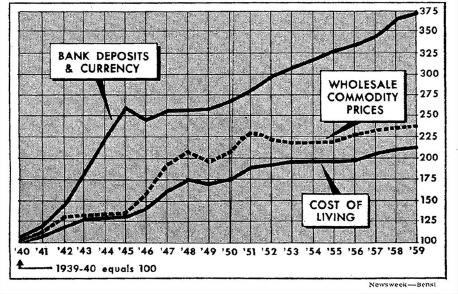
In this space nearly ten years ago (Newsweek, Sept. 17, 1951) I ran a chart comparing the increase in the cost of living, in wholesale commodity prices, and in the amount of bank deposits and currency, from the end of 1939 to the middle of 1951. This chart was incidental to pointing out that the rise in living costs and prices was the result of the increase in the supply of money and credit, and not of a “shortage of goods” or a so-called “cost push.”
We are now in a position to compare the same three items over a full twenty years, from the end of 1939 to the end of 1959. The accompanying chart gives us a panoramic view of the inflation during that period. It shows that, while consumer prices increased 113 percent between the end of 1939 and 1959, wholesale prices increased 136 percent in the same period and the total supply of bank deposits and currency increased 270 percent.
If we are to adopt the proper measures, the only effective measures, to halt inflation and prevent its resumption, we must clearly recognize that its basic cause is the increase in the supply of money.
Two rival theories still persist. One is that inflation and rising prices are caused by a “shortage of goods.” The figures refute this on their face. The official index of industrial production was 177 percent higher in 1959 than in 1939; in other words, the rate of production of goods was almost three times as great. It was in spite of this enormous increase in productivity that wholesale prices increased 136 percent—i.e., more than doubled—during the period. In other words, the increase in the money supply would have caused an even greater rise in prices if it had not been offset by an increase in the supply of goods. While the production of goods almost tripled, the supply of money and bank credit almost quadrupled.
MONEY VS. ‘COST PUSH’
The other rival theory is that inflation and the rise of prices are caused by higher wage demands—by a “cost push.” But this theory reverses cause and effect. “Costs” are prices. An increase in wages above marginal productivity, if it were not preceded, accompanied, or quickly followed by an increase in the supply of money, would not cause inflation; it would merely cause unemployment. It is not true, as so often assumed, that a wage increase in a given firm or industry can be simply “added on to the price.” Without an increased money supply, prices cannot be raised without reducing demand and sales, and hence production and employment. We can stop the “cost push” if we halt the increase in the money supply and repeal the labor laws that confer irresponsible private powers on union leaders.
May 9, 1960
Ever since the advent of the New Deal, socialist assumptions have tended increasingly to supplant capitalist assumptions in our thinking. Nowhere has this change been quite as marked as in foreign economic policy.
The whole foreign-aid program, outside of purely military aid, rests on socialistic assumptions. The quickest and healthiest way to economic growth, which will tend to supply soonest the goods that consumers most need, is the way of free enterprise. The first duty of the government of an undeveloped country (as of a rich and “developed” one) is to make its country as attractive for private investment, domestic or foreign, as it possibly can.
This means that it must assure a sound and stable currency to protect savers against inflation. It must restrict itself to prudent spending, to remove any need for burdensome taxation. It must not discriminate against foreign investors or harass its own businessmen. It must refrain from price-fixing, wage-fixing, and exchange controls, so that foreign investors are free to convert or withdraw their earnings at all times. Above all, it must not socialize or expropriate industry or property or threaten to do so. It must respect property rights at all times.
UNATTRACTIVE FIELD
In the main we followed such policies in our own early history and attracted British capital that greatly increased our rate of expansion. Canada in the main follows such policies today and has attracted billions of U.S. private investment. The great majority of “underdeveloped” countries today fail to follow anything like such policies. That is why they are so unattractive a field for private capital, foreign or domestic.
Foreign aid does not cure this situation. It aggravates and prolongs it. As long as foreign governments can get the capital they want from our government without adopting any of the policies or giving any of the assurances that private capital would properly insist on, they will not adopt these policies or give these assurances. So long as we do not insist on these policies (and are even afraid to do so for fear of “dictating” or “attaching strings”) our aid subsidizes and prolongs socialism and retards real economic growth.
Today we are actually making state “planning” or socialism a condition for the receipt of our foreign aid. Six weeks ago I called attention to the remarkable endorsement by President Eisenhower of socialized planning for Nationalist China and Latin America. On April 20 Secretary of State Herter went even further, and declared that the problem of land distribution should have the “urgent attention” of the Organization of American States.
‘LAND REFORM’
Now the Secretary should know that in the last twenty years so-called “land reform” in a score of nations has been commonly an accompaniment of socialization or communization. In most cases it has been a euphemism for expropriation, a fancy name for seizure. A typical procedure has been for the state to take over properties at a fraction of their market value and to pay even this sum in government bonds that would sell for only a fraction of their nominal value. What foreign countries do about their land problem is none of our business except when they expropriate American holdings. Then it is our plain duty to protect the lives and property of our citizens abroad. The Secretary’s statement may indicate why our protests against Castro’s seizures have been so feeble and perfunctory.
Another recent declaration of the State Department was revelatory. It declared that the picketing of the Egyptian ship Cleopatra by seamen in New York was “embarrassing” the conduct of United States foreign relations, but added that it recognized “the special status afforded to labor union picketing in labor disputes.” This “special status,” unfortunately, does exist under the Norris-La Guardia Act. Under the pretense of protecting “free speech,” this makes union members a privileged class, with the right to picket in mass, to intimidate and menace, to block entrance and exit—in short, to use private coercion. It is certainly “embarrassing”—and unconvincing—for our government to explain that it has stripped itself of the power to prevent this.
May 16, 1960
Last summer (Newsweek, July 27,1959) my colleague Raymond Moley wrote a column called “Inflation, a Moral Issue.” This ought to be the leading issue in the election.
Inflation never affects everybody simultaneously and equally. It begins at a specific point, with a specific group. When the government puts more money into circulation, it may do so by paying defense contractors, or by increasing subsidies to farmers or social-security benefits to special groups. The incomes of those who receive this money go up first. They begin to buy at the old prices. But their additional buying forces up prices. Those whose money incomes have not been raised are forced to pay higher prices than before; the purchasing power of their incomes has been reduced. Eventually, through the play of economic forces, their own money- incomes may be increased. But if these incomes are increased either less or later than the average prices of what they buy, they never fully make up the loss they suffered from the inflation.
Inflation, in brief, essentially involves a redistribution of real incomes. Those who benefit by it do so, and must do so, at the expense of others. The total losses through inflation offset the total gains. This creates class or group divisions. The victims of inflation resent the profiteers from inflation. Even the moderate gainers from inflation envy the bigger gainers. There is general recognition that the new distribution of income and wealth that goes on during an inflation is not the result of merit, effort, or productiveness but of luck, speculation, or political favoritism. It was in the tremendous German inflation of 1923 that the seeds of Nazism were sown.
SPECULATION VS. WORK
An inflation tends to demoralize those who gain by it as well as those who lose by it. They become used to “unearned increment.” They want to hold on to their relative gains. Those who have made money from speculation prefer to continue this way of making money to the former method of working for it. I remember once, early in 1929, a conversation between two friends, both of whom held prominent posts as book reviewers but both of whom were heavily in the stock market. They were exchanging stories about their profits. “Today your salary,” they agreed, “is just a tip.” People do not like to work full time just for a tip. The trend in an inflation is toward less work and production, more speculation and gambling.
The profiteers from inflation tend to spend freely, frivolously, and ostentatiously. This increases popular resentment. The incentive for ordinary saving, in the form of savings bank accounts, insurance, bonds, or other fixed-income obligations, tends to disappear. The spectacle of quick and easy returns increases temptation to corruption and crime.
‘A JUGGLING TRICK’
It is not merely that inflation breeds the gambling spirit and corruption and dishonesty in a nation. Inflation is itself an immoral act on the part of government. When modern governments inflate by increasing the paper money supply, directly or indirectly, they do in principle what kings once did when they clipped the coins. Diluting the money supply with paper is the moral equivalent of diluting the milk supply with water. For notwithstanding all the pious pretenses of governments that inflation is some evil visitation from without, inflation is practically always the result of deliberate governmental policy.
This was recognized in 1776 by Adam Smith in The Wealth of Nations. Though I have quoted the passage before, it bears repeating: “When national debts have once been accumulated to a certain degree, there is scarce, I believe, a single instance of their having been fairly and completely paid.” There is either “an avowed bankruptcy” or “a pretended payment.”
The pretended payment was inflation. The U.S. Government today is paying off in 47-cent dollars the debts it contracted in 1940. Adam Smith went on: “The honor of a state is surely very poorly provided for, when, in order to cover the disgrace of a real bankruptcy, it has recourse to a juggling trick of this kind, so easily seen through, and at the same time so extremely pernicious.”
May 23, 1960
More and more cynically, as the years go on, the social-security program is used as a political football. It is assumed that the votes of our older citizens are for sale to the highest bidder. Democrats suddenly push the Forand bill, openly for votes. The Administration, in panic, hastily slaps together a “substitute.”
I discussed the Forand bill in this place in Newsweek of April 25. In the same issue there was a special report of three pages on the measure. The report showed that a husband who began paying at the start of collections in 1937, when he was 42, and who retires this year at 65, has paid $1,100 in “premiums” but stands to get back an average of $30,000. Actuaries have figured that a maximum payment from 1937 to the end of 1959—$l,146—would actually finance a pension for a male at age 65 of about $7 a month.
Yet the 10 million people who are getting present windfall payments are treated as if they had somehow been victimized. Though a token increase in taxes would be placed by the Forand bill on people still working, those already receiving old-age pensions, who have not made even nominal contributions for medical care, would be entitled to receive medical benefits immediately.
DISGUISED RELIEF
The Administration bill was thrown together in haste. It is called “insurance,” but it is mere additional relief. Its benefits would be available free to elderly persons already on relief. Other elderly persons could get them, on payment of an annual fee of $24 each, provided their income did not exceed $2,500 a year for a single person or $3,800 for a married couple. The limitation imposed on the income of persons eligible shows that the Federal government has not the slightest belief that $24 would pay for earned insurance. That sum merely entitles the holder (because of his low income) to medical relief. The scheme would probably cost far more than the estimated $1.3 billion a year.
The best thing that could happen in this session of Congress would be for the various Democratic and Republican bills to kill each other off.
Then there would at least be opportunity for some new Advisory Council on Social Security (like that of 1937) to study the issue of medical care for the aged and to re-examine the whole social-security program.
The original social-security legislation was economically unsound. In spite of this, it has been “liberalized” substantially, apart from earlier expansions, in every election year—1950, 1952, 1954, 1956, and 1958. Not only are the benefit payments constantly raised, but new “needs” are constantly being discovered and provided for—first benefits for old age then for dependents, then for survivors, then for disablement, and now for medical care.
PSEUDO ‘INSURANCE’
Old-age “insurance” was originally enacted on the argument that it would do away with old-age relief. Yet Federal grants for old-age relief alone have grown from $247 million in 1939 to $1,880,000,000 in 1959. W. Rulon Williamson, the first actuary of social security, has pointed out that the benefits paid out under OASI in 1959 were ten times the benefits of 1950 and 10,000 times the benefits of 1937, the first year. Yet the total tax income has only reached seventeen times that of the first year.
That tax income is still inadequate. Williamson estimates that the unfunded accrued liability of the system may exceed $650 billion. It is neither on a sound actuarial basis nor on a sound basis in relation to need. The benefits to the most affluent are three times as great as those to the minimum qualifier.
Instead of recklessly piling on new benefits, it is time to stop, look, and listen. The social-security system cries out for reexamination. It does not add to the supply of goods and services; it merely operates to redistribute income. In fact it lowers national output by encouraging premature retirement and limiting allowable earnings. It cheats its supposed beneficiaries by forcing inflation and reducing the purchasing power of their pensions.
A leap into “medicare” may be a leap into socialized medicine; and a leap into socialized medicine may be a leap into the Big Brother State.
May 30, 1960
Grave as it is, the present international crisis has compensations. It can teach valuable lessons, if we still have time and wit to learn them.
It was unfortunate that a U-2 was downed 1,200 miles inside Russia. But as a result we now know that these planes have been flying over or deep into Russia for four years, that Russia has not previously had the equipment to detect them and bring them down, and that the piloted bomber is not obsolete. As Hanson Baldwin has put it: “It is safe to conclude that the Soviet air defenses today could not possibly fend off a major assault by SAC.” In short, our striking power is greater and Russian defensive power weaker than had been supposed.
This does not mean that Russia may not still have a substantial lead in long-range missiles. It is still true that our government, and the President, have made practically every diplomatic mistake in the book. It was a mistake to deny that the U-2 was on an espionage mission. It was an even bigger mistake to admit it, particularly after the denial. It was right to stress the need for such reconnaissance, but a mistake to do so without, at the same time, reciting Khrushchev’s open threats to bury us, and the whole appalling record of Soviet espionage. It was a mistake to imply that we would continue espionage flights. It was then a greater mistake to promise to stop them. This record of blundering, denial, confession, reversal, and retreat has done incalculable harm to our moral prestige.
THE ROOT ERROR
But beneath all the errors of the last few weeks has been the root error of our whole policy vis-à-vis Russia over the last fifteen years. From the very beginning, when we agreed to accept a militarily untenable position in Berlin, we have followed toward the Russian despots the same policy of appeasement, concession, acquiescence in insults and humiliation that Britain followed so disastrously toward Hitler.
Pressure to follow this policy has come continuously from the political left. Though Khrushchev, like Stalin, has successively broken every promise and treaty the moment it suited his ends to do so, though he feigned troop withdrawal from Hungary merely to give himself time to bring in more tanks to machine-gun patriots in the streets, we have been urged to negotiate with this monster as if he were a man of good faith, as if his word or his signature were worth something. The slogan of our appeasers has been “relaxation of tensions,” which, as Albert Wohlstetter has pointed out, is hard to distinguish from relaxing one’s guard.
END OF A DREAM
That we are all tense again is, in view of the actual threat we face, not a loss but a gain. We have been saved from a worthless agreement at the summit conference which might have caused us to live in a fool’s paradise while Russia built up for a devastating surprise attack. We should never have agreed to a summit conference. However we may try to disguise the matter, we agreed to that conference under the threat of Khrushchev to kick us out of Berlin. We should simply have told him we were there in accordance with our occupation rights and there was nothing to discuss. We could have told him that if he had any peaceful proposals to make our Ambassador in Moscow had plenipotentiary powers to discuss and convey them. We could have told him that if he wanted to relax tensions he could do so by a few simple deeds or restraints from deeds.
Let us hope that we are through with our summit-conference dreams. Our appeasement has only encouraged Khrushchev to recklessness. Let us at last launch a real propaganda counteroffensive of our own. Let us expose the nonsensical claims of Communist “economic growth” instead of swallowing them whole. Let us have the courage to defend capitalism, to explain the superiority of economic freedom. Instead of trying to call off the cold war, which we can’t, let us recognize at last that it is being relentlessly fought against us, by an enemy determined on world conquest; and that our only hope of peace and security is to accept the ideological challenge and to seek not a truce but a victory.
June 6, 1960
Our national debt is $289 billion. If there were any serious thought of ever paying this off, even in dollars of today’s buying power, it would present an appalling problem. If we could pay off an average of $2 billion every year, without interruption, and never incur another cent of debt, it would still take nearly a century and a half to wipe the slate clean.
Precisely because there is always danger of another war, it is merely common prudence and common sense to reduce the debt in time of peace or even cold war so that our national credit will be strong enough to meet the incalculable borrowing demands of a shooting war. Yet instead of reducing the debt in the fifteen years since the end of World War II, we have increased it, through deficits, by an average of $2 billion a year, so that it now stands $30 billion higher. And whenever the President talks of balancing the budget, not to speak of reducing the debt, he is accused of putting dollars and mere bookkeeping ahead of national needs.
HEAVY EVEN FOR US
Why is the debt problem treated so lightly? Probably the most frequent argument is that we are the richest country in the world, and can afford it. But the debt of the United States is one of the heaviest in the world even in proportion to our total wealth and resources.
I append below a table comparing the public debt of fifteen leading countries with the latest available figure of their annual tax revenues. The figures for the U.S. are for the current fiscal year. The figures for other countries are from the Statistical Yearbook of the United Nations for 1959. A few are for the 1959 fiscal year, and others earlier. The comparisons are in billions of the respective currencies of each country, except for France, Italy, and Finland, where they are in trillions. The figures in terms of currencies are therefore not comparable as between countries. What is significant and comparable is the percentage of each country’s debt to its own annual income from taxes. This I have calculated in the final column.
It will be seen that the U.S. public debt is not only by far the greatest in absolute terms but one of the heaviest even in relation to revenues.
It should not be assumed that the countries with the heaviest relative national debts are more blameworthy than others. The debts of the three great English-speaking countries are relatively highest not only because they were engaged in a great world war but because they have not reduced their relative debts to the same extent as some others by the swindling device of monetary inflation. But the comparisons do mean that their debt problem is still greater relatively than that of most other countries.
In fact, the relative debt burden of the United States is much greater than these comparisons imply. A year ago Secretary of the Treasury Anderson placed before the Senate Finance Committee a list of the long range commitments and contingent obligations of the Federal government in addition to the direct public debt. This total of contingent obligations alone came to $316 billion, or more than the direct debt itself. As The Morgan Guaranty Survey for May has pointed out, these contingent obligations are “a massive commitment of the public credit.” And in addition even to these $316 billion contingent obligations, our social-security program already involves a future actuarial liability running into hundreds of billions.
DEBT VS. REVENUES
Nation |
Public Debt |
Government Revenue |
% of Debt to Revenue |
| United Kingdom (£) | 27.5 | 5.6 | 490 |
| Canada($) | 20.2 | 4.6 | 438 |
| United States ($) | 288.6 | 78.6 | 367 |
| Spain (pesetas) | 113.4 | 37.2 | 305 |
| Philippines (pesos) | 1.9 | 1.0 | 190 |
| Turkey (lire) | 7.4 | 4.0 | 188 |
| France (fr.) | 7.0 | 4.2 | 169 |
| Switzerland (fr.) | 4.7 | 2.8 | 168 |
| Portugal (escudos) | 11.7 | 7.1 | 164 |
| Italy (lire) | 5.1 | 3.1 | 162 |
| Denmark (kr.) | 9.0 | 5.7 | 158 |
| Sweden (kr.) | 18.4 | 12.7 | 144 |
| Norway (kr.) | 8.3 | 5.8 | 143 |
| Germany (marks) | 22.2 | 31.6 | 70 |
| Finland (markkaa) | .17 | .29 | 59 |
To add lightly to this liability now, by hastily passing a “medical care” bill for the aged, would be an act of reckless folly.
June 13, 1960
Politicians are very generous in “doing something for our senior citizens,” but none tells us at whose expense. The only merit of the Forand bill is that it emphasizes how flagrantly “social security” has been turned into a political football. The benefits have been increased in every election year—1950, 1952, 1954, 1956, and 1958. Even in the nonelection year 1959, 173 bills were offered in Congress to liberalize old-age benefits; so far this year 79 more have been introduced.
This political exploitation has been made possible largely by the semantic device of calling the old- age pensions “insurance,” which has been correctly described as “a stroke of promotional genius.” The term was made plausible by levying nominal “contributory” taxes. As Franklin D. Roosevelt once put it: “We put those payroll contributions there so as to give the contributors a legal, moral, and political right to collect their pensions and their unemployment benefits. With those taxes in there, no damn politician can ever scrap my social-security program.”
‘THEY PAID FOR IT’
The result today is that the overwhelming majority of commentators in the press, even conservatives, believe that the present recipients of old-age pensions under the OASI scheme have “paid for” the “insurance” they are getting, and consider it an outrage that a man should have to retire from gainful employment at 65 in order to be eligible for his pension. “It is unjust,” according to one recent (and relatively moderate) editorial in a prominent newspaper, “to force them into unwelcome idleness on pain of losing the insurance income bought with deductions from their paychecks and the contributions of their employers.” A less restrained columnist has written: “This imbecilic penalty on grit and gumption bedded in the social-security law screams for redress.”
Now this is a clumsy provision. It does encourage economic waste and premature idleness. But with the present scale of pensions, some restriction like this is unavoidable to prevent the system from going broke or proving ruinous. Ray M. Peterson, associate actuary of the Equitable Life Assurance Society, has pointed out that to remove the limitation on earnings of eligible pensioners would increase outlays immediately by $2 billion a year and would require additional taxes of 1 percent of covered payrolls.
He calculates that for the vast majority of married couples who entered the system initially or became eligible later by amendments, the value of the benefits they now get, measured actuarially, is $10,000 to $22,000 greater than the value of the combined employee- employer social-security taxes paid. This difference is pure gift. Moreover, so far from its being related to need, the higher the recipient’s previous earnings, the greater the subsidy he gets!
TIME FOR REAPPRAISAL
As one actuary puts it privately: “Sometimes I think it would be a brilliant educational stroke to shame these advocates of the elimination of the work test by allowing them to get the amount of pension their taxes have financed and let them earn all they can between age 65 and 72, because that pension would really be about $5 a month. Then maybe some of the high-income groups and journalists would quit yelling about eliminating the work test, one of the few features that keeps the Social Security Act from exploding in our face.”
The Social Security Act cries for re-examination. It adds nothing to our national output of goods and services; it is merely a device for redistributing income. It gives heavy benefits to the present aged and loads the cost onto the present young. As Peterson declares: “There is probably no other legislative enactment that commits future generations to greater obligations than our Social Security Act.” Even the official actuaries of the system place its “unfunded liabilities” at some $350 billion. A former actuary, W. Rulon Williamson, places them in excess of $650 billion. The system promotes inflation. Its long-run tendency must be to discourage voluntary saving and self-provision and to increase dependency on government.
The minimum immediate need is to appoint a new advisory council to study the subject in every aspect.
June 20, 1960
The reduction of the discount rate by the Federal Reserve Banks (of the twelve banks only Atlanta and Boston have yet to act) from 4 percent to 3½ percent, following the action of the Open Market Committee in easing money by supplying additional reserves to the commercial bank system, is a step of dubious wisdom.
It was not taken to combat a serious recession. The day before the action was announced, the First National City Bank of New York, in its June letter, had pointed out that: “Lagging industrial activity has not prevented the nation from enjoying record overall levels of employment and income. Industry is going ahead with plans for enlarged plant and equipment expenditures. Construction activity is expanding seasonally. Retail trade, which picked up strongly with the arrival of spring, has been sustained at the higher level.” True, steel-mill operations have been low, but special conditions like this are not to be cured by cheaper money.
On the same day that the Federal Reserve lowering of discount rates was announced, the Federal Bank of West Germany made the opposite decision. It raised its discount rate from 4 to 5 percent, to combat inflation.
GOLD PROBLEM REMAINS
This emphasized the international problems raised by our own action. Our gold problem remains serious. Against our gold holdings of $19.4 billion, short-term liabilities to foreigners reported by American banks come to $19.6 billion. The deficit in our balance of payments, which reached $3.7 billion last year, is still running at an annual rate of some $2.5 billion.
The chief cause of the deficit in our balance of payments is domestic inflation, and consequent diminution of confidence in the dollar. This makes it imperative not only that we halt inflation, but that we follow policies calculated to assure both foreigners and our own citizens that it will stay halted. Yet even apart from the latest Federal Reserve action, we have been mainly doing the reverse. Railroad workers have been officially awarded pattern-setting inflationary wage increases. The Administration is pressing for a bigger foreign-aid program—though foreign aid, both directly and indirectly, tends to increase the deficit in our balance of payments. Higher defense expenditures may be unavoidable; but a Democratic Congress, with an eye on the campaign, is pushing increased “welfare” expenditures—more housing and school subsidies, aid to “distressed areas,” old-age medical-care programs.
THE INTEREST CEILING
One of the most disturbing developments has been the persistent refusal of Congress to remove the 42-year-old legal interest rate ceiling of 4¼ percent on bonds running for five years or more. Contrary to the professed aim of those who insist on keeping the ceiling, it actually increases the interest charges that the Federal government must pay. It prevents the Treasury experts from floating long term bonds when the going rate of interest is more than 4¼ percent, and forces them to glut the market for short-term securities. More serious excessive issue of short-term securities, taken by the banks, tends to increase the supply of money and credit and hence is directly inflationary.
Under policies long followed by the Fed, the main importance of the discount rate has been that of a signal. The lower rate was a deliberate signal that money was going to be made cheaper. The stock market immediately took the hint. In view of our balance of payments, the wisdom of that signal may be questioned. Banks, moreover, should pay a penalty rate for borrowing from the Federal Reserve—i.e., they should be obliged to pay more for reborrowing than they charge their own best customers. This sound rule has been ignored.
And Federal Reserve discretion has proved sadly wrong in the recent past. The Fed has yielded too easily to inflationary political pressures. It was not wise to have a discount rate of only ½ of 1 percent from 1942 to 1946; to keep the rate at 2 percent or less for the next nine years; to cut it from 3½ to as low as 1¾ percent in 1957 and 1958. We cannot indefinitely leave monetary control to bureaucratic discretion or whim. Ultimately we must return to the discipline of the full gold standard.
June 27, 1960
In Newsweek of Feb. 22, I discussed the Galbraith-Lippmann-Dale thesis that though “private affluence grows . . . there is poverty in the public sector of the economy”; that people really don’t need all the money they bother to earn, that they spend it foolishly, and that therefore still more of it should be seized from them in taxes to be spent wisely by the politicians.
Now the First National City Bank of New York, in its June letter, looks for the statistical evidence on which this thesis rests. It finds it hard to come by. In the past generation (since 1927) the cash intake of the Federal government has multiplied twenty times, though disposable personal income (what people have left after taxes) has multiplied only four times. The Federal government today enjoys a bigger cash income than any other government on earth—a cool $100 billion a year. Whereas Federal, state and local governments together were spending less than 11 percent of our gross national product in the mid-1920s, and less than 21 percent in 1940, they were spending 31 percent in the mid-1950s.
TAILFIN VS. WHEAT BIN
The bank presents a table of government revenues and expenditures in the mid-1920s, 1940, and the late 1950s. I append comparisons of some of the leading items for the late 1950s and 1940 alone. The comparisons emphasize the absurdity of the charge that we are “starving” health or hospitals or education or social security. No country approaches our spending on education. Total public and private expenditures for education in the U.S. reached $22 billion in 1959, almost triple their level in 1949.
“The preachers of the affluent society doctrine,” says the bank, “are fond of using tailfins on automobiles as the ultimate symbol of unnecessary private extravagance. They are not so apt to mention the wheat bins holding surplus grain for which taxpayers have put up more than $3 billion. . . . They say nothing about misconceived public-works products and the common abuses of social-welfare programs. . . .”
Despite the unparalleled extravagance of our Federal and local governments, it may be true that we sometimes spend too little for public purposes in some directions. More small parks and plazas in our cities, for example, as in the cities of Europe and Latin America, would not only make our cities pleasanter places to live in but would probably pay for themselves in higher property values. But it is precisely here that our government expenditures are comparatively modest and have increased least. Perhaps the answer is that a park is not a handout to any specific person or group. It is, bluntly, not a good vote-buying device, like farm subsidies or old-age benefits.
PEOPLE UNFIT TO SPEND
The Galbraith thesis may be reduced to this: That people are individually unfit to spend the money they themselves have earned, but somehow able to choose wisely the officeholders who will seize the money and spend it for them. This doctrine would deprive us, on the ground of our incompetence, of the freedom to spend our own incomes as we see fit. It assumes that people will continue to work to earn the same amounts or more, no matter how much their freedom to keep or spend their earnings is curtailed. It assumes that corporate income taxes of 52 percent, and personal income taxes rising to 91 percent, are not onerous enough, and that socialized spending will not in the least discourage individual earning and production.
The Galbraithians have belatedly discovered that free enterprise produces unparalleled affluence, but they still haven’t found out why.
GOVERNMENT EXPENDITURES AND GNP
1940 (in billions) |
Late 1950s |
|
| Federal | $ 9.6 | $ 94.8 |
| State and local governments | 10.3 | 48.8 |
| GNP | 95.6 | 463.8 |
SELECTED PUBLIC EXPENDITURES
(in millions) |
||
| Social insurance benefits | $1,215 | $15,975 |
| Highway expenditures | 2,177 | 8,702 |
| Public welfare and assistance | 1,314 | 3,777 |
| Police | 386 | 1,769 |
| Sanitation | 207 | 1,505 |
| Local parks and recreation | 162 | 685 |
| Hospitals | 537 | 3,849 |
| Education | 2,827 | 16,836 |
July 4, 1960
On Nov. 8 a new President will be elected; but he will not take office until Jan. 20. In this period of ten weeks, President Eisenhower, under the Twentieth Amendment to the Constitution (adopted in 1933) and the Presidential succession act of 1947, will retain the office and legal powers of the Presidency but will lose much of its authority and prestige.
This interregnum, which once lasted four months and still lasts two and a half, has always been potentially dangerous. On several occasions it has done incalculable harm. It was in the four months between the election and inauguration of Lincoln that seven states seceded from the Union and set up the Confederacy. In the interregnum after Franklin D. Roosevelt defeated Herbert Hoover in 1932 business confidence deteriorated rapidly; insolvencies, bank closings, and unemployment mounted. Roosevelt still lacked power to act; Hoover then lacked the public support to lead.
The problem was posed also in 1916. “Again and again,” wrote President Wilson to Secretary Lansing in that year, “the question has arisen in my mind, what would it be my duty to do were Mr. Hughes to be elected? Four months would elapse before he could take charge of the affairs of the government, and during those four months I would be without such moral backing from the nation as would be necessary to steady and control our relations with other governments. . . . Such a situation would be fraught with the gravest dangers.”
WILSON’S SOLUTION
It would be his duty, he concluded, “to relieve the country of the perils of such a situation at once,” and if he could gain the consent of the persons involved, to “join the Vice President in resigning and thus open to Mr. Hughes the immediate succession to the Presidency. . . . The whole country has long perceived, without knowing how to remedy, the extreme disadvantage of having to live for four months after an election under a party whose guidance has been rejected at the polls.”
Though the interregnum period has been shortened by the Twentieth Amendment, it has not been eliminated. The succession act of 1947 prevents the solution proposed by Wilson in 1916. Yet the dangers of that period have been incalculably increased both by the potentialities of nuclear-missile blackmail and warfare and by the propensity of the Communists—Russian, Chinese, Cuban, or what not—to exploit any interval of weakness, uncertainty, or indecision.
There is still time, in the remaining days of the present session, for Congress to eliminate these needless risks and dangers. No further tampering with the Constitution is necessary. All that is needed is the appropriate changes in the Presidential succession law. Congress could simply add a provision permitting an outgoing President to resign in favor of the President-elect.
NONPARTISAN REFORM
It need hardly be added that such a revised law should impose no economic penalties on resignation. It should provide that the salary of any President who resigned for this purpose would be continued until Jan. 20, just as if he had remained in office. The new law should also, preferably, give the Vice President and each outgoing congressman or senator the same right of immediate resignation in favor of his elected successor, under similar salary provisions.
There would be nothing obligatory about such resignations. But once legal provision were made for them, and the precedent set, both outgoing congressmen and outgoing Presidents would probably be eager to take advantage of it. Nobody likes the label or the status of a lame duck.
I made a similar proposal in Newsweek of Nov. 17 and Dec. 1, 1952, following the election of Mr. Eisenhower. But proposals of this sort are too often judged by the way in which they will immediately affect specific persons. These few weeks before the nominations, and when nobody is sure whether our next President will be a Republican or a Democrat, would seem to be an ideal time for Congress to make this reform. Patriotic men of both parties could agree to it on a completely impersonal and nonpartisan basis.
July 11, 1960
We ended the fiscal year 1960 with a national debt of $286 billion. In addition to this direct and avowed debt, our government has contingent obligations of some $316 billion, not including unfunded social-security liabilities of $350 billion or perhaps $650 billion, depending on the assumptions on which they are calculated. Our national debt, including contingent liabilities, is not only the highest in the world in absolute amount but the highest in relation to annual government revenues.
What would we think of the prudence of a man with a yearly income of $7,900 who owed $29,000 and had endorsed, in addition, IOU’s of relatives totaling $31,600 or even $76,000 more? Multiply these figures by 10 million and you get the position of our government.
It has long been fashionable to say that the maxims of fiscal conduct that apply to an individual do not apply to a nation. One facile argument, brought forward in the early days of the New Deal, is that the size of the national debt does not matter because “we owe it to ourselves.” Though this argument was put forward as a new discovery, it was really very ancient. In 1740, a generation even before the publication of Adam Smith’s Wealth of Nations, Smith’s countryman, the philosopher David Hume, in a remarkable essay, “Of Public Credit,” dealt with it specifically:
“We have indeed been told that the public is no weaker upon account of its debts, since they are mostly due among ourselves and bring as much property to one as they take from another. It is like transferring money from the right hand to the left; which leaves the person neither richer nor poorer than before. Such loose reasoning and specious comparisons will always pass where we judge not upon principles.”
DESTRUCTIVE TAXES
Hume went on to point out that the people who pay the taxes are not necessarily the same as those who receive the interest, and certainly never in the same proportion. Taxes always fall upon the most productive people in the community. “If all our present taxes be mortgaged, must we not invent new ones? And may not this matter be carried to a length that is ruinous and destructive?”
This was not the only “modern” fallacy that Hume answered. It was only last August that Britain’s official Radcliffe report announced that a big public debt “gives strength” to a nation. Yet more than two centuries ago Hume was writing: “What, then, shall we say to the new paradox, that public incumbrances are of themselves advantageous, independent of the necessity of contracting them; and that any state, even though it were not pressed by a foreign enemy, could not possibly have embraced a wiser expedient for promoting commerce and riches, than to create funds and debts and taxes without limitation? Reasonings such as these might naturally have passed for trials of wit among rhetoricians, like the panegyrics on folly and a fever, on Busiris and Nero, had we not seen such absurd maxims patronized by great ministers, and by a whole party among us.”
A CAUSE OF INFLATION
Hume proceeded to point out not only that interest payments on the debt must raise taxes, but that “public securities are with us become a kind of money . . . a kind of paper credit,” with “all the disadvantages attending that species of money.” In brief, he saw that debt led to inflation.
And Hume also recognized clearly that the persistent political pressures were all on the side of incurring debt rather than repaying it. “It is very tempting to a minister to employ such an expedient as enables him to make a great figure during his administration, without overburdening the people with taxes, or exciting any immediate clamors against himself. The practice, therefore, of contracting debt, will almost infallibly be abused in every government. It would scarcely be more imprudent to give a prodigal son a credit in every banker’s shop in London, than to empower a statesman to draw bills, in this manner, upon posterity.”
Hume was not too hopeful regarding the future. “I must confess that there is a strange supineness, from long custom, creeped into all ranks of men, with regard to public debts.”
July 18, 1960
Though the old doctrinaire socialism “public ownership and operation of the means of production” is in disrepute in the Western world, a new brand of socialism is now on sale. It does not insist on the socialization of production but on the socialization of consumption.
The New Socialists—or perhaps they should be called the New Collectivists—are at last willing to admit that capitalism, private enterprise, is incomparably more productive than socialism. But they don’t like what it produces. For under capitalism, it seems, people spend the money they earn in foolish and trivial ways and show dreadful taste. The government, therefore, the bureaucrats, the “public servants,” should step in and seize this money from them by imposing far more drastic taxes than the piddling sums people pay today, and spend the money not on the things that people individually want, but on what they would want if they were competent to know their own interest.
The chief spokesman for this New Collectivism is J. Kenneth Galbraith, but he has been rapidly acquiring disciples, of whom Charles F. Darlington, author of a piece in The New York Times Magazine of Sunday, July 3, seems to be typical. His thesis is stated in his second paragraph: “Nations, like individuals, can make vices of their virtues. Private enterprise is a virtue as a successful method of organizing society for production, but it takes on the color of a vice when, as today in the United States, it is widely regarded as the ideal of society. It is a means to a good society, but we are making it society’s goal.”
MEANS AND ENDS
The title of Darlington’s piece is “Not the Goal, Only the Means.” This is a false antithesis. Many things may be both means and ends. An outstanding example is liberty. Liberty is an indispensable means of accomplishing all our other purposes; but it is also an end in itself. Lord Acton went so far as to say that liberty “is itself the highest political end.”
Now capitalism, or private enterprise, is simply another name for liberty in the economic sphere. It leaves the Individual free to produce what he wants and free to consume what he wants. It allows him to keep the fruits of his labor. It protects him in that right by the institution of private property. Private enterprise is not merely a means; it is not simply a remarkable gadget for production; it is also an end in itself. It is the system of economic liberty. Once economic liberty is abridged or destroyed all other liberty is abridged or destroyed with it. “Power over a man’s subsistence,” said Alexander Hamilton, “is power over his will.” The freedom to spend is only a little less important than the freedom to earn.
FREEDOM REDEFINED
Darlington wishes to deprive the individual of this freedom. To make his argument seem plausible he has to redefine freedom, individualism, private enterprise, and government.”Freedom, above all for a great people, is found in doing what is morally right.” Who is to decide what is morally right? Darlington replies that “we” (presumably he and Galbraith) “know what is right. . . . We know that it is right for the rich to succor the poor . . . at home and abroad.” And this can be interpreted to mean that the industrious and efficient must be drastically taxed to compel them to support the shiftless and inefficient at home and socialist experiments abroad.
The “mainspring” of private enterprise is “self-interest, which is highly useful in getting things done, but self-interest idealized approaches selfishness.” Here is another basic confusion. Private enterprise does leave people free to pursue their own purposes. But are these necessarily selfish purposes? Is a man who works to support a large family and send his children to college acting selfishly? Are people selfish just because they are free? And if we compel them, through the government apparatus of coercion, to support the purposes of the politicians in power, does this make them unselfish?
The essence of collectivism is to belittle the purposes of the individual in favor of those of some mystic collectivity. The “national purpose” is no different from the purposes of the individuals who compose the nation.
July 25, 1960
So far as immediate policy is concerned, Congress was justified in granting and the President in using discretionary power to slash the Cuban sugar quota. The President, in fact, should have asked and Congress should have granted even wider discretionary powers many months ago, when Castro first started seizing American property and vilifying us.
As it is, our timidity, our declared fear of doing anything to injure “the Cuban people,” our failure even to stop subsidizing the Cuban economy, led Castro to conclude that he could go further and further with impunity. Our action came only after 2,380,000 of Cuba’s 3,120,000 quota of short tons for 1960 had already been certified for entry. The President had to cut 95 percent, or all but 40,000 tons of the 740,000 ton remainder. By that time Castro had burnt too many bridges behind him. Face-saving forced him to go further.
It is gratifying that when the President did act he acted firmly, and refused to allow himself to be bluffed by the Khrushchev threats. It is the duty of every nation to protect the lives, persons, and property of its citizens abroad. We should take whatever economic or diplomatic countermeasures our own interests require.
EXORBITANT COST
It is disheartening, however, to find that the only way the Administration can think of to protect our rights and to “counter Communism” in Latin America is to plan a still bigger “economic assistance” program there. This is getting to be hard to distinguish from an uneasy payment of tribute. The billions we have already given away globally have failed either to halt Communism or to win us reliable allies.
As for our long-run policy concerning sugar, what is required is not a readjustment of quotas but abolition of the quota system. That system goes back to the depression-inspired Jones-Costigan Act of 1934. The purpose of this legislation has been to “stabilize” the price of sugar and to protect our domestic producers. It has done so at an exorbitant cost.
An import-quota system must be discriminatory as between exporting nations. It breeds resentment in all but the most favored. Ironically, our sugar-quota system was set up especially to favor Cuba which, in addition to being allotted 96 percent of all foreign imports (apart from the special case of the Philippines), was granted a tariff preference and got from us a premium of 2 cents a pound above the world market. Now that we have cut that quota, Castro can plausibly claim that we are discriminating against Cuba.
We pay a heavy price to subsidize a domestic sugar production equal to only about a fourth of our total sugar consumption. In order to make our import-quota system work we also enforce a quota for every individual domestic producer.
TARIFF LESS HARMFUL
I have no wish to advocate tariffs. But if we want to continue to protect our domestic sugar producers, we can do it just as effectively through a higher tariff as through a quota system, without discrimination between foreign countries, with infinitely less red tape, and without authoritarian production controls at home. A uniform tariff would allow foreign countries to sell to us in proportion to their efficiency and costs. It would also allow our domestic producers to compete with each other on the basis of their individual efficiency and costs. Though our consumers would have to pay the duty in the price, most of it would go to the government in revenues, and (unless its total expenditures were increased) come off their taxes somewhere else.
A tariff is at least compatible with the continuance of an otherwise free economy; a quota system is not. Our regimentation of the sugar market has set an evil precedent. Practically everything that is wrong with our import-quota system in sugar is equally wrong with our recent import-quota system in oil. Here again, everything that a quota system accomplishes in holding up the price or holding down supply (assuming either aim to be desirable) could be accomplished much more flexibly and efficiently by a tariff, which would at least permit volume and cost competition within the domestic market.
August 1, 1960
The Democratic platform reads, at times, more like a parody than a serious document. It states mere wishes or problems as if it were stating solutions. It favors “an enduring peace . . . ending nuclear tests under workable safeguards . . . preventing surprise attack.” If you ask how it proposes to achieve these goals, why, it will set up “a national peace agency”!
When it comes to economic policy the platform drops all pretense to consistency or responsibility. It promises to “unshackle” American enterprise apparently by imposing new controls in every direction. We are told that “our economy can and must grow at an average rate of 5 percent annually.” Why stop at 5 percent? Why not 6 percent? Or if we are only talking about “goals” why not 50 percent? The platform framers should recall Shakespeare: “If to do were easy as to know what were good to do, chapels had been churches, and poor men’s cottages princes’ palaces.”
The Democrats “pledge” themselves “to policies that will achieve this goal without inflation.” However, “as the first step in speeding economic growth,” they demand an inflationary cheap-money policy. They would try to offset their own monetary inflation, they strongly imply, by the reimposition of price controls.
‘THE RIGHT TO A JOB’
The platform presents an “economic bill of rights.” This includes the “right” not only to a job but to a “remunerative” job. Nothing whatever is said about the diligence or qualifications of the worker, or about who is to be forced to supply the job, if it doesn’t exist. A new WPA?
“Full employment,” which has become a synonym for a policy of inflation, is made “a paramount objective.” “The right to a job,” we are told, “requires the restoration of full support for collective bargaining.” But it does not require state right-to-work laws. These are to be forbidden.
“Every farmer” (Why just the farmer? Why not everybody in every line?) is guaranteed “the right . . . to raise and sell his products at a return which will give him and his family a decent living.” Nothing is said about the need for his particular crop. Nor are we told who is to be forced to buy his crop at a profit above his cost, however high that happens to be. There is to be “positive action to raise farm income to full parity levels.” As more surpluses pile up in our warehouses they are to be treated “not as a liability but as a national asset.”
Everyone has the “right” not only to a home but to a “decent” home, even to “recreation”; and, of course, “the right to adequate medical care.” For the cities, a new Democratic Administration will help “clear their slums, dispose of their sewage, educate their children, transport suburban commuters . . . and combat juvenile delinquency.” No family or city will need to do anything for itself. As the French economist Bastiat put it more than a century ago: “The state is the great fiction by which everybody tries to live at the expense of everybody.”
ALL SUBSIDIZE ALL
After the Democratic platform pledges new and bigger expenditures in every direction, it declares with bland effrontery that “these needs can be met with a balanced budget, with no increase in present tax rates, and with some surplus for the gradual reduction of our national debt.” However, “if . . . the unfolding demands of the new decade . . . cannot be fulfilled without higher taxes,” the Democrats promise to impose them.
What we have, in sum, is a pledge to impose a total welfare state.
The Democratic Presidential candidate, after ordering and accepting all these sweeping promises of security, with no mention of any return by the individual in effort or obligation, then declared, in baffling contradiction, that he was appealing to the American people’s “pride, not their pocketbook,” and promising “more sacrifice, instead of more security.” More sacrifice just for taxpayers?
But he has yet to reveal the details of his personal platform. So far, its chief plank might be summed up by paraphrasing the Lord Chancellor in “Iolanthe”:
Youth is the sole embodiment
Of everything that’s excellent.
It alone discerns the truth,
And I, my friends, embody Youth.
August 8, 1960
The country can look forward to the forthcoming session of Congress only with profound misgiving. Its temper was foreshadowed by the action of Congress on July 1 in passing over the President’s veto a Federal pay increase of $764 million a year, correctly described by Mr. Eisenhower as “indefensible by any light.” A few routine appropriation bills may need to be passed. But the session was planned mainly to push big-spending or statist measures as part of the Democratic campaign.
There are five of these measures: A school-construction bill, a housing bill, the $1.25 minimum wage, a farm bill, and medical care for the aged. Not one of these is urgent. All would do harm. The school-construction bill would pour Federal funds and spread Federal power into an area which has been and ought to be the sole responsibility of the localities. Socialized housing, invading the field of private enterprise, leads directly toward the total welfare state.
As for the minimum wage, if money wages could be raised by government fiat, without loss of real purchasing power and without causing unemployment, there would be no point in stopping at $1.25 an hour. The higher minimum may raise some persons, hitherto receiving less, to that figure. But it is certain to throw others out of employment altogether unless the purchasing power of the dollar is further diluted.
INVERTED PYRAMID
The proposed farm bill will merely make the farm fiasco worse. It will increase the unmanageable farm surpluses that already cost us more than $1,000 a minute just to store. The medical care proposals are being hastily piled on top of a tremendous inverted pyramid of claims with a contemptuous disregard for ultimate costs or a cynical pretense that a nominal increase in tax contributions will “pay for” them. What the Social Security Act desperately needs, before still more unmeasured obligations are blindly assumed, is reexamination by a new advisory council.
The new session will be supercharged with partisan emotion, and create opportunities for infinite political mischief. The Democratic strategy will be to pass measures offering huge handouts to pressure groups. If these are vetoed by the President, the Republicans will be blamed for their defeat. If the measures become law, the Democrats hope to grab the credit. And in the Republican me-too mood, the prospects of defeating the measures are not bright. The country seems likely to take a further plunge into welfare socialism, big spending, and inflation.
And yet, if either party cared to seize it, the new session also provides an opportunity for responsible statesmanship and constructive achievement. I will mention only two items.
TO AVERT PARALYSIS
The President ought to renew his plea for a removal of the 42-year-old legal interest-rate ceiling of 4 percent on bonds running for five years or more. The effect of this ceiling is to compel excessive issues of short term securities. These are taken by the banks, and force an inflationary increase in the supply of money and credit. Repeal of the ceiling would go far to restore confidence in the dollar at home and abroad.
The other item is an amendment to our Presidential succession law to permit an outgoing President to resign in favor of the President-elect on any date that both might agree to after Election Day and before formal Inauguration Day on Jan. 20. The same right to offer an earlier transfer of office, without salary loss for incumbents, should be extended to outgoing House and Senate members. The mere existence of such a provision might forestall an effort on the part of the Communists—Russian, Chinese, Cuban, Congolese, or what not—to exploit what would otherwise be a two-and-a-half-months’ interval of uncertainty and indecision. In May, let us recall, Khrushchev declared he would not attempt to change the existing situation in Germany or West Berlin until after our elections in November but he did not promise to wait until after Jan. 20. The country cannot afford a period of paralysis in domestic or foreign policy simply because legal provisions for the transfer of power are rigid and inflexible.
August 15, 1960
The details of Nixon’s farm program have not yet been revealed, but his announcement of July 31 did not sound promising. He repudiated Secretary Benson, who has tried to move toward sense and sanity. “We must develop a massive program,” said Nixon, “which is not concerned with budgetary costs year by year.” As the government had put the farmer in his present fix by its wartime policies, “obviously the government must pay the cost of getting him out.”
This “new” farm program may turn out to be a serious political blunder, of which Kennedy has already taken advantage. Nixon cannot repudiate the record of the Eisenhower Administration in a major field. And an airy dismissal of “budgetary costs” would undermine his own main case against this year’s Democratic platform.
In any event the foreshadowed program sounds like a major economic error. What does Nixon mean by a “massive” program? Isn’t a cost to the Federal government of $5.5 billion a year, mainly to pile up unsalable crop surpluses, massive enough to suit any taxpayer? Would more massive payments do anything but pile up more massive surpluses?
The best farm program would be one to end “farm programs.” The major farm problem today is that created by the government itself.
SUPPORTS CAUSE SURPLUS
The constantly repeated contention that present crop surpluses are the result of a “technological revolution” on the farms is untrue. These chronic surpluses have occurred only in the crops under which the government has stuck price supports. The crop surpluses were built up by setting government price floors higher than the prices farmers could obtain in a free market. This caused the farmers to plant more than otherwise or to pour in more fertilizer to get more per acre. The higher prices also cut down the market demand. If support prices were stopped, farmers would raise less and consumers would buy more. Surpluses would cease to pile up.
What about the surpluses that already exist? That problem too could be solved in a single growing season. The government need merely sell back to the farmers themselves the surpluses it acquired from them. Before the new planting season for each crop of which the government holds a surplus, it could offer each grower his prorated share (figured on his previous acreage allotment) at a price set below the expected world market price and below the farmers’ own average cost of production. The government might issue to each farmer transferable certificates entitling the bearer to buy so many pounds of cotton or bushels of wheat at this bargain price. The farmer could then either turn in the certificates with the required amount of cash if he wanted to buy the crop to hold for later resale, or he could sell the certificates themselves in the open market. They would naturally sell at a price equal to the amount by which the free market price exceeded the low purchase price set on government holdings.
OPERATION DISPOSAL
Few farmers, except those with unusually low costs, would be foolish enough to plant more of that crop that year. They would know in advance that it would not pay them. From their sale of certificates they would get on the average a net income equal to what they would have received if they had planted a crop. They would have the choice of allowing their acreage previously planted to that crop to remain idle, or planting it to some other crop in which there were no accumulated surpluses.
As a result, the surpluses would be disposed of. The farmers would be free of regimentation and all acreage control. The government would, it is true, take a bookkeeping loss on stored crops held at its artificial cost prices. But instead of paying out more billions in cash, it would be receiving billions in cash from world consumers from the sale of surpluses.
After that Operation Disposal, the government should get out of the whole price-support fiasco and stay out. The price-support scheme has been a mainstay of the welfare-state sleight of hand which, as Wilhelm Röpke puts it, “robs nearly everybody and pays nearly everybody, so that no one knows in the end whether he has gained or lost in the game.”
August 22, 1960
In the present session of Congress, deliberately planned by the Democratic leaders as a campaign forum, President Eisenhower had a unique opportunity to call upon the members of both parties to rise to the responsibilities that the critical state of affairs abroad and at home lays upon them. The actual message he sent fell short of this, in both its omissions and its recommendations.
The most serious domestic issue today is the preservation of the integrity of the dollar. This requires an end to reckless Federal spending. It requires the tapering off or termination of some of our major spending programs. It requires not merely the passive consent of Congress to monetary discipline on the part of the Federal Reserve authorities, but positive Congressional insistence on such discipline. It requires removal of the interest-rate limitation on long-term Treasury bonds.
Yet the President’s message gave only a single perfunctory sentence to this last need, and nobody seriously expects the present electioneering session to pay the slightest attention to it. On the very day that the President was promising to “resist inflationary pressures by whatever means are available to me,” the Federal Reserve Board announced a reduction of member-bank reserve requirements to provide a potential expansion of lending power of some $3.6 billion. This action to increase the money supply was directly inflationary.
MONEY NOT ‘TIGHT’
The only criticism the Democrats make of the Federal Reserve is that it has been “strangling” the economy with a “tight-money” policy. Yet as the First National City Bank of New York pointed out in its August letter, in an illuminating table covering 60 countries, the current rate for prime commercial loans in this country is among the lowest in the world.
Though the President spoke against “reckless spending schemes,” he came out, on every specific issue, on the side of more spending. This applied to foreign aid, “food for the hungry,” medical aid for the aged, and assistance to depressed areas.
Suppose we test one or two of these programs by the principles of fiscal responsibility or free enterprise. The long-run effect of the ever-expanding program for foreign economic aid must be to slow up national and world economic growth, not to accelerate it. An “underdeveloped” country grows more soundly and rapidly when it seeks to attract foreign and domestic private capital by assuring protection of person and property, permitting withdrawal of earnings at all times, and giving assurances against vexatious restrictions or harassment, burdensome or uncertain taxation, expropriation, and making or keeping its currency inconvertible.
SUBSIDIZED SOCIALISM
But when a foreign country can get loans or gifts from our government without giving such assurances, it will not bother to give them. It will launch instead upon grandiose socialistic projects more calculated to sound good in speeches or to appeal to national vanity than to repay costs. Our “economic” foreign-aid program subsidizes and expands world socialism, and tends to deflect capital from constructive to wasteful use.
In special cases, when hunger follows some calamity outside the control of the country affected, aid from outside is more than justified. But as a regular established giveaway program it is shortsighted. It becomes an excuse to make uneconomic crop surpluses permanent. A country like the United States, which raises only an eighth of the world’s food supply, cannot hope to feed the world. When we dump food on another nation at less than world prices we merely discourage growers in that nation, or in still other nations, from raising the food they are physically and economically capable of raising. Such a program will not in the long run encourage either self-help or a net increase in the world’s food supply.
Apart from a strong military posture, the most important contribution the United States can make to the world’s economic strength and stability is to maintain confidence in the dollar. Yet, broadly speaking, the Republicans are giving only perfunctory attention to that goal, while the Democrats are ignoring it altogether.
August 29, 1960
Between them, the present session of Congress and the Federal Reserve seem to be working toward cheaper money and more inflation.
From time to time I get letters from readers asking how they can protect themselves from the eroding effects of inflation on their savings. It is possible to answer this question in a way that is helpful to a particular individual; it is not possible to answer it in a way helpful to everyone. What is still not widely understood is that inflation can benefit one man only at the expense of another. The price of what you have to sell can go up more or faster than the average price of what you have to buy only if the price of what other people have to sell to you goes up less or slower than the price of what they have to buy from you. Roughly speaking, one-half of the population can gain from inflation only at the expense of the other half. The political appeal of inflation comes from fostering the illusion in the great majority of voters that they will somehow get the better of the swindle, and profit at the expense of a few unidentified victims.
The pressure groups for inflation do vaguely or explicitly understand this. An inflation is initiated or continued in the belief that it will benefit debtors at the expense of creditors, or exporters at the expense of importers, or workers at the expense of employers, or farmers at the expense of city dwellers, or the old at the expense of the young, or this generation at the expense of the next. But what is certain is that everybody cannot get rich at the expense of everybody else. There is no magic in paper money.
HE WHO ACTS FIRST
It is true that an alert individual can do certain things to protect himself from the eroding effects of inflation on the value of his dollars but only if he acts both sooner and more wisely than the majority.
Even this used to be easier than it is today. In the German hyperinflation which culminated in 1923, a German could always buy American dollars, at the current rate in marks, as soon as his monthly, weekly, or daily income above current needs became available to him. But Americans today have no completely safe major foreign currency to turn to. They are prohibited by law from buying and holding gold at home. If they buy gold abroad, they face the risk that our government (following the domestic precedent of 1933) may force them to turn in their holdings at an arbitrary value in paper dollars.
They are left, then, in practice, with the choice of buying real estate, common stocks, cars, TV sets, paintings, Oriental rugs, jewelry—any equity or luxury that is not dollars or a fixed obligation payable in dollars. They are forced, in short, into extravagance and speculation.
MUTUAL FUNDS
An inexpert speculator may, of course, turn to investment trusts or mutual funds which diversify his investment for him and protect him to some extent against his own lack of expert knowledge. But always, the people who buy first, or at lower prices, can profit or protect themselves only at the expense of those who buy later or at the top.
It is impossible, in short, for everybody to protect himself against inflation. The early minority can do so only at the expense of the late-comers. And a scramble to get out of money and into things only intensifies the inflation, only increases and accelerates the rise of prices or the fall of the dollar.
This last result must follow whether individuals try to protect themselves against inflation by individual action or through such group devices as escalator wage clauses or escalator bond clauses. Such schemes accelerate inflation. Neither prices nor wages go up uniformly. Suppose some wages and prices have gone up 100 percent, and other wages and prices not at all. The average increase may be 50 percent. If cost-of-living escalator clauses are prevalent, and the wages or prices that have not gone up are raised 50 percent, the average wage or price level may be raised by that act itself to 75 percent. And so on.
There is only one solution only one sure hedge against inflation that can protect everybody: Don’t have the inflation. If you have it, halt it as soon as possible.
September 5, 1960
“Not inflation, but deflation is the new official worry.”
Such is the explanation now offered in some Washington reports for the action of the Federal Reserve authorities in lowering reserve requirements to add $3.6 billion to the money-and-credit-creating powers of the nation’s banks, in twice reducing the discount rate within three months, and in forcing down the prime lending rate. It is also put forward as the explanation of the increased spending programs in Congress, and pressure for medical care for the aged, higher farm price supports, and a higher minimum wage.
The slump in steel output, in construction, in appliance sales, the squeeze on profit margins, the relatively high levels of inventories and unemployment, are among evidences cited for the “deflation” that is feared.
There is nothing new in this fear. If one looks back over the record of the last twenty years, one finds a steady progress of inflation, with the total supply of bank deposits and currency up 270 percent between 1939 and 1959, and consequently with wholesale prices up 136 percent, and consumer prices up 113 percent, for the same period (see this column May 2).
Yet all during this twenty-year period it may be doubted whether a single week went by without at least somebody in Congress or the press expressing the fear that “deflation” might be just around the corner unless the economy were given a fresh inflationary shot in the arm.
MISUSE OF TERMS
These fears, to the extent that they are real, rest upon a misuse of terms and a confusion of thought. There has never been the slightest danger of “deflation” since 1933 in the true sense of a major contraction in the supply of money and bank deposits. Inflation means an increase in the supply of money and bank credit. The rise of commodity prices and living costs which almost inevitably follows is not the inflation but the consequence of the inflation. But by a still further extension of the two terms, any prosperity is called “inflation” and any recession or unemployment is identified with “deflation.”
This can lead to endless confusion. For, as illustrated in Germany and elsewhere since World War I, a sharp business recession and heavy unemployment can occur in the very midst even of a hyper-inflation.
Inflation works its apparent magic only in the short run, and only as long as final prices are rising faster than wage rates and other costs, so that employment and activity are stimulated by attractive profit margins or prospective profit margins. But if wage rates, taxes, or other costs rise as fast as or faster than selling prices, and start squeezing profit margins or inflicting losses on marginal firms, activity will fall and unemployment rise.
MONETARY MANAGERS
A new hike in minimum wage rates, and an extension of coverage, with 4 million already unemployed, would not be very intelligent. Its tendency would be to increase unemployment among the very groups it is ostensibly designed to help unless, of course, the purchasing power of the higher money wage rates were reduced by another dose of inflation.
What Congress and the Federal Reserve are in effect saying is that no recession is ever to be corrected by individual wage or price adjustments, but only by further doses of inflation to boost the whole price level. In fact, instead of there being any correction of uneconomically high wage rates in a recession, wage rates are to be hiked still higher.
It remains to be seen whether present inflationary policies will have their intended economic and political effects. They will surely do nothing to restore our export markets, to correct our adverse balance of payments, or to increase foreign confidence in the dollar. They are more likely to induce a further drain on gold stocks already slightly exceeded by our short-term liabilities to foreigners.
The recent actions by the Federal Reserve authorities not only seem unwise, they raise once more the whole question of whether monetary managers can be trusted, in the long run, to use wide discretionary powers wisely or whether restoration of a full gold standard, governed by strict and quasi-automatic rules, would not be preferable after all.
September 12, 1960
Import quotas: Our foreign policy becomes more and more incomprehensible. Castro seizes more than $800 million of American property in Cuba, arrests our citizens, engages daily in a calculated hate America campaign, and we dare not break off relations with him. Then we break off relations with Trujillo, who had not seized American property, arrested our citizens, whipped-up a hate American campaign, or invited the Russians in.
We explain that Trujillo is a “dictator” as if Castro were not a far more dangerous one, so far as our interests are concerned, and as if we were not recognizing scores of dictators all over the world, including Khrushchev himself. We continue to recognize Khrushchev though he shoots down our planes and murders our aviators above neutral waters.
No one in the Administration has seemed to consider what the long-run consequences are going to be of our strange sugar policy. Who is to be allowed to send sugar to us, and exactly how much, and whether those who sell to us are to be paid a bounty over the world price, is to be decided by Congressional fiat or the day- to-day whim of the Administration. The U.S. is still committed to pay the Castro government a subsidy of about $96 million a year above the world price for the 2.4 million tons of sugar remaining in the Cuban quota.
The resentment and economic disruption we are going to cause by this discrimination can easily be foreseen. The first step toward economic sanity and freedom would be to abolish entirely the whole sugar import- quota system and to substitute a uniform tariff. This would also allow us to abolish domestic quotas.
Socialist ‘Profit’
“City Transit Nets $5 Million Profit” ran the headline. What a triumph for municipal ownership and operation! At last an answer to the critics of local socialism. For though the New York City subways had tripled their fares since the city took them over, they could not seem to show anything but an operating deficit. The 1958–59 operations, for example, had shown a deficit of $10,184,316.
How has the new miracle happened? Well, the Transit Authority concedes that it did receive a little help. There were subsidies from the city totaling $18,604,499. Without them the city’s transit lines would have shown a deficit in the fiscal year ended June 30 last of $13,391,570. But such a detail ought not to be allowed to obscure the great fact that the Transit Authority’s books did show a “profit” of $5,212,928. Could private enterprise, paying heavy taxes instead of getting them, have done as well?
Why Labor Chaos
If you want to know why we have labor violence, if you want to know why an employer has no way of settling a strike except by giving in to the demands of the union, if you want to know why the government itself is impotent to halt what it calls “cost-push” inflation, you have merely to read the decision of the National Labor Relations Board holding the Kohler Co. guilty of prolonging by unfair labor practices the six-year-old strike by the United Auto Workers Union.
The board admits that the union engaged in illegal “belly-to-back” mass picketing and violence after the walkout began on April 5, 1954. But the board apparently regarded this violence as trivial compared with the unfair labor practice engaged in by Kohler. And what was this unfair labor practice? Why, the company granted a wage increase of 3 cents an hour to nonstrikers “without bargaining with the union.”
So the board ordered Kohler to rehire all the strikers (except 77) who had not been permanently replaced prior to June 1, 1954, the day of the wicked wage increase, provided they applied for reinstatement. The union estimates that this might mean replacing 1,700 to 2,000 of the total 2,500 that the company employs. And the board specifically ordered that this should be done even if it required discharge of the replacements, some of whom have now acquired six years seniority with Kohler.
Whatever “collective bargaining” is now interpreted to mean, it obviously does not mean free bargaining. The employer, or the non-union worker, has no bargaining freedom that any one is bound to respect.
September 19, 1960
It can be hazardous to write in a weekly magazine about a strike that could be settled at any hour of any day. But it seems reasonably safe to predict that the Pennsylvania Railroad strike settlement, when it comes, will be in favor of the strikers and distinctly not in favor of either the railroad or the traveling public. This will happen for the same reason that the 1959 steel strike and the recent Long Island Rail Road strike were settled in favor of the strikers and not in favor of the consumers or commuters. That reason is the existence of a set of Federal labor laws that make it all but impossible to settle a strike except by giving in to the demands of the union.
All during the long steel strike the Administration kept repeating that it was not “interfering” and would not “interfere.” Its protestations were made sincerely. They were accepted at face value by most of the press. Yet both before and during that strike the Federal government was in fact interfering every day through laws laying down one-sided rules of the game that it had enacted over the past 30 years notably the Norris- LaGuardia and Wagner-Taft-Hartley acts.
ONE-SIDED LAWS
These set up a situation in which the employers were forced to negotiate with the strike leaders, no matter how unreasonable the latter’s demands might be, for the simple reason that the law in effect compelled this and forbade the employers to negotiate with anybody else. And the strikers could throw mass picket lines around the steel mills with impunity, and physically prevent anybody else from applying for the jobs that they had voluntarily vacated, while the Norris-LaGuardia Act effectively denied the employers injunctive relief.
True, the railroad labor situation is somewhat different, owing to the fact that Congress (never troubled about consistency) has written and retained a different law for railroad labor than for other labor. Under the Railway Labor Act of 1926, elaborate machinery is set up by which no strike can take place until the President has appointed an emergency board to make strike settlement recommendations.
But the unions have found that they can successfully reject the Presidential board recommendations when these are not wholly to their liking. This happened in 1941 under Mr. Roosevelt and in 1946 under Mr. Truman. It is happening under Mr. Eisenhower in the present strike. Mr. Roosevelt simply reconvened his board and ordered it to try again; so the board dutifully brought in another decision still more in the unions’ favor. Mr. Truman personally granted the strikers more than his board had granted them. The Quill union, which has rejected the recommendations of President Eisenhower’s emergency board, is obviously hoping that something like this will happen now.
FORCED ARBITRATION?
The Pennsylvania Railroad has, unwisely, suggested that the President be given authority to compel binding arbitration in a dispute of this kind. Such a step would lead inevitably to general government wage fixing and price fixing.
The real need is to move in precisely the opposite direction. We need a sober reappraisal of the Federal labor laws of the last 35 years, and of the assumptions on which they are based. We should stop making a fetish of the phrase “collective bargaining.” As interpreted by the unions, and by government boards, it assumes that bargaining must be collective in other words, that it must not be individual. What we need to restore, both to the employer and the individual worker, is freedom of bargaining. This means that an employer should no longer be compelled to negotiate with a specified union, though he may always voluntarily agree to do so. It means that in a strike he should have freedom to hire any replacements willing to accept employment. The role of government should be to prevent violence, coercion, mass picketing, or any other form of intimidation.
The one-sidedness of our labor laws is ironically emphasized by the suit filed by the nationwide Brotherhood of Railroad Trainmen charging the nation’s railroads with “conspiracy” for daring even to set up a common strike insurance fund, and demanding that such protection be outlawed.
September 26, 1960
All through the twenty years of the Roosevelt and Truman Administrations, from 1933 to 1952, Democratic orators both implied and stated that to vote for a Republican President would be to vote for a return to depression, mass unemployment, bank runs, mortgage foreclosures, apple selling, and bread lines. A Republican President was eventually elected, and none of these things happened. On the contrary, our present economic fetish, the gross national product, is now at the highest level on record.
This would be embarrassing for Democratic orators today had not a new slogan, Economic Growth, come to their rescue. Sure, the economy grows; sure, everybody’s income gets higher every year, automatically; you can hardly prevent it. But our economic “rate of growth” just isn’t what it ought to be. The Republicans are holding it down, because they lack vision and are cold-blooded. Elect us to office, and watch things hum!
Anybody who thinks this is a caricature need merely read the full text of Senator Kennedy’s Labor Day speech in Detroit. He was very specific: “With an average rate of growth in this country every workingman in the last eight years would have received $7,000 more than he has received for an education, or a new house, or a rainy day, or his old age. With a really healthy rate of growth this country can have full employment for all who want a job.” How to get this $7,000 and this rate of growth? Simple: “Elect an administration that will do something about it.”
HOW TO RETARD GROWTH
The senator didn’t bother to explain just what this “something” would be. The only specific hint he threw out is that he would halt “this high-interest-rate policy.” But American interest rates today are among the lowest in the world. And the chief effect of the cheap-money policy under the New and Fair Deals was to produce or aggravate an inflation that cut the purchasing power of the dollar in half.
Kennedy never mentioned any policy that really might increase our rate of growth such as less drastic graduated income taxes to give more incentive to production, or sensible tax allowances for depreciation to encourage more new capital investment by corporations. Perhaps the crowning irony of the whole “rate of growth” agitation is that the people who insist most on faster growth demand policies least likely to promote it.
Kennedy’s Labor Day speech was no more convincing in its “facts” than in its theories. Take “Fact No. 1”: “Our economy, under the first six years of the Republican Administration, grew one-half as much as under the last six years of the Truman Administration.”
THAT TRICKY GNP
Why the last six years of the Truman Administration? Why not the first six? In 1944, the year before Mr. Truman came into office in April 1945, the official figure of the gross national product (as measured in “constant” 1959 dollars to eliminate the effects of more price inflation) was $366 billion. In 1945 it fell to $360 billion. In 1946 and 1947 it was down to $316 billion each year. In 1950 it was still only $356 billion.
In other words, in the first six years of the Truman Administration, the GNP actually fell in real terms. In 1952, the year before Mr. Eisenhower took office, the GNP was $399 billion. This rose to $451 billion in 1958, to $482 billion in 1959, and is currently running close to $500 billion.
The trick of Kennedy’s “rate of growth” comparison is that it was measured from the low point to which GNP fell in 1947. The rise to 1952, incidentally, was caused in large part by Korean-war expenditures. In fairness to Mr. Truman, the decline in GNP after 1945 was also largely the result of the decline from Federal World War II expenditures. Consumers were not less well off in 1947 than in 1944; the contrary was true. But all this only shows how artificial and tricky these GNP “rate of growth” comparisons can be.
The broader question raised by Senator Kennedy’s Labor Day speech, and its crude lure of “$7,000 for every working man,” is whether he himself understands the facts as little as his remarks indicate, or whether he merely has a low opinion of the voter’s intelligence.
October 3, 1960
The irresolution of our own spokesmen and officials, in the face of increasingly brazen Communist aggression and insults, has caused a deep uneasiness in the American people. This uneasiness is now reflected even in the trend of business and the security markets. Neither Presidential candidate has come to grips with the issue. Nixon seems to be the prisoner of his position, bound to defend the Eisenhower Administration’s every act or failure to act. Kennedy seems to suffer even more than the Administration from an appeasement ideology, typified by his remark that the President should have “expressed regrets” to Khrushchev for the U-2 flight, and promised not to do it again.
The truth is that the so-called internationalism that not only we but politicians of the whole West have been preaching and practicing for the last fifteen years is a false internationalism. It has put mere organization above principle. It should have been obvious from the beginning that no organization of which the Communist states were members would be allowed on net balance to promote world peace and justice.
TIME TO REEXAMINE
Whether our proper course now with respect to the United Nations is to try to expel the Communist countries from it, or to withdraw ourselves and form a union of non-Communist democracies, or merely to cease to be the U.N. host country, does not come within the purview of this column. But our attitude to the world economic bureaucratic machinery we helped to set up is directly relevant to our economic future. It is time to reexamine our premises.
It is time to ask whether we should continue to pour out billions of aid to subsidize foreign governments and their socialist planning. It is time to ask whether this aid in fact accelerates world economic growth or retards it. It is time to ask whether there is any real need for the International Monetary Fund, or whether this institution has not merely prolonged worldwide inflation and fiscal irresponsibility. By sanctioning arbitrary official valuations of irredeemable paper currency and automatic borrowing rights, and conniving at devaluations of scores of currencies, it has reduced the pressure within each country for monetary discipline, for free and full convertibility, and for making that country credit worthy.
The World Bank is the best of all these postwar official international institutions, but because it is an intergovernmental institution it inevitably subordinates economic to political considerations in its decisions concerning which countries and which projects shall have credit.
FREEDOM ABRIDGED
It is no accident that all the international commodity agreements, whether in wheat or metals or sugar, resort to a complicated set of rigid import or export or production quotas that try to freeze the situation and prevent the natural competitive forces from operating. These agreements clearly cause more economic disruption than they cure.
Finally, such regional institutions as the European Common Market, though they reduce tariff barriers and increase trade among their own members, tend to increase tariff barriers and to disrupt trade with nonmembers. Everything valid that the Common Market or the Free Trade Area seeks to accomplish could be accomplished better if each nation simply reduced its own tariff and restored the most-favored-nation principle.
What the world today calls “internationalism” is really interstatism, intergovernmentalism. It is a set of barriers, compulsions, prohibitions, and controls administered by an international bureaucracy. True economic internationalism is the internationalism that came close to realization before World War I. It is the freedom of individuals in all lands to deal freely with each other, to buy from and sell to each other, to lend to and borrow from each other, to exchange each other’s currencies at whatever rates they can mutually agree upon, and to do all this without having to run to some nationalistic-minded government bureaucrat for a special license for every transaction.
Is it utopian to think that we can begin once more to move toward this international freedom.
October 10, 1960
In his speech before the U.N., President Eisenhower came close to abdicating American responsibility and power and putting our consciences in the hands of other nations. “Only through the United Nations organization and its truly democratic processes,” he declared, “can humanity make real and universal progress toward the goal of peace with justice. . . . The United States stands squarely and unequivocably in support of the United Nations and those acting under its mandate.” This seems to pledge ourselves in advance to support every U.N. decision and action, wise or unwise, moral or immoral.
On Jan. 10, 1957, former Secretary of State Dean Acheson, not commonly regarded as an “isolationist,” observed to Congress, concerning what he even then considered an Administration tendency to pass the buck to the United Nations, that the U.N. is only “a forum. And if a great nation like the United States looks to the United Nations to form American policy, instead of fighting in [and outside?] the United Nations for what the American Government believes should be done, then we have committed an unprecedented abdication of responsibility and power.”
‘A FOOL’S PARADISE’
About a month before that, Viscount Cherwell, a nuclear scientist, declared in the House of Lords: “I hate living in a fool’s paradise, and though, like everyone else, I wish the U.N. could work, I have come reluctantly to the view that in its present form it cannot.” He went on to point out that in the Assembly, “the ultimate governing body of the U.N. . . . 5 percent of the world’s population can carry the day against the other 95 percent; and 10 percent could claim a two-thirds majority. . . . Half the population of the world is represented by four delegates, the other half by 75.” It is “nonsense,” he concluded, for nations to submit their “vital interests to a body so absurdly constituted.”
That the situation has been improved by the additions since that time may be doubted. Among the seventeen new nations just admitted to the U.N. are Cameroon, Niger, Gabon, and Chad. Those four can now outvote the United States, Britain, and France.
We do not need to ask, as a purely hypothetical question, what will come of putting our conscience in the hands of other nations. We already know. Going along with the Organization of American States, we have just broken off diplomatic relations with the Dominican Republic, because it is ruled by a “dictator,” but have not dared to break off relations with either Castro, who daily seizes American property, arrests our citizens, and vilifies us, or with Khrushchev, the butcher of Hungary, who sanctioned, in the President’s words, “the shooting down of American aircraft last July 1 over international waters, the apparent killing of four of its crew members, and the imprisonment of two others on trumped-up spy charges.”
WHY WE LOSE FACE
Because we lack courage even to break off relations with our sworn enemies, and because they are all in the U.N., we are obliged to admit them here, give them police protection, give them use of our own unparalleled communications channels to broadcast their hate campaigns against us, and treat them with all the punctilio that protocol demands. Of course we continue to lose face in the world. Have we also lost our national self-respect? Or are we sleepwalking in some utopian dream, wandering around in a moral fog?
The only solution the Administration can seem to think of for every problem in South America, Asia, Africa, or wherever is to give away more of the American taxpayers’ money in “aid.” Now we are to give it away through the United Nations, at the behest of the Secretary-General. Meanwhile we ignore the heavy deficit in our balance of international payments as a result of our foreign aid, or the renewed outflow of our gold as a result of this and our cheap-money policies. We have forgotten that the greatest service we can perform for world economic stability is to keep ourselves strong, and to keep the American dollar above suspicion. It is a disservice to the free world to allow confidence in the dollar to be undermined.
October 17, 1960
Those who followed the election of 1948 must be struck by the parallel between the campaign conducted by Governor Dewey then and that conducted by Vice President Nixon this year. The present commentator, turning back to his own record of events, finds the parallel even closer than he had remembered.
Let us begin with the overall strategy. Commenting in Newsweek of Nov. 15, 1948, on the reasons for Dewey’s defeat, I wrote: “He assumed that he already had a comfortable . . . lead, that the way to hold it was simply not to make any mistakes, and that the way not to make any mistakes was not to take any stand that would cost him any of his supporters. The result was that he repeated tediously high-sounding truisms about national unity and that he failed to debate the merits of a single major issue. He avoided all the little errors only by making the one tremendous error that defeated him.”
I went on to point out how he had thrown away all his real issues: “He never hinted, except in the vaguest generalities, how he would halt inflation. On New Deal policies such as farm parity payments, social security, public housing, and Federal minimum wages, he adopted a me-too attitude that many of his opponents thought was insincere and that many of his supporters hoped was insincere.”
ROAD TO NOWHERE
Dewey never seemed able to analyze his own mistake. He implied he had lost because the Republican record had been too conservative. I commented on this in Newsweek of Feb. 21, 1949: “What he fails to see is that the most fatal course of all is precisely the sort of ‘middle road’ he recommends one in which the Republicans accept the basic premises of the New Deal but allow themselves to be outbid in their application.”
It is astonishing how even the detailed issues and positions of 1948 parallel those of today. Dewey accepted the New Deal thesis that the country owed the farmers a living. But “his belated and halfhearted acceptance of the ‘parity’ nonsense made them suspect that he and the Republicans would offer them less of the taxpayer’s money than Mr. Truman.” Today Nixon repudiates the Benson farm program for one that he admits would be more expensive at the start but he offers smaller handouts than Kennedy does.
Next (in 1949): “Can the Republicans hope to win if they endorse the principle of Federal minimum-wage laws but offer only 65 cents an hour instead of 75 or only 75 instead of $1?” Or, in today’s terms, only $1.15 instead of $1.25?
Next (in 1949): “Can the Republicans hope to win if they come out belatedly for building private housing at public expense but offer only 500,000 units instead of Mr. Truman’s 1 million? Why so little of a wonderful thing?” The parallel today applies not merely to housing but to Federal aid to local public schools, and a score of other spending projects.
ME TOO, BUT–
Finally I came to social security, which Dewey had accepted in principle though drawing back from too much of it. Here again his attitude versus the Truman proposals of that time has been closely paralleled by Nixon’s attitude toward Kennedy’s old-age medical-care program today.
What is truly amazing is that Nixon, with the record of the Dewey campaign before him, should seem so bent on repeating it. He has yet to point out why any major Kennedy proposal is wrong in principle.
Nixon’s program so far, in brief, seems strangely like Dewey’s in 1948.
“Me too—but not as much.” It is the perfect formula for defeat. It throws away the principle, but reduces the size of the bribe. It loses votes at both ends of the political spectrum. The pressure groups vote against it because the other side offers them more. The conservatives, the taxpayers, those who fear inflation or have faith in the free market, become apathetic or indifferent. It is not true that they have “nowhere else to go.” As the 1948 election proved, they can stay home in droves. If they are to be aroused and got to the polls, the must be convinced that they have a clear-cut alternative worth voting for. There is still time for Nixon to offer it to them.
October 24, 1960
What are the central issues that will be decided in this election? The best way to find the answer is not through the TV “debates”—which seem mainly designed to show how quick each candidate is on his feet, and how he can handle, in two or three minutes, the particular curve thrown to him by a reporter—but by imagining the victory of either candidate, and asking ourselves what its probable sequel would be.
A victory for Kennedy would first of all be interpreted as a repudiation of the record of President Eisenhower, both in foreign and domestic policy. It would above all be interpreted as a repudiation of practically every element in his domestic policy that is conservative, noninflationary, or in the direction of fiscal prudence.
For the Democratic platform is an out-and-out left- wing document. It was drafted to reflect Kennedy’s ideas. He supports all its extreme proposals. He starts from the premise that the taxpayers and food consumers owe the farmers a living, at “full parity levels,” regardless of the conditions of supply and demand. This parity income is to be achieved even if it involves not only permanent subsidies but permanent controls over what the farmer plants and sells.
STRIKE VIOLENCE
Kennedy has not dared to differ on any important point from the country’s big labor bosses, especially Walter Reuther. They, in effect, dictated the labor planks of the Democratic platform. What this will mean in practice can be seen from a glance at the current General Electric strike. The International Union of Electrical Workers, AFL-CIO, has thrown picket lines around 55 plants. Around GE’s biggest plant, at Schenectady, the union threw a mass picket line of 3,500 strikers, “shoulder to shoulder and belly to back,” to prevent those who wanted peacefully to continue to work from doing so. If Kennedy sees anything wrong with such lawless violence he has neglected to make his view known.
The Democratic platform is a pledge to impose the total welfare state. It promises bigger spending in every direction—housing, education, farm subsidies, old-age medical care, public power. Vice President Nixon has estimated that it would increase total Federal spending by $13.2 billion to $18 billion a year. Kennedy has denied this, but on the Oct. 13 TV debate failed in answer to a direct question to supply his own total. Instead, he professed to believe, like the Democratic platform, that his huge new spending program could be financed with a balanced budget and without inflation. But as his spending promises can hardly add up to less than $10 billion more a year, he owes it to the voters to tell them what additional taxes he proposes to impose to raise it.
TENDENCY TO RETREAT
As to foreign policy, we find that, wherever Kennedy has turned from vague generalities to specific proposals, he has shown a tendency toward retreat and appeasement. His preference for advisers like Stevenson and Bowles, his suggestion that the President should have halted the U-2 flights earlier and expressed regrets to Khrushchev, his opposition to United States resumption of underground nuclear tests, his suggestion that we should publicly declare in advance that we have no intention of defending Quemoy or Matsu—all point in the same direction. If we were to surrender Quemoy and Matsu chiefly because they were “militarily indefensible,” what would become of the case for standing firm on Berlin?
If the implications of Kennedy’s election were more widely understood, that election would be improbable. Why is it, then, that his chances today seem at least even? The reason is that Nixon has failed to make the issues clear. He has not supplied a sufficiently clear- cut alternative. True, on a few questions—the U-2, Quemoy and Matsu, the error of attempts to force “economic growth” by cheap money and inflation—Nixon has spoken out. But he will have to speak out much more clearly for a firm and unequivocal foreign policy, for encouragement of private enterprise, and against big government, big spending, inflation, labor violence, and the total welfare state, if he hopes to win.
October 31, 1960
The present dollar crisis was immediately precipitated by the irresponsible spending and soft-money promises in the Democratic platform and in the speeches of Senator Kennedy, combined with an increasing fear that he may be elected.
But the dollar has been in an increasingly precarious position for the last two years. We have had a heavy deficit in our balance of payments and a heavy gold loss. As a result of unbalanced budgets, huge foreign- aid programs, inflation, and cheap-money policies, our gold holdings have dropped from $24 billion in 1949 to $18 billion. Our short-term liabilities to foreigners (payable in gold if their central banks demand it) exceed our entire gold reserve. They have risen from less than $8 billion in 1949 to more than $20 billion today.
The Democrats in Congress have done everything to undermine confidence in the dollar still further. They refused the President’s request to repeal the legal interest rate ceiling of 4 percent on long-term bonds, thus forcing more inflationary short-term financing. The Democratic platform, instead of giving assurance of economy, has proposed huge new expenditures in every direction. Nixon has estimated the increased expenditures it proposes at from $13 billion to $18 billion a year. Kennedy has refused to attach any price- tags to his promises and has said nothing about what taxes he would boost. At a time when our interest rates have been kept relatively too low, he has accused the Republicans of following a “tight” money policy. This is a demand that our interest rates be forced even lower.
PARALLEL WITH 1932
The integrity of the dollar can be protected, it can be kept on a gold basis at $35 an ounce, only if Kennedy immediately gives the strongest assurances that, instead of increasing nondefense expenditures, he will strive to cut them; that he will never seek either to overrule the Federal Reserve Board or to force it to follow cheap-money policies; and that, instead of agitating for still cheaper money, he will support monetary discipline firm enough to assure the outside world that we mean to maintain the dollar. Such assurances would require a complete reversal of the policies he has hitherto espoused.
There is an ominous parallel between our inflation crisis today and the deflation crisis between the defeat of President Hoover in November 1932 and the inauguration of President Roosevelt in March 1933. It was in this four-month interregnum that the great bank runs developed.
HOOVER AND F.D.R.
Hoover, in his memoirs, has given a detailed account of his persistent but futile efforts to get the cooperation of Roosevelt in halting the degeneration of confidence. Despite Roosevelt’s specific assurances prior to the election, there were spreading fears that he was determined to abandon the convertible gold standard for a managed currency or devaluation. There was a foreign run on our gold. In February, Hoover sent a confidential letter to Roosevelt declaring that it “would serve greatly to restore confidence” if “a very early statement by you” would give “prompt assurance that there will be no tampering or inflation of the currency; that the budget will be unquestionably balanced; . . . that the government credit will be maintained. . . .” No such reassurance was given.
The present crisis, of course, cannot be blamed on the proposed policies of Senator Kennedy alone. Behind the dollar crisis today lie years of wrong policies and irresponsibility on the part of both political parties and of the Federal Reserve System. The World Monetary Fund was set up without understanding of the terrific load it put upon us. It made the American dollar, in effect, support all other currencies. Our foreign-aid program was launched and expanded with no thought of the great pressure it would put upon the dollar. Federal “welfare” expenditures have been steadily increased. Our Federal Reserve authorities have pushed interest rates below the level necessary to prevent inflation, gold loss, and loss of confidence in the dollar.
If the dollar is to be saved, it can only be by courageous monetary policies and the united determination of the leaders of both parties.
November 7, 1960
Senator Kennedy’s choice of John Kenneth Galbraith as his chief economic adviser provides a clear warning of what Kennedy’s economic policies, if he became President, would be like.
The professor once exercised power. He was deputy price administrator in the OPA under Roosevelt in 1942 and 1943. Leading members of the food industry protested that he was primarily responsible for pricing regulations that had “strangled” their operations and produced “utter confusion and chaos in the production and distribution of the nation’s food supplies.” Leading members of Congress joined in demanding his resignation, which they finally forced in May of 1943. The professor still believes in price controls. He still believes he knows better than the free market just what prices ought to be.
The flavor of Galbraith is best conveyed in an often- quoted paragraph from his book The Affluent Society:
“The family which takes its mauve and cerise, air- conditioned, power-steered, and power-braked automobile out for a tour passes through cities that are badly paved, made hideous by litter, blighted buildings, billboards, and posts for wires that should long since have been put underground. . . . They picnic on exquisitely packaged food from a portable icebox by a polluted stream and go to spend the night at a park which is a menace to public health and morals.”
ARE WE TOO RICH?
If we accepted this extravagant caricature as accurate, what would it prove? According to Galbraith it proves that the problem of production is not only solved but oversolved. Capitalism is so productive that production is running wild. The American people have become too rich and affluent for their own good. The people who earn the money spend too much of it on themselves (the “private sector”), whereas it should be seized from them in taxes and spent by the politicians and bureaucrats (the “public sector”).
Actually the picture that Galbraith paints of American life seems a damning indictment of his own proposals. It would mean that for the money they spend on the private sector the American consumers get marvelous products and amenities never dreamed of before in human history. But though they are forced to spend more both absolutely and proportionately on the “public sector” than ever before in history, they are wretchedly served, because political spending is inherently improvident, inefficient, and wasteful. Yet Galbraith, in the face of the statistics, blandly blames it all on insufficient funds.
CONSUMERS AS DUPES
His whole program rests on an inner contradiction. It assumes that people are individually unfit to spend the money they themselves have earned, but somehow collectively competent to choose wisely the officeholders who will seize their money in still more onerous taxes and spend it for them. People as voters are supposed to have sense and wisdom; the same people, as consumers, are boobs, gulls, suckers who can be pushed into buying whatever Madison Avenue wants them to buy. Galbraith laughs at the idea of thinking such people worthy to retain the liberty to spend their earnings as they see fit. His conclusions remind me of de Tocqueville’s remark that “the taste a man shows for absolute government bears an exact ratio to the contempt he professes for his countrymen.”
I have discussed only Galbraith’s central contradiction. There is no room to discuss his lack of originality. Or his completely inverted ideas on inflation. Or his strange assumption that “goods” and “income” are two entirely separate things instead of two names for the same thing. Or his scheme for making unemployment perpetual and universal by paying everybody seven-eighths as much for not working as for working.
One thing, however, must be conceded. According to Galbraith, the great evil today is too much unneeded production. His schemes are certainly calculated to cure this. He would reduce or destroy every incentive to production and pay extravagant bonuses for malingering and idleness. His program would halt this demoralizing affluence and restore a noble and uncorrupted poverty.
November 14, 1960
In the last issue, space did not permit me to discuss certain aspects of the doctrine of J.K. Galbraith, present idol of the left. Further examination seems warranted.
The professor is nothing if not ironical; he is a fountain of perpetual paradox; and I do not get the impression that he cares very much whether or not a given proposition is true. He is out to épater le bourgeois, to demonstrate his iconoclasm, his superiority to what he disdainfully calls “the conventional wisdom.” But his claims to originality have been shown to be groundless. David McCord Wright has pointed out that Galbraith’s basic argument is simply an expanded rehash of one of Keynes’s essays, “Economic Possibilities for Our Grandchildren.” George Schwartz of The London Sunday Times has pointed out that 130 years ago, Southey, in his “Colloquies on Society,” was proclaiming that a people may be too rich but a government cannot be:
“A state cannot have more wealth at its command than may be employed for the general good, a liberal expenditure in national works being one of the surest means for promoting national prosperity; and the benefit being still more obvious of an expenditure directed to the purposes of national improvement. But a people can be too rich.”
BACK TO MERCANTILISM
I myself am tempted to trace the “Galbraith” thesis as far back as 1705, two generations before the appearance of Adam Smith’s The Wealth of Nations, to Mandeville’s “Fable of the Bees,” in which that satirist argued that jobs depended on the production of needless luxuries for the rich. The heretical Galbraith, like the heretical Keynes, ends by sliding back into seventeenth-century mercantilism.
It is interesting to notice one reason why he does so. Adam Smith considered it “too ridiculous to go about seriously to prove, that wealth does not consist in money . . . but in what money purchases.” Say and Mill pointed out that, when we remove “the monetary veil,” we find that we buy goods with other goods; each buys the production of others with his own. But Galbraith, whose disdain of the classical economists apparently caused him to skip the beginners course, never learned this elementary lesson. He treats “goods” and “income” as two entirely separate things. The “income” that men get from the production of “goods” he insists, is vital; but the “goods” themselves are excessive and unimportant.
What on earth is his concept of “income”? Is it paper dollars, which we could turn out on the printing press to any desired amount? Or is it not precisely the output of goods and services?
PLANNED IDLENESS
Galbraith praises unemployment compensation because “it provides income apart from production.” (My italics.) Hence his preposterous scheme to pay workers, as soon as unemployment gets beyond 4 million, seven-eighths as much for staying idle as for working at a job. How this enormous handout would be paid for, who would work under such conditions, how much goods would be produced for anybody to consume, and what the purchasing power would finally be of dollars handed out to promote nonproduction, seem to him problems hardly worth considering.
The old socialist contention was that the poor were getting poorer and that capitalism could not get optimum production, could not deliver the goods. Galbraith abandons this argument. He admits that production in the United States today far exceeds the most utopian dreams of the past. But instead of asking himself what has wrought this miracle—instead of examining the role of free markets and free enterprise, of competition for the consumer’s dollar, of incentives to production, of capital accumulation—takes it all for granted, as if it happened automatically, and would automatically continue, notwithstanding his own plans for drastic taxation, socialized spending, redistribution of income, and planned idleness.
Galbraith has overlooked one of the oldest discoveries of the conventional wisdom: That the workers of the world have enormously more to gain from continuous increase in per capita production than from any conceivable redistribution.
November 21, 1960
The most urgent problem that confronts the President-elect is to remove any suspicion or misgiving concerning the future of the American dollar. This issue cannot be postponed until he takes office on Jan. 20. It must be met now. For the dollar and gold are being traded in on every business day in the markets of the world. Their movements between countries, and the quotations on them, will be governed in the next nine weeks not only by what “speculators,” but investors, importers, exporters, and the great central banks think is going to be done about the dollar by the new Administration.
The first need, therefore, is for Mr. Kennedy to reaffirm the pledge he gave during the campaign not to “devalue the dollar from the present rate.” There are several reasons why this reaffirmation is necessary.
The first is to reassure all foreign governments and banks and holders of dollar assets everywhere that the pledge of Oct. 30 was not merely something said to win an election, but a deep determination that can be reiterated now that Mr. Kennedy has nothing to gain from doing so but his country’s honor and prestige.
NO REPETITION OF ’33
What must be at all costs averted is a repetition of what happened between the election of 1932 and the transfer of power on March 4, 1933. On Nov. 4, 1932, four days before the election, Franklin Roosevelt declared in a major campaign speech at the Brooklyn Academy of Music:
“One of the most commonly repeated misrepresentations of Republican speakers, including the President [Hoover], has been the claim that the Democratic position with regard to money has not been made clear. . . . The businessmen of the country, battling hard to maintain their solvency, were told in blunt language in Des Moines how close an escape the country had some months ago from going off the gold standard. But that, as has been clearly shown since, was a libel on the credit of the United States. . . . No responsible government would have sold to the country securities payable in gold if it knew that the promise, yes the covenant, was as dubious as the President of the United States claims it was.”
Yet when President Hoover after the election tried in a confidential letter to get President-elect Roosevelt to give “prompt assurance that there will be no tampering or inflation of the currency” the President-elect refused to give it. Indeed, he refused all cooperation in the interregnum period on the ground that “it would be unwise for me to accept an apparent joint responsibility with you when, as a matter of constitutional fact, I would be wholly lacking in an attendant authority.”
ROLE OF THE FED
Notwithstanding his pre-election pledge, Roosevelt, a few days after his inauguration, asked for and got emergency powers not merely to go off the gold standard, but to make it unlawful for any American to own gold or gold coins, gold bullion, or gold certificates.
That is why a reassertion of the pre-election gold pledge of Mr. Kennedy is so essential now to maintain confidence in the dollar. But while such a reassertion is necessary, it is not enough. Mr. Kennedy must also give assurance that the policies he intends to follow on government spending, taxes, avoidance of deficits, non-interference with efforts of the Federal Reserve to maintain monetary discipline and anti-inflationary interest policy will be such as to make the pledge meaningful.
Responsibility is not, of course, wholly upon Mr. Kennedy to maintain confidence in the dollar. The Eisenhower Administration must co-operate to the full. Above all, the Federal Reserve authorities must cooperate. It was highly unwise of them to reduce the discount rates from 4 to 3½ percent in June, and still more unwise of them to reduce it from 3½ to 3 percent in August. These reductions did not stimulate American business; they chiefly caused further loss of gold, further loss of foreign confidence in our determination to maintain the integrity of the dollar. The discount rate should be restored to 4 percent, both as a practical measure and as a symbol of that determination.
November 28, 1960
Associates of Senator Kennedy contend that in view of his religion and youth, and the fact that he was running at a time of peace and relative prosperity, his triumph was “miraculous.” When we add other handicaps that they do not mention, above all the extreme leftism of the Democratic platform, the Kennedy triumph seems indeed a miracle.
But the chief architect of that miracle was not Kennedy but Nixon himself. He lost the campaign because he lost the debate. Did he lose it because he was not, after all, a first-rate debater? Or because he did not basically understand the chief political and economic issues? Or because he lacked the courage to state his convictions because he was timid and opportunistic? I do not pretend to know the answers.
But for whatever reasons, he never stated the real case against Senator Kennedy. And when a candidate for the Presidency fails to make the case, nobody else can make it for him. The real issues were clear enough. They included the apparent Kennedy softness toward Soviet Russia and Communist aggression (as reflected both in his stand on Quemoy and Matsu and on expressing regrets to Khrushchev for the U-2); Democratic platform extremism on civil rights, and such economic issues as the Kennedy farm program and his big spending and soft-money policies.
BLUNTED ISSUES
Nixon seemed more anxious to blunt these issues than to drive them home. He kept trying to reduce the issue to a purely personal one. Choose between the two men. Which has the “experience”? Perhaps, as many think, the campaign was decided on the first television debate, when Nixon declared that he and Senator Kennedy had the same “goals,” and differed only as to “means.” And Nixon, for the most part, stood by this error. He treated his opponent with deferential politeness. He seemed to be intimidated by his implacable enemies; and afraid of being called “the old Nixon.”
So the campaign he followed remained to the last curiously like the Dewey campaign that had failed so disastrously against Truman. I described this parallel (Newsweek, Oct. 17: “How to Lose an Election”) as it had already been drawn early in October. Its basic formula on all leading economic issues was “Me too—but not as much.” Even when fears of a Kennedy victory led to a discount on the dollar in the London gold market, Nixon appeared to have no realization of its full significance, and made only a few perfunctory references to it. It was Kennedy who set the “issues”—economic growth, military strength, American “prestige.” He succeeded in keeping Nixon on the defensive.
NOT THE SPOKESMAN
It is only natural that many of us should feel sorry for Nixon on personal grounds. He conducted a campaign on a high level of courtesy and absence of personal abuse. He gave himself without stint to an incredible expenditure of physical energy. He fought against the handicaps of the laxness and ineptitude of the Eisenhower Administration in dealing with Khrushchev and Castro, and the gratuitous campaign blunders of Henry Cabot Lodge.
But when all this has been conceded, it is still clear that Nixon cannot be the spokesman of the opposition in the next four years, nor the formulator of Republican doctrine and policy, nor its next prospective candidate for the Presidency. If he could not win as the Vice President, backed by an Administration in power, how could he hope, as a man out of office, to win against a Kennedy Administration in power? More important, if he did not know how, or did not want, to state the case during the campaign against big spending, higher taxes, budget deficits, cheap money, and the total welfare state, how can he be expected to do so in the next four years?
It is the Republicans in office, and specifically the Republicans in Congress, who must now choose their leaders and formulate a positive policy. This policy must be what is now called conservative—that is, it must be a policy of limited government and sound money, or the name Republican will become meaningless. We do not need two parties to enforce inflation and the welfare state.
December 5, 1960
It is the view of the Administration that the recent gold and dollar outflow has been caused by “a deficit in the American balance of payments.” Consequently the remedies that the Administration is proposing—such as reducing the expenditures of our troops and their families abroad, or getting other nations to assume a greater share of the foreign-aid burden—are directly designed to reduce this “deficit.” But the diagnosis is mistaken and the proposed cure does not go to the heart of the problem.
“A deficit in the balance of payments” means the excess of our total payments to foreigners (for imports, tourism, long-term investments, etc.) over total receipts from foreigners (from exports, etc.). This excess is defined as and measured by our loss of gold and liquid dollar assets.
A fallacy occurs when it is tacitly assumed, as in most current discussion, that everything else in the “balance” (commercial imports, exports, etc.) is the result of intentional decisions by Americans or foreigners, while only the movement of gold and dollars is not intentional but merely the passive and unavoidable result of the other decisions. This is not true. The decision of foreigners to use their dollar credits (whether they got them from exports to us or from foreign aid) to buy goods from us, or to leave them here as dollar deposits, or to demand gold for them, is just as intentional as any other decision.
WHICH IS ‘CAUSE’?
It is not correct, therefore, to call the “deficit in our balance of payments” the cause of the gold or dollar outflow. The causation may be the other way round. A run on our gold would “cause” an increase in the balance-of- payments “deficit.” In fact, our loss of gold and dollars, and a deficit in the balance of payments, turn out to be simply two names for the same thing.
Our problem is only partly the result of our foreign- aid program. If our payments were otherwise in balance, and we gave away some $4 billion a year in foreign aid, then, if foreigners elected to take all this in the form of gold and dollars, we would have a deficit of $4 billion a year in our balance of payments. But this is unlikely to happen. If the rest of the world uses $3 billion of this to buy more goods from us, our resulting deficit is only $1 billion. Similarly, even if we pay $2 billion a year for our troops to spend abroad, some of the dollars they spend are likely to be used by foreigners to buy American goods, so reducing our net deficit.
TO RESTORE CONFIDENCE
Even if we were to cut down on our foreign troops or cut our foreign aid entirely, therefore, it does not follow that we would reduce our balance-of-payments deficit by the same amount. For we would not then be giving the rest of the world the added dollars to buy our goods. Of course our foreign-aid program does intensify our dollar problem. If our prices are not kept competitive, foreigners will use their dollar aid to drain our gold rather than to buy our goods. And if our foreign-aid program increases inflation here (by adding to budget deficits, for example), it works to undermine faith in the dollar.
The determining factor is, at bottom, the world’s faith in the dollar—faith that we do not intend to inflate or devalue, faith that our gold supply is great enough in comparison with the foreign claims on it to meet all demands. It is precisely this faith that we have been shaking. While the Eisenhower Administration busies itself belatedly with a fringe problem, the Federal Reserve has failed to take the measures necessary to assure foreigners that we have set our face against cheap money and inflation. And the President-elect, according to a report in The Wall Street Journal, “is preparing a series of possible moves to counter” feared unemployment in January, including “increased and faster Federal spending, more loans to small businesses at lower interest rates, and lower interest-rate ceilings on government-guaranteed housing loans. . . . Mr. Kennedy is fully prepared to set aside hopes for a balanced budget in favor of Federal stimulation of the economy.”
These plans to spend and inflate are the exact opposite of the assurance the world needs regarding the integrity of the dollar.
December 12, 1960
Within the next few weeks or months we may be forced into major decisions regarding gold and the dollar. It is vital that whatever decisions we make should at least be in the right direction.
That is why the proposals made by Henry C. Alexander, chairman of the board of the Morgan Guaranty Trust Co. of New York, in a speech before the Investment Bankers Association on Nov. 28, are a cause of concern. Alexander’s position and standing may give these proposals great influence, and yet they would take us, I believe, in the wrong direction. They would tend to encourage further inflation.
Two in particular call for discussion. The first is that we repeal even the present requirement that the Federal Reserve Banks keep a 25-percent reserve in gold against their note and deposit liabilities. (Until 1945 the required reserve ratios were 35 percent against deposits and 40 percent against notes.) The second is that we continue to forbid American citizens to own gold at home and even forbid them to own it abroad.
THE LAST VESTIGE
The proposal that we abandon even the 25-percent gold reserve requirement was made a year ago by Roy L. Reierson, vice president and chief economist of the Bankers Trust Co. of New York. I discussed it in Newsweek of Dec. 21, 1959, and Jan. 11, 1960. As Alexander makes substantially the same arguments for it, we may repeat the same answer. By taking this step, we would drop the last vestige of a domestic gold standard. We would, at best, keep the dollar good for foreigners for a while longer at the cost of permanently undermining its value for Americans. We would remove even the feeble restraint against inflation that a 25 percent gold requirement has exercised on our monetary managers.
When those monetary managers asked Congress in 1945 to lower the gold reserve requirements from 35 and 40 percent to 25 percent, they did so under the plea of war emergency. But though the war ended a few months later, they continued to permit and promote inflation. At the end of 1944, total bank deposits and currency amounted to $151 billion; today they amount to $252 billion. The increase of 67 percent in total money supply accounts for the increase of 69 percent in consumer prices in the same period. Monetary managers, under constant political pressure, tend to inflate to the extent that the law permits them to inflate.
Alexander contends that the pseudo gold standard that we improvised in the ’30s and formalized with the International Monetary Fund in the ’40s “has proved workable.” In whose favor? Hardly in that of the pensioners, bondholders, policyholders, and savings-bank depositors who have seen half the value of their savings wiped out.
WHY HOARDERS?
It is a sign of the extent to which the system has not worked that we are now in a gold and dollar crisis. Alexander thinks this can be cured only by removing all gold reserve requirements, and prohibiting Americans even from owning gold abroad. His argument for these measures is that gold “hoarding” by “speculators” or “eccentrics” undermines confidence in the paper dollar and reduces the amount of gold for “legitimate” monetary purposes. But these “speculators” are people who dislike being forced to speculate in a constantly rotting paper dollar. These “hoarders” and “eccentrics” are people trying to protect themselves against further expropriation of their savings by the monetary managers, whose idea of “legitimate” monetary purposes includes constant inflation.
Alexander rightly insists that “sound money” can only be achieved by “sound, honest, wise fiscal and economic policies.” He deplores “submitting to the automatic, unreasoning operation of a gold coin standard with full convertibility here at home.” But he seems to forget that it was precisely the function and merit of the full gold standard that it enforced strict limits on the inflationary schemes of the politicians.
What this country faces today is only secondarily a crisis in the “balance of payments.” It is primarily a crisis of inflation. Until we halt inflation, our problem is insoluble.
December 19, 1960
The need to increase America’s economic growth is urgent. We must expand our capacity to produce more and better goods in order to raise still further the American standard of living, to provide jobs at rising wages for our growing population, and to retain our economic leadership in an increasingly competitive world.
Yet the most important measure we can take to increase our rate of economic growth has been neglected.
America leads the world today in production per man-hour because it has provided each worker with more and better tools than any other nation. The National Industrial Conference Board estimates that the average capital invested for each worker in manufacturing industries in the United States amounts to $19,300. But today our growth is retarded because we are not replacing our tools of production fast enough to keep pace with the world’s rapidly advancing technology and our own economic potential. If we are to increase our productivity and maintain our lead over foreign competitors, American industry must invest substantially more than $19,300 for each new job. In addition, industry must of course put ever new capital, in the form of new and better plant and equipment, behind the present workers.
NEED TO MODERNIZE
In brief, we must give every possible encouragement to new investment by American business. Our rate of economic growth, and even the ability of our industry to hold its own against foreign competition, depend primarily on the volume of new investment—on the replacement of obsolete tools of production with the most modern and efficient equipment.
The main source of capital for new plant and equipment has not been savings of individuals but the savings of corporations themselves out of their profits. And of these by far the largest amount is what the corporations are allowed to set aside each year, free of taxes, for depreciation—the wear and tear and obsolescence of existing plant and equipment.
What are needed are tax laws and rulings that will encourage the maximum amount of modernization and new investment. Instead, our tax laws and rulings in this respect are the most restrictive and discouraging of any leading industrial nation. In adequate depreciation allowances and new investment incentives we are far behind Canada, Britain, France, Germany, Sweden, Belgium, the Netherlands, and even Uruguay.
In Germany, for example, tax reform played a central role in the miraculous recovery which began in 1948. Basic industries that replaced equipment were allowed a tax write-off of 50 percent of their whole investment in the first year. This has since been modified slightly because expansion was so rapid, but the allowances are still incomparably more liberal than our own. Write-offs of 25 percent of cost in the first year, and of 58 percent in the initial three years, are common.
HOPE OF REFORM
In U.S. industry, however, leading economists and accountants have estimated the costs of replacement are outrunning depreciation allowances by $5 billion to $8 billion a year.
But there are grounds for hope of reform. In January of 1960, the Senate Select Committee on Small Business reached the conclusion that: “Present depreciation policies do not sufficiently encourage the expansion of the national economy. Indeed, those policies have, in all probability, stifled economic growth. The twin problems of inflation and technological obsolescence . . . have made our depreciation policies completely out of date.”
Even more significant, in a statement on Oct. 30, during the campaign, Senator Kennedy declared: “We must stimulate plant modernization programs which are vital both to increased production and to building industrial facilities which can compete successfully with the modern plants of Europe and the Soviet Union. Wherever we are certain that tax revision—including accelerated depreciation—will stimulate investment in new plant and equipment, without damage to our principles of equity, we will proceed with such revision.”
There is no more urgent task before the new Congress than to make this reform in our tax laws.
December 26, 1960
Last week I discussed here the need of tax reform to encourage increased corporate investment in the most modern plant and equipment in order to promote more rapid economic growth and to enable American industry to meet increasingly serious European competition. The most important tax reform in this connection would be to permit more rapid write-offs for depreciation of old equipment.
Suppose you are in the laundry business, and have invested $5,000 in machinery which has worn out or become obsolete in five years. If you have been allowed to deduct $1,000 a year for depreciation, and at the end of five years the new machines available to replace the old cost you no more, then you can have both the funds and the incentive to replace your old machinery with new. But suppose the government refuses to allow you to write off your old machines over five years, and says you can only do so over ten, fifteen, or even twenty years? Then you may not have the funds to reinvest at the end of five years, and you will certainly have less incentive to do so.
REPLACEMENT COSTS
Even if you are allowed to depreciate your old equipment over five years, or some similar short time, it is improbable, in a period of inflation, that you will be able to replace your worn-out or obsolete equipment at the same dollar cost. It will probably cost you more. That is why, in France today, the government not only allows rapid depreciation deductions against original cost, but revaluations of property to take into account higher costs of replacement as a result of inflation. A like reform here would certainly be desirable, but accelerated depreciation allowances would at least make it less urgent. In a “creeping” inflation, prices of equipment rise less over a short period than over a long one.
If accelerated depreciation has such obvious advantages, if it encourages greater production, lower costs, faster economic growth, why did our government adopt it only for defense industries in wartime? Why does it refuse to permit all industry to make regular use of it?
The stock argument against this has always been that the government would lose revenue. The objection is shortsighted. Perhaps there would be some loss of revenue in the first year or two, but it is difficult to see how there would be any over the long run. A corporation is allowed to deduct, in any case, no more than 100 percent of the amount it has invested in plant or equipment. If it has invested $1,000 in a given machine, and the government does not change the corporate income tax rate over the years, what difference does it make to its revenues whether the corporation deducts $50 a year depreciation over twenty years, or $200 a year over five years, or $500 the first year and diminishing amounts in succeeding years? Whatever the government loses in tax revenues in the early years it makes up in later years.
INVESTMENT STIMULATED
Of course if the corporation tax rate is lowered in later years, the corporations “gain” and the government “loses” by accelerated depreciation. But if (as has, alas, been more usual) the tax rate is raised rather than lowered in later years, the corporations lose and the government gains by accelerated depreciation.
The foregoing calculations ignore, however, an even more important factor. Accelerated depreciation stimulates investment in modernization and new plants. This modernization increases production, payrolls, and corporate earnings, and so increases tax revenues over the long run.
This has been dramatically shown in Canada, which has far more liberal depreciation allowances than we have. A study by Maurice E. Peloubet, a prominent accountant, has shown that whereas depreciation allowances taken by Canadian corporations in 1959 were more than five times what they were in 1946, corporate profits before deducting either depreciation or taxes had increased three times in the same period. As a result corporate income tax revenues increased nearly two and a half times.
A recent poll by the American Economic Foundation shows that seven out of every ten business and labor economists favor liberalized depreciation. The reform is long overdue.

