
Business Tides
To Control Spending
January 6, 1958
With the present missile scare and deflation scare, the outlook for government economy is even dimmer than it was a year ago. The main hope of those who would like to see the Federal budget under some sort of responsible control lies in reforming the budget-making process itself. An opportunity exists in the very fact that Congress will probably be asked to raise the debt ceiling again. If Congress feels forced to do this, it can and should exact a price.
The minimum price should be a reform urged by the Hoover commission—that Federal expenditures be placed on an “annual accrued basis.” This technical term means simply that Congress should provide funds only for work done or services and goods actually received by the government in the fiscal year. Only by this reform can Congress regain the “power of the purse”—the control over annual spending—that it has lost.
Our Federal fiscal practices have become so complicated and involved that few laymen—and, in fact, few congressmen—understand them. It is still not clearly and generally understood that the Federal government has two budgets—the obligation budget and the expenditures estimates. Congress has control today only over the money it appropriates in any year; it does not have control over how much money is actually spent each year. Its present practice is to appropriate the entire sum necessary to complete a given Federal project regardless of how many years that project actually will take. This practice has resulted in some huge annual “carryovers” of unexpended Federal funds. These now are in the neighborhood of $70 billion.
HOW CONTROL IS LOST
The results of this practice were brought out graphically by Sen. Harry F. Byrd in a statement on Oct. 2 last: “On the last day of the session I estimated that the President’s January appropriation requests had been reduced by $6 billion or more, and I called upon the President to reduce expenditures by the same amount. The President’s mid-year review clearly indicates that these reductions in appropriations will result in virtually no reductions in Federal expenditures this year. Obviously the President will use unexpended balances in previous appropriations to keep expenditures at the level he estimated last January, or higher. This is contrary to the intent of Congress, which expected a substantial part of the reductions in appropriations to be reflected in this year’s expenditures.” The situation, the senator concluded, “clearly shows that Congress has lost control over Federal expenditures and makes it imperative that this control be recaptured.”
ANNUAL REVIEW
In a twelve-page pamphlet just published by the Citizens Committee for the Hoover Report, the case for “annual accrued expenditure budgeting” (or “pay-as-you-get”) is very clearly and ably presented, and objections systematically answered. I should like to deal here with one argument not covered by the committee’s report because it seems to me typical of the kind of objection now most likely to be heard. It was voiced by Hanson W. Baldwin in The New York Times of Aug. 22: “The Defense Department does not exist to show a profit-and-loss statement or to keep nicely balanced books. It exists for one purpose only—national security and combat effectiveness. If we emphasize the business ideal of cost accounting at the expense of combat effectiveness, we are lost.” This is clearly a false antithesis. Proper accounting practices are designed precisely to increase effectiveness and to detect and prevent misspending of limited resources. Wholly apart from the undemocratic nature of such a system, it would not increase combat effectiveness to deprive Congress of the right of annual review and control of expenditures.
H.R. 8002, the House bill which provides for placing Federal expenditures on an “annual accrued basis,” has twice passed the Senate unanimously in an even stronger version. It has been endorsed by the President, by former Secretary Humphrey, by the Director of the Budget, and unanimously endorsed by the House Committee on Government Operations. It should be budget reform No. 1. 
January 13, 1958
In this new year we face what may be the gravest crisis in our history. The very survival of the United States as a free nation, the survival of civilization, may be at stake.
Our predicament is, at least in part, the result of our own slack policies. We allowed our atomic and nuclear secrets to be quickly and easily stolen. We neglected for six irretrievable years the development of long-range ballistic missiles. So we have helped to bring about the alarming rise in neutralism and appeasement sentiment among other NATO members—which has led them, in turn, to put pressure on us not to strengthen the alliance, but to seek negotiations with the Kremlin.
Yet probably the worst thing that could happen to the West would be to get a disarmament agreement with Russia. Any sense of security it gave would be illusory. It would bind us, but it would not bind the leaders of the Kremlin. They have shown that they will stop at no crime and at no treachery. They are the same leaders who, a week after announcing that they had ordered withdrawal of their forces from Budapest, returned with armored divisions and bombers to machine-gun and massacre men and women in the streets.
THE NEW MACHIAVELLI
The Soviet leaders have not discovered any brilliant new form of diplomacy. The methods they have followed were described more than four centuries ago by Machiavelli:
“It is much safer to be feared than loved, if one of the two has to be wanting. Men in general are ungrateful dissemblers, anxious to avoid danger, and covetous of gain. As long as you benefit them, they are entirely yours, when the necessity is remote; but when it approaches, they revolt. The friendship that is gained by purchase is bought but not secured. Men have less scruple in offending one who makes himself loved than one who makes himself feared; for love is held by a chain of obligation which, men being selfish, is broken whenever it serves their purpose; but fear is maintained by a dread of punishment which never fails. . . . Men are so simple and so ready to obey present necessities, that one who deceives will always find those who allow themselves to be deceived.”
Our own proper course lies neither in appeasement nor in extending still more foreign aid to undependable allies. Does our sole reliance, then, lie in keeping ahead of Russia in a desperate and endless armament race? We need not come to so grim a conclusion. There is real hope in an additional course. We can try to convert the Communist countries to capitalism and private enterprise.
TEACH CAPITALISM
Such a proposal is likely to be greeted by our pseudoliberals with howls of derision. Yet the tactic has been used successfully enough against us. The Russian Communists, by lies and confusions, are constantly making new converts to Communism. The leaders in one country after another turn to government planning, to socialism, to Communism, because they have been led to think this is the way to economic salvation.
What we must do, if conversion to capitalism is to succeed, is to answer the Communists with truth and clarity on every intellectual level. We must point out that government ownership and operation are grossly inefficient that socialism does not create wealth but impoverishment; that dialectic materialism is nonsense; that the whole class-struggle argument is false; that workers and managers, employees and employers, are essentially cooperators in production; that the whole system of private capitalism is a marvelous system of social cooperation.
These things can only be taught by those who understand them. Western politicians and official propagandists are certainly not the ideal group to teach them. Most of them lack economic understanding and believe in the welfare state. But the stakes, for survival and civilization, are too enormous to abandon the effort in despair. And the outlook is far from hopeless. The conversion of a Djilas in Yugoslavia, the magnificent revolt in Hungary of a whole population subjected to years of indoctrination and terror show what might happen, even within Russia or China, with a little intellectual guidance from the West.
January 20, 1958
Our chief economic danger in 1958 is that we may get inflation and unemployment at the same time. The combination would not be, as some writers seem to think, “something new under the economic sun.” The combination has occurred frequently in Europe and in Latin America. It can occur whenever wage rates move upward faster than prices, unduly squeezing profit margins.
The January letter of the Guaranty Trust Co. of New York contains an able analysis of the danger. “Only a few months ago,” it points out, “spokesmen for organized labor were criticizing manufacturers for raising prices of their products at a time when sales were tending to decline. [Yet] in December, when the demand for labor had been weakening steadily for four months, the AFL-CIO announced its determination to press for higher wages, shorter hours, and expanded fringe benefits in 1958.”
Such policies, as the bank points out, must tend to price union members out of jobs. Unless these policies are corrected, the general business downturn now under way will be needlessly deepened and prolonged, billions of dollars’ worth of potential industrial output will be lost, and the entire economy will suffer—labor most severely of all.
WAGES AS COSTS
Yet union spokesmen declare that employment is declining not because wages are too high but because they are too low. This is merely a revival of the old “purchasing power” fallacy—the theory that the reason production and employment are not “full” at any given time is that there is not enough purchasing power to take the output off the market. The bank’s letter argues:
“An understanding of purchasing power is impossible without a grasp of the basic principle that every portion of the money value of every commodity and service produced is income, or purchasing power, to someone. Purchasing power is derived from output and, in the final analysis, is identical with output. It may be consumers’ purchasing power in the form of personal income. It may be business purchasing power in the form of net profit after taxes. It may be governmental purchasing power in the form of tax revenue. . . . It follows that purchasing power is automatically maintained as long as output is maintained. . . . The exclusive emphasis upon wages as a source of purchasing power is a fallacy fatal to clear economic thinking. Wage income is, of course, a form of purchasing power, like any other type of income. To the managers who make business decisions and create jobs, however, wages are primarily costs. At a time when cost-price relationships are already tending to make it unprofitable for business concerns to maintain and expand operations and thus to create jobs, nothing could be more short-sighted than to aggravate the difficulty by insisting upon a further increase in the cost of employment.”
WAGE RATES VS. INCOME
Though this analysis is correct, there is another and perhaps simpler way of pointing out the fallacy. The error seems to stem largely from a simple confusion between hourly wage rates and total wage payments, because the word “wages” is loosely used to cover both. It is seldom assumed that if a manufacturer increases his prices his dollar volume of sales will rise in direct proportion. In such a case few people confuse a price with an income. They recognize that a rise in prices, greater than justified by demand, will reduce volume of sales. In the same way a rise in hourly wage rates, greater than justified by labor’s marginal productivity, must reduce employment and probably reduce total payrolls and purchasing power.
The Guaranty Trust Co.’s letter ends with a well-timed warning:
“Spokesmen for the workingman have always been prone to quarrel with the employer’s profits. They have never been able to reconcile themselves to the fact that those profits are really the workingman’s best friend. It is the prospect of profits that creates the job, and it is the realization of profits that maintains the job. . . . When profits are squeezed and demand is faltering, the attack [on the employer’s profits] becomes a formula for unemployment.”
January 27, 1958
Forgotten Billions: Officially estimated expenditures of $73.9 billion in the 1959 Federal budget would by themselves constitute record peacetime spending. But in addition there will be expenditures out of government trust funds (mainly for social security and highways) of $16.4 billion. Even when interfund payments are deducted, this means that actual total expenditures will be more than $86.7 billion. Expenditures are not reduced, nor is the total burden of taxes, by hiding part of them in special segregated budgets.
Wishful Thinking: It seems highly probable that estimates of both receipts and expenditures for 1959 err on the optimistic side. Last year the President made both errors. Instead of the surplus of $1.8 billion he then promised for 1958, there is a prospective deficit of $400 million. He now promises a budget surplus of $500 million for 1959. But if he has made merely the same-size dollar error for 1959 as for 1958, this $500 million surplus would become a $1.7 billion deficit. It could even be much larger. In an acknowledged period of declining business, the President wishfully estimates budget receipts from the same taxes at $2 billion more in 1959 than in 1958. And Democratic leaders (and some Republicans) are demanding even higher spending.
Nondefense spending: It is when we come to nondefense spending that we get our greatest shock. Federal nondefense expenditures recommended for 1959 reach a new high record of $28.1 billion (not including the $2.5 billion for the highway program), compared with $28 billion in fiscal 1958, $25 billion in 1957, and $21.2 billion in 1954. If we compare these recommended 1959 nondefense expenditures with those of 1957, for example, we find that they are higher in every major category except “general government.” They are higher, in other words, in foreign economic aid, veterans’ benefits, “welfare,” farm subsidies, natural resources, and housing.
So here, where huge cuts were possible, we have instead mainly increases. In his Oklahoma talk of Nov. 13, the President declared that new expenditures for missiles would have to come out of nondefense programs: “Savings of the kind we need can come about only through cutting out or deferring entire categories of activities. This will be one of the hardest and most distasteful tasks that the coming session of Congress must face, and pressure groups will wail in anguish.” But when the moment came, Mr. Eisenhower himself had little stomach for the task. He has, it is true, asked for some peripheral “welfare” economies. But these, even if enacted, would not mean significant savings until 1960 or later. Yet the tax burden and strain on our resources are enormous, and economies which are always advisable have now become imperative.
Defense spending: There will be an increase of $3.3 billion in 1959 over 1957 just for missiles, nuclear weapons, etc. Total missile-program spending for 1959 is estimated at $5.3 billion. (In 1953 we spent only $1 million on long-range ballistic-missile development.) It may be, as so many congressmen and others are contending, that even these increases are not enough. But it is probable, as the Hoover commissions and Congressional investigations have repeatedly shown in the past, that there is huge extravagance and waste concealed in other parts of so-called defense spending. Total defense spending, in any case (including $3.8 billion for foreign military aid), is estimated at $45.8 billion for 1959, compared with $44.8 billion for 1958 and $44.4 billion for 1957.
How to Cut: There is no real problem in knowing where cuts in nondefense spending could be made. The whole $4.6 billion farm subsidy is an economic outrage. Most of the $5 billion foreign-aid program is demonstrably futile. The $5 billion of veterans’ benefits is shamelessly swollen. But all this has been pointed out many times before—to no avail.
One hope, at least, lies in getting some reforms in budget procedure. We should put government appropriation requests on an accrued expenditure basis and grant the President an item veto for appropriation bills. Mr. Eisenhower has asked for both.
February 3, 1958
At his press conference of Jan. 15, President Eisenhower declared that if revenues in the fiscal year 1959 failed to come up to the optimistic expectations of his budget message, the economy would require “a needle rather than a checkrein.” And he let it be explicitly understood that by a “needle” he meant deficit financing.
This statement cannot be dismissed as a mere slip of the tongue. The President’s 199-page Economic Report expresses the same philosophy, though in a more guarded way. The report pays the customary lip service to “policies that will help prevent inflation” and maintain “a free competitive economy.” But it ends with more than 40 recommendations, nearly all of which, if adopted, would either be inflationary or extend still further the domain of government intervention and creeping socialism. The two outstanding exceptions are the proposals to extend the Trade Agreements Act and to lower price supports on basic agricultural commodities.
THE ROTTING DOLLAR
The report boasts in its opening paragraph that the nation’s output of goods and services in 1957 totaled $434 billion, and personal income $343 billion, and that “both were 5 percent larger than in the preceding year.” Only later are we explicitly told that “four-fifths of this increase was accounted for by rising prices,” and that therefore “in physical terms, the increase was only about 1 percent.” This shows the deceptiveness of national income figures. Germany, in 1923, could boast that its national income had increased about a trillion times over its national income in 1913, for the simple reason that inflation had reduced the value of the mark to one-trillionth of its prewar value.
In spite of its length, there is no mention in the report itself of the extent to which the value of the dollar has declined since 1939. But from tables in the back of the report we can find, by making our own calculations, that wholesale prices at the end of 1957 had risen 136 percent as compared with 1939; that the consumers’ price index in the same period had risen 105 percent (reducing the purchasing power of the dollar to less than one-half); that the total supply of money and credit, as measured by total bank deposits and currency, increased 260 percent in this period, and as measured by demand deposits and currency had increased by 282 percent.
The price rise, in short, came in spite of a great increase in the production of goods. It has been solely the result of money-and-credit inflation. It is government policy, and not “unwarranted” price or wage increases, that is primarily responsible for this. It is money-and-credit expansion that makes price-and-wage increases possible, if not inevitable.
FAITH IN DEFICITS
This faith in the efficacy of deficit financing and inflation is apparently even stronger in most of the Democrats in Congress. Representative Wilbur D. Mills, the chairman of the powerful House Ways and Means Committee, thinks that before the end of the year we may have to reduce taxes, “even though it would mean deficit financing,” to get us out of the slump.
Yet the belief that employment and sound prosperity depend on or vary with the volume of government spending or deficit financing can be disproved both by logic and statistics (see this column, Newsweek, Oct. 3, 1955). Contrary to nearly everything now being said in Washington, inflation does not necessarily increase employment. It has this effect (following unemployment) only if it makes prices rise faster than wage rates. What is essential is a working equilibrium between wages and prices. When that exists, we can have full employment without inflation. But if wage rates rise faster than prices, squeezing out profit margins, we can have heavy unemployment even with inflation.
Salvation does not lie in deficit financing or monetary inflation. It lies in maintaining fluid and functional relationships between wage rates and prices. We can do this chiefly by ceasing to confer special monopolistic powers and immunities on labor unions. But we cannot squander ourselves into prosperity. And we cannot assure prosperity by still further eroding the value of the dollar.
February 10, 1958
Most of us still give lip service to the ideal of preventing further inflation; yet we advocate the very policies that increase inflation. Even the banking community is not exempt.
A few weeks ago, the Economic Policy Commission of the American Bankers Association proposed a general lowering of reserve requirements against deposits. The reserve requirements against checking deposits are now 20 percent for banks in “central reserve” cities (New York and Chicago); 18 percent for banks in 48 “reserve” cities; and 12 percent for “country” banks. The ABA recommends that these be reduced eventually to only 10 percent against demand deposits for all member banks no matter where located. In addition, it recommends that reserves against time deposits be reduced from 5 percent to 2 percent, and finally that vault cash be counted as part of required reserves.
FED PLANS
The member banks are not alone in such recommendations. Serious Washington reports indicate that the Federal Reserve Board is planning to increase the nation’s supply of bank credit sharply by reducing bank reserve requirements, and has failed to reach agreement merely about the exact timing of the announcement and the specific plan. It is meanwhile significant that the cut in the Federal Reserve discount rate from 3½ to 3 percent in mid-November was followed by a further cut in late January to 2¾ percent.
The huge inflationary potential in the ABA proposal can be seen from a simple calculation. On Dec. 25, the required reserves of all Federal Reserve member banks came to $18.9 billion. Calculating these respectively for central reserve city banks, reserve city banks, and country banks, we find that they would have permitted the member banks to make sufficient loans and investments to create demand deposits totaling about $117 billion. In other words, the average required reserves worked out to about 16 percent of demand deposits. If, now, the member banks are allowed to keep reserves of only 10 percent against demand deposits, they could create demand deposits of $189 billion—an increase of more than 60 percent in this part of the money supply.
We have still to consider the existing inflationary potential of the Federal Reserve Banks themselves. At one time they were required to keep gold and cash reserves of 35 and 40 percent against deposit and note liabilities respectively. But since 1945 they have been required to keep only 25 percent reserves in gold certificates against deposit and note liabilities combined. On Jan. 29, they kept a gold certificate reserve of $22 billion, or 47.3 percent, against combined note and deposit liabilities of about $46.7 billion. If they increased their own liabilities to reduce their gold certificate reserves to only 25 percent, those liabilities would go to some $88 billion. Depending on the percentage of the increase that went into creating deposits for the member banks, those deposits could increase from the present $19 billion to $40 billion or even to $60 billion. If the member banks then kept only 10 percent reserve against deposits, their demand deposits would increase from the present $117 billion to $400 billion or even $600 billion!
POTENTIAL INFLATION
Several conclusions are suggested by these theoretical calculations. There are enormous inflationary potentialities even under the present Federal Reserve law. These inflationary potentialities could and should be cut off by a change in the law. If the private banking community, the Federal Reserve authorities, or Congress want to cut off these possibilities, this is the place to begin. The big city banks are right when they argue that the present differentials in reserve requirements are obsolete and unfair. But the way to cure this discrepancy is not to lower the reserve requirements for everybody, but to equalize them (over a long period) at the present average level.
The agitation for lower reserves shows the inflationary psychology that follows when the gold standard is abandoned. If the reserves themselves are only paper, even bankers begin to wonder why it is necessary to keep them at all.
February 17 1958
A day does not pass now without someone in Washington proposing a new inflationary scheme. All these schemes are based on a common set of assumptions. It is taken for granted that under no conditions can the government permit a recession or even a comparatively mild readjustment. It is taken for granted that it is a “responsibility” of government to maintain “full employment” at all times. It is taken for granted that the government not only has the power to do this, but knows exactly how to do it. It can be done, it is assumed, either by heavy government spending, or heavy deficits, or forcing down interest rates, or an increase in the money supply, or all four.
The sole point of dispute among these inflationist groups concerns the exact dose of added spending, tax reductions, or money creation that is necessary to maintain “full employment.” The “conservative” inflationists want a comparatively mild dose—just enough to achieve “full employment,” but not enough to bring “true” inflation. The lunatic fringe wants to spend money with a steam shovel and to print it on a rotary press.
WAGE-PRICE RATIO
But all these groups are wrong in their fundamental assumptions. The truth is that neither government spending nor an increase in the money supply is either a necessary or a sufficient condition for the existence of full employment. What is necessary for full employment and prosperity is a proper relation among the prices of different kinds of goods and a proper balance between costs and prices, particularly between wages and prices. When this balance exists, so that the prospect for profits exists, full employment and maximized production and prosperity will follow. When this balance does not exist, when wage rates are pushed above the marginal productivity of labor, and profit margins are doubtful or disappear, there will be unemployment. The presence or absence of monetary inflation is by itself irrelevant.
If the proper relationship exists between costs of production and prices, between wage rates and prices, there can be full employment without inflation. And there will be unemployment even with a rampant inflation if wage rates are too high as compared with prices so that profits are distorted or on net balance negative.
What leads to the great contemporary faith in inflation as the cure-all for unemployment and other economic ills is the fact that under special conditions inflation may raise prices more than wage rates and so restore comparative equilibrium and workable profit margins. After an inflationary boom, there may be a depression accompanied by a collapse of prices. If labor unions then refuse to accept corresponding reductions in wage rates, a money-and-credit inflation, if not accompanied by a further rise in wage rates, may raise prices enough to restore profit margins, production, and employment.
WAGE RATE VS. INCOME
But today, we are given to understand, economic adjustment is never to be made by reducing wage rates, but always by more inflation to raise prices. The unions, going farther, insist that not only must wage rates never be reduced under any circumstances, but that they must be advanced each year, in monetary terms, especially when things get bad, for that will “increase purchasing power.”
This argument is, of course, wholly fallacious. It confuses wage rates with total wage payments; it confuses a price with an income. Higher wage rates, by excessively raising costs of production and wiping out profit margins, may create unemployment, and so reduce total labor income. It is in the interest of the whole body of labor itself that equilibrium wage rates should be established that maximize employment and labor income.
But today opinion is confused. One school of thought believes that wage rates ought not to be reduced under any circumstances; another school holds that in fact they will not be reduced because unions will never accept a reduction. That is why, unwilling to face up to the need for curbing the union monopoly powers that our labor laws have conferred in the last generation, so many people can see no way out but the dangerous and desperate road of more inflation.
February 24, 1958
It is only a few weeks since the President reported that the nation’s output of goods and services in 1957 totaled $434 billion, the highest figure on record. In December 1957, moreover, the average hourly earnings of manufacturing workers, at $2.11, were also the highest on record. But suddenly, overnight (if you believe the Democratic speeches in Congress), we are in a cataclysmic depression. Mass unemployment and starvation stalk the land, forcing soup kitchens and bread lines. (It is true that official estimates of unemployment rose to 5.8 percent of the labor force in January as compared with 5.2 percent in December.)
The Democratic politicians are almost praying for a depression so they can have the privilege of saving us from it this November, and again in 1960. And they have not the slightest doubt about the remedy. It is, as you might have guessed, for the government to spend more money. Especially we must start more “public works.” The question is not whether they are needed, but how much “employment” they will provide, and how much they will add to “purchasing power.” It is assumed that every dollar spent by government somehow magically multiplies itself in increasing national income. Given this theory, economy in government is not only unnecessary but antisocial and wicked; and squandering and waste are the height of economic wisdom.
NO MAGIC IN DEFICITS
It seems necessary to point out all over again that the government-spending theory has been repeatedly disproved in practice. In the fiscal year 1944, the Federal government spent $95 billion; in the fiscal year 1947, it spent only $39 billion. Here was a drop in the annual spending in this three-year period of $56 billion. A budget deficit of $51 billion in 1944 was also turned into a budget surplus of $754 million in 1947. Yet instead of a recession in this period there was a substantial increase in employment, wages, and prices. Again, in the fiscal year 1953, the Federal government spent $74 billion; and in the fiscal year 1955, only $64 billion. The budget deficit also dropped from $9.4 billion in 1953 to $4.2 billion in 1955. Yet in the calendar year 1955 the gross national product increased $28 billion above that of 1953.
I have repeatedly tried to explain in this column not only that the government-spending nostrum or government-deficit nostrum does not work in practice but that it is theoretical nonsense as well. This leads us to the depression remedy that the “conservatives” and Republicans are now suggesting, which is a cut in taxes. President Eisenhower has said that he would favor a tax cut to brake the recession unless the economy turns up by midyear. Now a tax cut would at least have several advantages as compared with an increase in expenditures. It is a smaller invitation to reckless government spending. A wisely made tax cut, moreover, could increase incentives. But this is not what anybody is suggesting. What is being mainly suggested is an increase of $100 or more in the personal income-tax exemptions which would take millions of people off the income tax entirely, leaving the confiscatory rates on higher incomes and the excessive rates on job-giving corporations.
WAGERATES AND JOBS
The President wisely pointed to the danger of “going too far with trying to fool with our economy,” and implied that he would want such a tax cut only if it would not be inflationary. But the very purpose of such a tax cut would be to resume inflation. What is proposed, in short, is a cut in taxes without a cut in expenditures, to increase the size of the deficit, and to get “recovery by deficit.”
The worst of all remedies for the recession is that proposed by Walter Reuther and the AFL-CIO. It is a further increase in wage rates to “increase purchasing power.” As I pointed out here last week, a further increase above present peak wage rates would simply increase costs of production, squeeze out more profit margins, price more goods and more labor out of the market, increase unemployment still more, reduce payrolls, reduce labor’s total income, and turn recession into real depression.
The country may well pray to be saved from its saviors.
March 3, 1958
One would suppose that, before politicians and “experts” rushed forward with sure cures for the recession, they would at least try to discover its causes. They would find most of them in the great length and extent of the preceding boom.
On the investment side, many industries have greatly expanded their capacity in the last few years. They are not planning to expand further until demand comes abreast of enlarged production. On the consumption side, many families have now acquired most of the durable goods they can absorb, and plan merely to replace these as they wear out or become obsolete. Moreover, much of their future buying power is already mortgaged. Installment credit outstanding has swollen from a total of $2.5 billion at the end of 1945 to $34.1 billion at the end of 1957—a thirteenfold increase.
The chief effect of installment credit is to enable people to buy right away what they could not otherwise buy until the next year or two. It makes one year more prosperous, in other words, at the expense of its successors. As it grows, the volume of repayments must grow. It is highly probable that the installment repayments in January and February this year exceeded the amount of new credit extended. But would it be wise to try to force up the total volume of installment credit still further?
BREATHING SPELL
What we are chiefly suffering from today is a hangover from the constant overstimulation of the economy in recent years—price-support subsidies to farmers for overproducing crops, huge foreign giveaway programs to give a false fillip to export “sales,” huge government mortgage guarantees to overstimulate home-building, grandiose Federal highway programs, constant expansion of welfare payments. When the economy pauses to catch its breath and make adjustments, we are deluged with proposals for more hypodermic injections of inflation: “massive” government intervention, huge new spending for public works, reduction of taxes without reducing expenditures, heavy deficits, further cuts in interest rates, reduction in bank-reserve requirements to increase the money supply.
Yet on one subject there is a great silence. No politician or government economist suggests that some wage rates may have risen to a point where the workers involved are pricing themselves out of jobs. Efforts to prove this statistically, by comparisons with physical productivity, have not been successful. Yet it is easy to show that wage rates have been shooting up far faster than either prices or corporation profits. Average hourly factory earnings increased 56 percent between 1948 and the end of 1957, compared with an increase of 18 percent in the consumer price index. This meant an increase of “real” wage rates in the period of 32 percent. On the other hand, corporate profits after taxes in 1957, at $20.6 billion, were hardly changed from the $20.3 billion in 1948. This meant a fall in “real” profits after taxes of 13 percent.
WAGES AS A COST
With rising unemployment, all the union leaders have to suggest is still further increases in wage rates, to “increase purchasing power.” But this suggestion confuses wage rates with total payrolls. Hourly wage rates are a cost of production. To raise costs still further can only raise prices or wipe out profits, and hence lead to smaller sales, less production, smaller total payrolls, and less employment.
When politicians do admit the possibility of excessive wage rates, it is only to express the pious hope that “labor” will show “restraint” in demanding wage increases. But the chief purpose of our Federal labor laws has been to rescue unions from the natural penalties of lack of restraint. Restraint will not be shown until Congress removes the irresponsible private monopoly powers it has put in the hands of union leaders. This involves a reconsideration of the Norris-LaGuardia Act, the Walsh-Healy Act, the Wagner-Taft-Hartley Act, etc. The present unwritten law is that wage rates must move only upward, and that whenever some of them become excessive we must increase inflation and depreciate the dollar more and more, to make them payable.
March 10, 1958
There is real danger that the present recession will be prolonged and intensified by some of the proposals most often put forward to cure it. One of these measures is bigger unemployment compensation for longer periods. The other is payment of still higher wage rates.
Not only labor-union leaders but academic economists have been assuring us that the repetition of a major depression is now impossible, chiefly because of what they are fond of calling “built-in stabilizers.” Foremost among these “built-in stabilizers” is thought to be unemployment compensation. The theory is simple. When there is unemployment, this compensation helps to maintain “consumer purchasing power.” So the recession tends automatically to correct itself.
What this beguiling theory overlooks is that the payment of overgenerous benefits may itself encourage and prolong unemployment. These act in the labor field somewhat like the price-support program in agriculture. Just as the farmer can overprice his crops as long as the government stands ready to buy and store whatever unsold surplus the excessive price creates, so unions can more easily overprice labor the more generous the government plan is to finance whatever unemployment an excessive wage-rate creates.
A dramatic illustration came on Feb. 19, when United Automobile Workers delegates voted to ask the Chrysler Corp. to re-establish a 44-hour week for its workers and to lay off those it could not employ full time. The union declared that many of the workers on a short-week schedule (some, they said, on only eleven hours) would make more money through unemployment benefits if they were made idle. A union official declared that with unemployment compensation and supplementary benefits, many would earn two-thirds of their regular pay, about $58.50 a week. Here is an appeal from a union for more unemployment on the ground that its members can “earn” more by not working than by working!
WAGE RATE VS. PAYROLL
As for the “cure” of paying still higher wage rates, I have pointed out in several recent columns that when wage rates rise to or above the “equilibrium” level, further increases do not increase payrolls and purchasing power but reduce employment, payrolls, and purchasing power.
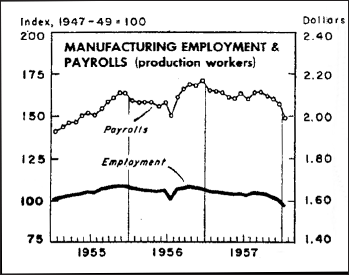
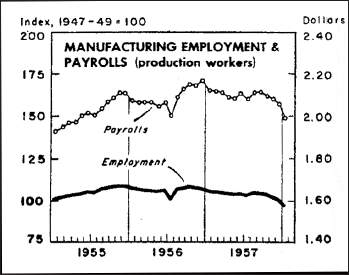
The statistical record now proves that this is precisely what has been happening. At the bottom of this column I reproduce two illuminating and significant charts, published without comment, and among other material, in the Feb. 14 issue of Business Statistics, put out weekly by the U.S. Department of Commerce. What these charts show is that, for the period they cover from the beginning of 1955, hourly wage rates in manufacturing have been rising steadily month by month to a new peak (about $2.10) in November, December, and January. But from the end of 1955, both working hours and employment have been falling. Fewer hours and less employment in combination have more than offset higher hourly rates since the end of 1956, and total manufacturing payrolls have taken a sharp dive—of nearly 13 percent—from a maximum index number of 171.4 in December 1956, to 149.5 in January 1958. A rise in wage rates, in brief, can mean a fall in payrolls.
March 17, 1958
To those of us who lived through the Great Depression, there is a curious familiarity about the schemes put forward to get us out of the present slump. On June 12, 1931, for example, the Chase National Bank of New York published a pamphlet by its economist, the late Benjamin M. Anderson, called “Equilibrium Creates Purchasing Power.” Anderson there drew a contrast between two opposing schools of thought. The school to which he adhered found the cause of the slump in “a disturbance of economic equilibrium.” The other found its causes in “deficiencies of purchasing power.”
The purchasing-power school was inflationist. It advocated “cheap-money policies,” farm price supports, and heavy spending on “public works.” It argued that “reductions in wages are on no account to be permitted.” “The general picture which the purchasing-power school presents is that of production running ahead of buying power.” As against this, Anderson advocated the restoration of equilibrium, mainly through adjustments of free and flexible prices and wages. He called for the restoration of a proper balance among the various types of production, among prices, and particularly between prices and costs of production, including wages, so that profits would be possible and stimulate enterprise.
PRICES AND COSTS
“When goods are produced in proper proportions,” he wrote, “they clear the markets of one another. . . . Production itself gives rise to the income which supports consumption. Production and consumption expand together. The 120 millions of people in the United States consume vastly more than the 400 millions in China, because they produce vastly more. . . . The problem is merely one of keeping the different kinds of production in proper proportion. This is accomplished under the capitalist system by the movement of prices and costs. Labor and capital tend to get out of lines where return is low and to move over into lines where return is better. The smooth working of this system calls for flexible prices, competitively worked out, which tell the truth regarding underlying supply and demand conditions.”
Anderson went on to point out that the purchasing-power theory was not working. “We have had extremely cheap money for over a year.” Inflexibility of industrial wage rates, while prices were falling, had led to increased unemployment. “Real” industrial wage rates between June 1929 and March 1931 had risen 11 percent, indirectly helping to force down “real” farm wages 17 percent.
But, as we know, the purchasing-power school—the inflationist school—won out. We had cheap money, inflexible or rising wage rates, and heavy government deficits for the next ten years. As a result, we also had mass unemployment for the next ten years—until the Second World War finally bailed us out.
TRIUMPH OF KEYNES
Today the chief ideological change is that there can hardly be said to be two schools of thought. Practically everyone in Washington seems to agree that we can easily float ourselves out of the slump through more inflation. We need merely give ourselves a sufficiently big dose—of increased spending, or tax reduction, or anything else that will produce a whopping deficit. The new Bible is Keynes’s General Theory, which denies Say’s Law and ignores any need for specific wage and price adjustments. The Administration disagrees with the Democratic inflationists only about the question of timing. It hopes everything will cure itself in the next few months. If it doesn’t, it promises to take “positive government action”—today’s euphemism for more inflation.
Meanwhile, neither political party calls attention to the fact that as factory wage rates have risen, unemployment has increased and payrolls have fallen. Neither party asks whether even massive inflation can restore employment as long as powerful unions have escalator contracts under which wage rates soar faster than living costs, preventing restoration of profit margins or lowering of prices. The only remedy proposed is bigger and longer unemployment compensation to help strong unions preserve upward-spiraling wage rates.
March 24, 1958
The President began with some sound and brave words in his March 8 letter to the Republican leaders of the House and Senate. The function of the government, he declared, “must necessarily be to stimulate private production and employment, not to substitute public spending for private spending, nor to extend public domination over private activity.” He expressed concern “over the sudden upsurge of pump-priming schemes” urging “wholesale distribution of the people’s money in dubious activities under Federal direction.” Having said all this, he proceeded to recommend a whole nest of pump-priming schemes, with wholesale distribution of the people’s money on loans, grants, and spending on dubious projects.
Just two days before this letter, the Federal Reserve Board ordered another cut in the discount rate from 2¾ to 2¼ percent. Two days after the letter, Vice President Nixon suggested a tax cut that would enlarge the deficit. Most of the Democrats in Congress complain only that these inflationary measures are not big enough. Even Republicans demand the scalp of Secretary Benson for suggesting some moderation and sense in farm price supports.
Both political parties, in short, are getting panicky. Both are urging policies which, though reckless, are unlikely to cure unemployment.
INSURANCE VS. RELIEF
The President recommends that Federal funds be used to “extend for a brief period” unemployment compensation benefits for workers who have exhausted their existing benefits. Some Democrats call for an extension to 42 weeks, compared with the 26 weeks or less in most state laws.
Our whole system of unemployment benefits needs basic reexamination. Present proposals may pervert what set out to be an unemployment “insurance” system into a glorified Federal relief system. Once the Federal government starts contributing funds, it will be called upon for more and more. The “insurance” may become a Federal relief system permanently. If we recall the history of “emergency” farm relief, the “emergency” RFC (now alias SBA), “temporary” veterans’ benefits, “temporary” foreign aid, and the constant expansion of Federal grants-in-aid, we will not deceive ourselves about the “temporary” character of the present proposal.
The purpose of unemployment insurance is to mitigate the hardships of unemployment without increasing or prolonging unemployment itself. We are losing sight of the second half of this objective.
ESCALATORS VS. JOBS
But the reason why even reckless inflationary measures may not cure the present unemployment is that the basic cause of the unemployment is being ignored. This is the excessive height to which the hourly wage rates of powerful key unions have now been pushed. As Prof. Ludwig von Mises recently reiterated: “The height of wage rates at which all those eager to get jobs can be employed depends on the marginal productivity of labor. . . . If wage rates, either by union pressure and compulsion or by government decree, are raised above this height, lasting unemployment of a part of the potential labor force develops.” Even Sen. Paul Douglas, in 1934, when he was still an economist, concluded in a 625-page book on wages: “If wages are pushed up above the point of marginal productivity, the decrease in employment would normally be from three to four times as great as the increase in hourly rates so that the total income of the working class would be reduced.”
Today, not only do excessive money wage rates show no signs of being adjusted to present realities; they are still rising because of built-in escalator contracts. In its December Monthly Labor Review, the Department of Labor tells us that “approximately 4 million workers in about 530 major bargaining situations will have their pay increased in 1958 by amounts specified in agreements negotiated in earlier years.” This includes not only built-in “productivity” or other automatic increases, but automatic increases based on the rise of the Consumer Price Index. Even further monetary inflation cannot cure unemployment by raising prices when it increases wage rates even more.
March 31, 1958
The history of unemployment insurance in this country is a classic illustration of how a “welfare” program keeps expanding almost automatically while the safeguards against abuses keep dropping away.
The Social Security Act, under which the individual states were in practice forced to set up unemployment-insurance plans, was passed in August 1935. The average weekly benefit of $10.54 paid to the unemployed in 1940 has about tripled to $30.11 in January of this year. This rise in itself is not surprising. The average weekly wages of covered workers went up from $26.60 in 1940 to slightly more than $80 now. But the same inflation that raised wages forced up benefit payments.
Most states started by requiring a waiting period of two to three weeks before benefit payments began; the waiting period in all states has now been reduced to one week or less. More significantly, in 1937 the most frequent maximum duration period for the payment of unemployment benefits was sixteen weeks; by 1955 this had risen to 26 weeks.
INSURANCE INTO RELIEF
New York State has just jumped the maximum weekly benefit from $36 to $45. It is variously proposed by the Administration and by Democrats that the Federal government pay unemployment benefits out of its own funds or deficits for up to thirteen or sixteen weeks beyond the maximum provided by the states. Anyone acquainted with the realities of politics or the “welfare” history of the last 25 years should know that once the Federal government adopts this “emergency” proposal its contribution will probably be permanent and increasing. It will turn an insurance plan into thinly disguised relief.
An ideal unemployment-insurance plan, if it could be realized, would be one that reduced the hardships of unemployment without increasing or prolonging unemployment itself. But there is a strong presumption that our present system tends to increase unemployment in three main ways:
1—It weakens the incentive of many workers to get a new job as soon as possible. The overwhelming majority of American workers, of course, prefer work to unemployment and charity. The number of outright shirkers or chiselers is probably negligible. But there is a less negligible number of people whose incentive to get a new job is or will be reduced as their unemployment benefits are increased or prolonged.
A U.S. Department of Labor pamphlet suggests that the weekly unemployment-benefit payment should be “at least 50 percent of weekly wages,” and that for low-wage earners it ought to be “70 percent or more.” Suppose a textile worker has been earning $60 for a 40-hour week, is laid off, and gets $42 a week, or 70 percent, as unemployment benefit. Even if he could get his old full-time job back at $60 before the expiration of his benefits, he may ask himself: “Why should I work for only $18 a week?” And if he could get the same hourly wage for a 27-hour week, he is asked to work, as he sees it, for less than nothing.
2—The present unemployment-insurance systems put a direct penalty on earning money by work. In most states a man is disqualified from unemployment benefits if he earns more than $5 or $6 a week during the period. This foolish deterrent could be removed by the simple device of reducing his benefits by, say, 50 cents for every $1 of outside earnings. In this way he could always increase his income by at least half the net amount he earned from casual work. At no point would he be out of pocket for taking such work. The states might treat “supplementary unemployment benefits” in the same way. To make (as 40 states now do) no deduction whatever for them, discriminates in favor of members of strong unions and subsidizes increased unemployment in such unions.
3—The most important way in which unemployment insurance increases unemployment is indirect. It subsidizes the unemployment created by excessive wage rates and relieves the pressure on powerful unions to bring wage rates down to the level at which full employment could be restored. It may be gravely doubted, in short, whether unemployment insurance, as it exists at present, is a “built-in stabilizer.”
April 7, 1958
Both political parties in Washington are convinced that there is only one way to cure existing unemployment, and that is by a still further and bigger dose of inflation. Both want to make our paper money cheaper and more plentiful. Both want a thumping deficit, “to increase purchasing power.” The only points they can’t agree on are exactly how big they want to make this deficit, whether they should get it mainly by more spending or by a tax cut, and exactly when they ought to start. But when it comes to the principal cause of the present recession, which is the excessive wage rates of the strong unions, and the escalator clauses they have been able to impose, Washington is deaf, dumb, and blind. It seems ready to adopt any inflationary scheme, however reckless, rather than suggest that these wage rates be readjusted.
WHERE THE JOBS ARE
Let us see where present unemployment is mainly concentrated. The government has estimated that 7.7 percent of the civilian labor force was unemployed in February. (Seasonally adjusted, the percentage was 6.7.) Here is the percentage of unemployment in some leading industries in February, and the latest available figures on hourly earnings of the workers employed in them:
| Unemployment | Hourly Wages | |
| Construction | 21.3% | $2.99 |
| Automobiles | 15.7% | 2.48 |
| Primary metals | 13.5% | 2.56 |
| Mining | 11.5% | 2.61 |
| Fabricated metals | 10.9% | 2.22 |
The average unemployment in all manufacturing industries in February was 9.8 percent; the average hourly earnings of workers in them was $2.10. In nondurable manufacturing industries unemployment averaged 8 percent and hourly earnings $1.92.
Such comparisons, of course, are not in themselves conclusive. Wage rates in certain industries may average higher than in others because of differences in skills, mechanization, growth, etc. But it is at least significant that present unemployment tends to be above average where wage rates are above average and highest where wage rates are highest.
The comparison is still more significant between the incidence of unemployment and of escalator wage contracts. I quote from the December Monthly Labor Review of the U.S. Department of Labor:
“At the beginning of 1958, almost ten years after the first agreement between General Motors and the United Automobile Workers to provide annual improvement factor increases and cost-of-living escalation, more than 4.3 million workers will be covered by cost-of-living escalator clauses. To a substantial degree, these same workers are also scheduled to receive deferred [the department’s euphemism for contractually mandatory] increases, since the majority of the workers covered by contracts incorporating provisions for deferred increases are also covered by automatic cost-of-living escalator clauses. . . . At the end of 1957, cost-of-living escalator provisions covered a greater number of workers than at any previous period.”
The article ends by pointing out that about half the wage increases granted in 1957 to railroad, automobile, and basic-steel workers came from cost-of-living escalators and half from other mandatory increases.
The leaders of the strong unions who have been able to exact these automatic wage increases have no intention of adjusting their labor contracts to the existing purchasing power of consumers of the products their unions make. They insist that their unions’ excessive wage rates and unemployment be subsidized out of Federal funds poured into state unemployment-insurance plans. They demand that the government pump more paper dollars into the economic system so that others can buy the products they make at the soaring prices that their own excessive wage rates have made necessary. They have no stake in stopping inflation because their own members are protected by escalator wage contracts. But their remedy, though reckless, will not work. For if further inflation raises purchasing power and prices it will also raise escalator wage rates still more, making a further rise in the price of key products necessary. And so ad infinitum.
April 14, 1958
Since its inauguration more than twenty years ago, our state unemployment-insurance program has steadily expanded while safeguards against abuses have been relaxed. Since 1940, as I have already pointed out (Newsweek, March 31), the average weekly benefit paid to an unemployed man has almost tripled. The waiting period before payments begin has been reduced from two or three weeks to a week or nothing. Since 1937 the most frequent maximum duration period of payments has been extended from sixteen weeks to 26.
But if the plan that the President recommended to Congress on March 25 is enacted (not to speak of worse Democratic plans) the state unemployment-insurance program will lose its last title to be called insurance. It will become a discriminatory relief system and a political football.
FAILURE AS RELIEF
The Administration program cannot be justified, in fact, either as insurance or relief. Considered as relief, it makes no test of need. As my colleague Raymond Moley pointed out last week, it would ignore the estimated 2.2 million unemployed who have received no unemployment compensation, but would provide additional payments to the less than 300,000 who have already received and exhausted their benefits. Considered as relief, it would also be rankly discriminatory. The sums paid under state plans are related to previous wages and not to family needs. Typically, the maximum weekly benefits are three times as great as the minimum benefits (e.g., $30 down to $10). The Administration plan would not change this basis. Considered as relief, payments even under the Administration plan would stop at the end of a maximum, say, of 39 weeks, even to those still out of work.
On an insurance basis, benefits may be properly proportional to the previous period of employment and the previous weekly wage—especially if the taxes paid in are also proportional. But any insurance justification for present differences will be destroyed if the Federal government suddenly orders an increase in the duration of benefits and tosses a huge added amount into the reserves to pay them.
The Administration plan is bad from no matter what standpoint it is considered. The President declares that “such legislation should not encroach upon the prerogatives which belong to the states.” The proposed legislation clearly encroaches upon these prerogatives. It orders the states to increase the duration of their payment of benefits by 50 percent. Ironically, under such a flat proportional plan the states that have already had the longest benefit payment periods are ordered to lengthen them the most and the states that have had the shortest benefit payment periods are asked to lengthen them the least. In addition to discriminating between unemployed in different states, the Administration plan discriminates in favor of the present unemployed (if it is really temporary, as it professes to be) as against the unemployed in future years.
Not the slightest evidence is offered that the states need these forced loans. State unemployment reserves now total $8.5 billion. This is where they stood at the end of 1956, their highest point except for the $8.9 billion at the end of 1953.
IMPROVISED SCHEME
The Administration proposal has obviously received no serious thought. It is a hastily improvised political gesture. Even as an “anti-recession” measure it is dubious. It may tend to prolong unemployment by reducing the incentive of many workers to get a new job as soon as possible, and by reducing pressure to adjust excessive wage rates.
The plan would destroy unemployment insurance. It would put the Federal government permanently into relief masquerading as insurance. Unemployment insurance as such can only be preserved if it is strictly separated from relief. What we really need now is not to desert the insurance principle but to return to it more strictly. A big step in that direction might be to have the workers themselves contribute directly toward the premiums, as they have always done in Britain, and in our own Federal old-age insurance system (OASDI).
April 21, 1958
Three events temporarily helped to slow down the panicky stampede in Washington to more inflation. The first was Bernard Baruch’s testimony before the Senate Finance Committee that “we must prevent further deterioration of the credit of the United States” and “reject all tax reduction and pump-priming proposals which require deficit financing.” The second was President Eisenhower’s warning the next day against hasty actions, including a major tax cut, to combat the slump: “You just are not going to get the economy . . . inspired and stimulated just by spending Federal money.” The third event was the Easter recess of Congress.
Unfortunately there are still serious factors on the other side. Baruch’s testimony was spoiled by his implied endorsement of price and wage controls. Within a few days of the time the President sounded his warning, he advocated an ill-considered increase in unemployment insurance, signed a $1.8 billion “emergency” housing bill, and abolished even the 2 percent down-payment requirement on mortgage loans guaranteed by the Veterans Administration. Congress rushed through several huge spending bills, including one to pump $1.8 billion in new Federal and state funds into highway construction, and the Federal Reserve Board proposed legislation to permit still further expansion of bank credit.
HALF ALREADY GONE
A warning of where such measures are likely to lead us, as well as an arresting summary of where they have already taken us, has just appeared in a study by Franz Pick: The United States Dollar: Requiem for a Dead Half (Pick Publishing Corp., N.Y.,30 pages, $25). “Whenever a currency loses more than half of its value in less than a generation,” he begins, “the unit is doomed. The United States dollar, in seventeen years . . . has declined to less than half of its 1940 buying power. This erosion cannot be halted.”
I hasten to say that I do not accept Pick’s defeatism concerning the American dollar. That defeatism seems to stem from a strange contradiction in his own economic philosophy. Though he is unsparingly sarcastic about the deceptions and consequences of inflation, he shares with the inflationists the belief that, “at a stable purchasing power of the dollar, the country cannot maintain full employment.” Neither theory nor history justifies this conclusion.
But Pick tellingly sums up what inflation has already done. It has debased the national debt. While that debt increased from a nominal dollar value of $49 billion in 1940 to $273 billion now, the purchasing power of this $273 billion debt, in 1940 terms, is only $133 billion. The government’s creditors, its bondholders, have been cheated out of billions in purchasing power.
GNP ILLUSIONS
One of the great illusions created by inflation concerns the growth of the national economy. Thus the gross national product (GNP) was estimated in 1940 at $101 billion and in 1957 at $433 billion. Here is an apparent growth of 330 percent. When the lowered purchasing power of the dollar is allowed for, this becomes a real increase of only 111 percent. When the increase in population is allowed for, this falls to a real per capita increase of only 61.2 percent. This, Pick tells us, means a per capita growth of gross national product in stable dollars “averaging not more than 3.6 percent per year.” Even Pick here understates his case. For if we figure, as we should, the average rate of increase from each year to the next, it falls to only 2.85 percent. Inflation has worked no miracles of real expansion.
I have said that Pick is wrong in contending that the erosion of the dollar cannot be halted. But no one familiar with the history of the last quarter century, or with the present Washington climate, will have the hardihood to argue that it will not be. The whole present clamor for increased spending on public works, major tax reductions, deficits, cheaper money, is a clamor for more inflation, for further deterioration of the national credit and further erosion of the dollar, in the desperate and delusive belief that this is the only alternative to recession and unemployment.
April 28, 1958
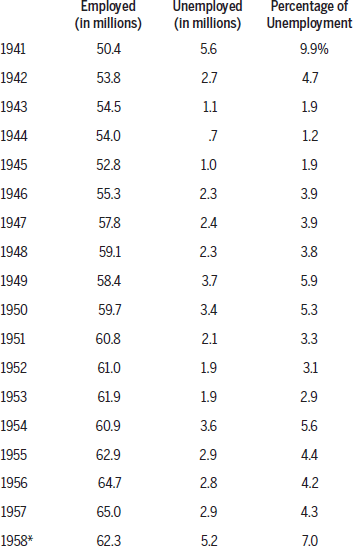
I pointed out here in the issue of March 17 that, after 1930, “We had cheap money, inflexible or rising wage rates, and heavy government deficits for the next ten years. As a result, we also had mass unemployment for the next ten years—until the second world war finally bailed us out.” As we are trying to adopt now precisely the remedies that failed in the ’30s, let us look at that period in more detail. Here are the deficit, number of unemployed, and percentage of unemployed to the total labor force, year by year in that decade:
In the following table the deficits are for fiscal years ending on June 30; the unemployment is an average of the full calendar year. Spenders, no doubt, will try to find a partial negative correlation between the size of the deficit and the number of unemployed; but the central and decisive fact is that heavy deficits were accompanied by mass unemployment. If we translate the foregoing figures into 1957 terms, we find: The average deficit in this ten-year period was $2.8 billion, which was 3.6 percent of the gross national product of the period. The same percentage of the gross national product of 1957 would mean a deficit of $15.6 billion. The average unemployment of the ten-year period was 9.9 millions, which was 18.6 percent of the total labor force. The same percentage of unemployment today would mean 12.6 million jobless instead of the present 5.2 million. So much for the effect of deficits as a cure for unemployment.
| Deficit (billions) | Unemployed (millions) | Percentage of Unemployment | |
| 1931 | $.5 | 8.0 | 15.9% |
| 1932 | 2.7 | 12.1 | 23.6 |
| 1933 | 2.6 | 12.8 | 24.9 |
| 1934 | 3.6 | 11.3 | 21.7 |
| 1935 | 2.8 | 10.6 | 20.1 |
| 1936 | 4.4 | 9.0 | 16.9 |
| Deficit (billions) | Unemployed (millions) | Percentage of Unemployment | |
| 1937 | 2.8 | 7.7 | 14.3 |
| 1938 | 1.2 | 10.4 | 19.0 |
| 1939 | 3.9 | 9.5 | 17.2 |
| 1940 | 3.9 | 8.1 | 14.6 |
Another point to be noticed in this table is that in the ten years from 1948 to 1957 inclusive, average unemployment was 4.3 percent of the total labor force. Yet this period was one of unusually high employment, even of “labor shortage.” But if four persons out of every 100 are “normally” unemployed, then the present “abnormal” unemployment is only three persons out of every 100. This is serious, especially for those directly concerned. But it hardly justifies reckless deficit spending or further dilution of the dollar in an effort to cure it. We could more profitably look at the relation of key wage rates to prices and consumer demand.
In this article I have taken official unemployment estimates at their face value. Next week we shall try to find how accurate these estimates are.
THE RECORD
* 1958 figures are for the month of March.
May 5, 1958
When, in the 1930s, some economists began seriously discussing just what is statistical “unemployment,” old Hugh Johnson retorted in one of his angriest columns: “Ask the man who’s out of a job!” But the problem does not yield to mere invective. You can find lots of people in Miami or Las Vegas who have no particular job but are not worried. Millions of women and children are without jobs. In fact, the population of the United States is about 173 million, and as there are only some 62 million employed, there must be today not merely 5 million, but 111 million “unemployed.”
For the statisticians, however, the “unemployed” consist only of those in the “labor force” who are not employed. Just how is the line drawn between the 67.5 million who are counted as part of the labor force and the 105.5 million who are not?
Here is how the U.S. Bureau of the Census describes how it decides: “Monthly estimates of the population of working age [14 years and over] showing the total number employed, the total unemployed, and the number not in the labor force are obtained from a scientifically selected sample of about 35,000 interviewed households in 330 areas throughout the country.” So the estimate of unemployed is in large part based on a sample of only one in every 1,400 households in the country.
SHIFTING ‘LABOR FORCE’
The bureau goes on: “The unemployed total includes all jobless who were looking for work.” How is the number of such persons estimated? From replies to the interviews. What constitutes realistically looking for work? The interviewers must rely in large part upon the realism of the replies. The labor force is not even a constant percentage of the total (“noninstitutional”) population. In July of last year it was 60.6 percent; but in December only 58.1 percent.
Some paradoxical results emerge. The last monthly report, for example, opened as follows: “Employment rose by 300,000 between February and March . . . while unemployment was unchanged.” How is that? The layman would naturally expect that if employment rose 300,000 in March unemployment would drop that much. The statisticians’ answer is that the “labor force” increased by that much.
The “labor force” increases partly by census estimates of the population reaching working age, etc., but also partly by changes in people’s decisions. Suppose a man has a good job, with a wife at home and a son and daughter in college. He loses his job, whereupon not only he, but his wife, his son, and his daughter start looking for work. Because one person has lost his job, four persons are now “unemployed.” So “unemployment” goes up faster than employment goes down. There were 1.4 million more persons employed this March than in 1954; yet 1.6 million more were unemployed.
DEFINING UNEMPLOYMENT
Let’s turn now to the Department of Labor: “Effective January 1957, persons on layoff with definite instructions to return to work within 30 days of layoff and persons waiting to start new wage and salary jobs within the following 30 days are classified as unemployed. Such persons had previously been classified as employed. . . . The combined total of the groups changing classification has averaged about 200,000 to 300,000 a month in recent years.” So the “unemployed” have increased some 300,000 since the end of 1956 simply by a change of definition!
Among the conclusions to be drawn from all this are: (1) The government figures of unemployed are merely estimates, subject to error. (2) Statistical unemployment of several millions, or 3 or 4 percent, may exist even when there is a definite “labor shortage.” (3) Not every “unemployed” person is necessarily in distress. (4) The existence of some statistical or “frictional” unemployment is not necessarily an evil. There are always some people who prefer to be temporarily unemployed rather than accept or keep a job or wage that does not suit them. In a free economy, 100 percent “full employment” is never realized. But in such an economy there is always a tendency toward full employment, if prices and wages are flexible, without the need for perpetual inflation.
May 12, 1958
It is not surprising to find politicians like Harry Truman and Lyndon Johnson blaming the recession on Republican “tight-money policy” and demanding “bold, prompt, confident action”—which always turns out to mean deficit spending and inflation. What is far more disturbing is to find committees of businessmen or economists plumping for the same inflationary policies.
I cite as outstanding examples the Committee for Economic Development and the Rockefeller Brothers Fund. The program committee of the CED called in March for increased spending for “public works,” but above all for “a large temporary cut in personal-income taxes to stimulate private spending.” This would mean “a cut of one-fifth in personal-income-tax rates”—or about $7.5 billion a year. “It is necessary that in a recession the budget be allowed to run a deficit. . . . The small decline in the money supply . . . should be halted and reversed.” If this is not a recipe for inflation I do not know what to call it. The Keynesian ideology concerning the cause and cure of crises is swallowed whole.
INFLATION AS REMEDY
Turn now to the report of the Rockefeller Brothers Fund. It has some sensible things to say about long-range tax reform and farm policy. It even has a sentence saying: “Business and labor must exercise restraint, the former in its pricing policies, the latter in its wage demands.” But it too recommends inflation as the cure for the slump. It advocates an immediate tax cut (amount unspecified). It wants to “accelerate public works,” and to set up “a permanent shelf of projected public works.” And it wants the Federal Reserve System to “increase the supply of money and credit as long as the economy is declining.”
Prof. Seymour Harris of Harvard, himself a Keynesian, has hailed the Rockefeller report as “virtually 100 percent Keynesian.”
For the long run, in fact, the Rockefeller report has even more inflationary implications than the CED report. The CED report looks only a year ahead, and proposes a tax cut only for that period. But the Rockefeller report looks forward for ten years, and what it looks forward to is steadily expanding government controls and government spending and a steadily expanding welfare state. It comes up with the remarkable discovery that an economic “growth rate” of 5 percent a year will lead to a bigger growth in ten years than a 3 percent rate or even a 4 percent rate. It assumes without argument that the way to get higher growth rates is for the government to spend more (and to tax us more to pay expenditures).
Of course if the government continues to inflate the currency and debase the dollar it can get (in dollars) any “growth rate” it wants. Let us remember that if there had been no inflation since 1939 (i.e., no increase in prices) the same real gross national product in 1957 would have been counted, not as $434 billion, but as only $194 billion.
RESTRAIN BOOMS
It is gratifying to turn to the sober analysis that one finds in the April survey of the Guaranty Trust Co. of New York. “The best way to prevent recessions,” the bank reminds us, “is to prevent booms, and the best way to minimize recessions is to restrain booms. . . . Booms generate unsound tendencies, including unwarranted expectations of future markets, excessive inventory accumulation, distorted price and cost relationships, outright speculation, credit strain, disproportionate production of different types of goods, and ill-advised investment.”
The recession, in brief, is itself part of a necessary corrective process. “The longer management clings to old methods, old products, and old pricing policies, the longer it will take to recover the lost markets. The more tenaciously labor insists upon maintaining or raising the cost of employment, the less employment there will be. . . . Sound incentives are derived from the removal of artificial restraints, not the administration of artificial stimulants.”
If space permitted, I should be tempted to quote this admirable discussion in full. But the rare voices making such sober diagnoses are drowned out by the swelling chorus of the inflationists.
May 19, 1958
I have already pointed out (Newsweek, April 14), as has Raymond Moley (April 7), what is wrong with the Federal extension of state unemployment insurance proposed by the President on March 25 and already passed by the House. If this measure becomes law, it will destroy the principles of state unemployment insurance and put the Federal government permanently into relief masquerading as insurance. Many conservatives in the House felt themselves compelled to vote for this ill-considered measure in order to stave off the incomparably more reckless and demagogic bill offered by the Democratic leadership.
In Newsweek of March 10 I gave one illustration of how the unemployment insurance system, even as it stands, directly tends to increase the very unemployment against which it insures. The United Automobile Workers asked the Chrysler Corp. to reestablish a 44-hour week for its workers and to lay off those it was employing only part time, on the ground that the latter would make more money per week through unemployment benefits if they were made completely idle.
PENALTY ON WORKING
This sort of consequence is the result of defects in the state unemployment insurance laws that the states themselves could remedy without the need for Federal intervention. Few people seem to realize that present state unemployment insurance systems put a direct penalty on earning money by work. In the great majority of states a worker is disqualified from unemployment benefits if he earns more than $5 or $6 a week during his benefit period. A handful of states have different formulas, but all of them put a positive penalty on earning above a certain amount.
This foolish deterrent to part-time work and earnings could be removed by a simple device. For every $1 of outside earnings that a man received during his benefit period, his weekly benefit could be reduced by 50 cents. In this way he could always increase his net weekly income by at least half the amount he earned from casual work. Suppose the weekly benefit to which the unemployed worker was entitled was $30. Then if he earned $10 by casual work in a given week he would not be completely disqualified from unemployment benefit but would receive $25, making his net income $35. If he earned $20 his benefit would be reduced to $20, making his net income $40. If he earned $30 his benefit would be reduced to $15, making his net income $45.
PREMIUM ON IDLENESS
It probably would not be wise to continue this formula beyond the point at which a man’s outside earnings exceeded his benefit. The primary purpose of unemployment insurance, after all, is to provide some minimum income during unemployment, not to supplement income from employment. But even if outside earnings exceeded the amount of the full benefit payment, it would be cruel and stupid, and defeat the purpose of unemployment insurance, to disqualify the unemployed worker completely. From that point on his weekly benefit could simply be reduced by the full amount of his additional earnings. This would mean, for example, that if a worker entitled to a $30 benefit earned $35 his benefit payment would be reduced to $10.
To prevent the formula I have suggested from being exploited as a subsidy for part-time work by any collusion between unions and employers, unemployment benefits, as now, should begin only after a worker had been laid off. And any part-time earnings from employment by the same firm that had laid him off, if they occurred during the benefit period, would be fully deducted against the benefit payment.
Under such a system the worker would at least never be out of pocket from accepting part-time or casual work, and in most cases he would gain by it. The states should, of course, treat “supplementary unemployment benefits” in the same way, deducting, say, 50 cents of unemployment benefit for every $1 of SUB. To make (as some 40 states now do) no deduction whatever for SUB, not only discriminates in favor of members of a few strong unions, but discriminates in favor of income from not working against income derived from work.
May 26, 1958
The treatment of the Nixon party in South America—the face-spitting, the rock-hurling, the desecration of the American flag—is an end result of our policy of total foreign entanglement in the last dozen years, and in particular of the foreign-aid program.
It may not be possible to determine the exact extent to which the South American riots were inspired by organized Communist plots directed locally or from Moscow, and to what extent they reflected genuine national feeling. In any case, the Communists won another major propaganda victory, and our own world prestige suffered another major blow. The Nixon tour was primarily an effort to woo South American good will and to secure a demonstration of it. Instead, our Vice President and his wife were insulted, physically attacked, and shamefully humiliated. The rioters successfully showed that they hate us and do not fear us. From this standpoint it is hard to deny the Moscow radio’s triumphant claim that the Nixon tour was a “fiasco.”
WE CAN’T BUY ALLIES
A few months ago (Jan. 13) I quoted here a passage from Machiavelli in which he pointed out that, in international affairs, “it is much safer to be feared than loved, if one of the two has to be wanting” and that “the friendship that is gained by purchase is bought but not secured.” James Burnham, in National Review (May 17), has taken an even more appropriate quotation from the same source: “When things are so managed in a government, that the neighbors purchase its comity, and make themselves its pensioners, ‘tis a certain sign of the potency of that government; but when the neighbors on the contrary receive money from it, ‘tis as infallible a sign of its weakness.”
From the very beginning, one of the main purposes of our foreign-aid program, in whatever euphemistic forms it may have been expressed, has been to buy the friendship and good will of other nations—to buy allies. It has not only failed to do so; it has done the opposite. We overlooked the elementary fact that the recipient of alms feels humiliated in accepting them. They wound its national pride; they advertise its dependence on the giver. The recipient resents any quid pro quo or any conditions, even when these are in its own interest. One of the signs carried by the mob that attacked Nixon in Lima was PERU IS NOT FOR SALE. Even if this was composed by Communists, they could count on it to inflame anti-American feeling.
GET RICH BY GIVEAWAY?
For many other reasons our foreign-aid policy has produced exactly the opposite results from those its supporters expected. To woo a country with bribes or their equivalent is to make that country feel that any alliance is primarily for our benefit rather than for its own. It regards such offerings as a sign of weakness. We lose respect by them. We have extended foreign aid to some 80 countries. The crowning irony is that nations that should have got not a cent from us are resentful and embittered because they get less than other nations.
The “economic” case for foreign aid is even worse. If there had been no economic foreign-aid program, countries wishing private American capital for development would have had to adopt sound political and economic policies to attract it. Government-to-government foreign aid has made this unnecessary. It has supported and prolonged foreign-exchange control, inflation, confiscatory taxes, and Socialism. And so it has on net balance retarded, not advanced, world production and economic recovery.
The reductio ad absurdum of all the economic arguments for foreign aid has been solemnly put forward by the Secretary of State. “The great bulk of our Mutual Security funds—over three-fourths,” he said on March 24—“are spent in the United States. . . . To cut these funds would be to cut employment here at home.” This is the argument that we get rich by giving our goods away. We could, of course, “create” the same employment by making the same goods to dump into the sea. If we want to subsidize our exporters, there are cheaper ways of doing it than giving away $100 for every $5 or $10 of net profit that exporters might get from added foreign sales.
June 2, 1958
The demand for real reform in our labor laws has reached a point where the Democratic Majority Leader, Lyndon Johnson, has promised action at this session in the Senate. But there is little prospect of action by the House and, if legislation does emerge, no prospect whatever that it will be anything but innocuous or positively mischievous.
The dilemma of the present recession is that nothing but politically unpalatable measures will permanently help, while nothing but politically popular measures are being proposed. A score of measures have been taken, and scores more are pending, to increase deficit spending and inflation. These measures may have a temporary effect in increasing national-income figures. But they merely pile up greater difficulties for the longer future. And they divert attention from the need to curb the present power of the giant industrywide unions to impose wage rates which either disrupt production and employment or force continuous inflation to try to make such excessive wage rates payable.
LABOR LAW ‘HOLIDAY’
This big-union power could be curbed, not by any “repressive” or “punitive” or “union-smashing” legislation, but merely by repealing most of the New Deal Federal labor legislation passed since 1932. This legislation has turned the Federal government, in effect, into a union-organizing agency and put the full machinery of government behind the union monopolists.
None other than John L. Lewis has several times proposed that we try a “holiday” of a year or two from present Federal labor legislation. But this proposal is probably too far out of accord with the way in which public opinion has been conditioned in recent years to be regarded as politically feasible. Something close to the same practical result, however, could be achieved by following the recommendations of Prof. Sylvester Petro in a recent pamphlet, Personal Freedom and Labor Policy, published by the Institute of Economic Affairs at New York University.
While a good many union leaders have been shown to be cheap crooks and embezzling scoundrels, he points out, still more laws against stealing will do no good; we already have such laws. They deal with only the most superficial symptoms of the things that have gone wrong in labor relations. We need to return to basic common-law principles.
FREE EMPLOYEE CHOICE
Petro declares that the legal reforms needed “may all be subsumed under a single heading: Unqualified supremacy of the principle of free employee choice.” In detail, this would require:
1—A broad prohibition of restraint and coercion by employers and unions of the right of employees to make up their own minds on the question of union membership or participation in strikes.
2—A specific provision of law to the effect that picketing, even when “peaceable,” is subject to ban when it has or is intended to have coercive effects, either physical or economic.
3—A specific declaration that the ban on restraint or coercion applies to the economic coercion implicit in all “agreements” proposed by unions or employers which make union membership or nonmembership a condition of employment. (“Integrity demands that if unions be allowed to impose compulsory unionism agreements, employers must be allowed similarly to impose nonunion agreements.”)
4—A clear prohibition against secondary boycotts.
5—Emphatic repeal of the exclusive-bargaining, majority-rule principle. This would include a positive statement that unions shall be the exclusive bargaining representatives of only those workers who expressly delegate such authority to them. The present statutory and doctrinal requirement, imposing a legally enforceable duty upon employers to bargain only with majority unions, would then need to be deleted.
Finally, Petro adds, defects in labor-law administration and enforcement are as grave as the defects in the law itself. He would repeal all anti-injunction legislation, abolish all labor-relations boards, and return administration of justice in labor relations to the courts.
June 9, 1958
Perhaps nothing this country could have done could have prevented the crisis in France. The diseases of French democracy are of long standing. In 1872, in a preface to his English Constitution, Walter Bagehot pointed out that the French Assembly “is divided into parties and into sections of parties” which habitually “scream”; that “real discussion is impossible,” that the French “Parliament can neither choose men nor measures”; that, as the French Premier would not have “the power of dissolving the Assembly . . . the Assembly would be always changing its ministry, that having no reason to fear the penalty which that change so often brings in England, they would be ready to make it once a month.”
The defects of the French system were never corrected. The Fourth Republic is (was?) more unworkable than the Third. Even in his desperate last-minute proposals for constitutional reform, Premier Pflimlin never dared ask for the unequivocal power of dissolution. It was precisely the pathological fear in France of the man on horseback that led to the built-in executive weakness which caused the return of the man on horseback.
FUTILITY OF AID
Not only has our postwar policy in France proved to be futile, but serious question must be raised whether it did not actually help to precipitate the crisis. Passing over our political interference and considering economic measures alone, if we had not so freely poured in government economic aid, and sponsored such unsound institutions as the International Monetary Fund, with its support of exchange control and artificial currency rates, France would have had to try to attract private capital. In these circumstances, it would not have plunged so heavily into draining, socialistic adventures. It would have had to abandon paper-money inflation and to stabilize the franc.
Much the same might be said of the end results of our aid to South American countries. As in France, that aid has proved to be futile either in preventing currency deterioration or in getting them to like us. Yet the response of the Administration to demonstrated failure, to insults and violence, has been to suggest still more aid! As James Burnham summarized the situation in National Review (May 31), how can “a nation that abandons its consuls—like Angus Ward—to Asian jails, that stands passive while its soldiers die slowly in Siberian slave camps, its aviators are brainwashed in filthy Chinese cells, its planes shot down by an Adriatic gangster, its diplomatic establishment smashed and burned, its flag cursed,” command respect? “If we do not respect ourselves, why should others respect us? And the nation’s response to the Nixon rocks? Abjectly confess how badly we have behaved. Pour out more money to the nations that have allowed these things to come to pass.”
DESCRIPTION OF TRADE
Yet there is one respect in which foreign nations do have a just complaint against us on economic grounds. This concerns our trade policy. It concerns our farm policy of first trying to make our farm exports arbitrarily expensive by crop controls and support-prices, then disrupting and demoralizing foreign markets and production by dumping our surpluses abroad at absurdly low prices. It concerns the vagaries of our government stock-piling and price-support for foreign metals. It concerns our policy of keeping out imports by excessive tariff rates or actual quotas. It concerns our sudden boosts or threatened boosts of tariffs whenever foreign competition seems on the point of succeeding.
We do not owe France or any South American nation any free gravy at all. Our giveaway program costs us dearly but does them no good. It merely degrades our relations. But we did owe and do owe France, Latin America, and every free country freedom to trade with us, on settled and predictable terms. And we should adopt lower tariffs not as a favor to them, but primarily in justice to our own consumers, who should be able to buy what they want where they can get it on the best terms. In brief, we should adopt seriously and literally the slogan that has received so much empty lip service in recent years: Trade, not Aid.
June 16, 1958
There are mounting indications that the recession has been flattening out. A few important industries have been turning upward. Even more clearly hopeful has been the turn in political thought. Only a couple of months ago the great majority of labor-union leaders, politicians, “research groups,” and academic economists who got into print were shouting that the only way to stave off disaster was an immediate massive public-works program and/or a huge tax cut of $5 billion to $10 billion or more to give us a thundering inflationary deficit.
Though much harm has been done by the inflationary spending programs that Congress so hastily approved (and that already give us a prospective deficit for the coming fiscal year of more than $10 billion), we have been at least temporarily saved from much worse consequences by the firmness of Secretary Anderson and (after initial wavering) of President Eisenhower. There has not for a long time been so admirable an example of economic sense and political courage as the President displayed in his speech of May 20. I quote some outstanding sentences:
“Reckless expenditure in the name of economic stimulation is both wrong and self-defeating. . . . I would like to nominate for oblivion . . . the idea that the consumer is not price conscious any more . . . the notion that without paying the piper in higher prices, we can as a nation overpay ourselves for what we produce . . . the idea that large annual wage increases can be regarded as a matter of course. . . . And, finally, we must be disabused of the thought that a competitive enterprise economy can be free of all loss, failure and disappointment, and that government can take all the bumps out of the road of business.”
BLOCKS TO ADJUSTMENT
A free-enterprise economy is self-adjusting. But it must be permitted to adjust. Much of the recent improvement in the business picture has been the result of the adjustments that have already taken place—in some better products, some lowered production costs, and especially in inventories. But the chief stumbling block to further adjustment and recovery is the excessive wage rates of some industrywide unions and the insistence of these unions on still greater wage boosts.
Outstanding examples exist in the steel, electrical, and automobile industries. For half a year the steel industry has been operating at only about 50 percent of capacity. The normal adjustment of a free economy to such a situation would be a reduction of steel prices to stimulate and restore demand. But on July 1 (as the third installment of wage boosts called for in the current three-year contracts), wages of the United Steelworkers union are due to go up another 20 cents an hour or so. The unions obdurately refuse to forgo this automatic increase. So the companies are planning to raise steel prices to meet the added cost.
GM WAGE PATTERN
In 1955, General Electric negotiated five-year agreements with more than 100 unions. These agreements not only provided a cost-of-living escalator arrangement, but substantial wage increases in addition which come automatically regardless of what happens to the cost of living and regardless of whether there is prosperity or recession. “Now,” the company has said, “we look ahead to the fourth and largest increase yet, just when we are trying to pull ourselves out of recession. This increase will be a deterrent to the development of the better product values which are needed for recovery and re-employment.” The company has also expressed the opinion that “any [general] wage increase at all now holds back recovery.”
The wage-contract pattern which General Electric was forced to follow in 1955 was set by the General Motors formula of 1948. This combined automatic cost-of-living increases with automatic “annual improvement” increases. Together these have already reached a total of 90 cents an hour.
Thus the chief “beneficiaries” of this wage formula have been a few great industrywide unions. But what Walter Reuther and the automobile, electric, and steel unions are now chiefly suffering from is too many victories. It is mainly where wage increases have gone farthest that there is heaviest unemployment.
Those of us who have insisted on the need of wage adjustment to promote enduring recovery are sometimes accused of wanting to “squeeze down the workers.” Such an accusation can be honestly made only by those who fail to understand either what is being proposed or what the real effect of the proposal would be. It is not being suggested that wages should be cut generally or by, say, some flat uniform percentage. What is being proposed is that the wage rates should be cut only of the still-employed members of those top-level unions who are monopolistically profiteering at the expense of higher living costs for all the rest of the workers. And the purpose of this wage-rate cut is not to reduce the purchasing power of the class of workers whose wage rates would be cut, but to increase their living standards and purchasing power. The purpose, in brief, is to cut certain hourly wage rates in order to increase total employment and payrolls.
WAGE RATE VS. PAYROLL
What has been happening under the steadily mounting hourly wage rates in manufacturing was shown in this column of March 10. The situation has become even more striking since then. Whereas average hourly gross earnings increased from $2.05 in December 1956 to $2.11 in April of this year, manufacturing payrolls fell from an index number of 171.4 in December 1956 to 139.6 in April of this year. In other words, an increase of 3 percent in wage rates has meant a fall of 18 percent in wage payments.
The word “wages,” in short, is ambiguous, and may mean two entirely different things. A cut in the price of labor may be necessary for a rise in the employment and total income of labor. Failure to understand this elementary distinction has prevented many workers from recognizing where their real interests lie. About 20 percent of the automobile workers are unemployed because Reuther’s wage victories have priced American cars into a lower volume of sales. The remedy is clear.
June 23, 1958
One of the groundless myths encouraged by the Russian sputnik is that Khrushchev is on the verge of achieving his boasts of “catching up and surpassing the United States in per capita production” and “conquering capitalism with a higher standard of living.”
Allen W. Dulles, director of the Central Intelligence Agency, made a speech on April 28 which seemed to give color to this claim. He declared that in the recent rapid growth of the Soviet economy, “at a rate roughly twice that of the economy of the United States . . . we have the most serious challenge this country has ever faced in time of peace.”
Now all published Soviet figures are designed primarily as propaganda, not as objective information. In Newsweek of May 27, 1957, I discussed here the careful study by Prof. G. Warren Nutter covering 37 leading industries from which he concluded that “Soviet industry seems still to be roughly three and a half decades behind us in levels of output and about five and a half decades in levels of per capita output.” He has now published a supplementary study (American Economic Review, May 1958) emphasizing the growth rate of the Soviet economy in the short period of 1950 to 1955. He calculates that the annual growth rate in the Soviet economy in these five years ranged from 7.7 percent to 11.7 percent as compared with an annual growth rate in the same five years in the U.S. of only 4.6 percent. This is apparently the comparison that so impressed Allen Dulles.
PRODUCTION COMPARED
But just how significant is this comparison? Germany and Japan have shown equally striking growth rates following catastrophes. And the United States, in the war period 1939–43, showed the astonishing annual growth rate of 21 percent, based on the Federal Reserve index of industrial production, and even of 10.5 percent based on Geoffrey Moore’s index of industrial-material production. This wide difference even in American indexes shows how tricky and elusive growth-rate comparisons can be even when they are honestly and conscientiously compiled.
The most nearly reliable comparisons we can make are of physical output. A pamphlet just published by the National Industrial Conference Board of New York (Economic Comparisons, U.S.A., U.S.S.R., $1.50) shows that in Russia there is one agricultural worker for every 10 sown acres as against one worker for every 60 sown acres in the U.S. Yet Russia produces only a third as much meat, half as much sugar, and half as much grain per capita as the U.S. The Russian occupies less than a fifth as much dwelling space as an American. “In the U.S.S.R.,” said a study prepared for the Joint Economic Committee of Congress, “most families have only a single room in which all members sleep.”
OVERALL VS. MILITARY
Even these comparisons ignore quality. Once an economy gets beyond the subsistence level, economic growth—in food, clothing, housing, amenities—is reflected less and less in quantitative terms and more and more in qualitative terms. We must question, therefore, the conclusion of Professor Nutter that there is “a long-run tendency . . . for the industrial growth rates to slow down, or retard, as the level of production gets higher.” Physical growth rates slow down; but not necessarily economic growth rates in the wider sense. All belief that Russian Communism can compete with American capitalism in overall growth must be dismissed as baseless.
But this does not mean that we can be complacent about the Russian military threat. Allen Dulles declared that the Russian gross national product in 1950 was about 33 percent that of the United States, and had increased to about 40 percent in 1956. Suppose, for the sake of argument, we accept these comparisons as meaningful. We are spending about one-eighth of our national income on defense. Suppose Russia is devoting one-half of its own national production to war purposes. One-eighth of 100 is only 12½, but one-half of 40 is twenty. Such a hypothetical comparison reminds us that a much inferior economy can outmatch us in military growth by a more determined and ruthless concentration on such growth.
June 30, 1958
In an all-out war between this country and Soviet Russia there would be no victor. If Communist Russia attacks us first, with nuclear missiles, we may have less than a few hours’ warning. It will be impossible to prevent appalling destruction and loss of life. It will be small consolation to know that we may have enough striking power left to devastate Russia also.
Perhaps the greatest problem mankind has ever faced is how to prevent such a war. One indispensable way is to keep even and if possible ahead in nuclear striking power. The Russian leaders must know at all times that any attempt on their part to attack us, no matter what its initial success, will be suicidal for them.
There is no substitute for this necessity. Those who like daydreams may put their faith in securing an agreement for the abolition of atomic and nuclear weapons. But there is no reason to suppose that the Russian leaders would ever keep such an agreement. Its chief result would be to give the West a false and perhaps fatal sense of security. It is easy to talk of guarantees through a “foolproof inspection system.” But the more we consider what would have to be done to assure a really airtight inspection in totalitarian areas like Russia and Red China, whose leaders are dedicated to our destruction by any wile or stratagem, the more unrealistic and unfeasible the whole proposal becomes.
CONVERT THE COMMUNISTS
Faced with this desperate dilemma, what can we do? We must seek to undermine the will of the Communists to destroy us. Massive retaliatory power would only partly achieve this goal. We must dissolve the Marxian ideology. We must do nothing less than try to convert the Communists to capitalism.
Our own ideology has already been so undermined by Communist and socialist propaganda that most of our officials will regard such a goal as fantastic. For more than 40 years Communist propaganda has been successfully converting increasing numbers in the Western world either to Communism or to the halfway house of “democratic socialism.” At best our own counterpropaganda has been sporadic, apologetic, defensive and usually inept and incompetent.
The basic reason is not organizational. The basic reason is that our officials have themselves only a feeble faith in and a confused understanding of the virtues and strength of free private enterprise. They already half suspect that the Communist and socialist systems may be more productive than our own. How else can one account for the flood of statistical and economic fallacies from such official agencies as the CIA and the State Department, warning us, not of Russian military output, but of total overall production, and calling the economic challenge “the most dangerous of all,” more dangerous even than the threat of war? How far such a belief is from the truth, how enormously comparisons of production and of living standards are in our favor, I tried to show in this space last week.
OUR WILL TO RESIST
For years Soviet Russia has been conducting a systematic cold war upon us. Its primary purpose has been to sow dissension, to undermine our faith in our own economic and political institutions, to encourage appeasement among us, to weaken our will to resist—in short, to soften us up as easy prey to a hot war or even to make any hot war unnecessary for their final victory.
And they have been incredibly successful so far. Not until a few years ago did most of us even realize that this cold war existed. Most of us still treat it as a figure of speech rather than as a reality. Yet if we hope to avoid an unlimited nuclear war we must recognize the existence of a cold war and wage it systematically, intelligently, and untiringly. The facts and the ideological weapons are on our side if we know how to use them. We must convince our own people, we must convince the democracies of the West, we must convince the socialists and neutralists of the East, and finally we must try to convince even the Communists themselves, that a free-enterprise system is infinitely superior to a socialist or Communist system for production, for social cooperation, for peace, and for freedom.
July 7, 1958
Just when our own official propagandists were warning us that Russian Communism was outpacing American capitalism in overall production, Khrushchev announced another major reform in the Soviet agricultural system that is interpreted as a step toward “the farm-commodity market of capitalist countries.”
Harry Schwartz of The New York Times describes it as follows: “In essence, the decision indicates that the key lesson learned by the Soviet agricultural officials who visited the United States three years ago is now being applied to the collective farms. That lesson is simply that the market forces of supply and demand, price and cost, profit and loss are more effective stimuli for an efficient agriculture than the government exhortations and orders the Soviet Union has relied upon for three decades.”
Whether the new reform does in fact go as far as this will be better known as more details become available and further decisions are announced. But there can be no doubt that Khrushchev, in spite of his daily denunciation of capitalism, has been moving in the direction of the capitalistic free market. This is shown in his attempts to decentralize industrial production decisions, to permit collective farms to own rather than rent tractors, and to set up what he calls a planned system based on “incentives.”
WHY WE ARE LOSING
It is true that the new system will be still far from a free market. The government will still set an arbitrary price and will still fix compulsory production or delivery “quotas.” Unfortunately, we cannot contrast our own system too sharply with this. We too, in agriculture, have abandoned the market system, at least for so-called “basic” commodities. These are supported by an arbitrary government-set price which creates wasteful surpluses and diverts land, labor, and capital from more needed output.
But with the growth of welfare statism at home, our own bureaucrats have come more and more to accept the socialist premises. That is why they are impressed by fallacious comparisons of Russian production with our own. That is why they believe that the road to world salvation lies in government-to-government foreign economic aid. That is why they are not only willing but eager to subsidize India’s socialistic Five Year Plan, an obvious imitation of Russian models.
And that is one of the main reasons why we have so steadily been losing the cold war. For this cold war is chiefly a war of propaganda. It is a struggle for men’s minds. And, if our leaders have only a feeble faith in our own system, if they do not understand its virtues and how to explain them, if they do not understand the Marxist philosophy and its weaknesses, they are putty in the hands of the trained dialecticians and determined propagandists of Moscow.
EDUCATE THE RUSSIANS
Marshal Zhukov once told General Eisenhower that the Soviet system “appealed to the idealistic” whereas ours appealed “completely to the materialistic.” “I was very hard put to it,” the President confessed at a press conference a year ago. “I had a very tough time trying to defend our position.” Two months ago Khrushchev told our American ambassador that when the Communists win the economic competition with the capitalistic world, “we shall also re-educate you.” And Ambassador Thompson merely stared at the floor with a faint smile.
Yet it is we who, for our own survival, must re-educate the Russians. It is their philosophy that is materialistic; it is the Western philosophy of economic, political, religious, and cultural freedom that is idealistic. If our economic system is also immensely more productive than Communism, it is precisely because it releases intellectual and spiritual energies.
A subordinate organization like the Voice of America, with its effort to penetrate the Iron Curtain by radio, can perform only a minor role in explaining all this. It must be explained at the summit. Our political leaders must know the right things to say. And, like their opposite numbers in Russia, they must say them persistently, systematically, daily. The fact that such a program will not cost billions or even millions is not a good reason why it can be neglected.
July 14, 1958
There cannot be two opinions regarding the impropriety of Sherman Adams’s relations with Bernard Goldfine. Goldfine paid hotel bills for Adams of more than $2,000, gave him a vicuña coat, loaned him an Oriental rug worth $2,400. Adams communicated with the Federal Trade Commission and the Securities and Exchange Commission regarding cases involving Goldfine, made an appointment for him, received an FTC memorandum, and transmitted it to Goldfine. These actions, in combination, were more than “imprudent,” as Adams confesses; they were improper.
There is a curious parallel between the defenses now offered for Adams and those put forward centuries ago for Sir Francis Bacon. Bacon himself admitted accepting presents from suitors in cases pending before his court, but his defense was that they had not influenced his decision! He insisted that he was “the justest chancellor . . . since Sir Nicholas Bacon’s time” and this, as the Encyclopaedia Britannica puts it, “on the plea that his intentions had always been pure and had never been affected by the presents received.” Macaulay ridiculed this defense in his famous essay in 1837. “It is plain,” he wrote, “that, long before Bacon was born, the accepting of presents by a judge was known to be a wicked and shameful act, that the fine words under which it was the fashion to veil such corrupt practices were even then seen through by the common people.”
THE NIXON DEFENSE
The strangest defense of Adams’s actions is that put forward by Vice President Nixon, who argues that members of Congress not only have a right but a duty to intervene with Federal agencies in behalf of their constituents. “It is proper for a member of Congress to write or call an agency in order to get information. It is proper to ask for justice for a constituent. . . . [Otherwise] we would wind up having a dictatorship by bureaucracy.”
Let us see. Nearly all the Federal agencies involved are called “quasi-judicial” agencies. Suppose they really were judicial agencies; suppose they were courts. Would Nixon regard it as proper for a congressman to write or call a Federal judge “to ask for justice” for a constituent? Such a request would be improper and insulting. It is taken for granted that a judge will dispense impartial justice to all parties before his court, and not merely to those for whom a special request has been made by a congressman. Would Adams have thought it proper to call a judge presiding in a case involving Goldfine and ask about the status of the case or arrange an appointment for him? The question answers itself.
Why, then, are the Federal quasi-judicial agencies considered fair game? Why is it thought not only right but necessary that individual congressmen or outside officials should intervene and put pressure on them in behalf of individual constituents or “lifelong friends”? Why are the agencies considered a real or potential “bureaucratic dictatorship”?
RIGHT OF APPEAL
The answer is that this is the way Congress has set them up. They are part of the vast growth of government power and intervention in the last few decades. Whenever Congress has not known how to solve a problem it has set up a new agency and delegated broad discretionary powers to it. A judge is bound by the law; his function and duty is to interpret and apply known law to particular cases. But the executive agencies, with their vast discretionary and quasi-legislative powers, and their exemption, over wide areas, from judicial review or reversal, are free to be arbitrary and capricious. This is government by special favor.
Many of the Federal agencies set up in recent years are both needless and pernicious. Those that are not abolished outright should have their irresponsible discretionary powers drastically cut down. Aggrieved parties before them should always be free to have recourse, not to a particular congressman or “an old friend,” but to the courts. They should be entitled to appeal from either questionable factual findings or punitive rulings. These principles should be applied to the FCC, the FTC, the SECM the ICC, the NLRB, and the whole bureaucratic jungle.
July 21, 1958
The effort to create a common European market calls attention to the radical reforms necessary in present-day economic and monetary policy even to move toward such a goal. The International Chamber of Commerce recently issued a statement dealing with the monetary problems of the European Economic Community. Among the major recommendations two stand out:
1—The member governments should agree not to ask their central banks for new credits “save in exceptional circumstances recognized as such in accordance with agreed criteria, by a competent body designated by them.”
2—The present claims on governments held by the central banks should be gradually transformed into negotiable securities bearing interest rates to make them attractive on the international monetary markets.
The purpose of the first recommendation is obviously to try to stop deficit spending by governments, financed by monetizing of new government debt. The purpose of the second recommendation is to restore liberty of action and transferability of assets to the central banks.
HOW FAR FROM FREEDOM
It is instructive to notice that the best experts of Europe are growing skeptical of the blessings of deficit spending and monetary inflation just when Washington has decided that this is the way to cure any recession. The chairman of the commission that prepared the ICC statement was Maurice Frere, formerly head of the Central Bank of Belgium. Among those who cooperated with him were Emmanuel Monick, formerly governor of the Bank of France, Herman Abs of the Deutsche Bank, Camille Gutt, former managing director of the International Monetary Fund, and other distinguished European bankers.
There is no doubt whatever that if the recommendations of the ICC were followed they would constitute an immense step toward currency stability and greater freedom of international trade. Yet they also emphasize how far away the “free” world, with all its beautiful talk about international cooperation and common markets, still is even from the amount of freedom and international cooperation that existed prior to the second world war, not to speak of the amount of freedom and international cooperation that existed prior to the first world war.
The most immediate international monetary need is the restoration of full currency convertibility—to any amount, and at any rate that those who wish to exchange currency find mutually agreeable. This convertibility could be restored overnight. All that is needed is that the governments of the world should permit it. But this is precisely what the International Monetary Fund and exchange control exist to prevent.
FORWARD TO GOLD
It is true, of course, that with practically every country on a paper-money basis, and subject to varying degrees of inflation, there would be wide fluctuations in the exchange rates between currencies. But these would be cured if the countries returned to a gold standard.
The final paragraphs of the statement by the ICC declare wistfully that the reforms it recommends “should result in creating among the common-market countries a ‘monetary community’ which may perhaps lead them one day, when political conditions make it possible, to a single currency. This would be the last stone crowning the edifice.” But this “single currency” was, in effect, what virtually the whole world enjoyed, under the international gold standard, prior to 1914. When every currency unit was freely convertible on demand into a specified weight of gold, there was a de facto common currency. The ICC statement declares that a single currency today would be “premature and “artificial” until nations “coordinate and harmonize their monetary policies.” It was precisely the requirement of constant gold convertibility that forced them to coordinate and harmonize their monetary policies prior to 1914. No elaborate international bureaucratic machinery was necessary.
In currency matters the world of 1958 has an enormous distance to go before it can even catch up with the nineteenth century.
July 28, 1958
In 1936, Prof. Jacob Viner, reviewing John Maynard Keynes’s new book The General Theory of Employment, Interest, and Money, ventured a prediction that has proved, at least in part, remarkably prophetic:
“Keynes’s reasoning,” he wrote, “points obviously to the superiority of inflationary remedies for unemployment over money-wage reductions. In a world organized in accordance with Keynes’s specifications there would be a constant race between the printing press and the business agents of the trade unions, with the problem of unemployment largely solved if the printing press could maintain a constant lead and if only volume of employment, irrespective of quality, is considered important.”
There may be some doubt whether the problem of unemployment has been “largely solved.” But we have certainly been trying to solve it since 1936 in accordance with Keynes’s specifications, and we have certainly embarked upon a race between the printing press and the trade unions.
Take the current recession. There has been some recovery from the bottom. Moderate increases have occurred in industrial production, retail sales, housing starts, the factory work week, and total employment. Particularly striking has been the maintenance of personal income, the rise of farm income, and the continued high level of consumer spending.
PLANNED INFLATION
But it is precisely the maintenance of high personal monetary income, in a period of smaller output, that points to the existence of inflation. With the index of industrial production down about 10 percent from a year ago, wholesale prices have risen and the consumer price index for this May was 3.3 percent higher than in May of 1957. The development that has caused most optimism in some quarters—the recent rise of the stock market to new high levels for 1958—finds a more plausible explanation in the fear of further dollar-erosion than in the trend of corporate earnings.
The 1958 inflation, like all inflation, is not the result of some inescapable plague. It is the deliberate creation of governmental policy. Part of this is the approval by Congress of inflationary spending programs, to be paid for by a deficit expected to reach $10 billion to $12 billion in the current fiscal year. Part of it is the result of Federal Reserve policies reducing bank-reserve requirements and forcing interest rates once more down to ultra-low levels (with Treasury bills yielding less than 1 percent). These policies have been reflected in an increase in total bank deposits and currency of $10 billion between April this year and a year ago.
WE ADJUST TO REUTHER
But has all this inflation worked? Has it, in fact, cured unemployment? True, the official estimate of employment was 920,000 higher in June than in May. Yet because of the flood of new graduates looking for jobs, the estimate of unemployment rose to 5.4 million, a seventeen-year high. This unemployment is still largely concentrated in such industries as automobiles and steel, with the steel industry still operating below 60 percent of capacity. American automobiles and steel are being priced out of a full-capacity market by high prices caused by excessive production costs. Yet instead of any move to lower wage rates to adjust to reduced demand, the powerful nation-wide unions in these industries have been forcing wage rates to new high levels.
A famous European clown used to have an act in which he would try to play a grand piano but find himself persistently thwarted because the stool was always in the wrong place. Whereupon he would try futilely to push the piano around to adjust it exactly to the stool. This is the Keynesian prescription. This is how we are trying to cure the present recession. We have legally made the unions so powerful that they can dictate their terms to the nation. Instead of, say, some 10 percent of the workers adjusting their excessive wage rates to the realities in their own industries, 170 million people are being forced to pay higher prices for everything in an effort to adjust the whole economy to the demands of the Reuthers and McDonalds. Meanwhile most of our politicians remain studiously ignorant of the real situation.
August 4, 1958
Surely the overturn in Iraq has supplied one more lesson in the folly of foreign aid. The economic and military aid that we poured into Iraq has not only gone down the drain, but we shall be lucky if these resources are not ultimately used against us.
Once more it has been proved that our foreign aid does not buy allies or even friendship. Once more it has been proved that it does not turn a country “away from the Communist camp.” In a book I wrote eleven years ago, Will Dollars Save the World? I pointed out that “the comparatively easy decision to give more of the American taxpayer’s money away cannot be regarded as a substitute for the hard political and diplomatic decisions that any serious program of countering Russian Communistic aggression must involve.”
The political folly of the foreign-aid program is exceeded only by its economic folly. One of its economic assumptions is that foreign aid will “raise living standards” and so “discourage Communism.” The statistical evidence fails to show that any recent rise in living standards has discouraged Communism. Nor is there any convincing evidence that the rise in living standards actually achieved in Europe or the Middle East in the last decade has been mainly the result of our foreign aid. On the contrary, whatever rise in living standards has occurred in the Middle East in the last ten to twenty years has been mainly brought about by the exploitation of oil.
WHERE THE OIL IS
The tremendous significance of this has been almost wholly lost on our own statesmen and on our socialistic “liberals.” One of their favorite themes in the last decade is that this country is rich because it has been blessed far beyond others with “natural resources,” whereas the “underdeveloped” countries are poor because nature has given them no natural resources. So we, the Have nation, must give to the Have-Not nations to satisfy their “legitimate aspirations.”
Turning to reality, let us look at one of the most vital of all national resources for modern industry, wealth, warfare. Last year the Middle East produced 23 percent of the oil out put of the free world. True, great as this is, it was only about half the oil brought to the surface in the United States, which accounted for 47 percent of the free-world total. But when we turn from current production to oil reserves, we get the reverse of this picture. According to the estimates of The Oil & Gas Journal, Middle Eastern lands contain proven oil reserves totaling 170 billion barrels, or 71 percent of the West’s still untapped crude petroleum, compared with known U.S. reserves of only 33 billion barrels, or only 14 percent of the free world’s holdings. The Middle East, in other words, has more than five times the known oil reserves of the United States.
RESULT OF CAPITALISM
Which then are the Have, which the Have-Not nations? In proportion to its area and population, the Middle East may be more richly endowed than ourselves, not only with oil, but with total natural resources. Some day, instead of giving aid to the Middle East, we may be asking for it.
Why, it may be asked, if the Middle East is so richly endowed, is its general standard of living so far below our own? I suggest that the reason is because America has followed the way of private competitive enterprise, the way of freedom and capitalism, whereas in the Middle East, generally speaking, private property and private capital, foreign or domestic, has never been safe from burdensome regulations or taxes, seizure, or socialism. Even the oil development that the Middle East has had has been almost wholly achieved through discovery and exploitation by American or British private enterprise.
But none of these facts has seemed to make the slightest impression on the semisocialist ideology of our Washington bureaucrats, whose cure for every crisis in foreign relations is still bigger American handouts. It is not easy to see how we can extricate ourselves gracefully, and without losing face, from our present awkward involvement in the Middle East imbroglio. But it is still not too late to reappraise some of the preconceptions and policies that chronically lead to such involvements.
August 11, 1958
The recent dramatic rise in the stock market has been hailed by many as a sign that the recession is over. But the rise has been quite disproportionate to the recovery in business. The Dow-Jones industrial average rose from 420 on Oct. 22 last year, and from 437 on Feb. 25 this year, to 505 on Aug. I, an overall increase of 20 percent.
The Federal Reserve index of industrial production, on the other hand, which stood at 142 last October, was only 130 in June of this year, a decline of about 8 percent. Unemployment was estimated at 2.5 million last October and is now estimated at about 5 million.
Well, it may be said, the stock market isn’t supposed to reflect actual conditions at the moment, but anticipated conditions; it is forecasting further recovery. But perhaps what the stock market really is reflecting is current credit inflation and the belief in a further shrinkage in the dollar.
The continued existence of inflation is plain enough not only from the rise in the stock market while unemployment is substantial and the level of output is down, but from the rise of both wholesale and retail prices in the face of this lower activity. The dollar has lost about 3 cents in purchasing power in the last twelve months. And it has done this because government (and Federal Reserve) policy has been increasing the number of dollars.
SWOLLEN MONEY SUPPLY
There are many economists and statisticians who contend that this has not occurred. The money supply, they argue, consists of demand bank deposits and currency outside of banks. The total of demand deposits, they point out, was $104.8 billion at the end of May 1957 and only $105.8 billion at the end of May this year. For the same period, currency outside of banks was $27.9 billion in 1957 and $27.8 billion in 1958. So for the twelve months the total money supply was almost unchanged.
This picture alters, however, as soon as we take account of time deposits. Between the end of May 1957 and the end of May this year, these increased by nearly $10 billion.
Here is where the expansion of bank credit—the inflation—has taken place. Since the end of 1951, demand deposits have increased only 8 percent and currency outside of banks only 5 percent, but time deposits have increased from $61.5 billion to $94.6 billion, or 54 percent. It is common to think of time deposits as “savings.” That is why their growth has been rather complacently regarded. But another interpretation may now be called for.
1958—AND 1928
There is a striking parallel between the present situation and that exactly 30 years ago. In June of 1928 Benjamin M. Anderson analyzed the situation in two bulletins for the Chase National Bank. “Since July of 1927,” he wrote, “there has been an immense expansion of bank credit flowing into the securities market. . . . The most conspicuous effect of cheap money and bank expansion has been in the speculative rise in the prices of securities and real estate, but this rise has in itself had a very marked effect upon the volume of consumer demand.” He went on to show how the Federal Reserve authorities, by lowering the rediscount rate and by other means, had brought about an expansion of bank credit which had taken the form primarily of increased time deposits. In the seven years ending in April 1928, whereas the net demand deposits of the reporting banks of the Federal Reserve System had increased 34 percent, their time deposits had increased 135 percent.
“The fact,” he continued, “that an immense expansion of bank credit has taken place, unneeded by commerce and industry, has made it inevitable that a high percentage of this increase would take the form of time deposits rather than demand deposits. . . . The greater part of time deposits in great cities” are not true savings deposits but “represent the temporarily idle funds of business corporations. . . . Most of the growth of the time deposits . . . is a product of bank expansion rather than of savings.”
All this applies to the present situation. Bank credit has expanded. Out-of-line wage rates have not been adjusted. So we have a booming market with continued unemployment.
August 18, 1958
The signs are becoming unmistakable that the recent rise in the stock market is more a reflection of the belief in further inflation (i.e., in a further shrinkage in the dollar) than a reflection of business recovery.
Certainly stock prices are not reflecting current earnings reports. The First National City Bank of New York reports that net profits after taxes of 809 corporations in the first half of this year were 30 percent under those for the corresponding period last year. The automobile industry suffered a 56 percent drop in profits; the railroads, a 61 percent drop.
No one would suspect anything about this by looking at the recent stock market. The Dow-Jones industrial average went up from 420 on Oct. 22 last year to 513 on Aug. 8. This has created some surprising relationships between prices of stocks and the earnings and dividends of the companies. Barron’s, the financial weekly, has pointed out that the stocks in the Dow-Jones industrial average, as of Aug. 1, were selling at a rate of about 17.3 [times] net earnings. This is higher than any “earnings multiplier” rate in the entire 1949–57 upswing. And The New York Times has called attention to some extraordinary examples, such as Universal Cyclops Steel selling at 100 times its current annual earnings rate and Crucible Steel at 110 times.
STOCK VS. BOND YIELDS
No less significant is the relationship recently established between the dividend yield of stocks and the interest yield of bonds. Normally the yield on common stocks, because of higher risk and uncertainty, is substantially above the yield on high-grade bonds. But as of July 30 the yield on Standard & Poor’s index of 500 common stocks was 3.87 percent, or only .13 percentage point above the 3.742 percent yield on its Al+ bond average. This is the closest the two yields have come together since July 1957, when for a short time stocks were actually yielding less than Al+ bonds. It was the first time this had happened in more than twenty years.
This situation is usually thought to be paradoxical. In fact, the near-approach of the yields on common shares and bonds is often followed either by a fall in the price of common shares or a rise in the price of bonds. But there is one situation in which the convergence or crossing of stock yields and bond yields is a logical response. This is when investors and speculators believe that still further monetary inflation is threatened. In that case stocks are valued abnormally high in relation to current earnings or dividends. Bonds, on the other hand, are valued abnormally low, because the purchasing power of the principal is expected to decline, and lenders insist on a higher interest rate as an “insurance premium” against this.
EVER-MOUNTING DEBT
If there is a fear of further depreciation of the dollar, the blame rests squarely in Washington. Congress and the Administration, between them, are responsible for the prospect of a $12 billion deficit in the current fiscal year. Even if we admit that the Federal Reserve authorities either can or should try to “stabilize the economy,” they made an extravagant overresponse to a mild recession, slashing the rediscount rate from 3½ to 1¾ percent, reducing required reserves of member banks, and engaging in massive support-buying of government securities. Whatever the immediate effects may be of the restoration of stock-margin requirements from 50 percent to 70 percent, it is unsound and ultimately futile to encourage a general inflationary flood and then try to dam off its effects in one or two directions.
And now the Treasury wants a further $8 billion boost in the national-debt ceiling to $288 billion. It is time to ask some blunt questions of Congress and the Administration. Do you ever expect the debt to be paid off? Do you ever intend even to reduce it? If so, at what rate? Under what conditions? Are the conditions likely to be realized? Do you intend to pay off either principal or interest in dollars of even present (48 cent) purchasing power, or do you mean to keep short-changing the government’s creditors by further depreciation?
President Eisenhower has expressed great concern which, however, must still be translated into policy.
August 25, 1958
Is it true, as we are now so frequently told, that Communist Russia’s economic “rate of growth” is faster than ours, or that we cannot survive unless we increase our own “rate of growth”? There are at least five main reasons why rate-of-growth comparisons are untrustworthy.
1—In the midst of daily glib comparisons of national income and particularly “gross national product,” or GNP, it may come as a shock to many to learn that these figures are in large part arbitrary. It is impossible to compare the national income of Russia with that of the U.S. We do not know whether the Communists are telling the truth about specific output figures. Even if they were, their figures would have little comparative meaning. They have no true market prices, but only arbitrary government prices and wages. The production of specific goods is not determined by consumer demand. The comparative purchasing power of the inconvertible paper ruble and the U.S. dollar can only be guessed at.
2—It would take a book to describe all the arbitrary judgments and guesses that enter into even our own national income figures. They measure only the values that pass through the market. When a man marries his cook, for example, the money value of her services disappears from the national-income accounts. Inflation constantly changes the value of the dollar in terms of which everything else is measured.
The President’s last annual Economic Report boasted in its opening paragraph that the nation’s output of goods and services in 1957 totaled $434 billion, “5 percent larger than in the preceding year.” Only later in the report were we explicitly told that “four-fifths of this increase was accounted for by rising prices,” and that therefore “in physical terms, the increase was only about 1 percent.” This July, however, all national-income estimates were revised again. It seems the government statisticians now think our GNP in 1957 was not $434 billion but $440 billion and that our 1956 GNP was not $415 billion but $419 billion. Yet in “1957 prices” our 1956 GNP was $435 billion.
3—It may be thought that we can make meaningful comparisons between the Russian economy and our own in physical terms. In certain homogeneous terms, such as pure metals in ingot form, this may be possible. But in most things there are enormous qualitative differences that never get into quantitative statistics. Not how much clothing but what kind of clothing; not how many square feet of housing but what kind of housing; not how much food in bulk but in nutrition, variety, flavor, and quality is what counts for economic welfare. Even in military weapons, quality may be the decisive factor.
4—Prof. G. Warren Nutter has pointed out that there is “a long-run tendency . . . for the industrial growth rates to slow down, or retard, as the level of production gets higher.” There are several basic explanations of this. One has to do with a trick of percentage figures. Another has to do with a physical satiety point in human needs. If only one family in a country has a bathtub, and the next year 50 families get one, the rate of growth is 5,000 percent. But when everybody has a bathtub net growth stops. This principle applies to houses, automobiles, radios, television sets, and so on.
5—Here we come to a more subtle point. Larger crops often have a smaller total dollar value than smaller crops. (Hence crop-restriction schemes.) But this merely illustrates a wider principle. Economists have pointed out since the time of Adam Smith that it is not “value-in-use,” but scarcity, that determines “value-in-exchange,” or money price. Water is an indispensable commodity that ordinarily commands no price at all. If more and more things became plentiful (except dollars), the national income, as measured in dollars, might begin to fall. If we could imagine a situation in which everything we could wish for was in as adequate supply as air and water, we might have no (monetary) national income at all!
Let’s stop making a fetish of national income statistics and percentage rates of growth.
September 1, 1958
Within a period of ten days the Federal Reserve authorities illustrated first the wrong and then the right way to control inflation. On Aug. 14 they raised the margin requirements for buying stocks from 50 to 70 percent. On Aug. 14 they permitted the Federal Reserve Bank of San Francisco to raise its discount rate from 1¾ to 2 percent. The first method is what is called “selective” credit control. The second is what is called general credit control. Only the second is equitable and effective.
The targets of selective credit controls are always politically selected. The stock market is the No. 1 target because those with no understanding of its role and function in the American economy regard it as a sort of glorified gambling casino. As G. Keith Funston, president of the New York Stock Exchange, said in a speech last October:
“I sometimes wonder at our sense of proportion. A man can borrow up to 75 percent to buy a car, 100 percent to buy a washing machine, and 94 percent to buy a house. But he can borrow only 30 percent to buy an interest in the company that makes the car, the washing machine, or the house. We have made it much easier to borrow in order to spend, than to borrow in order to save.”
THE CREDIT FLOOD
In addition to being discriminatory, these rigid restrictions on stock-buying margins are also in the long run futile. We cannot encourage a general inflationary flood and then expect to dam off its effects in one direction. Credit, like water, seeks its level and leaks through every crack. If a man is determined to buy shares, and does not have the required legal margin, he can mortgage his house or other assets and use the proceeds in the stock market.
Raising stock-market margin requirements seldom has the intended effects. No statistics can show, of course, what might have happened to stock-market credit or prices if margins had not been changed. But most margin increases have shown little effect on stockmarket credit.
Nor is it easy to justify the latest rise of margin requirements on this ground. As Funston has pointed out, customers’ net debit balances on June 30, 1958, totaled $3.1 billion, which represented only 1.4 percent of the market value of all stocks listed on the New York Stock Exchange on the same date, a ratio almost exactly the same as it was a month earlier or a year before. He might have gone on to point out that it was only half the ratio of 2.8 percent that prevailed in 1955, in the whole period from two to six months after margin requirements had been raised to 70 percent in April.
RED LIGHT
Increases in margin requirements have sometimes temporarily halted the upward movement of stock prices, but never for more than a month or two. In fact, in every instance of a margin increase from February 1945 through April 1955, stock prices six months later averaged at least 12 percent higher than in the six months before the margin change. That is what we might have expected. The price that people pay for stocks is primarily determined by the expected yield from those stocks and the capitalization of that yield as affected by interest rates.
But because the increases in legal stock margin requirements have not had their intended effect, it does not follow that they have done no harm. Their main effect, careful comparisons show, has been to reduce the volume of trading—sometimes as much as 25 percent. This does not merely mean that brokers lose commissions. It reduces the liquidity of the market and throws a damper on the willingness and ability of corporations to raise new money through stock issues.
An increase in the Federal Reserve discount rate is a move in the right direction. Yet it is not the Fed’s bad judgment in forcing the discount rate down to 1¾ percent that is being criticized by the apostles of inflation, but its return toward mild restraint. It is an ominous sign—on both sides—when the majority of standard common stocks sell at a lower yield than long-term government bonds. Some brokers are calling this a “flight from the dollar.” We will disregard this red light at our peril.
September 8, 1958
In a study just issued by the National Bureau of Economic Research, a private organization, Geoffrey H. Moore finds that recent data support earlier indications that the current business contraction may be drawing to a close. Most measures of aggregate economic activity, he finds, have risen above their lows of April or May and personal income has regained its pre-recession level.
These immediate facts are largely known. What I find most interesting in the study is the elaborate comparisons of past business cycles, particularly the comparisons of 24 cycles over a period of a century, from 1854 to 1954. These disprove some hardy myths about business cycles.
Perhaps the hardiest of these myths is the belief in the “regularity” of the business cycle. This belief is found, for example, in Keynes’s General Theory of Employment, Interest and Money: “There is some recognizable degree of regularity in the time sequence and duration of the upward and downward movements. . . . The duration of the downward movement [has] an order of magnitude which is not fortuitous, which does not fluctuate between, say, one year this time and ten years next time, but which shows some regularity of habit between, let us say, three and five years.”
MEASURING RECESSIONS
Now measuring business cycles is an extremely difficult (and partly arbitrary) task. Different indicators of economic activity have different amplitudes of movement. All reach their relative peaks and troughs at different times. But the statistical studies of the National Bureau of Economic Research are the most complete and meticulous yet made. And we find from Dr. Moore’s tables that the average duration of the downward movement of the 24 cycles in the period from 1854 to 1954 was just twenty months.
But this statistical average conceals a wide range of duration. The contraction beginning in August 1918 lasted only seven months; that beginning in October 1873 lasted 65 months. In spite of Keynes’s impression of regularity, here is a difference in duration of almost ten times as much in one case as in another.
Had Keynes been discussing the average duration of the whole cycle, instead of merely the downward phase, his guess would have come near the mark. The expansion and contraction phase together, of the 24 cycles, add up to just 50 months, or slightly over four years. But this average again conceals wide differences. For whereas the average expansion phase of the 24 cycles lasted 30 months, the range was from as low as ten months to as long as 80 months.
PRICES VS. WAGE RATES
Statistics by themselves cannot provide either forecasts or remedies. We also need a study of the reasons behind the statistics. Moore points out that with the exception of the 1929 depression, the typical length of the contraction period seems to have shortened since 1920. I suggest that the main reason for this is that since 1933 we have followed an almost continuous policy of inflation. This has restored a workable relationship between costs and prices not by reducing costs but by further raising prices.
But it does not follow that we need the evils of inflation to cure the evils of recession. There is a striking and instructive comparison between 1920 and 1929. Judged by almost any standard, the crisis of 1920–21 was far more severe than the crisis of 1929–30. Here, for example, drawn from Moore’s tables, are the percentage declines in selected indicators in one year in the first period as compared with the second:
| Jan. 1920-Jan. 1921 | Aug. 1929-Aug. 1930 | |
| Industrial Production | -23 | -21 |
| Corporate Profits | -90 | -57 |
| Wholesale Prices | -19 | -9 |
| Basic Commodity Prices | -39 | -17 |
| New Orders (durables) | -53 | -36 |
| Residential Construction | -57 | -40 |
| Industrial Construction | -77 | -46 |
Why is it, then, that the recovery from 1921 was astonishingly rapid, whereas the depression of 1929 got steadily worse? The chief answer will be found in what happened in the two periods to wage rates. In the first they were still flexible downward as well as upward; they adjusted to lower prices, and allowed a quick recovery.
September 15, 1958
Administration policy is difficult to follow. On Aug. 27, President Eisenhower told reporters that he would campaign for a Republican Congress this fall on the issue of “getting down these deficits and keeping our money sound.” On the same day he deplored the cut by Congress in foreign-aid spending as “my greatest disappointment.” On the day after that, the Administration announced it would participate in a $350 million aid plan to keep India’s grandiose socialistic development program afloat. And on the day before that, in an exchange of letters with Secretary Anderson, the President had urged a still further addition to an expansion of government agencies devoted to pouring U.S. taxpayers’ money into foreign countries.
There is already a bewildering maze of agencies for this purpose. There is the World Bank, the International Monetary Fund, the International Finance Corporation, the U.S. Export-Import Bank, the Development Loan Fund, the Agricultural Trade Development and Assistance Act. Now the Secretary and President propose to set up still another agency, an International Development Association, to make “loans” so soft and dubious that even the existing government agencies are forbidden to make them. In addition, larger U.S. Government guarantees are to’ be made to the World Bank and still more money is to be poured into the International Monetary Fund.
ALL PILED ON TOP
The proposal to expand the facilities of the Bank and the Fund might have something to be said for it, as a transitional measure, if it were meant to replace our foreign-aid program. But there is not the faintest suggestion of such a replacement; all these new schemes are to be piled on top of existing foreign aid. And that foreign aid—which in all forms has already run to more than $60 billion since the end of the second world war—is presumably to be itself enlarged and perpetuated.
What is the purpose of all this aid? Does experience show that the aid has helped to accomplish its purpose? The President’s letter declares that two of the purposes are to encourage “financial policies that will command the confidence of the public, and assure the strength of currencies” and “to avoid hampering restrictions on the freedom of exchange transactions.”
We have now had these institutions and foreign aid for more than a decade. The public never had less confidence in the financial policies of governments. If this were not so, governments could borrow all they really needed from private sources. Inflation is still rampant everywhere. The war that gets the blame ended more than a decade ago. Latin America, where some of the worst inflations are still going on, was relatively untouched by the war. Restrictions on the freedom of exchange transactions were never more widespread. They are all but universal. They are built into the very concept of the International Fund.
RESCUING SOCIALISM
The truth is that not only have the Fund and foreign aid done nothing to cure this condition; it exists largely because of the Fund and foreign aid. If the restrictionist, spendthrift, and socialistic governments of the world did not know that these guardian angels were standing by to rescue them from the results of their own folly, if they knew that there would be nobody to go to but hardheaded private lenders with a prejudice in favor of getting their money back, or of getting solid guarantees, they would long ago have been forced to return to the path of fiscal sanity. In brief, dramatic “rescues” effected by the Fund and our own foreign aid have encouraged the very socialistic planning and fiscal irresponsibility that have made the rescues necessary.
Instead of adding further to our foreign-aid and intergovernment lending institutions, which subsidize foreign socialism, inflation, and exchange control, we should be thinking of how to taper off and terminate such programs; how to stop confusing political with economic goals, and how to return the business of foreign investment to private hands. Not until we have done this will the world get back to stable, hard, and convertible currencies, to private enterprise, and to real economic progress.
September 22, 1958
So far as economic principles are concerned, it grows increasingly difficult to detect any difference between the two major parties. The President has said that he is going to stress “getting down these deficits and keeping our money sound.” A look at the record does show that the Democrats are more openly the party of inflation and massive spending than the Republicans. But it does not show any excessive devotion to economy on the part of the Republicans.
Let us glance back at the economic record of the last session of Congress, and begin with the credits. The list is short. It extended the Reciprocal Trade Act. It alleviated some of the difficulties of the railroads and other taxpayers by repealing the 3 percent tax on freight transportation and the 10 percent tax on passenger fares. Most important of all, as a result of the courage and persistence of Secretary Benson, it reduced the price supports for cotton, rice, and corn, and gave us a less expensive and outrageous farm law.
SUPER-SPENDING
On the debit side the list is much longer. Congress began furiously to “fight the recession,” i.e., to start a new round of inflation. It hastily passed a spate of “emergency” spending measures, including $1.8 billion for Federal housing loans and another $1.8 billion to speed up Federally aided highway programs. It increased and prolonged unemployment-insurance benefits. It offered a $500 million Federal loan guaranty program to rescue railroads from the results of excessive Federal regulation. It appropriated another $3.5 billion for foreign aid. It voted Federal aid (which the President fortunately vetoed) for “depressed areas.”
Nobody in Congress had time to keep count. When the session was over, the Tax Foundation, a private research group, announced that a peacetime record of $83 billion in appropriations and other forms of spending authority had been voted. The Treasury looks forward to a $12 billion deficit for the current fiscal year. So Congress raised the Federal debt limit to $228 billion.
The Kennedy-Ives labor bill did not become law, but that was fortunate. The bill contained no effort whatever to deal with the basic sources of union monopoly and coercion. Under the pretense of correcting union abuses it placed more burdens and restrictions on management.
SOCIAL INSECURITY
But if the record of the last session of Congress, and of both political parties, was typified by any one measure, it was the new social-security amendments. For the fourth successive election year, Congress approved a bill to “liberalize” the benefits. It had done this substantially in 1950, 1952, 1954, and 1956. This year’s amendments provided another 7 percent general increase. The one thing to be said in extenuation was that Congress did have the candor to provide higher social-security taxes to pay for the higher benefits. Effective next Jan. 1, employers will each have to pay 2.5 percent in payroll taxes, and the self employed 3.5 percent.
This is a tax on employment. It reduces the current living standards of self-supporting people. It does not increase the supply of goods and services, but places added burdens on production. There is no serious discussion of the long-range costs of this program or the dangers of overexpansion. Once more Peter is robbed to pay—Peter.
Worse, for the fifth time in twelve years, Congress provided for an increase in the Federal share in state public-assistance programs. The President not only signed this bill but hailed it as “a significant forward step.” He did object to the successive increases that have raised the Federal share of old-age assistance from 45 percent in 1956 to an estimated 58.5 percent under the new bill Last January he recommended gradual reduction in the Federal share to 50 percent. But why not, in accordance with the moderate suggestions of the Life Insurance Association of America, and in accordance with a purpose of the original Social Security Act, a gradual but complete elimination of any Federal contribution to state old-age assistance?
As of now, a vote for either party is a vote for more inflation.
September 29, 1958
In its September budget review, the government confirmed that it expects a deficit of more than $12 billion in the current fiscal year.
This is treated as nobody’s fault. It is all blamed impersonally on “the recession.” When the current budget was presented in January we were promised a surplus of $500 million. The present deficit is accounted for by an estimated increase in expenditures of $5.3 billion to $79.22 billion, and by an estimated decline in receipts of $7.4 billion to $67 billion. One way in which this was restated in some news stories is that 60 percent of the present expected deficit is accounted for by the impact of the recession on receipts and 40 percent by higher spending.
It is possible, however, to apply a different kind of analysis. This would begin by pointing out that the original January estimates were not realistic. This column was not alone in making such comments as the following (on Jan. 27): “It seems highly probable that estimates of both receipts and expenditures for 1950 err on the optimistic side. . . . In an acknowledged period of declining business, the President wishfully estimates budget receipts from the same taxes at $2 billion more in 1959 than in 1958. And Democratic leaders (and some Republicans) are demanding even higher spending.”
BLAMING THE RECESSION
Can the higher spending be blamed on the recession? Well, unemployment-insurance payments are now expected to be $585 million higher than expected in January, and expenditures on housing are expected to be more than $1 billion higher because of the “emergency anti-recession” mortgage-buying program. But it is not the recession or the panicky actions caused by it, but record crops (encouraged by the subsidies themselves) that account for the estimated increase of $1.8 billion in farm price supports. And the increase of $591 million in the estimated postal deficit was caused mainly by a retroactive pay increase.
Altogether estimated expenditures have increased over January by $5.3 billion. The planned expenditures even in January were far too high. The nondefense expenditures then recommended, in fact, reached a new high record of $28.1 billion (not including the $2.5 billion for the highway program) compared, say, with $21.2 billion in 1954. Proposed non-defense expenditures in January were higher for 1959 than for 1957 in practically every major category—for foreign economic aid, veterans’ benefits, “welfare,” farm subsidies, natural resources, and housing.
Estimated spending under the cash budget (which includes the operations of the government’s trust funds for social security and jobless pay) now comes to the staggering total for 1959 of $94 billion.
ARE WE HELPLESS?
Yet we are told that there is nothing we can do about this, and that we must resign ourselves, not only to a $12 billion deficit this year, but probably to at least a $6 billion deficit in the next fiscal year.
The truth is that, if a healthy public opinion made itself felt, and if the will existed in Washington, the nondefense budget could be cut now by an annual rate greater than the estimated $12 billion deficit, and with all-round advantage. The $6 billion farm-subsidy program is an economic outrage. Most of the $4 billion foreign-aid program is demonstrably futile. The $5 billion of veterans’ benefits is shamelessly swollen. All of which has been pointed out before.
But under our present budget system (or lack of system) responsibility for reckless expenditure and inflationary deficits cannot be fixed. Congress and the President shift the blame to each other. We will never have a responsible budget until we adopt the system that prevails in, say, Great Britain, and is approached in many of our states, under which the legislature cannot make any appropriation not recommended by the Executive, or in which the Executive can at least veto or reduce any item in an appropriation bill beyond his recommendation. This constitutional change, it is true, would not be in itself sufficient to assure fiscal responsibility. But it is highly improbable that such responsibility will ever be secured without it.
October 6, 1958
The new bargaining victories of the United Automobile Workers, in the face of the heavy unemployment already in their ranks and the fall in sales of American cars, may be attributed to the bargaining skill of Walter Reuther or the bargaining ineptitude of the companies. But a “third force” in the background exercised the determining effect. This is the one-sided labor laws and decisions that give enormous bargaining power to union leaders and bargaining weakness to management. A further recent illustration of the effect of these laws was the order issued by the United Steelworkers of America expelling the “ringleaders” of a rebel faction of “traitors” that polled nearly a quarter-million votes in the union’s election last year.
FREE EMPLOYEE CHOICE
It is facts like these that emphasize the irrelevance and futility of measures like the Kennedy-Ives bill, which divert attention from the real labor reforms that need to be made.
One of the few lawyers who do have a sense of the urgency of these reforms, and who combine it with political courage and an understanding of the basic economic as well as legal principles involved, is Prof. Sylvester Petro of the New York University School of Law. In a book and in numerous pamphlets and articles, Petro has emphasized “free employee choice” as the guiding principle of labor legislation. He has supported the Taft-Hartley Act and the state right-to-work laws to the extent that they are built around this principle. But he has criticized the provisions of the Taft-Hartley Act that sanction compulsory-unionism agreements or accept the exclusive-bargaining, majority-rule principle.
In a recent speech before a meeting of the Mont Pelerin Society at Princeton, Petro tried to clarify “free employee choice” further by outlining how a brief law might read. I quote some of his principal suggestions:
“1—Employees shall have the right to join or not to join labor organizations and to participate or to refuse to participate in collective bargaining and other concerted activities.
“2—It shall be unlawful: (a) for any employer or trade union by picketing or otherwise to coercively restrain employees in the exercise of the rights stated in Section 1 . . . and provided further that no party subject to this act shall be required to meet, treat, or bargain with any other party or person subject to this act; (b) for any party or person subject to this act to condition employment or to cause or to attempt to cause the conditioning of employment upon membership or nonmembership in any labor organization; (c) for any employer to induce or encourage any other employer or any other person to visit reprisals upon any employee for his exercise of the rights stated in Section 1; (d) for any trade union to induce or encourage any other trade union or any other person to cease or interrupt any economic relationship. . . . Provided that nothing in this act shall prohibit employees during a dispute with their own employer over their own wages, hours, or other conditions of employment from leaving their employment in an orderly way and to go on strike. . . .”
I have omitted several provisions because of the requirements of space. In addition, Petro would add a third set of provisions abolishing the National Labor Relations Board, repealing the National Labor Relations Act and all laws restricting the jurisdiction of the courts in labor disputes and giving full jurisdiction at law and in equity to any court, state or Federal, having jurisdiction over the parties to any case arising.
STOP UNION VIOLENCE
Petro has performed a service in trying to formulate a specific labor law to embody his central principle of free employee choice. By doing so he has helped to point up the one-sidedness of our existing labor laws drawn in the interests of maintaining union-boss power rather than in the interest of the individual worker, employer, or consumer. His accompanying discussion has brought out the unreality of present labor law that ignores the central problem of trade-union violence. The rule of law means rules that apply equally to all persons, not rules framed to favor on group at the expense of another.
October 13, 1958
It was the contention of John Maynard Keynes, still accepted by many academic economists, that interest rates are a purely monetary phenomenon. In his own words: “The rate of interest is the reward for parting with liquidity for a specified period . . . a measure of the unwillingness of those who possess money to part with their liquid control over it.”
This theory not only ignores or contradicts most of what has been written by economists for the last two centuries, but is clearly contrary to the facts it presumes to explain. If Keynes’s theory were right, short-term interest rates would be highest precisely at the bottom of a depression, to overcome the individual’s reluctance to part with cash then. But it is in a depression that short-term interest rates tend to be lowest. If the “liquidity-preference” theory were right, short-term interest rates would be lowest at the peak of a boom, because confidence would be highest then, and everybody would be wishing to invest in projects and “things” rather than in money. But it is at the peak of a boom that short-term interest rates tend to be highest.
It is not easy to prove this relationship statistically, partly because so many influences govern interest rates, and partly because there is no “pure” index of “depression” and “prosperity.” But Geoffrey H. Moore, associate director of research of the National Bureau of Economic Research, who has done much work along this line, has at my request kindly furnished the data, and H. Irving Forman of the same organization has prepared the accompanying chart, comparing the Federal Reserve index of industrial production with bank rates on short-term business loans in the ten-year period running from 1948 through part of 1958.
The industrial production scale on the left and the interest-rate scale on the right are ratio scales, in order to bring out more clearly the proportional changes in the two indexes.
MONEY-RATE AND OUTPUT
The results show that the two indexes tend to go up or down together. Or, more strictly speaking, the industrial production index leads, and the interest-rate index lags. This is what we might expect. When production has been low, demand for loans is low and interest rates are low. As production increases, the demand for loans to expand production increases, and if the money and credit supply is not too “elastic,” interest rates tend to rise, but with a time lag. There is also a reciprocal and inverse influence of interest rates on production. Low interest rates tend to encourage borrowing for subsequent production, and high interest rates to discourage borrowing for subsequent production.
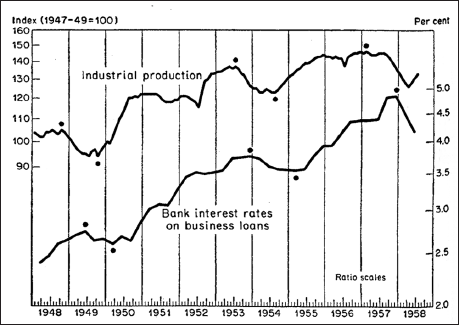
October 20, 1958
LONDON—The first thing that impresses the traveler who makes infrequent visits to a country is the change in the physical appearance. London in 1947 was still in large part a scene of ruins. By 1951 incredibly little progress had been made. Today, though there are still here and there jagged brick walls and unfilled excavations, the restoration, with many modern office buildings and new housing developments, seems almost complete. The improvement in the dress of the people, since 1947, is dramatic. The shops present a similar contrast—but the prices seem incredibly high, and comparing them with British wage statistics, one wonders where the purchasing power comes from.
The physical change in England is, of course, confirmed in the national income statistics, in the improvement in dollar and gold reserves, and in the strength of the pound sterling. Transferable nonresident sterling has reached practically complete convertibility. One of the most remarkable developments of the postwar period, in retrospect, has been the way in which the British have been able to maintain the pound sterling as the dominant currency of international trade, though it is tied, not to gold, but to the dollar. The tail, so to speak, has triumphed over the kite. The explanation is complex; but part of it is the superiority of British banking brains and British financial know-how.
COUNTERPROPOSALS
A chief topic of discussion here is the new common market and the British counterproposals for a free-trade area. The common market (or European Economic Community, EEC) is now, at least on paper, a fact. Under the Treaty of Rome the six countries of Belgium, France, Germany, Italy, the Netherlands, and Luxembourg have established a customs union which is to reduce and finally abolish tariffs among the six over a period of twelve to fifteen years, and maintain a common tariff, equal to the present average tariffs of the six, against all non-member countries.
The British, partly because of their ties with the other countries of the Commonwealth, and partly because of the political nature of the proposed common market, have refused to join but have proposed, as an alternative, that Britain, the six, and ten other countries, now members of the OEEC (Organization for European Economic Cooperation), form a free-trade area that would reduce and abolish tariffs among the seventeen members over a fifteen-year period, but would allow each to retain its own tariff schedule against non-member countries.
Reginald Maudling, who heads the committee negotiating for Britain, has objected to the proposed common market of the six on the ground that British goods would have to pay a higher rate of duty in the Dutch market, say, than German goods. He regards this as “discrimination.” He has expressed the fear that the six countries may pursue “inward-looking” or “trade diverting” policies rather than “outward-looking” or “trade creating” policies—in other words, they may concentrate more on expanding trade among themselves than on maintaining imports from “traditional suppliers.”
DOUBLE STANDARD
All these objections seem thoroughly justified. But if they seem valid for the British, they seem equally valid for ourselves. Why have American officials encouraged a common market from which the U.S. is to be excluded? Why, for that matter, are they encouraging a free-trade area from which the U.S. would be excluded? One can understand how they might take the position that it is no business of ours either way—unless discrimination against American goods turned out to be more serious, on net balance, after the EEC or the FTA became actualities. But it is a strange double standard of economic theory or economic morality for our officials to give their direct encouragement to a common market or a free-trade area for other countries, on the ground that freer trade among them is the best economic medicine, while we ourselves refuse to have anything to do with it, preferring to maintain protection, high tariffs, quotas on imports, and export subsidies, and dumping as a result of our farm price support program, and even accept discrimination against American exports in order to go it alone with our protectionism.
October 27, 1958
PARIS—The overwhelming popular endorsement of the new Constitution, which meant the overwhelming popular endorsement of the leadership of de Gaulle, has given a great lift to the French spirit and to French hopes. This increased confidence is, of course, primarily political and military. If de Gaulle is able to unify France, if he is able to bring peace in Algeria, if he is able to make France once more a bastion of NATO, the whole outlook for the West will become brighter.
This surge of confidence has had its immediate economic effect in encouraging a return of capital to France. It improves the long-term economic outlook. But the immediate problems are still grave, and above all the problems of the budget and of inflation. The officially estimated deficit for the present calendar year is 600 billion francs (about $1.4 billion), but most observers think it will run higher. And the budget for 1959, though it has not yet been presented, is widely expected to run to still larger expenditures and a still larger deficit. This is because increased authorizations have been voted or promised in the past. De Gaulle himself has promised increased spending for his Algerian development program.
MOUNTAIN OF SUBSIDIES
Among those who are concerned by this situation, however, there is widespread hope that de Gaulle and Finance Minister Pinay may make a thorough re-examination of the budget to find economies that will offset the promised new expenditures in Algeria. These economies, of course, will be tremendously difficult politically. For what unbalances the French budget is truly a mountain of welfare programs and subsidies—for “investment,” for social security, for the railroads, for coal, for wheat, for gasoline, for milk, for beet sugar, for chocolate.
Moreover, some authorities who have analyzed the French inflation point out that even the budget deficit, great as it is, has not been the chief cause of the inflation of the last six years. They blame the policy of the Bank of France. Between December of 1952 and September of this year, for example, the bank’s advances to the government increased by 464 billion francs. But the bank’s extension of “medium-term” credits increased by 1,004 billion francs. In other words, only about a third of the inflation (i.e., of the resulting increase in the money supply) was the consequence of the budget deficit, whereas about two-thirds came from the increase in medium-term credits. These credits are chiefly for housing; others are for the purchase of machinery by French industry. They are actually twenty-year loans; but they are called medium-term (moyen terme) because the government has agreed to take them off the bank’s hands at the end of five years.
TIGHTENED CREDIT
Critics of this policy contend that it is a gross violation of all central bank principles to discount loans running for twenty or even for five years. They argue that it is absurd to discount three-month bills at 5 percent, and to discount twenty-year paper at an effective rate of only 4 percent.
In the last year or so credit has been considerably tightened, but through quantitative controls rather than through a flat increase of the discount rate. Ceilings are now placed both on the borrowing of each commercial bank from the Bank of France and on the loans that the commercial banks may make. There are a series of such ceilings. The first amounts to 65 percent of the ceiling on a bank’s borrowings as of July 1, 1957. On such borrowings the commercial bank paid a 5 percent (now reduced to 4½ percent) discount rate. On any borrowing above this of 10 percent or less it paid in addition a penalty rate of 2 percent. If it broke through this second ceiling it paid a penalty rate of 4 percent up to a third ceiling.
These quantitative controls and penalty rates have slowed down the inflation considerably. But they take nearly all the flexibility out of the money market. They favor established borrowers at the cost of new enterprises. They lead to an uneconomic allocation of credit and production.
But the new government seems more determined than its predecessors to make courageous reforms.
November 3, 1958
BRUSSELS—Now that the Brussels World’s Fair has closed, we may take stock of the American exhibit. On net balance it must be set down as a missed opportunity.
Our exhibit had, of course, virtues as well as faults. The American pavilion, from the outside, was a circle of golden beauty, especially at night. And some individual exhibits, like the Circarama, were first-rate, and made one proud to be an American. But that exhibit was made possible by a grant from the Ford Motor Co. Fund.
There were two rational objectives for an American exhibit, one narrow, one broad. The narrower objective would have been to show foreign visitors the range and quality of goods that America has to sell to the world. This would have helped to increase American exports, as well as impressed foreigners with American economic strength, versatility, and skill. This task was hardly even attempted. The only automobile shown was a 1903 Ford. The few industrial exhibits of, say, model kitchens, office machines, TV, radio, etc., were scattered and haphazard, inferior to what one might find in a typical New York showroom. In fact, the American exhibit was notable for wasted space. All this contrasted sharply with the magnificent exhibit put on by the Federation of British Industries.
PEOPLE’S CAPITALISM
The wider objective of our exhibit might have been to display the merits of the American free-enterprise system. It would not have been to show how well off we were, but how we got to be that well off, and how other nations, by following the same policies, instead of the economic dead-end street of statism, socialism, or Communism, could achieve a like result. It would have been to show, in other words, how “people’s capitalism” had provided the American masses with comforts and amenities that a king could not enjoy a century ago.
It would be unfair to say that this objective was entirely neglected. The visitor who went through the American exhibit very carefully could have found small signs telling him that one of the great secrets of American productivity was that American industry had invested an average of $14,500 per worker to provide the tools and machinery responsible for this enormous productivity.
But none of this was dramatized or pictured. The signs were so small that one wonders whether one in a hundred visitors noticed them. On the other hand, great space was devoted to apologies. There were immense black-and-white pictures of New York and Chicago that seemed deliberately intended to emphasize drabness and ugliness. In accompanying signs visitors were told that Manhattan’s buildings are “generally without rhythm in the artless gridiron,” that they “have shot up without reference to any overall scheme—merely in answer to the law of supply and demand, tempered by the owner’s judgment.”
‘PLANNING’ BIAS
Much else reflected this “planning” and anti-free-market bias. The point is not whether such criticisms were warranted, but whether they had any place in an exhibit the primary purpose of which should have been to give the best, not the worst, impression of America. No other nation whose pavilion I visited seemed to have thought it necessary to exhibit its slums and its sore spots, or to make any apology for its shortcomings.
The model for what we should have done was of course not the Russian exhibit, with its display of ruthless power, its obsession with gigantic machines, its blatant propaganda and lies (there were cars on exhibit which the well-informed say will not be in production until 1962), but the British exhibit, which, with a much smaller budget than ours, turned in a thoroughly first-rate job. Ironically, the one photograph at the fair that showed lower Manhattan as a thing of beauty was a large colored transparency at the British exhibit advertising BOAC.
Somehow the United States exhibit at the fair seemed to symbolize an attitude of national apology and mea-culpism that has grown up in our officialdom in recent years in our relations with foreign countries. We are afraid to call attention even to our real virtues for fear that foreigners will think us boastful or will feel offended.
November 10, 1958
BONN—The economic history of present-day Germany begins on a single day—June 21, 1948. This was the day of what is usually described as “the currency reform.” On that day two things happened—the old currency was abolished and a new currency substituted; and price controls (with the exception of rent controls) were abolished overnight. The very next business day, goods appeared in the shops, and enterprise began to spurt forward.
In most discussion, both in Germany and the outside world, it is “the currency reform,” rather than the abolition of price control, that gets the chief credit for the resulting economic “miracle.” But an analysis of the facts does not seem to support this conclusion. It is said that the old currency had become “worthless”—but it was “worthless” only because nobody would sell anything at the ridiculously unrealistic controlled prices. It was this that drove the Germans into a primitive barter economy. This is not to belittle the importance of the currency reform, with its insurance of a relatively stable value; but, as France and Italy have proved, with relative freedom from absurd price controls, a nation’s economy can function even after a huge inflation and with a currency unit with a value of a fraction of an American cent.
INCREDIBLE PROGRESS
After ten years the German economic miracle continues, and the most impressive evidence is in the incredible amount and quality of new building. Practically all the leading cities suffered terrific destruction in the second world war, ranging from 60 to 90 percent. Taking the country as a whole, it is estimated that before the war the number of dwelling houses (or dwelling “units”) was 11.5 million. Of these about 2,250,000 were totally destroyed and 2.5 million so damaged as to become uninhabitable, making a total effective destruction of some 4,750,000. The proportional damage to office buildings and factories was presumably much worse, because of the concentration of bombing in the center of big industrial cities. Yet one can stand at many points of Bonn, Cologne, Düsseldorf, and Frankfurt and see nothing but new buildings, nearly all looking modern, substantial, even luxurious. Since 1950 Germany has built new dwelling units at an annual rate of 540,000. If this rate is continued, the housing target of the government will be achieved by 1962 or 1963.
The Germans themselves attribute their economic miracle, in the recent words of Karl Blessing, president of the Bundesbank (Germany’s central bank), to their trust “in a free-market economy and in private initiative.” And this explanation is correct. But it is necessary to add that the German economy, like the Swiss, is only relatively, not absolutely, a free-market and private-initiative economy.
PERSISTENT PROBLEM
Take housing, for example. A large percentage of it, renting for certain maximum rents, has been built with the help of state subsidies. Like all subsidized housing, in England, France, or at home, it can usually be quickly recognized by its regimented or barracks-like quality. For new non-subsidized housing or office buildings, there is no rent control, but rent control is still kept on old housing, which explains why it is so seldom renovated or adequately repaired.
In spite of the incredible economic renaissance of Germany, and its success in maintaining, with Switzerland, one of the two hardest currencies in Europe, it has not wholly escaped from the problems and dangers of inflation. Since 1951 the consumer price index has risen from 108 to 119, though it has been steady since January. The inflationary pressure comes from three sources. Wages, particularly in the building industry, have been pushing upward. The favorable balance of trade has led to the domestic money supply increasing more than the domestic supply of goods. And there are heavy and increasing drains on the budget. As one example, social-security payments now go up automatically with a rising wage index.
The political problem of inflation in Germany, in short, is not unlike that in the United States; and our present election results are likely to make our own inflationary pressures greater rather than less.
November 17, 1958
ROME—The clash between the British and French over the proposed free-trade area for seventeen countries versus the common market for six has underlined the fact that the difference between the two is not merely technical but one of basic concept. The free-trade area contemplates a mutual lowering of tariffs among seventeen European nations over a period of fifteen years, with each nation free to set its own tariffs against nonmember countries. The common market plans a mutual lowering and final abolition of tariff barriers among six nations (France, Germany, Belgium, the Netherlands, Luxembourg, Italy) over twelve to fifteen years, but insists these countries must maintain a common tariff, equal to the present average tariffs of the six, against all nonmember countries.
Each plan has its difficulties. The French point out that in the proposed free-trade area exporters of nonmember countries could ship their goods to whichever of the seventeen countries had the lowest tariff for their particular products, and that it might be extremely difficult to prevent transshipment free of duty to other countries within the free-trade area. The French seem to have little faith in the British schemes for certificates of origin, compensating duties, and so on. On the other hand, when the two projects are compared, it becomes increasingly clear that the British proposal for a free-trade area would really tend toward freer world trade, whereas the French-inspired common market might tend toward a perpetuation of protectionism, discrimination, planned economies, and inflationary pressures.
WORKABLE? DESIRABLE?
There are two main questions to be asked about the common market. Would it work as planned? And, assuming that it would work, would it be desirable?
When we consider the first question, we are confronted by a problem that is being treated very lightly and casually but which is central and crucial. This concerns the soundness and stability of each national currency. If any nation of the six has more inflation than another, if the real value of its currency falls with relation to the others, it is obvious that the common market will break down. Unless there is complete convertibility of each currency into the others, the common market is merely a name. But if there is such convertibility, and if one currency, say the French franc, is overvalued in the official rates of exchange, then France will develop a chronic deficit in its balance of payments, and the other countries will not be willing to extend it credit indefinitely for the purpose of subsidizing its internal inflation.
Even if we assume that this problem can be successfully surmounted, however, we must ask whether the common market would be desirable. And in regard to this question there have been rising doubts, not only among officials in countries outside the proposed common market, but among thoughtful persons within the common-market countries, and among genuinely liberal economists.
THE DANGER
Outstanding among the critics, for example, is the German-Swiss economist Wilhelm Röpke. Röpke points out that if each country concerned were willing to return to an internal free market economy and monetary discipline, and to lower tariffs of its own free will, for the benefit of its own consumers, there would be no need of a formal common market. On the other hand, if any one of the member countries fails to accept a market economy and monetary discipline the common market cannot function. The common market will not relieve any member country of the necessity of re-establishing free convertibility for its money.
Yet there is great danger that the countries in which inflationary pressures, the welfare state, a planned economy, and a philosophy of “full employment at any price” have gone farthest will push the other member countries in the same direction in order to “harmonize” production costs by raising rather than lowering them. And the greatest danger is that the common market, instead of “integrating” Europe, may disintegrate it by breaking it into rival blocs discriminating against each other.
November 24, 1958
The late Lord Keynes preached two great remedies for unemployment. One was deficit financing. The other was artificially cheap money brought about by central bank policy. Both alleged remedies have since been assiduously pursued by nearly all governments, and are still being assiduously pursued by our own. The result has been worldwide inflation and a constantly shrinking purchasing power of monetary units. But the success in curing unemployment has been much more doubtful.
In Newsweek April 28 I published a table comparing the deficits and unemployment for the ten years from 1931 through 1940. The average annual deficit in this ten-year period was $2.8 billion (equivalent to nearly $16 billion today as a comparable percentage of national income), yet unemployment then averaged nearly 10 million, or 18.6 percent of the total working force.
Does cheap money have any better record as a cure for unemployment? Here is a table covering the twelve years from 1929 through 1940 inclusive, comparing the average annual rate of prime commercial paper maturing in four to six months with the percentage of unemployment in the same year. Both sets of figures are from official sources.
| Year | Commercial Paper Rate | Percentage of Unemployment |
| 1929 | 5.85% | 3.2% |
| 1930 | 3.59 | 8.7 |
| 1931 | 2.64 | 15.9 |
| 1932 | 2.73 | 23.6 |
| 1933 | 1.73 | 24.9 |
| 1934 | 1.02 | 21.7 |
| 1935 | .75 | 20.1 |
| 1936 | .75 | 16.9 |
| 1937 | .94 | 14.3 |
| 1938 | .81 | 19.0 |
| 1939 | .59 | 17.2 |
| 1940 | .56 | 14.6 |
In sum, over this period of a dozen years low interest rates did not eliminate unemployment. On the contrary, unemployment actually increased in years when interest rates went down. Even in the seven-year period from 1934 through 1940, when the cheap-money policy was pushed to an average infra-low rate below 1 percent (.77 of 1 percent), an average of more than seventeen in every hundred persons in the labor force were unemployed.
Let us skip over the war years when war demands, massive deficits, and massive inflation combined to bring overemployment, and take up the record again for the last ten years:
| Year | Commercial Paper Rate | Percentage of unemployment |
| 1949 | 1.49% | 5.5% |
| 1950 | 1.45 | 5.0 |
| 1951 | 2.16 | 3.0 |
| 1952 | 2.33 | 2.7 |
| 1953 | 2.52 | 2.5 |
| 1954 | 1.58 | 5.0 |
| 1955 | 2.18 | 4.0 |
| 1956 | 3.31 | 3.8 |
| 1957 | 3.81 | *4.3 |
| 1958 (July) | 1.50 | *7.3 |
It will be noticed that though the commercial paper interest rate in this period averaged 2.23 percent, or three times as high as that in the seven years from 1934 through 1940, the rate of unemployment was not higher, but much lower, averaging only 4.3 percent compared with 17.7 percent in the 1934–40 period.
And within this second period itself the relationship of unemployment to interest rates is almost the exact opposite of that suggested by Keynesian theory. In 1949, 1950, 1954, and July of 1958, when the commercial paper interest rate averaged about 1½ percent, unemployment averaged 5 percent and over. In 1956 and 1957, when commercial paper rates were at their highest average level of the period at 3.56 percent, unemployment averaged only 4 percent of the working force.
In brief, neither deficit spending nor cheap-money policies are enough by themselves to eliminate even prolonged mass unemployment, let alone to prevent unemployment altogether.
The only real cure for unemployment is precisely the one that the Keynesians and inflationists reject—the adjustment of wage rates to the marginal labor productivity or “equilibrium” level—the balance and coordination of wages and prices. When wage rates are in equilibrium with prices, there will tend to be full employment regardless of whether interest rates are “high” or “low.” But regardless of how low interest rates are pushed, there will be unemployment if wage rates are too high to permit workable profit margins.
*Unemployment percentages before 1957 are based on Department of Commerce “old definitions” of unemployment; for 1957 and 1958 they are based on the “new definitions,” which make unemployment slightly higher—4.2 percent of the labor force in 1956, for example, instead of the 3.8 percent in the table.
December 1, 1958
MADRID—Spain today has one foot in the present age, the other in the past. It is trying to jump without intermediate steps from the candle to the fluorescent light, from the burro to the Buick. One drives out of a beautiful, expanding modern Madrid to villages where people live much as they did centuries ago. In comparison with all other Western European countries (except Portugal), the Spanish people still have an extremely low standard of living. As one editor put it to me: “We have an Arab economy—without the oil.”
If Germany is the most dramatic example in Western Europe of the miracles of recovery and production that can be brought about by monetary discipline and a free economy, Spain is the outstanding demonstration of how an economy can be unbalanced and shackled by socialism, government planning, and a tangle of interventions and controls.
Take the situation in automobiles. Unless you are a diplomat or have special governmental pull, it is practically impossible to import a foreign car. In fact, the hardest thing to get in Spain seems to be an import license for almost anything at all. Major auto companies are directly or indirectly government-owned or government-operated.
HOW TO GET A CAR
If you want a SEAT (licensed by Italy’s Fiat), you must first file an application accompanied by $400 (translating pesetas into dollars at 50 to 1). A year or so later you may be notified that your car is ready. You must then pay, before delivery, 100 percent of the price of the car—say $2,800. A month or two later you may get actual delivery. But if you sell the car on the black market you may get almost double what you paid for it. At present, I am told, there are 22,000 signed orders for SEAT’s, each accompanied by $400, yet the total production of SEAT’s this year will be only 10,000 and 12,000 next year.
American industrialists here tell me that they could sell 20,000 farm tractors over the telephone if they could get the import licenses. But the government insists that the farmers can wait until domestic industrial production is adequate to take care of their needs. All this, of course, slows down both Spanish agricultural and industrial growth.
Special permission must be obtained not merely to go into a new business, but to manufacture a prescribed maximum of a specific thing. Thus in September a number of firms were finally authorized to make television sets. The Spanish Marconi Co. was allowed to make 5,000; the Standard Electric, 5,000; the Spanish RCA, 3,500 sets, etc.
WHY IT FUNCTIONS
There is extensive price fixing and completely unrealistic rent control. As a result there are periodic shortages of, for example, oil, eggs, potatoes. Most new apartments are not rented but sold. There are periodic power shortages in Madrid, and the electricity is rationed or turned off. There has been great inflation. Between 1950 and 1957 the wholesale price index advanced 84 percent. Between July 1957 and July of this year the official cost-of-living index jumped 13 percent. The official rate for the peseta is 42 to the dollar, but the free-market rate in Tangier has been between 58 and 60.
What is amazing is how such an economy functions at all. And yet it does, and in some directions shows surprising growth. One reason seems to be that many of the controls that exist on paper are evaded or laxly enforced. It is widely admitted that the Spanish economy has been saved from grinding to a halt by the smugglers and the black marketeers.
The other main reason for Spain’s recent economic progress is that Franco has brought and kept domestic peace and order. All criticism of his economic policy (voluble in private conversation, but prohibited in the press) is tempered by the feeling that Franco is still the only alternative in Spain to the nightmare of Communist rule. Peace and order have enabled people to work, and the workers work hard for incredibly long hours. But Spanish recovery would jump forward dramatically if Franco could be brought to see that while a rich country does not need socialism, monopolies, and controls, a poor country cannot afford them.
December 8, 1958
A visit to seven European countries in a total of eight weeks is apt to produce kaleidoscopic impressions, but one or two stand out clearly. The first is a striking growth in prosperity compared with ten or even five years ago. Everywhere people are better dressed. Almost everywhere there is an astonishing amount of new building. This is most impressive in West Germany; but almost as remarkable is the new building in Belgium and in the northern half of Italy.
This new building has gone on in spite of—and even partly because of—rent control. All seven countries (except Belgium) have retained some sort of rent control. This usually takes the form of rent control on old houses and freedom from it on new ones. The result is increasing disrepair in old housing but some incentive to new housing, to which is commonly added the incentive of direct or indirect state subsidies. Where, because of the extent of inflation, rent control is most out of line with realities, as in France, the dilapidation of old housing and comparative lack of new housing is most noticeable.
BRANDS OF SOCIALISM
What stands out is not the differences in the economic policies of the various countries of Europe but the similarities. This applies even to Spain, which is under a dictatorship and still seems in large part cut off from the rest of Europe. Though all of Europe has been moving in the last five or ten years toward a relaxation of controls, most European economies are still marked by a continuation of socialism, protectionism, deficits, and inflation. While European “democratic” leftists have for twenty years been denouncing the “reactionary,” “dictatorial,” and “Fascistic” policies of Franco, it is hard, economically, to distinguish between their policies and his.
It is not easy to describe the difference, for example, between Italy’s Socialism of the left and Franco’s Socialism of the right. The Italian Government, through its holding company, Istituto per la Ricostruzione Industriale, popularly known as IRI (pronounced Erie), controls or owns stock in most large Italian industrial companies. The Spanish Government owns or controls large industries through a similar agency, Instituto Nacional de Industria, the INI. Both organizations came into existence because of an alleged emergency, but neither government seems in any haste to sell its securities back to private hands. If Italian industry has forged ahead faster than Spanish it is partly because IRI makes more effort to emulate the principles of private enterprise than INI, and partly because Italy does not put the appalling obstacles in the way of new private industry that Spain does.
WHAT WE COULD DO
Yet what is most puzzling in Europe is American policy. Why, for example, do we give our actual support and blessing to the proposed six-nation “common market”? This would discriminate against American goods, make it more difficult on net balance for American exporters to sell to the countries involved, divide Europe into rival trade blocs, and tend to increase, and perpetuate bureaucratic controls and protection rather than to move toward free trade. Why do we in Spain (or anywhere else) pour in American aid that obviously goes to subsidize foreign socialism and to prolong government controls, which in turn retard rather than promote economic growth and freedom?
There are two main things that we could do, in the economic sphere, for Europe and the rest of the world. The first would be to keep the dollar strong and beyond suspicion, a hitching post and a model for other currencies until they are restored to soundness. The second would be to open our markets to European goods, to encourage European industrial growth through the self-supporting and self-respecting method of trade, not aid. We are doing neither. At home we are pursuing policies of inflation, undermining the integrity of the dollar. In trade we are moving toward more protectionism, exclusionism, and quota systems. Abroad we are subsidizing, at the expense of the American taxpayer, exchange control, socialism, and inflation. Our so-called “foreign economic policy” is in need of thorough reform.
December 15, 1958
During the second world war there appeared a book called Defense Will Not Win the War, by W.F. Kernan. Its chief importance lay in the title, which stated a self- evident truth. No war is ever won by defense alone.
This applies also to a so-called cold war. We are in the present cold war whether we want to be or not; it is being persistently and relentlessly waged against us. And if we lose it, through appeasement, retreat, or by trying to pretend that it is not going on, we shall surely lose the total war if it comes or be forced to surrender before the mere threat of such a war.
The present Berlin crisis is “new,” and yet depressingly familiar. We accepted an arrangement in 1945 that enables Russia to put the squeeze on Berlin at any time it sees an advantage in doing so. It did so in 1948. Why were we taken by surprise by the new threats? Why did we act as if we were improvising an answer to a totally unexpected move? Why, above all, was our answer (until recently) merely defensive, and in at least one statement by Secretary Dulles, even ambiguous?
If we had warned Russia immediately that we meant to stand by our obligation to defend and maintain the status of Berlin against any breach by threat or force; if we had replied at the very beginning that we would be willing to discuss a peaceful change in the status quo in Germany but proposed that this should consist in a free and unintimidated vote of the East Germans as to whether they wanted to reunite with West Germany, much needless anxiety might have been saved.
ANSWER EVERY LIE
We might even have used the occasion to suggest that Russia keep her treaty agreements to allow free and secret elections in Poland, Rumania, Hungary, and Bulgaria for governments of their own choice. If Russia were shown that her diplomatic and propaganda offensives might boomerang, she might be less quick to try them.
This need to take the offensive in the cold war, for our own ultimate peace and safety, was emphasized by George F. Kennan in a lecture last year. Speaking of the way in which we often dismiss Soviet lies as “just propaganda,” he said:
“I’m always startled at the phrase ‘just propaganda.’ Why just? Is not propaganda a serious and important force in world affairs? . . . A wise Western policy will insist ‘no single falsehood or distortion from the Soviet side should ever go unanswered.’ This will be tiresome. We do not like repetition. But we cannot afford to dispense with it. Truth does not win over error on its merits. It, too, has to be assiduously propagated.
“I have asserted that there is nothing that could be said to Soviet leaders in the space of a few days that would change their strangely corrupted mentality. But there are things which could be said every day over the course of years which would exert a useful discipline upon them, would make it harder for them to ignore the distinction between the real and the unreal, and would place limitations on their use of falsehood as a weapon of political policy.”
ABSURD OUTPUT CLAIMS
To apply this to the particular purview of this column, in recent months a flood of nonsense has been pouring almost unanswered through the American press and through scores of speeches in which increasingly absurd claims of Communist Russia and Communist China regarding not merely military, but overall civilian production, are solemnly accepted as fact. The effect of this nonsense is to condition people to assume that the terror, force, and regimentation of Communism can increase production and even living standards faster than the freedom in choice of jobs and the free consumer choice of capitalism. Many officials of our own government seem to accept these claims at face value. Their real duty is to check the evidence, or lack of evidence, for every such claim, whenever made, and constantly present the enormous counterevidence. It is important to determine the truth about Russian military production. It is no less important not to be taken in by the brazen propaganda about production miracles and soaring living standards in Russia or Communist China.
December 22, 1958
The recent concern about our loss of gold cannot be dismissed as unwarranted. Between Feb. 19 and Dec. 10, 1958, the United States gold stock declined by $2.2 billion, a drop already exceeding that for any previous year.
This country, it is true, still holds $20.6 billion, more than one-half of the free world’s monetary gold. Yet behind the recent rate of gold loss is a situation that is more serious. Of our gold reserves of $20 billion on Dec. 3, $11.7 billion was required as the 25 percent legal cover for Federal Reserve note and deposit liabilities. This left “free” gold reserves of only $8.3 billion. And United States short-term liabilities to foreign countries on official as well as private account amounted in August 1958 to $14.2 billion.
The United States, in other words, owes foreigners more in dollars than it holds in excess gold reserves. If these foreigners elected to withdraw all their liquid dollar assets in the form of gold, they would more than wipe out the “free” gold we now have. It is also worth keeping in mind that if Congress had not reduced the gold-reserve requirements in 1945 to only 25 percent, instead of the previous 35 percent against deposits and 40 percent against notes, the amount of “free” gold today would be only $2.2 billion.
TO RESTORE TRUST
The probability that foreigners would actually seek to withdraw all their dollar balances in the form of gold is at the moment low. They can do so only through their central banks. They prefer, moreover, to keep a certain amount of dollar balances here because they earn interest, and because they are needed for working capital. In addition, foreigners owe American creditors dollars on long-term account.
But we cannot remain complacent about the situation. As the First National City Bank of New York points out in a sober discussion:
“A flight from the dollar—not only by foreigners but by Americans as well—might well be touched off if the idea gained ground that conditions were developing under which a rise in gold price would appear inevitable. Because of the strategic importance of the United States and the dollar, foreign bankers, businessmen, and investors are—understandably—watching how we handle our monetary and fiscal affairs. What counts is the determination of the United States Government and of the Federal Reserve System to safeguard economic and monetary stability and thus prevent—by deeds, and not by words alone—spread of doubts concerning the assured maintenance of dollar stability. The fact that excess gold reserves are still so far above minimum requirements gives time—but not indefinite time—to repair policies that hurt trust in the dollar.”
FIVE POSSIBLE STEPS
Here are some of the specific steps we might consider to keep or restore confidence in the dollar:
1—Let the Federal Reserve definitely abandon cheap-money policies. Moderately firm interest rates will not only discourage the withdrawal of foreign balances but will stop encouragement to credit expansion.
2—Congress could show its own determination to protect the integrity of the dollar either by restoring the pre-1945 Federal Reserve gold-cover requirements or by otherwise limiting further credit expansion.
3—The situation plainly calls for a drastic reduction in foreign aid. It is absurd to increase inflation here, and to undermine our own currency unit, by giving away more dollars to countries that already have deposits or short-term claims here in excess of our free gold supply.
4—We must immediately put our own fiscal house in order, drastically reduce our prospective $12 billion deficit in the current fiscal year, and try to eliminate any deficit in the next fiscal year. This could be accomplished by drastic cuts in foreign aid, in farm subsidies and price supports, and in a score of other directions.
5—Revise the Federal laws that put grossly excessive bargaining power in the hands of union leaders, make it all but impossible for employers to prevent “wage inflation,” and adversely affect our competitive position and our balance of trade.
December 29, 1958
Senator Johnson, the Majority Leader, wants Congress to investigate inflation. “We have no clear-cut idea,” he says, “of what is causing inflation and what should be done to prevent it.”
This is a disheartening comment. Inflation has been progressing in this country for a quarter of a century. Though there may be difference of opinion about details, there is no longer any excuse for ignorance of its main direct cause and cure. The direct cause of inflation is the continuous increase in the supply of money and credit. Most of this is in turn caused by a chronic budget deficit. The cause of the present inflationary fears is precisely the “liberal” spending policies that Senator Johnson and his Democratic majority will be pushing for in the new Congress. The cure would be to abandon these policies.
Though the action of security prices since last summer has been flashing a warning signal for all to see, this warning is being smugly ignored in Washington. Officials offer assurances for the immediate future. But it is the long-range considerations that are causing uneasiness. These have been admirably summarized by the Guaranty Trust Co. of New York in its December survey:
THE LONG-TERM VIEW
“In connection with the Federal budget, for example, misgivings do not arise merely from this year’s prospective deficit of $12 billion . . . serious as that is. They arise from the fact that this deficit is symptomatic of a rising tide of expenditure over which no one seems to have any real control. The situation has been developing for a generation and, far from showing signs of correcting itself, appears to be going from bad to worse. Economy drives by the Administration and Congress tend more and more to end in futility. There are too many continuing ‘programs’ that involve commitments for years in advance—the defense program, the highway program, the housing program, the social-security program, the farm program, the foreign-aid program, veterans’ programs, and all the rest.
“Each of these programs, of course, has its own pressure group or groups and its own army of bureaucrats whose jobs depend upon it—and most of whom, no doubt, sincerely believe that, however desirable governmental economy may be as a general principle, their own program is so worthy that it should not only be continued but expanded. The combined result of these programs is a swelling volume of expenditure which, despite tax rates rising to almost confiscatory levels, has produced deficits in 23 of the last 28 fiscal years.
“Yet nowhere in government is there serious talk of abandoning any major spending program. The most that anyone hopes for, apparently, is to retard the rate of growth and oppose the addition of still other programs. This is becoming increasingly difficult as state and local governments call upon Washington for aid. . . .
“It is not the fear of the 1959 deficit, unfortunate as this is, that basically causes distrust of the dollar. It is the growing fear of deficit financing as a ‘way of life’.”
REMEDIES
What can be done about inflation and the growing fear of inflation? We might put detailed remedies under four heads:
1—Futile as it sometimes seems, those who (like Budget Director Stans, Secretary Benson, Senator Byrd, editors, writers, private organizations like the Tax Foundation, and chambers of commerce) have been pointing out in detail where budget economies should be made, must keep up their insistence on specific savings.
2—We are unlikely to get reform until we have a really responsible executive budget. This means that the President must be given at least as much control over (and responsibility for) the Federal budget as, say, the governor of New York has over his state’s budget. (For details, see this column, Nov. 23, 1953.)
3—We must recognize the fallacies in the Keynesian ideology, dominant for 25 years, which regards inflation as necessary for full employment and economic growth.
4—We must take the kind of measures spelled out here last week to curb excessive union-leader power and restore confidence in the dollar.

