
Chapter VI
THE PRODUCTION OF MONEY in a free society is a matter of free association. Everybody from the miners to the owners of the mines, to the minters, and up to the customers who buy the minted coins, all of them benefit from the production of money. None of them violates the property rights of anybody else, because everybody is free to enter the mining and minting business, and nobody is obliged to buy the product.
Chapter VII
INFLATION IN THE FORM of fractional-reserve banking and fiat money is ultimately a self-defeating practice. It bears in itself the germs of its own destruction and, as we shall see, deflation is the essential vehicle of this destruction. We can distinguish three scenarios of the halt of inflationary processes:1
Chapter VIII
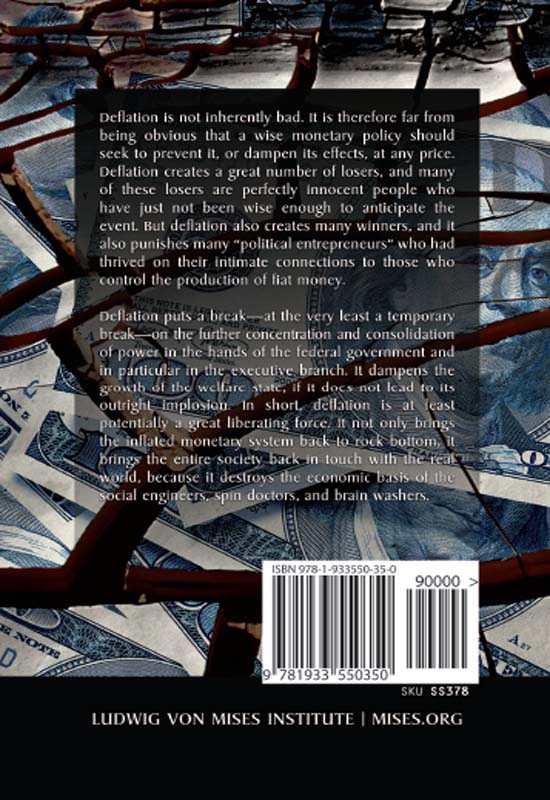
IN CONCLUSION LET US restate the main points: Deflation is far from being inherently bad. Quite to the contrary, it fulfills the very important social function of cleansing the economy and the body politic from all sorts of parasites that have thrived on the previous inflation. In a word: the dangers of deflation are chimerical, but its charms are very real. There is absolutely no reason to be concerned about the economic effects of deflation—unless one equates the welfare of the nation with the welfare of its false elites.
Back
The Economics of Prohibition
The Economics of Prohibition
The Economics of Prohibition
Title Page
The Economics
of Prohibition
Mark Thornton
University of Utah Press
Salt Lake City
Copyright Page

Copyright © 1991 University of Utah Press
All rights reserved
∞ The paper in this book meets the standards for permanence and durability established by the Committee on Production Guidelines for Book Longevity of the Council on Library Resources
Library of Congress Cataloging-in-Publication Data
Thornton, Mark.
The economics of prohibition / Mark Thornton.
p. cm.
Includes bibliographical references and index.
Foreword
Foreign wars come and go, but the Drug War is a constant of U.S. domestic policy. For nearly eight decades the government has attempted to prevent American citizens from using one or more illicit substances.
Acknowledgments
During my study of prohibition I have been helped by many friends and colleagues. Their encouragement, suggestions, and corrections made this book possible.
My gratitude and respect go to John D. Jackson, who provided the critical guidance so crucial to the completion of this project. The unceasing stream of comments and suggestions from Richard D. Ault and Leland B. Yeager contributed both insights and a broad perspective. Seth A. Anderson provided valuable suggestions and encouraged me in my efforts to find a publisher.
