
Part Two. The Bad Fascism: Germany
ONE FRUITFUL ORIGIN of much of the confusion about fascism in Germany arises out of the variety of people who hate it. Each hates it for some special reason. And while most people here abhor it for its brutal assaults upon the substance and implements of free government, there are many whose hatred is inspired by some special personal or group indignity or injustice suffered at the hands of the Führer.
Part Three. The Good Fascism: America
ON THE night of October 22, 1929, one of America’s most widely known economists addressed a great banquet of credit men. Not only were Wall Street prices not too high, he told his delighted hearers, but we were really only on the threshold of the greatest boom in the nation’s history. The prophecy evoked a burst of applause. Next morning, a few minutes after the great bell announced the opening of trading on the Stock Exchange, the storm broke.
VII. Bibliography
ITALY
Amoruso, Vincenzo, Il sindicalismo di Enrico Corradini, Palermo, 1929.
Ascoli, Max, and Feiler, Arthur, Fascism for Whom? W. W. Norton, New York, 1938.
Ashton, E. B., The Fascist: His State and His Mind, Wm. Morrow, New York, 1937.
Bonomi, Ivanoe, From Socialism to Fascism, London, 1934.
Borgese, G. A., Goliath, Viking Press, New York, 1937.
Brady, Robert A., Business as a System of Power, Columbia University Press, New York, 1943.
Cambridge Modern History, Vol. XII, Modern Age Books, New York.
Index
A | B | C | D | E
F | G | H | I | J
K | L | M | N | O
P | Q | R | S | T
About the Authors
JOHN T. FLYNN was an author and journalist, a social critic with wide-ranging interests. Born in 1882, Flynn was a graduate of Georgetown University Law School. He made his career in journalism, working for such publications as the New York Globe and the New Haven Register. During the 1930’s he wrote for the New Republic, and he also served as an adviser to the Senate Committee on Banking and Currency, economic affairs being one of his journalistic specialties. He was also a lecturer on contemporary economics at the New School for Social Research at this time.
Free Life Editions
FREE LIFE EDITIONS is an educational project formed to publish works confronting issues related to personal, social and political freedom. This includes both reprinting important libertarian classics as well as encouraging and publishing significant new contributions to the contemporary libertarian perspective. Libertarianism is for us not a closed doctrine, but a broadly construed anti-authoritarianism, a continuously developing understanding of the forms of freedom. It is to that understanding that we intend, through these publications, to contribute.
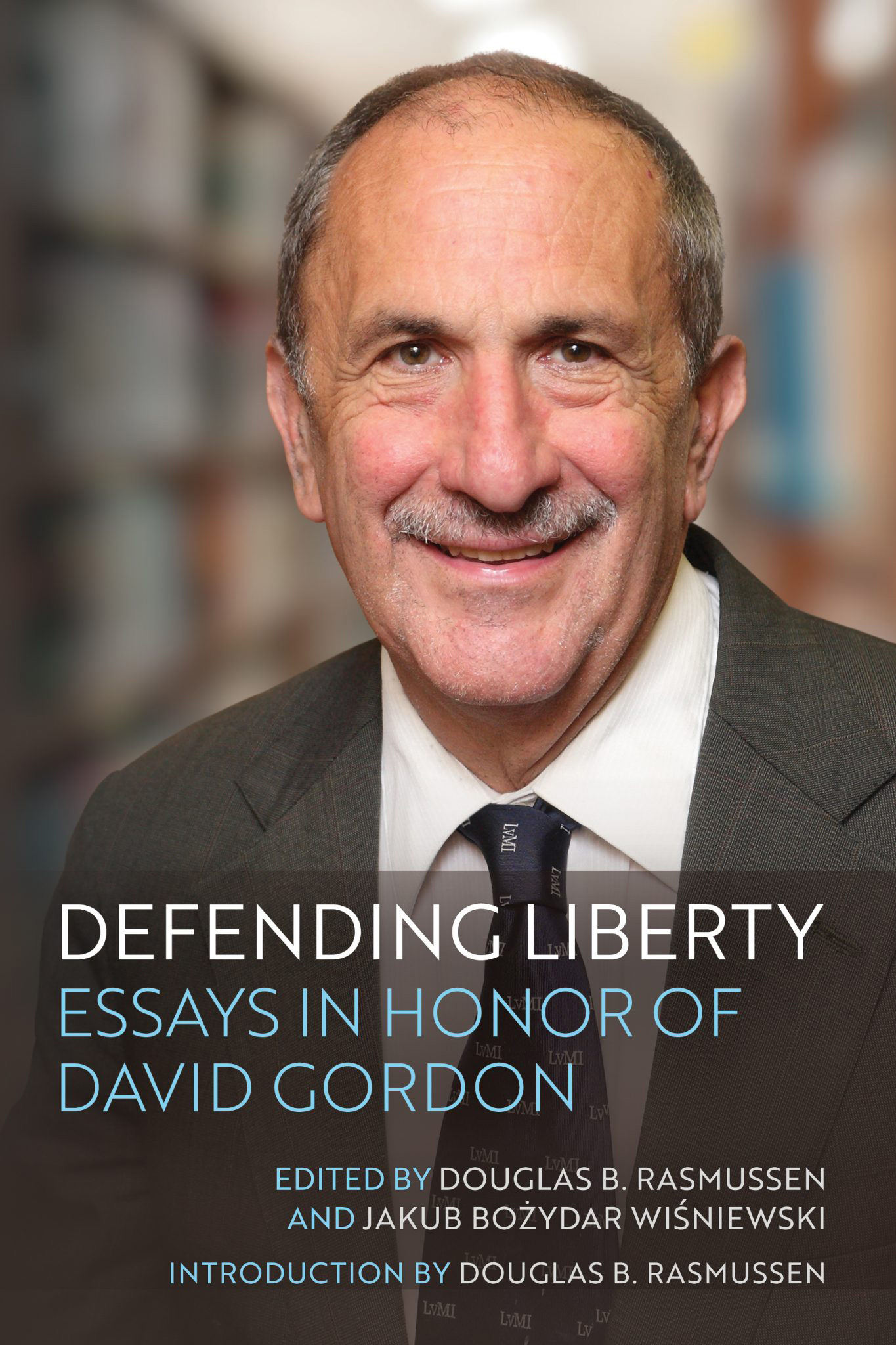
Defending Liberty: Essays in Honor of David Gordon
Htitle
Copy
THE MISES INSTITUTE, founded in 1982, is a teaching and research center for the study of Austrian economics, libertarian and classical liberal political theory, and peaceful international relations. In support of the school of thought represented by Ludwig von Mises, Murray N. Rothbard, Henry Hazlitt, and F.A. Hayek, we publish books and journals, sponsor student and professional conferences, and provide online education. Mises.org is a vast resource of free material for anyone in the world interested in these ideas.
Introduction
Introduction
The American notion [is] that the end of government is liberty, not happiness, or prosperity, or power, or the preservation of an historic inheritance, or the adaptation of national law to national character, or the progress of enlightenment and the promotion of virtue; [and] that the private individual should not feel the pressure of public authority, and should direct his life by the influences that are within him, not around him….
Liberty is not a means to a higher political end. It is itself the highest political end.
—Lord Acton
