John Law: Proto-Keynesian
[Excerpted from An Austrian Perspective on the History of Economic Thought, vol. 1, Economic Thought Before Adam Smith. An MP3 audio file of this article, read by Jeff Riggenbach, is available for download.]

[Excerpted from An Austrian Perspective on the History of Economic Thought, vol. 1, Economic Thought Before Adam Smith. An MP3 audio file of this article, read by Jeff Riggenbach, is available for download.]
From the New York Times, “Europe Is Turning Its Back on Keynes’s Cure for Recession“:
In Part One of As We Go Marching, John T. Flynn describes the rise of fascism in Italy. The following passages imply the need for two political parties.
A party on the left:
Thus in Italy, while individuals murmured against the growing debt, they continued as members of cities or villages or farming districts to fight valiantly for their share of the spendings. The people as beneficiaries were always more powerful than the same people as citizens.
[Speech given at The Economic Recovery: Washington’s Big Lie, the Supporters Summit for the Ludwig von Mises Institute, October 8, 2010.]
One of the more depressing implications of careful economic analysis is that it is very difficult to actually give away money in ways that actually benefit the people toward whom we are trying to be charitable. The law of supply is pretty robust here: if we effectively pay people to do something (stand in line for a handout), we will get more of that something (more people standing in line for a handout). You see it every Thanksgiving and Christmas: people lined up for blocks waiting for $0 food, clothing, shelter, toys, etc.
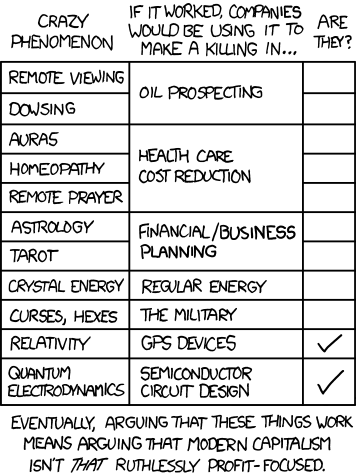
I tell my students that economics helps define the non-negotiable constraints on social reality. The principles that people respond to incentives and that people generally do more of things that they think will make them better off also help to clarify what is and isn’t (or what can and what can’t be) true. Today’s XKCD comic offers one of the best examples of this line of reasoning I’ve ever seen: if [X] really worked, then people would be able to get fantastically wealthy by doing [X].
The Brits are cutting down on their welfare state in an attempt to tackle deficits and save the state. The UK Chancellor of the Exchequer George Osborne claims the cuts of £83 billion ($130 billion) will bring the country back from “the edge of the economic abyss” and put an end to ten years of deficit spending. This may be an exaggeration, but is a welcome comment these days when destructive Keynesian economics seems to have been revived.
Since World War II, most economists have been apologists for government growth.1 Now the “experts” who never see a crisis coming tell us that we must once again abandon free-market principles to save