
22. On the Impossibility of Limited Government and the Prospects for a Second American Revolution
On the Impossibility of Limited Government and the Prospects for a Second American Revolution
Hans-Hermann Hoppe
In a recent survey, people of different nationalities were asked how proud they were to be American, German, French, etc., and whether or not they believed that the world would be a better place if other countries were just like their own. The countries ranking highest in terms of national pride were the United States and Austria. As interesting as it would be to consider the case of Austria, we shall concentrate here on the U.S.
23. The American President: From Cincinnatus to Caesar
The American President: From Cincinnatus to Caesar
Clyde N. Wilson
The great body of the nation has no real interest in party.
—James Fenimore Cooper
The American Democrat, 1838
Appendix A
Executive Usurpation: A speech by the Honorable Clement L. Vallandigham, Congressman from Ohio
Introduction
One of the greatest speeches in American history on behalf of individual freedom and against despotism, especially relating to the unconstitutional usurpation of executive powers by the president of the United States, was made by Clement Vallandigham, a Democrat congressman from Ohio.
Appendix B
Speech on the Declaration of War Against Germany By the Honorable Robert M. La Follette, Sr., U.S. Senator from Wisconsin, Opposing President Woodrow Wilson’s Request for a Declaration of War from Congress for World War I
Introduction
Senator Robert M. La Follette, Sr. (1855–1925) was one of the most courageous U.S. senators in American history. He earned the nickname “Battling Bob” for his vigorous political tactics. He was born in Primrose, Wisconsin, and worked his way through the University of Wisconsin.
Index
(Prepared by Marilyn Tenney)
AAA. See Agricultural Adjustment Act
Abraham Lincoln: His Speeches and Writings (Basler), 203n, 204n, 220n, 228n
“Acquitting Judge, The” (Williams) in For A New America: Essays in History and Politics from Studies on the Left, 1959–1967 (Weinstein and Eakins, eds.), 324n, 328n
Ackley Gardner, 598
Activism, presidential scholars’ bias toward, 3
Acton, Lord John, xviii, xviiin, 280, 670n
“History of Freedom in Christianity, The” in Essays in the History of Liberty (Fears, ed.), 670n
Contributors
• John V. Denson is editor of The Costs of War: America’s Pyrrhic Victories.
• George Bittlingmayer is professor of economics at the University of Kansas.
• Marshall L. DeRosa is professor of history at Florida Atlantic University.
• Thomas J. DiLorenzo is professor of economics at Loyola College.
• Lowell Gallaway is professor of economics at Ohio University.
• Richard M. Gamble is associate professor of history at Palm Beach Atlantic College.
• David Gordon is editor of The Mises Review.
The Philosophy of Ownership
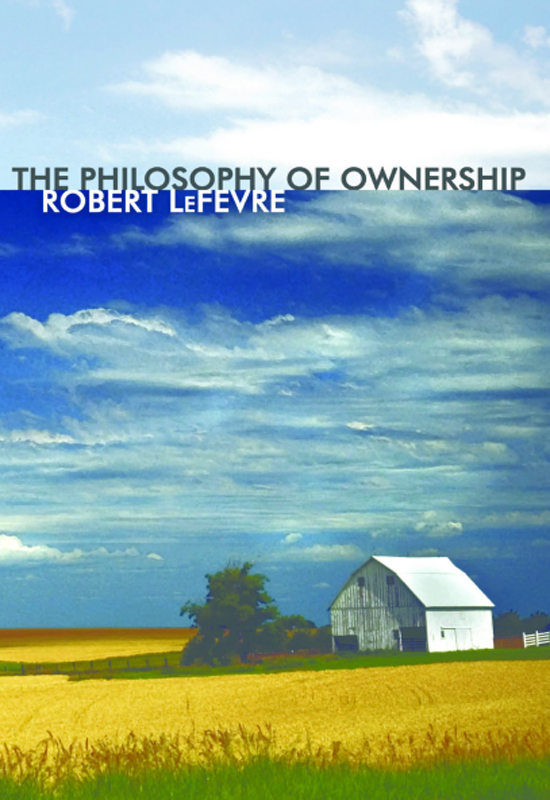
Title Page
The Philosophy
of Ownership
by
Robert LeFevre
First Printing 1966
Second Printing 1971
Copyright Page
Robert LeFevre is president of
Rampart College.
He is the author of The Nature of
Man and His Government, This Bread
Is Mine, The Philosophy of Ownership,
and numerous other published works.
A noted speaker, he conducts
seminars for advanced student and
business-oriented groups.
Chapter I. Property and Ownership
The significance of property ownership has rarely been fully appreciated. All sentient life is concerned with property, either instinctively or rationally. No organism capable of volitional action can escape the demands arising within it for some kind of property relationship. Survival of all beings capable of consciousness is predicated directly upon some kind of property relationship.
