
References
Ackerman, Bruce A. and Hassler, William T. 1981. Clean Coal/Dirty Air. New Haven and London: Yale University Press.
Anderson, Terry L. and Leal, Donald R. 1991. Free Market Environmentalism. San Francisco: Pacific Research Institute for Public Policy.
Armentano, Dominick T. 1990. Antitrust and Monopoly: Anatomy of a Policy Failure, 2nd ed.. New York and London: Holmes and Meier.
Baumol, William. 1970. Review of Buchanan (1969) Cost and Choice, in The Journal of Economic Literature. Vol. VIII No. 4.
Index
absolute liability, 101
actions, efficient (Kirzner), 46
actions, voluntary (Rothbard), 41-43
alternative, highest valued, 40
Anderson, Terry L., 89n4, 107, 114, 118n4
arbitrage, 64
Armentano, Dominick T., xiv, 1, 12n5, 40, 45
artifactual man, 46
Baden, John, 13n9, 115
bargaining process (Coase), 92-93, 96, 106-7
Baumol, William, 2, 12-13n7, 118n5
Back
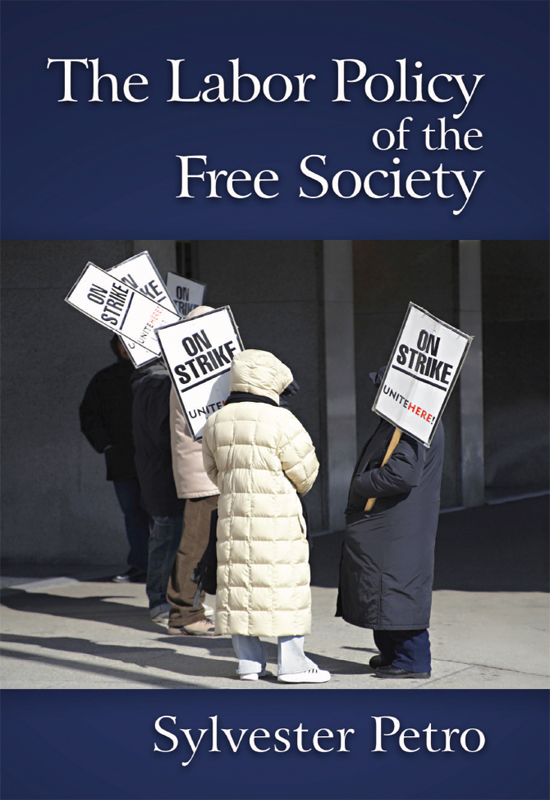
The Labor Policy of the Free Society
Title Page
THE LABOR POLICY
OF
THE FREE SOCIETY
by
SYLVESTER PETRO
PROFESSOR OF LAW
NEW YORK UNIVERSITY SCHOOL OF LAW
THE RONALD PRESS COMPANY • NEW YORK
Copyright Page

Copyright, ©, 1957, by
THE RONALD PRESS COMPANY
______
All Rights Reserved
The text of this publication or any part
thereof may not be reproduced in any
manner whatsoever without permission
in writing from the publisher.
5c
Library of Congress Catalog Card Number: 57-6822
PRINTED IN THE UNITED STATES OF AMERICA
Dedication
To
LUDWIG VON MISES
and
WILLIAM WINSLOW CROSSKEY
Since that moment when man first looked upon himself and saw the image of God, he has struggled against all the powers of nature and the supernatural, and against all the tyrannies of his fellow man, to fulfill the promise in that image. He has lived to the full, in pleasure and pain, the gregarious life to which half of his instincts and appetites committed him. And in response to the other half, he has striven in every element on earth, in the skies above the earth and in the waters under the earth, to express himself as an individual.
Preface
I have two objectives in offering this book to the public. I wish to define the essential features of the free society, and to advance certain proposals in the field of labor relations. These two objectives have, as it seems to me, many things in common, not the least of which is their common relevance to those prominent current problems which set our era apart in history. While we speak frequently of the free society, there is reason to believe that its essential nature is not clearly perceived by all its proponents.
Part I: The Free Society
Society is something temporary and ephemeral; man, however, is always man.
—Albert Schweitzer
. . . the movement in the progressive societies has hitherto been a movement from status to contract.
—Sir Henry Maine
