III. Money and Banking in the United States in the 20th Century
III. Money and Banking in the United States in the 20th Century
IV. The Case for Monetary Freedom
IV. The Case For Monetary Freedom
America’s First Free Market Gold Coins
Most people assume that governments must be the only parties allowed to mint money. Private minters, the argument goes, will put out coins of uncertain quality and take advantage of people. But not only have privately minted coins flourished; in at least one instance admitted by the U.S. Treasury’s mintmaster, the private minter had the edge over the government.
V. Real Money: The Case for the Gold Standard
V. Real Money: The Case For the Gold Standard
In chapters two and three, it was made clear that the economic shortcomings of the past were due to abuse of the gold standard, not to the standard itself. Men and governments have failed in the past; gold has not. The rule of law has been challenged by the rule of men throughout history, and this will continue. But the rule of law and the sovereignty of the people are much more likely to prevail with gold than with paper. For many economic reasons it is critical that the rule of law and gold win the great debate on monetary policy.
VI. The Transition to Monetary Freedom
VI. The Transition to Monetary Freedom
VII. The Next 10 Years
VII. The Next 10 Years
Appendix
The Purchasing Power of Gold and the Dollar, 1792-1981
The Purchasing Power of Gold and the Dollar, 1792-1981
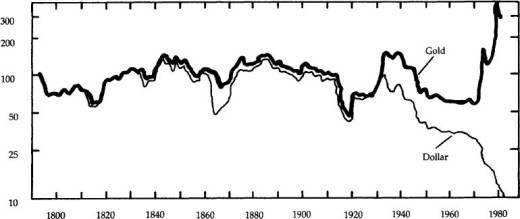
Source: American Institute for Economic Research
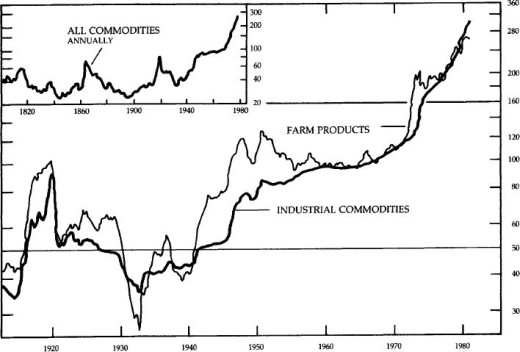
Producer Pricesquarterly
PRODUCER PRICES
QUARTERLY
RATIO SCALE, 1967 = 100
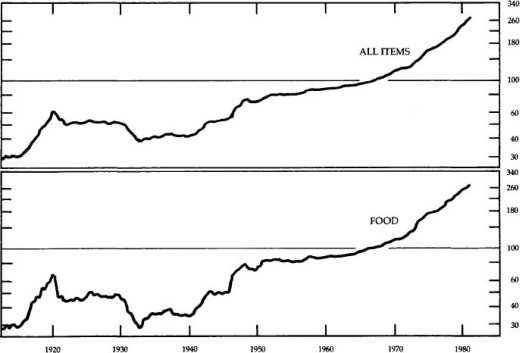
Consumer Prices All Items And Food Quarterly Averages, 1913–
CONSUMER PRICES ALL ITEMS AND FOOD QUARTERLY AVERAGES, 1913–
RATIO SCALE, 1967 = 100