
Index
A | B | C | D | E
F | G | H | I | J
K | L | M | N | O
P | Q | R | S | T
About the Author
Ralph Raico is professor of European history at Buffalo State College and a specialist on the history of liberty, the liberal tradition in Europe, and the relationship between war and the rise of the state. He is the recipient of the 2000 Gary G. Schlarbaum Prize for Lifetime Achievement in the Cause of Liberty. The author is grateful to the Independent Institute for permission to reprint some of the essays in this work.
Classical Liberalism and the Austrian School
Classical Liberalism and the Austrian School
Classical Liberalism and the Austrian School
Title Page
Classical Liberalism
and the Austrian School
Ralph Raico
Foreword by
Jörg Guido Hülsmann
Preface by
David Gordon
LvMI
MISES INSTITUTE
Copyright Page

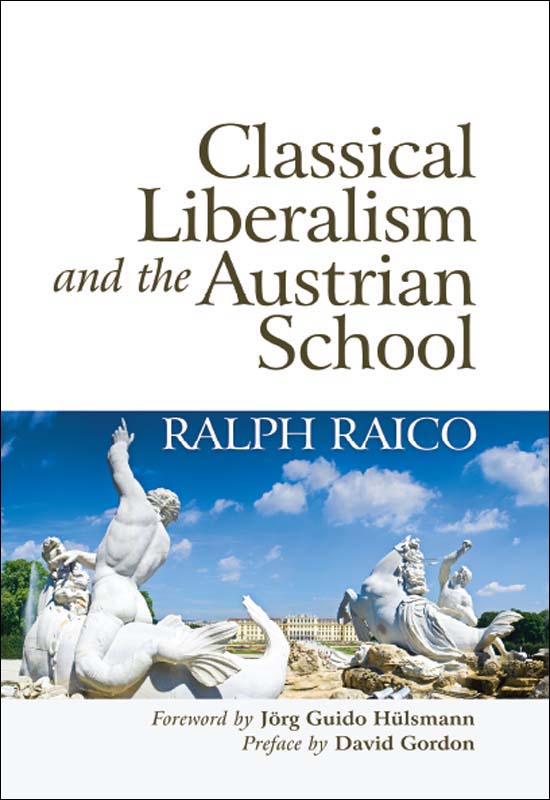
The cover design by Chad Parish shows the Neptune Fountain, at the Schönbrunn Palace, in Vienna.
Copyright © 2012 by the Ludwig von Mises Institute. Permission to reprint in whole or in part is gladly granted, provided full credit is given.
Ludwig von Mises Institute
518 West Magnolia Avenue
Auburn, Alabama 36832
mises.org
ISBN: 978-1-61016-003-2
Dedication
Dedicated to the memory of the great Ludwig von Mises
Foreword
“History looks backward into the past, but the lesson it teaches concerns things to come. It does not teach indolent quietism; it rouses man to emulate the deeds of earlier generations.”
Ludwig von Mises1
Preface
Ralph Raico in this brilliant book calls to our attention the dictum of Augustin Thierry: “The great precept that must be given to historians is to distinguish instead of confounding” (p. 136). Thierry, as Raico shows, did not always follow his own advice; but the remark perfectly describes the historical writing of Raico himself. He is master of the fine discriminations that F.R. Leavis thought essential to the task of the critic. His profound scholarship and keen intelligence make him a great historian. Indeed, he is our foremost historian of classical liberalism.
Introduction
Just a few words by way of introduction to this collection of varied essays. The title of this book and of its first essay is a misnomer, sadly advisable in order to avoid superficial confusion. That is, there was no “classical” liberalism, only a single liberalism, based on private property and the free market that developed organically, from first to last.
Nowadays, to this doctrine there is contrasted something called “modern” liberalism, which is in fact indistinguishable from democratic socialism.
