

I want to dispel the claim in the minds of the establishment media that depicts free market Austrian economists as heartless advocates against the poor and shills for the rich.
Nothing could be further from the truth. While mainstream economists pay lip service to the poor and actively support welfare payment programs to the non-working, Austrian economic analysis—based on economic theory—specifically points out how the political elites rig the system against the working class. Even more specifically, they point out how a market-based monetary system is a check on the uber-wealthy and is a mainspring source of increased wage rates and improvements in the standards of living.
While many of the statistical facts regarding incomes and wealth can be distortions, there is no denying there has been a widening gap between the economic attainments of the wealthy political elites and the working classes.
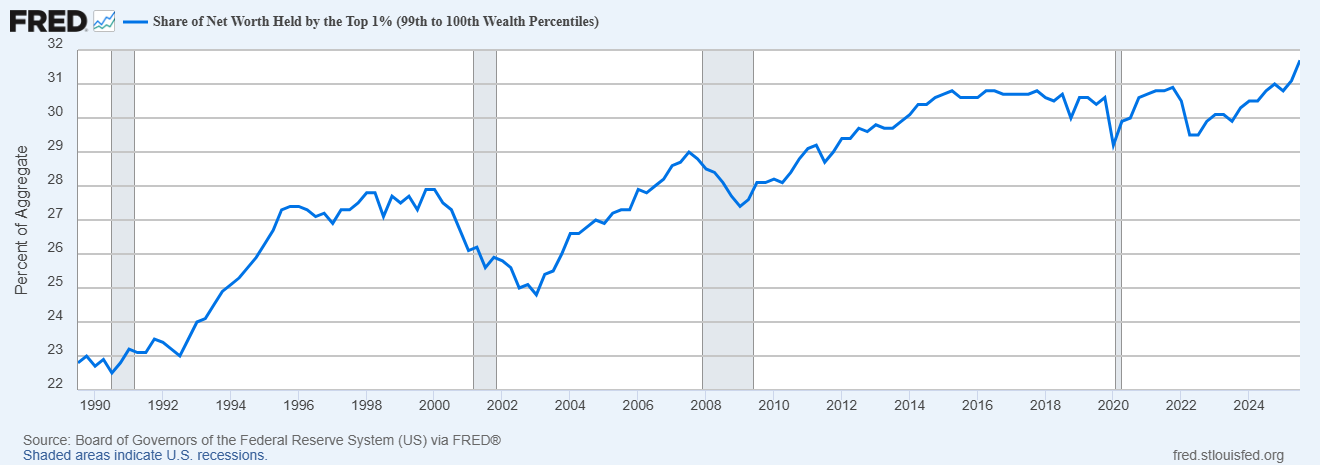
The graph shows the “net worth” estimate of wealth of the top 1 percent over time. The top possessed almost 23 percent of all counted wealth in 1990 and that increased to almost 32 percent of wealth in 2025.
https://fred.stlouisfed.org/series/WFRBST01134
A close look at the trend in wealth distribution confirms the Austrian analysis of the cause of trend changes and implies an obvious political cause and a policy solution that reverses the distortion and restores a more equitable distribution throughout the economy.
Upswings in wealth concentration are led by low interest rates and monetary expansion followed by increases in asset prices. Contractions in wealth concentration are centered on recessions as asset prices fall.
You may have heard some of the more advanced economic podcasters refer to early 18th-century Irish/French economist Richard Cantillon (pronounced “can’t-e-own”) and his famous monetary analysis called the “Cantillon Effect” to describe the current maldistribution of income brought about by central bank monetary inflation. I have also used this effect in explaining the K-shaped economy and its role in the Austrian business cycle theory.
Today, after recapping the typical introduction to the Cantillon effect, I will present my simple theoretical model of the effect based on Cantillon’s own writings. This should give you a clear idea of what the effect is and how it works. This will also show that the effect is even possible in a free-market economy and why government central banks and fiat paper money are necessary to make the “effect” a serious social problem that can lead to revolution and social destruction.
The short-hand version of the Cantillon effect is that he who gets the new money first benefits and he who gets it last—after prices have risen throughout the economy—absorbs most of the economic pain.
Your typical introduction to the Cantillon effect goes something like this: the government’s central bank increases the money supply with the new money created in banks, ending up in the hands of the rich and powerful, who benefit tremendously as a result. The rest of the people only feel the sting later on in the form of higher price inflation.
Cantillon, writing in the early 18th century, posits a free market economy in which a new gold mine is discovered. The first and most direct beneficiaries are the mine owner who is now wealthier and the miners themselves who get high wages.
They all increase their spending, including luxury goods, and this starts to raise prices of what they spend the new money on. Everyone else pays higher prices, obtains fewer goods, and is relatively impoverished as a result. The small number of people employed in and related to the mining industry are enriched at the expense of everyone else.
Extending the example to the business cycle, if the mine remains viable, the miners’ demand for meat and wine remains high, relative to bread and beer which remains lower, so do their prices, and more land will be repurposed from grain crops for beer and bread to vineyards for wine and pastureland for cattle. This changes the structure of production, requiring fewer blacksmiths, brewers, and bakers, and more cowboys, vintners, and butchers.
If the mine is inexhaustible then the economy will reach a new equilibrium. If the gold mine is exhausted of viable ore, the injections stop and the price system conducts a new allocation of resources, labor, and goods production. The economy returns to equilibrium, the distortions in wage rates that began in the mining industry are brought back towards equilibrium, but the wealth accumulations remain.
In a free market economy, the mining of precious monetary metals represents a tiny component of the overall economy and the annual additions to the monetary gold stock are a tiny fraction of the overall monetary supply. Returning to a real gold standard virtually eliminates the arbitrary increases that are politically possible with a paper or digital fiat monetary system based on fractional reserve banking.
A monetary metal system means that the value of money is likely to increase in purchasing power, rather than decrease over time, and the banking system is likely to offer savers a real return on their savings, automatically enrolling all participants in the wealth-creation process. A wealth-creation process based on actual savings means increasing wage rates and greater job stability. Such a change also means that the wealthy political elites would no longer have preferential access to easy credit or economic bailout from the keyboard accounts at the Federal Reserve.

