

If one has any awareness of the Panic of 1837 at all, one has likely been treated to the conventional story, wherein—as usual—the economic crisis and ensuing depression were supposedly caused by a lack of sufficient government regulation. In this case, the blame falls largely on Andrew Jackson and his destruction of the Second Bank of the United States. According to this narrative, the Second Bank had served as a necessary restraint on state-bank credit expansion. Jackson’s foolish dismantling of the institution removed that restraint, unleashing reckless inflation, speculation, and an unsustainable economic boom caused by state banks and free banking. His subsequent Specie Circular aggravated the instability, culminating in the Panic of 1837 and the ensuing depression.
Although economic historians have since developed more nuanced explanations, emphasizing such factors as international monetary conditions, specie flows, and British credit tightening, the traditional anti-Jackson narrative remains influential in popular accounts of the period. However, an Austrian examination of the crisis raises important questions about the role of government intervention, banking privileges, and the credit expansion that preceded the panic. This article seeks to be a stand-alone overview of the panic from an Austrian perspective.
The Mainstream View and Its Presuppositions
While not not accepting the mainstream view of the event, Peter Temin summarizes it effectively in his important book, The Jacksonian Economy (1969),
THE BANK of the United States had restrained the state banks; when this restraint was removed, according to the traditional account, unbridled expansion was the result. The state banks had been chafing at the bit before 1832, according to this story, and the “destruction” of the Second Bank allowed them to run wild. It was assumed—then as now—that the state banks needed an external restraint to preserve sensible banking standards. But this assumption is not true; it overstates the effects of the Second Bank and it misrepresents the nature of the inflation after 1832. To discover what actually happened, we must examine the events of the 1830’s in some detail.
To give credit where it is due, we should acknowledge something: The traditional explanation of the Panic of 1837 recognizes that excessive bank credit expansion generates inflation, speculation, and economic instability. Indeed, inflation and credit expansion were the root cause of the panic. Yet, the same mainstream explanation wrongly presupposes that a privileged national banking institution—the SBUS—was the solution to those problems. The latter assumption is a fatal mistake. However, we can appreciate when people begin to connect inflation and credit expansion to economic cycles.
Importantly, there is an inconsistency in this explanation. When state banks expand credit, the resulting inflation and instability are readily recognized and condemned, however, when a federally-privileged national bank—or a later central bank—expands credit, the same activity is often ignored or treated as a necessary instrument of economic stability. Certainly, there are institutional differences between state banks and central banks, but the underlying economic question remains: Why should credit expansion be considered destabilizing when conducted by state banks but stabilizing when conducted by a government-privileged banking institution? At the very least, the conventional explanation invites a closer examination of the monetary expansion preceding the Panic of 1837 and the institutions responsible for it.
Who Inflated the Money Supply?
While monetary inflation and credit expansion have the same fundamental economic effects regardless of which banking institution creates the additional money and credit, we should begin by identifying two problems with the traditional narrative. The first is an unrealistic presupposition and the second is an asymmetric assignment of blame. The unrealistic presupposition is that, while state banks recklessly inflated the money supply, the Second Bank of the United States was essentially a restraining influence rather than a contributor to monetary expansion. Consequently, blame for the inflationary boom and the subsequent crisis falls disproportionately on the state banks. However, both assumptions are fundamentally wrong.
In The Jacksonian Economy (1969), Peter Temin acknowledges the substantial price inflation of the 1830s while describing how traditional historians have interpreted its relationship to the subsequent crisis:
Inflation, of course, was the dominant economic fact of the 1830’s. Prices rose by 50 percent in the three years following 1834, producing—according to most versions—the crisis that followed. This inflation has been characterized as “a period of unparalleled speculation” and “an orgy of spending and speculation” by the authors of standard American history texts.
Who was responsible for the inflation of the money supply—state banks or the national bank? The answer is both. Credit expansion is credit expansion. However, the underlying problem was not simply the conduct of individual banks, but the legal system of government privileges and interventions that shaped American banking at both the state and federal levels. State banks operated under government-issued charters, often enjoying special privileges and—during financial crises—legal relief from their obligations to redeem banknotes in specie.
The Second Bank of the United States was itself a federally-chartered, government-privileged institution that participated in credit expansion. Moreover, the banking system permitted the pyramiding of credit upon fractional specie reserves, allowing the money supply to expand beyond the underlying stock of gold and silver. Thus, the inflationary banking system was not the product of an unregulated free market, but of a long-standing partnership between government and banking institutions (which the Jacksonians opposed).
From Panic to Panic: From 1819 to 1837
The Panic of 1819 had already demonstrated the dangers of this arrangement. During the War of 1812, state banks had been permitted to suspend specie payments while continuing to operate. This weakened a key restraint upon monetary expansion. The Second Bank—established in 1816, partly to restore monetary stability—instead contributed to another inflationary expansion before sharply contracting credit beginning in 1818. As even the FDIC acknowledges, the national bank’s policies aggravated the monetary instability and subsequent recession,
The creation of the Second Bank in 1816 was intended to restore the convertibility of state bank notes into specie and rein in the oversupply of money. However, not only did the policies pursued by the Second Bank during its early years fail to achieve these objectives, the bank’s policies actually worsened the monetary situation by extending more loans via its branches. Eventually, the overextended Second Bank tightened credit and reduced loan supply beginning in 1818. The dramatic change in money and credit supply induced by Second Bank’s tightening policy led to many bank failures and loan defaults, and the overall reduction in economic activity caused severe deflation and recession. (emphasis added)
Unsurprisingly to Austrians, the Second Bank became an engine of inflation rather than curbing it: “The boom therefore continued in 1818, with the Bank of the United States acting as an expansionary, rather than as a limiting, force.” During that time, many Americans seemed to recognize more clearly than today how the Bank of the United States and the government were to blame. John M. Dobson writes, “The bank’s policies fueled inflation, and it was popularly viewed as a major contributor to the Panic of 1819.”
Unfortunately, the crisis did not fundamentally dismantle the government-banking partnership. Banks continued to operate under government charters, governments remained important borrowers, and the precedent of political intervention in banking remained. Although credit contracted following the Panic of 1819, monetary expansion subsequently resumed under the same institutional framework, involving both the Second Bank and state-chartered banks. The result was another substantial expansion of money and credit during the 1820s—and especially the early 1830s—helping set the stage for the inflationary boom that preceded the Panic of 1837.
The monetary expansion preceding the Panic of 1837 did not begin with Jackson’s destruction of the Second Bank. As Rothbard points out, the Second Bank itself helped initiate the expansion during the early 1830s. Moreover, the continued inflation after 1833 cannot simply be attributed to the removal of the national bank’s restraint upon state banks. Rather, the expansion occurred within a fractional-reserve banking system that multiplied an extraordinary increase in specie into a much larger supply of money and credit.
Peter Temin supplies a useful chart tracks the money supply growth from 1820 through 1839 (see below):
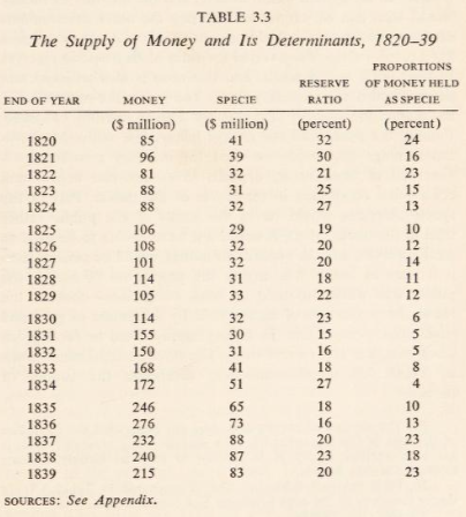
As Temin’s own figures demonstrate, the money supply expanded dramatically in the years preceding the Panic of 1837. Between 1830 and 1836, the money supply increased approximately 142 percent—from $114 million to $276 million. Remarkably, between 1834 and 1836 alone, it increased by approximately 60.5 percent, while specie reserves increased by only 43.1 percent and the reserve ratio fell from 27 percent to 16 percent.
This monetary expansion was followed by a sharp contraction of approximately 15.9 percent between 1836 and 1837, coinciding with the panic. Moreover, monetary expansion was already well underway before Andrew Jackson’s removal of federal deposits from the Second Bank of the United States in 1833. Between 1830 and 1832, the money supply had already increased by approximately 31.6 percent—from $114 million to $150 million—complicating the conventional narrative that Jackson’s dismantling of the Second Bank unleashed an otherwise restrained banking system.
Even if we grant that the Second Bank of the United States, at times, exercised some restraint over state-bank credit expansion, it does not follow that it successfully restrained monetary inflation. Indeed, the Second Bank not only failed to prevent the inflationary expansions preceding the Panics of 1819 and 1837, but actively contributed to them before sharply contracting credit and aggravating the subsequent crisis. And this was recognized by many at the time the bank was created. On April 1, 1816, Senator William H. Wells (Federalist of Delaware) said regarding the bank bill,
This bill came out of the hands of the Administration ostensibly for the purpose of correcting the diseased state of our paper currency, by restraining and curtailing the over issue of banking paper; and yet it came prepared to inflict upon us the same evil; being itself nothing more than simply a paper-making machine, and constituting in this respect a scheme of policy about as wise, in point of precaution, as the contrivance of one of Rabelais’ heroes, who hid himself in water for fear of rain. The disease, it is said, under which the people labor, is the banking fever of the States, and this is to be cured by giving them the banking fever of the United States. To my mind, the real evil consists not so much in a superabundance of paper, as in a scarcity of specie. (emphasis added)
The Panic of 1819 was not an isolated episode. Following that crisis, as is typical, the Bank was again a significant engine of monetary and credit expansion during the early 1830s, contributing to the Panic of 1837. As William Leggett observed at the time,
. . .let us but cast a glance at the manner in which the United States Bank regulated the currency in 1830, when, in the short period of a twelvemonth it extended its accommodations from forty to seventy millions of dollars. This enormous expansion, entirely uncalled for by any peculiar circumstance in the business condition of the country, was followed by the invariable consequences of an inflation of the currency. Goods and stocks rose, speculation was excited, a great number of extensive enterprises were undertaken, canals were laid out, rail-roads projected, and the whole business of the country was stimulated into unnatural and unsalutary activity. (emphasis in original)
Remarkably, Leggett’s observations anticipated important insights of what would later become Austrian business cycle theory. He recognized that inflationary credit expansion did not merely raise prices, but also unevenly stimulated speculation and encouraged investment in projects that might not otherwise have been undertaken. The apparent prosperity generated by monetary expansion could therefore conceal an artificial and unsustainable boom. As William M. Gouge likewise recognized, when credit expansion eventually gave way to contraction, the temporary prosperity would be followed by economic distress.
The rise of prices that follows an expansion of Bank medium, and the fall that follows a contraction, do not affect all descriptions of labor and commodities, at the same time, in an equal degree.
. . . .
Prices are raised again, and speculation is excited anew. But prices soon undergo another fall, and the temporary and artificial prosperity is followed by real and severe adversity.
Although neither developed the systematic theory later associated with Mises and Hayek, their contemporary observations reveal that the relationship between bank credit expansion, speculative investment, and economic crises was recognized long before the emergence of the Austrian School. Of course—fully armed with Austrian business cycle theory—Rothbard explained,
It is. . .a widespread myth that central banks are inaugurated in order to check inflation by commercial banks. The second bank of the United States, on the contrary, was inaugurated in 1817 as an inflationist sop to the state-chartered banks, which had been permitted to run riot without paying specie since 1814. It was a weak substitute for compelling a genuine return to specie payments. (emphasis in original)
The underlying process of monetary and credit expansion continued after the Panic of 1819, eventually contributing to the inflationary boom preceding the Panic of 1837. During the 1820s, the country’s specie stock remained relatively stable, but more specie moved from the public into banks, providing a basis for additional note and deposit creation. During 1833–1837, extraordinary specie inflows allowed banks to expand their liabilities substantially without necessarily reducing their reserve ratios. The underlying fractional-reserve system amplified the monetary expansion, even if state banks were not becoming progressively less conservative in their reserve practices.
The Bust
The inflationary boom of the 1830s could not continue indefinitely. As Rothbard explains, expanding bank credit and rising prices eventually increased pressures upon banks to redeem their notes and deposits in specie, forcing them to curtail credit expansion or even contract. Thus, the underlying instability preceded the immediate events that triggered the Panic of 1837. Although Jackson’s Specie Circular of 1836 is often blamed for precipitating the crisis, the inflationary banking system was already vulnerable to contraction.
The immediate catalyst came largely from abroad. Drawing upon Peter Temin’s research, Rothbard explains that the Bank of England tightened credit and raised interest rates in the latter half of 1836 in response to monetary pressures in Britain. This restricted financing for American cotton exports, contributed to falling cotton prices, and redirected capital toward England, placing additional pressure upon American banks. In May 1837, banks throughout the United States—including the former Second Bank of the United States, then operating under a Pennsylvania charter—suspended specie payments.
The ensuing contraction was substantial. According to Rothbard, the American money supply fell from $276 million to $232 million during 1837—a decline of approximately 16 percent. Although the nation’s specie stock continued to increase, growing public distrust of banks encouraged the withdrawal of specie and intensified pressure upon bank reserves. Wholesale prices consequently fell by more than 25 percent between February and September 1837. A temporary recovery followed in 1838, aided by renewed British credit expansion and rising cotton prices, but another crisis erupted in 1839.
The subsequent depression brought a more prolonged liquidation of the preceding boom. Between 1839 and 1843, the money supply contracted from approximately $240 million to $158 million—a decline of 34 percent—while the number of banks fell by 23 percent. As Rothbard observes, unsound banks disappeared and unsustainable investments undertaken during the boom were liquidated. (Interestingly, freer and sounder banks, operating under the Suffolk System fared well and during the crisis and continued to redeem specie). The Panic of 1837 and the subsequent depression thus illustrate the central Austrian insight that monetary and credit expansion can generate an artificial prosperity that ultimately gives way to painful economic adjustment.
Ultimately, the Panic of 1837 cannot be adequately explained by Andrew Jackson’s dismantling of the Second Bank of the United States or by the supposed absence of government regulation over state banks. Both the national bank and state-chartered banks participated in monetary and credit expansion within a system shaped by government privileges, political borrowing, and fractional-reserve banking. The resulting inflationary boom encouraged speculation and unsustainable investment, while the subsequent contraction exposed the fragility of the apparent prosperity.
As Jeffrey Rogers Hummel also demonstrated, the traditional interpretation of Jackson’s Bank War requires reconsideration not only in light of the historical evidence, but also of the economic theory used to explain it. Far from demonstrating the necessity of a government-privileged central bank, the Panic of 1837 illustrates the dangers of politically-privileged banking and inflationary credit expansion—state and national.
Despite taking unreasonable blame for the panic, it has been argued effectively that the policies of the Jacksonians, in part, actually contributed to America’s Industrial Revolution. This was largely due to the Jacksonian dismantling of the American System which “resulted in a great burst in industrialization and living standards.” While this included a move toward freer trade and restraining the spending and debts of the government, it also included, “The end of federal regulation of banks and a reduction in privileged state banking monopolies [which] encouraged greater competition and efficiency.”

