

In the year since Donald Trump’s “liberation day” in April 2025—on which he began raising import taxes on Americans —1.2 million fewer Americans are now working, and inflation-adjusted hourly earnings are still below where they were in 2021. Meanwhile, total manufacturing employment has fallen back to 2022 levels. As price inflation increases, thanks to the Trump administration’s elective war on Iran, the increasing cost of living, combined with this stagnating job market, will ensure further economic hardship for many Americans, especially those younger workers who were not able to buy up assets before the Great Inflation of 2022.
According to the latest employment data from the Bureau of Labor Statistics, released last week, the total number of payroll jobs increased by 115,000 in April, month over month. That might seem robust, but if we look beyond this single headline number we find that the true situation is far less impressive. For example, if we look at the household survey, which measures employed persons rather than jobs, we find that the employment level has fallen, month, over month, for the past four months. Household employment fell by 226,000 from March to April. This survey also shows that total employment is down by 1.2 million since one year earlier—the same month as the so-called “liberation day” in April 2025. Over the past four months, total employed persons has fallen by nearly 1.4 million.
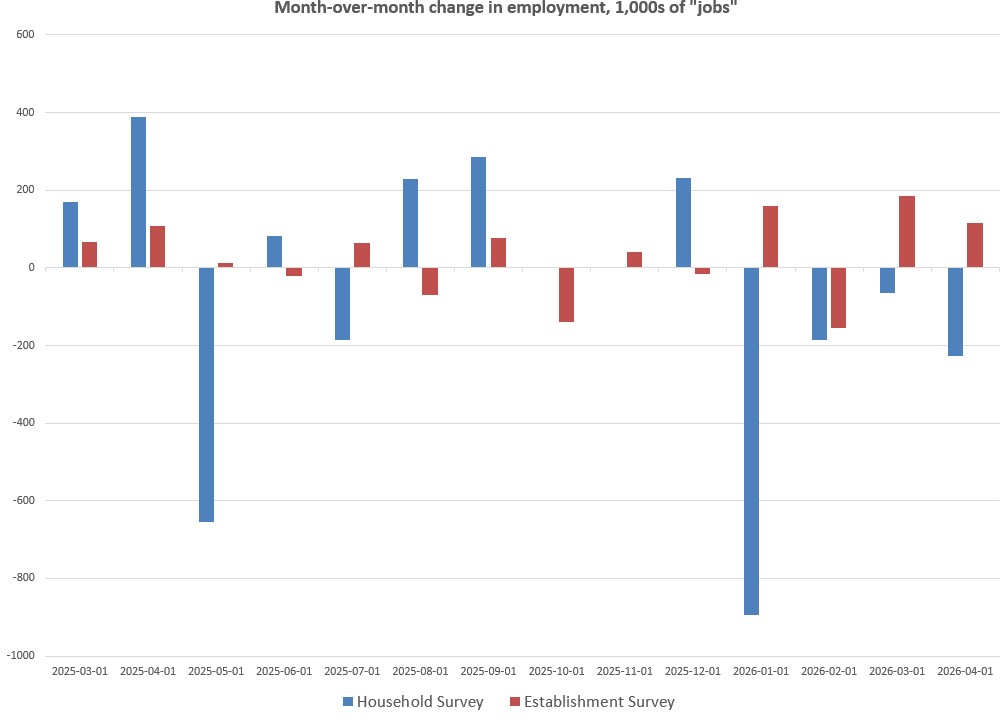
So, how could there be so much payroll job growth, but declining numbers of employed persons? Part of the discrepancy can be found in the fact that the payroll survey measures both full time and part time jobs. For April, the month-over-month measure shows that fulltime employment fell by 424,000 while part time employment rose by 123,000 in the same period. Year-over-year, however, fulltime employment is down by 1.1 million and part time employment is down by 109,000.
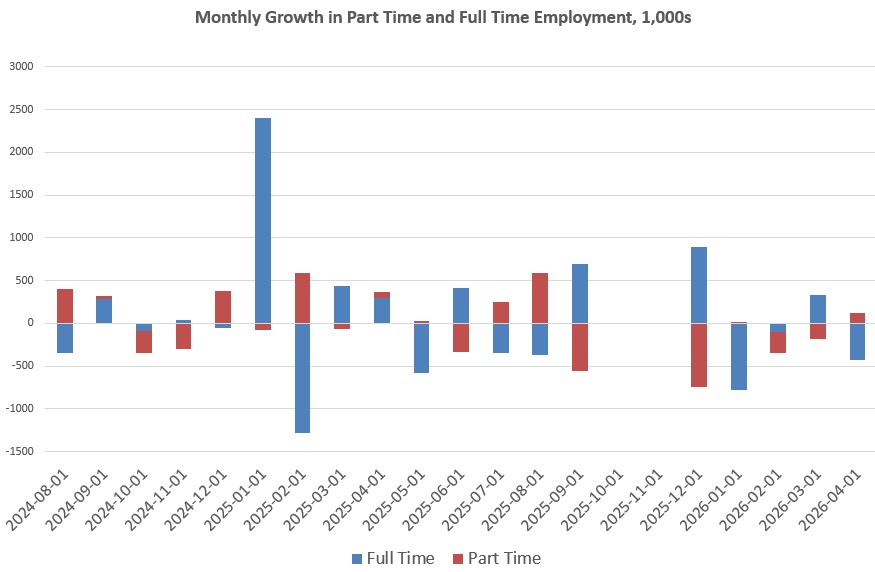
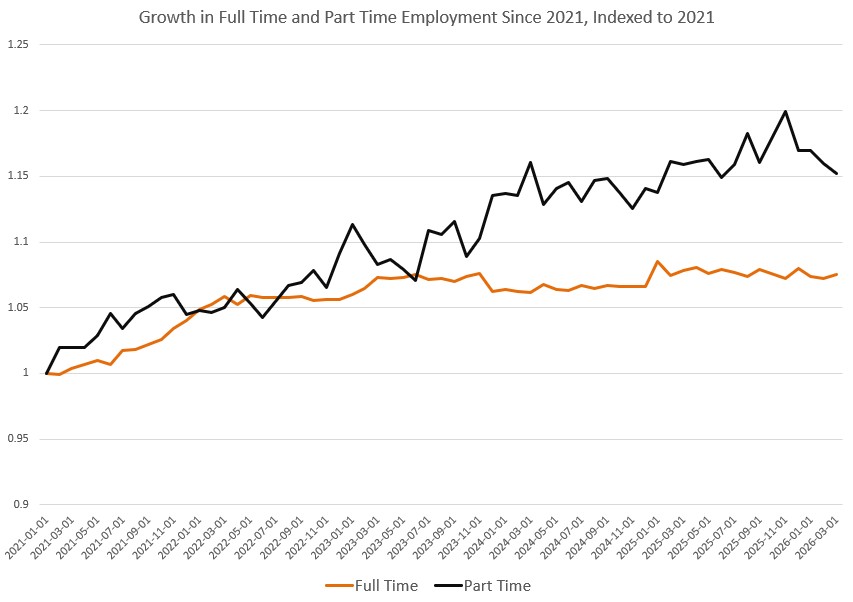
We can note that since 2023, fulltime employment has been flat, with virtually no change in more than three years. It is part time employment that accounts for most of the job growth over this period. Yet, even part time employment has begun to fall in recent months, with total parttime jobs falling by over one million since November of last year.
Some might point to the unemployment rate as evidence of some strength in the labor market. After all, the unemployment rate was unchanged from March to April, remaining flat at 4.3 percent. Yet, the labor force participation rate in April fell to 61.8 percent. That’s the lowest level since October of 2021. The labor force participation rate has fallen by more than half a percentage point since December of last year, suggesting that more than a million workers have left the labor force in that time. This does a lot to keep the unemployment rate from rising in spite of a stagnant employment situation. Not surprisingly, the employment-population ratio has also fallen repeatedly in recent months, and is now at the lowest level since Oct 2021. This is some of hte latest evidence of the “no hire-no fire” economy that Fed Chair Jerome Powell has repeatedly mentioned.
Indeed, the Washington Post reported last week that men are leaving the work force at “record rates.” This isn’t just retirees, either:
The share of American men in the labor force reached a record low in March, fueled by baby-boomer retirees and young men who are dropping out to study or because they are disabled or sick. (The only time it has been lower was during the first two months of the coronavirus pandemic in 2020.)
The labor market has weakened since early 2025, with most job opportunities concentrated in areas typically dominated by women, including health care and private education. At the same time, several male-dominated industries, including manufacturing, transportation and mining have shed jobs, leaving a mismatch between typical skill sets and job opportunities for men.
“It’s not all retirement and education. … There are guys just dropping off the planet. They’re not looking after their kids. They’re not in school. They’re not in the labor force,” said Betsey Stevenson, a professor of economics at the University of Michigan. “Across the board when we look at men, we see challenges that they face that leave too many men disconnected.”
(The new April employment report shows that the labor force participation rate for men was unchanged at its historically low level: at 67 percent, the same as the March number.)
In spite of White House claims that higher import taxes would somehow propel manufacturing work to fresh highs, the opposite has happened. Since “liberation day,” the US has lost 66,000 manufacturing jobs, including another 2,000 lost from March to April of this year. Manufacturing job totals are now at the lowest level reported since January of 2022.
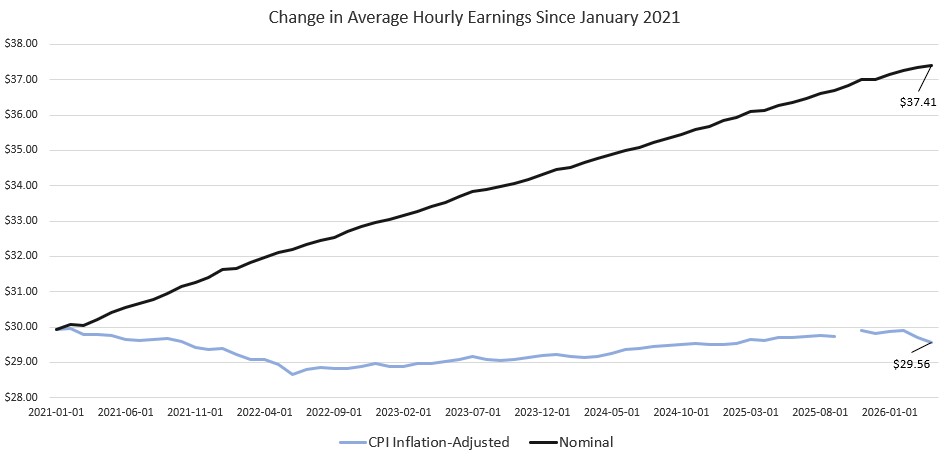
Finally, we can note that the current weakness in employment appears to be reflected in hourly earnings. In April, nominal hourly earnings increased to a new high of $37.41. Yet, if we adjust this for CPI inflation, we find that hourly earnings fell in April, both month-over-month and year-over-year. In fact, inflation-adjusted hourly earnings in April fell to the lowest level in fifteen months. By this measure, hourly earnings also remain below their January 2021 level. In other words, there has been no average hourly wage growth in more than five years.
All this might help to explain why consumer confidence continues to fall to multi-decade lows. CNBC reports today:
American consumers have been pessimistic for so long that now economists are wondering when — or even if — households will ever feel financially better off.
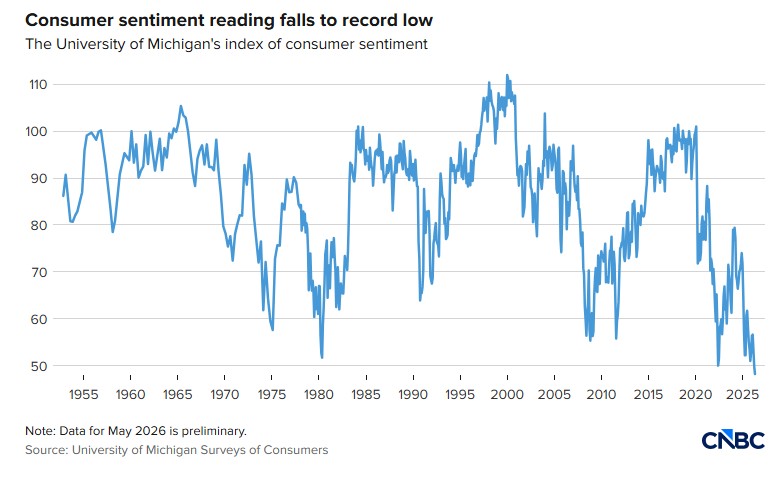
The University of Michigan Surveys of Consumers, a closely watched bellwether, hit all-time lows in May, according to a preliminary reading released last week. That is just one of several consumer opinion surveys showing Americans have never regained confidence in the U.S. economy since the Covid pandemic struck more than six years ago.
The University of Michigan’s consumer sentiment index has recently hit all-time lows, with the index even falling below levels measured in the early 1980s during a period of recession and stagflation.
Meanwhile, The Hill reports:
Nearly 6 in 10 Americans say the economy is getting worse, according to a new survey from The Economist/YouGov.
The survey, conducted from Saturday through Monday, found that 59 percent of 1,549 respondents said the economy is getting worse. Just 15 percent said it was getting better, while 20 percent said it was about the same and 6 percent were unsure.
This isn’t to say that all Americans are in feeling the pinch. Older, wealthier Americans continue to do well because they benefit from the ongoing asset price inflation that is fueled by the inflationary policies of both Trump and Biden during the covid panic and afterward. Yet, as the hourly earnings data suggests, wages haven’t been keeping up. That means workers who don’t already own large amounts of assets continue to face headwinds in dealing with a rising cost of living in the face of continued downward pressure in total employment and wages.

