

One of the standard holy doctrines of modern macroeconomics is the claim that the only way to end a recession is to increase government spending. John Maynard Keynes formalized this doctrine in his infamous The General Theory of Employment, Interest, and Money and his disciples then spread the word in the halls of academe and government.
Nobel Prize-winning economist Paul Krugman put an exclamation point on this idea as he claimed during a broadcast on August 14, 2011, that the best way to pull the economy to full employment in the waning days of the Great Recession was to “prepare for an imaginary invasion of space invaders.” While his idea was tongue-in-cheek, he was serious about the need for ramping up government spending, as he believed that even creating whatever was necessary to fight space aliens—even if none of it was ever used—would be valuable to the economy because it would increase spending.
Paul Krugman hardly is the only Keynesian economist who advocates massive spending to get out of a recession, but he had the best and most influential vantage point, being the main economics columnist for the New York Times for more than 20 years. Writes Robert Murphy:
There’s one saving grace about Paul Krugman’s column at the New York Times: when an Austrian economist wants to explain how mainstream economics leads to ruin, he can always trust Krugman to set up the target in a clear, concise manner. This saves us a lot of work, because we don’t have to first build up the position before knocking it down.
Like his other Keynesian allies, Krugman believes that a market economy naturally trends toward “underconsumption,” with consumers having the propensity to save too much of their income (the “Paradox of Thrift”), thus leaving too little money for spending, which then drags down the economy. Krugman has gone as far as to claim that recessions happen because consumers stop spending. He writes:
. . .one of the high points of the semester, if you’re a teacher of introductory macroeconomics, comes when you explain how individual virtue can be public vice, how attempts by consumers to do the right thing by saving more can leave everyone worse off. The point is that if consumers cut their spending, and nothing else takes the place of that spending, the economy will slide into a recession, reducing everyone’s income.
Keynesians hold that the economy is directed by “aggregate demand,” that is, overall spending, and that if consumers slow their spending, then the central bank can respond by lowering interest rates, which would encourage businesses to borrow money for expansion purposes, thus redirecting some of the lost consumer spending. However, according to Keynesians, if interest rates already are near-zero, then lowering rates is self-defeating and can lead to a “liquidity trap.” Murray Rothbard explains:
The ultimate weapon in the Keynesian arsenal of explanations of depressions is the “liquidity trap.” This is not precisely a critique of the Mises theory, but it is the last line of Keynesian defense of their own inflationary “cures” for depression. Keynesians claim that “liquidity preference” (demand for money) may be so persistently high that the rate of interest could not fall low enough to stimulate investment sufficiently to raise the economy out of the depression. This statement assumes that the rate of interest is determined by “liquidity preference” instead of by time preference; and it also assumes again that the link between savings and investment is very tenuous indeed, only tentatively exerting itself through the rate of interest.
Once the economy falls into a liquidity trap, according to Keynesians, then the only thing that can rescue it and restore full employment is for government to ramp up its spending. As Keynesians argued, the presence of a liquidity trap meant that consumers would indefinitely hold onto their money, waiting for interest rates to inevitably rise, and in the meantime, the economy would slowly grind to a halt. As Henry Hazlitt put it, this would be a “frozen disequilibrium” or, to put it in a more humorous note, it would be a situation resembling the band at the end of the movie Animal House trying to march through a wall.
The idea is that when the economy is in a liquidity trap, only outside intervention by government can reverse the slide. Mainstream economists speak of so-called automatic stabilizers in which government policies act in a counter-cyclical way to reverse harmful economic trends. According to the Tax Policy Center of the Brookings Institute:
Automatic stabilizers offset fluctuations in economic activity without direct intervention by policymakers. When incomes are high, tax liabilities rise and eligibility for government benefits falls, without any change in the tax code or other legislation. Conversely, when incomes slip, tax liabilities drop and more families become eligible for government transfer programs, such as food stamps and unemployment insurance, that help buttress their income.
The reasoning seems cut-and-dried. When the economy falls into recession, GDP falls, which means overall spending seems to have also fallen, so it would seem logical that boosting spending in any way possible would jumpstart things and reverse the trend. Likewise, in good times the government can raise taxes to offset the inflation created by an “overheating” economy and keep the excesses of the boom in check. (I remember in 1980 hearing former Newsweek financial columnist Jane Bryant Quinn claim that the US government should raise tax rates to help curb the double-digit inflation ravaging the economy at the time. The top rates were 70 percent, but she advocated even higher rates).
The Austrian Counter to Keynesian “Stabilization”
Keynesian economics was built on the assumption of factors of production being effectively homogeneous and interchangeable. I wrote in 2009:
If I can put the whole Keynesian set of fallacies into one statement, it would be this: the modern Keynesians believe that the economy operates like a perpetual motion machine, with government spending being the “grease” that keeps it from slowing down. The “friction” in this economic machine, according to the pundits, is private saving. Eliminate it, and the economy goes on forever, adding energy and expanding indefinitely.
The Austrian viewpoint, articulated by Murray N. Rothbard, does not see the economy as a homogeneous mass, but rather as an intricate set of relationships in which a structure of production that has both specific and non-specific factors are guided by the market rate of interest which itself is determined by individual time preferences within the economy. The longer the time preferences of the economic actors within the economy, the longer and more complex the structure of production.
Rothbard outlined the Austrian business cycle theory in America’s Great Depression in which he critiqued the Keynesian theories as being harmful, with the countercyclical policies actually being counterproductive to an economic recovery once a recession set it. Furthermore, Rothbard did not attribute a recession to a lack of consumer and business spending, but rather as an inevitable breakdown of the structure of production due to a wasteful boom.
The two camps could not be further apart, as Krugman noted in his 1998 article in Slate in which he derisively referred to the Austrian theory as “The Hangover Theory.” In his piece, he accused the Austrians of turning business cycles into morality plays in which a recession is “the idea that slumps are the price we pay for booms, that the suffering the economy experiences during a recession is a necessary punishment for the excesses of the previous expansion.”
Krugman went on to label the Austrian view as destructive:
The hangover theory is perversely seductive—not because it offers an easy way out, but because it doesn’t. It turns the wiggles on our charts into a morality play, a tale of hubris and downfall. And it offers adherents the special pleasure of dispensing painful advice with a clear conscience, secure in the belief that they are not heartless but merely practicing tough love. Powerful as these seductions may be, they must be resisted—for the hangover theory is disastrously wrongheaded. Recessions are not necessary consequences of booms. They can and should be fought, not with austerity but with liberality—with policies that encourage people to spend more, not less. Nor is this merely an academic argument: The hangover theory can do real harm. Liquidationist views played an important role in the spread of the Great Depression—with Austrian theorists such as Friedrich von Hayek and Joseph Schumpeter strenuously arguing, in the very depths of that depression, against any attempt to restore “sham” prosperity by expanding credit and the money supply. And these same views are doing their bit to inhibit recovery in the world’s depressed economies at this very moment.
Yet, there is nothing that any Austrian economist has written that claims that recessions are simply moral outcomes of excessive economic behavior. Instead, they have noted that, over time, booms that are triggered by artificially low interest rates created by central banks will lead to unsustainable malinvestments that eventually collapse under their own weight. When that happens, Austrians argue, trying to “stimulate” the economy through outside spending makes things worse by further distorting the economy’s production structure. Writes Rothbard:
The most important canon of sound government policy in a depression, then, is to keep itself from interfering in the adjustment process. Can it do anything more positive to aid the adjustment? Some economists have advocated a government-decreed wage cut to spur employment, e.g., a 10 percent across-the-board reduction. But free-market adjustment is the reverse of any “across-the-board” policy. Not all wages need to be cut; the degree of required adjustments of prices and wages differs from case to case, and can only be determined on the processes of the free and unhampered market. Government intervention can only distort the market further.
Contrary to Krugman’s claim that such a policy is little more than punitive and imagined “tough love,” Rothbard points out that non-intervention allows for the re-establishment of lower time preferences that the economy needs for the redevelopment of a sound structure of production. He notes:
There is one thing the government can do positively, however: it can drastically lower its relative role in the economy, slashing its own expenditures and taxes, particularly taxes that interfere with saving and investment. Reducing its tax-spending level will automatically shift the societal saving-investment-consumption ratio in favor of saving and investment, thus greatly lowering the time required for returning to a prosperous economy. Reducing taxes that bear most heavily on savings and investment will further lower social time preferences. Furthermore, depression is a time of economic strain. Any reduction of taxes, or of any regulations interfering with the free market, will stimulate healthy economic activity; any increase in taxes or other intervention will depress the economy further.
To put it another way, the so-called stabilizers actually destabilize the economy. In America’s Great Depression, Rothbard documents the various interventions that the Herbert Hoover administration imposed upon the economy following the stock market crash of October 1929. Contrary to the standard narrative that the economy collapsed under Hoover because he “did nothing,” Rothbard shows how Hoover’s interventions blocked the recovery that the economy would have made had the president done nothing as his critics have claimed.
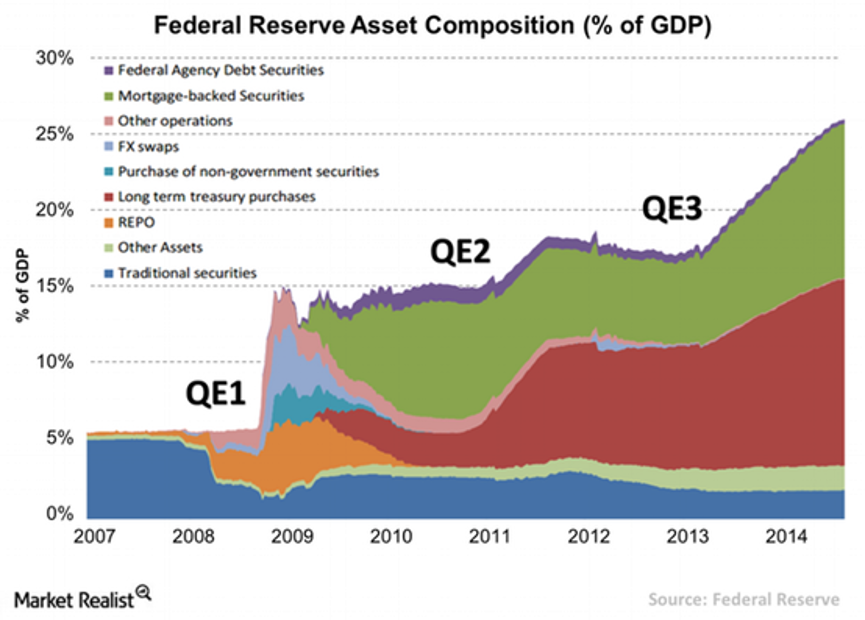
This last point is important because the moribund economy which Krugman referenced in his “space invaders” account in 2011 had seen massive government intervention following the Wall Street Meltdown of 2008 and the subsequent Great Recession that followed. Far from the George W. Bush and Barack Obama administrations following laissez-faire policies after the government-induced Housing Bubble collapsed, both presidents had the government massively intervene both on the spending side and by unleashing the Federal Reserve System to purchase government securities, stocks, and mortgage securities on a huge scale, as shown by the figure below. Yet, even after three years of intervention, the economy was sluggish with high unemployment and a slow recovery.
Krugman argued that the government hadn’t intervened enough and that because he claimed the economy was in a liquidity trap, the actions by the Fed were going to be ineffective, anyway. Yet, there is another way of looking at this, using the analysis Rothbard developed in America’s Great Depression.
Contrary to the standard macroeconomic narratives, a free-market economy does not tend toward that imaginary state of underconsumption in which the propensity of consumers to save “too much” of their income and drive consumption into a downward, recessionary spiral. Instead, when left alone, market economies can recover from crises. The history of the US economy is replete with recoveries that followed downturns with no appreciable government intervention being involved. As Rothbard noted in America’s Great Depression, the economy recovers from the collapse of the wasteful boom when the structure of production is permitted to match the time preferences of the economic actors within the economy.
It is doubly ironic, then, that those measures that mainstream economists have labeled as “stabilizers” actually destabilize an economic recovery. Economies do not recover because of these spending and regulatory measures; rather, recoveries occur in spite of these policies.
Conclusion
The standard Keynesian narrative, for all of its widespread acceptance in the world of academics, business, and government, is simply wrong. Instead of offering sound analysis, it turns the truth of the economy upside down, turning it into a crude blob of perfectly interchangeable factors that need only more money to be stirred into the pot in order to make the economy work.
Instead, as Rothbard clearly demonstrates in America’s Great Depression, the best way to grow the economy is to keep government out of the mix. Should government intervene, however, and drive the economy into a downturn, the solution is simple: get the government out of the economy. Intervention does not stabilize the economy; it destabilizes it.

