
A Treatise on Currency & Banking
Appendix
_____
A.
ON THE RELATIVE VALUE OF GOLD AND SILVER,
From the National Gazette, of January 26th, 1822.
Messrs. Editors:—In the autumn of the year 1820, an article written by me was published in your Gazette, explaining the cause of the disappearance of gold from the United States. It was there shown that, in spite of all the attempts made by the laws of various nations, to establish fixed proportions between gold and silver, those two metals had confirmed their right to be governed by the same laws of supply and demand, which regulate the relative value of all other commodities, and had actually in the market of the trading world assumed proportions different from those which had for many previous years been maintained. It was also shown, that one ounce of gold was at that time worth in Europe near sixteen ounces of silver, and that so long as the laws of the United States decreed that the proportions should be as one to fifteen, gold would not circulate, but would be exported from the country, in payment of debts, or in exchange for silver. The truth of that assertion has been verified; for although during the year 1820, gold was coined at our mint to the value of $1,319,030, and during the year 1821, to the amount of $185,325, yet not a gold coin is any where to be seen in circulation.
During the last session of congress, this subject of the disappearance of gold was considered by a committee, who made a report, recommending an alteration of the legal proportions, so as to make them correspond with the proportions which were at that time supposed to exist in Europe. At the present session, the same matter will probably come before the committee, to whom the subject of the coinage has been referred; and as it is an important one, a few observations in relation to it may not at this time be inappropriate.
Any attempt to fix by law, what cannot be fixed by nature, carries on its face an air of absurdity. Without animadverting upon the policy which led our predecessors to follow the footsteps of many of the European nations, and which may perhaps be justified by the then existing state of the country, it is certainly not the part of wisdom to pursue a course, which the lights of science and experience so clearly prove to be unsound. The very fact that gold and silver have departed from the proportions established by our laws, is ample proof that no such laws should ever have been enacted; and the certainty of a future change, is equally conclusive against any further legislation on the subject. Even since the date of the report of the committee above referred to, a more wide separation between the two metals has taken place; and had a law been enacted a year ago, agreeably to their suggestion, it might possibly have required an additional one in the present year to give it effect. The truth is, that until the physical and moral causes, which operate upon a currency, shall combine to establish an immutable relation between gold and silver, laws to determine their relative value can be nothing more than temporary expedients, at war with the true interests of the country, and the genuine principles of political economy. No nation ought to attempt to create two legal tenders; and as we have virtually, at least for a time, got rid of one of them, we ought not to be hasty in restoring it.
In a discussion upon this subject, it is not essential to consider the question, whether a gold or silver coinage is to be preferred. Many weighty arguments might be advanced in favor of each, but as the American people are best acquainted with silver, and as most ancient contracts stipulate for the payment of silver coins, there would seem to be a propriety in adhering to that metal; especially, too, as the universal establishment of banks of deposite, obviate almost entirely the expense and inconvenience of transporting and counting large sums. I take it for granted, that if one metal was alone declared to be a legal tender, that metal would be silver; and under that impression, I submit my remarks.
The first objection against an alteration of the relative legal value of gold and silver, is that there would be no certainty of the new proportions being maintained for any length of time in the general market.—Gold might rise still higher, and in that event the law would be of no avail. Or gold, might fall, and in that case, the silver would all be exported from the country, upon the principle that gold now is, as being the dearest of two commodities, which are declared by law to be equally legal tenders in discharge of the same debt. In case of such an event as the exportation of all our silver, it is easy to foresee what evil consequences would result. Gold would become the only circulating medium, and as it is impossible that the ordinary transactions of life could be carried on with such small pieces of gold as would correspond with our small silver coins, congress would be compelled to pass another law to bring silver back, and there would be no end to our legislation on the subject. If silver should be legislated out of the country, and afterwards be legislated back again, the nation would lose the whole value of the expense and risk of a double transportation, without an equivalent in return.
The second objection against this measure is, that it would be an improper interference with the rights of all creditors, public as well as private, in relation to contracts, existing at the time of the change. By the present laws, an individual or the nation has its option, in discharge of a debt, to pay one ounce of gold or fifteen ounces of silver; but if the proportions were altered as proposed, creditors could be compelled to receive in satisfaction of their claims, a less quantity of gold than they stipulated for. It is true, that no absolute injury would be sustained by creditors, so long as the new proportions should be maintained in the market, because with the new quantity of gold they could purchase as much silver, as the debtor had contracted at his option to pay. But the case would be widely different in the event of a falling back in the market to the present proportions. All debts would then be paid in gold, and creditors would be compelled to take in discharge of their contracts, a less quantity of gold than they had bargained for.
Whether or not congress possesses the power of enacting laws which shall thus impair the obligation of contracts, it is not necessary here to inquire. Be that as it may; it is a matter of deep concern, to the people of this republic, that their representatives should cautiously shun every measure, which has a tendency to countenance those frauds upon creditors which some European nations have practised, by debasing their coins, or by diminishing their weight without altering the denomination. The pound sterling was originally a pound of standard silver, which was coined into twenty equal pieces called shillings. The same quantity of silver is now coined into sixty-six shillings, twenty of which are a pound sterling. The livre of France, now worth less than nineteen cents, originally was a pound of silver of the French standard, which is nine-tenths pure metal and one-tenth alloy. Let it never be said, that the American eagle contained at one period of time two hundred and seventy grains of gold, eleven parts fine, and one of alloy, and at another, a different weight or a different degree of purity. Although an alteration of our mint proportions, may not be as flagrant a violation of the public faith, as those above referred to, yet we have seen that creditors, by its operation, may be deprived of their just rights, in case of a restoration of the present legal proportions, of one to fifteen, when perhaps, as a remedy for that evil, the next step might be to reduce the quantity or to alter the purity of the silver contained in the dollar, and thereby authorise a second fraud more odious than the first. Tampering with the metallic currency of the nation is a dangerous employment, and if it be commenced, there is no foreseeing where it may stop.
But it may be asked, is it not necessary that something should be done in relation to our coinage? In answer to this question I would reply, that if it is at all desirable that gold coins should be struck at our mint, it should be upon a different principle from that which prevails. The whole present expense of our gold coinage, is an absolute loss to the nation. Nearly all the pieces which are coined are exported to Europe, where they are exchanged for their proper equivalents, and melted, and thus our mint is occupied at no trifling cost, in assaying and stamping, free of charge to the owners, the bullion which our merchants are daily shipping abroad. I would suggest that the further coinage of eagles and their fractional parts be abolished, and that authority be given for the coinage of new pieces to be called by new names, to contain respectively an ounce, a half an ounce, and a quarter of an ounce of standard gold.
Between these pieces and silver no proportionate value should be attempted to be established, but they should be left to find their value in market like all other commodities. The advantage of such coins over the eagles would be, that as every body would soon become acquainted with their weight, without being obliged to resort to books in order to ascertain the precise number of pennyweights and grains contained in them, the mode of estimating their value in silver would soon become familiar, and those who possessed them would have less difficulty in exchanging them for their proper equivalents, than they would have with any coin, of which the weight could not be universally and readily recollected. The circumstance of the British and American standards being the same, would render this course the more advisable. The quotations of the price of gold and silver, which are brought by every ship, would keep us as regularly advised of the value of an ounce of gold, as of a barrel of flour; and there is every reason to believe, that as the fluctuations in the relative value of the two metals are not diurnal or monthly, nor even always annual, the proposed coins would find their way very readily into circulation.
It is a fact, familiar to all who are acquainted with the affairs of the western country, that depreciated bank notes pass amongst the merchants there, with perfect facility for what they are worth; and to such a system has this practice been reduced, that the newspapers regularly publish the prices current of bank notes at the principal money markets to be referred to as the scale of value. So would it be with gold coins of a well known weight and standard, which might even maintain for a long period together something like a settled proportion to silver. An additional reason why eagles cannot readily pass by weight, is that the idea of their being by law the equivalent of ten silver dollars, is so deeply rooted in the minds of the community, that it would be next to impossible to eradicate it. Those only who understand the subject, or whose trade renders them conversant with it, are acquainted with the true value of an eagle, and they are thereby enabled to take advantage of those who are less enlightened than themselves. But, let a new coin make its appearance of a familiar and well known weight, untrammeled by legal proportions, new views would present themselves to the public, and even common minds would be able to comprehend, what now appears to them to be enveloped in mystery. Suppose further, that this new coin, instead of containing an ounce, should contain the precise quantity of gold contained in the sovereign, or true pound sterling, lately emitted from the British mint, what incalculable benefits would not result? The important question of our exchange with England, would be exhibited in its true light, and the whole clamor about the balance of trade, an excess of imports over exports, and the necessity of laws to restrict the former, would cease, and leave our law makers at liberty to study the true interests of the country. It would then be seen, that the high nominal exchange on England is not the result of a balance of trade against us, but chiefly the effect of a change in the relative value of gold and silver, and that the gold pound sterling is the equivalent of 484 cents, and not 444 cents in silver.1
It has been inquired by some, in case such a coin as the one first suggested were authorised, whether it would not be advisable, in order to give it a currency by tale, to declare by law that it should be receivable in all dues to the government, as the equivalent of a fixed quantity of silver? I reply, that such a course would be liable in a great degree to the objections urged against the principle of establishing legal proportions; and I do not conceive that it would be attended with any advantage sufficient to counterbalance the risk of being obliged to take the gold, if at any time it should so fall in relation to silver, as to make it the interest of the public debtor to discharge his obligations in the former rather than in the latter metal, in which case the government would be a loser of part of its revenue, and, in addition to that, be obliged to become bullion dealers for the purpose of selling the coin paid into the public treasury. It would also be giving a forced currency to a coin, which, if it cannot find its way into circulation by the operation of natural means, had better not circulate at all, and would be laying the foundation for a course of legislation, which might ultimately be productive of mischief. If no such law should be enacted, the price of an ounce of gold would regularly conform to the variations of the market, which, being in their nature slight and gradual, could produce a serious loss to nobody. Whereas a law to establish a fixed value in payments to the government might be repealed at a moment unexpected by those who had received the coins at such valuation, by which a considerable loss might fall upon many, who were not conversant with the principles which determined the proportions.
It has also been asked, upon the supposition of the establishment of new mint proportions conforming to the actual relative value in the markets in Europe of gold and silver, what would be the effect of a seignorage on coins, that is, a charge for coinage at the mint, in restraining their exportation? To this question I would reply.
1. That if the seignorage were of an equal per centage upon both metals, it would leave the matter where it stood, inasmuch as their relative value would remain the same, as if no seignorage was exacted; and that as regards the question of exportation, the seignorage would be a nullity. The causes which operate upon the precious metals, in driving them from one country to another, have reference only to the intrinsic worth of coins, and not to their denominations. The quantity of silver contained in a Spanish dollar, would be just as much subject to the laws of exportation, as it would be, if it was denominated a French crown, and declared by our laws to be the equivalent of 110 cents; and so would an eagle be just as liable to exportation, if it was called by any other name, and declared by law to be the equivalent of eleven dollars.
2. That if the seignorage was charged upon one of them only, it would be difficult to foresee upon which of them it ought to be charged; for in the course of the ensuing five years, it is quite as possible that silver will rise in relation to gold, as that gold will rise in relation to silver.
3. That if it be placed upon gold only, under the impression that goldmight rise still further, it ought to be ascertained, in order to render it effective, how far gold will rise, which is impossible; for unless the seignorage be equal to the extent of the departure of gold from the proportions existing at the time of fixing the seiguorage, it would be of no avail. A seignorage of six per cent. on the present eagles, had it been originally imposed, would not have prevented their exportation; for at $10 60-100 a-piece, they would constitute a more profitable remittance to Great Britain, than bills purchased at the present rate of exchange.
A very small seignorage on gold, therefore, might answer no purpose, as a measure restrictive of exportation; for if it were limited to one or two per cent. a change in the relative value of gold and silver abroad to that extent, would neutralise it, if gold should become more valuable, whilst a high seignorage would unquestionably be productive of injurious consequences. This will be shown from the following illustrations, founded upon the assumption of one to sixteen as the new mint proportions, deducting five per cent for the seignorage, the market proportions being also one to sixteen.
First. So long as the market and mint proportions of the two metals remain exactly the same, gold may be coined as fast as it is brought into the country; for if the holder of one hundred ounces can get it promptly coined at the mint into ninety-five ounces of pieces, which are declared by law to be a legal tender of the equivalent of sixteen hundred ounces of silver, it will be the same thing to him, whether he does so, or sells it in the market for sixteen hundred ounces of silver.
Secondly. In case gold and silver should vary in the market, and assume a greater difference than the new mint proportions of one to sixteen, the event attempted to be guarded against, then no more gold would be sent to the mint; for the possessor of one hundred ounces of that metal, who could exchange it in the market for even a small fraction more than sixteen hundred ounces of silver, would not be willing to have it coined into ninety-five ounces, which he could by law only pass for 1600 ounces of silver. As regards the coins which had been previously emitted, they would continue to circulate, until ninety-five ounces of them would sell as bullion for more than 1600 ounces of silver, and they would then be exported, because the possessor of them would in that case be able to sell them in the market for more than their legal value. This event, if the coins were new, would happen when the new market proportions should be about one to seventeen; but if they were old, clipped, or worn, it would not happen until afterwards.
Thirdly. A high seignorage on gold would operate as a bounty on counterfeiting, and might even be sufficient to induce ingenious rogues to manufacture gold coins of full weight and of the true standard.—This might be done to advantage in those countries from which we should derive our gold when restored to circulation, and we might perhaps import eagles of foreign manufacture of lawful weight and purity, at a cheaper rate than that at which they could be procured at our mint, in the same manner as, it is supposed, many a cask of copper cents has been imported.
Fourthly. If, however, on the other hand, gold, instead of rising, as is supposed under the second head, should fall in the market in relation to silver, and bear the proportion of one to fifteen, in that case, great quantities of gold would be sent to the mint to be coined, for the simple reason, that the possessor of one hundred ounces could, by that means, procure ninety-five ounces of coin, equivalent in the payment of debts to sixteen hundred ounces of silver, whereas, by selling his hundred ounces of gold in the market, he could procure but 1500 ounces of silver. In such an event, the silver would leave the country to be exchanged for gold in order to be coined, and in a few months silver coins would be as scarce as gold ones are now, excepting indeed the small ones, which are so diminished in weight by friction, as already to have lost a considerable part of their intrinsic worth.
In addition to the above observations, it must be kept in mind, that all the objections urged against a variation of the mint proportions, as regards the obligation of contracts, apply with equal force against the adoption of a seignorage, inasmuch as creditors would be compelled, in discharge of debts, to accept a less quantity of gold, than they originally stipulated for.
It may perhaps be useful to some readers to know what are the existing proportions in the relative value of gold and silver in the European market. Of this matter we know nothing more at this moment, than what is furnished by the London quotations, which owing to the facility of intercourse, and the cheapness of transportation of the precious metals between that city and the principal continental cities, may be considered as furnishing materials for an estimate, not far from the truth. By dates of November 2, we learn that dollars were 4s. 9½d. per ounce. The mint price of gold, which is also the present market price, is 3l. 17s. 101/2d. per ounce. These two prices stand in the proportions of 1 to 16¼ and a small fraction, but as the purity of each metal is not precisely the same, a nice calculation would vary a trifle from these proportions.
HUSKISSON.
_____
B.
HISTORY OF THE GOLD COINAGE OF THE UNITED STATES.
From the Philadelphia Examiner, Vol. 2, of October 15, 1834.
THE GOLD COINAGE.—The party aspect which has been attempted to be given to the bill passed by Congress in the month of June last, altering the relative value of gold and silver, has rendered the present moment rather unpropitious for an investigation into its real merits. Like the American system, it is looked upon as a measure by which one’s devotion to a particular man is to be tested; and the same repugnancy to listen to arguments against the tariff, which, a few years ago, was exhibited by the friends of Mr. Clay, is now displayed as regards listening to arguments against the gold bill, by the friends of General Jackson. It is true, that all who approved the gold bill were not friends of General Jackson, and that all who opposed it were not his foes, but as the vote in congress was made, in a great degree, a party vote, the party which so turned it to account are using every effort to reap the fruits of their policy. Truth, however, has a power which no party management can permanently counteract, and the time will come when those who now think that an act of congress has showered gold upon the country, will lament the blindness which prevented them from foreseeing its baneful effects.
Our present design is to make a few remarks on the subject of the coinage, and as we have no party ends to answer, nor no private interest to consult, we shall examine the subject purely as a question of science, with the design of giving to those who desire thoroughly to understand the true state of the case, the elements of an investigation.
Gold and silver, like all other commodities, have an exchangeable value. This exchangeable value, too, like that of all other commodities, is regulated by the cost of production, and by the proportion which the supply bears to the demand, and hence these metals differ in nothing from other commodities in this particular.
If gold and silver could be dug out of the mines, be separated from the ore, be smelted and refined at one half the actual cost, or, if they were as abundant as iron and lead, it is manifest that their exchangeable value would be greatly diminished; that is, they would exchange for a much less quantity of other commodities, than they can now be exchanged for. Each one of these metals, however, is subject to its own particular laws, and each one stands in relation to all other commodities, in regard to exchangeable value, precisely as any other commodity stands in reference to all the rest.
Between gold and silver, therefore, there is not any fixed proportion as to value, established by nature, any more than there is a fixed proportion established by nature, between lead and iron, or between wheat and tobacco. Nature does not say, that one ounce of gold shall always be worth so many ounces of silver, any more than she says, that a certain number of pounds of iron shall always be worth so many pounds of lead, or, that a bushel of wheat shall always be worth a fixed quantity of tobacco. The truth of this proposition must be self-evident to every intelligent mind, and we shall not, therefore, enlarge upon it.
Taking it, therefore, for granted, that the reader admits these premises, the next position to be laid down is, that it is not in the power of human legislation to establish any fixed, unalterable proportions between the value of any two commodities in existence. It is not in the power of human laws to establish that one ounce of gold shall permanently be worth a certain number of ounces of silver, any more than they can fix the proportions at which iron and lead, or wheat and tobacco, shall be permanently exchangable for one another. Laws may indeed undertake to prescribe what they shall be, but such laws are founded in absurdity, and had their origin in days of ignorance, when the lights of political science had scarcely begun to shine.
It is true, however, that the relative value of gold and silver in the market of the trading world, is not so liable to fluctuation within short periods, as that of most, or all other commodities. It sometimes remains for years without alteration, but this is no evidence that there are not alterations, and the mere fact of a change within the last twenty years of six per cent., affords an unanswerable argument against the expediency of legal adjustment. For how do we know that in the next twenty years the proportions may not fall back to the old ratio, or advance six per cent. still further? It is also true, that the regulations of governments have an influence upon the relative market value of the two metals. They may drive either metal out of circulation, by rating it too low in reference to the mint price of the other, and thus diminish the demand for it in their respective countries, which effect cannot take place without disturbing the market proportions in all other countries. But this is rather a reason why governments should not interfere, than that they should interfere, inasmuch as greater fluctuations might take place, than would take place from the operation of natural causes alone. Thus, suppose that all the governments of Europe should be seized with the silver mania, as ours has been with the gold mania, and establish their mint proportions at such a ratio as would drive gold out of circulation, and substitute silver in its place, is it not evident that such a measure would enhance the value of silver in Europe as exchangeable for gold, and thus materially influence their relative value? The precise effect of the various mint regulations of the different countries in the world, upon the relative value of gold and silver in the general market, could not be easily ascertained, nor is it essential to our inquiry that it should be.
In the year 1792, when the mint of the United States was about being established, and when bank notes were little known, and intercourse between distant points of the country not easily carried on, it was natural that the people, who before the revolution, had been acquainted with guineas, and had still strongly impressed on their memories the fatal influence of the continental paper money, should desire again to see gold coins in circulation, if for no other purpose than the convenience of transmission. The expediency of adopting one only of the precious metals as the standard of the money of the country, leaving the other to find its relative value by the laws of competition, was not at that time decided, nor, indeed, is it probable that the importance and sound policy of adopting such a measure, was at that day apparent to many. It was accordingly resolved, that gold as well as silver coins should be struck at the mint; and in fixing the relative value of the two metals, one to fifteen was considered to be the ratio which would establish an equivalent currency, and it was accordingly provided, in the act of 2d of April, of that year, that in the coins of the United States, one ounce of pure or fine gold, should be the equivalent of fifteen ounces of pure or fine silver.2
It so happened, that for some years after the passage of this law, the market proportions abroad, as well as at home, continued to correspond with the mint proportions, so that the two metals were both retained in circulation at the legal ratio. Neither one was worth for exportation more than the other, and hence an eagle and ten dollars were convertible terms, and at the banks either could be obtained in exchange for notes, at the option of the holder.
It was in the early part of the year 1818, when the subject of the resumption of cash payments by the Bank of England (which had been suspended since 1797) occupied the attention of the British public, and prepared the way for the act of Parliament to that effect, which was adopted in 1819, that a change in the relative value of gold and silver in the market of the trading world, first became generally apparent in the United States. One ounce of gold, from the operation of that or other causes which disturbed the then existing proportions between supply and demand, became worth more than fifteen ounces of silver. In cases, therefore, where remittances of coin were made from the United States to England, gold was preferred to silver, for the simple reason that a gold eagle, which could be obtained here for ten silver dollars, could, in London be converted into more pounds, shillings and pence, than ten silver dollars.
This fact of the exportation of the gold coins did not pass unobserved, however, by those who had made the subject of coinage and currency a study. The matter was introduced to the notice of congress by Mr. Lowndes, at so early a period as the 27th of November, 1818, when a resolution submitted by him was adopted by the house of representatives, in the following words:
“Resolved, That a committee be appointed to inquire whether it be expedient to make any amendments in the laws which regulate the coins of the United States and foreign coins.”
On the 26th of January, 1819, Mr. Lowndes, as chairman of the committee appointed under this resolution, made a detailed report, favorable to a change in the mint proportion. This report was accompanied by a bill, providing as follows.
1. That there should be retained by the mint as seignorage, from every 371 grains and 25-100 of a grain of fine silver, (the weight of the dollar established by the act of 2d April, 1792,) the quantity of 14 grains and 85-100 of a grain, so as to reduce the weight of the dollar to 356 grains 40-100 of a grain of fine silver, and to 399 36-100 grains standard silver. Small coins to be in the same proportion.
2. That the Eagle should be reduced from 247½ grains of fine gold, or 270 grains standard gold (the weight established by the act of 2d April, 1792), to 237 98-100 grains fine, and 259 61-100 grains standard gold, and small coins in proportion. No deduction to be made of the quantity delivered at the mint for seignorage as in the case of silver, but the expense of refining all gold and silver below the mint standard to be paid by the owner.
Prior to this report, a communication was made, on the 6th of January, in pursuance of a call from the senate, by Mr. Crawford, secretary of the treasury, accompanied by a letter from Robert Patterson, Esq., director of the mint, dated 28th December 1818, in which that gentleman, adverting to the exportation of the gold coins, recommended a change in the relative value of ten per cent, which, had it been adopted, would have expelled every silver dollar and half dollar from the country, in the course of a single year.
Neither of these suggestions was acted upon, nor was the subject resumed at the next session of congress. On the 2d of February, 1821, however, a second report was presented to the house of representatives, by Mr. Whitman, on the part of a committee to which had been referred a resolution directing an inquiry. This report was also accompanied by a bill, simply providing for the reduction of the eagle and its fractions to the weight prescribed by the bill of Mr. Lowndes, leaving the silver coins untouched. This reduction was equal to an increase in the value of gold of 4 per cent. which was at that time considered to be equal to the change in the relative value between that metal and silver, which had occasioned the exportation of the eagles. This is proved by the report, which advances as an argument in favor of the change, that three half eagles, worth in the United States, $15, were worth in Spain or Portugal, $16, in France, $15½, and in England $15 1-5. This bill like its predecessor, remained without being acted on, and the exportation of gold coins continued until early in the year 1822, when not one was to be seen in circulation, although six millions of dollars had been coined at the mint, of which $1,319,030 were struck in 1820, and $185,325 in 1821. Had the measure then recommended been adopted, the bill would have proved inoperative, for at a subsequent period, a greater change than four per cent. in the relative value of gold and silver took place, which has ever since continued to exist, and which would have carried off the new coins.
The death, in the year 1822, of Mr. Lowndes, who was one of the few individuals in congress who had turned his attention to the subject of the coinage, and the reluctance of that body to intermeddle with a subject of so delicate a nature, jointly combined to postpone for a time all legislative action on the subject. The facilities of remittance afforded by bank notes and bills of exchange, and by improvements in rail-roads and steamboats, obviated entirely the necessity of a gold currency, and as the natural course of things, without any breach of public faith or violation of private contracts, had placed the country in the desirable situation of having but one legal tender, we should possibly have for many years remained in that situation, had it not been for a fresh occurrence, by which fancied private interest was brought to bear upon congress. That occurrence was the discovery of gold in North Carolina, and other southern states, respecting which, the following short notice, derived from the annual report of the director of the mint, of January 1, 1831, may be interesting.
“In the last annual report, the progressive development of the gold region of the United States was illustrated by referring to the increase of the annual receipts from North Carolina, which previous to 1824 had been inconsiderable, but from that year to 1829, inclusive, had advanced from $5000 to $128,000: and also to the then novel occurrence of gold having been received at the mint from Virginia and South Carolina, about $2500 having been received from the former, and $3500 from the latter. The past year exhibits in relation to all those states, a conspicuous increase in the production of gold, and presents, also, the remarkable fact of $212,000 in gold received from Georgia, from which state no specimen thereof had been presented at the mint in any previous year.”
In the report of January, 1834, the director gives the following statement of the amount of gold received at the mint from the southern states, in the years mentioned, stating at the same time, that he has reason to believe that in the two last years not more than half the gold produced in the country had been received at the mint, the residue having been consumed in manufactures, or exported in bullion.
| 1824, | - | - | - | - | - | 5,000 |
| 1825, | - | - | - | - | - | 17,000 |
| 1826, | - | - | - | - | - | 20,000 |
| 1827, | - | - | - | - | - | 21,000 |
| 1828, | - | - | - | - | - | 46,000 |
| 1829, | - | - | - | - | - | 140,000 |
| 1830, | - | - | - | - | - | 466,000 |
| 1831, | - | - | - | - | - | 520,000 |
| 1832, | - | - | - | - | - | 678,000 |
| 1833, | - | - | - | - | - | 868,000 |
| $2,781,000 |
This gradually increasing production of gold at the south, engendered precisely the same spirit as the increased production of iron had done at the north. The owners of the gold mines cried out for legislative protection, as the owners of the iron mines had previously done, and laws were solicited to enable the former to get more for their gold, or rather for the rent of their land, than they could otherwise have obtained, just as laws were solicited to enable the latter to get more for their iron, or for the rent of their land, than they could otherwise have obtained. This influence annually increasing in strength, constituted a powerful element towards a revival of the scheme of changing the relative value of gold and silver, the history of which is as follows:
On the 29th of December, 1828, Mr. Sanford of New York introduced in the senate of the United States, a resolution which was adopted in the following words, viz:
“Resolved, That the secretary of the treasury ascertain, with as much accuracy as possible, the proportional value of gold and silver in relation to each other; that he state such alterations in the gold coins of the United States as may be necessary to conform those coins to the silver coins in true legitimate value, and that he report at their next session.”
On the 9th of December, 1829, the same gentleman offered another resolution, which was agreed to, in the following words:
“Resolved, That a select committee be appointed to consider the state of the current coins, and to report such amendments of the existing laws concerning coins as may be deemed expedient.”
In compliance with this resolution, Mr. Sanford, on the 11th of January, 1830, made an able report, containing a fund of interesting and useful scientific matter in reference to gold, silver, and copper coins, leaving the question of a change in the relative value of gold and silver, unnoticed, with the view, no doubt, of waiting for the communication of the secretary of the treasury, called for on that subject.
That communication was made by Mr. Ingham on the 4th of May, 1830, under the title of a “report from the secretary of the treasury, respecting the relative value of gold and silver, &c.”—It was drawn up with great ability, and was the result of much scientific and historical research, eventuating in a conviction on the mind of the secretary, that it was not clearly advisable to act on the subject, but recommending, for reasons given at length, that if congress should otherwise decide, the ratio of 1 to 15.625 would be as near as could be ascertained, the proportions between the two metals which would make them circulate interchangeably.
On the 9th of December, 1830, Mr. Sanford renewed his resolution of the preceding session, which was adopted as follows:
“Resolved, That a select committee be appointed to consider the state of the current coins, and to report such amendments to the existing laws concerning coins, as may be deemed expedient.”
In conformity with this resolution, Mr. Sanford, as chairman, of the committee, reported, on the 15th of the same month, a bill entitled “An act concerning the gold coins of the United States.” This bill reduced the weight of the eagle (and of halves and quarters proportionally) from 270 grains standard gold, to 254 grains and 38-53 parts of a grain, being an augmentation of the value of gold, as compared with silver, of near 6 per cent. This bill passed the senate on the 14th of January, 1831, but was not acted upon by the house of representatives. We are not aware that any change was made in its provisions, or that any opposition was made to its passage, in the senate.
During the same session of congress, viz: on the 23d of December, 1830, Mr. Campbell White, of New York, introduced into the house of representatives, a resolution which was adopted as follows:
“Resolved, That a select committee be appointed to inquire into the expediency of providing by law, that dollars, of the new American Governments, and five franc pieces, shall be a legal tender in the payment of all debts and demands; and also, whether any additional regulations are necessary, relative to the re-coinage of foreign silver coin at the mint; and that said committee have leave to report by bill or otherwise.”
In March, 1831, Mr. White made a report in pursuance of the foregoing resolution, in which the expediency of having only one standard, and that silver, was urged, and the proportion of 1 to 15.625 between gold and and silver recommended, in case congress should resolve upon a change in the relative value.
On the 15th of December, 1832, Mr. White renewed his motion for the appointment of a committee on coins, which was adopted.
On the 7th of May, 1832, Mr. Wilde, of Georgia, offered a resolution instructing the committee on coins to make some further inquiries; which was adopted, with the following amendment, proposed by Mr. Verplanck;
“And also to inquire into the expediency of making silver the only legal tender, and of coining and issuing gold coins, of a fixed weight and fineness, which shall be received in payment of all debts to the United States, at such rates as may be fixed from time to time, but shall not be otherwise a legal tender.”
The session, however, having terminated without any act on the subject, Mr. Root, of New York, submitted some resolutions on the 14th December, 1832, which were adopted, calling upon the director of the mint for information concerning the relative value of gold and silver, which was furnished in a report from that officer on the 14th of January following. Nothing however, was done, until the 28th of June, 1834, when the bill in question became a law.
It thus appears that the matter had been kept in the view of congress for fifteen years, without eventuating in any legislation, and the question naturally presents itself, what could have been the reason why a matter now considered to be so important to the country, should have been so long neglected? To this question, we can give a ready reply. The matter had not been made a party question, and being regarded as one of those measures which involved the good faith of the government, and the stability of property, all parties were disposed to approach it with great caution, as it behooved them to do.
The arguments employed before the passage of the bill against interfering with the subject, may be simply summed up as follows:
1. That it is a dangerous policy for governments to tamper with their coinage, as is proved from the fact that the British pound sterling, which will now purchase only about four ounces of silver, was originally a pound of standard silver, and that the French livre, which is now worth only 19 cents, was, as its name imports, originally a pound of silver; and that it was to be feared, that, if congress did to day diminish the weight of the gold eagle, it might to-morrow diminish the weight of the silver dollar, and thus cheat all public and private creditors out of a part of their property.
2. That no law could prevent the fluctuations in relative value to which gold and silver are liable, in common with all other commodities, and that a law made to-day might prove inoperative to-morrow, or what would be worse, might require to be changed so frequently, as to leave the coinage of the country in a disturbed or unsettled state, highly prejudicial to that confidence between man and man, which ought to exist in reference to contracts for future payments.
3. That it is an absurdity to have more legal tenders than one, from the impossibility of establishing an immutable equivalency between two; and that as silver was better known to our citizens than gold, especially to the great body of the laboring people, was more convenient for small payments, was less liable to be counterfeited, and was the money in which most contracts for future distant payments were stipulated to be made, it would be unwise to enact a law the effect of which might be to expel all the silver from the country.
4. That if a new proportion corresponding to the present market proportion, were to be adopted, and it should so happen that the market proportion should hereafter fall back towards the rate of 1 to 15, the inevitable effect would be to drive the silver out of the country whenever the course of trade should warrant exports of coin, and for the identical reason that gold had been before driven out.
5. That a law declaring that an existing debt for $10, which, at the time of the contract, meant ten silver dollars, or a gold coin weighing 247½ grains of fine gold, shall now be discharged with a gold coin retaining the same name, but weighing only 232 grains of fine gold, is a law impairing the obligation of contracts and is a breach of the public faith as relates to all public creditors and salary officers.
6. That should the event take place of silver being driven out of the country, its absence would be most sensibly felt in all the small money transactions of the community, owing to the inconvenience, even if they could be had in sufficient abundance, of a gold coin of so low a denomination as one dollar.
7. That this inconvenience would press so heavily upon the public, that they would call out for a change in the laws, or what is quite probable, that they would fly to one dollar bank notes, as a remedy for the evil, and thus render the currency as bad as it was in 1816, in those states where the banks did not pay their notes in coin.
8. That if congress should, in order to prevent this calamity, alter the law, it would not be by increasing the weight of the eagle, but by diminishing the weight of the dollar, and thus, we should lay the foundation for a gradual depreciation of the currency, which at some future day might be employed to the perpetration of the same species of frauds upon public and private creditors, as have marked the course of all governments that have tampered with their coinage.
We are aware that in making these remarks we are treading upon the toes of many of the readers of this Journal in Georgia and North Carolina, and other states where gold is produced, who will not relish a doctrine that seems to be at war with their pecuniary interests. We can not, however, permit our reverence for what we conceive to be the truth, to be smothered by any private considerations. We would have prevented the passage of the gold bill, had we been able, believing it to be pregnant with great future evils to the country, and unattended with one single benefit to compensate for the mischief it is likely to produce. We think we can demonstrate, that as a means of breaking up the paper system, it is utterly futile, and that as a means, of putting money into the pockets of the owners of gold mines, beyond that inappreciable sum resulting from the increased value given to the whole supply of gold in the commercial world by the new demand for the American circulation, it will be found wholly delusive. We have, however, said enough for one occasion, and shall resume the subject hereafter, simply remarking, that by the bill, recently passed, a change has been made not only in the weight of the eagle, but in the standard also; the eagle now containing 232 grains pure, and 258 grains of the new standard, which is 21.58 and a small fraction carats fine, instead of 22, which is a debasement of one and three quarters per cent.
_____
THE GOLD COINAGE AGAIN.
From the same, of October 29, 1834.
IN a former article on this subject, we stated that the discovery of gold in our southern states, and the gradually increasing production of that metal since the year 1824, had occasioned an influence to be exercised upon congress, to which might be ascribed, in a great degree, the passage of the recent law, changing the relative value of gold and silver, from 1 to 15 to 1 to 16 and a fraction. In that article we also stated, that by this change the owners of the gold mines would derive no benefit beyond that resulting from the trifling increase in the value of gold which would be experienced throughout the commercial world, owing to the increased demand for the currency of the United States. We proceed now to prove that position, believing that as much error is prevalent on that subject at the south, as there exists at the north in reference to the benefits resulting from legislative interference with the domestic production of iron.
The common notion prevailing, and that which has been most extensively urged by those who have made the gold coinage a party question, is, that the producers of gold are now enabled to get 6 2-3 per cent.3 more for their gold than they used to get under the old law, seeing that 232 grains of pure gold are now declared to be the equivalent of ten dollars, whereas, under the old law, 247½ grains were the equivalent of that sum. This assertion would have been true, had the old law prohibited the producers of gold from receiving for their gold more than ten dollars for every 247½ grains; but this was not the case. From the very first moment that gold made its appearance in North Carolina, up to the present time, it has commanded a price in the market above the mint price; that is, one ounce of gold has exchanged for more than fifteen ounces of silver, or, what is the same thing, 247½ grains of pure gold have been exchanged for more than ten dollars. We have no official data to refer to, by which we can ascertain precisely the price at which gold has been sold at different periods at the different mines, but it is fair to presume, that it was as near to the Philadelphia market price as it is now, and as it will hereafter be. If, then, we can ascertain what has been the Philadelphia market price since the year 1824, we shall be able to throw some light on this subject, for let it be remembered, that whatever that price has been, it has gone into the pockets of the producers of gold, deducting the expense of transportation to Philadelphia, where the mint is located—an expense which must be borne by them hereafter, as heretofore. Fortunately upon this point we have evidence that no one will dispute, for, as it comes from a strong advocate of the gold bill, it can not be suspected of unfairness.
From the Washington Globe.
“The following statement of actual sales, made by the United States Bank, will show how she has sold foreign gold:
| Guineas. per cent. |
Sovereigns. per cent. |
Portugues Gold. per cent. |
|
| Jan. 5, 1828, | 9½ | 10 | 6½ |
| Jan. 3, 1829, | 8¼ | 8½ | 5½ |
| Jan. 2, 1830, | 7¾ | 8¾ | 4½ |
| Jan. 4, 1831, | 5¼ | 6 |
3 |
| Jan. 4, 1832, | 8¾ | 8¾ | 5½ |
| Jan. 3, 1833, | 7 | 7 | 3¼ |
“These are a few only out of thousands of sales made by the Bank of the United States. They go as high as ten per cent.”
Here, then, we see it shown that foreign gold has been sold by the Bank of the United States, at the periods mentioned, at a premium varying from 3 to 10 per cent. The reason why British gold sold higher than Portuguese gold, which is of the same standard, (22 carats fine, that is, 11 parts pure metal to one part alloy), is, that guineas and sovereigns are cash immediately on their arrival in England, even though somewhat lighter than full weight, whereas, Portuguese gold would be available only as bullion. Now, as American gold coins at the periods referred to were of the same standard as the Portuguese, and, like them, only available in foreign countries as bullion, it is fair to presume that the price of American gold was, in the Philadelphia market, the same as that of the Portuguese.
It would, then, appear, that American gold was worth, in Philadelphia, from 1828 to 1833, a premium varying from 3 to 6½ per cent., or upon an average, a fraction above 4½ per cent. In other words, we see that one ounce of gold has uniformly been sold for more than fifteen ounces of silver, and in one case for very near sixteen ounces. Now it must be apparent, that unless the producer of gold gets for his commodity at the mint 6 2-3 and a fraction per cent. more than he used to get in the market, he is not a gainer by the change to the extent asserted. But the new mint price is only 6.681 per cent. more than the old mint price, while the price in the market, upon the average of years quoted, was 4½ per cent. more, and, of consequence, the real advantage to the producer of gold can not possibly have been more than 2.181 per cent., that being the difference between the two rates of premium.
It is not an answer to these positions to say, that the price of gold in the market since October 1833, in consequence of the derangement of commerce and the currency, has been as low, at times, as four, three, two or one per cent., and even less, and thus the benefit to the producer of gold is consequently equal to the difference between those rates and 6.681 per cent. A temporary and unnatural state of things, is not a basis for sound conclusions, and can not, therefore, be admitted into a discussion of general principles.
It would appear, however, that although the gain to the producers of gold by the new law was not as much as has been alleged, yet that upon our own admission, it was equal to 2.181 per cent. In other words, it would appear, as if the mint afforded a constant market at a steady price, 2 per cent. and a fraction higher than used to be obtained in the market under the old law. Let us examine minutely into this, and see how the fact is.
The old mint price of pure gold was $19,39,4-10 cents per ounce of 480 grains, as may be ascertained from the fact that 247½ grains, [the weight of pure gold in an eagle of the old coinage] was the equivalent by law of ten dollars.4 The market price, therefore, of pure gold between the years 1828 and 1833 at 4½ per cent. premium, was $20,26 6-10 cents per ounce, which was, consequently, the price that the producer of gold used to get for his commodity in the Philadelphia market.
The new mint price of pure gold is $20,69 cents per ounce of 480 grains as may be ascertained from the fact that 232 grains (the weight of pure gold in an eagle of the new coinage) is the equivalent by law of 10 dollars.5
The difference between these two prices is 42 cents and 4-10ths of a cent per ounce, which is equal to 2 per cent. and a fraction, and it thus still appears that the present mint price is that much higher than the old market price, and consequently that the producer of gold gains 2 dollars and a fraction on every 100 dollars by the new proportion.
We say it appears so, and for the simple reason that the fact in reality is not so. To prove this, we must ascertain whether the 20 dollars 69 cents spoken of as the present price of an ounce of pure gold, are the same kind of dollars as those spoken of, where $20,26 6-10 are stated to have been the price of pure gold under the old law. For it must be very evident that the term dollar is in itself no sign of fixed quantity or value, and that as quantities and values are the things regarded in all sales and purchases, and not mere denominations, it is absolutely necessary that this point should be determined before any correct opinion can be formed.
Under the old law, a dollar was represented by a silver coin containing 416 grains of standard silver, or, by 24 grains and 75-100 of a grain of pure gold, that being the tenth part of the quantity of pure gold contained in an eagle of the old coinage.
A dollar under the new law is represented also by 416 grains of standard silver, or, by 23 grains and 20-100 of a grain of pure gold, that being the tenth part of the quantity of pure gold contained in an eagle of the new coinage.
It thus appears that the dollar spoken of at the two different periods, contains the same quantify of silver, but a different quantity of gold, and it is therefore evident that the producer of gold, when he sells one ounce of that metal for silver coins, gets 2 per cent. and a fraction more than he used to get, but when he sells it for gold coins he gets only the same quantity of gold that he used to get. For, in the first case, he gets for his ounce 20 dollars 69-100 of a dollar, each weighing 416 grains standard silver, that is 8607 grains, instead of 20 dollars and 26-100 of a dollar and a fraction, that is 8430 grains standard silver, the price he used to get; and in the second case he gets for his ounce a number of gold coins of a particular weight, and standard, which contain 480 grains of pure gold (that being what the mint is obliged to give for an ounce of pure gold) instead of a number of gold coins of a different weight and standard, but containing precisely the same number, that is, 480 grains of pure gold, which he could have received at the mint, had he taken it there, in preference to selling his gold in the market.
But it may be said, that although this be true, that is, although it be true that the producer of gold can get no more pure gold in coin for an ounce of pure gold in bullion, under the new law, than he used to get under the old law, yet that with his 480 grains of pure gold in coin, received at the mint for one ounce of pure gold, he can procure from the banks or from individuals, 8607 grains of standard silver, so that it amounts to the same thing whether he sells his ounce of metal for gold or silver. This would be true unquestionably, if the fact were as supposed that 8607 grains of standard silver could be permanently purchased for 480 grains of pure gold. That it can be thus purchased, at this time, will not be denied, but that it can permanently remain procurable at that rate, is not admitted. It is not possible for two metals, long to circulate interchangeably at a legal equivalency, if there be not at the same time, a market equivalency. The dearer one will inevitably be exported whenever the course of trade leads to the exportation of coin, leaving the cheaper one to supply the channels of circulation. Thus in the case before us, whenever exchange shall rise so high as to render it more profitable for an importing merchant to export bullion than to buy a bill, he will export silver, as being more valuable abroad, in consequence of its being undervalued at home, and on the other hand, whenever the course of trade invites the importation of bullion, gold will be imported, because it is over-valued by our laws. Nothing indeed can prevent in process of time the almost complete draining of the country of all its large silver coins of full weight under the present law, if the relative value of gold and silver in the market of the trading world, should continue the same as it now is, or fall back towards the old proportion of 1 to 15.
A gold standard then instead of a silver one, may be fairly considered as the one which must ultimately prevail in the United States, and consequently the gold dollar of 23 2-10 grains of fine gold, and not the silver dollar of 416 grains standard silver will be the money of account, and coin in which bank notes will be payable. When this state of things then arrives, what will the producer of gold in the southern states have gained by the change in the relative value of gold and silver? Positively nothing. He will not be enabled to exchange an ounce of gold for any more commodities than he used to do before the alteration of the coinage.—When people sell goods for gold, they sell them for specific quantities of gold, and not for the jingle it will make, or, for any title it may bear. If a law were to declare that a dollar, instead of containing 416 grains of standard silver, should contain but half the quantity, that is, 208 grains, and should be a legal tender at that weight, the consequence would be, that every man who had an article for sale worth one dollar before the enactment of the law, would refuse to sell it for less than two dollars. The same would be the case, whatever the diminution of weight might be. If 5 per cent. were deducted from the weight of coins, all commodities would rise in price 5 per cent. Nobody would gain by the change, except the class of debtors owing money at the time, and nobody would lose, but the class of creditors, the former by being enabled to discharge a debt with less metal than they had contracted to pay, and the latter by being compelled to accept it. But all new contracts and engagements would have reference to the new coins, which would possess a value precisely in proportion to the quantity of pure metal contained in them.
It may, however, be thought that during the time which must elapse before the standard is changed from silver to gold, by the expulsion of the silver, the producer of gold would be benefitted to the extent of two per cent. and a fraction, by his ability to obtain 8607 grains of standard silver for an ounce of pure gold. But this is not so, for the effect of the law is to depreciate the value of the silver down to the level of the gold, for, let it be remembered, that to increase the price of gold, which was the design of the gold bill, is to decrease the price of silver. The law which says, that a number of gold coins which contain one ounce of pure gold, shall pass for no more than the number of silver coins that contain 8607 grains of standard silver, at the same time declares, that the number of silver coins which contain 8607 grains of standard silver shall pass for no more than the number of gold coins that contain one ounce of pure gold. So long, therefore, as the two metals circulate interchangeably, the one possesses no more value in exchange, than the other, and consequently, a number of coins containing 8607 grains of standard silver, will purchase no more than a number of coins containing one ounce of pure gold. It is only for exportation, or consumption in manufactures, that the silver would possess the superior value referred to, and this superior value would benefit only the exporting merchant, and not the producer of gold. It is true, however, that after silver should have become scarce, it would command a premium in the market, as gold used to do, in which case 8607 grains of standard would no longer be procurable for one ounce of pure gold, and consequently the producer of gold would not have even the shadow of a benefit from the change.
Is there then no advantage to result to the southern producers of gold, from the operations of the measures of the great alchymists who have brought back the golden age? We reply, none whatever, except that trifling and almost inappreciable one to which we adverted at the commencement of this article, arising from the fact, that a new demand for gold has been created by its adoption as the American standard. What this will amount to must be conjectural, but we should suppose, when we advert to the actual stock of gold coin and bullion now in existence in Europe, Asia, Africa, North and South America, the accumulation of centuries, that the demand for the American market can have no perceptible influence in raising the value of the whole mass.—Whatever that rise may be, however, it will go to the benefit of the domestic producer of gold, but that is all he will derive from a measure fraught with infinite mischief to the country, and accompanied by a breach of the public faith.
NOTE.
After writing the foregoing article, we were furnished by a respectable broker of this city, with a statement of the price of American gold, during the years for which we have above given the prices of foreign gold, which is as follows:
| Buying price. per cent. prem. | Selling price. per cent. prem. | |
| 1828, Jan. 19, | 5 to 5½ | 7 |
| 1829, “ 1, | 5 to 6 | 6½ |
| 1830, “ 1, | 3½ to 4½ | 5 |
| 1831, “ 1, | 2½ to 3 | 4 to 5 |
| 1832, “ 13, | 2½ | 3½ |
An average of these rates is 3¾ for the buying price, and 5 per cent. for the selling price, giving a medium of 4 per cent. which is sufficiently near to 4½ per cent. for our purpose.
C.
CONDENSED STATEMENT OF THE CONDITION OF ALL THE BANKS IN THE UNITED STATES, AT DIFFERENT PERIODS.
From the Reports of the Secretary of the Treasury.
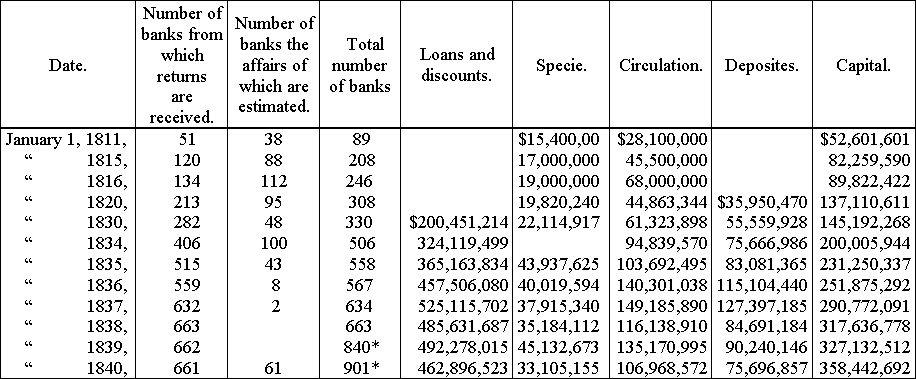
7 In these two years, the number of branches is included.
D.
THE NEW YORK GENERAL BANKING LAW.
AN ACT TO AUTHORISE THE BUSINESS OF BANKING PASSED APRIL 18, 1838.
The people of the State of New York, represented in senate and assembly, do enact as follows:
§ 1. The comptroller is hereby authorised and required to cause to be engraved and printed in the best manner, to guard against counterfeiting, such quantity of circulating notes, in the similitude of bank notes in blanks of the different denominations authorised to be issued by the incorporated banks of this state, as he may from time to time deem necessary to carry into effect the provisions of this act, and of such form as he may prescribe. Such blank circulating notes shall be countersigned, numbered, and registered, in proper books to be provided and kept for that purpose in the office of said comptroller, under his direction, by such person or persons as the said comptroller shall appoint for that purpose; so that each denomination of such notes circulating shall all be of the same similitude and bear the uniform signature of such register; or one of such registers.
§ 2. Whenever any person or association of persons, formed for the purpose of banking under the provisions of this act, shall legally transfer to the comptroller any portion of the public debt now created or hereafter to be created by the United States or by this state, or such other states of the United States as shall be approved by the comptroller, such person or association of persons shall be entitled to receive from the comptroller an equal amount of such circulating notes of different denominations, registered and countersigned as aforesaid; but such public debt shall in all cases be, or be made to be, equal to a stock of this state, producing five per cent. per annum, and it shall not be lawful for the comptroller to take any stock at a rate above its par value.
§ 3. Such person or association of persons are hereby authorised, after having executed and signed such circulating notes in the manner required by law, to make them obligatory promissory notes payable on demand, at the place of business within this state, of such person or association, to loan and circulate the same as money according to the ordinary course of banking business as regulated by the laws and usages of this state.
§ 4. In case the maker or makers of any such circulating notes countersigned and registered as aforesaid, shall at any time, hereafter, on lawful demand during the usual hours of business, between the hours of ten and three o’clock, at the place where such note is payable, fail or refuse to redeem such note in the lawful money of the United States, the holder of such note making such demand may cause the same to be protested for non-payment by a notary public, under his seal of office in the usual manner; and the comptroller on receiving and filing in his office such protest, shall forth with give notice in writing to the maker or makers of such note to pay the same: and if he or they shall omit to do so for ten days after such notice, the comptroller shall immediately thereupon, (unless he shall be satisfied that there is a good and legal defence against the payment of such note or notes,) give notice in the state paper that all the circulating notes issued by such person or association will be redeemed out of the trust funds in his hands for that purpose; and it shall be lawful for the comptroller to apply the said trust funds belonging to the maker or makers of such protested notes to the payment and redemption of such notes, with costs of protest, and to adopt such measures for the payment of all such circulating notes put in circulation by the maker or makers of such protested notes, pursuant to the provisions of this act as will in his opinion most effectually prevent loss to the holders thereof.
§ 5. The comptroller may give to any person or association of persons, so transferring stock in pursuance of the provisions of this act, powers of attorney to receive interest or dividends thereon, which such person or association may receive and apply to their own use; but such powers may be revoked upon such person or association failing to redeem the circulating notes so issued, or whenever, in the opinion of the comptroller, the principal of such stock shall become an insufficient security; and the said comptroller, upon the application of the owner or owners of such transferred stock in trust, may, in his discretion, change or transfer the same for other stocks of the kind before specified in this act, or may retransfer the said stocks or any part thereof, or the mortgages, or any of them hereinafter mentioned and provided for, upon receiving and cancelling an equal amount of such circulating notes delivered by him to such person or association, in such manner that the circulating notes shall always be secured in full either by stocks or by stocks and mortgages, as in this act provided.
§ 6. The bills or notes so to be countersigned, and the payment of which shall be so secured by the transfer of public stocks, shall be stamped on their face, “Secured by the pledge of public Stocks.”
§ 7. Instead of transferring public stocks as aforesaid to secure the whole amount of such bills or notes, it shall be lawful for such person or association of persons, in case they shall so elect before receiving any of the said bills or notes, to secure the payment of one half of the whole amount so to be issued, by transferring to the comptroller bonds and mortgages upon real estate, bearing at least six per cent. interest of this state, payable annually or semi-annually; in which case all such bills or notes issued by the said person or association of persons, shall be stamped on their face, “Secured by pledge of public stocks and real estate.”
§ 8. Such mortgages shall be only upon improved, productive, unincumbered lands within this state, worth, independently of any buildings thereon, at least double the amount for which they shall be so mortgaged; and the comptroller shall prescribe such regulations for ascertaining the title and the value of such lands as he may deem necessary; and such mortgages shall be payable within such time as the comptroller may direct.
§ 9. The comptroller may, in his discretion, reassign the said bonds and mortgages, or any of them, to the person or association who transferred the same, on receiving other approved bonds and mortgages of equal amount; and when any sum of the principal of the bonds and mortgages transferred to the comptroller shall be paid to him, he shall notify the person or association that transferred the bonds and mortgages of such payment, and may pay the same to such person or association on receiving other approved bonds and mortgages of equal amount.
§ 10. The person or association of persons assigning such bonds and mortgages to the comptroller, may receive the annual interest to accrue thereon, unless default shall be made in paying the bills or notes to be countersigned as aforesaid, or unless in the opinion of the comptroller the bonds and mortgages or stocks so pledged shall become an insufficient security for the payment of such bills or notes.
§ 11. In case such person or association of persons, shall fail or refuse to pay such bills or notes on demand in the manner specified in the 4th section of this act, the comptroller, after the ten days’ notice therein mentioned, may proceed to sell at public auction, the public stocks so pledged or the bonds and mortgages so assigned, or any or either of them, and out of the proceeds of such sale shall pay and cancel the said bills or notes, default in paying which shall have been made as aforesaid; but nothing in this act contained shall be considered as implying any pledge on the part of the state for the payment of said bills or notes, beyond the proper application of the securities pledged to the comptroller for their redemption.
§ 12. The public debt, and bonds, and mortgages, to be deposited with the comptroller by any such person or association, shall be held by him exclusively for the redemption of the bills or notes of such person or association put in circulation as money, until the same are paid.
§ 13. The plates, dies, and materials to be procured by the comptroller for the printing and making of the circulating notes provided for hereby, shall remain in his custody and under his direction; and the expenses necessarily incurred in executing the provisions of this act, shall be audited and settled by the comptroller, and paid out of any moneys in the treasury not otherwise appropriated; and for the purpose of reimbursing the same, the said comptroller is hereby authorised and required to charge against and receive from such person or association applying for such circulating notes, such rate per cent. thereon as may be sufficient for that purpose, and as may be just and reasonable.
§ 11. It shall not be lawful for the comptroller, or other officer, to countersign bills or notes for any person or association of persons, to an amount in the aggregate exceeding the public debt, or public debt and bonds and mortgages at their value, as provided in the 2d section of this act, deposited with the comptroller by such person or association; and any comptroller or other officer who shall violate the provisions of this section, shall, upon conviction, be adjudged guilty of a misdemeanor, and shall be punished by a fine not less than five thousand dollars, or be imprisoned not less than five years, or by both such fine and imprisonment.
§ 15. Any number of persons may associate to establish offices of discount, deposite, and circulation, upon the terms and conditions, and subject to the liabilities prescribed in this act; but the aggregate amount of the capital stock of any such association shall not be less than one hundred thousand dollars.
§ 16. Such persons, under their hands and seals, shall make a certificate which shall specify:—
1. The name assumed to distinguish such association, and to be used in its dealings.
2. The place where the operations of discount and deposite of such association are to be carried on, designating the particular city, town, or village.
3. The amount of the capital stock of such association, and the number of shares into which the same shall be divided.
4. The names and places of residence of the shareholders, and the number of shares held by each of them respectively.
5. The period at which such association shall commence and terminate; which certificate shall be proved or acknowledged and recorded in the office of the clerk of the county where any office of such association shall be established, and a copy thereof filed in the office of the secretary of state.
§ 17. The certificate required by the last preceding section to be recorded and filed in the office of the clerk of the county and secretary of state as afore-said, or copies thereof, duly certified by either of those officers, may be used as evidence in all courts and places for and against any such association.
§ 18. Such association shall have power to carry on the business of banking, by discounting bills, notes, and other evidences of debt; by receiving deposites; by buying and selling gold and silver bullion, foreign coins and bills of exchange in the manner specified in their articles of association for the purpose authorised by this act; by loaning money on real and personal security; and by exercising such incidental powers as shall be necessary to carry on such business; to choose one of their number as president of such association, and to appoint a cashier, and such other officers and agents as their business may require, and to remove such president, cashier, officers and agents at pleasure, and appoint others in their place.
§ 19. The shares of said association shall be deemed personal property, and shall be transferable on the books of the association in such manner as may be agreed on in the articles of association, and every person becoming a shareholder by such transfer, shall, in proportion to his shares, succeed to all the rights and liabilities of prior shareholders; and no change shall be made in the articles of association, by which the rights, remedies, or security of its existing creditors shall be weakened or impaired. Such association shall not be dissolved by the death or insanity of any of the shareholders therein.
§ 20. It shall be lawful for any association of persons organised under this act by their articles of association, to provide for an increase of their capital and of the number of the associates, from time to time, as they may think proper.
§ 21. Contracts made by any such association, and all notes and bills by them issued and put in circulation as money, shall be signed by the president or vice president and cashier thereof; and all suits, actions, and proceedings brought or prosecuted by or on behalf of such association, may be brought or prosecuted in the name of the president thereof; and no such suit, action, or proceeding, shall abate by reason of the death, resignation, or removal from office of such president, but may be continued and prosecuted according to such rule as the courts of law or equity may direct, in the name of his successor in office, who shall exercise the powers, enjoy the rights, and discharge the duties of his predecessor.
§ 22. All persons having demands against any such association, may maintain actions against the president thereof; which suits or actions shall not abate by reason of the death, resignation, or removal from office of such president, but may be continued and prosecuted to judgment against his successor; and all judgments and decrees obtained or rendered against such president for any debt or liability of such association, shall be enforced only against the joint property of the association, and which property shall be liable to be taken and sold by execution under any such judgment or decree.
§ 23. No shareholder of any such association shall be liable in his individual capacity for any contract, debt, or engagement of such association, unless the articles of association by him signed shall have declared that the shareholder shall be so liable.
§ 24. It shall be lawful for such association to purchase, hold, and convey real estate for the following purposes:—
1. Such as shall be necessary for its immediate accommodation in the convenient transaction of its business; or
2. Such as shall be mortgaged to it in good faith, by way of security for loans made by, or moneys due to such association; or
3. Such as shall be conveyed to it in satisfaction of debts previously contracted in the course of its dealings; or
4. Such as it shall purchase at sales under judgments, decrees, or mortgages held by such association.
5. The said association shall not purchase, hold, or convey real estate in any other case or for any other purpose; and all conveyances of such real estate shall be made to the president, or such other officer as shall be indicated for that purpose in the articles of association; and which president or officer, and his successors, from time to time, may sell, assign, and convey the same, free from any claim thereon, against any of the shareholders, or any person claiming under them.
§ 25. Upon the application of creditors or shareholders of any such association, whose debts or shares shall amount to one thousand dollars, and stating facts, verified by affidavit, the chancellor may, in his discretion, order a strict examination to be made by one of the masters of his court of all the affairs of such association, for the purpose of ascertaining the safety of its investments, and the prudence of its management; and the result of every such examination, together with the opinion of the master and of the chancellor thereon, shall be published in such manner as the chancellor shall direct, who shall make such order in respect to the expenses of such examination and publication as he may deem proper.
§ 26. Such association shall on the first Mondays of January and July in every year after having commenced the business of banking as prescribed by this act, make out and transmit to the comptroller, in the form to be provided by him, a full statement of the affairs of the association, verified by the oath of the president or cashier, which statement shall contain
1. The amount of the capital stock paid in according to the provisions of this act, or secured to be paid.
2. The value of the real estate of the association, specifying what portion is occupied by the association as necessary to the transaction of its business.
3. The shares of stock held by such association; whether absolutely or as collateral security; specifying each kind and description of stock, and the number and value of the shares of each.
4. The amount of debts due to the association, specifying such as are due from monied or other corporations or associations; and also specifying the amount secured by bond and mortgage or judgment; and the amount which ought to be included in the computation of losses.
5. The amount of debts due by such association; specifying such as are payable on demand, and such as are due to monied or other corporations or associations.
6. The amount of claims against the association not acknowledged by its debts.
7. The amount of notes, bills, or other evidences of debt, issued by such association.
8. The amount of the losses of the association; specifying whether charged on its capital or profits, since its last preceding statements, and of its dividends declared and made during the same period.
9. The average amount in each month during the preceding six months of the debts due to and from the association; the average amount of specie possessed by the same during each month, and the amount of bills and notes issued by such association and put in circulation as money, and outstanding against the association, on the first day of each of the preceding six months.
10. The average amount in each month during the preceding six months due to the association, from all the shareholders in the association; also the greatest amount due the association in each of the said preceding six months, from all the shareholders in such association.
11. The amount which the capital of the said association has been increased during the preceding six months, if there shall have been any increase of the said capital; and the names of any persons who may become parties to the said articles of association, or may have withdrawn therefrom since their last report.
It shall be the duty of the comptroller to cause the statement required to be made by this section, to be published in a newspaper printed in the county where the place of business of such association is situate, and in the state paper; the expense of which shall be paid by such association.
§ 27. If such association shall neglect to make out and transmit the statement required in the last preceding section, for one month beyond the period when the same is required to be made, or shall violate any of the provisions of this act, such association may be proceeded against and dissolved by the court of chancery, in the same manner as any moneyed corporation may be proceeded against and dissolved.
§ 28. If any portion of the original capital of any such association shall be withdrawn for any purpose whatever whilst any debts of the association remain unsatisfied, no dividends or profits on the shares of the capital stock of the association shall thereafter be made until the deficit of capital shall have been made good, either by subscription of the shareholders, or out of the subsequently accruing profits of the association; and if it shall appear that any such dividends have been made, it shall be the duty of the chancellor to make the necessary orders and decrees for closing the affairs of the association, and distributing its property and effects among its creditors and shareholders.
§ 29. Such association shall be liable to pay the holder of every bill or note put in circulation as money, the payment of which shall have been demanded and refused, damages for non-payment thereof, in lieu of interest, at and after the rate of fourteen per cent. per annum, from the time of such refusal until the payment of such evidence of debt, and the damages thereon.
§ 30. The president and cashier of every association formed pursuant to the provisions of this act, shall at all times keep a true and correct list of the names of the shareholders of such association, and shall file a copy of such list in the office of the clerk of the county where any office of such association may be located, and also in the office of the comptroller, en the first Mondays of January and July in every year.
§ 31. It shall not be lawful for any association formed under the provisions of this act, to make any of its bills or notes of a denomination less than one thousand dollars, to be put in circulation as money, payable at any other place than at the office where the business of the association is carried on and conducted.
§ 32. The legislature may at any time alter or repeal this act.
§ 33. No association of persons authorised to carry on the business of banking under this act, shall at any time, for the space of twenty days, have on hand at their place of business, less than twelve and a half per cent. in specie on the amount of the bills or notes in circulation as money.
State of New York, Secretary’s Office.
This bill having been approved and signed by the governor of this state, on the 18th of April, 1838, I do hereby certify that the same became a law on that day.
JOHN A. DIX, Secretary of State.
[See Appendix J.]
_____
E.
LETTER FROM THE AUTHOR TO JOHN W. COWELL, ESQ., AGENT OF THE BANK OF ENGLAND IN THE UNITED STATES.
Philadelphia, April 15, 1839.
MY DEAR SIR:
As you are upon the eve of departure for England, after, as I understand, a highly successful issue to your financial mission to this country, I take occasion to hand you a copy of the “Treatise on Currency and Banking,” of which you have seen a few of the early chapters, in the hopes that you will find them, in the main, in accordance with your own views of those important subjects. I am the more inclined to this expectation, from recollecting the tenor of the frequent conversations I have had with you, from which I need hardly say, I derived much valuable, instructive, and practical information, as well as from a perusal of the unpublished pamphlet, with a copy of which you favored me, setting forth your individual opinions upon the best system of reform for the paper currency of England.
In regard to the latter subject, I am free to confess, that the United States have a deep interest in its discussion, and they will owe much to the political economist or statesman, who shall be so fortunate, as successfully to advocate a reform that shall prevent fluctuations in the currency of Great Britain. It was some years since remarked in our congress, by a member, that the barometer of the money market of the United States was hanging up in the stock exchange of London. Since the conflagration of that building, I would say that the barometer has been hanging up in the “parlour” of the bank of England; and in truth; so closely allied are our two currencies by the ill-advised change in our gold coinage, which took place in the year 1834, that it is impossible that any expansion or contraction of the currency can take place in England, that will not be felt here; in the one case, inviting our banks to extend their discounts, and thereby excite overtrading and speculation, and in the other case, compelling them to contract their loans, and thereby produce a general commercial embarrassment.
The plan you have suggested, and to which I have above referred, appears to me to be eminently adapted to accomplish the end proposed; and if the paper currency of this country were under the control of a single legislative body, as it is in England, instead of thirty bodies, as it is, I would recommend it as the best plan I have yet met with, for enabling the public to enjoy all the benefits of a paper circulation, without any of its evils.
According to that plan, as I understand it, the mint is to issue certificates for sums of one pound, five pounds, and any greater denomination, upon a deposite of gold of equal amount; and such fixed proportion of the gold so deposited, as may be ascertained, from experience, to be the amount that may, with the most perfect safety, be withdrawn by exportation from the metallic portion of the currency, is to be immediately invested in the public funds, by commissioners appointed for that purpose. By this process, the following results will be effected:
First. The mixed currency, after the exportation of the gold above referred to, will be precisely equal to the quantity of coin that would have existed in the country, had there been no mint certificates.
Secondly. The country would derive the profits resulting from the employment of a certain amount of capital in commercial pursuits, which would otherwise have been unprofitably employed as currency.
Thirdly. The public, and not private corporations, or individuals, would enjoy a profit resulting from the circulation of the paper money, precisely equal to the accruing interest on the public debt held by the commissioners; and,
Fourthly. The country would be entirely exempted from any fluctuation in the currency, other than that to which a metallic currency is liable; it being necessarily incident to the plan, that whenever mint certificates should be returned for payment in gold, the commissioners should obtain in the market, by a sale of public securities, an amount of coin precisely equal to that which was invested, on the issue of the notes so returned.
Against the soundness of this plan, I am not able to see any objections. How far a general panic, arising from war, or domestic disturbance, might render it difficult to sell public securities in a time of emergency, you are better able to judge than I am. Certain is it, however, that no depression of the stock market could result from a reaction of an expanded state of the currency, the most frequent cause of depressions at the present day, for, as there would be no expansion, there could be no reaction.
Before parting, I can not omit the occasion to say to you, that, although the political horizon is, at this moment, somewhat over cast, I can not persuade myself that two countries like Great Britain and the United States, so peculiarly adapted to supply each other’s wants, and whose mutual interest it so manifestly is to maintain an eternal friendship, can, at this enlightened day, be guilty of the folly of going to war. And now, wishing you a safe and expeditious voyage,
I subscribe myself, very truly and respectfully,
Your friend and servant,
CONDY RAGUET.
F.
Imports and Exports of the United States, from the 1st of October, 1789, to the 30th of September, 1838, taken from documents accompanying the Secretary of the Treasury’s annual Report to Congress, of the 3d of December, 1839.
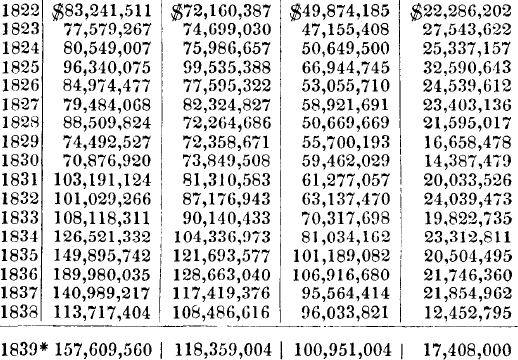
NOTE.
For the early years the aggregate of the value of imports does not appear on the official statement, and has been estimated at different amounts by different persons, and thus that column will not always correspond with former reports. But the difference will not be found so great as to affect materially any general result. [In former reports it is stated, that prior to the 1st of October 1820, the official returns do not show the value of imports. Previous to 1796, the returns of exports did not discriminate between domestic and foreign productions.—Author.]
G.
ON UNLIMITED LIABILITY.
By James Cox Esq. of Philadelphia.
THE question of the extent of the liability of individuals, and of their natural right to limit that liability, is one which, in its moral as well as in its economical aspects and relations, is of the highest interest and importance, and the satisfactory solution of which is intimately connected with the investigation of those general and fundamental principles of justice and of expediency, which should form the basis of all positive enactments.
Prominent among the many plausible yet shallow fallacies which have, with a zeal and a perseverance worthy of a better cause, been urged in favor of the device of a limitation of individual liability—of a restriction upon personal responsibility—is the vain and contradictory assumption that the adoption and extension of this system of restraints is required by an enlightened adherence to the doctrines of the free trade theory—a theory in the general truth of the conclusions of which there is, as we think, no sufficient reason to doubt.
What would be the condition of individuals living in a state of the largest liberty consistent with the protection of each in the enjoyment of his natural rights, and under the control of no laws except such as might be necessary to enforce that performance of engagements which is required by a regard to the paramount obligations of morality, and to the demands of justice? A. B. and C. would, as it is perfectly manifest, trade with each other upon the condition of the natural and unlimited liability of each. And should A. B. and C. associate together in order to trade with D. E. and F., it would still, in strict conformity with the moral law, be upon the basis of the natural and unrestrained responsibility of each, not merely for the consequences of his own individual actions, but for those of the association of which he was a member. And from this condition of natural and inherent obligation, from this state of subjection to the moral law, neither A. B. nor C. could, by his own unaided act or by his individual effort, liberate himself. To effect this, the efficacy of positive enactments must be called to his assistance. Recourse must be had to far fetched and fanciful analogies, to subtile refinements and to legal figments. Privilege usurps the place of right. Rights cease to be enjoyed upon the only proper condition of the full performance of duties. Perfect freedom is no longer demanded upon the sole ground of perfect responsibility. Liberty and liability are rent asunder; an appeal must be made to the legislative power to put a limitation upon that which was before unlimited—to restrict that which, in a state of freedom, was unrestrained. The very expression of “limited liability” betrays the weakness of the argument; whilst it suggests, and of necessity implies, from the force of the terms, the idea, not of freedom, but of restraint and of restriction.
We are thus irresistibly led to the conclusion that the fancied advocacy of the right freely to trade in commodities, resolves itself into an argument for the limitation of that which, but for the intervention of the law, and the interference of the law-makers, would be unlimited—for the restriction of that which, in the absence of positive and special enactments, would be unrestricted. The argument for restraints is not the less remarkable as occasionally proceeding from those who thrust themselves forward as the select and chosen champions of the beneficent doctrines of commercial freedom; and who complacently assume to themselves the character of the freest of the free.
“There seems to prevail,” says Mr. Tooke, “among those who incline to the introduction of the commandites” (or limited liability) “system, a vague notice that something like a right exists, on the part of individuals, to circumscribe their liability” * * “and that it is only by the special interference of the law of partnership that they are prevented from exercising that right, that the law is an interference with what would otherwise be the free, and probably, therefore, the best direction of capital in trade.” * * * “On the slightest reflection, however, it must be obvious that the commandite is a privilege, and has not the shadow of foundation as a natural right. The general if not universal, rule of commercial transactions is, that the individual is liable to the full extent of his means, for the engagements entered into by himself, or on his behalf, or jointly with others, and it is only by the intervention of a special law that he can be shielded from the more general one.” And whilst this interposition must be considered as granting “a privilege, it operates as a distinct inducement—a premium—to individuals to employ the inferior, instead of the better instrument for carrying on the trade of the country.”
But, possibly, it may be objected that individuals are at liberty, by mutual agreement, to limit their responsibility. This, however, in the sense intended, is a mere groundless assertion, without force or foundation. For, although it should be admitted that an individual may, in the performance of a specific contract, limit his liability to the extent of the pledged security, it would by no means necessarily follow that he can thus restrict and restrain his general liability. This liability, as we have seen, is the result of natural obligation. It arises from the operation of the moral law. It is binding upon the one party, from the mere force of moral considerations; and it is entirely independent of the claim of the other party. It results from the very nature of man as a moral agent. To be relieved from its practical operation recourse must be had to artificial distinctions, and to legal fictions. The proposition attempted to be sustained is neither more nor less than that men are born under a liability even less than that of corporations. For the latter being, by a legal refinement, considered as artificial persons, are responsible to the whole extent of their corporate property. It is true that the most ready resources of these artificial persons are frequently found to consist in an available fund of public credulity.
“If it should be urged that when a person intrusts property to another, he knowingly undertakes the risk of that other’s insolvency, and that if the contingent loss happens, he has no claims to justice on the other, the answer is this: that whatever may be thought of these claims, they are not the grounds upon which the debtor is obliged to pay. The debtor always engages to pay, and the engagement is enforced by morality: the engagement, therefore, is binding, whatever risk another man may incur by relying upon it. The causes which have occasioned a person’s insolvency, although they greatly affect his character, do not affect his obligations; the duty to repay when he has the power is the same; whether the insolvency was occasioned by his fault or his misfortune.” Being then able to pay, “does the legal discharge exempt him from the obligation to pay? No: and for this reason, that the legal discharge is not a moral discharge; that as the duty to pay at all was not founded primarily on the law,” the law cannot cancel the obligation.
If then individuals can, under no circumstances, except those of a distinct and special contract, be justified in limiting their responsibility to each other, much less can they limit it in reference to third parties, and least of all, can the banker and the bank debtor have, as has been most absurdly assumed, a natural and indefeasible right to impose, for the promotion of their own interested and sordid purposes, upon whole classes—upon the mass of the community—the absolute necessity of receiving, in payment of their dues, the promissory notes of associations made up of irresponsible persons. And vain and frivolous is the assertion that, as bank notes are not a legal tender, their circulation is the consequence of their voluntary reception. For, whatever bank notes may be by law, it cannot be denied that they are virtually, practically, and in fact, a legal tender. In cases innumerable there is no option, and their circulation is thus made compulsory. As is notorious, the great mass of the people are, at all times, totally without power to refuse them. Paper forms almost the whole of the circulating medium, and the only real alternative offered to a large proportion of the laboring and mechanical classes is to accept of bank notes, or to cease from their occupations. Thus there is resting upon the supreme authority the same obligation to prevent the circulation of worthless paper, as there is to preserve the purity of the coin. And the duty is the more binding, inasmuch as the country has sustained far more injury from the issue of fraudulent promises, than from the circulation of base coin. The great “commodity of contract” should not be left to fluctuate in value at the caprice, or to gratify the cupidity of irresponsible or unprincipled parties.
Obligation is involved in the very nature of that which is morally good. “Obligation to action and rectitude of action are obviously coincident and identical.” If men are morally responsible for the consequences of their own actions, and for those of their agents, (a proposition which will hardly be contested,) then should the legal liability be commensurate with the moral obligation.
But it has been said: “Grant to your neighbor the same secure exercise of the rights of person and of property that you desire for yourself.” And again: “if the abolition of restrictions will tend to enable men more rapidly to improve their condition, there can be no moral objection to the passage of a law granting to all men permission to trade with each other upon such terms as they may agree upon among themselves.” That is to say: secure to others, by means of positive enactments directly at variance with all sound and settled principles of moral and inherent accountability, the same legal exemption from the performance of duty—the same licence to disregard the requirements of moral rectitude—which you desire for yourself, and the climax of perfect freedom will then be attained. A will be at liberty to defraud B, because B will be free to cheat C, who, in his turn, may, with impunity, defraud A. The reciprocation of dishonesty is thus made perfect—the circle of deceit is complete. Than which, we are told, “nothing would tend more to promote the cause of morality!”
It is not at all surprising that such a chain of argument should assume, as its first link, the truth of the proposition that “the abolition of restrictions,” by which is intended the granting of exemptions, “will tend to enable men more rapidly to improve their condition;” thus proving the point at issue, by simply taking it for granted; and instead of reasoning directly for the expediency of a measure from its justice, adopting the inverted process—the retrograde and crab-like procedure of inferring its justice from its assumed expediency. Neither, under the circumstances, need it be an occasion of wonder, that whilst men are discoursing upon the truth and beneficent tendency of the doctrines of free trade, and expatiating upon the advantages to ensue to society from “the abolition of restrictions,” they should also be found pleading for “the passage of a law granting to all men” exemptions, to which, in the absence of all interference, on the part of the law-makers, with the natural state of perfect freedom upon the natural condition of perfect responsibility, they could make no valid claim whatever.
The doctrine of a limitation of liability thus strikes, as it is perfectly plain, at the very foundations of moral rectitude. It assumes the right of individuals to release themselves, and the possibility of their being released by others, from the bond of moral obligation; of being relieved from all other than a very limited measure of responsibility for the consequences of their own acts, or of those of their authorised and accredited agents. An assumption, as we have just seen, as little in accordance with sound principles of integrity, as it is irreconcilable with an unreserved obedience to positive precepts of the highest possible authority. The dogma has as slender a basis in natural equity, as it derives little support from enlightened views of expediency. Hence the entire correctness of the remark of a practical banker, of excellent understanding and of great experience, that “the commandite principle seems to involve something very nearly approaching to injustice, inasmuch as in the case of the insolvency of a concern, it tends to remove a portion of the loss, which must be borne by some party, from those who have voluntarily engaged in the concern, who have had the means of watching and controlling its progress, and who would have been the sole participators in the benefits of its success, for the purpose of throwing it upon those who had no means of insight into the state of the concern, no power over the management of it, and no share in its advantage. The partners may be but slightly injured, whilst the creditors are ruined. The difficulties too of guarding against fraud and intricate legislation are very great.” And where these difficulties have been in any considerable degree surmounted, it has usually been only by subjecting the privilege to such qualifications, and by imposing upon the exemption itself such restraints as have rendered it almost nugatory and altogether unacceptable to the parties desiring to profit by the limitation of their natural liability.
If such, then, is the true character of all devices intended to limit the liability of individuals, to put restraints upon the responsibility of moral agents, and to grant legal exemptions from the weight of natural obligations, how happens it that “the nicest conscience is not offended by holding stock in incorporated institutions?” The answer, in its application to incorporations for trading and banking purposes, the only description of associations contemplated, is obvious. Even of conscientious persons, some have never had the subject practically brought home to them—have never had their attention aroused and stimulated to a serious investigation of the merits of the question. Some are unconsciously biassed and swayed by interested motives; or they are influenced by plausible fallacies and by specious sophistries. Many are content to take things as they find them, without being at the pains to inquire into the truth of what they may persuade themselves are merely theoretical refinements and metaphysical abstractions. And of all it may be affirmed, such is the wide spread sway of vicious legislation, and especially in relation to the right to issue currency, that a strict adherence to undoubted principles—a rigid observance of maxims which, in a different and a better state of society, would bind the conscience—becomes, in a great degree, impracticable and superorogatory.
Whilst the objection noticed, furnishes not even a palliation, much less a justification of a system equally at variance with the dictates of justice, with the promptings of expediency, and with that natural order of things to advocate and to sustain which is the aim and the object of the political philosopher, it affords one of the strongest arguments against the prolonged existence of a policy fraught with evils of such magnitude, and obnoxious to objections so serious.
The efficient principle of liability thus brought into view is one highly conservative, and from the free and unrestrained operation of which individuals, neither singly nor in their associate capacity, should ever be permitted to feel themselves emancipated. Upon its uncontrolled influence, in conjunction with that of its antagonist principle—the love of gain—depend the strength and conclusiveness of the arguments in support of the beneficent doctrines of commercial freedom.
Free trade may be defined to be that system, under which every one is left in the enjoyment of his natural liberty of making such a disposition of his property, and of giving such a direction to his industry, as may to himself appear most conducive to his interests. It is that state of the law in which men, subject merely to the requirements of truth and of justice, are allowed to trade together as they like, it being reasonably presumed that, in the vast majority of cases, individual sagacity, sharpened by competition and by individual interest, will secure to the community the ultimate attainment of results more positively and diffusively beneficial, than can possibly flow from the interference of the (so called) collective wisdom of legislators. Upon the “tentative” efforts of interested parties reliance may securely be reposed for a satisfactory adjustment of conflicting claims, and for the establishment and continuance of that natural order of things which alone can be permanently and generally advantageous. This freedom, however, degenerates into a wild and unrestrained licence; individual sagacity ceases to be a solid and secure ground of confidence, when any one of the leading and influential principles, by which moral and responsible agents are governed, is impaired or weakened in its natural and healthy action—when men cease to be, under all contingencies, answerable for their doings—when the love of gain is inordinately stimulated by the hope of high profits; whilst the fear of loss is banished by the facility with which much of that loss may be thrown upon others—upon those who, under no circumstances, would have participated in the gains. The natural equilibrium of wisely balanced motives is disturbed. The just equipoise of conflicting influences is destroyed. The spirit of enterprise is unduly excited, and the public is thus deprived of the stability and security resulting from the salutary operation of a natural principle—the fear of loss—implanted in our natures for wise purposes; and which, in all cases of individual risk, undertaken and prosecuted under a sense of unlimited individual liability, constitutes a most wholesome restraint upon every scheme of doubtful utility—upon every project of questionable legality.
Thus it is that a writer, displaying a perfect familiarity with all the practical details of the subject, as well as a full comprehension of the great moral and economical principles involved in its discussion, adverting to the admitted truth that the spirit of speculation is already “too strong,” expresses his convictions in the following unreserved language: “Great danger is to be apprehended from any step that would tend to give unnatural inducement to persons not bred to, and not acquainted with mercantile pursuits, to embark their property in such concerns. Without the least hesitation, I pronounce it to be a scheme full of danger to the interests of the commerce and manufactures of this country,” (England) “placing them in a position of extreme hazard and likely to produce the most extensive mischief, if adopted.” And again: “Any thing that would attract capital in an unnatural way to speculative objects, I consider to be very disadvantageous.” And he concludes his summary of objections against the scheme with the observation that: “In my opinion there is no sound or safe system that can admit of limited liability.”
So also a practical and most judicious writer of ample experience, and enjoying every opportunity of the most extended observation: “In proportion as the consequences of failure are rendered less serious, must we not expect that concerns will be undertaken with a more speculative feeling, and be conducted with less vigilance and sobriety? We should consider well the tendency which the sense of limited responsibility has to elicit the spirit of gambling.”
As the principle of the limitation of the liability of individuals is thus obnoxious to the heaviest objections on the score of its evident and injurious tendency to promote an artificial distribution of the national capital, and thus to diminish its productiveness and to prevent its rapid accumulation, thereby retarding the natural progress of society, so its influence is no less sinister upon the moral and intellectual character of individuals. “Removing the risk of general liability would, in the existing state of society, have a tendency to separate still more than they are now, the partner bringing capital from the partner bringing labor. The idleness of the capitalist is now checked by the risk in which it involves the monied partners. The natural laziness of mankind would induce capitalists to unite in large partnerships for the most ordinary business matters, doing little or nothing themselves; and leaving the management to subalterns. The check upon this is the unlimited liability under the existing law, and the result of thus superseding industry in the principal, would be to deteriorate the talents and characters of the mercantile and manufacturing classes.” The question, too, it may be added in the words of an eminent moralist, “is not whether some men,” in view of the risks to be incurred, “would not prefer indolence to the calls of justice,”now so commonly disregarded, “but whether the public should judge accurately respecting what those calls are.”
If then the principles of free trade, which are but the principles of justice, of equality and of common sense, do not admit of unnecessary restraints upon the liberty of human action, much less, when properly understood, can they sanction or tolerate a limitation of individual liability.
The nature of the arguments frequently employed by the champions of the doctrine of a limitation of liability, especially in its application to associations of individuals for the manufacture and the issue of a paper currency, furnishes abundant evidence of the prevailing confusion of ideas in the discussion of economical questions; of the inability to discriminate between things possessing some few points of resemblance, yet in their real nature perfectly distinct; and of the too common deficiency of analytical sagacity, in considering as identical, propositions essentially different. Assuming, since it cannot be proved, that the opinion is correct that partnerships for commercial and manufacturing purposes—for dealing in commodities possessed of intrinsic value—for trading in corn, cotton or coin, may be safely and beneficially formed upon the principle of a limitation of liability; does it, there fore, follow that the same principle is equally applicable to associations for the manufacture and the issue of paper promises—of promises intended as a substitute for coin—of promises which, in the actual condition of affairs, no man can conveniently refuse, and which no man can, with entire safety, take? Is the grant of a bank credit, or the issue of a species of currency which, whilst it requires little expenditure of labor or of capital for its production, by the facility with which it is exchanged for articles possessed of intrinsic value, is in the highest degree profitable to the issuer, and thus holds out the strongest inducements to over-production, an overproduction, the constant tendency to which is feebly, if at all, restrained by the apprehension of the remote contingency of possible and ultimate loss—is this process to be compared with the production of commodities? Or is the trade in promises to be put upon the same footing with the exchange of material products—with the trade in real, not representative values? Is that which may be true of the substance, necessarily true of the shadow also?
The fallacy of the argument usually employed in the defence of a most pernicious and demoralizing doctrine, in its application to the question of the right to issue currency, consists in the dexterous employment of the term money in its double sense of coin, and of promises to pay coin. And, because it may possibly be admitted that the trade in coin, as in corn or in cotton, may properly be conducted upon certain principles, it is cunningly or ignorantly inferred that the same conclusion is applicable to the trade in promises. The truth of the proposition A is conceded, and the artifice or the blunder consists in taking for granted that the proposition B is identical with A, and that it is, therefore, equally true. This is one among the many instances of attempts, made by interested parties, or by deluded partisans, to mystify clearly ascertained principles, and to pervert established doctrines. If the major proposition is true, the minor is so also. If the trade in capital—if the borrowing and lending of coin, of metallic money possessed of intrinsic and indestructible value—cannot safely be allowed with a limitation of the liability of the dealers, much less can the trade in mere promises.
To the plan of subjecting associations for banking purposes to the regulation and restraint resulting from the natural and quiet operation of the equitable and salutary principle of the unlimited liability of individuals, it has been objected that the multiplication of banks being thereby effectually stayed, a wholesome competition is prevented.
The answer to this objection is as easy as it is conclusive. We assert, as that which cannot be disproved, that he multiplication of banks has no where been in this way improperly or unduly checked. On the contrary, under the application of the principle assailed and notwithstanding its assumed incompatibility with the freedom of the banking business, these establishments have not only increased in number, but their increase has been rapid, excessive and hurtful.
Thus, in Scotland, where joint stock banking companies are organised and administered upon the sound and salutary principle of the liability of each partner “to the whole extent of his fortune for whole debts of the company,” and where this liability of individuals furnishes to note-holders and depositors the firmest ground of confidence and of security, there are no fewer than 26 banks, with 314 branches. Eight of the former and 113 of the latter have been established since 1824; and such is their general diffusion over the country, that “there is scarcely a town, or even a village, into which branches of the Scotch banks, equivalent to so many separate and distinct banks have not penetrated.”
The consequence of this condition of the banking business is, that the dividends upon bank stock—the profits of the shareholders—are reduced to the lowest point consistent with the continued investment of capital in this department of commercial industry and enterprise. So little foundation is there for the positive assertions which have been so recklessly ventured as to the assumed necessity of holding out the expectation of exorbitant profits, as an inducement to capitalists to incur the risks of individual liability. It may, in truth, be questioned whether these risks have been practically at all increased; and whether the unrestrained responsibility of the parties has not been more than compensated by a commensurate increase of circumspection, of prudence, and of good management and by a consequent and coresponding enlargement of credit. Individual sagacity, in this as in all other analogous cases, has been sharpened, and individual caution has been stimulated by the absence of all positive and artificial restraints upon individual liability. Hence these banks are administered with a view to the promotion of the interests, not of the borrowers, as is too often the case in this country, but of the owners of bank capital. And there is no reason to believe that stockholders have in Scotland suffered as much as the same class of capitalists have endured in this country; whilst the losses of the public have been in a greatly diminished ratio.
Thus, also, in England where previous to 1826 companies for banking purposes were not allowed to consist of more than six partners, and where, as in Scotland, the unlimited liability of the associated individuals lies at the foundation of the system, such, since the repeal of the restriction upon the number of partners, has been the rapidity with which these associations have increased, that there were in 1836, in addition to several hundred private banks, 101 joint stock companies with very numerous branches. Of these 45 were registered in one year alone, and counting their branches “which are often removed from the parent establishment, and conduct all sorts of banking business, it may safely be affirmed that considerably more than 200 banking establishments were set on. foot in England and Wales in 1836.” Hence, whilst, by the most enlightened and strenuous advocates of the joint stock banking system, it has been freely and unreservedly admitted that “too many banks” have been established, by others, this increase has been represented as “alarming,” and the speculative spirit which thus developed itself, has been correctly characterised as a “mania,” to the prevalence of which there proved to be no serious obstacle, either in the unrestrained responsibility of the shareholder, or in the existence of a powerful national bank, possessed of monopoly privileges, and sustained by the whole force of government patronage and of government influence.
Are there not then, it may confidently be asked, ample and satisfactory reasons for admitting the entire propriety of the conclusion drawn by Mr. Quin, who, at the close of his most elaborate abstract and review of the evidence taken before the Parliamentary committee of 1832, remarks: “If men with sufficient capitals are already found in abundance disposed to embark in the banking trade at the risk of their own fortunes, there is no reason why speculators should be allowed to establish banks of issue upon a less responsible system.”
But again, we affirm, without the fear of refutation, that the beneficial tendency of competition to prevent excessive production, in its application to associations, not for the manufacture of articles requiring for their creation the expenditure of capital and the application of industry, but for the making and the issuing of currency of promises to pay—of paper costing comparatively nothing, has never yet been demonstrated. It has merely been taken for granted. In the case of commodities possessing not a representative, but an intrinsic value, the public are in general, secure from an over-production from the simple consideration that no man will knowingly continue to produce and to bring to market an article which does not realize to the producer the cost of production, together with at least the ordinary return upon the investment of capital, and the ordinary reward for the application of labor. And should an individual, from inexperience, from ignorance, or from any other cause, fall into the error of increasing the supply beyond the effective demand—beyond the demand of those able and willing to purchase, he would soon become satisfied of his mistake; and would be obliged, at his own expense, to correct the error. Now what is true of one individual is true of many. What is true of many, is true of the mass. Thus we may safely trust to “the spontaneous operation of private interests,” for the proper apportionment of the supply to the demand; and all interference of the governors with the governed must prove to be not merely ill advised and uncalled for, but ultimately and absolutely pernicious.
Widely different, however, is the case, when we proceed to an investigation of the causes which operate upon the manufacture of bank promises; to examine into the motives which influence in the issue of a currency possessed of little or no intrinsic value. Here the gain to the issuer is immediate, is considerable, is certain; whilst the cost of production is relatively insignificant, and the loss of profit consequent upon a re-action, is future, distant, contingent and uncertain. It may be avoided. It may be thrown, as it usually is, upon the shoulders of the public—and in few instances is the return of paper upon the issuer attended with a positive loss. Its effect is simply a diminution of anticipated profits. The actual loss is incurred by those bank debtors who may be compelled to make heavy sacrifices in order to sustain their credit and to honor their engagements; or by those bank creditors, who are in possession of obligations which are disregarded—of promises which are not performed. Thus there exists every inducement to banks to lend their credit, and to increase the supply of their paper; that is to say, there is every stimulus to an expansion; whilst, on the other hand, inasmuch as bank credit in the form of bank notes, so long at least as the ultimate solvency of a bank is thought not to be impaired, is to the borrower just as available as capital, the demand is limited only by the extent of the opportunities, or of the supposed opportunities, for profitably employing capital; that is to say, it is practically unlimited. “The constant tendency, therefore, of banks is to lend too much, and to put too many notes in circulation.”
Fancifully and absurdly to compare banks of issue—paper mints—to “shoe shops,” as has been done by some, and to assume that the one are subject to the same influences, and are governed by the same general laws as the other, may, to the unreflecting and to the superficial, present an appearance of plausibility and of acuteness; but to the mind of the philosophical inquirer, who perceives the entire absence of any analogy upon which to rest a parallelism of argument, such far-fetched comparisons can bring no conviction.
It is not merely a demonstrable truth, but a truth that has again and again been demonstrated, that banks issuing paper really and thoroughly convertible can neither expand nor contract the general mass of the currency to an amount permanently greater, or permanently less, than it would be with a medium exclusively metallic; and that, therefore, the average quantity of the currency, and consequently the average money values, or prices of real estate and of commodities generally, will in any given country be the same or nearly the same, whether the currency consists exclusively of convertible paper, or of coin; or whether it is compounded in any conceivable proportions of both. But it is equally true, in fact, it cannot be denied, that in this country the convertibility of paper is at all times exceedingly imperfect; and that there is constant danger of this imperfect convertibility ceasing altogether.
Neither, after the experience of all countries employing a paper medium, can there “any doubt be entertained that an excess of paper money, even when freely convertible into specie, may exist for some time unredressed; and although the check of convertibility must ultimately prevail, very considerable effects on prices may be produced in the interval.” And as this redundancy, however hurtful it may be, is surely and inevitably followed by a deficiency still more pernicious, “it is of great consequence that a paper currency should not only be subject to repression from without, but be placed under such a system of management as will prevent any excess in quantity from being issued.” But the only “system” which can possibly accomplish this most desirable object—the only policy at all entitled to be termed preventive—will be found to consist in an entire separation of the incompatible functions of banks of issue and of banks of discount. A paper currency, if such a currency is thought to be indispensable or desirable, should be furnished by banks purely of issue, automatically expanding and contracting the circulation simply in reference to the demand for paper in exchange for the precious metals and the demand for the metals in exchange for paper. On the other hand, commercial securities should be discounted, as is the practice in London, by banks not of issue, but of discount and deposite—by banks not “trenching on the perogatives of sovereignty by coining money“—but by banks which are properly mere borrowers and lenders of capital, and dealers in coin.
The functions of banks of discount are in their nature purely commercial, and the only supervision either necessary or justifiable on the part of government, is that the parties to contracts should be held strictly responsible for their performance. Banks of issue, on the contrary, cannot be kept too distinct in their operations not merely from all mercantile dealings, but they should be removed from all sympathy with money lenders and money borrowers.
The inevitable consequence of combining the issue of paper money with the proper and the appropriate business of banks of discount, is to aggravate commercial embarrassments, and to give redoubled intensity to commercial revulsions.
The system of paper money banking as it exists in this country, and the prominent feature of which is the confiding to associations of irresponsible traders and speculators the discharge of one of the most important and vital functions of sovereignty, and thus giving to interested parties the control over the great “commodity of contract,” is a system evil in its essence, vicious in its very constitution, and irremediably and irresistibly pernicious in its influences, tendencies and consequences.
In the fabrication and the issue of promises to pay there will be, as has been already shown, a constant tendency to excess, because the manufacture costs comparatively little or nothing; because the issue is highly lucrative; and because the performance of the promise can be evaded, and, as is perfectly notorious, constantly is evaded, whenever it becomes burdensome; or the burden will, at all events, be shifted to the shoulders of others. “Convertibility at the will of the holders, and a sense of this power in them, on the part of the issuer is not, as experience has proved and is proving, any restraint in the way of over-issue. It is not a preventive, but a painful method of cure.—And it appears to exercise no more influence on the mind of the issuer than the fear of future punishment is found to exercise on the majority of those who are in full possession of health and vigor.” On the contrary, the production and the supply of material commodities, possessed of intrinsic value, will not ordinarily be in excess; because the creation of such products involves an expenditure of capital, and the employment of industry; and because an excess in the supply, by causing a fall in price, whilst it benefits the consumer, entails a certain loss upon the producer.
But it is said that, under a system of free competition, banks of issue will effectually check each other, and thus prevent all undue expansions in the volume of the currency, and all injurious fluctuations in the value of its denominations.
Now, admitting, (the admission being in direct contradiction to all observation and to all experience,) that the banks of a community ordinarily act, not in combination and in concert, but in competition and in conflict with each other; still, as the object common to all banks, conducted with a reference to the promotion of the interests of the share holders, is, as far as possible, to extend their circulation and to lend their credit, and thus to swell their profits, this competition can manifestly have ultimately no other effect than to secure to each bank its just proportional share of the general circulating mass, and, also, its proportional share of any increase in that circulation—of any addition to the general mass; and the only consequence of an individual bank magnanimously declining to take its portion of growing profits, would be “that the rejected business would go to some other bank.”
Thus it is that, as with an expanding currency, banks emulously blow up the inflation, so, when the subsequent and surely consequent reaction has commenced, and when, from the external pressure of a demand for coin to be exported, constituting the only really operative check upon excessive issues, they are compelled to contract, they vie with each other in the haste with which they curtail. The competition, so far as it has an existence, consists at one time in a struggle to push out, and at another time in a convulsive effort to draw in as many notes as possible. This very elasticity of the circulation—this power of suddenly expanding and contracting its volume, which has so often been represented as forming one of its highest recommendations, thus rendering it eminently dangerous and explosive, and conferring upon it unequalled powers of mischief. This is the constitutional disease, the incurable taint inherent in the system, and against the destructive consequences of which no effective preventive has hitherto been, or is likely hereafter to be discovered, short of such a radical change as shall abolish the exercise of the abstract right to issue, and thus suppress all paper money; or as shall bring about an entire and complete separation between the conflicting, the incompatible and the irreconcilable functions of banks of issue and of banks of discount—of issuers of currency and of mere dealers in capital. Hence the entire correctness of the observation of one of the most able of our own writers, and one, too, of the most discriminating and logical of reasoners: “That the general tendency to an expansion of the currency, to be succeeded of course by a contraction of it, is much more considerable where many than where a few banks are competing with each other to obtain as large a portion of the circulation as they respectively can.” Hence, also, the justness of the conclusion of a foreign authority: “That the more banks are multiplied, the greater is the chance of fluctuations in their issues, and consequently in prices, credit and so forth.” It is not, on that account, the less true that so long as the system is allowed to exist, in the language of the same distinguished economist, “ If the names of the partners in deposite banks, or in banks issuing notes on security, be given; and if these partners be bound jointly and severally to the whole extent of their fortunes for their engagements, nothing more can be done by law for the protection of the public interests. Every thing else should be left to individual sagacity and prudence.”
Thus the guarantee against abuses, as it is perfectly evident, is found not in the competition, but in the thorough responsibility of the parties for whose benefit the issues are made, and who derive the whole of the profit accruing from the gainful process of converting paper into money—of exchanging promises for commodities.
In this unrestrained responsibility, and not, as is frequently and absurdly taken for granted, in any amount of competition real or imaginary, lies much of the secret of the comparative stability, solidity and security of the Scotch banking associations. To insist, however, upon the interference of the Legislature to regulate the number of banks, as it would be justly liable to other objections, so it would be to advocate the odious scheme of granting monopolies and exclusive privileges; and to all the evils inherent in our present vicious banking system, to add the abuses of special and of partial legislation. “The proper objects of government,” as stated by a writer of the most penetrating sagacity, and one of the most powerful and conclusive reasoners in favor of the free trade theory, “are to provide that paper money be perfectly secure, and at all times convertible into the coin which it represents; and that the danger of over issues should be met by adequate preventive, or remedial checks.” And as remarked by another economist, as the result of the most matured experience and of the closest observation: “The knowledge of who the partners are in a bank, and their unlimited responsibility, are the only securities that, speaking generally, are worth a pinch of snuff. If these cannot protect the public from fraud or loss, nothing else will; and the question will come to be, not whether the system should be reformed, but whether it should be abated as an incurable nuisance.” In the language of Mr. Ricardo: “Is it not inconsistent that government should use its power to protect the community from the loss of one shilling in a guinea, but does not interfere to protect them from the loss of the whole twenty shillings in a one pound note.”
To exonerate individual partners from the payment of partnership debts, is to encourage both rashness and fraud. “Under any circumstances,” in the words of an able writer and experienced banker, “it seems inexpedient, as regards the public, and unjust as regards private bankers, to favor especially joint stock banks, by making a particular law in their behalf.” And the practical operation of a legislative act granting to associated parties the privileges and the immunities conferred by their being invested with the corporate character is, that “they may contract debts to any amount, while they are bound to pay only to a specific amount; their charters thus vitiating the fundamental principle of all business, and the essence of all confidence, viz: the integrity of contracts. This surely may be termed a premium upon great villany.”
In favor of individuals and of associations of individuals. the claim has been advanced that they have the right to issue their paper promises intended as a substitute, and in fact, forming a substitute for the coin of the country—for the currency of the constitution.
As a mere theoretical question—a metaphysical abstraction, it may, perhaps, be admitted that such a right may be classed among those which have been termed natural. A similar concession might be made as to the right to coin metallic money. It is not, however, the less true that both the justice and the expediency of the unrestrained and unconditional exercise of the right has been assumed, rather than attempted to be proved. In former and in barbarous ages, powerful individuals have been allowed to coin money; but at more civilized periods, and among enlightened nations, the right to coin has always and everywhere been assumed and exercised by the supreme authority, to the entire exclusion of all participation of individuals in the discharge of a function properly described as sovereign. Hence, although it may be pushing the argument too far to assert that there are “no grounds for any claim of natural right in any individual to furnish, by his own notes, the whole or any part of the currency of the country,” it is undoubtedly true that the argument in favor of the policy of government assuming to itself the exclusive control over the metallic money of the country, is, at least, equally conclusive against allowing individuals to manufacture and to issue that which forms, and which is intended to form, the almost universal substitute for that money.
Thus the right to issue the substitutes for metallic money, intended to circulate in the place, and as the representatives of the precious metals, can be derived only from the right to coin that metallic money. “The exclusive power of regulating the metallic currency of the country would seem necessarily to imply, or more properly to include, as part of itself, a power to decide how far that currency should be exclusive—how far any substitute should interfere with it, and what that substitute should be.” If this were not true, it must necessarily follow that the prerogative of coining money, which has every where been exercised by the sovereignty, might be restrained, impeded, counteracted and defeated by the action of individuals or of associations. In the words of Mr. Tooke, a practical and scientific writer of the highest reputation: “Hitherto the legislature has restricted individuals under the severest penalties, from establishing private mints, and uttering metallic money of intrinsic and indestructible value; yet, with a degree of inconsistency which strikes us as most extraordinary the more attentively we consider it, our law-makers have permitted individuals to establish private banks of circulation—and to utter paper money which a breath of panic may at any time destroy. On the same principle that the government protects the public against the probable insecurity which might arise from individuals being permitted to utter metallic currency, it should guard against the more probable, nay certain insecurity which is created when individuals utter a paper currency. In every civilized country, supplying and regulating the circulating medium is a function of the sovereign prerogative.” And the author of the admirable “Essay on Value,” who is among the most able and zealous of the advocates of the doctrines of free trade in their widest application, states it as an obvious and incontestable truth, that government having undertaken the supply of the currency, “in order to facilitate or insure the accomplishment of its purposes, private persons may be very properly restrained from any proceedings which would tend to defeat them.” * * * * “If then government has determined, for any reason, to have a metallic currency, consisting of certain coins, here would be a plain ground for restricting the dealer in money from such issues of paper as would defeat the design.”
“The business of banking,” observes an acnte reasoner and a practical banker, “is one thing; that of issuing a paper money is another thing. There is no necessary connection between the two. The bankers in London and Paris are bankers strictly so called. They are lenders of their own and other people’s money. They must obtain it by industry or by loan, before they can lend it. They do not make it. The business of making and then issuing a paper money on loan is very different from that of obtaining a paper money on loan, and then re-lending it.” The two operations, although thus clearly distinct and widely different, are, by those who find their account in the present vicious system, sedulously sought to be confounded. To banks of issue is confided the creation of the circulating medium. The office of banks of discount is to assist in the distribution of that medium. The duty of the former is to issue the circulation upon such principles as shall cause its amount, and the value of its denominations to vary, as they would, were the currency metallic. The only object of the latter is so to use their available funds, as to secure upon their employment the highest rate of profit.
Thus it is that in all civilized countries the issue of notes for circulation is always with the consent, express or implied, of the supreme authority, which, at its discretion, regulates and restrains this issue. Hence in all cases in which the discharge of this important function has been committed to individuals, or to associations, there arise the questions—What are the conditions upon which the trust shall be delegated? What are the regulations and restraints proper to be imposed for the protection of the public? Evidently such, and such only, as, while they interfere in the smallest possible degree with the free application of capital, and the natural direction of industry shall have for their object to assimilate, in all desirable properties, these issues to a currency composed of the precious metals, and as far as practicable to confer upon the former the steadiness and the stability in value which, being inherent in the latter, have made them the universally received medium of exchange, and the “commodity of contract” preferred to all others. Prominent and most efficacious among these conditions is the unlimited individual liability of the issuing parties.
Let it be observed, however, that whilst the unlimited responsibility of individuals is, with entire propriety, represented as furnishing to the public a very strong guarantee against fraud; and as holding out to noteholders and to depositors increased protection against all danger of ultimate loss; the principle affords little or no security against those alternate expansions and contractions in the volume of the currency, and those fluctuations in the value or purchasing power of its denominations, which tend to give to all commercial undertakings a gambling character; but which are inseparable from the issue, by trading associations, of paper substitutes for metallic money; and which necessarily flow from a system of banking and of currency essentially vicious in its constitution, and defective in the very elements of its organisation. We admit the correctness of the assertion of Sir H. Parnell: “That all the public has lost by bank failures in Scotland, since banks were first established, amounts to £36,444, and that no such thing ever occurs in Scotland as a panic.” We are satisfied of the truth of the facts stated by Mr. M’Culloch, that “In 1793 and in 1825, when so many of the English country banks were swept off, there was not a single establishment in Scotland that gave way.” And we may very satisfactorily account for much of this superior stability, by the then greater freedom in Scotland of the banking business: this freedom being enjoyed upon the only proper condition of the thorough responsibility of the associated parties. We are convinced of the accuracy of the statement made by the first Lord of the Treasury and by the Chancellor of the English Exchequer: “That the Scotch banks have stood firm amidst all the convulsions in the money market in England.” It is, no doubt, true, as affirmed by Mr. Gilbart, a bank manager of great experience and a practical writer of established reputation, that “The enactment which renders the whole property of every shareholder answerable for the debts of the bank is very just and satisfactory. It is satisfactory to the public and satisfactory to the shareholder.” It can not be denied that whilst in 1837 and 1838, bank creditors were every where in this country defrauded by the depreciation of bank paper, and by the non performance of bank promises; and whilst the same thing has again partially occurred in 1839; in Great Britain “neither depositors nor noteholders have lost a shilling.” Mr. Bailey, a writer of the very highest character for power of logical discrimination, and for penetrating sagacity and analytical skill, is clearly in the right when he asserts that the legislature “acted wisely in not interfering to lessen,” by the grant of exceptions, “the liability of individuals.” Mr. Norman, a prominent director of the Bank of England and a writer of signal ability, was, no doubt, correctly informed, when he admitted the “general solidity of the Scotch banks,” when he stated, that “insolvency was almost unknown among them;” and when he referred to their well established reputation as “secure places of deposite.”
All these authorities (and their number might easily be extended) are direct in the testimony which they bear to the justice and the expediency of the principle of the unrestrained liability of individuals; and their evidence is conclusive as to the beneficial nature of the results springing from its practical application. It is, however, not on that account the less true that the only infallible test of the soundness of any scheme of paper issues, is to be found in the identity of the phenomena with those which would take place with a currency purely and exclusively metallic, and “it is as issuers of paper money that the Scotch banks are chiefly open to criticism. In times of prosperity they push out their notes and credits to an undue extent, and are consequently compelled to diminish them as violently when circumstances alter—thus in flirting on the public oscillations in the currency much more violent than could occur with a metallic circulation, or with paper regulated on sound principles.”
Of the Scotch banks, as of all others assuming the discharge of incompatible functions, and organised upon the unsound and pernicious system of making their credit issues in competition, and in the discount of commercial securities bearing interest, it may with truth be affirmed that “in periods of excitement and rising prices, they stimulate speculation unduly, and afford a spectacle of specious and factitious prosperity; while, when the recoil takes place, they sweep the solvent and comparatively prudent trader into the same net with the rash adventurer, and lead to awful and wide-spread ruin.” Hence it is that in periods of commercial difficulty, “no country is said to suffer from insolvency more severely than Scotland, whilst of Manchester, “where banks of issue have never existed until recently, and then to a small extent,” it is remarked that “it furnishes an interesting and instructive contrast.”
It is also notorious and not denied that in Scotland the use of gold is almost unknown, and that under the appearance of a nominal competition, a real combination exists against demands for specie and for the maintenance of an exclusive paper currency.
“There is no principle in the law better settled than that whatever has an obvious tendency to encourage guilty negligence, fraud or crime, is contrary to public policy.” And such, in the very nature of things, is the tendency of allowing the trader, and especially the banker, to limit, to throw off, or in any way to restrict his natural responsibility or his legal liability. From this liability there should be no escape, “not even by express promise or special acceptance any more than by notice.”
_____
H.
HISTORY OF THE MONEY CRISIS OF 1818.
Extracts from the report of the Committee of the Senate of Pennsylvania, appointed to inquire into the extent and causes of the present general distress.
IN the Senate of Pennsylvania, December 8, 1819. A motion was made by Mr. Raguet and Mr. Grosh, and read as follows, to wit:
Whereas it appears that a scene of distress and pecuniary embarrassment unexampled informer years, has been of late exhibited throughout this commonwealth. And whereas, at a period of general calamity, it is natural for the people to expect from the legislature such an investigation into the causes which have produced the evils under which they labor, as may be likely to mitigate their sufferings, or at least to prevent their recurrence. And whereas, a proper regard for the interests of posterity, as well as of our constituents requires, that an exposition of the actual condition of our suffering fellow citizens, as well as of the causes which have been instrumental in producing their distress, should be recorded in durable characters on the journals of this house. Therefore,
Be it resolved, That a committee be appointed to inquire into the extent and causes of the present general distress, and to recommend to the consideration of the legislature, such measures as in their opinion may be calculated to alleviate the public suffering, and to prevent the recurrence of a similar state of things.
On motion, made on the 10th of December, said resolution was again read, considered and adopted, and
Ordered, That Messrs. Raguet, Hurst, Eichelberger, Markley, M’Meens, Rogers and Breck, be a committee for the purpose therein expressed.
January 29, 1820. Mr. Raguet from the foregoing committee, made report, which was read as follows, to wit.
In the performance of a duty of such high importance as that which has been entrusted to your committee, they have felt it incumbent on them to enter at large into the investigation of the subject contemplated by their appointment, in order that the people of the present day may be correctly informed as to the extent and causes of the evils by which they are oppressed, and that the records of the house may be furnished with a document, which may afford evidence at a future day of the miseries which it is possible to inflict upon a people by errors in legislation and by the bad administration of incorporated institutions.
In ascertaining the extent of the public distress, your committee has had no difficulties to encounter. Members of the legislature from various quarters of the state have been consulted in relation to this subject, and their written testimony in answer to interrogatories addressed to them by the committee, has agreed with scarcely an exception, upon all material points. With such a respectable weight of evidence added to that which has been derived from the prothonotaries, recorders and sheriffs of the different counties, from an intercourse with numerous private citizens residing in different parts of the state, as well as from the various petitions presented to the legislature, your committee can safely assert, that a distress unexampled in our country since the period of its independence, prevails throughout the commonwealth. This distress exhibits itself under the varied forms of
1. Ruinous sacrifices of landed property at sheriff’s sales, whereby in many cases lands and houses have been sold at less than a half, a third, or a fourth of their former value, thereby depriving of their homes and of the fruits of laborious years, a vast number of our industrious farmers, some of whom have been driven to seek in the uncultivated forests of the west, that shelter of which they have been deprived in their native state.
2. Forced sales of merchandise, household goods, farming stock and utensils, at prices far below the cost of production, by which numerous families have been deprived of the common necessaries of life, and of the implements of their trade.
3. Numerous bankruptcies and pecuniary embarrassments of every description, as well among the agricultural and manufacturing, as the mercantile classes.
5. A general scarcity of money throughout the country, which renders it almost impossible for the husbandman or other owner of real estate to borrow even at a usurious interest, and where landed security of the most indubitable character is offered as a pledge. A similar difficulty of procuring on loan had existed in the metropolis previous to October last, but has since then been partially removed.
5. A general suspension of labor, the only legitimate source of wealth, in our cities and towns, by which thousands of our most useful citizens are rendered destitute of the means of support, and are reduced to the extremity of poverty and despair.
6. An almost entire cessation of the usual circulation of commodities, and a consequent stagnation of business, which is limited to the mere purchase and sale of the necessaries of life, and of such articles of consumption as are absolutely required by the season.
7. An universal suspension of all large manufacturing operations, by which in addition to the dismissal of the numerous productive laborers heretofore engaged therein, who could find no other employment, the public loses the revenue of the capital invested in machinery and buildings.
8. Usurious extortions, whereby corporations instituted for banking, insurance and other purposes, in violation of law, possess themselves of the products of industry without granting an equivalent.
9. The overflowing of our prisons with insolvent debtors, most of whom are confined for trifling sums, whereby the community loses a portion of its effective labor, and is compelled to support families by charity, who have thus been deprived of their protectors.
10. Numerous law suits upon the dockets of our courts and of our justices of the peace, which lead to extravagant costs and the loss of a great portion of valuable time.
11. Vexatious losses arising from the depreciation and fluctuation in the value of bank notes, the impositions of brokers and the frauds of counterfeiters.
12. A general inability in the community to meet with punctuality, the payment of their debts even for family expenses, which is experienced as well by those who are wealthy in property, as by those who have hitherto relied upon their current receipts to discharge their current engagements.
With such a mass of evils to oppress them, it cannot be wondered at that the people should be dispirited, and that they should look to their representatives for relief. Their patient endurance of sufferings, which can only be imagined by those who have habitually intermingled with them at their homes and by their fire sides, merits the commendation of the legislature, and prefers a powerful claim to their interference.
Having thus enumerated the most prominent features of the general distress, your committee will proceed to point out the cause which in their opinion has occasioned it. That cause is to be found chiefly in the abuses of the banking system, which abuses consist, first, in the excessive number of banks, and secondly, in their universal bad administration. For the first of these abuses the people have to reproach themselves, for having urged the legislature to depart from that truly republican doctrine, which influenced the deliberations of our early assemblies, and which taught that the incorporation of the monied interest already sufficiently powerful of itself was but the creation of odious aristocracies, hostile to the spirit of free government, and subversive of the rights and liberties of the people. The second abuse, the. mismanagement of banks, is to be ascribed to a general ignorance of the true theory of currency and banking, and to the avarice of speculators, desirous of acquiring the property of others, by an artificial rise in the nominal value of stock, and by the sharing of usurious dividends.
In order that this subject may be clearly understood, your committee have thought that the following concise history of banking in Pennsylvania, would be acceptable.
The first bank which was established in the state, and indeed in the United States, was the Bank of North America, which was chartered by congress on the 31st day of December, 1781, with a capital not to exceed ten millions of dollars, and without any limits being assigned as to its duration. This charter was confirmed by the state of Pennsylvania, on the 1st day of April, 1782. This bank commenced and continued its operations upon a capital paid in of $400,000, and as its credit stood high, and the Union was deficient in a circulating medium, it was enabled to extend its issues vastly beyond the amount of its capital. The extent of its loans may be inferred from the rate of its dividends, which were as high as 12 and even 16 per cent. per annum. The extensive and distant circulation of the notes of this bank occasioned by the disbursements of the general government which was a heavy borrower, emboldened its directors, and led them to overstep the bounds of discretion. The channels of circulation becoming overcharged with paper, and the public beginning to doubt the ability of the bank to redeem its notes on demand, naturally led to the consequences, which, with the unerring certainty of fate, will sooner or later result from an evtravagant emission of paper. The notes returned for payment, and with the diminution of its specie means, the bank to sustain its credit, was compelled to resort to the measure of calling upon its debtors for payment. This reduction of bank loans operated in its day, in precisely the same manner that we have seen it in ours. A general pressure for money, bankruptcies, usurious extortions, the disappearance of specie, and an impossibility of procuring loans at legal interest, were among the evils attendant upon it. For the truth of this assertion, your committee beg leave to refer to the journals of the House of Representatives of the 21st and 23d days of March, 1785, by which it will appear, that so great were the evils which resulted from the operations of this bank, that a petition from a number of inhabitants of Philadelphia and of the counties of Chester and Bucks were presented to the legislature, praying for a repeal of its charter. These petitions were referred to a committee, who on the 25th of the same month reported8 that a bill should be brought in to repeal the charter, which was accordingly done al the ensuing session, on the 13th day of September, 1785. The bank however claiming the right of prosecuting its business under the charter which it held from congress, continued its operations, and the legislature at a subsequent date, viz. on the 17th day of March, 1787, revived its charter, limiting its capital to 2,000,000 of dollars, (of which about 830,000 only were raised,) and its duration to fourteen years. This charter has been since extended for two successive periods of fourteen and ten years, on the 29th of March, 1799, and the 28th of March, 1814, and will expire on the 17th day of March, 1825.
On the 25th day of February, 1791, the first bank of the United States was chartered by congress with a capital of ten millions of dollars, and located at Philadelphia. Its charter expired without renewal on the 4th day of March, 1811.
On the 30th day of March, 1793, the Bank of Pennsylvania was incorporated for twenty years. The charter was renewed on the 14th of February, 1810, for twenty years longer, with an increase of capital which is now $2,500,000, and will expire the 4th of March, 1833. This bank was authorised to have branches, of which it established four, viz. at Lancaster, Reading, Easton and Pittsburgh, the last of which has been discontinued.
On the 5th of March, 1804, the Philadelphia Bank was chartered, after having been some time in operation without a charter, to continue until 1st of May, 1814, with a capital not to exceed two millions of dollars; of which 1,800,000 were raised. On the 1st day of March, 1806, it was renewed for 10 years, and will expire on the 1st day of May, 1824. It was authorised by an act of 3d March, 1809, to institute branches, of which it established four, viz. at Wilkes barre, Washington, Columbia and Harrisburg, the last two of which have been withdrawn.
On the 16th of March, 1809, the Farmers and Mechanics’ bank was incorporated, with a capital of 1,250,000 dollars, to continue until the 1st of May, 1824.
Some two or three years prior to the expiration of the charter of the Bank of the United States, application was made to congress for its renewal; which having failed, overtures were made to the legislature of Pennsylvania, but without success. The anxiety displayed by the stockholders of this bank to continue their business, and the successful appearance of their dividends added to the location of branches by the Pennsylvania Bank in the country, very naturally excited the attention of the public, and particularly of the inhabitants of some of the interior counties of the state, who fancied that much of the prosperity of cities was to be traced to the establishment of banks, and that if that were the case, there was no reason why the country should not participate in their advantages. Such considerations as these, urged on by the desire of accumulating wealth without the dull exercise of labor, engendered a spirit of speculation. It was supposed that the mere establishment of banks would of itself create capital, that a bare promise to pay money, was money itself, and that a nominal rise in the prices of land and commodities, ever attendant upon a plenty of money, was a real increase of substantial wealth. The theory was plausible, and too well succeeded. The Farmers’ Bank, with a capital of $300,000 dollars, was established in the county of Lancaster, in the beginning of the year 1810, and was accompanied by several others in the city, as well as in other parts of the state.
These early symptoms of a mania for banking induced the legislature, on the 19th of March, 1810, to enact a law prohibiting unincorporated associations from issuing notes, or pursuing any of the operations of banks, but in defiance of its provisions, the system was persevered in, and even companies incorporated for the purpose of constructing bridges, departed from the spirit of their charters, converted themselves into banks, and emitted notes for circulation.
The evils, however, which would have flowed from this banking spirit, would soon have been checked, by the usual corrective, viz. the return of the notes for payment, had not the war which was declared in June, 1812, interposed. Prior to that period, the emissions of our banks were regulated with a constant regard to their liability to be called upon for the payment of their notes in coin. The periodical demand for dollars for the China and India trade, which regularly occurred every spring, was a check upon the overtrading spirit, which has always characterised corporations exempt from individual responsibility. The merchants at that day, were not afraid to demand their rights, and those who held claims upon the banks in the nature of notes or deposites, would make a demand for an hundred thousand dollars, with less hesitation than they now display in asking for a single thousand. Banks were then, what they should always be, the servants of the public, and until they are again reduced to the relation in which they ought to stand to the community, their operations must ever continue to be injurious. Without liability to prompt payment, uninfluenced by any considerations of fear, forbearance, or delicacy, on the part of the public, the community has no guarantee against a depreciated and fluctuating currency.
The war, as might naturally be expected, put a temporary stop to the exportation of specie, and there by removed the only sure check against inordinate issues of paper, which can possibly exist. This cessation of the returning of notes for payment, had the effect of inviting the banks to enlarge their issues. Loans were made to government to an immense amount, and to individuals vastly beyond what the absence of foreign commerce justified, and a gradual depreciation of the currency was the result. The increase of dividends and the facility with which they appeared to be made, extended throughout the whole commonwealth the spirit of speculation, already introduced into some counties. The apparent success of the Farmers’ Bank of Lancaster, which from the enormous extent of its issues, was enabled to divide upwards of twelve per cent. per annum; and to accommodate its stockholders with loans to double the amount of their stock, had a powerful influence upon the public mind. A bank by many was no longer regarded as an instrument by which the surplus wealth of capitalists could be conveniently loaned to their industrious fellow citizens, but as a mint in which money could be coined at pleasure, for those who did not possess it before. Under these delusive impressions, associations of individuals sprang up in every quarter, holding out inducements to the farmer, the merchant, the manufacturer and mechanic, to abandon the dull pursuits of a laborious life, for the golden dreams of an artificial fortune.
The liability however to individual ruin, attendant upon unchartered copartnerships, restrained in a degree, the banking mania, and impelled the projectors to apply for a legislative sanction. During the session of 1812-13, a bill to incorporate twenty-five institutions, the capitals of which amounted to 9,525,000 dollars, was passed by both houses of the Legislature by a bare majority of one vote in each. The bill was returned by the governor with his objections, which were sensible and cogent, and on a reconsideration the votes were 38 to 40. At the following session the subject was renewed with increased ardor, and a bill authorising the incorporation of forty-one banking institutions with capitals amounting to upwards of 17, 000,000 of dollars, was passed by a large majority.—This bill was also returned by the governor with additional objections, but two thirds of both houses (many members of which were pledged to their constitutents to that effect) agreeing on its passage, it became a law on the 21st of March 1814, and thus was inflicted upon the commonwealth an evil of a more disastrous nature than has ever been experienced by its citizens. Under this law thirty-seven banks, four of which were established in Philadelphia, actually went into operation, the charters of which will expire on the 1st of April, 1825.
The immediate commencement of a number of these banks, with scarcely a bona fide capital equal to the first instalment, for the convenient mode of discounting stock notes to meet the subsequent payments was soon discovered, increased the mass of paper credits already too redundant, and depreciated the whole circulating medium so far below a specie value, as to excite a want of confidence in its convertibility. In the absence of a foreign demand for specie a domestic one arose. The laws of the New England states had been so rigorous upon the subject of banks which were liable to a penalty of 12 per cent, per annum for the non-payment of their notes, that no depreciation of their currency took place. The consequence thereof was, that the difference between the New England prices of commodities, stocks and foreign bills of exchange, and those of Pennsylvania was equal to the extent of the depreciation of the currency of the latter, and as our bank notes were at that time redeemable on demand, the most profitable remittance which could be made to New England in exchange for her commodities was specie, and this demand created a run upon the banks, which they were not able to withstand. The situation of the southern and of the western banks was precisely similar to that of our own. All had over issued, and a general depreciation had ensued. The same causes produced the same effects, and a general stoppage of payment of all the banks in the United States, except those of New England, took place in August and September, 1814.— The New England demand, it is true, was increased by two causes, viz: first, by facilities in foreign trade through neutral vessels, which were afforded them by an exemption from the blockade of the enemy, and secondly, by a well grounded apprehension, that the southern banks from their extensive emissions would necessarily become embarrassed. Certain it is, however, that all these causes combined, could not have produced a general suspension of payment, had our banks observed the same caution in their issues as that which characterised the banks of the Eastern states.
At the time of the suspension of our city banks a public meeting of merchants and others was held, who publicly sanctioned the measure, under a pledge given by the banks, that as soon as the war was terminated, specie payments would be resumed. That this measure was intended, is evident from the curtailment of loans immediately consequent upon the suspension.
But unhappily the redemption of the pledge was not demanded by the public at the stipulated time, and the banks urged on by cupidity, and losing sight of moral obligation in their lust for profit, launched out into an extent of issues, unexampled in the annals of folly. The fulfilling of a promise to pay money, by tendering another promise equally false, sanctioned by the public acquiescence, led to the organization of additional banks, under the act of March 1814, which had not until then been attempted to be formed, and a scene of indiscretion in the loaning of bank credits was every where exhibited, which realised the anticipations of those who had foretold the ruinous effects of the paper system. Money lost its value. The notes of the city banks became depreciated 20 per cent. and those of the country banks from 25 to 50, and specie so entirely disappeared from circulation, that even the fractional parts of a dollar were substituted by small notes and tickets, issued by banks, corporations and individuals. The depreciation of money enhancing the prices of every species of property and commodity, appeared like a real rise in value, and led to all the consequences which are ever attendant upon a gradual advance of prices. The false delusions of artificial wealth increased the demand of the farmer for foreign productions, and led him to consume in anticipation of his crops. The country trader seduced by a demand for more than his ordinary supply of merchandise, was tempted to the extension of his credit, and filled his store at the most extravagant prices with goods vastly beyond what the actual resources of his customers could pay for, whilst the importing merchant having no guide to ascertain the real wants of the community but the eagerness of retailers to purchase his commodities, sent orders abroad for a supply of manufactures wholly disproportioned to the effective demand of the country. Individuals of every profession were tempted to embark in speculation, and the whole community was literally plunged into debt.—The plenty of money, as it was called, was so profuse, that the managers of the banks were fearful they could not find a demand for all they could fabricate, and it was no unfrequent occurrence to hear solicitations used to individuals to become borrowers, under promises as to indulgence, the most tempting.
Such continued to be the state of things until towards the close of the year 1815. At that time the doctrine so generally taught and so generally received by the great mass of the community, that the paper currency was not depreciated but that specie had risen in value, began to be abandoned. The intelligent part of the people became convinced, that although the nominal prices of property and commodities had been advanced, the substantial wealth of society had absolutely diminished, and the evils attendant upon a depreciated and a perpetually fluctuating currency were universally acknowledged. Each city, town and county, had its own local currency, bearing no equivalency with, or a fixed proportion to any other; the consequence of which was, that a new and extensive class of brokers sprang into existence, who have ever since been supported at the expense of those who have been defrauded by the banks of their just and indisputable rights. Counterfeiters also added to the mass of paper in circulation, and the difficulty of detection where so many signatures were current, invited to an increase of their numbers.
The plan about this time projected of establishing a national bank with a commanding capital, held for than expectation, that the desired restoration of the currency was about to be effected. Petitions in favor of the measure were presented to congress, and the general government weary of the embarrassments to which its fiscal concerns had been subjected, from a currency varying not only in every state but in almost every village, (for the banking system had by this time extended itself through the middle, southern and western states) chartered the present Bank of the United States with a capital of thirty five millions of dollars on the 10th day of April, 1816, with corporate powers which will expire on the 3d of March, 1836.
No sooner was this measure adopted, than the numerous city banks, alarmed for their safety, resolved upon a retrograde movement, and with the reduction of their loans, commenced a reaction, which was accompanied by great mercantile distress. The result of this procedure, however, was a gradual melioration of the currency, insomuch that by the month of July of that year the depreciation of the notes of the banks in Philadelphia was brought to 7 or 8 per cent. and by the month of December to considerably less.
The Bank of the United States, the subscriptions to which were opened on the 1st Monday of July, 1816, commenced its operations about the 1st of January, 1817, and had it been conducted with the discretion and wisdom which were essential to so powerful a machine, its influence might have been productive of the most happy results. The public was aware that the currency of the state banks was still depreciated from excess, and that nothing but a further reduction of their issues, could remove its unsoundness; and yet with this fact, evident to the most limited capacity, the directors of the new bank fancied, that if they could only persuade the city banks to call that a sound currency which was in reality an unsound one, the evil of depreciation would be cured, and they accordingly proposed to them to enter into an agreement to resume specie payments on the 21st of February following. The city banks, sensible that their power over the community was so great, that few individuals would have the boldness to make large demands upon them for coin, and relying upon that forbearance which had hitherto been extended to them by an injured public, who had been for two years and a half paying them 6 per cent. per annum for the use of their dishonored bills, consented to the arrangement, and specie payments were accordingly nominally resumed on the appointed day. We say nominally, because in point of fact, a bona fide resumption did not take place as is evident from the well known circumstance, that for a long time after that period, American as well as foreign coins would command on the spot a price in city bank notes above their nominal value. Depreciation can as well result from the forbearanee of the public to demand their rights, as from the refusal of the banks to pay their engagements; and the arrangement alluded to, was not any real resumption of cash payments, but a mere change of one species of inconvertibility for another. No sooner, however, had the directors of the national bank succeeded in the desirable object of rendering depreciated paper an equivalent for their own convertible notes, than, instead of reflecting from an acquaintance with general principles, and from the experience of the past, that the channels of circulation could contain without depreciation, but a limited amount of paper credits, and that that amount was already in those channels, they began to add to the mass already redundant, by emissions of their own notes; and in the course of a few months added to the mass of bank loans an amount greatly beyond the reductions which had been made. By this means the currency, although nominally convertible, was depreciated below its former low state, and was thrown back, instead of being advanced on the road of restoration; and thus was rendered nugatory all the pain and embarrassment which the public had suffered from the former curtailments of the state banks.
This unwise procedure of replunging the people into the debts from which they had been partially extricated, and of involving others who had hitherto escaped, was continued for a time; but the dreadful day of retribution at length arrived. The bank discovered almost too late, that its issues had been extended beyond the limits of safety, and that it was completely in the power of its creditors. It also foresaw that the payment of that portion of the Louisiana debt, redeemable on the 21st of October 1818, which was held by foreigners, might occasion a demand for a considerable amount of coin, that the enhanced prices of China, India and other goods occasioned by the depreciation of the currency from the over issues of itself and the slate banks, would lead to a demand for specie, and that as it was professedly a specie bank, liable, under a penalty of 12 per cent. per annum to pay its notes on demand, the same delicacy and forbearance would not be extended towards it as to the state banks. These considerations impelled it to seek its safety and from that moment a system of reduction commenced. This reduction operating upon the state banks, which had not profited by the opportunity afforded them of contracting their loans whilst the other was extending, obliged them also to diminish their transactions, and a general curtailment ensued, which has not yet had its consummation. The severity of the second pressure commenced in the city in October 1818, and was continued without intermission for a year; at the expiration of which time it is said that the reductions made there by the national bank alone have exceeded seven millions of dollars, and those by the other banks probably two or four more. The reductions of the country banks during the three last years may be inferred from the following statement which exhibits the amount of their notes in circulation at four different periods.
| November 1, | 1816, | $4,756,460 |
| Do. | 1817, | 3,782,760 |
| Do. | 1818, | 3,011,153 |
| Do. | 1819, | 1,318,976 |
From the foregoing history it will be seen, what influence has been produced upon the affairs of the community by the operations of the banking system. Real property has been raised in nominal value, and thousands of individuals have been led into speculations, who without the facility of bank loans would never have been thus seduced. The gradual nominal rise in the price of land, has produced an artificial appearance of increasing wealth which has led to the indulging of extravagance and luxury, and to the neglect of productive industry. Foreign importation and domestic consumption have thus been carried to an extent, far beyond what the actual resources of the country and people would justify, and in pursuing a shadow the community has lost sight of the substance. * * * * * * *
Your committee is sensibly impressed with the dangers which may hereafter arise from the renewal and creation of bank charters, and as they have deemed it to be within the limits embraced by the resolution under which they act, they take the liberty of giving to the Senate their ideas of the provisions which should be incorporated in every charter of a bank hereafter sanctioned by the legislature. They are as follows:
First. A penalty of twelve per cent. per annum in addition to a forfeiture of the charter, should be imposed upon the amount of all notes and deposits not redeemed in specie on demand.
Secondly. No bank should be allowed at any time to loan more than fifty per cent. beyond the amount of its capital.
Thirdly. All profits above six per cent. should be equally divided between the stockholders and the state, the amount accruing to the latter to be specifically appropriated to internal improvements. The justice of this provision is founded upon the consideration, that although high dividends have been made, yet none but the original subscriber gets the benefit of them, for all subsequent purchasers are compelled to pay for the stock a speculative advance upon its par value, at least equivalent to the extraordinary interest.
Fourthly. No director except the president should be re-eligible for more than three years, in any period of six, and none should be entitled to loans beyond a limited amount.
Fifthly. The affairs of the bank and the private accounts of the directors should at all times be open to the inspection of the legislature.
Sixthly. No note for less than five dollars should be issued, inasmuch as no solid system of paper credits can any where exist, unless the minor channels of circulation are exclusively supplied with coin.
Without such provisions as these, the propriety of which has been established by the dear bought experience of the past, your committee conceive, that it will be impossible to guard the public in future, against the evils of excessive issues, which, whenever they are made, must sooner or later re-act upon the community, with effects in a greater or less degree, similar to those which our fellow citizens now so unhappily experience.
_____
I.
PRICES AT LONDON OF AMERICAN SECURITIES, AT THE DIFFERENT DATES MENTIONED.
| October 23d, 1838. | |||||||
| New York | Fives | - | - | - | 91 | to | 95 |
| Pennsylvania | “ | - | - | - | 92 | “ | 96 |
| Louisiana | “ | - | - | - | 95 | “ | 96 ½ |
| Alabama | “ | - | - | - | 83 | “ | 84 |
| Indiana | “ | - | - | - | 83 ½ | “ | 84 ½ |
| Ohio (1856) | Sixes | - | - | - | 100 ½ | “ | 101 ½ |
| Mississippi | “ | - | - | - | 93 | “ | 94 |
| Virginia | “ | - | - | - | 95 | “ | 96 |
| Illinois | “ | - | - | - | 83 ½ | “ | 84 ½ |
| S. Carolina, | Sterling | Fives | - | - | 95 | “ | |
| Alabama | “ | “ | - | - | 93 | “ | 94 |
| April 30th, 1840. | ||||||||
| N. York | Fives, | 1845 | to | 1860, | 86 | to | 87 | |
| Penn’a | “ | 1854 | “ | 1865, | 74 | “ | 76 | |
| Louisiana | “ | 1844 | “ | 1852, | 90 | “ | St’g bonds. | |
| Alabama | “ | 1863 | “ | 1868 | 68 | “ | ||
| Do. | “ | 1859 | “ | 80 | “ | St’g bonds. | ||
| Indiana | “ | 1864 | “ | 65 | “ | |||
| “ | “ | 80 | “ | St’g bonds. | ||||
| Ohio | Sixes, | 1850 | to | 1860, | 90 ½ | to | 91 ½ | |
| Illinois | “ | 1870 | “ | 75 | “ | |||
| Mas’s | Fives, | 1868 | “ | 101 | “ | |||
| Maryland | “ | “ | 80 | “ | ||||
| Mississippi | stocks, | no quotation | ||||||
From the New York American. Extract from a letter dated London, April 30th,1840.
“We are in some respects mending in the American Stock Market. United States Bank shares are done at 15l. 15s. to day, and there are two or three buyers at 15l. 10s. Pennsylvania stock is very heavy, and holders are loud in their expressions of dissatisfaction at the legislature for not passing the bill for taxes. Several parties have sold in alarm—and there is now some in the market of 1856, at 75. This is a bad state of things, when we have four millions of dollars pledged here for the United States Bank, and $400,000 for the Girard, and new loans making. If there had been any care evinced by that state for maintaining its credit, no doubt we should have had a considerable and rational improvement. The state of money, and the opening of the continental market for the stock, would have enabled the French bankers to add Pennsylvania to their administration of American stocks, and it would have given satisfaction to all.
_____
J.
NEW YORK GENERAL BANKING LAW.
Extract from the annual Report of the Comptroller made to the Legislature of New York in January, 1840.
OPERATIONS UNDER THE ACT TO AUTHORISE THE BUSINESS OF BANKING.
THE press of business under this act existing at the time the present comptroller came into office and which continued to increase until very recently, rendered it indispensably necessary to employ additional aid. There are now engaged five registers and a book-keeper, and yet it has been necessary to pay a large amount to clerks for services out of office hours, and to other individuals for numbering circulating notes. At times, with all the force which could with propriety be put in requisition, the demand for notes could not be supplied promptly. That demand has now abated and it is supposed that hereafter a less number of registers may be able to answer all calls for bills within a reasonable time.
With a view to arrive at some degree of certainty in regard to the title and value of the real estate mortgaged, and to the accuracy of the conveyances, all the bonds and mortgages, with the deductions of title and appraisals of the land, which had been received in security or deposite, previous to the period when the present comptroller took charge of the office, were submitted to a professional gentleman of high standing for a thorough and critical examination, to the end that all defects or omissions might be supplied. The result of that examination showed its necessity and the propriety of a similar course thereafter, and therefore all papers relating to the pledge of real estate have been strictly examined and approved, before any circulating notes were delivered upon such securities. All the defects that were discovered have been supplied, and there is every reason for believing that the titles to property mortgaged are valid, the appraisals generally fair and reasonable, and that the papers are in due form.
Some months since, one of the associations which had elected to deposite state stocks and securities on real estate under the seventh section of the act, and had received bills stamped on their face “secured by pledge of public stocks and real estate,” applied for a further amount of bills to be stamped “secured by the pledge of public stocks,” tendering at the time of demand other stocks as a security on which the bills stamped as last mentioned were to be issued. The claim being contrary to the decision of the late comptroller, and in which the present comptroller acquiesced, the receipt of the stocks and the delivery of the bills was declined. Whereupon an application was made by the association to the Supreme Court for process to compel a compliance with such demand, which after argument of counsel on both sides, resulted in the award of an alternative mandamus. The comptroller, under these circumstances, came to the conclusion to yield to the alternative of issuing bills on stocks only to the association applying—a new account was opened with the same institution with a view to keep the two discriptions of bills separate, as well as the securities on which they were issued. Several other associations have been furnished circulating notes in like manner since that period.
In regard to receiving the stocks of other states, there has been a wide difference of opinion between persons engaged in banking and the comptroller, as to the amount at which those stocks should be received in pledge. The act having vested a discretion in the comptroller, in the receiving, and also in respect to the amount at which they might be received, constituted that officer the guardian of the interest of the bill holder; and in maintaining and protecting that interest, it is not surprising that there should have arisen a collision of opinion on the question of value. It was, among other things, alleged “that the late comptroller had decided to admit or receive the six per cent stocks of other states at par, or as equal to the five per cents of this state, and that purchases had been made with reference to that decision. As the prices of stocks had materially declined in market, and could not with propriety be received at that rate, to remove all ground of complaints arising from misapprehensions, the comptroller on the 9th March last, gave public notice as follows: “Notice to persons forming associations under the general banking law—
“To meet the inquiries that are constantly made respecting the principles which govern the comptroller in receiving stocks as collateral security for circulating notes, he thinks proper to state—that the stocks of this state, and those of the United States, at or about five per cent. will be received at par value, and notes will be delivered to an equal amount on such stock being deposited; and that stocks of other States of the United States, will be received or not according to circumstances existing at the lime they shall be offered, and when received will be estimated at a rate not exceeding the market value, and notes will be delivered accordingly.” Since which six percent. stocks of other states have been received from time to time, at 95, 90, 85, 80, and 70 per cent, and five per cent stocks at nearly corresponding rates.—The entire amount received is $4,9S4, 700 38-100, of which $478,200 38-100 are of this state $1,099,000 of Arkansas, $872,000 of Michigan, $1,045,000 of Illinois, $1,043,000 of Indiana, $10,000 of Ohio, $69,000 of Missouri, $207,000 of Alabama, $110,000 of Maine, $50,000 of Kentucky, and $1500 of United States.
Fully to carry into effect the manifest intention of the Legislature, by providing an ample security for all circulating bills delivered to the associations, it became a duty to fix a price at all times approximating to the actual market value of the different stocks offered and to do this, and at the same time to give general satisfaction to depositors, imposed a duty of extreme delicacy and much perplexity. There seemed to be no means within reach, by which the actual value of stocks could be ascertained with any tolerable degree of certainty. Stocks were evidently continually on the decline, and the comptroller felt it to be his duty to keep at or below the supposed value in market, for the reason that the disposal of the stocks pledged will most probably be called for at a time of the greatest pecuniary difficulty, and the sale must be promptly made at whatever sacrifice, to meet immediate demands that admit of no delay. In rating the value of stocks, this consideration has been steadily kept in view, to the end that, under the most adverse circumstances, there should be an adequate redemption fund; a matter of vital importance to the stability of the system, as well as to retain the confidence of the community, which has been so strongly manifested in favor of the circulation of these banks.
To some of the associations a larger amount of circulating notes has been delivered than the present estimated value of the stocks pledged will warrant, and in such cases the dividends on the stock will be retained to increase the security, agreeably to the fifth section of the act. The stocks received have been made payable to the comptroller in trust for the institution depositing, or have been assigned in writing, or an endorsement made upon each bond, specifying that the same has been deposited in pledge for circulating notes by the association making the deposite; this was done to prevent any unauthorised transfer of the securities. Although this is not in accordance with the custom among dealers in such securities, which authorises transfers by delivery, yet it has been deemed prudent to adopt every practicable measure tending to the safety of the deposite. As transferred or endorsed, these securities cannot become again negotiable without the signature and seal of the comptroller.
Beside this guard, and a safe place of deposite, the farther precaution has been taken to provide a suitable book, in which a general description of each certificate of state stock or bond is entered, in order that if any of the securities should be missing, a description and notice could be given to the proper officer of the state which issued the paper, and thereby prevent its payment to the holder. These measures are supposed to be all that are necessary for the safe keeping of the securities deposited. Less precaution seemed required in relation to the bonds and mortgages, as that class of securities is assigned to the comptroller, and the mortgages and assignments thereof have been duly recorded in the counties where the lands conveyed by them are situated, and notice of the assignment given to the obligors, and an acknowledgment of the amount due thereon taken of the mortgagors, where the mortgages were of long standing.
The joint committee appointed to examine the Treasurer’s accounts and the accounts in the Canal Room, has been invited to extend its examination to the Bank Department. The invitation was accepted, and a general examination has been had in relation to the situation of the securities, the manner of keeping the books and the general condition of that department.
The past year has not furnished a fair criterion by which to judge of the operation of the system. About half of the new banks have been in business but a few months, embracing a period of unusual derangement of the currency. As part of them, at least, were formed and put in operation without due preparation, and have been managed by officers of limited experience, it could scarcely prove otherwise than that difficulty and embarrassment should attend their operation. It is an experiment; and a much longer period of time will be required than has yet been given fully to test the practical effects of the system. A restriction which had existed for many years was suddenly removed; the right of banking by complying with certain conditions was opened to all; the occasion has been seized with avidity; 134 certificates of the formation of associations have been filed, seventy of which have commenced business, and also three private individual banks, making seventy-three new banks.
Such securities as are mentioned in the act have been sought, obtained and deposited to the amount of $7,168,507, and upon which over $6,000,000 in circulating notes have been issued from the office within the last fifteen months. A sort of banking mania seemed to prevail which alarmed the community at its extent and possible results. The comptroller felt that nothing short of the most rigid performance of the duty assigned to him in relation to the securities pledged, would sustain that confidence upon which the whole circulation of the free banks depends. One bank has been wound up without loss to the holders of its bills; two others are now coming to that point, and it is confidently believed that the result will be the same. If in times like these the redemption fund proves adequate to its object, additional confidence will be accorded to this class of circulation. During the influx of this new medium in the absence of organization and concert among the new banks, it is not surprising that the emission should become somewhat depreciated, more especially when it is considered how extremely difficult it has been to preserve the safety fund circulation of the country banks from a like depreciation, notwithstanding an organization of years standing, and the great experience of the officers of these institutions, and the privilege of availing themselves to some extent of the aid of the State by receiving its deposites.
The heavy expenses incident to the organization of so large a number of institutions, have with few exceptions, been paid on the draft of the comptroller, at sight. Such part of their circulation as has been returned for redemption has been promptly met, except by those associations in New York now closing.
The amount of circulation of the safety fund banks, as appears by the report of the bank commissioners,
| Jan. 1st, 1839, was - - - | $19,373,149 00 |
|
The amount of circulating notes of free banks, Jan. 1st, 1839, was - |
396,300 00 |
Making the whole circulation of the state, on the 1st of Jan. 1839 - |
$19,769,449 00 |
The total amount of circulating notes issued up to the 1st Dec. 1839. |
|
| $6,012,019 00 | |
Estimated amount of |
|
Making the entire circulation on 1st of Dec. 1839, - - - |
18,012,019 00 |
By this it is shown that the circulation has diminished - - |
$1,757,440 00 |
And it is apparent that as that of the free banks expanded, that of the safety fund institutions contracted in about the same proportion. The aggregate of circulation of the state, (allowing all the notes delivered to the new banks to be out,) does not equal the aggregate of 1st January, 1839, by the sum above stated,
This does not include the amount of post notes issued by a very limited number of the free banks.—The comptroller has not deemed that a legitimate issue, and has therefore dircouraged the practice, and it is believed that it has not obtained to any considerable extent.
Such issues if allowed by law, will operate injuriously upon the credit of the new system. No pledge is made for the redemption of that species of paper a fact unknown to many, and therefore its circulation is deceptive.
Arrangements were made in the month of September last with the deposite bank in this city, to receive the bills of the associations from the treasurer in deposite at par, which enabled him to receive those bills for all sums due to the state. This arrangement put the bills of this description on an equal footing with the safety fund bills, so far as regarded the moneys receivable for the general and other funds of the state, (except the canal fund,) and large sums have been received by the treasurer in that kind of paper. As to receiving the bills of the free banks for tolls on the canal, the commissioners of the canal fund found that by the existing law, they were only authorised to deposite the moneys belonging to that fund with “safe incorporated moneyed institutions of this state;” consequently the canal board are compelled to select incorporated banks to receive tolls during the season of navigation. Having no right to direct what description of money or paper the selected banks should receive for tolls, the comptroller, in his communication, requested them to receive all kinds of bills provided they could do so without loss; and directions were given to the collectors to receive all kinds of bills which the deposite bank would receive of them.
Many of these banks have received of the collectors the bills of the associations in their vicinity, and some of those that were more remote. New banks were springing into existence as if by magic, and a part making no provision for the redemption of their bills in New York or Albany, the deposite banks felt unwilling to receive notes about which they could know little or nothing. Had the commissioners of the canal fund been able to give time to convert the new currency, an arrangement might have been made to receive them. But the constant heavy drafts of the canal commissioners in favor of the contractors, during a period of unprecedented pecuniary distress, placed it beyond their power to extend the time requisite to make such conversion. While no directions, therefore, could be given to receive the notes of the free banks for tolls, for the reasons mentioned, many of the deposite banks have taken freely of such as have taken the precaution to make arrangements to redeem their bills at New York or Albany, at similar rates as the safety fund banks. Had all adopted this course, there would have been little if any difficulty in the reception of the bills of all, in ordinary times. It is confidently hoped that hereafter, when the associations shall have had time to perfect a system of redemption and give a fair standing to their several institutions, no such difficulty will then be experienced.
It is one of the first and most sacred obligations of these associations and all other institutions enjoying the privilege of supplying a currency for the country, to render that currency equal to gold and silver at its place of payment. As a debtor cannot well be required to pay at two or more places, because that would require a double provision for his debts; and as the place of payment may be, and often is, distant from the point to which the currency is carried by the course of trade, there will naturally and necessarily be a depreciation in such currency equal to the expense of transporting gold and silver to such point. This is reasonable, but any farther depreciation is unjust to the community which has to sustain it.—The great question then arises how is this to be prevented in regard to the circulating notes issued by the banking associations under the general law.
A recent arrangement into which the safety fund banks, and many of the associations have entered, has proved in practice so successful in its operation, that nothing more seems required than to give it the sanction of law, and thereby compel its universal adoption by all the associations, to render their notes a sound and safe currency, equal to gold and silver in every part of the state, abating the slight deduction justified by the distances of the respective associations from the place where their notes maybe concentrated. The following might be substantially the provisions of such law. The banking associations should each be required to appoint a delegate to meet at some central point in the state to represent them, and the majority of such delegates to select some bank or banking association in the city of Albany as an exchange agent, and agree with it upon the terms on which it would perform the duties of the agency. Should the associations neglect to make such selection and agreement, some state officer or officers should be authorised to do it for them.
The agency being established, every association should be at liberty to send to it the notes of all the others for exchange and redemption. On a given day in each week the exchange agent should assort, count and arrange in separate packages all the notes received at the agency, adjust the balances between the different associations, seal each package, and give notices by mail to the respective associations, of the amount due from each, which notices should require the balances to be paid at the agency, at times to be adapted to the distance of the debtor association from it. The associations at and east of Utica might be required to pay in ten days after mailing the notice; those at and east of Rochester in fifteen days; those at and east of Buffalo in eighteen days; those at and south of Whitehall fifteen days; those at New York eight days; those at Poughkeepsie and north of it five days. Their times of payment would of course be regulated according to distances and facility of intercourse, and the same principle may be applied to all the counties in the state.
In case of a default to pay a balance at the appointed time, the exchange agent shall furnish proof of the fact to the comptroller, who should be authorised immediately to dispose of so much of the securities deposited with him, by such defaulting association, as shall be necessary to pay such balances, and thereupon redeem its notes sealed up, take them into his possession, and cancel the same. But if the comptroller should be of opinion that at the time, and under the circumstances, when such balances accrued, the securities deposited with him might not be immediately available to redeem the whole circulation of any defaulting association, he might be authorised to pay a just proportion on the amount of notes so sealed up, and in that case the notes sealed up should be delivered to him for the purpose of making such proportionate payment to owners of them. The comptroller may be authorised when no doubt is entertained of the sufficiency of such securities, to advance from the treasury the sum necessary to discharge such balances, to be refunded, with seven per cent. interest, with all costs and charges, out of the sale of the securities of the delinquent association. Upon the occurrence of such default, if the balance be not paid within ten days, with the interest, costs and charges the attorney-general should be required to apply to the chancellor, or a vice chancellor, for an order, which such officer should be authorised to grant, to restrain the officers and agents of such association from transacting any business, except the payment of its notes then in circulation, and to receive payment of debts due to it.
Upon granting such order, the officer to direct some master in chancery or some other proper person, to be designated, at the expense of the association, to examine into and report forthwith the condition of the same; and on such report coming in, the court to be authorised to dissolve the association and appoint a receiver to take charge of the effects and pay the debts. This plan will abundantly secure the holders of the circulating notes, and enable them at all times promptly to convert them into cash at a discount equal to the time allowed for payment of balances, which may be from ¼ of one per cent. to 1 per cent. and will not probably exceed the latter amount. It at the same time affords a reasonable time to the associations to meet their balances, and save them the necessity of providing funds in the principal cities to meet any larger amount. The clause requiring them to keep 12 ½ per cent. of the amount of their circulation in specie at the place of their business, may be so modified as to allow of a deposite to their credit at the agency for redeeming their notes, as an equivalent.
The rates at which compensation may be made to the exchange agency, in case no agreement be made by the associations, should be limited by the act.
It is believed that such a plan would render the circulation of these associations all that their most ardent friends have anticipated; no good reason can be perceived why the proposed system of redemption might not be applied also to the safety fund banks, thereby at once placing the whole circulation of the state on the same footing.
The following is also submitted as necessary amendments to the act authorizing the business of banking, viz:
1. No circulating notes to be delivered to any association or individual, until satisfactory proof shall be produced to the comptroller, showing that the capital paid in or secured to be paid in, amounts to $100,000.
2. No stocks, other than such as have been, or shall be issued by the authority of, and for the redemption of which the faith of the United States or of this state is or shall be pledged, shall be received in security for circulating notes, except where satisfactory evidence shall be adduced that such stocks cannot be procured without the payment of an exorbitant price.
3. Individual bankers, who shall commence business after 1st January,1840, shall comply with the same regulations which are applicable to associations. Such bankers who had commenced business before that day shall hereafter make semi-annual reports in like manner as associations, and comply with all regulations prescribed by law for associations.
4. Bonds and mortgages made direct to the comptroller by the president or other officers of the associations, or individual bankers, shall be valid, and such bonds and mortgages in such cases may hereafter be received in like manner as if transferred according to the 7th section of the act aforesaid.
5. No association or individual banker shall make, issue, or put in circulation as money, any notes, bills or other evidences of debt, except such as shall be obtained from the comptroller according to law.
6. Mutilated circulating notes may be returned and others issued in lieu of them, if the securities shall be sufficient to warrant it.
7. All protest fees shall be paid by the person procuring the services to be performed, and for which fees the association or individual banker shall be liable. No part of the pledged fund shall be applied in payment of such fees. There shall be but a single fee for protest allowed on all bills held by the same person, or persons, jointly interested at the time of protest.
8. When the dividend on stocks, or interest on mortgages shall be retained by the comptroller, he shall receive the same and deposite it in some safe bank or association in trust for the institution or banker to whom it belongs, at the highest rate of interest which can be obtained, to remain in deposite till the securities will authorise it to be paid over.
9. The committee annually appointed to examine the treasurer’s accounts, shall also examine all the securities, account books and other papers which may be necessary, in their opinion; to enable them to report the true state and condition of that department to the legislature.
NOTE BY THE AUTHOR.
During the late session of the New York Legislature, two laws were passed relating to the Free Banks, copies of which could not be procured in time, but, the principal features of which are as follows:
From the New York Journal of Commerce of 25th April.
Redemption of Country Bank Notes.—The bill passed by the assembly on Tuesday in relation to this subject, provides that every bank, banking association and individual banker, except those in the cities of New York, Albany and Brooklyn, shall appoint an agent in the city of New York for the redemption of their notes, at a rate of discount not exceeding one half of one per cent.; that the bank, banking association or individual banker, whose agent shall neglect or refuse to redeem such notes on demand shall pay interest on the same at the rate of 20 per cent. per annum; and if such redemption and payment of interest is not made within 20 days after demand, such bank, banking association or individual banker, shall be liable to be proceeded against by the bank commissioners; that every association and individual banker who shall hereafter commence business, shall appoint an agent before receiving any circulating notes from the comptroller. That any number of banks, banking associations and private bankers, may, by agreement associate to raise a joint fund to be placed in the hands of the common agent for the redemption of their notes in the city of New York; and also the circulating notes of other banks, banking associations and individual bankers; and that no bank, banking association or individual banker, shall purchase, buy in or take up, their circulating notes at an amount less than what purports to be due thereon, at any other place or in any other manner than is directed by the present bill.
From the New York Commercial advertiser of May 20th.
Act to amend the act authorising the business of banking.—The second section of the act is amended so as to authorise the issue of notes by the comptroller to an amount equal to that of stocks of this state deposited with him by any person or association—such stocks to be equal to a five per cent stock of this state, and not to be taken at a rate above their par value, or above their current market value.
Stocks now held by the comptroller may hereafter be transferred to and received by him at their market value.
No association shall commence business until stocks to the amount of $100,000 have been deposited.
No person or association shall put in circulation any note not payable on demand. Violation of this provision punishable with fine and imprisonment, as a misdemeanor.
Comptroller shall receive mutilated notes, and issue others in place of them.
Thirty-third section of the act repealed.
When the securities deposited with the comptroller are in his judgment insufficient, he may receive the dividends on stocks and interest on bonds and mortgages, and deposite the same in some bank of Albany in trust, at such rate of interest as he may deem most advantageous; to be withdrawn and paid over when the sufficiency of the security shall render it proper.
The joint committee appointed to examine accounts of the treasurer shall also examine securities deposited with the comptroller, and books and papers.
President of any banking association may execute bonds and mortgages to the comptroller, as security for circulating bills.
Fees for protest of circulating notes to be paid by the person at whose instance the protest is made—association to be liable therefor—but not the securities deposited.
Bankers and associations made liable to inspection and supervision of the bank commissioners.
Refusal to submit books and papers for examination or to be examined under oath, or any violation of law, subjects parties to the same proceedings as in the case of incorporated banks.
An additional bank commissioner appointed, to be paid out of interest of securities deposited.
Bodies corporate may receive and hold transferable shares in stocks of banking associations, the same as in other stocks.
THE END.
_______________
9 When this was written, the exchange upon London in the United States, was at twelve and a half per cent advance.
10 The weight of the eagle was fixed at 247 50-100 grs. fine, and 270 grains standard gold. The weight of the dollar at 371 25-100 grains fine, and 416 standard silver. The standard of gold was fixed at 22 carats, that is, 11 parts fine, to 1 part alloy. That of silver at 1485 parts fine, to 179 parts alloy.
11 The precise per centage is 6.681, which is a fraction more than 6 .
12 If 247½ grains are equal to $10, 480 grains are equal to $19,39,4.
13 If 232 grains are equal to $10, 480 grains are equal to $20,69.
14 The imports and exports, for 1839, are estimated thus by the secretary, the exact returns not having been received by him.—Author.
15See the report at full length in Journal of 28th March, 1785.
- 1* When this was written, the exchange upon London in the United States, was at twelve and a half per cent advance.
- 2* The weight of the eagle was fixed at 247 50-100 grs. fine, and 270 grains standard gold. The weight of the dollar at 371 25-100 grains fine, and 416 standard silver. The standard of gold was fixed at 22 carats, that is, 11 parts fine, to 1 part alloy. That of silver at 1485 parts fine, to 179 parts alloy.
- 3* The precise per centage is 6.681, which is a fraction more than 6.
- 4* If 247½ grains are equal to $10, 480 grains are equal to $19,39,4.
- 5* If 232 grains are equal to $10, 480 grains are equal to $20,69.
- 6* In these two years, the number of branches is included.
- 7
- 8*See the report at full length in Journal of 28th March, 1785.
- 9It is a fact, familiar to all who are acquainted with the affairs of the western country, that depreciated bank notes pass amongst the merchants there, with perfect facility for what they are worth; and to such a system has this practice been reduced, that the newspapers regularly publish the prices current of bank notes at the principal money markets to be referred to as the scale of value. So would it be with gold coins of a well known weight and standard, which might even maintain for a long period together something like a settled proportion to silver. An additional reason why eagles cannot readily pass by weight, is that the idea of their being by law the equivalent of ten silver dollars, is so deeply rooted in the minds of the community, that it would be next to impossible to eradicate it. Those only who understand the subject, or whose trade renders them conversant with it, are acquainted with the true value of an eagle, and they are thereby enabled to take advantage of those who are less enlightened than themselves. But, let a new coin make its appearance of a familiar and well known weight, untrammeled by legal proportions, new views would present themselves to the public, and even common minds would be able to comprehend, what now appears to them to be enveloped in mystery. Suppose further, that this new coin, instead of containing an ounce, should contain the precise quantity of gold contained in the sovereign, or true pound sterling, lately emitted from the British mint, what incalculable benefits would not result? The important question of our exchange with England, would be exhibited in its true light, and the whole clamor about the balance of trade, an excess of imports over exports, and the necessity of laws to restrict the former, would cease, and leave our law makers at liberty to study the true interests of the country. It would then be seen, that the high nominal exchange on England is not the result of a balance of trade against us, but chiefly the effect of a change in the relative value of gold and silver, and that the gold pound sterling is the equivalent of 484 cents, and not 444 cents in silver.*
- 10In the year 1792, when the mint of the United States was about being established, and when bank notes were little known, and intercourse between distant points of the country not easily carried on, it was natural that the people, who before the revolution, had been acquainted with guineas, and had still strongly impressed on their memories the fatal influence of the continental paper money, should desire again to see gold coins in circulation, if for no other purpose than the convenience of transmission. The expediency of adopting one only of the precious metals as the standard of the money of the country, leaving the other to find its relative value by the laws of competition, was not at that time decided, nor, indeed, is it probable that the importance and sound policy of adopting such a measure, was at that day apparent to many. It was accordingly resolved, that gold as well as silver coins should be struck at the mint; and in fixing the relative value of the two metals, one to fifteen was considered to be the ratio which would establish an equivalent currency, and it was accordingly provided, in the act of 2d of April, of that year, that in the coins of the United States, one ounce of pure or fine gold, should be the equivalent of fifteen ounces of pure or fine silver.*
- 11The common notion prevailing, and that which has been most extensively urged by those who have made the gold coinage a party question, is, that the producers of gold are now enabled to get 6 2-3 per cent.* more for their gold than they used to get under the old law, seeing that 232 grains of pure gold are now declared to be the equivalent of ten dollars, whereas, under the old law, 247½ grains were the equivalent of that sum. This assertion would have been true, had the old law prohibited the producers of gold from receiving for their gold more than ten dollars for every 247½ grains; but this was not the case. From the very first moment that gold made its appearance in North Carolina, up to the present time, it has commanded a price in the market above the mint price; that is, one ounce of gold has exchanged for more than fifteen ounces of silver, or, what is the same thing, 247½ grains of pure gold have been exchanged for more than ten dollars. We have no official data to refer to, by which we can ascertain precisely the price at which gold has been sold at different periods at the different mines, but it is fair to presume, that it was as near to the Philadelphia market price as it is now, and as it will hereafter be. If, then, we can ascertain what has been the Philadelphia market price since the year 1824, we shall be able to throw some light on this subject, for let it be remembered, that whatever that price has been, it has gone into the pockets of the producers of gold, deducting the expense of transportation to Philadelphia, where the mint is located—an expense which must be borne by them hereafter, as heretofore. Fortunately upon this point we have evidence that no one will dispute, for, as it comes from a strong advocate of the gold bill, it can not be suspected of unfairness.
- 12The old mint price of pure gold was $19,39,4-10 cents per ounce of 480 grains, as may be ascertained from the fact that 247½ grains, [the weight of pure gold in an eagle of the old coinage] was the equivalent by law of ten dollars.* The market price, therefore, of pure gold between the years 1828 and 1833 at 4½ per cent. premium, was $20,26 6-10 cents per ounce, which was, consequently, the price that the producer of gold used to get for his commodity in the Philadelphia market.
- 13The new mint price of pure gold is $20,69 cents per ounce of 480 grains as may be ascertained from the fact that 232 grains (the weight of pure gold in an eagle of the new coinage) is the equivalent by law of 10 dollars.*
- 14
- 15The first bank which was established in the state, and indeed in the United States, was the Bank of North America, which was chartered by congress on the 31st day of December, 1781, with a capital not to exceed ten millions of dollars, and without any limits being assigned as to its duration. This charter was confirmed by the state of Pennsylvania, on the 1st day of April, 1782. This bank commenced and continued its operations upon a capital paid in of $400,000, and as its credit stood high, and the Union was deficient in a circulating medium, it was enabled to extend its issues vastly beyond the amount of its capital. The extent of its loans may be inferred from the rate of its dividends, which were as high as 12 and even 16 per cent. per annum. The extensive and distant circulation of the notes of this bank occasioned by the disbursements of the general government which was a heavy borrower, emboldened its directors, and led them to overstep the bounds of discretion. The channels of circulation becoming overcharged with paper, and the public beginning to doubt the ability of the bank to redeem its notes on demand, naturally led to the consequences, which, with the unerring certainty of fate, will sooner or later result from an evtravagant emission of paper. The notes returned for payment, and with the diminution of its specie means, the bank to sustain its credit, was compelled to resort to the measure of calling upon its debtors for payment. This reduction of bank loans operated in its day, in precisely the same manner that we have seen it in ours. A general pressure for money, bankruptcies, usurious extortions, the disappearance of specie, and an impossibility of procuring loans at legal interest, were among the evils attendant upon it. For the truth of this assertion, your committee beg leave to refer to the journals of the House of Representatives of the 21st and 23d days of March, 1785, by which it will appear, that so great were the evils which resulted from the operations of this bank, that a petition from a number of inhabitants of Philadelphia and of the counties of Chester and Bucks were presented to the legislature, praying for a repeal of its charter. These petitions were referred to a committee, who on the 25th of the same month reported* that a bill should be brought in to repeal the charter, which was accordingly done al the ensuing session, on the 13th day of September, 1785. The bank however claiming the right of prosecuting its business under the charter which it held from congress, continued its operations, and the legislature at a subsequent date, viz. on the 17th day of March, 1787, revived its charter, limiting its capital to 2,000,000 of dollars, (of which about 830,000 only were raised,) and its duration to fourteen years. This charter has been since extended for two successive periods of fourteen and ten years, on the 29th of March, 1799, and the 28th of March, 1814, and will expire on the 17th day of March, 1825.

