
Study Guide Man, Economy, and State
Chapter 7. Conclusion: Economics And Public Policy
Chapter Outline
1. Economics: Its Nature and Its Uses
Economics is a science that provides us with true laws of cause and effect. It tells us that if we know A is true, then we conclude that B must also be true. Even though the logical implication is necessarily true (if our deductions are free of error), the conclusion B is only true when the initial assumption A is satisfied.
On an unhampered market, the economic theorist is of little use to the businessperson. However, in a regulated market, the economist can often provide insight because he understands the effects of intervention. The economist can say what will happen when the demand for butter increases, but this is of no use to the dairy farmer, who needs to know if the demand for butter will change. But such conditional laws are useful in public policy debates, because if the minimum law will change is precisely what the citizens can (indirectly) determine.
2. Implicit Moralizing: The Failures of Welfare Economics
The mainstream economist often smuggles dubious value judgments into his allegedly scientific work. Beyond this, mainstream economists often openly announce the ethical goal—such as “equality”—and then design policies to approach it. They are wrong for thinking that their role as mere advisor is still neutral, for by helping others achieve the goal, they implicitly endorse it.
3. Economics and Social Ethics
Even the Wertfrei economist can play a role in public policy questions. First, using only praxeology, he can rule out meaningless or conceptually impossible ethical goals championed by others, and he can also refute popular objections to the market that rely on false propositions. Second, the Wertfrei economist can explain all of the myriad consequences of government intervention and of complete socialism, and contrast these effects with the description of a free market economy.
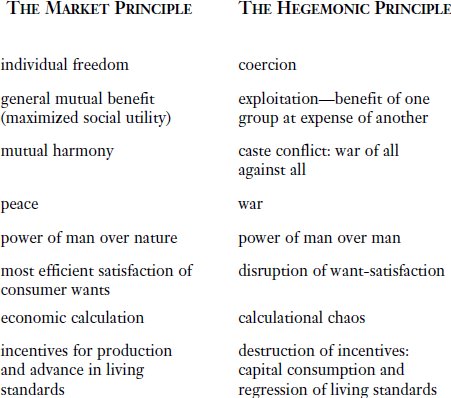
4. The Market Principle and the Hegemonic Principle
There are only two methods of social relations, the market versus the hegemonic principle. The difference can be summarized in the following table:
SOME CONSEQUENCES OF:
Notable Contributions
• Rothbard’s view (p. 1362) that the economist in a mere advisory role is implicitly endorsing the goals of his or her superiors is actually fairly unorthodox. Most economists believe that, as technicians, they can inform politicians about the likely consequences of various policies, all the while maintaining their own neutrality. However, surely Rothbard’s view is correct if we change the scenario to physicists and chemists working on horrible weapons for a totalitarian government.
• Rothbard even departs from Mises on the issue of ethical judgments. Mises generally assumed that, e.g., price controls only occurred because people falsely believed they would help the poor. Once economists had explained the true situation, Mises thought, the support for price controls would vanish. But as Rothbard points out (p. 1362), it is entirely possible that the rulers know the effects of their interventions and simply rank their own power higher on their scale of values than the welfare of their subjects.
Technical Matters
- Wertfrei was the German term Mises often used to describe economic science. It means “value-free.” This doesn’t mean that the study of economics commits one to nihilism, but rather that economics itself is a positive (versus normative) enterprise that discovers true causal relations in the world. In the same way, medicine is value-free; one must study bacteria or cancer in a neutral way to understand them. Of course the application of economic or medical science necessarily involves value judgments.
- Rothbard, unlike Mises, did not endorse Hume’s famous fact/value dichotomy, often summarized by, “You can’t derive an ought from an is.” Rothbard thought that an objective ethics was indeed possible, and that one could legitimately argue with another’s chosen values. Even so, Rothbard agrees with Mises that economics cannot do this.
Study Questions
- Give an example of a praxeological law with a conclusion that is always true, and one with a conclusion that might not be true in a particular situation (p. 1357).
- Give some examples of “implicit moralizing” in mainstream economics (pp. 1360–61).
- If the economist who advises an interventionist government is endorsing their goals (p. 1362), then would an economist who explains the effects of socialism (p. 1363) still be Wertfrei? (p. 1363)
- What are the three possible responses of the hypothetical director of the Office of Price Administration? Which of these is consistent with praxeology? (pp. 1364–65)
- If the world is a complex place, where each society has a mixture of the market and hegemonic principles, isn’t Rothbard’s table a bit simplistic? (pp. 1365–66)
- Why does the “mixed” society move toward one of the polar opposites of pure market or pure hegemony? (p. 1366)
- Is a socialist community impossible? (pp. 1366–67)
- Is a purely free economy necessarily stable? (p. 1367)
- Why is the American farm program a “classic example” of the cumulative nature of intervention? (pp. 1367–68)
- What does Proudhon mean by his maxim, “Liberty the Mother, not the Daughter, of Order”? (p. 1368)

