
The Strike-Threat System
5. The “Bargaining Power” Concept
MY Theory of Collective Bargaining contains a history and critical discussion of the notion of “labor’s disadvantage in bargaining,” an idea which, first introduced in Adam Smith’s Wealth of Nations, remains a powerful influence in popular opinion and has not disappeared from the field of labor economics. In Alchian and Allen’s excellent textbook, the concept of “bargaining power” is described categorically as “a vacuous concept of little analytical substance.”1 I hope in this chapter to show that this description is justified. But the term is still widely used. It is treated with such respect by labor economists of high apparent authority that it is at least expedient in a work of this kind to examine the notion.
In a masterly work, Fritz Machlup has collected and classified a wide range of attempts at giving meaning to notions of “inequality of bargaining power.”2 His rigorous examination of these ideas has exposed very effectively the intellectual muddle they have caused. But since his book appeared, the terms and phrases he criticized have continued to be used as though his contribution had never been made.3 In the following discussion, which is indebted to Machlup’s, I shall repeat the challenge in a different approach.
Since I treated the subject in 1930, my interpretation of Adam Smith’s famous passage about “labor’s disadvantage” has changed slightly. When he referred to “labor’s disadvantage in the dispute,” I now think he was not asserting that labor was at a disadvantage in the free market. He visualized two different things.
Firstly, he seems to have had in mind an attempt to force higher wage rates through an actual strike; and he apparently felt that, in the circumstances of his day, efforts to achieve sectional gains in that manner were more likely to fail than succeed (despite the violence which he believed often accompanied strikes). To the extent to which this was his point, there need be no argument. The size of a strike fund can, beyond doubt, influence the chances of the strikers getting better terms for those of their members who retain employment4 at the higher labor costs. And it is true that the individual worker can seldom effectively disrupt the production process,5 while a few workers among many may have hardly any ability to do so.
Secondly, Adam Smith believed that the masters possessed a tacit monopoly in purchasing labor—what we now call “oligopsony.” Now if workers who do not act collusively face a monopsonist or effective oligopsony (see Chapters 8 and 9), they may be said to be at a disadvantage. Again, there need be no argument on that point. But economists who followed Adam Smith began to use the idea of “labor’s disadvantage” in contexts in which, by implication, neither a strike situation nor the presence of monopsony is assumed.
The idea which this century has inherited is that combinations among the workers are needed to offset “labor’s disadvantage in bargaining” or “labor’s inferior bargaining power,” because the free market value of labor is depressed through some disadvantage other than monopsonistic exploitation. At times, however, monopsony is assumed, while at other times the “bargaining disadvantage” implied is the inability of a group of workers to exploit either the other cooperant parties to production or consumers, in the absence of concerted action. Sometimes one or more of these ideas seems to be woven into an argument expressed in terms of a “balance of power” between “employers” and “unions,” which collective bargaining somehow brings about. Usually the assumption is that the meaning of all these terms is self-evident. In fact, their use has seriously confused thinking about the wage-determining process.
We can begin by considering the phrase “balance of power.” If all this phrase is intended to mean is a situation in which no one can say with certainty which party will succeed in a wage dispute (whatever “success” can imply here),6 it has at least a modicum of meaning. It suggests that neither strikes nor management-ordered work stoppages will be attempted because, in the presence of this “balance,” the outcome is likely to be indecisive and hence resort to aggression too costly (see pp. 54-55). Such a connotation centers attention upon a threatened work stoppage and borrows a perfectly clear notion from political science. War between two powers is, according to the “balance-of-power” theory, unlikely if the armed strength of the two parties is about equal. In those conditions, according to the theory, neither side is certain that it will be victorious, while the costs of war are high. Similarly, the high costs of work stoppages help deter attempts to determine labor cost through the imposition of nonmarket values. Hence a “balance of power” will cause the maintenance of the status quo. This is obvious, of course. The burden of any work stoppage on both parties will always be weighed against the prospective gains from it. If both parties think that possible winnings do not justify the stakes, there will be no aggression. “Industrial peace” will prevail.
This is, however, seldom the sort of consideration which is in the minds of economists and others who use terms like “bargaining power,” “labor’s disadvantage in bargaining,” and so forth. To get near to what may be meant when monopoly-monopsony is not ruled out, we can, I think, simplify the question by the following approach. In every case the phrases we are examining suggest that, in the conclusion of any wage contract, the party with “strong bargaining power” will get better terms while the party with “weak bargaining power” will get worse ones. Let us suppose that what is envisaged has reference to whether the wage rates or prices determined are above or below what the free market value would be. If this is indeed what is meant, then the possibilities can be expressed with fair conceptual clarity in terms of monopolistic or monopsonistic influences. A simple diagram can represent the possibilities by representing the wage rates which would be determined under different assumptions.
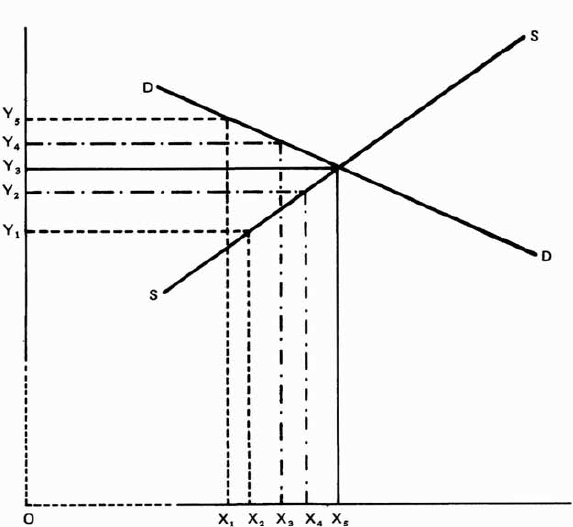
OY5 Monopolistic Labor against Competing Investors
OY4 Monopolistic Labor against Monopsonistic Investors
OY3 Competitive Labor against Competitive Investors
OY2 Monopolistic Labor against Monopsonistic Investors
OY1 Competitive Labor against Monopsonistic Investors
On the above diagram, wage-rate possibilities are represented on the vertical axis and numbers employed on the horizontal axis. OY5 represents the wage-rate that a union would think to be to its members’ advantage to enforce (if it could) against uncombined, competing firms. It is described as “monopolistic labor against competing investors.” The numbers employed will be OX1. OY1 represents the opposite. It is the wage rate which managements (on behalf of investors) possessing the power to purchase labor monopsonistically might think it profitable to enforce (if they could) where the workers were wholly unorganized. It is described as “competitive labor against monopsonistic investors.” The numbers employed will be OX1. OY3 represents what the price of labor would be in a free market. It is described as “competitive labor against competing investors.” The numbers employed will be OX5. OY4 and OY2. represent what we might assume about the extreme possibilities under what used to be called “bilateral monopoly,” i.e., with “monopolistic labor against monopsonistic investors.” The numbers employed will be OX3 and OX4 respectively, or somewhere between.
If by convention we always described wage rates higher than the level OY3 as due to the “superior bargaining power” of labor (or the “inferior bargaining power” of investors) and those below the level OY3 as due to the “superior bargaining power” of managements on behalf of investors (or the “inferior bargaining power” of labor), we should at least have intelligible notions. And I think we do find that all attempts at rigorous definition on this topic are groping toward a definition of the degree to which the price of labor diverges from the competitive level, OY3. Thus, the term “bargaining power” could be used to refer to the ability of one or other party (a) to force a price or wage rate above or below the free market level, or (b) to neutralize, in whole or in part, an opposed monopsony or monopoly, thereby forcing a price or wage rate toward or across OY3, in other words, toward or across what the free market level would have been.
Often, however, terms like “bargaining strength” or “labor’s disadvantage” are used in a manner which does not enable us to relate them simply to this conceptual framework. For instance, under monopsony, if A has higher-paid alternative employments than B, he may be paid more than B for an identical kind of work. B is then said to have “weaker bargaining power.” But A’s services are more valuable to society in other uses than B’s (although not in the particular job to which A is attracted, where they contribute no more to the value of the product than do B’s). If we describe A’s greater “opportunity value” as his “greater bargaining power,” we must bear in mind the full implications of the facts, firstly, that under competition for labor, no individual worker would have any advantage or disadvantage in relation to his competing comrades; and secondly, that even a monopsonist will employ no A’s for the job until there are no additional B’s available.
Actually, within any competitive labor market, where each worker is free to move to where he believes he can earn most, his “bargaining power” will rise as his services become more valuable through training or experience. The term is then simply a synonym for value! In every case the crucial consideration is the worker’s alternatives. Where competitive conditions rule, the refusal of any offer is simply a means of saying, “I have (or I believe I have) a more favorable alternative.” Such a communication may result in an improved offer. Where a worker (or his union on his behalf) can say truthfully to management, “I should like to work (or continue to work) for your undertaking but I think I can do better elsewhere,” that is, where he refuses an offer because he knows of or expects higher remuneration or better prospects in another firm, we all know what is meant when it is said that his “bargaining power” is strong.7 But it could then be argued that there is hardly any point in using that term. It only means that his free market value is as high as any other prospective offer. Of course, a person might successfully represent that the market value of his services is higher than it really is. We can then (if we wish) describe his bargaining bluff as “bargaining power.” It is not a very helpful usage.
Even in a noncompetitive market, we can still say that a worker’s “bargaining power” is represented by his “opportunity value,” which means the value of his alternatives; but we then mean that this power will be weak (the “opportunity value” low) when alternative employments can be somehow withheld from him.8 In Chapter 7, I shall explain that exploitation (whether monopolistic or monopsonistic in origin) occurs through the process of shutting off alternatives for those exploited. The important point to remember is that the “weak bargaining power” notion which I have here suggested might be used with meaning and consistency has reference to the individual worker. The notion cannot be simply transferred to labor in general. We cannot talk of “labor’s disadvantage in bargaining,” although we can discuss the individual’s. The remedy for the individual’s “bargaining weakness” is to raise the value of his work. His “bargaining power” depends (a) on his having scarce and valuable powers, which simply means that he can provide goods and services which consumers need, and (b) on his effective right to use those powers.
All the workers in an occupation may be exploited under monopsony, however, if managements can tie them under contracts which are not for their benefit, or shut them in in other ways. The remedy in that case is action to remove the barriers to other employments.
But monopoly or monopsony may influence the value of complementary services in the production process without exploitation, that is, without the monopolist or monopsonist shutting out any alternatives from any participant. As will become more clear in Chapter 8, discrimination is exploitative only when the monopsonist himself has in some way held off competing opportunities. Because the worker who has only lowly-paid alternatives has “weak bargaining power,” this does not mean that he is more exploitable (under the definition of “exploitation” we are using) than the worker who has relatively well-remunerated alternatives. Thus, a monopsonist may pay the workers he recruits (who have well-paid alternatives) a wage rate just sufficiently above their free market value in their former jobs to compensate for mobility costs, while those he retains (who have poorly-paid alternatives) may be paid just sufficiently to make it not worth their incurring the mobility costs of accepting other alternatives in the free market. As we are about to see, the lower wage rate needed to hold the latter does not mean that they are exploited under the definition we are using (see p. 3).
An often-used illustration, assuming (usually tacitly) monopsony, compares the worker who has “reserves” and can “hold out” with the case of the worker who is prepared to accept a lower wage rate than the average because he has no “reserves.” The typical example takes an untypical case, namely, that of an unemployed person. The argument is that if he has a large fund of savings, he can refuse what he thinks is a poor offer and for the time being purchase leisure, or finance his prospecting for a better opportunity, out of his capital. His less-thrifty colleague, on the other hand, who may have spent his last dollar, will be desperately in need of an immediate material income, so that a monopsonist will be able to discriminate against him.9
Now although such discrimination can occur if the monopsonist knows the worker’s situation, it is not exploitation unless the monopsonist himself has been able in some way to withhold employment opportunities from the worker in question. Let us consider a monopsonist who has closed no doors to any other employments, offering annual contracts of employment to individual employees through advertisements, and again assume that he recruits two classes of workers, those we can call As, who have well remunerated alternative employments and those we can call Bs, who have relatively poorly remunerated alternatives. Let us imagine also that the wage rates he offers initially are on the low side, in order to test the market. The first workers to accept the terms offered and to tie themselves for, say, a year (the Bs) will be those who can better their condition most thereby (because they have but poor alternatives, including poor “reserves”). If the monopsonist has been unable to attract all the labor he needs by the first offer (through which he recruits Bs), we can imagine that he will be able to attract some As, by offering better terms to them. It is important to notice that the condition of the Bs is improved, not depressed, in relation to their initial condition. The contracts under which the Bs earn less than the As are accepted by the former because they open the way to more highly paid alternatives than society is offering in other ways.
It can indeed be to the Bs’ advantage that they shall be discriminated against. The principle is particularly clear when economies of scale effect “natural monopsony” (either as the inevitable concomitant of “natural monopoly” or independently.10 For it is conceivable that only under the economies achievable through discrimination against the Bs will it be possible for the new, naturally monopsonistic venture that raises their earning power to be established at all. The general principle here (to be explained in Chapters 8 and 12) is that discrimination is justifiable (in the interests of the “optimization” of the community’s “welfare”) when the parties discriminated against are nevertheless the beneficiaries of that discrimination.
Hence phrases like “the workers’ bargaining strength,” in referring to each individual’s alternatives, may envisage either (a) alternatives determined in the free market or (b) alternatives influenced by a monopolist or a monopsonist. In the former case, no exploitation is involved. In the latter case, exploitation may be a factor. But labor’s “bargaining power” in a different sense will be influenced by the elasticity of demand for the end product (which will determine the exploitability of consumers) and by the elasticity of supply of complementary factors (which will determine the exploitability of suppliers of raw materials and/or investors in fixed capital). “Exploitative power” would be more apt.
When “bargaining strength” is sought by the unions by way of the strike threat, that itself involves what in practice is the most important shutting off from alternatives for the less-fortunate workers. Any duress-imposed wage rate in excess of the free market level denies access for some to jobs of higher productivity and remuneration. It may be held therefore to reduce their “bargaining power.” At the same time, it means that the “bargaining power” of a privileged group is strengthened. The principle is, then, that any individual denied access to any bargaining table is usually left with curtailed “bargaining power” in the employment outlets for which he is allowed to bargain. The depleted earnings he must accept in order to get immediate or early alternatives to the job he has lost, and his weakened security of employment, are consequences of restraints enforced through the strike threat.
In a competitive labor market, a temporarily displaced worker is confronted with a wide range of “take-it-or-leave-it” choices, just as is a shopper regarding a range of competing commodities and competing shops. Under such conditions, managements buy labor through wage-rate offers and shops sell goods through price offers which those who want employment (or better paid employment) or goods accept. It is said, however, that the worker is “at a disadvantage” compared to the shopper because he has no “waiting power.” But as we have seen, the lack of “reserves” is no disadvantage in a competitive market. Shoppers equally have no “waiting power” regarding certain of their purchases. They must buy food for the immediate future or starve.
The word “monopoly” is conventionally used to describe what Ludwig von Mises has argued cogently ought to be called the union’s “supply restriction.” Mises’s case is that “monopolistic action” is advantageous to a monopolist only if total proceeds at a monopoly price exceed total net proceeds at the potential competitive price,11 That is, the monopolist must allow for the loss in respect of the capacity he withholds; whereas the organizers of supply restrictions, like unions, “are not concerned with what may happen to the part of the supply they bar from access to the market. The fate of the people who own this part does not matter to them.”12 The important but generally overlooked difference in principle to which Mises is here referring is one which I tried to get round in 1935 by introducing the term “contrived scarcity” (contrasted with “natural scarcity”).13 in Chapter 7, I shall use this and related concepts in an attempt to clarify the issue further. But when I use the term “monopolistic restriction” or “monopsonistic restriction” I shall have in mind the shutting out or shutting in of those who believe they could otherwise improve their earning power or profits by moving their labor or their capital to another occupation, industry, firm, or area. And every such “restriction” (or “shutting out” or “shutting in”) involves “exploitation.”
I propose now to draw the reader’s attention to some typical uses of the term “bargaining power” in contexts in which the market alternatives available to the bargainer are obviously not what the writer has in mind. Suppose we consider the situation which arises when unionized workers, acting in concert, are in a position to say to management, in the friendliest way, “We have the power to ruin your stockholders. We don’t want to do that. A fight will involve some costs to us; but we shall feel forced to use this power unless you agree to our very reasonable terms. If you refuse to make the consumer pay a modest extra sum on our behalf, you will have to transfer some of your investors’ income to us. What we ask won’t actually ruin your undertaking. We know what your profits are. If you want what is good for your stockholders, you will agree to our terms.”
This coercive power may, if we wish, be termed “bargaining power.” But it is then an exact parallel to the “bargaining power” of the salesman of jukeboxes, gambling machines, and vending machines, who (in the United States) sometimes tells his prospective customers, with the greatest politeness, “If you know what is good for you, you will sign this agreement for the installation of one of these machines.” Every customer then knows that failure to agree will bring costly damage to his shop or personal violence against himself.
“Bargaining power” in that sense bears no resemblance to the ability to command a certain wage rate because of the existence of actual or potential competing offers. Hence although we might say that that party’s bargaining power is greatest which can convince the opposing party that it is in a position to do that party the greater harm, ought we not to convey our meaning by a simple descriptive term and say that the “stronger” party is that which has the greater “coercive power”? If I am stopped by a hijacker who has a gun while I have only fists, isn’t it just a misleading euphemism to refer to his superior “bargaining power”?
However, if the term is defined to mean “power to disrupt and hence to coerce,” it is both realistic and understandable, but it cannot then be used in the other connotations! Presumably managements rely upon a similar power if they themselves order a work stoppage with coercive intentions. But the literature of the labor movement leaves the impression that the actual use of a parallel power by management is virtually unknown and the threat almost as rare. Mere refusal to accept union conditions is not a work stoppage. As we have seen, there is a continuous offer of employment from management’s side, at stipulated wage rates, just as there is a continuous offer of goods, at stipulated prices, in a shop.14
Moreover, the downward adjustment of wage-rate offers when a wage contract is renewed, where necessary to price some current output within reach of the community’s income (that is, following reduced entrepreneurial bidding for the available labor supply), is not coercive. It is a means of avoiding (a) the displacement of labor and (b) (from society’s angle) the depletion of the wages flow. It is no more disruptive than is inflation which, since the Keynesian era, has been a crude alternative way of reducing real wage rates (as a means of mitigating the depletion of the wages flow caused through strike-threat action). The step taken by managements is not evidence of their superior “bargaining strength” but a consequence of their subordination to consumers’ sovereignty, as representatives of the residual claimants on the value of the product.
I know of no recorded case in which general wage-rate reduction has been used as a threat by managements, or punitively. But the workers in an undertaking have often been warned about the impossibility of continuing the employment of former numbers in the event of a forced wage-rate increase. It is easy enough to describe such warnings as “threats”; but they are no more coercive than warnings that smoking is liable to cause lung cancer. Admittedly, in the course of negotiations conducted in the shadow of the strike threat, managements are likely to paint the consequences of enhanced labor costs in unduly somber colors. Hence there may sometimes be a “threat” element present.15 In fact, I believe, the threat of disruption as a “bargaining weapon” (in the sense of a means of coercion) is used almost entirely by the unions. But no matter what party may actually be guilty of using it, either the threat of or the use of private coercion in the “bargaining process” is intolerable.
N. W. Chamberlain brings in such factors as “the pressure of immigration, the cityward movement of farm population, the speed of mechanization and mass production techniques” among the circumstances which create “labor’s disadvantage,” because they “place employment at a premium.”16 But all this means is that one’s “bargaining power” is raised or lowered by anything which causes demand for what one has to sell to rise or fall or its competing supply to fall or rise! Chamberlain may possibly intend, however, that these are circumstances which limit the exploitative power of the strike threat. He regards labor’s “bargaining weakness” as overcome when “by common action workers could prevent themselves from being played off one against the other.”17 But the “playing-off” of one would-be seller or buyer against another is the only way in which any party entering into a contract can protect himself against exploitation; and the collusive action which is here represented as rectifying the “bargaining disadvantage” turns out merely to be a particular method of contriving a scarcity. In other words, “labor is at a disadvantage in bargaining” comes to mean, “labor finds it difficult to exploit displaced or excluded workers, consumers, risk-takers and the providers of complementary assets in production.”
Most discussions of this issue view the parties to negotiations over a wage contract, under the strike-threat shadow, in a most unrealistic way. They portray the workers (or the union) on the one side and the “employer” (presumably management representing investors) on the other side. But the reality that successful wage negotiations require the expression of agreements or settlements in a form which maintains the prestige (and hence maintenance in office) of the union officials is seldom mentioned (see above, p. 47).
In practice this is often (if not most often) the vital consideration. As skilled negotiators, managements understand the expediency of allowing the union officials to receive the whole credit for every improvement in wage contracts. When managements make concessions, they must do so in such a way that the union rulers will be able to show a capitulation on the part of the enemy—“the employer.” Indeed, managements normally permit every intermittent restoration, full or partial, of real remuneration in the course of an inflation to be claimed as a union triumph. And more generally, when the maximum concessions managements can contemplate are small, it is at times good strategy for them to stage a fight against certain fringe benefits demanded, which cost little. After thus making an effective show of opposition, their (the managements’) eventual retreat will preserve the illusion of successful strike-threat pressures, and hence make it possible or expedient for the leaders of the unions to recommend acceptance of the terms. Occasionally, by such tactics, managements can get away with relatively small concessions. In some cases indeed, the prestige of the union officials can be protected by the acceptance of conditions of which the burden may fall wholly on the union membership itself.18
Moreover, what actually happens in almost every case when both parties have become accustomed to, and experts in, the “bargaining process” is that managements begin negotiations with a fairly clear idea of the limits to which they are prepared to go in concessions (in order to avoid an actual stoppage). They will declare at the outset their determination not to concede more than a very small part of what they expect to concede; while unions will begin by asking for more than they believe managements will concede (with or without actual recourse to the strike). For instance, managements which, in a free labor market, would have found it profitable to offer, say, $400 per month in order to retain (from alternative employments available) the most profitable number of workers may think it good tactics to begin by offering, say, $350. They know that, in the market circumstances ruling, such remuneration offered would be disadvantageous (or even ruinous) to them because it would mean their losing too many of their most valued personnel; but they regard their initial offer, maintained for a time, as serving the practical purpose of enabling an apparent capitulation; for such a capitulation is above all essential in order to satisfy the union leaders.19 If we are realistic, then, we must perceive that there are three parties involved in “collective bargaining” over wage contracts. It is not the conflicting interests of the workers in relation to the interests of the investors which constitute the really crucial issue in the struggle, but the interests of the elected rulers of the union.
In thus insisting that the essential condition is the satisfaction of the union rulers, I am envisaging as realistically as I can the internal democracy which is characteristic of the majority (but by no means all) unions. In general it is true that, in B. C. Roberts’s words, “while there is little direct check upon leaders during the course of negotiations, they must be able to . . . secure the votes of members in referendums and elections for office.”20 But it is just this concern of the leaders with reelection that is the critical issue with which managements are confronted during wage negotiations. Union officials are faced with the dilemma that they do not wish to kill the goose; and sometimes they clearly do not wish to harm the general economic conditions which provide sustenance for the goose (see pp. 140-142). Yet most union members expect immediate results, while rivals for power are prepared to claim that they could win more. Indeed, there will often be competitors for office who are as unscrupulous and irresponsible in promise-making as the typical politician during election campaigns!
We sometimes hear it said that it is the duty of unions and of managements to bargain in good faith, not merely to demand. Does this mean that it is their duty not to dig their heels in and refuse to make concessions? If so, it implies that it is the duty of both sides to begin by asking more favorable terms than they are prepared eventually to accept. What else can it mean? Because the strike-threat system exists, it may well be good tactics—even inevitable tactics—for managements to carry on more or less continuous discussions with union officials. But recognition of this practical reality must not blind us to the basic principle that it is managements’ task to offer such wage rates as they predict will justify the purchase of labor services for investment into work in progress; and this must be seen as a facet of the continuous process of investment of stockholders’ capital into the retention, replacement, or accumulation of inventories of materials and fixed capital.
This does not mean that under nonstrike negotiations the wage rates set can be said to have been determined “unilaterally,” “without negotiation,” “dictatorially,” and therefore unjustly. The word “unilateral” which has been used in this connection is a red herring. Collective bargaining is not an alternative to unilateral decision-making. Every offer accepted must be bilateral. Prices are marked for goods offered in shops but this does not prevent every purchase from being a bilateral transaction. Would a system of haggling over every retail transaction result in greater consumer freedom, security, or justice? Similarly, no employee is forced to retain or accept any employment at the remuneration set by any management in a free labor market. On the termination of any wage contract he may leave, as he will, if he can get better terms or prospects elsewhere. It is that which, as we have seen, constitutes his “bargaining power” (in the least unsatisfactory use of that term). And a management may be just as helpless in respect of the wage rate at which it forecasts that the most profitable number of workers can be retained by or attracted to the enterprise as is a shopkeeper in fixing prices which he predicts will retain or attract the most profitable number of customers (when he is not in a position to act monopolistically). (See p. 14.)
Where no unions exist, one management makes offers for different types and grades of workers on behalf of many stockholders, while an individual decision to accept an offer must occur before any person becomes an employee or continues as an employee. On the other hand, at the bargaining table, a union may accept or reject offers not specifically on behalf of individuals but on behalf of large groups of those it represents. That is not a necessary arrangement, however, whereas it is impossible for each individual stockholder to make a separate contract with every worker; for the plant and the firm constitute a unity. The only parallel to this unity on the labor side is when several persons form a partnership, like a cooperative theatrical group, and offer their services as a whole to the highest bidder. But then they have usually already arranged among themselves for their relative individual remuneration. And dealing in that case with the executive of the group, or with the union executive, does not cause the decision-making to be more (or less) bilateral.
Ideally, collective bargaining involves the union officials negotiating, so to speak, bulk contracts for groups of individuals. In some circumstances, we can regard all the workers employed as having agreed, in advance, to accept whatever terms the officials accept on their behalf, subject to their retaining employment under those terms. But if union officials are seen as servants and not the masters of union members, each member should be free, if he should so wish, to make an independent contract with management, especially those who might otherwise be laid off.
As every worker knows if he participates in sports, human abilities in different directions vary considerably. Hence bargaining freedom requires that those who contribute differentially to the satisfaction of consumers’ demands should be allowed to make available their services for remuneration in proportion to what they believe the value of their contribution to be. And that value may be higher than or (when the alternative is displacement) less than the wage rate which a union might have negotiated. “Bargaining justice” requires therefore that while a union should retain the right to advise an individual against what is thought to be his wrong judgment of the value of his services, that word advise should not be allowed to be interpreted in the way in which the words “persuade” or “induce” have come to be so often interpreted, namely, as synonyms for “intimidate” or “coerce.” The individual’s “bargaining power” means, indeed, his “bargaining freedom.”
Let us consider in this context the case of a worker whose way of life faces the prospect of disruption through his threatened displacement following a change in consumer preference. The right of such a person to offer his services at a reduced wage rate in order to avoid displacement (which consumers would otherwise enforce) ought to be recognized as the source of a basic security—a fundamental freedom. Even if he is confronted with the dilemma of accepting or rejecting a wage rate set below what he believes will ultimately be his free market value, he can still retain an income by temporarily accepting a wage cut, and live on the curtailed income while he (or his union) is looking for an opening remunerated at what would perhaps be the present value of his services in a better-coordinated society.
When industry-wide bargaining is enforced (as it is for instance in the steel, coal, automobile, tire, trucking and other industries in the United States) a monopsonistic structure representing the managers of the producing units is almost necessarily created. But in the absence of agreements not to “poach” labor (and assuming that antitrust is effective) individual managements will be competing for such labor supply as the standard rate leaves profitably employable by the industry as a whole. The real danger in these circumstances is not of exploitation of labor but of the public; for with the support of unions, corporations with which the wage contract is made have the power to create “joint monopolies” with labor,21 or to encourage unions to bring under their wing the employees of concerns (perhaps of a different type) which, by reason of some greater technical efficiency or superior price policy, appear to be taking business from them.22
Unions are fully conscious of their exemption from antitrust or similar penalties, and whenever competition from substitutes appears, they may recognize a solidarity of interest with stockholders. What, then, becomes of the notion of labor’s supposedly inferior “bargaining power?” A divergence of interest about the division of the spoils of joint monopoly will remain, and the “just” sharing of gains at consumers’ expense will be as indeterminate as the “just” sharing of stolen booty always is. This is one of the cases in which the “bargaining power” notion seems to be concerned with who will get the biggest share of ill-gotten gains; that is, the case in which the superior “bargaining power” will reside in the party which is apparently in a position to harm the most. When unions and managements resort to such collusion, unions will, naturally enough, express concern for justice toward their competitors in the expanding enterprises which are offering substitutes that are better value for money. They will want the interlopers to be brought into one “bargaining unit” for the protection, they will say, of their competitors as well as of themselves.23 The merging of the steel and the aluminum workers in the United States, as technical progress caused formerly complementary products to become competing products, is a case in point. But the “protection” achieved is essentially of the power to exploit.
Let us now return to the question of the actual determination of a wage agreement when the strike threat is an influence. If an offer by the management of a corporation is at first refused by a union, there is very little that the economist can usefully say about the terms which are likely to be eventually accepted. That is, the determinants of the wage agreement (wage rates plus fringe benefits for work during a certain period) can then be subjected to purposeful economic analysis only in the sense that the use of resources in the course of warfare can be studied.24
Now in warfare, the ultimate and overriding objective, namely, victory, is a product to one party and a negative product (namely, a deprivation) to the other, and there seems to be little purpose in showing that, if we have sufficient data, we may be able to forecast the probable result of any resort to the strike threat (or to an actual strike). The result is certainly not relevant to the vital question that concerns society today: Can we tolerate economic warfare unless wehave satisfactory grounds for believing (a) that it is inevitable, or (b) that it is likely to result in victory for the good and defeat for the wicked? Obviously, analysis of strikes and the strike threat can throw no light on the relevance of their outcome to the socially desirable division of the value of output. Yet it is just this relevance with which many writings on collective bargaining have ostensibly been chiefly concerned.
Attempts have been made nevertheless to study rigorously the factors which are likely to lead one or the other party to victory in the clash between the unions and the “employers.” Studies in this field may be said to have begun with J. R. Hicks’s Theory of Wages (London, 1932), although Edgeworth, Marshall, Bowley and others had previously discussed the indeterminateness of value under bilateral monopoly.25 But in my judgment, Hicks’ discussion and all subsequent explorations in this field, down to recent contributions by N. W. Chamberlain,26 C. Stevens,27 B. D. Mabry28 and others have done little more than elaborate the truism that, in warfare of the kind analyzed, and looking at the issue from the standpoint of one of the parties, (a) the greater the resources in supplies and weapons of aggression possessed by that party, and (b) the less onerous the terms of surrender it offers to the other side, the more likely it will be that that party will be able to force the capitulation of its opponent, with or without an actual strike or management-imposed work stoppage; and that, in the event of a party meeting more stubborn resistance than it had expected, it may have an incentive to soften the terms of surrender it demands.
I conclude that “labor’s inferior bargaining power,” which is said to be strengthened by agreements in concert to refuse a particular employment at less than a certain wage rate, refers most often to monopolistic power to exploit three groups, namely, and in order of importance: firstly, displaced or excluded comrades; secondly, consumers; and thirdly, the suppliers of complementary productive services, including those investors in fixed resources who have not adequately allowed for the risks arising from the strike threat when they have invested. Only when monopsonistic power can be wielded by managements to maintain or reduce wage rates below the free market level, by somehow excluding access to alternative employments, can it be claimed that phrases like “labor’s disadvantage in bargaining” are anything more than unintended euphemisms.
NOTES
29 Armen A. Alchian and William R. Allen, University Economics (2nd ed.: Belmont, Calif.: Wadsworth Publishing Company, 1967), p. 420.
30 Fritz Machlup, The Political Economy of Monopoly (Baltimore: Johns Hopkins Press, 1952), pp. 333-58.
31 To the best of my knowledge there has been no attempt at refutation of the chapter in question.
32 The terms of a so-called wage contract, “agreed to” under coercion, seldom binds any firm to provide so much employment at the stipulated wage rate. The firm merely binds itself not to employ any person who might find that he can better his condition by working for less than the “agreed” figure.
33 I say “seldom” because, as we have seen, a single key worker may, at a crucial point of time, be in a position to disrupt operations by the withdrawal of his services.
34 The use of the strike threat or the strike may be said to be “successful” from the standpoint of those who retain employment at a higher real wage rate. Those who are laid-off in consequence, or whose prospects are damaged, will (if they perceive how they are affected) regard it differently.
35 “What bargaining power may mean . . . is simply the highest salary one can get from other jobs” (Alchian and Allen, op. cit., p. 402).
36 His remuneration could then be represented as OY1, in the diagram on p. 63.
37 Actually, as Alchian and Allen point out, “the employee does not lose his entire source of income; he loses the premium he was getting in his former job over the next best alternative adjusted for moving and job-exploration costs,” (p. 402).
38 The adjective “natural” describes monopolies or monopsonies which emerge without collusion. (See pp. 103, et seq.)
39 Ludwig von Mises, Human Action (New Haven: Yale University Press, 1949), p. 374.
40 Ibid., p. 373.
41 W. H. Hutt, “Natural and Contrived Scarcities,” South African Journal of Economics, 1935.
42 I return shortly to the suggestion that for managements simply to make wage offers would be for them to determine labor’s remuneration “unilaterally,” that is, without bargaining (see p. 71).
43 The real danger today, however, is that managers who explain objectively the market factors through which social discipline could replace economic warfare, and who, in so doing, point to the probable immediate labor displacement consequences when labor costs are determined under the strike threat, may be accused and even convicted, in the United States, of “unfair labor practices.” I have been assured that, if a negotiator points out that the number of workers employable in an undertaking will increase more slowly, cease to grow, or even decline as a result of consumers being forced to pay more for output, his assertion might be ruled by the NLRB as in the nature of a threat to rob the workers of their livelihood!
44 N. W. Chamberlain, Collective Bargaining, 2nd ed. (New York: McGraw-Hill, 1965), p. 123.
45 Ibid., p. 124.
46As one shrewd commentator has put it, “the novel feature in the compulsory (pension) plans promoted by most union leaderships does not lie in what the unions take from the companies but rather from what they take from their own members, namely, the power to decide freely on how to dispose of each member’s income.” Philip D. Bradley, Involuntary Participation in Unionism, in Labor Unions and Public Policy (Washington: American Enterprise Association, 1958), pp. 57-58.
47 Hence it is theoretically possible that, through bargaining tactics, the settlement will determine wage rates no higher than the free market would have guaranteed. Through such a stratagem, managements may be said to have performed their duty to the community as well as to stockholders.
48 B. C. Roberts, in John Dunlop, Theory of Wage Determination (London: Macmillan, Ltd., 1957), p. 109.
49 See the next paragraph and pp. 50, 122, 128.
50 For example, some of the self-service stores in the United States, confronted with the more effective economies of the discount houses, seem once to have followed this (probably short-sighted) policy.
51 The reader should be reminded that the expanding enterprises of which the progress is thus curbed had been attracting labor from less productive to more productive and more highly remunerated work.
52 The concept of “economic” is not irrelevant in war operations. In rationally conducted warfare, although forecasts in detail, and hence proximate objectives, are in process of constant revision, or even fundamental change (as the pattern of events confirms or negates forecasts), each proximate objective can still be pursued in a manner calculated to minimize detriment to other proximate objectives.
53 If there is a corporation with monopsonistic powers facing a labor union with monopolistic powers there will be, for a certain range, nothing resembling a market price to determine the wage rate (e.g., on the diagram on p. 63, the range will be between OY2 and OY4). The position will be similar to that which exists under “pure barter.” Marshall illustrated the situation by the exchange of nuts and apples between two persons in isolation. (See above pp. 62-63.)
54 N. W. Chamberlain, Collective Bargaining, 2nd ed. (New York: McGraw-Hill, 1965).
55 C. Stevens, “On the Theory of Negotiation,” Quarterly Journal of Economics, February 1958; Strategy and Collective Bargaining Negotiations (New York: McGraw-Hill, 1963).
56 B. D. Mabry, Labor Relations and Collective Bargaining (New York: Ronald Press, 1966). Mabry’s book contains a short bibliography covering this topic (pp. 239-240).
- 1I did not then know of Eugen Böhm-Bawerk’s important Control or Economic Law? which reached conclusions similar to those I reached. It had not then been translated into English. Nor had works by Ludwig von Mises which dealt briefly with the same issue.
- 2I discuss Marshall’s contribution on pp. 7-9.
- 3I noticed the important contribution of Professors Johnson and Mieskowski too late to permit a discussion of it in all appropriate contexts. I refer to its findings in an appendix to Chapter 15. I received E. P. Schmidt’s splendid study. Union Power, on the day I received the page proofs of this book.
- 4W, H. Hutt, “Misgivings and Casuistry on Strikes,” Modern Age, Fall 1968.
- 5Barbara Wootton, Freedom under Planning (Chapel Hill: University of North Carolina Press, 1945), p. 97,
- 6F. A, Hayek, The Constitution of Liberty (Chicago; University of Chicago Press, 1960), p. 505.
- 7That is, as is to be explained later, the workers will be forced to hire or rent the fixed assets they need and to pay interest on the circulating capital because the owners of assets will only make them available on those terms.
- 8Sidney and Beatrice Webb, The History of Trade Unionism and Industrial Democracy (London: Longmans Green and Co., 1920).
- 9Because, as we are about to see, when duress-imposed labor costs in any activity reduce the number of workers who can be profitably employed in it, the number of workers who must compete for employment in other activities is increased, while as consumers all other workers will be disadvantaged.
- 10A tax is said to be “regressive” when the proportion of the tax to the taxpayer’s income is greater the smaller his income. Thus import and excise duties and sales taxes are obviously regressive.
- 11I use the work “substantial” because in this context I am relying upon empirical evidence (see chapter 16). In the light of the general case argued in this chapter and the rest of the book, the word “substantial” could be omitted.
- 12Cliffe Leslie was one of a group of writers on wage questions (of whom the others were Thornton, Longe and Fleeming Jenkins) who had tried to show how union initiatives could enable a redistribution of income in labor’s favor. They had a considerable influence on John Stuart Mill during the last years of his life, when he was contemplating entry, and after his entry, into politics. I have discussed their contributions in my Theory of Collective Bargaining (Glencoe. Ill.: Free Press, 1954).
- 13“Bilateral monopoly” means, in this context, “monopsony” (see above footnotes) among the purchasers of labor and monopoly (a union) among the suppliers of labor. Under such conditions there is no market determination of the price of labor.
- 14The demand for a thing is said to be “inelastic” when a change in its price will have little influence on the amount of it that will be purchased.
- 15Alfred Marshall, Economics of Industry (London: Macmillan, Ltd., 1909), p. 389.
- 16Ibid., pp. 388-9.
- 17Within the category “labor” there must have been a consequential regressive redistribution (see footnote 10 and below pp. 168, et. seq.).
- 18S. and B, Webb, op. cit. p. 46 (my italics). On the whole, Parliament sided with the craft guilds until the middle of the eighteenth century (by which time their effectiveness was rapidly weakening); but with the spread of laissez-faire ideas in the latter part of the century, Parliament was less inclined to protect craft privileges.
- 19So effectively has the myth I am here exposing been propagated that even in Armen A. Alchiàn and William R. Allen’s University Economics (2nd ed.; Belmont, Calif.: Wadsworth Publishing Company, 1967), which contains by all odds the most satisfactory elementary discussion of the labor union issue to be found in any currently used textbook, the student is told that the British anticonspiracy laws tried to abolish “the right to form a union—which is a very different thing from a strike.” Associations of working people were encouraged rather than frowned upon provided they did not resort to anything resembling the strike. Nor is this textbook quite correct in saying that “the threat of violence via the strike was basically what anticonspiracy laws aimed to stop. . . .” (p. 406). This was true only of certain of the special statutes, referred to on pp. 29-30. The gist of any “conspiracy” offense was concerted action to agree upon a price or wage rate. (See p, 31.) Violence was always a separate transgression.
- 20The London carpenters were charged with trying to keep “foreigners” (i.e., workmen from outside London) from accepting less than sixpence a day.
- 21Wyclif was attacking the masons employed in church building. The quotation is A. H. Gardner, Outline of English Architecture (New York: Scribners, 1946), p. 24.
- 22Quoted in M. D. George, The Combination Laws Reconsidered, cited in Economic Journal History Supplement, 1927, p. 215.
- 23Important instances were in the woolen, cotton, linen, silk, hemp, fustian, hatters, dyers, pressers and the iron industries.
- 24This is surely indicated in the very name of an early general statute: Act of Conspiracies of Victuallers and Craftsmen, 1549. Consumers’ interests were paramount.
- 25I say “apparent” because the evidence of growing union activity is mainly indicated in the increasing number of court cases involving unions; and this may have been correlated with rising industrial outputs or due to more vigorous law enforcement.
- 26One very defensible practice of those days (which survived into the nineteenth century) was the subsidization of craftsmen in the form of what were called “traveling” or “tramping” benefits if they were prepared to leave an area in which there was unemployment. This could have led to an improved allocation of labor over area—greater geographical mobility.
- 27Smith, op. cit., p. 126.
- 28The King v. Eccles, quoted in Donald Dewey, Monopoly in Economics and Law (Chicago: Rand McNally and Company, 1959), p. 120n.
- 29Already in the late 1920s I had reached the conclusion that all the textbook treatments I could find of this important subject were—superficially considered—definitely indefensible or inadequate and unconvincing, For instance, the great Alfred Marshall’s treatment of what he appeared to regard as the crucial issue—bilateral monopoly—was illustrated by his famous example of the barter of nuts and apples; yet as I saw the problem, the circumstances he was thus postulating were, for a variety of reasons, of negligible practical significance. And Marshall was widely regarded as the greatest economist of his age.
- 30Already in the late 1920s I had reached the conclusion that all the textbook treatments I could find of this important subject were—superficially considered—definitely indefensible or inadequate and unconvincing, For instance, the great Alfred Marshall’s treatment of what he appeared to regard as the crucial issue—bilateral monopoly—was illustrated by his famous example of the barter of nuts and apples; yet as I saw the problem, the circumstances he was thus postulating were, for a variety of reasons, of negligible practical significance. And Marshall was widely regarded as the greatest economist of his age.
- 31I expected that the obvious challenge of my book would prompt a major contribution, from economists better qualified than myself, to deal with the questions I raised. During my entire academic life I have been expecting an authoritative book. But although there have been many splendid contributions, mainly in the form of articles that have given more or less the same answers that I myself have given, they have had hardly any policy impact. The following economists have all written cogently on aspects of the problems discussed here, and I have gained something substantial from each of them (although some might differ—or would have differed—sharply on certain issues): Fritz Machlup, Ludwig von Mises, Milton Friedman, Friedrich A. Hayek, Aaron A. Director, M. Reder, Goetz A. Briefs, John Van Sickle, Armen A. Alchian, William R. Allen, Marshall Colberg, Yale Brozen, Arthur A. Shenfield, S. Rottenberg, H. Gregg Lewis, Gottfried Dietze, Clarence Phil-brook, Henry Hazlitt, H. Demsetz, F. A. Harper, A, Rees, P. Sultan, V, Orval Watts, C. E. Lindblom, C, H. Cooley, Henry Simons, W. Eucken, E. H. Chamberlin, Wilhelm Röpke, David McCord Wright, Gottfried Haberler, Sylvester Petro, N. J, Simler, Ben Rogge, Helmut Schoeck, H. G. Johnson, and P. Mieskowski. Of course, there are many others who would share some or most of my conclusions. Yet these economists have not yet succeeded in making their convictions on the strike-threat issue influential. They have failed, particularly, to win the sympathy even of those of their academic colleagues whose minds are not closed (which, unfortunately, I often think today is a small proportion).
- 32There is of course today an enormous literature on “labor economics.” I find it for the most part tendentious, often derivative, and usually devoid of any original or independent thinking. Much of it has been written, I guess, to satisfy the imperative in American universities to “publish or perish.” Trying to judge whether there is anything worthwhile in all these volumes has been exasperatingly time-consuming and unrewarding. But it is the bias of most of this literature which is most disturbing. In an article published a few years ago, I ventured a diagnosis. I said that most books on “labor economics” have been by labor consultants, arbitrators, conciliators, mediators, labor attorneys, labor correspondents; and that such “economists” cannot think or write dispassionately on matters affecting their incomes.
- 33Two decades ago, a leading member of the British Labor party, Lady Wootton (Barbara Wootton), stated quite categorically, that it is “the business of a union to be anti-social; the members would have a just grievance if their officials and committees ceased to put sectional interests first.” F. A. Hayek, commenting on this passage, noted “few liberal sympathizers of the trade unions would dare to express . . . [this] obvious truth.” But why should trade union sympathizers, including their academic advisers, not dare to refer to such a truth unless they felt that their political ambitions or prospects as consultants, or advisers, or labor journalists would be jeopardized by so frank art admission?
- 34Two decades ago, a leading member of the British Labor party, Lady Wootton (Barbara Wootton), stated quite categorically, that it is “the business of a union to be anti-social; the members would have a just grievance if their officials and committees ceased to put sectional interests first.” F. A. Hayek, commenting on this passage, noted “few liberal sympathizers of the trade unions would dare to express . . . [this] obvious truth.” But why should trade union sympathizers, including their academic advisers, not dare to refer to such a truth unless they felt that their political ambitions or prospects as consultants, or advisers, or labor journalists would be jeopardized by so frank art admission?
- 35The problems to be considered here fall within this theoretical framework. Wage-rate increases enforced through the strike threat benefit those remaining employed at the enhanced labor costs. But, on whom does the burden then fall? On the specific investors? On investors in general? On displaced or excluded workers? On consumers? What is the incidence of the burden? This problem is like that which economists discuss under the heading of the incidence of taxation. To express the issue in abstract terms (which means in the simplest terms), any one party to the productive process can exploit one or more of the other parties only in a measure determined by the “elasticities of supply” of the different productive services rendered by the people or by the assets employed. In this connection I propose to draw attention to four vital realities: (1) In the absence of man-made barriers to mobility, noticed above (p. 4), there is a wide range of alternative uses for a large proportion of workers and assets, a fact which implies long-term elasticities of supply. (2) Assets are often substitutable for labor (a consideration which is usually taken into account under the heading of “elasticity of substitution”). (3) If growing large scale recourse to the strike threat, accompanied by growing hostility to inflation, does not cause a disastrous cumulative decline in real income (depression without deflation), it must eventually force labor somehow to become the residual claimant on the value of the product, in order to make profitable the replacement of the complementary assets labor requires, let alone permit any growth in the stock of such assets in response to society’s saving preference. (4) Substitution of the consumption process for the saving process may contribute to the elasticity of supply of assets as such. (See p. 145)
- 36The only practically important case of monopsony (to be discussed in Chapter 8) involves some clear “shut-in” power. Yet even the Webbs, in two massive studies (both special pleading for the union movement), have presented no evidence of “employers,” in collusion or singly, ever deliberately and fraudently enticing employees into specialized occupations, with a view eventually to reducing their remuneration unfairly.
- 37The effect of wage rates determined under labor union pressure is, I shall insist, to distort society’s production structure, while it causes no redistribution whatsoever in favor of the poorer classes as such. The only income transfers that the use of strike power can effect are (1) in favor of those employed in one occupation at the expense of those in others, or (2) in favor of workers as such when entrepreneurs generally have failed to forecast the extent to which, as investors, they will be subjected to duress-imposed costs.
- 38When a wage rate is raised so as to price some part of potential output higher than consumers are prepared to pay, the wage gain is partly at the expense of workers who would otherwise have found their most remunerative employment in that trade; partly, of course, it is at the expense of consumers in general; but hardly ever (and I shall be developing this point at some length) is it at the expense of those who provide complementary resources—i.e., the assets which, in general, multiply the yield to effort. It is consumers who ultimately pay wages; and when the market value of output of any kind is forced (whether by the right to strike or through legal enactment) above the level which the free market would have determined, the effect is, in general, actually to harm the poorer classes disproportionately. This “regressive” consequence is aggravated because the process keeps (in the long run) a large segment of the work force in low-productivity and low-paying jobs; or (in the short run) forces workers into short-time jobs and (encouraged by unemployment compensation) into idleness. Hence the effect of the strike-threat system upon the distribution of the wages flow is to render it less equitable.
- 39Through the consequences of the strike-threat system upon the composition of the assets-stock, and the nature of the employment outlets available, the flow of output as a whole and hence aggregate real income will be reduced. And, because all must admit that it is highly improbable that any substantial redistribution of the shrunken real income in favor of labor has ever been thereby effected, obviously the system has all along been reducing the flow of real wages and the average of real wage rates.
- 40In the “classical” theory of wages, as it had evolved at Cambridge in the pre-Keynesian era (by which I mean before publication of J. M. Keynes’s General Theory of Employment, Interest and Money in 1936), the issues which I have discussed in this chapter were virtually ignored. On the points which concern society most seriously, exposition was hopelessly contradictory for this reason. An inherent part of Alfred Marshall’s imposing synthesis of the “orthodoxy” of his age was the marginal productivity theory of wage-rate determination. This was clear, for instance, when he criticized Cliffe Leslie who (in attempting to justify strike-threat actions) had, Marshall showed, failed to understand why competition tended to establish equivalence of net advantageousness in labor’s earnings. Yet other passages in Marshall’s writings appear to me to have been quite inconsistent with the insight he showed in his reference to Leslie.
- 41This criticism applies, I suggest, particularly to Marshall’s discussion of what has been called the “range of indeterminateness” under bilateral monopoly; for the circumstances imagined relate to the problem of income distribution, I maintain, only under the assumption of wrong predictions. And I find that his contemporaries and successors who have relied upon similar kinds of reasoning have never stated this assumption—either explicitly or implicitly.
- 42Marshall does recognize, through his notion of “derived demand,” that consumers ultimately employ all the resources used. But does not his analysis treat only the particular case? For one thing, it shows that consumers are the more exploitable the greater the inelasticity of demand’ for the output happens to be. For another, it indicates that the suppliers of fixed and circulating capital who have failed to anticipate and discount typical trade-union practices (the vital qualification which Marshall does not specifically make) are more exploitable (a) the fewer the alternative uses there happen to be for the assets they have provided, (b) the smaller the proportion of labor cost to the total cost of the output, and (c) the fewer the opportunities of replacing existing employees by others (for example, strikers by blacklegs) or by labor-economizing machinery or organization.
- 43Marshall’s lack of rigor on the labor issue raises a question of great sociological interest. In his Economics of Industry he seems to imply (without clearly referring to the strike threat) that workers as a whole gain through their unions. He says that their power “to sustain high wages depends chiefly on the influence they exert on the character of the workmen themselves. . . .” If this means that the unions increase personal efficiency so that the market value of the workmen is higher, the question is how the unions manage to do so. Exploiting the consumer and excluded workers could, of course, take away, in Marshall’s words, “that want and fear of hunger which depressed the physique and moral character of the working class,” on the part of the exploiters; but as it would further depress those exploited, it is difficult to see how the “working class” as a whole could benefit. He goes on to say, “Unions have been at once a chief product and a chief cause of this constant elevation of the standard of life: where that standard is high, unions have sprung up naturally; where unions have been strong, the standard of life has generally risen.” That unions have been a product, of which more has in fact been acquired when the standard of living generally has been rising, is beyond question. But overcoats and bicycles and cars and television sets have also been products of which more has been acquired as standards of living have risen. Hence it is quite another matter to claim that living standards generally have risen because the unions have been strong, or because people generally have more overcoats or bicycles. Marshall refers also to the unions compelling employers to treat the worker “as an equal with something to sell that they (the employers) wanted to buy.” Of course union officials who are allowed to use the strike threat will be treated courteously by managements, as will their tax assessors. But will management’s fears of a union’s powers enable its members to raise their earnings without exploiting people poorer than themselves? Marshall did not face this sort of question with frankness; nor, in my judgment, have most subsequent economists.
- 44Marshall’s lack of rigor on the labor issue raises a question of great sociological interest. In his Economics of Industry he seems to imply (without clearly referring to the strike threat) that workers as a whole gain through their unions. He says that their power “to sustain high wages depends chiefly on the influence they exert on the character of the workmen themselves. . . .” If this means that the unions increase personal efficiency so that the market value of the workmen is higher, the question is how the unions manage to do so. Exploiting the consumer and excluded workers could, of course, take away, in Marshall’s words, “that want and fear of hunger which depressed the physique and moral character of the working class,” on the part of the exploiters; but as it would further depress those exploited, it is difficult to see how the “working class” as a whole could benefit. He goes on to say, “Unions have been at once a chief product and a chief cause of this constant elevation of the standard of life: where that standard is high, unions have sprung up naturally; where unions have been strong, the standard of life has generally risen.” That unions have been a product, of which more has in fact been acquired when the standard of living generally has been rising, is beyond question. But overcoats and bicycles and cars and television sets have also been products of which more has been acquired as standards of living have risen. Hence it is quite another matter to claim that living standards generally have risen because the unions have been strong, or because people generally have more overcoats or bicycles. Marshall refers also to the unions compelling employers to treat the worker “as an equal with something to sell that they (the employers) wanted to buy.” Of course union officials who are allowed to use the strike threat will be treated courteously by managements, as will their tax assessors. But will management’s fears of a union’s powers enable its members to raise their earnings without exploiting people poorer than themselves? Marshall did not face this sort of question with frankness; nor, in my judgment, have most subsequent economists.
- 45To sum up. When the owners of assets or the suppliers of labor anticipate the possibility or likelihood of “exploitation,” as they will if society permits attempted “exploitation,” they will be unexploitable. Neither the providers of assets nor the providers of effort and skill are exploitable by one another (a) unless the former fail to predict and allow for the full cost consequences of future strike threats when they choose their investments, or (b) unless the latter fail to predict the wage-rate consequences of lockout threats or monopsonistic action by the hirers of labor when choosing and preparing for specialized employment. To me it seems unchallengeable that, because during the past half century or more the strike-threat influence has obviously been increasing, investors must on the whole have predicted the cost implications and hence have been virtually unexploitable. I use the word “virtually” because whether they have overestimated or underestimated the cost effects of strike power is difficult to judge. But if my reasoning is valid, the major consequences of society’s tolerance of the strike-threat system must have been simply a slowing down of the rate of increase in aggregate income, to the disadvantage of both participants, and with no discernible change in the proportion in which income is shared between “capital” and “labor”.
- 46Even the Webbs’ presentation quotes no facts which might suggest the operation of formal monopsonies during the eighteenth and nineteenth centuries. Actually their explanation of the need for the protection of labor relies most often on the fact that “employers” had not combined. They refer, for example, to the craft guilds fighting for legislative protection “against the cutting down of their earnings by the competing capitalists.” This is of course the opposite of the monopsony allegation. If the masters were competing in the sale of the product, they were equally competing for the purchase of labor and materials. Hence they would have been tending to bid up the remuneration of the work force (actual or potential) as a whole, not to push it down.
- 47We must notice at the outset that, as feudalism and serfdom disappeared during the last two centuries of the Middle Ages, and especially following the Black Death, associations of workers for peaceful and lawful purposes had been neither illegal nor discouraged. Nor were they ever illegal or discouraged in subsequent ages. But from the thirteenth century, the conviction clearly emerged that certain antisocial practices affecting the pricing of products (including the product of labor) had to be restrained for the common good. Thus, practices known as “forestalling, engrossing and regrating” were forbidden by ordinances and statutes because these were supply and pricing procedures which were perceived to be exploiting the common people through the contriving of scarcities of food and necessities.
- 48Collusive action to raise the price of labor was, then, regarded as pernicious only in the sense that agreements to raise the price of food or necessities (such as salt) were considered pernicious. The spirit of the law seems never to have been hostile to artisans as such, still less to the laboring masses. Its hostility was directed against what I like to call “the contrived scarcity.” Cases such as those brought against London carpenters in 1339 and against shoemakers in 1349 certainly seem to have had the aim of preventing specific commodity prices from being forced up.
- 49One thing which makes the preindustrial revolution era rather difficult to interpret is a blatant inconsistency in this respect. Merchant and craft guilds, constituted by charter, had the explicit right to act in a manner which would have been criminal, under the common law and certain statutes, had it not been for the protection of a charter. Wyclif accused the guilds of conspiring “that no man practicing their craft shall take less payment daily than that they have agreed among themselves,” and that “they oppress other men who are in the right” (meaning that these others were prepared to work for less). But the guilds were protected by charter. The anomaly can probably be explained in terms of pre-eighteenth-century conservatism. Unsettling change could be prevented by way of protection of a privileged status quo (and this policy took the form among other things of encouragement of craft and merchant guilds) as well as through the prevention of any new privileges which seemed likely to arise. Revolutionary changes were feared. By the middle of the eighteenth century, however, the guilds had largely lost their power, and rather different forms of organization—labor unions of the modem type—emerged as “friendly societies.”
- 50A supplementary policy, developed following the Black Death, was that embodied in wage-fixing by authority and, following the Elizabethan Statute of Artificers, generally bolstering up the guild system. Important provisions of this statute had, however, the effect of enforcing adherence to contract. An artisan wishing to transfer to another master required a testimonial certifying that he had carried out his obligations to the master he was leaving. In some cases the employee was bound by contract until a specific piece of work had been completed, for example, “any ship, house or mill or any work taken by the gross or piece.” If he left before then, his master could claim damages fixed in the statute.
- 51Recourse to special statutes to outlaw “conspiracy” in particular trades seems to have been mainly because really effective enforcement of the common law (when there was no exoneration through guild privilege) had seemed beyond the administrative machinery of the courts until modern times. Common law cases had to be heard by judges and hence were costly. They were time-consuming. By reason of long delays, artisans charged could often escape trial by moving to other districts where they could seldom be traced. Statute law cases, on the other hand, could be dealt with expeditiously by justices. That is why we found “masters,” in the emergent industries of the seventeenth and eighteenth centuries, petitioning Parliament for explicit statutory protection against “conspiracy” for their own industries or trades. In Britain, as a whole, some 40 such statutes were repealed in 1824. But before then enforcement of common and statute law in this sphere seems to have been curiously casual. Moreover, as I have already insisted, conspiracy law was not aimed primarily at labor.
- 52Recourse to special statutes to outlaw “conspiracy” in particular trades seems to have been mainly because really effective enforcement of the common law (when there was no exoneration through guild privilege) had seemed beyond the administrative machinery of the courts until modern times. Common law cases had to be heard by judges and hence were costly. They were time-consuming. By reason of long delays, artisans charged could often escape trial by moving to other districts where they could seldom be traced. Statute law cases, on the other hand, could be dealt with expeditiously by justices. That is why we found “masters,” in the emergent industries of the seventeenth and eighteenth centuries, petitioning Parliament for explicit statutory protection against “conspiracy” for their own industries or trades. In Britain, as a whole, some 40 such statutes were repealed in 1824. But before then enforcement of common and statute law in this sphere seems to have been curiously casual. Moreover, as I have already insisted, conspiracy law was not aimed primarily at labor.
- 53Nevertheless, the problem to which these laws were believed to offer a solution seems to have increased in importance during the late eighteenth century, probably because of the gradual emergence of labor unions in the modern sense in the relatively highly-paid crafts and occupations, and their apparent growing activity. Unions were “friendly societies” concerned with the commendable task of insuring their members against the worst consequences of sickness or unemployment. This was the more conspicuous side of their activities but probably not the most important. Indeed, it seems that their insurance funds were often more in the nature of strike funds. Where apprenticeship had survived, they enforced the rules under some protection from the otherwise virtually moribund Elizabethan Statute of Artificers. Some “friendly societies” were trying to maintain, even at that time, what is today called “the closed shop.” In the light of rising sophistication during the eighteenth century, the harm done may well have been becoming more conspicuous. For instance, Adam Smith pointed out that the wool-combers were able, by refusing to take a reasonable number of apprentices, not only to “engross the employment, but reduce the whole manufacture into a sort of slavery to themselves, and raise the price of their labour above what is due to the nature of their work.”
- 54Nevertheless, the problem to which these laws were believed to offer a solution seems to have increased in importance during the late eighteenth century, probably because of the gradual emergence of labor unions in the modern sense in the relatively highly-paid crafts and occupations, and their apparent growing activity. Unions were “friendly societies” concerned with the commendable task of insuring their members against the worst consequences of sickness or unemployment. This was the more conspicuous side of their activities but probably not the most important. Indeed, it seems that their insurance funds were often more in the nature of strike funds. Where apprenticeship had survived, they enforced the rules under some protection from the otherwise virtually moribund Elizabethan Statute of Artificers. Some “friendly societies” were trying to maintain, even at that time, what is today called “the closed shop.” In the light of rising sophistication during the eighteenth century, the harm done may well have been becoming more conspicuous. For instance, Adam Smith pointed out that the wool-combers were able, by refusing to take a reasonable number of apprentices, not only to “engross the employment, but reduce the whole manufacture into a sort of slavery to themselves, and raise the price of their labour above what is due to the nature of their work.”
- 55Nevertheless, the problem to which these laws were believed to offer a solution seems to have increased in importance during the late eighteenth century, probably because of the gradual emergence of labor unions in the modern sense in the relatively highly-paid crafts and occupations, and their apparent growing activity. Unions were “friendly societies” concerned with the commendable task of insuring their members against the worst consequences of sickness or unemployment. This was the more conspicuous side of their activities but probably not the most important. Indeed, it seems that their insurance funds were often more in the nature of strike funds. Where apprenticeship had survived, they enforced the rules under some protection from the otherwise virtually moribund Elizabethan Statute of Artificers. Some “friendly societies” were trying to maintain, even at that time, what is today called “the closed shop.” In the light of rising sophistication during the eighteenth century, the harm done may well have been becoming more conspicuous. For instance, Adam Smith pointed out that the wool-combers were able, by refusing to take a reasonable number of apprentices, not only to “engross the employment, but reduce the whole manufacture into a sort of slavery to themselves, and raise the price of their labour above what is due to the nature of their work.”
- 56Persons in possession of any articles of trade may sell them at such prices as they individually may please, but if they confederate and agree not to sell them under certain prices, it is conspiracy; so every man may work at what price he pleases, but a combination not to work under certain prices is an indictable offence.

