
Socialism and International Economic Order
Chapter XI. The “Socialist” World Market”
As has been shown in the course of this study, no system of international economic cooperation can be fully grasped without a thorough understanding of the workings of its constituting parts, that is, of each internal national economy. We, therefore, begin with a brief outline of Soviet planning methods; methods which were also adopted by the Eastern European countries soon after the Communist parties there arrived at power following the victories of the Red Army in 1945. After a short historical digression on the development of mutual international economic intercourse between the C.M.E.A. countries, we will analyze the fundamental problems connected with this intercourse. In doing so, we will endeavor to draw on as many Eastern European sources as possible. Finally, a word will be said on the effects of the examined problems and policies on East-West trade.
THE SOVIET SYSTEM OF ECONOMIC PLANNING: A SHORT SURVEY
The following aspects characterize the foundations of Russia’s planned economy, as Lenin had envisaged them:
(1) utmost centralization of economic decision making;
(2) loyal and accurate implementation of this plan by the masses, which is to be achieved by their awakening to “socialist consciousness”;
(3) the proper use of accounting and control in everyday economic operations.
These three aspects, in fact, conceal the fundamental and hitherto unsolved problems of Soviet-type economies. The first major difficulty is the organization of a well-oiled, nationwide machinery that receives, elaborates, and passes on orders and controls their proper execution at the various subordinate levels. Secondly, the question arises of how to induce individuals, especially enterprise managers, to comply with plan prescriptions (the problem of incentives). Finally, one is faced with the basic issue regarding the rationality of the entire economic process.
The Main Aspects of Centralized Decision Making and the Problem of Constructing an Efficient Administrative Hierarchy
The often-repeated cardinal goal of Soviet planning is the rapid development of the U.S.S.R.’s economy based on the consciously planned growth of her productive forces.1 The Leninist maxim of building up large-scale industry was, as Stalin saw it, not a sufficient measure for achieving this purpose:
The core of industrialization, its very basis, consists of the development of heavy industry (fuel, metal, etc.), and of the expansion, as a last resort, of the output of the means of production of our own engineering.2
The priority accorded to the development of heavy industry has repeatedly been reaffirmed as the dominant feature of Soviet economic policy.3 It reveals a second important aspect of socialist planning: the drive for autarky.4 Its implication is clear: the country’s economic life is to be separated from that of the rest of the world; industrialization is to be achieved by the efforts and privations of the “toiling masses” alone. Furthermore, the promised ultimate end of this industrialization, the rise of living standards, is to be attained only after the completion of long and therefore costly roundabout processes of production. Hence, these methods require considerably more investments than if an outright increase in the output of consumer goods was the goal. However, such methods directly contribute to the consolidation and expansion of the power of that body which claims to speak on behalf of the proletariat: the Communist Party. This body has assumed the exclusive right to dispose of the nation’s riches, that is, of those commodities which are not consumed in any given period. It is only natural that its representatives have a strong predilection for steadily raising the share of investment goods in national income, most particularly of those products which are deemed indispensable for the “defense capacity of the U.S.S.R.” Nevertheless, it is an ever recurring theme of propaganda that under socialism, “the complete concordance of social requirements with the interests of the individual toilers and collectives constitutes the most important propelling force of our economic and social development.”5
Thus, Soviet-type decision making at the top, based on Lenin’s principle of “democratic centralism,” is a relatively simple affair. It represents, to say it again,
a single system built on the basis of the strictest subordination of lower units to the direction and control of superior agencies, the decisions of which are binding.6
It is one will, that of the supreme leader of the Communist Party, or perhaps, in more recent times, a majority within its highest ranks, that decides autonomously on the major lines of national resource use. It is this will which determines the basic structure of the Soviet economy. Once the basic goals are thus formulated, the corresponding instructions are passed on to Gosplan (the U.S.S.R.’s central planning office). This agency then works out a comprehensive and consistent plan for the national economy, covering usually seven years.7
But here some of the real problems become apparent. At this juncture, they are of a twofold character. Soon after 1917, the leading Party and state officials could not but realize that to plan and control all of their country’s economic activities was a venture which far exceeded the capacity of their restricted number. Some of their powers, therefore, had to be delegated to subordinate agencies. One of the basic and still unsolved problems is the determination of the proper degree to which economic power is to be divided and of the kind of hierarchical structure which best corresponds to it. “It was through continued modifications in economic organization, mostly described by Western authors as a fluctuation between centralization and decentralization, that the correct organizational form was to be detected.”8 The centralized character of economic decision making was, of course, not to be impaired by these experiments; yet, difficulties have kept arising from the subordinate agencies’ attempts to expand their competence at the expense of the center.
Earlier, the Soviet planning and control apparatus embraced a varying number of industrial ministries situated in Moscow. These ministries exercised their functions through local branch offices (glavki). In 1957, they were replaced by regional economic councils (sovnarkhoz); henceforward, industrial units were administered by these local authorities independently of their specific fields of activity. Through this reorganization, Khrushchev proposed to combat the unfavorable effects of “departmentalism”—only to replace it by a new, no less harmful phenomenon: “local patriotism.”
The second main set of problems is connected with the transcription of the general economic directives, as issued by the highest Party and state organs, into concrete plan targets on every level of fulfillment. The method used is that of physical planning. On the basis of past statistical information, input norms (“transformation coefficients”) are calculated which provide the data for the establishment of material balances.9 Since the system of equations underlying these quantitative balances cannot be solved simultaneously, planning begins with the compilation of balances for materials considered especially important (“funded” or “centrally planned” goods), and only gradually extends to all inputs and outputs. As these calculations are underway, enterprises are expected to communicate their latest achievements. Theoretically, these figures, properly elaborated by the intermediary agencies, must reach the central planning office in time for it to take account of them in the final version of the plan. In practice, however, this stream of information becomes obstructed at different levels of the organizational hierarchy so that, at the decisive point in time, Gosplan disposes only of incomplete statistical data. This fact, along with the very method of drawing up material balances, results in disequilibria between supplies and requirements and in the problem of “secondary effects.”10 Under these circumstances, even the most conscientious planners could not possibly avoid grave inconsistencies. The actual procedures adopted, most frequently consisting of the transference of supplies from the consumption to the investment goods sector, tend, in their arbitrariness, to increase these imbalances. Consequently, the “planning principle” alone is unable to fulfill even the task of quantitative allocation and distribution of materials. It is for this reason that money prices continue to play a major role. This important problem will presently be treated in greater detail.
But still other difficulties arise from the Soviet planning system. Deficient coordination of partial plans is one of them:
The Gosplan department that establishes the plan for the most important items for sovnarkhoz and the enterprise is not at all interested in either prime costs or profitability. Ask the head expert of the department in which firm this or that production can be executed more cheaply. He has no idea of it. Another department, which is not much concerned with money values, draws up the gross production plan. A third section, departing from the principle that prime costs are to be lowered continually and labor productivity is to be raised, plans the targets concerning prime costs, the number of staff to be employed, and the wage fund. Stocks of materials and intermediary products are planned by numerous other departments. But there is no Gosplan department responsible for the coordination of these plan tasks.11
Frequent plan changes give additional reasons for complaint:
Constant changes of plans (since the beginning of the year the planning organs made more than 250 changes affecting the Moscow industry relative to the volume of production, the items to be produced, and the supply of commodities) disarrange the normal work of enterprises.12
At the same time, managers and local economic councils are suffering from an excessive rigidity of plans; they do not possess the right of altering central prescriptions according to suddenly arising economic requirements. This difficulty becomes all the more serious if it is remembered that plans are prepared for a period of seven years and that the targets are laid down months or even years before the plan is put into operation.
The Foundations of Soviet Managerial Behavior
We have reached the second nodal point at which, in a centrally planned economy, the orders issued from above are received by the lowest units of the pyramid. Establishments are organized, in the U.S.S.R. on a so-called independent basis: their output (quantity, quality, and assortment) as well as their inputs are prescribed by the plan; but the corresponding delivery contracts are concluded among the firms themselves at centrally fixed prices. Payments are made exclusively through bank accounts held with the local branch of the state bank which sees to it that they meet the requirements of the plan.13 Each enterprise keeps its own bookkeeping accounts; the difference between its prime costs and sales prices appears as its planned profits (or planned loss) to be paid to (or covered by) the state budget.
The Soviet government, keen on rapid industrial growth, was not slow to perceive that in order to stimulate individual effort, it had to introduce a highly differentiated system of wages and premiums. Besides a basic, but usually insufficient salary, the administrative personnel of an enterprise receive bonuses in varying proportions to the fulfillment and overful-fillment of the input, output, and profitability plans, the main stress being laid on the fulfillment of quantitative production targets. This system of extra rewards provides the decisive parameter for managerial behavior. Its significance grows in positive correlation to the deficiencies and even contradictions of the central plan. What are the practical implications?
Since the premium rises progressively with the rate of over-fulfillment, the firm is interested in low plan targets. It will continually tend to balance the gains to be derived from all too favorable production results against the risk of the superior authorities’ raising, based on this performance, its plan targets for the next period. As regards its input demands, the enterprise, concerned with assuring its plan fulfillment, tends to ask for more investment and intermediary material allowances than it actually needs. In doing so, it must take into account, on the one hand, Gosplan’s opposite policy of cutting down input requirements and, on the other, the fact that it will be hard enough to procure the needed commodities even though their allocation to the firm has been centrally approved.
Managerial behavior in this respect cannot be fully understood without a fundamental notion of Soviet price policy. According to official theory, “commodity production” (in the Marxist sense) is retained only in the consumer goods sector. It was held “that in the sphere of socialist state property the law of value no longer operated. And since, in essence, we believed that the prices of production goods were subject to no laws at all. . . , a considerable percentage of them did not even express prime costs—they were subsidized prices.”14
Thus, input prices were (and are) far from reflecting relative scarcities; they therefore play a very subordinate role in the enterprises’ activities. As the author just quoted observes: “the material incentives connected with the firm’s performance frequently encouraged enterprise activities which were opposed to the interests of the national economy.”15 Since, e.g., production goals are often prescribed in quantitative terms, more premiums can be earned by simply increasing the weight of the goods produced. The consequent scarcity of important materials throughout the economy and the centrally devised system of bonuses which causes enterprises to be interested only to a very limited extent in plan fulfillment with respect to profitability, quality, and the stipulated date of delivery, time and again interrupt the smooth functioning of the planned machinery. In their attempt to counteract these unfavorable effects, enterprises accumulate hidden reserves and attempt to control production phases preceding their own. This phenomenon also prevails in the Eastern European countries. “The situation is such,” writes the official Hungarian newspaper,
that due to the peculiarities of our price system and the system of stimulation, the advantages accruing to the national economy from specialization show up as losses for the production enterprises and vice-versa; plant autarky leads, in the enterprise accounts, to a lowering of prime costs. According to common sense, however, it should be impossible to compete, as regards costs, with a specialized plant. As things are, it is not surprising that our enterprises pursue autarky and manufacture everything themselves, down to the screw.16
The same autarkic tendencies were observable, prior to 1957, in the different ministries which all endeavored, as far as possible, to extract their own fuel and process their own basic materials. Khrushchev’s reforms were unable to alter this basic trend in Soviet-type economies, since trade dependence continues to be a risky affair under conditions referred to in Western literature as a sellers’ market. As long as the deficiencies of central planning methods prevail and the managers’ “socialist consciousness” falls short of the desired standard, the officials of economic councils, themselves endeavoring to maximize their bonuses, cannot be expected to act otherwise with respect to their regions than did their predecessors with respect to their branches.
The Problem of Economic Rationality
“Can this be called state planning? This is nothing but chaos, it is the cheating of the Party and the state!”17 This angry exclamation was made in Moscow at the 22nd Party Congress in 1961. Something was felt to be fundamentally wrong. What was it? And who was responsible?
Stalin’s economic policy was characterized by the absence of any theoretical model elaborated for a centrally planned economy. It was an attempt “to solve theoretical problems by administrative decrees.”18 Nor was economic research encouraged or even permitted since this would have necessarily led to a critical examination of the specific economic structure created by the almighty dictator.
However, with the growing complexity of the Soviet economy and the social changes entailed in this development, and as the practical implications of central planning became more evident, it was realized that mere accounting on the enterprise level was not sufficient for ensuring the rationality of economic conduct. Economists increasingly came to perceive the vital necessity, also for a socialist economy, of a rational price system.
The ensuing debate centered around the problem of what was to be the proper basis from which to calculate planned profit and hence to form prices: should it represent a certain percentage of total prime costs including the input price of materials purchased by the firm? In such a system, generally adopted in the Eastern European countries, “of two products of equal value [always in the Marxist sense, E.T.], that commodity appears to command a higher price which contains more materials, i.e. which, in its earlier production phases, has passed through more enterprises. The resulting divergence of price relations from value relations is economically senseless.”19 As against this method of price determination, orthodox Marxists come out for planned profits to be computed onto the value added by each enterprise (i.e. wages and amortization). And a third group of authors favors the inclusion, into the “price basis,” of some sort of interest.20 Some advocate the introduction of world market prices, and still others recommend models based on input-output calculations and mathematical programming to arrive at a price system that is optimal from the planner’s point of view.
Attention is also given to the problem of flexibility versus stability of prices. An Eastern European author writes: economic and technical changes at home and abroad make it necessary “that prices follow as closely as possible those objective conditions which they are to reflect, i.e. that prices be of maximum elasticity. But this is only one side of the medal. There are weighty arguments also for stability. . .. It is easier to understand and evaluate the information contained in prices, it is easier to plan, to assign tasks, and to control their execution.”21 Prices that are too elastic introduce an element of insecurity into the planned system; a medium position must therefore be found: “we aim at stability as long as this is meaningful, and we are flexible if this is necessary for rational decisions.”22
Most of these proposals aim at abolishing the hitherto existing dual price system, that is, at establishing, through uniform prices for all sectors of the economy, a direct profitability link between the production of investment and the production of consumption goods. Yet, it is affirmed
that even a carefully chosen price basis and a corresponding price system cannot operate satisfactorily unless it conforms to the planning, controlling, etc. system, in short to all the other elements of our economic mechanism.23
It can be seen that these price discussions must find their limit where they touch the foundations of the Soviet economic system (systemkonstituierender Bereich24), characterized as it is by the unrestricted domination of the economy by the Communist Party. Nor is the political principle of the priority accorded to the development of heavy industry to be subjected to any criticism (zielkonstituierender Bereich25), although “the Soviet leadership seems to have recognized that the one-sided preference of heavy industry has become, at the present stage of Soviet economic development, an impediment to a high growth rate of the general economy which continues to be one of its goals.”26 Hence, economic research must be restricted to the problem of increasing the efficiency of that relatively subordinate sphere of activity (instrumentaler Bereich27) which is concerned with the execution of the central plan.
However, it lies in the nature of things that economists are led, by their investigations, beyond the problem of improving certain efficiency indices:
Even ideally constructed indices give nothing by themselves. It is not indices that matter, but the system of linking enterprises with the national economy, the planning methods, the evaluation of and reward for the performance of productive collectives.28
Whereas J. Libermann wishes to combine the strengthening of central planning with “decentralized” enterprise activity, some Polish economists, headed by O. Lange, advocate price fixing by the state on the basis of marginal costs (i.e. of the variable production costs of the least efficient producer). There is even a group demanding “that all commodity prices should be determined on the market by the interplay of supply and demand which would ensure their proportionality with production costs.”29 But how would such a system be compatible with central planning and the particular preferences of the Communist Party? Clearly, the Eastern European economists are faced with an insoluble dilemma. As to the practical results of the price discussion, L. Maizenberg summarizes them as follows:
We have not yet agreed on a method of determining the socially necessary outlays on the production of goods.30
NATIONAL PLANNING, INTERNATIONAL SOLIDARITY AND THE COUNCIL OF MUTUAL ECONOMIC AID
To what extent does Stalin’s statement31 on the nature of the socialist world market correspond with the domestic economic characteristics created by himself and his followers? In this section, we confine ourselves to describing briefly the evolution of foreign trade relations between Comecon countries and to recording some general observations made by Eastern European authors concerning this evolution. In the next section, the specific problems connected with the international economic intercourse of centrally planned economies will be discussed.
The Initial Years Characterized by an Autarkic Industrial Development within Each Country
After the Russian victories in Eastern Europe in 1945, the Communist parties in this area prepared the ground for taking over full power at the appropriate moment. By the late 1940’s, they were firmly established in the government of each “people’s democracy,” and it seemed only natural to their leaders to look to the first socialist power of the world for guidance and help in building up a socialist economy in their own countries.32
This meant a policy of forced industrialization with the emphasis placed on the development of heavy industry.33 Yet, the small, predominantly agrarian countries failed to dispose of the vast natural resources on which the Soviet government could rely. This policy, which aimed at the rapid development of nearly all branches of production in all countries, without considering their comparative advantage or any other criterion of economic rationality, left little scope for extensive international exchange. Moreover, the inherent rigidities of domestic planning soon appearing also in these countries, accompanied by a general shortage of the same, essential commodities all over the “socialist camp,” increased the party officials’ preference for home resources.
By the adoption of Soviet rules of industrialization, the Eastern European economies were closely tied to that of the U.S.S.R. which became both their principal supplier of raw materials and their chief “customer.” “The Soviet objective of more energy and more machinery seems to have been little more than the amassing of goods needed for reinvestment and defense. If there was further rationalization of duplicating this pattern, it was doubtless that eventual exports of these products to the U.S.S.R. would contribute to its cycle of accumulation. Shipments of primary materials were less in demand because the Soviet endowments of minerals (other than fuel), and of manpower for their extraction, were considered adequate, and because no food imports were required by the Soviet consumption plans.”34
The serious disproportionalities resulting from this policy had disastrous consequences on the internal economies of each country affected; consequences which, a few years later, were depicted in most vivid colors by the Communist spokesmen themselves. Must, therefore, the foundation of the Council of Mutual Economic Aid in 1949 not be regarded as the expression of the Communist party’s determination to place the international economic intercourse of their countries on foundations more akin to proletarian internationalism? When looking at the first communiqué with its stress on national sovereignty and equality, one is tempted to answer this question in the affirmative. The impartial observer, familiar with the general facts and trends of economic cooperation on both sides of the Iron Curtain, however, will be surprised to read, in the same declaration, about “the dictatorship of the Marshall Plan” and its alleged disrespect of national sovereignty and national economic interests. Could it not be that Moscow, concerned about the success of the Organization of European Economic Cooperation and the attraction that this body might exercise on the Eastern European countries, was creating new institutional ties by which to attach these states more closely to its own orbit? Considering the international tensions prevailing at that time, I. Ágoston concluded “that the creation of the Council of Mutual Economic Aid was motivated more by political than by economic reasons.”35 As to the emphasis on sovereignty, “the Soviet government did not then see this formula as a potential obstacle to group action. In its relations with Comecon governments it was de facto as much at the head of a centralist administration as de jure within its own frontiers. Inside the U.S.S.R., the exercise of Union-Republican sovereignty in any restrictive or preemptive sense was held to be impossible.”36
Until 1954, intra-bloc economic relations remained substantially unchanged. Each country was anxious to fulfill its “trade” obligations vis-à-vis the Soviet Union;37 but such bilateral treaties as existed between the people’s democracies themselves were only partially executed. Under an economic system where all governments were in bad need of the same materials and products and where trade dependence could make things only worse, it was considered safest to stick to one’s own resources—no matter how high the costs for such a policy might be in terms of general welfare. “The theoretical justification of national autarky in the socialist economic system was based on the idea that the combination of the Marxian theory of labor value with the fundamental law of socialism: proportional and planned development which necessarily implies industrialization, was only possible within the framework of a closed economy.”38
Attempts at Closer Cooperation within Comecon by Plan Coordination
After Stalin’s death, numerous facts and problems hitherto ignored made their pressing appearance. The internal economic situation39 in each people’s democracy had deteriorated to a point where the Communist parties saw themselves compelled to abandon, for a short interval to be sure, the forced development of heavy industry. The economic senselessness of national autarky became evident to everyone: it was to be replaced by a policy aiming at the autarky of the whole C.M.E.A. group. What form was this new socialist international division of labor to assume?
Obviously, it was to be strictly planned. But a choice had to be made between the two fundamental alternatives: either the whole area was henceforward to be governed by one single plan, or economic sovereignty was to be retained and national plans correspondingly “harmonized” by mutual negotiations within Comecon. The second alternative was adopted, the method of “multilateral plan coordination,” described by R. Noetel as follows:
“Multilateral cooperation within this group means unanimous decisions of the member states directly interested in all matters of coordination concerning production and foreign trade plans for one year, five years, or fifteen years, i.e. the consideration of each country’s plans, their possibilities of specialization and large-scale production, their natural resources and, in principle, their production costs. It means the subsequent incorporation of these unanimous decisions into the national plans of the same duration with respect to production and commerce and, finally, it means commercial agreements concluded between governments and commercial arrangements on the enterprise level within a framework always restricted to pairs of member states.”40
From-1956 onward, it was decided, as a reaction to the successful establishment of the Common Market, to strengthen the Council of Mutual Economic Aid by the creation of numerous specialized subagencies. These subagencies sometimes succeeded in reducing waste by distributing productive tasks according to excessive capacities already in existence, or by recommending specialization in certain types of products, thereby furthering large-scale production. However, whenever these recommendations entailed deep-going modifications in the economic structure of member countries (an effect which became unavoidable in view of the very similar internal economic setups inherited from the Stalin era), they lost much of their appeal. This is not surprising since these changes involved either (1) new investments, the funds for which a planning office could only raise by withdrawing them from other uses estimated at least as important from the national point of view, (2) the conversion of enterprises to new production programs (a measure fiercely resisted by the managers), or (3) the outright scrapping of plants, the erection of which had cost heavy sacrifices to the national economy.
In addition, national plans can more easily be coordinated in theory than in practice. The following passage, quoted again from the official Hungarian party newspaper, gives an idea of the actual difficulties involved:
We have just elaborated our development plan for 20 years for metallurgical industry. Since the consumer industries failed to communicate to us any information regarding their future requirements, we were obliged to base ourselves, when preparing the 20-year plan, on the earlier consumption trends of the industries of transformation as well as on the data of world statistics. It is self-evident that this procedure contains numerous sources of error. It would be urgent to undertake a systematic study of the national economy’s requirements in view of the fact that investments in metallurgical industry and the evolution of this branch are, for a long period, determining the production possibilities of the mechanical industry.41
It is clear that these defects must have serious consequences when it comes to the fulfillment of international agreements based on these long-term plans. “If the other member countries have, in their turn, drawn up their plans with error margins of similar dimensions—and chances are high that this be the case—the practical value of the international coordination of these plans, as considered from their fulfillment side, must be negligible.”42
Furthermore, despite the progress made in the appreciation of international trade, there was no intention of casting overboard the “fundamental economic law of socialism.” Thus, the Eastern European Communist parties, assembled in Moscow in 1958, issued a communiqué43 demanding the rapid development of production of all raw and basic industrial materials in all member countries, without regard to costs. Similarly, the Basic Principles of Comecon, published in 1962, states that international plan coordination must combine
the socialization of production with the complex (diversified) development of each member country in order to assure in it the most rational utilization of economic and natural resources, including labor reserves.44
Special stress is being laid on the separate development, in each country, of the mechanical, and more recently also of the chemical, industries. Hence, inter-product specialization between Comecon members has made relatively little progress; international cooperation is usually restricted to the exchange of complementary commodities within the same branch and raw materials not (or not sufficiently) available on a country’s own territory.45
The U.S.S.R.’s own attitude was, for once, little suited to serve as a model for the smaller C.M.E.A. states’ economic policy. “The Soviet Union would commit its exports under planned trade, but reserved to itself the production of a full profile of outputs. The attitude that Comecon was something essentially for the other parties was tacitly reflected in the press.”46 At the same time, however, it continued to hold its key position in the smaller Eastern European countries’ foreign trade. “When one refers to the cooperation perspectives within C.M.E.A. in the fields of petroleum, cotton, and others, one continues, as a matter of fact, to speak of cooperation taking place mainly between the Soviet Union as supplier and the other countries as buyers.”47
Soviet Proposals for a Central Comecon Planning Agency
In 1962, Nikita Khrushchev implied in an article a possible reversal of Soviet autarkic policy:
International specialization is advantageous not only to small countries, but also to such large states as the Soviet Union. . . . The Soviet Union is even prepared to reduce its output of some kinds of manufactures if it proves more expedient to produce them in other C.M.E.A. countries.48
This concession to socialist international division of labor was, however, linked with the proposal that the Council of Mutual Economic Aid should establish “a unified planning organ, empowered to compile common plans and to decide organizational matters.”49 The same subject was also discussed by International Affairs (Moscow) exactly at the time when the Khrushchev article was published:
The economic laws inherent in Socialism rule out any development of the Socialist countries as a mosaic, as tight, separate national entities. Already, the resources at the disposal of the Socialist countries must be used in the most rational way, a fact which underlies the coordination of their long-term national economic plans, itself an important step toward the consolidation of the world Socialist system of economy into a single whole. . . . As their respective economic levels even off and the economic barriers between them are erased, increasing importance will attach to the rational planned distribution of means and resources in the common interest.50
And the author concludes that, from 1970 onward,
there will be a much greater tendency to draw up a single national-economic plan for the whole system.51
Underlying these reform plans was the argument that the immobility of national productive resources can be overcome only by withdrawing them from the economic sovereignty of the member states and placing them under a “higher” form of “international” ownership. Agoston comments: “According to the Soviet conception, the common plan signifies at the same time a federation among states. In such an event, the fate of the people’s democracies could well resemble what the federal states or economic regions are at present in the U.S.S.R. and there would no longer be question of international collaboration or integration. The entire problem would become the internal affair of a supranational state.”52
Despite official propaganda assertions, however, national and bloc interests do not converge. As an Hungarian author expressed it:
The main problem consists of the fact that national interests and the economic conceptions of each country fail automatically to coincide with the interests of the rest. In fact, due to differences in the levels of development inherited from capitalism, the contradiction between national and common interests almost necessarily appears.53
Here we touch upon the crucial point of a dispute which was conducted “between those who sought maximum efficiency within the group, thus largely concentrating output on existing producers, and those—notably Rumania—who would postpone that aim until all members had reached roughly similar levels of industrialization.”54 The theory advanced by an East German author to the effect that “active industrialization,” i.e. the development of heavy industry, was to be reserved to countries disposing of the necessary economic prerequisites for such a policy, whereas the others should raise labor productivity through the expansion of agriculture (“passive industrialization”), was rejected by the latter group as un-Marxist.
But the “gradual removal of historical differences in the economic development levels of socialist countries,” one of the C.M.E.A. aims laid down in the Basic Principles, cannot be efficiently and rapidly achieved unless the relatively richer countries place capital at the disposal of their less advanced brother-nations. Yet, as we have already seen, no socialist country has any resources to spare, and no affirmation of proletarian internationalism can make up for or alter this fundamental feature. Hence, the less developed nations in the socialist bloc must basically rely on their own resources, a practice openly approved by the Basic Principles. This circumstance certainly does not hasten the equalization of development levels. It is these countries which, for good reasons, offer the most severe resistance against any attempt to cut short this vicious circle by supranational planning. Thus, a Rumanian economic journal replied to a Moscow professor having suggested
a detailed study of the location of the new big industrial projects in the lower Danube region, bearing in mind the interests of the whole of the world socialist economy as well as the most efficient development of the entire territorial production complex of the lower Danube55
as follows:
Is it necessary again to remind the author that two-thirds of the territory to which he refers is an integral part of the territory of the Rumanian People’s Republic, an independent and sovereign socialist state? On this territory nobody has anything to study, neither in detail, nor in lesser detail, without authorization from the Rumanian government, for both the efficient use of resources and the location of objectives, as well as any other problems, big or small, are of the exclusive competence of the Rumanian government and people. The Rumanian regions in the “district” of the lower Danube are developing within the framework of, and according to, the interests of Rumania’s national economy and this is the sole way in which their resources may serve the interests of strengthening socialism as a world system, interests to which schemes of the kind we are now discussing cannot but cause serious prejudice. . . . The more projects of this kind are made in the name of deepening economic cooperation between member countries of the Council of Mutual Economic Assistance, the less public opinion will understand the relation between these proposals and the basic principles on which C.M.E.A. is founded.56
The same journal takes a stand against the “possibility and utility of the seasonal and permanent migration of the population between various socialist countries”57 by asserting that
This notion of the international “migration” of the population is incompatible with socialism.58
To conclude, the Rumanian and other Eastern European countries’ successful defense of their national and economic sovereignty led to a tacit abandonment of Khrushchev’s proposals for a Comecon planning agency in 1963, a victory which can only be understood within the context of the sharpening Sino-Soviet dispute. The return to the coordination of long-term economic plans as “the basic method of operation of the C.M.E.A.,” however, meant the continuance of resource immobility and of the set of unsolved problems relative to international specialization within the socialist camp.
The “Dialectical” Contradiction between the International Character of Socialist Production and the National Ownership of the Means of Production
The struggle between Eastern European nationalism and what may be called Soviet internationalism became a fundamental reality of “socialist cooperation,” a reality which neither the organs of Comecon, nor even the spokesmen of the different Communist parties themselves, could pass over any longer in silence. Though the underlying problems are viewed, as is to be expected, from the tenets of dialectical materialism, it is not without interest to quote some recent passages on this subject.
“The socialist economy” writes a leading Soviet expert on Comecon affairs,
is the result of the interaction of two progressive tendencies: in the first place the tendency of strengthening its national economy, its independence and sovereignty, and secondly the tendency toward an increasing rapproachment of the socialist countries, toward their cooperation of production and toward a mutual exchange of their experiences59 in the building of socialism. . . . However, overestimation of one side of this twofold process and underestimation of the other creates serious difficulties for the development of cooperation between socialist countries.60
An Hungarian author comments:
In the present phase of development of the socialist world economy, increasingly extensive international economic relations are conducted by historically conditioned national economies which are characterized by a separate ownership of the means of production and by socialist economic planning; they determine, independently and according to their own estimates, the use to be made of the natural and economic resources in their ownership as well as of the results of their economic efforts. . . . The separateness of ownership and the national economic objectives founded on national sovereignty do not coincide in all cases with the objective requirements of planned cooperation arising from their mutual economic dependence and from their interlaced plans of reproduction.61
And T. Kiss, the author of an Hungarian textbook on the Council of Mutual Economic Aid, speaks of a (“nonantagonistic” to be sure)
contradiction between the internationalization of production and the state character of economic planning.62
How is this contradiction to be resolved? Most authors can offer nothing more precise than the statement that state planners must strike a “fair” balance between their own national interests and a C.M.E.A. optimum based on the development requirements of the whole bloc.
But this dialectic interaction between nationalism and internationalism received a rather wide interpretation at the Rumanian Party Congress in July, 1965. E. Bodnaras pointed out that
the socialist order warrants the most suitable conditions for the all-around development of the nation, the display of its creative power and capacities, the socialist state being the main guarantor of this development. The nation as an historical formation is far from being out-dated; it is only in socialism that it finds the preconditions to fully assert and maintain itself, the precondition to make use of its entire capacity. The independence and sovereignty of the nation and of the socialist state are thus objectively founded postulates.63
And N. Ceausescu, the First Secretary of the Rumanian Communist Party, added:
The ways and means by which each party solves its tasks cannot be the subject of discussions. It is the exclusive right of each party to elaborate independently its political line as well as the forms and methods of its activity and to determine the objectives by creatively applying the general truths to the concrete conditions of its country, and contributing in this way to the enrichment of the stock of common revolutionary ideas and of the common revolutionary experiences.64
It thus becomes clear that behind the “nonantagonistic contradiction” between socialist nationalism and internationalism lurks the basic antinomy between national autarky and international central planning. The stand which each author—or, at that, each country—takes in this vital matter is revealed by the emphasis given to one or the other side of the “twofold process.” As to those who still seem sincerely to believe in the “balanced” approach, one of their representatives summarizes the actual difficulties involved as follows:
In practice, the creation of productive structures which are of optimal efficiency with respect to the community can only be achieved if the relative advantages and disadvantages arising from such structural modifications can be satisfactorily balanced or compensated for each participant. .. . We must, above all, mention the problem that the organizational state (the cooperational mechanism of the socialist world economy and even its backbone, the C.M.E.A.) is not sufficiently developed to measure exactly in value terms (efficiency) the actual effects of the satisfaction of the different requirements from the viewpoint of the member countries as a whole. Without this, however, it is impossible to ascertain either the real extent of relative advantages and disadvantages arising from cooperation, or their equalization, nor can the absolute amount of secondary results be calculated and duly distributed. . . . This circumstance not only restricts the conscious implementation of the requirements of planned and proportional development in the economic intercourse of socialist countries, but also prevents the recognition of the objective character of these requirements.65
The author is touching here the cardinal problems of socialist international economic cooperation which will now be examined in more detail.
THE BASIC PROBLEMS OF SOCIALIST INTERNATIONAL ECONOMIC INTERCOURSE
“While C.M.E.A. was busy with production specialization, it has failed to elaborate the concrete principles of socialist international division of labor.”66 It is thus openly admitted that the allocation of productive tasks to member countries by Comecon, notwithstanding the fact that it was based on “multilateral agreement,” took place essentially according to arbitrary lines. Admittedly, even within a national economy, planners do not “see clearly”67 when prescribing goals and allocation resources. All the problems and difficulties described in the first section of this chapter make themselves felt even more pressingly in international economic relations.
What then are the pertinent problems? They refer to three major issues relevant to foreign trade operations. In the first place, we must again deal with organizational matters, now concerning the domestic foreign trade apparatus of each country. Secondly, the central theme of value and efficiency will occupy us again. Thirdly, the problems connected with international payments will be analyzed.
The Effects of the Foreign Trade “Mechanism” Operating in Each C.M.E.A. Country
The Hungarian situation, not very different from that prevailing in the other C.M.E.A. countries, is characterized by A. Rába in his article on “Export and Economic Mechanism”68 as follows:
“The problem . . . consists of the fact that production and realization are economically separated. . . . No economic contact comes into being between the producing enterprise and the foreign customer and this is not only because of the intervention of the foreign trade company, but also because of the interference of the whole system of central instructions. This system is not built on material incentives channeling the performances of both the foreign trade and the producing enterprise . . . into a favorable direction.. ..
“In our country . . . , the producing enterprise’s goal of activity does not point toward realization and the satisfaction of needs, but toward production itself, more exactly .. . toward the fulfillment of the directives which prescribe bindingly and minutely the quantity to be produced. But not only is the volume of production (and in many cases also the assortment and quality) fixed for the enterprise; the rhythm of production and commodity prices are also centrally determined. . . . The commodity listed in the export plan goes to the foreign trade enterprise. Just as the producing enterprise is obliged to produce the goods prescribed by the plan, so the foreign trade enterprise is under obligation to accept them. The producing enterprise is thus not basically concerned with selling problems: its assignment is production, the selling being done by the foreign trade enterprise.
“This concatenation of directives and prescriptions strongly limits the enterprises’ scope of action. Its consequences are detrimental from numerous points of view:
a) The industrial enterprise aims at drawing up and having accepted a production program which, given its production capacities, it can fulfill with minimum effort. It therefore refuses to disclose all its reserves to the planning authorities and endeavors to achieve ‘security,’ all the more so since the fulfillment of its plans depends on numerous factors (allocation of materials, the amount of foreign exchange available for imports, deliveries from cooperating partners, quality of purchased inputs) which are outside its control. As a result of these uncertainties—and since our entire economic system neither encourages nor even enables enterprises to take risks—the enterprises’ plan suggestions as regards quantity, assortment, etc., fall behind the optimum and fail sufficiently to reflect market demand as communicated to them by the foreign trade companies. The final plan targets are the result of a compromise between the loose’ (in the above sense) enterprise plan suggestions and the ‘stretching’ demands of the central planning authorities.
b) Industrial enterprises ‘fight’ for obtaining more input allocations than absolutely necessary. . . . This tendency probably—and it has been proved in many cases—leads to the uneconomic use of scarce productive resources.
c) Whereas an enterprise producing export goods is sheltered by the greater or lesser security conferred on it by the ‘sellers’ market’ prevailing at home, the foreign trade enterprise has to face the uncertainties of the ‘buyers’ market’ abroad. The foreign trade enterprise . . . itself plans cautiously since, on the one hand, it is at the mercy of the producing enterprise and since, on the other, it attempts to protect itself from the risks connected with market fluctuations and because it reckons with the ‘stretching’ demands of the central planning authorities.
d) As a result of these circumstances, planned production for foreign trade is generally unable to take into due consideration the qualitative, technical, etc., requirements of the various markets. The risk of losing a market fails to affect—apart from exceptional cases—the producing enterprises. And as regards the foreign trade enterprises, they are exclusively concerned with the fulfillment of their own plan indices and are therefore frequently indifferent to the real conditions of production.
e) Finally, it must be mentioned that our system of economic direction breaks down export activities into short periods covering one year. . . . This rigid subdivision interrupts the continuance of economic activity. Enterprises are obliged to adjust their delivery contracts to the one-year plans. Input orders must be given in advance of the plan (even if orders from the foreign customer have not come in yet) because later on the plants run the risk of no longer receiving their raw materials in time. Furthermore, these one-year arrangements . . . also restrict market and technical research, activities the results of which become effective . . . only in the long run.”
All these detrimental effects, Rába continues, are aggravated by the separation of internal prices from those prevailing outside the national economy. “The producer delivers an article made for export to the foreign trade enterprise at essentially the same (fixed) price which he would have received from a home user. But since export production generally requires more effort at the same prices, the producing enterprise often feels exports to be burdensome. .. . The foreign sales price is independent of the home price received by the producer: the system of price equalization causes the latter to be indifferent to the effects of the obtainable foreign exchange price. This provides also one of the elements which contribute to the ‘sheltering’ of the producer from the demand conditions and value judgments prevailing on the foreign market.”69
The price equalization account is credited for all net gains in foreign transactions and is conversely charged for net losses, foreign prices being converted at the official exchange rate. Usually, the account shows a deficit which is financed by the state budget. The extent to which foreign trade has been subsidized by the state (and hence lastly by the consumers) is illustrated by the following figures for East Germany:70
Price Equalization Account—Annual Deficits (billions of Ost Mark)
| 1950 | 0.960 |
| 1951 | 1.521 |
| 1952 | 1.428 |
| 1953 | 2.029 |
| 1954 | 3.548 |
| 1955 | 3.822 |
| 1956 | 3.918 |
A further difficulty lies in the slow functioning of the foreign trade apparatus itself. New ideas and proposals referring to changed market requirements must be submitted for approval to no less than three government agencies: the competent commission of the foreign trade monopoly; the national planning bureau; and the Ministry of Finance. By the time the document is returned, duly signed and approved, the market has probably changed and calls for new adjustments.
Reform proposals, therefore, necessarily focus on the problem of how to integrate organically the nation’s foreign trade activities within the framework of the general plan. They are almost inevitably reduced to the demand for a greater independence of both the producing and the foreign trade enterprises. Some interesting innovations were recently introduced in Czechoslovakia: their goal is a closer and branch-wide cooperation between the two. The system of premiums is changed so as to interest the producing enterprises in foreign trade results. The latter are even to participate, in proportion to their performance, in the foreign exchange earnings (not converted into national currency!) of their products. At a later stage of this reform it is intended to establish a direct connection between foreign and home prices.71 The results of these measures are as yet to be felt.
In some other Eastern European countries, certain producing enterprises possess the “right of autonomous exportation,” but only with respect to the capitalist market. The “independent” delivery contracts concluded by them are subject to the approval of the foreign trade monopoly and no foreign exchange funds are placed at their disposal.
The Need for an Objective Measure of Profitability for International Economic Transactions
We now come to the crucial issue of socialist international economic cooperation: the problem concerning the economic rationality of foreign trade transactions. “International economic relations between socialist states mainly materialize in the form of an exchange of commodities.”72 What commodities are to be exchanged? What lines of production are to be “given” for specialization to what countries? Obviously, these questions cannot rationally be decided in the absence of an objective measure for home costs, a measure which, as we have seen, is lacking in the Eastern European economies.
As things are, the following method is still used for the determination of exports and imports: “The national ‘material balances’ exhibit a surplus of one product and a deficit of another, and these become respectively the export availability and the import requirement.”73 Until very recently, these surpluses and deficits were readjusted according to an “efficiency index” relating foreign exchange receipts to the foreign exchange price of imported inputs incorporated in a reviewed commodity. This procedure naturally encouraged the export of goods containing as few imported raw materials and as much home labor as possible, thereby leading to a substantial waste of scarce domestic labor and other resources. Yet, it also occurred that, when the state felt itself to be in urgent need of foreign exchange, just any available commodity was exported, no matter how “efficient” this transaction was. It could thus happen, Hungarian authors relate,74 that some of these commodities were sold abroad for less than had been spent on their import contents!
Almost every issue of economic journals and periodicals that have been published in the Comecon countries during the last few years contains the ever more pressing demand for a price system correctly reflecting home costs. The various and often contradictory proposals advanced for this purpose as well as the ideological taboos connected with this problem have already been presented.
The persistent deficiences of the price system have led a growing number of economists to elaborate efficiency indices intended to serve as a secondary tool for the assessment of economic rationality. It is impossible to describe here even the major index constructions proposed or to discuss the problems involved in them.75 It must suffice to quote, for the sake of illustration, some Polish figures indicating the home costs in zloties (the Polish monetary unit) necessary to produce 1 ruble’s worth of foreign exchange with regard to the following commodities:76
| Hard coal | 2 |
| Brown coal | 1 |
| Tinplate | 3.5 |
| Electrolytic zinc | 3.5 |
| Carbide | 12.5 |
| Calcined soda | 14.0 |
| Coke | 5.8 |
| Coal derivatives | 6.1 |
| Cement | 21.0 |
| Cotton and silk fabric | 50.0 |
| Woolen fabrics | 11.0 |
| Sugar | 11.9 |
| Molasses | 4.4 |
| Tinned ham | 1.5 |
Average efficiency value of all items analyzed: 4.0
Average excluding hard coal: 7.1
Official exchange rate: 1 zloty=l ruble.
The efficiency index used for the calculation of these values is expressed by the following formula:
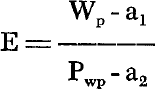
where
Wp ==domestic costs in zloties, in a given phase of production
a1 ==the zloty-value of all inputs which have been used in production and which command a world market value
a2 ==same as a1, but at their foreign exchange value
Pwp ==world market price of the commodity.
The wide variations of the above figures ranging from 50 for cotton and silk fabric to 1 for brown coal, show that the commodities traded by Poland have very different “foreign trade efficiences.” It is not difficult to perceive, moreover, that these indices can only demonstrate which exports (or imports) are more rational than others. They provide no information as to a country’s foreign trade optimum.
But these constructions have further serious defects. It is impossible to avoid calculating with home costs (Wp in the above formula). But “costs generally do not express the value of products.” Hence, “it is entirely correct to deduct from expenses the total amount of planned profits accumulated in each product in very different proportions77 and to reconvert the expenses for imported materials into foreign exchange in order to arrive at real prime costs. However, when making the calculations in practice, it is very easy to forget that even the real prime costs reflect only part of the export products’ value.”78 Another Hungarian author therefore observes:
The calculations of indices is extremely complex and the indices are static; their elaboration requires a relatively long time and it thus frequently occurs that the newly elaborated economic indices have already become obsolete. In addition, these calculations fail to embrace all export commodities and are covering only a small percentage of imports.79
Yet, even the limited information conveyed by these indices fails to be translated into practice:
During the last years, no considerable improvement has occurred in the efficiency of either our exports or of the structure of our import-replacing products; the results with respect to the utilization of the advantages accruing to us from both our participation in the socialist international division of labor and our economic intercourse with capitalist countries have remained unsatisfactory.80
This is so because the observance of the results of efficiency calculations, however limited their use may be, would clearly interfere with the discretionary power of the highest state authorities in the same way as an improved price system would do. This interference is all the more rejected by the party organs because it lies in the nature of these procedures that they tend to be progressively applied to the vital questions of the national economy as a whole. For example, the first authors to have proposed efficiency calculations in the Eastern bloc could not begin their article without the observation that
the efficiency of production as a method is subordinate to the class struggle for the victory of socialism; thus, the economic requirements regarding the safeguarding of national independence, the predominance of the socialist forms of production, the consolidation of political power and, finally, the raising of the social and cultural level, have to be made to prevail at the expense of efficiency.81
Yet, in the very same article, the authors raise the ominous question: what place is the national economy to occupy in the international division of labor? and make it unmistakably clear that the autarkic policy hitherto pursued had catastrophic results for the entire economy. Some years later, T. Liska suggests going back to “the really given, on principle unchangeable, data at the time of planning”82 and, based on these realities, “to calculate, with the help of linear programming, the main [macroeconomic, E.T.] proportions themselves which at present are approximated by estimates.”83 And he reaches the weighty conclusion:
The increase of the investment share and the additional accumulation achieved thereby can only be justified by a more rapid increase in the living standard, attained within a foreseeable time. . . . With an adequate price system, even the enterprises and branches of the producers’ goods industry can show the degree to which they have contributed to the consumptive fund.84
However, for the time being, it is still the Communist Party and it alone which determines the major proportions of the national economy. Its decisions are not founded on any objective measure of scarcity, on consumers’ preferences, or on international requirements. But since every Party has somewhat different ideas on how best to develop its national economy and since there exist no common principles of socialist pricing, the various national price lists are inadequate for the comparison of international values. Under these circumstances, it is impossible to conceive of a unified monetary system governing the Comecon area. It is impossible even to establish a rational link between the different national currencies by means of a realistic exchange rate:
In our foreign trade system, there is at present no direct connection between the exchange rate, price relations, and the development of international economic relations. . . . Numerous economists in the socialist countries hold the view that under socialism, the exchange rate is independent not only of the balance of payments, but also of the relative price levels prevailing in the different countries and on the world market.85
According to this conception,
the determination of the exchange rate is no economic activity, and it is therefore economically irrelevant at which level the state fixes it.86
As a result of this theory,
it is impossible to answer one of the most important questions regarding the extension of international division of labor, viz. what production or what foreign trade commodity structures are promoting the saving of social labor and the rise of productivity in the various countries.87
In the last few years, increasing attention has been devoted, in the C.M.E.A. countries, to the problems connected with the determination of a calculative exchange rate. Exchange rates can theoretically be determined in accordance with (1) gold parities; (2) purchasing power parity; and (3) the amount of foreign exchange earned by a unit of traded commodities. As regards the first alternative, all Eastern European countries have, indeed, defined their currencies in terms of gold. However, “the fact that all currencies of the Eastern bloc simply lack the preconditions for convertibility into dollars or another hard currency precludes any direct link with gold . . . and hence the fixing of a realistic gold parity.”88 Etschmann speaks in this respect of a pure farce, devised to give an apparently solid foundation to communist monetary policies in the eyes of foreigners as well as those of the unexperienced citizen. All Western and most Eastern authors agree that these rates are strongly overvalued and therefore without any use for assessing foreign trade profitability.
Referring to the second alternative, K. Pécsi writes:
Since the exchange rate is dependent on the price system, it is necessary, in order to give it economic content and allow it to express price relations correctly, to approximate the price systems and mechanisms of socialist countries, to abolish, in essence, the dual price system, etc.89
But he adds:
In the absence of these necessary prerequisites, it is as yet impossible to establish a uniform exchange rate able to serve the purposes of economic analysis, to supply a criterion for investment cooperation and, for the products of joint enterprises, to examine foreign trade efficiency and to provide the basis for international clearing.90
Noetel sees, it is true, in the ruble devaluation of January 1, 1961, “the application of the principle of comparing the purchasing power of producers’ prices in the Soviet Union expressed by the purchasing power of world market prices.”91 But, he continues: “This change . . . has of course no direct influence on the decisions relative to any export or import transaction.”92
There thus remains only the third alternative for arriving at a more realistic exchange rate.
The great majority of economists agrees to the necessity of departing from the Forint93 costs of “producing” (by way of exports) the various foreign currencies. There is also agreement on the principle that the exchange rate must be at least as high as to enable inland prices for imports to cover the inland costs of the offsetting exports. . . . Opinions differ as to . . . whether (1) the basis of the exchange rate is to be the average ratio of foreign exchange earnings or whether (2) it is to be determined at the upper limits of the expenses incurred for foreign exchange production.94
The author quoted favors an exchange rate to be fixed according to the “expenses incurred in the production of the least efficient tenth or fifth of the exports necessary to keep the balance of payments in equilibrium.”95 He admits, however, “that it would be very difficult, on the basis of our present statistics, to ascertain the average exchange rate of these export ranges according to the various foreign currencies.”96 And one of his colleagues observes:
One cannot identify the G-index [i.e. Forint/Dollar, ET.] of the least efficient export product with the marginal exchange rate unless the present volume and composition of our exports could be regarded as optimal. Yet no one having sufficient insight into the present situation of our foreign trade could earnestly affirm this.97
Thus, no efficiency indices, however perfectly constructed, can avoid calculating with existing domestic prices and costs. Yet, it is impossible to make these prices and costs reflect relative scarcities unless a thoroughgoing economic reform is introduced; a reform which would be tantamount to the abolition of central planning itself. But any scientific research advancing too far in this direction cannot even be tolerated by the Communist parties in power. Hence, the arguments of Eastern European economists must turn round in a vicious circle: the deeper the latter come to understand the interdependence of economic phenomena, the more their theoretical debates will be conducted in an academic vacuum.
Price Formation on the Socialist World Market: Theories and Reality
Eastern European economists have, for some time, been concerned with elaborating the foundations for a unified international socialist price system. They have necessarily encountered the very same problems just analyzed. However, these discussions shed a new light on the inseparability of economic from political matters characteristic of the Comecon countries.
Khrushchev’s appeal “to find economic instruments to stimulate the interests of socialist countries in increasing cooperation and specialization in developing mutually advantageous trade”98 was answered by a Bulgarian proposal suggesting man-hours as the basis for independent socialist prices. But, according to an East German estimate made in 1958, the index of industrial labor productivity in the Eastern European countries shows the following variations, with Czechoslovakia as base:99
| Bulgaria | 57 | Rumania | 99 |
| Hungary | 57 | G.D.R. | 90 |
| Albania | 58 | Czechoslovakia | 100 |
| Poland | 84 | U.S.S.R. | 120 |
Such a price system would therefore clearly disfavor exports that require a high investment share. Hence, it was rejected by the more developed C.M.E.A. partners:
The use of national labor outlays as trade prices between C.M.E.A. members as a principle would make mutual advantage in the exchange of goods more difficult and would hinder the achievement of a rational international division of labor. . . . Factors influencing price relationships must also find expression in the autonomous price structure, so that such prices express the economic conditions of all the economies cooperating in the C.M.E.A.100
And Tálas hits the nail on the head, when he writes:
The exchange of equal national labor . . . would by no means serve the optimal development of socialist productive forces; it is contrary to the real content of the cooperating states’ sovereignty, let alone the fact that it represents an outright contradiction to Marx’s labor value theory.101
The debate concerning an independent Comecon price basis involves, in fact, nothing less than the economic sovereignty and independence of the Council’s members. It lies in the nature of socialist prices that they are not autonomously formed, but imposed from above. And since, as we have seen, there are no rational and objective guidelines for price-fixing, the entire issue becomes a question of simple power: who is to impose on whom “socialist prices” and thereby his political will?
For the time being, the economic intercourse between socialist countries is based on world market prices. This is not the place to describe in detail the various methods adopted to “correct” these prices; it may just be pointed out that they directly affect the respective countries’ terms of trade and are therefore subject to embittered disputes. Frequently, prices are fixed by bilateral negotiations each year so that one and the same commodity has different quotations within the Comecon area as well as through successive rounds of negotiations.
International Clearing between C.M.E.A. Countries
As it is impossible to arrive at an ex ante equilibrium of the “material balances,” the planners are unable to foresee with precision the development of their national balance of payments. Unplanned surplus and deficits frequently arise; at the same time, each C.M.E.A. country has been under obligation to balance, at the end of each year, its trade with every other brother state taken separately. Not until 1959 were provisions introduced to ease this rigid bilateral clearing. Noetel noted “a really spectacular increase of bilateral trade”102 due to these provisions; yet the fact remains that “the system of payments between socialist states is characterized by pure and simple barter.”103
Formally, the ruble acts as the instrument of international monetary settlement. But since it is not convertible, bilateral balances must be settled by additional commodity deliveries which, under a system of central planning, represent an additional sacrifice to the national economies affected. In view of the general shortage of capital, the C.M.E.A. members avoid granting swing credits to each other, especially since these bear only very low interest. A few triangular compensation arrrangements have occurred, but their extended use finds its limits in the deficiencies of a centrally planned and administered system.
In 1963, the Comecon countries agreed to set up an International Bank of Economic Cooperation,104 which started its operations in January, 1964. Strict bilateral balancing was to be replaced by “a balance of receipts and expenditures in transferable rubles within the calendar year with all the other contracting parties as a whole.”105 Also, more attention was to be given to a precise ex ante planning of balance of payments surplus and deficits and to the inclusion of such imbalances into trade agreements with third countries. Are these measures a first step toward a more general multilateral clearing within the Comecon area?
True multilateral payment arrangements are impossible to achieve by an economic system in which home costs cannot objectively be assessed and where therefore a rational link between national currencies does not exist. The “transferable” ruble would fulfill the conditions of multilateralism only if all other member currencies could be defined by a single and realistic exchange rate with regard to the Soviet monetary unit (and also to each other) and if any C.M.E.A. country holding such rubles was free to buy with them whatever it desired, if not in the Comecon area as a whole, at least in the U.S.S.R. But such advantages are incompatible with the principle of national planning. International economic relations between Comecon countries will therefore continue to be forced into restrictive bilateral channels.106 And this circumstance is little altered by the fact that the new Comecon Bank is not only to provide “lubricating” commercial credits, but also is to finance joint investment projects at very low interest rates.
Recently, a high official in the Polish Ministry of Finance, H. Kotlicki, proposed the introduction, by degrees, of ruble convertibility.107 According to this suggestion, debtor countries are to pay in gold approximately 10% of their liabilities to the Comecon Bank. This provision would, in Kotlicki’s view, tend to increase both the financial discipline of Comecon countries and the quality of the products they offer to each other. However, Czechoslovak authors already warned against the consequences of such a measure which would cause the less efficient C.M.E.A. partners to shrink back from an extension of their foreign trade. Some countries may even be led into a kind of commercial “flight into the West,” a nightmare which for years has haunted many Soviet economists and state officials. It is not surprising that the U.S.S.R. has openly rejected the Polish proposal. In doing so, “Moscow has apparently been concerned not only about the Soviet shares in the proposed gold coverage, but to an equal extent also about the implied East-West political-economic quintessence of the Polish convertibility suggestions—about the question relative to the control of trade in the Soviet Bloc.”108
The continued survival of separate national sovereignties in a collectivist economic order thus precludes a unified international monetary system.
THE PROBLEMS CONNECTED WITH EAST-WEST TRADE
The basic characteristic of a socialist economy, that is, the subjection of the economic sphere to political control, is at the bottom of all problems hitherto analyzed. It is nowhere more evident than when East-West trade is discussed. Here, two economic systems founded on entirely different principles and conceptions meet with and react to each other, one system openly proclaiming its firm determination to undermine and eventually to smash the other.109
The unfortunate Western intervention in Siberia in 1918 served as a confirmation of the theory that imperialism constituted a deadly menace to a young socialist country. It gave Stalin a welcome ideological explanation for the hardships his autarkic industrialization program imposed on the Soviet peoples. But we have already seen that autarky is an inherent feature of a centrally planned economy. It also appears whenever the economic control of one state authority, necessarily limited regionally or branchwise, conflicts with that of another.
After World War II, Western “strategic controls” of exports to the Soviet Bloc were again used as a pretext for the reorientation of the Eastern European countries’ trade to fit Russian purposes. One passed over the fact in silence110 that these controls were provoked by the aggressive postwar policies of the
Foreign Trade Problems with C.M.E.A. Countries as Seen from the West
The classical theory of international trade no longer holds for trade relations with socialist countries in which real costs cannot be assessed. Cheap sources of supply from the C.M.E.A. Bloc, therefore, do not justify a corresponding shift of resources in the Western partner states; to the extent that such changes nevertheless occur, the socialist foreign trade monopoly and through it the Foreign Ministry obtain a fruitful field for manipulating the internal market of its capitalist partners. This circumstance is of special avail in the case of Eastern large-scale orders for productive equipment. These orders usually have, via the acceleration principle, more or less far-reaching effects on the supplying country’s internal economy, depending upon the latter’s existing capacities. Conversely, the supply of vital commodities by Comecon countries (e.g. Russian oil) may—and is frequently intended to—lead to a dangerous economic dependence of the West.
On the other hand, communist trade relations with Western countries are accompanied with increased personal contacts between the principal agents of the two systems. Such contacts tend to correct stubborn ideological prejudices. This factor and the opportunity given to Eastern European officials of forming independent judgments on the Western economic and political order constitute an important political potential for the free enterprise countries.
The form under which East-West trade takes place is usually a bilateral trade agreement containing a list of goods or commodity groups to be exchanged. But this list can more easily be agreed upon on paper than executed in practice. On the one hand, the socialist foreign trade monopoly remains free to switch its orders from one country to another for both political and economic reasons (e.g. foreign exchange availabilities or shortages). On the other hand, no Western government can guarantee that the goods offered by the Eastern European states will provoke sufficient interest in private traders and entrepreneurs so that they will actually be imported. The problem involved in the bargaining position of the two trading partners must also be mentioned: an individual enterprise, competing with many others, is faced with a powerful state agency. Yet, as we know, the Western disadvantage is frequently offset by the rigidity of socialist demand for a specific product, a fact which has led to relatively higher prices for commodities delivered to the East. This tendency is reinforced by the restricted use which Western countries or entrepreneurs can make of a bilateral credit balance accumulated against an Eastern state. If no one can be found who is willing to acquire these sums at the agreed exchange rate, they must be disposed of on the international currency market at a disagio—a risk which will naturally be included in the initial price calculations.
This fact, and Western reluctance to grant most-favored-nation treatment to the centrally planned economies, has led Eastern European economists to complain of “capitalist” trade discrimination against the exports of their countries. However, it should be remembered that the most-favored-nation clause is a device built wholly on the assumption of international trade between free market economies. It is, in fact, one of the characteristics of international economic intercourse between free market and centrally planned economies that the latter force their proper forms of cooperation on their Western partners. Thus, for instance, “it is generally known that a great part of [Western, E.T.] export industry was feeling very well under the protection of bilateral contingents.”111 A number of political problems therefore arises, for the Western countries, from East-West trade. If they do not wish to emerge as the net losers—and this question must be judged following the same method that is adopted in the socialist countries themselves, considering economic as well as political aspects—they should subject this trade to conscious government control and mutually harmonize their commercial policies.
Foreign Trade with “Capitalist” Countries as Seen from the East
Officially approved Eastern European textbooks and articles on foreign trade openly advocate self-sufficiency of the C.M.E.A. Bloc as the long-term goal of socialist economic policy. They not only refer to the alleged aggressiveness of the imperialist camp and the corresponding necessity for their countries to attain economic independence; they also point out that the “chaos” of the world market and its unpredictabilities provide a constant source of disturbance to the planned machinery of their national economies. In addition (though less emphasized), East-West trade finds itself in direct competition with the extension of the socialist international division of labor and the strengthening of Comecon.112 The conclusion is obvious: East-West trade must be reduced to a minimum.
Yet it is clear that both the abundance and the variety and quality of “capitalist” goods and services have a great attraction to socialist planners, especially those from the small Comecon countries. The increase of trade with the West beyond the extent dictated by the strict necessities of the plan would bring a twofold advantage: in the first place, it would in some way rationalize at least the import side of the foreign trade of these countries since the conditions for the acquisition of these goods are objectively defined by market prices. Thus, it is reported that Rumania has been able to raise the rate and efficiency of her industrial growth by purchasing the latest Western factory equipment.113 But it will of course still be true that the country’s exports are composed of those goods which are apt to find a Western buyer, whatever price they may bring, without regard to their production profitability. Secondly, this trade would lead to a loosening of the political ties by which the C.M.E.A. countries are bound to the U.S.S.R.
But the smaller Eastern European governments’ willingness to expand their trade with the West finds its limits not only in the distrust with which the Soviet Union views all such attempts, but also in their acute shortage of convertible currencies. Frequently, these countries’ exports are unable to meet the much higher quality requirements of the Western consumer. Here, the deficiencies of the planning apparatus described above constitute a special encumbrance. This is why these states are pressing for long-term credits from their Western trade partners.
The Prospects of East-West Trade
What, then, are the prospects of East-West trade? A number of Western authors, among them A. Nove and F. L. Pryor, are warning against an overemphasis of the political factors by the West. They point to the increased attention that is being devoted by socialist planners to purely economic considerations and to the probability that the rise of living standards in the C.M.E.A. countries will gradually weaken the impact of communist ideology. Therefore, the West should renounce its discriminatory commercial policies and expand East-West trade which is beneficial to both parties. It is argued that the markets for Western goods lying east of the Elbe are unlimited; but that the West must also consent to buy more from these countries since otherwise no lasting trade expansion can take place.
This proposal cannot be discussed in length here since this would involve a thorough examination of the deep political and social forces now at work in the C.M.E.A. Bloc. Yet, our previous analysis has yielded two results that are relevant in this context: a certain “liberalization” of scientific inquiry has, indeed, occurred. We have seen that the burning economic problems are openly discussed and that today audacious theoretical conclusions and even policy recommendations are allowed to be printed in these states—a thing unheard of in Stalin’s times. However, the Communist parties in this area still adhere to the principles of Marxism-Leninism and to their unlimited power position derived from it. It is due to this fact that so little progress has been made in the realization of the economists’ reform suggestions. The importance of this fact can only be grasped if one considers the enormous national economic costs that have been caused by the lack of rational value criteria, irresponsible planning, slow administration, and the drive for autarky. The “true representatives of the workers and of the people” do not hesitate to impose these costs on their population.
In view of this unchanged fact it is to be hoped that the extension of East-West trade will go hand in hand with a concerted though carefully prepared and differentiated policy of the Western industrialized countries.
SUMMARY AND CONCLUSIONS
Foreign trade, which is the principal form of socialist “integration,” shows the lowest expansion rate next to agriculture in the Comecon countries’ economies. Five main reasons account for this fact and conspicuously contradict the often repeated principles of socialist internationalism and brotherhood; reasons which are inherent in the political and economic system adopted by the Eastern European countries headed by the Soviet Union:
(1) The absence of a rational value criterion and the corresponding impossibility of international cost and price comparisons;
(2) inconsistent planning and the slow and deficient working of the administrative apparatus;
(3) a system of material rewards stimulating enterprise actions which are contrary both to the interests of the national economy and to the planners’ intentions;
(4) a resulting drive for autarky on all levels, from the individual company up to the national planning office;
(5) the obstinate survival of national sovereignty which leads, due to its enlarged internal powers, to a complete separation of national price systems.
It is for these reasons that the national antagonisms inherited in this area from earlier times were unable to be tempered by socialist economic cooperation. They grew, in fact, more intense as a result of the overall competition of these countries for raw materials and favorable production assignments from the Council of Mutual Economic Aid. The number of obstacles for the expansion of fruitful international trade between Comecon members is increased by “the uncertainty of being able to obtain, in the narrow framework of bilateralism, the products which become the speciality of another member or to dispose of their own specialized products on the other’s markets.”114 Generally, international production specialization is accompanied by a price rise of the commodities agreed upon, a factor which particularly prejudices those trade partners that renounce the earlier production phases of these commodities.
The “socialist world market” is characterized by resource immobility. There have been, as yet, very few instances of international lending and investment cooperation; international migrations have outright been declared as “incompatible with socialism.” Here, as well as with respect to the problem of constructing a workable international monetary order, the basic contradiction of socialism again becomes apparent: socialism first concentrates economic power in the hands of a small group representing a particular “collectivity” and then expects the holders of this internally unlimited power to show a degree of self-imposed restraint in their relations with other collectivities which cannot even be found in Utopia. The manifold obstacles to international economic cooperation under collectivism can only be removed by the “internationalization” of the internal orders realized in each socialist state, that is, by the abolition of hitherto sovereign governments and the subjection of their territories to the will of a single, all-powerful superstate.
Numerous proposals have been advanced for remedying the chaotic situation of domestic prices. They range from the suggestion to introduce a free market economy—with the retention, to be sure, of public ownership of the means of production—to orthodox Marxist conceptions based on the labor theory of value and the dual price system. But these debates have little affected economic practice in the C.M.E.A. countries due to the party hierarchies’ determined resistance against any interference with their discretionary power. As interesting as Czechoslovakia’s and Hungary’s recent price reforms may be in detail, these countries’ economies continue to bear the marks of this fundamental dilemma.
Can it nevertheless be maintained, as it often is, that the Soviet-type economies have, in recent years, successfully approached efficiency and rationality?. The enormous economic waste that occurred in the Stalin era due to negligence, incompetence, and total irresponsibility—a waste which is “unnecessary” even in a centrally planned economy—has certainly been reduced in the past decade. Great progress has also been made in the scientific investigation of economic laws and their general economic interdependence. Yet, the Communist parties in power are well aware that a consistent implementation of the results of this economic research would shake the foundations of the socialist economic structure. They combat the “decentralizing” tendencies within their countries just as the most powerful of them, the Communist Party of the Soviet Union, is gravely concerned about the centrifugal forces within the Comecon area dominated by it. The fundamental issue of socialist integration: the conflict between national economic sovereignty and centralized planning on a supranational level, is still unresolved. Power will have the last word in deciding this issue, a power which is decisively influenced by the political developments both within and without the Communist Bloc. These developments will also have a decisive impact on the final solution of the question as to whether the C.M.E.A. Bloc will permanently and hermetically be separated from the rest of the world or whether the victory of common sense and mutual economic advantage will lead to a true and worldwide economic integration.
NOTES TO CHAPTER XI
115This objective has, for decades, been expressed by the slogan that the Soviet Union must, within the shortest possible time, catch up with and surpass the most developed capitalist countries, especially the U.S.A.
116Speech given in 1926, quoted in Kaser, M., Comecon. Integration Problems of the Planned Economies. London, Oxford University Press, 1965, p. 18.
117E.g. in Pravda, October 19, 1961: “Heavy industry has always played and will play the leading role in expanded production. The party will continue unflaggingly to concern itself with its growth, considering this as the decisive condition for the creation of the material-technical basis for swift technical progress, as the basis for the strengthening of the defense capacity of the socialist state.”
118Stalin wrote: “The country of the dictatorship of the proletariat, in conditions of capitalist encirclement, cannot remain economically independent if it does not produce at home the instruments and means of production.” Quoted in Kaser, M., op. cit., p. 18.
119Ulbricht, W., “Die Anwendung der Leninschen Prinzipien der sozialistischen Wirtschaftsführung in der D.D.R.” Wirtschaftswissenschaft, Vol. XI, No. 3, March 1964, p. 357. Cf. also Gáspár, S., “A part vezetö szerepéröl” (On the Leading Role of the Party). Tdrsadalmi Szemle, Vol. XIX, No. 10, 1964, p. 3: The most important prerequisite of the party’s leading role is its possession of those qualities by means of which it understands and formulates the interests, wishes, and aspirations of the working class and the entire working population, lays down the strategies and tactics of the struggle and is able to secure, by its organizational activities, the implementation of the policies thus determined.” Italics original.
120Quoted from Bolshaya Sovetskaya Entisiklopedia (USSR) in Kaser, M., op. cit., p. 26.
121There also exist long-term “perspective plans” covering fifteen or twenty years.
122Knirsch, P., “Grundzüge und Perspektiven der sowjetischen Wirtschaftspolitik.” Neue Zürcher Zeitung, December 24, 26, 27, and 28 (Nos. 4956, 4964, 4975, and 4987), 1961; separate reproduction, p. 6.
123See p. 145.
124Revisions in the balance of one product usually entail a wave of corrections affecting other inputs and outputs which in turn engender further revisions and so on in an almost infinite chain.
125Report of the Director of Omsk Tyre Factory in Pravda, October 5, 1962.
126Ibid., November 4, 1962.
127The chief function of the state bank is thus the control of managerial performance.
128Esze, Z., “Érték és árvita. A szocializmus árúuviszonyainak megismerése” (The Debate on Value and Prices; The Proper Understanding of Commodity Relations Under Socialism). Kòzgazdasági Szemle, Vol. XII, No. 4, 1965, p. 443. Since Soviet planning methods served as a model to all Eastern European countries, socialist price policy can be illustrated by the following example, published in the Polish Gaspodarska Planowa, 1960, No. 6, p. 3, relating to hard coal:
| Year | Average prime costs per ton (zloties) | Average sales price per ton (zloties) | Prices covering costs (percent) | |||
| 1950 | 62.14 | 53.22 | 85 | |||
| 1951 | 62.22 | 54.82 | 88 | |||
| 1952 | 73.82 | 57.37 | 78 | |||
| 1953 | 102.41 | 74.88 | 71 | |||
| 1954 | 110.86 | 73.45 | 66 | |||
| 1955 | 120.39 | 72.35 | 60 | |||
| 1956 | 163.18 | 128.25 | 79 | |||
| 1957 | 222.49 | 128.91 | 58 | |||
| 1958 | 225.26 | 128.84 | 57 | |||
| 1959 | 236.01 | 128.98 | 55 |
129Esze, Z., loc. cit., p. 444.
130Népszabadság, August 31, 1962.
131Pravda, October 20, 1961.
132V. Iljitchev’s speech on the 22nd Party Congress, Pravda, October 26, 1961.
133Esze, Z., loc. cit., p. 450. This is so because the prices of some commodities contain, for extra-economic reasons, a greater percentage of planned profit than others.
134That this problem is still subject to ideological dispute becomes evident from the following recently printed passage: “Does not the charge for the use of capital imply a violation of the Marxist theory of value? . . . Since the main task consists of the minimalization of labor costs, and since society disposes of its instruments—i.e. capital goods—only to a limited extent, the use of capital, considered as the reflection of the scarcity of the material factors, can be reckoned among real costs.” Pirittyi, O., “Vita a szocialista árrendszerröl” (Debate on the Socialist Price System), Közgazdasági Szemle, Vol. XI, Nos. 7-8, 1964, p. 974.
135Balázsy, S., “További mechanizmusproblémák a külkereskedelemben” (Further Organizational Problems in Foreign Trade). Ibid., Vol. XII, No. 5, 1965, p. 587.
136Ibid. However, one has only to consider that the Soviet price reform, having become effective on January 1, 1965, “is the result of a preparatory work carried out since 1960 to which practically the whole economic administrative apparatus has contributed” (Haffner, F., “Die Revision der Industriepreise in der Sowjetunion zum 1. Januar 1965.” Osteuropa-Wirtschaft, July 1946, p. 1) in order to get a glimpse of the practical difficulties involved in the problem of centralized price fixing. This renders Balázsy’s vague statement meaningless.
137Esze, Z., loc. cit., p. 457.
138Hoehmann, H. H., “Zur Entwicklung der sowjetischen Wirtschaftslehre.” Osteuropa-Wirtschaft, December, 1964, p. 11.
139Ibid., p. 12.
140Ibid., p. 13.
141Ibid.
142Libermann, J., “Plan, Profit, Premium.” Paper reprinted in Pravda, September 9, 1962.
143Kurowski, S. J., “Rynek i plan.” 1957, quoted in Machowski, H., “Die Preisdiskussion und die Industriepreisreform vom 1. Juli 1960 in Polen.” Osteuropa-Wirtschaft, April, 1964, p. 25.
144Ekonomicheskaja Gazeta, March 9, 1963, translated and reprinted in “Price Policy and Theory.” Problems of Economics, Vol. VI, No. 12, 1964, p. 27.
145See pp. 101-2.
146The granting of this assistance was even more “self-evident” to the Soviet government itself which was thereby correctly fulfilling its “historical role.” We can read in the 1960 version of the History of the Communist Party of the Soviet Union: “The international character of the dictatorship of the proletariat gave rise to a fundamentally new, hitherto non-existent function of the Socialist State—the function of assisting other countries in the building of Socialism and of establishing international Socialist relations. . . . The path travelled by the Soviet people is the highroad of Socialist development for the working people of all countries. The main features and laws of development of the Socialist revolution and of the building of Socialism in the U.S.S.R. are not of local, specifically national, significance: they are of international importance.” Quoted in Kaser, M., op. cit., p. 17.
147At the same time, however, de-industrialization became the fate of Eastern Germany. The large-scale dismantling of industrial facilities by the Soviet Union was estimated at 70 billion Reichsmark.
148Kaser, M., op. cit., p. 19.
149Ágoston, I., Le marché commun communiste. Principes et pratique du COMECON. Geneva, Droz, 1964, p. 22.
150Kaser, M., op. cit., p. 19.
151Thus, during 1946-53, Poland delivered Silesian coal to the Soviet Union at a price that covered only transport costs. The total Soviet gains from this transaction are estimated at $900 million. In the years immediately following World War II, the Soviet Union also exacted reparation payments from Eastern Germany, Hungary, Rumania, and Bulgaria. In these and other states under her influence, she converted, in addition, enterprises formerly owned by German nationals into the so-called Mixed Companies over which she exercised exclusive control. They were not dismantled until 1954, when the Soviet shares were “bought back” against heavy sums by the respective governments.
152Ágoston, I., op. cit., p. 220.
153“The main contradiction was that in spite of the rapid growth of production, the standard of living not only failed to rise, but even declined to a certain extent.” Közgazdasági Szemle, Vol. IV, No. 3, 1957.
154Noetel, R., “Les relations économiques de l’Union soviétique avec les pays de l’Est européen.” Revue économique et sociale, Aprii 21, 1963, p. 83, italics added.
155Népszabadság, April 2, 1963. The author, S. Énekes, continues: “This study is all the more urgent as one begins at last to recognize that metallurgical products cannot be produced during decades without the modernization and improvement of their quality.”
156Ágoston, I., op. cit., p. 113.
157Pravda, May 25, 1958.
158New Times (Moscow), 1962, No. 27.
159“The crucial fact of Comecon’s history from its foundation to the present is that the rapid growth of its aggregate production has not been accompanied, as in other world economic groups, by a relatively more extensive international division of labor, either among its members or with the rest of the world.” Kaser, M., op. cit., p. 16.
160Ibid.
161Noetel, R., loc. cit., p. 97. Cf. also Ágoston, I., op. cit., p. 163: “It is one of the characteristic aspects of cooperation within C.M.E.A. that the U.S.S.R. possesses an absolute preference right as to the purchase of investment goods and equipment produced by the people’s democracies.”
162Kommunist, August 1962.
163Ibid.
164Karkhin, G., “Socialist Community: Possibilities and Prospects.” International Affairs (Moscow), August 1962, pp. 19-20.
165Ibid., p. 19.
166Ágoston, I., op. cit., p. 116.
167Apro, A., A szocialista országok gazdasdgi egyáttmüködése (Economic Coop-ation Between Socialist States). Budapest, Kossuth Kònyvkiadó, 1964, p. 252.
168Kaser, M., op. cit., p. 121, cf. also pp. 161 seq.
169Valev, E., in Vestnik Moskovskogo universiteta: Seriya geografìa, No. 2, 1964.
170Vita economica, June 12, 1964.
171P. Alampiev’s lecture, delivered to the Fourth Congress of the Geographical Society of the U.S.S.R. in 1964.
172Quoted in Kaser, M., op. cit., p. 166.
173In fact, the organization of technical collaboration and the interchange of expertise have provided a field for successful Comecon activities. Ágoston observes, however, that the reception by one country of technical experts and elaborated projects from abroad is not always an unmixed blessing. The receiving country may see itself obliged to develop “this or that branch of industry the choice of which does not belong to itself and the economic efficiency and profitability of which may be doubtful. The resulting waste of national resources may be far greater than the gain from technical assistance.” Op. cit., p. 207.
174Bogomolov, O., “Erfahrungen aus der wirtschaftlichen Zusammenarbeit der Länder des R. G. W.” Wirtschaftswissenschaft, Vol. XII, No. 4, April, 1964, p. 535.
175Tálas, B., “A szocialista világgazdasági kapcsolatok néhány elméleti kér-déséhez” (Theoretical Questions Concerning Socialist Economic Relations). Közgazdasági Szemle, Vol. XI, No. 9, 1964, pp. 997-998, italics added.
176Kiss, T., A szocialista országok gazdasági együttmükodése (Economic Cooperation of Socialist States). Budapest, Kossuth Kiadó, 1961, p. 129.
177Neue Zürcher Zeitung, No. 3104, July 24, 1965, italics original.
178Ibid., No. 3054, July 20, 1965, italics original.
179Tálas, B., loc. cit., pp. 1007-8, italics original.
180Kiss, T., op. cit., p. 131.
181Esze, Z., loc. cit., p. 444.
182Rába, A., “Export és gazdasági mechanizmus” (Export and Economic Mechanism). Külkereskedelem, Vol. IX, No. 7, 1965, pp. 199-201, italics original.
183Ibid., p. 201.
184Quoted from Forster, W., “Das Aussenhandelssystem und Valutamonopol der UdSSR und ihrer Satellitenstaaten,” in Das Unternehmertum und die politische Gefahr der Gegenwart, Frankfurt/M., 1956, by Etschmann, R., Die Währungsund Devisenpolitik des Ostblocks und ihre Auswirkungen auf die Wirtschaftsbeziehungen zwischen Ost und West. Ph.D. dissertation, Bonn, Rheinische Friedrich-Wilhelms Universität, 1959, p. 37.
185“The New System of Foreign Trade Direction in Czechoslovakia.” Külkereskedelem, Vol. IX, No. 5, 1965, pp. 142-43.
186Tálas, B., loc. cit., p. 999.
187Kaser, M., op. cit., p. 36. “Our economic system,” writes a Polish author, “is an abracadabra of prices, costs, and salaries. No sage could possibly tell what is rational and what is not.” Trybuna Ludu, November 18, 1956.
188Liska, T., and Máriás, A., “Economic Rationality and International Division of Labor.” Közgazdasági Szemle, 1954, No. 1, pp. 75-94.
189Some types of indices show a higher export efficiency for products containing many imported materials than for those with less or no import contents. Others neglect the capital tied down in the production of a given export good. A third group only examines efficiency in the “last phase” of production, etc., etc. For a detailed analysis of these indices, cf. Ágoston, I., op. cit., pp. 233 seq.
190Gospodarska Planava, 1957, No. 2.
191In Hungarian economic language the term “accumulation” is used for denoting the total amount of planned profits being accumulated in each product as it passes from one enterprise to another. It is recalled that this question represents the central issue in the debate concerning socialist price reforms.
192Nagy, A., “A külkereskedelem optimalizálása és az ösztönzes” (The Optimization of Foreign Trade and Material Stimulation) Közgazdasági Szemle, Vol. XII, No. 2, pp. 214-15.
193Balázsy, S., “Termelöi árak-devizaárak-árkiegyenlítés” (Production Prices, Foreign Exchange Prices, Price Equalization). Közgazdasági Szemle, Vol. XI, No. 9, 1964, p. 1059.
194Nagy, A., loc. cit., p. 216.
195Liska, T., and Máriás, A., loc cit., p. 76.
196I.e. the working population, land and known natural resources, productive capacities at the beginning of the planning period, the level of national income attained, and its present subdivision into consumption and investment; the known possibilities of technical progress, and the estimated interplay of supply and demand.
197Liska, T., “A gazdasági számitások továbbfejlesztéséért” (Toward the Further Development of Efficiency Calculations). Közgazdasági Szemle, Vol. VIII, No. 3, 1961, p. 305.
198Ibid.
199Kövér, K., “A valutaárfolyam néhány elméleti problémája a szocializmusban” (Theoretical Problems Relative to the Exchange Rate Under Socialism). Ibid., Vol. XI, Nos. 7-8, 1964, p. 919.
200Ibid., p. 920.
201Ibid., p. 921.
202Etschmann, R., op. cit., p. 93.
203Pécsi, K., “A beruházási együttmüködés néhány nemzetközi pénzügyi vonat-kozása a K.G.S.T. országokban” (The International Monetary Aspects of Investment Cooperation Between the C.M.E.A. Countries). Közgazdasági Szemle, Vol. XI, No. 4, 1964, p. 430.
204Ibid.
205Noetel, R., loc. cit., p. 99.
206Ibid.
207Basic unit of Hungarian currency.
208Balázsy, S., loc. cit., p. 1062, italics original. Applied to our example on p. 250, the problem would be whether the calculative exchange rate ought to be fixed at 4, or 7.1 zloties per ruble (average index) or at 50 or some average of the least efficient items (marginal index).
209Balázsy, S., “További mechanizmusproblémák a kiilkereskedelemben” (Further Problems of Foreign Trade Mechanism). Közgazdasági Szemle, Vol. XII, No. 5, 1965, p. 581.
210Ibid.
211Nagy, A., he. cit., p. 215.
212Kommunist, No. 12, 1962.
213Wirtschaftswissenschaft, No. 4, 1963, p. 553.
214Ibid., No. 4, 1964, pp. 601 and 608.
215Tálas, B., loc. cit, p. 1010, italics added.
216Noetel, R., loc. cit, p. 991.
217Ágoston, I., op. cit., p. 258.
218In fact, an international bank has already been in existence since 1957, but it remained not very effective.
219Birladeanu, A., in Pravda, October 25, 1963.
220An Eastern European C.M.E.A. expert wrote: “Polish investments in coal extraction were discouraged by the fact that it was difficult to obtain, in bilateral transactions, sufficient indispensable commodities from each of the countries that wished to purchase Polish coal.” Kiss, T., “The Effects of Economic Cooperation Between Socialist Countries on the Development of the Hungarian Economy.” Társadalmi Szemle, 1958, No. 11, pp. 796-815.
221Neue Zürcher Zeitung, No. 3245, August 6, 1965.
222Ibid.
223We can read in the Great Soviet Encyclopedia: “The development of Soviet foreign trade is of first-rank importance for (Soviet) political relations.” And the East German Secretary of Foreign Trade declared: “Foreign trade has not only the task of appreciably bettering the standard of living of our people; through its activity in the Capitalist world, foreign trade must also . . . support the peace-loving forces in these countries and strengthen them in their fight against the robbing monopolists.” Both statements quoted in Pryor, F. L., The Communist Foreign Trade System. Cambridge (Mass.), M.I.T. Press, 1963, pp. 163 and 170.
224A practice also adopted by not a few authors of pertinent books published outside the Communist Bloc.
225Etschmann, R., op. cit., p. 110. This author also gives a detailed description of the West-German bilateral trade agreements with the Comecon countries and their practical results. In order to avoid the permanent granting of swing credits, the federal government introduced, in 1956, the restricted convertibility of the D-Mark (Beko-Mark) in order to encourage these countries to accumulate balance of trade surpluses with Western Germany.
226“The fact that the C.M.E.A. member countries maintain their relations with the capitalist market limits, to a very large extent, the possibilities for introducing a price system which would differ too much from capitalist prices. Countries which would be placed at a disadvantage by this new system and the exports of which could obtain a better price on Western markets, would not fail to make an attempt at reorienting their trade in this direction.” Ágoston, I., op. cit., p. 231.
227Apparently, this country now disposes of sufficient workers and experts specially trained for operating and taking care of this equipment.
228Ágoston, I., op. cit., p. 123.
- 1.“Socialism, then, will flourish in proportion as the consciousness grows that there is something vitally wrong in the industrial organization of society.” Guthrie, W. B., Socialism Before the French Revolution. New York, Macmillan, 1907, p. 68. As Robert Owen expresses it: “Until society can be made to understand the impracticability of improving its conditions under the existing circumstances and can be induced to change these circumstances in toto, no real advantages can be obtained for mankind.” Lectures on an Entire New State of Society. London, 1820, p. 138.
- 2.Cf. Karl Marx’s 11th Thesis on Feuerbach. In Borkenau, F. (ed.), Karl Marx. Frankfurt/M., Fischer, 1956, p. 42.
- 3.The term “liberal” is used here in its original European sense. “Liberalism is a belief in the value of human personality, and a conviction that the source of all progress lies in free exercise of individual energy; . . . it therefore involves a readiness to use the power of the state for the purposes of creating the conditions within which individual energy can thrive, of preventing all abuses of power, of affording to every citizen the means of acquiring mastery of his own capacities and of estabhshing a real equality of opportunity. . . .” Encyclopaedia Britannica, Vol. XIII, 1959, p. 999d.
- 4“It follows from what has been said that the system here established, if it is to be realized, should be adopted or rejected in entirety.” Fichte, J. G., op. cit., p. 103.
- 5Freyer, H., op. cit., p. 26.
- 6Heuss, A., “Hellas. Die archaische Zeit.” Propyläen Weltgeschichte, ed., G. Mann and A. Heuss, Berlin, Propyläen Verlag, 1962, III, p. 373.
- 7Ibid.
- 8“They will go to mess and live together like soldiers in a camp. . . . They alone of all the citizens may not touch or handle silver or gold, or be under the same roof with them or wear them, or drink from them. And this will be their salvation, and they will be the saviors of the State.” Quoted from Republic, Book I, in Gray, A., The Socialist Tradition. Moses to Lenin. London, Longmans, 1946, p. 19.
- 9Plato, Laws. With an English translation by R. G. Bury, London, Heinemann, 1926, Vol. I, Book I, p. 9.
- 10Ibid., Vol. II, Book XII, p. 477.
- 11Ibid., Book VII, p. 135.
- 12Ibid., p. 149.
- 13Ibid., Book XII, p. 547.
- 14Ibid., p. 537.
- 15Ibid., p. 521.
- 16Ibid., Book VII, p. 185.
- 17Ibid., Book XI, p. 413.
- 18Ibid., Book VIII, p. 171.
- 19Ibid., Vol. I, Book IV, pp. 257-59, italics added.
- 20Ibid., Vol. II, Book VIII, p. 185.
- 21Ibid.
- 22Ibid., p. 187.
- 23Ibid., Book XII, p. 503.
- 24Ibid. Plato lays down the following rules: “First, no man under forty years old shall be permitted to go abroad to any place whatsoever; next, no man shall be permitted to go abroad in private capacity, but in a public capacity permission shall be granted to heralds, embassies, and certain commissions of inspection. . . . These men, when they return home, will teach the youth that the political institutions of other countries are inferior to their own.” Ibid., p. 505.
- 25Ibid., p. 507.
- 26Ibid.
- 27Ibid., p. 509.
- 28Ibid., p. 511.
- 29Ibid. “The officials . . . shall have a care lest any such strangers introduce any innovation, and they shall duly dispense justice to them, and shall hold such intercourse as is necessary with them, but to the least extent possible.” Ibid., p. 513.
- 30Guthrie, W. B., op. cit., p. 64.
- 31Ibid.
- 32Ibid., p. 68.
- 33More, Sir Thomas, The Utopia. In Latin from the edition of March 1518 and in English from the first edition of Ralph Robynson, translated in 1551, edited by J. H. Lupton. Oxford, Clarendon Press, 1895, p. 118.
- 34Ibid., p. 119.
- 35Ibid., p. 140.
- 36Ibid., p. 157.
- 37Ibid., pp. 170-71.
- 38Ibid., pp. 171-72.
- 39Ibid., p. 245.
- 40Ibid., p. 244.
- 41Ibid., p. 154.
- 42Ibid., pp. 154-55, italics added.
- 43Ibid., p. 179.
- 44Ibid., p. 251.
- 45Guthrie, W. B., op. cit., p. 54.
- 46Fichte, J. G., op. cit., pp. 4-5.
- 47“I have described property as the exclusive right to actions, by no means to things.” Ibid., pp. 5-6, italics original.
- 48Ibid., p. 4.
- 49Ibid., p. 56, italics original.
- 50Ibid., p. 14.
- 51Ibid., p. 19.
- 52Ibid., p. 26, italics added.
- 53Ibid.
- 54Ibid., p. 27, italics original.
- 55Ibid.
- 56Ibid.
- 57Ibid., p. 41, italics original.
- 58“The wealth of a person does not depend on how many pieces of money he possesses, but on how large a part of total circulating money he holds.” Ibid., p. 42.
- 59“Every possibility of world trade presupposes the availability of a universally accepted means of exchange. . . . Hence, our task should be solved in the following way: all world money possessed by the citizens, that is all gold and silver, should be brought out of circulation and exchanged for a new national currency which would be valid only inside the country.” Ibid., pp. 99-100, italics original.
- 60Ibid., p. 111.
- 61Ibid.
- 62“The import and use of commodities which serve prestige purposes only can at once be prohibited.” Ibid., p. 115.
- 63Ibid., p. 113, italics original.
- 64Fichte clearly realized this and also the danger of inflation it implies. Therefore, in order to assure the success of the monetary reform, “the government formally renounces, for eternal times, to increase arbitrarily and to its own advantage the quantity of circulating national money.” Ibid., p. 103. The author goes so far as demanding that the centrally fixed prices must be constitutionally laid down and guaranteed.
- 65Ibid., p. 114.
- 66Ibid., p. 90, italics original.
- 67Ibid., p. 119.
- 68Ibid., pp. 94-95, italics added.
- 69Ibid., pp. 95-96.
- 70Ibid.
- 71Ibid., p. 98.
- 72Ibid., p. 94.
- 73Ibid., p. 93.
- 74Ibid., p. 118 (note). This, however, is in contradiction to Fichte’s apprehensions against inflation. Cf. footnote 64 of this chapter.
- 75“Foreign machines should be bought and imitated at home. Promise of money defeats any prohibition.” Ibid., p. 117. Moreover, the government “should attract, from abroad, at whatever cost, great personalities who are competent in the applied sciences. . . . By paying rewards which no other governments can afford, people will hurry to offer their services.” Ibid., p. 116.
- 76Ibid., p. 119.
- 77Ibid., pp. 122-23.
- 78Ibid., p. 16.
- 79Du Principe Fédératif, p. 274. It is to be expected that an absolutist government “will be the more insufficient, oppressive, odious to its subjects and consequently instable in that the State will have become larger. History has conserved the memory of, and modern centuries have supplied examples of, these frightful monarchies, shapeless monsters, real poltitical mastodons which a better civilization should progressively eliminate.” Ibid., p. 289.
- 80Ibid., pp. 275 and 279.
- 81Ibid., p. 307.
- 82Ibid., pp. 319-20. Proudhon defines the socialist communities as the “miniature image of all absolutist states. One who joins an association of this kind, particularly if it is to be perpetual, is surrounded by more fetters and is subject to more charges than he had initially.” Ibid., p. 319.
- 83Ibid., p. 354. Proudhon adds, however, that a free economic order must not rest on exploitation.
- 84Ibid., p. 334, italics original.
- 85Ibid., p. 335, italics added.
- 86Ibid., p. 550.
- 87Ibid., p. 112.
- 88Ibid.
- 89Ibid.
- 90Ibid., pp. 109-10.
- 91“Politique” (journal), mentioned in text on p. 81. No. 6, June 15, 1930.
- 92Daily Herald, January 31, 1935.
- 93Lawley, F. E., op. cit., p. 378.
- 94Franq, R., L’économie rationnelle. Quoted in Lawley, F. E., op. cit., p. 371.
- 95Report presented to the Thirteenth Congress of the National Federation of Consumers’ Cooperative Societies at Lille, 1926, quoted in Lawley, F. E., op. cit., p. 364.
- 96“L’O.I.T. face au problème de l’organisation de l’économie. Les derniers enseignements et le suprême appel d’Albert Thomas.” Annales de l’Economie Collective, Vol. XXIX, Nos. 335-42, May-December, 1937, p. 166.
- 97Lawley, F. E., op. cit., p. 374.
- 98“The theory of the capitalist market price, which dies hard among economists, will then have died. Market price, under capitalism, has no relation to the true economic price which is based on actual economic services conceived as collective functions, without reference to the need, under private capitalism, of assigning part of the product of industry to be utilized as private profit in a competitive market.” Ibid., pp. 387-88.
- 99Ibid., p. 388.
- 100Ibid., p. 392.
- 101Ibid., pp. 386-87.
- 102Ibid., p. 390.
- 103Ibid., pp. 374-75.
- 104Ibid., italics added.
- 105.Ibid., p. 172, footnote.
- 106.Bettelheim, C, Les problèmes théoriques et pratiques de la planification. 2nd ed., Paris, Presses Universitaires de France, 1951, p. 345. The English translation was taken from the English edition. Bettelheim calls “relative labor costs” those which arise as a result of the fact that national economic policies are being independent of the world economy. They can only be overcome and replaced by absolute labor costs if the world economy becomes one planned unit so that “each region would specialize in the kinds of production for which it was absolutely (and not only relatively) best situated.” Ibid., p. 354, footnote 2.
- 107.Quoted in Hayek, F. A., op. cit., p. 128, italics added.
- 108Ibid.
- 109We can read in the Great Soviet Encyclopedia: “The development of Soviet foreign trade is of first-rank importance for (Soviet) political relations.” And the East German Secretary of Foreign Trade declared: “Foreign trade has not only the task of appreciably bettering the standard of living of our people; through its activity in the Capitalist world, foreign trade must also . . . support the peace-loving forces in these countries and strengthen them in their fight against the robbing monopolists.” Both statements quoted in Pryor, F. L., The Communist Foreign Trade System. Cambridge (Mass.), M.I.T. Press, 1963, pp. 163 and 170.
- 110A practice also adopted by not a few authors of pertinent books published outside the Communist Bloc.
- 111Etschmann, R., op. cit., p. 110. This author also gives a detailed description of the West-German bilateral trade agreements with the Comecon countries and their practical results. In order to avoid the permanent granting of swing credits, the federal government introduced, in 1956, the restricted convertibility of the D-Mark (Beko-Mark) in order to encourage these countries to accumulate balance of trade surpluses with Western Germany.
- 112“The fact that the C.M.E.A. member countries maintain their relations with the capitalist market limits, to a very large extent, the possibilities for introducing a price system which would differ too much from capitalist prices. Countries which would be placed at a disadvantage by this new system and the exports of which could obtain a better price on Western markets, would not fail to make an attempt at reorienting their trade in this direction.” Ágoston, I., op. cit., p. 231.
- 113Apparently, this country now disposes of sufficient workers and experts specially trained for operating and taking care of this equipment.
- 114Ágoston, I., op. cit., p. 123.
- 115SOCIALISTS HAVE CONCLUDED that something is fundamentally wrong with the “society” in which they live. Consequently, they feel compelled to change it.
- 116SOCIALISTS HAVE CONCLUDED that something is fundamentally wrong with the “society” in which they live. Consequently, they feel compelled to change it.
- 117The main target of socialist criticism, therefore, is the liberals’ stress on individual freedom and utility. Such freedom and utility, it is argued, lead to particularism and chaos. Since the profit motive is founded on considerations of individual as distinct from collective welfare, it is, in the opinion of socialists, totally unsuitable as a means of regulating the economy. Unlike the liberals, therefore, the socialists are primarily preoccupied with the exaltation of the community, and the subordination of the individual to it.
- 118Freyer compares the inner organizational structure of an ideal commonwealth with the “cosmos of the Greek philosophers: finite, round and numerically ordered so that it can simply and clearly be governed by static laws.” To this self-inclusive system all forces not rooted in its laws, and which therefore threaten to interfere with its proper functioning, must appear hostile and dangerous. The only choice a Utopian author leaves his reader is an uncompromising take it or leave it. Hence, a utopia must be strictly isolated from the rest of the world; “all factors and forces which by their nature transgress borderlines and join countries, must at the outset be viewed suspiciously in utopias.”
- 119Freyer compares the inner organizational structure of an ideal commonwealth with the “cosmos of the Greek philosophers: finite, round and numerically ordered so that it can simply and clearly be governed by static laws.” To this self-inclusive system all forces not rooted in its laws, and which therefore threaten to interfere with its proper functioning, must appear hostile and dangerous. The only choice a Utopian author leaves his reader is an uncompromising take it or leave it. Hence, a utopia must be strictly isolated from the rest of the world; “all factors and forces which by their nature transgress borderlines and join countries, must at the outset be viewed suspiciously in utopias.”
- 120Mankind will always be indebted to Plato for the prototype of the ideal commonwealth. This author lived at a time when democracy, the long cherished political order of Athens, had degenerated into a “bustle of rancour and baseness.” In this period of political disintegration and liberated individualism, Socrates had been sentenced to death and executed by the Athenian authorities. The rising philosophical school of the Sophists relativized all moral institutions as being solely dependent on human will in general, and that of the strong in particular.
- 121Against this philosophical anarchism Plato set his theory of the objective existence of absolute principles, the highest of which was justice. Justice may be recognized by an intelligible act and thus refuses to tolerate any authority besides itself, not even that of laws. “What is just can only be discerned for each individual case with respect to the Idea and by the one who possesses the necessary capability; that is, by the philosopher. . . . The just in the highest sense, hence the one who discerns, is therefore himself the law and thus above the rigid letter.”
- 122Human domination is thus openly admitted, but it must be domination by the chosen few endowed by nature, as an old Greek legend has it, with golden hearts. Plato’s goal is to found a state which would personify the moral Idea. The first prerequisite for such a state is unity of purpose, directed at the attainment of absolute justice. The second step is to devise a way of life for the “lovers of wisdom” which would bring them into closest communication with the Idea and its dictates. To achieve this end, Plato established severe rules for the philosophers, forbidding them to have families and private possessions and forcing them into a life of military discipline. Here, for the first time, the ideal of asceticism was linked with the denunciation of gold and silver which was identified with wealth and was regarded as the last cause of human greed and egoism.
- 123Plato, well aware that his Politeia was not realizable on this earth, designed, in his “Nomoi,” a second-best State in which the rulers were less enlightened and therefore, as the title indicates, in need of a coherent framework of guiding laws. Plato retains the military structure in the interior, he even defines “the well-constituted State” as one which “ought to be organized in such a way as to be victorious in war over all other States.” Elsewhere he writes:
- 124The main principle is this: that nobody, male or female, should ever be left without control, nor should anyone, whether at work or in play, grow habituated in mind to acting alone and on his own initiative, but he should live always, both in war and peace, with his eyes fixed constantly on his commander and following his lead.
- 125For this purpose, it is necessary to liberate the citizens from their “lust for wealth which allows a man no leisure time for attention to anything else save his own private property.” And the author continues: “That the laws previously ordained serve to repress the majority of desires, is not surprising.” This is so because “all our laws must always aim at one single object which, as we agreed, is quite rightly named ‘Virtue.’” The State and its citizens are identical in that they both require “the salvation of laws;” therefore, “everyone shall regard the friend or enemy of the State as his own personal friend or enemy.”
- 126For this purpose, it is necessary to liberate the citizens from their “lust for wealth which allows a man no leisure time for attention to anything else save his own private property.” And the author continues: “That the laws previously ordained serve to repress the majority of desires, is not surprising.” This is so because “all our laws must always aim at one single object which, as we agreed, is quite rightly named ‘Virtue.’” The State and its citizens are identical in that they both require “the salvation of laws;” therefore, “everyone shall regard the friend or enemy of the State as his own personal friend or enemy.”
- 127For this purpose, it is necessary to liberate the citizens from their “lust for wealth which allows a man no leisure time for attention to anything else save his own private property.” And the author continues: “That the laws previously ordained serve to repress the majority of desires, is not surprising.” This is so because “all our laws must always aim at one single object which, as we agreed, is quite rightly named ‘Virtue.’” The State and its citizens are identical in that they both require “the salvation of laws;” therefore, “everyone shall regard the friend or enemy of the State as his own personal friend or enemy.”
- 128For this purpose, it is necessary to liberate the citizens from their “lust for wealth which allows a man no leisure time for attention to anything else save his own private property.” And the author continues: “That the laws previously ordained serve to repress the majority of desires, is not surprising.” This is so because “all our laws must always aim at one single object which, as we agreed, is quite rightly named ‘Virtue.’” The State and its citizens are identical in that they both require “the salvation of laws;” therefore, “everyone shall regard the friend or enemy of the State as his own personal friend or enemy.”
- 129For this purpose, it is necessary to liberate the citizens from their “lust for wealth which allows a man no leisure time for attention to anything else save his own private property.” And the author continues: “That the laws previously ordained serve to repress the majority of desires, is not surprising.” This is so because “all our laws must always aim at one single object which, as we agreed, is quite rightly named ‘Virtue.’” The State and its citizens are identical in that they both require “the salvation of laws;” therefore, “everyone shall regard the friend or enemy of the State as his own personal friend or enemy.”
- 130Internal economic life is strictly regimented. Thus, “each several craftsman in the State shall have one single craft and gain from it his living.” Or again:
- 131The Law-wardens must meet in consultation with experts in every branch of retail trade, and at their meetings they must consider what standard of profits and expenses produces a moderate gain for the trader, and the standard of profits and expenses thus arrived at they must prescribe in writing; and this they must insist on—the market stewards, the city stewards and the rural stewards, each in their own sphere.
- 132Most of the Greeks arrange for their food to be derived from both land and sea, but our people will derive it only from the land. This makes the lawgiver’s task easier.
- 133For if the State was to be on the sea-coast, and to have fine harbors, and to be deficient in many products, instead of productive of everything—in that case it would need a mighty savior and divine lawgivers, if, with such a character, it was to avoid having a variety of luxurious and depraved habits. As things are, however, there is consolation in the fact of that eighty stades. Still, it lies unduly near the sea, and the more so because, as you say, its harbors are good; that, however, we must make the best of. . . . Our State has compensation in the fact that it is all-productive; and since it is hilly, it cannot be highly productive as well as all-productive; if it were, and supplied many exports, it would be flooded in return with gold and silver money—the one condition of all, perhaps, that is most fatal, in a State, to the acquisition of noble and just habits of life.
- 134What remains of foreign trade is severely guarded by the State. It is true that “no toll shall be paid in the State by anyone either on exported goods or on imports,” but this is practically meaningless since
- 135Frankincense and all such foreign spices for use in religious rites, and purple and all dyes not produced in the country, and all pertaining to any other craft requiring foreign imported materials for a use that is not necessary, no one shall import; nor, on the other hand, shall he export any of the stuff which would of necessity remain in the country. . . .
- 136In regard to arms and all instruments of war, if there is need to import any craft or plant or metal or rope or animal for military purposes, the hipparchs and generals shall have control of both imports and exports, when the State both gives and takes, and the Law-wardens shall enact suitable and adequate laws therefor; but no trading for the sake of gain, either in this matter or in any other, shall be carried on anywhere within the boundaries of our State and country.
- 137the intermixture of States with States naturally results in a blending of characters of every kind, as strangers import among strangers novel customs: and this result would cause immense damage to peoples who enjoy a good polity under right laws.
- 138reputation in the eyes of others, whether for goodness or the reverse, is a thing that should never be lightly esteemed.
- 139The State may send out “inspectors,” i.e. men over fifty years of age and of great merit, “who desire to survey the doings of the outside world in a leisurely way.” But they must be “incorruptible, so as to confirm thereby such of his native laws as are rightly enacted, and to amend any that are deficient.” On their return, the inspectors will report to a “mixed body of young men and old” on “anything important they may have learnt elsewhere.”
- 140The State may send out “inspectors,” i.e. men over fifty years of age and of great merit, “who desire to survey the doings of the outside world in a leisurely way.” But they must be “incorruptible, so as to confirm thereby such of his native laws as are rightly enacted, and to amend any that are deficient.” On their return, the inspectors will report to a “mixed body of young men and old” on “anything important they may have learnt elsewhere.”
- 141The State may send out “inspectors,” i.e. men over fifty years of age and of great merit, “who desire to survey the doings of the outside world in a leisurely way.” But they must be “incorruptible, so as to confirm thereby such of his native laws as are rightly enacted, and to amend any that are deficient.” On their return, the inspectors will report to a “mixed body of young men and old” on “anything important they may have learnt elsewhere.”
- 142But if, on the other hand, such an inspector appears to be corrupted on his return, in spite of his pretensions to wisdom, he shall be forbidden to associate with anyone, young or old; wherein if he obeys the magistrates, he shall live as a private person, but if not, he shall be put to death.
- 143All foreigners—whether in a public capacity or on a private visit—are, immediately upon their arrival, taken care of by State officials or by priests. Plato is especially distrustful of that “inevitable emigrant” choosing “summer, as a rule, for his annual visits.”
- 144“Plato was the intellectual father of socialists as well as of philosophers.” But whereas he “had a more general abstract end in view . . . , More was interested in the practical solution of actual and present social problems, and busied himself with plans to alleviate existing unfortunate conditions.” These conditions resulted from the enclosure movement in sixteenth-century England. Therefore, “the appearance of ‘Utopia’ marks the beginning of the modern social problems as they show themselves in the incipient stages of the capitalistic period.”
- 145“Plato was the intellectual father of socialists as well as of philosophers.” But whereas he “had a more general abstract end in view . . . , More was interested in the practical solution of actual and present social problems, and busied himself with plans to alleviate existing unfortunate conditions.” These conditions resulted from the enclosure movement in sixteenth-century England. Therefore, “the appearance of ‘Utopia’ marks the beginning of the modern social problems as they show themselves in the incipient stages of the capitalistic period.”
- 146“Plato was the intellectual father of socialists as well as of philosophers.” But whereas he “had a more general abstract end in view . . . , More was interested in the practical solution of actual and present social problems, and busied himself with plans to alleviate existing unfortunate conditions.” These conditions resulted from the enclosure movement in sixteenth-century England. Therefore, “the appearance of ‘Utopia’ marks the beginning of the modern social problems as they show themselves in the incipient stages of the capitalistic period.”
- 147The Island of which Hythloday enthusiastically reports is in the form of a horseshoe and its shores are washed by a calm and friendly sea. However, when Utopus first conquered “Abraxa,” it was a peninsula. This wise king made it an island by cutting an isthmus of fifteen miles. The entry into Utopia’s inviting bay is, moreover, made treacherous by nature because of dispersed rocks and shallows—the safe passages being known only to the fortunate inhabitants themselves.
- 148that they do not think felicity to rest in all pleasure, but only in that pleasure that is good and honest. . . . They define virtue to be a life ordered according to nature . . . and that he does follow the course of nature who in desiring and refusing things is ruled by reason.
- 149This greatly simplifies the economic process. Both men and women work and, since private property is unknown, there is no distinction between rich and poor. Hence, an idle class which must be supported does not exist. In addition, the demand for goods and services is reduced because homespun garments “are throughout all the Island of one fashion . . . seemly and comely to the eye, fit both for winter and summer.” Simple but abundant meals are taken in common, and whatever else is produced is done so in good and lasting quality. Hence, six hours of daily work are sufficient to provide for the Utopians’ necessities; the rest of the time is devoted to common recreation, games, and studies. But even so, the inhabitants cannot help producing surplus. All commodities are stored in warehouses or markets;
- 150from hence the father of every family or every householder fetches whatsoever he and his have need of, and carries it away with him without money, without exchange, without any gage or pledge. For why should anything be denied to him; seeing there is abundance in all things, and that it is not to be feared lest any man will ask more than he needs.
- 151then of those things whereof they have abundance, they carry forth into other countries great plenty; as grain, honey, wool, flax, madder, purple dye, felles, way, tallow, leather and livestock. And the seventh part of all these things they give frankly and freely to the poor of that country. The residue they sell at a reasonable and mean price. By this trade of traffic or merchandise, they bring into their own country not only great plenty of gold and silver, but also all such things as they lack at home, which is almost nothing but Iron. And by reason they have long used this trade, now they have more abundance of these things than any man will believe.
- 152Now, therefore, they do not care whether they sell for ready money or else upon trust to be paid at a day, and they have the most part in debts. But in so doing they never follow the credence of private men, but the assurance or warrantise of the whole city, by instruments and writings made in that behalf accordingly. . . . The most part of it they never ask. For that thing which is to them of no profit, to take it from others to whom it is profitable, they think it no right nor conscience. But if the case so stand that they must lend part of that money to another people, then they require their debt; or when they have war.
- 153Of course, the Utopians will never go to battle because of unsettled trade matters. But they will do so
- 154in defence of their own country or to drive out of their friends’ land the enemies that had come in or . . . to deliver from the yoke and bondage of tyranny some people that be oppressed with tyranny. Which things they do by mere pity and compassion.
- 155There may be still another occasion for war. It may happen that the Utopian population (despite institutional attempts at regulation) so increases that it “exceeds the due number throughout the whole island.” In such a case,
- 156they build up a town under their own laws on the nearest part of the mainland where the inhabitants have much waste and unoccupied ground, receiving also the inhabitants to them, if they will join and dwell with them. . . . But if the inhabitants of that land will not dwell with them, to be ordered by their laws, then they drive them out of those boundaries which they now mark out for themselves. . . . For they account this the most just cause of war when any people holds a piece of ground void and vacant to no good nor profitable use, keeping others from the use and possession of it which notwithstanding by the law of nature ought thereof to be nourished and relieved.
- 157The Utopians readily observe this law by returning the colonizers to their native cities as soon as the Island’s number of inhabitants has become deficient. Beyond that, only “very few” go to foreign countries and this only “for some reasonable cause” such as trading.
- 158Utopia’s chief instruments of war are gold and silver. These precious metals are used to hire mercenaries and to lavishly reward foreign agents charged with the outright murder of a hostile prince or to “procure occasions of debate and dissention to be spread among their enemies.” The Utopians themselves, though well trained and prepared for war, fight only if they must to defend their country.
- 159“The first socialistic theorist, Sir Thomas More,” wrote his Utopia as a reaction against the social evils of his time. General humanitarian feelings and a strong empathy with the miserable lot of the poor classes merged, in the eighteenth century, into the powerful current of thought which was set free by the Enlightenment. History and politics were now subjected to the analysis of reason. A natural and reasonable social, political, and economic order was supposed to exist, derivable from the knowledge of human character. The “social contract” offered a normative formula which indicated how society should be built if its construction were influenced only by reason and not also by error, lust for power, and custom.
- 160Johann Gottlieb Fichte, at the turn of the century, combined French rationalism and radicalism with German nationalism. Unlimited freedom, he wrote, means no freedom at all since “no one may appropriately put something into effect and rely for one moment on its duration. This antagonism of the free forces can only be counteracted by the individuals making a mutual agreement.” This agreement restricts the liberty of its participants equally and contains the assignment of an exclusive right to a determined “free” activity to each participant. The agreement thereby constitutes property.
- 161Johann Gottlieb Fichte, at the turn of the century, combined French rationalism and radicalism with German nationalism. Unlimited freedom, he wrote, means no freedom at all since “no one may appropriately put something into effect and rely for one moment on its duration. This antagonism of the free forces can only be counteracted by the individuals making a mutual agreement.” This agreement restricts the liberty of its participants equally and contains the assignment of an exclusive right to a determined “free” activity to each participant. The agreement thereby constitutes property.
- 162it is the State’s function to assign property to each and then only to protect his corresponding rights.
- 163unless it fixes the exact number of those who are permitted to work in a given branch and provides for production of the necessary means of subsistence for all. It is only through this closure that a branch of activity becomes the property of the class which works in it.
- 164the superfluous is always to be set behind the things which are indispensable or hard to dispense with. . . . All should first have enough to eat and be permanently accommodated before anyone decorates his dwelling; all should have warm and comfortable clothes before anyone puts on a sumptuous gown. . . . It is inadmissible to say ‘I can pay for it.’ It is very unjust that one person is able to afford the unnecessary whereas his fellow citizens lack the essentials.
- 165The government guarantees not only work, but also a ready market to its citizens. This is possible on the basis of the general plan. Prices are fixed by the State, and have a legal character.
- 166The State is obligated to guarantee to all citizens, by law and coercion, the conditions resulting from this equilibrium of mutual intercourse. Yet it is unable to do so if any person outside its laws and dominion has any influence on this equilibrium. It is therefore imperative to cut off the possibility of such an influence. All intercourse with foreigners must be forbidden and made impossible to its subjects.
- 167the government, in order to continuously guarantee its subjects the fulfillment of their customary needs, must be able to rely on the fact that a certain quantity of goods is being traded. How can it count on the foreigner’s contribution to this quantity since he is outside the government’s dominion? It is to fix and warrant the price of a commodity. How can it succeed with respect to the foreigner if it is unable to determine those prices which prevail in his country and at which he buys the raw materials? If the government sets him a price which he cannot afford, he will henceforth avoid its market and deficiency in the satisfaction of customary needs will result. It is to guarantee to each subject the sale of his products at the due price. How can it do so if the subject sells on foreign markets where different commodity relations prevail which it can neither survey nor influence?
- 168a closed commercial state just as it is a closed imperium of laws and individuals.
- 169Each man as well as each commodity belongs either to its jurisdiction or it does not: “there is no third choice.” It follows that any foreign trade that may be judged necessary falls to the exclusive competence of the government “just as it alone is to decide on war, peace, and alliances.”
- 170Each man as well as each commodity belongs either to its jurisdiction or it does not: “there is no third choice.” It follows that any foreign trade that may be judged necessary falls to the exclusive competence of the government “just as it alone is to decide on war, peace, and alliances.”
- 171A closed commercial state . . . can turn into money whatever it desires, provided only that it declares to accept this and no other money. . . . It would thus create a national currency without even raising the question as to whether this money would or would not be accepted abroad, since for a closed commercial state foreign countries are as good as nonexistent.
- 172A closed commercial state is utterly indifferent to whether there is, to speak in customary language, a large or a small circulation of money. The total sum of circulating money simply represents the total quantity of publicly traded goods.
- 173In the first place private foreign trade is to be made impossible by depriving citizens of all international means of payment. This deprivation must be preceded by the following measure:
- 174Immediately before the promulgation of the new national currency, the government buys all foreign goods existing in the country. . . . This purchase takes place partly in order to assess the available stock and the present needs for these commodities, and partly in order to centralize their price fixing.
- 175By the same stroke with which it introduces the new national currency, it is to take over all assets and liabilities resulting from foreign trade.
- 176Henceforth, the government will decide which commodities will continue to be exported and imported.
- 177The government pays to or claims world currency from the foreigner and then pays to or claims national currency from the citizen.
- 178The same method of control will be applied to all foreign trade transactions and their corresponding payments. The separation of currencies will be paralleled by a separation of the internal price level from that prevailing on the world market. Therefore,
- 179the citizen does not buy at the price the government pays to the foreigner for a commodity, but at the one prescribed by internal law with due consideration for the citizen’s fair subsistence during the time he resells it.
- 180Exports are to be similarly regimented. The prices of foreign goods are gradually raised so as to break the citizens of their habit of desiring them, the final aim being “that the State completely isolates itself from any foreign trade.”
- 181Fifthly, “simultaneously with the execution of these measures the State is to move into its natural frontiers.” This leads us to an interesting point of Fichte’s political theory. He writes:
- 182Certain areas of the earth’s surface, including their inhabitants, are clearly destined by nature to form political units. They are separated from the rest of the earth by large rivers, seas, inaccessible mountains. . . . It is these indications of nature as to what is to remain united and what is to be separated that one has in mind when speaking, in modern politics, of the natural frontiers of empires; a consideration which should be taken far more seriously than is commonly done. Nor is sole emphasis to be placed on strong and militarily well protected frontiers, but much rather on productive independence and self-sufficiency.
- 183will speak of the necessity of rounding off their borders and assert that, in view of their other lands, they cannot exist without this fertile province and that mine or salt work, always dimly thinking of the acquisition of their natural frontiers.
- 184Wars are therefore inevitable and must be fought by the State, though “not properly speaking by the peoples, to whom, if only they are united, it can be indifferent under whose name or dynasty this takes place.”
- 185must give and be able to give its neighbors the guarantee that it will henceforth refrain from further expansion. However, it can give this guarantee only on the condition of becoming a closed commercial state. Closure of territory, and closure of commercial intercourse are mutually interrelated and complementary measures. A state which adheres to the ordinary system of commerce and aims at supremacy in world trade, retains a continuing interest in expanding beyond its natural frontiers in order to increase its trade and hence its wealth. . . . To the closed commercial state, on the other hand, not the slightest advantage can accrue from an expansion beyond its natural frontiers since its whole constitution is calculated only for its given extension.
- 186The Vernunftsstaat, finally, establishes the foundations of the future closed economic order. It does so by systematically exploring the production possibilities of the country with respect to import substitutes and by setting up plans accordingly. In its calculations, the government must, on the one hand, distinguish “between such needs which can really contribute to well-being and others which merely serve prestige purposes.” On the other hand, it will not be difficult to find adequate substitutes for foreign products if neither trouble nor costs are spared. The government
- 187The Vernunftsstaat, finally, establishes the foundations of the future closed economic order. It does so by systematically exploring the production possibilities of the country with respect to import substitutes and by setting up plans accordingly. In its calculations, the government must, on the one hand, distinguish “between such needs which can really contribute to well-being and others which merely serve prestige purposes.” On the other hand, it will not be difficult to find adequate substitutes for foreign products if neither trouble nor costs are spared. The government
- 188has enough means to try everything at its own costs and calmly await success. Within the country, this costs nothing more than a piece of money which it can easily produce.
- 189At this time, foreign trade is still being transacted so that the State can use all foreign exchange reserves for building up the fundaments of the present and future economy. Fichte has so much confidence in the size and efficiency of the Rational State’s gold and silver stock that the latter’s purposeful devotion to the preparation of war—the acquisition of raw materials and armaments—may exclude any serious resistance of its enemies
- 190so that it may reach its goal without bloodshed and almost without striking a blow, and that its operation is more like an occupational campaign than a war.
- 191Between such states, destined by nature to a continuing barter, a trade agreement could be reached according to which one partner is pledged for eternal times to grow for the other a certain quantity of wine in exchange for the delivery of a specified quantity of corn. Neither partner is to aim at a profit, but at an absolute equality of value. Hence, there would be no need for money for such trade, only for clearing.
- 192Questions such as: why should I not have a commodity in the same perfection as that manufactured in another country, comes down to asking: why am I an inhabitant of this country, and amounts to the same as if the oak tree should ask: why am I not a palm tree and vice versa. Every man must content himself with the sphere in which nature has placed him and with everything that comes from this sphere.
- 193Although maximum freedom from government intervention is the ideal of the economic sphere, some kind of authority must exist. Proudhon’s next task is to find a balance between these two antagonistic forces. He distinguishes between two kinds of authority: monarchy and “panarchy,” or “communism,” which is characterized by centralized administration and undivided power, and democracy or self-government which is founded on liberty and law.
- 194Although maximum freedom from government intervention is the ideal of the economic sphere, some kind of authority must exist. Proudhon’s next task is to find a balance between these two antagonistic forces. He distinguishes between two kinds of authority: monarchy and “panarchy,” or “communism,” which is characterized by centralized administration and undivided power, and democracy or self-government which is founded on liberty and law.
- 195With arbitrariness fatally entering politics, corruption soon becomes the soul of power and society is dragged, without pause or mercy, on to the endless path of revolutions. That is where the world is today.
- 196A federative contract aiming, in general terms, at guaranteeing to the federated states their sovereignty, their territory, the freedom of their citizens; at settling their disputes; at providing for general measures pertaining to the security and common prosperity . . . this contract then, in spite of the magnitude of the interests involved, is essentially restricted. The authority charged with its execution is never allowed to prevail over its constituting members; I mean that the federal attributes can never exceed in number or reality, those of the communal and provincial authorities, just as the latter cannot exceed the rights and prerogatives of man and the citizen. If it were otherwise, . . . the federation would again become a centralization of the monarchic type.
- 197The internal structure of the federate system is thus seen to be the exact opposite of the internal structure of hierarchy and administrative centralization. But the political order must be complemented by a free economic order, designed so that it does not give “ceaseless causes for dissolution.”
- 198In such systems . . . one can say that the idea of natural frontiers is a fiction or rather a political fraud; rivers, mountains, and seas are regarded in them not as territorial limits, but as obstacles over which the freedom of the sovereign and of the nation provides a challange for triumph. And this is the natural outcome of its underlying principle: the faculty of possessing, accumulating, commanding, and exploiting is infinitely great, limited only by the universe itself. . . . Nothing can stop its encroaching advance [of the State, E.T.] except the collision with another State, just as aggressive, and capable of defending itself.
- 199By virtue of the principle which, by limiting the treaty of federation to mutual defense and to a few other objects of common utility, guarantees to each State its territory, its sovereignty, its constitution, the freedom of its citizens and, over and above, leaves it with more authority, initiative, and power than it gives up, federation is automatically restricted . . . with the result that a federation provides a guarantee both to its own members and to its non-federated neighbors.
- 200A federate people is a people organized for peace; what use could it make of armies? . . . No need for alliance or commercial treaties: between free nations, common law is enough. Freedom of exchange . . . freedom of circulation and residence within the limits of the respect due to the laws of each country. . . . Such is the idea of federation and such are its consequences.
- 201The system of cooperation establishes direct relationships between production and consumption; and, by its efforts to use savings rationally, it gives a satisfactory answer to the requirement expressed in many resolutions “regarding the necessary regulation of capital movements.” Cooperation is the manifestation of “a converging effort of wills:”
- 202The system of cooperation establishes direct relationships between production and consumption; and, by its efforts to use savings rationally, it gives a satisfactory answer to the requirement expressed in many resolutions “regarding the necessary regulation of capital movements.” Cooperation is the manifestation of “a converging effort of wills:”
- 203Already we see that . . . coordinating international bodies are emerging which confront needs and resources and ensure stable transactions based on equitable reciprocity.
- 204the desire of each nation and of each people to preserve the degree of independence which is indispensable if it is to peacefully develop the resources of its genius, all of its moral and spiritual values.
- 205A writer in Politique suggested the creation of an International Bureau of Production to be directed by intelligent and competent businessmen. Just as a certain coordination of central bank policies was achieved by regular contacts within the B.I.S., so managers and directors should come together and deliberate on vital questions of production. Their conclusions reached after careful study would become public and binding. The Bureau, cooperating with the League and the I.L.O., would have adequate authority to have its decisions observed by the industries of the various countries. It would also supervise producers’ agreements and entertain close contacts between cartels.
- 206Another similar suggestion was made in 1935 by the U.S. Secretary of Commerce, D. Rooper, with respect to the establishment of an international board to divide the world export makers among the producing and manufacturing nations.
- 207Businessmen have started to abandon more completely as obsolete the idea that unrestricted competition ensures the best interests of producers, while certainly consumers are coming to see that, whatever dangers unregulated trusts and monopolies may present, competition does not give them the best terms. Reduced costs, as the basis of lower prices and stability, ensuring the worker smoother employment and thus augmenting his purchasing power, and as a source of economy to the employer, especially through the enabling of a wiser use of capital, and surer and accessible markets, these are some of the fruits of large scale, coordinated organizations.
- 208For the conception of unorganized labor, which is translated by the law of supply and demand, and leads to the “struggle for life,” socialism substituted a scientific organization of production and exchange whose elevated moral and social aims are unassailable from the point of view of justice and human fraternity.
- 209We have arrived at the most perilous stage of economic evolution. To pass beyond it, we must not be held back by the illusions of the doctrines, now outworn of laissez-faire. . . .
- 210They say: impossibility of social security charges; they say: economic impossibilities, and at the same time the world seems to overflow with possibilities of wealth and production. Raw materials—they are there. Stocks are not diminishing—they are increasing! Men and workers—they are there. . . . What then is lacking? What is lacking is organization; the possibility of combining all these elements, the desire to put all these resources to work . . . according to the postulates of social justice. What is lacking is the supreme initiative which makes possible international decision-making.
- 211It will be most essential that the central body is equipped with an expert staff to provide it with a thorough knowledge of production costs. When international production is organized on the true basis of international collective economy, the international organization will fix prices, on which the exchange of goods will occur, bearing in mind the payment of proper wages and salaries, collective transportation, the covering of capital costs, and the cost of maintenance and repairs of plant and machinery.
- 212On the basis of such “true economic prices,” international exchange will be centrally planned and stable:
- 213The manipulations and instability of the capitalist exchange system—with varying exchange rates (and quotations of stocks and shares) will no longer exist.
- 214As to the monetary system, “the best solution would be a uniform international currency,” managed and controlled by the B.I.S. But this will be of relatively minor importance because the Milhaud plan
- 215contains the seeds of the new forms of economic practice in regard to international exchange of the future, inasmuch as it emphasizes that the distribution of goods and services and not the passage of money is the vital thing in economic life.
- 216As regards investment, “only a central International Authority can determine in the world’s general interest, where credit should be allocated.” The capital charges included in prices will, because of the eventual collective ownership of funds,
- 217not be at all similar to those when a return on private capital has to be envisaged. . . . What is now called interest on such capital will go to the collectivity.
- 218the basis of its work must be a firm foundation laid by authoritative National Economic Councils.*
- 219It is improbable that a number of independent socialist commonwealths would isolate themselves, each in its own distinctive economic system, when self-interest and socialist principle alike would impel them to adopt an integrated system of economic planning and costing.
- 220In the second phase it seems that the integration of the various economic plans must progressively increase which means that it will be necessary to consider more and more the possibility of redistributing certain productive forces among the planned economy countries and taking into consideration not only relative saving of labor, but also absolute saving.
- 221The most important and critical question for socialism . . . is necessarily this : what people is pre-eminently summoned to power, because it is the exemplary leader in the organization of peoples?
- 222Recently, a high official in the Polish Ministry of Finance, H. Kotlicki, proposed the introduction, by degrees, of ruble convertibility. According to this suggestion, debtor countries are to pay in gold approximately 10% of their liabilities to the Comecon Bank. This provision would, in Kotlicki’s view, tend to increase both the financial discipline of Comecon countries and the quality of the products they offer to each other. However, Czechoslovak authors already warned against the consequences of such a measure which would cause the less efficient C.M.E.A. partners to shrink back from an extension of their foreign trade. Some countries may even be led into a kind of commercial “flight into the West,” a nightmare which for years has haunted many Soviet economists and state officials. It is not surprising that the U.S.S.R. has openly rejected the Polish proposal. In doing so, “Moscow has apparently been concerned not only about the Soviet shares in the proposed gold coverage, but to an equal extent also about the implied East-West political-economic quintessence of the Polish convertibility suggestions—about the question relative to the control of trade in the Soviet Bloc.”
- 223The basic characteristic of a socialist economy, that is, the subjection of the economic sphere to political control, is at the bottom of all problems hitherto analyzed. It is nowhere more evident than when East-West trade is discussed. Here, two economic systems founded on entirely different principles and conceptions meet with and react to each other, one system openly proclaiming its firm determination to undermine and eventually to smash the other.
- 224After World War II, Western “strategic controls” of exports to the Soviet Bloc were again used as a pretext for the reorientation of the Eastern European countries’ trade to fit Russian purposes. One passed over the fact in silence that these controls were provoked by the aggressive postwar policies of the
- 225This fact, and Western reluctance to grant most-favored-nation treatment to the centrally planned economies, has led Eastern European economists to complain of “capitalist” trade discrimination against the exports of their countries. However, it should be remembered that the most-favored-nation clause is a device built wholly on the assumption of international trade between free market economies. It is, in fact, one of the characteristics of international economic intercourse between free market and centrally planned economies that the latter force their proper forms of cooperation on their Western partners. Thus, for instance, “it is generally known that a great part of [Western, E.T.] export industry was feeling very well under the protection of bilateral contingents.” A number of political problems therefore arises, for the Western countries, from East-West trade. If they do not wish to emerge as the net losers—and this question must be judged following the same method that is adopted in the socialist countries themselves, considering economic as well as political aspects—they should subject this trade to conscious government control and mutually harmonize their commercial policies.
- 226Officially approved Eastern European textbooks and articles on foreign trade openly advocate self-sufficiency of the C.M.E.A. Bloc as the long-term goal of socialist economic policy. They not only refer to the alleged aggressiveness of the imperialist camp and the corresponding necessity for their countries to attain economic independence; they also point out that the “chaos” of the world market and its unpredictabilities provide a constant source of disturbance to the planned machinery of their national economies. In addition (though less emphasized), East-West trade finds itself in direct competition with the extension of the socialist international division of labor and the strengthening of Comecon. The conclusion is obvious: East-West trade must be reduced to a minimum.
- 227Yet it is clear that both the abundance and the variety and quality of “capitalist” goods and services have a great attraction to socialist planners, especially those from the small Comecon countries. The increase of trade with the West beyond the extent dictated by the strict necessities of the plan would bring a twofold advantage: in the first place, it would in some way rationalize at least the import side of the foreign trade of these countries since the conditions for the acquisition of these goods are objectively defined by market prices. Thus, it is reported that Rumania has been able to raise the rate and efficiency of her industrial growth by purchasing the latest Western factory equipment. But it will of course still be true that the country’s exports are composed of those goods which are apt to find a Western buyer, whatever price they may bring, without regard to their production profitability. Secondly, this trade would lead to a loosening of the political ties by which the C.M.E.A. countries are bound to the U.S.S.R.
- 228It is for these reasons that the national antagonisms inherited in this area from earlier times were unable to be tempered by socialist economic cooperation. They grew, in fact, more intense as a result of the overall competition of these countries for raw materials and favorable production assignments from the Council of Mutual Economic Aid. The number of obstacles for the expansion of fruitful international trade between Comecon members is increased by “the uncertainty of being able to obtain, in the narrow framework of bilateralism, the products which become the speciality of another member or to dispose of their own specialized products on the other’s markets.” Generally, international production specialization is accompanied by a price rise of the commodities agreed upon, a factor which particularly prejudices those trade partners that renounce the earlier production phases of these commodities.

