
A Short History of Paper Money and Banking
Chapter II. Of Provincial Paper Money
Paper money was first issued by Massachusetts in 1690. The object was not to supply any supposed want of a medium for trade, but to satisfy the demands of some clamorous soldiers. Other issues were subsequently made, partly with the view of defraying the expenses of Government, and partly with the view of making money plenty in every man’s pocket. But, as the quantity increased, the value diminished, as will be seen on inspecting the following table.1
| Exch. with London. |
1oz.Silver. | |||||
| 1702 | - | 133 | - | 6s. | 10½d | |
| 1705 | - | 135 | - | 7 | ||
| 1713 | - | 150 | - | 8 | ||
| 1716 | - | 175 | - | 9 | 3 | |
| 1717 | - | 225 | - | 12 | ||
| 1722 | - | 270 | - | 14 | ||
| 1728 | - | 340 | - | 18s. | ||
| 1730 | - | 380 | - | 20 | ||
| 1737 | - | 500 | - | 26 | ||
| 1741 | - | 550 | - | 28 | ||
| 1749 | - | 1100 | - | 60 | ||
The ill-judged expedition of the Carolinians against St. Augustine, in 1702, entailed a debt of 6000 pounds on that colony, for the discharge of which a bill was passed by the Provincial Assembly for stamping bills of credit, which were to be sunk in three years by a duty laid upon liquors, skins and furs. For five or six years after the emission, the paper passed in the country at the same value and rate as the sterling money of England.2
To defray the expenses of an expedition against the Tuscaroras, and to accommodate domestic trade, the Legislature of South Carolina established a public Bank in 1712, and issued 48,000 pounds in bills of credit, called Bank bills, to be lent out on interest on landed and personal security, and to be sunk gradually at the rate of 4000 pounds a year. Soon after the emission of these Bank bills, the rate of exchange and the price of produce rose, advancing in the first year to 150, and in the second to 200 per cent.3 By the year 1731, the rate of exchange rose to 700, at which, says Holmes, “it continued with little variation upwards of forty years.”
In the year 1723, “the province of Pennsylvania made its first experiment of a paper currency. It issued, in March, 15,000 pounds, on such terms as appeared likely to be effectual to keep up the credit of the bills. It made no loans, but on land security, or plate deposited in the loan office: obliged the borrowers to pay five per cent. for the sums they took up; made its bills a tender in all payments, on pain of confiscating the debt, or forfeiting the commodity; imposed sufficient penalties on all persons, who presumed to make any bargain or sale on cheaper terms in case of being paid in gold or silver; and provided for the gradual reduction of the bills, by enacting that one-eighth of the principal, as well as the whole interest, should be annually paid.”4
Governor Pownall, in his work on the Administration of the Colonies, bestows high praise on the paper system of Pennsylvania, “I will venture to say” he declares, “that there never was a wiser or a better measure, never one better calculated to serve the interests of an increasing country that there never was a measure more steadily pursued, or more faithfully executed, for forty years together, than the loan office in Pennsylvania, founded and administered by the Assembly of that province.” Dr. Franklin, also, bestowed high commendation on the system. And Adam Smith, apparently guided by Governor Pownall and Dr. Franklin, says “Pennsylvania was always more moderate in its emission of paper money than any of our other colonies. Its paper currency accordingly is said never to have sunk below the value of the gold and silver which was current in the colony before the first emission of its paper money.”
All things go by comparison. The credit bills of Pennsylvania were so much better than those of the other Governments, that there was a demand for them throughout the country as bills of exchange: but it was not a fact that they never sunk below the value of the gold and silver which was current in the colony before the first emission of its paper. The following table taken from an official document to be found in Proud’s History of Pennsylvania shows that the paper was never at a less discount than eleven per cent. if gold be taken as the standard, or seven per cent. if silver be the standard.
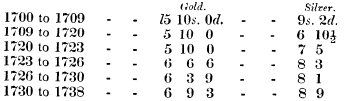
We have no account of the bullion market in provincial Pennsylvania, subsequent to the year 1738, but this table shows that those who represented to Adam Smith that the paper of the colony suffered no depreciation, were misled by making neither gold nor silver the standard, but by making the paper the standard of itself. As the Pennsylvania pound current never changed its name, they thought it never changed its value.5
The following table shows the rate of exchange of the currencies of the different colonies, for £100 sterling, at two different periods.6
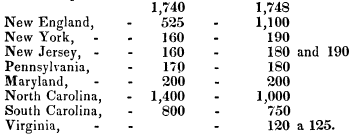
The Government of Virginia appears not to have issued any paper money previous to the Revolutionary War.
In respect to the paper money of the colonies generally, we may say, in the language of Adam Smith, “allowing the colony security to be perfectly good, a hundred pounds payable fifteen years hence, in a country where interest is at six per cent., is worth little more than forty pounds ready money. To oblige a creditor, therefore, to accept of this as a full payment for a debt of a hundred pounds actually paid down in ready money, was an act of such violent injustice as has scarce, perhaps, been attempted by the Government of any other country which pretended to be free. It bears the evident marks of having originally been, what the honest and downright Dr. Douglass assures us it was, a scheme of fraudulent debtors to cheat their creditors. The Government of Pennsylvania, indeed, pretended, upon their first emission of paper money, to render their paper of equal value with gold and silver, by enacting penalties against all those who made any difference in the price of their goods when they sold them for colony paper, and when they sold them for gold and silver: a regulation equally tyrannical, but much less effectual than that which it was meant to support. A positive law may render a shilling a legal tender for a guinea, because it may direct the courts of justice to discharge the debtor who has made that tender. But no positive law can oblige a person who sells goods, and who is at liberty to sell or not to sell as he pleases, to accept of a shilling as equivalent to a guinea in the price of them.”
Dr. Williamson, the historian of North Carolina, says: “Of all the varieties of fraud which have been practised by men who call themselves honest, and wish to preserve a decent appearance, none have been more frequent in legislative bodies than the attempt to pass money for more than its proper value. There are men who conceive that crimes lose their stain, when the offenders are numerous: that in the character of legislators they cannot be rogues: “defendit numerus.” There are men who would be ashamed to acquire five shillings by stealing, picking a pocket, or robbing on the high-way; but they would freely and without blushing assist in passing a law to defraud their creditors of their just demands. There are instances of men being banished from North Carolina for stealing a hog not worth five dollars: while the men who banished them would contend for paying a debt of seven pounds with the value of twenty shillings: the moral sense is depraved by tender laws, or laws that enable the debtor to defraud his creditor, by offering him a fictitious payment. By such laws the mind is alienated from the love of justice, and is prepared for any species of chicane and fraud.”
Hutchinson, the historian of Massachusetts, has preserved many curious particulars of the introduction of paper money into this country, and of its operation on society. After relating the unsuccessful expedition of the Massachusetts troops against Quebec in 1690, he says:
“The Government was utterly unprepared for the return of the forces. They seem to have presumed, not only upon success, but upon the enemy’s treasure to bear the charge of the expedition. The soldiers were upon the point of mutiny for want of their wages. It was utterly impracticable to raise in a few days such a sum as would be necessary. An act was passed for levying the sum, but the men would not stay until it should be brought into the treasury. The extreme difficulty to which the Government was thus reduced, was the occasion of the first bills of credit ever issued in the colonies, as a substitute in the place of money. The debt was paid by paper notes from two shillings to ten pounds denomination, which notes were to be received for payment of the tax which was to be levied, and all other payments in the treasury. This was a new expedient. They had better credit than King James’ leather money in Ireland, about the same time. But the notes would not command money, nor any commodities at money price. Sir William Phipps, it is said, exchanged a large sum at par in order to give them credit. The soldiers in general were great sufferers, and could get no more than twelve or fourteen shillings in the pound. As the time of payment of the tax approached, the credit of the notes was raised, and the Government allowing five per cent. to those who paid their taxes in notes, they became better than money. This was gain to the possessor, but it did not restore to the poor soldier what he had lost by the discount.
“The Government, encouraged by the restoration of credit to their bills, afterwards issued others for charges of Government. They obtained good credit at the time of their being issued. The charges of Government were paid in this manner from year to year. Whilst the sum was small silver continued the measure, and bills continued their value. When the charges of Government increased, after the second expedition to Canada in 1711, the bills likewise increased, and in the same or greater proportion, the silver and gold were sent out of the country. There being a cry of scarcity of money in 1714, the Government caused £50,000 to be issued, and in 1716, £100,000, and lent to the inhabitants, to be paid in at a certain period, and in the mean time to pass as money. Lands were mortgaged for security. As soon as the silver and gold were gone and the bills were the sole instrument of commerce, pounds, shillings, and pence were altogether ideal, for no possible reason could be assigned why a bill of twenty shillings should bear a certain proportion to any one quantity of silver more than another. Sums in bills were drawing into the treasury from time to time, by the taxes or payment of the loans: but then other sums were continually issuing out, and all the bills were paid and received without any distinction, either in public or private payments, so that, for near forty years together, the currency was in much the same state as if an hundred thousand pounds sterling had been stamped on pieces of leather, or paper of various denominations, and declared to be the money of the Government, without any other sanction than this, that, when there should be taxes to pay, the treasury would receive this sort of money, and that every creditor should be obliged to receive it from his debtor. Can it be supposed that such a medium could retain its value? In 1702, 6s. 8d. was equal to an ounce of silver. In 1749, 50s. was judged equal to an ounce of silver. I saw a five shilling bill which had been issued in 1690, and was remaining in 1749, and was then equal to eight pence only in the lawful money, and so retained but one-eighth of its original value. Such was the delusion, that not only the bills of the Massachsetts Government passed as money, but they received the bills of the Governments of Connecticut, New Hampshire, and Rhode Island also as a currency. The Massachusetts bills passed also in those Governments.7
By the year 1713, “silver and gold were entirely banished. Of two instruments, one in use in a particular State only, the other with the whole commercial world, it is easy to determine which must leave the particular State and which remain. The currency of silver and gold entirely ceasing, the price of every thing bought or sold was no longer compared therewith, but with paper bills, or rather with mere ideal pounds, shillings, and pence. The rise of exchange with England and all other countries was not attributed to the true cause, the want of a fixed staple medium, but to the general bad state of the trade. Three parties were formed, one very small, which was for drawing in the paper bills and depending upon a silver and gold currency. Mr. Hutchinson, one of the members for Boston, was among the most active of this party. He was an enemy all his life, to a depreciating currency, upon a principle very ancient, but too seldom practised upon, nil utile quod non honestum, [nothing which is not honest is useful.]
“Another party was very numerous. These had projected a private Bank, or rather had taken up a project published in London in the year 1684: but this not being generally known in America, a merchant in Boston was the reputed father of it. There was nothing more in it that issuing bills of credit, which all the members of the company promised to receive as money, but at no certain value compared with silver and gold: and real estates, to a sufficient value, were to be bound as a security that the company should perform their engagements. They were soliciting the sanction of the general court and an act of Government to incorporate them. This party, generally, consisted of persons in difficult or involved circumstances in trade, or such as were possessed of real estates, but had little or no ready money at command, or men of no substance at all: and we may well enough suppose the party to be very numerous. Some, no doubt, joined them from mistaken principles, and an apprehension that it was a scheme beneficial to the public, and some for party sake and popular applause.
“A third party, though very opposite to the private Bank, yet were no enemies to bills of credit. They were in favor of a loan of bills from the Government to any of the inhabitants who would mortgage their estates as a security for the repayment of the bills, with interest, in a term of years, the interest to be paid annually, and applied to the support of Government. This was an easy way of paying public charges, which no doubt, they wondered that in so many ages the wisdom of other Governments had never discovered.
“The controversy had a universal spread, and divided towns, parishes, and particular families. At length, after a long struggle, the party for the public Bank prevailed in the General Court for a loan of fifty thousand pounds in bills of credit, which were put in the hands of trustees, and lent for five years only, to any of the inhabitants at five per cent. interest, one-fifth part of the principal to be paid annually. This lessened the number of the party for the private Bank, but it increased the zeal and raised a strong resentment in those that remained.”8
Under this system the trade of the province declined, and in the year 1720, there was a general cry for want of money. “The bills of credit, which were the only money, were daily depreciating. The depreciation was grievous to all creditors, but particularly distressing to the clergy and other salary men, to widows and orphans whose estates consisted of money at interest, perhaps just enough to support them, and being reduced to one-half the former value, they found themselves on a sudden in a state of poverty and want. Executors and administrators, and all who were possessed of the effects of others in trust, had a strong temptation to retain them. The influence a bad currency has upon the morals of the people, is greater than is generally imagined. Numbers of sherries, for private and public emissions of bills, were proposed as remedies, the only effectual one, the utter abolition of the bills, was omitted.”9
In 1721, the Governor recommended measures for preventing the depreciation of the currency: and the Assembly gave him for answer, that they “had passed a bill for issuing one hundred thousand pounds more in bills of credit.” This alone, as Hutchinson justly observes, had a direct tendency to increase the mischief: but they added that “to prevent their depreciation, they had prohibited the buying, selling and bartering silver, at any higher rates than set by acts of Parliament.” This certainly could have no tendency to lessen it. Such an act can no more be executed than an act to stop the ebbing and flow of the sea.”10
“In 1733 there was a general complaint throughout the four Governments of New England of the unusual scarcity of money. There was as large a sum current in bills of credit as ever, but the bills having depreciated, they answered the purposes of money so much less in proportion. The Massachusetts and New Hampshire Governments were clogged with royal instructions. It was owing to to them that those Governments had not issued bills to as great an amount as Rhode Island. Connecticut, although under no restraint, yet consisting of more husbandmen and fewer traders than the rest, did not so much feel the want of money. The Massachusetts people were dissatisfied that Rhode Island should send their bills among them and take away their substance and employ it in trade, and many persons wished to see the bills of each Government current within the limits of such Government only. In the midst of this discontent, Rhode Island passed an act for issuing £100,000 upon loan, for, think, twenty years, to their own inhabitants, who would immediately have it in their power to add £100,000 to their trading stock, from the horses, sheep, lumber, fish, &c., of the Massachusetts inhabitants. The merchants of Boston, therefore, confederated and mutually promised and engaged not to receive any bills of this new emission, but, to provide a currency, a large number formed themselves into a company, entered into covenants, chose directors, &c., and issued £100,000, redeemable in ten years; in silver at 19s. per oz. the then current rate, or gold in proportion, a tenth part annually. About the same time the Massachusetts treasury, which had been long shut, was opened, and the debts of two or three years were all paid at one time in bills of credit: to this was added the ordinary emission of bills from New Hampshire and Connecticut; and some of the Boston merchants, tempted by an opportunity of selling their English goods, having broke through their engagements and received Rhode Island bills, all the rest soon followed the example. All these emissions made a flood of money, silver rose from 19s. to 27s. the oz. and exchange with all other countries consequently rose also, and every creditor was defrauded of about one-third of his just dues. As soon as silver rose to 27s., the notes issued by the merchants at 19s., were hoarded up and no longer answered the purposes of money. Although the currency was lessened by taking away the notes, yet what remained never increased in value, silver continuing several years about the same rate, until it took another large jump. Thus very great injustice was caused by this wretched paper currency, and no relief of any sort obtained; for, by this sinking in value, though the nominal sum was higher than it had ever been before, yet the currency would produce no more sterling money that it would have done before the late emissions were made.11
Towards the close of the year 1738, a great clamor arose against the Governor for adhering to his instructions about paper money, and an agent was appointed at the expense of the colony, to procure, if possible, a relaxation of the instructions. A petition was presented by him from the House to his Majesty in Council, but it had no effect.
“A general dread of drawing in all the paper money without the substitution of any other instrument of trade in the place of it, disposed a great part of the province to favor the Land Bank or manufactory scheme, which was begun or rather revived in this year, 1739, and produced such great and lasting mischiefs, that a particular relation of the rise, progress, and overthrow of it, may be of use to prevent any attempts of the like nature in future ages. By a strange conduct in the General Court they had been issuing bills of credit for eight or ten years annually, for charges of Government, and being willing to ease each present year, they had put off the redemption of the bills as far as they could, but the Governor being restrained by his instructions from going beyond the year 1740, that year was unreasonably loaded with thirty or forty thousand pounds sterling taxes, which, according to the general opinions of the people, it was impossible to levy. Royal instructions were no bar to the proceedings of private persons. The project of a Bank in the year 1714 was revived. The projector of that Bank now put himself at the head of seven or eight hundred persons, some few of rank and good estate, but generally of low condition among the plebians, and of small estate, and many of them perhaps insolvent. This notable company were to give credit to £150,000, lawful money, to be issued in bills, each person being to mortgage a real estate in proportion to the sum he subscribed and took out, or to give bond with two sureties, but personal security was not to be taken for more than £100 from any one person. Ten directors and a treasurer were to be chosen by the company. Every subscriber or partner was to pay three per cent. interest for the sum taken out, and five per cent. of the principal, and he that did not pay bills might pay the produce and manufactures of the province at such rates as the directors from time to time should set, and they should commonly pass in lawful money. The pretence was, that by thus furnishing a medium and instrument of trade, not only the inhabitants in general would be better able to procure the province bills of credit, but trade, foreign and inland, would revive and flourish. The fate of the project was thought to depend on the opinion the General Court should form of it. It was necessary therefore to have a House of Representatives well disposed. Besides the eight hundred persons, subscribers the needy part of the province, in general, favored the scheme. One of their votes will go as far in popular elections as one of the most opulent. The former are most numerous, and it appeared that by far the majority of representatives for 1740 were subscribers to or favorers of the scheme, and they have ever since been distinguished by the name of the Land Bank House.
“Men of estates and the principal merchants in the province abhorred the project and refused to receive the bills, but great numbers of shopkeepers who had lived for a long time before upon the fraud of a depreciating currency, and many small traders, gave credit to the bills. The directors, it was said, by a vote of the company became traders, and issued just what bills they thought proper without any fund or security for their ever being redeemed. They purchased every sort of commodity, ever so much a drug, for the sake of pushing off their bills, and by one means or other a large sum, say perhaps fifty or sixty thousand pounds, was abroad. To lessen the temptation to receive the bills, a company of merchants agreed to issue their notes or bills redeemable by silver and gold at distant periods, much like the scheme in 1733, and attended with no better effect. The Governor exerted himself to blast this fraudulent undertaking, the Land Bank. Notonly such civil and military officers as were directors or partners, but all who received and paid any of the bills, were displaced. The Governor negatived the person chosen Speaker of the House being a director of the Bank, and afterwards negatived 13 of the new elected counsellors who were directors or partners in, or reputed favorers of, the scheme. But all was insufficient to suppress it. Perhaps the major part, in number, of the inhabitants of the province openly or secretly were well-wishers to it. One of the directors afterwards acknowledged to me that although he entered into the company with a view to the public interest, yet when he found what power and influence they had in all public concerns, he was convinced it was more than belonged to them, more than they could make a good use of, and therefore unwarrantable. Many of the most sensible, discreet persons in the province saw a general confusion at hand. Application was therefore made to Parliament for an act to suppress the company, which, notwithstanding the opposition of the agent, was very easily obtained, and thereon it was declared that the act of the 6th of King George the First, chapter eighteenth, [the Bubble Act] did, does, and shall extend to the colonies and plantations in America. Had not the Parliament interposed, the province would have been in the utmost confusion, and the authority of Government entirely in the Land Bank Company.”12
Every scheme for fixing the value of the provincial bills of credit having failed, “a new project was, in 1741, reported by a committee of the House and accepted, and afterwards concurred in by the council and consented to by the Governor. This was a scheme to establish an ideal measure, in all trade and dealings, let the instrument be what it would. The act which passed the Court declared that all contracts should be understood payable in silver at 6s. 8d. the ounce, or gold in proportion. Bills of a new form were issued, 20s. of which expressed in the face of the bill three ounces of silver, and they were to be received accordingly in all public and private payments, with this saving, that, if they should depreciate in their value, an addition should be made to all debts as much as the depreciation from the time of contract to the time of payment. How to ascertain the depreciation from time to time was the great difficulty in framing the act. To leave it to a common jury would never do. There were some doubts whether a House of Representatives would be wholly unbiassed. At length it was agreed that the eldest counsellor in each county should meet once a year to ascertain the depreciation.
“This at best must have been a very partial cure. It did not prevent the loss from the depreciation of the bills in those persons’ hands through which they were continually passing. All debts which were contracted and paid between the periods when the value of the bills was fixed annually, could not be affected by such fixing, and unless in debts of long standing which the debtor would not pay without an action at law, demand was not ordinarily made for depreciation, and what rendered it of little effect in all other cases, the counsellors appointed to estimate the depreciation never had firmness enough in any instance to make the full allowance, but when silver and exchange had risen 20 per cent. or more, an addition was made of four or five only. The popular cry was against it, and one year when Nathaniel Hubbard, Esq. the eldest counsellor for the county of Bristol, a gentleman of amiable character, and who filled the several posts he sustained with applause, endeavored to approach nearer to a just allowance than had been made in former years, he felt the resentment of the House, who left him out of the council the next election. In short, the act neither prevented the depreciation of the bills nor afforded relief in case of it, and was of no other service than to serve as a warning, when an act passed for establishing the currency a few years after, to leave nothing to be done by any person or bodies of men, or even future legislatures, to give the act its designed effect, but in the act itself to make full provision for its execution in every part.”13
“By the expedition to Lewisburgh, the preparations for the reduction of Canada, and the several supplies of men for Nova Scotia, the province had,” by the year 1747, “issued an immense sum in bills of credit, between two and three millions, according to their denomination in the currency. The greater part of this sum had been issued when between five and six hundred pounds was equal to one hundred pounds sterling, and perhaps the real consideration the Government received from the inhabitants who gave credit to them, was near four hundred thousand pounds sterling: but by thus multiplying the bills they had so much depreciated that, at the end of the war, eleven or twelve hundred pounds was not equal to more than a hundred pounds sterling, and the whole debt of the province did not much exceed two hundred thousand pounds sterling. Thus the people had paid two hundred thousand pounds sterling in two or three years, besides a large sum raised by taxes each year, as much as it was supposed the people were able to pay; but to pay by the depreciation of the bills, although infinitely unequal, yet, as they were shifting hands every day, it was almost insensible, a possessor of a large sum for a few days not perceiving the difference in their value between the time when he received them and the time when he parted with them. The apprehension of their depreciation tended to increase it, and occasioned a quick circulation; and for some time, even for English goods, which ordinarily sell for the longest credit, no body pretended to ask credit. They were constantly, however, dying in somebody’s hands, though nobody kept them long by them. Business was brisk, men in trade increased their figures, but were sinking the real value of their stock, and, what is worse, by endeavors to shift the loss attending such a pernicious currency from one to another, fraudulent dispositions and habits are acquired, and the morals of the people depreciate with the currency.
“The Government was solicting for the reimbursement of the charges in taking and securing Cape Breton, and by the address, assiduity, and fidelity of William Bollan, Esq.; who was one of the agents of the province for that purpose, there was a hopeful prospect that the full sum, about £180,000 sterling, would be obtained.
“Mr. Hutchinson, who was then Speaker of the House of Representatives, imagined this to be a most favorable opportunity for abolishing the bills of credit, the source of so much iniquity, and for establishing a stable currency of gold and silver for the future. About two millions two hundred thousand pounds would be outstanding in bills in the year 1749. One hundred and eighty thousand pounds sterling at eleven for one—which was the lowest rate of exchange with London for a year or two before, and perhaps the difference was really twelve to one—would redeem nineteen hundred and eighty thousand pounds, which would leave but two hundred and twenty thousand pounds outstanding: it was therefore proposed that the sum granted by Parliament should be shipped to the province in Spanish milled dollars and applied for the redemption of the bills as far as would serve for that purpose, and that the remainder of the bills should be drawn in by a tax on the year 1749. This would finish the bills. For the future, silver of sterling alloy at 6s. 8d the ounce, if payment should be made in bullion, or otherwise milled dollars at 6s. each, should be the lawful money of the province, and no person should receive or pay within the province, bills of credit of any of the other Governments of New England. This proposal being made to the Governor, he approved of it, as founded in justice and tending to promote the real interest of the province, but he knew the attachment of the people to paper money, and supposed it impracticable. The Speaker, however, laid the proposal before the House, when it was received with a smile, and generally thought to be a Utopian project; and, rather out of deference to the Speaker than from an apprehension of any effect, the House appointed a committee to consider of it. The committee treated it in the same manner, but reported that the Speaker should be desired to bring in a bill for the consideration of the House. When this came to be known abroad, exceptions were taken and a clamor was raised from every quarter. The major part of the people in number, were no sufferers by a depreciating currency; the number of debtors is always more than the number of creditors, and although debts on specialities had allowance made in judgments of courts for depreciation of the bills, yet on simple contracts, of which there were ten to one speciality, no allowance was made. Those who were for a fixed currency were divided. Some supposed the bills might be reduced to so small a quantity as to be fixed and stable, and, therefore, were for redeeming as many by bills of exchange as should be thought superfluous; others were for putting an end to the bills, but in a gradual way, otherwise it was said a fatal shock would be given to trade. This last was the objection of many men of good sense. Douglass, who had wrote well upon the paper currency and been the oracle of the anti-paper party, was among them, and, as his manner was with all who differed from him, discovered as much rancor against the author and promoter of this new project as he had done against the fraudulent contrivers of paper money emissions.”14
After many weeks spent in debating and settling the several parts of the bill, it was rejected: but, afterwards, on motion, reconsidered, passed by the House and Council, and approved by the Governor.
“The provision made by this act for the exchange of the bills and for establishing a silver currency, was altogether conditional, and depended upon a grant of Parliament for reimbursement of the charge of the Cape Breton expedition. This being at a distance and not absolutely certain, the act had no sudden effect upon the minds of the people, but when the news of the grant arrived, the discontent appeared more visible, and upon the arrival of the money there were some beginnings of tumults, and the authors and promoters of the measure were threatened. The Government passed an act with a severe penalty against riots, and appeared determined to carry the other act for exchanging the bills into execution. The apprehensions of a shock to trade proved groundless: the bills being dispersed through every part of the province, the silver took place instead of them, a good currency was insensibly substituted in the room of a bad one, and every branch of business was carried on to greater advantage than before. The other Governments, especially Connecticut and Rhode Island, who refused, upon being invited, to conform their currency to the Massachusetts, felt a shock in their trade from which they have not yet recovered. The latter had been the importers for Massachusetts, of West India goods for many years, which ceased at once.”15
From this account of the operation of the provincial paper money of Massachusetts, the reader may judge of its operation in the other colonies; and thereby learn to estimate properly that provision of the United States’ Constitution, which forbids any State “to emit bills of credit, pass any law violating the obligation of contracts, or make any thing but gold and silver a legal tender in the payment of debts.”
The successful issue of the experiment in Massachusetts did not induce the other Governments to take the necessary measures for substituting a metallic for a paper medium. But, as the British merchants trading to the colonies were sufferers by the monetary system of the day, an act of Parliament was passed in 1763, “to prevent paper bills of credit, hereafter to be issued in any of his Majesty’s colonies or plantations in America, from being declared to be a legal tender in payment of money, and to prevent the legal tender of such bills as are now subsisting from being prolonged beyond the periods for calling in and sinking the same.”
The preamble to the act declared, with great truth, that, by means of paper bills of credit, “debts have been discharged with a much less value than was contracted for, to the great discouragement and prejudice of trade and commerce of his Majesty’s subjects, by occasioning confusion in dealings and lessening credit in the said colonies or plantations.” The body of the act made void all acts of Assembly thereafter passed to establish or keep up such tender; and inflicted a fine of 1000 pounds (with immediate dismissal and future incapacity to fill any public office or place of trust,) on any Governor who should give his assent to such act of legal tender.
This measure caused much murmuring, for the speculating classes of society, who are always the most noisy, liked not to be deprived of so many opportunities of profit as a vacillating currency afforded them. They appeared to have had influence enough to prevent the act from being effective in some of the colonies; for we find that ten years after, another act with the same title was passed by the British Parliament.
The two acts together seem to have reduced the paper bills of credit to a very small amount; for Pelatiah Webster, a respectable merchant of Philadelphia, estimates the whole circulating cash of the thirteen States, just before the war, at twelve million dollars, or perhaps, not more than ten million hard dollars in value. “Not more than half, or at most three-fifths of the circulating cash in this State (Pennsylvania,) was paper; and I am well convinced that that proportion was not exceeded in the other States where paper money was circulated.”
This provincial paper may be regarded as a species of Government script which by an act of tyranny was made a legal tender. It fluctuated in value, according to the changes in the credit of the Government by which it was issued, and the amount thrown into the market. Being more liable to great depreciation, it was inferior to Bank paper as money: but its character was better understood by the people. They knew the authority of the Government, and the resources of the Government. When they were injured, they knew by whom they were injured, if not to what extent.
In one respect the provincial paper money system had an effect directly opposite to that of the present Banking system. Through the present Banking system, dealings on credit are carried to an extent beyond that in which they are useful, and in which they become highly pernicious. Through the old paper money system, confidence was destroyed, and credit prevented from spreading to its natural extent.
The profits gained by the Governments by the issues of paper money, enabled them to diminish the regular taxes; but this gain was insignificant, and the evils produced by the system were incalculably great. All that honest men lost by highwaymen, house-breakers, foot-pads, and horsethieves, was trifling in amount when compared with that which they lost through the instrumentality of the paper money of the different colonies.
_____________
16 Holmes. Vol. II, p. 179.
17 Ib. Vol. II, p. 58.
18lb. Vol. II, p. 82.
19 Holmes. Vol. II, p. 110.
20 It is curious to observe the similarity of the reasoning of the supporters of this paper money with that of the anti-bullionists of a subsequent period. A merchant of Boston writing to his friend in England in 1740, uses the following language.
“Upon the continuance of a favorable turn in the trading circumstances of the province of New England, the Government might stop at any rate which silver should fall to, and make that rate the fixed silver pound, and make it a lawful tender; and common consent or acceptance of the people would complete the scheme of silver money. And thus the pound sterling is fixed in England at three ounces seventeen penny weights and two grains of silver, of a certain fineness, or silver at five shillings and two pence per ounce.
“But if that kingdom were under our unhappy circumstances, as not having a sufficiency in value in silver and all other exports to discharge the whole demand of their imports: it would then be next to a miracle if silver did not rise to above five shillings and two pence per ounce in the market, in proportion to the balance of debt against them; and their trading circumstances continue to decline, as ours have; their silver would be brought to twenty seven shillings per ounce, as ours is, and the current money of Great Britain be at the rate of twenty shillings per ounce, whatever the lawful money might be.”
Anderson, vol. iii. p. 498.
Here we have the doctrine clearly stated that when paper is at a discount, it is not paper that has fallen, but silver that has risen; and the English Anti-Bullionists are thus deprived of all claim to originality in error. All the arguments they used during the suspension of specie payments were mere plagiarisms from the Boston merchant.”
21 The items in the first column are from Anderson: those in the second from Dr. Douglass.
22 Hutchinsons’ History of Massachusetts, vol 1, p. 402-3. London edition, 1765.
23 Hutchinson, vol. I. pp. 206, 7, 8 & 9. Boston edition of 1765.
24 Hutchinson, pp. 231, 2.
25 Ib. pp. 245, 6.
26 Hutchinson, p. 380, 1.
27 Hutchinson, pp. 392, 3, 4, 5 and 6.
28 Hutchinson, pp. 402, 3, 4.
29 Hutchinson, pp. 435, 6, 7.
30 Hutchinson, p. 440.
- 1* Letter to Mr. Gallatin, by Publicola, New York, 1815.
- 2† Ib. Vol. II, p. 58.
- 3‡lb. Vol. II, p. 82.
- 4* See Say, Book, Chap. xxi, Section 2.
- 5* This is not the first time this remark has been made. In the British Bullion Report, made in 1811, the following passage occurs: “The wages of common country labor, the rate of which, it is well known, adapts itself more slowly to the changes which happen in the value of money, than the price of any other species of labor or commodity.”
- 6* They were those of Scott and M’Michael, Peter Baynton & Co., and of one other firm, the name of which is not recollected by our informant.
- 7* This opinion was sufficiently refuted by the Bullion Committee, so long ago as 1811 ; and the correctness of their conclusion is confirmed by those who have had the best opportunities for observing the operations of the Banking system. “I consider the opinion entertained by some,” says Sir F. B., “that the Bank ought to regulate its issues by the public demand, as dangerous in the extreme; because I know by experience, that the demand for speculation can only be limited by want of means.” The general practice in England is to discount only business paper, but this does not prevent the recurrence of evils similar to those we suffer in the United States.
- 8* “A bill of exchange drawn by an individual or individuals who do not issue notes having the character of currency, appears to us to be clearly distinguished from a Bank note, though it is a substitute, and lessens the amount of currency which would otherwise be required. A payment made in Bank notes is a discharge of the debt, the creditor having no further recourse against the person from whom he has received it, unless the Bank had previously failed. The bill of exchange does not discharge the debt, the person who receives it having recourse against the drawer and every preceding endorser, in case the drawer should fail or refuse to pay. But the essential distinction is, that bills of exchange are only promises to pay in currency: and that the failures of the drawers, drawees, and endorsers, does not in the smallest degree, affect the value of the currency itself, or impair that permanent standard of value by which the performance of all contracts is regulated.”
- 9† “The essential difference between Banking and other commercial business is that merchants rely for the fulfilment of their engagements on their resources, and not on the forbearance of their creditors, whilst the Banks always rely, not only on their resources, but also on the probability that their creditors will not require payment of their demands.”
- 10† Ib. pp. 245, 6.
- 11* It is observed by Mr. White, Cashier of the United States Branch Bank at Baltimore, in a letter to the Secretary of the Treasury, under date of Feb. 30th, 1830: “Congress fixed the relative value of gold at 15 for 1 of silver; and under the natural presumption that gold and silver coin would compose a portion of the general circulating medium, it has also been enacted, that a tender of either of those metals should be the only legal mode of discharging obligations. In practice, however, and in fact, our currency consists altogether of paper. In this State, (Maryland,) and in Pennsylvania, Virginia, and perhaps some others, the fractional parts of a dollar circulate in sufficient quantity to purchase with coin, marketing, or other low priced necessaries; but in the Carolinas, Georgia, and all that great district eastward of Pennsylvania, composing the States most distinguished for commerce and manufactures, and for wealth, there is no transfer of the value of the established unit that is not effected by paper. This Bank paper is sustained by public confidence on a specie basis, considered sufficient to liquidate balances accruing among the several States, and to supply the demands for foreign commerce.”
- 12* Hutchinson, pp. 392, 3, 4, 5 and 6.
- 13* Hutchinson, pp. 402, 3, 4.
- 14* Hutchinson, pp. 435, 6, 7.
- 15* Hutchinson, p. 440.
- 16“In most disquisitions upon the noxious tendency of Banks,” says another writer* “much stress has been laid upon the injuries they have a power to inflict, by excessive loans and consequent bankruptcy, and by creating and circulating a permanent excess of currency. Could these two evils be avoided, many believe that Banks would be innoxious. I regret to differ. I am not of those who imagine that Banks incorporated with a liberal capital, will ever endanger their solvency by extending their loans; nor of those who believe that Banks controlled by specie payment, can circulate a permanent excess of paper. And yet, I think I can perceive a portentous power that they exercise over commercial enterprize. I am of opinion that they can circulate a temporary excess of paper, which, from time to time, finds a corrective, in a run upon the Banks for specie; that this temporary excess is succeeded by a temporary deficiency, one extreme invariably tending to another; that the consequences of this alternate excess and deficiency are, in the former case to impart an undue excitement, and in the latter an undue depression to commercial enterprize; that the effect of the former is to create an unnatural facility in procuring money, and to enhance unnaturally the price of commodities; while that of the latter is to produce an artificial scarcity, and to cheapen prices artificially; that the victims of these vibrations are the great body of merchants, whose capital and average deposits cannot always command discounts; that the gainers are a few intelligent and shrewd capitalists, the magnitude of whose deposits commands enormous discounts at all times, and who, being behind the curtain, know when to buy and when to sell. I am of opinion that these vibrations inflict evils which close not with mercantile speculation; that they tend to unhinge and disorder the regular routine of commerce, and introduce at one moment a spirit of wild and daring speculation, and at another, a prostration of confidence, and stagnation of business: that these feelings are transferred from the counting-house to the fire-side; that the visionary profits of one day stimulate extravagance, and the positive losses of another engender spleen, irritation, restlessness, a spirit of gambling and domestic inquietude.
- 17The ill-judged expedition of the Carolinians against St. Augustine, in 1702, entailed a debt of 6000 pounds on that colony, for the discharge of which a bill was passed by the Provincial Assembly for stamping bills of credit, which were to be sunk in three years by a duty laid upon liquors, skins and furs. For five or six years after the emission, the paper passed in the country at the same value and rate as the sterling money of England.†
- 18To defray the expenses of an expedition against the Tuscaroras, and to accommodate domestic trade, the Legislature of South Carolina established a public Bank in 1712, and issued 48,000 pounds in bills of credit, called Bank bills, to be lent out on interest on landed and personal security, and to be sunk gradually at the rate of 4000 pounds a year. Soon after the emission of these Bank bills, the rate of exchange and the price of produce rose, advancing in the first year to 150, and in the second to 200 per cent.‡ By the year 1731, the rate of exchange rose to 700, at which, says Holmes, “it continued with little variation upwards of forty years.”
- 19Because they are divisible into extremely minute portions, and capable of re-union without any sensible loss of weight or value; so that the quantity may be easily apportioned to the value of the articles of purchase.*
- 20Wages appear to be among the last things that are raised by an increase of Bank medium. The working man finds all the articles he uses in his family rising in price, while the money rate of his own wages remains unchanged. In the year 1831, which was a year of great expansion, rents rose enormously in many parts of the town, store goods advanced in price, and such fresh provisions as are sold in the market were higher than they had been at any time since the resumption of specie payments; but the money rate of wages was hardly affected.*
- 21We have become so accustomed to this system of breaking, that we begin to consider it a part of the system of nature. But it was not so always. Previous to the revolutionary war, there were but three bankruptcies among the large dealers in Philadelphia.* A bankruptcy in the olden time, spread as much gloom over a family as a death; and if the bankruptcy was the result of misfortune, the family had the sympathy of all their neighbors.
- 22A common opinion is, that, if the Banks would not discount accommodation notes, and if they would confine themselves to business paper of short dates, their operations would not be injurious to the community.* But, a little reflection may convince us, that, by discounting business paper, as much Bank paper might be set afloat, as by discounting accommodation notes. The same lot of goods might be sold to a dozen persons, and each might give a note, and each of these twelve notes might be discounted at Bank. The limit on Bank issues would be the same as at present—that is, the demand for specie for foreign trade. The anxiety of the Banks to extend their issues would be in no way diminished. The inducement, then, would be to buy and sell goods that notes might be discounted at Bank. Now, it is to have notes discounted at Bank, that goods may be bought and sold. The spirit of speculation being excited by any cause, notes would flow in for discount, and the Banks would, as at present, discount as many as they might deem prudent.
- 23As mere evidences of debt, they differ not from the promissory notes of merchants. They are also, in common with bills of exchange and business notes, a commercial medium; but in some respects, there is an essential difference between Bank notes and the notes of merchants.*
- 24The promises to pay of the merchants are fulfilled, when the notes arrive at maturity. Bank notes are never paid.†
- 25In 1721, the Governor recommended measures for preventing the depreciation of the currency: and the Assembly gave him for answer, that they “had passed a bill for issuing one hundred thousand pounds more in bills of credit.” This alone, as Hutchinson justly observes, had a direct tendency to increase the mischief: but they added that “to prevent their depreciation, they had prohibited the buying, selling and bartering silver, at any higher rates than set by acts of Parliament.” This certainly could have no tendency to lessen it. Such an act can no more be executed than an act to stop the ebbing and flow of the sea.”†
- 26It is folly to say that the money of the country is not paper money. In Virginia, Pennsylvania, and Maryland, payments of a less amount than five dollars are made in real money: but in the other States, dollar notes circulate, so that payments in specie are made for only fractional parts of the dollar. In North Carolina, South Carolina, and some other parts of the Union, notes for 25 cents, 12½ cents, and even 64¼ cents, are current. There even small silver change is a rarity.*
- 27“Men of estates and the principal merchants in the province abhorred the project and refused to receive the bills, but great numbers of shopkeepers who had lived for a long time before upon the fraud of a depreciating currency, and many small traders, gave credit to the bills. The directors, it was said, by a vote of the company became traders, and issued just what bills they thought proper without any fund or security for their ever being redeemed. They purchased every sort of commodity, ever so much a drug, for the sake of pushing off their bills, and by one means or other a large sum, say perhaps fifty or sixty thousand pounds, was abroad. To lessen the temptation to receive the bills, a company of merchants agreed to issue their notes or bills redeemable by silver and gold at distant periods, much like the scheme in 1733, and attended with no better effect. The Governor exerted himself to blast this fraudulent undertaking, the Land Bank. Notonly such civil and military officers as were directors or partners, but all who received and paid any of the bills, were displaced. The Governor negatived the person chosen Speaker of the House being a director of the Bank, and afterwards negatived 13 of the new elected counsellors who were directors or partners in, or reputed favorers of, the scheme. But all was insufficient to suppress it. Perhaps the major part, in number, of the inhabitants of the province openly or secretly were well-wishers to it. One of the directors afterwards acknowledged to me that although he entered into the company with a view to the public interest, yet when he found what power and influence they had in all public concerns, he was convinced it was more than belonged to them, more than they could make a good use of, and therefore unwarrantable. Many of the most sensible, discreet persons in the province saw a general confusion at hand. Application was therefore made to Parliament for an act to suppress the company, which, notwithstanding the opposition of the agent, was very easily obtained, and thereon it was declared that the act of the 6th of King George the First, chapter eighteenth, [the Bubble Act] did, does, and shall extend to the colonies and plantations in America. Had not the Parliament interposed, the province would have been in the utmost confusion, and the authority of Government entirely in the Land Bank Company.”*
- 28“This at best must have been a very partial cure. It did not prevent the loss from the depreciation of the bills in those persons’ hands through which they were continually passing. All debts which were contracted and paid between the periods when the value of the bills was fixed annually, could not be affected by such fixing, and unless in debts of long standing which the debtor would not pay without an action at law, demand was not ordinarily made for depreciation, and what rendered it of little effect in all other cases, the counsellors appointed to estimate the depreciation never had firmness enough in any instance to make the full allowance, but when silver and exchange had risen 20 per cent. or more, an addition was made of four or five only. The popular cry was against it, and one year when Nathaniel Hubbard, Esq. the eldest counsellor for the county of Bristol, a gentleman of amiable character, and who filled the several posts he sustained with applause, endeavored to approach nearer to a just allowance than had been made in former years, he felt the resentment of the House, who left him out of the council the next election. In short, the act neither prevented the depreciation of the bills nor afforded relief in case of it, and was of no other service than to serve as a warning, when an act passed for establishing the currency a few years after, to leave nothing to be done by any person or bodies of men, or even future legislatures, to give the act its designed effect, but in the act itself to make full provision for its execution in every part.”*
- 29“Mr. Hutchinson, who was then Speaker of the House of Representatives, imagined this to be a most favorable opportunity for abolishing the bills of credit, the source of so much iniquity, and for establishing a stable currency of gold and silver for the future. About two millions two hundred thousand pounds would be outstanding in bills in the year 1749. One hundred and eighty thousand pounds sterling at eleven for one—which was the lowest rate of exchange with London for a year or two before, and perhaps the difference was really twelve to one—would redeem nineteen hundred and eighty thousand pounds, which would leave but two hundred and twenty thousand pounds outstanding: it was therefore proposed that the sum granted by Parliament should be shipped to the province in Spanish milled dollars and applied for the redemption of the bills as far as would serve for that purpose, and that the remainder of the bills should be drawn in by a tax on the year 1749. This would finish the bills. For the future, silver of sterling alloy at 6s. 8d the ounce, if payment should be made in bullion, or otherwise milled dollars at 6s. each, should be the lawful money of the province, and no person should receive or pay within the province, bills of credit of any of the other Governments of New England. This proposal being made to the Governor, he approved of it, as founded in justice and tending to promote the real interest of the province, but he knew the attachment of the people to paper money, and supposed it impracticable. The Speaker, however, laid the proposal before the House, when it was received with a smile, and generally thought to be a Utopian project; and, rather out of deference to the Speaker than from an apprehension of any effect, the House appointed a committee to consider of it. The committee treated it in the same manner, but reported that the Speaker should be desired to bring in a bill for the consideration of the House. When this came to be known abroad, exceptions were taken and a clamor was raised from every quarter. The major part of the people in number, were no sufferers by a depreciating currency; the number of debtors is always more than the number of creditors, and although debts on specialities had allowance made in judgments of courts for depreciation of the bills, yet on simple contracts, of which there were ten to one speciality, no allowance was made. Those who were for a fixed currency were divided. Some supposed the bills might be reduced to so small a quantity as to be fixed and stable, and, therefore, were for redeeming as many by bills of exchange as should be thought superfluous; others were for putting an end to the bills, but in a gradual way, otherwise it was said a fatal shock would be given to trade. This last was the objection of many men of good sense. Douglass, who had wrote well upon the paper currency and been the oracle of the anti-paper party, was among them, and, as his manner was with all who differed from him, discovered as much rancor against the author and promoter of this new project as he had done against the fraudulent contrivers of paper money emissions.”*
- 30“The provision made by this act for the exchange of the bills and for establishing a silver currency, was altogether conditional, and depended upon a grant of Parliament for reimbursement of the charge of the Cape Breton expedition. This being at a distance and not absolutely certain, the act had no sudden effect upon the minds of the people, but when the news of the grant arrived, the discontent appeared more visible, and upon the arrival of the money there were some beginnings of tumults, and the authors and promoters of the measure were threatened. The Government passed an act with a severe penalty against riots, and appeared determined to carry the other act for exchanging the bills into execution. The apprehensions of a shock to trade proved groundless: the bills being dispersed through every part of the province, the silver took place instead of them, a good currency was insensibly substituted in the room of a bad one, and every branch of business was carried on to greater advantage than before. The other Governments, especially Connecticut and Rhode Island, who refused, upon being invited, to conform their currency to the Massachusetts, felt a shock in their trade from which they have not yet recovered. The latter had been the importers for Massachusetts, of West India goods for many years, which ceased at once.”*

