
The School of Salamanca
III. The School of Salamanca
THE MEN
IF in most parts of Europe the old scholastic tradition had nearly died away by the middle of the sixteenth century, in Spain it was not until this time that it bore its finest fruits. The work of the theologians and jurists who brought fame to the Spanish universities is thoroughly scholastic in form. The full panoply of Questions, Articles, Objections, Distinctions, Solutions, and Conclusions is unsparingly displayed. Every utterance is checked against Aristotle and St. Thomas, and every page encrusted with quotations from their works. Too rigid a strait-jacket, it might be supposed, to contain the great expanding world of the sixteenth century. Yet the writings of the Spanish theologians convey no sense of restraint. For all their stiff, unbending style, our writers were flexible of mind, attentive to new facts and doctrines, and respectful of the honestly held opinions of the ordinary man.
At Salamanca, Vitoria and his followers devoted a large share of their efforts to reshaping the old ius gentium in order to regulate the relationship that had recently arisen between the conquered peoples of America and the Spanish Crown.1 But they also spared time for political, social, and economic theory, to which the discovery of the New World gave powerful impetus. They engaged, for example, in a lively philosophical debate on the advantages and disadvantages of private property, inspired by reports of the primitive American communities, especially the collectivist society of Peru, which were seized upon as survivals of a lost Golden Age when all things were held in common.2 And the practical problems of business life were growing daily more pressing. The inflationary economy of the period offered unprecedented opportunities for enrichment, and the Church’s solemn warnings against undue love of gain passed all too often unheeded. Lip-service was paid to the prohibition of usury, but, since theologians themselves differed as to the definition of the term, laymen could scarcely be blamed if they lapsed into ‘error’. The most blatant forms of usury were universally practised, though generally under cover of some device invented to conceal the true nature of the transaction. In Spain, the great stronghold of religious authoritarianism, such a situation could not idly be tolerated. Some reconciliation of Thomist doctrine with the new economic order was urgently demanded. The Spanish theologians tackled this difficult task with zeal, and, what is perhaps more remarkable, with a fair measure of success. Here we shall not be primarily concerned with their moral teaching, or even with their economic theory as a whole, but only with one small fraction of their work, their analysis of money. Though they wrote as moralists, they were at pains to study the nature of money objectively, and they were not content merely to approve or condemn the monetary system as it functioned in their day, but tried to go deeper and explain it scientifically.3
In October, 1534, four years after replying to the merchants of Antwerp, Vitoria began to deliver a course of lectures on the Secunda Secundae or moral system of St. Thomas. Vitoria was now at the height of his powers, and his eloquence, simplicity, and great personal charm made his lecture-room at Salamanca a meeting-place for all who were perplexed by the manifold legal and ethical problems that arose in the government of the far-flung Spanish Empire. To Vitoria had fallen the task of reconciling historical reality with Thomist doctrine, of modifying each in the light of the other, and of passing on the traditional ideas he had imbibed during his period of apprenticeship in Paris, remoulded to fit the circumstances of his time. In March and April of 1535 Vitoria was engaged in explaining St. Thomas’s doctrine of usury. His words were carefully noted down by one of his pupils, whose manuscript may still be read in the library at Salamanca.4 Vitoria had evidently given a good deal of thought to the current problems of commercial morality since replying to the merchants of Antwerp four years before. Yet even this maturer work, though interesting for the first-hand picture it gives of the business world of Spain and Flanders, makes no great advance on medieval economic theory. Later writers associate Vitoria with some of the more advanced doctrines of the School of Salamanca, and it is possible that his best work in this field has not come down to us. However this may be, Vitoria’s interest in the problems of commercial ethics certainly seems to have stimulated those around him, for a number of his colleagues and pupils blossomed forth as capable economists during the next few years.
Among the first generation of the School, contemporary with Vitoria, two of the best writers on economic matters were the Dominicans, Domingo de Soto and Martin de Azpilcueta Navarro (often called simply Navarrus). Soto, who was born in 1495, was of humble origin. He studied first at Alcalá de Henares and later in Paris, coming under the influence of Vitoria, who was then teaching at the Sorbonne. In 1532 Soto was appointed to a chair of theology at Salamanca. The terrible famine that ravaged Spain in 1540 led him to write his well-known treatise on poor relief, in which he upheld the poor man’s right to liberty of person and of action, arguing against his colleague, Juan de Medina, who maintained that the problem of vagabondage could only be solved by the strict and centralized control of the movements of poor persons. In 1545 the Emperor appointed Soto, by now regarded as the most eminent of the Spanish theologians after Vitoria (who was in failing health), as his representative on the Council of Trent. In 1548 Soto became confessor to the Emperor, but two years later he caused general surprise by relinquishing this influential post and returning to the University of Salamanca, where he continued to teach until his death in 1560. Soto’s monetary theory is expounded in his treatise De justitia et jure, an extensive work on the philosophy of law which was published in 1553 and is said to have been based on a series of lectures given at Salamanca in 1540–1 and repeated in 1552–3.5 In this important treatise, which was reprinted no less than twenty-seven times before 1600 and which continued to be read and quoted by jurists and moralists for some 200 years after its original publication, Soto begins by explaining the general nature and functions of Law. He then turns to the moral problems created by the contemporary expansion of commerce, a subject which (as he tells us) was so peculiarly interesting to him that it alone had led him to take up the burden of writing his great treatise. Long chapters are devoted to the problems of usury, the general position of commerce within the State, the fixing of the just price, the fluctuations of that price and their cause, the purchase of rent-charges, the formation of commercial companies and the propriety of investment in such companies by Christian men, and the character of shipping and life insurance. Each of these chapters would repay detailed study. Besides providing a mass of factual information, they conceal beneath their theological dress many general concepts that deserve a place in the history of economic doctrine.
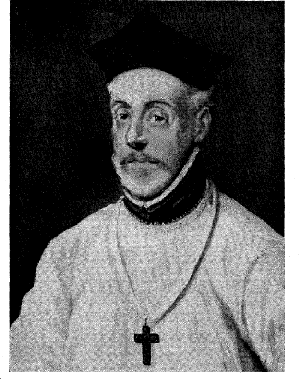
DIEGO DE COVARRUBIAS Y LEIVA
From a portrait by El Greco in the
Greco Museum, Toledo
Another distinguished figure at Salamanca was Martín de Azpilcueta Navarro. A scholar famed for his saintly life and vast learning, he had taught canon law at Toulouse and Cahors before coming to Salamanca, and he was chosen by Charles V as rector of the newly established University of Coimbra. He spent the last years of his life in Rome. Azpilcueta’s monetary theory is developed in his Comentarios de usura, which were published in 1556 as an appendix to a manual of moral theology dedicated to his friend and protectress the Princess Juana, sister of Philip II. The manual and commentaries were translated into Latin and Italian, and they continued to be followed by Roman Catholic writers for many years.
Another leading member of the School of Salamanca was Diego de Covarrubias, a pupil of Azpilcueta. Born in 1512, he became Bishop of Ciudad Rodrigo and later President of the Council of Castile. He was one of the greatest experts of his day on Roman law and was called ‘the Spanish Bartolus’ by his contemporaries. For some reason he seems to have been particularly widely read in Italy. His work is often cited by Davanzati, and at least once by Galiani, writing as late as 1750.6
The fame of these and other scholars who taught at Salamanca greatly enhanced the prestige which the University had acquired under Vitoria, and the doctrines evolved there soon spread to other parts of Spain. In the 1570s an interesting group of economists sprang up in Valencia, who based their ideas on those of the theologians of Salamanca. The best-known members of this little satellite school are Miguel Salón, Bartolomé de Albornoz, and one very gifted economist, Francisco García.
At the end of the sixteenth century the monetary theory taught at Salamanca received further development at the hands of two important theologians, the Dominican, Bañez, and the Jesuit, Luís de Molina. Domingo de Bañez, who held a chair of theology at Salamanca for some years, is remembered as the friend and confessor of St. Teresa. His chief contribution to theology was his doctrine of grace, in which he was strongly opposed by Molina, the upholder of free will, according to whom the grace of God could only become efficient by the consent of man. The ensuing polemic troubled the whole cultural and religious life of Spain during the last years of the sixteenth century. Though the Pope finally imposed silence on the contending parties, the writings of Bañez and Molina, passing into Belgium and France, were to prove one of the main sources of the Jansenist controversy. With these two writers the monetary theory of the School of Salamanca may be regarded as having travelled so far beyond the limits of its original home as no longer to be specifically ‘Salamancan’.
Enough has been said of our Spanish economists to show that we are not dealing with a group of obscure writers whose work was no sooner published than forgotten. On the contrary, our doctors of Salamanca were heard with respect by the whole world of learning. They lectured to successive generations of students of every nationality, and their books continued to be translated and reprinted for many years after they themselves had passed away.
THE DOCTRINES
While adhering closely to traditional doctrine, our Spanish writers gave a novel twist to the teaching of their medieval predecessors, and, discarding some of the older ideas and emphasizing others, wove a solid, coherent, and characteristic body of theory of their own.
The Aristotelian and scholastic ideas about the nature, origin, and functions of money were handed on unchanged except for a few elaborations of minor importance. Even today these traditional concepts of money as a medium of exchange and a measure and store of value, together with the customary ‘historical’ account of the inconveniences attendant upon a barter economy, are still reflected in our text-books. The School of Salamanca is simply a link in the long chain of writers who have helped to pass on these ideas. The School’s original contribution to monetary theory consists, in my opinion, in its formulation of a psychological theory of value applied to both goods and money, of the quantity theory, and of a theory of foreign exchange that closely resembles the modern purchasing-power parity theory.
Theory of Value. The markedly subjective theory of value adopted by our writers appears in an extreme form in the work of Saravia de la Calle (Text I). Saravia denies with considerable vehemence that cost-of-production can play any part at all in the determination of price. Viewing the poor man not as producer but as consumer, he clearly fears that the least relaxation of his doctrine will give merchants an excuse for raising prices on the pretext of recouping their expenses. Another extreme subjectivist was Diego de Covarrubias. ‘The value of an article’, he says, ‘does not depend on its essential nature but on the estimation of men, even if that estimation be foolish. Thus, in the Indies wheat is dearer than in Spain because men esteem it more highly, though the nature of the wheat is the same in both places.’ In assessing the just price, Covarrubias continues, we are not to consider how much the article originally cost, nor the labour its acquisition cost the vendor, but only its common market-value in the place where it is sold. Prices fall when buyers are few and goods and vendors many, and rise when the contrary conditions prevail.7
Most members of the School, however, do not go quite so far. As a rule they concede, though sometimes rather grudgingly, that cost-of-production, including the remuneration of labour, may help to determine price. But they all agree that the most important determinant of the ‘natural’ or uncontrolled price of an article is the estimation in which that article is held, such estimation being in its turn determined primarily by the forces of supply and demand, utility, rarity, and so on. From the tone of our writers it is evident that the subjective theory of value enjoyed their moral approval while the labour theory smacked of brimstone as the favourite tenet of the contemporary ‘selfish business man’. This subjectivist tendency led to some interesting attempts to analyse the psychological springs of economic activity. For some authors, such as Francisco García, value in exchange expressed the subjective estimates of utility, a view which he develops in workmanlike style (Text V). Others regard scarcity as the chief determinant of price. Bartolomé de Albornoz, for example, develops this concept at length, and relates the story of King Tarquin and the Sibylline books to illustrate the principle that price, as the reflection of estimation, increases with rarity.8 All these ideas lend a remarkably modern air to the discussions of our authors.
When they turned from theory to practice, most of the Spanish economists agreed that the price of necessary articles such as bread and meat ought to be fixed by the State, while that of luxury goods might well be left to find its ‘natural’ level in accordance with market conditions (Text II). The question then arose: on what principles should the tasa or controlled price of necessities be fixed? Many authors seem to think that the legal price of an article ought to correspond to its ‘natural’ price and be roughly equivalent to whatever sum the article might reasonably be expected to fetch in a free market. The difficulty of estimating the ‘natural’ price of an article whose price is, in fact, controlled does not seem to have struck them at all forcibly. At least one writer, however, though of a rather later date, realized that this position was unsatisfactory and concluded that the price of corn, the first necessity of life, ought to be measured by the amount of labour spent in an average working day (Text VIII). In support of this view he uses very much the same argument as did Adam Smith in 1776 when he advanced his more generalized form of labour theory: namely, that money and other objects are useless as measures of value, since their own value is subject to continual fluctuation.9 Thus it would be untrue to say that the labour theory, which in the Middle Ages had run side by side with the subjective theory, disappeared entirely in the work of the School of Salamanca. But it was temporarily submerged and seems to have occupied a secondary place in the minds of most of the Spanish economists.
The emphasis laid on the subjective factors that go to determine the price of goods was extended also to the value of money. Our writers thus brought both goods and money within the scope of a single theory of value, and in doing so made a great advance on the work of their medieval predecessors. By about 1560 the old contrast between the ‘intrinsic’ and ‘extrinsic’ value of money, the former being derived from the metal content of the coin and the latter from its tale, had faded away and been replaced by a new antithesis—that of the metal content and tale on the one hand, called simply valor, and that of estimación or subjective value on the other. The definition of these terms, and the careful distinction that was made between them (Text IV, p. 98), paved the way for some very neat and lucid theorizing. The exchange-value of money, according to the School of Salamanca, depends largely on the estimation in which the money is held, and the estimation of money, like that of goods, fluctuates with variations in supply and demand, utility, the safety of the money in question, its presence or absence, and so on. Monetary theory was thus rendered a very flexible instrument which could be applied successfully to the most varied circumstances. We shall see presently how it was capable of bringing order even into the seemingly hopeless chaos of foreign exchange business. But before passing on to this subject I should like to say a little about our writers’ formulation of the quantity theory of money.
Quantity Theory. To account for the fall in the value of money, and to study the moral and legal problems it entailed, was perhaps the most pressing task that awaited our Spanish monetary theorists. In 1550 Diego de Covarrubias published a celebrated treatise10 in which he traced the chequered history of the maravedí and showed how sharply its value had fallen even within living memory. The treatise bristles with statistics but is little concerned with theory and attributes the contemporary rise in prices chiefly to debasement. Nevertheless, the book was of great value in its day, since it provided the theorists for the first time with definite information on which to build.
The history of the quantity theory has frequently been studied and wide credence accorded to the claim made by Jean Bodin in 1568 that he was the first to connect the contemporary rise in prices with the increase in the quantity of money in circulation, an increase which he attributes to the influx of American gold and silver, among other causes.11 Yet the basic principles of the quantity theory had certainly been glimpsed by medieval writers, while the effect of American treasure on the European price-level was first noted, as we might naturally expect, in Spain, the country where it was first felt. We have seen that both prices and the imports of bullion reached a new high-level in the sixth decade of the century. In 1556 Azpilcueta Navarro produced the first clear statement that the high cost of living was a result of the import of treasure (Text III, p. 95). He thus preceded Bodin by twelve years. In England it was not until 1581 that the same observation was made,12 and it is interesting to see how American treasure in its passage across Europe called up the quantity theory in Spain, France, and England successively.
The purchasing-power parity theory of exchange. The most noteworthy achievement of our Spanish writers, and the most original, was their formulation of the basic principles of the purchasing-power parity theory of exchange,13 a doctrine not usually associated with the sixteenth century. We have seen that when the doctors of Paris were consulted in 1530 as to the legitimacy of exchange transactions they seem to have grasped, though not perhaps very clearly, the fact that the rates of exchange fluctuated in accordance with the state of supply and demand (Appendix, p. 126). Vitoria, in the lectures he delivered in the spring of 1535, preferred to regard the ‘profit’ made on a bill of exchange as compensation for the labour and risk entailed in sending the money abroad, and as a reward paid by the party who wished to make the transfer in return for the benefit he received. Vitoria mentions, however, that ‘when the Emperor was in Germany and money was very scarce there, if the Duke of Alba paid a thousand ducats in Medina he would receive less in Germany, and rightly so’, a statement that takes supply and demand into account. Vitoria condemns as usurious any profit made in the transfer of money by bill of exchange over short distances, but considers that similar transfers effected between different countries fulfil a real need, since they ‘avoid the inconvenience of transporting specie, and also because the export of specie is forbidden by law’.
The decisive factor in the evolution of our theory was the turning of the exchanges against Spain, or, at least, the general realization that they were unfavourable. We have no good study of the actual course of the exchanges, and have to rely on the information dropped by our Spanish economists. This much is clear: when money was sent from foreign countries to Spain a considerably larger sum was usually repaid in Spain than had been delivered abroad, but when money was sent in the opposite direction, from Spain to places abroad, only a slightly larger sum, and sometimes even a smaller one, was repaid abroad than had been delivered in Spain. This discrepancy had nothing to do with the quality of the actual coins delivered and repaid. It existed even when the transaction was confined to one particular kind of money, such as the Spanish escudo, and therefore the question of weight, fineness, tale, &c. could not enter into the matter. Moreover, the same amount of labour and risk were involved in sending money from Spain to places abroad as in the other direction. Monetary theorists were called upon to explain this apparent anomaly. And here their subjective theory of value, already applied in the case of goods, came to their rescue. Since the agio could not be explained by objective factors, it must presumably be derived from a variation in the subjective value of money in the different countries. Estimation, declared our authors, was the real measure of the value of money as of goods, and estimation was determined by supply and demand, and by utility. Obviously, the relative abundance of money in Spain must be the thing that lowered its estimation and hence its exchange value.
This view was propounded a little timidly by Juan de Medina in 1550,14 and in authoritative style by Domingo de Soto in 1553.15 After examining in exhaustive detail the traditional objections to exchange transactions, and carefully refuting each of them in turn, Soto remarks that ‘the more plentiful money is in Medina the more unfavourable are the terms of exchange, and the higher the price that must be paid by whoever wishes to send money from Spain to Flanders, since the demand for money is smaller in Spain than in Flanders. And the scarcer money is in Medina the less he need pay there, because more people want money in Medina than are sending it to Flanders.’ Just as one measure of wheat delivered where the price of wheat is high may lawfully be exchanged for two measures where the price is low, so will it be with money. ‘It is lawful’, Soto concludes, ‘to exchange money in one place for money in another having regard to its scarcity in the one and abundance in the other, and to receive a smaller sum in a place where money is scarce in exchange for a larger where it is abundant.’ When the two sums are exchanged by reason of a divergence in place, not time, the transaction is not a loan but ‘the true exchange of two things present which are of equal value’. Some such doctrine had been current in the market-place long before it was echoed in the august precincts of the University of Salamanca. But the emphasis laid on it by Soto was new in a spokesman of the Church.
The next step in the evolution of the purchasing-power parity theory was taken by Azpilcueta Navarro in 1556. He had, he tells us, at one time rejected the view that abundance or scarcity of money was the factor that determined the course of the exchanges, but he had been led to alter his opinion by the ‘new arguments and considerations advanced’ (namely, by Soto). As Azpilcueta had spent a long life in the perusal of scholastic treatises, his designation of our theory as ‘new’ helps to confirm our version of its early history—more especially since Azpilcueta himself makes no claim to its discovery! Let us again turn to the passage that has already been presented as an important document in the history of the quantity theory (Text III). When we come to examine it more carefully we shall see that it was written to account for the behaviour of the international exchanges, not merely to explain fluctuations in the value of money within a single country. Azpilcueta introduces the factor of the price-level and replaces the concept of ‘estimation’ by that of purchasing-power. In doing so he brings Soto’s doctrine into line with modern theory, and anticipates not only Bodin but very much later economists.
Sanctioned by the authority of Soto and Azpilcueta, our theory was now ripe for diffusion. The work of vulgarization was begun by Azpilcueta himself, since his manual was written in Spanish instead of Latin and was meant for the guidance of simple priests as well as theologians. The theory was brought to the attention of laymen by our old friend Tomás de Mercado (Text IV, pp. 98–103), who dedicates his book to the merchants of Seville and explains that his teaching is based on the doctrine of the theologians of Salamanca. The merchants thus received back their own theory in a form that made it intellectually and morally acceptable.
A few years later quite a sharp controversy broke out in Valencia over the purchasing-power parity theory. Francisco García, who had read Saravia, Mercado, Soto, and Azpilcueta, closely follows Mercado in his theory of foreign exchange, and studies at great length the effect of any variation in supply and demand on the estimation of money. But Bartolomé de Albornoz, while agreeing that an increase in the circulating medium tends to raise prices, maintains that the relative purchasing-power of money in different countries cannot justly be taken into account in determining rates of exchange.16 But Albornoz fought a losing battle. Domingo de Bañez, in a comprehensive discussion of the purchasing-power parity theory, concludes that in places where money is scarce, goods will be cheaper than in those where the whole mass of money is bigger, and therefore it is lawful to exchange a smaller sum in one country for a larger sum in another. Since the primary end for which money was ordained is the purchase of goods, it follows that wherever money is more highly esteemed for this purpose it may be exchanged for a larger sum than where it is less so. … We admit that one party may lawfully agree to repay a larger sum to another, corresponding to the amount required to buy the same parcel of goods that the latter might have bought if he had not delivered his money in exchange.17
And Luís de Molina, the great opponent of Bañez in other controversies, fully endorses the latter’s theory of foreign exchange (Text VII). This early version of the purchasing-power parity theory was of considerable practical importance in its day. It removed the taint of usury that had formerly accompanied even the most genuine exchange transaction, and it also provided for the first time a satisfactory explanation of the movements of the exchanges.
It is evident, then, that in their analysis of the subjective factors that go to determine price, and in their formulation of the quantity theory of money and the purchasing-power parity theory of exchange, our Spanish writers made an original and useful contribution to monetary theory. Now, the type of doctrine they favoured is very much alive today. And, since the work of the School of Salamanca long continued to endure in other branches of law and theology, it seems at least possible that their monetary theory was also read and that it has played its part in the shaping of modern doctrine. We have already tried to show something of the debt owed by our writers to their medieval predecessors. It remains for us to see what influence, if any, they exerted on later generations.
________________
18 As early as 1730 the importance of the Spanish contribution to the science of natural law was recognized by Hermann Conring (Examen rerum publicarum potiorum totius orbis, ch. 1, in Opera, Brunswick, 1730) who stresses the influence exerted by Vitoria, Vasquez, and Covarrubias on Grotius. The best modern studies of the subject are E. Nys, Le Droit des gens et les anciens jurisconsultes espagnols, 1914, and J. B. Brown Scott, The Spanish Origin of International Law, 1932, and The Spanish Conception of International Law and of Sanctions, Washington, 1934.
19 Doctrinas de los tratadistas españoles de los siglos XVI y XVII sobre el comunismo, ed. Carmelo Viñas Mey, Madrid, 1945.
20 The credit for the discovery of the School of Salamanca, so far as monetary theory is concerned, has been generally accorded by Spanish scholars to J. Larraz, who, in his Época del mercantilismo en Costilla, Madrid, 1943, pointed out the similarity of ideas that unites the various members of the School. But Larraz had predecessors. A. E. Sayous, in his ‘Observations d’écrivains du 16me siécle sur les changes’ (Revue économique internationale, November 1928), drew attention to the work of Tomás de Mercado, while the monetary theory of Azpilcueta Navarro has been excellently analysed by Alberto Ullastres Calvo (Anales de economía, Nos. 4–5, 1942).
21 Reprinted with an introduction by R.P. Vicente Beltrán de Heredia, O.P. under the title of Comentarios de la Secunda Secundae in the Biblioteca de teólogos españoles.
22 R.P. Venancio Carro, O.P., Domingo de Soto y su doctrina jurídica, Madrid, 1943.
23 Della Moneta, 1750, ch. 2.
24 Variarum ex pontificio, regio et caesareo jure resolutionum, libri 4, 1554, vol. ii, lib. 2, ch. 3.
25 Arte de los contractos, Valencia, 1573, p. 64.
26 ‘Labour alone, never varying in its own value, is alone the ultimate and real standard by which the value of all commodities can at all times and places be estimated.’ Adam Smith, Wealth of Nations, Bk. I, ch. v.
27 Veterum numismatum collatio, 1550.
28 See p. 34 (note 5).
29 By John Hales in his Compendious or brief examination of certain ordinary complaints, &c. (1581 edition).
30 By the purchasing-power parity theory I shall mean in this essay the doctrine summarized in the following passage in the Bullion Report of 1810: ‘In the event of the prices of commodities being raised in one country by an augmentation of its circulating medium, while no similar augmentation in the circulating medium of the neighbouring countries has led to a similar rise in prices, the currencies of the two countries will no longer continue to bear the same relative value to each other as before. The exchange will be computed between these two countries to the disadvantage of the former.’ Quoted as an early example of the theory by G. Halm, Monetary Theory, Philadelphia, 1942, p. 222. For the history of the purchasing-power parity theory in the nineteenth century see J. W. Angell, Theory of International Prices, Cambridge, 1926, ch. III, sec. 4.
31 De restitutione et contractions tractatus, 1550.
32 De justitia et fure, Lib. 7, Q. V, Art. 2.
33 Op. cit., pp. 131–2.
34 De Justitia et Jure, 1594, Q. LXXVIII, De cambiis, Art. IV.
- 1Earl J. Hamilton, American Treasure and the Price Revolution in Spain (Harvard Economic Studies), Cambridge, 1934, pp. 11-45.
- 2Ramon Carande, Carlos V y sus banqueros, vol. i, La vida económica en España en una fase de su hegemonia, Madrid, 1943, p. 155.
- 3Cristobal de Villalón, Provechoso tratado de cambios y contrataciones de mercaderes y reprovación de usuras, Valladolid, 1542. Luis de Alcalá, Tratado de los préstamos que passan entre mercaderes y tractantes, Toledo, 1543. Luis Saravia de la Calle, Instructión de mercaderes muy provechosa, Medina del Campo, 1544. Tomás de Mercado, Tratos y contratos de mercaderes, Salamanca, 1569 (of which a revised edition entitled Summa de tratos y contratos was published at Seville in 1571 and an Italian translation at Brescia in 1590).
- 4Saravia de la Calle, op. cit, p. xciv (verso).
- 5As follows:
- 6Ibid., p. xcv (verso).
- 7Op. cit., p. 89 (verso).
- 8The fairs and Bourse of Antwerp are described by R. Ehrenberg, Zeitalter der Fugger, Jena, 1896 (English translation under the title of Capital and Finance in the Age of the Renaissance, London, 1928). An account of the life of the Spanish merchants in Antwerp is given by J. A. Goris, Études sur les colonies marchandes méridionales à Anvers de 1488 à 1567, Louvain, 1925.
- 9Mercado, op. cit., pp. 88-89.
- 10De justitia et jure, Salamanca, 1553, p. 595.
- 11I know of no comprehensive modern study of the rates of exchange for money sent to and from Spain at this period. See, however, A. Sayous, ‘Les Changes de l’Espagne sur l’Amérique au XVIe siécle’, in Revue d’économie politique, 1927, pp. 1417 et seq., and the same author’s ‘Observations d’écrivains du XVIe siécle sur les changes’, in Revue économique internationale (Nov. 1928).
- 12Complaints of a ‘scarcity of money’ are common in the mercantilist literature of all countries. For a discussion as to what was meant by the phrase see E. Heckscher, Mercantilism, London, 1935 (English translation of Merkantilismen, Stockholm, 1931), vol. ii, pp. 221-4, and J. Viner, Studies in the Theory of International Trade, London, 1937, pp. 87-90.
- 13Mercado, op. cit., p. 88.
- 14A specimen document of this type is included by Diaz de Valdepeñas in his Summa de notas copiosas, Valladolid, 1553, a collection of model contracts for the guidance of public scriveners.
- 15Saravia de la Calle, op. cit, p. xciv (verso).
- 16A Defence of Usury, 1787, pp. 73-77.
- 17Mercado, op. cit., p. 87.
- 18The monetary theory of the period is based on the assumption that money was more ‘abundant’ in Spain than elsewhere. But when we come to analyse this ‘abundance’ we encounter certain difficulties. The most reliable estimate of the quantity of gold and silver imported into Spain is based on the remittances registered at the House of Trade in Seville. Naturally, no account could be taken in this estimate of the contraband and therefore unregistered remittances of bullion that entered Spain, but there is reason to think that they were considerable. And even if we knew the exact amount of bullion imported we still could not be certain as to what proportion of it was actually coined and put into circulation. Some part of the treasure, no doubt, was melted down for plate and ornaments. Immense sums, too, were sent to Flanders, Germany, and Italy, some through the fair of Medina but others directly, in payment of the loans advanced to Charles V by foreign bankers. In the present state of our knowledge, therefore, no exact correlation between treasure imports and prices is possible.
- 19The monetary theory of the period is based on the assumption that money was more ‘abundant’ in Spain than elsewhere. But when we come to analyse this ‘abundance’ we encounter certain difficulties. The most reliable estimate of the quantity of gold and silver imported into Spain is based on the remittances registered at the House of Trade in Seville. Naturally, no account could be taken in this estimate of the contraband and therefore unregistered remittances of bullion that entered Spain, but there is reason to think that they were considerable. And even if we knew the exact amount of bullion imported we still could not be certain as to what proportion of it was actually coined and put into circulation. Some part of the treasure, no doubt, was melted down for plate and ornaments. Immense sums, too, were sent to Flanders, Germany, and Italy, some through the fair of Medina but others directly, in payment of the loans advanced to Charles V by foreign bankers. In the present state of our knowledge, therefore, no exact correlation between treasure imports and prices is possible.
- 20From about 1540 onwards there appeared a whole crop of handbooks, written mostly by learned friars, which paint a vivid picture of the business life of the times. Their authors vie with one another in offering the merchant the perfect guide for the salvation of his soul, though one writer’s injunction to his readers that they were ‘not to twist a rule of iron into one of lead’ suggests that their teaching was often followed in the letter rather than the spirit. These little books reflect, in a simplified form comprehensible to the layman, the more elaborate body of doctrine that was in process of evolution at the universities.
- 21Close upon the merchant’s heels followed the moneychanger ‘travelling from fair to fair and from place to place with his table and boxes and books’. In theory he was a public official whose business it was to deal in cambium minutum or the changing of gold coins into silver or other money in return for a small fee. A series of royal pragmatics issued in 1550, 1551, and 1552 prescribe the proper table of equivalences for cambium minutum and provide that any money-changer who failed to give the legal rate should be fined for a first offence, flogged for a second, and banished for a third. The broker who arranged the deal was to suffer the same punishment. Money-changers were to keep proper books ‘and not leave blank sheets between the pages already used’, and only persons appointed by the cities, villas, and lugares might act as brokers.
- 22Close upon the merchant’s heels followed the moneychanger ‘travelling from fair to fair and from place to place with his table and boxes and books’. In theory he was a public official whose business it was to deal in cambium minutum or the changing of gold coins into silver or other money in return for a small fee. A series of royal pragmatics issued in 1550, 1551, and 1552 prescribe the proper table of equivalences for cambium minutum and provide that any money-changer who failed to give the legal rate should be fined for a first offence, flogged for a second, and banished for a third. The broker who arranged the deal was to suffer the same punishment. Money-changers were to keep proper books ‘and not leave blank sheets between the pages already used’, and only persons appointed by the cities, villas, and lugares might act as brokers.
- 23Sharing the common fate of laws in Spain, these drastic measures were effective only on paper. In practice, many money-changers no longer stooped to deal in cambium minutum at all. ‘Go up to their tables if you dare’, writes one observer, ‘and ask them to give you small change for a real or a ducat. You will soon see how angry they get and with what a peevish, grave face they complain that you are affronting them, for they do not deal in such low trade.’ Nor did the more enterprising money-changers deal in genuine bills of exchange, though this was another important part of their official activities. They had, in fact, ceased to be money-changers at all in the traditional sense of the term and were simply fair-bankers. As soon as they got to the fair they made their way to a part of the Rua or high street that was marked off for their accommodation by means of heavy chains thrown across the road. There they proceeded to set up their tables and rake into their coffers all the loose cash the newly arrived merchants would deposit with them, paying their customers 6 maravedís for every 1,000 deposited. The whole business of the fair was then conducted through the fair-bankers, and cash transactions were reduced to a minimum by the cancelling-out of book entries. If a merchant wanted to be paid in cash for his goods before the official settling-day he was required to pay a commission to the fair-banker. The rate was in theory the same as the rate paid by the bankers to the merchants, namely, six to the thousand, but in practice it was much higher. In 1542 it is said to have reached 25 and 30 per thousand at the fairs of Rioseco and Medina del Campo. Mercado complains that ‘the money-changers sweep all the money into their own houses, and when a month later the merchants are short of cash they give them back their own money at an exorbitant rate’. In this and other ways the money-changers made big profits, and it is for them that the severest strictures of the theologians are reserved.
- 24The banker proper was a much more dignified personage. ‘The Seville bankers’, writes Mercado, ‘are in substance the treasurers and depositaries of the merchants. When the fleet comes in, every merchant puts into the bank all the treasure that is brought to him from the Indies, the bankers having first given a pledge to the city authorities that they will render good account to the owners.’ The bankers served their depositors free of charge and used the money deposited with them to finance their own operations. Most of the gold and silver brought in by the fleet passed in this way through the hands of the bankers and served as a basis for the creation of credit. ‘In Spain’, concludes Mercado, ‘a banker bestrides a whole world and embraces more than the Ocean, though sometimes he does not hold tight enough and all comes crashing to the ground.’ We know the names of some at least of the Seville bankers who were operating in the second half of the sixteenth century: Alonso and Pedro de Espinosa, Juan Iñiguez in partnership with Octaviano de Negrón, Domingo de Lizarrazas, and Pedro de Morga.
- 25THE FAIRS AND THE FOREIGN EXCHANGES
- 26In the great melting-pot of the fairs the activities of merchants, money-changers, and bankers were fused into one. Gone was the old medieval principle of every Jack to his trade. Merchants were less than ever content to serve the community by supplying it with goods in return for a modest living, and were tending to engage more and more in purely financial business, thereby (in the eyes of theologians) impoverishing their fellow men and imperilling their own souls. As early as 1526 the Venetian ambassador had observed that although goods were abundant at the fair of Medina del Campo the most important business was done in exchange transactions. All the evidence points to an accentuation of this tendency during the succeeding decades. The fairs lost the last traces of their old local character and became great national, and indeed international, clearing centres, ‘the beginning and end of all payments ’.They were by this time ‘mainly places for settling accounts, not for true buying and selling’, though of such there was still ‘a good share’.
- 27In the sixteenth century, the Spanish and Flemish fairs were held in conjunction with one another and together formed one of the main arteries through which American treasure flowed from Seville across the Pyrenees. A good description of the methods of payment in force at the end of the reign of Charles V is given by the latter’s confessor and representative at the Council of Trent, the theologian Domingo de Soto. After observing that ‘an author who seeks to reprehend the customs of the exchanges must note the practice of merchants with his own eyes’, Soto tells us that four fairs were held every year in Spain and the same number in Flanders. The first was the May fair of Medina del Campo, for which payment opened on the 15th of July and closed on the 10th of August. This fair corresponded to the September fair in Flanders, for which payment opened on the 10th of November and closed at the end of that month. The second fair was at Rioseco, for which payment opened on the 15th of September and closed on the 10th of October, corresponding to the Christmas fair in Flanders. The third was held at Medina del Campo, corresponding to the Easter fair in Flanders, and the fourth at Villalón, corresponding to the June fair in Flanders. As had been the practice since medieval times, accounts between merchants were settled by order of transfer in bank while the fairs were in progress. During the period allotted for payment, any balances outstanding were remitted by bill of exchange, which was customarily drawn on the fair that immediately followed.
- 28If we may accept the widely divergent figures given in books published within a year or so of one another, the rates at which money could be sent by bill of exchange between Spain and other countries fluctuated violently. Such fluctuations are to be expected in the relatively narrow and inflexible money-market of the period. The figures show that the exchanges turned consistently against Spain, and, within Spain itself, against Seville, the home port of the treasure fleet. Soto has already given us the rate at which money could be sent from Medina to Antwerp and back again from Antwerp to Medina in 1553. In 1569 money could be sent from Medina to Lisbon at par or at 1 per cent, premium and from Lisbon to Medina at a premium of 5, 6, or 7 per cent., from Seville to Flanders at a discount of 5 or 6 per cent, and from Flanders to Seville at a premium of 8 or 9 per cent., from Seville to Rome at a discount of 8 or 10 per cent., and from Rome to Seville at a premium of as much as 15 or 20 per cent.
- 29To the ordinary citizen money seemed anything but ‘abundant’. On the contrary, there was an acute shortage of specie which provoked bitter complaints from merchants and economists alike. The May fair of Medina del Campo had to be postponed on this account in 1543, 1553, and 1554. Thomas Gresham, who visited Spain in 1554 with the object of cashing bills of exchange to the value of 320,000 ducats drawn in Antwerp and payable at the Spanish fairs, was unable to bring away more than 200,000 ducats, and expresses astonishment at the shortage of specie in Spain.
- 30If we may accept the widely divergent figures given in books published within a year or so of one another, the rates at which money could be sent by bill of exchange between Spain and other countries fluctuated violently. Such fluctuations are to be expected in the relatively narrow and inflexible money-market of the period. The figures show that the exchanges turned consistently against Spain, and, within Spain itself, against Seville, the home port of the treasure fleet. Soto has already given us the rate at which money could be sent from Medina to Antwerp and back again from Antwerp to Medina in 1553. In 1569 money could be sent from Medina to Lisbon at par or at 1 per cent, premium and from Lisbon to Medina at a premium of 5, 6, or 7 per cent., from Seville to Flanders at a discount of 5 or 6 per cent, and from Flanders to Seville at a premium of 8 or 9 per cent., from Seville to Rome at a discount of 8 or 10 per cent., and from Rome to Seville at a premium of as much as 15 or 20 per cent.
- 31The double transaction of the exchange and rechange was frowned upon by the Church. A purely financial operation, it was condemned as a device of the Devil to ensnare men in their own unbridled lust for gain. And it came perilously near to ‘dry exchange’, a term loosely applied to any unlawful form of exchange operation. Used in a narrower sense, the term ‘dry exchange’ referred to a fictitious operation devised to evade the usury laws, which we first meet in Florence in the later Middle Ages. Dry exchange in this narrower sense was redefined and condemned by a Papal Bull of 1566 and again by a Spanish pragmatic of 1598, and was stigmatized as a ‘manifest cankered usury’ by our own Thomas Wilson in 1572. It was, in fact, nothing but a loan camouflaged as an exchange deal. The borrower drew a bill of exchange in favour of the lender on some man of straw nominated by the latter, and this nominee protested the bill on its arrival. The borrower was then legally obliged to compensate the lender for the pretended loss sustained on both the exchange and the rechange. In legitimate exchange business it was usual for a merchant who drew a bill on some person in another city to give a guarantee against the bill’s being protested by binding himself in such case to refund the principal, interest, and costs of the double transaction. He might also deposit jewels or other valuables as a pledge. No doubt the same practice was followed in dry exchange, but in this case the ‘pledge’ was intended to be forfeited. Merchants in all countries long continued to resort to this way of raising money by fictitious exchange transactions. Even in the late eighteenth century we find somewhat similar practices described by Jeremy Bentham and Adam Smith under the name of ‘drawing and re-drawing’.
- 32Sharing the common fate of laws in Spain, these drastic measures were effective only on paper. In practice, many money-changers no longer stooped to deal in cambium minutum at all. ‘Go up to their tables if you dare’, writes one observer, ‘and ask them to give you small change for a real or a ducat. You will soon see how angry they get and with what a peevish, grave face they complain that you are affronting them, for they do not deal in such low trade.’ Nor did the more enterprising money-changers deal in genuine bills of exchange, though this was another important part of their official activities. They had, in fact, ceased to be money-changers at all in the traditional sense of the term and were simply fair-bankers. As soon as they got to the fair they made their way to a part of the Rua or high street that was marked off for their accommodation by means of heavy chains thrown across the road. There they proceeded to set up their tables and rake into their coffers all the loose cash the newly arrived merchants would deposit with them, paying their customers 6 maravedís for every 1,000 deposited. The whole business of the fair was then conducted through the fair-bankers, and cash transactions were reduced to a minimum by the cancelling-out of book entries. If a merchant wanted to be paid in cash for his goods before the official settling-day he was required to pay a commission to the fair-banker. The rate was in theory the same as the rate paid by the bankers to the merchants, namely, six to the thousand, but in practice it was much higher. In 1542 it is said to have reached 25 and 30 per thousand at the fairs of Rioseco and Medina del Campo. Mercado complains that ‘the money-changers sweep all the money into their own houses, and when a month later the merchants are short of cash they give them back their own money at an exorbitant rate’. In this and other ways the money-changers made big profits, and it is for them that the severest strictures of the theologians are reserved.
- 33The double transaction of the exchange and rechange was frowned upon by the Church. A purely financial operation, it was condemned as a device of the Devil to ensnare men in their own unbridled lust for gain. And it came perilously near to ‘dry exchange’, a term loosely applied to any unlawful form of exchange operation. Used in a narrower sense, the term ‘dry exchange’ referred to a fictitious operation devised to evade the usury laws, which we first meet in Florence in the later Middle Ages. Dry exchange in this narrower sense was redefined and condemned by a Papal Bull of 1566 and again by a Spanish pragmatic of 1598, and was stigmatized as a ‘manifest cankered usury’ by our own Thomas Wilson in 1572. It was, in fact, nothing but a loan camouflaged as an exchange deal. The borrower drew a bill of exchange in favour of the lender on some man of straw nominated by the latter, and this nominee protested the bill on its arrival. The borrower was then legally obliged to compensate the lender for the pretended loss sustained on both the exchange and the rechange. In legitimate exchange business it was usual for a merchant who drew a bill on some person in another city to give a guarantee against the bill’s being protested by binding himself in such case to refund the principal, interest, and costs of the double transaction. He might also deposit jewels or other valuables as a pledge. No doubt the same practice was followed in dry exchange, but in this case the ‘pledge’ was intended to be forfeited. Merchants in all countries long continued to resort to this way of raising money by fictitious exchange transactions. Even in the late eighteenth century we find somewhat similar practices described by Jeremy Bentham and Adam Smith under the name of ‘drawing and re-drawing’.
- 34We are now in a position to survey the whole network of the fairs, and we can visualize the money flying back and forth between them by the shuttle-system of the exchange and rechange. A merchant who laid out part of his capital in exchange business could, according to one critic expect to make about 12 per cent, per annum on his money. Not such a very exorbitant return by modern standards, though it filled the writer in question with horror and dismay. Yet it was enough to tempt many merchants away from their usual pursuits and into that dim borderland of finance that the Church could neither approve nor altogether condemn. Fortunes were made overnight and bankruptcies were frequent. Speculators borrowed all they could in markets where money was plentiful and sent it post-haste to places where it was scarce. ‘Then, when the time of the fair comes, not a farthing being visible on earth, the rates soar up to the skies. And opening the exchanges they lend at 20% and 25% for Seville and Lisbon.’ The unhappy merchants ‘bounced from fair to fair like balls’. In a desperate attempt to stave off their creditors they took to ‘straddling the fairs’. Instead of making their bills payable ‘at the next fair’, which was the usual and lawful practice, they borrowed for a period of several fairs ahead at a high rate of interest. As the high premium was clearly meant to compensate the lender for the exceptionally long period that would elapse before the bill fell due, this practice of straddling the fairs provoked fresh fulminations from both Church and Crown.

