
The Return to Protection
XXIV. Our Possible Gain from Colonial Preference
When we deduct imports we could not send, and imports we cannot in reason hope to send, the amount of trade which we might possibly take from the foreigner is quite insignificant.
THE above, then, being the actual results of the Canadian Preference, the next consideration is as to what would be the possible gain to us from a preference system adopted by all the self-governing Colonies. What we have to do evidently is to ask how much foreign countries send into these Colonies at present, and see how much of that trade we could take from them under such a system.1
According to the last returns, June, 1901, Canada imported from outside (exclusive of bullion and specie) goods to the value of £38,400,000. Of this, £8,829,000, or 23 per cent., came from the United Kingdom; £761,000, or 2 per cent., came from British Possessions; £28,810,000, or 75 per cent., came from Foreign Countries.
What we may possibly gain is some of the trade represented by the £28,810,000. But, from this possibility we must deduct:—
(1) Goods which Great Britain does not grow or make, such as Sugar, £1.6 millions; Maize, £1.3 millions; Raw Cotton and Cotton Wool, £981,000; Tea, £463,000; Rubber, £363,000; Tobacco, £349,000; Green Fruit, £347,000; Dried Fruits, £256,000, etc., etc. Such goods make up a total of £6,273,000 of imports into Canada which we could not take from the foreigner.
(2) Many goods we do grow or make, but could not, in reason, hope to supply Canada with—they are almost all United States products–such as Coal and Coal dust, £2,737,000; Wheat, £1,309,000; Wood, £687,000; Oats, £195,000; Bacon and Hams, £149,000; Coke, £140,000; Horses, £125,000; Cheese, £125,000; Pork, £94,000, etc., etc. These make up a total of £6,583,000.
Deducting these two items, there is left £16 millions of imports into Canada which we might possibly take from foreign nations and secure for our own producers. But we have had a Preference since 1897, and we are further away from getting any of it than ever. What new inducement is there for our exporters to do any more than they are doing? Or what new inducement is there for the Canadian consumer to demand that these goods be British-made and not foreign-made?
But, on looking into the details of the £16 millions, we find something more that makes the possibility still less of a probability. It is that these foreign imports are scattered over some seventy categories of different goods, only one of them amounting to over a million. Is it to be expected that seventy different trades, without any new motive, will show enough new energy and enterprise to wrest these imports from the foreigner?
Pursuing the same line of investigation as regards the other self-governing Colonies, we get the following results:
Cape Colony, in 1900, imported from outside £17,163,000. Of this, £11,053,000, or 64½ per cent., came from the United Kingdom; £2,478,000, or 14½ per cent., came from British Possessions; £3,632,000, or 21 per cent., came from Foreign Countries. The possible gain of trade for us is £2,092,000, spread over some forty categories, only five of them over £100,000.
New Zealand, in 1900, imported from outside £10,208,000. Of this, £6,453,000, or 63 per cent., came from the United Kingdom; £2,239,000, or 22 per cent., came from British Possessions; £1,516,000, or 15 per cent., came from Foreign Countries. The possible gain is £1,276,000, spread over some forty-five categories, only three of them over £60,000.
Australia, in 1900, imported from outside £40,188,000. Of this, £25,113,000, or 63 per cent., came from the United Kingdom; £3,728,000, or 9 per cent, came from British Possessions; £11,347,000, or 28 per cent, came from Foreign Countries. The possible gain is £8,007,000, spread over some seventy categories, only five of them over £250,000.
Natal, in 1900, imported from outside £5,912,000. Of this, £3,726,000, or 63 per cent, came from the United Kingdom; £1,147,000, or 19 per cent., came from British Possessions; £1,039,000, or 18 per cent, came from Foreign Countries. The possible gain is £539,000, spread over twenty categories, only two of them over £60,000.
Newfoundland, in 1900, imported from outside £1,512,000. Of this, £458,000, or 30 per cent., came from the United Kingdom; £582,000, or 39 per cent., came from British Possessions; £472,000, or 31 per cent., came from Foreign Countries. The possible gain is £220,000, spread over twenty categories, only two of them over £20,000.
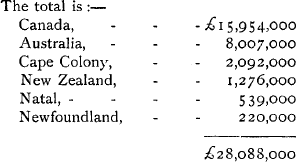
That is the magnificent total possibility; the limit of our possible extension of trade if we could secure the whole of the Colonial imports which foreign countries now send.2 If we deduct the Canadian £16 millions on which we have a Preference, there remain £12 millions which we might possibly take from the foreigner by the extension of the preference system over all our Colonies. But the probability, of course, is ever so much less. In this list are numbers of things that the Colonies will not take from us, even if they are cheaper than competing goods from other countries: we have seen how it is with Canada—that what determines an import is not so much cheapness as a demand for a special quality or style of article.3 We should be well off if we gained a quarter of the £12 millions.
If this possible but extremely improbable increase of trade were the sole ground for overturning our Free Trade system, and establishing tariffs against countries which send us some three-fourths of the goods we import, then one would be inclined to say that nothing so reckless and ill-judged had ever been proposed in the British Parliament.4
But, it may be asked, what about the future? £28,000,000 is a small sum, but the Colonies are a growing market. Think, it is said, of what they will buy when their white people have increased from eleven millions to forty millions.5
Is this to be taken seriously? Is it not notorious that Canada, though an agricultural country, and therefore, presumably, a country where population grows fast, is not “holding her own population,” but grows from outside?6 In the five years from 1897 to 1902, the total population has increased from 5,141,508 to 5,456,931, or under 8 per cent.—not very much more rapidly than our own. At the census of 1901, the rate of increase was found to be less than it had been in 1891. The birth rate and the number of persons to a family are both decreasing. And is it not a fact bitterly commented on that the “natural increase” of Australasia, like that of France, is arrested?7
But, of course, increase of trade does not depend altogether on increase of population; trade increases also with growing wealth. A family of five may buy as much as a family of ten, if it is twice as rich. Think, then, it may be urged, of the importance of securing this increase of purchasing power.
But, under present circumstances, we have secured the large proportion of the purchasing power in five out of the six Colonies. In Australia, New Zealand, and Natal, we have 63 per cent, of the import trade; in Cape Colony, 64½ per cent.; and that without Preference. Only in the one Colony which gives us a preference is the proportion the other way about—23 per cent. British to 75 per cent, foreign—and the proportion is falling.
If, then, all that Canada’s Preference has done for us is to secure a small and a diminishing proportion of Canada’s imports, and if, without Preference, we have already the larger proportion of the imports of the other five Colonies, is it common sense to ask us to become protectionist in the hope that we may secure a still larger proportion? What guarantee or hope have we that, under Preference, the five Colonies will serve us any better than Canada has done?
But, if they do not, the argument for Preference goes by the board.
8 The details which follow are taken from the Board of Trade Blue Book, p. 381.
9 It is perhaps unnecessary to remind the reader that this sum of £28,000,000 is possible trade, not possible profit.
10 The New Zealand Premier unconsciously testifies to this, in the details of his new scheme of Preference. Foreign goods are to be surtaxed; but that he does not in the least anticipate that the surtax will exclude them, is evident from his estimate that he will raise £70,000 or £80,000 on imports that amounted last year to only £313,000.
11”The foreign trade of this country is so large, and the foreign trade of the Colonies is comparatively so small, that a small preference given to us upon that foreign trade would make so trifling a difference—would be so small a benefit to the total volume of our trade—that I do not believe the working classes of this country would consent to make a revolutionary change for what they would think to be an infinitesimal gain.”—Mr. Chamberlain, 9th June, 1896.
12 “How long are we going to be four times as many as our kinsfolk abroad.” . . . “It seems to me to be not at all an impossible assumption that, before the end of this half century, we may find that our fellow subjects beyond the seas may be more numerous than we are at home.”—Mr. Chamberlain at Birmingham, May 15, 1903.
13 In the year ending June 30th, 1902, the total immigrants numbered 64,634. Of these, 24,000 came from the United States.
14 Mr. Coghlan, the Government Statistician for New South Wales, reports in 1903: “Present indications give no hope of a teeming population springing from Australasian parents, for the birth rate in all the States has declined very greatly, especially during the last fifteen years, and, when compared with the total population, the births in three of them are proportionately less numerous than in any European country, France alone excepted.”
- 1“When, on Pike’s Peak in Colorado, the thermometer is down to 12° or 13°, and, in the North-west is only a few degrees above freezing point, in New England it will be moderately cool—say 43°; in the Mississippi valley it will be comparatively warm—say 52°; and in Florida it will be at summer heat—75°.”—Lawson, American Industrial Problems, p. 43.
- 2The above figures of Imports and Exports, taken from the Statistical Abstract 1903, do not include Bullion and Specie, of which we imported, in 1902, £21,629,000 of gold (£8 millions from South Africa, £3¼ millions from India, £5 millions from Australia), and £9,764,000 of silver (£8 millions from the United States), and exported £15,409,000 of gold and £10,716,000 of silver. Nor do they include, either as imports, exports, or re-exports, excisable foreign merchandise transhipped under Bond, (£13,683,000). To the imports should be added £5,380,000 of diamonds from the Cape, not declared to the Customs. It may be noted that fish of British take, landed in the United Kingdom, are not included among imports. The value of these in 1901 was £9,000,000.
- 3Without going into the mysteries of banking, it may suffice to say that the reason why payment for foreign goods is not made by cheque is that each country’s banking system does not extend beyond its own shores.
- 4It is strong testimony to the literal “trust” which underlies the credit system that, in the great majority of home transactions, the promise is not put in documentary shape at all; goods are sold on customary terms of credit, and paid on a mere reminder that payment is due. Perhaps there is no better instance of the recognition of a “common interest” and a “general will” among whole peoples than this.
- 5Giffen’s calculation was first made in 1882 (Essays in Finance, Second Series, p. 132), and was revised in 1898 (Royal Statistical Society’s Journal, 1899, p. 11). His method was to take the British gross tonnage earnings at £15 and £5, for steamers and sailers respectively, at the former date, and at £12 and £4 at the latter. The Board of Trade, on the other hand, took the total exports and imports of the principal countries of the world, which are, of course, the same goods valued at points of departure and arrival; accepted the £224,000,000 difference in their value (see p. 41) as representing freights and insurance; halved this sum to represent our share of the carrying tonnage of the world; deducted 9 per cent. for colonial ships, and further deducted £12½ millions for coals and stores purchased abroad, harbour and other dues; and arrived at the figure of £89½ millions.
- 6The importance of Shipping as a British export industry may be realised by remembering that £90,000,000 is just about the value of our cotton and woollen exports combined.
- 7“Unfortunately, there are no official figures with regard to the investments of foreigners in this country, though they are certainly very much smaller in the aggregate than British investments abroad. America is the only foreign country, so far as known, whichh as made important investments in the United Kingdom in recent years,” Board of Trade Blue Book, p. 102. On this whole subject, the admirable article in the Blue Book should be referred to.
- 8IT would be rather short-sighted to gauge the importance to us of foreign trade by the fact that it is perhaps only one tenth or one eighth of our total trade. If the United States were to shut herself up inside a prohibitive wall of tariffs, she would still be almost self-sufficient. But we lie between 50 and 60 degrees north latitude; ours is a very small country at best, with a dense population; and we have, besides, sunk much of our capital and specialised much of our labour in industries which depend on other countries for their material and for their market. It seems, too, as if we were destined by nature to be ocean carriers.
- 9Our foreign trade, then, altogether amounts to £877,000,000; made up of £528,000,000 of Imports, and £349,000,000 of Exports (£65,000,000 of these being re-exports). These are values of solid Commodities brought in and taken out over British seas; and—partly as reflex and consequence—of the 32,000,000 gross tons of shipping in the world, we own the half.
- 10Nor yet is the way in which payment is made essentially different. In due time, home goods are paid by a cheque; foreign goods, by a bill of exchange. Indeed, in many cases, when goods are put on board ship, the Bill of Lading is given to a bank here, which does not give it up till cash is paid abroad, the bank meantime giving an advance to the exporter to a large proportion of the value. In either case, the sender gets his payment, in British money, through his own bank, and each transaction ends with a payment. The export of goods, again, from other countries to us takes place in exactly the same way—merchants and manufacturers, there also, sending out goods for a profit, getting paid in their own money, and the transaction ending with the payment.
- 11It takes a little thinking to realise that, in home trade, payments are made by setting debts against debts, and that this is merely another way of saying, “setting goods against goods.” You send me £100 worth of goods, and I, for the moment, am in debt, and send you a record of it in the shape of a promise to pay in three months. On the other hand, I send you £100 worth of goods, and you give me a promise to pay in three months. The promises may be bought and sold and pass into other hands; in any case, they remain in existence as debts for three months. At the end of that time they are brought together and cancel each other. What really has happened, of course, is that the one sending of goods has been put in contra-account against the other. So banking is just a vast complex system of contra-accounting—value of goods represented for the moment by documents put to the debit and credit sides of bankers’ books. Happily, this need not be dwelt on, because, in international trade, the foundation of the contra-account is quite obvious and prominent.
- 12It may be expected, then, that a nation which owns half the world’s shipping, and carries for foreigners as well as for British merchants, will be paid a very large sum for this service. The amount was estimated by Giffen, in 1898, as £90,000,000. An independent calculation, on quite different lines, was put forward by the Board of Trade in 1903, and makes it £89½ millions.
- 13This is the first item which explains our apparent Balance of Imports. Our exports are really £90,000,000 more than the statistical exports shown by the official returns.
- 14The corresponding returns which pay income tax in our country amount to £62½ millions, but this includes only the interest on foreign and colonial securities, coupons, and railways. To this must be added the dividends on miscellaneous industrial undertakings abroad. After all deductions on account of other countries which have lent and invested capital with us, we may accept the Board of Trade conclusion that “£62½ millions is a minimum figure, which is probably largely exceeded.” In 1898, Sir Robert Giffen estimated it at £90 millions, and probably more.

