
Upcoming Event

Making of an Austrian Economist Members-Only Online Seminar
November 12, 2026
•
Auburn, AL

XIV. Plus ÇA Change—
Articles against peace are written with pens made of the same steel as cannon and shells.—Aristide Briand.
“THE more it changes, the more it’s the same old thing,” say the French, and the French ought to know. They are the countrymen of the cynical Clemenceau, the facile Tardieu, and the scheming Poincaré. No matter what new things the American Moses, with his “new decalogue,” the Fourteen Points, might insist upon at the peace conference, the makers and interpreters of the peace treaty would see to it that nothing was changed fundamentally. In the name of self-determination of peoples the map of Europe and the Near East was carved up into a new geographic pattern with many small new states. This new arrangement frequently served to emphasize the old system of rival alliances, secret diplomacy, irredenta, etc. “Mandates” were established as a move against the old colonialism, but before long every nation looked upon its “mandates” as national possessions or protectorates. The “reparations system” proved even worse and more disturbing internationally than the old practice of military plunder and indemnities. Peace treaties were written which contained a dozen causes for friction, dispute, and war. And finally a League of Nations was established as a herald of a new era in world affairs, but all too often this body proved to be little more than a buttress for the peace treaties.
If a deliberate attempt had been made to create a situation in which the arms merchants could flourish, nothing better could have been devised. After the “war to end all war” was concluded, Schneider, Vickers, Skoda, and even the crest-fallen Krupp were literally “at it” again.
Indeed the peace conference was still in session when a war between the Greeks and the Turks broke out. A ruthless Mohammedan massacre of Christians was enough to set going the ambition of Venizelos and his soldiers. The English supported the Greeks; and Vickers arms, through the kind offices of Sir Basil Zaharoff, were amply supplied to the Hellenes as they advanced into Asia Minor. But the French were also interested in the Levant and they did not restrain Schneider from arming the Turks.
And so immediately in this “new world” there is the old and familiar phenomenon of two friendly, in fact allied, states, supporting respectively two other warring countries. The World War was over, but the arms factories were still geared up for mass production and they were grateful for any outlet for their wares. The Greeks, whether through bad generalship or because of the inferiority of Vickers products, were put to flight by the Turks and were soon streaming back over Anatolia in great disorder. An American correspondent told the tale:
A short time later it looked as if the Quai d’Orsay was at war with itself. Down in Morocco the French had something more authoritative than a mandate, a prosperous colony. Their possession of this was suddenly challenged by that valiant sheik of North Africa’s wild mountains, the hero of all the scattered Mohammedan tribes, Abdel Krim. This leader of the Rif went on the war path and talked ambitiously of a Rif republic. His first encounters were with the Spaniards whose possessions included part of the Rif. Huge Spanish armies were routed and the Rif republic was beginning to be more than a fantastic dream. Now the French must be driven out also. So formidable was the threat of this mountain chieftain that the French found it necessary to send to Africa one of their best soldiers, Marshal Lyautey, with something like 158,000 men. The Rif uprising was finally put down and Abdel Krim was banished from his native mountains.
These were great days for French politics and the French armament industry. French influence spread all over Central and Eastern Europe and Creusot waxed strong and hearty. No longer had M. Schneider to suffer the humiliating rebuffs that were his lot during the Putiloff affair. The adept chicanery that was his salvation in that affray was now employed not in defense but in offense. France rose in power; and nothing is more evident than that cannon follow the flag.
Indeed there is a connection which explains the extravagant sympathy by French editorial writers for the imperialist ventures of Japan. As previously noted, the leading organs of Paris are controlled by M. Schneider. Le Matin, Le Temps, and Le Journal des Débats all take their cue from the French arms maker. Thus orders from Japan to Schneider also insure a favorable press in Paris for the Manchurian expedition of the Japanese.
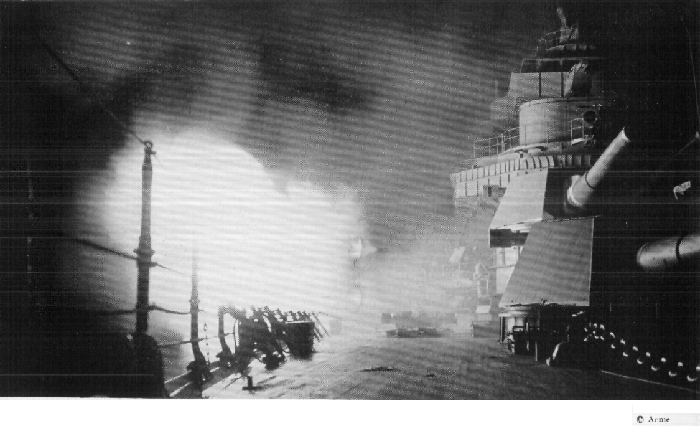
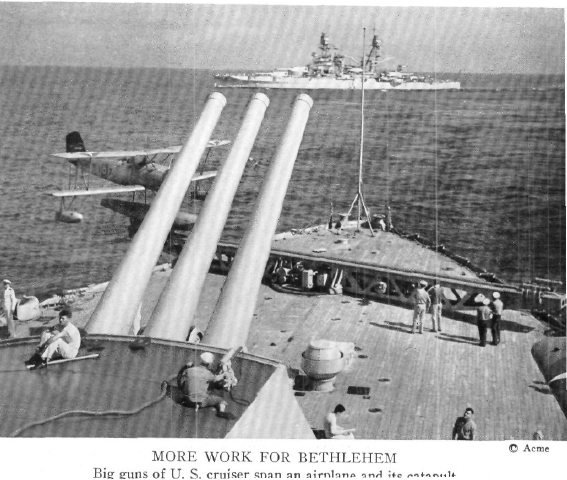
FLASH AND THUNDER
A super-dreadnaught costs $30,000,000 to $35,000,000. Its annual upkeep is about $2,000,000. A single salvo, as pictured, sometimes costs $25,000
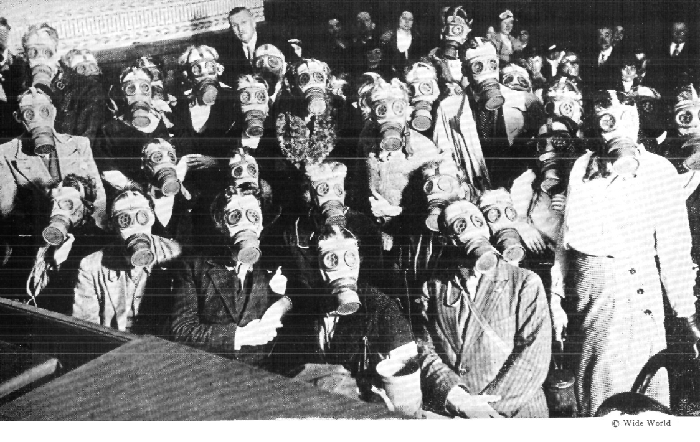
THE VIOLET CROSS
Civilians of Paris prepare for gas raids—members of new Violet Cross organization for universal use of gas masks
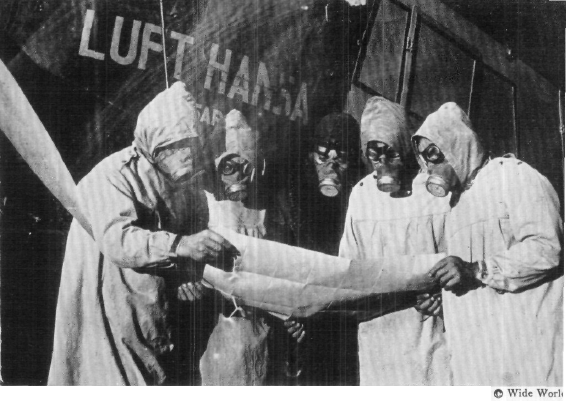
HARPIES—NEW STYLE
German pilots before attack, study area to be gassed
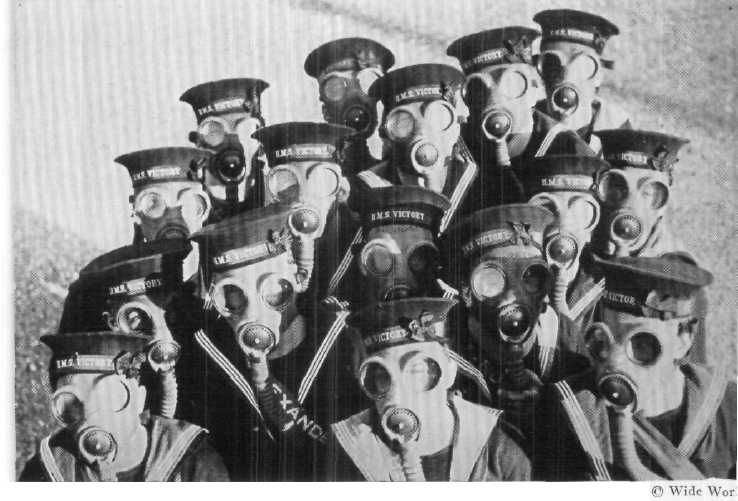
JOLLY TARS—NEW STYLE
British sailors receive instruction at Royal Navy Anti-Gas School
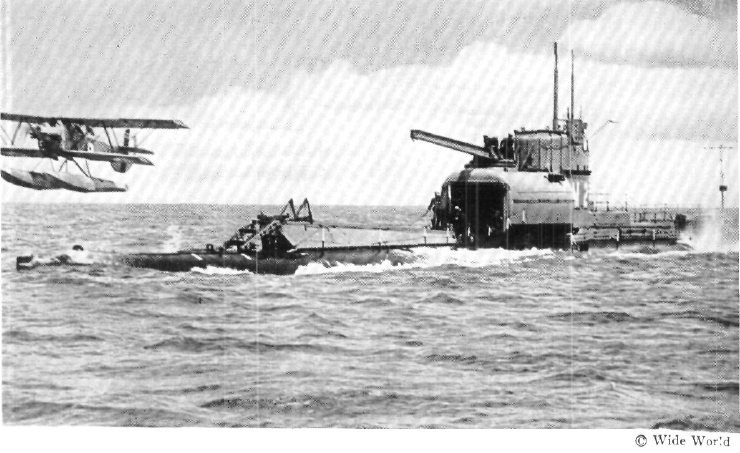
MORE WORK FOR VICKERS
British submarine, one of the few submersible airplane hangars
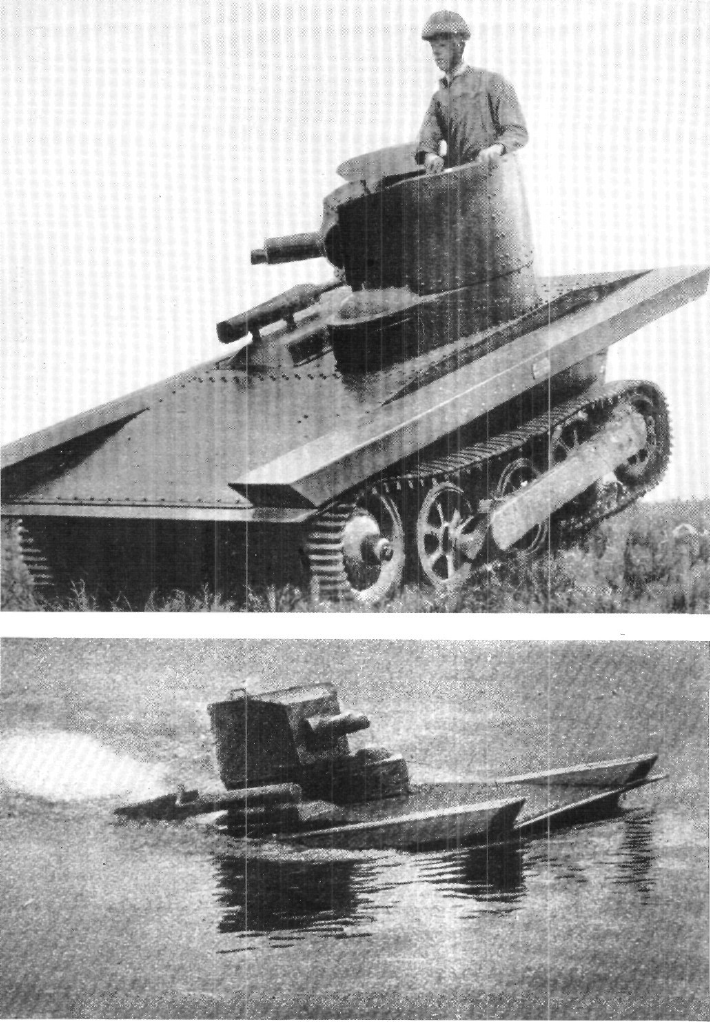
AMPHIBIAN
Vickers tank with speed of 40 miles an hour and 6 knots enters and leaves water without any preliminary adjustment
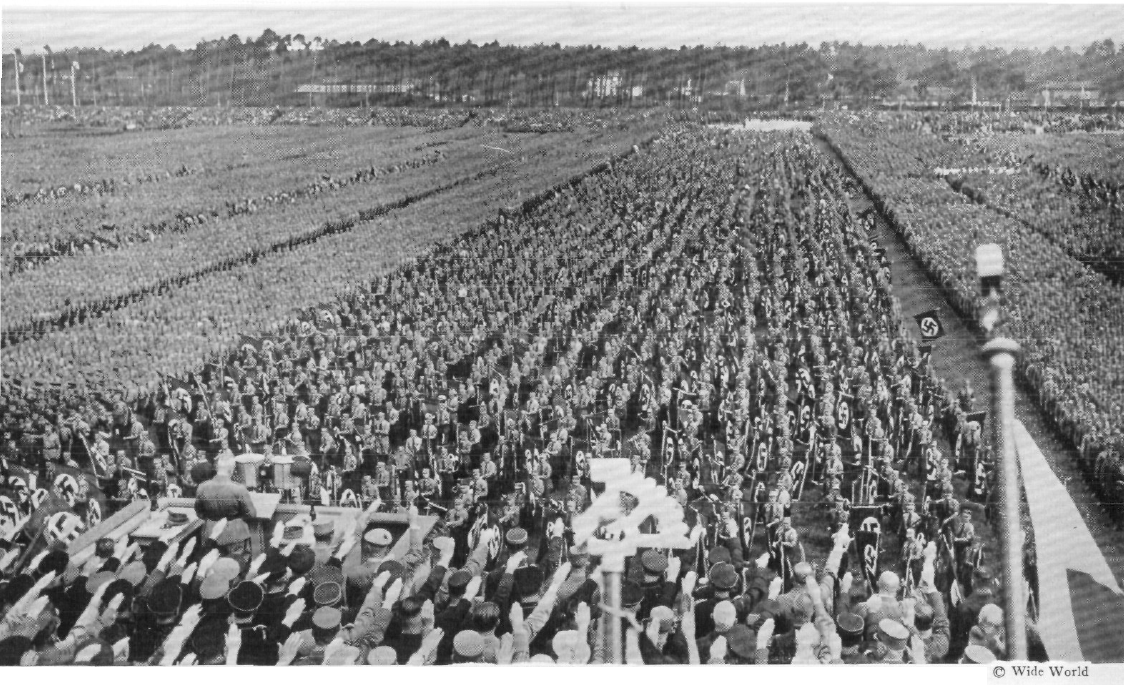
HEIL SCHNEIDER!
160,000 Nazi Troopers — armed? Hitler received funds from directors of Skoda, a subsidiary of Schneider-Creusot
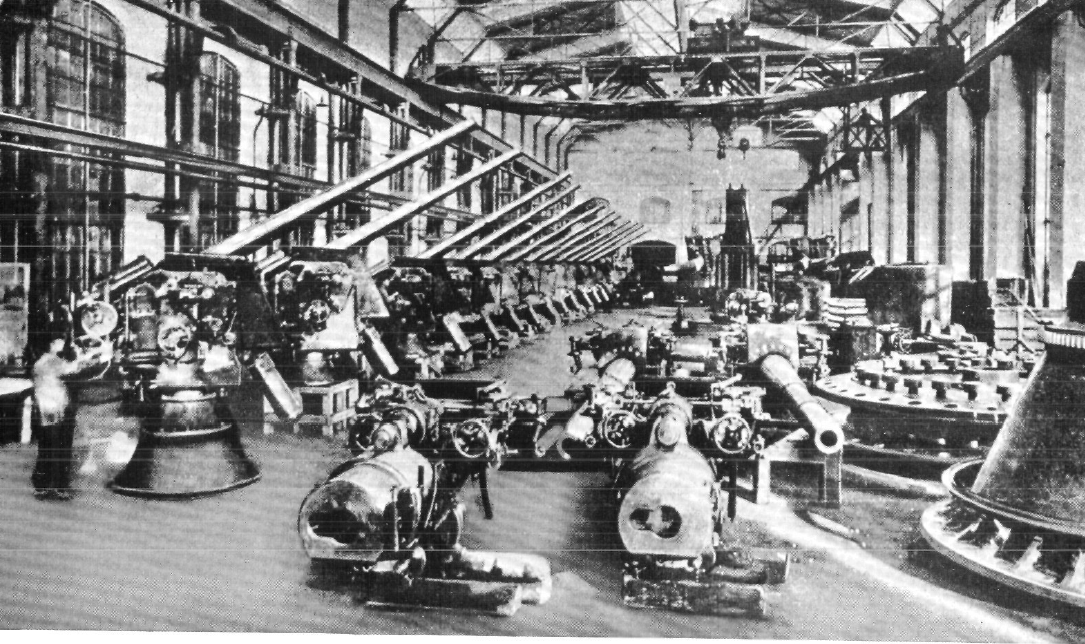
THE INTERNATIONAL AT WORK
Division of Bofors, the Swedish firm in which Krupp has an interest
It looked as though it was a case of “Creusot über alles.” Certainly it is on the Continent. Vickers, while still fighting bravely for its place, underwent some reverses—at least for a time. Unlike the French, the British have lent one ear to peace advocates. It started with the Washington Naval Conference of 1921, when Charles Evans Hughes proposed that the fleets of Great Britain, the United States, and Japan should be limited in the case of capital ships to the ratio of 5-5-3. The British Stock Exchange, delicate registrar, immediately translated this news into a fall in the prices of Vickers securities.
More heroic measures than encouragement from the Admiralty were needed. Vickers had expanded prodigiously during the war, and England had not arranged for any gradual reduction in the armament business after the Armistice had shut off orders. To save itself Vickers had to launch into other lines of business. It branched out into the construction of railroad cars and electrical equipment. It subscribed more capital and took a factory in Poland for the manufacture of war materials. It even built a shipyard on the Baltic, altered its Italian Terni factory to take care of electrical orders, and took over some mines in Ponserrada, Spain. But the more it struggled the more unwieldy it became.
It was obvious that the electrical and allied enterprises would not supply the expected business, and the depression in Britain had not lifted. Credit allowed to Continental states had been lost through inflation, and it was apparent that Vickers was in extreme danger. A committee of bankers and industrialists set up an investigation of its affairs with a view to reorganization. The upshot was that assets were revalued and its capital stock was reduced to one-third. It was a painful measure for stockholders, but they faced possible loss of all their holdings and the result was that Vickers, while taking a smaller place among world trusts, was saved.
It was another one of those cases where peace meant disaster, particularly since Vickers’ great rival, Armstrong, also came to grief. It had attempted to follow Vickers’ lead in embarking on a course of diversification of its products and it was in much worse condition than Vickers. There were reorganization committees sitting on its fate with the inevitable consultations with bankers, and, as usual, a radical operation was prescribed. Sir Basil Zaharoff appeared from his eyrie on the Mediterranean in one of his last and most shadowy missions. It was said that he put pressure on banks which held the fate of Armstrong’s in their hands and that they ordered Armstrong’s to combine with Vickers at a huge loss or to take the consequences. The fact is that they did combine, with Vickers getting the lion’s share of the reorganization and merger.
Perhaps it was this triumphant dénouement of Sir Basil’s career in international finance that inspired Vickers to present him with a golden cup with the following inscription: “Presented to Sir Basil Zaharoff, G.C.B., G.B.E., by the chairman and directors of Vickers, Ltd., on the completion of fifty years’ connection with the company and as a mark of their great appreciation of the valuable work he has done for them and of their sincere gratitude and high esteem.”
One of Vickers’ most interesting ramifications is in Germany. After Krupp bowed to the Treaty of Versailles and discontinued the manufacture of arms, he transported part of his armament industry across the border to Holland where he has a factory; another famous arms maker, Rheinmetall, has a Dutch factory; and Vickers is interested in both. Vickers is also interested in the Nederlandsche-Engelse Techniese Handelsmij at The Hague and in the Fabrique de Munitions Hollandaise.
More significant is its connection with the Dutch firm of airplane makers, Fokker, which is a subsidiary of Pintsch of Berlin. For this Pintsch house, which is ostensibly a manufacturer of gas apparatus, actually produces war material, and English engineers have worked there. But what is even more interesting is that Pintsch is also mentioned as one of the subsidizers of Hitler.
But to proceed with Vickers across the map of Europe and Asia—there is Vickers stock in the Swiss firm of Brown-Boveri and in Italy Vickers-Terni supplies Mussolini and through him Hungary. Meanwhile, Sir Herbert Lawrence, director of Vickers, is also director of the Bank of Rumania, a strategic position when arms orders are given out in King Carol’s country. In far-off Japan Vickers has an interest in the Japanese Steel Works, and an English M.P. has accused Vickers of being “one of the principal supports of the Manchurian conflict.” Thus the old employers of Sir Basil Zaharoff, while suffering reverses for a time, have nevertheless retained their place in the sun.
He became the angel for the Greek war of expansion in Anatolia. His old comrade, Lloyd George, gave him the British benediction and Clemenceau did not raise opposition. He put up some $20,000,000 for the support of the Greek army, and if it had not been for unexpected French antagonism—the power of Clemenceau was waning—and a sudden revolution in Athens against Venizelos, he would possibly have seen his dream come true. But the Greek statesman fell; the Turks, armed with French cannon, defeated the Greek forces, and, worst of all, Lloyd George failed him.
As the Greek army streamed dejectedly back over Asia Minor, there were hot assaults on the alliance between the famous Zaharoff and the Welsh politician. The war-weary British public asked why Lloyd George was so willing to drag their countrymen into such an uninteresting land, and M. P. Walter Guiness hinted that the Greek was “the power behind the throne.” Englishmen decided that no munitions maker could dictate policies to their premier and the government of Lloyd George had to resign.
It was the end of Lloyd George’s power in English politics and it was the end of Sir Basil’s prestige in the chancelleries of Europe. By departing from the impartial international code of the arms merchants, this great exponent of the code went down to defeat. He still, however, had one realm over which he could rule supreme. His friend Clemenceau had arranged that the principality of Monaco should be free of French interference, and Zaharoff obtained a controlling interest in the Casino at Monte Carlo. He married the Duchess of Villafranca, one of the royal Bourbon house of Spain, and settled down as potentate over roulette and baccarat.
One year later his bride died and Zaharoff retired from the Casino. He retired also from active business and politics. His Vickers shares had caused him heavy losses, but his oil holdings were so large that he was still tremendously wealthy. And he is still the man of mystery. Every now and then the wires are agitated with reports of his death—for he is now over eighty years old. More interesting are rumors that he has written his memoirs. Finally, the announcement that he had founded a hospital at Biarritz for war-wounded will no doubt furnish excellent material to the cynical—and to others.
Zaharoff in retirement, Vickers just saved from bankruptcy, and Krupp put out of business by the Treaty of Versailles—in many ways this seems like a true Götterdämmerung of the arms merchants. But it did not last long. Vickers survived and showed signs of recovery. And even Krupp has made a singular resurrection. Krupp’s great cannon factories had been forbidden, by the terms of the treaty, to make arms. Reorganized Vickers and triumphant Schneider might continue the merry game of selling to their countries’ friends and enemies, but legally Krupp and his German corpsbrüder could not participate. Indeed, Krupp’s suit against Vickers for the royalties of his grenade fuse looked as though the old business man had decided to balance his books and to close out his accounts in arms once and for all. But not for long.
So the new world which was to arise out of the ashes of the World War turned out to be very much like the old. Political and territorial disputes still continued, nationalism went on unabated, and the peace treaties, having sown dragon teeth, produced a huge crop of bitter fighting men. It seemed in many ways an even better world for the arms merchant than that preceding the war. Adjustments had to be made, to be sure, because the volume of business created by the war could not be maintained in times of peace. But the future, on the whole, looked bright. The greatest menace was the growing demand all over the world for disarmament. The insistent cry of the peace forces, of labor, and of the common people groaning under the burden of taxation, forced the governments to call international conferences at which world disarmament was discussed. Should these conferences succeed, the business of the arms merchants would certainly suffer. But the arms makers were equal to this emergency.
