
Men Against the State
IV. The Fragmentation and Decline of Anarchist Experimentation
The Fragmentation and Decline of Anarchist Experimentation
Interest in the economic and social experimentation taking place at “Modern Times” was not confined to the New York Fourierites and the various unfriendly critics and denunciators frightened by the implications of the attack on the fundamental precepts of authority and the contemporary business system. The circulation of Warren’s Periodical Letter and the publication of numerous letters in the London Leader dealing with sympathetic aspects of the equitable town on Long Island resulted in the development of a circle of proponents of the labor exchange principles in England.1 It is significant that the leading members of this group were long associated with Robert Owen and William Thompson, although by the early 1850’s they had transmuted the new interest in Josiah Warren into an attempted breach in Owenism.2
The readers of Owenite papers in England had become acquainted with the ideas of Warren over a period of two decades or more by this time.3 From the point of view of practical operations, a much larger and more sympathetic audience existed in England, where labor exchange ideas were demonstrated on a larger scale than they ever were to be in America. About six months after the opening of the first Cincinnati time store in May, 1827, the first English trial along similar lines began in Brighton. The Co-operative Benevolent Fund Association, as it was known, established a central “repository” where members brought various articles of their own production. A designated committee issued orders payable in other commodities deposited by other members on a basis of equal value established on a scale which was constructed as close to original cost as could be determined. In the case where a person wished no products in supply, a labor note was issued to him which could be redeemed at a later occasion, “which note may be cancelled when articles of that value are issued for it, so that the labour notes may always represent the quantity of goods in store and work unrequited.”4
The labor exchange brand of coöperation gained considerable headway during the next six years in London and Birmingham,5 under the sponsorship of Owen and a gifted lieutenant, William Pare.6 This culminated in the establishment of the memorable National Labour Exchanges in those cities in May and July, 1833.7 Eminently successful despite their brief existence,8 the underlying idea inexplicably went into eclipse, intellectually as well as practically. The political heat produced by the Chartist movement, which sought to be distinguished from this particular variety of “socialism,”9 undoubtedly helped it into obscurity.
Fired by the establishment of “Modern Times” and influenced by Stephen Pearl Andrews’ Sovereignty of the Individual, English interest in American anarchist decentralism revived, tempered by considerations peculiar to conditions in England. In 1853, a loose organization of these early scientific anarchists arose. Under the name of the London Confederation of Rational Reformers, the philosophy of the group combined the ideas of Warren with others of their own, hoping to realize in a country-wide manner the decentralist society which the Americans were attempting in independent small communities.10 William Pare continued to be a prominent associate of the London group, although his interests became distracted by agrarian coöperative enterprises in Ireland,11 dividing his time between stays in London and Dublin.
The secretary and strong spirit of this new center of radicalism, for over thirty years occupied in some phase or other of the left wing reform movement in England, was Ambrose Caston Cuddon. Cuddon was actively corresponding with Warren early in the year the London Confederation began its extensive propaganda campaign,12 which involved not only the use of Warren’s stereotyping inventions as a means of disseminating their publications, but a reprinting of an English edition of Equitable Commerce as well.13 The English supporters of Warren displayed little timidity in their efforts to spread their beliefs. Cuddon brought the matter to the attention of important political personages, including the prime minister, Lord Aberdeen.14 While seeking support, Pare carried the story of the Warrenite villages and their basic operating principles before the reserved meetings of the Royal Statistical Society about two years later, in the summer of 1856. Explaining to his listeners Warren’s use of the term “commerce” in the old English connotation of the whole of the proceedings of human relations, Pare described its potentialities in enthusiastic and engaging language:15
It will be perceived by the acute intellect that a principle is here broached which is absolutely revolutionary to all existing commerce. Perhaps a few minds may follow it out at once to its consequences far enough to perceive that it promises the most magnificent results in the equal distribution of wealth proportional to industry—the abolition of pauperism—general security of condition instead of continual bankruptcy or poverty—universal co-operation—the general prevalence of commercial honor and honesty, and in ten thousand harmonizing and beneficent effects, morally and religiously.
English interest in the American trial villages remained on an intellectual level, despite a visit to both “Modern Times” and “Utopia” by Cuddon in June and July of 1857.16 Although favorably impressed, his return to England resulted in no practical operations of any kind. Cuddon continued to head up the literary front in the London area, publishing articles with a strong anarchist flavor in the Cosmopolitan Review and the Working Man throughout most of 1861-1862. The escape of Michael Bakunin from Siberia and his subsequent arrival in London on January 10, 1862 provided another opportunity for Cuddon to associate with the radical movement, heading the delegation chosen to greet the prominent leader of the growing proletarian wing of the anarchists on the continent. Henceforth no uniformity prevailed among the members of this group. Cuddon took a prominent part in the London convention of August of this same year, at which the idea of the International Working Men’s Association was broached publicly for the first time.17 He continued his relations with Warren and the Americans to the end, however, attempting to introduce the former’s ideas on land among the adherents of cooperation in England without effect.18 Pare gradually drifted away from espousal of Warrenite principles into the camp of the Rochdale wing of cooperation, where he remained until his death in 1873,19 but Cuddon’s attachment remained strong. Now an old man and in straitened circumstances, his influence as a pamphleteer became negligible.20
Interest in American anarchist teachings in England was to remain dormant for over a decade after this, a revival taking place with the beginning of the journal The Anarchist in March, 1885, by Henry Seymour. Most of Seymour’s group soon broke away and gathered around Peter Kropotkin, who began publication of the communist-anarchist Freedom in October of the next year.21 Thereafter the followers of Warrenite anarchism in England were to be a minority fringe among the advocates of the autonomous collective commune.
The repeated appearances of Warren in the Boston area as a speaker between 1848 and 1852 met favorable response in more respects than the intellectual. Members of both the Ohio and Long Island towns were recruited there from time to time, the best-known being the “Boston Group.”22 It was also in the Boston area that the only prominent attempt at practical exposition of the equitable principles not begun by Warren took place. Its promise drew Warren himself away from Long Island for a time, during which he published a small sheet called the People’s Paper,23 devoted to a description of the proceedings, in the latter part of 1855-1856, before leaving to visit the equitists in Ohio.
Under the direction of men named Keith and Robinson, an attempt at forming a colony in the outskirts of Boston was made, but did not get beyond the stage of the selling of land lots at cost price.24 Keith set up a cost-price “House of Equity” in the city, which served to illustrate one element of the cost economy, although there was no use made of the labor notes. Other stores similar to this were set up in other parts of the state, among them South Boston and Lawrence, and the Boston suburbs of Charlestown and Roxbury.25 In many ways the conduct of the enterprises directed by Keith approached philanthropy rather than the system of cost exchange which Warren advocated and demonstrated. A businessman with investments in the Boston area as well as South America, his experimental stores passed on the savings to customers with little or no attempt to encourage the labor exchange among the patrons, as had been the practice of Warren in Cincinnati and New Harmony, as well as the mutualist towns. The destruction of the first Boston store by fire, closely followed by investment losses in overseas undertakings, brought about his withdrawal from active participation, but the independent equitable stores survived for some time afterward.26
Warren was dismayed by the widespread use of the word “equity” which grew out of the success of Keith and his associates in their fragmentary demonstration of his ideas.27 Speculators quickly grasped the popularity of the term and a rash of “Equity Eating Houses,” “Equity Produce Cellars,” and “Equity Stores” followed, while Warren ruefully noted that “original” Houses of Equity were “as plenty as blackber-ries.”28 For a time during the summer of 1856 a village was under consideration in Cliftondale, where from three to four hundred lots were surveyed and sold within three months. Warren himself considered constructing a building there,29 apparently with a view to remaining there at least long enough to aid in the formation of a community similar to that on Long Island, but the withdrawal of the Keith group put these plans to an early end.
While the 1850’s saw the propagation of native anarchist ideas by Warren and Andrews, this was also the period of the introduction into America of early European anti-statism by Wilhelm Weitling and Joseph Dejacque. Weitling, a German immigrant, rejected the principle of private property summarily,30 which placed him in the opposite camp from the Warrenite Americans. After the failure of his communist community in Wisconsin, in 1853, he withdrew from the radical cause.31 Dejacque, arriving from France, made New York his center of operations, and published the first journal of communist anarchism in America, Le Libertaire, from 1858 to 1861.32 At first a follower of Proudhon, Dejacque broke away, reproducing the philosophy of the stateless commune in Le Libertaire during the years 1858-1859 under the title “L’Humanisphere,” which was later collected and published as a single work in Brussels in 1899.33 Important in the study of the beginnings of nineteenth century anarchist thought, Weitling and Dejacque had little influence in the United States, and their impact upon the native group was undiscernible. Not until the time of the formation of the I.W.M.A.34 following the collapse of the Paris Commune were anarchist doctrines of alien origin to obtain a following among American radicals.
The continuation and intensification of war conditions had another effect besides dispersing many of the original settlers from “Modern Times”; Warren’s retreat was brought about as well. Retiring to Boston in despair in 1863, he spent most of the year writing his first full-length work, which summarized the philosophy and practical accomplishments of his thirty-nine years in the field of economic and social reform. Published under the title True Civilization35 in this same year, this volume was unique among his works in the scope of its attention to contemporary problems created by the war. It also disclosed a regression to the support of methods of social control which he first became acquainted with while with the Owenites at New Harmony in 1825-1826.
A prominent feature of the educational system which had been under consideration at New Harmony at that time was the presence of a semi-military force among the young of the group, drilled in military tactics and created for the purpose of supplying the community with protection from invasion by unfriendly outside elements.36 Owen had been enough of a realist to anticipate the possibility of aggression, which thus made preparation for protection a vital part of community action. Believing that war would eventually be cast aside as a policy when societary reformation had taken place, there still remained the necessity for providing for the dangerous period of transition immediately ahead.37 Although this plan had gone quickly into obscurity due to the brief duration of the Owenite settlements, the idea remained with Warren for almost two score years before being once more proposed.38 Provoked now by the presence of so much militarism, and surrounded on all sides by a behavior pattern which reflected on the whole the violence of the conduct of war, Warren displayed his disillusionment by now admitting, in the case of society as a whole, the necessity for the presence of a military group on a temporary basis,39 which he thought could consist of either policemen or soldiers.
The architect of scientific anarchism in America carefully distinguished between the terms in general use and the connotations they carried in the free type of society which he advocated and had been striving to introduce through the medium of the autonomous local community. “Government,” he said, “strictly and scientifically speaking, is a coercive force; a man, while governed with his own consent, is not governed at all.”40 In a similar manner he differentiated between the act of being “within” and “under” discipline; the former he declared was the situation prevailing in the voluntary community, while the latter, considered conventionally desirable, he likened to being under instead of within water.41 In a third instance he separated the concepts of leadership and what he called the “deciding power.”42 Leadership, he declared, was a state of affairs which inhered in the free consent of a voluntarily assembled group of persons. Agreement preceded leadership; a six year old boy could give the final order to nine adult men who were in agreement as to the necessity and desirability of picking up a log. On a more complex level the principle remained the same. When the act of leading impinged upon the act of deciding, which Warren considered an individual matter exclusively, the invasion created an artificial situation, and as a result coercion became an inevitable course of action.
If men were to have “government,” an agreement as to principles had to be made; opportunism as the basis of society was an admission that barbarism was the inevitable and normal condition of man.43 If the search for principles was undertaken, Warren felt that statements of colonial times were adequate; “I venture to assert that our present deplorable condition . . . is in consequence of the people in general never having perceived, or else lost sight of, the legitimate object of all governments as displayed or implied in the American ‘Declaration of Independence.’ ”44 This document, he contended, contained the entire essence of the “democratic idea,” and constituted the base of all American institutions, however “caricatured” and “distorted” they had become as a result of ignoring it.45 The admission of the rights of “life, liberty and the pursuit of happiness” was to Warren an admission of the indestructible principle of the individuality of persons and a restraint upon govrenments as to the limits of their extension.
The ends of society according to Warren were two: permanent, universal peace and the security of both person and property.46 With reference to the latter, each individual exercised absolute authority here, and the mission of government was solely to insure the continuation of peace and to repel invasions of individual rights:47
. . . it is not the true function of governments to prescribe opinions, either moral, religious, or political; to meddle with manufactures or importations; to prescribe the cut of the citizen’s hair, the employment of his time, or the disposal of his life or his property, but simply to protect him against such impertinences.
“Coincidence must be had before anything requiring the coöperation of numbers can be properly done,” Warren admitted, but positive governmental institutions erred in believing that coöperation could be approached in any other manner than by degrees.48 Governments merely produced chaos by treating diversity of views as dangerous to the “public welfare,” and punishing by imprisonment and death the expression of divergence, in act and opinion, from their desired uniformity of behavior.49 Constitutions were “defective generalizations,”50 he held, the rules of which were valid and effective only when applied to specific situations and specific places. “Self-sovereignty in every individual is my constitution” was Warren’s reply to apprehension as to the effect of individual judgment of legislation upon “law and order.”51 Natural law, when violated, brought its own punishment. The state of lawlessness prevailing in the social structures of man’s construction was unknown in nature, and freedom was all that was needed for the individual to discover the fact for himself.
All this Warren advanced in support of his plea for the free society, but he admitted that in the present condition of the nation, the ideals of violence were too deeply rooted to make any consideration of natural living feasible. A new approach attended the changing of accepted attitudes, and Warren, believing that the war was about to plunge the North as well as the South into a state of deterioration and inversion little above the level of barbarism, proposed alternative agencies capable of being utilized as auxiliaries in the event of a stalemate or breakdown. One of these was a system of deliberative bodies which approximated the formal courts, the personnel to consist of “counsellors” who for the most part were expected to be the elders of the community.52 Serving without salary until their services had been supplied, and then only compensated by voluntary contributions, it was Warren’s belief that such councils might settle the mass of community troubles without recourse to violence or punitive measures of any type. It was his conviction that such “counsellors in equity” had social and educational as well as legal functions to serve, contributing to intelligent public opinion by airing the disputes of the citizenry in an intelligent manner before all who cared to be present.53 In the case of crimes involving violence or aggression, it was deemed more important to investigate the causes, thus arriving at appropriate and practical means of prevention54 rather than relying upon the supposed inhibitory influence of punitive action, at best retaliatory and negative in effect. Granting that disorder and encroachment were bound to occur which could not possibly be neutralized by the action of the non-invasive tribunals, Warren was hesitant and vague as to the extent to which force might be made recourse. At most he sanctioned the formation of parallel bodies of militia55 trained in preventive techniques and the use of restraint in the protection of person and property, in the event of collapse of the familiar civil order. Still convinced that social ills were a complex product and not the result of a streak of diabolism present within a portion of humanity, he was still hesitant as to how far society’s agents might be permitted to go in penalizing56 actions which might be considered harmful.
When compared with the brutal realities of the mid-Civil War period, Warren’s suggestions for remedial action appeared simple and naïve to hardbitten thinking in terms of the techniques of power. Critics might hold that his free society postulated the existence of a rather high type of human material with which to work, and dismiss his constructive recommendations with no further hearing. Associates and sympathizers on the other hand looked with favor upon his condemnation of national and sectional patriotism,57 the recourse to war as an instrument of public policy, and the glorification of its destructive efficiency58 while engaged in the annihilation of the individual personality.59
In the summer of 1864, Warren moved to Cliftendale once more, resuming for a time his previous labors toward beginning another mutual town there,60 building upon the remains of the Keith essay of almost ten years before. At the same time he renewed the campaign of propaganda in the interests of decentralization, proposing the erection of a number of parallel communities.61 The “new cities” were to be located as close to existing communities “as the prices of land and the facilities of inter-course will permit,” and were to involve a greater degree of planning of the physical appearance. In order to avoid the elements of discord created at “Modern Times” in its early days and to promote esthetic considerations, he suggested the mapping out of the nucleus intensively, including the streets and sidewalks, the entire area to be figured as a single unit when being settled in the contract of purchase.62 It was also recommended that the location of the industries contemplated be determined and that a central area designated as a common recreation center, inspired by his observations of the Boston Public Garden, become a prominent feature of any plan.
Continuing to reflect the pessimism toward the future that had filled True Civilization, and looking forward to disintegration on a large scale as a consequence of the war, Warren had firm convictions that the Jeffersonian concept of cities as the sores of society was still correct, and that the adjustment of human affairs awaited the simplification of social organization. Anticipating an exodus from the country, and continuing relations with the earlier residents of “Modern Times” who had sought escape from the war by fleeing to the Caribbean area, he at the same time made preliminary preparations for the setting up of similar colonies in Jamaica and Central America.63
The attempts at practical resumption of the equity movement were destined to be rendered ineffective. The physical and spiritual exhaustion and the widespread apathy of the first few years after the war proved too disheartening a soil to furnish the Warrenite ideas with sustenance. No outside support for his plans materialized; the Caribbean project languished; while Warren himself and a few friends continued a fragmentary association in Cliftondale and Boston, with a shrinking total of results to show for their efforts. For a time the publication of the Quarterly Letter64 kept alive the intellectual aspect of the decentralist movement with practically no other support than that of a handful of old friends, but by 1869 the impulse toward investigation of the possibilities of the labor exchange in a non-coercive and autonomous individualist community situation vanished.
While Warren had been circularizing friends and potential participants in a renewal of practical demonstration of “equitable commerce” during the last year of the war, a Massachusetts protagonist had written:65
Your plan of beginning a movement I do not feel competent to express an opinion upon. It seems to me that the public mind must in some way, by books, papers, or lectures be indoctrinated with the true principles more before much can be done. I am ready and very desirous to do all I can for the great cause.
By the latter part of the 1860’s such an intellectual campaign had begun. Consisting for the most part of younger men and disillusioned veterans of a variety of reform movements, a loose group of radicals had begun a study of the literature and philosophy of opposition to the state and its centralizing effect upon the economic activities of the nation, which the struggle for control of political power and support by industrial, financial, and laboring interests presaged. Destined to be looked upon as intractable extremists for their insistence in basing their arguments upon principles and premises which excluded participation in political organization, they undertook an intensive examination of the writings of not only Josiah Warren but other dissident individualists of prominence such as William B. Greene, Lysander Spooner, Joshua K. Ingalls and their associates.
Not satisfied with this alone, the men themselves were sought out and brought together into two loose federations which became known as the New England Labor Reform League and the American Labor Reform League. It was to these associations that the initiative in the dissemination of native anarchist thought passed. The active influence of Warren, now a man of over 70 years of age, having become stilled, still his association with the Reform Leagues was eagerly solicited. It was as the intellectual patriarch of these groups that he spent the rest of his life, where his infrequent words were given attention and his name always mentioned with respect. It was probably at the inducement of Ezra Heywood, around whom the Reform Leagues centered for a time, that he revised, edited and enlarged his first work, Equitable Commerce, and published it for the fourth time while still at Cliftendale in 1869 under the title of True Civilization: A Subject of Vital and Serious Interest to all People but Most Immediately to Men and Women of Labor and Sorrow.66
For the most part the revision contributed nothing new to the body of native anarchist thought, although there were several clarifications of previous positions, and indications of considerable reading in both history and jurisprudence. Having already made the mistake of combining their interests too closely, it appeared to Warren that being governed by the dictates of the greatest number was probably the best of a number of expedients, but gravely dangerous to the security of both person and property.67
He believed that political theorists explaining majority rule were eminently unsound in supposing that a concurrence of the vote indicated any such phenomenon as a “general will.” The many hidden diversities of the individual personality, when multiplied by the number of persons taking part in any given election, created a huge barrier against any such expectation of coincidence.68 Unless political systems provided unlimited opportunity for the freedom to differ,69 the attainment of social harmony was impossible and an invitation to the use of force in an attempt to obtain accord. Hence the erection of a “soulless phantom” called the state, in whose name men acted without having any conception of what it was, at the same time escaping the responsibility for acts which they would never have done as private individuals. When the leaders of the French Revolution spoke of “crimes against the state,” Warren declared that such phrases were nothing more than the conjurings of a “barbarian imagination” which were later used to absolve murderers of the responsibility for their crimes.70 Advocates of community of property were no better71 than the exponents of other types of “organized” society, he held; sinking the individual beneath his institutions was a course of action which was bound to frustrate the achievement of harmony.
The production of True Civilization was the last of Josiah Warren’s activities in Cliftondale; his removal to Boston shortly after for the most part brought the period of experimentation in the practical aspects of American individualist anarchism to a close. His voice was henceforth to be a minor one during the early years of an unusually vigorous interest in the political and economic implications of anarchist philosophy, a period characterized by a great volume of published works and intellectual absorption in abstract considerations. The growth of Warren’s stature as an exponent of native American radical thought has been partially alluded to, but his followers for over fifty years after his death paid profuse tribute to the character of his life and the value of his contribution to the thought and the literature of freedom.
Josiah Warren died on April 14, 1874 at the home of Edward Linton, a ship carpenter, anarchist convert and former associate of Warren’s at “Modern Times,” in the Bunker Hill district of Charlestown, Massachusetts. A substantial half-column obituary in the Boston Globe the following day reported that he had been ill for some time but did not mention the cause of death. A mysterious aspect of the account was the total absence of any mention of Warren’s forebears and surviving members of his family, customary materials to be found in obituaries. The largest part of the story was devoted to his already legendary experiences from New Harmony through “Modern Times,” and a serious and respectful summary of his philosophy, and concluded with a gentle tribute: “He was of a kindly disposition, and leaves a large circle of friends to lament his death.”72
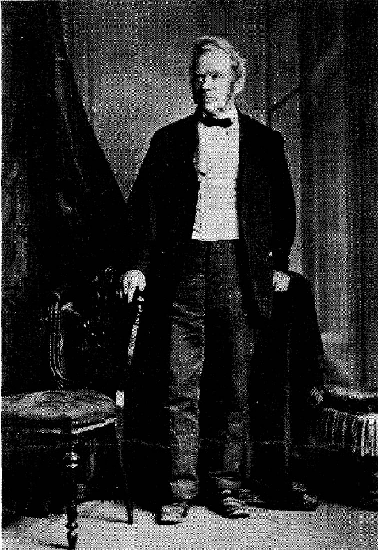
JOSIAH WARREN
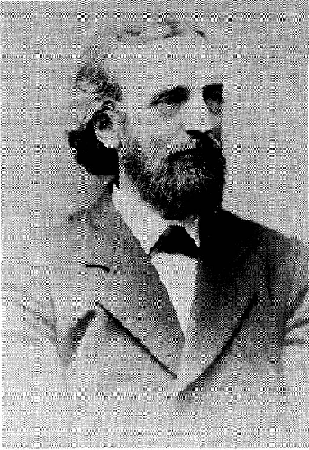
EZRA HEYWOOD
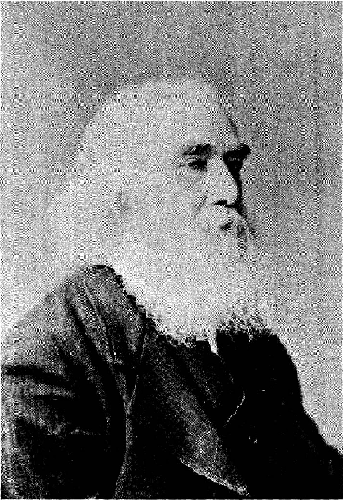
LYSANDER SPOONER
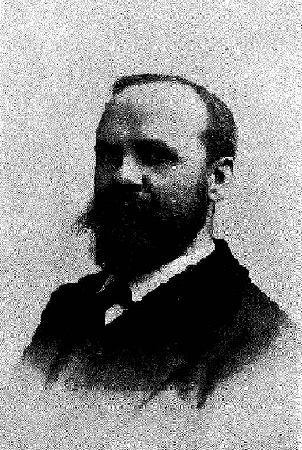
BENJAMIN R. TUCKER
___________
73. For a discussion of individualist anarchism in Europe and the influence of Warren and Benjamin Tucker in England, France, Belgium and Germany, see Nettlau, Der Vorfrühling, 125-132.
74. Nettlau, Anarquia, 44.
75. Nettlau, “Anarchism,” 45.
76. Podmore, Robert Owen, 386; quoted from Cooperative Magazine, November, 1827.
77. Warren was fully aware of the activity in England leading up to the formation of the Equal Exchange bazaars. In his Peaceful Revolutionist of February 5, 1833 he published the following article:
PROGRESS OF EQUAL EXCHANGE IN ENGLAND. The Working Man’s Advocate of N.Y. Jan. 12, contains a letter written by Robert Owen to a friend in Liverpool dated at Birmingham Nov. 27 stating that there had been a meeting the day before and he says “I should think from eight to ten thousand persons were present. . . . An unanimous resolution was adopted by acclamation to establish the first provincial branch of the Labour Exchange in Birmingham.” He also says “I am obliged to return to London. . . . I have to open a new branch establishment which has been preparing during my absence and only waits my return.”
78. Pare, a native of Birmingham and associated with the early beginnings of the English labor movement, became a complete convert to Owen’s “new system,” and delivered his first public lecture, in the capacity of corresponding secretary of the first Birmingham Coöperative Society, in the Mechanics’ Institution in Manchester on March 30, 1830. Although he did not become an opponent of the trade union, he became convinced that the struggle by combination to keep money wages up was impotent and useless. Holyoake, History of Co-operation, II, 147, 254.
79. The rise and fall of the National Equitable Labour Exchanges is adequately described in Holyoake, History of Co-operation, I, 159-172. See also Podmore, Robert Owen, 393-422. Owen’s first opening actually took place September 17, 1832, following the success of a similar exchange begun in April of the same year by William King. One of the copper plates, from which the English labor notes of this period were printed, is in the collection of Owen material in the Workingmen’s Institute Library.
80. Speaking of the cupidity and violence produced by their operation, Holyoake remarked, concerning their suppression; “Despite the conflict of management, the inexperience which belong to all new schemes, the ignorance, the distrust and the jealousy which the new plan of commerce had to encounter, it attained to considerable organization . . . the child was well born, was of good promise, but was strangled as signs were appearing of lusty growth. Labor exchanges did not perish because they failed but because they succeeded.” History of Cooperation, I, 174.
81. Mark Hovell, The Chartist Movement (Manchester, England, 1918), 32.
82. The objectives of the English exponents of anarchism were outlined in two now exceedingly scarce publications, A Contribution Towards the Elucidation of the Science of Society, and An Outline of the Principles, Objects, and Regulations of the London Confederation of Rational Reformers, founded in August, 1853, by a few Private Individuals of the Middle and Working Classes. See Nettlau, “Anarchism,” 50. On the influence of Warren’s ideas upon members of this London group see also report in London Leader, October 15, 1853, reprinted in Periodical Letter, I (July, 1854), 13, which commended the London group for following “the policy and patient good sense of the American Reformers of Modern Times,” and referring to their first tract as “a novelty in English democratic literature.”
83. See Pare’s own account of the most important of these, Cooperative Agriculture: a Solution of the Land Question as Exemplified in the History of the Ralahine Cooperative Agricultural Association, County Clare, Ireland (London, 1870).
84. Josiah Warren to Ambrose C. Cuddon, March 12, 1853; Warren MSS., Labadie Collection. It is probable that Cuddon is the author of the early publication of the London group, although neither carry the names on the cover or title page, according to Nettlau. See note 10, above. Cuddon also was an early associate of Robert Owen. See his outline of the objectives of the Home Colonization Society in Robert Owen, A Developement (sic) of the Principles and Plans on Which to Establish Self-Supporting Home Colonies (London, 1841), 48.
85. Periodical Letter, II, 47-48. It is doubtful whether any of Warren’s works were published in their entirety in Great Britain, despite the preparations which were made at this time.
86. Periodical Letter, I, 94. Aberdeen was prime minister of a Conservative-Liberal coalition government from 1852-1855. Walter Phelps Hall and Robert Greenhalgh Albion, A History of England and the British Empire (New York, 1937), 642.
87. Pare, “Equitable Villages in America,” in Journal of the Statistical Society of London, XIX, 143.
88. Periodical Letter, I, 2nd series, 74. Cuddon’s trip westward included a stay in Indiana at the home of a daughter.
89. Nettlau, “Anarchism,” 51; Edmond Villetard, History of the International (Susan M. Day, translator) (New Haven, 1874), 51-69. This gathering is not to be confused with the more famous one in London in September, 1864, from which time the Working Men’s International Association properly stems. See also Arthur Müller Lehning, “The International Association, 1855-1859; A Contribution to the Preliminary History of the First International,” in International Review for Social History (Leiden, Netherlands, 1936- ), III (1938), 1-102, pp. 52-54.
90. For a report of Cuddon on his activities at the Coöperative Congress of 1869, see his letter to Warren, June 21, 1869, in Warren MSS., Labadie Collection.
91. Pare’s death was impressively recorded at the 1873 Coöperative Congress at Newcastle-on-Tyne. Holyoake, History of Co-operation, II, 430.
92. “You are aware that I have written a Treatise on the Science of Society in a Series of lectures, but which I could not afford to publish. Since then I have added much to them for I can think of nothing else but our subject, which in fact embraces every thing which regards the well being of mankind.” Ambrose Caston Cuddon to Josiah Warren, September 15, 1873. Cuddon remarked that he was now 82 years of age but enjoyed life as much as ever “and more than ever, if I can get out my book.”
93. For a summary of this matter see article “The Oldest Paper on the Left,” in Freedom, IX (April 3, 1948), 2. The first paper of this name suspended publication in 1927. In November, 1936 publication resumed under the title Spain and the World, changed successively to Revolt!, and War Commentary, reverting to the old name at the end of 1945.
94. See advance notices and reports on Warren’s lectures in Boston Investigator, June 25, July 2, July 9, August 20, September 24, October 8, October 22, 1851.
95. Periodical Letter, II, 33.
96. Periodical Letter, II, 34.
97. Warren reported that the “House of Equity” was located in a seven story building, doing business to the amount of $1000 a day.
98. Warren printed with obvious pleasure the observation of the editor of the Boston Post upon the closing of the “House of Equity”; “There was, however, a principle in that store, which, though only partially developed, a thousand failures could not affect.” Periodical Letter, II, 35.
99. The cut-price system growing out of the Keith affair Warren considered misleading. “Cheapness to consumers may be great injustice and ruin to producers and venders. The principle of equivalents alone can regulate this important matter.” Warren, Equitable Commerce (leaflet), 3-4.
100. Periodical Letter, II, 36.
101. Caroline Cutter Warren to Josiah Warren, July 20, 1856. Warren’s wife considered the idea ill-advised.
102. Clark, “A Neglected Socialist,” 81. Weitling appears to have been influenced to a greater extent by the socialists Fourier and St. Simon than by Proudhon. Although rejecting with the latter the right of occupation solely as the basis of property ownership, his plan for the reorganization of society is founded upon an analysis of human nature similar to that of the former. Kaler, Wilhelm Weitling, 11, 79, 83.
103. Clark, “A Neglected Socialist,” 79; Kaler, Wilhelm Weitling, 74. There is some ground for doubt that Weitling considered the abolition of the state but, like several German and French Socialists, conceived it as a device for bringing about the organization of the society which they planned. Zenker, Anarchism, 30.
104. Le Libertaire was published from June 9, 1858 to February 4, 1861, a total of 27 numbers appearing during that time. Max Nettlau to Agnes Inglis, April 11, 1931, Nettlau MSS., Labadie Collection; Müller Lehning, “The International Association,” 46, note. See also Kropotkin, article “Anarchism,” in Encyclopedia Britannica, XI ed., I, 918.
105. Nettlau, Esbozo de Historia de las Utopias, 48. Nettlau was of the opinion that Dejacque arrived at his anarchist beliefs independently of Proudhon, while Zenker maintained that he first was a Proudhonian. See Nettlau, Bibliographie, 30-32, 56; same author, “Anarchism: Communist or Individualist?—Both,” in Freedom, XXVIII (March, 1914), 21; Zenker, Anarchism, 241.
106. For Dejacque’s part in the early beginnings of the I.W.M.A. see Müller Lehning, “The International Association,” 44-50; Nettlau, Der Vorfrühling, chapter XXIV.
107. Warren published three different works whose titles contained these two words, a matter of considerable confusion to bibliographers. The distinction can be clearly made by consultation of the sub-titles. The volume produced in 1863 was scheduled for a second edition of 1872 as True Civilization Part II, but no copies have ever been discovered of this latter proposed release. Page citations from the 1863 edition will hereinafter be designated as True Civilization an Immediate Necessity.
108. Owen stated that part of the education of the young at New Lanark also had this objective in mind; “. . . the children of these work-people were taught and exercised in military discipline, to teach them habits of order, obedience, and exactness, to improve their health and carriage, and to prepare them at the best time, in the best manner, when required, to defend their country at the least expense and trouble to themselves.” The Life of Robert Owen by Himself (New York edition, 1920), 319-320. With relation to New Harmony see also the short summary in Nicholson, The Hoosiers, 109. .
109. “If it should be possible for an enemy to exist, in opposition to a population known to act upon millennium principles, war may always be prevented, by those who adopt the principles of peace, being, at all times, prepared to resist injustice and oppression; and this preparation may be easily effected by wise arrangements in the education of the young, without any trouble or expense, that would not be amply repaid.” Owen, A Development of the Principles and Plans on Which to Establish Self-Supporting Home Colonies, 6. See also same author, A New View of Society; or, Essays on the Principle of the Formation of the Human Character, 105-112.
110. Warren developed some of the ideas which he had first expressed in the pamphlet Modern Government written at “Modern Times” the year before.
111. In some respects the doctrine was a recapitulation of Owenism; “The whole mission of coercive government being the defense of persons and property against offensive encroachments, it must have force enough for the purpose. This force necessarily resolves itself into the military, for the advantage of drill and systematic cooperation; . . . this being perhaps the best form that government can assume, while a coercive force is needed.” True Civilization an Immediate Necessity, 15; Modern Government, 4. The qualification as to the time element was even more explicitly the doctrine of his early teacher; “. . . this Modern Military, as a Government, will be necessary only in the transitionary stage of society from confusion and wanton violence to true order and mature civilization.” Modern Government, 15.
112. True Civilization an Immediate Necessity, 28; Modern Government, 11-12.
113. True Civilization an Immediate Necessity, 27.
114. True Civilization an Immediate Necessity, 128-129, 135.
115. True Civilization an Immediate Necessity, 43.
116. True Civilization an Immediate Necessity, 10-11.
117. “The democratic idea,” Warren charged, “has never been introduced into our military discipline, nor into our courts, nor into our laws, and only in a caricatured and distorted shape into our political system, our commerce, our education and public opinion.” Modern Government, 9.
118. True Civilization an Immediate Necessity, 14.
119. True Civilization an Immediate Necessity, 169-170.
120. True Civilization an Immediate Necessity, 145.
121. True Civilization an Immediate Necessity, 129.
122. True Civilization an Immediate Necessity, 137-138.
123. True Civilization an Immediate Necessity, 54, 152.
124. True Civilization an Immediate Necessity, 29-30; Modern Government, 12.
125. True Civilization an Immediate Necessity, 108.
126. In considering the phenomenon of crime, Warren leaned heavily upon the Owenite thesis of environmentalism to the exclusion of his own stress upon individuality and responsibility. Witness his conclusions relative to the preventative function of the new legislative bodies:
“When the simply wise shall sit in calm deliberation, patiently tracing out the complicated and entangled causes of avarice, of robberies, of murders, of wars, of poverty, of desperation, of suicides, of slaveries and fraud, violence and suffering of all kinds, and shall have found appropriate and practical means of preventing instead of punishing them, then the military will be the fitting messengers of relief and harbingers of security and peace . . .” True Civilization an Immediate Necessity, 34.
127. True Civilization an Immediate Necessity, 15, 18, 24-27; Modern Government, 13. Warren’s transitional military force combined in its training a number of provoking elements, among them a course of discipline allowing for independent decisions upon the part of the members when matters involving affairs properly beyond their scope were involved. Part of the drill was to include the giving of orders permitting the commission of unnecessary harm with the express purpose of having the orders disobeyed. The moral culpability of soldiers acting under orders was to come under scrutiny some 80 years later with the trials of German military personnel at Nürnberg at the end of World War II.
128. “If the sole proper function of coercive force is to restrain or repair all unnecessary violence, then the conclusion is inevitable that all penal laws for punishing a crime or act after it is committed, except so far as they work to compensate the injured party equitably, are themselves criminal.” True Civilization an Immediate Necessity, 39.
129. Warren considered the logical conclusions of patriotism ominous. The polarization of the world’s peoples into nations was to him the prelude to “signing a death-warrant” in the case of individuals within them, and sure oblivion to refuse to belong to any. True Civilization an Immediate Necessity, 47. For Warren as a contributor to anti-war thought, see Merle Curti, Peace or War; The American Struggle 1636-1936, p. 59.
130. “Even in mechanism the arts of destruction have gone beyond those of preservation; and the best military commander is announced, without blushing, to be he who can most adroitly mislead, deceive, entrap, and kill his fellow men, who are at least his equals in every view of manhood and worth. And these are the model precedents and model men held up for imitation by the coming generations!” True Civilization an Immediate Necessity, 42.
131. True Civilization an Immediate Necessity, 48-50, 53, 170-171. Disinterested in the political issues with which the term “secession” was connected, Warren always used the term loosely; he considered the act of a slave running away from his master as much a matter of “secession” as the desertion of the Union by a state.
132. See Notebook “D,” entry dated July 4, 1864, for extensive plans for reviving the labor exchange with residents of Charlestown as well.
133. Warren, The Emancipation of Labor, 2.
134. The Emancipation of Labor, 3.
135. The Emancipation of Labor, 8.
136. It is improbable that Warren continued publication of this journal later than the end of 1867. Issues dated later than this are thus far unlocated.
137. Eugene Hutchinson to Josiah Warren, July 10, 1864, Warren MSS., Labadie Collection.
138. This edition bore the designation “Part I” on the cover page, being essentially the first of Warren’s larger writings on the subject of his thought and action.
139. True Civilization, Part I, 25.
140. True Civilization, Part I, 23-24, 34.
141. “Having the liberty to differ does not make us differ, but on the contrary, it is a common ground upon which all can meet, . . . giving full latitude to every experiment (at the cost of the experimenters), brings everything to a test, and insures a harmonious conclusion . . . the more liberty there is to differ, and take different routes, the sooner will all come to . . . the right one; . . .” True Civilization, Part I, 26.
142. True Civilization, Part I, 27. In a similar manner he had repudiated what he termed “barbarian laws of war” which made all the members of a nation at war with all those of another. See True Civilization an Immediate Necessity, 58-59.
143. True Civilization, Part 1, page cited above.
144. Boston Globe, April 15, 1874. Warren had been preceded in death by his wife, Caroline Cutter Warren, in Evansville, Indiana, in 1872, and by his elder brother, George, in Cincinnati in the same year. For other related matters, see Appendix II.
- 1It has been evident to thoughtful observers for more than two generations that the words “anarchist,” “anarchism,” and “anarchy” have been used so loosely by writers and the general public alike that they have practically ceased to have any definite meaning. The problem here is similar to that existing in many other cases where abstract terms or generalizations having no or little substance have been overused or misused. Nor has the use of these terms by scholars tended to promote any greater degree of understanding. In too many cases the tendency has been to resemble the weaknesses of the general observer. Here the situation has been usually created by the repeated interpretation of expressions of hostility to the status quo as evidence of anarchist thought.
- 2It has been evident to thoughtful observers for more than two generations that the words “anarchist,” “anarchism,” and “anarchy” have been used so loosely by writers and the general public alike that they have practically ceased to have any definite meaning. The problem here is similar to that existing in many other cases where abstract terms or generalizations having no or little substance have been overused or misused. Nor has the use of these terms by scholars tended to promote any greater degree of understanding. In too many cases the tendency has been to resemble the weaknesses of the general observer. Here the situation has been usually created by the repeated interpretation of expressions of hostility to the status quo as evidence of anarchist thought.
- 3The idea has long been prevalent that violent conduct is characteristic of anarchists, and that anarchism is a doctrine of destruction. There exists little justification for such a stand, in actuality. In addition, the rejection of one particular variety of authority in favor of its replacement by another finds continual identification with anarchism, while social philosophies which are utterly opposed to it are on occasion labeled “anarchistic.” This merely adds to the already large amount of confusion existing on the subject, setting up extremely vague limitations and permitting the inclusion of many elements which are quite controversial.
- 4Since 1880 and thereabouts people have almost universally thought of anarchists in terms of violence and conspiracy. The result has been the regarding of anarchist literature as a product of a handful of criminals. In Europe the advent of this revolutionary movement was accompanied by a number of sensational acts which led to the identification of anarchism with socially pathological developments. In the United States there have been similar implications, to the point where even governmental policy incorporated the layman’s conception of anarchism and anarchists. The definition of anarchism employed by the Department of Justice in modern times is essentially derived from this earlier period.
- 5Although the tendency to blame destruction of property and loss of life during industrial disputes on “agitators,” “doctrinaires,” and “communists” prevailed for some time previous to the celebrated Haymarket incident in Chicago in May, 1886, such predilections received a powerful stimulus from this event. The now-familiar stereotype of the black whiskered, bomb-throwing vandal came into being at this time and created a new political symbol which has been used to manipulate mass opinion with an impressive degree of success. As a consequence of this and other factors, anarchism became so tainted with diabolism that rational study of its place in American history has rarely taken place.
- 6Although the tendency to blame destruction of property and loss of life during industrial disputes on “agitators,” “doctrinaires,” and “communists” prevailed for some time previous to the celebrated Haymarket incident in Chicago in May, 1886, such predilections received a powerful stimulus from this event. The now-familiar stereotype of the black whiskered, bomb-throwing vandal came into being at this time and created a new political symbol which has been used to manipulate mass opinion with an impressive degree of success. As a consequence of this and other factors, anarchism became so tainted with diabolism that rational study of its place in American history has rarely taken place.
- 7The attempt to link these varied phenomena into a logical sequence has been undertaken by others as well, with less success. It now appears that the assumption that American anarchism stemmed from Puritan Antinomianism and was associated with the peculiar variety of resistance to the state found in the non-resistant and “no government” sentiments of the Garrison school of “Christian Anarchist” abolitionists is untenable. It is more probable that, rather than being a derivative of native American conditions, the real source of the anti-statist evidences observed in Antinomianism and other varieties of early colonial dissidence and unrest can be discovered in the radicalism, both religious and socio-economic, already developing in England before the times of Charles I, and which found expression through lower class spokesmen at the time of the English Civil War. Concerning other aspects of this matter, it can be argued quite effectively that the designation “Christian Anarchist” is really a contradiction in terms, and that religious rebellion along individualist lines can be interpreted as anarchism only under highly specialized circumstances. The rejection of one variety of religious authority in favor of its replacement by another can hardly be related to anarchism, which categorically rejects authority. In another connection, the interpretation of American anti-statism as an evolutionary process, passing from religious to economic spheres, is also open to serious objections. There is not only lack of continuity in influence, but no logical sequence in the elaboration of a program of propaganda. In searching the field it becomes more apparent that the elements of a radical movement with a fully developed propaganda structure can be found in one of the sub-areas only. It is the contention of this work that individualist anarchism can be seen to satisfy the requirements mentioned elsewhere. Not only is it the only part of the radical movement native to America with a propaganda, but it has depended on natives for its promotion. Furthermore, it is unique in that members of the group actually attempted under practical conditions to try out its theory.
- 8In the United States there seems to have been little notice of an extensive literature hostile to the state and its functions until after Haymarket. The dominant conception of anarchism after the violence in Chicago was in accord with the inflammatory utterances of the European-born revolutionaries now gathered in the several large Northern cities. Lack of attention had resulted in the failure to note that a serious split had been developing within the worldwide anarchist movement, and that various distinct elements could now be recognized.
- 9The semantic smokescreen raised up by the moral uproar here and overseas after Haymarket and a number of sensational assassinations in Europe covered over in the process the uncompromising stand taken by the American individualist anarchists, who deplored the use of force, or “direct action,” and asserted as before their traditional hope of the eventual adoption of noncoercive individualist equity as a result of education and rational conviction. Much of what they had to say had been propagated here for nearly a half century before there developed a competing body of beliefs put forward by followers of Bakunin and Kropotkin. In the form in which it appeared during the 80’s and 90’s, but especially as broadcast by Emma Goldman, Alexander Berkman and other Russians after the turn of the century, it is possible to see emerging the full outlines of what has since become known as communist anarchism. It has since received its best statement by Italian and Spanish radicals. (Further examination of the famed Haymarket Germans suggests a serious question as to whether these men were not far closer to state socialism, actually, than anarchism.)
- 10The semantic smokescreen raised up by the moral uproar here and overseas after Haymarket and a number of sensational assassinations in Europe covered over in the process the uncompromising stand taken by the American individualist anarchists, who deplored the use of force, or “direct action,” and asserted as before their traditional hope of the eventual adoption of noncoercive individualist equity as a result of education and rational conviction. Much of what they had to say had been propagated here for nearly a half century before there developed a competing body of beliefs put forward by followers of Bakunin and Kropotkin. In the form in which it appeared during the 80’s and 90’s, but especially as broadcast by Emma Goldman, Alexander Berkman and other Russians after the turn of the century, it is possible to see emerging the full outlines of what has since become known as communist anarchism. It has since received its best statement by Italian and Spanish radicals. (Further examination of the famed Haymarket Germans suggests a serious question as to whether these men were not far closer to state socialism, actually, than anarchism.)
- 11The two groups differed sharply on basic issues. The communist anarchists rejected private property, and taught the ideal of the collective autonomous commune. A portion of their number advocated the overthrow of the State by violence. The individualist anarchists held that the collective society in any form was an impossibility without the eventuality of authoritarianism, and ultimately, totalitarianism, and adhered resolutely to the concept of private property insofar as the term could be defined as the total product of a given individual’s labor, but not more broadly than this. They abandoned the idea of an equalitarian utopia, and worked for a world free from arbitrary restrictions on opportunity and legal privilege, which breakdowns they claimed “laissez faire” really produced. No other radical group denounced the prevailing system more vigorously than the spokesmen for individualist anarchism.
- 12The two groups differed sharply on basic issues. The communist anarchists rejected private property, and taught the ideal of the collective autonomous commune. A portion of their number advocated the overthrow of the State by violence. The individualist anarchists held that the collective society in any form was an impossibility without the eventuality of authoritarianism, and ultimately, totalitarianism, and adhered resolutely to the concept of private property insofar as the term could be defined as the total product of a given individual’s labor, but not more broadly than this. They abandoned the idea of an equalitarian utopia, and worked for a world free from arbitrary restrictions on opportunity and legal privilege, which breakdowns they claimed “laissez faire” really produced. No other radical group denounced the prevailing system more vigorously than the spokesmen for individualist anarchism.
- 13The individualist anarchists had no blueprint for the future of social organizations under conditions free from coercion. The direction to be taken by voluntary associations was left for the future, and no predictions of a static millennium filled their writing. The group had within their number adherents to a system of decentralized local communities of small size, and at the same time proponents of free associations of producers and consumers within large urban industrial centers. The best known of this group of native radicals, Josiah Warren, Lysander Spooner, Stephen Pearl Andrews, William B. Greene, Ezra Heywood, and Benjamin R. Tucker, came in for a measure of attention during the peak of the furor over radicalism reached at about the time of the Spanish-American War. But the greater part of the attention of the time was focussed on their German and Russian contemporaries, with whom they were already at variance in many respects. Those most familiar with the individualist suggestions for the solution of the currency, labor and other pressing problems dismissed them as the fulminations of a group of irresponsibles, dreamers and cranks. Their work along practical lines at an earlier time was practically unknown in any circles, and much of what they had to say later on was mostly forgotten when the stage was taken over by the Industrial Workers of the World, The Socialist Party and the First International.
- 14. George Warren, “Josiah Warren,” 1. This brief biographical reminiscence of Warren by his only son is an unpublished manuscript written in Evansville, Indiana in 1893, apparently at the request of Lockwood, who was engaged in preparing his study of the New Harmony communities. See Warren MSS., Workingmen’s Institute, George B. Lockwood to George W. Warren, November 10, 1893. Many of the early dates mentioned in this manuscript have proven inaccurate.
- 15. George Warren, “Josiah Warren,” above. This lamp was patented February 28, 1821, but Warren paid little attention to this matter after becoming part of the New Harmony community. Dictionary of American Biography, XIX, 483. See also note 80, below.
- 16. The standard work on Owen’s life is Frank Podmore, Robert Owen, A Biography (2 vols. London, 1906). Other works of value are William L. Sargant, Robert Owen, and His Social Philosophy (London, 1860); Lloyd Jones, The Life, Times, and Labours of Robert Owen (2 vols. London, 1890); G. D. H. Cole, The Life of Robert Owen (London, 1930). Owen’s autobiography, The Life of Robert Owen by Himself (New York edition, 1920), is a valuable source.
- 17. A brief, concise statement of Owen’s stand on this matter may be found in George Milton Janes, Who Should Have Wealth and Other Papers (Milwaukee, 1925), 48. Owen’s “Five Fundamental Facts of Human Nature” are reproduced by Podmore, Robert Owen, 481-482. Page citations are from the one volume edition (New York, 1910).
- 18. Owen was born at Newtown, Montgomeryshire, Wales, on May 14, 1771. He purchased and began operating the mills at New Lanark in 1798. See the brief, approved biographical sketch in his periodical The New Moral World (London and Leeds, 1834-1845), I (November 1, 1834), 7. This publication was a continuation of The Crisis (London, 1832-1834), which is an extremely important source for the origin and early operations of the renowned Labor Exchanges. Other indispensable periodicals for material concerning Owen are Robert Owen’s Journal (London, 1850-1852), and Robert Owen’s Millennial Gazette (London, 1856-1858). The biography by Podmore contains the most adequate bibliography of Owen’s works, among the standard treatments, which may be supplemented by National Library of Wales, A Bibliography of Robert Owen, the Socialist 1771-1858 (Aberystwyth, Wales, 1914).
- 19. A brief account stressing the accomplishments of the Rappites at New Harmony is Jacob Schneck and Richard Owen, The History of New Harmony, Ind. (Evansville, Ind., 1890). See also Lockwood, New Harmony Movement, 19-57; John S. Duss, George Rapp and His Associates (Indianapolis, 1914), an account by a specialist in Rappite history.
- 20. Podmore, Robert Owen, 288; Lockwood, New Harmony Movement, 75; Robert Dale Owen, Threading My Way. Twenty-Seven Years of Autobiography (New York, 1874), 211. Owen claimed that the purchase price was $140,000. The New Harmony Gazette, II (August 15, 1827), 353.
- 21. Owen’s brief stopover in Cincinnati on his way to New Harmony on December 9, 1824 did not include a speaking engagement there, according to his son William, who was with him on this journey. Joel W. Hiatt, ed., “Diary of William Owen from November 10, 1824, to April 20, 1825,” in Indiana Historical Society Publications, IV, 61. Owen left New Harmony January 7, 1825, and spoke in Cincinnati on his way to Washington where he addressed the House of Representatives in February and March. Hiatt, ed., “Diary,” 97. For further corroboration consult The Diaries of Donald Mac-Donald 1824-1826 (Indiana Historical Society Publications, vol. XIV) (Indianapolis, 1942), 236, 296.
- 22. The name of the community was not decided upon at first, the space being left blank in the preamble. Warren’s suggestion that the association adopt the title “Commonwealth of New Harmony” was negatived, and William Owen’s motion that the space remain blank was carried. The name “New Harmony Community of Equality” was adopted February 5, 1826. See “Minutes of the Convention for Forming a Constitution for the Society of New Harmony held Jan. 25, 1826,” February 2, 1826, February 5, 1826. The preamble is reproduced in the minutes for February 1, 1826. In the valuation list prepared at the direction of the select committee on February 8, 1826, Warren and his family were assigned $169 per annum. Warren might have arrived in the spring of 1825. MacDonald reported that several families arrived at New Harmony from Cincinnati between April 13 and April 24, but did not mention Warren specifically. MacDonald Diaries, 292.
- 23. “When I reached New Harmony, early in 1826, . . . I looked at everything with eyes of enthusiasm. . . . The evening gatherings too, delighted me . . . the weekly concert, with an excellent leader, Josiah Warren, and a performance of music . . . much beyond what I had expected in the backwoods . . .” Robert Dale Owen, “My Experiences of Community Life,” in Atlantic Monthly, XXXII (September, 1873), 338.
- 24. The first entry of the Warren family in the account book of the community store is dated March 8, 1826. The family pass books have never been located, and constitute another Warren document of considerable interest for which search continues. For a description of the account books see William Pelham to William Creese Pelham, September 7, 1825, in Harlow Lindley, ed., Indiana as Seen by Early Travellers (Indiana Historical Collections, vol. Ill) (Indianapolis, 1916), 371.
- 25. Warren MSS. notebook, Labadie Collection, University of Michigan, undated, unpaginated. This is another obscure Warren source, unrelated to the series of notebooks which are apparently in the nature of a diary, containing entries through June, 1873, and of which only one has so far been located. See note 13. For mention of the above document elsewhere, consult R. C. Stewart, “The Labadie Labor Collection,” in Michigan Alumnus Quarterly Review, LIII (May 10, 1947), 250.
- 26. Periodical Letter, II (July, 1856), 55; Warren, Practical Details in Equitable Commerce, showing the workings in actual experiment, during a series of years, of the social principles expounded in the works called “Equitable Commerce” by the author of this and “The Science of Society,” by Stephen P. Andrews, 71, cited hereafter as Practical Details. A second edition from the same plates was published in 1854. Although this book was not published until 1852, some of the material existed in manuscript for twenty-five years before revision and release under the above title. For the most part, this latter work is the principal source of information concerning the decision to leave New Harmony and the events of the three years following. Any account of Warren’s early experiments in social reform is bound to rely upon it heavily.
- 27. Warren’s views have been summarized adequately in Ely, Labor Movement, 238. A fuller treatment by Warren is contained in Periodical Letter, 2nd. series, I (December, 1856), 34.
- 28. Periodical Letter, II (July, 1856), 55-56. Dr. Lyman O. Warren has raised some interesting points in speculating upon the intellectual origins of Josiah Warren’s unorthodox thinking. He has called attention to the observation of the famous philosopher George Santayana in his Persons and Places that the Brighton Warrens, of whom Josiah was a member, were “a dissentient family.” Santayana was a boyhood friend of the uncles of Dr. Warren. The record for independent intransigence appears to go back at least as far as his first American ancestors. John Warren of the Arbella is noted in Bond’s History of Watertown as having been arrested on one occasion for nonattendance at church and for harboring Quakers on another. Further investigation into the family prior to migration to America, itself an act of extraordinary self-assertion and independence, might establish a much longer record of nonconformism. A future biographer of Josiah Warren might well consider the pertinence of this durable tradition.
- 29. Six years after leaving New Harmony, Warren wrote, “It is the influence of surrounding circumstances which . . . divided society into rich and poor, which enables some to command and others unable to do otherwise than obey. It is the influence of circumstances which produces different classes in society, and that influence only, which divides men into different political parties and ranges them under different banners of religion. . . . It will be seen that this knowledge warrants us in making a critical examination into our own condition, and all the circumstances which have surrounded us from birth, to see whether they have been . . . such as are most favorable to our happiness, and it teaches us not to reverence or perpetuate bad circumstances simply because we are born under them. . . . This knowledge therefore lays a broad, rational and consistent foundation for unlimited improvement; . . .” The Peaceful Revolutionist, I (February 5, 1833), 5. This short-lived Warren periodical continues to be considered the first anarchist publication in existence.
- 30. Warren MSS., Labadie Collection, undated entry in notebook. It is thought from the arrangement of the material that this notebook was intended as reference at impromptu meetings in private homes, where Warren was a more convincing speaker than he was on the public lecture platform.
- 31. The idea of paper money representing a certain amount of labor rather than a certain precious commodity was held in common and developed separately by several radical economic thinkers in the first half of the nineteenth century as well. Besides Owen in England, similar conceptions on a different scale can be found in the writings of John Gray, A Lecture on Human Happiness (London, 1825); William Thompson, An Inquiry into the Principles of the Distribution of Wealth Most Conducive to Human Happiness (London, 1824; another edition, 1850); John Francis Bray, Labour’s Wrongs and Labour’s Remedy; or, the Age of Might and the Age of Right (Leeds, 1839). Johann Karl Rodbertus in Germany and Pierre Joseph Proudhon in France evolved similar monetary substitutions. Short summaries of their theories can be found in Edward C. K. Gonner, The Social Philosophy of Rodbertus (London, 1899); Dennis W. Brogan, Proudhon (London, 1934); Henry Cohen, Proudhon’s Solution of the Social Problem (New York, 1927). The simplicity of application of this idea by Warren is unique during a time confined almost entirely to theorizing about this matter.
- 32. These were later published as a bound collection under this title. (Manchester, Eng. 1837). A contemporary edition appeared in London in 1813 under the title A New View of Society; or, Essays on the Principle of the Formation of the Human Character, with separate pagination.
- 33. Consult Edger A. J. Johnson, Predecessors of Adam Smith (New York, 1937), Chapters XII-XIII, for a development of the background of the labor cost theory. Whether Warren was acquainted with the writings of Adam Smith is not known but unlikely. However Proudhon, developing a similar line of thought to Warren in a French environment, mentioned Smith, along with the Bible and Hegel as his three principal sources of inspiration. Zenker, Anarchism, 35.
- 34. The following extract from the diary of William Owen, referring to his father’s visit in Kentucky on the way to New Harmony in the late fall of 1824, is of great interest in the effort to assign proper credit for the labor note idea: “We walked through the town-Mayesville [sic] and found a good front and a tolerable second street. Hunter and my father bought mits and Mr. Owen had a bantering conve[r]sation with the storekeeper regarding money and labor notes. He told us that a gallon of whisky, which will make twelve individuals quite drunk, can be bought for 12½ cents.” Hiatt, ed., “Diary of William Owen,” 61. Italics are the present writer’s.
- 35. John R. Commons and Associates, A Documentary History of Industrial Society, V, 79.
- 36. Practical Details, 75.
- 37. It should be remembered that Warren’s continual use of the term “equitable commerce” occurred with the understanding that the word “commerce” was being used in its overall sense as the sum total of human activities and not merely economic considerations alone. There is no doubt that Warren believed that major reforms in the economic sphere were the most important, nevertheless.
- 38. The first systematic and extended arrangement of Warren’s convictions was his Equitable Commerce: a new developement [sic] of principles for the harmonious adjustment and regulation of the pecuniary, intellectual and moral intercourse of mankind, proposed as elements of New Society (New Harmony, Ind., 1846), hereafter cited as Equitable Commerce.
- 39. Ely, Labor Movement, 238; Warren, Practical Details, 13.
- 40. An admirable summation of Warren’s philosophy of individualism is that of Thomas Low Nichols, Forty Years of American Life, II, 39. Nichols’ relations with Warren and the anarchists at “Modern Times” will be found in Chapter III.
- 41. Warren, Practical Details, 13. Capitalized portions are Warren’s.
- 42. Practical Details, above.
- 43. Practical Details, 14.
- 44. Practical Details, above.
- 45. On his return to Cincinnati, Warren leased the tract of land bounded by Elm, John, Fifth and Ninth Streets from Nicholas Longworth for 99 years. His return of the lease to Longworth is anomalous, in view of the fact that he still conceived of land as a commodity and subject to purchase and sale. The loss of this tract as a bargaining weapon must have been keenly felt at the time consideration of a colony site was taking place. See George Warren, “Josiah Warren,” 2, for a summary of this curious incident.
- 46. Practical Details, 14.
- 47. The earliest proposal for the employment of labor notes in England similar to those which enjoyed widespread use in Warren’s Cincinnati store is that of the Brighton Co-Operative Benevolent Fund Association, in November, 1827, six months after their successful introduction in the Ohio pioneer venture. The operation of the store and the determination of the value of the labor notes differed slightly from that already functioning in America. One of the plates from which the English labor notes were printed is in the collection of the Workingmen’s Institute. See the description of the English plan in Podmore, Robert Owen, 386, quoting from the Cooperative Magazine of November, 1827.
- 48. Quarterly Letter, I, 6.
- 49. Quarterly Letter, I, above. The amount charged to pay this item was a variable in Warren’s plan. By the fifth month of the first year the amount added to original cost had been reduced to four per cent. Twenty years later he recommended adding six per cent to the original cost. Practical Details, 22; Equitable Commerce, 61.
- 50. Practical Details, 15.
- 51. Practical Details, 29.
- 52. The Peaceful Revolutionist, I (February 5, 1833), 6. Warren skirted barter economy but briefly, even though he saw nothing particularly invidious about its operation if the need of either party involved did not constitute a margin sufficiently noticeable to promote exploitation one by the other.
- 53. Quarterly Letter, I, 6.
- 54. Warren, True Civilization an Immediate Necessity and the Last Ground of Hope for Mankind. Being the Results and Conclusions of Thirty-nine Years’ Laborious Study and Experiments in Civilization as it is, and in Different Enterprises for Reconstruction, 88, hereafter cited as True Civilization an Immediate Necessity; Practical Details, 15.
- 55. Warren MSS., Labadie Collection, “A Scrap of History,” undated and un-paginated. This brief manuscript appears to be part of another attempted publication, but a comparison with his published works indicates that it remained unused.
- 56. The first customer in the time store was Warren’s brother, according to Warren’s account. He recalled prevailing upon him to make the first purchase to start the experiment, “desperate with disappointment and chagrin” at the failure of three friends to make promised transactions. Warren, Practical Details, 17-18. Two weeks after the Time Store opened, the Western Tiller of Cincinnati began publication of a series of eight dispatches, which ran from June 1 through July 27, written by “A Late Member of New Harmony,” and addressed “To the Friends of the Social System,” which, based on the criteria of internal criticism, must be attributed to Warren. These essays are not only prepared in his peculiar style, but amount to a trial run of some of the ideas to be found later in Equitable Commerce.
- 57. Practical Details, 24; Peaceful Revolutionist, I (April 5, 1833), 15,
- 58. Practical Details, 22, 25, 31.
- 59. This was Richard Folger, who with John Pickering, were among the earliest supporters of equity. Pickering later broke with Warren at the time of the commencement of “Utopia,” some twenty years later. Practical Details, 33; Periodical Letter, I, 2nd. series, supplement 2, p. 2; Peaceful Revolutionist, II (May, 1848), 13-15.
- 60. Peaceful Revolutionist, I (February 5, 1833), 6.
- 61. See Warren’s letter to the Mechanic’s Free Press (Philadelphia, 1827-1831), May 10, 1828, p. 2, quoted in Commons, Documentary History, V, 133-137.
- 62. Practical Details, 16; Peaceful Revolutionist, I (February 5, 1833), 7.
- 63. Practical Details, 27, 29.
- 64. Compare prices reported by Warren in 1827 in Practical Details, 21, 23, 27.
- 65. The following is a representative example: “Bought three barrels of rice at Haydn & Co’s. auction at 1½ cents a pound, and am selling it out at 1¾, while the customary price for so good an article has uniformly been 8 cents a pound; people are coming from all directions to get it . . .” Practical Details, 26.
- 66. This has been a controversial point among interested observers, although Warren leaves no doubt about the matter. For confirmation of the three year duration see Peaceful Revolutionist, I (February 5, 1833), 7; The Herald of Equity, I (February, 1841), 6.
- 67. Practical Details, 40.
- 68. Practical Details, 23. Saunders later wrote for the Free Enquirer under the pseudonym “Philanthropos.” Free Enquirer, I, new series, (December 31, 1829), 79; Periodical Letter, I, 2nd. series, (January, 1858), 98-101.
- 69. Ely stated that Warren did a total business of $150,000 during the operation of the time store, but Warren’s contemporary accounts were much more modest than this. In March, 1829 he revealed that he had never utilized more than $4,000 in the proceedings up to that time, and that he had retailed a total of about $30,000 worth of goods. Warren had actually begun the process of liquidation of the store at this time, but shortly revived it again. It is unlikely that his volume quintupled in the next year of operations. Ely, Labor Movement, 239; Practical Details, 31-32.
- 70. Practical Details, 41.
- 71. Practical Details, 42.
- 72. True Civilization an Immediate Necessity, 107-108.
- 73 An example of the problem involved in the matter of accurately using such specialized words can be found in the interesting study by Arthur E. Bestor, Jr., “The Evolution of the Socialist Vocabulary,” in Journal of the History of Ideas, IX (June, 1948), 259-302.
- 74 Ernest A. Vizetelly, The Anarchists (London, 1911), and Peter Latouche, Anarchy! An Authentic Exposition of the Methods of Anarchists and the Aims of Anarchism (London, 1908), are prime examples of popular writing concerned with anarchism primarily as a program of calculated terrorism aimed in particular to those in high places. Latouche, in his zeal to lay all prominent international political assassinations at the door of the anarchists, even included those of Presidents Lincoln and Garfield. Anarchy!, 238. For vindication of the employment of violence by anarchists, see Peter A. Kropotkin, article “Anarchism,” Encyclopedia Britannica, XI ed., (29 vols. London, 1910), I, 916.
- 75 There is virtually no credible evidence for the assumption that violence is a basic element of the strategy of the anarchists. In distinguishing between the doctrine and the coercive action sometimes associated with it, the non-anarchist German observer and critic Ernst Victor Zenker remarked, “That the theory of Anarchism is not merely a systematic incitement to robbery and murder, we need hardly to repeat. . . . Proudhon and Stirner . . . never once preached force. . . . The doctrine of propaganda which since Proudhon’s time has always accompanied a certain form of anarchist theory, is a foreign element, having no necessary or internal connection with the fundamental ideas of anarchism. It is simply a piece of tactics borrowed from the circumstances peculiar to Russia, and accepted moreover only by one fraction of the Anarchists, and approved by very few indeed in its most crude form; it is merely the old tactics of all revolutionary parties in every age.” Anarchism, a Criticism and History of Anarchist Theory (English translation, New York, 1897), 306.
- 76 Zenker, Anarchism, 6. An early and exhaustive inquiry into the matter is Césare Lombroso, Gli Anarchici (Turin, 1894). A German edition was published in Hamburg the next year under the title Die Anarchisten. Eine Kriminal Psychologische und Sociologische Studie. Lombroso’s methods and techniques as well as most of his conclusions have been discarded for some time.
- 77 Henry David, The History of the Haymarket Affair, continues to be the most thorough account of this unfortunate occurrence. In American history the identification of anarchism with terroristic activities dates from this time, an impression which neither time nor attempts at rectification of the injustice inflicted at the time have succeeded in erasing.
- 78 An accompanying attitude has been the double standard which has tacitly been adhered to with respect to the employment of extra-legal violence. No public condemnation accompanied the use of coercion on the part of industrialists and local groups of citizènry, acting in a vigilante capacity, in disputes with strikers and radicals, until very recently. For an account of this matter see Robert Hunter, Violence and the Labor Movement (New York, 1914), 276-326.
- 79 See especially David W. Petegorsky, Left Wing Democracy in the English Civil War; A Study of the Social Philosophy of Gerrard Winstanley (London, 1947), Chapters I-V, and Mildred A. Gibb, John Lilburne, The Leveller (London, 1947), introduction. See also Mosca, Ruling Classes, 271-272, for the advancement of a cyclical theory dealing with the persistence of anarchist and allied sentiments in the ancient literature of China, India, Persia, Israel, Greece and Rome, and continuing down through the Christian Fathers and the Muslims. The influence of Merriam’s view on subsequent writers dealing with anarchism in the United States is readily observable, however.
- 80 The 1880’s saw the presence in the United States of anarchists in numbers almost equal to those of socialists. Morris Hillquit, Loose Leaves from a Busy Life (New York, 1934), 4.
- 81 For a presentation of this matter as it came to a head at the time of the badly-ignored Anarchist convention in Pittsburgh in 1883, see Chester McA. Destler, “Shall Red and Black Unite? An American Revolutionary Document of 1883,” in Pacific Historical Review, XIV (December, 1945), 434-451.
- 82 For brief expert summaries of both “schools” from the individualist point of view see Victor Yarros, article “Individualist or Philosophical Anarchism,” 41-45, and Clarence Lee Swartz, article “Anarchist Communism,” 45-50, in William D. P. Bliss and Rudolph M. Binder, (eds.), The New Encyclopedia of Social Reform (New York, 1908). For an admirable and sympathetic treatment of the European anarchist philosophy and its exponents by a conservative, consult Alvan F. Sanborn, Paris and the Social Revolution (Boston, 1905), Chapters I-VII.
- 83 For other aspects of this conflict consult Ernest Armand, Formas de Vida en común sin Estado no Autoridad (Carlos Espinosa, trans.) (Madrid, 1934); Rudolf Rocker, Nationalism and Culture (Los Angeles, 1937); same author, La Juventud de un Rebeide (Buenos Aires, 1947); Helmut Rüdiger, Federalismen (Stockholm, 1947).
- 84 “In a world where inequality of ability is inevitable, anarchists do not sanction any attempt to produce equality by artificial or authoritarian means. The only equality they posit and will strive their utmost to defend is the equality of opportunity. This necessitates the maximum amount of freedom for each individual. This will not necessarily result in equality of incomes or of wealth but will result in returns proportionate to service rendered. To base society on the supposition that the laborer of great capacity will content himself, in favor of the weak, with half his wages, furnish his services gratuitously, and produce for that abstraction called “society,” in the words of Proudhon, ‘is to base society on a sentiment, . . . which, erected systematically into a principle, is only a false virtue, a dangerous hypocrisy.’ A hypocrisy, unfortunately, eagerly subscribed to by a weak, downtrodden, and misguided portion of the populace.” Quoted from Laurance Labadie, Anarchism Applied to Economics (a leaflet). Emphasized portions are his.
- 85 For example, the presence at the Warrenite colony of “Modern Times” of such a wide variety of the most extreme types of unconventional behavior has resulted in the estimation of this experiment in anarchist voluntarism as a gathering of spiritualists, Fourierites, free lovers, Comtean Positivists, and even Swedenborgians. Scarcity of contemporary accounts is in a large way responsible for the confusion of interpretations.
- 86The details concerning Warren’s birthplace and parentage are still obscure. Beyond the knowledge of his birth in 1798, practically nothing of an authoritative nature exists. One thing is quite definite, nevertheless; sharing an illustrious colonial name did not mean a similar sharing of the general good fortune of the Warren clan. The year 1819 found him making the familiar trek westward and southward down the Ohio which a vast number of Americans continued to make until the midway point in the century was reached, with the principal aim in view of bettering their economic conditions. Warren and an elder brother, George, had shown considerable promise as musicians while still very young, and had become members of the “Old Boston Brigade Band” while still boys of school age. When he and his recently-acquired wife settled in Cincinnati, Josiah continued to earn his livelihood as a musician and teacher of music, an activity he never completely deserted.
- 87The change of locale seems to have sharpened a native inventive genius. Here he began a restless career of invention and innovation in the fields of illumination, printing-press manufacture, stereotyping and musical notation worthy of closer examination in connection with contributions of the Ohio valley to the growing industrial consciousness of the nation. His first contribution was a lamp of revolutionary construction, devised to burn lard instead of the much costlier tallow. It had unusual success, and led to the construction and operation of a factory devoted to its production which prospered, lard oil not yet being known.
- 88It is highly probable that with this background and bent, Josiah Warren might have become one of the early men of wealth in the growing Midwest, had not the personality of Robert Owen intruded and so impressed him with the exciting and disturbing spirit of social reform. Owen’s attempt to remake the pattern of mankind’s affairs is doubtless an occurrence without comparison in the social history of the new West. One of the few early industrial millionaires, the Welsh textile magnate and philanthropist conceived of a new world on a scale which was lavish far beyond the imagination of his time.
- 89Owen was an environmental determinist. Beginning with the assumption that human nature was a constant, he related all behavior patterns to subsequent reactions to environmental forces. The core of his doctrine was that man’s character was a product of exterior stress which he as an individual had no appreciable part in forming. Thus the social system was responsible for its wayward folk, and desirable modes of conduct could be brought about by proper education and supervision. Owen decried the idea of personal responsibility, believing the tenet absurd and productive only of harm; praise and blame on a personal level formed no part of his working social vocabulary.
- 90Having already partially developed his environmental thesis in his model factory town of New Lanark, Scotland, which enjoyed unsurpassed living and working conditions, Owen was determined to put it into operation on an even more striking level, with a new continent as a backdrop. He purchased the colony of Harmony, Indiana from its founders and occupants, a divergent German Lutheran sect known as Rappites. A communal venture with a deeply religious flavor, this group had developed an extensive and strikingly productive estate out of raw wilderness on the Indiana bank of the Wabash River some fifty miles upstream from its juncture with the Ohio. Desiring once more to return to their earlier home in western Pennsylvania, they sold the tract of 30,000 acres of land and the sturdy buildings thereon to Owen for the sum of $150,000. He then renamed it New Harmony and brought in settlers sympathetic to his philosophy and anxious to experience practical success. It was the largest and most promising experiment in environmentalism in the nineteenth century.
- 91Having already partially developed his environmental thesis in his model factory town of New Lanark, Scotland, which enjoyed unsurpassed living and working conditions, Owen was determined to put it into operation on an even more striking level, with a new continent as a backdrop. He purchased the colony of Harmony, Indiana from its founders and occupants, a divergent German Lutheran sect known as Rappites. A communal venture with a deeply religious flavor, this group had developed an extensive and strikingly productive estate out of raw wilderness on the Indiana bank of the Wabash River some fifty miles upstream from its juncture with the Ohio. Desiring once more to return to their earlier home in western Pennsylvania, they sold the tract of 30,000 acres of land and the sturdy buildings thereon to Owen for the sum of $150,000. He then renamed it New Harmony and brought in settlers sympathetic to his philosophy and anxious to experience practical success. It was the largest and most promising experiment in environmentalism in the nineteenth century.
- 92Having already partially developed his environmental thesis in his model factory town of New Lanark, Scotland, which enjoyed unsurpassed living and working conditions, Owen was determined to put it into operation on an even more striking level, with a new continent as a backdrop. He purchased the colony of Harmony, Indiana from its founders and occupants, a divergent German Lutheran sect known as Rappites. A communal venture with a deeply religious flavor, this group had developed an extensive and strikingly productive estate out of raw wilderness on the Indiana bank of the Wabash River some fifty miles upstream from its juncture with the Ohio. Desiring once more to return to their earlier home in western Pennsylvania, they sold the tract of 30,000 acres of land and the sturdy buildings thereon to Owen for the sum of $150,000. He then renamed it New Harmony and brought in settlers sympathetic to his philosophy and anxious to experience practical success. It was the largest and most promising experiment in environmentalism in the nineteenth century.
- 93Warren was to know the exhilaration and dejection of the founding and decline of the Owenite interlude at New Harmony before striking out on his own as a social radical. Although unable to hear Owen speak until 1825, he was a member of the first group gathering for the purpose of forming a community of property at the appointed place. By the fall of this same year he was taking active party in the Preliminary Society, and was a participant in the drafting and approving of the first constitution of the New Harmony Community of Equality in February, 1826. His musical training was soon employed; as leader of the community’s band, he was long remembered by the first settlers. By the late winter Warren, his wife and baby daughter were an established family unit of the settlement, and were to remain there for over a year.
- 94Warren was to know the exhilaration and dejection of the founding and decline of the Owenite interlude at New Harmony before striking out on his own as a social radical. Although unable to hear Owen speak until 1825, he was a member of the first group gathering for the purpose of forming a community of property at the appointed place. By the fall of this same year he was taking active party in the Preliminary Society, and was a participant in the drafting and approving of the first constitution of the New Harmony Community of Equality in February, 1826. His musical training was soon employed; as leader of the community’s band, he was long remembered by the first settlers. By the late winter Warren, his wife and baby daughter were an established family unit of the settlement, and were to remain there for over a year.
- 95Warren was to know the exhilaration and dejection of the founding and decline of the Owenite interlude at New Harmony before striking out on his own as a social radical. Although unable to hear Owen speak until 1825, he was a member of the first group gathering for the purpose of forming a community of property at the appointed place. By the fall of this same year he was taking active party in the Preliminary Society, and was a participant in the drafting and approving of the first constitution of the New Harmony Community of Equality in February, 1826. His musical training was soon employed; as leader of the community’s band, he was long remembered by the first settlers. By the late winter Warren, his wife and baby daughter were an established family unit of the settlement, and were to remain there for over a year.
- 96Warren was to know the exhilaration and dejection of the founding and decline of the Owenite interlude at New Harmony before striking out on his own as a social radical. Although unable to hear Owen speak until 1825, he was a member of the first group gathering for the purpose of forming a community of property at the appointed place. By the fall of this same year he was taking active party in the Preliminary Society, and was a participant in the drafting and approving of the first constitution of the New Harmony Community of Equality in February, 1826. His musical training was soon employed; as leader of the community’s band, he was long remembered by the first settlers. By the late winter Warren, his wife and baby daughter were an established family unit of the settlement, and were to remain there for over a year.
- 97Warren made a quick and incisive deduction as to the cause of the debacle which placed him at once in a camp far removed from that in which the faithful Owenites would henceforth gather. He felt that the common property scheme of the New Harmony colony had been instituted by Owen as a means and not as an end; that what had been desired was a social situation in which the interests of the different individuals would coöperate instead of clash one with the other. Even though thirty years of retrospection upon the experience continued to bring back pleasant memories of what had transpired there, the management of financial and property affairs convinced him of the failure of their mission; “but for property considerations the experiments never would have commenced,” was his pithy summation of the situation. Why did an amicable settlement of material affairs fail to become a reality? Warren blamed it upon the submergence of the individual within the confines of the community. The consequences of such a procedure, said Warren, were inevitable. Not only was individual initiative stifled by failure to provide a place within the structure for personal rights and interests beyond the sphere of religious matters, but the elimination of individual property rights resulted in almost total dissipation of responsibility for the occurrence of individual incapacity, failure, and short-comings of other kinds. This was not all. He had noted that the expressions of natural differences of opinion were increasingly looked upon as unfortunate developments and obstacles to success, which had damaging effect on the continuance of courtesy and tolerance. Thus, despite frequent reorganizations, failures became more abrupt and chaos drew nearer. Warren summed up the whole matter in one vigorous outburst:
- 98Warren made a quick and incisive deduction as to the cause of the debacle which placed him at once in a camp far removed from that in which the faithful Owenites would henceforth gather. He felt that the common property scheme of the New Harmony colony had been instituted by Owen as a means and not as an end; that what had been desired was a social situation in which the interests of the different individuals would coöperate instead of clash one with the other. Even though thirty years of retrospection upon the experience continued to bring back pleasant memories of what had transpired there, the management of financial and property affairs convinced him of the failure of their mission; “but for property considerations the experiments never would have commenced,” was his pithy summation of the situation. Why did an amicable settlement of material affairs fail to become a reality? Warren blamed it upon the submergence of the individual within the confines of the community. The consequences of such a procedure, said Warren, were inevitable. Not only was individual initiative stifled by failure to provide a place within the structure for personal rights and interests beyond the sphere of religious matters, but the elimination of individual property rights resulted in almost total dissipation of responsibility for the occurrence of individual incapacity, failure, and short-comings of other kinds. This was not all. He had noted that the expressions of natural differences of opinion were increasingly looked upon as unfortunate developments and obstacles to success, which had damaging effect on the continuance of courtesy and tolerance. Thus, despite frequent reorganizations, failures became more abrupt and chaos drew nearer. Warren summed up the whole matter in one vigorous outburst:
- 99Warren made a quick and incisive deduction as to the cause of the debacle which placed him at once in a camp far removed from that in which the faithful Owenites would henceforth gather. He felt that the common property scheme of the New Harmony colony had been instituted by Owen as a means and not as an end; that what had been desired was a social situation in which the interests of the different individuals would coöperate instead of clash one with the other. Even though thirty years of retrospection upon the experience continued to bring back pleasant memories of what had transpired there, the management of financial and property affairs convinced him of the failure of their mission; “but for property considerations the experiments never would have commenced,” was his pithy summation of the situation. Why did an amicable settlement of material affairs fail to become a reality? Warren blamed it upon the submergence of the individual within the confines of the community. The consequences of such a procedure, said Warren, were inevitable. Not only was individual initiative stifled by failure to provide a place within the structure for personal rights and interests beyond the sphere of religious matters, but the elimination of individual property rights resulted in almost total dissipation of responsibility for the occurrence of individual incapacity, failure, and short-comings of other kinds. This was not all. He had noted that the expressions of natural differences of opinion were increasingly looked upon as unfortunate developments and obstacles to success, which had damaging effect on the continuance of courtesy and tolerance. Thus, despite frequent reorganizations, failures became more abrupt and chaos drew nearer. Warren summed up the whole matter in one vigorous outburst:
- 100Warren made a quick and incisive deduction as to the cause of the debacle which placed him at once in a camp far removed from that in which the faithful Owenites would henceforth gather. He felt that the common property scheme of the New Harmony colony had been instituted by Owen as a means and not as an end; that what had been desired was a social situation in which the interests of the different individuals would coöperate instead of clash one with the other. Even though thirty years of retrospection upon the experience continued to bring back pleasant memories of what had transpired there, the management of financial and property affairs convinced him of the failure of their mission; “but for property considerations the experiments never would have commenced,” was his pithy summation of the situation. Why did an amicable settlement of material affairs fail to become a reality? Warren blamed it upon the submergence of the individual within the confines of the community. The consequences of such a procedure, said Warren, were inevitable. Not only was individual initiative stifled by failure to provide a place within the structure for personal rights and interests beyond the sphere of religious matters, but the elimination of individual property rights resulted in almost total dissipation of responsibility for the occurrence of individual incapacity, failure, and short-comings of other kinds. This was not all. He had noted that the expressions of natural differences of opinion were increasingly looked upon as unfortunate developments and obstacles to success, which had damaging effect on the continuance of courtesy and tolerance. Thus, despite frequent reorganizations, failures became more abrupt and chaos drew nearer. Warren summed up the whole matter in one vigorous outburst:
- 101Although Warren broke sharply with Owen’s collective plans for producing the good life, in other respects the cleavage was not so clearly marked. Indeed, his championing of individual sovereignty was to posit a dilemma which was never satisfactorily reconciled. His writings continued to put forth the doctrine of environmentalism, but liberally interleaved with a persistent promotion of belief in free will and individual responsibility which Owen would have categorically dismissed as prime heresy. Conventional society lost Warren forever, despite all this. For almost half a century he followed a course of ceaseless activity, attempting several experiments embracing his own conception of societary reorganization. He never repudiated Owen in an overt way, his attitude toward the founder of New Harmony remaining one of deep respect to his last days. Many years after the break took place Warren declared:
- 102Although Warren broke sharply with Owen’s collective plans for producing the good life, in other respects the cleavage was not so clearly marked. Indeed, his championing of individual sovereignty was to posit a dilemma which was never satisfactorily reconciled. His writings continued to put forth the doctrine of environmentalism, but liberally interleaved with a persistent promotion of belief in free will and individual responsibility which Owen would have categorically dismissed as prime heresy. Conventional society lost Warren forever, despite all this. For almost half a century he followed a course of ceaseless activity, attempting several experiments embracing his own conception of societary reorganization. He never repudiated Owen in an overt way, his attitude toward the founder of New Harmony remaining one of deep respect to his last days. Many years after the break took place Warren declared:
- 103One element of Owen’s thought found ready acceptance, in contrast to the lukewarm attitude toward social experimentation. In the hands of Warren and a large number of Warren’s followers throughout the remander of the century, the basic economic doctrine of coöperation met no opposition whatever, despite the serious trouble encountered in putting it into action. This was the proposal to exchange all labor employed in the production of goods and services equally, hour for hour, substituting for the state or privately controlled currency based on metallic commodities a circulating medium consisting of “labor notes.” These were simply bills issued in the form of currency, limited in issue and signed by the issuer, promising to furnish labor at specified occupations or activities for specific periods, in exchange for services desired of and rendered by another. These were to be issued on the basis of hours of labor or fractions of hours, depending upon the amount of another’s labor consumed.
- 104Owen had been mulling over the labor theory of value before coming to America. His four Essays on the Formation of Human Character, published in New Lanark in 1812-1813, contained indications of his whole-hearted conversion to this doctrine. The contention that the true price of a thing is the amount of labor expended in its production had been espoused by political economists generations before Adam Smith, although Smith had stated it in classic form in 1776. Owen’s labor note idea was a ground-breaker in the direction of practical realization of this idea, and this he also had fully developed in his own mind before reaching New Harmony.
- 105Owen had been mulling over the labor theory of value before coming to America. His four Essays on the Formation of Human Character, published in New Lanark in 1812-1813, contained indications of his whole-hearted conversion to this doctrine. The contention that the true price of a thing is the amount of labor expended in its production had been espoused by political economists generations before Adam Smith, although Smith had stated it in classic form in 1776. Owen’s labor note idea was a ground-breaker in the direction of practical realization of this idea, and this he also had fully developed in his own mind before reaching New Harmony.
- 106Owen had been mulling over the labor theory of value before coming to America. His four Essays on the Formation of Human Character, published in New Lanark in 1812-1813, contained indications of his whole-hearted conversion to this doctrine. The contention that the true price of a thing is the amount of labor expended in its production had been espoused by political economists generations before Adam Smith, although Smith had stated it in classic form in 1776. Owen’s labor note idea was a ground-breaker in the direction of practical realization of this idea, and this he also had fully developed in his own mind before reaching New Harmony.
- 107Warren became a permanent convert to this new system, propagandizing for its adoption both verbally and through practical attempts for almost forty-five years. Its operation was never realized at New Harmony, so Josiah Warren became the first person to employ the device in everyday economic intercourse. His Cincinnati Time Store of 1827-1830 became the first scientific experiment in coöperative economy in modern history, despite its limited objectives as such, as well as its obscurity resulting from the modest unsophisticated structure employed and the stark utilitarianism which prevailed during its existence.
- 108While Warren was forming his own philosophy, rejecting part of Owen’s convictions and accepting another part, his New Harmony experiences as a member of the original Community of Equality were producing other repercussions. His observation of human differences, among other things, shattered his faith in the ideal of economic equality. Basing his conclusions on the assumption that different persons put differing amounts of energy and time toward the accomplishment of various ends, and satisfied with the motivational drives which “enlightened self-interest” might supply, he proposed the substitution of the ideal of equal opportunities to the access to land, raw materials and credit. Equal opportunities being provided, individual differences and completely free competition would gradually work toward the establishment of an equitable society, in which returns would be measured by the amount of work performed, both quantitatively and qualitatively. To Warren the striving for equity was the highest possible goal of human effort.
- 109While Warren was forming his own philosophy, rejecting part of Owen’s convictions and accepting another part, his New Harmony experiences as a member of the original Community of Equality were producing other repercussions. His observation of human differences, among other things, shattered his faith in the ideal of economic equality. Basing his conclusions on the assumption that different persons put differing amounts of energy and time toward the accomplishment of various ends, and satisfied with the motivational drives which “enlightened self-interest” might supply, he proposed the substitution of the ideal of equal opportunities to the access to land, raw materials and credit. Equal opportunities being provided, individual differences and completely free competition would gradually work toward the establishment of an equitable society, in which returns would be measured by the amount of work performed, both quantitatively and qualitatively. To Warren the striving for equity was the highest possible goal of human effort.
- 110Warren’s complete program was a cumulative affair which did not receive definitive statement for almost twenty years. A part of this period of growth was his growing disregard for constituted authority, partially a product of attachment to a number of attitudes which convinced him that institutional government was a superfluous part of human society. His primary source of dissatisfaction with what he called the “communistic experiments” in New Harmony was the combination of interests. This combination required, as he saw it, a government based on authority and demanding obedience which resulted in the death of individual liberty. The alternative which he proposed and crusaded for was a system based on voluntary coöperation, but at no place rising above any individual within its structure; “the sovereignty of the individual” had to be preserved at all costs. This matter he considered more important than any artificial arrangement of individuals which demanded the fidelity of all. There was no compensation which could equate the sacrifice of this principle of individuality. There is a frontier flavor to his own blunt declaration of individualist war upon the hobbling tendencies of institutionalism which still commands at-tention:
- 111Warren’s complete program was a cumulative affair which did not receive definitive statement for almost twenty years. A part of this period of growth was his growing disregard for constituted authority, partially a product of attachment to a number of attitudes which convinced him that institutional government was a superfluous part of human society. His primary source of dissatisfaction with what he called the “communistic experiments” in New Harmony was the combination of interests. This combination required, as he saw it, a government based on authority and demanding obedience which resulted in the death of individual liberty. The alternative which he proposed and crusaded for was a system based on voluntary coöperation, but at no place rising above any individual within its structure; “the sovereignty of the individual” had to be preserved at all costs. This matter he considered more important than any artificial arrangement of individuals which demanded the fidelity of all. There was no compensation which could equate the sacrifice of this principle of individuality. There is a frontier flavor to his own blunt declaration of individualist war upon the hobbling tendencies of institutionalism which still commands at-tention:
- 112Warren’s complete program was a cumulative affair which did not receive definitive statement for almost twenty years. A part of this period of growth was his growing disregard for constituted authority, partially a product of attachment to a number of attitudes which convinced him that institutional government was a superfluous part of human society. His primary source of dissatisfaction with what he called the “communistic experiments” in New Harmony was the combination of interests. This combination required, as he saw it, a government based on authority and demanding obedience which resulted in the death of individual liberty. The alternative which he proposed and crusaded for was a system based on voluntary coöperation, but at no place rising above any individual within its structure; “the sovereignty of the individual” had to be preserved at all costs. This matter he considered more important than any artificial arrangement of individuals which demanded the fidelity of all. There was no compensation which could equate the sacrifice of this principle of individuality. There is a frontier flavor to his own blunt declaration of individualist war upon the hobbling tendencies of institutionalism which still commands at-tention:
- 113Warren’s complete program was a cumulative affair which did not receive definitive statement for almost twenty years. A part of this period of growth was his growing disregard for constituted authority, partially a product of attachment to a number of attitudes which convinced him that institutional government was a superfluous part of human society. His primary source of dissatisfaction with what he called the “communistic experiments” in New Harmony was the combination of interests. This combination required, as he saw it, a government based on authority and demanding obedience which resulted in the death of individual liberty. The alternative which he proposed and crusaded for was a system based on voluntary coöperation, but at no place rising above any individual within its structure; “the sovereignty of the individual” had to be preserved at all costs. This matter he considered more important than any artificial arrangement of individuals which demanded the fidelity of all. There was no compensation which could equate the sacrifice of this principle of individuality. There is a frontier flavor to his own blunt declaration of individualist war upon the hobbling tendencies of institutionalism which still commands at-tention:
- 114Using this concept of individualism, then it appeared logical to him that interests, responsibilities and actions all had to be confined to this level.
- 115To solve this problem Warren brought forth the labor exchange idea which he had absorbed from Owen and which remained firmly planted in his mind. This became his initial action in the effort to promote adoption of a satisfactory method of effecting equitable exchanges, paying little attention to the complexities which had grown upon this branch of human relations through centuries of changing ethical approaches. Nevertheless, an economy based on the exchange of equivalents, or as he termed it, “labor for labor,” became the basis for the new society he projected. His formula therefore rejected the idea of paying for such goods of the earth as were not the product of human labor. Unlike later adherents to native anarchism, Warren continued to think land a fit subject for sale, an obvious inconsistency. On other matters, which he occasionally referred to as “spontaneous fruits of nature,” the raw materials derived from labor on the land, he held that such were no more fit subjects for monopoly and sale than sunshine or air.
- 116As regards compensation, Warren saw nothing fundamentally wrong with the original Owenite proposal to exchange labor time on an equal hour-for-hour basis. One of the perennial stumbling blocks to the realization of the labor cost theory, the problem of determining the relative intensities and production of the hour’s work being exchanged, did bother him somewhat. But he assumed that the principle of individual sovereignty being preserved at all times, each individual would make what he considered the necessary exceptions to the hour-for-hour yardstick without causing any noticeable disaffection among those involved in the labor exchange group.
- 117Josiah Warren was no aimless manipulator of theories. All his life he manifested a tireless interest in proof through demonstration. Scarcely had the reluctant admission of failure in Indiana appeared in the New Harmony Gazette in May 1827, when Warren gathered his family, his scant goods and savings together and returned to Cincinnati, anxious to try out his economic scheme in an actual social situation. He decided that the best means of effecting proof of the workability of his views was through the operation of a retail store, observing that such a trial was bound to affect a wide variety of persons, and its operations would thus become a type of laboratory exhibit.
- 118The venture was carefully planned. Warren had no intention of continuing in the capacity of storekeeper if what he thought proved to be successful. His intention was to close the store abruptly and begin a model village at once on the outskirts of Cincinnati. The residents he hoped to recruit from among the more enthusiastic of the group of co-operators. This was to be done as quietly as possible, publicity being kept to a bare minimum. His strategy involved the practical demonstration of every element of non-coercive equity on the autonomous local community level in such a manner as to leave no doubt as to their value and practicability. Following the explanation of the manner in which the process had been accomplished, Warren believed that a rapid growth of mutualist villages would take place. Like Robert Owen, he anticipated great things for the betterment of mankind, although the structure he contemplated was far less complex.
- 119Thus the anarchist vision of a world composed of autonomous local communities, in which individuality would be one sacred principle and economic life regulated by the mutual exchange of goods and services on a cost basis, found its expression on the trans-Allegheny frontier two decades before similar European conceptions made their appearance. Furthermore, while the present-day modified coöperative movement looks to Rochdale, England and the earlier London Labor Exchanges, the first venture in coöperative marketing had an uncontestably American setting, predating either of these more widely known English events and in some respects providing the inspiration for them.
- 120The original stock of the store consisted of three hundred dollars’ worth of groceries and dry goods which were in greatest demand. Warren posted the bills of purchase within view of all potential customers, that all might see what had originally been paid for the goods on sale. Accompanying them was a notice stating that the cost price would be charged plus a seven per cent mark-up to pay what he called “contingent expenses.” This constituted the first part of the transaction. He made it plain that no element of the cash price consisted of his profit or return as storekeeper. The customer was first to pay this cost price, plus the seven per cent, which was to defray shipping cost and general overhead of the store. But for the portion which represented his own labor, Warren merely required the customer to present him with a labor note. This note promised to repay an equal amount of time, in the customer’s occupation, to the storekeeper, as he had consumed of the storekeeper’s time in effecting the transfer of the merchandise. The principal distinction between Warren’s store and those of his neighbors was this simple feature, the separation of the merchant’s compensation from the cost of the goods sold.
- 121The original stock of the store consisted of three hundred dollars’ worth of groceries and dry goods which were in greatest demand. Warren posted the bills of purchase within view of all potential customers, that all might see what had originally been paid for the goods on sale. Accompanying them was a notice stating that the cost price would be charged plus a seven per cent mark-up to pay what he called “contingent expenses.” This constituted the first part of the transaction. He made it plain that no element of the cash price consisted of his profit or return as storekeeper. The customer was first to pay this cost price, plus the seven per cent, which was to defray shipping cost and general overhead of the store. But for the portion which represented his own labor, Warren merely required the customer to present him with a labor note. This note promised to repay an equal amount of time, in the customer’s occupation, to the storekeeper, as he had consumed of the storekeeper’s time in effecting the transfer of the merchandise. The principal distinction between Warren’s store and those of his neighbors was this simple feature, the separation of the merchant’s compensation from the cost of the goods sold.
- 122The original stock of the store consisted of three hundred dollars’ worth of groceries and dry goods which were in greatest demand. Warren posted the bills of purchase within view of all potential customers, that all might see what had originally been paid for the goods on sale. Accompanying them was a notice stating that the cost price would be charged plus a seven per cent mark-up to pay what he called “contingent expenses.” This constituted the first part of the transaction. He made it plain that no element of the cash price consisted of his profit or return as storekeeper. The customer was first to pay this cost price, plus the seven per cent, which was to defray shipping cost and general overhead of the store. But for the portion which represented his own labor, Warren merely required the customer to present him with a labor note. This note promised to repay an equal amount of time, in the customer’s occupation, to the storekeeper, as he had consumed of the storekeeper’s time in effecting the transfer of the merchandise. The principal distinction between Warren’s store and those of his neighbors was this simple feature, the separation of the merchant’s compensation from the cost of the goods sold.
- 123Often asked by people who failed to understand what he was trying to do, why he did not charge a blanket percentage to cover the entire matter of costs and profit, Warren patiently explained that failure to disconnect the two operations would destroy the principle he was trying to illustrate. No percentage could be accurately assigned to serve either the seller’s or the buyer’s interest; no particular relation existed between the profit and the labor expended in production of the article vended. Thus for instance twenty percent profit on needles would soon result in the storekeeper’s ruination, while the same percentage on broadcloth would net him a return of probably two dollars for a scant ten minutes work, obviously inequitable. A storekeeper, he went on, might buy and sell one barrel or a hundred barrels of flour in the same time; thus the correct basis upon which he should be paid was solely the amount of time expended in conducting the transaction.
- 124Warren was convinced that nothing was superior to the direct exchange of commodities and services; if agreement as to labor content existed, it was preferable to any system involving elements of confidence and risk, which he was convinced the use of currency necessarily provoked. Realizing that specialization and diversity of tastes made this only a partial solution to the continual problem of exchange, the adoption of the labor note paper bills served the function of completing all exchanges not available to settlement by direct exchange. There was a difference in the application of this device by Warren as compared to its original purpose as conceived by Owen. Where the latter had intended it as a means of effecting transactions among the different communities at New Harmony, the former reduced the scope to the local function of a limited currency, but valid among all those who engaged in any part of the business at the time store.
- 125The name “time store” was a popular designation, not an original appellation of Warren’s, and had come into general use by the end of the third month of the store’s existence. The circumstances responsible for this have aroused the interest and curiosity of several commentators, but Warren’s own explanation is the clearest.
- 126This was an innovation. It was to the interest of the customer to take up as little of the storekeeper’s time as possible, since time was one of the elements in the price settlement. Thus wrangling and higgling over prices, which Warren considered a particularly degrading feature of ordinary commerce, was eliminated in time store operations, a matter of considerable significance at a time when such functions were an almost fundamental part of merchandising. Transactions were expedited by the open display of goods and prominence of list prices, another unprecedented feature.
- 127It is interesting to note that before the store was terminated, Warren succeeded in reducing the commerce in such staples as flour, meal, beans, beef, pork and shoes to a modified labor exchange level. A set of actual labor prices based on an average estimate of the labor cost of production of each of these commodities evolved, which was posted in the store, and these changed from time to time as labor estimates fluctuated. The partial realization of an economy resting exclusively on exchange of labor notes thus took place independent of the use of legal currency.
- 128Warren’s unpretentious establishment opened its doors on May 18, 1827 and after a faltering start produced results which he found highly gratifying. The failure of New Harmony had become common knowledge in Cincinnati by the time Warren expressed his determination to begin his labor exchange store, and his friends begged him to refrain from additional attempts at reform. The promise of financial support in commencing a conventional business venture was of no avail. Nor was he inhibited by denunciations of his plan as “utopian” or “visionary,” or as just one more of the numerous tricks to aid speculating or swindling which were all too common in the port towns along the water route to New Orleans. Despite all the discouraging factors, the time store began operations, and at the end of three months had resulted in making an impression in the retail trade of the area which has since drawn the attention of students of early American economic radicalism.
- 129Warren’s methods of doing business were adopted by a neighboring merchant, while he declared that the new methods permitted him to sell as much merchandise in an hour as normally was retailed in a day. This increased activity forced him to close part of the day to rest and to furnish information as to how the labor exchange store functioned. There was a mixed reception to the new shop. Some, who considered the principles equitable, thought them a thing of the future. Others circulated rumors that Warren was an accomplice of big merchants, helping them dispose of their damaged and inferior stocks of goods. One opponent, still remembering New Harmony and the suspicion it had aroused among conservative folk, asserted that Warren was an agent of Robert Owen and had been commissioned to engage in a plot to undermine the United States. No one seemed to realize that Warren’s system was a direct blow at the money economy and the power that such a system had in determining the nature of production and the incidence of distribution. The time store founder was not to feel the full impact of a large-scale whispering campaign for some time in the future, not until the time of the founding of the much-discussed individualist colony on Long Island.
- 130Warren, in his anxiety to extend the labor exchange method in as many ways as possible, gave music lessons in the evenings to young men who understood the operation of the plan and agreed to enter as participants. He and a group of his mutual customers succeeded in securing a teacher for their children who also accepted compensation in labor notes. In 1829 he asserted that three physicians had already purchased goods on these same principles, promising professional services on demand. An agnostic, he took pleasure in telling at a later time of an influential Methodist convert to the time store principles who had interrupted an argument about a point of faith and charity with the following observation: “Well, brothers, people have been disputing for eighteen hundred years about what is true Christianity. Now, if you will go down to the corner of Fifth and Elm Streets, you will see it in operation for the first time in the world.”
- 131Warren, in his anxiety to extend the labor exchange method in as many ways as possible, gave music lessons in the evenings to young men who understood the operation of the plan and agreed to enter as participants. He and a group of his mutual customers succeeded in securing a teacher for their children who also accepted compensation in labor notes. In 1829 he asserted that three physicians had already purchased goods on these same principles, promising professional services on demand. An agnostic, he took pleasure in telling at a later time of an influential Methodist convert to the time store principles who had interrupted an argument about a point of faith and charity with the following observation: “Well, brothers, people have been disputing for eighteen hundred years about what is true Christianity. Now, if you will go down to the corner of Fifth and Elm Streets, you will see it in operation for the first time in the world.”
- 132Warren borrowed money to aid in the development of the store in its early days, but insisted on giving the lenders notes which were payable on demand. He never explained whether such payments had ever been requested or whether he had ever agreed to pay interest, or how immediate payment was possible if the sum obtained through loan had been invested in fixed capital by the time demand for its return had been made. There is no doubt, however, that he received the necessary backing, in view of the prolonged period of operations.
- 133Warren was opposed to enlarging the scope of his activities. He stressed continually that he was not attempting to put retail storekeepers out of business but trying to demonstrate principles of mutualism. He did double the capacity of the original store before the end of the first year, employing the labor of seven carpenters on the familiar exchange procedure; still he insisted on keeping the business on the same simple relationship between keeper and customer and never expanded to the extent of hiring clerks. This action would have been in the nature of a partnership under his conception of the plan, and such combination of interests was diametrically opposed to the principle of individuality which he unequivocally professed.
- 134The introduction of still another aspect of labor exchange opened his eyes to other inequalities in the economic system which he believed called for reparation. This was what he called the “report of demand.” A large sheet of paper was posted on one wall of the store on which those with particular needs made them known, and those with labor and services available for exchange stated the nature of their particular ability or capacity. At the same time he posted a list of commodities for which he would exchange the same, in an attempt to produce a “leveling” of supply. Warren’s conception of the terms “supply” and “demand” had little relation to their use in economic terminology of the present day. In his simple system, the declared desire to have a given object constituted “demand” for it, and no relation whatever to the possession of ability to pay on the basis of theoretical graduated price curves, in a money economy. He was convinced that existing economic relationships were exactly reversed in operation, to that demanded by distributive justice. The only way to bring about equity was to adapt supply to what he called “demand,” and thus eliminate the occasion for speculation in human need.
- 135The great number of requests for employment in unwanted occupations distressed him considerably, as did the observation that the labor return of children and women was artificially depressed below the level existing among adult men engaged in similar activities. This led to an investigation and condemnation of the apprentice system, which he called an “obsolete barbarity,” a deliberate and artificial restriction of employment which curtailed demand for many services and products. Thus began a full-scale campaign to spread information about all types of skills, a matter of vital concern at a time previous to the widespread adoption of automatic machinery. Warren reasoned that the cost-basis economy required the production of all goods at the lowest possible labor cost. This could only be accomplished by the employment of each in the activity he could do best, and therefore cheapest, from the point of view of labor time involved. It was at this time also that he observed another harrassing element in the labor exchange operation. This was the problem of determining intensity of relative hours of labor, further complicated by the fact that the most repulsive types of labor were generally the poorest paid. This matter he wrestled with for the remainder of his life, and was never able to satisfy himself as to the best method of solution.
- 136Warren’s activities in marketing spread over a wide range. He sold almost any product or article which he thought would demonstrate his theory. In all transactions, he attempted a drastic underselling of his competitors to provide the greatest possible contrast between the profit system and the coöperative system. This occasionally involved practices which were not strictly in accordance with equity, such as purchases in wholesale lots, often at public auctions. Such were sacrifices and not exchanges of equivalents. He justified this action by asserting that other retailers bought as much as he, but failed to pass on the saving to their patrons.
- 137Warren’s activities in marketing spread over a wide range. He sold almost any product or article which he thought would demonstrate his theory. In all transactions, he attempted a drastic underselling of his competitors to provide the greatest possible contrast between the profit system and the coöperative system. This occasionally involved practices which were not strictly in accordance with equity, such as purchases in wholesale lots, often at public auctions. Such were sacrifices and not exchanges of equivalents. He justified this action by asserting that other retailers bought as much as he, but failed to pass on the saving to their patrons.
- 138The Cincinnati Time Store was finally liquidated in May, 1830. Warren had long been satisfied that his plan was sound and that he had succeeded in regulating his business by principles without utilizing what he called “the customary machinery of organization,” or the “erection of any power over the individual.” In fact, he thought that this had been proven in the first six months. The original intent to start communities based on such principles he found more difficult to promote than expected. As early as November, 1827, he had contemplated beginning on a holding of 1500 acres of land in Logan County, Ohio, which had been offered for the purpose by an enthusiast named Samuel Hyde Saunders. Nothing was done at this time, nor even a year later when he considered moving outside the city and forming a model village.
- 139The Cincinnati Time Store was finally liquidated in May, 1830. Warren had long been satisfied that his plan was sound and that he had succeeded in regulating his business by principles without utilizing what he called “the customary machinery of organization,” or the “erection of any power over the individual.” In fact, he thought that this had been proven in the first six months. The original intent to start communities based on such principles he found more difficult to promote than expected. As early as November, 1827, he had contemplated beginning on a holding of 1500 acres of land in Logan County, Ohio, which had been offered for the purpose by an enthusiast named Samuel Hyde Saunders. Nothing was done at this time, nor even a year later when he considered moving outside the city and forming a model village.
- 140The Cincinnati Time Store was finally liquidated in May, 1830. Warren had long been satisfied that his plan was sound and that he had succeeded in regulating his business by principles without utilizing what he called “the customary machinery of organization,” or the “erection of any power over the individual.” In fact, he thought that this had been proven in the first six months. The original intent to start communities based on such principles he found more difficult to promote than expected. As early as November, 1827, he had contemplated beginning on a holding of 1500 acres of land in Logan County, Ohio, which had been offered for the purpose by an enthusiast named Samuel Hyde Saunders. Nothing was done at this time, nor even a year later when he considered moving outside the city and forming a model village.
- 141A third and final decision to begin a village was made in April, 1829. Despite the hundreds of customers who had made purchases in the time store, all involving the acceptance and utility of labor notes, Warren ruefully recalled that only four people were ready to take part in this adventure. Warren learned, as had Owen before him, that the inertia of the status quo was a formidable antagonist to such a sweeping reorganization of human affairs as he entertained. He was too practical to think that such a plan as he proposed could succeed if supported only by the poor, the needy, and others at the bottom of the economic ladder, even though it was one of the principal reasons for starting in the first place, to eliminate the perpetuation of this by-product of what he called “legalized cannibalism.” He remarked that hundreds were interested in his proposition who were too poor to afford the loss of the month’s income which removing and changing positions would occasion. Others had different objections. Some feared inability to obtain employment under the new conditions. Others did not look favorably upon the equitable compensation of women and children or the proposal to teach the secrets of carefully guarded trades in a few days or weeks. Those with means admitted in private conversations the worth of some of his proposals yet abstained entirely from offering assistance.
- 142A third and final decision to begin a village was made in April, 1829. Despite the hundreds of customers who had made purchases in the time store, all involving the acceptance and utility of labor notes, Warren ruefully recalled that only four people were ready to take part in this adventure. Warren learned, as had Owen before him, that the inertia of the status quo was a formidable antagonist to such a sweeping reorganization of human affairs as he entertained. He was too practical to think that such a plan as he proposed could succeed if supported only by the poor, the needy, and others at the bottom of the economic ladder, even though it was one of the principal reasons for starting in the first place, to eliminate the perpetuation of this by-product of what he called “legalized cannibalism.” He remarked that hundreds were interested in his proposition who were too poor to afford the loss of the month’s income which removing and changing positions would occasion. Others had different objections. Some feared inability to obtain employment under the new conditions. Others did not look favorably upon the equitable compensation of women and children or the proposal to teach the secrets of carefully guarded trades in a few days or weeks. Those with means admitted in private conversations the worth of some of his proposals yet abstained entirely from offering assistance.
- 143Warren felt at the time that those who participated in his time store still lacked the capacity to understand the nature of the proposals the way he had explained them. Many years later, however, he became convinced that, looking back on the wreckage of several community attempts, failure had been due more to the planned efforts of an element among the business community, which he claimed had everywhere created difficulties and placed obstacles in the way of success of his non-profit community projection. In spite of the mounting gloom occasioned by the unresponsiveness of his former coöperators to the call to form a village, the plan was persevered in, and the land was selected upon which to move, in the spring of 1829.
- 144Warren felt at the time that those who participated in his time store still lacked the capacity to understand the nature of the proposals the way he had explained them. Many years later, however, he became convinced that, looking back on the wreckage of several community attempts, failure had been due more to the planned efforts of an element among the business community, which he claimed had everywhere created difficulties and placed obstacles in the way of success of his non-profit community projection. In spite of the mounting gloom occasioned by the unresponsiveness of his former coöperators to the call to form a village, the plan was persevered in, and the land was selected upon which to move, in the spring of 1829.

