
Man, Economy, and Liberty
13. Utility and the Social Welfare Function
13
Utility and the
Social Welfare Function
Leland B. Yeager
The Issues
Murray Rothbard’s judiciously skeptical but creative interests in utility theory, welfare economics, interpersonal utility comparisons, inequality and egalitarianism, Pareto optimality as a supposed evaluative device, philosophy and particularly ethics, and the relation between value judgments and positive economics date back to some of his earliest writings (his 1956, for example). His interests in these topics have inspired or reinforced my own.
Here I try to rethink some related issues. My discussion largely takes the form of a sympathetic but not wholly concurring review of writings by an economist who shares several of Rothbard’s philosophical interests, John C. Harsanyi (see the references, especially 1976, Chapter V). Rothbard may well think that Harsanyi takes interpersonal utility comparisons and the social-welfare function too seriously and that his rejection of egalitarianism is incomplete and insipid. Although Harsanyi treats inherently fuzzy concepts as if they were sharp, doing so can have heuristic value, helping to clarify certain ethical issues. As for egalitarianism, Harsanyi was focusing on one narrow aspect or application of it and was not aspiring to as comprehensive a critique as Rothbard offers.
Rothbard may also be unhappy with some of my specific judgments. (I am still trying to make up my mind on some points.) I can only hope that he will find my discussion on the whole compatible with or complementary to what he has written.
Harsanyi has argued that the very meaning of utility, coupled with compelling postulates of rationality and with individualist (nonauthoritarian) values, practically demands a social-welfare function whose maximand is the arithmetic average of the utilities of individuals. The required premises of Bayesian rationality are transitivity of preference, each person’s aim to maximize his own expected utility, and the sure-thing principle, meaning that if a person would have made a particular risky choice and if the reward for being right is increased, then the person would still make the same choice. A social-welfare function incorporating individualistic values would approve of any change in circumstances benefitting one or more persons and harming none.
No one supposes that a single “correct” social-welfare function objectively exists for society as a whole. Each person who cares about such matters has his own SWF. Harsanyi is merely examining the characteristics of any defensible SWF embodying humanitarian and individualist values. He stipulates, however, that the evaluator is applying his social or ethical preferences rather than his own subjective preferences. Instead of trying to promote social arrangements favoring persons with his own particular characteristics, he is adopting a detached, “moral,” point of view. He disregards knowledge of any abilities and tastes distinctively his own, including any especially high or low degree of risk aversion. Such an evaluator, Harsanyi argues, would opt for the criterion of maximum average utility.
Some critics say that this criterion is not egalitarian enough. Harsanyi replies that the critics either are mistaken or are applying nonindividualistic values. This is the issue I want to focus attention on.
Strange as it may seem to say so at this point, the version of utilitarianism that most appeals to me turns out not vulnerable to James Buchanan’s well-based strictures against the idea that economics concerns techniques of maximization (strictures implied by much that Murray Rothbard also has written). I ask the reader to be patient, until later on, with language nevertheless seeming to suggest that utilities are measurable and interpersonally comparable and that social welfare is a maximizable function of them.
The Charge of Incoherence
First, let us get a subsidiary issue out of the way. David Gauthier (1978, 1982, 1985) has raised an objection to the criterion of average utility as assessed by Harsanyi’s impartial evaluator. The evaluator would imagine himself as each of the various members of society, each with his own particular characteristics and tastes and social position, and would estimate the utility experienced by each one under each of the alternative sets of social arrangements being compared. The arrangements recommended would be those expected to yield highest average utility.
Gauthier objects that such a choice, instead of being made on the basis of any single self-consistent utility function, is made on the basis of a hodge-podge of diverse and even divergent functions. It is made in the absence of the conditions necessary for individual choice and so must be incoherent. It reflects no particular point of view. No actual person, aware of his own identity, would have to consider its implementation rational and fair.
Although Gauthier makes repeated and lengthy stabs at stating this objection, I confess I do not see its force. I am tempted to dismiss it with “So what?” or “Where is the incoherence?” (Goldman 1980, pp. 386-388, also seems unconvinced by Gauthier’s argument.) True enough, Harsanyi’s disinterested evaluator, akin to Adam Smith’s (1759/1976) benevolent and impartial spectator, has an incomplete utility—or welfare—function. He merely prefers whatever set of social arrangements will give diverse individuals the best opportunities to achieve satisfaction as they themselves feel it. But such a function suffices for the purpose at hand. A smoothly operating system of social cooperation is conducive to people’s successfully seeking satisfaction in many different specific ways.
Gauthier presses the objection just noted to clear the grounds for his own supposedly “contractarian” approach. Explaining why that approach seems unsatisfactory to me would be irrelevant to our present topic.
The Charge of Insufficient Egalitarianism
Egalitarian critics of the average-utility criterion (e.g., Rawls 1971, Sen 1973) would prefer a more to a less nearly equal distribution of utilities even at the cost of a somewhat lower level. As Gauthier says (1982, p. 154), Harsanyi fails to distinguish adequately between utilities themselves and their welfare significance or ethical worth. A given increment to the already high utility level of a fortunate person may well count less socially than the same increment to an unfortunate person’s low level.
Harsanyi does not reject an egalitarian slant in assessing different distributions of money or goods and services, (He recognizes diminishing marginal utility of income or wealth.) He does not consider and so does not deny the invasions of personal rights, the impairment of production, and other consequences that would flow from efforts to implement such a slant. He focuses on a narrower and more technical aspect of egalitarianism. When distributions of utilities are at issue, a further egalitarian slant rests, he says, either on a logically indefensible double adjustment for distribution or on rejection of the individualist postulate that only individuals’ preferences are to count. He gives a similar answer to egalitarian criticisms (considered below) based on aversion to the risk associated with dispersed prospective utilities.
I keep changing my mind on whether Harsanyi or his critics are right on this issue of double adjustment. The puzzle illustrates Harsanyi’s own point (1976, p. 64) that social scientists encounter not only (1) formal or logical problems and (2) empirical problems but also (3) conceptual-philosophical problems. By confessing my wavering on the type-3 problem under discussion here, I am trying to invite comments that will bring it closer to solution.
Average versus Maximin
Harsanyi defends the average-utility criterion partly by contrasting it with the maximin criterion of John Rawls (1971). Rawls recommends social arrangements to maximize the welfare (strictly, the index of “primary goods”) of the least-well-off stratum of the population. But this criterion could call for odd, counterintuitive policies—allocating a scarce drug to a poor patient precisely because he is poor rather than to a rich patient whose medical need is greater (Harsanyi 1976, p. 72), or sticking with a dismal job to avoid the slight risk of a plane crash on the way to an inviting new job (Harsanyi 1975, p. 595).
Rawls’s attempt to swat down such counterexamples with a micro/ macro distinction fails. It just is not reasonable to formulate policies by paying overriding attention to the most unfortunate persons or the worst conceivable outcomes. In many cases, the maximin and maximum-average criteria may not call for appreciably different policies, and maximin may then be a convenient simplification. When they do clash, though, the average criterion makes better sense (Harsanyi 1975, pp. 595-596).
Interpersonal Comparisons
The required interpersonal comparisons can be made in a rough and ready way. It is not nonsensical to imagine myself in the position of another person, with his values and tastes, and consider how my utility would then be affected by some event or set of circumstances (perhaps a distribution of income or wealth). We make such judgments all the time. Harsanyi (1976, pp. 75-76) offers the example of two five-year-old boys. One seems happy and able to derive joy even from little presents; the other seems morose and hard to cheer up. To which one should Harsanyi give a little present he happens to have in his pocket? He would give it to the boy likely to get more utility from it (unless he saw reasonable hope that receiving presents and other signs of attention might benefit the morose boy’s personality and happiness in the long run).
Expected Utility
Harsanyi’s argument also depends on recognizing that the utility of a “lottery ticket”—a set of risky outcomes with associated probabilities—is the weighted average of the utilities of its possible outcomes, the weights being the probabilities of those outcomes. Two “tickets” having the same weighted average have the same overall desirability, regardless of the probability distribution of the particular outcomes. Suppose I attach 50 utils and 0.2 probability to outcome A, 30 utils and 0.5 probability to outcome B, and 70 utils and 0.3 probability to outcome C. The expected utility of the set, or ticket, is therefore 0.2 × 50+0.5×30+0.3×70=46 utils. A different ticket offers outcomes whose utilities and probabilities are 30 and 0.2 for A, 40 and 0.3 for B, and 56 and 0.5 for C, giving the same weighted average of 46 utils. I am therefore indifferent between the two sets. When, however, two sets have different weighted averages, a rational chooser prefers the one with the higher average, no matter how “unequal” its distribution of individual utilities may be.
This argument concerns the utilities and not the amounts of income or wealth associated with outcomes. Suppose an experimenter offers you a choice between two free lottery tickets, each offering a 50 percent chance of prize A plus a 50 percent chance of prize B. With ticket 1, A is $4900 and B is $5100. With ticket 2, A is $1 and B is $9999. Although the two tickets are equal in expected dollar value, you might definitely prefer ticket 1.
Unlike the dollar amounts of possible individual outcomes, their utilities do represent what significance the individual attributes to the dollar amounts. Utility is the sort of thing of which more or less means better or worse from the standpoint of the affected person.
You may object that a person cannot measure the utilities and estimate the probabilities of chancy outcomes. But a person making a decision in an uncertain situation cannot avoid trying to do so, however rough his estimates must be. Suppose you are deciding whether to accept a new job far away or to keep your old job and home. Either choice, either “ticket,” offers a whole range of possible outcomes, but you must assess them as best you can. Or suppose an experimenter offers you a choice between two lottery tickets. One pays you $1000 if candidate A wins an election and nothing if he loses; the other tickets pays $500 if rival candidate B wins and nothing if he loses (compare Harsanyi 1976, p. 78). You will not refuse both free tickets; and in choosing between them, you rationally must consider what significance you would attribute to each amount of money and what you think each candidate’s chances are.
Harsanyi is not inventing these aspects of choice in uncertain situations; he is just calling attention to them. Numerical examples exaggerate the precision with which people can estimate utilities and probabilities, but doing so is legitimate to clarify the issue.
Societies as Lottery Tickets
Harsanyi applies the reasoning just described to a hypothetical evaluator choosing among alternative types of society, in each of which he would be a person selected at random, enjoying or suffering his fate in accordance with that person’s utility function and position in life. Harsanyi’s device for thus envisioning an impartial choice resembles Rawls’s “original position” behind a “veil of ignorance,” but it is free of the latter’s pretense of contract and other implausible features.
In assessing alternative types of society, Harsanyi’s impartial evaluator employs the weighted-average-utility criterion as he would do in choosing among lottery tickets. The weights or probabilities are presumably proportional to the number of persons likely to be in each slot. If each person is considered to occupy a slot of his own, the weights are equal. (The criteria of average and total utility do not diverge, of course, if the population can be taken as given.)
Egalitartanism Again
In reply to critics urging a more egalitarian criterion, Harsanyi argues that their views involve either a mistake or refusal to count only the preferences of individuals. He is not criticizing an egalitarian bias in assessments of distributions of money or goods and services; he is referring to distributions of utilities.
The average-utility criterion already takes account of any nonproportionalities between levels of utility and levels of income or wealth experienced by individuals. People’s feelings about distribution itself are likewise reflected in their utilities. If people would feel uncomfortable living in a society with a very rich minority, then their discomfort is expressed in the lowness of their utilities, which holds down the average.
To insist on further egalitarianism in the social-welfare function would be to adjust twice, illegitimately, for feelings about inequality. An evaluator who does so must be taking as his supreme criterion or ultimate moral value something other than the well-being experienced by individuals. He must, as Harsanyi says (1976, p. 68), be willing to sacrifice humanitarian considerations to his own egalitarian views. That is what it means for an evaluator to attribute diminishing marginal social significance to the utilities of persons.
Consider a state of affairs in which, all things considered, including the pattern of distribution, 99 persons enjoy 50 utils each and the 100th person enjoys 80. To prefer a more egalitarian society in which the 99 retain their 50 utils and the 100th has his utility chopped down to 55 is an extreme example of abandoning the individualistic postulate. Such a SWF makes the well-being of the 100th person affect social welfare perversely, negatively. The evaluator employing that SWF wants to obtrude his egalitarian feelings onto the members of society in a way going beyond his perhaps being one of those members.
Why should the welfare criterion be the arithmetic mean of individual utilities rather than, say, their geometric mean? Suppose that three slots exist, the probabilities of occupying each being equal and the associated utilities being 50, 60, and 70. The arithmetic mean is 60, their geometric mean 59.44. Now the original utilities change to 60, 60, and 59. Their total falls by 1 util and their arithmetic mean by ⅓ util; yet their geometric mean rises slightly, to 59.66. The change is for the worse by Harsanyi’s criterion, for the better by the more egalitarian geometric criterion. Why the disagreement? Harsanyi would insist on the very meaning of utility. Loss of one unit is just that, a loss. It is either irrational or anti-individualistic to attribute less significance to a unit of utility when enjoyed by a higher-utility person than when enjoyed by a lower-utility person.
The geometric-mean criterion is not so extremely egalitarian that a cut in the utility of the best-off person, other utilities unchanged, could raise the social-welfare score. Neither is any of a family of functions conveniently given by a formula adapted from Alexander (1974, p. 611): Social welfare is the A’th root of the arithmetic mean of the A’th powers of the utility levels of the individual members of society. When A= 1, the criterion is simply the arithmetic mean. An A greater than 1 is anti-egalitarian: inequality biases the welfare score upward from the mean. An A smaller than 1 gives an egalitarian bias. A function with an extremely negative A might be called quasi-Rawlsian, since it yields a welfare score almost as low as the lowest of the individual utilities. A different type of function, such as one according the standard deviation of utilities a negative influence on the welfare score, is required to represent so egalitarian an attitude that an unaccompanied cut in the utilities of the best-off persons could count as an improvement.
Adjustment for Risk
Something further must be said about risk. James Sterba (1980, pp. 47-50) offers the example of persons behind Rawls’s veil of ignorance who expect equal chances of belonging to the Privileged Rich or to the Alienated Poor. Under social arrangement A, expected utilities are 55 for the Rich and 10 for the Poor, with an arithmetic mean of 32.5. Under arrangement B, expected utilities are 40 and 20, with a mean of only 30.
Sterba recognizes that the utility numbers are supposed to take the diminishing marginal utility of income or wealth already into account. Yet, he asks, might not people reasonably consider the chance of having 55 utils under arrangement A rather than 40 utils under B insufficient to outweigh the danger of having only 10 utils rather than 20? Might it not be reasonable to play safe by choosing B despite its lower expected utility? Remember, a person is going to wind up definitely belonging to the Rich or to the Poor and will never experience average utility. To choose according to the average-utility criterion, persons would have to think of themselves as destined to live, seriatim, integral parts of the lives of many randomly selected individuals. That criterion curiously expects persons to think of themselves as parts of “average persons.”
Sen (1973) had already presented a similar argument for making social welfare depend not only on the mean but also, inversely, on the dispersion of individuals’ utility levels. Harsanyi (1976, pp. 72-73) sees a close formal similarity between Sen’s argument and the utility-dispersion argument about lottery tickets. On that view, the desirability of a lottery ticket should depend not only on its expected (mean) utility but also on risk as reflected in some measure of dispersion among the utilities of its possible outcomes.
Yet, Harsanyi continues, that argument is notoriously fallacious. True, a similar argument would be valid if references to the money values of possible prizes replaced references to their utilities.
But the argument does not carry over from possible money outcomes to their utilities. “… the utility of any possible money income is measured by the decision makers’ von Neumann-Morgenstern utility function, which already makes appropriate allowance for his attitude toward risk. For instance, if he has a negative attitude toward risk, then his utility function will display decreasing marginal utility for money.… Thus, his risk aversion will already be fully reflected in the utilities he assigns to various possible incomes and, therefore, also in his expected utility associated with the lottery ticket. Hence, it would be unnecessary and inadmissible double-counting if we made an allowance for the decision maker’s risk aversion for a second time, and made his utility for a lottery ticket dependent, not only on its expected utility, but also on the dispersion in achievable utilities” (Harsanyi 1976, pp. 73-74).
Sen’s utility-dispersion argument about social welfare falls, says Harsanyi (1976, pp. 74-75), to essentially the same objection. So, then, does Sterba’s. It illegitimately transfers a mathematical relation, nonlinearity, from money amounts to utility levels.
For Harsanyi, the issue is not merely mathematical but also moral. When we measure utility changes affecting two different persons as being of the same size, we mean that those changes involve human needs of equal urgency. It would be unfair and often inhumane discrimination to maintain, as a matter of principle, that satisfaction of one person’s needs should socially count less than satisfaction of the other’s no more intense needs. (Recall Harsanyi’s example, 1975, p. 75, of the scarce life-saving drug.)
Is it irrational to prefer being a person selected at random in a society with lesser expected mean utility than being a person at random in an alternative society with a greater dispersion of individual utilities? As I read him, that is just what Harsanyi says. If the chooser would be unhappy about winding up as a relatively disadvantaged person, especially in a highly unequal society, then he already takes these feelings into account in assessing individual utility levels and their mean. He already discounts the higher individual utilities for the risk of not receiving them, much as one might discount future utilities in terms of present ones. The lowness of the low utilities already takes full account of the danger of winding up with them, especially as members of a highly unequal distribution. With risk and risk aversion thus already taken into account, taking them into account again would be an illegitimate double adjustment. (Remember that Harsanyi conceives of the chooser as applying ethical rather than personal preferences: he lacks or disregards knowledge of his own distinctive characteristics, including any especially high or low degree of risk aversion.)
What Conception of Utility?
I confess to gnawing doubt. Harsanyi avowedly employs the von Neumann-Morgenstern conception of measurable utility, which is defined in the context of decisions under risk. Is he eliding some necessary distinction between utility so conceived and utility in the ordinary or more intuitive sense? Is he eliding a distinction between the utilities of chances and the chances of utilities? I suspect he is and that his doing so is connected with the particular conception of utility he employs.
Consider two lottery tickets. One bears a 50 percent chance of $490 plus a 50 percent chance of $510, while the other bears 50-50 chances of nothing or $1100. Expected dollar values are $500 for the first ticket, $550 for the second. On the von Neumann-Morgenstern conception, but only on that conception, the choice between those tickets is the same as the choice between (a) a 50 percent chance of the utility of $490 plus a 50 percent chance of the utility of $510 and (b) a 50 percent chance of the utility of nothing plus a 50 percent chance of the utility of$1100.
On a more nearly traditional conception, one must distinguish between utilities of chances and chances of utilities. On the more nearly traditional conception, whereby utility means subjectively perceived satisfaction, it is not necessarily irrational to prefer the lottery ticket affording not only the lesser expected dollar value but also the lesser expected utility score. I might attribute 490 utils to $490 and 508 utils to $510, averaging 499 utils as the utility score of a 50-50 chance of winning one or the other of those prizes. And I might attribute zero utils to zero dollars and 1040 utils to $1100, giving 520 as the expected utility score. Yet even though the second ticket offers a higher expected utility score than the first, I might rationally prefer the first instead because of my risk aversion and the greater riskiness of the second ticket.
The distinction deserves emphasis: “Measurable utility in the von Neumann-Morgenstern sense bears little resemblance to the measurable utility that was discarded during the past two decades” (Strotz 1953, p. 181). “… the von Neumann-Morgenstern measure is convenient and manageable for the class of problems involving risk, but it need not prove convenient for all classes of utility problems that may conceivably arise. Nothing rules out the usefulness of another measure for another purpose” (Strotz 1953, p. 194).
William J. Baumol acknowledges the argument that von Neumann-Morgenstern utility calculation already take the dispersion of lottery prizes into account and that adjustment for the dispersion of their utilities would be an illegitimate double adjustment (1965, chapter 22, esp. p. 520 and footnote). But, he says, it is generally (though not universally) agreed that no relation holds between von Neumann-Morgenstern and neoclassical utility theories. VN-M theory is concerned with predicting choices between lottery tickets, not with cardinal utility in the old-fashioned sense of introspective pleasure intensity (Baumol 1965, chapter 22, esp. pp. 523-524).
The upshot is that the vN-M conception, making expected or average utility the criterion of rational choice, does indeed already take account of risk aversion in cases of dispersed possible outcomes expressed in utility terms. It does so in such a way that further adjustment for risk would be double adjustment, and illegitimate. But it does so by its special definition of utility. When utility is understood as subjectively experienced satisfaction instead, it is not so clear that allowance for dispersion and risk is illegitimate and that rationality practically demands the criterion of maximum expected or average utility.
Choosing (or recommending) a kind of society, as already suggested, resembles choosing between alternative lottery tickets. If rationality requires choosing the ticket or the society affording maximum average expected von Neumann-Morgenstern utility, then rationally employing the person-at-random criterion is equivalent to employing the von Neumann-Morgenstern criterion.
Perhaps it is not true that as between, say, Sterba and Harsanyi, one is right and the other wrong. They may be talking at cross-purposes. Sterba is saying that maximum average classical utility is not the correct criterion, and Harsanyi is not necessarily disagreeing. He is calling for maximum average vN-M utility instead, which does take full account of risk and risk aversion.
Admittedly, though, I am unsure about this conclusion. I have changed my mind before and may well change it again. I especially invite attention to the issue.
Operationality and Heuristics
How does all this bear on the choice among types of society, sets of social arrangements? How does it matter, in practice, what particular conception of utility the social philosopher might have vaguely in mind? Can one distinguish, operationally, between operating with one conception of utility and another? Is there any way of really measuring and comparing and making calculations with the utilities of different persons?
Operationally, of course not. Our theorizing as if we could measure and compare and calculate is best interpreted as a device for sharpening our thinking about—as a stylization of—what we can in fact do. What we can do is make an intuitive stab at estimating utilities and their average. This stab, though the best we can do, is so very rough and ready that the question whether we are adequately allowing for risk sinks into nonoperationality.
Harsanyi, as I interpret him, takes this approach. When he shifts to a level of discourse more nearly operational than that of the mathematics of utility and social-welfare functions, he in effect recommends the good-society or comparative-institutions criterion: What set of social arrangements would offer the most appealing menu of prospects (unavoidably, uncertain prospects) for individuals in their various possible roles in life? Which arrangements, which menu of prospects, would most appeal to an evaluator consulting his ethical preferences rather than his own distinctive preferences?
Such an evaluator, practically by definition, is contemplating equal chances of being the occupant of each of the possible slots in society. He contemplates the least fortunate and most fortunate and in-between occupants and tries to imagine how he would feel being each of them. If in a particular kind of society he would feel miserable as a member of the least fortunate stratum, that assessment counts against that society.
F. A. Hayek proposes a similar criterion. True, he does not envision maximizing any aggregate or average of numerical measures (but neither does Harsanyi, except heuristically, if my interpretation is correct). “The conception of the common welfare or of the public good of a free society can … never be defined as a sum of known particular results to be achieved, but only as an abstract order which as a whole is not oriented on any particular concrete ends but provides merely the best chance for any member selected at random successfully to use his knowledge for his own purposes” (Hayek 1967, p. 163). The aim in developing or altering rules of just conduct “should be to improve as much as possible the chances of anyone selected at random” (Hayek 1976, pp. 129-130). “The Good Society is one in which the chances of anyone selected at random are likely to be as great as possible[.] … we should regard as the most desirable order of society one which we would choose if we knew that our initial position in it would be decided purely by chance.… the best society would be that in which we would prefer to place our children if we knew that their positions in it would be determined by lot” (Hayek 1976, p. 132, where one sentence appears in italics as a section heading). (Similar formulations by Hayek occur in his 1978, pp. 62-63, and 1976, p. 114; compare Vickrey 1961.)
If Harsanyi’s and Hayek’s (and Vickrey’s) formulations sound like Rawls’s criterion of choice behind a veil of ignorance, the similarity goes to show that such a criterion need not be a distinctively contractarian one.
Understood literally, I cannot recommend the criterion of the maximum of the average of measurable and interpersonally comparable-utilities. Yet I do like the criterion of the sort of society in which an impartial evaluator would prefer to be a member chosen at random. The latter way of looking at things is a device, an expedient, for handling the fact that measurement and comparison are not really possible. As in the examples of deciding whether to move to a new job or which of two free bets on an election to accept, one unavoidably must act as if one could assign utilities and probabilities to the outcomes. The maximum-average and person-at-random criteria thus boil down to practically the same thing. The former is an exaggeration, a stylization, to focus our thought.
The numerical immeasurability of classical utility—subjective experiences—does not wholly discredit the concept. It is not meaningless to say that average utility would be lower or higher than it is in the United States today if circumstances were changed in specified ways. One could even meaningfully say more: As compared with the level and distribution of individual utilities in the United States today, specified changes would make the level-cum-distribution less or more satisfactory. And it not a meaningless judgment, though certainly one difficult to implement, to say that the criterion of institutions and policies should be whatever is likely to yield the most satisfactory level-cum-distribution of the utilities of individual persons.
A question might still seem to arise about the choice between maximum average utility on the one hand and lesser average utility associated with a more nearly equal distribution on the other hand. While the question may arise with the classical conception of utility, it does not arise, if Harsanyi is right, with the von Neumann-Morgenstern conception; and applying the criterion of maximum average vN-M utility is equivalent in practice to the person-at-random criterion.
It seems reasonable to conjecture, furthermore, that this averageversus-distribution question just dissolves on the level of discourse concerned with social institutions. Is it possible to specify a set of institutions that would yield greater average utility but a lesser degree of equality and an alternative set that would yield a lesser average but a greater degree of equality? We can, of course, conceive, at one extreme, of a complete absence of redistributive measures (other than, perhaps, private charity) and conceive, at the other extreme, of egalitarian measures involving punitively progressive taxation. But persuasive arguments suggest that either extreme policy would result in lesser average utility—or less attractive prospects for the person considered at random or even for members of the worst-off stratum—than some intermediate policy. Such arguments would enlist facts and theory from various fields of knowledge. Similar considerations would still apply, if less decisively, to comparisons between alternative nonextreme policies. We would never obtain all the detailed factual and theoretical knowledge necessary to say that one policy would yield more utility more unequally distributed while another would yield less utility less unequally distributed. Further information and reasoning would always remain relevant to assessing alternative sets of social institutions. We would never, I conjecture, have to make a sheer value judgment on a clear-cut tradeoff between utility and equality.
Positive research in economics, political science, psychology, and other disciplines into the probable operating properties and consequences of alternative institutions and policies contributes to and even constitutes the rough and ready measurement that utilitarians can carry out. Even regarding redistributionary policies, room remains for positive research into operations and consequences. We should beware of classifying unsettled issues as purely ones of tastes or values; we should not give up prematurely on positive research. As Harsanyi suggests (1975, p. 82), “the most important sources of moral disagreements are disagreements about what conditional or unconditional predictions—whether deterministic or probabilistic predictions—to make about future empirical facts.”
Another indication that the utilitarian criterion is not meaningless is that it contrasts with conceivable alternatives—Rawlsian maximin, Nietzschean perfectionism, deontology, and others.
Political Economy and Operations Research
The foregoing discussion makes contact, I hope, with an important insight expressed by James Buchanan (for example 1979, especially selections 1,2, and 4). The problem investigated by economists and tackled by policymakers is not properly seen as that of maximizing a social-welfare function—or anything else. It is not analogous to a problem in engineering or business administration, where the decisionmaker does pursue a rather definite objective. The economic problem is quite different. It is one of easing cooperation among millions, indeed billions, of distinct persons and easing coordination among their plans and activities as each of them pursues goals of his own. Each may be trying to maximize something—his own satisfaction, his own profit—and the concept of maximization is fruitful in economic theory. Yet no definite thing exists whose aggregate or average “society” or the policymaker may properly (except perhaps metaphorically or heuristically) be said to be trying to maximize.
What the policymaker is concerned with instead, ideally, is improving laws and institutions that affect how well diverse persons can coordinate their own efforts. (Compare Vining 1984.) While it can be useful in some strands of theory to speak of maximizing social welfare or average utility, such language really serves little more than a heuristic purpose. It reminds us of what the ultimate criterion of tinkering with rules and institutions is—utility or satisfaction, conceived of, however, not as an actual aggregate but as something experienced by each person in his own way. One who uses such language for heuristic purposes is not necessarily exposing himself to Buchanan’s strictures.
Social cooperation—to adopt a term much used by Herbert Spencer, Ludwig von Mises, and Henry Hazlitt and a concept going at least as far back as Thomas Hobbes and David Hume—becomes the criterion of institutions and policies. A system of social cooperation is a means so essential to the effective pursuit of happiness by individuals in their own diverse ways that it may be regarded almost as an end in its own right. Operationally, the average-utility criterion of policy is pretty much the same thing as the criterion of serving social cooperation.
Conclusion
Rationality does not flatly require maximizing average utility, unless, perhaps, utility is interpreted in the sense of von Neumann and Morgenstern. When classical utility is meant, James Sterba may have a valid point about the possible rationality of preferring a distribution with a slighter dispersion at the cost of a lower average level. However, this consideration does not much impugn Harsanyi’s criterion of what the person taken at random would prefer. Operationally, we cannot distinguish between maximizing expected average utility and adopting the choice of the person considered at random. Described either way, this version of utilitarianism is practically equivalent to what is sometimes called the good-society or comparative-institutions approach to assessing social arrangements. Comparing alternative sets of institutions, enlisting positive analysis, is as close as we can come, operationally, to “measuring” utilities and social welfare.
I hope Murray Rothbard agrees. What he and I might disagree on is whether utilities have any proper place in the appraisal of alternative sets of social institutions, whether some version or other of utilitarianism is an acceptable philosophical stance. Rothbard, as I understand him, might insist, instead, on conformity with personal rights as the supreme test. But is there any real clash? Recognition and respect for rights, instead of being taken as undiscussibly axiomatic, can be defended as serving utility, human well-being. But that is material for some further discussion.
___________________
The author is Ludwig von Mises Distinguished Professor of Economics at Auburn University. He thanks Roger Garrison for suggesting that the present topic might be suitable for the Festschrift. He thanks Will Carrington Heath, in particular, for thoughtful written comments on an earlier draft.
References
Alexander, Sidney. “Social Evaluation through Notional Choice,” Quarterly Journal of Economics (November 1974): 597-624.
Baumol, William J. Economic Theory and Operations Analysis. 2nd ed. Englewood Cliffs, N.J.: Prentice-Hall, 1965.
Buchanan, James M. What Should Economists Do? Indianapolis, Ind.: Liberty Press, 1979.
Gauthier, David. “Bargaining and Justice.” Social Philosophy & Policy” 2 (Spring 1985): 2947.
———“. On the Refutation of Utilitarianism.” In The Limits of Utilitarianism, edited by Harlan B. Miller and William H. Williams, 144-63. Minneapolis: University of Minnesota Press, 1982.
———“. The Social Contract: Individual Decision or Collective Bargain?” In Foundations and Applications of Decision Theory, vol. 2., edited by C. A. Hooker, J. J. Leach, and E. F. McClennan, 47-67. Dordrecht and Boston: Reidel, 1978.
Goldman, Holly Smith. “Rawls and Utilitarianism.” In John Rawls’ Theory of Social Justice, edited by H. Gene Blocker and Elizabeth H. Smith, 346-94. Athens, Ohio: Ohio University Press, 1980.
Harsanyi, John C. “Can the Maximin Principle Serve as a Basis for Morality? A Critique of John Rawls’s Theory.” American Political Science Review 69 (1975): 594-606.
———“. Cardinal Welfare, Individualistic Ethics, and Interpersonal Comparisons of Utility.” Journal of Political Economy 63 (August 1955): 309-21. Reprinted in Economic Justice, edited by Edmund S. Phelps, selection 10, 266-85. Baltimore: Penguin, 1973.
———. Essays on Ethics, Social Behavior, and Scientific Explanation. Dordrecht and Boston: Reidel, 1976.
———“. Morality and the Theory of Rational Behavior.” Social Research 44 (1977): 623-56.
———“. Rule Utilitarianism and Decision Theory.” Erkenntnis 11 (1977): 25-53.
———“. Rule Utilitarianism, Equality, and Justice.” Social Philosophy & Policy 2 (Spring 1985): 115-27.
Hayek, Friedrich A. Law, Legislation and Liberty, vol. 2, The Mirage of Social Justice Chicago: University of Chicago Press, 1976.
———. New Studies in Philosophy, Politics, Economics, and the History of Ideas. Chicago: University of Chicago Press, 1978.
———. Studies in Philosophy, Politics and Economics. Chicago: University of Chicago Press, 1967.
Rawls, John. A Theory of Justice. Cambridge: Belknap Press of Harvard University Press, 1971.
Rothbard, Murray N. Egalitarianism as a Revolt Against Nature and Other Essays. Washington, D.C.: Libertarian Review Press, 1974.
———. The Ethics of Liberty. Atlantic Highlands, N.J.: Humanities Press, 1982.
———. Freedom, Inequality, Primitivism and the Division of Labor. Menlo Park, Calif.: Institute for Humane Studies, 1971.
———. Man, Economy, and State. 2 vols, (continuous pagination). Princeton: Van Nostrand, 1962.
———“. Toward a Reconstruction of Utility and Welfare Economics.” In On Freedom and Free Enterprise, edited by Mary Sennholz, 224-62. Princeton: Van Nostrand, 1956.
Sen, Amartya K. On Economic Inequality. Oxford: Clarendon Press, 1973.
Smith, Adam. The Theory of Moral Sentiments. (Originally published in 1759.) Indianapolis, Ind.: Liberty Classics, 1976.
Sterba, James P. The Demands of Justice. Notre Dame: University of Notre Dame Press, 1980.
Strotz, Robert H. “Cardinal Utility.” American Economic Review 43 (May 1953): 384-97. Reprinted in Readings in Microeconomics (the version cited here), edited by David R. Kamerschen, 180-194. Cleveland and New York: World, 1967.
Vickrey, William S. “Risk, Utility and Social Policy.” Social Research (Summer 1961). Reprinted in Economic Justice, edited by Edmund S. Phelps, selection 11, 286-297. Baltimore: Penguin, 1973.
Vining, Rutledge. On Appraising the Performance of an Economic System. New York: Cambridge University Press, 1984.

1. Murray at one and one-half years old.

2. A sixteen year old Murray with his parents in 1941.
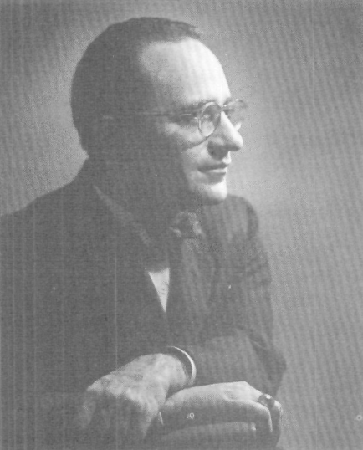
3. Murray earned his Ph.D. in 1956 from Columbia University and had this picture taken to forestall his parents who wanted a picture taken in his cap and gown.
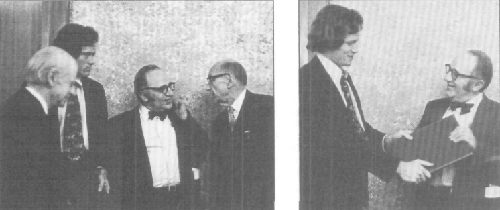
4. & 5. At a dinner given by the National Taxpayer’s Union in 1973, Murray was presented with one of five bound volumes of Benjamin Tucker’s Liberty magazine. Top left, left to right, Professor W. H. Hutt, James Dale Davidson (founder of the National Taxpayer’s Union), Murray, and Henry Hazlitt; top right, James Dale Davidson and Murray.

6. From left to right, Ralph Raico, Murray, George Reisman, Robert Hessen, and Leonard Liggio in August 1955.
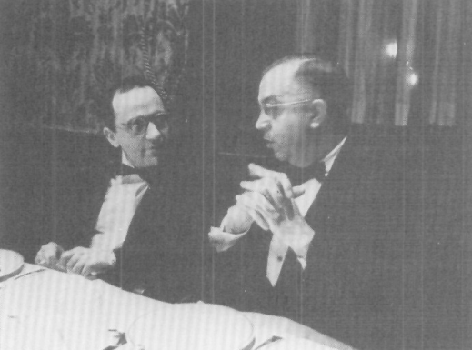
7. This picture was taken at a dinner given in honor of Ludwig von Mises in 1955; at right, Murray and F. A. Harper, founder of the Institute for Humane Studies.

8. Murray in 1962.

9. On a trip by the York River in 1967.

10. This picture was taken in 1965, in Orange, Virginia, as the Rothbards took their first trip to the South.

11. Murray with Robert Kephart, founder of Audio-Forum and the Personal Finance newsletter, in August 1979.

12. Murray and JoAnn Rothbard in 1979, take a few minutes to vacation in Florida.

13. Murray in a thoughtful moment.

14. Happy Sixtieth Birthday, Murray!
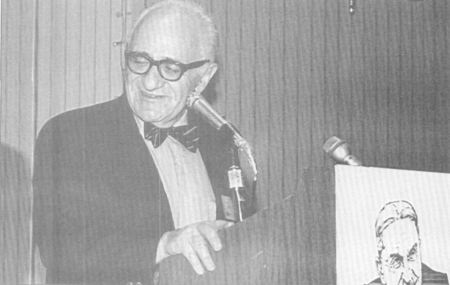
15. Rothbard responds with appreciation to the papers delivered in his honor at the Mises Institute Conference, Man, Economy, and Liberty, that accompanied the surprise birthday party for his sixtieth birthday.
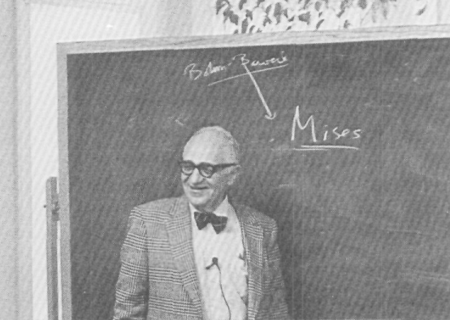
16. Murray lectures on the foundations of the Austrian school at a Mises Institute seminar in Washington, D. C.
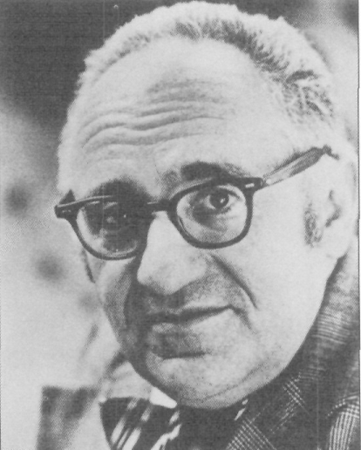
17. The classic Rothbard! Picture taken in 1978 at a meeting of the board of the Cato Institute.
Pictures Courtesy of:
The Cato Institute 17
David Jarrett 14, 15, 16
Robert Kephart 11,12
JoAnn Rothbard 1,2, 3, 4, 5, 6, 7, 8,9,10
The Ludwig von Mises Institute 13,16

