
Liberty
Chapter 13. The Extent Of Lost Liberty
CHAPTER THIRTEEN
THE EXTENT OF LOST LIBERTY
A ROUGH MEASUREMENT of the encroachment on liberty is to be found, then, in the proportion of the product of a person’s labor that is taken from him by force or by threat of force, by government. A study of these figures, over the century and a half of our history as a nation, gives cause for deep concern (see chart on page 108).1
In 1947 the figure for governmental take was 29 cents from each dollar of income, or one and one-half times the entire food bill of the nation (excluding the taxes buried in the price of food).2 A common reaction may be, “Perhaps so, but I don’t pay any such amount in taxes.” Much of this tax is in the form of hidden taxes, and one cannot see what is hidden. About two-thirds of this 29 cents, or about $1,000 in a year for the average family, is in the form of various hidden taxes; this amount of tax has become buried in the prices of everything you buy and of every service you employ — bread, shoes, haircuts, electric bill, the new car, movies, railroad tickets — everything. One author has estimated that there are 502 taxes on a pair of shoes. When all of these hidden taxes are brought to light, one finds that he now works 3½ months for the government, leaving only 8½ months to work for himself.
LOSS OF FREE CHOICE IN THE SPENDING OF INCOMES
Figures prior to 1849 include Federal Government only
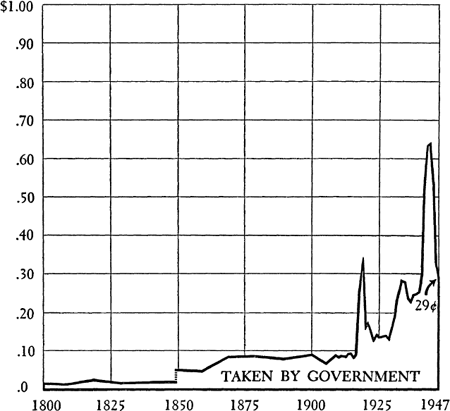
Government in the United States is now taking from persons’ incomes an amount equivalent to the complete enslavement of about 42 million persons — working persons and members of their families. Compare that figure, and the concern about it, with the figure of 4 million privately-owned slaves in the United States at the outbreak of the War Between the States!
All this is being done under the name of liberty, in a nation where liberty supposedly reigns as a beacon for the rest of an enslaved world. It is all being done under the name of a “progressive” society.
The present figure of 29 cents, even under present conditions of high employment and money incomes, is frightening enough. But a decline in employment to a point like that of 1938-40, in its effect on the national income, would automatically increase the burden to 35 cents or more out of each dollar of persons’ incomes; and this estimate fails to include any additional governmental costs “to relieve the depression.”
The threat and danger embodied in a figure of 35 cents, or more, can be gleaned from a few comparisons. The latest figure at hand for the United Kingdom is about 35 cents out of each dollar.3 The situation in the United Kingdom under this burden is well known, as suggested by the common use of the word “austerity,” and also by the fact that the United States is being asked to contribute great sums of money in the hope of bolstering the British economy.
A study of the tax burden of 48 nations in the late twenties offers some sobering evidence.4 Among those 48 nations were four large ones (over 25 million population) where the government was then taking more than 20 per cent of the citizen’s income. Call to mind what has happened in those four countries from the standpoint of liberty of the citizens:
|
Taxes as per cent of national |
|
USSR |
29 |
|
Germany |
22 |
|
France |
21 |
|
United Kingdom |
21 |
A near-comparable figure for the United States at that time was 14 per cent, as the cost of government in proportion to the national income.
“The power to tax is the power to destroy.” The power to tax incomes is the power to destroy incomes. The power to tax property is the power to destroy property, whether by a capital levy or in any other form. And since income and property are the economic extensions of the person, the power to tax becomes the power to destroy persons to whatever extent economic considerations are important to life and happiness.
In an autocracy, the power to tax is the power of the autocrat to destroy persons in this sense. In a democracy, the power to tax becomes the power of certain persons to destroy other persons, and it becomes the right to use all forms of legalized power and influence to do so — lobbies, pressure groups, and all the others.
Dr. Colin Clark, the Australian economist, has concluded from his study of governmental costs that whenever the figure for any country rises to more than 20 or 25 per cent, progressive inflation and the debauchery of the currency is the likely result.5
And Lord Keynes reported:
Lenin is said to have declared that the best way to destroy the Capitalist System was to debauch the currency. By a continuing process of inflation, governments can confiscate, secretly and unobserved, an important part of the wealth of their citizens.6
The “Capitalist System,” which Lenin wished to destroy, is based on the right to the product of one’s own labor and on the right to save some of it as private property. It is based on the foundation of liberty, as herein defined.
The private property that comes into being when a person spends less than his income, or consumes for purposes of his current living less than he produces, becomes the capital of the “Capitalist System.” This right to private security in the form of one’s savings put to some productive use, is the essence of economic liberty. Destroying the “Capitalist System” means destroying this liberty and these rights; it means the prohibition of the self-responsibility and private security, in the form of personal savings; it means a most powerful invitation to personal irresponsibility and intemperance in economic consumption.
History confirms the effectiveness of these means of destroying the foundations of human liberty. And it further records the failures of socialistic nations of the past, in sharp contrast with the human happiness and progress that abounds wherever a high degree of human liberty prevails.
Events before the French Revolution illustrate the consequences of economic intemperance. Following a long series of governmental deficits, the debt by 1788 had reached such proportions that, with an added deficit of 20 per cent of governmental expenditures in that year, half of the budget went for costs of the debt.7 The cost of the debt would have exceeded even that proportion, except for the “shameless waste” and extravagance that padded the remaining portion of expenditures. Taxes, though having been raised to the limit of yield, were far from enough to pay the costs of this wastage and the pensioning of privilege and favoritism. Indirect taxes, including inflating the currency to pay expenses, was used more and more. The credit standing of the government finally was completely destroyed, so that income from the issuance of loans was no longer possible. The government extended its monopolies and confiscated wealth in various ways. Personal violence began and spread as a consequence of enforcing the decrees and as an accompaniment of the growing economic vice, until the bloody revolution was in full swing.
Among the authorities on the subject of liberty in relation to the rise and fall of civilizations is Sir Flinders Petrie, the great British archeologist. He traced the six great civilizations of the world during the last 8,000 years. He found that the rise of these civilizations occurred while liberty was at its height, that when economic parasitism set in these civilizations degenerated rapidly into a long period of “dark ages.”
That, in a nutshell, indicates the present status of liberty in the United States.
Many persons who call themselves realists, but who are called fatalists by others, know these events of history and believe that liberty in a nation tends to erode more and more until finally it has been almost entirely lost. Whereas it seems that such has tended to be the pattern of national experience, no one pattern is inevitable as the course of a national society. If it were inevitable, why would there be all the variation of patterns between nations now and at any other time in the past? This argument of inevitability becomes an effective weapon of those who are pleased with recent trends in this and in other countries, and who would like to have all opposition to their hopes fade before the “inevitable.”
The lovers of liberty must remember that, in a seriously ill society as with a seriously ill person, the choice may be between some form of early medical treatment — perhaps pills that may be unpalatable at the moment — and the services of an undertaker. If these preventive steps are not taken in time, and if the little problems of liberty are allowed to go unsolved, they accumulate into catastrophe; in the end there comes bloody revolution of the worst sort, when the growing octopus of tyranny has finally become unbearable.
The great social problem of our age is that of designing the preventive medicine that will stop the eroding liberty in the body politic. Further, once the disease has advanced to the point of a most serious danger, a bitter curative medicine is required to regain already-lost liberty.
1 For detailed comments on the history of these changes, see 31¢, by F. A. Harper, (Irvington, New York: The Foundation for Economic Education, 1947).
2 The figure includes “loans” by the United States Government to foreign nations, because past experiences and present conditions in these foreign governments suggest that repayment is highly questionable.
3 Derived from figures in “National Income and Expenditure of the United Kingdom,” His Majesty’s Stationery Office, London, 1947, and other sources.
The London Economist for March 19, 1949 reported that the figure for the current budget has risen further to 40 per cent of the total of all incomes.
4 Edmond E. Lincoln, “Sobering Realities Regarding Tax Burdens,” The Commercial and Financial Chronicle (April 1, 1948).
5 Dr. Colin Clark, “Public Finance and Changes in the Value of Money,” The Economic Journal (December, 1945).
6 John Maynard Keynes, The Economic Consequences of the Peace (New York: Harcourt, Brace and Howe, 1920, p. 235).
7 Georges Lefebvre, The Coming of the French Revolution (Princeton University Press, 1947, p. 22).

