
Let Freedom Reign
3. Let’s Be Philosophers
LET’S BE PHILOSOPHERS
We can gain in self-controlled, rational activity only as we become what I call philosophers. Viewing ourselves in this role brings forth a few more thoughts about why the overall luminosity—Creative Wisdom—brightens among free men.
Tradition has it that philosophy is a discipline reserved for rare souls with brilliant minds and an esoteric bent. I propose a break with this tradition: let’s all be philosophers! We can begin by understanding what philosophy embraces in its most meaningful sense.
Ortega describes philosophy as going down deep for underlying causes and forces and surfacing with them, that is, bringing them up in clarity for the sake of understanding. Thus, the philosopher is the clarifier, the simplifier of complex reality, the one who can see through and explain in terms that others may also see. If he does this well, we call him a “seer.”
Parenthetically, it is doubtful if anyone ever clearly sees that which he cannot bring to the surface in clarity, which is to say that no idea is clear in the mind of a person if he cannot lucidly express it in words. An idea, committed to words, is but the reflection of what’s in the mind; if the reflection is fuzzy, so is the original. An intelligible idea can be plainly articulated.
Bringing difficult matters to the surface—clarification to the point where others may behold and use them—gives us a helpful picture. But it occurs to me that “going deep” conjures up a wrong impression as to where truth and ideas, awaiting apprehension, are to be found. Using this analogy, we may visualize a globe with ourselves on the surface. So far, so good! “Going deep,” however, suggests that the probing—searching for truth—is toward the globe’s center. Were this the case, then the deeper philosophers probe, the nearer would they come to agreement; they would be working toward a common position. Eventually, there at center would stand the philosophers, all in unison, proclaiming Truth in its pristine purity.
This going-down-deep analogy simply does not square with reality. For proof, take a look at the findings and explanations of some four hundred of the most famous philosophers who have lived1—and note how rarely have any two seen the same things. Here some light, there a flicker, with each philosopher seeing and explaining some tiny point different from all other sightings. I can find no evidence that these intellectual giants have been moving toward a common point or center. To the contrary, each appears to find a fragment which he brings to the surface as a bit of light. There isn’t necessarily a contradiction in the findings, but there is an impressive lack of unanimity.
How, then, can we better visualize what actually occurs?
Simply imagine a globe with all of us on the surface, as before, with the lines of search stretching up and away rather than down and deep. The lines, instead of converging toward a center, are diverging as they reach out toward an ever-expanding and limitless periphery—the infinite.
Our customary way of thinking has philosophers going deep and bringing their findings back to the surface as in A. Instead, they go up and outward and bring their findings back to the surface as in B:
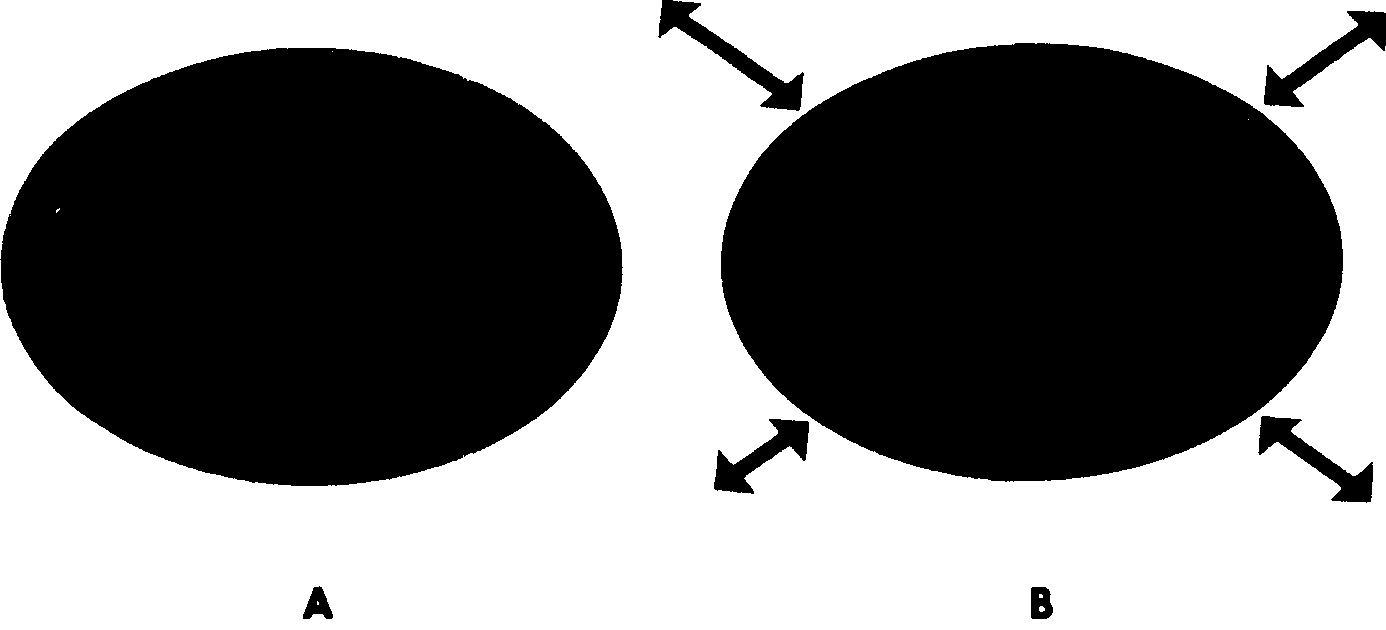
The A diagram pictures the searchers for and explainers of truth coming closer to agreement the “deeper” they probe. This is false. B, on the other hand, has them probing outward and bringing back to the surface bits of truth that are always new and different. The further they probe, the greater the divergence. This squares with what we observe—the gist of the matter.
Now, here’s where we come in. According to the above description, philosophers are not merely the few who have distinguished themselves historically—become famous—but every last one of the countless millions—known and unknown—who reach out, discover, and bring back to the surface rays of light: creativities, inventions, insights as we call them, ideas. Admitted as philosophers in this description are the unknowns who discovered how to harness fire, invented zero, and so on. Indeed, our tribe, when described this way, goes back to the dawn of self-consciousness and includes all persons past or present who have probed, found, and brought to the surface any bit of light. There have been trillions of flickers and flashes, from the dimmest to the brightest.
At first blush, this thesis gives the appearance of beating a very tiny drum. But there’s more to it than first meets the eye.
Consider the millions of us on the surface and how bewildered we are by the absence of unanimity among those who sincerely search for truth and seriously try to explain and clarify their findings. Instead of their findings moving toward a hoped-for agreement, these impress us as more and more antagonistic; they seem to be at sixes and sevens. This isn’t, we are prone to believe, the way it ought to be. But we need to take another look: these seeming antagonisms are not necessarily antagonisms but, rather, varying fragments on which evolution and all progress are dependent.2 For peace of mind, we need to see these variances for what they really are: assets, not liabilities.
That which philosophers seek and sometimes find and bring back to the surface is, hopefully, and often is, a bit of truth. And, interestingly enough, the more the prober knows of truth, the more he knows he doesn’t know. The more he finds, the more he should know there is to find. This is finite man in a never-ending invasion of infinity—man’s wonderful destiny.
Put it another way: Out and away from the surface, challenging man now and forever, is unseen truth, a limitless darkness. Truth can only be found in an infinity of fragments—call them ideas—awaiting apprehension. And the moment any idea is apprehended it becomes a light. Philosophers bring to the surface these tiny rays of light which, in their aggregate over the millennia, result in an enormous luminosity.
The Elusiveness of Truth
Without denying that there are verities, we observe that new-found truths are forever correcting or even displacing earlier “truths.” A new bulb for one that has dimmed or burned out! One of countless examples: Galileo affirmed the theory of Copernicus that the solar system does not revolve around our earth. Galileo brought a new ray of light to the surface by a new apprehension; he added to the illumination by which we live and evolve. So long as we do not go static, that is, so long as we are philosophers, truth will remain an ever-elusive, advancing object, a wisdom to be pursued but never captured entirely.
We should bear in mind that man progresses or regresses, which is to say, humanity evolves or devolves as the surface luminosity dims or brightens. It seems to follow that everything in life that matters hinges on our competency as philosophers.
This luminosity, gathered within the history of mankind—rays of light by the trillions—is sometimes referred to as “knowledge in society” rather than my own favorite term: “Creative Wisdom.”
Once the enormity of Creative Wisdom—the luminosity—is grasped we see that:
-
The wisdom by which we live is unimaginably greater than can possibly exist in any discrete individual;
-
All forms of authoritarianism are pompous nonsense;
-
These trillions of tiny know-hows—ideas—to be useful, must flow and exchange freely, which explains our vital need for individual liberty;
-
The miracle of the free market is the miraculous coalescence of these tiny rays of light into the over-all luminosity;
-
It is possible to have jets, cars, pencils, and a million other things without any one person knowing how to make them;
-
We can trust mail delivery or any other creative activity to the free market;
-
We are the beneficiaries of countless economic, political, moral, ethical, and spiritual principles we have not ourselves deduced;
-
We owe our lives to this inheritance and, as specialists, we are interdependent;
-
My freedom depends upon yours.
Philosophy—the pursuit of truth and bringing the findings to the surface in clarity—is not reserved to those with brilliant minds and an esoteric bent. Philosophy is for you and me and for every human being who cares one whit about his own growth and the welfare of others.
I say, let’s all try to be philosophers!
- 1The Royal Bank of Canada Monthly Letter, February, 1969.
- 2Even prohibiting pollution in highly polluted areas may be no solution. Pollution is becoming a problem of the whole troposphere, that is, the troposphere assuredly has containment limitations. If this view be accepted, then pollution released atop Mt. Everest could eventually wreak its havoc on Americans.

