
Karl Marx and the Close of his System
Appendix
CRITICS of Marx have hitherto shown little inclination to examine more closely the procedure which is used in the third volume of Capital1 for the transformation of values into prices of production and for the determination of the average rate of profit, in order to see whether this procedure is free of contradictions.
Tugan-Baranowsky provides an exception in this respect.2 He has shown specifically that the way Marx calculates the average rate of profit is not valid. Moreover, Tugan-Baranowsky has pointed out how with given prices of production and a given average rate of profit it is possible to calculate correctly the corresponding values and the rate of surplus value. In this case there is posed a problem which is the opposite of that which Marx tried to solve.
It is nevertheless interesting to show that Marx erred, and in what way, without reversing his way of posing the problem. For this purpose, it will be convenient, in order not to complicate the presentation, to introduce the same limiting assumption which Tugan-Baranowsky made use of, namely, that the entire advanced capital (including the constant capital) turns over once a year and reappears again in the value or the price of the annual product.3 Insofar as it is a question of demonstrating Marx’s errors it is quite unobjectionable to work with limiting assumptions of this kind, since what does not hold in the special case cannot claim general validity.
In still another respect the procedure followed here agrees with that of Tugan-B aranowsky. The different spheres of production from which Marx composes social production as a whole can be put together into three departments of production. In Department I means of production are produced, in Department II workers’ consumption goods, and in Department III capitalists’ consumption goods. At the same time we shall assume that in the production of all three groups of means of production, that is, those which are used respectively in Departments I, II, and III—the organic composition of capital is the same.
Finally, we shall assume “simple reproduction.”
Let c1, c2, c3 stand for the constant capital, v1, v2, v3 for the variable capital, and s2, s2, s3 for the surplus value in Departments I, II, and III respectively. The conditions of simple reproduction are expressed in the following system of equations:
(1) c1 + v1 + s1 = c1 + c2 + c3
(2) c2 + v2 + s2 = v1 + v2 + v3
(3) c3 + v3 + s3 = s1 + s2 + s3
If we now designate the rate of surplus value by r, then we have
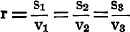
and equations (1), (2), and (3) can be rewritten as follows:
(4) c1 + (i + r)v1 = c1 + c2 + c3
(5) c2 + (i + r)v2 = v1 + v2 + v3
(6) c3 + (i + r)v3 = s1 + s2 + s3
The problem now is to convert these value expressions into price expressions which conform to the law of the equal rate of profit.
Marx’s solution consists, first, in forming the sums
(7) c1 + c2 + c3 = C
(8) v1 + v2 + v3 = V
(9) s1 + s2 + s3 = S
next, in determining the sought-for average rate of profit, which will be designated by ρ, from the formula
(10) 
and, finally, expressing the production prices of the commodities produced in the three departments by
c1 + v1 + ρ (c1 + v1)
c2 + v2 + ρ (c2 + v2)
c3 + v3 + ρ (c3 + v3)
from which it emerges that the sum of these three price expressions, or the total price, is identical with the sum of the corresponding value expressions, or the total value (C + V + S).
This solution of the problem cannot be accepted because it excludes the constant and variable capitals from the transformation process, whereas the principle of the equal profit rate, when it takes the place of the law of value in Marx’s sense, must involve these elements.4
The correct transition from value quantities to price quantities can be worked out as follows:
Suppose that the relation between the price and the value of the products of Department I is (on the average) as x to 1, in the case of Department II as y to 1, and in the case of Department III as z to 1. Furthermore let ρ be the profit rate which is common to all departments (though now formula (10) can no longer be regarded as the correct expression for ρ).
The counterpart of equations (4), (5), and (6) is now the following system:
(11) (1 + ρ)(C1X + v1y) = (C1 + c2 + c3)x
(12) (1 + ρ)(c2x +v2y) = (v1 + v2 + v3)y
(13) (1 + ρ)(c3x + v3y) = (s1 + s2 + s3)z
In this manner we obtain three equations with four unknowns (x, y, z, and ρ). In order to supply the missing fourth equation we must determine the relation between the price unit and the value unit.
If we were to choose the price unit in such a way that total price and total value are equal, we would have to set
(14) Cx + Vy + Sz = C + V + S
where
(15) C = c1 + c2 + c3
(16) V = v1 + v2 + v3
(17) S = s1 + s2 + s3
If, on the other hand, the price unit and the value unit are to be regarded as identical, then we have to consider in which of the three departments the good which serves as the value and price unit is produced. If gold is the good in question, then Department III is involved and in place of (14) we get
(18) z = 1
Let us follow this last procedure. In this fashion the number of unknowns is reduced to three (x, y, and ρ).
To arrive at the simplest possible formulas, let us form the following expressions:
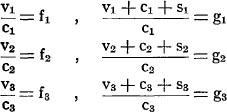
and
1 + ρ = σ
Equations (11), (12), and (13) can be rewritten, taking account of (1),(2),and (3),as follows:
(19) σ (x + f1y) = g1x
(20) σ (x + f2y) = g2y
(21) σ (x + f3y)= g3
From equation (19) we get:
(22) 
If we substitute this value for x in equation (20) the result is
(23) (f1—f2) σ2 + (f2g1 + g2) σ—g1g2 = 0
from which it follows that
(24) 
or, otherwise written,
(25) 
It is easy to show that in this case the quadratic equation (23) yields only one solution which is relevant to the terms of the problem. If f1—f2 > 0, we get σ < 0 by putting a minus sign in front of the square root in formula (24). If on the other hand f1—f2 < 0, the result of putting a plus sign in front of the square root in formula (25) is

and a fortiori

This contradicts equation (20) which yields

From equations (20) and (21) we find:
(26) 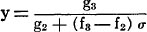
and when we have solved for σ and y, x can be calculated according to formula (22).
Let us now see by several numerical examples how these formulas can be used to transform values into prices. Suppose for example that the given value expressions are the following:
TABLE 1: VALUE CALCULATION
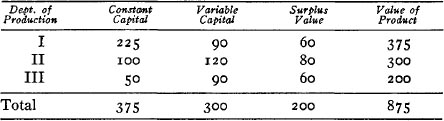
From this we derive the following numerical values:
c1 = 225, c2 = 100, c3 = 50, v1 = 90, v2 = 120, v3 = 90, s1 = 60, s2 = 80, s3 = 60, and further: 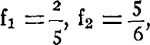
Formulas (25), (26), and (22) yield:
σ =  , therefore
 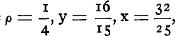 and we get:
TABLE 2: PRICE CALCULATION
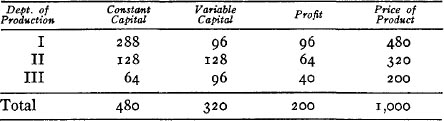
In Department I the price expression for constant capital (288) comes from multiplying the corresponding value expression (225) by , and the price expression for variable capital (96) from multiplying the corresponding value expression (90) by
  . The profit in this department consists of the sum of the two price expressions (288+96) multiplied by the profit rate (
 ). The figures for the other departments are calculated in exactly the same way.5
That the total price exceeds the total value arises from the fact that Department III, from which the good serving as value and price measure is taken, has a relatively low organic composition of capital. But the fact that total profit is numerically identical with total surplus value is a consequence of the fact that the good used as value and price measure belongs to Department III.
It is not without interest to compare the price and profit relations of Table 2 with the price and profit relations which Marx would have obtained in this case. According to formula (10) Marx would have written 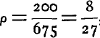 , since (according to Table 1) S = 200, C = 375, V = 300.
We get:
TABLE 3: PRICE CALCULATION ACCORDING TO MARX
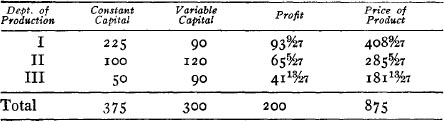
There thus emerges a discrepancy between the prices of the quantities produced in the various departments (408 , 285
, 285 , 181
, 181 ) and the numerical expressions for constant capital, variable capital, and profit. As already indicated, Marx would have had to determine the average rate of profit in this case to be
  , or 29.6 percent, while according to the correct procedure it amounts to ¼, or 25 percent.6
But Marx not only failed to indicate a valid way of determining the rate of profit on the basis of given value and surplus value relations; more, he was misled by his wrong construction of prices into an incorrect understanding of the factors on which the height of the rate of profit in general depends.7 He took the position that with a given rate of surplus value the rate of profit is greater or smaller according as the total social capital, including all spheres of production, has a lower or higher organic composition. This view follows from the fact that Marx expressed the rate of profit by formula (10). If we designate, as before, the rate of surplus value by r and the relation of the value of constant capital to total capital by q0, according to which
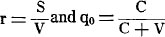
we should then have:
(27) ρ = (1 – q0) r
According to this, with a given rate of surplus value the only circumstance which affects the height of the rate of profit is whether the share of constant capital in total capital, the quotient q0 is larger or smaller; and it would make no difference at all what differences existed between the organic composition of the capitals in the different spheres of production.
It is true that in Capital we read that the general rate of profit is determined by two factors: (i) the organic composition of the capitals in the different spheres of production, hence the different profit rates of the individual spheres, and (2) the distribution of the total social capital among these different spheres.8 But the way Marx works these two factors into his calculation schema is such as to allow us to reduce them to one single factor, namely the organic composition of the total social capital.
Let q1 represent the relation of constant capital in our Department I to the total capital of that department, γ1 the share of the latter in the total social capital. Similarly let q2, γ2 and q3, γ3 represent the analogous quantities in Departments II and III. These designations can be expressed in the following formulas:
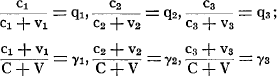
From these formulas it appears that:

or also, since c1 + c2 + c3 = C and 
(28) q0 = γ1q1 + γ2q2 + γ3q3
If one now substitutes this formula for q0 in (27) and takes account of the fact that γ1 + γ2 +γ3 = 1, one gets:

This formula expresses the Marxian standpoint very clearly: the general rate of profit (ρ) appears as the arithmetic average of the particular rates of profit (1—q1)r, (1—q2)r, and (1—q3)r, which contribute to the formation of the average with the respective “weights” γ1, γ2, γ3. And of the two factors which in Marx’s view determine the general rate of profit, one, according to formula (29), is represented by q1, q2, q3 and the other by γ1, γ2, γ3 It is, however, obvious from formula (28) that these two factors can be reduced to one single factor, that is to say, to the organic composition of the total social capital which is represented by q0.
In opposition to this view we shall now show by means of a suitably constructed numerical example that, because formulas (27) and (29) are false, cases are possible in which, with a given rate of surplus value, one and the same rate of profit is compatible with different organic compositions of the total social capital. Take the following value schema as a starting point:
TABLE 4: VALUE CALCULATION
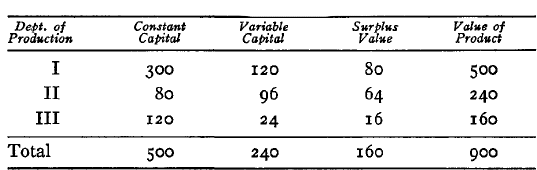
If we compare this table with Table 1 we find that the rate of surplus value is the same (66 ⅔ percent), while the organic composition of capital is higher. According to Table 1, 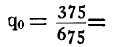 .556; while according to Table 4,
 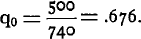 Marx would say that the rate of profit must fall from 29.6 percent to 21.6 percent.
If we now apply to this table the correct method of transformation, as we did in going from Table 1 to Table 2, we find x = 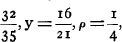 and as a complete result:
TABLE 5: PRICE CALCULATION
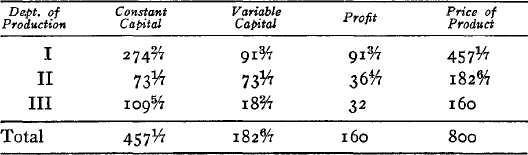
The reason why Table 4 gives the same rate of profit as Table 1 (25 percent) is that according to formula (25) the rate of profit (ρ = σ—1), given a certain rate of surplus value, depends exclusively on the organic composition of the capitals in Departments I and II (in this connection it is necessary to keep in mind the meaning of the quantities f1, f2, g1, and g2), and that in this respect Tables 1 and 4 are identical. But the circumstance that the ratio of constant capital to total capital in Department III has grown from about 36 percent to about 83 percent has no bearing on the height of the rate of profit. For the rest, however, this result is hardly surprising from the point of view of the theory of profit which sees the origin of profit in “surplus labor.” Ricardo had already taught that a change in the relations of production which touches only such goods as do not enter into the consumption of the working class cannot affect the height of the rate of profit.9
Let us now consider a case where the rate of profit changes in spite of the fact that the organic composition of the total social capital remains the same. This happens if one contrasts with Tables 1 and 2 the following tables:
TABLE 6: VALUE CALCULATION
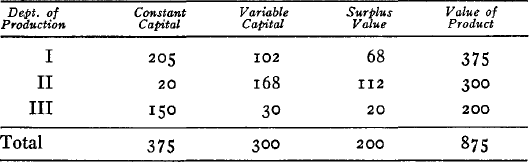
Following formulas (25), (26), and (22) we get

and as a complete result:
TABLE 7: PRICE CALCULATION
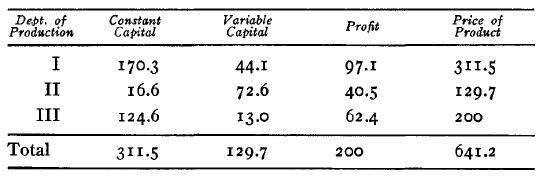
Marx’s method of transformation would have produced the same rate of profit again, 29.6 percent (instead of 45.3 percent), and the distribution of the total profit among the three departments would have been as follows: Department I, 90  (instead of 97.1), Department II, 55
 (instead of 40.5), and Department III, 53
 (instead of 62.4).
The erroneous character of Marx’s transformation method comes out even more clearly in the special case where there is no constant capital in Department II. We have this case in the following table:
TABLE 8: VALUE CALCULATION
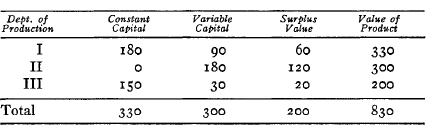
In this case we can no longer use formula (25) for the purpose of calculating ρ or σ, because f2 = ∞ and g2 = ∞. We have instead to go back to equations (11), (12), and (13). We find from (12), since c2 = 0, that
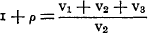
By reason of formula (2) we can also write (again because
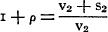
and finally

or ρ = r
The rate of profit is equal to the rate of surplus value, thus according to Table 8 equal to ⅔ or 66⅔ percent. If we put this value of ρ into formulas (11) and (13) we get two equations of the first degree with two unknowns (x and y), since here too z = 1, and we find: x =  . The conversion of values into prices and of surplus value into profit gives:
TABLE 9: PRICE CALCULATION
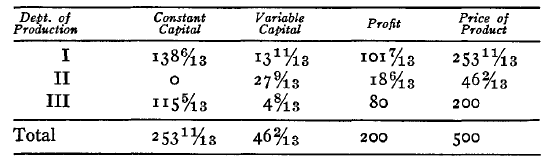
According to Marx, however, the relevant quantity relations would be as follows:
TABLE 10: PRICE CALCULATION ACCORDING TO MARX
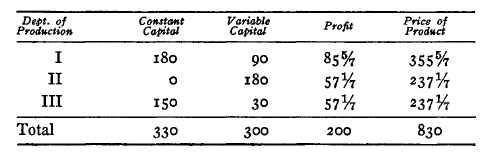
The rate of profit would  be or 31.8 percent (instead of 66⅔ percent!).
In this case, characterized by the absence of constant capital in Department II, the incorrectness of Marx’s derivation of prices and profit is particularly obvious. For it is clear that here in Department II, where the outlay of capitalists consists solely of variable capital and indeed of the very commodities which are produced in that department, the gain of the capitalists must always remain in the same relation to their outlay whether the prices of the relevant commodities are higher or lower. There is no way, either through exchange of commodities or through “price regulation,” by which this relation could be reduced from 66⅔ percent to 31.8 percent.
Following Table 9 we can represent commodity exchanges as follows:10
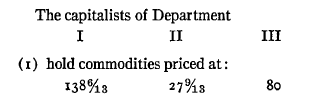
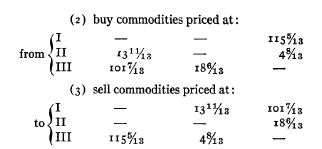
As can be seen, in the case of each group of capitalists the sum of the prices at which commodities are bought is the same as the sum of the prices at which commodities are sold. Table 10 would show a different picture:
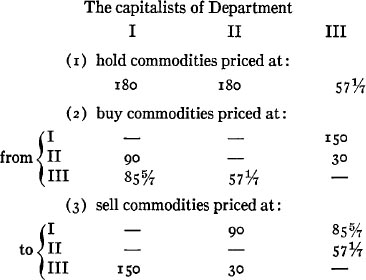
Here the capitalists of Departments I and III would take in less than they pay out, while contrariwise the capitalists of Department II would take in more than twice what they pay out.
The case where c2 = o is, however, useful not only for showing up very clearly to what paradoxes Marx’s method of converting values into prices leads, it is also very well suited to serve as a starting point for an essential supplement to our previous exposition.
One would be inclined to conclude from the fact that in this particular special case the rate of profit is simply equal to the rate of surplus value, and also from the fact that it is entirely independent of the organic composition of capital in Departments I and III, that the organic composition in these two departments could be of any height without there ensuing a decline in the rate of profit. If this were true, and regardless of its being a special case, one could hardly suppress a strong doubt about the correctness of explaining profit by the principle of “surplus labor.”
The truth of the matter, however, is that the share of constant capital in the total investment of Departments I and III cannot exceed a certain limit if the rate of profit in these two departments is also to equal r. If we substitute r for p in equation (11) and take account of equation (4), we get:

from which follow

and also

On the other hand, by reason of equation (1), with c2 = 0, we have
c3 = (1 +r)v1
Let us introduce the new expressions

We now have the inequality
(30)
Therefore

or
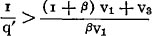
and as a consequence
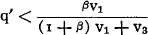
(31)
We then have a fortiori:

or
(32)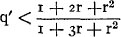
The quantity q’ is, however, the expression for the organic composition of the combined capitals of Departments I and III. The independence of the rate of profit from the organic composition of the capitals in I and III, in the case where there is no constant capital in II, therefore, does not at all mean that the organic composition of capital in the other two departments can be indefinitely high. The truth of the matter is rather that if the share of constant capital in these departments, the quantity q’, exceeds a certain limit, the equalization of the rate of profit becomes impossible.
In order to determine the upper limit for q0, in other words for the share of constant capital in the total social capital, it is most convenient to start from the inequality (30) which can also be written as follows (with c2 = o):

We have

and therefore:
(33)
From the relation
(34) 
we get, however,
v = v2 + rv2
and since on the other hand
v = v1 + v2 + v3
it emerges that:
v1 + v3 = rv2
and as a consequence

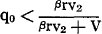
If we now substitute rv2 for v1 in (33), we get a fortiori
or also, taking account of (34),
(35)
Hence if the rate of surplus value is 66⅔ percent, as we have assumed in the foregoing examples, then the constant capital invested in Departments I and III can in no case exceed ⅝ of the total social capital.
So much for the case in which c2 = 0, that is to say in which constant capital is absent from Department II.
Likewise if C1 = 0 it is impossible to determine the rate of profit by means of formulas (24) or (25), because here f1 = ∞ and g1 = ∞. If we take equations (11) and (12) as a basis for the determination of ρ or σ, we easily find:
(36)
where r, as formerly, signifies the rate of surplus value . This last equation can also be derived from equation (23) if one divides its coefficients by g1. With c1 = 0,
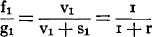
It would be entirely wrong to assume from the fact that r appears in (36) and not in (23) that in the case where c1 is not zero the rate of profit is independent of the rate of surplus value. This is because the quantities g1 and g2 depend on r. We have:
g1 = 1 + (1 + r)f1
and
g2 = 1 + (1 + r)f2
If we eliminate the quantities f1, f2, g1, g2 from equations (23) and (36) by introducing the quantities q1, q2, and r, then the following relations emerge:
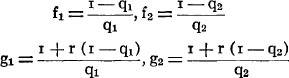
From this it is at once apparent that the rate of profit depends only on the rate of surplus value (r) and the organic composition of the capitals invested in Departments I and II.
The rate of profit is always smaller than the rate of surplus value, if we abstract from the special case where c2 = 0. This can be proved as follows:
From equation (11) we find
c1x + v1y < (c1 + c2 + c3)x
and, taking account of (4),
v1y < (1 +r)v1x,
from which it follows that

From equation (12) there thus emerges the inequality:

or, taking account of (9),

and finally
1 + ρ < 1 + r
and
(37) ρ < r
Another upper limit for ρ can be derived from (n) in the following way. We have:
(1 + ρ)c1x < (c1 + c2 + c3)x
and hence
(38)
This inequality allows us to conclude that with a given rate of surplus value (r) and a given quantity of variable capital (V), an unlimited growth of constant capital cannot take place without bringing about a decline in the rate of profit.
It follows from (4) that:
c2 + c3= (1 + r)v1
and this means that the growth of constant capital in Departments II and III finds a limit in the height of the rate of surplus value and in the size of the total disposable variable capital. It is to be remembered, too, that v1 forms a part of V.
We could say with equal justification that the growth of constant capital in Departments II and III finds a limit in the quantity of labor which society has at its disposal in a given economic period. Let this quantity be H. Of this h1 belongs to Department I, h2 to II, and h3 to III, so that H = h1 + h2 + h3. If we designate the quantity of labor contained in one unit of value as η then we have:
h1 = (v1 + s1η, h2 = (v2 + s2)η, h3 = (v3 + c3)η, and
H=(V + S)η,
We can now write
(c2 c3)η = h1
and since hi is a part of H, it appears that the constant capital invested in Departments II and III, measured in terms of the quantity of (stored-up) labor which it contains, is limited by the quantity of (living) labor which is available for use in production during the relevant economic period.
Nevertheless, so far as the constant capital invested in Department I (c1) is concerned, one can imagine it as growing indefinitely without disturbing the conditions of economic equilibrium as they find expression in equations (4), (5), and (6). But, as formula (38) shows, sooner or later the consequence of the growth of constant capital in Department I must be a decline in the rate of profit. For the rest, the inequality (38) is valid even in the case where c2 = 0.
It follows from what has been said that it would be entirely incorrect to state in opposition to Marx that the rate of profit does not depend in general on the organic composition of the total social capital. The simple relation between ρ and q0 with which Marx operates—see equation (27)—does not exist, and cases can be constructed in which, with a given rate of surplus value (r), the rate of profit (ρ) remains unchanged although q0 takes on different values, just as cases are possible in which ρ assumes different values although q0 remains unchanged. But—and this should not be overlooked—such cases are based on the supposition that the organic composition of capital is different in the three departments. If, on the other hand, the condition q1 = q2 = q3 is fulfilled, then values and prices are identical and formula (27) comes into force.
This last remark cannot serve to excuse Marx. For if the condition which would validate formula (27) is fulfilled, then the entire operation of converting values into prices is pointless, while Marx makes use of this formula precisely in connection with this operation.
The above remark is directed only against the criticism which holds that, regardless of whether the quantities q1, q2, and q3 are equal or not, the Marxian thesis of the influence of the organic composition of the total social capital on the height of the rate of profit, as this thesis finds expression in formula (27), is false.
Tugan-Baranowsky in particular makes this mistake. The two numerical examples with which he tries to refute the Marxian thesis are precisely characterized by the assumption that the organic composition of capital is equal in all three departments, in other words that q1 = q2 = q3 = q0.
In one example,11 r (the rate of surplus value) falls from 1 to  , while at the same time q0 increases from ⅔ to
  , from which it emerges, entirely in keeping with formula (27), that ρ (the rate of profit) declines from ⅓ to
  12
12
In the other example,13 r rises from 1 to  , while at the same time q0 increases from ⅔ to
  , from which, once again in keeping with formula (27), ρ increases from ⅓ to
  .
.
Tugan-Baranowsky concludes from the fact that in the one case a growth in the share of constant capital accompanies a fall and in the other case a rise in the rate of profit, that the general rate of profit is entirely independent of the organic composition of the social capital, and that therefore the Marxian theory of profit is false.14
As though such numerical examples could in any way touch the Marxian theory of the influence of the organic composition of the total social capital on the rate of profit! According to Marx, this influence makes itself felt in the indicated way only if the rate of surplus value remains unchanged.15
16 Vol. III, pp. 182-203.
17 Theoretische Grundlagen des Marxismus (Leipzig, 1905), pp. 170-188.
18 This assumption is also found, for example, in Kautsky, Karl Marx1 Okono-mische Lehren (Stuttgart, 1903), p. 98.
19 For a closer examination of this point, see the second article of my work “Wertrechnung und Preisrechnung im Marxschen System,” Archiv für Sozialwissenschaft und Sozialpolitik, Vol. XXV, No. 1 (July, 1907).
20 Table 1 is taken from the above-mentioned work of Tugan-Baranowsky, and all figures in Table 2 are related to the corresponding figures of Tugan-Baranowsky (ibid., p. i 7 i ) a s 8 t o 5 . Tugan-Baranowsky sets up his value schema in terms of labor units instead of money units. This is legitimate enough, but it turns attention away from the real difference between value calculation and price calculation.
21 See the first article of my work “Wertrechnung und Preisrechnung,” in Archiv für Sozialwissenschaft und Sozial politik, Vol. XXIII, No. 1, p. 46.
22 By rate of profit we understand here and in what follows, unless the contrary is expressly stated, the average rate of profit.
23 Vol. III, pp. 191-192.
24 For a closer examination of this point, see the third article of my work “Wertrechnung und Preisrechnung.”
25 For the sake of simplicity it is assumed that the capitalists advance consumption goods to their workers in natura so that the workers take no direct part in commodity exchanges.
26 Op. cit., p. 177.
27 By q0 I always understand the relation of the value of variable capital to the value of the total capital, while in Tugan-Baranowsky’s examples it is a question of price expressions. In the place of q0, which equals  ,there thus appears
  . But the latter expression is identical with q0 if one assumes, as Tugan-Baranowsky does, that the organic composition of capital is identical in all three departments. For in this case we have x = y or alternatively x = y = 1.
28 Ibid., pp. 180-181.
29 See the first article in my work “Wertrechnung und Preisrechnung,” pp. 48-49.
30 Capital, Vol. III, for example p. 75 and p. 248. The extent to which this limiting condition figures in the Marxian law of the falling rate of profit I have discussed thoroughly in the third article of my work “Wertrechnung und Preisrechnung im Marxschen System.”
- 1See the already repeatedly mentioned article “Zur Kritik,” pp. 555 ff.
- 2See above, pp. 49-51.
- 3O. v. Boenigk, ed., Staatswissenschaftliche Arbeiten: Festgaben für Karl Knies, Berlin, 1896. It appeared in separate covers during the same year and was reprinted in Franz X. Weiss, ed., Böhm-Bawerk’s Kleinere Abhandlungen über Kapital und Zins, Vienna and Leipzig, 1926.
- 4“It is singular,” Böhm-Bawerk wrote, “that Marx himself became aware of the fact that there was a contradiction here, and found it necessary for the sake of his solution to promise to deal with it later on. But the promise was never kept, and indeed could not be kept.” Capital and Interest, p. 390.
- 5Engels summed up these developments in his triumphal appearance before the Zurich Congress of the Second International (1893). “From the little sects of those days [the 1840’s],” he told the cheering delegates, “socialism has now developed into a powerful party before which the whole world of officialdom trembles. Marx is dead; but if he were still alive, there would be no man in Europe or America who could look back on his lifework with better reason for pride.” Quoted in Gustav Mayer, Friedrich Engels (1934), pp. 322-323.
- 6See, for example, O. D. Skelton’s Socialism: A Critical Analysis (1911), which is perhaps the ablest anti-socialist book by an American. Skelton refers to Karl Marx and the Close of His System as a “classic analysis,” and his own thought is obviously strongly influenced by it. In his well-known textbook, the late Professor Taussig devoted two chapters to socialism; in his bibliography to these chapters he lists Böhm-Bawerk first among “the innumerable discussions and refutations of the Marxian doctrines.” Principles of Economics, 3rd ed. (1921), Vol. II, p. 502. It would be easy to multiply examples.
- 7The Theoretical System of Karl Marx (1907), p. 85.
- 8P. H. Wicksteed, Das Kapital: A Criticism, first published in the socialist magazine Today, October, 1884; reprinted in The Common Sense of Political Economy (1933), Vol. II, pp. 705ff. In my judgment Wicksteed’s criticism, despite its brevity, is in many respects a better piece of work than the virtually simultaneous chapter on Marx in Böhm-Bawerk’s Capital and Interest. It is interesting to note that Wicksteed’s review appeared at a time when Marxism seemed to be making real headway in Britain. Later on, when the British labor movement had definitely turned away from Marxism, no topflight British economist showed any interest in the subject until Mrs. Joan Robinson’s very interesting Essay on Marxian Economics (1942).
- 9It could be argued that Pareto did in fact occupy this position in the Latin countries. I do not know the relevant literature well enough to form an opinion on this; but I do know that Pareto’s criticisms of Marx were never translated and exerted no significant influence in German- or English-speaking countries.
- 10Below, p. 3 ff.
- 11Franz Weiss says, with justice, that “Böhm-Bawerk’s criticism of Marx contrasts favorably with much that has since been written, both for and against Marx, by its dispassionate tone. Standing in complete opposition to Marx’s teachings, Böhm-Bawerk was extremely careful to be fair to him as a person.” Gesammelte Schriften von Eugen von Böhm-Bawerk, pp. xiii-xiv.
- 12For instance Vol. III, p. 243, where Marx affirms that “in no circumstances can the rise or fall of wages ever affect the value of the commodities.”
- 13Ibid., pp. 180-181.
- 14A translation of Das Finanzkapital is now in preparation and will be published by Augustus M. Kelley.
- 15For details and dates I have relied on Alexander Stein, Rudolf Hilferding und die deutsche Arbeiterbewegung: Gedenkblätter, published by the German Social Democratic Party in 1946.
- 16AN APOLOGIST of Marx, as intelligent as he is ardent, has lately appeared in the person of Werner Sombart. His apology, however, shows one peculiar feature. In order to be able to defend Marx’s doctrines he has first to put a new interpretation upon them.
- 17Let us go at once to the main point. Sombart admits (and even adds some very subtle arguments to the proof) that the Marxian law of value is false if it claims to be in harmony with actual experience. He says (p. 573) of the Marxian law of value that it “is not exhibited in the exchange relation of capitalistically produced commodities,” that it “does not by any means indicate the point towards which market prices gravitate,” that “just as little does it act as a factor of distribution in the division of the yearly social product,” and that “it never comes into evidence anywhere” (p. 577). The “outlawed value” has only “one place of refuge left—the thought of the theoretical economist. ... If we want to sum up the characteristics of Marx’s value, we would say, his value is a fact not of experience but of thought” (p. 574).
- 18BÖHM-BAWERK’S WORK was first published in 1896, under the title Zum Abschluss des Marxschen Systems, in a volume of essays in honor of Karl Knies. It appeared in Russian the following year and in English (in both London and New York) in 1898.
- 19It was quite natural, one might almost say inevitable, that Böhm-Bawerk should write this book. In his well-known history of theories of capital and interest, he had devoted a whole chapter to criticism of the theories of value and surplus value expounded in the first volume, of Capital. There he had noted that Marx was aware that commodities do not in fact sell at their values under developed capitalist conditions. He also noted that Marx promised to solve this problem in a later volume, a promise which Böhm-Bawerk was convinced Marx could not keep. Hence, when the third volume finally appeared with Marx’s detailed treatment of this question, Böhm-Bawerk doubtless felt duty bound to examine it with all possible care and to pronounce his verdict.
- 20It is against this background that we must evaluate Böhm-Bawerk’s critique of the theories of Marx. Organized socialism in Europe experienced a rapid growth in the last three decades of the nineteenth century, and it was also during this period that within the continental socialist movement Marxism won out over rival schools and doctrines. Hence, while the original reaction of the academic world had been to ignore Marx, it became increasingly difficult to maintain this attitude; as time went on it became more and more urgent to organize a counter-attack.
- 21So far as the United States is concerned, all the serious criticisms of Marxian economics with which I am acquainted recognize the authority, if not the primacy, of Böhm-Bawerk in this field; while the similarity of the anti-Marxian arguments in the average textbook to those of Böhm-Bawerk is too striking to be easily accounted a coincidence.
- 22From the Marxian camp the testimony to Böhm-Bawerk’s pre-eminence as an opponent is at least as striking. Louis B. Boudin, in the economic chapters of his important survey of the Marxian system and its critics, pays most attention to Böhm-Bawerk’s arguments: “First because Böhm-Bawerk is so far superior to his comrades in arms and his authority is acknowledged by them to such an extent, that it can hardly be claimed to be unfair to these critics, to pick Böhm-Bawerk as an example of them all. Second, because there seems to be quite a good deal of unanimity among these critics on this particular point [value theory], and the arguments advanced by the others are either directly borrowed from Böhm-Bawerk, very often with an acknowledgment of receipt, or are variations on the same tune deserving no particular attention.” The situation did not change greatly in this respect in the following decades. William Blake, writing in 1939, could say: “Böhm-Bawerk anticipated nearly all the attacks on Marxism from the viewpoint of those who hold political economy to center on a subjective theory of value. On the whole, little has been added to his case by other critics; their important contributions are outside the theories he chose to contest.”
- 23It has been necessary to stress the historical importance of Böhm-Bawerk’s criticism of Marx, but this should not lead us into the error of falsely evaluating the work itself. The truth is that in its essentials Karl Marx and the Close of His System is not a particularly remarkable performance. It is obviously the work of a skilled debater, but its intellectual content is largely confined to applications of the elementary principles of the marginal utility theory. Böhm-Bawerk’s line of reasoning was thoroughly familiar in academic economic circles, and any number of his contemporaries could have produced a critique of Marx which would have differed from Böhm-Bawerk’s only in matters of emphasis and detail. The examples of Wicksteed in England and Pareto in the Latin countries prove this, if indeed proof is required. We do not need to assume, therefore, that things would have been much different if Karl Marx and the Close of His System had never been written. Some other economist would have come forward to do the job which Böhm-Bawerk did; or perhaps Pareto’s critique, since it bore the authoritative stamp of the Lausanne school, might have assumed the pre-eminent position that Böhm-Bawerk’s actually occupied. Marx had to be refuted, and history, in casting her eyes over the possible candidates, selected Böhm-Bawerk as best fitted for the assignment. But if he had refused or fallen down on the job, some one else would have been ready to take his place. Here is a case, I think, where we can clearly accept Engels’ dictum: “That such and such a man and precisely that man arises at that particular time in that given country is of course pure accident. But cut him out and there will be a demand for a substitute, and this substitute will be found, good or bad, but in the long run he will be found.”
- 24It has been necessary to stress the historical importance of Böhm-Bawerk’s criticism of Marx, but this should not lead us into the error of falsely evaluating the work itself. The truth is that in its essentials Karl Marx and the Close of His System is not a particularly remarkable performance. It is obviously the work of a skilled debater, but its intellectual content is largely confined to applications of the elementary principles of the marginal utility theory. Böhm-Bawerk’s line of reasoning was thoroughly familiar in academic economic circles, and any number of his contemporaries could have produced a critique of Marx which would have differed from Böhm-Bawerk’s only in matters of emphasis and detail. The examples of Wicksteed in England and Pareto in the Latin countries prove this, if indeed proof is required. We do not need to assume, therefore, that things would have been much different if Karl Marx and the Close of His System had never been written. Some other economist would have come forward to do the job which Böhm-Bawerk did; or perhaps Pareto’s critique, since it bore the authoritative stamp of the Lausanne school, might have assumed the pre-eminent position that Böhm-Bawerk’s actually occupied. Marx had to be refuted, and history, in casting her eyes over the possible candidates, selected Böhm-Bawerk as best fitted for the assignment. But if he had refused or fallen down on the job, some one else would have been ready to take his place. Here is a case, I think, where we can clearly accept Engels’ dictum: “That such and such a man and precisely that man arises at that particular time in that given country is of course pure accident. But cut him out and there will be a demand for a substitute, and this substitute will be found, good or bad, but in the long run he will be found.”
- 25It was entirely within the framework of this approach that Böhm-Bawerk carried out his examination of Marxian theory. After a brief introduction, he devotes two chapters to setting out Marx’s theories of value, surplus value, average rate of profit, and price of production—“for the sake of connection,” as he says. On the basis of this exposition he concludes that Marx had not one but two theories of value (one in Volume I of Capital and another in Volume III) in Böhm-Bawerk’s sense of the term, that is, market exchange ratios. Moreover, according to Böhm-Bawerk, these two theories lead to different results, not occasionally or exceptionally but regularly and as a matter of principle. Hence, Bôhm-Bawerk “cannot help himself”; he is forced to the conclusion that there is a contradiction between Volume I and Volume III of Capital. He next proceeds to analyze at length—more than a third of the whole critique is devoted to this—the arguments by which, according to Bôhm-Bawerk, Marx seeks to prove that the contradiction is only apparent and that the theory of Volume I is valid, after all. Having disposed of these arguments one by one, Bôhm-Bawerk is at last ready to deal with the heart of the matter, “the error in the Marxian system,” for it is by now clear that error there must be. Naturally, he finds that the error lies in the fact that Marx started from the old-fashioned and exploded labor theory of value instead of pushing his way through to the new and scientifically correct subjective theory of value. This error ramifies throughout the system and vitiates it from top to bottom.
- 26This, then, is the form and substance of Böhm-Bawerk’s case against Marx. It is particularly important to recognize that it is not a personal attack on Marx. Nor is it simply one theorist’s dissection of the work of another, though this is undoubtedly what Böhm-Bawerk was aiming at. It is rather a systematic exposition of why subjective value theory, the “new economics” of half a century ago, rejected the Marxian system root and branch. It is this fact, rather than any special brilliance or originality in the work itself, which constitutes the importance of Böhm-Bawerk’s critique.
- 27It is evident that the total expenditure in wages is a product of the quantity of labor employed multiplied by the average rate of the wages. Now as, according to the (Marxian) law of value, the exchange relations must be determined solely by the quantity of labor employed, and Marx repeatedly and most emphatically denies that the rate of wages has any influence on the value of the commodities, it is also evident that, of the two components of the factor expenditure in wages, only the amount of labor employed is in harmony with the law of value, while in the second component, rate of wages, a determinant alien to the law of value enters among the determinants of the prices of production.
- 28In the other example, r rises from 1 to , while at the same time q0 increases from ⅔ to , from which, once again in keeping with formula (27), ρ increases from ⅓ to .
- 29Das Finanzkapital by Rudolf Hilferding is certainly one of the best-known works in the field of Marxian economics since Capital itself. The author is less well-known than the book, however, and it may be interesting as well as useful for our present purpose to review Hilferding’s career before taking up his reply to Böhm-Bawerk, which was one of the earliest, if not actually the first, of his published writings.
- 30Das Finanzkapital by Rudolf Hilferding is certainly one of the best-known works in the field of Marxian economics since Capital itself. The author is less well-known than the book, however, and it may be interesting as well as useful for our present purpose to review Hilferding’s career before taking up his reply to Böhm-Bawerk, which was one of the earliest, if not actually the first, of his published writings.

