
Full Reserve Banking
1. A Neo-Banking-School Approach: A Brief Overview
CHAPTER 1
A Neo-Banking-School Approach:
A Brief Overview
The economic justification for fractional reserve banking provided by the banking school lies in the alleged problems that an increase in the demand for money would cause with an inflexible money supply. These problems, which will be discussed in detail later, arise from frictions due to price rigidities or resource costs derived from the production of money proper.
Rallo (2019) concurs with the banking school. He also finds problems with an inelastic money supply when the demand for money increases and sees the solution in fractional reserve banking following the banking-school tradition. However, Rallo’s banking-school approach is of a unique or special kind.
Rallo’s idiosyncratic version of the banking school combines several approaches and ideas: First, there is the needs-of-trade doctrine. The Spanish economist (Rallo, 59) follows the idea of Fullarton that the production of unbacked money substitutes (fiduciary media) would adjust to the needs of trade within a fractional reserve free banking system. If there is an increase in the demand for money, the fractional reserve banking system produces more money substitutes. If too many money substitutes are produced, they flow back to the emitter. This is the law of reflux, the second idea that Rallo adopts from the banking school. Due to the needs-of-trade doctrine and the law of reflux, the fractional reserve free banking system flexibly adjusts the amount of fiduciary media to the needs of trade.
Third, Rallo (71) adheres to the real bills doctrine. The real bills doctrine may be considered a refined version of the banking school’s view. Some authors even regard the real bills doctrine and the banking school’s view as equivalent. The real bills doctrine defends the production of fiduciary media—i.e., unbacked money substitutes—(only) through the purchase (or discounting) of real bills. As real bills are guaranteed or collateralized by goods that are close to being bought by consumers, there exists an exogenous, real limit to the production of fiduciary media. According to the real bills doctrine, it is the volume (71) of goods produced that limits the amount of fiduciary media produced in a competitive fractional reserve banking system.
The volume of goods influences the demand for money since money is needed to complete the transactions to buy the goods produced. In short, when the demand for money increases because more goods are produced, in a fractional reserve free banking system, the supply of fiduciary media increases, thus facilitating trade. From this perspective, the issuance of fiduciary media is not distortive but rather coordinating. In this way, Rallo follows the old banking school, which maintains that credit expansion directed into the correct lines—i.e., via short-term credit (real bills)—will cause neither price inflation nor a business cycle (Rothbard 2000, 76).
In sum, Rallo’s theory amounts to a combination of the real bills doctrine, the needs-of-trade doctrine, and the reflux theory (Huerta de Soto 2014).
1.1 Rallo’s Critique of Mises
Based on this theory Mises is a logical target for Rallo because Mises stands in the tradition of the currency school, which opposes the banking school’s ideas. Mises distinguishes between circulation credit, which is credit unbacked by real savings, and commodity credit, which is backed by real savings. With circulation credit, fiduciary media (unbacked money substitutes) are created, while with commodity credit this is not the case.
For Rallo (123) this Misesian differentiation between commodity credit and circulation credit is problematic and somewhat artificial. He outright rejects the notion of circulation credit. He contends that banks are always credit intermediaries rather than credit creators. He points out that banks’ assets always equal liabilities. Therefore, the credit granted by a bank (loans) is equal to the credit that it receives (liabilities such as the deposits and notes it issues). In other words, the credit that the bank provides to its debtors is equal to the credit that banks’ creditors provide to the bank.
1.2 An Example of Saving
Rallo (125) provides an illustrative example of credit intermediation and saving. He assumes a fractional reserve gold standard. In this world, a bank creates fiduciary media to grant a mortgage. The mortgage holder buys a house from a developer using the fiduciary media as payment. When the developer accepts the payment with fiduciary media, he becomes a saver in Rallo’s eyes because he does not ask for money proper (gold in this case).
Rallo then imagines the same situation without the bank (i.e., without the intermediary). Without the bank the developer receives as payment an IOU (fiduciary media) issued by the house’s buyer. The developer now holds the IOU issued by the buyer and has to wait until paid in gold. As the mortgage is paid, the developer receives money proper (gold). Rallo argues that the holder of the IOU (the developer) is saving and that the substance of the example does not change when there is an intermediary, because he regards the fiduciary media as an IOU issued by the bank. The holder of the fiduciary media is, therefore, also saving.
As long as the fiduciary media are in circulation, someone is giving up present goods. The holder sticks to fiduciary media instead of buying present goods (127). He is waiting to get the money proper.
If the holder of fiduciary media sells them to another person, this other person has two options. First, he could go to the bank and demand money proper (gold); then the gold is held by this person. The amount of fiduciary media is reduced (reflux). Second, he can hold on to the fiduciary media and forgo withdrawing the gold (128–29). Then the person is, according to Rallo, saving.
Rallo (65) maintains that the people that hold bank notes “finance” the granting of credit by the bank because they do not ask to redeem their bank notes (fiduciary media) into base money (money proper).
Rallo also denies that the issue of fiduciary media implies a double availability of money proper, as 100 percent reservists claim. He argues that there are only two options. First, the holder of the fiduciary media redeems them into gold. In this case, the gold is only available to the person who redeems the fiduciary media (and not to someone else). Second, the fiduciary media is not redeemed; then the gold remains available to the bank (and is not available to the holder of fiduciary media).
Having briefly exposed the functioning of the fractional reserve free banking system as envisioned by Rallo, I will take a look at his arguments in favor of such a system. In the discussion we must look at the workings of cash-building deflation and the question of an ideal money.
________________________
Humphrey and Timberlake (2019, 11n) argue that it was Lloyd Mints (1945) who gave the doctrine the name “real bills doctrine.” Before that, it was known as the “banking-school view” or the “commercial loan theory of banking.”
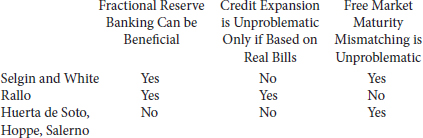
One should not confuse Rallo’s particular approach with other fractional reserve approaches having links to the Austrian school, most prominently the one defended by George Selgin and Lawrence White (1996). While there are certain differences, Rallo’s neo-banking-school approach and Selgin and White’s fractional reserve banking approach have more commonalities than differences. Both oppose 100 percent reserve banking. Both believe that fractional reserve banking does not necessarily cause business cycles. Both argue that in order to reinstate monetary equilibrium following an increase in the demand for money, a fractional reserve banking system could expand credit. Both maintain that holding fiduciary media equals savings. Both also maintain that there are no necessary legal or ethical problems with fractional reserve banking.
However, there are also some differences. Selgin and White do not regard maturity mismatching in a free banking system to be problematic, while Rallo believes this to be the true origin of the business cycle. Moreover, Selgin and White consider all credit expansion (independent of the type of loan created) to be unproblematic in a free banking system, while Rallo argues that only credit expansion based on real bills (or equivalents) is unproblematic. The following table portrays the differences between the fractional reserve schools and the full reservists such as Huerta de Soto, Hans-Hermann Hoppe, Joseph Salerno, and Murray Rothbard. The view of Huerta de Soto, Hoppe, and Salerno on maturity mismatching is inferred from the theory they defend.
The astute reader will notice that, at this point, the example becomes problematic. The IOU issued by the house buyer is fundamentally different from fiduciary media issued by a bank, because the latter are perfect money substitutes.
It is true that the gold is only in the possession of one person at a time. However, this does not negate the fact that there can be several persons that have a right to that gold at the same time and consider it part of their cash balances.

