
Free Banking: Theory, History and a Laissez-Faire Model
5. Scottish Free Banking
The three previous chapters have presented a number of theoretical arguments for free banking. One must turn now to the historical side of this issue. This chapter is devoted to a look at Scottish free banking. Chapter 6 will examine the American experiment with multiple issuers of notes. These are probably the best-known and best-documented cases of free banking. However, the reader should be aware of a problem that persists with any review of these periods. There is much anecdotal evidence extant, but rather limited hard data—especially in the Scottish case. Therefore, some of the implications of the model presented earlier simply cannot be tested in any direct way, and the empirical conclusions that can be reached must in some instances be rather tentative because of the nature and age of the data. Despite such difficulties, the importance of these episodes makes their investigation imperative.
There was a time when knowledge of free-banking regimes had almost disappeared from economic history. This was, of course, prompted by the theoretical conviction that central banking was natural and necessary, because free banking was believed to be chaotic and inflationary. The recent rebirth of interest in the theory of multiple note issuers1 has also inspired much historical investigation. Work by, among others, Hugh Rockoff (1975; 1985), Arthur Rolnick and Warren Weber (1982a; 1982b; 1985; 1986), Lars Jonung (1989), Kevin Dowd (1992), and Donald Wells and Leslie Scruggs (1986a) has significantly expanded the understanding of such systems. For example, it is now known that banking with multiple note brands has been much more common than most would think. There appear to have been at least sixty episodes of approximate free banking, that is, cases where banks were allowed to issue their own notes (Dowd 1992, 2).2 Perhaps the most influential of all such examinations of historical free banking has been the work of Lawrence H. White on Scottish banking (1984a, 1984b, 1989a, 1991).
Friedrich Hayek had earlier presented a theoretical case for thinking that free banking would work. White’s Free Banking in Britain appeared in 1984 and argued that free banking had already worked in Scotland during an earlier period. A convincing “test case” for free banking seems to have been overlooked for generations.3 White’s conclusions have elicited intense interest, and deserve to be examined seriously and carefully.
WHITE’S INTERPRETATION
Free banks began to appear after the charter of the monopolistic Bank of Scotland expired in 1716. The first was the Royal Bank of Scotland in 1727. The competition that arose between the two rivals quickly brought benefits to the public in the form of “the cash credit account, a form of overdraft account” (White 1984a, 26). This expanded the bank’s note circulation at the same time that it “allowed an individual to borrow against his human capital at lower transactions costs and so enable him to undertake productive projects that otherwise would have been unprofitable” (White 1984a, 27). During the 1740s and 1750s, a number of small banking concerns appeared, but the most important entrant of the time was the British Linen Company (later the British Linen Bank) in 1746.4
There was nearly complete freedom of entry into banking during this era. After 1765, the only legal restrictions were (1) shareholders faced unlimited liability regarding creditors’ claims on the bank,5 (2) banks could not print notes of denominations smaller than one pound-sterling, and (3) option clauses were illegal. Despite these constraints, banking in Scotland prospered, and the economy grew. By 1844, there were “19 banks of issue in Scotland with 363 branches, providing one bank office for every 6,600 persons in Scotland, as compared with one for 9,405 in England and one for 16,000 in the United States” (White 1984a, 34). Even though there existed some economies of scale, there seemed to be no tendency for the system to collapse into a single entity. Moreover, economic growth seemed robust. Citing Rondo Cameron, White declares that “Scotland’s per capita income was no more than half that of England’s in 1750 but nearly equal it by 1845” (1984a, 24).
An important feature of the Scottish system was the weekly note-exchange. This developed spontaneously in the late 1760s. Banks realized that in order to maximize the market for their own notes, they would need to accept their rivals’ notes at face value. That is, if consumer X is presently holding notes issued by bank A, he is unlikely to open an account with bank B unless B is willing to credit him with the face value of the banknotes he possesses. This note-exchange process involved the weekly clearing of interbank holdings of one another’s notes. It served not only to increase the marketability of banknotes relative to specie, but also to check any attempt at overissue on the part of an individual bank (White 1984a, 20–22).
According to White, the virtues of the Scottish system were undeniable. Counterfeiting was “not a significant problem in the Scottish experience” (White 1984a, 40), for example. This he attributes to the care the free banks took in designing elaborate and distinctive notes and the rapidity with which—because of the note-exchange process—notes were returned to their issuer. By way of contrast, counterfeiting of Bank of England notes was a chronic problem in England, especially during the 1797–1821 suspension of specie payments. Noteholder losses in Scotland were also relatively small. The total loss to the public brought about by bank failures amounted to 32,000 pounds-sterling for the period 1695 to 1841, whereas the losses in England for the year 1840 alone were twice as great (White 1984a, 41). This was an innovative system as well. The British Linen Bank of Edinburgh established the first branch bank in the early 1760s. The Union Bank of Glasgow made the first public disclosure of a bank’s annual balance sheet in 1836.
Bank failure was not common according to White. The only major bank failure during the entire period was that of the Ayr Bank in 1772. It tried to do what could not be done in this system. It attempted to expand the circulation of its notes beyond the demand. Indeed, the Ayr Bank overextended itself to the tune of about 667,000 pounds-sterling. Nevertheless, this failure did not result in a general bank panic. In fact, the Edinburgh banks experienced a perceptible increase in specie demand for only one day. The reason was that, because of the rapid note-exchange mechanism, no other major banks were caught holding large amounts of the Ayr Bank’s notes. Furthermore, because of the unlimited liability provision, all the bank’s creditors were paid in full by the bank’s 241 shareholders (White 1984a, 31–32).
On top of everything else, the “Scottish free banking system proved far hardier during periods of commercial distress than did its English counterpart” (White 1984a, 44). Throughout the long Napoleonic Wars, for example, the Scottish economy allegedly experienced milder cyclical fluctuations than did that of England. This White attributes in part to its superior banking system. The empirical support for White’s conclusions consists of data on comparative failure rates for Scottish versus English banks over the period 1809–1830. This reveals that on average Scottish banks failed at the rate of 4.0 per thousand, whereas English failures were 18.1 per thousand (White 1984a, 48).
White admits the danger of basing broad conclusions on a single historical example. Nevertheless, he believes Scottish free banking to be illustrative of certain basic principles.
[B]ecause we lack knowledge of any other truly free banking systems of significance, the Scottish experience, interpreted in the light of our theoretical constructions, must largely inform our understanding of what we should generally expect from free banking. Though perhaps not conclusive, Scotland’s experience is certainly consistent with the hypothesis that monetary freedom is workable and self-regulating. (White 1984a, 137)
Finally, White notes that free banking ended not because of dissatisfaction on the part of either the consumers or the bankers in Scotland. Both seemed quite pleased with—even protective of—the system. The demise of Scottish free banking was imposed from above for political reasons. The English Parliament passed the Bank Charter Act in 1844 and the Scottish Bank Act in 1845. These effectively ended freedom of entry and the competitive issuance of notes, and put the Scottish banks under the aegis of the Bank of England.
A CRITIQUE OF WHITE
The increasing attention devoted to free banking in the last few years has certainly been both invigorating and long overdue. Moreover, much of the credit for this reanimated interest must be given to White for his research into Scottish banking. However, despite its stimulating content, White’s work is not without some questionable elements. The present section will enumerate some of the reasons for such skepticism.6 In general, it is not that White’s facts are false. The doubts that arise stem principally from the belief that White has either misinterpreted the facts or failed to include certain countervailing facts.
One should understand, first of all, that this controversy is not merely some trivial dispute over an arcane bit of history with no relevance for the present day. In many writers’ minds, the theoretical case for free banking has been intimately tied to the alleged success in Scotland. White himself contends that free banking in Scotland “provides unique evidence on the workability of monetary freedom” and “may also help us answer other questions concerning the stability or efficiency of an unregulated monetary system” (1984a, 137, 141).
Furthermore, White’s interpretation of Scottish banking has gained a wide circulation. Among those who have cited White favorably, one finds Milton Friedman and Anna Schwartz (1986, 49–51), George Selgin (1988a, 7, 81, 140; 1989, 450), Catherine England (1988, 795–96), Karen Palasek (1989, 400), Gerald O’Driscoll and Mario Rizzo (1985, 10, 225), Murray Rothbard (1983, 185), Gerald O’Driscoll (1986, 601–2), David Glasner (1989, 37), Dowd (1989, 153–57; 1992, 1), and Roger Miller and Robert Pulsinelli (1989, 211–12). As for objections, until recently, there had been few. Jack Carr and Frank Mathewson (1988), Larry Sechrest (1988; 1990; 1991), Rothbard (1988b), and Tyler Cowen and Randall Kroszner (1989) have posed challenges to White’s historical work, whereas Charles Munn (1985) and Charles Goodhart (1987) have offered short critical reviews.
The issues to be raised here are (1) bank failure rates, (2) economic growth, (3) note convertibility, (4) restrictions on small-denomination notes, (5) the Usury Law as a constraint on competition, and (6) the privileges of the chartered banks. The contention is that, although Scotland did allow a multiplicity of note issues, it nevertheless was not the close approximation to “pure” free banking that White seems to think it was.7
Much of the evidence presented in what follows will be drawn from the survey of Scottish banking written by S. G. Checkland (1975). This work White has called “S. G. Checkland’s authoritative chronicle of the industry” (1984a, 33). Moreover, White himself has declared that Checkland “is, of course, the authority on the facts” (letter to Peter Lewin and the author, April 30, 1986).
Bank Failures and Stability
Certainly one of the key dimensions along which one would want to measure the success of any banking system is the rate of firm failure.8 White obviously agrees for he bases most of his case for Scottish stability on the allegedly lower rate of failure experienced by Scottish banks relative to English banks (1984a, 48). Not surprisingly, he concludes from this that Scottish banks were substantially less failure-prone and calls the Scottish system one of “remarkable monetary stability” (1984a, 23).
First of all, White seems slightly to miscalculate the averages. From his own table, the figures work out to be 4.46 and 17.54, respectively, rather than 4.0 and 18.1. More importantly, White’s figures cover only a small portion of the period in question. He himself has stated that “the act of 1765 left Scotland with free banking” (1984a, 30). A longer time series would seem desirable, especially in light of the Ayr Bank failure of 1772. That episode White describes as minor insofar as the system as a whole was concerned (1984a, 32). Checkland agrees that little permanent damage was done (1975, 133–34), but does point out that “no less than thirteen Edinburgh private bankers fell with the Ayr Bank, never to rise again” (1975, 132). There were also several Scottish failures between 1773 and 1808. If one includes these data, one finds that for the period 1772–1830, the average annual failure rates per thousand for England and Scotland are 14.90 and 14.88, respectively (see Table 1). The rate for Scotland is thus not statistically different from that for England at the 99 percent confidence level.
White has recently attempted to rebut this point. He suggests carrying the series back to 1716 and thereby achieving a failure rate for Scotland of 7.98 (White 1991, 811–12). This, however, is inconsistent with his own declaration that the free-banking era started in 1765 (1984a, 30). Indeed, since White puts such great emphasis on the note-exchange process as a foundation of the Scottish success, one would think that he might identify the beginning of free banking with the development of that process, that is, about 1770.9 White also suggests that one should be more concerned with economic significance than with statistical significance and that raw failure rates per se are not necessarily very important (1991, 813). Both points are well taken. However, how does one determine what an “economically significant” rate of bank failure may be? For example, the average annual rate per thousand for U.S. banks between June 30, 1921 and June 30, 1929 was 22.23 (Upham and Lamke 1934, 247), higher than either the English or Scottish rates noted above. Furthermore, the 1920s are conventionally perceived as having been both prosperous and stable. Is 22.23 a “significantly” high rate of failure? Finally, if White did not think failure rates so important, why did he make the contrast between the two countries a prominent part of his defense of Scottish free banking?
Table 1
Bank Failures per Thousand, 1772–1830
| Year | England | Scotland |
| 1772 | . . . 10 | 451.6 |
| 1773 | . . . 11 | 0 |
| 1774 | . . . 12 | 0 |
| 1775 | . . . 13 | 0 |
| 1776 | . . . 14 | 47.6 |
| 1777 | . . . 15 | 0 |
| 1778 | . . . 16 | 0 |
| 1779 | . . . 17 | 0 |
| 1780 | . . . 18 | 0 |
| 1781 | . . . 19 | 41.7 |
| 1782 | . . . 20 | 0 |
| 1783 | . . . 21 | 0 |
| 1784 | 25.2 | 0 |
| 1785 | . . . 22 | 0 |
| 1786 | . . . 23 | 0 |
| 1787 | . . . 24 | 0 |
| 1788 | . . . 25 | 0 |
| 1789 | . . . 26 | 0 |
| 1790 | . . . 27 | 0 |
| 1791 | . . . 28 | 0 |
| 1792 | . . . 29 | 0 |
| 1793 | 17.9 | 90.9 |
| 1794 | 3.7 | 0 |
| 1795 | . . . 30 | 0 |
| 1796 | 6.6 | 0 |
| 1797 | 17.4 | 0 |
| 1798 | 12.8 | 0 |
| 1799 | . . . 31 | 0 |
| 1800 | 8.1 | 0 |
| 1801 | 10.4 | 0 |
| 1802 | 7.6 | 0 |
| 1803 | 14.6 | 0 |
| 1804 | 14.5 | 0 |
| 1805 | 11.4 | 0 |
| 1806 | 4.2 | 0 |
| 1807 | 5.8 | 0 |
| 1808 | 5.2 | 54.1 |
| 1809 | 5.7 | 0 |
| 1810 | 25.6 | 27.0 |
| 1811 | 5.1 | 0 |
| 1812 | 20.6 | 0 |
| 1813 | 8.7 | 14.3 |
| 1814 | 28.7 | 0 |
| 1815 | 27.3 | 9.0 |
| 1816 | 44.5 | 14.1 |
| 1817 | 4.0 | 0 |
| 1818 | 3.9 | 0 |
| 1819 | 16.5 | 0 |
| 1820 | 5.2 | 13.2 |
| 1821 | 12.8 | 66.7 |
| 1822 | 11.6 | 13.0 |
| 1823 | 11.6 | 0 |
| 1824 | 12.8 | 0 |
| 1825 | 46.4 | 12.0 |
| 1826 | 53.1 | 11.1 |
| 1827 | 11.9 | 0 |
| 1828 | 4.5 | 0 |
| 1829 | 4.4 | 11.4 |
| 1830 | 20.9 | 0 |
Sources: Lawrence H. White, Free Banking in Britain: Theory. Experience, and Debate. 1800–1845 (New York and London: Cambridge University Press, 1984) 48. Sidney G. Checkland, Scottish Banking: A History. 1695–1973 (Glasgow, Scotland: Collins, 1975) 132, 177–78. Leslie S. Pressnell, Country Banking in the Industrial Revolution (Oxford: Clarendon Press, 1956) 11, 537–38.
Notes: mean (England) = X1= 14.90
mean (Scotland) = X2 = 14.88
standard deviation (England)= σ1 = 12.09
standard deviation (Scotland)= σ2 = 60.01
observations (England)= n1 = 37
observations (Scotland)n2 = 59
To test the hypothesis that X1 = X2,
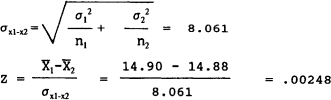
Therefore, one cannot reject the hypothesis at 99 percent confidence level.
In contrast, using White’s figures,
| X1 = 17.54 | σ = 14.33, | n1 = 22 | ||
| X2 = 4.46 | σ = 5.98, | n2 = 22 |
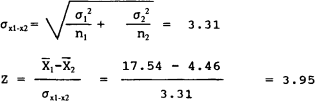
Thus, one must reject the hypothesis at the 99 percent confidence level.
32No data are available.
To pursue the issue of stability, one may note that there occurred a number of financial crises during the free-banking period: in 1772, 1778, 1787, 1793, 1797, 1802–1803, 1809–1810, 1818–1819, 1825–1826, 1836–1837, and 1839 (Checkland 1975, 213–14, 403), nor does one get an impression of much stability if one examines wholesale prices for Great Britain during the 1765–1845 period (see Table 2).33 Checkland offers a summary judgment of the Scottish system when he says that “[i]n principle, it should have been capable of stability or, at least, of fairly easy contraction. In reality, it was not” (1975, 214).
Table 2
Wholesale Price Index for Great Britain, 1765–1845 (1770 = 100)
| Year | Index |
| 1765 | 106 |
| 1766 | 107 |
| 1767 | 109 |
| 1768 | 108 |
| 1769 | 99 |
| 1770 | 100 |
| 1771 | 107 |
| 1772 | 117 |
| 1773 | 119 |
| 1774 | 116 |
| 1775 | 113 |
| 1776 | 114 |
| 1777 | 108 |
| 1778 | 117 |
| 1779 | 111 |
| 1780 | 110 |
| 1781 | 115 |
| 1782 | 116 |
| 1783 | 129 |
| 1784 | 126 |
| 1785 | 120 |
| 1786 | 119 |
| 1787 | 117 |
| 1788 | 121 |
| 1789 | 117 |
| 1790 | 124 |
| 1791 | 125 |
| 1792 | 123 |
| 1793 | 135 |
| 1794 | 137 |
| 1795 | 160 |
| 1796 | 162 |
| 1797 | 148 |
| 1798 | 150 |
| 1799 | 174 |
| 1800 | 210 |
| 1801 | 217 |
| 1802 | 170 |
| 1803 | 173 |
| 1804 | 173 |
| 1805 | 189 |
| 1806 | 187 |
| 1807 | 183 |
| 1808 | 201 |
| 1809 | 216 |
| 1810 | 213 |
| 1811 | 202 |
| 1812 | 228 |
| 1813 | 235 |
| 1814 | 215 |
| 1815 | 181 |
| 1816 | 166 |
| 1817 | 184 |
| 1818 | 194 |
| 1819 | 178 |
| 1820 | 160 |
| 1821 | 139 |
| 1822 | 123 |
| 1823 | 137 |
| 1824 | 142 |
| 1825 | 157 |
| 1826 | 139 |
| 1827 | 138 |
| 1828 | 134 |
| 1829 | 134 |
| 1830 | 132 |
| 1831 | 132 |
| 1832 | 128 |
| 1833 | 124 |
| 1834 | 121 |
| 1835 | 118 |
| 1836 | 132 |
| 1837 | 131 |
| 1838 | 137 |
| 1839 | 145 |
| 1840 | 143 |
| 1841 | 137 |
| 1842 | 124 |
| 1843 | 111 |
| 1844 | 113 |
| 1845 | 116 |
Source: Brian R. Mitchell, European Historical Statistics; 1750–1970. 2nd ed. (London: Macmillan Press, 1978) 388.
Economic Growth
What of White’s claim that “the period of Scottish free banking coincided with a period of impressive industrial development. . . . The growth of Scotland’s economy in the century prior to 1844 was more rapid even than England’s” (1984a, 24)? This conclusion is based on the statement of economic historian Rondo Cameron to the effect that “it would not be unreasonable to infer . . . that in 1750 per capita income of Scotland was no more than half that of England, but that by 1845 it very nearly equaled England’s” (1967, 94). This inference is not based on unambiguous data. Cameron himself admits that “there are no separate statistics of national income for Scotland for this period” (1967, 94). Conclusions of the sort in which Cameron and White indulge must, therefore, be based on indirect evidence. Admittedly, some such evidence does exist.
For example, both Richard Hildreth (1968, 16) and T. S. Ashton (1969, 70–75) suggest that the banking industry in Scotland contributed significantly to that country’s expansion. White cites Adam Smith as an additional proponent of this view (1984a, 24). However, this writer can find no such assertions in the Wealth of Nations.34 Indeed, the opposite seems more nearly to be Adam Smith’s position.35 Smith states that “Scotland, though advancing to greater wealth, is advancing more slowly than England” (1937, 189). He also makes references to the “imprudence” of Scottish banks (1937, 288) and “that excess of banking, which has of late been complained of both in Scotland and in other places” (1937, 302). It would seem clear that the issues of cyclical stability and economic growth will not be resolved until separate series on Scottish prices, interest rates, and national income are either discovered or generated. Until then, White’s conclusions must remain quite tentative.
Banknote Convertibility
White goes so far as to define free banking as “the unrestricted competitive issue of specie-convertible money by unprivileged banks” (1984a, ix). More recently, he has reaffirmed that redeemability is an essential characteristic of competitive inside money (1989b, 368fn). Thus, if convertibility was not, in fact, consistently practiced in Scotland, then one may conclude that a significant element of free banking was absent.36 Of course, it is well known that before 1765 immediate redemption did not always occur because banks sometimes invoked the “option clause”; that is, they delayed redemption in exchange for the payment of explicit interest to the noteholder. Did strict convertibility hold, however, after 1765? Damaging to White’s case is this declaration by Checkland:
The Scottish system was one of continuous partial suspension of payments. No one really expected to be able to enter a Scots bank . . . with a large holding of notes and receive the equivalent immediately in gold or silver. At best they would get a little specie and perhaps bills on London. (1975, 185)
Checkland also suggests that “much emphasis was laid on the loyalty of the banks’ customers—requests for specie met with disapproval and almost with charges of disloyalty” (1975, 184). Frank W. Fetter agrees: “To a large degree there was a tradition, almost with the force of law, that banks should not be required to redeem their notes in coin” (1965, 122). To this, Henry Meulen adds the observation that a Scottish bank usually “paid notes instead of gold to any depositor who might call, and thus was able to operate with a smaller reserve of gold than would otherwise have been necessary” (1934, 136). Additional comments along these lines may be found in both Checkland (1975, 186, 222, 438) and Meulen (1934, 129).
Curiously, White (1989a, 36) claims that statements such as the foregoing have been rebutted by Kevin Dowd (1989). In fact, Dowd agrees that “Scottish notes were imperfectly convertible, even after the passage of the 1765 Act” (1989, 156). What Dowd does dispute is that such inconvertibility represented a significant departure from free banking (1989, 156–57).37 Yet both White (1984a, 6–19) and Selgin (1988a, 94–96) have argued forcefully that free banks issuing debt-based, that is, specie-convertible, notes and deposit credits are constrained from overissuing such liabilities by the fact that these firms face rising marginal costs. Furthermore, said marginal costs rise largely because of liquidity costs, that is, the costs of acquiring and holding specie for the purpose of redemption. This redemption may occur in the course of either interbank or bank-customer transactions (the processes of adverse clearings and reflux).
In the absence of convertibility, free banks would experience a much-relaxed constraint on overissuance. For example, when discussing free banking in Michigan, Dowd seems to concede this when he states that “the suspension of convertibility removed the main check against over-issue, and so a monetary explosion was to be expected” (1989, 137). It would seem clear that convertibility is essential to any (specie-based) system that merits being characterized as free banking.
Small-Denomination Notes
In 1765, the British Parliament imposed on Scotland legislation that prohibited not only the option clause, but also the issue of notes smaller than one pound-sterling. The option clause has often been discussed—see Dowd (1991h), White (1984a), or Selgin (1988a), for example—but the prohibition of small-denomination notes seems to have received little attention.
Three aspects of this are of importance. First of all, one needs to realize that the one-pound note of 1765 had roughly the purchasing power of $180–$200 in the United States today.38 This figure may be achieved by discovering that British prices are presently ninety to 100 times the level of 1765 (Mitchell 1988, 719–34) and observing recent exchange rates of about $2.00 per pound. The implication is that after 1765 many day-to-day transactions could not be conducted in terms of banknotes; recourse to coins was necessary. Furthermore, the control of coinage rested with the Royal Mint and the Bank of England (Clapham 1958, Vol. II, 51–53). In other words, Scottish banks were systematically excluded from competition by means of notes for the business of those whose currency needs were relatively small in scale.
This restriction likely had two further effects. It may have served as a barrier to entry for small banks, since it could deny them the “niche strategy” of catering to small entrepreneurs and to the less wealthy consumers. Furthermore, since small-denomination notes always tend to circulate more rapidly than those of large denominations (White 1984a, 8), it would seem that the Act of 1765 must have reduced to some extent the effectiveness of the reflux process. That is, it may have raised the average period of circulation for Scottish banknotes and, thereby, increased the possibility of inflationary overissues. Consistent with this hypothesis, one finds Adam Smith’s observation in 1776 that in Scotland, “the circulation has frequently been over-stocked with paper money” (1937, 286). One may add to this the facts that (1) food prices fell from 1717 to 1750 but rose strongly in the latter part of the eighteenth century, as did coal, cattle, and grain prices, and (2) Scottish net exports declined after 1775 and were generally negative from 1780 to 1805 (Lythe and Butt 1975, 102, 103, 113, 116, 117, 162, 247). All of this suggests—but does not prove—the existence of an inflationary monetary expansion.
Interest Rate Ceilings
In 1714 the Usury Law, to which the Scottish banks were subject, established a legal maximum rate of 5 percent to be charged by financial institutions. The last remnants of this law did not disappear until 1854 (Clapham 1958, Vol. II., 224). Of these facts, there can be no doubt. However, White has questioned, first of all, whether the 5 percent ceiling applied to one of the key sources of revenue for Scottish banks: the discounting of commercial bills of exchange (letter to Peter Lewin and the author, April 30, 1986). It did indeed. The Usury Law was applicable to “the entire bill market” until 1833, when ninety-day bills were made exempt (Homer 1963, 205).
Also, in the same letter cited above, White wonders if this ceiling was ever a binding constraint. If one takes that phrase to denote a circumstance in which market rates of interest are driven above the maximum legal rate, then one must apparently answer in the affirmative. S. G. E. Lythe and J. Butt, while discussing Scottish finance in the eighteenth century, note that “the price for capital might be higher than the legal maximum bank rate” (1975, 155). Since consols39 issued by the British government were not subject to the Usury Law (Homer 1963, 205), one might take the yield on consols to be a reflection of market conditions. That yield exceeded 5 percent in the years 1781, 1782, 1784, and 1796–1799 (Homer 1963, 161–62). During the long Napoleonic Wars (1793–1815), effective market rates were often above the maximum legal rate (Homer 1963, 186, 205).40 Short-term market rates also rose above 5 percent during the years 1836, 1837, and 1839–1841 (Homer 1963, 208). However, it is unclear whether the latter posed an impediment to bank competition, since bills of exchange and promissory notes were exempt from the Usury Law after 1833 (Checkland 1975, 192, 443). It is possible that short-term rates were greater than 5 percent during part of 1826 as well: The average of such rates for that year was 4.5 percent (Mitchell 1988, 683).
It would seem that the interest rate ceiling must, in fact, have been a constraint on bank competition during at least part of the 1765–1845 period. Checkland concurs when he states that “the Usury Law limited competition for deposits” and that its effect on “any form of advance was seriously inhibitive” (1975, 432, 192). This assessment is echoed by Meulen (1934, 92).
Privileged Banks
One may recall White’s definition of free banking as a system of “unprivileged private banks.” Yet there were two tiers to the Scottish system: (1) three chartered “public” institutions (the Bank of Scotland, the Royal Bank, and the British Linen Bank) and (2) the various private banks and joint stock banking companies. Since the three public banks enjoyed limited shareholder liability while the others were all subject to unlimited liability, Checkland concludes that the former “were in a preferred position relative to all others” (1975, 235). The state had created these public banks and “continued to confirm their preferred position through their limited liability and through their public identity and perpetual succession” (Checkland 1975, 275). It would thus seem that the nonchartered banks faced a significant regulatory barrier to entry: unlimited liability.41 This did not prevent the formation of a number of private banking concerns, but it imposed a constraint on such firms that was not applicable to the three chartered banks.
White contests this. He asserts that unlimited liability must not have been a binding constraint on the private banks, because they “chose to retain unlimited liability in the 1860s and 70s even after limited liability became available to them” (1984a, 143). To argue thus is less than convincing. Institutional structures must be viewed contextually. The fact that Scottish banks of the 1860s seem not to have seen unlimited liability as an odious imposition does not prove that it was not considered to be such in, say, 1780 or 1810. By 1860, the tradition of unlimited liability may have become so deeply entrenched that to abandon it would have shaken consumer confidence. Despite this, unlimited liability may still have been a barrier to entry during the eighteenth and early nineteenth centuries. In addition, there is a powerful counterpoint that one must consider. Since the three public banks expended real resources in order to (1) obtain their charters and (2) prevent other banks from gaining charters, one must conclude that a limited liability bank charter was perceived as conferring some significant advantage upon its holder (Cowen and Kroszner 1989, 226).
A specific manifestation of said advantage was the fact that “there was a long-standing government instruction to the officers of the customs to accept only the notes of the chartered banks in payment of duties, and to ‘refuse the Notes of every other bank without exception’ ” (Checkland 1975, 186). In short, an artificial demand for the notes of the public banks was established by fiat. Yet one might wonder if the payment of customs duties was of a magnitude sufficient to produce a significant gain for those institutions. One possible indication is the proportion of total government revenues represented by customs duties. One finds that customs duties averaged 22.3 percent of annual government income over the period 1765–1801 and 27.6 percent from 1802 to 1845 (Mitchell 1988, 576–77, 581–82).42 The collection of customs duties—and therefore the benefit to the public banks—seems not to have been trivial.
Dependence upon the Bank of England
Several writers have argued that the Scottish system was not true free banking because it was crucially dependent upon the Bank of England. That is, it has been claimed that the private Scottish banks depended upon the three public banks, and those three in turn relied upon the Bank of England for their liquidity needs (Rothbard 1988b;43 Sechrest 1988; Cowen and Kroszner 1989; Dow and Smithin 199244). These arguments have been based on various statements by historians of the period.
For example, Checkland declares that “by 1810, the Bank of England, short of the state itself, was the effective final arbiter of the supply of liquidity, both for England and Scotland” (1975, 276). Meulen notes that “it transpired that at times when gold was being drained both from Scottish and English banks the Scottish bankers had not restricted their note issue, but had withdrawn gold from the Bank of England to support their credit system” (1934, 141). Furthermore, the 1810 Bullion Committee’s report stated that “the circulation of the Bank of England had an important influence on the circulation of the country banks and of the Scottish banks” (quoted in Fetter 1965, 50). Finally, “the three chartered banks of Scotland kept their reserves largely in deposits with the Bank of England” (Fetter 1965, 34).
White has offered a rebuttal to the foregoing that is quite plausible even if not conclusive (1989a, 20–34). He seems to make three key assertions. First, White points out that the evidence for the pyramiding of Scottish bank notes on a base of Bank of England notes is sketchy and circumstantial.45 There seem to be no unambiguous data that could resolve the question. Second, he grants that England and Scotland formed an integrated economic whole,46 but denies that this means that the Scottish system was a satellite of the Bank of England. As he puts it, one would not conclude that the U.S. banking system was a satellite of the English system just because actions by the Bank of England had spill-over effects in America. Finally, White offers evidence that the Bank of England did not explicitly consider itself to be a lender of last resort during the Scottish free-banking period. He argues persuasively that there is an important distinction between an ex ante lender of last resort and an ex post source of liquidity. One might call the former structural dependence and take it to be indicative of central banking. One might call the latter circumstantial reliance and perceive it as being consistent with free banking.
SUMMARY
Lawrence H. White’s very valuable research into Scottish free banking has generated much interest and some controversy. His work has explicitly suggested that the Scottish experience can tell us a great deal about how a true free-banking system would perform. To many writers, Scotland has come to represent the paradigmatic “test” of free banking.
However, on closer inspection, one finds some serious flaws in the Scottish system. The failure rate (1772–1830) for Scottish banks was not lower than that for English banks. Banknotes were not consistently convertible into specie on demand. The prohibition of small-denomination notes not only curtailed mutually beneficial transactions between banks and their customers, but also may have diluted the constraints on overissue. The Usury Law limited competition in credit markets. The three chartered banks held privileged positions within the system, and Scotland seems to have avoided neither the inflation nor the numerous crises that plagued the English.47 Doubts about White’s interpretation of the Scottish experiment with free banking seem justified.48 Finally, it is interesting to notice that White himself seems to be retreating a bit from his original position. Instead of speaking of free banking as lasting from 1765 to 1845, he now appears only to defend the period 1810–1844 as exemplifying free banking (1989a, 15, 16, 35).
NOTES
Portions of this chapter are reprinted, by permission, from Cato Journal 10 (Winter 1991): 799–808.
49 The key works are probably Hayek (1978), White (1984a), Selgin (1988a), and Dowd (1989).
50 All of these included other restrictions on bank activity, however.
51 One of the rare exceptions was Vera C. Smith (1990).
52 These three large, chartered banks—the Bank of Scotland, the Royal Bank, and the British Linen Bank—were distinct from other Scottish banking concerns and were referred to as “public banks.” Whether these three were legally privileged is one of the controversies to be addressed.
53 This was true of all except the Bank of Scotland, the Royal Bank, and the British Linen Bank. The shareholders of those three were subject to limited liability.
54 The author would like to emphasize that he has great respect for White’s work in general, but is unable to dispel certain doubts about White’s view of Scottish free banking. Moreover, these doubts only very slowly displaced an initial enthusiasm for White’s conclusions.
55 Simply put, the question is “how good” a test of free banking was the Scottish case. This is important, but it is, admittedly, a question of degree rather than of kind.
56 Most assume that success is achieved by a low rate of failure. A few economists—particularly Murray Rothbard—argue that high failure rates are desirable as an indication of market restraint.
57 That is one of the reasons why the author started his series with 1772.
58 It would have been far preferable to present data for Scotland alone, but such a series seems not to exist.
59 Neither edition of the Wealth of Nations possessed by the author is that which is cited by White. It is possible that some small—but in this case important—difference exists between the editions consulted.
60 It would be fair to keep in mind that Smith was writing in 1776. His comments do not, therefore, necessarily apply to the mature Scottish system. On the other hand, White seems willing to consider 1716 as the beginning of free banking (1991, 811–12). From that perspective, Smith’s comments would apply.
61 Arguments in defense of option clauses and indirect convertibility within the context of free banking will be discussed in Chapter 7.
62 This is not surprising, since Dowd is not reasoning from the same model that White employs.
63 Cowen and Kroszner (1989, 224) cite an estimate of $200.
64 Consols are bonds that never mature but pay interest to the holder forever.
65 Considering the substantial inflation in Britain during the period, it is hardly surprising that this should be the case. See Brian Mitchell (1988, 720).
66 See Carr and Mathewson (1988) for more on this issue.
67 These figures are for Great Britain as a whole; separate series for Scotland do not exist.
68 Rothbard’s essay, though shrill in tone, nevertheless raises some worthwhile points. Most important of these is his claim that White has misinterpreted the theoretical debate over free banking. To the author’s knowledge, Rothbard is the only one who has challenged White on this issue.
69 Sheila Dow and John Smithin also argue that the Scottish system exhibited a strong tendency toward concentration. This they applaud, for they ascribe the degree of success the Scots enjoyed to the lack of competition in the conventional sense.
70 White allows for the possibility that such pyramiding might have occurred during the 1797–1821 period (1989a, 22).
71 White recognizes that his earlier work may have led readers to conclude that he believed Scotland to be an entirely autonomous economy relative to England (1989a, 33).
72 This brings one back to a key theoretical issue. Is a properly functioning free-banking system not capable of at least mitigating the effects of external shocks? The author would argue that true free banking is capable of this. To test the stability of the Scottish system in a clear fashion, one would need separate series for Scottish prices, interest rates, industrial production, employment, and national income. To repeat, these do not appear to exist.
73 The author’s position has long been that the theoretical case for free banking need not rely on evidence from ambiguous historical cases like that of Scotland.
- 1It has been demonstrated that the FDIC and FSLIC have contributed to the banking and savings and loan (S&L) crises by virtue of their role as sources of “moral hazard.” Moral hazard is the idea that any entity that is insured against risk—especially when it does not bear the full costs of the risk—tends to indulge in riskier behavior. The principal problem with FDIC insurance is that the premiums paid by financial institutions are not adjusted for the riskiness of the asset portfolios held by those institutions. As a predictable result, many institutions have acquired assets, for example, made loans that promised high potential rates of return but also were subject to significant risk. At the first sign of an economic downturn, many such assets experience rapid declines in their market value. This may leave the institution insolvent. Thus, deposit insurance has contributed to the large number of failures of both S&Ls and banks during the past decade.
- 2Milton Friedman has stated that “in my opinion, no major institution in the United States has so poor a record of performance over so long a period . . . as the Federal Reserve” (1985, 5). He goes on to recommend that we “abolish the money-creating powers of the Federal Reserve, freeze the quantity of high powered money, and deregulate the financial system” (1985, 12). Friedrich Hayek has argued that “I do not think it an exaggeration to say that it is wholly impossible for a central bank subject to political control, or even exposed to serious political pressure, to regulate the quantity of money in a way conducive to a smoothly functioning market order” (1978, 113). James Buchanan, finding the existing operating structure wholly inadequate, proposes that the salaries of Fed officials be inversely related to the rate of inflation as a means of promoting monetary stability. He goes on to suggest that “if no incentive-motivational structure is deemed to be institutionally and politically feasible . . . the argument for more basic regime shift in the direction of an automatic or self-correcting system based on some commodity base is substantially strengthened” (1986, 148).
- 3The question remains: Is the problem one of specific policies undertaken by the Fed (which, presumably, could be curbed by changing the motivational constraints on the Fed), or is the problem the fact that the United States has a central bank? In short, are central banks inherently inconsistent with monetary stability? The overwhelming majority of economists are very reluctant to answer the latter question in the affirmative. Despite the rapidly growing body of scholarly work on free banking, most still scoff at the idea that money can be safely and sanely provided in an unfettered market context. This is evidenced, for example, by the fact that free banking is rarely discussed sympathetically in textbooks, if it is mentioned at all.
- 4Before discussing free banking in any detail, one must first of all define the term—as well as its opposite, central banking. Central banking is a nonmarket, centralized approach to monetary matters. A central bank is granted certain legal powers and privileges that are the means by which it attempts to manipulate selected macroeconomic measures. These measures most often are the rate of inflation, the rate of unemployment, various market interest rates, and Gross National Product (GNP). The specific tools by use of which a central bank may affect the foregoing usually include (as in the case of the Federal Reserve) the buying and selling of government securities, changes in the rate of interest charged by the central bank on loans to private depository institutions, and changes in the reserve requirements imposed on these institutions.
- 5In contrast, one finds free banking, a term that denotes a market-oriented, decentralized approach to money. Free banking’s most obvious features are (1) the absence of any central monetary authority and (2) the issuance of notes as well as deposit accounts by individual private banks. More generally, under a free-banking structure, “banks are free to pursue whatever policies they find advantageous in the issuing of liabilities and the holding of asset portfolios, subject only to the general legal prohibition against fraud or breach of contract” (White 1985, 117). Furthermore, “entry into a free banking system is unrestricted” (Selgin 1988b, 621), and “loans and securities would not be subjected to interest controls, nor would investment in any particular industry be mandated or forbidden . . . banks could even acquire equity positions in other firms” (Wells and Scruggs 1986b, 262). Also, such banks “would be free to open and close branches wherever they wanted” (Wells and Scruggs 1986b, 263). Finally, government deposit insurance would be neither necessary nor desirable, since market forces would encourage consumers to “find ways to protect their funds” privately (England 1988, 772). Thus, a “pure” free-banking system (which has never existed) would be one in which there were (1) no governmental restrictions on entry or exit by firms into or out of banking, (2) no restrictions (other than the enforcement of valid contracts) on the issuing of notes as well as deposit accounts by financial institutions, (3) no central bank that acts as an ex ante lender of last resort, (4) no governmental deposit insurance, (5) no statutory reserve requirements, (6) no minimum capital requirements, (7) no restrictions on branching, (8) no restrictions regarding the kinds of activities in which a bank might engage, such as the underwriting of corporate stock or bond issues, and (9) no interest rate controls. In short, free banking means the total deregulation of the banking industry. It is the thorough application of the principles of laissez faire to the one realm of economic activity where even most “free market” economists have assumed such principles cannot be applied: money and banking.
- 6Logically, one next needs to reduce the inconvenience of frequent physical transfers of coins. This was accomplished—for the first time in history—by the money-changers and bill brokers of twelfth-century Genoa who kept ledger accounts for frequent traders (Selgin and White 1987, 442). Notations in account books took the place of specie transfers. Thus deposit banking was born. In this context, Selgin and White point out why fractional reserve banking can develop in a rational and nonfraudulent manner: “(1) money is fungible, which allows a depositor to be repaid in coin and bullion not identical to that he brought in and (2) the law of large numbers with random withdrawals and deposits makes a fractional reserve sufficient to meet actual withdrawal demands with high probability” (1987, 443). This result is reinforced if one allows for the use of “option clauses,” as Selgin and White do.
- 7Monetary economics continues to be dominated by the almost unquestioned assumption that in order to achieve and maintain stability and real growth, all modern industrial nations must have a central bank that both conducts some macromonetary policy and is the sole issuer of legal currency. Nevertheless, in recent years, challenges to that orthodoxy have been mounted by a growing number of theorists. Perhaps the most influential of these works have been the books by Friedrich Hayek (1978), White (1984a), Selgin (1988a), and Kevin Dowd (1989). There are two distinctly different models of free banking to be found therein. Each will be summarized below. Other approaches to free banking have been proposed by writers such as David Glasner (1989), Robert Greenfield and Leland Yeager (1983), W. William Woolsey and Leland Yeager (1991), Murray Rothbard (1983, 1985), and Ludwig von Mises (1966, 441–48). Such alternative approaches are the subject matter of Chapter 7.
- 8In this system, there would probably be only a handful of large banks that issued their own currencies; the majority of institutions would denominate deposits and loans in terms of one of those currencies. The small number of banks-of-issue would be due to the fact that only a few different currencies would, presumably, be marketable. This follows from Hayek’s apparent belief that the information and transaction costs to consumers of coping with multiple currencies rise significantly as the number of such currencies increases (Hayek 1978, 23–24). Since the banks-of-issue would not want “to repeat the mistakes governments have made” (Hayek 1978, 61), they would not guarantee to bail out nonissuing banks that had outstanding obligations denominated in the currencies of the issuing banks. Thus, the large number of nonissuing banks would be compelled to practice more or less 100 percent reserve banking (Hayek 1978, 61). Such institutions would, therefore, be more like present-day finance companies than commercial banks.
- 9In the work of both White and Selgin, banks would, of course, be free to issue their own distinctive notes as well as deposit accounts. The supposed attraction for consumers would be the explicit guarantee by the issuing bank to redeem its notes in gold or silver upon demand of the holder. Banks would compete for consumers’ patronage by providing branch offices in convenient locations, by remaining open longer hours per day and/or being open more days per year, and by offering higher rates of interest on deposits and lower rates on loans (White 1984a, 7–9). Above all, however, banks would vie with one another in terms of public confidence in the note issue. A bank’s market share would increase as did consumers’ belief that the bank would never fail to convert its notes (or deposit accounts) into specie on demand.
- 10*No data are available.
- 11*No data are available.
- 12*No data are available.
- 13*No data are available.
- 14*No data are available.
- 15*No data are available.
- 16*No data are available.
- 17*No data are available.
- 18*No data are available.
- 19*No data are available.
- 20*No data are available.
- 21*No data are available.
- 22*No data are available.
- 23*No data are available.
- 24*No data are available.
- 25*No data are available.
- 26*No data are available.
- 27*No data are available.
- 28*No data are available.
- 29*No data are available.
- 30*No data are available.
- 31*No data are available.
- 32. . . *
- 33Under neither model of free banking is money production a natural monopoly, nor is money a public good. Issuers do not face marginal costs that decline throughout the relevant range of output. This follows from the fact that it is not the mere physical production of the banknote that is important; it is maintaining it in circulation that requires public acceptance and incurs rising marginal cost (White 1984a, 5–8). Furthermore, money cannot be a public good, because its benefits are clearly excludable. Person B cannot enjoy the liquidity services provided by a unit of money that is held by Person A (Selgin 1988a, 154). Additionally, in Hayek’s scheme, as well as in the White-Selgin model, the nominal money supply for the society is determined at a microeconomic level. Changes in said money supply certainly have important macroeconomic effects. Nevertheless, and in contrast to central banking, the source of the changes is microeconomic in nature. Both models imply that there is no role for a central bank that conducts monetary policy on a national basis. Many economists infer that chaos would inevitably result from the absence of centralized control. Yet, as Thomas Saving has pointed out, “competition is perfectly compatible with a stable monetary system” (1976, 994). The manner in which such stability might be achieved will be seen later.
- 34The principal attraction of the Hayekian currencies is, as was seen earlier, the promise of constant purchasing power. Thus, the critical issues become: (1) could such banks actually maintain such constancy in the purchasing power of money, and (2) would it be maintained regardless of circumstances? Hayek himself seems to think that the only safeguard against fluctuations in purchasing power is the continual monitoring of the currency’s value by consumers (1978, 59). But would such monitoring actually be an effective safeguard? There are reasons to doubt it.
- 35As with the works just cited, this book will take the price of nominal money holdings to be their purchasing power per unit (PPM). It is further assumed that such purchasing power can be measured (at least approximately) by the reciprocal of the price level (1/P), with that price level represented by the appropriate price index.
- 36As with the works just cited, this book will take the price of nominal money holdings to be their purchasing power per unit (PPM). It is further assumed that such purchasing power can be measured (at least approximately) by the reciprocal of the price level (1/P), with that price level represented by the appropriate price index.
- 37Regarding model selection, two considerations were of paramount importance: (1) to utilize the simplest model that produced useful conclusions and (2) to reflect, as closely as possible, Selgin’s presentation. Therefore, a quantity theory approach was chosen. Here the demand for money is a function only of k, P, and y; interest rates play no role. Both the prices of goods and the prices of inputs respond to market considerations, that is, they are “flexible” (though not necessarily instantaneously so) rather than “fixed.” Aggregate demand and, therefore, nominal income are affected by nominal money holdings, but real income is determined exogenously.
- 38Regarding model selection, two considerations were of paramount importance: (1) to utilize the simplest model that produced useful conclusions and (2) to reflect, as closely as possible, Selgin’s presentation. Therefore, a quantity theory approach was chosen. Here the demand for money is a function only of k, P, and y; interest rates play no role. Both the prices of goods and the prices of inputs respond to market considerations, that is, they are “flexible” (though not necessarily instantaneously so) rather than “fixed.” Aggregate demand and, therefore, nominal income are affected by nominal money holdings, but real income is determined exogenously.
- 39The controversy over whether there will be such an effect in an all-inside-money regime dates back to the late 1960s. At first it was thought that if there were no outside money in circulation, then there would be no real-balance effect (Patinkin 1965, 297). Later it was demonstrated that the inside-outside contrast was not the determining factor. What was crucial was whether the money represented net wealth, and, as David Laidler has pointed out, “regardless of whose liability it is, any money which bears interest at a market rate is not net wealth on the margin, and any money which does not bear such interest is net wealth” (1990, 33). In all modern industrial economies, the money supply consists primarily of deposits, not banknotes or coins. There is no reason to think matters would be appreciably different under free banking. Since competition would compel banks to pay interest on deposits, only a fraction of the money supply could constitute net wealth. Furthermore, it is even conceivable, though unlikely, that interest might be paid on banknotes. Therefore, free banking will exhibit a small, or no, real-balance effect.
- 40The controversy over whether there will be such an effect in an all-inside-money regime dates back to the late 1960s. At first it was thought that if there were no outside money in circulation, then there would be no real-balance effect (Patinkin 1965, 297). Later it was demonstrated that the inside-outside contrast was not the determining factor. What was crucial was whether the money represented net wealth, and, as David Laidler has pointed out, “regardless of whose liability it is, any money which bears interest at a market rate is not net wealth on the margin, and any money which does not bear such interest is net wealth” (1990, 33). In all modern industrial economies, the money supply consists primarily of deposits, not banknotes or coins. There is no reason to think matters would be appreciably different under free banking. Since competition would compel banks to pay interest on deposits, only a fraction of the money supply could constitute net wealth. Furthermore, it is even conceivable, though unlikely, that interest might be paid on banknotes. Therefore, free banking will exhibit a small, or no, real-balance effect.
- 41Two points require clarification. Earlier it was assumed that k represented a money/income relation that referred only to inside money. Now one encounters ki and ko, one for inside money and one for outside money. The reason for the change is quite simple. Emulating Selgin, it was earlier assumed that no outside money was in circulation, it all being held by banks as reserves, that is, previously ko = . The present case is merely one in which outside money demand grows at the expense of inside money demand. Thus, ko>. It is, furthermore, important to recognize this as a classic “redemption run” on banks.. That is, consumers liquidate part of their holdings of banknotes and/or checkable deposits and demand payment in specie. The conventional textbook explanation of redemption runs under central banking is that an increase in the demand for outside money reduces the total reserves of the banking system, which, in turn, brings about a multiplicative decline in the total money supply and a destabilizing deflation in the economy (Jaffee 1989, 341–42).
- 42That is, an increased demand for currency (banknotes) has no net effect whatever on the money supply. Currency runs pose no threat to free banks and do not imply deflation for the economy, unlike the case of central banking.
- 43This will likely be the case if either (1) workers form their inflationary expectations adaptively, that is, based purely on past trends, or (2) labor contracts are typically negotiated for long time periods, for example, for a two-year period.
- 44In other words, the negative relation between inflation and unemployment applies to the short run, but becomes a positive relation in the long run.
- 45Significant portions of the Austrian theory can be traced back to the work of Knut Wicksell.
- 46As seen earlier, in an all-inside-money regime, an excess supply of money would represent an excess demand for credit, and such excesses would only be temporary phenomena.
- 47Non-Austrians seem often to misunderstand this point. They interpret this to mean that business cycles are caused only by “low” interest rates (thought of in absolute terms). Austrians insist that what they mean is simply interest rates that are lower than they would have been in the absence of the monetary expansion (in relative terms). From an empirical standpoint, the problem is that the Austrians’ benchmark of stability, the natural rate of interest, is unobservable, but then, is not the natural rate of unemployment also unobservable?
- 48New-classical economists assume that individuals’ expectations are formed “rationally” (people cannot be systematically deceived regarding the actual rate of inflation) and that markets clear continuously (economic agents never fail to take advantage of opportunities to increase their utility). These assumptions lead such economists to propose that government policies will seldom have any impact on real variables, such as the rate of unemployment or real output.
- 49 For an excellent analysis of this issue, one should see Edward J. Kane, The Gathering Crisis in Federal Deposit Insurance (Cambridge: MIT Press, 1985).
- 50 Friedman, along with his long-time collaborator Anna J. Schwartz, repeats this theme in later work (Friedman and Schwartz 1986).
- 51 An exception is Miller and Pulsinelli (1989). Widely used texts, such as Lawrence Ritter and William Silber (1989) and Frederic Mishkin (1989), either ignore free banking altogether or dismiss it brusquely as chaotic and inflationary.
- 52 This may be a “discount” rate, as in the United States, or a “penalty” rate, as in Great Britain.
- 53 For detailed discussions of a number of approximate free-banking episodes, see Kevin Dowd, ed., The Experience of Free Banking (London: Routledge, 1992).
- 54 The option clause is a device by which a bank may delay the redemption of its notes in exchange for the payment of explicit interest to the noteholder. Option clauses will be discussed in Chapters 5 and 7.
- 55 Most of the extant articles and books on free banking are listed in the bibliographic section of this book.
- 56 It is somewhat ironic that Rothbard (1985) bitterly criticizes Hayek’s proposal, since their approaches share one striking feature. In both cases, either most banks (Hayek) or all banks (Rothbard) must make loans out of their own capital rather than out of funds deposited. This follows from the fact that they practice 100 percent reserve banking.
- 57 Such redemption may or may not be immediate. Both White and Selgin see no problem in permitting banks to issue notes subject to option clauses.
- 58 One should refer to Chapter 8 for an extended discussion of these points.
- 59 This one may be taken to be the inverse of the price level. However, there are two possible interpretations of the concept “price level.” The conventional understanding of the term is that the price level is the weighted average of a large number of selected relative prices, as embodied, for example, in the CPI (Timberlake 1987, 88–91). An alternative view is that the price level should be thought of in a more micro-economic way. This approach argues that the price level is nothing more or less than the array of all relative prices, which, supposedly, no index number can represent meaningfully (Rothbard 1988a, 182–83).
- 60 Some economists argue that money has neither a market nor a price of its own (Yeager 1986, 377). Their conclusion stems from the observation that, since money trades against goods and services in a multitude of markets, the price of money (its purchasing power) does not instantaneously adjust to changes in the supply of or demand for money. One need not challenge the accuracy of that observation in order to maintain that (conceptually) money has a market and a price. This is especially true if one thinks of the price level as the array of goods’ relative prices rather than as their weighted average.
- 61 This is not meant to deny that there are problems inherent in the use of any price index. All that is being suggested is that the concept “price level” is useful pedagogically.
- 62 There are, however, some departures from Selgin, as will be seen.
- 63 They are not ignored altogether, however. Chapter 3 discusses the interest rate effects of the parametric changes dealt with here.
- 64 Legal constraints (the Banking Act of 1933, also known as the Glass-Steagall Act) are the only reason for the long-standing absence of interest-bearing demand deposits in the United States.
- 65 An obvious possibility would be the issuance of notes subject to an option clause.
- 66 Since free banks would have a profit incentive to maintain redeemability and to nurture consumer confidence in that redeemability, it seems unlikely that redemption runs would occur with any frequency in a free-banking regime.
- 67 This is certainly true as long as the currency run does not degenerate into a redemption run. Even then, as discussed earlier, it is likely that free banking would prove to be self-correcting.
- 68Since the demand for money is stable, any significant fluctuations in the money supply are likely to result in monetary disequilibrium and bring about macroeconomic disruption. Business cycles begin with an increase in the money supply such that the money supply exceeds money demand at the existing level of prices. As moneyholders spend their excess cash balances, prices rise. If the resulting actual rate of inflation exceeds the expected rate of inflation forecast by workers, then real wage rates fall, the demand for labor rises, and unemployment declines below the natural rate (assuming nominal wage rates are bid up by an amount less than the actual rate of inflation). In order to maintain the low rate of unemployment, the rate of money growth and, thus, the rate of inflation must not only continue, but accelerate. Eventually the monetary authorities will become concerned about the rapidly rising inflation and begin to reduce the rate of growth in money (if they do not, then hyperinflation is inevitable). As the growth in money slows down, the rate of inflation falls. This fools workers in the opposite direction. The actual rate of inflation is less than the expected rate, real wage rates rise, and unemployment increases. In order temporarily to enjoy low unemployment, the society must first endure rising inflation and then, later, high unemployment. The expansion necessitates the contraction. Stability is regained when the actual rate of unemployment once again equals the natural rate of of unemployment.
- 69Since the demand for money is stable, any significant fluctuations in the money supply are likely to result in monetary disequilibrium and bring about macroeconomic disruption. Business cycles begin with an increase in the money supply such that the money supply exceeds money demand at the existing level of prices. As moneyholders spend their excess cash balances, prices rise. If the resulting actual rate of inflation exceeds the expected rate of inflation forecast by workers, then real wage rates fall, the demand for labor rises, and unemployment declines below the natural rate (assuming nominal wage rates are bid up by an amount less than the actual rate of inflation). In order to maintain the low rate of unemployment, the rate of money growth and, thus, the rate of inflation must not only continue, but accelerate. Eventually the monetary authorities will become concerned about the rapidly rising inflation and begin to reduce the rate of growth in money (if they do not, then hyperinflation is inevitable). As the growth in money slows down, the rate of inflation falls. This fools workers in the opposite direction. The actual rate of inflation is less than the expected rate, real wage rates rise, and unemployment increases. In order temporarily to enjoy low unemployment, the society must first endure rising inflation and then, later, high unemployment. The expansion necessitates the contraction. Stability is regained when the actual rate of unemployment once again equals the natural rate of of unemployment.
- 70Money enters the economy not as “helicopter money,” that is, not as equiproportional increases in everyone’s nominal cash balances, but in specific markets such that it brings about changes in relative prices. These relative price changes can be disruptive even if the overall price level does not change. The most important relative price is the price of credit—the market interest rate—which affects the extent to which there is intertemporal coordination. If the central bank increases the supply of bank reserves and, thus, the monetary base, and assuming that an increase in money demand did not precede the increase in reserves, then the result will be both an excess supply of money and an excess supply of credit. Since goods markets often adjust more slowly than do financial markets, the market interest rate will tend to fall quickly, while prices of goods will rise, but more slowly.
- 71Money enters the economy not as “helicopter money,” that is, not as equiproportional increases in everyone’s nominal cash balances, but in specific markets such that it brings about changes in relative prices. These relative price changes can be disruptive even if the overall price level does not change. The most important relative price is the price of credit—the market interest rate—which affects the extent to which there is intertemporal coordination. If the central bank increases the supply of bank reserves and, thus, the monetary base, and assuming that an increase in money demand did not precede the increase in reserves, then the result will be both an excess supply of money and an excess supply of credit. Since goods markets often adjust more slowly than do financial markets, the market interest rate will tend to fall quickly, while prices of goods will rise, but more slowly.
- 72The lower market rate induces entrepreneurs to undertake additional investment projects. Since voluntary savings have not increased, ex ante investment must exceed ex ante savings, but ex post, the two must be equal. This necessitates the appearance of “forced savings.” “The forced savers are the existing holders of money. Their ability to consume is impaired by the influx of new purchasing power represented by the excess supply of money” (Horwitz 1990, 12). The demand for capital goods has increased, but the demand for consumer goods has not declined, because the boom in capital goods leads to greater incomes for the resource owners in that sector. This increase in incomes is spent primarily on consumer goods. The economy appears to be “booming.” Sooner or later, however, entrepreneurs discover that the real resources necessary for their capital projects will not be forthcoming. Also, the prices of inputs rise as firms bid for factors of production. Profits, which at first appeared robust, begin to dwindle. The supply of credit declines, and interest rates rise, further reducing profitability. Projects are cancelled, workers are laid off, losses are incurred, and the recession follows. According to this Austrian malinvestment approach, the seeds of the recession may be found in the expansionary period, the fluctuations in the prices and production levels of capital goods will be greater than the fluctuations in the consumer goods sector, and stability returns when the market rate of interest once again equals the natural rate.
- 73Any significant commonality between these two theories is usually denied vigorously by both sides. Nevertheless, this is not the first work in which parallels have been drawn between Austrians and monetarists. Horwitz (1990) deals sympathetically with both, and suggests that Austrians offer the more compelling analysis of inflation, but monetarists the better analysis of deflation. Thomas M. Humphrey goes so far as to declare that “monetarist and Austrian theories of the business cycle share many of the same or similar characteristics. Because of this, the two approaches should be seen as complementary rather than as competing” (1984, 19). More recently, Humphrey (1990) has argued that Knut Wicksell’s interest rate model (which forms the basis of much Austrian thinking) is quite similar to the monetary model of Irving Fisher (one of the most influential monetarists). Finally, it is interesting to notice that David Laidler, a well-known monetarist, describes “new-classical” economists both as economists who wished “to restate monetarist analysis with greater rigour than its pioneers” (1990, 57) and as “neo-Austrians” (1982, 77–83).

