
Efficiency and Externalities in an Open-Ended Universe: A Modern Austrian Perspective
Chapter 4: Catallactic Efficiency and Externalities
The framework of catallactic efficiency suggests a mode of analysis for assessing the welfare implications of externalities that differs significantly from the standard approach. Most importantly, the impact that any external effects have on particular market outcomes, i.e., prices or output levels, cannot be a deciding factor in determining the effects of the externality on market efficiency. In the context of catallactic efficiency there are no particular prices or output levels that can be deemed efficient or inefficient a priori, i.e., apart from the goal seeking activities that have generated them.
Within the framework of the ideal institutional setting (IIS) outlined in the previous chapter, prices and outputs will be as efficient as possible. But this conclusion is reached only as a derivative of the fact that the plans being made and executed and the exchanges being made as part of the means-acquisition process are as consistent as possible with the sought-after goals. Prices and outputs cannot be divorced from these actions.
From the perspective of catallactic efficiency, then, the assessments of externality-related outcomes found in standard welfare economics are not only irrelevant but meaningless. Such assessments would be accurate only by chance, with no meaningful benchmark for verification, even ex post. For the economist or policy maker concerned about catallactic efficiency, the only way to improve market outcomes is to adjust the institutional setting in which plans are formulated.
EXTERNALITIES AND SOCIAL EFFICIENCY
The relative social efficiency of any activity that gives rise to externalities can only be judged by the extent to which it distorts the knowledge generating and disseminating function of the catallaxy. That function is distorted when people are prevented from making and executing plans that they otherwise would be able to make, and accurate information concerning preferences, scarcities, expectations, etc., is prevented from entering the exchange process. If an externality gives rise to such problems it will hinder the efficiency of individual goal-seeking activities. Conversely, if the externality does not have such effects then it cannot be judged detrimental. External effects that enhance goal-seeking activities, then, should be seen as promoting efficiency. Within this framework the term “externality” does not automatically have negative connotations. It is possible that some externalities considered detrimental to social welfare in the traditional Pigouvian framework could enhance goal-seeking activity and therefore promote catallactic efficiency.
Positive and Negative Externalities
In examining externalities within the framework of catallactic efficiency the standard definitions and categories may be adopted. The concepts of positive and negative externalities as received from standard Pigouvian analysis are suitable as broad categories of external effects, but in and of themselves they have no unambiguous normative implications. Further refinements of the “positive-negative” framework need to be made. Each of these categories can be broken down into those external effects that are consistent with the IIS and those that are not. The diagram below can be a useful guide.
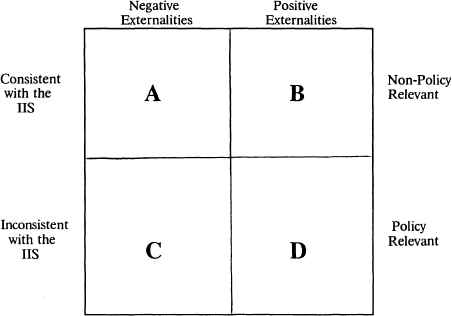
Those externalities that fall into the lower half of the matrix can be analyzed as unambiguously generating efficiency problems for the catallaxy. Furthermore, at least conceptually these externalities can be dealt with through some refinement of the institutional setting. Thus, they can be categorized as “policy relevant.” In other words, the possibility exists that efficiency can be enhanced through some public-policy action.
Those that fall into quadrants A and B will need further refinement in order to reach some specific conclusions concerning their implications for catallactic efficiency. But as will be demonstrated, any problems that are caused by externalities that lie in this half of the matrix cannot be unambiguously improved on by exogenous manipulation of either market results or the institutional setting. Any unambiguous improvements in efficiency with respect to externality problems that arise in these two categories must be generated endogenously through market activity. It will be argued that these external effects should not be the target of public policy and they will be categorized as “non-policy relevant.”
Policy-Relevant Externalities
By their very nature, externalities that are inconsistent with the IIS are most likely to be negative, i.e., those that would fall in quadrant C. I will leave open the possibility that quadrant D could be empty. (An exception might be those positive externalities that are associated with intellectual pursuits and new inventions. These will be discussed below.) In particular we are considering externalities that involve the physical invasion of property rights or those that involve a conflict in the use of property to which title is not clearly defined. The former is a problem of property rights enforcement while the latter is a matter of ambiguity in property rights.
This is not to argue that it is impossible for positive externalities to be the result of uninvited physical invasions of property. For example, one could imagine a classical music fan living next door to a concert violinist, where, happily, the sound of the violinist’s practicing drifts into the neighbor’s surroundings. While this positive externality, at least initially, represents the use of one’s property by another without his permission, it ultimately turns out to be a “welcome” intrusion and therefore does not constitute a violation of the IIS. For a policy-relevant externality problem to exist, it must first physically invade the rights of others or make use of property that the person generating it is not clearly entitled to. Second, it must, in an unwanted manner, interfere with the formulation and execution of plans with respect to the property that is being coopted. If the second criterion is not met, there can be no negative impact on catallactic efficiency. The positive externality generated by the violinist does not meet that second criterion.
Most of the standard cases of negative externalities, such as air, water, and noise pollution, fit into the category represented by quadrant C. These would be interpersonal conflicts over the use of property, conflicts that prevent plans made with respect to that property from being carried out. Those are unambiguous “externality problems,” and conceptually, if not always practically, they can be remedied by making refinements in the legal-institutional environment such that it more closely conforms to the IIS.
Furthermore, this will have implications for the relative accuracy of information that is being captured and disseminated through the price system. It is likely that contracts were made based on the expectation that the destroyed crops would eventually come to market. In light of the externality, the contracted prices have captured false information with regard to the relative scarcity of the farmer’s product; that in turn has sent and is sending false signals to other market participants.
The solution is to enforce the farmer’s right to use his entitlement as he sees fit, thus restoring the conditions of the IIS. (The specifics of that kind of solution will be discussed in the following chapter.) In terms of public policy, only this solution would unambiguously enhance catallactic efficiency. It could be argued that to do nothing and allow the property rights invasion to continue, i.e., to effectively transfer rights for the purposes of grazing to the rancher, could also restore catallactic efficiency in the long run. In other words, the farmer’s expectations and plans, and therefore market prices would adjust to the new property rights arrangement.
While that may be true in a strictly static setting where the problem at hand is viewed in isolation, this kind of solution would have a detrimental effect on the plan formulation process in general. Ultimately it would introduce a great deal of uncertainty with respect to property rights themselves. People acquire property with purposes in mind. As discussed, to make efficient plans, and by implication for prices to project accurate information, people need to be able to count on having the right to use that property for their purposes. If people cannot be sure that their property rights will be upheld the whole process of plan formulation and goal seeking in general would be severely hampered. Risks associated with the possibility of not being able to eventually implement some plans could prevent what would otherwise be mutually beneficial exchanges from being made and ultimately could prevent many goals from being achieved or even pursued. As will be noted in the following chapter, this creates efficiency problems for the negligence rule in tort law that are typically ignored in the standard analysis (see Rizzo, 1980A).
A second kind of problem that could arise as a policy-relevant externality is associated with ambiguity in entitlements. Imagine an unowned or “publicly owned” stream that is being polluted, making it unusable for recreational purposes by residents downstream. A conflict has arisen because of ambiguities with respect to entitlements to the stream. Two separate sets of plans have been made with respect to the same physical resource. This can be traced to a flaw in the existing institutional setting, i.e., property rights are not clearly defined.
The standard approaches to dealing with the issue of original entitlements are theoretically flawed, from the perspective of both Austrian economics and catallactic efficiency, and have no practical value as real world guides to policy. Typically those approaches involve methodologically illegitimate and fundamentally non-operational interpersonal utility comparisons, and consequently are not ends-independent.
Coase’s analysis (1960) (to be discussed at greater length in chapter 5) suggests that the rights to the stream should go to the person whose use adds most to the social value of output. But both subjective value theory and the knowledge problem suggest that this approach is not only non-operational, but more fundamentally, that Coase’s normative standard, i.e., maximizing the social value of output, has no meaningful economic content.
This is not to suggest that a “Coase theorem” type solution, where the problem is resolved by mutual consent that arises through a bargaining process, would be unacceptable. In fact, this would, from the perspective of catallactic efficiency, be the most promising solution. But no conclusion could be reached regarding the relative “social value” of output that results from this bargaining process. Furthermore, in the absence of a bargain, that solution could not be mimicked by a judge or other public policy maker, as is suggested by Coase and assumed in most of the law and economics literature.
Buchanan’s constitutional approach, which focuses on rules determination and property rights arrangements before market processes are set in motion, i.e., in a state of nature (1975), also offers no practical public policy guide for problems such as those that arise with the unowned stream. Buchanan focuses on the unanimous agreement that could be reached with regard to undetermined entitlements when individuals are trapped behind a Rawlsian-type veil of ignorance. But clearly that is not the world that is being dealt with when analyzing day-to-day externality problems. As noted, unanimous agreement among the affected parties, possibly brought about as part of a bargaining process, would be ideal. But the relevant public policy question must focus on how to delineate property rights in the absence of mutual consent.
The Pigouvian approach, for the same reasons that apply to Coase, also offers no solution to this problem. As noted, the Pigouvian solution requires the objectivisation of costs and benefits and the use of interpersonal utility comparisons. But the problem of defining property rights would still need to be resolved if Pigouvian tax policies were to be implemented. The basic question of who is the source of the problem and therefore who should be taxed cannot be determined in the absence of property rights. This is the problem of joint causation implied by Coase’s article (1960) and this was a central theme of Coase’s criticism of Pigou’s analysis. The Pigouvian approach is essentially institutionless. In any given conflict, who has title to what resources must be assumed before Pigouvian analysis can proceed. This is as true for public goods problems as it is for negative externality problems (see below).
To some extent we can question the typical agnosticism of Austrians, qua economists, on the issue of original entitlements. We have already shown that there is a role for economic analysis when analyzing the implications of “unowned” property for externality problems. In the stream pollution example, prior to determining the “justice of entitlements,” economic reasoning can be invoked to describe the detrimental effects that such a situation can have on catallactic efficiency. Furthermore, such reasoning can be used to suggest the appropriate focus for public policy. Prior to settling the ethical issue of who should be granted the entitlement in question, it is possible to use economic analysis to point out the efficiency problems that will arise from such a situation and to delineate the outlines of a policy solution. Taking this analysis one step further, it will be argued in the following chapter that economic analysis, again invoking a standard of catallactic efficiency, can be used, in some situations of tort, to settle the final question of who should get the entitlement.
I am not taking issue with the entire thrust of the more traditional Austrian conclusions in this area. While the approach here suggests that in some instances economic analysis can be useful in helping to decide questions of original entitlement, this is not true in all cases. The general Austrian approach, even with catallactic efficiency as a backdrop, severely limits the extent to which economic reasoning, particularly costs-benefit analysis, can be used to resolve externality problems where property titles are not clearly defined. A completed public policy approach to this issue needs not only a theory of efficiency, but a theory of justice. Economists who do not recognize this lack a clear understanding of the boundaries of economic science and, as is often the case, are bound to espouse incoherent and inappropriate approaches to public policy.
Before moving on to the issue of externalities that arise within the context of the IIS, those in the upper half of the matrix, we need to examine the possibility of policy-relevant externality problems that are the result of the generation of external benefits. In other words, externalities that would fall into quadrant D. As was argued above, positive externalities by definition do not result in the violation of anyone’s property rights. If they are truly positive externalities they become a welcome “intrusion” from the perspective of the recipient of the external benefit. For this reason, it could be argued that, quadrant D is empty, i.e., there are no policy relevant external benefit problems. (The issue of whether externality problems or efficiency analysis in general is appropriately used as a justification for establishing institutions for formulating and instituting policy in the first place will be discussed later in this chapter and in the conclusion of this book. This is the question of whether the typically perceived positive externality problems associated with public goods, i.e., free rider problems and joint consumption problems, can be used ultimately as a justification for the existence of a government. For our purposes here, it is assumed that an apparatus of some kind is in place for adjudicating and enforcing property rights disputes.)
Mises has suggested, though, that an external benefit “problem” might arise where intellectual property rights are not clearly defined; this is the issue of patents and copyrights (see chapter 1). Mises clearly focuses on an issue of property rights that may have normative implications for catallactic efficiency. Ambiguities with respect to entitlements in the area of inventions and the generation of ideas can lead to interpersonal conflicts in the plan-formulation and goal-seeking process. As noted, to efficiently make plans, individuals need to know that their rights to use the relevant property will be upheld at pertinent points in the future. The issue of patents and copyrights may be an application of this principle.
As discussed in Chapter 1, Rothbard rejects the notion of intellectual property rights, noting the conflicts that arise with respect to the rights of independent discoverers. He also points out that, if reproduction is the concern, the inventor of a product or the writer of a book can, through contract, limit the rights of others with respect to the use of these products. Furthermore he rejects the standard external benefits argument for intellectual property rights which claims that the lack of such rights results in the underproduction of research and innovation. Invoking the standard Austrian criticism of orthodox externalities analysis, Rothbard asks, “By what standard do you judge that research expenditures are ’too much,’ ’too little,’ or just about enough?” (1970, p. 72).
If it is concluded that discoveries and ideas are not the appropriate target of property rights then these kinds of externalities would be moved to quadrant B in the upper half of our matrix. In other words they would not constitute a violation of the IIS. That may be the appropriate positioning for such externalities in any case, since it is not clear that catallactic efficiency is unambiguously improved by establishing such entitlements, particularly given the problem of independent discovery. Clearly this issue is one of many that would require further analysis within the context of this theory of externalities. The purpose of this book is not to thoroughly analyze and resolve every issue that can arise under the rubric of externalities, but to provide a general framework under which that analysis can proceed.
Non-Policy-Relevant Externalities
Non-policy relevant externalities are those external effects that, while possibly effecting the utility level of the recipient of the externality, is neither the result of or results in a violation of the IIS. Such externalities can be either positive or negative. Furthermore, while often such externalities will impinge on the plan-formulation process, i.e, they will not necessarily be neutral with respect to people’s means-ends framework, they will not have the effect of distorting price signals. In other words, the accuracy of information flows associated with prices will be unaffected. The hallmark of that kind of externality is that catallactic efficiency cannot be unambiguously improved on through public policy.
Most negative externalities, even in the standard literature, involve the invasion of one person’s property by another. But there are examples where negative externalities are generated completely within the context of clearly defined and well-enforced property rights. In chapter 1 we discussed the case of neighborhood effects. For example, the person who stores old cars on his front lawn may impose a negative externality with respect to both his neighbor’s utility level and possibly the value of his neighbor’s property.
First, it should be pointed out that from a strictly subjectivist perspective, the presence of such externalities would be unverifiable by an outside observer, such as a policy maker or economist. There is no way of telling what the actual impact of such an effect is on the utility of those living in the neighborhood; no way of knowing whether such effects are necessarily negative. For example, other old car enthusiasts or automobile hobbyists in the neighborhood may find such circumstances aesthetically pleasing. For them the cars on their neighbor’s lawn could represent a positive externality. Furthermore, even if utility were observable, in cases where the cars might be generating both positive and negative effects, there is no way of telling, since utility is not comparable, whether, on net, they represent a positive or negative externality.
Similar conclusions can be reached with respect to the effect of the externality on the market value of homes in the area. Others who are inclined to store old cars on their front lawn may actually be willing to pay more to live in a location where they have neighbors who are doing the same thing. To know the effect on the market value of homes in the area, one would have to know what the value would be in the absence of the externality-clearly an impossibility.
With regards to positive externalities, it might be useful to invoke Mises’s two categories discussed in chapter 1. A type 1 external benefit is one where, in spite of the externality, the good in question continues to be produced. This is analogous to what the standard literature would consider a less than purely public good. A type 2 external benefit is one that renders the good in question unprofitable to produce at all and is analogous to a pure public good.
As has been traditionally the case with Austrian analysis, a type 2 externality result may be an interesting one from the perspective of positive economics, in that it represents a particular kind of explanation of why a good might go unproduced in a market. But the result itself has no normative implications. A production level of zero is no less optimal than any positive level of production. In fact, so long as that outcome reflects a market process that was the result of decisions made within the context of the IIS, the process and therefore the outcome would have to be judged efficient.
From the perspective of catallactic efficiency and the Austrian school in general, the only time a type 2 outcome could be deemed inefficient is ex post, and then only by the market participants themselves. If this turned out to be the case then it would be expected that the market process would modify itself in the direction of a more efficient, i.e., means-ends consistent, outcome.
The results that Mises associates with this type of externality are essentially the results that are gotten in the case of a “pure public good.” Because of a severe free-rider problem, no profits can be generated from the production of the good and therefore the good is not produced. But if this result is shown, ex post, to be inefficient from the point of view of market participants, then we can expect behavior to be modified and a tendency will exist to convert this situation into a type 1 externality. All that would be necessary to convert a type 2 result into a type 1 result is that the good become profitable to produce. If the goal of market participants is to obtain the good and they realize that their means, i.e., free riding, is inconsistent with their ends, then continued attempts at being a free rider would be irrational.
Not all potential market participants would have to change their actions for this type of conversion to take place. What would be necessary is simply that enough individuals decide that they want to achieve their end badly enough to pay an amount sufficient to create a profit opportunity for potential entrepreneurs, in spite of the fact that positive externalities will be generated. As long as there are people who are actually willing to pay a profit-generating price to obtain the good, a true opportunity for mutually beneficial exchange will arise. If a consumer’s goal is not strictly to obtain the good for free, it would be irrational for him to continue his inefficient behavior once he learns that the good is not forthcoming.
According to what Kirzner describes as the “market discovery process” (1985, p. 137), just such a learning process can be expected. Kirzner argues that:
[d]emand for regulation ... stem[s] from the belief that unsatisfactory conditions will never be corrected unless by deliberate intervention. Such demands ... might be muted ... were it understood that genuine inefficiencies can be relied upon in the future to generate market processes for their own correction ... the urge to ... alter [market] outcomes must presume not only that these undesirable conditions are attributable to the absence of regulation, but also that the removal of such conditions cannot be expected from the future course of unregulated market events. (1985, p. 137-138)
It is not being argued that all type 2 externalities will eventually evolve into type 1 externalities only that those type 2 externality results caused by the inefficient pursuit of goals should eventually make the conversion. If the good continues to go unproduced, it must be assumed that people will demand it only if they can obtain it for free, or at least at a price insufficient to generate a profit. If this is the case, then, as argued above, the result cannot be appraised as inefficient.
This discussion assumes that the process and results being discussed are occurring within a context where property rights are recognized and enforced. In other words, it cannot be said that goods that go unproduced as a result of free-rider problems within that context should be produced. The question arises as to the production and maintenance of the institutional setting itself. What if the institutional setting goes undeveloped as a result of free-rider problems? This is the typical argument for state provision of courts and protection services such as police and national defense. It is argued that such institutions would not arise in the absence of coercive measures instituted by a state.
In fact, though, this is ultimately a discussion of a good that may go unproduced outside a market setting. In other words, in order to establish markets there must be a system of recognized property rights. Any discussion of markets or catallactics assumes the right to trade. To argue that the institutional setting necessary for a market to exist will go unproduced in a free market is putting the cart before the horse. This is ultimately a question of how to establish and maintain, in a prior sense, the institutions that are necessary for the existence of catallactic processes.
The discussion here can tell us what the role of those institutions should be once they are established, namely to delineate and enforce property rights according to the guidelines of the IIS. What a theory of catallactic efficiency cannot do is dictate how those institutions should be established and maintained in the first place. Such a discussion, by definition, comes prior to the beginning of catallactic processes. That point is typically ignored in the standard analysis of the public goods question.
The underlying and unstated assumption in standard public goods theory is that people have the right to make certain trades but choose not to make them. In order for orthodox analysis to proceed with respect to analyzing the provision of those institutions that establish and protect property rights, such as courts and police protection, it must assume that the very institutions that the market supposedly is failing to produce already exist. It is illogical to argue that markets would fail to produce the institutions necessary to establish and protect property rights when these institutions are a necessary pre-condition to having markets. If people do not already have rights to exchange, at the very least, their labor services, and to control and exchange the fruits of those services, the fact that an exchange process does not develop in such a way as to give rise to those rights cannot be legitimately called a “market failure”. Certainly to argue that the necessary institutional setting is a pure public good that would go unproduced by markets is to place one in a logical contradiction. The right to contract and make exchanges is necessarily inherent in all market analysis, including Pigouvian public goods analysis.
That issue is finessed even in Buchanan’s discussion of how rules of the game would be established by unanimous consent in bringing society out of a Hobbesian state of nature. As with public goods analysis, the underlying and unstated assumption is that people, at least, own themselves and have a right, presumably enforceable, to make contracts.
Ultimately, this issue which is typically addressed as a part of welfare economics and leads to the economic justification for the existence of government, is not a question of economic or catallactic analysis at all. Such issues must be dealt with before invoking economic analysis. Some argue that such institutions as police and courts would, and historically did, in some settings, evolve spontaneously without the existence of an organized state apparatus (see Rothbard, 1973; Friedman, 1973; and Benson, 1990). Whether or not such institutions would flourish without invoking coercive elements, such as taxation, through a state apparatus is an empirical question open to debate. Furthermore, whether it is worth using, at the margin, such coercive measures in order to obtain more property rights protection than would occur in their absence is also debatable. Economics, along with other social sciences such as sociology, anthropology, and history can be used in a positive sense to inform those debates. Catallactic efficiency can provide a normative justification, in a general sense, for the establishment and maintenance of private property rights, but economics must remain agnostic from a normative perspective with respect to the question of how the institutions meant to establish and maintain those rights are initially created.
Similar analysis applies to the appropriate level of property rights protection. Assuming that the appropriate institutions are in place, normative questions related to the tradeoffs that “should” be made between additional protection or refinements in the institutions and other goals, public or private, cannot be directly answered through efficiency analysis. To the extent that such decisions are made through the state apparatus, economics can help clarify some of the opportunity costs associated with transferring additional resources from the private to the public sector, and some of the benefits that might accrue for the market process as the result of enhanced property rights enforcement. The relationship between those costs and benefits cannot be weighed by the economist to determine an “optimal” level of enforcement. This issue would have to be solved through the political process.
The same would be true if the issue were determined through completely voluntary means. Efficiency analysis could not be invoked by an economist or other third party to determine whether the level of property rights protection that is being chosen is “optimal.” At the margin, people would decide, based on their own perceptions of costs and benefits, the level of property rights protection that is consistent with their other goals. Clearly, this is the case now for those who desire and purchase property rights protection over and above the level that is provided by the state.
The fact that the solution to these problems are not forthcoming within the context of catallactic efficiency is not a deficiency in the analysis relative to the standard approach. These questions are only apparently answered in the Pigouvian framework. As has been argued elsewhere, the tools that are typically invoked to determine the “optimal” level of national defense or police protection are fundamentally and irreparably flawed. The answers to these questions that Pigouvian analysis provides are, in reality, no answers at all. I agree with the traditional Austrian assessment in such areas: namely that an economist, qua economist, cannot offer a normative foundation for answering such questions. Ultimately other disciplines, in particular, philosophy and ethics, possibly informed by economic analysis, must provide the normative framework for assessing these issues.
KIRZNER’S IIS: THE THREAD THAT BINDS
It is clear that the normative analysis of externalities in this chapter, invoking the welfare standard of catallactic efficiency, is consistent with the dominant Austrian approach of Mises and Rothbard. Furthermore the conclusions are the same as those that were reached when viewing the issue from the perspective of either Rothbard’s demonstrated preference standard or Kirzner’s coordination standard of social welfare. That agreement can be traced to certain fundamental concerns and presuppositions that all three of these approaches to efficiency and social welfare have in common.
Beyond this though, there is a fundamental agreement on the specifics of an appropriate legal setting. It is this agreement that has led to the normative interpretation of externalities that most Austrian economists hold in common, even in the absence of a consensus on welfare theory itself. All three approaches to efficiency ultimately conclude, either explicitly or, as in Rothbard’s case, implicitly through ethical analysis, that the most efficient legal arrangement for society is the one that is described by the IIS. After defining the market system as ideally coinciding with the legal environment established by the IIS, Kirzner concludes that interference with the market so defined can only decrease efficiency. He states that “interference with the ... market process limits the attempts of participants to coordinate their activities through an engine of remarkable efficiency-the market” (1963, p. 309). Likewise, Rothbard, arguing from the perspective of “demonstrated preference” concludes that, “No government interference with exchanges can ever increase social utility ... whenever government forces anyone to make an exchange which he would not have made, this person loses in utility as a result of the coercion” (1977, p. 29).
It would be inappropriate to conclude that those Austrian approaches to welfare economics have simply been ex post rationalizations for some ideologically desired result. It is arguable that these conclusions regarding institutional efficiency are an inevitable consequence of consistently following the constraints imposed by Austrian methodology. The consistent focus on individual goal seeking, a theme of Austrian analysis beginning with Menger, coupled with the analytical constraints of radical subjectivism, may necessarily lead to the IIS, or something close to it, as an institutional touchstone for normative analysis.
More specifically, Austrian methodology requires that any approach to normative economics take individual goals, preferences, and therefore perceptions of opportunity costs as given. An implication is that the analysis would have to be “ends independent” and eschew all interpersonal and intertemporal cost-benefit analysis. This methodological approach necessarily shifts the focus from comparative “outcomes” analysis to comparative “processes” analysis. More specifically, it leads to comparisons of the market processes that will arise under alternative institutional arrangements.
In this context, the concept of “market failure” has no meaning. The ability of the market system to promote efficiency from any of the Austrian perspectives is always limited by the institutional setting that it must operate within. The price system will capture and disseminate as much of the relevant information as that setting allows. The emphasis here shifts from the concept of market failure to the concept of “institutions failure.”
When externalities are viewed in light of the IIS the Austrian conclusions as originally put forth by Mises are automatically implied. Only externality “problems” that involve the conflicting use of property are inconsistent with that institutional arrangement. Activities that generate external benefits do not typically involve a conflict in the use of property and in general do not violate the ideal institutional conditions. Therefore, they are not seen as adversely affecting economic efficiency or welfare. The point is that the general normative analysis of externalities found throughout the Austrian literature can be interpreted as an attempt to establish or maintain a widely agreed on “ideal” institutional arrangement. In addition, viewing the analysis from this perspective gives it an overall coherency that cannot be seen when discussing it strictly from the perspective of any of the separate welfare criteria.

