
The Economics of Illusion
13. Anachronism of the Liquidity Preference Concept
It is the contention of this chapter that the concept of liquidity preference is not applicable under present conditions. In part, it has always been superfluous; moreover, the aspects to which it was once appropriate have lost practical importance through institutional changes that have taken place in the last decade.
THE PRESENT CONCEPT OF LIQUIDITY PREFERENCE
As is well known, liquidity preference was conceived within the framework of the theory of interest. At some times it has been considered more important than at others.
a. In classical theory the liquidity preference concept, or something equivalent to it, is, generally speaking, not mentioned. The interest rate keeps the supply of money saved in balance with the demand for money to invest. The concept of hoarding or the possibility of hoarding plays no major role. The theory of interest was monistic, “pure.” 2
b. However, it had always been observed that the credit market supply was at times influenced by demand for credit that did not originate in the normal desire for capital, i.e., purchasing power for productive purposes; that a special “money or cash demand” existed.
As a result of this observation, neoclassical theorists developed, in the so-called “loanable fund” theories of interest, “dualistic” theories of credit demand: money was demanded not only to be spent but also to be hoarded, and supplied not only because saved but also because dishoarded 3—or incidentally, of course, because created by banks. These theories thus achieved a synthesis of what can be called “purely monetary” and of “pure” theories of credit demand and supply.4
c. This dualistic theory prevailed in continental European and Anglo-Saxon literature until Keynes replaced it by a monistic, purely “money demand” theory.
According to Keynes’ liquidity preference theory, interest is paid for the “desire to hold wealth in the form of cash” and received as “the reward for parting with cash” against some instrument of saving.5 It is “the reward for not hoarding,” not “the reward for not spending.” 6 In other words, the owner of a savings account receives interest because he does not hoard, not because he does not spend money; and he loses interest because he hoards money, not because he spends it. The demand for cash comes from the desire to transform savings accounts into cash. It is denied that money is demanded in order to be spent, not to be hoarded. In short, the switching from savings accounts into cash for hoarding, not the withdrawal of savings accounts for spending, is considered the only possibility. At least on the surface, this is a “monistic” theory of cash demand for hoarding purposes.
Keynes’ liquidity preference theory has often been criticized with much acuteness. It has been demonstrated that a monistic theory, neglecting the influence of saving and borrowing for consumption or production purposes on the interest rate, must necessarily be one-sided and unrealistic.7
My own main objection is that his theory is not consistent even as a “hoarding theory of interest,” and does not explain what it purports to explain, namely, that interest is paid for keeping liquidity, and interest is received for parting with it.
1. Cash is defined not only as actual cash but may include “money-time deposits with banks and, occasionally, even such instruments as treasury bills, and it is as a rule co-extensive with bank deposits.” 8 As one can earn interest on all such investments, one receives interest for holding liquidity, not for parting with it.9 This interest may, it is true, be lower than interest paid on longer-term investments; but in times of money stringency short-term interest rates can be, and have been, higher than long-term; so that for holding liquidity, one not only receives interest, but even higher interest than illiquid investments would yield.
2. Keynes gives four motives for wanting cash: the Income motive, the Business motive, the Precautionary motive, and the Speculative motive.10 All are clearly taken from the arsenal of the classical “pure” interest theory: anyone who holds cash for the purposes mentioned obviously holds it with the intention of spending it, either at regular intervals or speculatively sooner or later than is usual.
If individuals obtain cash or checking accounts for these purposes they have to pay interest, not for hoarding the money but for keeping it to be spent sooner or later. So in reality, interest is paid for spending, not for hoarding money.11
3. The liquidity preference concept is so widened that it is supposed to be effective not only when somebody hoards or does not spend money because he wishes to retain cash, but also when he does not spend money for quite other reasons. It has thus become a negative rather than a positive concept. It suggests that hoarding, for instance because of low profits on an investment, is due to a special demand for liquidity, not to the simple fact that profits for the time being are expected to be lower than lost interest.
The general objection to Keynes’ theory, however, is that it is monistic, not dualistic. “Such loose phrases as that interest is not the reward of non-spending but the reward for not hoarding seem to argue a curious inhibition against visualizing more than two margins at once.” 12
d. Since Keynes issued his General Theory, the neoclassical dualistic theory seems to have made a comeback—again, very generally speaking. It is recognized that money is wanted for spending as well as for hoarding. As a consequence of this dualistic approach, the interplay of the credit demand for productive purposes and for holding liquidity—which is considered to decline as interest rates rise—has a major role in contemporary writing on interest rates.
However, the concept of liquidity preference is much broader than the neoclassical concept of money demand. The demand is directed towards bank accounts and short-term investments as well as cash.
e. We shall try to prove that the concept of liquidity preference is superfluous and confusing when it goes beyond the neoclassical concept of money or cash demand. Money demand, too, has become an obsolete concept because of certain changes in currency systems. For all practical purposes, the classical monistic “pure” theory of interest is necessary and also adequate to explain interest rates in a modern economy.
THE CRITERION OF LIQUIDITY PREFERENCE
Within the Keynesian system the liquidity preference concept is introduced to explain why, under certain conditions, the supply of credit available for ordinary demand is curtailed by an extraordinary demand. This special demand is supposed to absorb a part of the available cash; therefore some other demand is left unsatisfied. Liquidity preference is, as has been correctly stated,13 a sort of “death trap” for savings in that it raises (by withholding the hoarded money from the credit markets) the interest rate above the level that assures (within a given demand schedule for credits) a given level of purchasing power. In other words, liquidity preference is supposed to explain what before Keynes was simply called “deflationary pressure from the credit supply side.”
Deflationary pressure from the credit supply side is present—
1. If, ceteris paribus, effective demand, MV, declines, i.e., when there is deflation;
2. If the decline is due to the withholding of purchasing power from the credit markets by creditors who keep their funds in cash or relatively liquid rather than illiquid forms, thereby curtailing the supply of credit and raising interest rates above those that would otherwise prevail.
Let us now examine to what degree the liquidity preference concept, as generally used nowadays, fulfills these conditions and to what degree it belongs to quite different theoretical categories. The concept covers four kinds of liquidity preference, each of which coincides with a different situation in the money and capital markets: interest rates are low on short- and long-term, on first- and lower-grade investments; or they are low on short- and long-term investments but not on lower-grade investments; or they are low only on short-term money; or finally, they may be high on short-term money too.
LIQUIDITY PREFERENCE OF THE ENTREPRENEUR: LIQUIDITY PREFERENCE AS THE INVERSE OF INVESTMENT PREFERENCE
The liquidity preference of the entrepreneur is, directly at least, not at all due to a curtailment of the credit supply. If MV dwindles, it is because demand for credit is weak.
If an entrepreneur holds cash or checking accounts for speculative or precautionary reasons and does not spend them within a normal period, he undoubtedly exercises a deflationary influence on MV. However, what causes the money to become idle is not a special liquidity preference of the entrepreneur. It is the simple consequence of the fact that for the time being profits on productive investments are deemed smaller than interest received for holding bank accounts, the zero interest on cash, or incidentally, the interest that would have to be paid for borrowing money. When the entrepreneur borrows from the bank, the marginal efficiency of capital is acknowledged to be solely responsible for the credit demand schedule at various interest rate levels.14 But there is not the slightest difference between borrowing from a bank and from oneself. The liquidity preference is fully accounted for by the demand schedule for capital, which compares the utility of various amounts of capital with the utility of corresponding amounts of cash or bank accounts. To speak of a special liquidity preference as a motive for refraining from productive investments is double counting, and as illogical as it is to speak of a special hunger preference of somebody who does not want to eat. Liquidity preference is merely the inverse of the preference to invest. The accumulation of cash or of bank accounts is just an expression of a weakening demand for credit—a downward shifting of the credit demand curve. It is not caused by a special liquidity preference, nor does it cause deflation. It is the consequence and reflection of what used to be called self-deflation.
It could be argued that the entrepreneur who accumulates cash or bank accounts curtails the supply of money that could serve as a source of credit for others and thus exercises indirectly a deflationary pressure. We shall revert below to the question whether and under what conditions that might happen.
Liquidity preference of entrepreneurs is usually accompanied by low short- and long-term interest rates, high bond prices, and ample offering of bank credits. This combination appears at the very end of a cyclical depression when inventories have been liquidated under the impact of deflation. Banks have become liquid and are ready to grant new credit, whereas entrepreneurs are reluctant to apply for credit because they fear losses from further declining prices for their products. Credits are low and the economy remains in a state of underactivity.
To explain this situation, the concept of a “low marginal efficiency of capital,” or its expectation, is fully adequate, and the liquidity preference concept is entirely unnecessary.
LIQUIDITY PREFERENCE OF CREDITORS: LIQUIDITY PREFERENCE AS AN EXPRESSION OF THE RISK FACTOR
Just before the cyclical phase mentioned above is reached, short -and long-term interest rates are usually low, government and AAA bonds high, but venture capital, either directly or by means of the stock market and bank credits, is scarce; and what little is available is very costly. There is a margin between the “pure” interest rate, which is low, and the interest rate that comprises the risk premium, which is high. Though clearly arising because the flow of investible funds reaches only first risk investments and is prevented from reaching investments with higher risks, this situation too is often considered to be caused by liquidity preferences, this time of creditors or banks.
If banks are reluctant to grant new credits, it is because they fear their funds will be newly “frozen” and lost in case of enforced liquidation, not because they have “no money” or the money has disappeared in a “death trap.” They have all the money they need either in their safes or as reserves in the central banks. What they desire to retain is not cash—in fact they try to get rid of it whenever they see a half-way safe or profitable investment opportunity—but their own bank liquidity in the private economic sense of the word. In this limited sense, I myself, twenty-six years before Keynes, considered interest as the reward for parting with liquidity.15
Incidentally it should be noted that the stringency of bank credit at this juncture is caused not only by a curtailing of supply but also by an increase of demand for credit. A new demand for credit, called in German “Durchhaltekredite,” appears. In a cyclical crisis, goods become unsalable at the prevailing price level. Producers are at first reluctant to incur losses by liquidating their accumulating inventories at lower prices. Instead they allow their inventories to pile up. Lacking money to pay current production expenditures, they have to apply to the banks for additional credit. Although this credit demand gets its impulse from the fact that buyers withhold their purchasing power from the markets for fear of falling prices, the ensuing credit stringency is caused not only by a dwindling supply of bank credit but also by the increased credit demand for the purpose of postponing the liquidation of abnormally high inventories. There is a genuine new credit demand.
The behavior of creditors that creates the situation characterized by low interest rates for first-class investments and high interest rates for lower-grade investments, as just described, is really not due to a liquidity preference at all. The situation is caused by the blocking of the flow between the pure money and capital markets and the investment markets, not by a deflationary pressure from the money side. Therefore the liquidity preference concept has no raison d’être as a special category; what it tries to explain is entirely covered by the concept of the risk of the lender.16 It can also be interpreted as the lowering of the demand schedules of professional lenders who consider that only the interest rates at which they borrow themselves, not the risk premium, are covered by the high interest rates on the investment markets.
This margin between the pure and what has been called the gross interest rate, caused principally by the nonfunctioning of the banking system, undoubtedly tends to narrow. Such a nonfunctioning is not likely to be tolerated in the future. Organizations—many of which are already in existence—will grant the credit banks will be reluctant to give, or the governments will guarantee such credit so that the banks will no longer be concerned about their liquidity.17 It is a matter of opinion how far this development can be considered to have gone already.
LIQUIDITY PREFERENCE OF THE ARBITRAGEUR WHO ARBITRAGES BETWEEN MONEY AND CAPITAL MARKETS
Having considered the case where the pure interest rate is low on money as well as on capital markets, we now examine the case where short-term interests are low, but long-term interests, even yields on government bonds, are high.
Arising in a cyclical phase somewhat before the one previously described, this is the situation that plays such an important role in Keynes’ liquidity preference theory.18 He considers it a case of the liquidity preference of owners of bank accounts or of banks that are bullish on interest rates because they fear an aggravation of the crisis.19
Again there seems to be no special reason to retain a special concept of liquidity preference of the owner of bank accounts or cash. What really causes the margin between long- and short-term money is that the arbitrageurs between money and capital markets, who usually borrow from the banks on short-term and buy long-term bonds (the banks themselves can also be arbitrageurs in this sense), hesitate when they consider that they would lose more on the price of the bonds than they would gain from the interest rate margin. The banks in particular hesitate to use their money-creating power to buy long-term bonds. Therefore, what is called liquidity preference is again merely the inverse expression of a low investment preference of the professional investor in long-term securities. Incidentally, this margin, too, clearly tends to disappear so that the importance of the phenomenon in practice, and therefore also in theory, must be considered as decreasing. The reasons are two-fold:
First, the prevailing easy-money policy has greatly reduced the risk that short-term interest rates will be allowed to rise. Secondly, the power the Federal Reserve System now has to buy long-term government bonds—which it will use, if for no other reasons than fiscal—puts the long-term interest rate, formerly solely dependent on the arbitrage between money and capital markets, almost as directly under its control as the short-term interest rate.
LIQUIDITY PREFERENCE THAT CREATES HIGH SHORT-TERM INTEREST RATES: LIQUIDITY PREFERENCE IDENTICAL WITH CASH PREFERENCE
Undoubtedly at times the money markets were very tight and short-term rates very high. Then there was real deflationary pressure from the money side. We contend, however, that these situations cannot be explained by liquidity preference in the usual way if bank accounts and short-term investments as well as cash are considered objects of the preference. We must distinguish between liquidity preference for cash, in the narrowest sense, on the one hand, and for bank accounts, short-term investments, etc., on the other.
The liquidity preference that could influence the supply for money and exercise a deflationary pressure from the money side on the basic short-term money rates can only be a preference for cash, never for other investments. To prove this, we have only to examine the demand and supply for purchasing power in an economy without currency. The procedure is the one I followed in my first article on money market problems, quoted above.20
A. Liquidity Preference in a Money-free Economy. In an economy in which there can be no demand for or supply of cash, the demand for loans is obviously identical with the demand for and supply of sight deposits (checking accounts) in banks. As the ability of banks to create such accounts autonomously by granting credit furnishes the marginal supply of such credit, we can say that the supply of credit is dependent upon the ability of the banks to create credit through creating debtor and creditor accounts.
In such a situation money cannot be kept from the credit market because no money exists; there is no “death trap” for money. And as far as sight deposits are concerned, they are never withdrawn. The fact that they are “held” means that they have been loaned—through the bank as intermediary—to a debtor of the bank. The persons who hold them for liquidity reasons thereby satisfy their liquidity preference.21 No hoarding can raise the interest on short-term money markets. The money might not spill over to capital markets, it is true, but liquidity preference can never create high interest rates on the money markets as long as bank accounts or money market instruments, not cash, are hoarded.
Again it could be argued that deflation would ensue if banks were unable or unwilling to grant new credit which would compensate a decreasing V through an increasing M; also that legal reserve requirements on the one hand and liquidity fears on the other could set a limit to such granting of new credit.
However, as far as liquidity fears (as described on p. 152) are concerned, they could never prevent the banks from buying first-class securities in any amount they wished, and thus from lowering the supply price of credit to any desired level. Moreover, reference to legal reserve requirements is clearly out of place in a “money-free” economy. If a certain percentage of bank accounts have to be covered by balances with central banks, holding the former amounts to holding, indirectly, the latter or the cash that can be freely obtained against the accounts.22 Therefore, if bank accounts for which a coverage is required are hoarded instead of spent, this is really the case of hoarding real cash discussed below under B.
For continental Europe, where reserve requirements were unknown and private banks were not dependent upon the central banks for credit expansion, as long as the public did not convert its deposits into cash, reference to reserve requirements would, of course, be entirely out of place. Even in countries such as the United States, where coverage requirements exist, they could be of practical importance only at the beginning of a depression when, as described above, credit demand increases. In the later stages of a depression, after bank balances have contracted, the excess of reserves is so large that every credit demanded can be granted.
B. Cash Preference in the Past. What has led and theoretically in the future could lead to a deflationary pressure from the credit supply side is merely a demand for cash—a cash preference, we may call it. It is the pre-Keynesian concept of money demand to which we thus return and which, in the opinion of this author, should never have been given up.
What are the reasons for such a money demand? Obviously it could never appear in a “money-free” economy, where the demands for purchasing power in the form of bank accounts and for loanable funds are always identical. Only when two kinds of purchasing power—bank deposits and cash—co-exist and are to a certain extent interchangeable can there be a demand for money outside of and not satisfied by bank deposits.
The customary assumption seems to be that to hold cash, instead of either holding a bank account or spending the cash, gives a certain pleasure or convenience that declines with the amounts involved. All sorts of supply and demand curves attempt to show the interaction of the demands for money to hoard and for money to spend at various levels of interest rates. However, this type of analysis, while logically perfect, cannot describe realistically how the demand for money affects the supply of credit. It fails also to clarify how far the liquidity preference concept, even in the narrowest sense of “money demand,” is still of actual importance at present and will be so in the future. To do this, we must recognize that there are several varieties of money demand and that they are governed on the supply as well as on the demand side by quite different laws. The following varieties must be distinguished: 23
a. Extraordinary Money Demand.24 The most outstanding examples of extraordinary money demand occurred during the famous bank crises of 1847, 1857, and 1866 in England. The public, fearing for the safety of deposits, sought to turn them into legal tender. Because there was not enough money to transform the billions of bank deposits into real money, a terrific deflationary process ensued. Each crisis led to the suspension of the Peel Act. As soon as the Bank of England was permitted to issue as many bills as it wanted, the demand for cash subsided. Similar crises have occurred in the United States, the most recent in 1933.
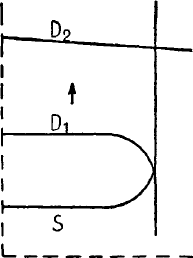
During such bank crises the money demand curve runs very high, almost horizontally, i.e., it is virtually independent of the interest rate. The public is prepared to pay very high interest rates for practically unlimited amounts. The supply curve, on the other hand, after a certain point runs nearly vertically. As more money is not available at higher rates, there is a real and terrific deflationary pressure from the money side.
b. A special case of the “extraordinary money demand” is the extraordinary demand for gold or foreign exchange,25 which arises when not only “bank money” but also legal tender is suspect; so that a flight from the domestic currency ensues. The demand curve runs from the right to the left at very high levels, but not horizontally. The higher the interest rates, the more they are considered to offset the losses from currency depreciation. The supply curve, too, moves up to higher levels.
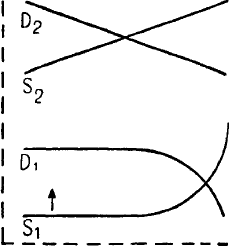
Under modern conditions, an extraordinary gold or foreign exchange demand usually leads to either the devaluation of the currency or a system of currency restrictions—witness the money disturbances of the ’thirties. Confidence in money at the former parity is not restored because readjustments of the basic disequilibria are not to be expected in a world of rigid costs.
c. Ordinary Money Demand.26 We distinguish five varieties:
1. The demand arising because people are paying cash rather than by check.
2. The demand arising from a concentration of needs for cash at certain times.
In addition to these two, which, for obvious reasons, I have called technical,27 there are three cases of nontechnical, “economic,” money demand:
3. The demand arising when bank accounts grow with prices and/or output. Obviously, the percentage that has to be paid in cash must keep pace with the growth of bank accounts.
4. The demand arising from the higher turnover of bank accounts. More money is demanded because the cash usually brought to the banks in between payments has to remain longer outside the banks, thereby curtailing the money supply.
5. The demand arising when banks grant more credit to compensate for a decreasing V—as described above. It is partly satisfied by the influx of money to the banks when the velocity of turnover of bank accounts slows down and people keep their cash reserves in banks. However, to the extent that people keep their reserves at home, thus really hoarding, the banks need new cash to grant new credit, of which a certain percentage must be paid out in real cash. If money demands 3 and 4 can be called inflationary, the money demand described here can be called antideflationary. This demand for additional money arises because people “hoard” rather than “save.” It is the only case where the “death trap” really works and the hoarding theory of interest is justified.
The main reason for differentiating these five varieties of money demand is that the satisfaction of each has quite different results. Satisfying money demands 1 and 2 is economically neutral, leading to neither credit expansion nor money inflation. Satisfying money demands 3 and 4 leads to inflation by enabling either credits to expand or the velocity of purchasing power to accelerate. By meeting or not meeting this inflationary money demand, monetary authorities can endeavor to stabilize the price level. Satisfying money demand 5 leads to an increase of credit, but not to inflation, because the increase of M offsets a previous decrease of V. Satisfying this kind of antideflationary money demand also is economically neutral.
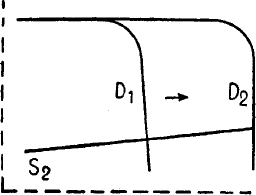
It has become customary to consider all sorts of money demand as inversely dependent upon interest rates. The higher the interest rates, it is assumed, the less the propensity to pay cash and to hoard instead of to save, because the “quasi profit” of cash is seen to decline gradually.28 However, the effect of the interest rate has been in the past and certainly is for the present and future very much overrated. To be realistic, one must consider the demand curve for cash as running at a high level almost horizontally from the left to the right at first, then very soon almost vertically downwards. In the past when money was offered only at relatively high rates, the horizontal branch may perhaps have been cut by the supply curve, but today when money is offered at very low rates, only the vertical part, which reflects very inelastic demand, is cut by the supply curve. Therefore, even if the supply curve moves further down—in other words, if interest rates decline further—no more money is actually used.
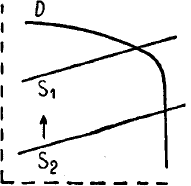
Without doubt we are now experiencing the development of a new sort of technical money demand: black market operations and the possibility of tax evasion have tremendously increased the desire to pay large amounts in cash instead of by check. The demand curve for money therefore runs a long distance almost horizontally, i.e., for the additional demand not lower but nearly the same interest rates are offered. This demand, however, is satisfied at low interest rates because of the prevailing elasticity of the money supply.
EFFECTS OF MONEY DEMAND ON INTEREST RATES IN THE FUTURE
From the above I think it is evident that the future influence of liquidity preference, even in the denatured form of cash preference, on interest rates will be very limited, if it does not disappear entirely. Indeed, its influence may well be so small that theory could afford to ignore the existence of liquidity or cash preference and revert to the classical monistic “pure” interest theories.
a. Extraordinary Money Demand. There is no doubt that if a bank crisis occurs in the future the central banks of every country will immediately supply the banking system with money to meet the extraordinary money demand.
b. Extraordinary Demand for Gold and Foreign Exchange. Despite some illusions nourished during the Bretton Woods discussions, but fading more and more, interest rates will not be allowed to rise because of an external drain on foreign exchange, especially not if it is caused by capital flight. Devaluation and currency restrictions will always be preferred to the traditional play of the gold standard. Deflations from so-called external drains will not be tolerated, and the so-called external discount policy will be a thing of the past.
c. Technical Money Demand. Technical money demand, likewise, will no longer be able to bring about deflation. People may use or hoard as much money as they want. The supply will always be adequate. It is inconceivable that money scarcity due to changing habits of payment will be tolerated in the future.
d. Economic Money Demand. We must distinguish between inflationary money demands 3 and 4 and the antideflationary money demand 5.
1. The antideflationary money demand represents, as shown above, the real and only “death trap” situation. However, the “death trap” cannot cause money stringency in the future. Central banks will always offer enough cash to the banking system to enable “compensating” new credit to be created. As has been repeatedly stated,29 any demand for money arising from increased liquidity preference can easily be met by issuing new money. It not only can be, but actually will be. And if this is true for a cyclical increase in liquidity preference, it must be even more true for a secular increase,30 which Keynes seems to have had in mind in the first place. Governmental liquidity production will always outrun the liquidity preference of the public. There is no longer room for the assumption of the inverse dependence of the size of hoards on interest rates that Keynesians emphasize so much. Their assumption ignores the disappearance of the gold standard and its replacement by an entirely elastic currency throughout the world. The quantity of money issued is no longer governed by considerations of legal limitations; rather these legal limitations are always modified as soon as other considerations seem to suggest increases in the quantity of money.
2. By controlling the inflationary money demand, central banks can, at least theoretically, control inflation and practice the so-called internal discount policy.
From all we have said it is clear that this part of “economic money demand” is identical with the “pure” credit demand. Cash, in a certain proportion to noncash forms of purchasing power, is demanded if and when funds for consumption or production purposes are wanted.
The problem of whether and at what interest rate central banks will be prepared to satisfy the economic money demand is the same as the problem of whether the easy-money policy which stabilizes interest rates for all practical purposes will be maintained. The relative merits of interest rate flexibility and stability are still being discussed. If any general statement can be ventured at this moment, it is that the overwhelming opinion seems inclined to sacrifice interest rate flexibility for interest rate stability. The internal discount policy, designed to combat inflation of domestic prices, will likewise hardly be applied in the future. Price fixing, rationing, and other measures will be preferred to the natural means, namely, a restrictive discount policy.31 Among the many reasons the chief one, aside from fiscal considerations, is that easy money is thought to incite and perpetuate investments. In the writer’s opinion, it does so only under very special conditions.
SOME CONSEQUENCES OF CHANGES IN MONEY DEMAND
Keynes’ General Theory of Employment as presented in his General Theory, Chapter 18, rests essentially upon the choice of the independent and dependent variables of his system. Among his independent variables the most important is the rate of interest,32 which is dependent upon the state of liquidity preference and on the quantity of money;33 his dependent variables are the volume of employment and national income.34 We have tried to show that interest rates are stabilized, liquidity preferences frustrated, and the quantity of money always created in accordance with prices and output which, in turn, are dependent upon quite different independent variables. Consequently, Keynes’ choice of independent variables seems so unrealistic that his Employment Theory is deprived of its usefulness as a tool of analysis.
Even more important than these theoretical effects of the changes in money demand are the implifications for the economy itself:
Deflationary pressure from the money side is not likely in the future. Neither the extraordinary money nor the extraordinary foreign exchange demand of money crises will be allowed to repeat themselves. Nor will deflations from an increase in “technical money” demand or from an “antideflationary” money demand, i.e., from liquidity preference proper, be allowed—undoubtedly a favorable development.
On the other hand, the adoption of an apparently permanent easy money policy has not only caused the disappearance of a “death trap” for credits, but has eliminated the possibility of stabilizing business activity through interest rate manipulation. Since very low interest rates cannot be reduced further, the stabilizing effect of interest rate reduction in a depression is destroyed; and if a ceiling is put upon interest rates, the stabilizing effect of high interest rates during a boom cannot be counted upon either.
This means that our modern credit system, while protected against autonomous deflations from the credit supply side, has become very sensitive to changes on the demand side. Low demand and deflationary tendencies and high demand and inflationary tendencies will no longer be mitigated by compensating interest rate movements.35
If our analysis is correct, the pattern of future business cycles will differ greatly from that of past. Without trying to predict this future pattern, the following brief remarks may be ventured:
1. The beginning of a depression will no longer be characterized by high interest rates. The specific features of a monetary and banking crisis will be absent. The market for long-term government bonds may remain strong. There need not be anything like a general crisis of credit and confidence. Such symptoms were virtually absent already from the recession of 1938.
The unnecessary and exaggerated liquidations under the impact of deflations will not be repeated. On the other hand, too high inventories built up during the boom will not be immediately liquidated; the liquidation process will be protracted.
2. The depression, while less severe in the absence of real deflationary pressure, may be prolonged because the stimulating effect of declining interest rates is absent.
3. During prosperity the rising demand for credit will no longer be counteracted by the increasing cost of the supply. Easy money will postpone the end of the boom, but by no means indefinitely. If not curtailed by other changes detrimental to investment, e.g., too high wages, taxes, etc., overspeculation will go further than usual.
The paradoxical result of all this is that the business cycle will not be more stabilized in the future than it has in the past, in spite of all endeavors. There will be no more deflations from the credit supply side; however, this advantage will be offset by the stabilization of interest rates, which has destroyed a potentially strong anti-cyclical measure.36
37 Appeared first in Kyklos, International Review for Social Sciences, 1947, 3.
38 Cf. Gottfried Haberler, Prosperity and Depression, 1941, p. 195.
39 Ibid., p. 196.
40 My own work on the subject goes back to 1918, when I published an article entitled “Der Gegenstand des Geld- und Kapitalmarktes in der modernen Wirtschaft: ein Beitrag zur Theorie des Bankgeschäfts,” in Archiv für Sozialwissenschaft und Sozialpolitik, 1925, vol. 51, p. 289; and “Zur Frage des sogenannten Vertrauens in die Währung,” in Archiv für Sozialwissenschaft und Sozialpolitik, 1925, vol. 52, p. 289. My “dualistic” theory was finally formulated in my Volkswirtschaftliche Theorie des Bankkredits, 3rd edition, 1930, p. 53 ff.
41 J. M. Keynes, The General Theory of Employment, Interest, and Money, New York, 1936, p. 167.
42Ibid., p. 174.
43 Cf. Jacob Viner, “Mr. Keynes and the Causes of Unemployment,” in Quarterly Journal of Economics, 1936-37, p. 152. D. H. Robertson, “Alternative Theories of the Rate of Interest,” in Economic Journal, vol. 47, 1937, p. 431, and “Mr. Keynes and the Rate of Interest,” in Essays in Monetary Theory, 1940, p. 1 ff. For a good summarization of the criticism of Keynes’ liquidity preference theory see George Halm, Monetary Theory, 1942, pp. 72-73 and 220-23.
44 Keynes, op. cit., p. 167, footnote 1.
45 Cf. Halm, op. cit., p. 221.
46 Keynes, op. cit., pp. 195-96.
47 Cf. Halm, op. cit., p. 72.
48 D. H. Robertson, loc. cit., Economic Journal.
49 Robertson, “Some Notes on Mr. Keynes’ General Theory of Employment,” in Quarterly Journal of Economics, vol. 5, 1937, p. 173.
50 Keynes, op. cit., p. 135.
51 Hahn, Volkswirtschaftliche Theorie des Bankkredits, 1st edition, p. 102: “If the amount of credits given by the banks is dependent on their private liquidity, the interest rate, i.e., the price that has to be paid for the credit, is merely the reward for the loss of liquidity caused by the granting of the credit.” Keynes uses almost exactly the same words (General Theory, p. 167): “The mere definition of the rate of interest tells us in so many words that the rate of interest is the reward for parting with liquidity for a specified period.” Keynes stressed later the importance of the “liquidity of banks” (Economic Journal, vol. 47, 1937, p. 660).
52 Mentioned by Keynes, General Theory, p. 144.
53 This is why I cannot place the same emphasis on the risk factor as H. C. Wallich does in his interesting article, “Changing Significance of the Interest Rate,” American Economic Review, 1946, p. 76, where, as far as pure interest rates are concerned, conclusions similar to mine are drawn.
54 Keynes, op. cit., pp. 168 ff. and pp. 202 ff.
55 That rising interest rates during a boom have nothing to do with liquidity preference in any sense but are due to higher profit expectations has been correctly observed by Jacob Viner, loc. cit.
56 Mr. Hawtrey followed the same procedure in Chapter I, “Credit Without Money,” in his Currency and Credit, 1919. Incidentally, the procedure leads inevitably to the statement that investments and savings are necessarily equal. In a “world with only credit,” as soon as a credit has been granted and the credited amount spent for productive purposes, new deposit accounts are created. I formulated the theorem of the equality of investment and saving as early as 1920 with the statement that savings are either always invested or nonexistent (Volkswirtschaftliche Theorie des Bankkredits, 1st ed., p. 153). Keynes expressed the same idea in his General Theory: “No one can save without acquiring an asset, whether it be cash or a debt or capital goods” (p. 81), and “in the new situation someone does choose to hold the additional money” (p. 83).
57 As clearly recognized by Viner, loc. cit., p. 155.
58 Accounts with the Reichsbank were therefore called “Giralgeld” by German writers and considered as money rather than as bank accounts.
59 The distinctions are those made in my Volkswirtschaftliche Theorie des Bankkredits, 3d ed., p. 54 ff.
60 Ibid., p. 66.
61 Ibid., p. 70.
62 Ibid., p. 74.
63 Ibid., p. 78 ff.
64 I contrasted the “Quasi-Zinsgenuss” of the cash-holder to the receipt of interest by the holder of bank accounts in my article cited above (Archiv für Sozialwissenschaft, 1925, Vol. 52, p. 304).
65 Cf. Howard S. Ellis, “Monetary Policy and Investment,” American Economic Review, Vol. XXX, No. 1, March 1940, Supplement, p. 29; and Gottfried Haberler, “The Interest Rate and Capital Formation,” Capital Formation and its Elements, National Industrial Conference Board, New York, 1939, pp. 126-27.
66 As quite correctly stated by Ellis, loc. cit., and Jakob Viner, loc. cit., pp. 152 to 160.
67 See Chapter 7.
68 Keynes, op. cit., p. 245.
69 Ibid., p. 246.
70 Ibid., p. 245.
71 To what extent the elasticity of money supply is now considered a matter of course is shown by the introduction of the so-called Acceleration Principle as an explanation of business cycles. The requirement of large capital expenditures within a relatively short period, for an increase in the production of consumer goods, has always been recognized. It is one of the cornerstones of Spiethoff’s Overproduction Theory. Later monetary business-cycle theorists did well to reject Spiethoff’s theory. They argued that what led to the over-proportional capital expenditure was not so much the extraordinary demand as a too low discount rate which failed to curtail the credit supply sufficiently to guarantee an equal distribution of capital expenditures over time. If the old Spiethoff theory can today be presented in a new form without arousing objections, it is only because interest rates are practically stabilized and the credit supply perfectly elastic, so that a concentrated increase of demand causes a concentrated increase of expenditures for the production of capital goods.
72 See Chapter 7.
- 1* Appeared first in The Banking and Law Journal, July 1943.
- 2Tübingen, 1st ed., 1920; 2d ed., 1924; 3d ed., 1930.
- 3Berlin, 1930; Tübingen, 1931. These articles, as well as those mentioned above, are available in the New York Public Library.
- 4A summary of this volume will appear in German in “Ordo,” Zeitschrift für Ordnung von Gesellschaft und Wirtschaft, 1949, and in French in Economie appliquée, Archives de l’Institut de Science Economique Appliquée.
- 5Remarks on my priority are to be found in Gottfried Haberler, Prosperity and Depression (1939), Wilhelm Lautenbach, “Zur Zinstheorie von John Maynard Keynes,” in Weltwirtschaftliches Archiv (Vol. 45, 1937), Heimann, History of Economic Doctrines (1945), and others.
- 6In my first criticism of The General Theory in 1936, mentioned above.
- 7Vol. 57, pp. 803 ff. (Tübingen, 1927).
- 8Claude William Guillebaud, The Economic Recovery of Germany, London, 1939, p. 21.
- 9On September 21, 1931, Great Britain suspended the gold standard, and on December 8, 1931, the Brüning government cut all income from interest, wages, social insurance, and relief, as well as prices; see Reichsgesetzblatt, 1931, I, p. 699.
- 10Guillebaud, op. cit., pp. 63-65.
- 11Reichskreditgesellschaft, Deutschlands Wirtschaftliche Lage in der Jahresmitte 1939, Berlin, 1939, p. 5.
- 12In a Reichstag address of September 1, 1939: Monatshefte für auswärtige Politik, 1939, p. 907.
- 13Banker (London), February 1937, p. 114; Fritz Lehmann and Hans Staudinger, “Germany’s Economic Mobilization for War,” National Industrial Conference Board, Conference Board Economic Record, New York, 1940, pp. 290-309.
- 14Banker, July 1938, p. 14; Guillebaud, op. cit., p. 63.
- 15Allen Thomas Bonnel, German Control over International Economic Relations, Urbana, 111., 1940, p. 118.
- 16Harris, op. cit., p. 38.
- 17Schacht in Frankfürter Zeitung, November 19, 1927.
- 18Young Plan Advisory Committee Report, Economist, Supplement, January 2, 1932, p. 5.
- 19The Problem of International Investment (cited above), p. 13.
- 20Statistisches Jahrbuch, 1938, p. 254.
- 21Ibid., 1938, p. 254.
- 22In the early days of the Nazi regime exports were promoted by giving the exporter as a subsidy the difference between the low market price paid in foreign exchange for the German bonds repurchased abroad and their nominal Reichsmark value. Blocked mark accounts were bought up by the “Golddiskont” bank at a heavy discount; the discount was also used to subsidize the exporter, as was the gain from the repurchase of the scrip certificates issued after June 1933 in part payment of interest on Germany’s long-term debt. In the middle of 1934, however, the issue of scrip was stopped and the buying of German bonds abroad through the Exportförderung was limited to cases in which payment did not become due until twelve months after the sale. From then on exports were subsidized from a fund (800 million marks in 1935 and 1,000 million in 1936) produced by a levy on the annual turnover. Throughout this period exports were subsidized also by the use of blocked marks (Banker, February 1937, p. 161).
- 23The German-Swiss dealings are a case in point. Although Germany owed money to Swiss citizens for the credits granted her from 1924 to 1930, Switzerland paid for the German coal deliveries of later years by putting the money at the disposal of German tourists traveling in Switzerland. Instead of seeing to it that her own nationals, who were Germany’s creditors, were paid out of the coal deliveries, Switzerland reciprocated by new services. Schacht cleverly used Switzerland’s biggest export industry, tourism.
- 24The Problem of International Investment (cited above), p. 238.
- 25Dr. H. Neisser in Social Research, August 1944, pages 369-381, has pointed out that my “position is surprisingly close to the position of certain Keynesians, who have argued . . . that the amount of saving necessary for expanding the current rate of output is always automatically created by increasing the current rate of investment.” He thinks that capital can be made by inflation only if a totalitarian government can tell the people “how much to save or how much to spend” and if “a certain historically obtained standard of living must be maintained for the major part of the population.” To this I would agree to a certain extent, but would raise the question whether a country urgently seeking capital abroad has not to lower rather than to raise “the historically obtained standard of living” by opposing instead of encouraging wage increases.
- 26Cf. Sumner H. Slichter, in Harris, op. cit.: “The fears which encourage the hoarding of cash may be partly fears of higher taxes, i.e., fears aroused by the deficit itself” (p. 250).
- 27There exists, in addition to the incorrectness of his factual assumptions, a methodological reason why Keynes’ theory cannot be considered a satisfactory analysis of a stable equilibrium but only of frictional maladjustments: in an equilibrium analysis it is inadmissible to assume that some of the data, the prices of goods, yield to inflation whereas the others, the wages, interests, profits remain rigid. Either everything or nothing must be considered as flexible. In the first case the quantity theory is valid; in the latter case we have a sort of regulated economy in which not economic but price- and wage-fixing laws reign over the market.
- 28I consider the refusal of the Brüning government to follow a reflationary policy in 1931 the most important cause of the victory of the Nazi party.
- 29For the distinction between structural and cyclical unemployment, cf. L. Albert Hahn, 1st Arbeitslosigkeit unvermeidlich?, Berlin, 1930. The reader will find in this booklet a summary of the views on unemployment expressed in Europe during a discussion which strikingly resembles the one going on at the present time in this country.
- 30Accordingly, in the third edition of my Volkswirtschaftliche Theorie des Bankkredits, the Interest Theory of Unemployment was developed as a cyclical theory.
- 31A Select Collection of Scarce and Valuable Tracts and Other Publications on Paper Currency and Banking, ed. by J. R. McCulloch, 1862.
- 32See Chapter 6, p. 62.
- 33See the corresponding remark by D. McC. Wright in “The Future of Keynesian Economics,” in American Economic Review, vol. 35, no. 2 (June 1945), p. 299.
- 34Abba P. Lerner, “Functional Finance and the Federal Debt,” in Social Research, vol. 10, February, 1943, p. 39.
- 35Kenneth E. Boulding, The Economics of Peace, New York, 1945, p. 215.
- 36W. H. Beveridge, in his Full Employment in a Free Society, London, 1944, demands strict control of the labor supply. This is probably nothing but the tacit acknowledgment of the changes in the labor supply we have described. Yet the restoration of a free labor market remains as an alternative—and a desirable one, at least as long as we wish to live in a truly free economy, rather than in Beveridge’s pseudo-free economy.
- 37 2. Should a Government Debt, Internally Held, Be Called a Debt at All?*
- 38I have attempted to counter to the best of my ability the noxious extremes to which monetary policy and theory seem to swing, pendulum-like, as if subject to a historical law. My first publication, the Volkswirtschaftliche Theorie des Bankkredits, it is true, was an inflationary book in an inflationary time; it was understandable, however, as a reaction against the hyper-classicism of prevailing theory in which the effects on the economy of manipulation of money and credit were entirely ignored. It is, to my present way of thinking, a typical soft money book and I attribute its success mainly to the fact that any soft money book—any book that promises prosperity by the relatively easy means of monetary manipulations—is eagerly taken up by readers who have recently witnessed the beneficial effects of inflation in its first phases.
- 39When in 1929 practice and theory again became deflationary in most countries, and especially in Germany, my fight was directed against deflationism, particularly of the Bruening-Luther brand which, I was convinced, would undermine the economy to the breaking point. The Nazi revolution was, in my opinion, largely the inevitable result of the deflationary policy of the last pre-Hitler government. By lectures and articles in daily papers, notably the Frankfurter Zeitung, and in journals, I tried in vain to combat this policy. Of longer articles that were published separately, 1st Arbeitslosigkeit unvermeidlich? (Is Unemployment Unavoidable?) and Kredit und Krise (Credit and Crisis) may be mentioned. Like that of all similar endeavors, their effect was frustrated by the strongly anti-inflationary editorial attitude of the influential Frankfurter Zeitung and the Deutsche Volkswirt which, even after the pound sterling had been devaluated, saw in every monetary adjustment an attack on the value of the mark and persistently warned against what they called unzulässige Währungsexperimente (inadmissible currency experiments). As occurs all too frequently, the people, politicians, and economists had forgotten the past and were solely under the impression of the immediately preceding experience—the hyper-inflation of 1921-23.
- 40These articles are reprinted in this volume with only slight alterations—some omissions to prevent repetitions, and a few supplementary footnotes. I am conscious that today I would express many things differently and, above all, that somebody else, more familiar with the English language and the technique of expressing theoretical statements usual in this country could do better. However, in view of the almost entire lack of anti-Keynesian literature, I have felt obliged to surmount my inhibitions in order to relieve this situation to the best of my ability.
- 41In rejecting Keynesianism, I am in a peculiar position. Keynesianism is a sin of my youth, for as early as 1920 in my Volkswirtschaftliche Theorie des Bankkredits I presented what to me are the basic Keynesian statements. As I confessed later, “all that is wrong and exaggerated in Keynes I said much earlier and more clearly.” Unfortunately I cannot refer to an English translation of my book to prove my claim to priority to English readers. However, Howard S. Ellis gives a very good résumé of my theories in his German Monetary Theory (Harvard University Press, 1934). In order that the reader may judge for himself, and because I refer several times to my work in the following articles, the chapter of Ellis’s book summarizing my theory is reprinted in Appendix I. For the same reason, part of Gottfried Haberler’s extensive résumé and criticism of my book, which appeared in the Archiv für Sozialwissenschaft und Sozialpolitik, has been translated (Appendix II). Another reason for adding these two excerpts is that what the authors say, with full justification, against my theses can be said with the same justification against Keynes, but has not been.
- 42In rejecting Keynesianism, I am in a peculiar position. Keynesianism is a sin of my youth, for as early as 1920 in my Volkswirtschaftliche Theorie des Bankkredits I presented what to me are the basic Keynesian statements. As I confessed later, “all that is wrong and exaggerated in Keynes I said much earlier and more clearly.” Unfortunately I cannot refer to an English translation of my book to prove my claim to priority to English readers. However, Howard S. Ellis gives a very good résumé of my theories in his German Monetary Theory (Harvard University Press, 1934). In order that the reader may judge for himself, and because I refer several times to my work in the following articles, the chapter of Ellis’s book summarizing my theory is reprinted in Appendix I. For the same reason, part of Gottfried Haberler’s extensive résumé and criticism of my book, which appeared in the Archiv für Sozialwissenschaft und Sozialpolitik, has been translated (Appendix II). Another reason for adding these two excerpts is that what the authors say, with full justification, against my theses can be said with the same justification against Keynes, but has not been.
- 43In rejecting Keynesianism, I am in a peculiar position. Keynesianism is a sin of my youth, for as early as 1920 in my Volkswirtschaftliche Theorie des Bankkredits I presented what to me are the basic Keynesian statements. As I confessed later, “all that is wrong and exaggerated in Keynes I said much earlier and more clearly.” Unfortunately I cannot refer to an English translation of my book to prove my claim to priority to English readers. However, Howard S. Ellis gives a very good résumé of my theories in his German Monetary Theory (Harvard University Press, 1934). In order that the reader may judge for himself, and because I refer several times to my work in the following articles, the chapter of Ellis’s book summarizing my theory is reprinted in Appendix I. For the same reason, part of Gottfried Haberler’s extensive résumé and criticism of my book, which appeared in the Archiv für Sozialwissenschaft und Sozialpolitik, has been translated (Appendix II). Another reason for adding these two excerpts is that what the authors say, with full justification, against my theses can be said with the same justification against Keynes, but has not been.
- 44But the spring of 1931 represented the turning point. The Reichsbank lost nearly 2 billion marks in gold and foreign currency in the two months after the crash of the Austrian Kreditanstalt in May of that year. In a panic the German Government sent the president of the Reichsbank to the European money centers in quest of new credits of at least 400 million dollars. On July 9 Dr. Luther arrived in London, on the 10th he was in Paris, and on the 11th he flew home. On the 13th he went to Basle to attend a meeting of the governors of the central banks. The credit of 100 million dollars which had been granted the Reich in June for three weeks was extended for three months—for all practical purposes it was frozen anyhow—but a new credit grant was refused. The creditors were no longer willing to pour money into the bottomless German barrel. Germany was forced to act alone. On July 14 the government announced a bank holiday, and on the 15th centralized all foreign exchange dealings in the Reichsbank, which meant the first step toward full currency control. Germany was embarking upon a new policy: to live without importing capital.
- 45The world expected a new collapse. True, a heavy deflationary crisis shook Germany. But the deflation was not caused by capital withdrawals or by the lack of new capital influxes; it was government-made, to enable German exporters to compete with the British, who were being favored by the devaluation of the pound.
- 46At the beginning of September 1931 the first moratorium agreement for short-term credits was concluded. In June 1933 a partial transfer moratorium for the service of long-term loans was announced, followed by an almost total one in 1934. Nevertheless, until her war with the United States, Germany continuously repurchased her loans in foreign markets, where they were devalued by default. Thus she recovered from the 1931 crisis not only without capital imports but even while reducing her foreign debt.
- 47Since the turning point Germany has produced capital in tremendous amounts, for domestic investment as well as for exportation. The Hitler era before the war was one of intensive industrial reconstruction, in which Germany’s capacity for production in general, and for the production of war material in particular, was enormously expanded. During those six years from 1933 through 1938 the capital produced for domestic investment was as follows (in billions of marks):
- 48Hitler’s statement that Germany spent 90 billion marks on her armament from March 1933 to the outbreak of the war in 1939 is corroborated by estimates made in Great Britain and in this country. And the output of armament represented capital production, inasmuch as it withdrew goods and services from consumption.
- 49Hitler’s statement that Germany spent 90 billion marks on her armament from March 1933 to the outbreak of the war in 1939 is corroborated by estimates made in Great Britain and in this country. And the output of armament represented capital production, inasmuch as it withdrew goods and services from consumption.
- 50As for capital exports, Germany transferred, from the turning point in July 1931 to the outbreak of war in 1939, approximately 4.5 billion marks on her debt service; of this, it must be emphasized, approximately 3 billion was transferred during the pre-Hitler era. In addition, her foreign debt was reduced during these years by 14.3 billion marks, as shown in the table above. Of that amount 6 billion marks was accounted for by the depreciation of the creditor countries’ currencies, and only part of the remaining 8.3 billion represented actual repayments, for Germany was able, as shown in preceding table, to repurchase loans and marks in foreign hands well under par. Nevertheless, very substantial exports took place, and the capital exported was replaced by domestically created capital.
- 51As for capital exports, Germany transferred, from the turning point in July 1931 to the outbreak of war in 1939, approximately 4.5 billion marks on her debt service; of this, it must be emphasized, approximately 3 billion was transferred during the pre-Hitler era. In addition, her foreign debt was reduced during these years by 14.3 billion marks, as shown in the table above. Of that amount 6 billion marks was accounted for by the depreciation of the creditor countries’ currencies, and only part of the remaining 8.3 billion represented actual repayments, for Germany was able, as shown in preceding table, to repurchase loans and marks in foreign hands well under par. Nevertheless, very substantial exports took place, and the capital exported was replaced by domestically created capital.
- 52It is very difficult to estimate the creditors’ losses. As far as the moratorium credits are concerned, it is generally estimated that the creditors lost 15 per cent when they sold their accounts; this would mean a loss of approximately 825 million marks, since 5.5 billion marks in these accounts was disposed of by 1939. Estimates on the repatriation of the foreign bonds range from 400 to 700 million dollars. Up to 1934, when approximately 300 million dollars in these accounts had been repatriated, the foreign creditors had lost about one-half through sales below par; later their loss was much higher.
- 53Another explanation that has been put forward is that the loans were used not for production but for consumption purposes, such as the construction of “stadia, swimming pools, and ornamental buildings.” This is true only to a small extent, however, for most of the loans were granted to private industrial firms and public utilities. Furthermore, Germany’s productive capacity, whatever may be meant by that rather vague term, was increased sufficiently after 1923 to create a surplus production equivalent to the amount necessary for amortization and interest.
- 54Still another explanation, frequently encountered, is that the default was caused by the German debtors’ lack of liquidity; especially the German banks are accused of having borrowed short and lent long. After the bank holidays, however, and the subsequent moratorium agreements of 1931, all short-term loans became long, and interest and amortization payments were nevertheless suspended in 1933.
- 55The best of the usual explanations, and one that seems to be generally accepted nowadays, is that in regard to the loans of that period—in contrast to the big international loans of the nineteenth century—it was no longer possible to transfer the interest and amortization burden to the creditor countries. The argument is accurately summarized in the report of the Study Group of Members of the Royal Institute of International Affairs: “In the nineteenth century . . . the chief lending country, namely Great Britain, herself constituted a market with unlimited possibilities of expansion for the produce of the countries to which she lent; and her lending served to increase the output of precisely the commodities which she was ready to consume. But when the United States lent . . . there was only a somewhat weak presumption that Germany’s capacity to sell goods in world markets would thereby be increased, and virtually no presumption at all that the United States herself would be willing to increase her imports in proportion to the growth of her interest claims.”
- 56Nevertheless, events since 1933 and particularly during the last years before World War II, show that the reasoning of the Royal Institute report is only partly correct. Although the creditor countries, reluctant to accept more imports, rationed them and imposed high duties on them, they could not prevent their arrival from Germany; these measures merely made importation harder for the debtor, who was forced to subsidize his exports. In the matter of a country’s ability to make payments abroad, it should never be forgotten that, despite the widely held opinion, no country is predestined to have an active or passive trade balance. A small deflationary pressure on the price level, or a small inflationary rise in the price level, will, under certain conditions, suffice to reverse the trend of the trade balance. This is especially clear from the change in the German trade balance between 1927, the year of the largest capital import, and 1931, the year of the largest capital export. In 1927 it showed an import surplus of 3,427 million marks, and in 1931 an export surplus of 2,872 million, a difference of 6,299 million.
- 57In the first period the balance of trade became unfavorable and the acquisition of foreign exchange ceased, simply because Germany started on a policy of credit expansion to combat unemployment. During this credit expansion the exchange rate of the mark was not lowered, although it had previously risen substantially through the devaluation of other countries’ currencies. In these circumstances it was only natural—according to all rules of the purchasing-power parity theory, the classical theory of exchange-that the balance of trade became passive; it turned from an export surplus of 1,072 million marks in 1932 to an import surplus of 284 million in 1934. Thus from June 1934 the default on interest and amortization on long-term loans was inevitable.
- 58In addition, exports were fostered. The technique of the so-called Exportförderung (promotion of exports) changed as time went on, but the fundamental idea was always that through defaulting on her foreign loans Germany could depreciate her foreign bonds. Furthermore, by restricting the use of certain mark balances and securities held by people abroad (Auslandssperrmark, Effektensperrmark, Auswanderer sperrmark), she depreciated these assets too, and was thus able to repurchase them at a fraction of their face value. With the profits from this procedure her exports were subsidized and, in consequence, substantially increased.
- 59Finally, it should be remembered that in all countries the position of creditors, in comparison with that of industrialists, suffers from an inherent weakness. Industrialists will continue their export business even if the debts accumulated from former exports have not been paid. They would rather give away goods, if the gifts come out of the pockets of the bondholders, than turn down new business. That is why most countries are reluctant to use all possible means of collecting their external debts, so long as there is a chance of continuing exports to debtor nations.
- 60From 1924 to 1931 foreign loans poured into Germany in the huge amounts mentioned above. But whether they actually augmented Germany’s productive capacity is open to question. Her balance of payments raises some doubts. Of the net capital import of 17.3 billion marks from 1924 to 1930, only 2.4 billion was used to buy merchandise; the remainder was spent on the transfer of interest payments (2.7 billion marks), on reparations (10.1 billion) and for the import of gold and foreign currency (2.1 billion). Thus only a relatively small part of the gigantic capital influx was used for really productive purposes, and we may therefore conclude that only a small part was needed for such purposes.
- 61Elasticity of production was the strength of the European countries after the 1914-18 war. They have since acquired in addition elasticity of money and credit. With the abandonment of the gold standard, governments and central banks are no longer forced to restrict their credits in order to maintain the parity of their currency. There is no longer such a thing as need for the so-called external discount policy. Now there exists only the so-called internal discount policy, which is used to manipulate the business cycle and the capital and credit supply. The supply of credit can be raised and the interest rate lowered at will; the effect is merely a change in the distribution of income between debtors and creditors. The “slight inflation” that arises from such inflationary expansions of credit restricts current consumption, through raising the prices of goods, and directs economic activity toward the production of capital goods, as described above.
- 62When employment is created by means of governmental deficit spending, the day will come when people realize that the real rates of earnings have been reduced and they will demand higher rates. Labor will not be satisfied with the prevailing wage level, less capital will be offered at the prevailing interest rate, and less entrepreneurial activity at the prevailing profit rate. All supply price schedules will move upward. Which of these upward movements will be the strongest depends upon whether labor, capital, or entrepreneurial earnings are expected to be taxed most heavily. The consequences for the structure of the economy are well known; in any case, a further increase in employment will not be possible. And if the government tries to compensate for the compensating reactions by spending still more, again still higher taxes will be anticipated, and so on in a vicious spiral. All this will happen at the latest when the first taxes to meet the larger government obligations are to be levied.
- 63Our conclusion is that the case Lord Keynes regards as the “general case” is in reality a special case, valid only under special conditions and for a certain time. His theory is a special theory of employment for the case when the money illusion works.
- 64Consequently, monetary manipulations will be effective in shortening the transition period from a cyclical depression to recovery. Lowering interest rates below the prevailing market rates and governmental deficit spending are defensible, even advisable at this juncture. But all this is nothing more than the discount policy, open-market policy, and fiscal policy recommended as a means of mitigating cyclical movements, long before Keynes, by almost every monetary business-cycle theorist.
- 65Now there is no doubt that Keynes’ employment theory was conceived during and under the impression of such a cyclical prerecovery and recovery period. This alone can explain his factual assumptions which are typical for such periods but entirely atypical for other periods. On the other hand, Lord Keynes certainly does not intend his theory to be merely a theory of fluctuations in employment during business cycles; these are treated as a special case toward the end of his work. He deals with the establishment of stable equilibria with larger employment, as distinct from the increase of employment during the dynamic process of the cycle. He means his theory to be, chiefly, a theory of noncyclical and thus stabilized, or—to use the European expression—structural employment and unemployment; in short, a general theory. And it is just and only as a general (not as a business-cycle) theory that it is original, challenging, and different from the classical. And it is at this point that there arises a phenomenon that is tragic for economic theory and dangerous for practical economic policy: what is really a theory of cyclical unemployment is formulated as a theory of structural unemployment. And once formulated, it leads its own life, detached from its premises, and becomes the basis and justification for policies concerning situations for which it is not valid, such as unemployment caused by wages which are structurally too high.
- 66To this case Keynes’ scheme is not applicable. In other words, neither lowering interest rates nor government compensatory spending is effective when unemployment prevails at a price level that is neither boom-inflated nor depression-deflated. The reason is simply that in this case the illusion effect does not work for any length of time and that the reaction period is therefore very short.
- 67The aim of science should be, in this as in every other field, to achieve a synthesis of divergent concepts. Such a synthesis was reached by David Hume in his Essay on Bank and Paper Money, 1752. He describes the strong effects of inflation on production during transitory periods and the ineffectiveness of purely monetary measures for longer periods. He recognizes the reason for this: inflation no longer works as soon as the various data of the economy have become adjusted to the increased quantity of money. Thus Hume avoids the overestimation of the Mercantilists as well as the underestimation of the Classicists.
- 68It is not necessary to decide whether an analysis in terms of effective demand alone was justified ten years ago. Today, an analysis in terms of effective demand that is not supplemented by analysis in terms of effective supply, especially of labor, is not justified in any circumstances. It seems both illogical and certain to lead to false conclusions if one indulges (as is so often done) in elaborate estimates of employment at various levels of effective demand, from private or public spending, without making the corresponding estimates of the employment that is created by the same effective demand at various wage levels.
- 69It is not necessary to decide whether an analysis in terms of effective demand alone was justified ten years ago. Today, an analysis in terms of effective demand that is not supplemented by analysis in terms of effective supply, especially of labor, is not justified in any circumstances. It seems both illogical and certain to lead to false conclusions if one indulges (as is so often done) in elaborate estimates of employment at various levels of effective demand, from private or public spending, without making the corresponding estimates of the employment that is created by the same effective demand at various wage levels.
- 70A second matter for consideration is that the devices to combat unemployment known as “government deficit spending,” “compensatory spending,” or “functional finance” are clearly an outgrowth of the idea that in the general case more investment leads to more employment. If our analysis is correct, this will be true only under special conditions. Thus, before applying government spending one has to study carefully to what extent the wage situation has caused the unemployment, and whether and to what extent wages can be held inflexible in an upward direction. Unless this is done, government spending, apart from all fiscal difficulties, will only lead to price inflation. The indiscriminate creation of purchasing power every time private demand slows down for whatever reason or whenever full employment is not achieved, as advocated by the proponents of “functional finance,” is indeed “like almost every important discovery . . . extremely simple.” It is, in fact, not only extremely simple but also an extreme oversimplification of very complicated problems. And if another proponent of “functional finance” wishes to “persuade people that inflation is impossible as long as there is serious unemployment, for under those circumstances a rise in money demands leads to a rise in output and employment, not to a rise in prices,” we should like to take the opposite position: people—economists and laymen alike—should be persuaded that even with serious unemployment the rise in money demand may, under today’s conditions, lead to a rise in prices rather than to a rise in output or employment. The widely held belief in an a priori parallelism of investment and employment is not justified.
- 71A second matter for consideration is that the devices to combat unemployment known as “government deficit spending,” “compensatory spending,” or “functional finance” are clearly an outgrowth of the idea that in the general case more investment leads to more employment. If our analysis is correct, this will be true only under special conditions. Thus, before applying government spending one has to study carefully to what extent the wage situation has caused the unemployment, and whether and to what extent wages can be held inflexible in an upward direction. Unless this is done, government spending, apart from all fiscal difficulties, will only lead to price inflation. The indiscriminate creation of purchasing power every time private demand slows down for whatever reason or whenever full employment is not achieved, as advocated by the proponents of “functional finance,” is indeed “like almost every important discovery . . . extremely simple.” It is, in fact, not only extremely simple but also an extreme oversimplification of very complicated problems. And if another proponent of “functional finance” wishes to “persuade people that inflation is impossible as long as there is serious unemployment, for under those circumstances a rise in money demands leads to a rise in output and employment, not to a rise in prices,” we should like to take the opposite position: people—economists and laymen alike—should be persuaded that even with serious unemployment the rise in money demand may, under today’s conditions, lead to a rise in prices rather than to a rise in output or employment. The widely held belief in an a priori parallelism of investment and employment is not justified.
- 72A second matter for consideration is that the devices to combat unemployment known as “government deficit spending,” “compensatory spending,” or “functional finance” are clearly an outgrowth of the idea that in the general case more investment leads to more employment. If our analysis is correct, this will be true only under special conditions. Thus, before applying government spending one has to study carefully to what extent the wage situation has caused the unemployment, and whether and to what extent wages can be held inflexible in an upward direction. Unless this is done, government spending, apart from all fiscal difficulties, will only lead to price inflation. The indiscriminate creation of purchasing power every time private demand slows down for whatever reason or whenever full employment is not achieved, as advocated by the proponents of “functional finance,” is indeed “like almost every important discovery . . . extremely simple.” It is, in fact, not only extremely simple but also an extreme oversimplification of very complicated problems. And if another proponent of “functional finance” wishes to “persuade people that inflation is impossible as long as there is serious unemployment, for under those circumstances a rise in money demands leads to a rise in output and employment, not to a rise in prices,” we should like to take the opposite position: people—economists and laymen alike—should be persuaded that even with serious unemployment the rise in money demand may, under today’s conditions, lead to a rise in prices rather than to a rise in output or employment. The widely held belief in an a priori parallelism of investment and employment is not justified.

