
The Development of Economics
Chapter VII: Analysis of The Wealth of Nations
CHAPTER VII
ANALYSIS OF THE WEALTH OF NATIONS
A. Division of Labor and the Wealth of Nations
1. Keynote and Plan of the Book.
“The annual labor of every nation is the fund which originally supplies it with all the necessaries and conveniences of life which it annually consumes, and which consist always either in the immediate produce of that labour, or in what is purchased with that produce from other nations.
“Accordingly, therefore, as this produce, or what is purchased with it, bears a greater or smaller proportion to the number of those who are to consume it, the nation will be better or worse supplied with all the necessaries and conveniences for which it has occasion.
“But this proportion must in every nation be regulated by two different circumstances: first, by the skill, dexterity, and judgment with which its labour is generally applied; and secondly, by the proportion between the number of those who are employed in useful labor, and that of those who are not so employed. . . . Whatever be the soil, climate, or extent of territory of any particular nation, the abundance or scantiness of its annual supply must, in that particular situation, depend upon these two circumstances.”
The first topic to which he gives attention is the “skill, dexterity, and judgment with which [its] labour is generally applied,” and to this he devotes the first book; and the second is “the proportion between the number of those who are employed in useful labour and that of those who are not so employed” and to this he devotes the second book. In these two books he expounds his fundamental doctrines. In Book III he discusses what he calls “The Different Progress of Opulence in Different Nations,” explaining in the light of the principles he has expounded the reasons why some have prospered and others have declined. This book is divided into four chapters, of which the first is entitled “Of the Natural Progress of Opulence”; the second, “Of the Discouragement of Agriculture in the Ancient States of Europe, after the Fall of the Roman Empire”; the third, “Of the Rise and Progress of Cities and Towns after the Fall of the Roman Empire”; and the fourth, “How the Commerce of the Towns Contributed to the Improvement of the Country.”
In his fourth book he examines critically the mercantile and physiocratic systems, giving what might be called a history of the science of political economy to his time; and the fifth he devotes to public finance, under the head “Of the Revenue of the Sovereign or Commonwealth,” dividing it into three subtopics entitled respectively “Of the Expenses of the Sovereign or Commonwealth,” “Of the Sources of the General or Public Revenue of the Society,” and “Of the Public Debts.”
2. Labor as the Source of the Wealth of Nations.
In making the statement that “the annual labor of a nation is the fund that originally supplies it with all the necessaries and conveniences of life,” Smith did not forget that nature plays an important role in production. The closing sentence of the passage quoted above indicates this, as do many other passages which might be quoted. His thought evidently was that the physical environment of every nation is fixed and unchangeable and that labor is variable. Given the physical environment, variations in the wealth of nations depend upon the labor factor. In an explanation of the differences between the wealth of two or more nations, of course differences in physical environment would have to be considered as well as differences in the labor factor. Of this Smith was well aware.
It is possible that the emphasis here laid on the labor factor was intended by Smith to bring his point of view into contrast with that of the Physiocrats. Whether intended or not, it certainly accomplishes that result. The Physiocrats built their system about the proposition that land alone is productive and that the wealth of nations is connected with the produit net in agriculture as effect to cause. Smith built his system about an essentially different proposition, but recognized and appropriated the element of truth in the fundamental proposition of the Physiocrats.
3. The Nature, Advantages, Causes, and Consequences of the Division of Labor.
In answer to the question upon what depends “The skill, dexterity, and judgment with which [the] labour [of a nation] is generally applied,” the subject of Book I, Smith declares (Book I, Ch. 1, p. 2) that “the greatest improvements in the productive powers of labour, and the greater part of the skill, dexterity, and judgment with which it is anywhere directed or applied seem to have been the effects of the division of labour.” This, therefore, is the first and the chief topic of Book I. The second one, entitled “Of the order according to which [its] produce is naturally distributed among the different ranks of the people,” is clearly a digression, probably added after his visit to France and suggested by the Physiocrats. It could be omitted without in any way interfering with the argument of the first two books.
Under the head “Division of labor” Smith included “The separation of different trades and employments” as well as the separation of processes within each trade, and held that this separation “is not originally the effect of any human wisdom, which foresees and intends that general opulence to which it gives occasion,” but “the necessary, though very slow and gradual consequence of a certain propensity in human nature, which has in view no such extensive utility; the propensity to truck, barter, and exchange one thing for another” (Book I, Ch. 2, p. 6). “Whether this propensity be one of those original principles in human nature, of which no future account can be given, or whether, as seems more probable, it be the necessary consequence of the faculties of reason and speech” he does not say, but he insists that “it is common to all men.” The division of labor, therefore is rooted in human nature and is one of those ultimate facts with which science may begin and on which it may build.
The advantage of the division of labor is a great increase in the productive power of labor. He illustrates this in the case of the manufacture of pins, reaching the conclusion that the laborers employed in this manufacture “if they had all wrought separately and independently, and without any of them having been educated to their particular business, they certainly could not each of them have made twenty, perhaps not one pin in a day; that is, certainly not the two hundred and fortieth, perhaps not the four thousand eight hundredth part of what they are at present capable of performing, in consequence of a proper division and combination of their different operations” (Book I, Ch. 1, p. 3).
The explanation of this great increase in productivity he attributes to “three different circumstances: first, to the increase of dexterity in every particular workman; secondly, to the saving of the time which is commonly lost in passing from one species of work to another; and lastly, to the invention of a great number of machines which facilitate and abridge labour, and enable one man to do the work of many” (Book I, Ch. 1, p. 4).
Some of the consequences of the division of labor he brings out in the following passage (Book I, Ch. 1, p. 5): “It is the great multiplication of the productions of all the different arts, in consequence of the division of labor, which occasions in a well-governed society that universal opulence which extends itself to the lowest ranks of the people. Every workman has a great quantity of his own work to dispose of beyond what he himself has occasion for; and every other workman being exactly in the same situation, he is enabled to exchange a great quantity of his own goods for a great quantity, or what comes to the same thing, for the price of a great quantity of theirs. He supplies them abundantly with what they have occasion for, and they accommodate him as amply with what he has occasion for, and a general plenty diffuses itself through all the different ranks of the society.”
4. Limitations of the Extent to Which the Division of Labor May Be Carried.
The importance assigned to the division of labor led Smith to inquire into the extent to which it could be carried and to the limitations upon its extension. In this connection he considers as determining influences the nature of the occupation, the extent of the market, and the machinery of commerce. In agriculture, for example, the division of labor cannot be carried so far as in manufactures, and in some manufacturing industries it can be carried further than in others. The nature of the processes involved is the determining factor here, and there is obviously a limit to which processes can be divided. That limit is found at different points in different industries.
Whether or not the division of labor can be carried to the point rendered possible by the nature of the industry will depend in part upon the extent of the market. “As it is the power of exchanging,” he says (Book I, Ch. I, p. 8), “that gives occasion to the division of labor, so the extent of this division must always be limited by the extent of that power, or, in other words, by the extent of the market. When the market is very small, no person can have any encouragement to dedicate himself entirely to one employment, for want of the power to exchange all that surplus part of the produce of his own labor, which is over and above his own consumption, for such parts of the produce of other men’s labour as he has occasion for.”
The extent of the market is conditioned by the facilities for transportation and the density of population. In order to trade, people must be able to communicate with each other and to send goods from place to place without too great expenditure of time and labor. Smith explains the location of the early civilizations on the seacoasts and in the great river valleys as due to the facilities for easy and cheap transportation by water which these locations afforded. He also notes the fact that certain occupations, like that of a porter for example, can be carried on only in a large town, because only when large numbers of people live in close proximity to each other is there a sufficient amount of that kind of work to be done to occupy the time of one or more persons.
The necessary connection between exchange and the division of labor accounts for Smith’s treatment of the subject of money at this point. In his discussion money is regarded as an instrumentality for the facilitation of exchange without which commerce on a large scale would be impossible; hence its importance to the extension of the division of labor.
The subject of money suggests to Smith the topic of prices and this in turn that of distribution—rent, wages, and profits, according to his view, being the component parts of the price of commodities. The illogical character of this arrangement of topics suggests the probability that the treatment of this latter topic was an afterthought, suggested perhaps by the Physiocrats and incorporated at this point for lack of a better place. Neither it nor the topic of prices throws any light on the subject of the division of labor, which is the subject under consideration in this book.
5. Capital and the Division of Labor.
The extent to which the division of labor will be carried under the conditions and limitations imposed by the extent of the market, the density of population, and the machinery of commerce depends upon the accumulation of what Smith calls “stock.” His argument is that, after division of labor has become common, the satisfaction of the greater part of each person’s wants is accomplished by the sale of his surplus products, but that the accumulation of surplus products is rendered possible only by a previous accumulation for the maintenance of the worker during the period of production. In his own words (Book II, Introd., p. III), “ a stock of goods of different kinds, therefore, must be stored up somewhere, sufficient to maintain him, and to supply him with the materials and tools of his work, till such time at least as both these events [the production and sale of his own goods] can be brought about.”
The next step in his argument is that the extent to which the division of labor is carried is proportional to the amount of stock accumulated. “As the accumulation of stock must,” he says (ibid.), “in the nature of things, be previous to the division of labour, so labour can be more and more subdivided in proportion only as stock is previously more and more accumulated. . . .As the division of labor advances, therefore, in order to give constant employment to an equal number of workmen, an equal stock of provisions, and a greater stock of materials and tools than what have been necessary in a ruder state of things, must be accumulated beforehand.”
Not only is the amount of industry at any particular time proportioned to the accumulation of stock, according to Smith, but also the efficiency of each industry. “The quantity of industry,” he says (ibid.), “therefore, not only increases in every country with the increase of stock which employs it, but, in consequence of this increase, the same quantity of industry produces a much greater quantity of work.”
B. Capital and the Wealth of Nations
The second main topic which Smith’s plan required him to treat was the proportion of the total population of a nation which is engaged in productive labor. He finds the solution of this problem in the amount of the nation’s capital and the manner in which it is employed.
1. The Functions of Capital.
In many connections Smith describes the function of capital as the setting of labor in motion. By this he meant that capital supplies labor with the food, tools, buildings, etc., necessary for the conduct of productive processes in a society based upon division of labor. The argument outlined in the closing paragraphs of the preceding chapter is applicable here. An accumulation of capital is necessary before the division of labor can be carried very far, and beyond a certain point the extension of the division of labor and its efficiency in promoting skill, dexterity, and judgment in the application of labor is proportional to the amount of such accumulation. Capital, therefore, is the force which sets the productive machinery of society in motion and determines its efficiency. The proportion of the total population of a nation, therefore, which can be employed in productive labor is determined by the amount of its capital and the manner in which it is employed. But what is meant by capital, what is the distinction between productive and unproductive labor, and how is capital accumulated? These are the topics treated in Book II.
2. Definition, Classification, and Sources of Capital.
Smith defines capital as that portion of the stock of an individual or of a society which affords or yields a revenue. It is contrasted with that portion which is reserved or used for immediate consumption. In substance this definition does not differ from the one commonly employed later; namely, that capital is that portion of the wealth of society employed in the production of other wealth, since the only means by which society can derive a revenue from wealth is by its employment in the production of other wealth.
According to the manner in which capital yields a revenue to its owner Smith classified it as fixed and circulating. Fixed capital is that which “affords a revenue or profit without circulating or changing masters.” It consists of “useful machines and instruments of trade which facilitate and abridge labor,” “of all those profitable buildings which are the means of procuring a revenue,” “of the improvements of land,” and “of the acquired and useful abilities of all the inhabitants and members of society.”
Circulating capital is that which yields a revenue by circulating or changing hands and is composed (a) of money; (b) “of the stock of provisions which are in the possession of the butcher, the grazier, the farmer, the corn merchant, the brewer, etc.”; (c) of the raw materials of manufacture; (d) of partly manufactured goods; and (e) of completely manufactured goods “not yet disposed of or distributed to the proper consumers.”
Fixed capital is derived from circulating capital and circulating capital from “lands, mines, and fisheries.” Smith’s conception of the entire productive process may be illustrated by the following diagram:
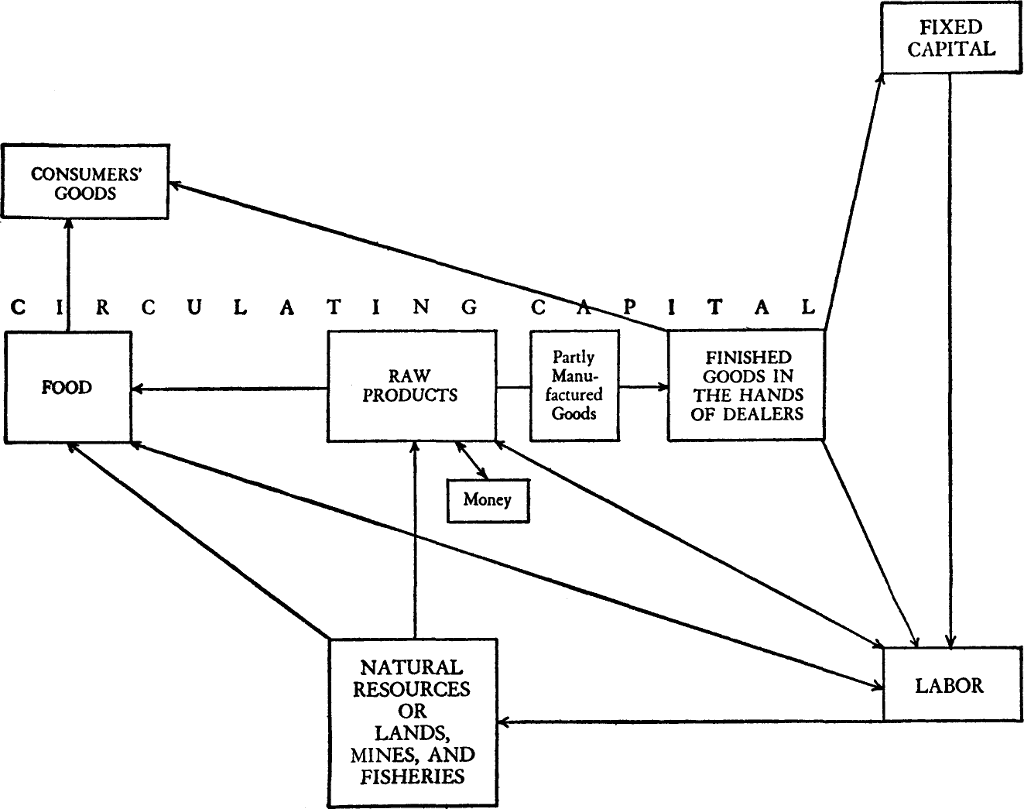
Fixed and circulating capital sets labor in motion, which operates upon natural resources in the forms of lands, mines, and fisheries in such a manner as to bring forth certain kinds of food and raw products. It further transforms some of the raw products into food and others into finished goods which in turn pass, some into the category of consumers’ goods, and some into that of fixed capital, while some help directly to set labor in motion. Some of the food also passes directly into the category of consumers’ goods, and the remainder helps to set labor in motion again. All the fixed capital is used in setting labor in motion.
3. The Gross and the Net Revenue of Society.
The above analysis reveals a distinction which Smith, as well as the Physiocrats, regarded as important; namely, that between the gross and the net revenue of society. “The gross revenue of all the inhabitants of a great country,” he says (Book II, Ch. II, pp. 115-116), “comprehends the whole annual produce of their land and labour; the net revenue, what remains free to them, after deducting the expense of maintaining first, their fixed, and, secondly, their circulating capital, or what, without encroaching upon their capital, they can place in their stock reserved for immediate consumption, or spend upon their subsistence, conveniences and amusements. Their real wealth, too, is in proportion, not to their gross, but to their net revenue.” In the above diagram what is marked “consumers’ goods” is net revenue, according to Smith’s analysis, and the enlargement of this is the real goal of the economic activities of society. In Smith’s thought this fund occupied a place resembling closely that occupied in the minds of the Physiocrats by the produit net in agriculture.
The costs of the maintenance of the fixed and circulating capital of society are, first, a sum sufficient to replace the encroachments made upon fixed capital, and second, a sum sufficient for the maintenance of the money supply. Smith did not regard the replacement of the three other categories of circulating capital—namely, provisions, materials and finished work—as a deduction from net revenue, but included under this latter head all of these three categories that is not annually transferred to the category of fixed capital. This method of procedure enabled him to avoid the apparent anomaly of excluding the food and finished goods consumed by laborers from the category of net revenue, but it involved him in the equally striking anomaly of including in net revenue the materials upon which the laborer operates and such finished work as he requires not for his personal consumption but for his work, which, according to Smith’s analysis, could not be included under the head of fixed capital.
Of these two charges against society’s gross revenue Smith selects for the most extended treatment that connected with the circulating medium. In order to show how this charge may be made as small as possible, Smith explains the use of paper currency. “The substitution of paper in the room of gold and silver money,” he says (Book II, Ch. II, p. 108), “replaces a very expensive instrument of commerce with one much less costly, and sometimes equally convenient. Circulation comes to be carried on by a new wheel, which it costs less both to erect and to maintain than the old one.”
The explanation of how the substitution takes place led Smith to an interesting digression on the subject of banking, which shows wide and accurate knowledge and a thorough understanding of that important instrumentality of modern commerce, then only in the early stages of its development.
4. Effect of Different Employments of Capital.
To the two methods of increasing the net revenue of society suggested by Smith in the discussion already reviewed, namely, the increase in its capital stock and the decrease of the cost of maintaining that stock, he added a third, namely, a better application of the capital fund. “Though all capitals,” he says (Book II, Ch. V, p. 147), “are destined for the maintenance of productive labour only, yet the quantity of that labour, which equal capitals are capable of putting in motion, varies extremely according to the diversity of their employment; as does likewise the value which that employment adds to the annual produce of the land and labour of the country.”
His classification of the ways in which the capital of a nation may be employed is as follows (ibid.): “A capital may be employed in four different ways; either, first, in procuring the rude produce annually required for the use and consumption of the society; or secondly, in manufacturing and preparing that rude produce for immediate use and consumption; or, thirdly, in transporting either the rude or manufactured produce from the places where they abound to those where they are wanted; or, lastly, in dividing particular portions of either into such small parcels as suit the occasional demands of those who want them. In the first way are employed the capitals of all those who undertake improvement or cultivation of lands, mines, or fisheries; in the second, those of all master manufacturers; in the third, those of all wholesale merchants; and in the fourth, those of all retailers. It is difficult to conceive that a capital should be employed in any way which may not be classed under some one or other of those four.”
This same classification slightly expanded is elsewhere described as the employment of capital in agriculture, manufactures, and commerce, the latter subdivided into domestic and foreign commerce instead of as above into wholesale and retail trade.
Smith attempts to show that while these different branches of economic activity are mutually dependent and necessary each to the others, the amount of labor set in motion by the same amount of capital is greatest in agriculture, next in magnitude in manufactures, next in domestic commerce, and least in foreign commerce. From the principle that labor is the real productive agency he concludes that the magnitude of the product is proportional to the amount of labor set in motion, and therefore that agriculture is the most productive industry and that manufactures and domestic and foreign commerce rank in productivity after agriculture in the order named.
That the same amount of capital sets in motion more labor in agriculture than in manufactures, in manufactures than in domestic commerce, and in domestic than in foreign commerce he shows by noting the relative amounts of capital per laborer required in each of these industries. In agriculture little or no capital in the form of raw products is required, the soil itself taking the place of these, and the amount of capital in the form of tools and machinery is, proportionately to the number of laborers, less than in manufactures. Moreover, he adds, “no equal quantity of productive labor employed in manufactures can ever occasion so great a reproduction. In them nature does nothing; man does all; and the reproduction must always be in proportion to the strength of the agents that occasion it. The capital employed in agriculture, therefore, not only puts in motion a greater quantity of productive labour than any equal capital employed in manufactures; but in proportion, too, to the quantity of productive labour which it employs, it adds a much greater value to the annual produce of the land and labour of the country to the real wealth and revenue of its inhabitants. Of all the ways in which a capital can be employed, it is by far the most advantageous to society.” (Book II, Ch. V, p. 149.)
In this statement Smith probably reveals the influence of the Physiocrats. The idea that in agriculture, and only in agriculture, does nature work together with man, expressed here as well as elsewhere—notably in his chapter on the rent of land—shows that Smith accepted one of their fundamental doctrines and that his difference with them regarding the question of the productivity of the different industries was centered about the use of the word productive, rather than about their chief contention.
However, the proposition which Smith is mainly concerned in expounding in his chapter “Of the Different Employments of Capitals” is not the relative productivity of the same amount of labor in agriculture and other industries, but the amount of labor which the same amount of capital will set in motion in the different branches of production. From this point of view the work of nature in agriculture is that of the substitution of land, etc., for the raw products and some of the machines required in manufactures, and thus the saving of capital.
In commerce, both domestic and foreign, the capital, especially in the form of finished goods, employed per laborer is very much greater than in any branch of manufacturing, and hence the same amount sets in motion less labor. In foreign commerce a part, and in the foreign carrying trade nearly all, of the labor set in motion belongs to foreign countries, and to that extent increases the wealth of the foreign and not of the home country. For this reason the same amount of capital employed in domestic commerce would be more advantageous to the nation, since it would set in motion more domestic labor. For the same reason, of the two branches of foreign commerce which he mentions, the foreign carrying trade and what he calls the foreign trade of consumption, by which he means the purchase of goods in one country and their sale in another, the former is the more advantageous.
This discussion raises the question of the limit to the amount of capital that may be employed in any industry or in any nation. That there is such a limit is clearly implied, though not directly stated, in this part of Smith’s discussion. Here he is chiefly concerned with the best application of the capital of a nation which does not possess more, but rather less, than it might conceivably use, and his point is that, if a nation’s capital is inadequate for all possible purposes, agriculture should receive first attention. He says (Book II, Ch. V, p. 150):
“When the capital of any country is not sufficient for all those three purposes (namely; agriculture, manufactures and commerce) in proportion as a greater share of it is employed in agriculture, the greater will be the quantity of productive labour which it puts into motion within the country; as will likewise be the value which its employment adds to the annual produce of the land and labour of the society. After agriculture, the capital employed in manufactures puts into motion the greatest quantity of productive labour, and adds the greatest value to the annual produce. That which is employed in the trade of exportation has the least effect of any of the three.
“The country, indeed, which has not capital sufficient for all those three purposes, has not arrived at that degree of opulence for which it seems naturally destined. To attempt, however, prematurely, and with an insufficient capital, to do all the three, is certainly not the shortest way for a society, no more than it would be for an individual, to acquire a sufficient one. The capital of all the individuals of a nation has its limits, in the same manner as that of a single individual, and is capable of executing only certain purposes. The capital of all the individuals of a nation is increased in the same manner as that of a single individual, by their continually accumulating and adding to it whatever they save out of their revenue. It is likely to increase the fastest, therefore, when it is employed in the way that affords the greatest revenue to all the inhabitants of the country, as they will thus be enabled to make the greatest savings. But the revenue of all the inhabitants of the country is necessarily in proportion to the value of the annual product of their land and labour.”
This passage, as well as the one which follows in which he discusses the policy proper for the American Colonies, suggests the natural stages in the evolution of a nation’s industries. In the first, agriculture should receive chief attention, manufacturing and commerce being left to more advanced nations. Next in order of development would come manufacturing industries. This stage would be reached when the nation’s capital had increased to such a degree that a part could be spared for manufactures without infringing upon the amount needed for the most complete development of agriculture. Next in order of development would come domestic commerce, and last of all foreign commerce.
That Smith did not consider of practical importance the question of the limits to the amount of capital that might possibly be employed within a nation is evident from the following statement (Book II, Ch. V, p. 151): “The course of human prosperity, indeed, seems scarce ever to have been of so long continuance as to enable any great country to acquire capital sufficient for all those three purposes; unless, perhaps, we give credit to the wonderful accounts of wealth and cultivation of China, of those of ancient Egypt, and of the ancient state of Indostan. Even those three countries, the wealthiest, according to all accounts, that ever were in the world, are chiefly renowned for their superiority in agriculture and manufactures. They do not appear to have been eminent for foreign trade. The ancient Egyptians had a superstitious antipathy to the sea; a superstition nearly of the same kind prevails among the Indians; and the Chinese have never excelled in foreign commerce. The greater part of the surplus produce of all those three countries seems to have been always exported by foreigners, who gave in exchange for it something else, for which they found a demand there, frequently gold and silver.”
5. Productive and Unproductive Labor.
The labor which capital sets in motion is what Smith calls “productive labor,” but there is another kind, otherwise set in motion, which he calls “unproductive labor” and which performs a very different function in the national economy. The former kind “adds to the value of the subject upon which it is bestowed”; the latter does not. As a type of the former he takes a manufacturer; and of the latter, a menial servant. “A manufacturer,” he says (Book II, Ch. III, p. 135), “adds generally to the value of the materials which he works upon, that of his own maintenance and of his master’s profit. The labour of a menial servant, on the contrary, adds to the value of nothing. . . . A man grows rich by employing a multitude of manufacturers; he grows poor by maintaining a multitude of menial servants.”
Under the head “unproductive labor,” with menial servants, he classes “the sovereign . . . with all the officers, both of justice and war, who serve under him, and the whole army and navy.” “In the same class must be ranked,” he says (Book II, Ch. III, p. 136), “some both of the greatest and most important, and some of the most frivolous professions; churchmen, lawyers, physicians, men of letters of all kinds, players, buffoons, musicians, opera singers, opera dancers, etc. The labour of the meanest of these has a certain value, regulated by the very same principles which regulate that of every other sort of labour; and that of the noblest and most useful produces nothing which could afterwards purchase or procure an equal quantity of labour. Like the declamation of the actor, the harangue of the orator, or the tune of the musician, the work of all of them perishes in the very instant of its production.”
Since the wealth of a nation depends upon the proportion that its productive laborers bear to the total population, including, of course, unproductive laborers, it follows that the former class should be as large, and the latter as small, as possible, provided, of course, that the increase of the wealth of the nation is to be desired. This latter question Smith does not consider. His task was to show how national wealth is increased and decreased, regardless of its desirability or undesirability; and to him it was evident that unproductive laborers are a source of expense to a nation. What is taken from the gross revenue of society for their support diminishes by the same amount the fund of capital, and since this fund sets productive labor in motion, it diminishes the producing power of the nation.
6. The Size of the Capital Fund of Society.
Since the magnitude of the capital fund of society is the chief determining factor in its productivity, a consideration of the influences which determine that magnitude should occupy an important place in a treatise on the wealth of nations. According to Smith, the chief among these is parsimony, or what his successors commonly called the instinct to save. In conflict with this is prodigality or the instinct to lavish expenditures on immediate gratification and misconduct. “Capitals,” he says (Book II, Ch. III, p. 138), “are increased by parsimony, and diminished by prodigality and misconduct. Whatever a person saves from his revenue he adds to his capital, and either employs it himself in maintaining an additional number of productive hands, or enables some other person to do so, by lending it to him for an interest, that is, for a share of the profits. As the capital of an individual can be increased only by what he saves from his annual revenue, or his annual gains, so the capital of a society, which is the same with that of all the individuals who compose it, can be increased only in the same manner.”
The immediate effects of the operation of these human instincts (parsimony, prodigality, misconduct) are the same; that is, all three result in the consumption of wealth; but their ultimate effects are very different. Saving ultimately results in the employment of productive labor and consequently in the reproduction and more than the reproduction of what was consumed, while prodigality and misconduct result in the mere destruction of wealth without any reproduction. “What is annually saved,” says Smith (Book II, Ch. III, p. 139), “is as regularly consumed as what is annually spent, and nearly in the same time too: But it is consumed by a different set of people. That portion of his revenue which a rich man annually spends, is, in most cases, consumed by idle guests and menial servants, who leave nothing behind them in return for their consumption. That portion which he annually saves, as, for the sake of the profit, it is immediately employed as a capital, is consumed in the same manner, and nearly in the same time too, but by a different set of people; by laborers, manufacturers, and artificers, who reproduce with a profit the value of their annual consumption. His revenue, we shall suppose, is paid him in money. Had he spent the whole, the food, clothing, and lodging, which the whole could have purchased, would have been distributed among the former set of people. By saving a part of it, as that part is, for the sake of the profit, immediately employed as capital, either by himself or by some other person, the food, clothing, and lodging which may be purchased with it, are necessarily reserved for the latter. The consumption is the same, but the consumers are different.”
The influences which strengthen and develop the instincts of parsimony and prodigality respectively Smith did not attempt fully to explain. He expressed the belief, however, that the former is a more persistent trait of human nature than the latter and that it tends to increase in strength. For example, he maintained that the proportion between the fund “destined for replacing a capital” and that which is destined for unproductive consumption is greater in a rich than in a poor country, and this, according to his reasoning, implies that the instinct of saving is relatively more powerful in the former.
7. Expenditures on Durable vs. Expenditures on Perishable Goods.
According to Smith, the former type of expenditure contributes to public opulence more than the latter. “The revenue of an individual,” he says (Book II, Ch. III, pp. 142 and 143), “may be spent either on things which are consumed immediately, and in which one day’s expense can neither alleviate nor support that of another; or it may be spent on things more durable, which can therefore be accumulated, and in which every day’s expense may, as he chooses, either alleviate or support and heighten the effect of that of the following day. . . . Were two men of equal fortune to spend their revenue, the one chiefly in the one way, the other in the other, the magnificence of the person whose expense had been chiefly in durable commodities, would be continually increasing, every day’s expense contributing something to support and heighten the effect of that of the following day; that of the other, on the contrary, would be no greater at the end of the period than at the beginning. The former too would, at the end of the period, be the richer of the two. He would have a stock of goods of some kind or other, which, though it might not be worth all that it cost, would be worth something. No trace or vestige of the expense of the latter would remain, and the effects of ten or twenty years’ profusion would be as completely annihilated as if they had never existed.
“As the one mode of expense is more favorable than the other to the opulence of an individual, so it is likewise to that of a nation. The houses, the furniture, the clothing of the rich, in a little time, become useful to the inferior and middling ranks of people. They are able to purchase them when their superiors grow weary of them; and the general accommodation of the whole people is thus gradually improved, when this mode of expense becomes universal among men of fortune.”
C. Government and the Wealth of Nations
Government affects the wealth of a nation through its expenditures and the methods by which it raises its revenues and through its regulation or non-regulation of the activities of the individuals of which the nation is composed. Smith considers the first of these topics in Book V and the second in Book IV in his discussion of what he calls the commercial and the agricultural systems.
The physiocratic, the chief of the agricultural systems, which he examined at length and criticized in some respects, received his unqualified approval in one respect, namely, “in representing perfect liberty as the only effectual expedient for rendering this annual reproduction the greatest possible” (Book IV, Ch. IX, p. 282). In next to the last paragraph of Book IV he expresses his allegiance to the same principle and outlines the duties of government in the following words (Ch. IX, p. 286):
“All systems, either of preference or restraint, therefore, being thus completely taken away, the obvious and simple system of natural liberty establishes itself of its own accord. Every man, as long as he does not violate the laws of justice, is left perfectly free to pursue his own interest in his own way, and to bring both his industry and capital into competition with those of any other man, or order of men. The sovereign is completely discharged from a duty, in the attempt to perform which he must always be exposed to innumerable delusions, and for the proper performance of which, no human wisdom or knowledge could ever be sufficient; the duty of superintending the industry of private people, and of directing it towards the employment most suitable to the interests of the society. According to the system of natural liberty, the sovereign has only three duties to attend to; three duties of great importance, indeed, but plain and intelligible to common understandings; first, the duty of protecting the society from the violence and invasion of other independent societies; secondly, the duty of protecting, as far as possible, every member of the society from the injustice or oppression of every other member of it, or the duty of establishing an exact administration of justice; and, thirdly, the duty of erecting and maintaining certain public works, and certain public institutions, which it can never be for the interest of any individual, or small number of individuals to erect and maintain; because the profit could never pay the expense to any individual, or small number of individuals, though it may frequently do much more than repay it to a great society.”
1. Self-Interest and the Employment of Capital.
Smith’s reason for believing that the application of the principle of liberty would yield the best results in the long run was his conviction that the self-interest of individuals would lead them to employ their capitals so as to set in motion the largest possible amount of productive labor. To prove this, in the second chapter of the fourth book he indicated what are the most profitable uses individuals can make of their capital under different conditions and concludes that under all circumstances self-interest will lead them to do precisely what they ought to do in the public interest. “Every individual,” he says (p. 183), “is continually exerting himself to find out the most advantageous employment for whatever capital he can command. It is his own advantage, indeed, and not that of society, which he has in view. But the study of his own advantage naturally, or rather necessarily, leads him to prefer that employment which is most advantageous to the society.”
In proof of this he maintains first (p. 183), “that every individual endeavors to employ his capital as near home as he can and consequently as much as he can in the support of domestic industry”; and second (p. 184), that “every individual who employs his capital in the support of domestic industry necessarily endeavors so to direct that industry, that its produce may be of the greatest possible value.”
He then adds (pp. 184-185): “As every individual, therefore, endeavors as much as he can, both to employ his capital in the support of domestic industry, and so to direct that industry that its produce may be of the greatest value; every individual necessarily labours to render the annual revenue of the society as great as he can. He generally, indeed, neither intends to promote the public interest, nor knows how much he is promoting it. By preferring the support of domestic to that of foreign industry, he intends only his own security; and by directing that industry in such a manner as its produce may be of the greatest value, he intends only his own gain; and he is in this, as in many other cases, led by an invisible hand to promote an end which was no part of his intention. Nor is it always the worse for the society that it was no part of it. By pursuing his own interest, he frequently promotes that of the society more effectually than when he really intends to promote it. I have never known much good done by those who affected to trade for the public good. It is an affectation, indeed, not very common among merchants, and very few words need be employed in dissuading them from it.
“What is the species of domestic industry which his capital can employ, and of which the produce is likely to be of the greatest value, every individual, it is evident, can in his local situation judge much better than any statesman or lawgiver can do for him. The statesman, who should attempt to direct private people in what manner they ought to employ their capitals, would not only load himself with a most unnecessary attention, but assume an authority which could safely be trusted, not only to no single person, but to no council or senate whatever, and which would nowhere be so dangerous as in the hands of a man who had folly and presumption enough to fancy himself fit to exercise it.”
2. The Effects of Government Interference.
In a negative form Smith’s argument is that interference with the free play of self-interest necessarily diverts capital from more to less profitable employments. He presents this argument (Book IV, Ch. II, p. 185) in the form of a detailed examination of the effects of different forms of interference, beginning with restraints upon importation:
“To give the monopoly of the home market to the produce of domestic industry, in any particular art or manufacture is, in some measure, to direct private people in what manner they ought to employ their capitals, and must, in almost all cases, be either a useless or a hurtful regulation. If the produce of domestic can be brought there as cheap as that of foreign industry, the regulation is evidently useless. If it cannot, it must generally be hurtful. It is the maxim of every prudent master of a family, never to attempt to make at home what it will cost him more to make than to buy. The tailor does not attempt to make his own shoes, but buys them of the shoemaker. The shoemaker does not attempt to make his own clothes, but employs a tailor. The farmer attempts to make neither the one nor the other, but employs those different artificers. All of them find it for their interests to employ their whole industry in a way in which they have some advantage over their neighbors, and to purchase with a part of its produce, or what is the same thing, with the price of a part of it, whatever else they have occasion for.
“What is prudence in the conduct of every private family, can scarce be folly in that of a great kingdom. If a foreign country can supply us with a commodity cheaper than we ourselves can make it, better buy it of them with some part of the produce of our own industry, employed in a way in which we have some advantage. The general industry of the country being always in proportion to the capital which employs it, will not thereby be diminished, no more than that of the above mentioned artificers; but only left to find out the way in which it can be employed with the greatest advantage. It is certainly not employed to the greatest advantage when it is thus directed towards an object which it can buy cheaper than it can make. The value of its annual produce is certainly more or less diminished, when it is thus turned away from producing commodities evidently of more value than the commodity which it is directed to produce. According to the supposition that commodity could be purchased from foreign countries cheaper than it can be made at home; it therefore could have been purchased with a part only of the commodities, or, what is the same thing, with a part only of the price of the commodities, which the industry employed by an equal capital would have produced at home, had it been left to follow its natural course. The industry of the country, therefore, is thus turned away from a more to a less advantageous employment; and the exchangeable value of its annual produce, instead of being increased according to the intention of the lawgiver, must necessarily be diminished by every such regulation.”
The argument advanced by protectionists that by means of duties on imported goods “a particular manufacture may sometimes be acquired sooner than it could have been otherwise, and after a certain time may be made at home as cheap, or cheaper, than in the foreign country” is met by Smith as follows (ibid.):
“But though the industry of the society may be thus carried with advantage into a particular channel sooner than it could have been otherwise, it will by no means follow that the sum-total either of its industry or of its revenue can ever be augmented by any such regulation. The industry of the society can augment only in proportion as its capital augments, and its capital can augment only in proportion to what can be gradually saved out of its revenue. But the immediate effect of every such regulation is to diminish its revenue; and what diminishes its revenue is certainly not very likely to augment its capital faster than it would have augmented of its own accord, had both capital and industry been left to find out their natural employments.
“Though, for want of such regulations, the society should never acquire the proposed manufacture, it would not upon that account necessarily be the poorer in any one period of its duration. In every period of its duration its whole capital and industry might still have been employed, though upon different objects, in the manner that was most advantageous at the time. In every period its revenue might have been the greatest which its capital could afford, and both capital and revenue might have been augmented with the greatest possible rapidity.”
He concludes his argument on this point in the following words (Book IV, Ch. II, pp. 185-186):
“The natural advantages which one country has over another in producing particular commodities are sometimes so great that it is acknowledged by all the world to be in vain to struggle with them. By means of glasses, hot-beds, and hot-walls very good grapes can be raised in Scotland, and very good wine, too, can be made of them at about thirty times the expense for which at least equally good can be brought from foreign countries. Would it be a reasonable law to prohibit the importation of all foreign wines merely to encourage the making of claret and Burgundy in Scotland? But if there would be a manifest absurdity in turning towards any employment thirty times more of the capital and industry of the country than it would be necessary to purchase from foreign countries an equal quantity of the commodities wanted, there must be an absurdity, though not altogether so glaring yet exactly of the same kind, in turning towards any such employment a thirtieth, or even a three hundredth part more of either. Whether the advantages which one country has over another be natural or acquired, is in this respect of no consequence. As long as the one country has those advantages, and the other wants them, it will always be more advantageous for the latter rather to buy of the former than to make. It is an acquired advantage only, which one artificer has over his neighbor, who exercises another trade; and yet they both find it more advantageous to buy of one another than to make what does not belong to their particular trades.”
3. Permissible Exceptions to the Principle of Freedom of Trade.
Footnotes
1 Quotations are from, and references are to, the edition published by T. Nelson and Sons, London, in 1891, with introduction and notes by J. Shield Nicholson.
2 Book IV, Ch. V.
3 Ch. VI.
4 Ch. VIII.
- 1Professor Schmoller found the key to the explanation of this aspect of the system in the development of the national economies of the various European states. These succeeded (in order of time) territorial, municipal, tribal, and family economies, each representative of a certain stage in the history of European civilization, and each produced by the struggle of contending forces, a higher and broader organization in each case subordinating to itself lower and narrower ones. “The essence of this system,” he says, “lies not in some doctrine of money, or of the balance of trade; not in tariff barriers, protective duties, or navigation laws, but in something far greater, namely, in the total transformation of society and its organization, as well as of the state and its institutions, in the replacing of a local and territorial economic policy by that of the national state.” More specifically he says, “The whole internal history of the seventeenth and eighteenth centuries, not only in Germany but everywhere else, is summed up in the opposition of the economic policy of the state to that of the town, the district, and the several estates; the whole foreign history is summed up in the opposition to one another of the separate interests of the newly rising states, each of which sought to obtain and retain its place in the circle of European nations, and in that foreign trade which now included America and India. What was at stake was the creation of real political economies as unified organisms, the center of which should be, not merely a state policy reaching out in all directions, but rather the living heart-beat of a united sentiment.”
- 2Professor Schmoller found the key to the explanation of this aspect of the system in the development of the national economies of the various European states. These succeeded (in order of time) territorial, municipal, tribal, and family economies, each representative of a certain stage in the history of European civilization, and each produced by the struggle of contending forces, a higher and broader organization in each case subordinating to itself lower and narrower ones. “The essence of this system,” he says, “lies not in some doctrine of money, or of the balance of trade; not in tariff barriers, protective duties, or navigation laws, but in something far greater, namely, in the total transformation of society and its organization, as well as of the state and its institutions, in the replacing of a local and territorial economic policy by that of the national state.” More specifically he says, “The whole internal history of the seventeenth and eighteenth centuries, not only in Germany but everywhere else, is summed up in the opposition of the economic policy of the state to that of the town, the district, and the several estates; the whole foreign history is summed up in the opposition to one another of the separate interests of the newly rising states, each of which sought to obtain and retain its place in the circle of European nations, and in that foreign trade which now included America and India. What was at stake was the creation of real political economies as unified organisms, the center of which should be, not merely a state policy reaching out in all directions, but rather the living heart-beat of a united sentiment.”
- 3The industrial organization of the towns was also gradually weakened by conflicts of interest between townsmen themselves and the oppression of the weaker trades by the stronger, and by the growth of domestic industries. Increasing interference of the central government in town affairs was invited by these conditions, and the power of resistance to it was weakened. The growth of a merchant class in London and some of the other large towns also contributed to the same result. The interests of this class extended beyond the boundaries of the town in which they lived and were promoted by the breaking-down of local trade barriers. The power of this class grew rapidly in and after the sixteenth century.
- 4By the seventeenth century a national commercial and industrial organization had developed, the chief organs of which were middlemen who intervened between producers and consumers and between different classes of producers. Among those of chief importance were the wool-staplers, the clothiers, the drapers, and the foreign trading companies. The wool-staplers purchased the farmers’ wool, their most important staple, and sold it to manufacturers or foreign merchants. The clothiers acted as middlemen between the carders, spinners, weavers, and other handicraftsmen engaged in transforming the wool into cloth. They purchased the wool from the staplers, delivered it to the carders and spinners, distributed the yarn among the weavers to be woven into cloth, and then placed the cloth in the hands of the “fuller,” “walker,” or “tucker” to be fulled and cleansed. The spinners, carders, weavers, and fullers were scattered throughout the hamlets and villages as well as the cities of the country, in many, perhaps most cases, doing agricultural work as a main or a side occupation. The drapers purchased the cloth and sold it to consumers or to foreign merchants; some of them were themselves connected with one of the trading companies. Foreign commerce was chiefly carried on by these latter organizations, to each of which a charter had been granted conferring the exclusive right to trade in a specified part of the world. The Eastland Company, for example, had the exclusive right to trade with Scandinavia and the Baltic region; the Russian Company, with Russia; the Merchant Adventurers, with the Netherlands; the Levant Company, with the Mediterranean region; the Guinea or African Company, with Africa; the East India Company, with the countries of Asia; and several other companies with portions of the American field. At the beginning of the seventeenth century France, Spain, and Portugal were the only countries with which trade could be carried on by an Englishman not a member of one of the companies.

