
The Development of Economic Doctrine: An Introductory Survey
IV. The Physiocrats: Quesnay and Turgot
CHAPTER IV
THE PHYSIOCRATS: QUESNAY AND TURGOT
Quesnay
THE position of Francois Quesnay1 (1694-1774) in the history of economic doctrine is in many ways remarkable. The man himself is an interesting and engaging personality. A successful medical practitioner attached to the Court, with a record of medical dissertations on such subjects as suppuration, gangrene and fevers, he burgeoned as an economist at the age of sixty-two. Yet despite this tardy blossoming, he lived to be the acknowledged head of the most compact of any of the schools of economists, and he died, at the age of eighty, the revered master of a large band of disciples, whose panegyrics sound extravagant even for an age when the art of eulogy was assiduously cultivated. It naturally follows also from Quesnay’s late absorption in economics that his literary labours were unusual. It is not true, as has sometimes been said, that he wrote little, but it is true that all he wrote has the appearance of disconnected efforts, contributions to encyclopaedias, periodicals, and what not; and moreover hardly any of it was published under his own name.
It is a further consequence that Quesnay tends to merge into his school, that body of men who called themselves “economists,” and whom posterity has agreed to designate as “Physiocrats.” It is true, of course, that there were differences of view, different shades of emphasis among the Physiocrats, but it is a remarkable tribute to the cohesion of the school that common usage lumps them comprehensively under the name of the “Physiocrats,” and seldom thinks of the units concealed behind the collective phrase. It is, however, from Quesnay that the entire impulse comes, and all that is characteristic of Physiocratic doctrine is to be found in his writings. This section will therefore be confined almost exclusively to Quesnay, as representative of the whole body of physiocratic theory.
Three points of a general character can hardly fail to strike any reader who approaches Quesnay. In the first place the economic doctrine, such as it is, is really only a corollary to something much larger. For Quesnay, as for all the Physiocrats, his economics was but part of a Weltanschauung—it is difficult to avoid the German word. He is a moralist; primarily perhaps the foundation of the whole structure is to be found in his view of natural and positive law, a conception indeed (that of the “rule of nature”) to which the school owes the title by which it is now universally known. Consequently it is necessary to disentangle, somewhat gingerly, the economic aspects of the Physiocratic structure. The second point is that, despite the immingling of relatively alien elements, Quesnay has substantial claims to be regarded as the real founder of Political Economy in the modern sense. With him the empirical element has gone; whether he is right or wrong, Quesnay realizes that the problem of the nature of wealth, the conditions of its production and the laws of its distribution are matters to which scientific and precise reasoning may be applied with the object of arriving at universal truths. The third point is perhaps rather a comment on, or an illustration of this; it is the extent to which Quesnay anticipates Adam Smith. The differences are obvious, and have indeed been excessively underlined by Smith himself, but the similarities are still more remarkable. The exact relationship between Quesnay and Smith has been much discussed, and for a time there was a tendency to suggest that Smith may have been influenced by Quesnay, with whom he was familiar during his visit to France. It is now clear, however, that the main outlines of Adam Smith’s thought had been evolved while he was still professing in Glasgow, at a time when Quesnay could not have influenced him. Almost certainly the similarities of Quesnay and Smith merely exemplify once more the wholly natural fact that independent inquirers do frequently, about the same time, arrive at substantially the same conclusions.
Firstly, and warily, as to the fundamental point of natural law. For Quesnay there is a “law” which governs human actions, no less than the rest of the field of nature, and the problem is to find the structure of society which will accord with this natural law. What is this “droit naturel,” most elusive of conceptions? It differs from the “droit légitime,” the mere act of a legislature, in that it is recognized by the light of reason, and by that evidence alone. It is binding apart from any constraint, whereas a “droit legitime” is obligatory by reason of the penalty attached. Thus the “droit naturel” is superior to the laws of man’s making, as is abundantly proved by the multitude of contradictory and absurd laws which have been enacted.2
But to change the ground and come to a point of more direct economic substance, to what does man have a “natural right”? Vaguely, these are comprehended in the right he has to the things which are “propres à sa jouissance.”3 But this must be defined. The theoretical right of everyone to everything is illusory; it must be limited to the right of everyone to that portion of things which he can obtain by his own labour. The swallow might be said to have a right to all the flies that dance in the air; in fact, the swallow’s rights are limited to those he can catch. (The rights of the fly are not discussed.)4 When men come to enter into society, they will increase this natural right, and guarantee its enjoyment, “if the constitution of the society is in agreement with the order which is evidently the most advantageous to men relatively to the fundamental laws of their natural right.”5 One further natural right calls for emphasis; each one has the right to make use of all the faculties given him by nature on condition that he hurts neither himself nor others—though why, at this stage, he should not be allowed to hurt himself is not clear.6 It will be obvious how far, on the economic side, these propositions take Quesnay. He has consecrated private property on the basis of labour; he has established the principle of freedom of contract, and he has made it a primary function of the State to guarantee these rights. Indeed, so fundamental is this, that where property and liberty are not guaranteed, there is no government but merely anarchy.7
We come then to human society, which is subject to two kinds of laws, the lois naturelles and the lois positives, the former, despite their high authority and the praises bestowed upon them—are they not “immuables, et irréfragables et les meilleures lois possibles”?8—remaining somewhat nebulous, the latter being of human origin, and therefore strictly subordinate. Indeed the primary function of the positive laws is to “declare” the natural laws.9 The first positive law, underlying all other positive laws, consists in the institution of public and private instruction in the laws of the natural order,10 although, regrettably, the syllabus of the course is not provided. Positive laws are merely deductions from, or comments on, the primitive natural laws. The fundamental laws of society are imprinted on the hearts of man; they form the light which illumines his conscience. In relation thereto, the sphere of positive law is little more than that of interpretation. Positive laws are thus essentially subordinate, and should only be introduced in so far as they are in conformity with, and rigorously subject to, these other essential laws. They are therefore not of arbitrary institution, and “the legislator cannot render them just by his authority, except in so far as they are just in their essence.”11
Further discussion of the subtleties of “natural law” may be left to the political philosopher, to whom the subject properly belongs. Here we are only concerned with the economic implications of Quesnay’s generalizations. And it is clear in what direction he is heading. The art of the legislator is to interpret for this confused world certain natural laws (though it is as well not to be too curious as to their contents). The test of good legislation is found in the extent to which positive laws are a faithful reflection of their shadowy prototypes. Clearly there must be no contradiction; but clearly, also, embroidery should be reduced to a minimum. In short, having caught the reflection of these eternal immutable laws, the less legislation the better. Thus, on high abstract grounds, we arrive at the great principle of nonintervention, the doctrine of laissez-faire, laissez passer, to use the tag which the Physiocratic school has bequeathed to the world. It is the duty of the Government to see to the defence of society. Since prosperity (apparently a simple matter) depends merely on cultivating the soil and keeping down thieves and blackguards, positive law will be necessary to restrain the evil-doers.12 But if positive law fussily goes beyond the point of protection against invasion, restraint of the wicked, and of routine administration, can it lay any claim to be but a reflex of eternal law? The blessedness of Free Trade and of Government inactivity is knocking at the door.
The search for the natural order leads, on the economic side, to the adoration of agriculture, the most familiar of Physiocratic doctrines. It was not merely, as Quesnay emphasized—and perhaps he was right—that agricultural nations alone can form empires which are fixed and durable,13 but agriculture is itself the only source oi wealth. The Physiocratic accentuation of the importance of agriculture was doubtless in origin but a reflection of the needs of France at the time, and a reaction against that phase of Mercantilism which stressed the importance of manufactures, and which, being sponsored by Colbert, has made “Colbertism” almost a French synonym for Mercantilism. Yet the Physiocrats devised for their instinctive preferences a theoretical basis which led to inextricable entanglements. For they sought to prove that agriculture alone produced the wealth of the community, and that, in contrast to this “productive” activity, all other occupations, however laudable and necessary, were “unproductive” and “sterile.” “Agriculture,” says Quesnay, “is the source of all the wealth of the State and of the wealth of all the citizens.”14 Again, “everything that is disadvantageous to agriculture is prejudicial to the State and the nation, and everything that favours agriculture is profitable to the State and the nation.”15 Nor is this merely an echo of the vague generalities of Xenophon and Cicero. The exaltation of agricul-ture over other economic activities rests on a subordination of these which is theoretically demonstrable. In Quesnay’s earliest articles on Fermes and Grains, this position is already emphatically stated:
“Agriculture and commerce are constantly regarded as the two sources of our wealth. Commerce, like industry, is merely a branch of agriculture. These two states exist only by virtue of agriculture. It is agriculture which furnishes the material of industry and commerce and which pays both; but these two branches give back their gain to agriculture, which renews the wealth which is spent and consumed each year” (Grains; p. 216).
Indeed Quesnay at times speaks as if the commercial classes were scarcely a part of the nation at all. A mixed agricultural and commercial kingdom, he says, unites two nations which are distinct one from the other. The agricultural is “the constitutive part of the society.”
The other is an extrinsic addition which forms a part of the general republic of external commerce.16 He returns to the idea that the commercial classes are a race apart from all other nations, forming in a sense a sect among themselves: “Nos commercants sont aussi les commercants des autres nations; les commercants des autres nations sont aussi nos commerçants.”17 As is natural in the light of this contrast, Quesnay regards it as a mistaken policy to show favour to the inhabitants of the towns, as by cheap grain, at the expense of the country. In this way “on desole les campagnes, qui sont la source des vraies richesses de l’Etat.”18
The distinction between agriculture on the one hand and industry and commerce on the other, is further revealed by the fact that in the former there is a surplus, while the others merely pay their way. This surplus is the famous “produit net,” the token of Nature’s superior bounty in agricultural operations. On Quesnay’s theory, agriculture is carried on by advances of various kinds (avances foncières, avances primitives, avances annuelles), some of these falling on the proprietor and some on the cultivator. But when all expenses have been met, and the cultivators have taken all that is required to maintain themselves and reimburse them in respect of their annual advances, there still remains something over, a “produit net”19 (a rent) which is payable to the proprietor. This “ produit net” is in fact the real revenue of the nation, and it is this which, in one form or another, supports the manufacturing and commercial classes. Thus we get the triple division of classes, so dear to the Physiocrats. There is, firstly, the class of proprietors, to whom the “produit net” is paid, whose services consist in making the avances foncières, and also in the more general and social duties which fall upon them; there is, secondly, the productive class, who cultivate the soil; and thirdly, there are all those who are lumped together under a title, which, despite all apologetics, has in it something wounding and depreciatory, the “unproductive” or sterile class. Strictly speaking, there is a fourth class, the wage-earners, but they do not occupy a large place in Physiocratic classification.
The “sterility” of these unproductive sections of the community may require a further word of explanation. So far as concerns commerce, there need be little difficulty; the view corresponds to what is in some ways an instinctive reaction of the unsophisticated human mind. The man who merely exchanges does not “produce”; and Quesnay pushes to its logical conclusion the view that the purchases represented by commerce are merely “exchanges of value for equal value, without loss or gain on one side or the other.”20 The trader merely brings about a transference of wealth from one hand to the other. Whereas the cultivators can pay with what they have received from the hand of Nature, rendered productive by their labours, the traders can only pay out what they have been paid: “ils sont payés pour payer.” The difference is between les salariants and les salariés;, or in another phrase of which frequent use is made, the unproductive class is the classe stipendiée: it is kept and maintained by the other.21
With regard to the industrial and manufacturing classes the argument is similar, though inevitably it seems more forced and unnatural. The common value of a commodity Is merely the value of the original material and of the cost of maintenance of the worker during the time he has been engaged.22 If the work of the artisan were “productive,” it would be desirable to increase the amount ot work necessary for a job.23 In fact, however, such labour cannot increase the wealth which the nation spends annually, because the labour is limited by the amount of this wealth, and this can only be increased by agriculture, and in no way by the expense involved in the work of the artisans (a question-begging argument; but he means for what it is worth, that to increase the number of cobblers, e.g., there must first be an increase in the number of cow hides).24 The product of the artisan then is merely worth the expense involved; he merely acquires a right to share in the consumption of wealth produced by the cultivator. But in contradistinction to agriculture, there is no surplus. In his own language, which happens to be correct, the worker speaks of “earning his keep”; he does not say that he produces it: “il dit qu’il gagne sa subsistance, et ne dit pas qu’il la produit.”25 Thus by arguments which appear thin and unconvincing, as is inevitable in the defender of a confused cause, Quesnay demonstrated that the artisan, the industrial worker, is an unproductive labourer.26
The distinction between productive and unproductive labour was the most tiresome of the legacies which the Physiocrats bequeathed to the economic world. For at least two generations every writer on these matters felt it incumbent upon him to return to the point and to attempt to give some sense to a distinction which in truth had none. As expressed by the Physiocrats, the position is clearly untenable. There is no such sharp distinction between agricultural labour and all other occupations as would justify us in classifying the former as productive labourers and all others as unproductive. It is a useful, if trite, maxim that production is not completed until the commodity, whatever it be, is in the hands (or on the table) of the consumer; and if we ask for bread, the ploughman, the miller, the baker, and the baker’s van-boy (if he be indispensable) all alike minister to our needs. What is wanted in this life is the right thing in the right place at the right time, and all who contribute to this so desirable end are economically, on this point at least, doing the same kind of thing. Further, the argument that agriculture produces in rent a “produit net,” whereas elsewhere there is no surplus, is of course entirely fallacious. But that is a matter for Mr. Ricardo to deal with.
This may be the place for such notice as is unavoidable of the “Tableau Économique,” in its time the crowning achievement of Quesnay and the Physiocratic school, now perhaps better reduced to an embarrassed footnote. Despite Dupont’s assurance that the Tableau Économique is obscure only to those who are lacking in the power of comprehension, it may be doubted whether it will ever be anything but a vast mystification, a subject to be treated gingerly by commentators, rendered uneasy by the feeling that they do not quite understand what they are talking about. The attitude of the Physiocrats towards Quesnay’s masterpiece was one of extravagant adoration. In the eyes of Mirabeau (the elder) there had been since the world began three great discoveries—the invention of writing, the invention of money and the Tableau Économique; and though Mirabeau reached the top-notch in adulation, others were not far behind in prophesying that posterity would derive incalculable advantages from Quesnay’s supreme discovery.
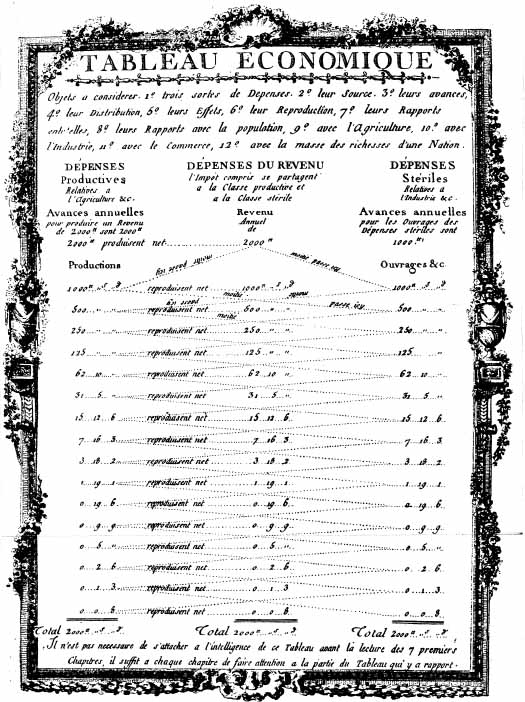
Reproduction of the Tableau Économique from the Elemens de la Philosophic rurale by the Marquis de Mirabeau
(Reprinted from Oncken’s Geschichte der Nationaldkonomie by the courtesy of the publishers, Messrs. C. L. Hirschfeld.)
It is easier to say what are the ideas behind the Tableau Économique than to explain how it gives expression to these ideas. Firstly, as Dupont remarks, whereas Economics had hitherto been a conjectural science, subject to inductive reasoning, the Tableau Économique attempted to make Economics an exact science (or rather suggested the possibility of such an attempt being made). More important, the Tableau Économique endeavoured to trace the flow of wealth through a community in terms of Physiocratic doctrine, with the practical end of ascertaining the health of the community. It was thus to be a tool in the hands of the Government, “la boussole du gouvernement des états.” Assuming that the “produit net” is 100 per cent, of the avarices annuelles, i.e. that 2,000 livres disbursed by the productive classes will yield 2,000 livres to the proprietors after all expenses are met, the problem is to trace the subsequent history of these 2,000 livres. Half (Quesnay assumes) will go back to the productive classes, and this sum of 1,000 livres will again yield a “produit net” of 1,000 livres; the other half will go to the sterile classes, who, however, will pay back a half (500 livres) to the producers; and so we proceed y what Quesnay calls the “ziczac,” dividing by two as we go along.
In the case postulated by Quesnay there is equilibrium at the end of the proceedings; here we have a state in which there is neither increase nor decay. If an undue proportion of the national revenue is diverted to the right (i.e. to the unproductive classes) an unhealthy condition arises and the State is threatened with decline. Though recognizing that the Tableau would vary according to the different data and assumptions, and that “a different case would lead to a different result,”27 no attempt seems to have been made (and probably none could be made) to apply the Tableau to the special circumstances of any community. If the Tableau was an outil, as the Physiocrats were given to declaring, it was one which the Physiocrats made no attempt to use. The idea that wealth flowed through a community, and that the health of the community depended on how it flowed, and might be imperilled by an undue diversion in one direction, was however, a useful conception. Here alone is the significance of the Tableau Économique; otherwise, apart from its interest to the economic antiquarian, a detailed study of the “ziczac” is but an example of unproductive labour.
On this general view of the relation between different classes of society, the encouragement of agriculture becomes the chief article of policy of the Physiocrats For agriculture to be profitably pursued, it is essential, in Quesnay’s eyes, that it be conducted on a large scale. This is the constantly recurring theme of his first two articles on Fermiers and Grains. Indeed it is not too much to say that he aims at giving agriculture something of an industrial form. He constantly emphasizes the need of capital in agriculture, the importance of the rich “fermier.” The “fermier” is not to be a labourer who himself tills the ground; he is to be an “entrepreneur qui gouverne.”28 So, negatively, manufactures are not to be encouraged at the expense of agriculture. Above all, there is for Quesnay a wisdom in high agricultural prices; it is fatal to seek to encourage manufactures through lowering the price of the means of subsistence.29 His detailed observations regarding agriculture are, however, of his time, and hardly concern us here.
It is, however, when Quesnay advocates Free Trade and analyses the assumptions of the mercantilists, that he most clearly speaks with the voice of Adam Smith. Money is supposed to be wealth, because with money one can buy what one has need of. But money is not obtained for nothing; it also costs as much as it is worth to the buyer, and nations will always be able to obtain as much money as they require, if they have things to give in exchange for it. Wealth consists in the sum total of things necessary for life and in the annual reproduction of these things, and the quantity of money may diminish without these things being affected, since in a rich country, with freedom of commerce, there are means of supplying the place of money. The opulence of a state must not therefore be judged by the greater or less supply of money it possesses. Money is therefore but a richesse sterile, the only utility of which consists in its employment in effecting purchases and sales.30 Further, buying and selling are but two aspects of the same operation; every purchase is a sale, and every sale is a purchase. It follows that the central idea of the mercantilists, that of a nation selling more than it buys, is not merely erroneous but absurd: “Instead of saying that you wish our sales to exceed our purchases, which is physically impossible, you ought merely to say that you wish to purchase money with your productions.”31In an effective phrase, selling more than is bought is merely a “commerce commencé,”32 an incomplete transaction. The argument resting on the greater durability of metal is admirably disposed of by a reductio ad absurdum, that if the contention be valid, then in logic it leads to the conclusion that any quantity of the metals, however small (being durable), is worth more than any quantity of commodities however large (being perishable).33 The doctrine of the balance of trade is thus reduced to “nothing and perhaps less than nothing.”34 Commerce not to be regarded as a state of war against an enemy; the only interest a nation has is to leave trade entirely free, in order that the greatest possible competition of buyers and sellers may guarantee the highest possible price for the sale of its products and the lowest price for the purchase of what may be necessary.35 Commerce cannot be conducted at the expense of other nations, for a good and a just God has decreed that commerce shall always be “le fruit d’un avantage évidemment reciproque.”36 All this and much more may strike the rétentive student as strangely familiar, and as an echo of certain classic passages in the fourth book of Adam Smith.
It would, however, be a mistake to consider that the Physiocratic advocacy of Free Trade was rooted in any importance attached to foreign trade as such. On the contrary, foreign trade, like all trade, is for the Physiocrats essentially unproductive. As Quesnay specifically puts it, it is only possible to buy from the foreigner as much as one sells to him; and the consequence is that in a state of free competition in foreign trade, there can only be an exchange of value for equal value, without gain or loss on one side or the other.37 Reverting to Quesnay’s distinction between the two nations—agricultural and commercial—combined in a mixed kingdom, the expenses of the second, even if necessary, are to be regarded as an “onerous expense,” laid on the revenues of the landed proprietor.38 Foreign trade is thus primarily a liability rather than an asset. The whole tendency of Physiocratic thought is to depreciate the importance of foreign trade. It is above all by the condition of internal commerce that the wealth of a country must be judged; a nation that is making the best use of its soil and its men has no occasion to be envious of the commerce of its neighbours.39 It is curious that the first school in modern times to proclaim Free Trade did so, not from any belief in the advantages of foreign trade, but on general principles of a quasi-philosophical and religious nature.
Quesnay’s peculiar views with regard to agriculture as the only productive activity and the only source of the national revenue lead to certain important conclusions in the field of taxation. Taxation also is subject to laws and immovable rules, capable of rigorous demonstration.40Here it is only possible to note two of Quesnay’s fundamental points. The first (a counsel of perfection) is that the State should avoid loans; the statesman should hope for resources in special emergencies from the prosperity of the nation, and not from the credit of the financiers. The objection to loans is primarily that they create a “traffic in finances,” from which spring “fortunes pécuniaires” and “rentes financières.” Sterile fortunes, withdrawing money from agriculture, are thus created (the corresponding Tableau Économique would show a drain to the right to the unproductive classes). Moreover such “pecuniary fortunes” know no king nor country. In more modern language, loans lead to a rentier class operating in an international field of investment.41
The second point is more fundamental. Since there is only one source of national wealth, all taxation must ultimately fall there, and therefore all taxation should be imposed at once where the burden will ultimately fall. Quesnay, in short, advocates a single direct tax falling on the “produit net.” In this he is wholly logical on Physiocratic assumptions. Sooner or later a tax is bound to be shifted on to the “produit net,” if the “produit net” is what Quesnay considers he has shown it to be; and therefore the simplest and least onerous way of raising a revenue is to divert directly to the State a part of what is the only real national revenue. Quesnay in various places devotes considerable attention to proving the inconvenience and loss, and the detriment to the State which would result from any other method of taxation; and in particular, in The Second Economic Problem, he proves (at least to his own satisfaction) that though the landowner might imagine that he would be advantaged by some other form of taxation, yet in the end, owing to the shifting of the tax, the burden—and moreover an increased burden, owing to the inevitable incidental frictions and losses—will fall upon him. It is interesting to note, in passing, that in the course of his discussion of the incidence of taxation, Quesnay enunciates what a later generation has come to know as the Iron Law of Wages: “Wages, and in consequence the enjoyments which wage-earners can obtain, are fixed and reduced to the lowest level by the extreme competition which is among them.”42
Turgot
Of the other members of the Physiocratic school, one only requires mention in such an elementary discussion as this, partly because in some respects he stood slightly apart from the main body of Physiocrats, partly because the lustre of his great name has given dignity to the school from which he drew his inspiration. Moreover, his high office in the State, held for too brief a period, gave him an opportunity of revealing Physiocracy in action. This is not the place to discuss the life and achievement of Anne-Robert-Jacques Turgot43 (1727-1781), who, as Intendant of Limoges and later Comptroller-General (August, 1774—May, 1776), did what he might to put things in order. His achievements were indeed reversed on his fall from office, but his admirers may, and do, claim that though in his life his greatest works were nullified, he triumphed at the Revolution and dominated the nineteenth century.
Turgot’s doctrine is to be found primarily in two small tracts, the Éloge de Gournay and the Réflexions sur la Formation et la Distribution des Richesses; in addition Turgot had the pleasant habit of infusing statements of economic doctrine into his official and state documents, and from this point of view such edicts as those suppressing the corvées and the jurandes have an economic as well as an historic interest. The Éloge de Gournay is a pious appreciation of one of the earliest of the Physiocrats who, perhaps even more than Quesnay, influenced Turgot’s development. While purporting to be a statement of Gournay’s views, it is clear that Turgot is also expressing his own. The Éloge, in fact, is a rather extreme statement of laissez-faire, along lines which later developed into an orthodoxy. Government restraints and interference, whereby towns come to regard each other as mutual enemies, are treated as “remnants of Gothic barbarism.” The new system of M. Gournay had rested on the maxim that “in general every man knows his own interest better than another man to whom that interest is entirely indifferent.” The State is interested in commerce in two ways: (1) it is interested in seeing that no one can do to another any considerable wrong, against which the sufferer cannot guarantee himself; and (2) it is interested in the mass of the wealth of the State being as large as possible. The first of these objects requires that the Government should protect the natural liberty which the buyer has to buy and the seller to sell. Freedom of competition among buyers and sellers is a sufficient guarantee against any abuse; complete liberty in this respect can alone assure the seller a price capable of encouraging production, and give the buyer the best wares at the lowest price. To go beyond this and to seek to prevent anyone from ever being defrauded is to assume the obligation of providing pads for all the children who might fall (de fournir des bourrelets à tous les enfants qui pourraient tomber); it is (since all regulations are onerous in execution) to impose on commerce and on the nation a heavy tax in order to dispense a small number of lazy people from the trouble of learning how not to be cheated.
A consideration of the second point leads to the same conclusion. On familiar Smithian lines, the wealth of the nation, being but the produce of the soil and the industry of its inhabitants, will be greatest when the produce of each acre of land and of the industry of each individual is carried to the highest possible point. But indeed it requires no proof that each individual is the only capable judge of the employment of his resources; he alone has the necessary local knowledge and experience. It follows, therefore, on all grounds, that the interest of the individual, who is left free to pursue that interest, “will more surely produce the general good than the operations of the Government, which are always at fault and necessarily directed by a vague and uncertain theory.”
This is sturdy and uncompromising laissez-faire doctrine, and even the words “in general,” in the fundamental formula regarding enlightened self-interest, leave but a small opening for retreat. For the rest, the Éloge contains familiar Physiocratic doctrine to the effect that “l’agriculture, animée par le commerce” (the modification is significant), is the source of all revenues and that all taxes are paid by the proprietor. Interesting also, in view of Turgot’s later edicts, is the statement that what Gournay most condemned in the system which he attacked was that “it always favoured the rich and the idle section of society to the prejudice of the poor and labouring sections.”
The Réflexions are arranged in a hundred short paragraphs, and may be taken as a summarized statement of economic doctrine, as apprehended by one Physiocrat. In this brief treatise—written, it is said, for the instruction of two Chinese students—there are many acute and ingenious observations embedded in a dogmatic statement of the more untenable portions of Physiocratic theory. The superiority of agriculture is here in its full glory, and the iron law of wages, as applied to the worker who has only his arms and his industry, is one of the consequences of this superiority. The simple labourer is beaten down in his negotiations with a master who has a choice among many workers.44 It is different with the worker on the soil: “Nature does not bargain with him to oblige him to be content with the absolutely necessary.”45 The happy position of the agriculturist is that he receives, over and above his subsistence, a “richesse independente et dis-ponible” which he has not bought and which he sells. The land is therefore the unique source of all wealth, and that part which it gives as a pure gift (en pur don) is the net product. There is something excessively naïve in this touching faith in the bounty of Nature which few farmers—at least in Buchan—could share. Of other points in the Réflexions, it must suffice to note Turgot’s zealous plea for the abolition of all restraints on the fixing of the rate of interest; the payment of interest, being to the advantage of both parties concerned, should be determined solely by the course of trade.46 On this point, which Turgot also discusses elsewhere, he reveals the logic of laissez-faire in its most cogent form.
Reference has been made to the importance, economically, of some of the State documents for which Turgot was responsible. The edict for the suppression of the Jurandes (i.e., for the abolition of all restraints on the freedom of work) may be taken as an example of Turgot’s reforming zeal, and of the high grounds of economic policy on which his action was based. “ Le droit de travailler” which this edict established is an awkward phrase to translate, if one would avoid ambiguity. Louis Blanc criticized Turgot because in proclaiming “le droit de travailler,” he had in no wise recognized “le droit au travail.” What the edict did was to abolish the privilege which conferred on some a monopoly of certain kinds of work, so that the right to engage in such work was preserved for a favoured section of the community. Here also what was aimed at was an enlargement of the liberty of enterprise, so that all the avenues of life should be open to everyone. This liberty, as indeed it ought to be on laissez-jaire principles, is for Turgot the most fundamental of all rights:
“Dieu, en donnant à l’homme des besoins, en lui rendant nécessaire la ressource du travail, a fait du droit de travailler la propriété de tout homme, et cette propriété est la première, la plus sacrée et la plus imprescriptible de toutes.”
The object of this step was indeed to assure to commerce and industry “the entire liberty and the full competition which they ought to enjoy.” It is perhaps worthy of notice, in view of criticisms much later, when another age had brought other problems, that the fourteenth article of the edict forbade all and sundry, “maîtres, compagnons, ouvriers et apprentis” to form any manner of association or assembly on any pretext whatever. Here, if one chooses, expression is given to the view that the maintenance of full freedom requires the denial of the right of association. But it is rather unfair to entangle Turgot in the controversies of the nineteenth and the twentieth centuries; he might with reason plead that he wasn’t there.
“This system, with all its imperfections, is perhaps the nearest approximation to the truth that has yet been published upon the subject of political economy.” Thus Adam Smith on his immediate forerunners. The achievement of the Physiocrats was indeed remarkable. Even in these days when laissez-faite no longer commands the reverence it once did, it may be agreed that in reaction against the mercantilists the doctrine of laissez-faire had to be stated On all this side of the question the Physiocrats were courageous champions of freedom, and expressed the central truths of Adam Smith’s doctrine with an enthusiasm, a vigour and a logic unexcelled even by the economist of Kirkcaldy. This is their imperishable memorial. Their “imperfections”are too obvious to require disentanglement and comment. They were right, particularly in the circumstances of their time, in emphasizing the importance of agriculture; they were wrong in seeking to prove the superiority of agriculture by abstract reasoning, based on an untenable distinction between productive and unproductive labour. From this all their errors flowed. The whole doctrine of the net product, which makes rent a token of the bounty of nature, an extra douceur or tip given to those who work the soil, is tinged with eccentricity, and the consequent advocacy of the single tax is not so much a serious contribution to the science of finance as an exercise in logic, being indeed a perfectly valid inference from Physiocratic assumptions. These embroideries, with the fantastic Tableau Économique, add a piquant interest to the Physiocrats, and have been a godsend to countless examiners; but that which is fundamental is their anticipation of Adam Smith. Even an admirer of Smith may have no scruple in finding in the Physiocratic group the real beginnings of modern economics.
_____________
47 Born at Méré (Seine et Oise), 1694; brought up in the country and largely self-taught. After a distinguished medical career, became physician to Madame de Pompadour in 1749, and to the King in 1755.
48 Le Droit Naturel, chap. 2, pp. 365-366, in Oncken’s complete edition, to which subsequent references relate.
49 Le Droit Naturel, chap. 1, p. 359.
50 Ibid., chap. 2, pp. 366-367.
51 Ibid., chap. 3, p. 368.
52 Ibid., chap. 3, p. 371.
53 Ibid., chap. 5, p. 374. The two fundamental principles of security of property and freedom of contract are expressed with perhaps even greater emphasis in the Maximes Générales. See Maxime 4 and 13, pp. 331, 333.
54 Ibid., chap. 5, p. 375.
55 Ibid., chap. 5, p. 376.
56 Ibid., chap. 5, p. 375.
57 See Le Despotisme de la Chine, chap. 8, and especially lections 6 and 19, pp. 642, 650.
58 Le Droit Naturel, chap. 5, p. 375; Despotisms de la Chine, chap. 8, sec. 6, p. 642.
59 Despotisms de la Chine, chap. 8, sec. 12. p. 647.
60 Maximes Generates, No. 1, p. 331.
61 Analyse du Tableau Économique, p. 319; but one might say passim.
62 Analyse du Tableau Économique, p. 321.
63 Ibid., p. 328.
64 Fertniers, p. 180.
65 Analyse du Tableau Économique, pp. 304-309.
66 Du Commerce, p. 458.
67 Ibid., p. 471.
68 Sur les Travaux des Artisans, p. 537.
69 Ibid., p. 532.
70 Ibid., p. 533. As this is of the essence of the argument the exact words may be given: “Ces travaux ne peuvent done accroitre les richesses que la nation dépense annuellement, puisqu’ils sont eux-mêmes limités par la mesure de ces richesses, qui ne peuvent s’accroître que par les travaux de l’agriculture et non par les dépenses des travaux des artisans.”
71 Réponse au Memoire de M.H., p. 390.
72 The reader who is beclouded by this brief summary should refer to the Réponse au Memoire de M.H., pp. 384-395, and the dialogue Sur les Travaux des Artisans, p. 256 et seq., where this point is discussed with much Physiocratic subtlety.
73 Analyse du Tableau Économique, pp. 311, 316.
74 Grains, p. 219.
75 See Maximes du Gouvornement Économique (No. 9), attached to the article on Grains, p. 327; also Fermiers, p. 180. Quesnay epigrammatically sums up his position in the eighteenth of the Maximes Générates: “ Abondance et non-valeur n’est pas richesse. Disette et cherté est misère. Abondance et chertéest opulence,” p. 335.
76 See in particular the seventh observation on the Analyse, p. 324; and the note on the thirteenth of the Maximes Générales, pp. 347-348.
77 Du Commerce, pp. 478, 479.
78 Ibid., p. 473.
79 Ibid., p. 479.
80 Ibid., p. 482.
81 Ibid., p. 477.
82 Ibid., p. 484.
83 Fifth observation on the Analyse, p. 321.
84 Ibid., p. 321.
85 Nos. 12 and 13 of the Maximes, attached to Grains, p. 239.
86 Despotisme de la Chine, chap. 8, sec. 7, p. 645.
87 Nos. 28, 29, 30 of the Maximes Générales, p. 337.
88 Second Probleme Économique, p. 706.
89 Born at Paris in 1727; prior of the Sorbonne in 1749. Giving up the career in the Church for which he had prepared, entered the magistracy and rose to be Intendant of Limoges. Called to Paris by Louis XVI in 1774 and made Secretary of State for the Navy, and soon afterwards Comptroller-General and Minister of Finance. His reforms aroused opposition, and he was dismissed in 1776.
90 Turgot’s statement is not infrequently quoted, and is almost classical: “En tout genre de travail il doit arriver et il arrive en effet que le salaire de I’ouvrier se borne a ce qui lui est nécesaire pour lui procurer sa subsistence.” Réflexions, section 6.
91 Ibid., section 7.
92 Ibid., sections 71-75.
- 1The Republic, Jowett’s translation, p. 49.
- 2Ibid., Book III, p. 106.
- 3The Republic, Jowett’s translation, p. 154.
- 4Beer, Social Struggles in Antiquity, p. 97.
- 5Ibid., p. 124.
- 6Ibid., p. 401.
- 7Laistner, Greek Economics, p. 16; Ways and Means, etc.
- 8The Laws, Jowett’s translation, p. 121.
- 9Ibid., p. 127.
- 10Ibid., Book I, chaps. 5 and 6.
- 11Ibid., p. 92.
- 12Ibid., p. 230.
- 13Ibid., p. 87.
- 14Politics, Book II, chap. 3, Welldon’s translation, p. 43.
- 15Ibid., Book II, chap. 5, p. 48.
- 16Ibid., Book II, chap. 5, p. 49.
- 17Ibid., Book I, chaps. 3 and 8.
- 18Ibid., p. 517.
- 19Analyse du Tableau Économique, pp. 304-309.
- 20Ibid., Book I, chap. 6, Welldon, p. 13.
- 21Ibid., Book I, chap. 8.
- 22Ibid., Book I, chap. 9.
- 23Ibid., p. 153.
- 24Ad Helviam Matrem de Consolatione, chap. 9.
- 25Réponse au Memoire de M.H., p. 390.
- 26The reader who is beclouded by this brief summary should refer to the Réponse au Memoire de M.H., pp. 384-395, and the dialogue Sur les Travaux des Artisans, p. 256 et seq., where this point is discussed with much Physiocratic subtlety.
- 27Ethics, Book V, chap. 5, Welldon’s translation, p. 149.
- 28Ecclesiasticus xxxviii. v. 32, 33. The corresponding passage on the same subject in Xenophon (Œconomicus IV, 2, 3) is interesting, inasmuch as the writer assigns reasons for the contempt of the illiberal arts: “They utterly ruin the bodies of workers and managers alike, compelling men, as they do, to lead sedentary lives and huddle indoors, or in some cases to spend the day before a fire. Then as men’s bodies become enervated, so their souls grow sicklier. And these vulgar crafts involve complete absence of leisure and hinder men from social and civic life; consequently men such as these are bad friends and indifferent defenders of their country. Moreover, in some states, particularly in those accounted warlike, no full citizen is permitted to practise the vulgar arts.” (As translated in Laistner’s Greek Economics, pp. 39, 40. See also Loeb edition, P. 391).
- 29Politics, Book III, chap. 5, Welldon, p. 113.
- 30Ibid., p. 405.
- 31Loeb translation, pp. 367, 409.
- 32De Ira, III, 32, 33.
- 33Pliny, Book XVIII, chap. 7.
- 34Ibid., p. 482.
- 35Ibid., p. 477.
- 36Ibid., p. 484.
- 37Printed in Laistner, Greek Economics.
- 38Pliny, Book XXXIII, chap. 19.
- 39Nos. 12 and 13 of the Maximes, attached to Grains, p. 239.
- 40Despotisme de la Chine, chap. 8, sec. 7, p. 645.
- 41“For just as all other arts are developed to superior excellence in large cities, in that same way the food at the king’s palace is also elaborately prepared with superior excellence. For in small towns the same workman makes chairs and doors and ploughs and tables, and often this same artisan builds houses, and even so he is thankful if he can only find employment to support him. And it is, of course, impossible for a man of many trades to be proficient in all of them. In large cities, on the other hand, inasmuch as many people have demands to make upon each branch of industry, one trade alone, and very often even less than a whole trade, is enough to support a man: one man, for instance, makes shoes for men, and another for women; and there are places even where one man earns a living by only stitching shoes, another by cutting them out, another by sewing the uppers together, while there is another who performs none of these operations but only assembles the parts. It follows, therefore, as a matter of course, that he who devotes himself to a very specialized line of work is bound to do it in the best possible manner. Exactly the same thing holds true in reference to the kitchen; in any establishment where one and the same man arranges the dining couches, lays the table, bakes the bread, prepares now one sort of dish and now another, he must necessarily have things go as they may; but where it is all one man can do to stew meats and another to roast them, for one man to boil fish and another to bake them, for another to bake bread and not every sort at that, but where it suffices if he makes one kind that has a high reputation—everything that is prepared in such a kitchen will, I think, necessarily be worked out with superior excellence.” (Cyropœdia, Book VIII, ii, 5-6; Loeb translation, PP- 333-335.)
- 42Second Probleme Économique, p. 706.
- 43Laistner, op. cit., p. 41.
- 44“Now in regard to trades and other means of livelihood, which ones are to be considered becoming to a gentleman and which ones are vulgar, we have been taught, in general, as follows: First, those means of livelihood are rejected as undesirable which incur people’s ill-will, as those of tax-gatherers and usurers. Unbecoming to a gentleman, too, and vulgar, are the means of livelihood of all hired workmen whom we pay for mere manual labour, not for artistic skill; for in their case the very wages they receive is a pledge of their slavery. Vulgar we must consider those also who buy from wholesale merchants to retail immediately; for they would get no profits without a great deal of downright lying; and verily there is no action that is meaner than misrepresentation. And all mechanics are engaged in vulgar trades; for no workshop can have anything liberal about it. Least respectable of all are those trades which cater to sensual pleasures:
- 45Ibid., section 7.
- 46Ibid., sections 71-75.
- 47So far as economic theory is concerned, it is in Plato that Greek thought advances beyond the level of such wise saws as may be extracted from Hesiod and others, and arrives at some consecutiveness. Yet Plato is the supreme example of the classical tendency to regard economics as a minor subsection of ethics and politics. It is above all in The Republic, and to a lesser extent in The Laws, where he indulges in “an old man’s game,” that Plato turns to economic questions. The former is primarily a discussion on Justice, and it is because the essential nature of Justice may perhaps be most easily discerned in the State—since for the short-sighted the larger letters may be more easily read—that the disputants turn aside in the second book to discuss the State and its origin, and are thus led to construct from the foundation an ideal polity. It is noticeable that the origin of the State is attributed wholly to economic considerations: “A state arises out of the needs of mankind; no one is self-sufficing, but all of us have many wants,” and moreover, Plato indicates that no other origin of a state can be imagined. This line of argument, after a consideration of the essential needs of mankind, leads to Plato’s discussion of division of labour, which has so often been compared with the famous chapter in Adam Smith. The essential needs of mankind are food, dwelling and clothing, so that the barest notion of a state must include four or five men—a husbandman, a builder, a weaver, and perhaps a shoemaker or a representative of some other similar occupation. Each of these is, moreover, to confine himself to his own calling. The governing considerations in the application of the principle of division of labour, as conceived by Plato, are then, firstly, that there are “diversities of natures among us which are adapted to different occupations,” and secondly, and as a consequence of this, that “all things are produced more plentifully and easily, and of a better quality, when one man does one thing which is natural to him and does it at the right time, and leaves other things.” It is in order that this principle may be satisfied that Plato then extends his State to include a considerable diversity of other crafts—sailors, traders, retailers and others.
- 48Thus we arrive at the guardians, who practise an art which is not to be combined with any other occupation, since one man cannot practise many arts with success. The guardians require careful selection; likewise very careful education. They must combine apparently contradictory qualities, inasmuch as they must be dangerous to their enemies and gentle to their friends. We are not here concerned with the lengthy discussion of the education of the guardians, nor with the subsequent distinction between “guardians in the fullest sense” (the real rulers) and the auxiliaries, but the words in which communism is enacted are of importance in specifying both the scope and the purpose of the communism prescribed. The guardians are to look round for a spot where they can best suppress insurrections within and defend the State from enemies without, and they are to encamp there. Further, in order to ward off the danger that they may become enemies instead of friends of the citizens, their whole mode of life is to be such that they will not be tempted to prey upon the other citizens. Consequently they are devoted to an ascetic method of life; they are to have no property beyond what is necessary; they are to receive a fixed rate of pay, sufficient to meet expenses and no more: “Should they ever acquire homes or lands or moneys of their own, they will become housekeepers and husbandmen instead of guardians, enemies and tyrants instead of allies of the other citizens.”
- 49Then secondly, as to the purpose of the guardians’ communism, it is noticeable that Plato in his motives is poles asunder from other communistic dreamers. Elsewhere the cry for communism arises from an aggrieved sense of the injustice and monstrous inequality of the world. It is not so in Plato. For his guardians, communism is an act of ascetic renunciation; it is the condition on which alone they can efficiently discharge their duties. The work they have to do is so important that they may only do it properly on condition that they remain free of the snares and the entanglements of this world. In its motive therefore it is akin to the celibacy of the Roman Catholic priesthood. The object of Plato’s communism is in no way to establish a right to equal enjoyment; rather it is a part of the price that must be paid by a class on whom special responsibilities have been imposed. An interesting, if trivial sidelight, illustrative of the fact that the whole arrangements with regard to the guardians are designed to free them from the ordinary troubles of life, is furnished by the provision that when a woman guardian has a child, the process of suckling shall not be protracted too long: “the mothers will have no getting up at night or other trouble, but will hand over all this sort of thing to the nurses and attendants.”
- 50Firstly, as to the scope of Plato’s communism, it is clear from the whole argument that it is prescribed only for the limited class of the guardians, who are indeed throughout to live a semi-military life. It is, in fact, the communism of the camp. The contrary view has been argued along lines which need not here be indicated, and one authority has contended that “a superficial reading of The Republic gives the impression . . . that Plato recommends communism solely for these upper sections.” It is almost sufficient to note that Aristotle himself is one of these superficial readers; it is entirely sufficient that Plato expressly describes the regulations as “appointed by us for the guardians,” and even more conclusive is his statement that if the guardians depart from their communistic life, they will become housekeepers and husbandmen.
- 51A slight glance at The Laws, as supplementing the teaching of The Republic, is almost essential. The Laws is the work of an old man whose fire is spent, and some have found in it the marks of the disillusionment of age. Yet here Plato still clings to the old ideal: “The first and highest form of the State and of the Government and of the Law is that in which there prevails most widely the ancient saying that ‘Friends have all things in common.’” But that is rather a State for gods and the sons of gods, and therefore he now outlines the State which “when created, will be nearest to immortality and the only one which takes the second place.”Such a state comprises 5,040 lots, since the city must not be too large and the citizens should be known to each other, and this figure is administratively convenient, as it is divisible by all numbers up to ten. There is no longer any question of communism, since “community of goods goes beyond their proposed origin, and nurture, and education.” The regulations throughout are to aim at a middle and contented condition of life, based on the doctrine that poverty is to be regarded as the increase of a man’s desires and not the diminution of his property. No one is to possess gold or silver except as coin for daily use, and the currency of the country is to be peculiar to it and not acceptable abroad. Inequality of condition cannot be avoided; but undue disparity, arising from extreme poverty or excessive wealth, is to be guarded against. For this purpose the population is to be divided into four classes, the limit of poverty being one lot which is to be guarded unimpaired, while the maximum possession is to be the equivalent of four lots, the surplus to be surrendered to the State. No money is to be lent at interest, and, more startling, there is to be no obligation to repay even the capital, a provision explicable on the ground that this is to be a society of half-brothers, if not of brothers, and that there is a definite restriction imposed on the amount of permissible wealth.
- 52The third Greek writer to contribute certain embryonic elements to an economic science is Xenophon, who approaches matters throughout in an entirely practical spirit. His achievement is perhaps greater than has generally been admitted, and even where his speculation is confused, it may at least be pleaded on his behalf that the man who gives a wrong answer to a question has at least made some progress, insofar as he realizes that a question exists. The pleasantly innocuous dialogue Œconomicus, devoted to a discussion of the principles of estate management, opens with an analysis of wealth in the manner of Ruskin. Wealth is only wealth to him who can use it, or, more epigrammatically, useful things are those things which one knows how to use; so also, even money is not wealth to him who does not know how to use it. Further, wealth is to be interpreted in relation to needs: the man of simple tastes and little substance is wealthy in comparison with the man of great possessions on whom excessive claims rest. All this is the stuff of which proverbial philosophy and the home-spun poetry of contentment are woven. Primarily, Xenophon is an agricultural writer, and it is of interest to note that he furnishes the motto to Quesnay and the Physiocratic school many centuries later: “When husbandry flourishes, all the other arts are in good fettle; but whenever the land is compelled to lie waste, the other arts of landsmen and mariners alike wellnigh perish.” His praise of agriculture is indeed of Physiocratic excess. It is the easiest of all things to learn; none gives quicker returns (to a careful man); it is the giver of all things; no art is “dearer to servants, or pleasanter to a wife, or more delightful to children, or more agreeable to friends.” Moreover, on Xenophon has been fathered an approach to the familiar agents of production, two—land and labour—being recognized; for though agriculture or the land supplies good things in abundance, “she suffers them not to be won without toil.” So also in a fumbling way he approaches, or seems to approach, the Law of Diminishing Returns: “the landowners could all tell you how many teams and how many labourers are required for their estates. If anyone employs hands in excess of requirements, it is reckoned as a loss.”
- 53The third Greek writer to contribute certain embryonic elements to an economic science is Xenophon, who approaches matters throughout in an entirely practical spirit. His achievement is perhaps greater than has generally been admitted, and even where his speculation is confused, it may at least be pleaded on his behalf that the man who gives a wrong answer to a question has at least made some progress, insofar as he realizes that a question exists. The pleasantly innocuous dialogue Œconomicus, devoted to a discussion of the principles of estate management, opens with an analysis of wealth in the manner of Ruskin. Wealth is only wealth to him who can use it, or, more epigrammatically, useful things are those things which one knows how to use; so also, even money is not wealth to him who does not know how to use it. Further, wealth is to be interpreted in relation to needs: the man of simple tastes and little substance is wealthy in comparison with the man of great possessions on whom excessive claims rest. All this is the stuff of which proverbial philosophy and the home-spun poetry of contentment are woven. Primarily, Xenophon is an agricultural writer, and it is of interest to note that he furnishes the motto to Quesnay and the Physiocratic school many centuries later: “When husbandry flourishes, all the other arts are in good fettle; but whenever the land is compelled to lie waste, the other arts of landsmen and mariners alike wellnigh perish.” His praise of agriculture is indeed of Physiocratic excess. It is the easiest of all things to learn; none gives quicker returns (to a careful man); it is the giver of all things; no art is “dearer to servants, or pleasanter to a wife, or more delightful to children, or more agreeable to friends.” Moreover, on Xenophon has been fathered an approach to the familiar agents of production, two—land and labour—being recognized; for though agriculture or the land supplies good things in abundance, “she suffers them not to be won without toil.” So also in a fumbling way he approaches, or seems to approach, the Law of Diminishing Returns: “the landowners could all tell you how many teams and how many labourers are required for their estates. If anyone employs hands in excess of requirements, it is reckoned as a loss.”
- 54A slight glance at The Laws, as supplementing the teaching of The Republic, is almost essential. The Laws is the work of an old man whose fire is spent, and some have found in it the marks of the disillusionment of age. Yet here Plato still clings to the old ideal: “The first and highest form of the State and of the Government and of the Law is that in which there prevails most widely the ancient saying that ‘Friends have all things in common.’” But that is rather a State for gods and the sons of gods, and therefore he now outlines the State which “when created, will be nearest to immortality and the only one which takes the second place.”Such a state comprises 5,040 lots, since the city must not be too large and the citizens should be known to each other, and this figure is administratively convenient, as it is divisible by all numbers up to ten. There is no longer any question of communism, since “community of goods goes beyond their proposed origin, and nurture, and education.” The regulations throughout are to aim at a middle and contented condition of life, based on the doctrine that poverty is to be regarded as the increase of a man’s desires and not the diminution of his property. No one is to possess gold or silver except as coin for daily use, and the currency of the country is to be peculiar to it and not acceptable abroad. Inequality of condition cannot be avoided; but undue disparity, arising from extreme poverty or excessive wealth, is to be guarded against. For this purpose the population is to be divided into four classes, the limit of poverty being one lot which is to be guarded unimpaired, while the maximum possession is to be the equivalent of four lots, the surplus to be surrendered to the State. No money is to be lent at interest, and, more startling, there is to be no obligation to repay even the capital, a provision explicable on the ground that this is to be a society of half-brothers, if not of brothers, and that there is a definite restriction imposed on the amount of permissible wealth.
- 55A slight glance at The Laws, as supplementing the teaching of The Republic, is almost essential. The Laws is the work of an old man whose fire is spent, and some have found in it the marks of the disillusionment of age. Yet here Plato still clings to the old ideal: “The first and highest form of the State and of the Government and of the Law is that in which there prevails most widely the ancient saying that ‘Friends have all things in common.’” But that is rather a State for gods and the sons of gods, and therefore he now outlines the State which “when created, will be nearest to immortality and the only one which takes the second place.”Such a state comprises 5,040 lots, since the city must not be too large and the citizens should be known to each other, and this figure is administratively convenient, as it is divisible by all numbers up to ten. There is no longer any question of communism, since “community of goods goes beyond their proposed origin, and nurture, and education.” The regulations throughout are to aim at a middle and contented condition of life, based on the doctrine that poverty is to be regarded as the increase of a man’s desires and not the diminution of his property. No one is to possess gold or silver except as coin for daily use, and the currency of the country is to be peculiar to it and not acceptable abroad. Inequality of condition cannot be avoided; but undue disparity, arising from extreme poverty or excessive wealth, is to be guarded against. For this purpose the population is to be divided into four classes, the limit of poverty being one lot which is to be guarded unimpaired, while the maximum possession is to be the equivalent of four lots, the surplus to be surrendered to the State. No money is to be lent at interest, and, more startling, there is to be no obligation to repay even the capital, a provision explicable on the ground that this is to be a society of half-brothers, if not of brothers, and that there is a definite restriction imposed on the amount of permissible wealth.
- 56Under the section which deals with the relationship of master and slave occurs Aristotle’s celebrated defence of slavery, which sounds so oddly in modern ears. The principle of rule and subjection is, he says, inevitable and beneficent, and there are “natural slaves,” persons who are as far inferior to others as the body is to the soul, or a beast to a man. In these cases a life of slavish subjection is advantageous. Aristotle is not blind to the obvious objection that, as he puts it, it may happen “contrary to the intention of Nature that those who possess the bodies do not possess the souls of free men and vice versa” for even if there be those who are “slaves by nature,” it calls for supreme faith to believe that the accidents of life should at any time sort out the slaves and the non-slaves, in accordance with the definition of a “natural slave.” Hence he distinguishes between natural and legal slaves, and speaks of the law being a convention according to which all conquests in war are the property of the conqueror. The whole discussion is curious and unconvincing, and is perhaps best viewed as a reflection of the fact, not merely that many slaves were well-treated, but also that their position would have been worse but for the institution of slavery.
- 57For Monchrétien, the foreigner is in the main a person given to fraud and guile. Specifically “whatever is foreign corrupts us.” In particular, foreign books “poison our spirits and corrupt our manners,” and therefore their importation should be prohibited. Indeed Montchrétien approves of a vigorous all-round national exclusiveness, hinting at a divine ordinance which has assigned to the inhabitants of any area the use of the elements and the goods which it produces. Further, he cites with admiration the example of Lyons, which acted on the principle that “each town should have something particular and in reserve for its own children, in order that it may help them.” Montchrétien is thus a stout defender of the maxim which enjoins upon us the expediency of rendering to our own sea-maws their ancient and prescriptive dues.
- 58Among other points it is perhaps worthy of mention that the second best State is to enjoy free trade and complete immunity from import and export duties, subject only to the importation of unnecessary luxuries and the exportation of what is wanted in the country being prohibited. Retail trade is forbidden, and there is also a curious desire to preserve the virtues and the purity of the city by removing it to a safe distance from the sea, for “the sea is pleasant enough as a daily companion, but has indeed also a bitter and brackish quality; filling the streets with merchants and shopkeepers, and begetting in the souls of men uncertain and unfaithful ways.” But into the rather wearisome details of the State contemplated in The Laws, it is unnecessary here to enter.
- 59Among other points it is perhaps worthy of mention that the second best State is to enjoy free trade and complete immunity from import and export duties, subject only to the importation of unnecessary luxuries and the exportation of what is wanted in the country being prohibited. Retail trade is forbidden, and there is also a curious desire to preserve the virtues and the purity of the city by removing it to a safe distance from the sea, for “the sea is pleasant enough as a daily companion, but has indeed also a bitter and brackish quality; filling the streets with merchants and shopkeepers, and begetting in the souls of men uncertain and unfaithful ways.” But into the rather wearisome details of the State contemplated in The Laws, it is unnecessary here to enter.
- 60When we turn to Aristotle, we are confronted with a writer who, by his analytical frame of mind, went further than any other thinker in antiquity in the direction of detaching a separate science of economics. This is not the place to consider his political theories, but his starting point that man is by nature a political animal enthroned for him the science of politics, so that ethics and economics alike were viewed by him from a political angle. Two points are of peculiar interest to the economist. The first is his destructive criticism of Plato’s communism in the second book of the Politics, and the other is his analysis of the household, leading to a discussion of the economic bases of society. On the former point, with the arguments of all the ages ringing in our ears, Aristotle’s contentions may appear hackneyed. What he says about the snares inherent in community of wives need not detain us; it never has been, and is not now (it may be hoped) an urgent question. But his arguments on the general question of community of property might date from the present year of grace. It is still true that “people pay most attention to their own private property and less to that in which they have but a part interest”—as witness the carved hieroglyphics on the seats in any public park contrasted with the reverence paid to the domestic Chesterfield.
- 61Aristotle’s arguments, in the main, are of a highly practical character; in short, that a system of communism would not work, and that it violates natural human instincts. There would be disputes between those who get less and work more, and those who get much and work little—the old difficulty of distribution among frail, grudging and suspicious men. Unity built on communism is in fact a delusion; the common purse leads to quarrels arising out of trivial causes. Moreover there is an immense advantage in the sense of private property. It corresponds to natural instincts; “the love each individual bears to himself is not purposeless,” as he remarks in a phrase in which we seem to catch the tones of Adam Smith’s invisible hand. Again, in an argument which is still common, though of doubtful cogency, he urges that community of property would destroy the virtue of liberality. His own position is not, however, merely negative. As against reformers in a hurry in all ages, he contends that the evils are due, not to the institution which it is proposed to destroy (in this case private property), but to defects in human nature. Unless that is first amended, he would seem to say, there will be no advantage in abolishing something which in itself may be used for good or evil. “The existing system, if embellished by the moral tone of those who live under it and by a code of wise laws, would be far superior.” The ideal which Aristotle outlines is thus that of private possession with use in common, so far as that may be practicable—in modern language, private property mellowed by a sense of the responsibility of wealth, a position not so different from that of the Christian Socialists.
- 62Aristotle’s arguments, in the main, are of a highly practical character; in short, that a system of communism would not work, and that it violates natural human instincts. There would be disputes between those who get less and work more, and those who get much and work little—the old difficulty of distribution among frail, grudging and suspicious men. Unity built on communism is in fact a delusion; the common purse leads to quarrels arising out of trivial causes. Moreover there is an immense advantage in the sense of private property. It corresponds to natural instincts; “the love each individual bears to himself is not purposeless,” as he remarks in a phrase in which we seem to catch the tones of Adam Smith’s invisible hand. Again, in an argument which is still common, though of doubtful cogency, he urges that community of property would destroy the virtue of liberality. His own position is not, however, merely negative. As against reformers in a hurry in all ages, he contends that the evils are due, not to the institution which it is proposed to destroy (in this case private property), but to defects in human nature. Unless that is first amended, he would seem to say, there will be no advantage in abolishing something which in itself may be used for good or evil. “The existing system, if embellished by the moral tone of those who live under it and by a code of wise laws, would be far superior.” The ideal which Aristotle outlines is thus that of private possession with use in common, so far as that may be practicable—in modern language, private property mellowed by a sense of the responsibility of wealth, a position not so different from that of the Christian Socialists.
- 63Apart from the dispute regarding communism, the main part of Aristotle’s economic teaching is to be found in the first book of the Politics. The place which this discussion occupies in his general treatment flows from his general theory of the State. The State has in all cases a natural existence; it is the complete development of the earlier associations, the household and the village, and Aristotle accordingly proceeds to consider, as the logical first step, the economy of the household. Here there are three fundamental relationships to be borne in mind, that of master and slave, of husband and wife, and of parent and children. The fourth and last of the parts of Domestic Economy is the art of finance, which is not to be confused with Domestic Economy, since it is the business of finance to provide and of Domestic Economy to use that which is provided.
- 64The third Greek writer to contribute certain embryonic elements to an economic science is Xenophon, who approaches matters throughout in an entirely practical spirit. His achievement is perhaps greater than has generally been admitted, and even where his speculation is confused, it may at least be pleaded on his behalf that the man who gives a wrong answer to a question has at least made some progress, insofar as he realizes that a question exists. The pleasantly innocuous dialogue Œconomicus, devoted to a discussion of the principles of estate management, opens with an analysis of wealth in the manner of Ruskin. Wealth is only wealth to him who can use it, or, more epigrammatically, useful things are those things which one knows how to use; so also, even money is not wealth to him who does not know how to use it. Further, wealth is to be interpreted in relation to needs: the man of simple tastes and little substance is wealthy in comparison with the man of great possessions on whom excessive claims rest. All this is the stuff of which proverbial philosophy and the home-spun poetry of contentment are woven. Primarily, Xenophon is an agricultural writer, and it is of interest to note that he furnishes the motto to Quesnay and the Physiocratic school many centuries later: “When husbandry flourishes, all the other arts are in good fettle; but whenever the land is compelled to lie waste, the other arts of landsmen and mariners alike wellnigh perish.” His praise of agriculture is indeed of Physiocratic excess. It is the easiest of all things to learn; none gives quicker returns (to a careful man); it is the giver of all things; no art is “dearer to servants, or pleasanter to a wife, or more delightful to children, or more agreeable to friends.” Moreover, on Xenophon has been fathered an approach to the familiar agents of production, two—land and labour—being recognized; for though agriculture or the land supplies good things in abundance, “she suffers them not to be won without toil.” So also in a fumbling way he approaches, or seems to approach, the Law of Diminishing Returns: “the landowners could all tell you how many teams and how many labourers are required for their estates. If anyone employs hands in excess of requirements, it is reckoned as a loss.”
- 65The distinction between agriculture on the one hand and industry and commerce on the other, is further revealed by the fact that in the former there is a surplus, while the others merely pay their way. This surplus is the famous “produit net,” the token of Nature’s superior bounty in agricultural operations. On Quesnay’s theory, agriculture is carried on by advances of various kinds (avances foncières, avances primitives, avances annuelles), some of these falling on the proprietor and some on the cultivator. But when all expenses have been met, and the cultivators have taken all that is required to maintain themselves and reimburse them in respect of their annual advances, there still remains something over, a “produit net” (a rent) which is payable to the proprietor. This “ produit net” is in fact the real revenue of the nation, and it is this which, in one form or another, supports the manufacturing and commercial classes. Thus we get the triple division of classes, so dear to the Physiocrats. There is, firstly, the class of proprietors, to whom the “produit net” is paid, whose services consist in making the avances foncières, and also in the more general and social duties which fall upon them; there is, secondly, the productive class, who cultivate the soil; and thirdly, there are all those who are lumped together under a title, which, despite all apologetics, has in it something wounding and depreciatory, the “unproductive” or sterile class. Strictly speaking, there is a fourth class, the wage-earners, but they do not occupy a large place in Physiocratic classification.
- 66Under the section which deals with the relationship of master and slave occurs Aristotle’s celebrated defence of slavery, which sounds so oddly in modern ears. The principle of rule and subjection is, he says, inevitable and beneficent, and there are “natural slaves,” persons who are as far inferior to others as the body is to the soul, or a beast to a man. In these cases a life of slavish subjection is advantageous. Aristotle is not blind to the obvious objection that, as he puts it, it may happen “contrary to the intention of Nature that those who possess the bodies do not possess the souls of free men and vice versa” for even if there be those who are “slaves by nature,” it calls for supreme faith to believe that the accidents of life should at any time sort out the slaves and the non-slaves, in accordance with the definition of a “natural slave.” Hence he distinguishes between natural and legal slaves, and speaks of the law being a convention according to which all conquests in war are the property of the conqueror. The whole discussion is curious and unconvincing, and is perhaps best viewed as a reflection of the fact, not merely that many slaves were well-treated, but also that their position would have been worse but for the institution of slavery.
- 67Coming to the question of acquisition or wealth-getting,Aristotle is concerned to show how far it is or is not a part of Domestic Economy. Clearly part of wealth-getting must belong to Domestic Economy, since the household requires to be supplied with what is necessary, if this is not already provided. This leads to the rather curious distinction between true or genuine wealth to which there is a limit, and another unnatural kind of acquisition (finance in the bad sense) to which there is no limit. Nature supplies men with the means of subsistence which are gathered in various ways, so that men’s lives may be classified as those of the nomad, the husbandman, the brigand, the fisherman and the hunter. Property which so arises is “assigned by Nature,” and such property and such alone constitutes genuine wealth. Apart from the odd appearance of the brigand in this galley, this is merely, in the main, an anticipation of Physiocratic thought. Here also, so far as concerns real wealth, that is to say the acquisition of the means of subsistence, there is a definite limit assigned, since wealth in this sense must be limited by the needs and the purpose of the household and the State.
- 68As against this, there is another kind of finance, which does not have a natural existence and which is ultimately based on the distinction, familiar long afterwards as that between value in use and value in exchange. Every object has two uses; the shoe has a use as a covering for the feet; it has also a use as an article of exchange. So long as we are in the region of primitive barter, we are still concerned with what is natural, but this has ceased when we come to retail trading, where exchange is “carried beyond the point of satisfying mere requirements.” Out of mere simple barter to satisfy a real need, the evil art of finance—retail trading—develops as a natural consequence after the introduction of a system of currency, the successive stages of which are noted with a fair approximation to the discussion in Jevons’s textbook. Finance, in the natural sense, is a part of Domestic Economy. Unnatural finance is not; it produces money merely by means of exchange, and here wealth is unlimited. The one, the healthy, might be described as the acquisition of the means of living, the securing of the “pre-requisites which Nature ought to provide”; the other is merely money-making. The one is laudable; the other enriches one party at the expense of the other. But of all evil forms of finance, the worst is usury, since here money produces the gain itself, and is diverted from the purpose for which it was devised.
- 69Apart from the Politics, there is also a passage in the Nicomachcean Ethics (Book V, chaps. 7 and 8) which is of some economic interest. Aristotle is there concerned with justice in private dealings. Discarding the mathematical theory of proportion in which his doctrine is embedded, the central point of his teaching is that “when people get as the result of exchange exactly what they had at the beginning, neither more nor less, they are said to have what belongs to them and to be neither losers nor gainers.” How is this principle to be carried out? That things may be exchanged, they must in some sense be comparable, and hence money is invented. It measures all things, and consequently, in the case taken, that of a cobbler and a builder, it measures the number of shoes which are equivalent to a house. “As a builder then is to a cobbler, so must so many shoes be to a house or a meal.” It is the demand for mutual services which binds society together, and money is the recognized representative of this demand. Money, Aristotle says in this passage, has not a natural but a conventional (vóμω) existence, and for this reason it is called money (vóμlσμα): it is within our power to change it and make it useless, a doctrine which would seem to possess kinship with Knapp’s theory that money is a creature of the law. Money, he adds, is serviceable for future exchanges; it is a guarantee that if we do not desire a thing now, we shall be able to get it when we do want it. Though the value of money is not always the same, it tends to have a more constant value than anything else. Aristotle was obviously not unfamiliar with certain orthodox views regarding the nature and the functions of money.
- 70Seneca’s views on economic matters are not in the main of great interest. Money (and not merely the love of money) is emphatically the root of most evils. Envy and greed are the sources of all injustice. But in the midst of much in this train of thought which, even if true and well-expressed, has ill-founded claims to originality, there is one thought that is significant, namely that the various quarters of the earth have been differently endowed in such a manner that the peoples of the world would appear to have been called to enter into intercourse with each other for the mutual satisfaction of their needs.
- 71With regard to the industrial and manufacturing classes the argument is similar, though inevitably it seems more forced and unnatural. The common value of a commodity Is merely the value of the original material and of the cost of maintenance of the worker during the time he has been engaged. If the work of the artisan were “productive,” it would be desirable to increase the amount ot work necessary for a job. In fact, however, such labour cannot increase the wealth which the nation spends annually, because the labour is limited by the amount of this wealth, and this can only be increased by agriculture, and in no way by the expense involved in the work of the artisans (a question-begging argument; but he means for what it is worth, that to increase the number of cobblers, e.g., there must first be an increase in the number of cow hides). The product of the artisan then is merely worth the expense involved; he merely acquires a right to share in the consumption of wealth produced by the cultivator. But in contradistinction to agriculture, there is no surplus. In his own language, which happens to be correct, the worker speaks of “earning his keep”; he does not say that he produces it: “il dit qu’il gagne sa subsistance, et ne dit pas qu’il la produit.” Thus by arguments which appear thin and unconvincing, as is inevitable in the defender of a confused cause, Quesnay demonstrated that the artisan, the industrial worker, is an unproductive labourer.
- 72With regard to the industrial and manufacturing classes the argument is similar, though inevitably it seems more forced and unnatural. The common value of a commodity Is merely the value of the original material and of the cost of maintenance of the worker during the time he has been engaged. If the work of the artisan were “productive,” it would be desirable to increase the amount ot work necessary for a job. In fact, however, such labour cannot increase the wealth which the nation spends annually, because the labour is limited by the amount of this wealth, and this can only be increased by agriculture, and in no way by the expense involved in the work of the artisans (a question-begging argument; but he means for what it is worth, that to increase the number of cobblers, e.g., there must first be an increase in the number of cow hides). The product of the artisan then is merely worth the expense involved; he merely acquires a right to share in the consumption of wealth produced by the cultivator. But in contradistinction to agriculture, there is no surplus. In his own language, which happens to be correct, the worker speaks of “earning his keep”; he does not say that he produces it: “il dit qu’il gagne sa subsistance, et ne dit pas qu’il la produit.” Thus by arguments which appear thin and unconvincing, as is inevitable in the defender of a confused cause, Quesnay demonstrated that the artisan, the industrial worker, is an unproductive labourer.
- 73Apart from the Politics, there is also a passage in the Nicomachcean Ethics (Book V, chaps. 7 and 8) which is of some economic interest. Aristotle is there concerned with justice in private dealings. Discarding the mathematical theory of proportion in which his doctrine is embedded, the central point of his teaching is that “when people get as the result of exchange exactly what they had at the beginning, neither more nor less, they are said to have what belongs to them and to be neither losers nor gainers.” How is this principle to be carried out? That things may be exchanged, they must in some sense be comparable, and hence money is invented. It measures all things, and consequently, in the case taken, that of a cobbler and a builder, it measures the number of shoes which are equivalent to a house. “As a builder then is to a cobbler, so must so many shoes be to a house or a meal.” It is the demand for mutual services which binds society together, and money is the recognized representative of this demand. Money, Aristotle says in this passage, has not a natural but a conventional (vóμω) existence, and for this reason it is called money (vóμlσμα): it is within our power to change it and make it useless, a doctrine which would seem to possess kinship with Knapp’s theory that money is a creature of the law. Money, he adds, is serviceable for future exchanges; it is a guarantee that if we do not desire a thing now, we shall be able to get it when we do want it. Though the value of money is not always the same, it tends to have a more constant value than anything else. Aristotle was obviously not unfamiliar with certain orthodox views regarding the nature and the functions of money.
- 74One last point worthy of passing mention is that Aristotle’s attitude towards “mechanics” and their share in the State is in line with that of most writers in antiquity. It is summed up in the general statement that all who are indispensable to the existence of the State cannot be regarded as citizens, and that in the best State (whatever may happen elsewhere) citizenship will not be conferred upon any mechanic. There is here a striking similarity to the passage in the Book of Ecclesiasticus in praise of artificers: “Without these cannot a city be inhabited”; yet “they shall not be sought for in publick counsel.”
- 75One last point worthy of passing mention is that Aristotle’s attitude towards “mechanics” and their share in the State is in line with that of most writers in antiquity. It is summed up in the general statement that all who are indispensable to the existence of the State cannot be regarded as citizens, and that in the best State (whatever may happen elsewhere) citizenship will not be conferred upon any mechanic. There is here a striking similarity to the passage in the Book of Ecclesiasticus in praise of artificers: “Without these cannot a city be inhabited”; yet “they shall not be sought for in publick counsel.”
- 76The third Greek writer to contribute certain embryonic elements to an economic science is Xenophon, who approaches matters throughout in an entirely practical spirit. His achievement is perhaps greater than has generally been admitted, and even where his speculation is confused, it may at least be pleaded on his behalf that the man who gives a wrong answer to a question has at least made some progress, insofar as he realizes that a question exists. The pleasantly innocuous dialogue Œconomicus, devoted to a discussion of the principles of estate management, opens with an analysis of wealth in the manner of Ruskin. Wealth is only wealth to him who can use it, or, more epigrammatically, useful things are those things which one knows how to use; so also, even money is not wealth to him who does not know how to use it. Further, wealth is to be interpreted in relation to needs: the man of simple tastes and little substance is wealthy in comparison with the man of great possessions on whom excessive claims rest. All this is the stuff of which proverbial philosophy and the home-spun poetry of contentment are woven. Primarily, Xenophon is an agricultural writer, and it is of interest to note that he furnishes the motto to Quesnay and the Physiocratic school many centuries later: “When husbandry flourishes, all the other arts are in good fettle; but whenever the land is compelled to lie waste, the other arts of landsmen and mariners alike wellnigh perish.” His praise of agriculture is indeed of Physiocratic excess. It is the easiest of all things to learn; none gives quicker returns (to a careful man); it is the giver of all things; no art is “dearer to servants, or pleasanter to a wife, or more delightful to children, or more agreeable to friends.” Moreover, on Xenophon has been fathered an approach to the familiar agents of production, two—land and labour—being recognized; for though agriculture or the land supplies good things in abundance, “she suffers them not to be won without toil.” So also in a fumbling way he approaches, or seems to approach, the Law of Diminishing Returns: “the landowners could all tell you how many teams and how many labourers are required for their estates. If anyone employs hands in excess of requirements, it is reckoned as a loss.”
- 77The third Greek writer to contribute certain embryonic elements to an economic science is Xenophon, who approaches matters throughout in an entirely practical spirit. His achievement is perhaps greater than has generally been admitted, and even where his speculation is confused, it may at least be pleaded on his behalf that the man who gives a wrong answer to a question has at least made some progress, insofar as he realizes that a question exists. The pleasantly innocuous dialogue Œconomicus, devoted to a discussion of the principles of estate management, opens with an analysis of wealth in the manner of Ruskin. Wealth is only wealth to him who can use it, or, more epigrammatically, useful things are those things which one knows how to use; so also, even money is not wealth to him who does not know how to use it. Further, wealth is to be interpreted in relation to needs: the man of simple tastes and little substance is wealthy in comparison with the man of great possessions on whom excessive claims rest. All this is the stuff of which proverbial philosophy and the home-spun poetry of contentment are woven. Primarily, Xenophon is an agricultural writer, and it is of interest to note that he furnishes the motto to Quesnay and the Physiocratic school many centuries later: “When husbandry flourishes, all the other arts are in good fettle; but whenever the land is compelled to lie waste, the other arts of landsmen and mariners alike wellnigh perish.” His praise of agriculture is indeed of Physiocratic excess. It is the easiest of all things to learn; none gives quicker returns (to a careful man); it is the giver of all things; no art is “dearer to servants, or pleasanter to a wife, or more delightful to children, or more agreeable to friends.” Moreover, on Xenophon has been fathered an approach to the familiar agents of production, two—land and labour—being recognized; for though agriculture or the land supplies good things in abundance, “she suffers them not to be won without toil.” So also in a fumbling way he approaches, or seems to approach, the Law of Diminishing Returns: “the landowners could all tell you how many teams and how many labourers are required for their estates. If anyone employs hands in excess of requirements, it is reckoned as a loss.”
- 78Seneca’s views on economic matters are not in the main of great interest. Money (and not merely the love of money) is emphatically the root of most evils. Envy and greed are the sources of all injustice. But in the midst of much in this train of thought which, even if true and well-expressed, has ill-founded claims to originality, there is one thought that is significant, namely that the various quarters of the earth have been differently endowed in such a manner that the peoples of the world would appear to have been called to enter into intercourse with each other for the mutual satisfaction of their needs.
- 79In the tangled mass of Pliny’s Natural History there are certain interesting passages relating to money. There is more than a touch of Rousseau in his assertion that the worst crime against mankind was committed by him who was the first to put a ring (of gold) upon his finger. There is much vitriolic denunciation of gold “discovered only for the ruin of mankind.” How much more happy the age when things were bartered for one another! Yet despite this, he explains, not unreasonably, the causes which led to the pre-eminence of gold, as that it suffers no damage through fire, that it wears the least of all the metals by use, that no material is more malleable, that it is not subject to rust and so on. The other passage in Pliny which has been so frequently quoted is that which relates to the extent of the farm. He refers with approval to Vergil’s maxim “to praise a large farm, but cultivate a small one,” and adds in a celebrated and ominous phrase that the widespread domains had been the ruin of Italy: “latifundia Italiam perdidere.”
- 80It is, however, when Quesnay advocates Free Trade and analyses the assumptions of the mercantilists, that he most clearly speaks with the voice of Adam Smith. Money is supposed to be wealth, because with money one can buy what one has need of. But money is not obtained for nothing; it also costs as much as it is worth to the buyer, and nations will always be able to obtain as much money as they require, if they have things to give in exchange for it. Wealth consists in the sum total of things necessary for life and in the annual reproduction of these things, and the quantity of money may diminish without these things being affected, since in a rich country, with freedom of commerce, there are means of supplying the place of money. The opulence of a state must not therefore be judged by the greater or less supply of money it possesses. Money is therefore but a richesse sterile, the only utility of which consists in its employment in effecting purchases and sales. Further, buying and selling are but two aspects of the same operation; every purchase is a sale, and every sale is a purchase. It follows that the central idea of the mercantilists, that of a nation selling more than it buys, is not merely erroneous but absurd: “Instead of saying that you wish our sales to exceed our purchases, which is physically impossible, you ought merely to say that you wish to purchase money with your productions.”In an effective phrase, selling more than is bought is merely a “commerce commencé,” an incomplete transaction. The argument resting on the greater durability of metal is admirably disposed of by a reductio ad absurdum, that if the contention be valid, then in logic it leads to the conclusion that any quantity of the metals, however small (being durable), is worth more than any quantity of commodities however large (being perishable). The doctrine of the balance of trade is thus reduced to “nothing and perhaps less than nothing.” Commerce not to be regarded as a state of war against an enemy; the only interest a nation has is to leave trade entirely free, in order that the greatest possible competition of buyers and sellers may guarantee the highest possible price for the sale of its products and the lowest price for the purchase of what may be necessary. Commerce cannot be conducted at the expense of other nations, for a good and a just God has decreed that commerce shall always be “le fruit d’un avantage évidemment reciproque.” All this and much more may strike the rétentive student as strangely familiar, and as an echo of certain classic passages in the fourth book of Adam Smith.
- 81It is, however, when Quesnay advocates Free Trade and analyses the assumptions of the mercantilists, that he most clearly speaks with the voice of Adam Smith. Money is supposed to be wealth, because with money one can buy what one has need of. But money is not obtained for nothing; it also costs as much as it is worth to the buyer, and nations will always be able to obtain as much money as they require, if they have things to give in exchange for it. Wealth consists in the sum total of things necessary for life and in the annual reproduction of these things, and the quantity of money may diminish without these things being affected, since in a rich country, with freedom of commerce, there are means of supplying the place of money. The opulence of a state must not therefore be judged by the greater or less supply of money it possesses. Money is therefore but a richesse sterile, the only utility of which consists in its employment in effecting purchases and sales. Further, buying and selling are but two aspects of the same operation; every purchase is a sale, and every sale is a purchase. It follows that the central idea of the mercantilists, that of a nation selling more than it buys, is not merely erroneous but absurd: “Instead of saying that you wish our sales to exceed our purchases, which is physically impossible, you ought merely to say that you wish to purchase money with your productions.”In an effective phrase, selling more than is bought is merely a “commerce commencé,” an incomplete transaction. The argument resting on the greater durability of metal is admirably disposed of by a reductio ad absurdum, that if the contention be valid, then in logic it leads to the conclusion that any quantity of the metals, however small (being durable), is worth more than any quantity of commodities however large (being perishable). The doctrine of the balance of trade is thus reduced to “nothing and perhaps less than nothing.” Commerce not to be regarded as a state of war against an enemy; the only interest a nation has is to leave trade entirely free, in order that the greatest possible competition of buyers and sellers may guarantee the highest possible price for the sale of its products and the lowest price for the purchase of what may be necessary. Commerce cannot be conducted at the expense of other nations, for a good and a just God has decreed that commerce shall always be “le fruit d’un avantage évidemment reciproque.” All this and much more may strike the rétentive student as strangely familiar, and as an echo of certain classic passages in the fourth book of Adam Smith.
- 82It is, however, when Quesnay advocates Free Trade and analyses the assumptions of the mercantilists, that he most clearly speaks with the voice of Adam Smith. Money is supposed to be wealth, because with money one can buy what one has need of. But money is not obtained for nothing; it also costs as much as it is worth to the buyer, and nations will always be able to obtain as much money as they require, if they have things to give in exchange for it. Wealth consists in the sum total of things necessary for life and in the annual reproduction of these things, and the quantity of money may diminish without these things being affected, since in a rich country, with freedom of commerce, there are means of supplying the place of money. The opulence of a state must not therefore be judged by the greater or less supply of money it possesses. Money is therefore but a richesse sterile, the only utility of which consists in its employment in effecting purchases and sales. Further, buying and selling are but two aspects of the same operation; every purchase is a sale, and every sale is a purchase. It follows that the central idea of the mercantilists, that of a nation selling more than it buys, is not merely erroneous but absurd: “Instead of saying that you wish our sales to exceed our purchases, which is physically impossible, you ought merely to say that you wish to purchase money with your productions.”In an effective phrase, selling more than is bought is merely a “commerce commencé,” an incomplete transaction. The argument resting on the greater durability of metal is admirably disposed of by a reductio ad absurdum, that if the contention be valid, then in logic it leads to the conclusion that any quantity of the metals, however small (being durable), is worth more than any quantity of commodities however large (being perishable). The doctrine of the balance of trade is thus reduced to “nothing and perhaps less than nothing.” Commerce not to be regarded as a state of war against an enemy; the only interest a nation has is to leave trade entirely free, in order that the greatest possible competition of buyers and sellers may guarantee the highest possible price for the sale of its products and the lowest price for the purchase of what may be necessary. Commerce cannot be conducted at the expense of other nations, for a good and a just God has decreed that commerce shall always be “le fruit d’un avantage évidemment reciproque.” All this and much more may strike the rétentive student as strangely familiar, and as an echo of certain classic passages in the fourth book of Adam Smith.
- 83It is, however, in the short essay on The Ways and Means to Increase the Revenues of Athens that Xenophon is most interesting, most enlightened and perhaps also most confused. Here he is concerned with finding a “remedy for the poverty of our citizens,” and the tract therefore resolves itself into an elementary discussion of public finance. Throughout, a more liberal view than customary is manifested. The foreign residents are seen as a source of revenue, and Xenophon argues for the abolition of all regulations that inflict disabilities on this class. He is indeed anxious to attract “more and better class foreigners to settle at Athens,” and in pursuance of this policy he would show favour to merchants—by free seats at festivals and invitations to banquets. No less significant is his suggestion to raise a capital sum to provide accommodation for merchants and shops and houses for retail dealers. Equally enlightened is his contention that it is the cities which have been longest at peace that have been most prosperous; despite the booty of war, it is in peace that wealth is accumulated; it is in war-time that it is spent.
- 84In the tangled mass of Pliny’s Natural History there are certain interesting passages relating to money. There is more than a touch of Rousseau in his assertion that the worst crime against mankind was committed by him who was the first to put a ring (of gold) upon his finger. There is much vitriolic denunciation of gold “discovered only for the ruin of mankind.” How much more happy the age when things were bartered for one another! Yet despite this, he explains, not unreasonably, the causes which led to the pre-eminence of gold, as that it suffers no damage through fire, that it wears the least of all the metals by use, that no material is more malleable, that it is not subject to rust and so on. The other passage in Pliny which has been so frequently quoted is that which relates to the extent of the farm. He refers with approval to Vergil’s maxim “to praise a large farm, but cultivate a small one,” and adds in a celebrated and ominous phrase that the widespread domains had been the ruin of Italy: “latifundia Italiam perdidere.”
- 85It would, however, be a mistake to consider that the Physiocratic advocacy of Free Trade was rooted in any importance attached to foreign trade as such. On the contrary, foreign trade, like all trade, is for the Physiocrats essentially unproductive. As Quesnay specifically puts it, it is only possible to buy from the foreigner as much as one sells to him; and the consequence is that in a state of free competition in foreign trade, there can only be an exchange of value for equal value, without gain or loss on one side or the other. Reverting to Quesnay’s distinction between the two nations—agricultural and commercial—combined in a mixed kingdom, the expenses of the second, even if necessary, are to be regarded as an “onerous expense,” laid on the revenues of the landed proprietor. Foreign trade is thus primarily a liability rather than an asset. The whole tendency of Physiocratic thought is to depreciate the importance of foreign trade. It is above all by the condition of internal commerce that the wealth of a country must be judged; a nation that is making the best use of its soil and its men has no occasion to be envious of the commerce of its neighbours. It is curious that the first school in modern times to proclaim Free Trade did so, not from any belief in the advantages of foreign trade, but on general principles of a quasi-philosophical and religious nature.
- 86Quesnay’s peculiar views with regard to agriculture as the only productive activity and the only source of the national revenue lead to certain important conclusions in the field of taxation. Taxation also is subject to laws and immovable rules, capable of rigorous demonstration.Here it is only possible to note two of Quesnay’s fundamental points. The first (a counsel of perfection) is that the State should avoid loans; the statesman should hope for resources in special emergencies from the prosperity of the nation, and not from the credit of the financiers. The objection to loans is primarily that they create a “traffic in finances,” from which spring “fortunes pécuniaires” and “rentes financières.” Sterile fortunes, withdrawing money from agriculture, are thus created (the corresponding Tableau Économique would show a drain to the right to the unproductive classes). Moreover such “pecuniary fortunes” know no king nor country. In more modern language, loans lead to a rentier class operating in an international field of investment.
- 87Even a brief survey of Xenophon would be incomplete without reference to a passage in the Cyropœdia which, being quoted by Marx and others, has become one of the curiosities of economic literature. It represents division of labour as applied to the kitchen, run mad, with one man to boil fish and another to bake them. Here, surely, the centuries have shown retrogression.
- 88The second point is more fundamental. Since there is only one source of national wealth, all taxation must ultimately fall there, and therefore all taxation should be imposed at once where the burden will ultimately fall. Quesnay, in short, advocates a single direct tax falling on the “produit net.” In this he is wholly logical on Physiocratic assumptions. Sooner or later a tax is bound to be shifted on to the “produit net,” if the “produit net” is what Quesnay considers he has shown it to be; and therefore the simplest and least onerous way of raising a revenue is to divert directly to the State a part of what is the only real national revenue. Quesnay in various places devotes considerable attention to proving the inconvenience and loss, and the detriment to the State which would result from any other method of taxation; and in particular, in The Second Economic Problem, he proves (at least to his own satisfaction) that though the landowner might imagine that he would be advantaged by some other form of taxation, yet in the end, owing to the shifting of the tax, the burden—and moreover an increased burden, owing to the inevitable incidental frictions and losses—will fall upon him. It is interesting to note, in passing, that in the course of his discussion of the incidence of taxation, Quesnay enunciates what a later generation has come to know as the Iron Law of Wages: “Wages, and in consequence the enjoyments which wage-earners can obtain, are fixed and reduced to the lowest level by the extreme competition which is among them.”
- 89Apart from these three main representatives of Greek thought, a passing reference is perhaps due to the dialogue called Eryxias, which is of interest as being devoted wholly to an analysis of wealth, and which clearly distinguishes between material and immaterial wealth, so that “in exchange for their art” men may obtain the necessaries of life; and to Aristophanes’ wholly diverting play Ecclesiazusœ, a skit on communism (not neglecting votes for women) which is full of the most modern thrusts.
- 90Of the philosophers (of whom Cicero, Seneca and Pliny may be taken as typical) it may be suggested that in so far as they merely censure luxury, or emphasize the beauty of simplicity and the right uses of wealth, they are primarily moral rather than economic teachers. To a considerable extent this exhausts their content. On other questions there is little that is new. One of the most illuminating passages in Cicero’s De Officiis is that in praise of agriculture, which is also and even more emphatically in dispraise of all other occupations. In itself this passage indicates why the spirit of antiquity could scarcely be expected to evolve a body of economic doctrine. As has been properly observed, Cicero is here concerned with the respectability of various occupations, not with their productiveness. Notable is his comparative tolerance towards wholesale trade, especially if it leads to a country estate. Usury naturally is condemned, in this passage on the feeble ground that it incurs people’s ill-will; but it is also to Cicero that we owe Cato’s terse comment: “How about murder?” to one who inquired: “How about money-lending?”
- 91The Réflexions are arranged in a hundred short paragraphs, and may be taken as a summarized statement of economic doctrine, as apprehended by one Physiocrat. In this brief treatise—written, it is said, for the instruction of two Chinese students—there are many acute and ingenious observations embedded in a dogmatic statement of the more untenable portions of Physiocratic theory. The superiority of agriculture is here in its full glory, and the iron law of wages, as applied to the worker who has only his arms and his industry, is one of the consequences of this superiority. The simple labourer is beaten down in his negotiations with a master who has a choice among many workers. It is different with the worker on the soil: “Nature does not bargain with him to oblige him to be content with the absolutely necessary.” The happy position of the agriculturist is that he receives, over and above his subsistence, a “richesse independente et dis-ponible” which he has not bought and which he sells. The land is therefore the unique source of all wealth, and that part which it gives as a pure gift (en pur don) is the net product. There is something excessively naïve in this touching faith in the bounty of Nature which few farmers—at least in Buchan—could share. Of other points in the Réflexions, it must suffice to note Turgot’s zealous plea for the abolition of all restraints on the fixing of the rate of interest; the payment of interest, being to the advantage of both parties concerned, should be determined solely by the course of trade. On this point, which Turgot also discusses elsewhere, he reveals the logic of laissez-faire in its most cogent form.
- 92The Réflexions are arranged in a hundred short paragraphs, and may be taken as a summarized statement of economic doctrine, as apprehended by one Physiocrat. In this brief treatise—written, it is said, for the instruction of two Chinese students—there are many acute and ingenious observations embedded in a dogmatic statement of the more untenable portions of Physiocratic theory. The superiority of agriculture is here in its full glory, and the iron law of wages, as applied to the worker who has only his arms and his industry, is one of the consequences of this superiority. The simple labourer is beaten down in his negotiations with a master who has a choice among many workers. It is different with the worker on the soil: “Nature does not bargain with him to oblige him to be content with the absolutely necessary.” The happy position of the agriculturist is that he receives, over and above his subsistence, a “richesse independente et dis-ponible” which he has not bought and which he sells. The land is therefore the unique source of all wealth, and that part which it gives as a pure gift (en pur don) is the net product. There is something excessively naïve in this touching faith in the bounty of Nature which few farmers—at least in Buchan—could share. Of other points in the Réflexions, it must suffice to note Turgot’s zealous plea for the abolition of all restraints on the fixing of the rate of interest; the payment of interest, being to the advantage of both parties concerned, should be determined solely by the course of trade. On this point, which Turgot also discusses elsewhere, he reveals the logic of laissez-faire in its most cogent form.

