
Collectivist Economic Planning
Appendices
By E. BARONE
I. THE SCOPE OF THIS ARTICLE
1. IN the consideration of production in a collectivism State there are two questions entirely distinct from each other. The first is: Will it be beneficial for some of the capital 1 to become collective property and for production to be socialized? The second is this: How, in a collectivist régime, ought production to be directed? One can discuss the second question quite independently of the answer one gives to the first. My particular purpose here is to make a study of the second question, setting the problem in as precise a form as is possible.
Hence I do not write for or against Collectivism. I assume it to be established in a certain social group and I propose to establish certain general lines of the solution which the Ministry of Production ought to give to the vast problem with which it is faced.
Many believe that they have confuted Collectivism when they have shown that some propositions, of Marx or of others, contain errors and contradictions. But the mere confutation of these propositions has not, in fact, any value, because without falling into such errors and contradictions one can very well imagine an economic system which would realize the spirit of the Marxist system. Logical absurdities can be eliminated. But it is necessary to have a clear idea of what the nature of the system could be after eliminating such absurdities. The elucidation of this system is the object of the following pages.
2. In this article I use mathematics for the simple reason that I do not know another method which, with similar precision and brevity, allows me to put certain questions in unequivocal terms and to give a precise exposition of certain propositions. . . .2
3. Since many, who speak of arguments which they do not understand, show that they believe that the Mathematical School and the Austrian School are identical and that the former must necessarily make use of some of the fundamental concepts of the tatter, I propose to prove also, that to define the economic equilibrium—be it in a régime of free competition, in one of monopoly, or in the Collectivist State—there is no need to have recourse to the concepts of utility, of the final degree of utility, and the like ; and neither is it necessary to have recourse to Pareto’s concept of the Indifference Curve, although it represents a notable step in freeing the Mathematical School from all that seems metaphysical. The old and simple ideas of demand, supply and cost of production, suffice, not only to construct into a system of equations the most important interrelations of economic quantities, but also to treat the various dynamic questions which relate to the greater or smaller welfare of individuals and of the community.
4. In this article—in which I have used freely the works of my predecessors, and especially that of Vilfredo Pareto, to which I have added my original contribution—I propose to determine in what manner the Ministry concerned with production ought to direct it in order to achieve the maximum advantage from its operations. Some of the arguments I use and some of the conclusions at which I arrive have already been made available to us, as the special contribution of the indefatigable and prolific work of that solitary thinker of Céligny. Others are my own. This I say not in order to draw attention to the original element in my work. Rather, it is my purpose to make sure that readers little familiar with the new theories should not attribute to me that which belongs to Walras and Pareto.
II. THE INDIVIDUALIST RÉGIME
5. The Data and the Unknown Quantities.—This régime is essentially one in which free competition, monopolies and cartels are all present.
Let us state the conditions of equilibrium, dealing first with free competition, afterwards introducing monopolies and cartels.
The data are: the quantity of capital (including free capital) possessed by each individual ; the relations, in a given state of technique, between the quantity produced and the factors of production ; and the tastes of the various individuals. On these last we will make no pre-supposition, no preliminary inquiry, limiting ourselves simply to assuming the fact that at every given series of prices of products and productive services, every single individual portions out the income from his services between consumption and saving in a certain manner (into the motives of which we will not inquire) by which, at a given series of prices, the individual makes certain demands and certain offers. These quantities demanded and offered vary when the series of prices vary.
Thus we disengage ourselves from every metaphysical or subtle conception of utility and of the functions of indifference, and rely solely on the authenticity of a fact.3
6. Let us represent among the data the quantities of the different kinds of capital possessed by single individuals. Let the different kinds of capital be S, T . . . to n terms. The total quantities of these existing in the group will be Qs, Qt . . . Among these n kinds of capital there is also working capital, and also the kinds H, K . . . (to n terms) of new capital in process of construction.
Let the technical coefficients be as, at . . ., bs, bt . . ., indicating, respectively, the quantity of services S, T . . . necessary for the manufacture of every unit of A, B . . . which are the various kinds of products, m in number.
For the present we will not count the technical coefficients among the unknown; let us suppose them given, temporarily. We shall see afterwards that they are determined by the condition of minimum cost of production.
The unknowns are set out in the following table:
| Quantity. | Number of Unknowns. | |
| Products : | ||
| Quantity demanded and produced . . | Ra, Rb, ... | m |
| with cost of production ..... | πa, πb, ... | m |
| and prices . . . . . . . . . | 1, Pb, . . . | m —1 |
| Existing Capital : | ||
| Quantity of their services directly consumed4. . . . . . . . . | Rs, Rt, ... | n |
| prices of services ....... | Ps, Pt, ... | n |
| Nevi Capital : | ||
| Quantity manufactured . . . . . | Rh, Rk, ... | n’ |
| with cost of production..... | Πh, Πk, ... | n’ |
| Total excess of income over consumption, expressed in numerical terms5 | E | 1 |
There are altogether 3m + 2n + 2n′ unknowns.
The question now is to see if there is an equal number of independent equations.
7. Equations expressing the R’s and E as Functions of Prices.— Let us begin with individual budgets. It is convenient to suppose—it is a simple book-keeping artifice, so to speak—that each individual sells the services of all his capital and re-purchases afterwards the part he consumes directly. For example, A, for eight hours of work of a particular kind which he supplies, receives a certain remuneration at an hourly rate. It is a matter of indifference whether we enter A’s receipts as the proceeds of eight hours’ labour, or as the proceeds of twenty-four hours’ labour less expenditure of sixteen hours consumed by leisure. The latter method helps to make easier the comprehension of certain maxims of which we shall speak later. Naturally we shall not use this artifice, when (§ 22) we deal with the case of services being monopolized by an individual or a group.
The individual then, selling at prices ps, pt . . . the quantities qs qt . . . of the services of capital of which he disposes, devotes the proceeds to certain products ra, rb . . . and certain services rs, rt . . . which he consumes, saving e.
The individual, then, within the limits of the equation
para + pbrb + . . . psrs + ptrt + . . + e = psqs + ptqt+ . . .,
which the economic society in which he lives imposes, after having sold all his services, reserves a part of his receipts for saving.
We shall not inquire into the criteria on which this distribution is made. It is a fact, and here we confine ourselves to formulating it ; and to showing that if the series of prices were different, he would demand final products and consumable services in different amounts and would save a different amount.
Hence each of these quantities demanded (and likewise the amount of the individual’s savings) depend on the entire series of prices, according to certain functions which it is not necessary to define here. By saying that the individual r’s and e are functions, intricate though they be, of all prices, we are only stating a fact of universal experience. And that is enough.
Given, then, a series of prices, the r’s and e are determinate ; and consequently the R’s and E are determinate as functions of prices. Note that each one of these m + n + I quantities is a function of all the m + n - I prices of products and services.
8. The Equations of the Equilibrium.—Beside m + n + I, which express the R’s and E in functions of all the prices of final goods and services, the following relationships can be established:
The first system of equations expresses the physical necessities of production: the total of the services of existing capital must suffice for final goods and services and for the manufacture of new capital, including new working capital:

There are n of these equations.
Then we have an equation, which says that the excess of incomes over consumption is used in the manufacture of new capital:
II. E = ΠhRh + ΠkRk + ...
Another system of equations gives the cost of production of final goods and new capital as functions of prices of productive services:

They are m + n’ in number.
Lastly, another system expresses one of the characteristics of free competition that the price of final products and of services of new capital equal their cost of production:
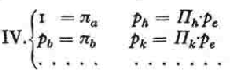
There are m + n’ – I of these equations, because among the varieties of new capital is new working capital, the price of which is pe.
For new capital the condition of the price of the services being equal to the cost of production means that the net rate of yield of new capital is equal everywhere to the interest pe on free capital (included among the p’s of the various services).
9. Counting the number of the equations of the four systems and adding the m + n + I relations which express the R’s and E in functions of all prices, we find in all 3m + 2n + 2n’ + I equations. These exceed by I the number of the unknowns; but, as it is easy to see, one of the equations is the result of the others. In fact, summing up on the one hand the equalities of the individual formulae, we arrive at
Ra + pbRb + ... + PsRs + PtRt + ... + E =psQs + PtQt+ ...,
which is the same result as is obtained by adding together, on the other hand, those of system (I) after having multiplied by ps, pt... and taking account of (II), (III) and (IV).
Thus we have the same number of equations as of unknowns. The entire economic system is thus determinate.
10. We have considered the technical coefficients as given quantities; now let us determine them. Some are constants; others are variables and related to each other and to the quantity produced by certain relations. These relations are those of increasing or decreasing returns, as is shown by experience. This economic variability of the technical coefficients is related to phenomena of the greatest importance. On these matters Vilfredo Pareto has made a most useful contribution to our science. To proceed gradually, let us begin by considering the limiting case of free competition, when, that is, the profits of enterprise are absent, and production is in the hands of one or more entrepreneurs, whose firms are similar to each other, and who are producing at the same cost. It is easy to see by what relations the technical coefficients and the sizes of the firms are determined.
To give the problem its most general solution, let us suppose that between the n technical coefficients of the product B there are k relations (k < n) of the form :
fθ(bsbt ... Qb) = 0 ... θ = 1 ... k
n – k + I equations are necessary to determine the n coefficients and the quantity Qb. And these precisely we have, giving the minimum πb = bsps + btpt + . . ., in which the prices are considered as constant and b and Qb related by fθ. Thus is constituted the well-known theory of maximum and minimum relations.
11. Now let us consider, taking a step towards the real case, several competitive enterprises and their profits.
Profit, in which there is an element in addition to the wages of management, i.e. there is a differential gain, appears as soon as the competing entrepreneurs are not manufacturing under the same conditions. For it is evident—in the realistic case—that it is necessary to admit that, besides the technical relations between the technical coefficients, there are, for each entrepreneur, special economic relations, which are usually based either on the want of ability to discern and to put into action a plan which combines the technical coefficients to the greatest economic advantage, or on the impossibility of arranging that combination of maximum advantage because of the limitation on the available supply of some factor. Hence originates the transitory profit of various enterprises, even in static conditions.
It is easy to see how even in this case the problem may be determined. It is a question of α competing entrepreneurs. There are α new unknowns representing the respective individual profits g1, g2 . . . gα, and α new unknowns representing the respective quantities produced.
Now in this case each entrepreneur, in organizing his production in a manner to obtain the maximum profit Qb(pb—πb), will consider as constants (because he is not able to change them himself) the prices of the product and of the services, and as variables the quantities to be produced and the technical coefficients. These are the conditions in which the quantity produced and the technical coefficients for each firm are determined. The profits per unit are:
pb = b’sps + b’tpt + ... + g1 = b”sps + b”tpt + ... + g2 = ...6
If a marginal producer α makes no profit, gα = 0.
But, reserving for later discussion the profits of the various enterprises, let us confine ourselves now to the limiting case to which free competition tends, in which there are one or more competing entrepreneurs who make no profit and who produce at the same cost.
12. The ‘Maximum’ of Free Competition.—The system of equilibrium equations which we have just seen can be simplified in the following manner:
the system of R’s and E in functions of prices;
the system (I) which expresses the physical necessities of production and which, obviously, will be found in any other economic régime ;
the following system (II) :

which is characteristic of free competition;
finally the system in which the technical coefficients are determined in such a manner that the costs of production may be at a minimum ; and this case also, as that of the price being equal to the cost, is characteristic of free competition.
13. A noteworthy property of this equilibrium is that the partial differential of
Ф= Rα + pbRb + . . . +psRs + ptRt + ... + E
is zero when prices are considered as constants.
The quantity Ф can also be put in the form

We will show first that the partial differential of Φ, taking prices as constants, is zero ; afterwards we will interpret the economic significance of it.
In fact
(a) Leaving fixed all the other quantities R, suppose an increase in the quantity of one of the products, say B, of ΔRb, allowing for the services required. Then we have in Ф on one side the increment of pbΔRb, and on the other the decrease (psbs + ptbt + ...)ΔRb; and therefore ΔФ is nil because Pb = psbs + ptbt + ...
(b) Leaving fixed all the other quantities R, suppose an increase in new capital of some kind, of ΔRh allowing for the necessary services, Then we have in Ф on the one side the increment  and on the other the decrease (pshs + ptht + ...) ΔRh; and therefore ΔФ is nil, because ph = pe(pshs + ptht + ...).
(c) Leaving fixed all the other quantities R, suppose that in the manufacture of B there are used more of S and less of T (bs and bt are independent), adding or subtracting the services consumable by them. Then the variation of Ф will be (psΔbs + ptΔbt) Rb. But this variation is zero, because the technical coefficients were determined with the condition of πb minimum.
Consequently, precisely by virtue of the conditions which are characteristic of free competition (that is, the cost of production equals the prices and the costs of production are at a minimum) given the quantity of services available, the partial differential of Ф when prices are considered constant is zero.
Of this proposition we may give further demonstration.
If that equilibrium is changed in any manner whatever (for example, by changing the technical coefficients so that the costs of production are no longer the minimum; or by disturbing the equality of prices to the costs of production) so that the R’s and P’s are changed, since always, according to the individual equations, there must be
Ra+PbRb+ ... +psRs+ptRt+ ... + E = psQs+PtQt+ ...,
the total variation of the first section will be composed of two parts. The former is that ΔФ, just now considered by us, which is obtained by differentiating with the p’s regarded as constant and the R’s as variables. The second, on the other hand, is obtained by differentiating with the R’s regarded as constants and the p’s as variables. It is easy to see immediately that the first part, our ΔФ, is zero if in the equilibrium the equations (IV) hold. It is enough to multiply (I) by Δps, Δpt . . . and to sum up.
Note that this partial differential ΔФ, just now considered, can be put [as it is easy to verify, finding the total differential and taking account of equations (III)] in the form ΣR(Δπ—Δp), which expression is zero if the costs of production are minimum and prices equal costs and it becomes negative, as might be expected, if, on the other hand, one or more prices become higher than the respective minimum costs of production.
14. Let us remember now that Ф is the sum of all individual quantities analogous to
ϕ = ra + Pbrb + ... + Psrs + Ptrt + ... + e,
which we have seen in the individual equations.
Let us remember, moreover, that if the individual A, by an alteration in the economic equilibrium, obtains a positive Δϕ, considering prices constant, his situation is improved. Vice versa, his situation deteriorates if a negative Δϕ results. Let us demonstrate this, specifying the significance of that improvement and deterioration. Then let us suppose that prices vary and therefore the different r’s of the individuals vary. In the individual equations which express the usual relations the total variation of the first section is composed of two parts : the first is our Δϕ, considering prices constant, the second, on the other hand, is obtained by differentiating with prices as variables and the r’s as constants. Then
Δϕ = qsΔps + qtΔpt + ... —(rbΔpb + . . . +rsΔps+rtpt+ . . .).
When this Δϕ is positive, that is to say, if the individual holds his consumption unchanged at the new prices, he will have an excess of income over expenses. Therefore, however the individual disposes of this excess in new consumption, and independently of whatever criterion is the basis of this distribution, his situation will be improved, because even if he spends all the increase on a single item of consumption, taking all the others as at first, he will now achieve a more advantageous combination than before, improving his situation in a sense which cannot give rise to equivocation.
As for a negative change, this necessarily constrains the individual to adopt a combination β, less advantageous than the former combination α, since if it did not, it would mean that in passing from β to α with a positive Δϕ, the individual would not obtain a more advantageous combination ; we have already seen that, in this latter case, a more advantageous combination is obtained. From these premises we come to a most important conclusion.
This conclusion is, that if in any way whatever the conditions alter, the costs of production falling and the prices remaining equal to costs, ΔФ will be negative, that is to say, the individual Δϕ’s will either be all negative (i.e. every individual will suffer loss) or there will be some positive and others negative, the negative preponderating. That is to say, some individuals will be benefited, others will suffer loss ; the loss to the latter will be decidedly greater than the advantage to the former, in the sense that even taking all their gain from those who have gained in the change (which takes them back to their former condition) and giving it to those who have lost by it, the latter, even with such an addition, remain in a worse situation than originally : or indeed, what comes to the same thing, some of the latter with such an addition might be brought back to their former situation, but all of them certainly could not.
To explain more clearly this conception, which is of great importance, let us think of three individuals only. When that equilibrium is attained at which Δϕ1 + Δϕ2 + Δϕ3 is zero, it is implicit that every divergence from the equilibrium conditions expressing the minimum costs of production and the equality of prices to costs renders that sum (Δϕ1 + Δϕ2 + Δϕ3) negative. If all three terms are negative the positions of all the three individuals will become worse. If some are positive and some negative—e.g. Δϕ1>0, Δϕ2>0, Δϕ3<0—while in absolute value Δϕ3>Δϕ1 + Δϕ2, if the gain of individuals 1 and 2 were transferred to 3 (who has lost) the latter would still be left with less than he had formerly.
15. One can say then, with regard to this maximum, that production organized with the two conditions characteristic of free competition does not itself maximise, as it is often erroneously said, the sum of the products which are afterwards distributed among the group by the competitive system. If we may be allowed for the moment to use that incorrect expression and unscientific concept “the sum of the products” (which is greater, the “sum” of a hundred litres of grain and ten of wine or that of ninety of grain and fifteen of wine?) it is not at all true that this sum of the products is maximized, because if, e.g. the individuals would be satisfied with less leisure the “sum of the products” could be increased. If the use of the word “sum” is tolerated, the only “sum” which is maximized is that of products and services, including leisure.
Nor is it correct to say that free competition leads to this maximum because within the limits of the equation
rα+pbrb + ... + psrs +ptrt + . . . + e = qsps + qtpt + . . . each individual is free, with the services which he supplies, to make that choice between consumption of products, consumption of services and saving, which pleases him best ; because obviously, in other régimes, although the expression and form of that equation might be different it is perfectly conceivable that the individual may be left free within the same limits to make whatever choice he pleases between consumption of products and consumption of services and saving.
And lastly, the maximum of free competition certainly does not imply that, in such a régime, every individual, with the services at his disposal, obtains a higher scale of choice than that which is possible in any other régime.
It is quite incorrect to suppose that this maximum has any such implications.
16. The maximum, we repeat, simply means this: that by substituting other conditions for one or more of the characteristics of free competition (minimum costs of production, equality of prices and costs of production) the conditions of all could not be improved. On the contrary, if some are benefited by this substitution their gain is less than the loss of those who suffered. So that if all their gain is taken from those who gained by the substitution, and is given to those who suffered loss by it, the latter could never retrieve their former position and some would always remain losers.
17, Such is the significance of the maximum, from which we deduce these corollaries:
(1) That each substitution of other conditions, for one or more of the characteristic conditions of free competition, is a destruction of wealth, in the sense that wealth which could have been produced with the available resources is not obtained.
(2) That if it is considered desirable to benefit some at the expense of others, it is much better—rather than by altering the conditions of free competition to obtain such a result indirectly —to make direct transfers from the latter to the former, because by such a method the harm inflicted on the latter is less, in proportion to the gain made by the former. Naturally, this is true only so far as this method of direct transfer does not noticeably alter the conditions of production.
The old economists had a vague idea of all this; but they had not a precise conception, nor were they able to give a rigorous demonstration. Consequently sometimes by clumsy arguments (which have a curious effect on those who are used to most rigorous logic) they arrive at conclusions which in the main are correct. These conclusions they had in fact perceived by intuition, though they believed they had demonstrated them. To have defined precisely this fundamental conception, to which we shall often refer later, and to have given it a thorough demonstration is the great merit of using mathematical analysis in political economy.
18, Before passing to monopolies and cartels, let us illustrate the genesis and the significance of a more or less graphical method, of which we shall sometimes make use later. It is a quick way, useful for obtaining immediately—provided it is adopted with due caution—a rough idea of certain results, which it would be much more laborious to deduce by using directly the system of equations of equilibrium.
For product B, for example, we have seen (7) that the price is a function not only of Rb, but of all the R’s ; as, vice versa, the quantity Rb is a function not only of pb, but of all the p’s. Hence it is not possible to imagine any cause whatever which makes one p vary without altering all the others and all the R’s, sooner or later, according to the friction, as we say, which the economic system presents to the propagation of these movements; even without altering the technical coefficients which, by their economic variability, are bound up in the entire system,
But it is possible to imagine an intermediate period between one equilibrium and another, in which pb alone varies, with the consequential changes of the R’s, without the movement of variation being transmitted by pb to all the other prices. Then for the small variations of pb we could hold
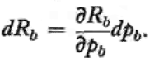
That partial derivative is generally negative, as experience shows. Whence arises the conception of a small movement along the smooth curve of demand on either side of the position of equilibrium.
In this intermediate period, since the equation
Ra + pbRb + . . . psRs + ptRt + . . . + E = psQs + ptQt + . . .
must always hold good, the usual variation of Ф, the single price pb being varied, will be
dRa + pbdRb + . . . + psdRs + ptdRt + . . . + dE = - Rbdpb
This means that after the variation of the single pb and before the variation is transmitted to the other prices, the mass of individuals has experienced a change, as if the sum of all the productive services Qsps + Qtpt + . . . had undergone a variation -Rbdpb; which, apart from the second order of small quantities, is the shaded area shown in Fig. 1. Thence is derived the concept of the variation of the consumers’ surplus. This variation gives in an approximate way, for small oscillations around the position of equilibrium M, an idea of the variation of the state of the individuals: how much they are affected by the variations of a single price pb. This is subject to the hypothesis that this variation of one price has not so far been transmitted to other prices.
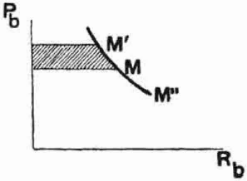
FIG. 1.
This procedure is adopted with the same caution with which, in infinitesimal calculus, one makes use of certain graphical illustrations, as distinct from graphical proofs; just as in the formula for the radius of curvature of a smooth curve it is said that it is equal to the infinitesimal length of the arc divided by the angle which the two tangents at the extremities of the same arc make, without taking into consideration the known infinitesimal curvilinear triangle.
19. Monopolies and Cartels.—Equilibrium in an individualist régime exists in a medley of free competition, monopolies and cartels.
We note that in the equilibrium previously studied, which represented the full régime of free competition, each individual in the market, either as a consumer or as a producer, or as an entrepreneur, acts pursuant to the maximization of his own gain but subject to the market prices of products and services. He is subject to them in the sense that, as he cannot influence them in any appreciable manner by increasing or restricting the demands or offers which he makes, he will consider such prices as given constants (11). On the other hand, monopolies and cartels are characterized precisely by the fact that by increasing or decreasing supplies they can noticeably influence the prices. They therefore take account of the variability of these prices and of the influence they can exercise directly in order to increase their own profits.
20. The Monopolies which are most interesting are those of a single entrepreneur manufacturing a product and a single seller of a productive service.
Let us repeat that the origin of the difference between equilibrium in this case and equilibrium in the preceding case is that in the case of free competition the manufacturer of a product or the seller of a service cannot, by decreasing or increasing the quantity of the product or service, influence in a noticeable manner the total supply in the market, and therefore he cannot directly influence the price, which he must consider as constant. In the case of monopoly, on the other hand, by changing R the respective p can be influenced; and therefore in solving his own problem of maximizing his gains a supplier will consider this price as a variable function of the quantity he supplies and will therefore adjust the quantity to his own advantage. Now we will proceed.
21. Let us suppose the manufacture of product B to be monopolized. The entrepreneur seeks to maximize the profit (Pb – πb)Rb from his monopoly. If, as is the most general case, he can act only on the selling price of the product and not at all on the cost of production (because he is obliged to accept the prices of services as they ate and cannot influence them directly, because he finds himself demanding services in competition with the manufacturers of other products), then, to obtain his maximum profit, he must consider pb and Rb as variables (the latter as an independent variable) and πb as a constant. Then the condition of this maximum is

which in system (IV) is substituted for pb = πb.
22. Let us suppose one of the services, say S, is monopolized. Then the quantity at the disposal of the market is no longer given: it is a new unknown, which it is in the power of the monopolist to augment or diminish. At the same time there is added to the system of equations one which formulates that the sole possessor of such a productive service will try to obtain the maximum Qsps; this equation is

If instead of a single monopolist there is a cartel, that is a syndicate of θ individuals, the possessors of a service which, to their own advantage they can monopolize, the preceding equation is used for the determination of Qs, the new unknown, and in the expression of the individual relationship the qs of each individual is determined in the second term, by the way in which Qs is distributed between them (i.e. how each individual contributes to the total Qs of the cartel).
Consequently also in these cases the equilibrium is perfectly determinate. It is not true that the cartelization renders the problem of price and quantity indeterminable. Given any particular agreement among members of the cartel on the distribution of the individual contributions to the total Qs supplied to the market, and on the distribution of receipts, the entire equilibrium is determinate. But whatever may be this division of Qs into individual contributions and this division of Qsps between the members, it is obviously always advantageous to all that Qs shall be such that Qsps is maximized.
23. Our analysis of the complications introduced by cartels and monopolies can be illustrated graphically.
Let us look at the case of the cartel (Fig. 2). The quantity Rs is a function, as we know, of all prices. But if all the prices except ps are considered constant (and the syndicate will consider them as such in aiming at its maximum profit) the relations between Rs and ps can be represented by a smooth curve (18).
The point M of the equilibrium of the cartel (we will call it Cournot’s point) is that in which the shaded rectangle is maximized; it has the property that the projection PB is equal to the abscissa OP, also AN = NO.
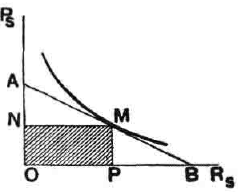
FIG. 2
And, since OP is the 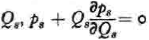 , therefore NO = ps and
 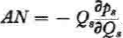 .
.
Let us now look at the case of monopoly (Fig. 3). The problem is to maximize the shaded rectangle (OO’ is the cost of production). It is maximized when AN = NO; or when 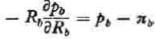 .
.
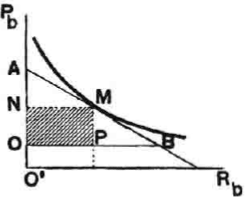
FIG. 3
24. As we said so much about it in section 17, there is no need for another demonstration of the proposition that monopolies and syndicates create a difference from the equilibrium of free competition which may be described as a destruction of wealth, in the sense that if some (the monopolists) obtain a profit by it, others (the consumers) lose more. The latter would lose less if, without altering the conditions of productions of free competition, they surrendered freely to the former that increase of wealth which the constitution of monopolies and syndicates would have procured for those people.
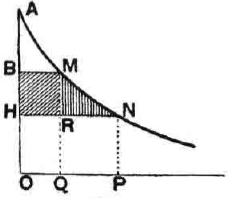
FIG. 4
Using (as in Section 18) the crude graphical representation, we note that precisely the same conclusion is revealed (Fig. 4). Indeed, in passing from the point N (free competition, price equal to cost) to point M (monopoly, with the condition of BMRH maximized) the loss of some is BMNH and the gain of the monopolist is BMRH: the loss of the former, then, is greater than the gain of the monopolist by MRN. There would have been less disadvantage to all if BMRH had been taken away directly and been given freely to the monopolist, leaving production as before: the destruction of MRN would have been avoided.7
24A. Money.—Economic equilibrium is the starting-point for all further inquiry. Consideration of as many other problems as we please naturally rise from that point, as branches from the trunk of a tree.
Let us take an example: money.
In order to see things with a greater clarity, let us suppose—a temporary hypothesis which we will modify immediately—that the merchandize A, instead of money, be the numeraire (that is, that in terms of which the prices are expressed) and that one of the productive resources, M, already included in the equilibrium, is money, i.e. it has that special function which, in production and exchange, it fulfils independently of its numerical quality in the sense now defined. Individuals and entrepreneurs will not require a quantity, Rm, of money, but a certain quantity, RmΠm (Πm is the price of money expressed in the numeraire) which is a function of all the prices. For this money-good, as for everything else, the quantity, Rm, the Πm and pm (the price for the use of it), will be determined in the equilibrium. Likewise there will be a definite quantity, Ra, of A, which is both a commodity and the numeraire. All is determinate.
Now let us reject that temporary hypothesis and identify M with A, in the system, making A become not only a commodity and the numeraire but also money. It is easy to see that even now the problem is entirely determinate. Indeed, in the system of equations of the equilibrium we have only to introduce these variations:
(1) In the place of ms, mt . . . write as, at . . .
(2) In the place of Rm write Ram understanding this to be the quantity of A money, to distinguish it from the quantity of Ra goods.
(3) To introduce the new equation Πm = πa. But it is easy to see there is another way. Indeed, of the three
Πm = asps + atpt + . . .
πa = asps + atpt + . . .
Πm = πa
one is the consequence of the other two.
The problem of the monetary equilibrium, then, is determinate. The quantity of A goods is given here as Ra, and the quantity of A money, Ram. The equilibrium is stable, and in dynamic changes the equalization of the prices of A goods and A money (both the prices equal to 1) is maintained by shifting the commodity to or from the monetary use. That is, of course, in a closed market.
25. The reader will notice that all this theory of the economic equilibrium, in which we have compressed into a system of equations many varied circumstances, of which we take account at one moment8—all this theory, we say, we have expounded without it being necessary to refer to any concept of utility, the final degree of utility or to effort-costs and such-like. “Synthetic economics” can do without all that, without a single one of its theories suffering for it. It does not need to avail itself of any other concepts but those old, well-known and clear ones of demand, supply and cost of production expressed in a numeraire, and not in terms of vague “efforts and sacrifices”.
This is the best proof that there is no necessary bond between the new theories of “synthetic economics” and the theories of the final degree of utility.
It is useless to make out that economics would not have been able to attain the degree of synthesis of the new theories unless mathematical analysis had been previously applied to it.
And now we pass to the Collectivist Régime.
III.—THE COLLECTIVIST RÉGIME
26. The Statement of the Problem.—Some resources remain the property of the individuals (e.g. that which they devote to personal uses): let them be M, N . . . to l terms. Let the resources which become the collective property of the State (e.g. fixed capital and land capital) be S, T . . . to n – I terms.
The Ministry of Production has to solve the problem of combining these individual and collective services in order to procure the maximum welfare for its people. We shall see in what precise sense this vague formula can be understood. The Ministry has studied the very complex problem and has solved it, on the basis of a certain formula of distribution which has been established by the community, on certain ethical and social criteria, with which we do not propose to concern ourselves directly. Such a formula of distribution we suppose (we shall deal with the wherefore later) may be embodied in a certain law, according to which is distributed between the members of the community, what in the old régime was the yield of resources now appropriated by the State and what was the profit from various enterprises now administered directly by the State (i.e. socialized). We shall see later whether all this income can be effectively distributed among the community.
27. If the exposition of the solution of the problem were to follow step by step the route followed in the inquiry, it would be long and confusing.
Therefore, with a view to brevity and clarity of exposition, we shall first enunciate the conditions in which the Ministry is faced with the task of solving the problem. We shall see how in such conditions, and with the criterion of the maximum collective welfare, it succeeds in determining the equilibrium perfectly, with as many equations as unknowns.
Later we shall return to the conditions which it has imposed on itself and we shall show how, if the conditions were different, scientific collectivism would break down either because the problem was indeterminate (the number of conditions insufficient to determine the equilibrium), or because the problem is not only practically but also logically insoluble (the number of equations exceeding the number of quantities to be determined), or, indeed, even when the number of conditions equals the unknowns and the equilibrium is therefore determinate, because the maximum of collective welfare obtainable in this equilibrium would be less than that necessary to provide the distribution formulated.
Hence it is preferable for it to plan production in its own way, and if it still wishes to correct the distribution it should work directly on the formula of distribution, varying certain coefficients γ which we shall define later, rather than directing production on fines inconsistent with the fundamentals of its own arrangement.
Hence the reader must expect that the conditions which we have posited here will be discussed later (§§ 39–54), after the solution of the problem, when a comparison will be made between those conditions and others which could have been posited.
28. Here are the conditions in which the Ministry of Production faces the problem:
(1) There is no money. There are products of a certain work of a given kind. There are no prices : but the Ministry maintains, for no other purpose than the social accounts, some method of determining ratios of equivalence between the various services and between the various products and between products and services.
(2) On the basis of these equivalents 9 the individuals themselves bring their products to the socialized shops to obtain consumable goods or to obtain from the social administration per-mission to use some resources of which the State is the proprietor.
The Ministry also maintains ratios of equivalence between the services of socialized resources and other goods, because it is agreed (we shall state the reasons later) that it would be a grave social loss to cancel arbitrarily the equivalences of these socialized resources. Let 1, λb . . . λm, λn . . . λs, λt . . . be the equivalences determined upon.
29. (3) The members of the community can enjoy the benefit of the quantity Qsλs + Qtλt + . . . which we will call X (remember that Qs, Qt . . . are the quantities of collectively-owned resources) either by an indirect distribution, the equivalents of the products being reduced, or by a direct distribution, that is giving to the members a supplement (to income) which is a quota of X.
The Ministry of Production has agreed that, generally, from the point of view of the greatest collective welfare, the direct distribution is preferable to the indirect.
The same cannot always be said for certain economic quantities which appear in the collectivist equilibrium and which are analogous to the profits of the old régime. We shall discuss them later.
30. (4) Being obliged to proceed with the system of direct distribution of X, the Ministry has decided, in agreement with the people, to try a certain system of distribution of X as a supplement to incomes. To each individual belongs γX. The γ could be different for every individual or different for different groups or arranged in such other ways as are possible. We shall discuss these different arrangements afterwards. For now and throughout the greater part of our discussion, let us suppose that γ is determined and differs from one individual to another. It is clear that Σγ = 1.
31. (5) As for saving, the Ministry, although the people do not wish to hear the words “saving” and “interest”, still ought to arrange so that all its productive services are not directly consumed or employed in the production of goods for consumption. Capital, or if we do not wish to speak of capital, the means of production, is used up and unless something is substituted for it, it will be necessary to reserve a part of the productive services for the manufacture of it.
But that is not all. The Ministry knows that if it devotes an adequate portion of productive services to this manufacture of the means of production it will in the future assure a still greater benefit to its people. The Ministry therefore requires some saving to be done. If it is left to individuals to save as much as they like (they then being obliged to lend the savings freely to the State), the amount of saving may not be sufficient to provide for the manufacture of that quantity of new capital which will be considered of maximum social advantage. It could impose a greater saving on individuals; but what if these are not content and prefer a greater present consumption to a greater one in the future? It could deduct from X, before proceeding to the direct distribution of it, that amount which it thinks appropriate for the manufacture of new capital; but it is agreed (we shall see later, in the sequel, the reason for this) that by such a method it would attain a collective maximum less than that which is possible by adopting the following method : let it choose at random a rate of premium for deferred consumption ; let it then see how much saving on the basis of this premium its people put freely at its disposition. Then let it find out if with this sum of saving it is possible to manufacture such a quantity of new capital that it will be able, in the future, to put at the disposition of the people a quantity of products and consumable services so great that it can really give them the promised premium for deferred consumption. And by trial and error, raising and reducing the promised premium, it will eventually make its promise in terms which can be realized. By such a method it could provide for their greater future welfare without disturbing their freewill and without interfering with that distribution which each one makes of the income he receives for his work, between his present and future needs.
It could, if it wished—and nothing prevents it—prohibit the savers from lending their savings to others and oblige them to lend them to the State so that the production of some goods would be the monopoly of the Government. In the collectivist régime, the Ministry of Production orders the use of individual saving to be sold only to the Government.
32. (6) In distributing his earnings, which he receives in exchange for his services—according to the established equivalents of the Ministry—and that amount which he receives as a supplement to distribution (X), between consumption of various kinds and saving the individual is left free to choose, according to his own pleasure.
The Ministry of Production, after mature reflection, imposes these same conditions on itself in striving to provide the maximum collective welfare. Consequently it ought to order production so as to obtain the maximum benefit for its people with the services of which the State disposes and those of which the individuals dispose. These have the freedom, in ordering their own individual economies, to make the choice they believe most convenient, consistent with the equation
ra + λbrb + . . . λsrs + λtrt + . . . + e = λmqm + λnqn + . . . + γX.
33. The Collective Maximum.—The Ministry of Production commences with the adoption of the technical coefficients which happen to exist at the time (but which satisfy their technical equations). It does not for the present preoccupy itself with the economic variability of these coefficients. It fixes, moreover, at random, a series of R’s which, however, accord with the physical necessities of production (that is System (I) of § 8). It is absolutely essential that, having chosen the technical coefficients, whatever afterwards may be the system of production which it wishes to follow, the quantity of productive services available must always be precisely that which is necessary to provide for services which are consumed directly and for the manufacture of products and of new capital.
Let it give now, a random series of equivalents and the modifications which may be necessary in order that these technical conditions of production (System (I)) may be satisfied. It is understood that there is not a single system of equivalents which satisfies these conditions. If it, indeed, announced at random m + n – I equivalents of products and productive services, each of its people will make, as we say, a schedule. The individual schedules will give, for the series of equivalents selected by chance, the individual r’s and e, whence are derived the totals R’s and E. But as System (I) gives a number of relations between these R’s and the E, less than the number of equivalents, which are m + n - I, the system of equivalents satisfying System (I) will admit an infinite number of solutions. Then the Ministry decides on one among those which satisfy System (I) as a starting-point. It will then make adjustments in such a way as to attain the end of the maximum collective welfare.
34. What concrete and unequivocal significance must be attached to this very vague expression “ maximum collective welfare ”?
If the Ministry corrects one of the equivalents consistently with (I), the individual will make a new choice, which will be more or less advantageous than the preceding choice according as
Δra + λbΔrb + . . . + λsΔrs + λlΔrl + . . . + Δe
which we call Δθ, is positive or negative (14) according to which, we will say, for the sake of brevity, the individual will be higher or lower.
The meaning of the collective maximum would be patent if, by successive attempts, the Ministry could arrive at such a series of equivalents that every further modification of it would place all individuals lower. But suck a series of equivalents does not exist ; it is useless to try to find it. It would be necessary to find such a series of equivalents, that by modifying one of them by a very small quantity, the Δθ for each individual would be reduced to zero. And that is impossible ; since, as we shall now see, the sole condition for reducing to zero not the individual Δθ’s but their sum ΣΔθ,10 implies as many conditions as are sufficient to determine completely all the equivalents.
We must bear in mind the possibility that, by making use of the great freedom with which the individual γ’s can be varied (subject to the sole condition that Σγ = 1), we can obtain a series of γ’s and of such equivalents that not only ΣΔθ is zero but all individual Δθ’s are zero also. We will show in an appropriate place (53) that this is impossible.
35. What does the reduction of ΣΔθ signify? To eliminate
ΔRa + λbΔRb + . . . + λsΔRs + λtΔRt + . . . + ΔE
means that every other series of equivalents, different from that which accords with this condition, would make that sum negative. That is to say, either it causes a decline in the welfare of all or, if some decline while others are raised, the gain of the latter is less than the loss of the former. (So that, even taking all their gain from those who gained in the change, reducing them to their former position, to give it completely to those who lost, the latter would always remain in a worse situation than their preceding one, without the situation of the others being improved.) Since it is absurd to attempt to resolve the impossible problem of finding such a series of equivalents that every further alteration would produce a reduction of welfare for everyone, we will consider that the sole criterion of maximum welfare which the Ministry of Production can use is ΣΔθ = 0.
36. How the Equilibrium is Determined.—ΣΔθ can be put in the form
ΔRa + λbΔRb + . . . + λsΔRs + λtΔRt + . . . + ΔhΔRh + ΔkΔRk. . . calling Δh, Δk. . . the quantities of saving necessary for the manufacture of a unit of H, K . . .
Let us remember that in the first approximate solution the Ministry of Production had assumed a series of technical coefficients at random (though satisfying their technical equations) and one of such possible series of equivalents and of R’s as will satisfy System (I)
Now it is necessary to correct this series of quantities so long as successive corrections always give a positive ΣΔθ, and stop at that point at which further corrections give a zero increment, a sign that the maximum is attained and that further modifications would give rise to a decline in welfare.
37. The technical coefficients are not changed at first: this task is reserved for later.
Keeping an eye on the System (I) of the physical necessities of production which must always be satisfied:
(a) Rb is increased by ΔRb, the necessary services being taken from those directly consumed. Then ΣΔθ is constituted by the increment λbΔRb in the product less the diminution
(λsbs + λtbt + . . .)ΔRb,
in the consumable services. Therefore in these changes the Ministry ought to stop when the total increment is zero, which can never happen except when
λb = λsbs + λtbt + . . . . . . (α)
For the purpose of verification, and because thereby the significance of this argument will appear still more clear, let us begin by considering a situation in which the equivalent of B (which is afterwards the price, under another name, expressed in terms of that special kind of work which is called the goods) is greater than the cost of production. In such a case, the Ministry of Production, in the interests of the community, agrees to increase Rb and to decrease the consumable services, because by manufacturing more of Rb, the addition being ΔRb, there is for ΣΔθ on the one hand the increase λbΔRb, by the increase in B, and on the other hand the diminution (λsbs + λtbt + . . .) ΔRb, by the diminution in consumable services. The net result of this is evidently advantageous because, by hypothesis, λb exceeds λsbs + λtbt + . . . The maximum will be achieved only when there is no more advantage to be gained by such adjustments, which is when λb = λsbs + λtbt + . . .
(b) Increase one of the new productive resources H by ΔRh, taking the services necessary from those directly consumed. Then for ΣΔθ there will be on the one hand the increase ΔhΔRh and on the other the decrease
(λshs + λtht + . . .)ΔRh;
and hence, with the same reasoning as before, we arrive at the condition
Δh = λshs + λtht + . . . . . . (β)
(c) Now let us proceed to the savings. The Ministry disposes of a quantity of saving
E = ΔhRh + ΔkRk + . . . + Re,
with which it must increase as much as is possible the total quantity of services available for subsequent production. It will approach this maximum, by transferring new capital from one use to another, until, λhλk . . . λe being the equivalents of the services of the new kinds of capital11 λhRh + λkRk + . . . λeRe reaches the maximum.
This condition of the maximum is only satisfied, evidently, when

(d) Now we proceed to the technical coefficients. The Ministry, in the first approximate solution, had chosen them in such a way that they should simply satisfy their technical equations. But we know that some of them are variables, in the sense that some can be diminished while in others there is a compensating increase. Let S and T be the services for which in the manufacture of B these variations can be made. Then, per unit of B, more of S and less of T will be employed as far as is advantageous from the point of view of the collective maximum. The ΣΔθ is constituted, with regard to the consumable services, by an addition λtRbΔbt and a diminution λsRbΔbs. Therefore the variation is zero if
λsΔbs + λtΔbt = 0
which is one of the conditions of the λb minimum when the economic variability of the technical coefficients is considered.
38. Taking account of what we have just said on the technical coefficients and glancing at the relations (α), (β), (γ) of § 37, it is immediately evident :
(1) That the system is perfectly determined : there are as many equations as unknowns,
(2) That the Ministry of Production in this perfecting of its first approximate and indeterminate solution (the sole criterion of perfection being the maximum collective welfare) comes to the conclusion that production should be so organized that (with the systems of technical coefficients, of the λ’s and R’s) the cost of production may be minimized and that the equivalents for the products and for the additions to capital may be such as will correspond to their respective costs of production.
(3) That the system of the equations of the collectivist equilibrium is no other than that of the free competition.
Which only means that with equal resources (the quantities Q) the economic quantities of the collectivist equilibrium (λ, R, etc.) will be the same as those in the individualist equilibrium ; and that is due to the presence of that supplementary term γX in the individual equations of the collectivist régime, which does not occur in the individual equations of the individualist régime.
39. The Distribution of X.—Now is the time to discuss the conditions (§§ 28 to 32) which the Ministry has considered as the basis of its problem,
There are five problems concerned here : the distribution of services possessed by the State ; saving and the creation of new capital ; the distribution of the profits from the undertakings ; multiple prices ; and the supplements to income (X).
Let us discuss them in order.
If the productive resources S, T, . . . (n-l in number) are the property of the State, there are two different ways of enabling the community to reap the benefit of this collective property : either that which we have assumed as one of the conditions in the solution of the problem of the collectivist equilibrium (that is, the direct division of X, giving to each individual a supplement to his income γX) ; or that of reducing to zero, in the cost of production, the equivalent of the services of resources which are the property of the State, and taking as the equivalent of each product (the λ, which is subsequently the price) the cost of the direct personal services which are required for its production. When the product is made with others, this cost is found by dividing the total cost in personal services by the entire quantity produced.
40. This system of indirect distribution, coupled with the reduction of the equivalents of the services of collective property to zero, is, at bottom, Marx’s theory of value.
Those people who have criticized Marx have justly directed attention to the fact that such a system would be far from achieving the result, “ to each person the entire product of his labour ”, which is asserted to be connected therewith, because it is evident that a certain quantity of work of a given kind would be rewarded by a greater or smaller quantity of a certain product, according to the quantity and quality of the State-property with which it is employed. Hence the distribution of the product, made by such a system, is very far from realizing the formula of “ the whole produce ”. But showing that this formula is not realized does not mean that indirect distribution is shown to be unsuitable. With more effect is it remarked that even when some resources are collective property the State can do no less than fix a price for their services, since there would otherwise be an enormous waste of these, with a consequent destruction of wealth. These services would be used in a large measure, not for further production, but as consumable services, and of those employed productively there might easily be an excess in one kind of production, which excess would be more useful socially in another industry in which there was a deficiency of resources.
This is the correct and fundamental argument against indirect distribution and in favour of direct distribution : the impossibility of obtaining a maximum as high as that which could be achieved with the latter method.
41. Of such a truth we can give, in a few words, a more general and “ synthetic ” demonstration which can be applied equally to all those systems which propose to reduce to zero the equivalents of all or some of the services of those resources which become collective property.
To wish that the n-l quantities λs, λt . . . may be equal to zero, is to introduce into the general system of equilibrium, which we have seen entirely determined, n-l new equations. Hence either there is an impossible problem (the number of equations greater than the number of unknowns), or, to make it at least logically possible, it is necessary to exclude from the system n-l of the equations which are already there. And as this exclusion cannot be done by taking the equations of the R’s from System (I), because they express the physical necessities of production which any economic order whatever must necessarily respect ; then to make the problem possible, it would be necessary to exclude as many equations as those which express the minimum costs or the equality of prices and costs. This means that it is necessary to exclude as many equations from those which express the obtaining of that certain maximum ; exclusions by virtue of which it certainly could only obtain a lower maximum. The Ministry of Production, instead of rising to the limit, would be forced to stop half-way.
Hence one can affirm that the better way for the Ministry of Production to provide for the welfare of its subjects, is not that of indirect distribution (i.e: the reduction to zero of the λ’s of the services of collective property), but that of direct distribution of supplements to income.
42. The collectivists persist in defending themselves, by expounding, with subtle and laborious interpretations, certain propositions which are either contrary to facts or do not bear a penetrating analysis. They do not appear to think that, if they are to remain collectivists, they must now cast off these gross errors which they derived from a nebulous vision of the phenomenon and from a muddled idea of the mutual dependence of economic quantities.
Of course their attitude in this respect is reminiscent of the reluctance with which the dogmas of a religion are discussed, especially when the latter has great propaganda value.
In addition there is a consideration of great moment in a collectivist régime : that is, that indirect distribution is rigid and does not permit certain ethical and social criteria to be observed with all that liberty which is realized (by giving opportunity values to the γ’s) by direct distribution.
43. Saving and the Creation of New Capital.—For the discussion of the condition which the Ministry has imposed on itself concerning saving and the creation of new capital it will be enough for us to make :
(1) A brief observation on what we should call the productivity of capital.
(2) A comparison between the method followed by the Ministry of Production and another which it would be possible to follow, by deducting from X, before distributing it, that part which is necessary for the manufacture of new capital. Here it will be easy to show that by this second method it would realize a lower collective maximum than that which it can secure with the system preferred.
44. As for the first point, it is necessary to understand well that whether some capital is the property of individuals or whether it is collective property, does not upset the technical fact, that by once subtracting a part of the disposable productive services from the production of consumption goods, and then to produce new capital (new means of production, if that term is preferred), there is secured for always an increase of production greater than the amortization of capital.
Let us express this conception, which is the crux of the matter, with greater precision.
With the quantities Rs + Rs’ and Rt + Rt’ of the services S and T it may be possible for us to manufacture the quantity Rb + Rb’ of the product B. We are speaking of a given unit of time, e.g. one year. In this unit of time we may sacrifice the consumption Rb’ and with the services Rs’ and Rt’ we may manufacture instead some capital Rk. And let us call ε the fraction of Rk which it is necessary to manufacture every year in order to maintain the quantity intact (amortization).
In the next unit of time, and so in continuation, with the same services Rs + Rs’ and Rt + Rt’ along with Rk , after having taken away from those services the part which is necessary for the reintegration of Rk, we could have, instead of the product Rb + Rb’ which we obtained formerly, a quantity of product which we shall call  , which is obviously given by these equations:
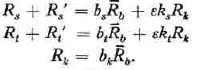
It often happens technically—and the most obvious experience shows it—that with the choice of an appropriate method 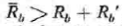 ; thus this is the criterion on which the decision, whether to manufacture capital or not, is based. That condition is necessary though not always sufficient. Then with the sacrifice of Rb’ once made, there is an everlasting additional product
 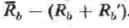 . Hence there is the possibility of a premium on deferred consumption of
 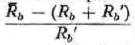 for every unit of B subtracted from present consumption.12 It is precisely this purely objective technical fact, which does not depend in the slightest on whether the capital is individual property or collective property, which gives the Ministry the means to promise a premium on deferred consumption to those who are willing to provide it with savings for the construction of the new means of production. In substance, these people promise not to present a part of their earnings at the general shops to obtain goods, but to deposit it (though it continues to be their property) with the Ministry. The Ministry is thereby enabled to manufacture, with the total available services, a smaller quantity of final products and to set aside a part of the same services for the manufacture of new means of production. These new means of production will then be available to it in successive periods of production. It is precisely this objective fact which is the origin of what may be called the economic productivity of savings employed in production even in the collectivist régime.
45. Now we pass to another point : is it advantageous that the Ministry of Production, instead of having recourse to individual saving and promising (in order to secure a sufficient quantity of it) a premium on deferred consumption to those individuals who supply it, should, before distributing X, deduct that part of it which is considered necessary for the creation of new capital?
The criterion is, and must be, always the same : the greatest welfare for society.
Let us leave aside the consideration that by the second method the Ministry would take no account of the wishes of its subjects, who might prefer a greater γ X to-day to a smaller future increment ; and let us also leave aside the consideration that the Ministry would by such a method be without any means of determining the most advantageous quantity of new capital to create. We will confine ourselves here to viewing the case exclusively from the point of view of the collective maximum.
Then, in order to manufacture by this second method the same quantities of new capital Rh, Rk , . . the Ministry distributes to the community an amount reduced by E. But each individual, even without the promise of a premium for deferred consumption, and simply for the provision of future needs, might for his own advantage decide not to consume ail his earnings, but to save a certain amount. Hence there is a certain sum of individual saving, which we will call Et to distinguish it from the quantity E which the Ministry, by reducing X, uses for the manufacture of new capital.
Ei is the sum of all the ei’s which result from the individual equations, which now become like this :
ra + λbrb + . . . + λsrs + λtrt + ei = qmλm + qnλn + . . . + γ(X – E).
Or for the community :
Ra + λbRb + . . . + λsRs + λtRt + Ei + E = Qmλm + Qnλn + . . . + Qsλs + Qtλt . . .
That is to say, that with this second method (i.e. the method of the Ministry deducting from X the quantity E necessary for the manufacture of new capital, before distributing X among the people) the whole body of individuals is forced to limit the sum of goods and services consumed more than they did with the other system, with the prospect of a future increase of products and services no greater than that which the other system offers. Therefore evidently, in the interests of the maximum welfare of the community, the former method is preferable to the latter.
This conclusion will be more readily understood, if it is realized that this second method (which is not to be preferred) does not use, for increasing goods and services in the future, that sum of money which various individuals still save even without the promise of a premium for deferred consumption,
46. The Distribution of the Profits of the Undertakings.—The problem is in these terms : the product B, for example, is manufactured in two different ways, each with its own technical coefficients. Hence there is a profit for the method of production which costs less. The undertakings being socialized, this profit belongs to the community. It can be distributed among the members of the community in two ways : either directly, taking λb equal to the higher cost and adding the profit G to the X which is distributed to the community ; or indirectly, lowering the price to the average cost of production. Which is more advantageous?
47. Such questions we can solve by a simple graphical device. Let the product B be manufactured in two ways at different costs, as Fig. 5 indicates. The quantity produced is ON, the higher cost MN, the profit of the lower cost undertaking RSQP. Let M’N’ be the average cost, so that the obliquely shaded area will be equal to the profit RSQP of the lower cost enterprise. It is clear that at the average cost the consumption will be ON’. And it is also clear that if in passing from the production of ON to ON’—we will say in passing from M to M’—the average cost remains the same, the lowering of the price is preferable to the direct distribution of the profit, because with the latter method the community gains the shaded area, while with the method of reducing the price all the shaded area plus the black area is gained. Such a conclusion is true a fortiori, if in passing from M to M’ the average cost diminishes.
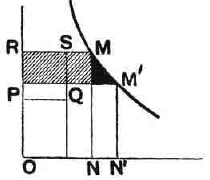
FIG. 5.
But if, instead, the average cost increases, because the new consumption NN’ has to be produced at a higher cost than the two preceding ones or at a greater new cost, then according to the position, either the direct or indirect distribution of the profit is preferable.
In Fig. 6 M’ is the level of the previous average cost when the production is ON, The profit is shown by the horizontally and vertically shaded areas combined. M” is the level of the new average cost when the production becomes ON”. Let us call the two shaded areas a and b respectively (a the horizontally shaded and b the vertically shaded) and the black area is c. It is clear that with the system of direct distribution of the profit the community gains a + b. With the system of indirect distribution, that is, with the lowering of the price to the average cost, it gains a + c. Hence the first or second method will be the more advantageous according as b is greater than c or vice versa.
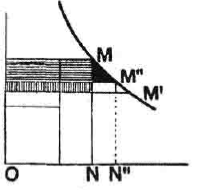
FIG. 6.
48. We have said this because such an aspect of the question cannot be avoided in our analysis.
However, as experience shows, the total sum of the profits is in reality unlikely to be large (there are losses as well as profits) ; and it will still be necessary to use a part of these profits as remuneration for the work of those people who, as assistants of the Ministry, are engaged in endeavouring to keep the cost of production as low as possible ; and lastly, as we have already noticed, every method of indirect distribution implies a loss of freedom—curtailing the liberty of giving to the γ’s the most advantageous values from ethical and social aspects. For these reasons the Ministry would decide that there was no case for departing from the general principle of direct distribution, even in the sphere of profits. This decision would be reinforced by the fact that any such departure would give rise to further practical complications, and the Ministry would, apart from this, as we shall see later, already find itself in the midst of a multitude of complications arising out of the practical resolution of the equations of the equilibrium.
49. Multiple Prices.—The consumption of the product B, for example, may be ON, with the price MN which is equal to the cost of production (Fig. 7). To extend the consumption of the product and to render it more widely accessible, we can increase the price of a part of the supply, in order to lower the price of the other part, making the adjustment by a redistribution of the total cost ; for example, the amount OC could bear the price CD, while for CH the price would be HB. If when the output is increased the cost of production does not vary (then the two shaded rectangles are equal) it is obvious that this proceeding implies a destruction of wealth ; for it is better to take directly from some to give to others ; or it is better to work on the γ’s.
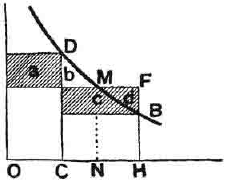
FIG. 7.
In fact, passing from the position of equilibrium with a single price to that with a double price, in this case of costs remaining constant when output increases, a destruction of wealth, MBF, is caused. This may be easily verified by considering what, in passing from one state to the other, will be the variation of the consumers’ surplus : as a result of the change it decreases by a + b for one part and increases by b + c for the other, a net increase of c – a ; but a = c + d because the average cost per unit is HF ; therefore, on the whole, the consumers’ surplus is diminished by d.
50. In order that there shall be no loss, it is necessary (though not sufficient) that the cost should fall as output increases. Then a system of multiple prices can be advantageous, when, as it is easy to verify (Fig. 8), by increasing consumption from M with a single price to N with multiple prices, with the lessening of the unit cost, the obliquely shaded surface may be bigger than the vertically shaded area. This is demonstrated in a few words, in spite of the apparent complication. Indeed, if there is a change from position M with a single price to position N’% still with a single price, the gain is the obliquely shaded area. If from position N’ with a single price there is further change to position N with multiple prices, the loss (according to what we saw just now) is represented by the vertically shaded area ; thus in passing from M with a single price to N with multiple prices, there is a gain represented by the first area (oblique shading) and a loss by the second (vertical shading).
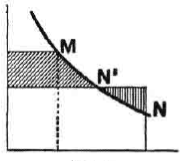
FIG. 8.
Hence, when the first area is larger than the second it is possible that multiple prices may be consistent with increased welfare for the community. And as such a proceeding is more possible practically when production is socialized, this is in reality a sound argument in defence of socialized production, in certain cases, when such conditions are proved to exist.
51. Now, without rejecting the notion that in some particular case the proceeding may be applicable, the Ministry of Production, since it has under its control the determination of the y’s of the supplements to income, with which it can directly modify distribution, does not (having regard to the practical necessity of not adding other complications to those which it must solve in the immense problem with which it is faced) think it opportune to depart from the criterion of the single price in general. At the same time it may consider some particular cases in which the multiple price system can noticeably increase the collective welfare. For example, it might treat as special cases some products for wide consumption, by extending the production of which it would make possible a considerable lessening of the cost of production.
In such cases the sale of one part under cost and of another above cost, can produce advantage for some such as could be obtained by an increase in their γ’s only by reducing the γ’s of the others by much more than the latter would lose by having to pay a price above cost.
There are cases also, in which the multiple price system, with the increase of production which it makes possible, can lead to such a lessening of cost that the new price above cost would remain below the old single price equal to the cost of production. And in such cases, of evident and great advantage to the community, nothing debars the Ministry of Production from adopting the multiple price system in place of the single price. It is an error to believe that the single price is the better system in every case.
52. The Supplement to Incomes.—The origin of all the supplements distributed to the various individuals is constituted by the price of the services of which the State has become the possessor. This sum is divided according to certain rules fixing the individual γ’s. It would be erroneous to conclude from this that in the collectivist régime the individuals are benefited by all that which in the old régime formed the income of the possessors of this capital. In fact, with the mass of all the disposable services—which, save for the different appropriation, let us suppose for the purpose of comparison, are not changed—in the old régime, the consumption of products, the consumption of services and saving for the formation of new capital were provided for. If it is desired that in the new régime existing capital should not be destroyed and that creation of new capital should be continued at a rate no less than that which was obtained in the old régime, the community must save as formerly. Hence its consumption (of products and consumable services) would be unchanged ; and thus in the new régime the community could not appropriate for consumption the income of the old possessors of resources, but at most only that part of this income which they consumed.
53. The distribution of that certain quantity
X = Qsλs + Qtλt + . . .,
the price of the services of the resources possessed by the State, can be made in many different ways. For example: in equal parts, making y identical for all individuals ; by classes, giving to the individual a fraction γ1,X, γ2X, etc., according to the class to which he is assigned.
It may be asked (34) if it is not possible for the Ministry of Production, in exercising its power to vary the individual γ’s, subject only to the condition of Σγ = 1, to arrive at a series of γ’s, with the equivalents and the technical coefficients such that not only ΣΔθ is zero but also the single Δθ’s are zero. Then an absolutely indisputable maximum would be realized, because then such an economic system would be worked out, that every alteration from it in the γ’s, in the equivalents and in the technical coefficients would produce a decline in welfare for everyone : the ideal of economic systems. But such a system of γ’s does not exist.
In fact, the individual γ’s must be a function of the λ’s and satisfy the condition that the variation of a λ involves a variation of the γ which makes the former equal zero.
The function γ must therefore satisfy the conditions

(let us recollect that the individual equation is
ra + λbrb + . . . + λmrm + λnrn + . . . + λsrs + λtrt + . . . + e = λmqm + λnqn + . . . + γX);
that is, it must satisfy the conditions

It is easy to see that the function γ which satisfies such conditions does not exist; since describing as yb . . . ym . . . γt, its partial derivatives, the known conditions of integrability are not satisfied.

Hence there does not exist a function of the λ’s, which, used for the regulating of the γ’s, can lead to the marvellous result that the individual Δθ’s may equal zero, so that any subsequent alteration in the equivalents would cause a decline in welfare for everyone.
54. The effects of distribution on production would vary with the different methods by which X is distributed.
We have already noted (38) how the complete resemblance between the equations of free competition and the equations of the collectivist equilibrium, established with the idea of obtaining the maximum collective benefit, only means that there being in the group the same quantities of capital in one case as in the other, the appropriation alone being different, the economic quantities of the equilibrium will be equal to those of the other, there still being in both cases equations expressing the conditions of minimum cost and of prices equal to costs; that is precisely on account of that supplement added to the income of each individual. The distribution, which is made of that X in one way or another according to the various values which are given to the y’s, influences diversely these economic quantities. The study of these diverse influences gives rise to interesting speculations, one of the most remarkable (though not unexpected) results being that there would be a sharp rise in the premium for deferred consumption—which is the parallel to interest on saving in the old régime—which according to most superficial collectivist doctrines would be abolished. Precisely the opposite is the case !
55. The Equations of the Equilibrium insoluble a priori.—For the solution of the problem it is not enough that the Ministry of Production has arrived at tracing out for itself the system of equations of the equilibrium best adapted for obtaining the collective maximum in the well-known sense (to which we need not return). It is necessary to solve the equations afterwards. And that is the problem.
Many of the writers who have critized collectivism have hesitated to use as evidence the practical difficulties in establishing on paper the various equivalents ; but it seems they have not perceived what really are the difficulties—or more frankly, the impossibility—of solving such equations a priori.
56. If, for a moment, we assume that the economic variability of the technical coefficients may be neglected and we take account of their technical variability only, it is not impossible to solve on paper the equations of the equilibrium. It would be a tremendous—a gigantic—work (work therefore taken from the productive services): but it is not an impossibility.
It is conceivable, in fact, that with a vast organization for this work it would be possible to collect the individual schedules for every given series of the various equivalents, including the premium for deferred consumption. Hence it is not inconceivable that with these schedules collected—always supposing the technical coefficients known and invariable—it would be possible by a paper calculation to find a series of equivalents, which would satisfy the equations expressing the physical necessities of production and the equalization of costs of production and the equivalents, which become the prices. There is no analytical difficulty about it: it is a problem of very simple linear equations. The difficulty arises rather from the very great number of individuals and goods of which we must take account; but it is not inconceivable that, with still more arduous work, such difficulty could be overcome.
57. But it is frankly inconceivable that the economic determination of the technical coefficients can be made a priori in such a way as to satisfy the condition of the minimum cost of production which is an essential condition for obtaining that maximum to which we have referred. This economic variability of the technical coefficients is certainly neglected by the collectivists; but that it is one of the most important sides of the question Pareto has already very clearly shown in one of his many ingenious contributions to the science.
The determination of the coefficients economically most advantageous can only be done in an experimental way: and not on a small scale, as could be done in a laboratory; but with experiments on a very large scale, because often the advantage of the variation has its origin precisely in a new and greater dimension of the undertaking. Experiments may be successful in the sense that they may lead to a lower cost combination of factors; or they may be unsuccessful, in which case that particular organization may not be copied and repeated and others will be preferred, which experimentally have given a better result.
The Ministry of Production could not do without these experiments for the determination of the economically most advantageous technical coefficients if it would realize the condition of the minimum cost of production which is essential for the attainment of the maximum collective welfare.
It is on this account that the equations of the equilibrium with the maximum collective welfare are not soluble a priori, on paper.
58. Some collectivist writers, bewailing the continual destruction of firms (those with higher costs) by free competition, think that the creation of enterprises to be destroyed later can be avoided, and hope that with organized production it is possible to avoid the dissipation and destruction of wealth which such experiments involve, and which they believe to be the peculiar property of ‘anarchist’ production. Thereby these writers simply show that they have no clear idea of what production really is, and that they are not even disposed to probe a little deeper into the problem which will concern the Ministry which will be established for the purpose in the Collectivist State.
We repeat, that if the Ministry will not remain bound by the traditional technical coefficients, which would produce a destruction of wealth in another sense—in the sense that the greater wealth which could have been realized will not be realized—it has no other means of determining a priori the technical coefficients most advantageous economically, and must of necessity resort to experiments on a large scale in order to decide afterwards which are the most appropriate organizations, which it is advantageous to maintain in existence and to enlarge to obtain the collective maximum more easily, and which, on the other hand, it is best to discard as failures.
59. Conclusions.—From what we have seen and demonstrated hitherto, it is obvious how fantastic those doctrines are which imagine that production in the collectivist régime would be ordered in a manner substantially different from that of “ anarchist ” production.
If the Ministry of Production proposes to obtain the collective maximum—which it obviously must, whatever law of distribution may be adopted—all the economic categories of the old régime must reappear, though maybe with other names: prices, salaries, interest, rent, profit, saving, etc. Not only that; but always provided that it wishes to obtain that maximum with the services of which the individuals and the community dispose, the same two fundamental conditions which characterize free competition reappear, and the maximum is more nearly attained the more perfectly they are realized. We refer, of course, to the conditions of minimum cost of production and the equalization of price to cost of production.
60. This conclusion could have been reached, at first sight, by a “synthetic” argument; but it could not have acquired the value of a demonstrated truth, without the phenomenon being subjected to a minute quantitative analysis, as has been done in the preceding pages. The argument would be this: to hand over some capital to the State and afterwards to distribute the yield thereof among the individuals, according to a certain law, whatever it is, is like starting from a situation in the individualist régime, in which the individuals, besides having their own capital, may be possessors of certain quotas of capital of which the State has become the controller, quotas corresponding to that same law of distribution which we supposed adopted.
In such a situation what are the technical coefficients and what is the system of equivalents which allow the attainment of the maximum? Those which give the equalization of price to cost of production and the minimum cost of production 1
61. That supplement to income distributed among the individuals—whatever may be the system of distribution—does not augment, as we have seen, the consumption of products and consumable services of the group, by the total income which in the old régime the possessors of capital received and which is appropriated by the State in the new régime, even when this appropriation takes place without some promise of compensation to the expropriated owners. When there is no intention of restricting saving and the creation of new capital to narrower limits than in the old régime (to this we shall return in a moment) the total consumption of products and of consumable services can be scarcely different from what it was before.
Hence, given that there is no wish to check the creation of new capital in the new régime, the distribution of consumable goods and services among the people must inevitably be restricted within the limits of what in the old régime the possessors of the capital, which is now socialized, consumed, not the whole of what they received as income. Besides this, account must be taken of the necessary remuneration of the army of officials whose services would be devoted not to production but to the laborious and colossal centralization work of the Ministry (assuming the practical possibility of such a system).
62. If it were so desired, it would be possible to augment consumption, at the expense, however, of the formation of new resources, but of all the new resources, even at the expense of the birth-rate. To promise increased welfare and to propose to “ organize ” production and to preach about free love in the new régime is simply ridiculous nonsense. If the State does not wish the collective maximum to decrease rapidly in time, the accumulation of capital must be regulated according to the birth-rate ; or, conversely, the latter must be restricted within the limits set by the former.
_______________
13 [The term capital is here and throughout this article used in the comprehensive sense introduced by Professor Irving Fisher. It includes land as well as the produced means of production.—Ed.]
14 [In the passages which were left out Barone referred to a further instalment of this article in which he intended to present the problem in the form of a discourse which the Minister of Production of the Socialist State delivers to his colleagues. This part was unfortunately never published.—Ed.]
15 In my elementary treatise, ‘Principi di economia politica’ (Bibliotica del Giornale degli economisti), I used the conception of utility, because it seemed to me the simplest and clearest method to explain to the beginner some of the most notable results of the new theories. This treatise will be referred to in future by the short name ‘Principi’.
16 Thence the quantities Qs - Rs, Qt - Rt ... are devoted to the manufacture of new capital and of final products.
17 This excess serves for the manufacture of new capital and the constitution of new working capital.
18 The reader will find a graphic illustration of equilibrium, taking account of the profits of the undertakings, in ‘Principi’§§8-13.
19 See ‘Principi’, §§ 16–18.
20 Since this is what the recently developed doctrines amount to, it seems more appropriate to describe them as “synthetic economics” than as “mathematical economics”.
21 We will discuss later if and when it is convenient, in the interests of the community, to establish different equivalences for the same goods according to the various categories of the individuals.
22 Which does not mean eliminating every individual Δθ, for the individuals may not be identically provided with the resources and have identical tastes.
23 λeis the premium for deferring for one unit of time consumption of one unit of saving.
24 For a very elementary illustration, see ‘ Principi § 37.
- 1It was largely owing to this temporary eclipse of analytical economics that the real problems connected with the suggestions of a planned economy have received so surprisingly little careful examination. But this eclipse itself was by no means only due to the inherent weaknesses and the consequent need for reconstruction of the old economics. Nor would it have had the same effect if it had not coincided with the rise of another movement definitely hostile to rational methods in economics. The common cause which at the same time undermined the position of economic theory and furthered the growth of a school of socialism, which positively discouraged any speculation of the actual working of the society of the future, was the rise of the so-called historical school in economics. For it was the essence of the standpoint of this school, that the laws of economics could only be established by the application to the material of history of the methods of the natural sciences. And the nature of this material is such that any such attempt is bound to degenerate into mere record and description and a total scepticism concerning the existence of any laws at all.
- 2The fact that this most influential school of socialism was so closely related to the general antitheoretical tendencies in the social sciences of the time had a most profound effect on all further discussion of the real problems of socialism. Not only did the whole outlook create a peculiar inability to see any of the permanent economic problems which are independent of the historical framework, but Marx and the Marxians also proceeded, quite consistently, positively to discourage any inquiry into the actual organization and working of the socialist society of the future. If the change was to be brought about by the inexorable logic of history, if it was the inevitable result of evolution, there was little need for knowing in detail what exactly the new society would be like. And if nearly all the factors which determined economic activity in the present society would be absent, if there would be no problems in the new society except those determined by the new institutions which the process of historical change would have created, then there was indeed little possibility of solving any of its problems beforehand. Marx himself had only scorn and ridicule for any such attempt deliberately to construct a working plan of such an “utopia”. Only occasionally, and then in this negative form, do we find in his works statements about what the new society would not be like. One may search his writings in vain for any definite statement of the general principles on which the economic activity in the socialist community would be directed.
- 3It is impossible within the scope of this discussion of socialism to enter further into this separate problem of state intervention in a capitalistic society. It is mentioned here only to say explicitly that it is excluded from our considerations. In our opinion well-accepted analysis shows that it does not provide an alternative which can be rationally chosen or which can be expected to provide a stable or satisfactory solution of any of the problems to which it is applied.
- 4The omnipresence of this problem of value wherever there is rational action was the basic fact from which a systematic exploration of the forms, under which it would make its appearance under different organizations of economic life, could proceed. And up to a certain point from the very beginning the problems of a centrally directed economy found a prominent place in the expositions of modem economics. It was obviously so much simpler to discuss the fundamental problems on the assumption of the existence of a single scale of values consistently followed than on the assumption of a multiplicity of individuals following their personal scales, that in the early chapters of the new systems the assumption of a communist state was frequently used—and used with considerable advantage—as an expository device. But it was used only to demonstrate that any solution would necessarily give rise to essentially the same value phenomena—rent, wages, and interest, etc.—which we actually observe in a competitive society, and the authors then generally proceeded to show how the interaction of independent activities of the individuals produced these phenomena spontaneously without inquiring further whether they could be produced in a complex modern society by any other means. The mere absence of an agreed common scale of values seemed to deprive that problem of any practical importance. It is true that some of the earlier writers of the new school not only thought that they had actually solved the problem of socialism but also believed that their utility calculus provided a means which made it possible to combine individual utility scale into a scale of ends objectively valid for society as a whole. But it is now generally recognized that this latter belief was just an illusion and that there is no scientific criterion which would enable us to compare or assess the relative importance of needs of different persons, although conclusions implying such illegitimate interpersonal comparisons of utilities can probably still be found in discussions of special problems.
- 5But it is evident that as the progress of the analysis of the competitive system revealed the complexity of the problems which it solved spontaneously, economists became more and more sceptical about the possibility of solving the same problems by deliberate decision. It is perhaps worth noting that as early as 1854 the most famous among the predecessors of the modern “marginal utility” school, the German, H. H. Gossen, had come to the conclusion that the central economic authority projected by the communists would soon find that it had set itself a task which far exceeded the powers of individual men. Among the later economists of the modern school the point in which already Gossen based his objection, the difficulty of rational calculation when there is no private property, was frequently hinted at. It was particularly clearly put by Professor Cannan, who stressed the fact that the aims of socialists and communists could only be achieved by “abolishing both the institution of private property and the practice of exchange, without which value, in any reasonable sense of the word, cannot exist”. But beyond general statements of this sort, critical examination of the possibilities of a socialist economic policy made little headway, for the simple reason that no concrete socialist proposal of how these problems would be overcome existed to be examined.
- 6But it is evident that as the progress of the analysis of the competitive system revealed the complexity of the problems which it solved spontaneously, economists became more and more sceptical about the possibility of solving the same problems by deliberate decision. It is perhaps worth noting that as early as 1854 the most famous among the predecessors of the modern “marginal utility” school, the German, H. H. Gossen, had come to the conclusion that the central economic authority projected by the communists would soon find that it had set itself a task which far exceeded the powers of individual men. Among the later economists of the modern school the point in which already Gossen based his objection, the difficulty of rational calculation when there is no private property, was frequently hinted at. It was particularly clearly put by Professor Cannan, who stressed the fact that the aims of socialists and communists could only be achieved by “abolishing both the institution of private property and the practice of exchange, without which value, in any reasonable sense of the word, cannot exist”. But beyond general statements of this sort, critical examination of the possibilities of a socialist economic policy made little headway, for the simple reason that no concrete socialist proposal of how these problems would be overcome existed to be examined.
- 7But it is evident that as the progress of the analysis of the competitive system revealed the complexity of the problems which it solved spontaneously, economists became more and more sceptical about the possibility of solving the same problems by deliberate decision. It is perhaps worth noting that as early as 1854 the most famous among the predecessors of the modern “marginal utility” school, the German, H. H. Gossen, had come to the conclusion that the central economic authority projected by the communists would soon find that it had set itself a task which far exceeded the powers of individual men. Among the later economists of the modern school the point in which already Gossen based his objection, the difficulty of rational calculation when there is no private property, was frequently hinted at. It was particularly clearly put by Professor Cannan, who stressed the fact that the aims of socialists and communists could only be achieved by “abolishing both the institution of private property and the practice of exchange, without which value, in any reasonable sense of the word, cannot exist”. But beyond general statements of this sort, critical examination of the possibilities of a socialist economic policy made little headway, for the simple reason that no concrete socialist proposal of how these problems would be overcome existed to be examined.
- 8All the further discussions of the economic problems of socialism which appeared before the War confined themselves more or less to the demonstration that the main categories of prices, as wages, rent and interest, would have to figure at least in the calculations of the planning authority in the same way in which they appear to-day and would be determined by essentially the same factors. The modern development of the theory of interest played a particularly important rôle in this connection, and after Böhm-Bawerk it was particularly Professor Cassel who showed convincingly that interest would have to form an important element in the rational calculation of economic activity. But none of these authors even attempted to show how these essential magnitudes could be arrived at in practice. The one author who at least approached the problem was the Italian economist Enrico Barone who in 1908 in an article on the Ministry of Production in the Collectivist State developed certain suggestions of Pareto’s. This article is of considerable interest as an example of how it was thought that the tools of mathematical analysis of economic problems might be utilized to solve the tasks of the central planning authority. An English translation will be found as an appendix to this volume.
- 9All the further discussions of the economic problems of socialism which appeared before the War confined themselves more or less to the demonstration that the main categories of prices, as wages, rent and interest, would have to figure at least in the calculations of the planning authority in the same way in which they appear to-day and would be determined by essentially the same factors. The modern development of the theory of interest played a particularly important rôle in this connection, and after Böhm-Bawerk it was particularly Professor Cassel who showed convincingly that interest would have to form an important element in the rational calculation of economic activity. But none of these authors even attempted to show how these essential magnitudes could be arrived at in practice. The one author who at least approached the problem was the Italian economist Enrico Barone who in 1908 in an article on the Ministry of Production in the Collectivist State developed certain suggestions of Pareto’s. This article is of considerable interest as an example of how it was thought that the tools of mathematical analysis of economic problems might be utilized to solve the tasks of the central planning authority. An English translation will be found as an appendix to this volume.
- 10Among these early socialist contributions to the discussions, in many ways the most interesting and in any case the most representative for the still very limited recognition of the nature of the economic problems involved, is a book by Dr. O. Neurath which appeared in 1919, in which the author tried to show that war experiences had shown that it was possible to dispense with any considerations of value in the administration of the supply of commodities and that all the calculations of the central planning authorities should and could be carried out in natura, i.e. that the calculations need not be carried through in terms of some common unit of value but that they could be made in kind. Neurath was quite oblivious of the insuperaole difficulties which the absence of value calculations would put in the way of any rational economic use of the resources and even seemed to consider it as an advantage. Similar structures apply to the works published about the same time by one of the leading spirits of the Austrian social-democratic party, Dr. O. Bauer. It is impossible here to give any detailed account of the argument of these and a number of other related publications of that time. They have to be mentioned, however, because they are important as representative expression of socialist thought just before the impact of the new criticism and because much of this criticism is naturally directly or implicitly concerned with these works.
- 11In Germany discussion centred round the proposals of the “socialization commission” set up to discuss the possibilities of the transfer of individual industries to the ownership and control of the State, It was this commission or in connection with its deliberations that economists like Professor E. Lederer and Professor E. Heimann and the ill-fated W. Rathenau developed plans for socialization which became the main topic of discussion among economists. For our purpose, however, these proposals are less interesting than their Austrian counterparts because they did not contemplate a completely socialized system but were mainly concerned with the problem of the organization of individual socialized industries in an otherwise competitive system, For this reason their authors did not have to confront the main problems of a really socialist system. They are important, nevertheless, as symptoms of the state of public opinion at the time and in the nation where the more scientific examination of these problems began. One of the projects of this period deserves perhaps special mention not only because its authors are the inventors of the now fashionable term “planned economy”, but also because it so closely resembles the proposals for planning now so prevalent in this country. This is the plan developed in 1919 by the Reichswirtschaftsminister R. Wissel and his under-secretary of state W. v. Moellendorf. But interesting as their proposals of organization of individual industries are and relevant as is the discussion to which they gave rise to many of the problems discussed in England at the present moment, they cannot be regarded as socialist proposals of the kind discussed here, but belong to the halfway house between capitalism and socialism, discussion of which for reasons mentioned above has been deliberately excluded from the present work.
- 12The distinction of having first formulated the central problem of socialist economics in such a form as to make it impossible that it should ever again disappear from the discussion belongs to the Austrian economist Professor Ludwig von Mises. In an article on Economic Calculation in a Socialist Community, which appeared in the spring of 1920, he demonstrated that the possibility of rational calculation in our present economic system was based on the fact that prices expressed in money provided the essential condition which made such reckoning possible. The essential point where Professor Mises went far beyond anything done by his predecessors was the detailed demonstration that an economic use of the available resources was only possible if this pricing was applied not only to the final product but also to all the intermediate products and factors of production, and that no other process was conceivable which would take in the same way account of all the relevant facts as did the pricing process of the competitive market. A translation of this article is contained in the present volume and it is hoped that the larger work in which it was later incorporated will also soon be available in an English edition. Together the two works represent the starting-point from which all the discussions of the economic problems of socialism, whether constructive or critical, which aspire to be taken seriously must necessarily proceed. As the main argument is contained in the article reproduced later in this volume, nothing further need to be said about it at this point.
- 13Some of the points on which I can only touch here I have developed at somewhat greater length in my inaugural address on the Trend of Economic Thinking, Economica, May, 1933.
- 14A useful collection of the different allusions to this problem in Marx’s works, particularly in the Randglossen zum Gothaer Programm (1875), will be found in K. Tisch, Wirtschaftsrechnung und Verteilung im zentralistisch organisierten sozialistischen Gemeinwesen, 1932, pp. 110-15.
- 15Cf. L. V. Mises, Interventionismus, Jena, 1929.
- 16Cf. particularly F. v. Wieser, Natural Value, London, 1893, passim.
- 17E. Cannan, A History of the Theories of Production and Distribution, 1893, 3rd edition, 1917, p. 395. Professor Cannan has later also made an important contribution to the problem of the international relation between socialist states. Cf. his essay on “The Incompatibility of Socialism and Nationalism” in The Economic Outlook, London, 1912.
- 18H. H. Gossen, Entwicklung der Gesetze des Menschlichen Verkehrs und der daraus fliessenden Regeln für menschliches Handeln, Braunschweig, 1854, p. 231 : “Dazu folgt aber ausserdem aus den im vorstehenden gefundenen Sätzen über das Geniessen, und infolgedessen über das Steigen und Sinken des Werthes jeder Sache mit Verminderung und Vermehrung der Masse und der Art, dass nur durch Feststellung des Privateigenthums der Massstab gefunden wird zur Bestimmung der Quantität, welche den Verhältnissen angemessen am Zweckmässigsten von jedem Gegenstand zu produzieren ist. Darum würde denn die von Communisten projectierte Zentralbehörde zur Verteilung der verschiedenen Arbeiten sehr bald die Erfahrung machen, dass sie sich eine Aufgabe gestellt habe, deren Lösung die Kräfte einzelner Menschen weit übersteigt” (italics in the original).
- 19A completely neglected attempt to solve the problem from the socialist side, which shows at least some realization of the real difficulty, was made by G. Sulzer, Die Zukunft des Sozialismus, Dresden, 1899.
- 20In addition to his general work on interest, his essay on “Macht und ökonomisches Gesetz” (Zeitschrift für Volkswirtschaft, Sozialpolitik und Verwaltung, 1914) should be specially mentioned, which in many ways must be regarded as a direct predecessor of the later critical work.
- 21V. Pareto, Cours d’Economie Politique, Vol. II, Lausanne, 1897, pp. 364 et seq.
- 22O. Neurath, Durch die Kriegswirtschaft zur Naturalwirtsckaft, München, 1919.
- 23This plan was originally developed in a memorandum submitted to the Cabinet of the Reich on May 7, 1919, and later developed by R. Wissel in two pamphlets, Die Planwirtschaft, Hamburg, 1920, and Praktische Wirtschaftspolitik, Berlin, 1919.
- 24Die Wirtschaftsrechnung im sozialistischen Gemeinwesen, Archiv für Sozialwissenchaften und Sozialpolitik, Vol. 47/1, April, 1920. Most of this article has been embodied in the more elaborate discussion of the economic problems of a socialist community in Part II of Professor Mises’ Gemeinwirtschaft, Jena, 1922, 2nd ed., 1932.

