
The Case for Legalizing Capitalism
Chapter 4: Regulation: The Helping Hand That Harms
Chapter 4:
_______________
Regulation: The Helping Hand That HarmsMost people believe that the United States is a free country with free markets. Whenever economic problems arise, they blame unfettered capitalism. The truth is that the entire U.S. economy is controlled to a very large degree by government intervention. The intervention, or regulation, consists of anything from anti-trust laws and price controls, to actions forcing companies to or prohibiting them from engaging in particular activities.100 The Federal Register, the book which lists government regulations, now has more than 73,000 pages, which is an increase of 10,000 pages or 16 percent over the last thirty years. Still, socialists claim that our economy has been deregulated.
Every instance of intervention constitutes the government’s prohibiting individuals or companies from acting in a way they choose, by way of threatening the use of physical force. People believe that if individuals and companies were left to their own devices, they would harm others. In some small percentage of cases they would (but much less than under our current system of regulation). In these cases there should indeed be laws that promise and carry out punishment of those who physically harm others or their property (including the government) in the form of making them (or their insurance company, as it would be) pay compensation.
Most people mistakenly believe that harm can be done from the normal procedures of carrying out production and exchange, in other words, by individuals doing business with each other. They believe that all of our laws and regulations exist simply to protect innocent people from being harmed. Nothing could be further from the truth. As we have seen to some degree already and will continue to learn, businesses, unless they break simple capitalistic laws aimed at preventing the forceful taking of private property (including by way of fraud), cannot harm us by hiring us, producing for us, or selling to us.101 We need only these basic laws protecting property rights — which includes one’s person — and a court system in order to deter or punish acts of harm to one’s property; we do not need 73,000 pages to do it. If an individual’s property has been taken or harmed by a company or employer, they would have a legal claim to compensation.102 Don’t confuse political law (regulation) with civil and merchant laws (protection of person and property).
Most of the myriad regulations on our books, however, do not protect private property, rather, they allow one group to benefit at the expense of another group and to thus take their property. The regulations prevent companies from operating in a fashion that would offer too much competition to other politically favored groups. There is no net benefit to society at all from these regulations, but only harm and injustice.
Consider the list of government departments below, of which defense departments are not listed:
Administration for Children and Families (ACF)
Administration for Native Americans
Administration on Aging (AoA)
Administration on Developmental Disabilities
Agency for Healthcare Research and Quality (AHRQ)
Agency for Toxic Substances and Disease Registry
Agricultural Marketing Service
Agricultural Research Service
Alcohol and Tobacco Tax and Trade Bureau
Alcohol, Tobacco, Firearms, and Explosives
Animal and Plant Health Inspection Service
Arms Control and International Security
Bureau of Economic Analysis (BEA)
Bureau of Engraving and Printing
Bureau of Indian Affairs (BIA)
Bureau of Industry and Security (formerly Export Patent & Trademark Office)
Bureau of International Labor Affairs
Bureau of Labor Statistics (BLS)
Bureau of Land Management (BLM)
Bureau of Public Debt
Bureau of Reclamation
Bureau of the Census
Bureau of Transportation Statistics
Center for Nutrition Policy and Promotion
Centers for Disease Control and Prevention (CDC)
Centers for Medicare & Medicaid Services (formerly the Research, Education and Economics)
Community Oriented Policing Services (COPS)
Community Planning and Development
Computer Emergency Readiness Team (US CERT)
Cooperative State Research, Education and Extension
Domestic Nuclear Detection Office
Drug Enforcement Administration (DEA)
Economic Development Administration
Economic Research Service
Economic, Business, and Agricultural Affairs (SAMHSA)
Economics & Statistics Administration
Elementary and Secondary Education
Employee Benefits Security Administration (formerly U.S. Citizenship and Immigration Services)
Employment and Training Administration (ETA)
Employment Standards Administration
Executive Office for Immigration Review
Executive Office for U.S. Attorneys
Farm Service Agency
Federal Aviation Administration (FAA)
Federal Bureau of Investigation (FBI)
Federal Bureau of Prisons
Federal Emergency Management Agency (FEMA)
Federal Highway Administration
Federal Law Enforcement Training Center
Federal Motor Carrier Safety Administration
Federal Railroad Administration
Federal Student Aid
Federal Transit Administration
Financial Management Service (FMS)
Fish & Wildlife Service
Food and Drug Administration (FDA)
Food and Nutrition Service
Food Safety and Inspection Service
Food, Nutrition and Consumer Services
Foreign Agricultural Service
Foreign Claims Settlement Commission
Forest Service
Geological Survey (USGS)
Global Affairs
Government National Mortgage Association (Ginnie Mae)
Grain Inspection, Packers and Stockyards Administration
Health Care Financing Administration
Health Resources and Services Administration (HRSA)
Indian Health Service (IHS)
Institute of Education Sciences
Internal Revenue Service (IRS)
International Trade Administration (ITA)
Management Under Secretary
Maritime Administration
Marketing and Regulatory Programs
Mine Safety and Health Administration
Mineral Management Service
Minority Business Development Agency
Multifamily Housing
National Agricultural Statistics Service
National Cemetery Administration Service
National Drug Intelligence Center
National Highway Traffic Safety Administration
National Institute of Standards & Technology (NIST)
National Institutes of Health (NIH)
National Interagency Fire Center
National Marine Fisheries
National Oceanic & Atmospheric Administration (NOAA)
National Park Service
National Technical Information Service
National Telecommunications & Information Administration
National Weather Service
Natural Resources Conservation Service
Occupational Safety & Health Administration (OSHA)
Office for Civil Rights
Office of Disability Employment Policy
Office of Enforcement
Office of English Language Acquisition
Office of Fair Housing and Equal
Opportunity
Office of Federal Housing Enterprise
Oversight
Office of Healthy Homes and Lead Hazard Control
Office of Housing
Office of Innovation and Improvement
Office of Intergovernmental and Interagency Affairs
Office of Justice Programs (Juvenile Justice, Victims of Crime, Violence Against Women and more)
Office of Management
Office of Public and Indian Housing
Office of Refugee Resettlement
Office of Safe and Drug-Free Schools
Office of Surface Mining, Reclamation & Enforcement
Office of the Chief Financial Officer
Office of the Chief Information Officer
Office of the Comptroller of the Currency
Office of the Pardon Attorney
Office of Thrift Supervision (OTS)
Operations Coordination Office Pension and Welfare Benefits Administration
Pipeline and Hazardous Materials Safety Administration
Policy Development and Research
Policy Office
Political Affairs
Postsecondary Education
Preparedness Directorate
Program Support Center
Public Diplomacy and Public Affairs
Research and Innovative Technology Administration
Risk Management Agency
Rural Business-Cooperative Service
Rural Development
Rural Housing Service
Rural Utilities Service
Saint Lawrence Seaway Development Corporation
Science and Technology Directorate
Special Education and Rehabilitative Services
Substance Abuse and Mental Health
Services Administration
Surface Transportation Board
Transportation Security Administration
U.S. Coast Guard
U.S. Customs and Border Protection
U.S. Immigration and Customs Enforcement
U.S. Marshals Service
U.S. Mint
U.S. Mission to the United Nations
U.S. National Central Bureau of Interpol
U.S. Parole Commission
U.S. Secret Service
U.S. Trustee Program
Veterans Benefits Administration
Veterans Health Administration
Veterans’ Employment and Training Service (VETS)
Vocational and Adult Education
Women’s Bureau
Almost every one of these departments exists to tamper with the marketplace in such a way that government can have the outcome it wants. Most of these interventions do not protect citizens or increase their standards of living one iota.
The notion that regulations give voters what they truly want is an incorrect one. First, voters are able to get what they want as consumers, as will be explained in Chapter 5. The price system, if allowed to operate freely, puts individuals in charge of the marketplace. Regulation, on the other hand, allows a minority group of voters to benefit at the expense of other voters who have not shown as consumers that they want what the minority voters want. For example, if consumers truly wanted “greener” vehicles or other alternative forms of energy, they would have shown, through their buying habits, that they were willing to pay higher prices for these less economical means of production. But they haven’t. Environmentalists, intent on pushing their unreasonable environmental restrictions upon all members of society, persuade the average voter to believe that going green is good for everyone. Thinking that it sounds reasonable and could do no harm, the average voter goes along with environmental regulation. But it does do harm by imposing the higher costs on them — costs that they chose not to vote for as consumers — harm for which they later blame the free market (more on environmentalism in Chapter 8).
One might argue that voters did in fact go along with the proposals, revealing that they in fact wanted the regulations. But that is the nature of the problem: the average uninformed voter goes along with all “reasonable sounding” proposals, without understanding the real damage to themselves. An example of this, as discussed in Chapter 1, is that it sounds reasonable to voters that the poor and the unions need a minimum wage and that imposing one would seem to do no harm; in fact it does. Similarly, forcing companies to incur higher costs for regulation x, y, or z would seem to not affect the voters’ own employment, wage level or standard of living, but it does. The voter just can’t see the negative consequences occurring.
Average voters, by going along with “reasonable sounding” proposals, almost always worsen their own lives. The cost of any particular regulation is one that they will pay for in the end, sooner rather than later. Making the means of production more costly and less efficient hurts everyone in numerous ways. The average voter would agree that environmental regulation is good. But if you asked them whether they were willing to have their family pay $5,000, $10,000, or $20,000 per year, or whatever the actual cost is, for this regulation, most would undoubtedly say no. Yet this is what they do to themselves by going along with regulations (via foregone higher wages or purchasing power).
But it gets worse: regulation breeds more regulation. Because government’s first intervention in the marketplace has unexpected negative consequences, politicians and average voters think yet more regulation is needed to fix the problem. Instead, more regulation makes things still worse. For example, as part of the commodities boom caused by the central bank (regulation), milk prices rose dramatically and then fell. Farmers increased supply when prices were rising, but they were left with an excess supply of milk when prices collapsed, causing losses. Milk farmers now believe that their oversupply of milk (selling at losses) was caused by an inability of the market to match supply with demand. They don’t realize that 1) “demand” was simply increased prices, not a real need to consume significantly more milk, and 2) that “demand” could never change so quickly and drastically in absence of the printing of money. Now the farmers, not knowing that their problems were caused by previous regulation, want new regulation in the form of government help in managing the industry, matching supply and demand for them, and providing yet more subsidies for their losses with taxpayer money. The additional subsidies will then help cause an oversupply of milk, and government control will have resulted in even more distorted prices and production — and losses. Soon the industry will need bailouts, price controls, and still more subsidies! At that point, many will call for outright communism (as they do today for healthcare) so that the government can have full control. The results from that measure will be the same as they were with food production in communist China, Russia, North Korea, and Cuba: death and starvation, economic retrogression, and a totalitarian state that kills its own people. Government intervention is like a disease — it starts tearing up what it touches and causes it to deteriorate.
In Cuba, regulation intended to protect and help citizens includes making air conditioners, toasters, and microwaves illegal. In Belize, citizens are protected by regulation giving one company a monopoly on cell phone service, making its owner very wealthy. Naturally, it is very costly to make calls.
Regulation is socialism. Karl Marx rightly stated that socialism is that state of transition between capitalism and communism. “Socialism;” “the third way;” “a regulated free market;” whatever the terms used, cannot be a lasting phenomenon, because the policies enacted inevitably cause more problems that then necessarily must be controlled with yet more regulation and more policies. Socialism must continually slide down the spectrum to communism.
With that being said, let’s take a look at our current state of socialist regulation and see what results can be identified from it. The few examples in this chapter summarize the imposition of prior regulation and the resulting problems. Both the lists below and their cause-and-effect scenarios are far from exhaustive. To fully expose the effects of all regulations would take years and years of writing by many people.
How Anti-Trust Regulation Brings About Monopolies
Most Americans, and most economists as well, believe that antitrust regulation prevents monopolies and fosters competition. They believe consumers are protected by the government from big corporations that reduce their production in order to raise prices, or run smaller weaker companies out of business, so that they can enjoy high profits at the expense of the rest of society. This argument is fallacious.
The truth is that anti-trust laws exist in order to allow the creation of monopolies that could not otherwise exist: the government protects less efficient but politically favored companies from more efficient competition. The companies themselves are usually the ones to originate and promote the regulation. Companies use government power to prevent the mergers, acquisitions, expansions, or particular investments or production of rival firms so as to make them less competitive. In some cases, two firms that would have as small as a combined 3 percent market share in their industry have been prevented by the government from merging.103 The government also prevents newer, smaller competitors from competing with larger corporations because the immense amount of time, money and hurdles required under regulation is often unaffordable to smaller companies that have not yet acquired as much capital as their larger competitors. The resulting failure of these small firms is, of course, the intention of the regulation.
Trust-Busting
But surely, you must be thinking, what about all the historical cases you’ve heard about concerning the large trusts (early forms of corporations) of the late 1800s that were broken up because of their monopoly control and presumed damage to citizens, right? The stories are myths... complete myths. Indeed, the government broke up these companies and destroyed or diminished their productive capabilities, but the trusts were not harmful economic entities; they contributed greatly to increased prosperity for all. It is true that some of those who owned or ran the trusts eventually asked the government for protection from competitors (regulation), and this is shameful. It is also true that many other companies became powerful and wealthy through government-assigned privileges. But without question, the trusts did not become large and successful by somehow “unfairly” competing in an otherwise free market.
Thomas J. DiLorenzo showed in the June 1985 issue of the International Review of Law and Economics104 that the industries accused of being monopolies at the initiation of the Sherman Antitrust Act were expanding production four times more rapidly (some as much as ten times faster) than the economy as a whole for the entire decade leading up to the Sherman Act. These firms were also dropping their prices faster than the general price level (remember that prices fell during most of the 1800s). One of the senators in favor of antitrust laws at the time, Representative William Mason, admitted that the trusts “have made products cheaper, have reduced prices.”105 Nonetheless, he argued that in accomplishing this, the trusts put honest competitors out of business, which implies that the trusts were dishonest and that they had engaged in wrongful acts by simply competing in business. He stated this because he, along with most congressmen at the time, wanted to protect less efficient companies in their districts from the more efficient competition of the trusts.106 Economic policy actions are almost always taken for political reasons.
Similarly, Dominick Armentano found that of the fifty-five most famous antitrust cases in U.S. history, in every single one, the firms accused of monopolistic behavior were lowering prices, expanding production, innovating, and typically benefiting consumers.107 He found that it was their less efficient competitors, not consumers, who were harmed.
As further evidence of the lack of any harm trusts caused individuals, economic historians Robert Gray and James Peterson pointed out that between 1840 and 1900, the proportion of national income received by workers remained unchanged: Labor received 70 percent and owners of capital, property, and materials received 30 percent. This means that companies did not gain at the expense of the public.
The most famous trust is probably that of John D. Rockefeller’s Standard Oil. The company refined oil that was mostly used in kerosene products (gasoline and automobiles were just being developed). The oil business was very small as compared to today. Standard Oil began as a smaller company, and grew in size through normal business competition — providing a better product at lower prices. As a result of its innovation and the competition it fostered, the price of refined petroleum fell from over 30 cents per gallon in 1869 to 5.9 cents in 1897.108 Competition did in fact force many companies into bankruptcy, which is what happens to any company that fails to compete effectively. Still, such occurrences formed the basis of accusations of wrongdoing against Standard Oil in court. However, unlike most cases, companies that could not compete with Rockefeller were usually able to sell their assets to him. One man so benefitted from Rockefeller’s buying him out that every time he went out of business, he started a new oil company that Standard Oil could once again out-compete and buy out. He became very wealthy by having Rockefeller buy him out eleven times.109 Even though Rockefeller outcompeted most companies, there were other companies that in fact gained ground on Standard Oil and prevented it from having a monopoly — in the free market, without government help.
What is a Monopoly?
A key way in which the government finds firms guilty of being monopolies is in defining monopoly in both vague and unrealistic terms. According to the government’s and government economists’ view, there should always exist a world they describe as having “pure and perfect competition,” in which there are numerous firms in an industry, selling identical products, each having a small market share, operating in fluid, continuous markets, where there is a constantly fluctuating market price, where no single firm has any pricing power, and where there are no barriers to entry of the market (of any kind, even those which are natural ones).
In government economists’ view, if this description of a marketplace does not actually exist, there instead exists a monopoly, duopoly, or oligopoly, with unnatural pricing and competitive powers. As we all know, industries with this profile rarely exist; which is why the government always has an excuse to find firms guilty of being monopolistic. Additionally, it is very difficult in many cases to determine exactly what the industry is. Does Coca Cola compete only with other soft drinks, or does it also compete with iced tea, fruit drinks, coffee, water, and beer? Depending on how the definitions are used, any firm could be a monopoly. For example, Wendy’s could be a monopoly even though so many other burger places exist, since only Wendy’s has a menu offering large square beef patties with baked potatoes offered as a side dish. In fact, companies normally compete in part by means of intentionally differentiating themselves. And in the bigger picture, all products compete with all products. For example, if you win the lottery, you might choose between a boat, an RV, and a diamond ring.
The reality of the case is that there can be very tight competition in different industries with five, two, or even one competitor. Additionally, there might exist only one business in an entire industry! But having only a single “monopoly” firm in an industry does not mean that it has the power to restrict output or raise prices. An industry, even with only one company, is competitive as long as competition is a threat. This is the case, for example, with the NFL, which does not act monopolistic in the least: it constantly creates new product attributes such as instant replay for questionable referee calls, and it expands supply by adding new teams. Additionally, it always has indirect competitors (the CFL, sitcoms, other forms of entertainment, etc.), and sometimes has direct competitors, such as the XFL football league which attempted to compete in 2001. But it always has the threat of competition.
In the same fashion, Alcoa was the only producer of aluminum ingot for many years, but did not constitute a monopoly in the traditional sense, because it did not prevent competitors from entering the marketplace, and its rate of profit, at 10 percent, was not an extremely large one.110 It earned its position in the marketplace by honestly and fairly out-competing other previously-existing firms. Nonetheless, the U.S. Court of Appeals found the company guilty of employing “superior skill and foresight”111 that the court felt “forestalled” competition by less efficient businesses. Alcoa was accused of being “exclusionary,” since not all firms in its industry had equal skill and foresight.112 In other words, Alcoa was guilty of outcompeting in the marketplace by offering a superior product at lower prices.
Conversely, harmful monopolies can exist while numerous companies operate in a market. In New York and many other cities, larger, more efficient taxi cab operators are prevented from competing against smaller, costlier ones through the government’s limiting of the number of licenses it sells (at over $100,000 each). Were supply not limited, profits would fall, and cost savings would be initiated; only the most efficient competitors would remain, and they would do so by being larger (like car rental companies). In the end, fewer firms would provide more, higher quality, and cheaper services. A harmful monopoly exists whenever government prevents even one competitor from entering a market.
Why Harmful Monopolies Can’t Exist in Free Markets
The reason that even a single firm cannot act monopolistic is rather simple. The higher the prices a company charges, the more profit it makes. The higher the profit, the more competition is invited into the market, as long as other firms are permitted to freely enter the market. The more firms that enter the given market, the more likely the existing firms will lose market share. Therefore, not only do existing firms (or a would-be monopolistic firm) try to prevent possible competitors by keeping the selling prices of their products not too far above costs, but they continually try to find ways to reduce their costs. For if existing firms remained inefficient, they would lose market share to new entrants who would come to take advantage of the fact that they could make larger profits by producing with lower costs than the current firms, while maintaining the same selling price, or even lowering the selling price. As long as even a sole competitor has the threat of a new competitor, it will sell for as low a price as possible, which it could achieve more easily with economies of scale that come from increased production.
It is for this reason that we have products that are very important to us, but that still sell for relatively low costs. For example, one would think that automobile batteries or the on/off switch to an air conditioning unit would cost thousands, since the overall machines could not function without these small parts. But instead of being expensive, these parts are easily affordable because they are priced based on their costs of production plus a reasonable profit;113 their costs of production, in turn, are based mostly on the market prices for each individual subcomponent, which themselves are based on cost of production resulting from supply and demand of the individual “factors of production,” along with the product’s “marginal utility.” If firms tried to sell these parts for more than potential competitors could sell them for, they would be facing stiff competition.
On that note, it should be pointed out that product prices on the retail side, which are largely based on the value that consumers attribute to their enjoyment of the product (marginal utility), can sometimes enjoy higher profit margins in cases where direct, comparable competition is impossible. For example, a restaurant whose particular ambiance, recipes, flavors, and taste of food, cannot be easily replicated by competitors could earn very high rates of profit. According to the government, the restaurant would constitute a monopoly even by providing such a great product that consumers go out of their way to pay the asking prices (which could still not be too high without causing a decline in the restaurant’s revenues and profits).
Since the key to the prevention of monopolistic practices is the freedom to compete, another argument government economists often put forth should be considered. This is that if the barriers to entry are too high, the market is not competitive. This thinking is wrongheaded. Just because one is free to enter a market does not mean that one has the means to do so. High capital requirements, typically seen as a barrier to entry, in reality just mean that in order to be profitable, the producers must operate with low costs. Many industries require this large scale and efficiency, which requires an immense amount of investment. The need for large investments and large scale is the reason that so many industries end up with only two or three firms. Would-be smaller competitors are not able to achieve such a high quantity of production and low selling prices.
Predatory Pricing
One of the most influential theories with regard to monopolies is that of so-called predatory pricing. Under this theory, a company, particularly a large, wealthy one, could temporarily slash its prices in order to undercut the smaller firms and drive them out of business, at which time the large firm would be able to reduce its production and raise its prices. The idea is that the large firm, more than the small, can afford to sell at a loss for a while, and then make up the loss later with its higher prices. After the large firm becomes the sole supplier in the industry, it is held, other firms will not attempt to compete for fear of incurring losses in the same way again. The list below comprises the primary reasons why this predatory pricing doctrine is completely unrealistic.114 Though the list is somewhat technical and infused with economic jargon, it is important at least to present these arguments to the reader, because the predatory pricing doctrine has such a profound influence on the world of political economics; it is a primary cause of harm to millions of consumers:
- Though the large firm has more money, any loss incurred would be in the same proportion as that of the small firm; the large firm is thus hurt just as much (even if the marketplace in question is that of a particular operating location, and the large firm has many other locations to support the one location in question, it cannot afford to maintain an unprofitable operating location which reduces its overall profits).
- If the relative proportion of capital of the small firm is larger than that of the large firm, it can afford to sustain losses for a longer period.
- In order to recoup previous losses, the large firm has to raise prices to such a degree that their very large profits would attract new competitors that could even possibly compete at lower costs, due to the lack of losses to make up. But in fact it is restrained from raising prices due to this fact. Also, once the large firm succeeds, its new profits are limited because if it raises prices too high, demand will fall (since customers can choose to buy less or buy alternative products).
- Depending on the remaining productive capacity of the large firm as well as the so-called elasticity of demand (the extent to which buyers will continue to buy more, less, or the same quantities at higher and lower prices), a lower price could cause increased demand which would drive the price higher because there would not be enough capacity to meet the new demand. If the large firm increases capacity in order to meet the new demand, it has to keep funding that new capacity after all market manipulation is complete. The resulting costs could outweigh the gains from possible higher prices later.
- The large firm must sell below the variable operating costs, not the largely fixed total costs. As long as the small firm can produce above operating costs, it pays to continue operations. If much of the costs of the small firm are fixed, it might be able to profitably operate for quite a while.
- Suppliers to the competing firms, who would be harmed by decreased demand resulting from the large firm’s future higher prices, would have an incentive to subsidize the small firm so as to prevent the large firm from raising prices.
- Were the large firm really to try and continually lower prices to harm smaller firms, the small firm could profit by shorting the stock of the large firm every time it re-entered the market where the large firm was operating, making the money needed to support its other losses.
- Were the now sole large firm to continually lower prices, every time small firms tried to compete, the small firms could encourage buyers to wait until they entered the industry and the large firm reduced prices. At this point the withheld demand would be so high that the small firm could sell at higher prices and profit.
- Were buyers to see that only a single firm would be left, they would require contractual agreements in order to deal with such a price-manipulating company; otherwise, they would stand to be harmed financially.
- If the small firm goes out of business, its assets are worth less. They can be bought at bargain prices in bankruptcy, thus offering a low cost basis with which the new small firm owner can be competitive.
The occurrence of any particular one of the above events would likely make attempted predatory pricing unprofitable. The reality is that the large firm would suffer extreme losses and would, in fact, be more profitable by sharing the industry with competitors.
Predatory pricing does not really occur, even though some economists like to pretend it does. Examples abound of supposed companies that engage in predatory pricing, but are instead simply better competitors. One example is the former A&P grocery store chain, which used to be a very prominent national chain that was accused of predatory pricing. But in the end, they were outcompeted, likely because they were prevented by government from offering their own private labels like grocery stores do today; the government saw that act as monopolistic at the time.
It should occur to readers at this point that companies can easily be held guilty by the government of raising prices too much on the one hand, and of lowering them too much on the other. They often are accused of at least one of these.
The Only Real Monopolies — Government Monopolies
The only way firms can be the sole company in an industry and not face the threat of possible competition is by having the government prohibit (i.e., threaten to use physical force) others from entering a particular market. Indeed, the government engages in such action; it is therefore instructive for us to look at the results of such efforts. The most common occurrences of true monopolies are in the areas of railways, telecommunications, water services, electricity services, mail delivery, and public schools. These are industries where frequent train wrecks (Amtrak), power blackouts, and water shortages (public utilities) occur, along with constantly increasing prices (post office and schools & universities), long lines, and poor services (post office), as well as underachieving students and dramatically increasing taxes and tuitions (schools and universities).
It is argued by government economists that most of these are “natural monopolies” where the existence of a single provider is more efficient than multiple providers. This argument, just like the predatory pricing argument, is not only fallacious, but is based purely on preconceived false notions, not on observation from reality. In fact, the theory was made up after the fact (i.e., it is a rationale for actions previously undertaken).
Before the government decided that government-imposed monopolies should exist, there was in fact competition in these markets; in most of them, there was more robust competition: Six electric light companies operated in New York City prior to 1890; 45 had a legal right to operate in Chicago in 1907; prior to 1905, Duluth Minnessota had 5 electric light companies, and Scranton Pennsylvania had 4. After monopoly regulation was implemented in these cities, prices (and profits) usually stayed the same or went up (this was during a period where prices were falling).115 University of Illinois economist Walter Primeaux found that those cities which allowed two or more competing utilities firms (some for over 80 years) had prices that were on average 33 percent lower than those that didn’t.116
Until the early 1900s, many large cities had at least two telephone companies. Once AT&T’s patents on telephone service expired in 1893, more than 80 competitors cropped up within a year, and by 1900, over 3,000 telephone companies existed.117 Prices fell dramatically and call volume increased exponentially. But upon the initiation of World War I, the government nationalized the phone company in the name of “national security.” Until it was again denationalized 80 years later, Americans faced punishingly expensive telephone service that made calling long distance a rare event. Once deregulation arrived again in the 1980s, prices fell dramatically; now, cheap long distance calls are made by all of us daily without our giving it a second thought. Many state telephone companies in foreign countries were forced into privatization in the 1990s as cell phones became competition: the rigid, overpriced hard lines could not compete with the cheaper, higher quality service of mobile phones.
The government’s antitrust department is a massive bureaucracy constantly searching for companies to harm. A prime example is its prohibiting RCA Corporation from charging royalties to American licensees in the 1950s, a practice deemed to be monopolistic. RCA instead licensed to many Japanese companies, which gave rise to the Japanese electronics industry, which ended up outcompeting the American industry.118 RCA was eventually bought by a Japanese company in 1990.
Pan American World Airways was destroyed by antitrust regulation because it was forbidden to acquire domestic routes, action that was deemed to be unfair competition to other airlines. Since it had no “feeder traffic” for its international flights, Pan Am also went bankrupt in 1990.
Examples such as these belong to the long list of harm done to companies, employees, investors, and mostly consumers by the federal government. Normal competition is often deemed anti-competitive by government bureaucrats; companies that are more successful than others are deemed to have an unfair advantage. Government officials and contributing Harvard and Yale socialist economists always believe that they know better than the marketplace what actions should be taken to please the most number of people in society, and they believe they know the exact prices that should be charged for thousands of products. Some economists have even gone so far as to argue that a company that creates an innovative new product from which consumers can benefit is a monopoly until competitors come along. Thus, the government, they say, should regulate companies’ research and development spending in such a way that all companies can produce new products in synch.119 In other words, it is argued that competition should be abolished, and companies should instead spend time and money lobbying the government for the right to produce the particular things that they want to produce with their own private property.
Typically, politicians call new monopoly regulation — as well as most other types of regulation — “deregulation” (most laws government passes are titled in ways that describe the opposite of what they are). Deregulation often involves the government’s setting prices at below-market prices, with the outcome that new companies will not enter the market to compete since they can’t make profits by charging market prices. When this happens, politicians and socialists say that deregulation has failed and that government control is needed. Regulation is regulation, not deregulation.
A typical way that government economists determine that a company is monopolistic is by assessing whether it is making “high” profits. Armies of economists are trained to be able to perform such “scientific analysis.” These economists take a snapshot of company data at one point in time, make assumptions to fill in the gaps, and determine whether profits are too high. But research has shown that when the same company data is studied over time, those with higher rates of profit tend to have profits fall to the average rate, while companies with lower rates of profit tend to see profits rise towards the average rate, just as was discussed with the uniformity of profit principle in Chapter 1.120
Government should be kept out of the marketplace and companies should be allowed to compete without regulation. Unfair competition and exploitation of consumers is not possible. Successful companies can only run other competitors out of business, which, contrary to the government’s beliefs, is not an act which causes harm to society.
Regulation of the Financial Industry
In the midst of the most recent financial crisis, dishonest socialists cry that financial deregulation caused the mess. The public, due to either ignorance or dishonesty or both, echo the same cries. But it should be clear from Chapter 3 that our financial markets have not been free. When government controls both the quantity and price of money — the very basis of the financial markets — there is almost complete government control. Indeed, the Financial Services Modernization Act of 1999 repealed much of the Glass-Stegall Act121 in 1999, but it did not constitute deregulation, considering our non-gold-backed currency.122 Instead, it amounted to corporate welfare for financial institutions, giving them incentives to take on risks for which bank account holders and tax payers would be liable. Other (valid) financial deregulation in recent years resulted in things such as drastically reducing transaction fees (stock trades that used to cost $300 per 100 shares can now be executed for $1.00), among others. In our “deregulated” environment, although the government allows market participants to deal with one another, the guidelines for every action that banks, brokerages, and other financial firms may or may not engage in are dictated by the government (i.e., regulation).
How could the financial markets be called free when they are controlled on a daily basis by the Federal Reserve, the Treasury department, the SEC, the Comptroller of the Currency, the FDIC, the Bank of International Settlements, the Office of Thrift Supervision, the Office of Federal Housing Enterprise Oversight, the Federal Home Loan Board, the Federal Financing Housing Board, the Department of Housing and Urban Development, the states Superintendent of Banking, the National Credit Union Administration, the Federal Financing Bank, the Federal Financial Institutions Examination Council, the Thrift Depositor Protection Oversight Board, and the Community Development Financial Institutions Fund, among others? For more on this, see the housing discussions in Chapter 11.
All of these regulatory institutions are supposedly there to protect investors, bank account holders, and consumers. Instead, they protect the banks and financial institutions and harm everyone else in society. Consider also what D.W. MacKenzie says about regulation protecting the public:
Those who claim that more regulation will stabilize financial markets ignore the obvious fact that corporations lobby those who write regulations. They ignore the less obvious truth that special interests, corporate or otherwise, hold inherent advantages in politics. It is much easier for narrow special interests to organize lobbying efforts. Proponents of increased regulation dream of a world where the state promotes the public interest, but this runs counter to the nature of large activist governments.123
The obvious solution, then, is to get government out of the business of intervening in business.
As for cases like Bernie Madoff’s ponzi scheme, it should be realized that the SEC had been notified by individual investors from 1999 on about his suspicious actions and financial statements. But Madoff used his close family ties with the SEC to keep investigations at bay. The SEC has failed to catch numerous other financial crimes. It has also failed to be in compliance with regulation it must adhere to, and received failing marks from the government’s own auditing arm. But due to its failures, it will now receive larger budgets and more power.
There is one very important thing to understand and remember: without fractional reserve banking, any derivatives and mortgages losses could NOT have affected the entire financial system and put all individual bank account deposits at risk. Any losses incurred by lenders and investors would affect only those parties, not you and me and the entire national and world economy.
Regulation of the Shrimp Industry
It was stated previously that it is usually individual companies that bring about regulation for their own benefit. The following is a prime example of this. But in this case, it should be added that it is not just companies per se, but often entire industries that benefit most from regulation.124
Several decades ago, shrimp were considered a delicacy and were very expensive, but today, can easily be obtained at moderate prices in stores and restaurants. Americans currently consume more than four times the amount of shrimp they did in 1970.
American shrimp trawlers, who operate mainly in the Gulf of Mexico, have suffered economic losses in the process. This is because of industry innovations consisting of shrimp farming, which produces much more shrimp at lower costs and effort, as well as increased shrimp supplies from many other countries. The shrimp industry of eight southern states, as represented by their lobbying organization, the Southern Shrimp Alliance, filed an anti-dumping petition with the U.S. Department of Commerce (DOC) against shrimp farms in six other countries providing shrimp imports to the U.S. It was a typical case of companies turning to the government to help them at the expense of both other companies and consumers, since anti-dumping laws are pure protectionism.
The supposed act of dumping involves foreign firms’ setting of prices in their export market either below their cost of production, or below the prices they charge in their own markets; it would be another instance of so-called predatory pricing. Similar to what was described above, the theory is that foreign firms would dump their products on the U.S. market at below-market prices, and therefore gain increased market share and drive their competitors out of business. These predatory firms would then raise their prices to recoup the losses they incurred and would gouge American consumers by forcing them to pay whatever price they asked.
But the idea of dumping is absurd, because it implies that hundreds of firms from multiple different countries were somehow communicating and organizing to coordinate precisely when and how much to cut their prices, and in order to target a particular single price — without any single colluder cheating by selling at a higher price! Further, even if it was actually possible to communicate and coordinate and not cheat, all of these firms would incur massive losses that would grow larger as their market shares grew. The companies would realistically not be able to raise their prices later to such a degree that they would recoup their losses, much less bring additional profits. With any substantial increase in shrimp prices, U.S. consumers would quickly turn to sellers in one of the other 44 shrimp exporting countries. Additionally, they would choose not to buy shrimp, or to buy other types of seafood or meat instead.
But the government does not consider any such logic. Instead, the DOC and government economists engage in their own brand of economic assessments of whether foreign exporters were harming domestic businesses. It compared the price of exporters’ shrimp sold in the U.S. to other locations, including its home country. But, businesses often sell the same product for different prices in different countries, often because of the costs of various regulations, requirements, transportation costs, taxes, and tariffs in different countries. In two of the countries in question, exporters didn’t even sell frozen shrimp in their own countries. When there are no prices to compare to, the DOC estimates what the price would be if the exporter did sell the same shrimp at home! It is, of course, impossible to know what the price would be if it existed, since it does not in fact exist. Any estimated price is purely arbitrary, and likely one made up to arrive at the most needed for the politics at hand (since the DOC has almost always ruled in favor of the antidumping petitioner).
The possibility of price dumping is also often assessed on the basis of profit margins. Supposedly, if a firm is selling for a loss, it is likely price dumping. But under this logic, the very firms supposedly needing protection, the American shrimp trawlers, since they are barely breaking even or incurring losses, are themselves price dumping!
No matter: the shrimp trawlers got their government protection in 2005 when the DOC imposed tariffs of up to 112 percent on the six countries in question, because the DOC determined that the American shrimpers had been caused “material injury” by the foreign exporters. It was naturally expected that the tariff would protect US shrimpers from competition by reducing shrimp imports; this would, like most regulation, increase the prices we consumers have to pay.
But in this particular case, the tariffs were placed against six particular shrimp exporting countries, not all countries. Thus, American shrimp importers turned to the other 44 foreign exporters. Additionally, the six exporters named in the suit began exporting other types of shrimp, such as breaded shrimp (instead of plain frozen shrimp), that were not named in the anti-dumping law. The result was that shrimp imports into the U.S. have increased by 14 percent since the tariff was imposed, and shrimp prices have declined by 9 percent (It is fortunate that tariffs were not placed on all shrimp imports).125
The monies collected from the tariffs were distributed among the American shrimpers. But then, newly enacted laws stopped this activity. Thus, the Southern Shrimp Alliance (SSA) used high-priced lawyers to file a special appeal with the DOC that threatened foreign shrimp producers with more extensive tariffs. More than 100 foreign shrimp suppliers thus paid the SSA millions of dollars in return for its promise to drop the petition. The SSA used the money to pay its lawyers, to pay lobbyists to rally government support for the industry, and to pay office expenses. The domestic shrimpers, its clients, now receive nothing. The beneficiaries of the shrimp tariff are lawyers and lobbyists, not shrimpers.
Government Price Controls
In Praise of Price Gouging
There is not really such a thing as price gouging, as long as there are competitive markets. In competitive markets, any rise in price, even if labeled price gouging by consumers and politicians, is in fact the market price. During hurricanes and other natural disasters, shortages of goods often appear due to a lack of supplies (which itself is often due to government’s preventing the free movement of goods in the name of safety of those otherwise willing to transport goods). In such times, government imposes price-gouging laws. But in these cases, more than in most, what’s needed is for the price accurately to reflect the supply of goods relative to their demand; what’s needed is for prices to rise (so-called price gouging).
Consider a gas station convenience store along a relatively isolated highway after a hurricane. If the price of gas rose extremely high — to the market price — people would only take as much of the expensive gas as they felt they needed, leaving spare gas for others. But if the price is set artificially low, those that arrive first will fill their tanks “just to be safe.” The same applies for the goods inside the store. Those first on the scene would take, say, five boxes of cereal apiece at a price of, say, $5. But if, due to scarcity, the price of the cereal box instead rose to, say, $95, each customer would likely take only one box. And just because the price increases does not mean that only the rich could afford the cereal. Poorer people could afford the first $95 box they really needed more easily than the rich could afford a second, third, or fifth box they don’t really need. Government-imposed price ceilings cause goods to become unavailable, whereas supplies would otherwise be available at some price.
The Worldwide Food Shortage
The same concept applies to the recent food shortages many countries experienced. Government imposed price caps on food and gasoline (food is made and transported with the use of gasoline) resulted in a lack of supply of food in these countries. The cost of making the food had risen considerably — by way of high commodity prices — but food producers were not allowed to sell their product for a profit, since government limited their selling price. They therefore quit bringing food to market. People thus starved, fought each other for food, and engaged in riots.
Paul Krugman blamed the price of food on, among other things, new food demand from China, and diversion of farmland from growing food to growing biofuel crops. Krugman did not, however, mention that the underlying cause of food shortages must necessarily be the lack of a free market, since shortages could not exist in a free market. Under free markets, while prices of goods would likely rise at the onset of reduced supplies, the goods in question would always be available at some price — and the higher the price, the more the supply would increase to meet demand, which would then of course reduce the price. If we had free world markets, food would be exported from some countries, such as the U.S. and Europe, where food is plentiful, to countries where it is needed. This is because it would be profitable to ship goods to needy areas where selling prices were higher. Yes, the poor countries could afford higher prices because 1) they would be buying less at the higher prices, 2) they would curtail other consumption and 3) just because they are poor does not mean they have no purchasing power at all.
The fact that this was not happening can be a result only of government price controls (that prevented prices from rising in needy countries), trade restrictions, or some other government barrier which prevents people from getting what they need. The World Bank, at the time, had cited a list of 21 countries which had price controls on basic staples. We all remember the stories of people in Ethiopia starving in the 1980s, when 3 million people went hungry. What was unreported was that there were 60 million people in Ethiopia at the same time who were unaffected by famine. The moving of food from one part of the country, where it was plentiful, to the other part, affected by drought, was prevented by fighting between the government and rebel groups near the area of the drought. Economic incentives were prohibited by 1) the government’s forced withholding of food shipments (so that rebel soldiers would not have access to supplies), 2) price controls, 3) the prohibition of grain wholesaling in much of the country, and 4) by the prohibition of the private selling of farm produce or machinery (based on communist economic planning). A similar situation occurred in Zimbabwe in the early 2000s. Indian economist Amartya Sen won a Nobel Prize for demonstrating that most famines are caused not by lack of food but by governments’ ill-advised intrusions into the functioning of markets. The rising food prices, as we discussed in Chapter 3, could only come from government printing presses. Otherwise, prices could not rise dramatically unless the real supply of food was quickly disappearing.
To be clear: for various fundamental reasons related to production, supply, and demand, there was a lack of supply of some commodities available relative to the growing real demand for them. Still, this lack of supply was not the root cause either of the occurrence of shortages or of the extreme increase in world food prices (by over 80 percent in three years). Additionally, though many commodities such as wheat had been stagnant or in reduced production over the prior several years, other commodities had seen continued increases in production. And other food groups such as cereals, fruits, livestock, and fish/seafood products had seen mostly increased supply. Data from The Food and Agriculture Organization of the United Nations showed that both world agriculture production and food production per capita had risen since 1990, and stayed steady since 2000.126 In comparison, commodities’ prices constantly rose between 2000 and 2008.
Any real “new demand” for food from China (the increased “demand” was actually only an increase in the printing of money by the Chinese central bank, putting more money in its citizens hands) would necessarily have resulted not only in the Chinese themselves producing more food to meet this demand, but in the rest of the world doing so as well. In fact, China had increased agricultural production per capita by 22 percent between 2000 and 2007. Can we really imagine that world food producers would not have spotted this demand and tried to make profits by satisfying it? They had, and had therefore been producing more food. The Chinese population is increasing by just over one-half of one percent per year. How, then, could the Chinese suddenly have a desire and need for 30 percent or so more food per year in recent years? Further: how could they pay for it, even if they had the want of more food? The answer: they didn’t have that much of an increased real demand, they simply paid 30 percent more for it with the additional paper currency their government printed. If there were as much of a new demand for food in China as Krugman claimed, given a constant amount of money in the economy, there would necessarily be a corresponding reduction in the demand and prices of other goods. Therefore, the Chinese may well be consuming more food, but this increased consumption would not be responsible for (absolute) higher prices or shortages. The higher prices were the manifestation of inflation created by the world government’s printing of money, and shortages arose from price controls imposed because of the inflation.
As for Krugman’s last argument — that farmland usable for food was being diverted to the growing of biofuel feedstock instead — this is a question mark. In a free market, if there were a shortage of food and if the (necessarily) associated high prices of food gave that market signal, land used for any other item — biofuel feedstock, car lots, movie theatres, houses, or whatever — would be converted to use for farming. If we experienced sustained food shortages in the United States, for example, this is what would happen. Indeed, agriculture used to represent 50 percent of GDP at the beginning of last century, but is now less than 1 percent. Land use has changed to meet changing demands. But if we needed food, we could and would build agriculture back up towards that 50 percent level. On a world-wide scale, as food prices rose, land would be turned to the more profitable growing of food instead of the less profitable growing of biofuel feedstock.
Only if government subsidies were high enough to obscure these market signals, or if government required energy companies to purchase feedstock (which this author is told is the case in the U.S.), could the agriculture production structure be deformed so that this market response would not take place. Similarly, if agricultural lands became difficult to develop due to government regulations to, e.g., protect current farmers, increased production could become difficult.
In sum, the real cause for the previously rising food prices was the printing of money by world governments: since they slowed the printing presses in the last couple of years, and since commodities prices fell as a result, food prices have stabilized and fallen. The real cause of actual food shortages was the prevention of profitable global trade in food by the ill-advised policies of governments of the very people who are starving. To the extent that any other causes proposed contributed to a reduced supply more than temporarily, this must be because governments prevented the market from working. To ignore these primary drivers of recent world food shortages is either willfully to dismiss economic logic, or to be unaware of it.
The Gasoline Crisis of the 1970s 127
A gasoline shortage occurred in the U.S. in the early 1970s due to price controls. When an Arab-led OPEC embargo raised the price of oil in the west, the U.S. government imposed price controls in the North Eastern United States. Whereas OPEC could not have otherwise harmed us, our politicians allowed them to do so. Had our government allowed prices to rise, oil would have flowed from other parts of the U.S. (and the world), to the North East. But since it was unprofitable to do so, this did not happen. The result was cars lined up for hours waiting to obtain some of the little gasoline that very few gas stations had.
We should not be bothered about a possible refusal by Arab or all OPEC countries to sell to the United States harming us — a concern often voiced by those who cry that we should not be oil-dependent. As prices rose in the United States, non-OPEC oil-producing countries, along with other countries that also purchase oil from OPEC and non-OPEC countries, would export oil to the U.S. because they could profit by doing so. Besides, even if there were no indirect means of obtaining OPEC oil, OPEC would not refuse to sell to us for long. For doing so would cut off much of their revenues and profits. They would be engaging in economic suicide.
In fact, an OPEC boycott would help us, and it would have done so in the 1970s had we not had price controls, and had the American oil industry been otherwise unregulated (i.e., free).128 As world oil prices shot up, American oil companies would have made tremendous profits, and would have therefore been in a position to locate, develop and produce much more oil, as well as other forms of energy, such as shale. Additionally, oil-dependent Western Europe would have needed to turn to the U.S. for their oil. The U.S. would have established itself as a much larger oil producing country and exporter. The OPEC countries, on the other hand, would have been deprived of oil revenues, and the smarter countries of the group would have broken from the OPEC alliance so as to resume bringing income into their country. All of these actions would have served to bring oil prices back down, and probably to a point lower than where they previously were.
A Personal Example of Being Harmed by Price Controls
Permit me to offer a personal example of what it means to be harmed by price controls. Upon the death of a family member several years ago, we as beneficiaries hired an accountant to help settle the estate. Upon interviewing this particular accountant recommended by my deceased family member, we inquired as to his estimated charges. He gave a reasonable figure and we accepted. Had the estimate been higher, we would have instead employed another accountant whom we knew personally, and who had given a similar cost estimate. Ultimately, the bill we received from the accountant was about four or five times larger than he had estimated. Further, he could not account for the details of the charges; he could not explain what was done hour-by-hour, so as to account for the number of hours he charged. I proceeded to make a formal complaint and appeared before a judge to make my case. No matter that the accountant clearly seemed to have lied and cheated us (an accusation he never contested), I lost the case, because of the fact that the charges were within the official range, as a percentage of the total estate, accorded by state law.
What’s notable is that the state effectively gives the accountants and lawyers themselves the power to write the law, as it is only they, supposedly, who know the “appropriate” charges. The law is presented as a means of protecting the consumer from price gouging, but in fact sets a price floor for the transaction. Though the lawyers, in the laws they write, cite a maximum percentage to be charged, they also cite a minimum percentage — at a price which represents very nice profits for themselves. In a free market any price could be charged, but competition would dictate that it is kept low. Of course there could be cases where an accountant figures a client to be a sucker, and charges him or her way too much. But, such a case would be rare, and most other clients, unlike today, would be charged appropriately based on true costs. Secondly, even if overcharged, clients would have first had to agree willingly to the charges (or could legally contest them), which means the charges were to a large degree acceptable to them. Otherwise, they could have hired one of the many other accountants and lawyers who could perform the same service for less. But because of today’s regulations, my family members lost money to others who could legally swindle us (and the estate was not a large one).
Rent Controls
The government sometimes imposes a maximum rental price so that renters will not be overcharged. The result is a lack of housing and deteriorating quality of current housing. If rental prices are capped, owners cannot adjust revenues to their higher costs as inflation rises. Thus, new housing will not be built. Existing owners invest little in maintaining their units, because they are not rewarded for doing so since 1) they can’t raise rents, and 2) they do not have to compete with other housing units in order to attract renters — given that the scarcity of new apartments leads to more renters competing for the same quantity of housing as the population increases. Whenever something seems screwy, look for the existence of government intervention and regulation.
The results of such regulation can be easily seen in New York City, one of the few cities in the U.S. still under heavy rent control laws. New York is famous for a shortage of housing, with renters competing for old, out-of-date, run-down apartments. It is common for the superintendents of these buildings, who are in charge of letting the apartments, to take bribes of tens of thousands of dollars from renters competing for the housing that’s available (at low monthly rates). Naturally, the poor can’t compete.
Were rent control abolished, thousands of old buildings would be torn down and replaced with well-maintained high-rise apartments, due to the very high prices that would suddenly take effect. After the supply of apartments increased, however, there is no question that overall rental prices would fall.
Pay Day Loans
I have a socialist aunt who insisted several years ago that the poor should never be charged a higher interest rate than other people. She was referring to the pay day lending business. She didn’t understand that pay day lenders were helping the poor, not hurting them.
Pay day lenders lend to those to whom others deem an unacceptable risk. Borrowers typically have very bad credit, which means they have not always repaid the money they owe on time, if at all. Predictably, many who borrow through pay day lenders do not repay their loans. Thus, the lenders must charge high rates in order to cover the losses they incur from those who don’t repay. The rates they charge are certainly high, typically well over 100-200 percent on an annualized basis (they usually lend money for a matter of weeks, until the borrowers receive their next paycheck, which is then used to repay the loan).
If the borrowers could have obtained loans at a bank, they would have. But since they were high risk, and since they likely had no collateral, banks do not typically lend (unless forced to and/or subsidized by government programs, as they are to a large extent). Thus, pay day lenders make money available to borrowers who otherwise would have no immediate means to obtain needed cash.
To a large degree credit card lenders work the same way; high rates cover the losses they incur from those who do not pay. Were such lenders forced to loan at official interest rates through some type of “fair lending” laws (new laws in addition to the current ones that have already put lenders out of business or ones that force the taxpayer to subsidize loans), they would either go out of business, lend only to borrowers with exceptional credit, or require some type of collateral in order to extend credit. For those who don’t believe these logical explanations and feel that these lenders are still gouging consumers, let them open a business lending to consumers at lower rates and see if they could take market share away from the current “greedy” lenders. Obviously, if this were possible, people would already be doing such things. In fact they have, and they brought interest rates down to the current market rates, the rates which are deemed excessive.
A friend recently equated credit card companies to the IRS. In correcting his understanding, I explained that for it to be the same thing, he would have to be forced by the government to borrow from a single government-run monopoly lender at the high rates they dictate (in order for there to be lower rates, the lender would have to be subsidized the equivalent amount by extra income taxes). In reality, if my friend does not like his current lender he can shift to others, or, choose not to borrow at all. With the IRS, we can’t choose not to deal with them.
Regulation of the Healthcare Industry
The AMA Monopoly
While most people believe that our healthcare industry is one comprised of free markets, it is anything but. The industry is completely distorted by government manipulation.129
To start with, the American Medical Association (AMA) has had a government-granted monopoly on the healthcare system for over 100 years. It has intentionally restricted the number of doctors allowed to practice medicine so as to raise physician incomes artificially. The primary way it does this is by using the coercive power of the state to restrict the number of approved medical schools in operation. After the AMA created its Council on Medical Education in 1904, state medical boards complied with the AMA’s recommendation to close down medical schools. Within three years, 25 schools had been shut down, and the number of students at remaining schools was reduced by 50 percent. After three more years, 10 more schools were closed. Since that time, the U.S. population has increased by 284 percent, while the number of medical schools has declined by 26 percent to 123.130 In 1996, the peak year for applications, only 16,500 candidates were accepted out of 47,000. While high rejection rates can be common in many schools, applicants to medical schools are usually among the brightest and highest quality students who have put themselves through a very costly admissions process. High rejection rates are why so many aspiring doctors attend medical schools in the Caribbean, where they are prepared to be American doctors. The medical monopoly also marginalizes or outlaws alternative or slightly alternative (i.e., competing) medical practices, along with nurses and midwives, who could perform many of the tasks doctors do today.
The AMA also has monopoly power over the state boards which issue licenses. A physician can practice only by having a state license (licenses in general exist primarily to prevent competition). Each state has licensing boards consisting of AMA members who decide which applicants, according to them, are competent and morally fit. The boards also have police and enforcement powers to monitor their own kind, and keep as many nasty incidents as possible out of the public eye. The state medical boards masquerade as consumer protection agencies. Instead of revealing competition to the public as something that lowers doctor’s incomes, the AMA and medical boards present it as something that must be stopped in the name of keeping patients safe.
As a further understanding of the intertwining of government and our healthcare system, consider the following summary by Henry E. Jones, MD:
Most members of the state medical boards are appointed by the governor. State and county medical associations, medical specialty societies, large medical group practices, HMO’s, health insurance companies, chain and wholesale pharmacies, and large hospital chains contribute heavily to the campaigns of candidates for governor and attorney general. Thus, the governor appoints to the state medical board those desired by the medical monopoly. Doctors selected by the medical monopoly for appointment to the state medical board can be counted on to cooperate. And it works the same way with the State Board of Pharmacy.
The medical monopoly contributes heavily to congressmen and maintains one of the best-financed and most effective lobbying programs in Washington, D.C. It is important that the AMA, the state medical board, and the state attorney general in each state work hand-in-glove to further the interest of the medical monopoly. 131
Do We Need To Be Protected?
One might retort that restricting the supply of doctors is good, because only the smartest, most knowledgeable, and safest people should be responsible for our very lives. But under this argument, we could ask “why stop at the doctor-limiting threshold at which we currently operate?” Why not restrict the supply further so that we have only the top thousand or even the top ten doctors in the nation to take care of us? In that case of having only the most qualified doctors, even more people would die each year for lack of affordability as well as lack of opportunity to actually get in to see the doctor.
Look at it another way, what if we limited the number of automobiles in the same way? What if we were only allowed to produce cars with the quality and safety of the top Mercedes, BMWs, and Rolls Royce’s, as well as prohibiting cars older than three years old (since they are less safe)?
In terms of assigning grades to the quality and capability of the doctors: what if we should restrict the number of doctors to those who are grade B and above, but we have already placed restrictions at a higher level such that we only accept A+ doctors?
Just as a Saturn Astra or a used Ford Escort deliver a valuable service to many, so would a B- or even a C grade doctor, particularly for non-life-threatening issues. There are many of us who would pay, say, $30 to visit a C grade doctor for a cold, versus $100 to visit an A grade doctor.
In a free market, any doctor could practice medicine. But would we then have any and everyone hanging out shingles calling themselves doctors only to kill someone due to misdiagnosis or by removing the heart instead of the spleen? No, we wouldn’t, as I explain shortly. But even if that did happen on rare occasion, the number of deaths resulting from such an event would likely be much less than the number who die currently from current doctor’s mistakes (see below), or from the number of those who die from a lack of affordable healthcare (I know of one person who because he couldn’t afford treatment for his Parkinson’s disease committed suicide last year). Besides, in those terrible rare cases, individuals would have at least had the opportunity to choose what they thought was best for them.
In reality, the doctors who would practice would be those who are educated to do so. Besides, any unqualified doctor who did bad work would lose clients and go out of business, as word got around. Above all, there would be private ratings agencies comparable to other consumer reports services telling us how various doctors rank, and which doctors have high accident or casualty rates.
At the least, why not allow competing medical associations? We could have 4 or 5 other associations with the same criteria of competency as the AMA. We could allow an absolute rather than a rank-ordered threshold to be met in order to practice medicine. Or, why not permit many more less qualified people to practice medicine, and then let individuals choose between higher-priced AMA-certified and lower-priced non-AMA certified doctors?
Healthcare “Insurance”
The other major problem with our healthcare system is our third-party payer system, where we rely on someone else to pay most of our bills; i.e., we use “insurance” that is funded mostly by corporations and the government. Though this system originated with the Blue Cross and Blue Shield entities early last century (which obtained government-supported advantages over competing private systems), the third-party payer system really took hold with the advent of government regulation during WWII. Since economy-wide prices were rising due to the government’s printing of money that paid for the war, politicians imposed universal price and wage controls. Since, then, businesses could not compete for labor by bidding up wages, they began to compete by offering special benefits, including paying employees’ healthcare costs (which socialists now see as something incumbent on large companies).
When something is free or mostly free, people demand more of it. With someone else paying their bills, people make more trips to the doctor, they don’t negotiate against increasing prices they face, and they don’t balk at more and more superfluous tests and more specialist visits being required of them. This constitutes more demand for healthcare services and equipment, the owners of which raise prices in response, not only to take advantage of their increased pricing power, but to try to reduce their workload, since more people start to demand healthcare than providers have the time and resources to address. Prices are used to equate supply with demand. With the supply of doctors restricted by the AMA, and increasing demand for relatively free healthcare on the part of consumers, prices began to rise rapidly, and waiting times to see doctors became longer.
Since healthcare then became unaffordable to many (whereas previously it was not), politicians, in the name of helping people in order to get votes, set up government agencies to offer Medicare and Medicaid to pay for the healthcare costs of those who could not afford it. With the government spending additional billions of dollars to compete for the limited amount of healthcare services, prices began to increase all the more. With every new instance of government’s paying for citizens’ healthcare, such as the Medicare Part D program enacted in 2003 to pay for prescription drugs, healthcare costs rise still further. Had the companies facing price controls in the 1940s chosen to pay for employees’ food instead of their healthcare, we would likely have grocery prices rising at phenomenal rates today, causing a “food-care” crisis supposedly brought about by free market failures.
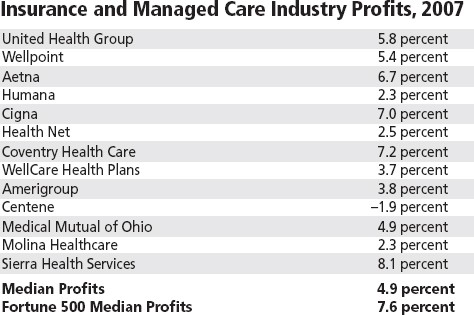
Source: Fortune Magazine, 2007: http://money.cnn.com/magazines/fortune/fortune500/2006/industries/Health_Care_Insurance_Managed_Care/1.html
Figure 4.1: Profits in the insurance industry.
It is very important to understand that, since the government funds one of every two healthcare dollars spent, and since much of the government’s spending comes from the printing press, a substantial portion of the demand for healthcare consists of money being printed — much of the credit creation by the central bank goes directly into raising healthcare costs.
Each year, as costs rise due to increased spending on healthcare, private insurance companies simply raise the costs of premiums so as to cover these increased expenditures they pay on our behalf. The more we spend, the higher are our premiums. But as prices rise, fewer people can afford premiums, and those paying premiums for others, such as employers, can’t afford to cover as many treatments.132 Just to prove that insurance companies are not simply raising their profits at our expense, as both individuals and politicians alike claim, consider their profits in Figure 4.1, which are lower than the average company. Profits — and costs — in the industry would be lower still if government did not restrict competition amongst insurance companies.
The Quality and Cost of Our Regulated Healthcare
With all this regulation and expensive healthcare, Americans receive only a mediocre quality of care. For instance, the U.S. is far from achieving the lowest world infant mortality and death rates; fatalities from incorrect healthcare treatment are the third-leading cause of death in the U.S., after heart disease and cancer; and over 225,000 people die each year from doctors’ mistakes: 12,000 deaths occur each year due to unnecessary surgery; 7,000 deaths are due to medication errors in hospitals; 20,000 deaths are due to other hospital errors; 80,000 are due to infections in hospitals; and 106,000 due to the negative effects of drugs.133
And for this level of quality, we pay about $6,000 per person each year in the United States. How is it that we are unaware that we are paying this much? We don’t see that amount subtracted from our checking accounts because individuals, on average, fund only about 20 percent of their annual healthcare costs with employers and governments paying the rest. But in truth, we all still pay the remaining amount, because all money eventually comes from individuals (or at least those who work and produce). The dollar amount of healthcare that employers pay on our behalf is in fact subtracted directly from our paychecks. Obviously, if companies did not have to pay healthcare costs, those monies would instead be paid to workers, or to machines that would increase the productivity and thus the paycheck of workers (as explained in Chapter 1). The dollar amount of healthcare that government pays for on our behalf is taken directly from our paychecks in the form of taxes and indirectly through inflation. Additionally, the Cato Institute estimates that the cost per household of medical providers’ compliance with health services regulation was $1,546 in 2002. It also estimated that roughly one out of every six uninsured persons was uninsured because of the cost of regulations.134 All of this regulation exists, yet most people still believe we have a free market in healthcare, and that that is the root of our problems.
On top of the two primary issues discussed above, doctors and hospitals are subjected to unbelievable amounts of burdensome oversight and enforcement agencies, bureaus and commissions. As Jones states: “Rules, regulations, and laws are duplicated, redundant, multiplied, magnified, and contradictory. Laws and regulations covering doctors and hospitals plus all the other parts of our healthcare system now account for over half of all the words, sentences, and paragraphs in our entire body of law.”
Socialized Medicine
Socialists want us to turn to nationalized healthcare, where the state will pay for our healthcare (as though we will not still be paying for it). But this will not work either.135 When medical care is free, people consume more of it. The costs would continually rise, as they currently do in the United States. Since national governments have limited budgets, governments with socialized medicine impose cost controls and limit spending to a particular amount. But since nothing limits individuals from going to the doctor, waiting lines grow longer and longer. At this point governments limit doctor visits or limit the types of procedures which can be done. For example a particular treatment might only be authorized given the existence of a particular set of other symptoms. Or surgery might be restricted to patients who are under a given age.
After getting sick, famed British record label owner, radio and TV presenter, nightclub owner, and journalist Tony Wilson (about whom the film 24 Hour Party People was made) faced death due to the fact that Britain’s National Health System (NHS) refused to fund an expensive cancer drug he needed to stay alive. He stated “I’ve never paid for private health care because I’m a socialist. Now I find you can get tummy tucks and cosmetic surgery on the NHS but not the drugs I need to stay alive. It is a scandal.” Wilson died not long after in 2007.136
In England’s state-run system, the waiting list is nearly 800,000 people. This is in addition to those denied medical attention: 7,000 for hip replacements; between 4,000 and 20,000 for coronary bypass surgery; 10,000 to 15,000 for cancer chemotherapy.
Even with our current screwed up system, one can get treatment if they, or their friends or charities, can pay the price. Under socialized medicine, where many are prevented by government from getting care, the socialist’s “right” to healthcare certainly goes out the window.
Additionally, in countries with socialized medicine, physicians’ and researchers’ incomes are limited, thus taking away their incentive to compete or to be innovative with new forms of technology or treatments. Such is inherently the case under a government bureaucracy.137 For these very reasons, Canada’s healthcare system has taken the first step towards privatization, due to Quebec’s lifting a ban on private health insurance. As the New York Times Stated:
The Supreme Court decision ruled that long waits for various medical procedures in the province had violated patients’ “life and personal security, inviolability and freedom,” and that prohibition of private health insurance was unconstitutional when the public health system did not deliver “reasonable services.”138
The quality of service also diminishes with reduced incentives. Soviet hospitals were characterized by widespread apathy and disregard for lives: AIDS was contracted in Russia primarily through dirty needles at state hospitals; patients had to pay bribes in order to receive minimal attention (anesthesia was often withheld until bribes were paid); patients were routinely taken from their deathbed and shoved out the door in order to improve success rate statistics; X-rays were denied in order to save the expensive film.
Socialists believe we have a “right” to healthcare. They simultaneously refuse to believe that having the right to something that is necessarily taken from others against their will constitutes theft; they believe that to associate “theft” with taxes is nutty, no matter how accurate it is in reality (see Chapter 7 for a detailed discussion). Suppose that you were one of the first settlers of this country, at Plymouth Rock, for example, where a majority of the settlers starved to death because the leaders had implemented communism.139 When the settlers were spending their day working the land with the few tools they had, exactly what healthcare did they have a right to? Did they have a right to take their neighbors bandages? Did they have a right to take their neighbor’s alcohol to poor on their wounds? Real healthcare did not exist then and there. It was later created and produced in this country. If we all believe we have a right to have as much as we want of the limited amount of healthcare available, from whom will we take it? And do we also have a right to food? The first settlers at Plymouth Rock indeed relied on each other to produce food for them, thus producing little themselves. The food was put into a common pile where everyone came to take what they wanted. Soon, the food was gone and the settlers were starving. A system based on positive “rights” leads to poverty.
Only Free Markets Can Solve the Healthcare Crisis
Every election cycle, we hear politicians talk only of cost controls, electronic medical records, and preventing lawsuits in order to solve our medical crisis. We do not hear from them discussions of the real problems of government-paid insurance and the third-party payer system, and of medical boards. Some pundits argue that technology increases medical costs. Though technology lowers costs in other industries, people think that it somehow increases costs in the healthcare industry. Indeed, Paul Krugman claims that healthcare costs rise simply “because of medical progress.”140 With these kinds of backwards notions, our “leaders” set out to implement yet more regulation and price controls, which will only exacerbate the problem.
What we need are truly free markets in healthcare, which would bring about an increased supply of doctors and healthcare facilities, and drastically lower costs. By bringing free market profits to the industry, the quality of care would improve due to providers competing to make the most money by trying to please the most consumers. Healthcare costs used to represent 5 percent of national income, now it’s 17 percent.141 Each year, due to increased demand paid for by companies and the government, a greater proportion of our incomes are funneled into healthcare expenditures, and a smaller proportion into other goods. Under free markets, healthcare prices would fall in real terms (if not also nominal terms), and the cost of staying in a hospital would approximate the costs of staying in a hotel plus the additional marginal costs of the labor services of nurses and doctors, and the costs of the use of the tools and technology. If we all paid for our own healthcare, instead of having others pay, it would be mathematically impossible for costs to be at a level above what each of us could afford; doctors and hospitals could not make as much money if they charged more than people could afford to pay. This is why we can afford things in other industries — because goods are priced at a level commensurate with our incomes. The key is to pay for our own healthcare as needed. Costs of healthcare would be affordable to everyone in the same way that food, televisions, and tools at Home Depot are; they would be just another average cost that we pay.
For those who still doubt such an argument, think seriously about whether the supposed high costs that would occur in a free market would really outweigh the costs we incur today where healthcare costs rise at two to three times the rate of inflation. And consider whether the supposed physical harm that would occur would outweigh the deaths and physical suffering that occur today due to the fact that millions can’t afford access to healthcare. Additionally, if licensing is so important in order to guarantee competent and qualified service providers, shouldn’t we, in the same vein, require all politicians to go through years of training in the areas of philosophy, history, economics (including free market economics), industrial production, accounting, and management before they are permitted to pass laws that affect the economy and our lives? Shouldn’t they be licensed?
Regulation of Local Government Services
The following posting contains an email to ABC News’ John Stossel in response to a report Stossel did on regulation. The email speaks for itself:
I own a private, non-emergency ambulance service in Northwest Arkansas. On 01/01/09, private ambulance services [were] no longer allowed to transport patients in one of the cities we have served for over 25 years. The city of Fayetteville, along with eight smaller cities, has formed an ambulance authority that [now has] exclusive rights to all emergency and non-emergency transfers within the nine cities. ...Essentially, the Fayetteville City Council has decided to eliminate any competition and charge whatever it wants. My service currently has contracts with two hospitals in Fayetteville and charges the minimum amount allowed by Medicare ($195.67 + $6.87 per mile) for any transports for these facilities. We have competed directly with the government-owned service for 25 years, and, quite frankly, run circles around them. In response, they had taxpayers pay $100,000 for a bogus study that recommended, lo and behold, that they be the only provider in town. [Now] transports in Fayetteville will cost patients $523.34 + $10.74 per mile. That is at least 2.64 times what they pay private services today. Health care facilities affected by the enormous price increase are upset, but they have made little progress in eliminating this government monopoly.142
Regulation of the Airline Industry
From the beginning of the airline industry until 1978, the Civil Aeronautics Board (CAB) controlled an artificial cartelization of the airline industry. It limited competition, kept fares far above the free-market price, and allowed politically favored airlines to obtain profitable routes. Competitors were prevented from entering the industry or literally put out of business when the CAB prevented their operations from continuing. In 1978 the government abolished the CAB and allowed airlines to more freely compete, after which, new airlines cropped up, and inefficient ones left the industry. The result was fares that were 40 percent lower, a 50 percent increase in flights, and a 112 percent increase in passenger boardings over the next 20 years.143
But in place of the CAB we now have the FAA controlling much of the industry. Instead of allowing free-market prices to dictate the cost of “slot” fees (takeoff and landing spots on runways), which would equate supply with demand, the FAA rations slots, and charges a below-the-free-market-price that causes congestion on airport runways. A free-market pricing system (whereby prices are determined based on competitors buying and selling) would raise prices during peak hours, limiting flight privileges to those who could most afford it, such as large airlines carrying business travelers. Most smaller corporate jets and delivery service jets would then not take up runway space during rush hour. The FAA, absent competition and the need for profits, has no incentive to keep traffic flowing efficiently.
Air traffic control is a monopoly run by the FAA. While the number of flights was increased through the years, the number of air traffic controllers has not kept pace. Even though private industry builds and operates the planes, the government supposes that private industry should not run traffic control services. But there is no reason why it shouldn’t. Privatized air traffic control and runway slot control would increase the number of flights per hour and reduce the overcrowding and shortages of runways, preventing planes circling for hours waiting to land (or, waiting on the tarmac — an occurrence the media blames on airlines, who are simply following FAA rules).
Another problem with airline service is that every single commercial airport in this country is owned and operated by local governments (except for two airports run by the federal government), who don’t have the incentive, or the skill, to provide the services needed for smooth operations. Worse, airport security is handled by the federal government. Is it any wonder, therefore, that we stand in line for hours sometimes to check in or to go through security? The Feds are also responsible for baggage handling. Do you think as many bags would be mishandled and lost by profit-seeking companies? More importantly, local governments don’t build enough gates, runways, and even airports to satisfy demand. Thus, airports often selectively assign a limited number of gates to politically favored airlines. In many cities, the arrival of new and competing airlines is prevented due to economically powerful airlines that hold sway over local city councils preventing gates from being made available to competitors.
Anyone who is not aware of the previous facts should still have known that the airline industry is highly regulated because they don’t’ see foreign airlines compete with domestic ones. Foreign carriers are allowed to fly into and out of a particular destination in the U.S., but not from city to city. Were Lufthansa, for example, allowed to fly from, say, Salt Lake City to Nashville, competition would intensify and prices would fall.
One reason this has not taken place, besides the fact that our government attempts to protect domestic carriers from competition, is that here again, government economists, have their feeble theories about how capital should be efficiently allocated in the industry. It is argued that due to the high fixed costs of operating, it is more efficient to allow only a few carriers manage the load. Such irrationality, or more specifically, political wrangling, probably does not need to be addressed at this point — there are many companies and would-be companies ready and willing to compete. We should let them.
With all the protection, government control, and regulation in the airline industry, taking even an hour’s flight is a stressful, exhausting, four-hour challenge. And inefficient, loss-making airlines need taxpayer bailouts every decade. We should demand of our government that it privatize the entire industry and abolish all regulation. Lines would disappear, costs would decline, quality would improve, and safety would increase.
Regulation of the Oil Industry
On the supply side, it’s simple: we don’t produce enough oil in the U.S. because the government prevents it. Because of extensive regulation, mostly environmental regulation, it is simply too expensive to explore, refine, and produce oil at a faster pace than we do currently. Additionally, the government maintains a monopoly ownership of land that has large oil deposits (for example, the government owns over 87 percent of land in Alaska). Because of environmental regulations, there has not been a new oil refinery built in the United States in more than 30 years, and the number of refiners has been cut in half in the last 15 years. Saudi Arabia has even offered to build two new refineries in the U.S., but only if “someone else obtains all the necessary environmental permits first.”144 They would produce oil for us in the U.S. but environmental laws prevent them from doing so.
America’s invasion of Iraq, a former large oil producer, has also served to reduce the world supply of oil. And to the small extent that OPEC influences oil prices, we can blame government intervention in those countries, since OPEC is comprised largely of state-owned companies. Privately competing firms in Iran or Nigeria would have no incentive to withhold oil from the market, and competition would prevent these private firms from raising prices.
American consumers are also unable to consume as much oil as they would otherwise because stiff taxes make the price artificially high. Taxes vary by state, but they comprise about 50 cents of every gallon of gas, on average. Gasoline tax is just another method of extracting money from tax payers because one of the many other forms of tax money (state & local income tax, etc.) was spent on wealth redistribution instead of roads and highways. Of course, high taxes are also used as an incentive to make us drive less, since the government does not build enough roads with all the tax money it confiscates.
On the demand side of gasoline prices, we’ve already seen in Chapter 3 that prices rise mostly because of the printing presses of world governments. While speculators are usually blamed by governments (and even economists) for dramatic price changes (especially currency collapses), they are almost always caused by the government itself. But speculators (and investors in general) cannot just run a price up for no reason. They cannot control the entire world market for oil. For every trading position they open, they must close another. Therefore, their speculation must be correct or they will suffer losses. World governments dramatically reduced their rates of printing money in 2006 and 2007. As a result of this, and the recessions that action brought about, we saw world demand, and therefore prices, collapse in 2008. Any speculators betting that prices were going to rise in mid-2008 got slaughtered by betting incorrectly. Yet no one asks why the speculators supposedly decided to suddenly drive oil prices lower. Do they no longer want to make profits?
Analogously, though OPEC and oil companies were being blamed for manipulating oil prices, no one asked why they had decided not to manipulate prices as they were falling from the mid 1980s until the late 1990s, when oil prices ended up at $12 per barrel. OPEC produces only 30 million of the 80 million barrels produced each day;145 plus, they still face consumers who will purchase less oil if prices rise too much. Not to mention that individual countries within the cartel regularly cheat on their quotas. In sum, OPEC thus has little pricing power. Along the same lines, the size of American oil companies pales in comparison to the sum of all other oil producers in the world. Therefore, it’s impossible for American firms to control oil prices. Still, a recent poll shows that 69 percent of the American people “can see the president making gasoline prices go up or down [manipulating prices].”146
It is true, however, as commonly stated, that America consumes much more energy than other countries. Yet this is a wonderful fact, not one to deplore. America’s level of oil consumption reveals the amount of capital we have in our possession and reflects the amount of goods we are able to produce. It reveals, and is the reason for, the advanced technological state of our country. It reveals that our standard of living is that much higher than most other countries.
More importantly, we should consume more, not less! We need to consume energy — mainly in the form of oil, for now — in order to advance and progress economically. There is plenty of oil in the world to do this with, and as technology advances we’ll find more. If we don’t find more, so what? Given the price of oil that will exist when oil stocks are becoming depleted, the cost of producing oil will exceed the cost of alternative fuels, and we will then switch our production to those alternatives. While socialists claim that oil companies prevent the switch from taking place now, the truth is that oil companies, or any other entrepreneurs, will use their capital to produce any type of energy that’s possible at prices consumers are willing to pay. Currently, consumers are not willing to pay two or three times as much for energy. And government subsidies aimed at making alternative energy “affordable” do the opposite. Subsidies deduct money from our wages so that they can then be used to purchase alternative energy we would not choose to pay for on our own. This destroys wealth, as well as making us pay more for energy than we have to, leaving less money for other parts of our lives. It is simply not yet economically feasible to use most alternative energies.
Therefore, let’s use oil and use a lot of it. The more we use, the more prosperous we will be. At today’s rate of world consumption, there are enough oil reserves for 40 more years. That amount will likely increase, as it always has. The only reason, besides environmentalism, that we have a mindset of needing to conserve energy is that our government(s) does not provide enough of it. If we got government out of the way and allowed the free market to produce energy, we would have an abundance of energy and at lower prices.
Hurricane Katrina
Thanks to the media and the leftists, it is now folklore that Hurricane Katrina was the reason New Orleans was flooded and partially destroyed. Few people seem to know or care to remember that hours after the hurricane passed, New Orleans was relatively calm and unscathed. It was after the hurricane that the levies broke. The levies were a crucial part of the New Orleans infrastructure — built, owned, and managed by the government. The levies had not been kept up properly for years. Had they instead been in private hands, run by a profit-seeking entity, they would have likely been newer and stronger, and capable of withstanding foreseeable stresses.147
In any case, New Orleans should not even have become a major city, but instead remained a small port. Had the government not been involved, New Orleans would not have grown to the size it was. This is because, due to hurricanes and flooding, most people would not have chosen to live there because the risk of having their property damaged or destroyed was too great. Because of the high risks, property would have been either prohibitively expensive or uninsurable all together. But instead, both state and federal governments subsidized flood insurance and other disaster insurance.148 In other words, homeowners and businesses were encouraged to build in dangerous places they otherwise wouldn’t have because the rest of the nation paid for their losses or potential losses. Now, due to problems which have arisen from this, congress is actually considering increasing the subsidies.149 Additionally, people who don’t have insurance can increasingly rely on retroactive government emergency aid money to bail them out. This is yet another example of wealth redistribution and the destruction of wealth.
Abolish All Regulation
Though there is not enough space here to list all examples of government regulation in all industries, the same types of cause-and-effect with negative outcomes explained above apply to almost every industry and government agency. Regulations related to even those areas where people strongly believe government should have sole power to keep us safe can be shown to be detrimental to our lives. For example, the FDA delays (often for decades) in approving, or prevents us from having, life-saving drugs and technologies that are available in other countries. Conversely, it approves dangerous food, drugs, and products. Free-market consumer agencies — whose success depends on getting it right — could serve the public’s interest much more effectively, with many fewer deaths involved.
Virtually all regulation is politically-based, and merely enables one group to benefit at the expense of another. Regulation does not, as most people believe, help and protect all of society. Contradictory as it may sound, only the free market can regulate the marketplace. Intense competition among multiple parties, all seeking profits, ensures that products will be as safe as possible, that prices will be as low as possible, that quality will be as high as possible, and that consumers will always have alternatives. It is laws and the court system that protect us; regulation, on the other hand, often forces citizens to deal with monopolies or other inefficient entities that lack the incentive to do the right thing. Government can’t help us, but the self-regulating free market can.

