
The Case for Discrimination
35. Compromising the Uncompromisable: Discrimination
SHOULD PEOPLE BE FREE TO DISCRIMINATE AGAINST OTHERS?1 At first glance, the only proper answer to this question would appear to be a resounding (and horrified), “No!” However, on further reflection, things are not quite so simple.
A few preliminary remarks. The liberals, who are most associated with this lofty reply in the public mind, by no means give total assent to it. Their protestations notwithstanding, they actually favor discrimination on racial2 grounds—as long as it favors the underdog vis-à-vis the “overdog.” They might not choose to accept this description, but their advocacy of affirmative action, quotas, “goals,” set-asides, preferences, norming, and all such other programs amounts to discrimination—no more, no less. They of course do this for the “best” of reasons, or at least for reasons that seem good and sufficient to them, but the same might be said of anyone at all who acts (Mises 1966). In summary, “progressives” favor discrimination on behalf of downtrodden groups as a matter of principle, and, presumably, act in this manner in their own lives.3
What of the conservatives? Nowadays, they speak out in favor of something called “color blindness” (Bolick 1996; Eastland 1996). This amounts to a restoration of the Civil Rights Act of 1964, and Martin Luther King’s dream of a society in which decisions are made on the basis of people’s characters, not the color of their skins.4 This, too, sounds nice. What could be more fair or just? Treat all people based on their merits.
But this position is also philosophically flawed. First of all, merit is merely another characteristic on the basis of which people can discriminate against each other. Because merits of different types and varieties are statistically correlated with different groupings, including racial, preferences for people on this basis are not at all distinguishable, at least in effect, from choices made with respect to race or color. If true colorblindness is the goal, allowing discrimination on the basis of merit will hardly achieve it (Gottfredson 1987, 1988; Herrnstein and Murray 1994; Levin 1997; Rushton 1988; Seligman 1992; Sowell 1975).5
Secondly, neither liberals nor conservatives are really serious about this goal, at least for the personal if not the business arena. If colorblindness is truly virtuous, and for some reason should be required by law, then why confine this compulsion to one or another aspect of our lives? Why not compel it throughout? If a person must hire employees on the basis of character or merit or on the basis of anything but skin color and must apply this criterion to firing, investing, selling, buying, and so on, then why should this basic element of morality not be applied to private life as well? Why not prohibit racial discrimination in the choice of friends, dating partners, or marriage partners? The conservatives (at least nowadays) talk a good colorblindness line, but their adherence to it is only skin deep. Even the conservatives jettison the whole perspective as applied to their whole lives.6, 7
LIBERTARIAN COMPROMISE
What, then is the Libertarian Compromise? For this position, we must make a sharp and deep distinction between the public and the private sectors not only of the economy but of the society as well. The libertarian sees an unbridgeable philosophical chasm between the government, which is necessarily based on force and compulsion, and the private sphere, which consists of voluntary interaction.8
This being the case, the compromise must come in two sections, one devoted to each of these spheres. In the private sector, the rule is not race preference to the underdog of the progressives, nor is it the colorblindness of the conservatives. Instead, it is one of completely voluntary association, where each person is “free to choose.”9 All people are or should be free to make up their own minds about how they will choose their spouses, friends and neighbors, customers, employees, employers, and other business associates. The clear implication is that the Civil Rights Act of 1964 must be repealed, as it is inconsistent with the total freedom to choose one’s associates in all spheres of life.
Some people might recoil in horror from turning the clock on race relations back to the pre-1964 period. They would object that if a majority were free to discriminate against a minority, the latter would be greatly disadvantaged. That is, if, for example, whites, were to refuse to buy from, sell to, hire, work for, invest with, for example, blacks, the latter would be unemployed, homeless, and starving.
But this position is economically erroneous. All such scenarios fail to take into account the market’s fail-safe mechanism that helps those subjected to discrimination. Consider employment. If white racists rebuffed black workers, the first effect would indeed be unemployment or lower wages for the latter group. But this situation is only temporary, a mere first stage in the mental experiment we are now considering.10 For with lower wages or greater unemployment, some whites11 would be sorely tempted to employ these blacks, because they can earn additional profits exploiting workers who are underpaid or idled.
| TABLE 1 | ||
| Marginal | ||
| Productivity | Wage | |
| Black | $10 | $10 |
| White | $10 | $10 |
Consider a two-stage numerical example. Initially, there is no racism, and white and black workers are all employed at $10 per hour (Table 1). We assume that marginal revenue product, marginal productivity, or just plain old productivity was also equal to $10 for both groups; thus we start out at a competitive equilibrium. All employers are of course seeking profits, but, because they rival for workers, wages are bid up to productivity levels and no profits are actually made.
Now, in the second stage, we introduce racism into the analysis. This means, if it means anything, that while the demand curve for white workers remains intact, that for blacks shifts to the left (Figure 1). This, in turn, implies that while white wages and employment levels remain as they were before, the number of blacks hired, and their compensation levels, falls.
FIGURE 1
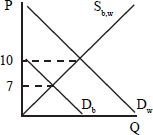
Supply and Demand for Black and White Labor
Let us suppose that it decreases to $7 per hour (Table 2). But this, clearly, is untenable and cannot endure for long. If an employer hires a white, he earns zero profit;12 in contrast, if he hires a black, he will net $3 additional per hour. Some employers, blinded by their race prejudice, will still insist on hiring only whites.13 However, in the competitive struggle, those who either have no race prejudice, or choose not to indulge in it, will hire the equally productive blacks14 at $3 per hour less. On this basis, they will be able to manufacture the product at lower cost. Then, they will either keep prices the same and pocket additional profits, or lower their prices. In either scenario, there can be only one result: The racists will be driven out of business.15
| TABLE 2 | ||
| Marginal | ||
| Productivity | Wage | |
| Black | $10 | $7 |
| White | $10 | $10 |
A similar analysis could be applied to every other arena of commercial endeavor. If blacks are not sold houses (or food, or clothing), the price they must pay will rise, making them better buyers from the point of view of lenders,16 others will jump into the breach. If blacks are not given loans, the interest they will be forced to pay will increase, rendering them better borrowers; others, blacks as well as whites, will be more than happy to “exploit” these blacks, by lending to them.17
But is this not unfair to blacks? Why should they have to endure the indignity of lower wages and unemployment (or higher prices for food, clothing shelter, loans, etc.), even if it is only temporary? One answer to this very reasonable challenge is to realize that the enemy is not the market, which is riding to the rescue of the downtrodden group (by first allowing it to suffer, and then, in effect, making this suffering the key to their economic salvation). Another perhaps better answer is that this scenario is a hypothetical construct, articulated in terms of two stages, separate in time, and mainly for heuristic purposes. That is, to clarify the process, we purposefully assume that there would be two stages; in the first, the position of blacks is worsened, to show that in the second they would be rescued. In actual point of fact, there are no such two stages. Any time the wages of blacks (or anyone else) dips below their productivity levels, even by a tiny amount, there are immediate profit incentives to hire them, which starts their wages up on an upward spiral back toward equality.18
Let us now summarize this part of our discussion. For the libertarian, there is a compromise between the conservative’s call for colorblindness and the liberals advocacy of equal representation of all groups in all possible niches of the economy. This compromise is, simply, that no one is forced to discriminate, but no one is prevented from so doing either. People are totally free to choose. There is complete freedom of association, and this applies to both the spheres of business and personal life. This is as a matter of right. As a matter of utility, the claim which emanates from this sector of the political-economic spectrum is that discrimination is impotent to do any real damage to its supposed victims. This is because any time any group is subjected to discrimination, its economic status makes its people more acceptable to others, and these others can bankrupt the discriminators.
PUBLIC SECTOR
Now let us move to the second stage of our analysis, and consider the libertarian compromise in the case of the public sector. For the libertarian anarchist, this compromise is a very simple one. Because there is no public sector at all, the question of whether it should or should not discriminate on any basis simply does not arise.
The response from the limited government libertarian is greatly simplified as well. For this position, the application of the question is very much reduced (although not completely eliminated); it no longer applies to virtually the entire economy, as at present, but instead is limited to police, armies, and courts. In this system, all people are forced to pay taxes for the upkeep and maintenance of the government; therefore, all of them should have an equal legal right to work for it in these three realms. Here, the libertarians borrow a leaf from conservatives: colorblindness and merit.19 This does not mean, however, that all racial, sexual, or other designated groups should be assigned jobs in proportion to their percentage of the population, as the liberals would have it.20 Rather, as the purpose of government in this philosophy is to maintain civil order and protect person and property, then the people who can best achieve these goals, whatever their background, should be hired for them.
AN OBJECTION21
The implication of this paper is that the Civil Rights Act of 1964 was unjust,22 was enacted to correct a problem that was not really a problem, and was, therefore, unnecessary.
But an immediate objection arises: Can we not think of this legislation as a form of reparations? After all, suppose you are a member of a minority race and a majority comes along and captures you, forcing you to work as a slave. This system lasts for hundreds of years. Then, happily, you and your people are freed. After that, you are allowed to trade and exchange freely, but virtually all of the means of production have been taken up by others; more specifically, the land ownership rights are almost totally owned by the majority. Why should you consider this allocation of property rights a legitimate starting out point for trade and exchange? Would justice not consist of the majority’s giving up some of its wealth, property, and privileges, by force if need be, so that the minority could reclaim at least some of the fair market value of what had been confiscated from them?
The starting out point, then, is crucial for the analysis of markets. If the minority were brought back to the status quo ante,23 then, perhaps, the argument might go, there would be no need for the Civil Rights Act of 1964. But, as this has not occurred, that legislation is justified, at least as a second-best policy.
The liberal-egalitarians would deny there is any need for reparations. They think that income should be equalized among all people in any case. So, there is no warrant for transferring funds to them based on considerations of the past. Suppose there were two groups of poor people, one victimized unfairly in the past, the other not. The consistent egalitarian would not wish to elevate the former over the latter; rather, he would want to bring up the income of both groups, so that it attained the level achieved by everyone else. The conservatives too would deny there is any need for reparations. Some would argue that none of the people alive in 1964, and even more certainly not at the time of this writing, were actually slaves. They are only the descendants of such people. Therefore, restitution should only be given to those who were direct victims of injustice; as there are no such people alive any longer, compensation for slavery is not justified. Others correctly see the demand for restitution as a demand for justice. However, remarkably, they either deny that there is any such thing as justice, or maintain that “the search for justice will destroy the world.”24
In contrast, the libertarian position is that amends of the income transfer variety are most certainly justified. For example, I advocated just this in a case analogous to slavery, stating (Block 1985, p. 496):
According to the [John Lockean] theory of property rights, the peasants who tilled the soil are the rightful owners of the land. The conquistadores who conquered them stole this land. Their descendants, many of the large land owners in South and Central America, thus hold unjust title to their land.25
Note that not every type of reparation is justified under libertarianism. For restitution to be proper, it must meet certain criteria. Foremost, the land or other valuable consideration must be taken away from the actual thieves or from their descendants,26 not from innocent people, or all people including the innocent. Second, the burden of proof always rests on those who would overturn extant property titles. As the lawyers say, possession is nine-tenths of the law. If redress is due, the claimant must offer proof, not mere allegation.
Unhappily for the objection we are now considering, these criteria do not apply to the Civil Rights Act of 1964 nor to any welfare scheme that transfers funds, on net balance, from whites to blacks in the modern era,27 because forcing present day whites to integrate with blacks, or to in any other way give up their right of free association, is to punish innocent people for the evil deeds of their grandparents. But in the libertarian legal code, a person can be punished only for his own rights violations. In any case, there are many whites now in the country whose grandparents were in Europe or in Asia and had absolutely nothing to do with slavery.
In sharp contrast, however, there is a strong case that can be made for the transfer of some property now owned by whites to some blacks. Had justice been attained in 1865, the slave owners would have been punished28 for the crime of slave owning.29 Certainly, their property would have been seized from them and given over to their ex-slaves, as (partial) compensation for the years of misery inflicted on them. The slave owners, unfortunately, are beyond the reach of present day justice. However, their lands, plantations, other holdings, never should have been given to their children, and, through further inheritance, to those who hold these properties at the turn of the 21st century. In justice, they should be given back, provided that specific present day blacks can prove they are the descendants of slaves who worked on precisely located land. With historical records, including notations on family Bibles, this should not prove impossible. Of course, it would have been somewhat easier to offer such proofs in 1964, because records tend to become lost as time passes.30
Levin (1982, p. 85) addresses the dichotomy these two options present, saying, “The difference between the two policies is the difference between restoring a robbery victim’s property to him, and hunting up the descendants of robbery victims and giving them goods at the expense of people who robbed no one.” Levin “has no quarrel with the former, many quarrels with the latter.”31 But we can see that he must necessarily have a quarrel with the libertarian view of reparations. The descendants of the white slaveowners robbed no one. According to Levin, it is therefore unjust to find the descendants of slaves and give them the plantations and other property on which their great-grandparents worked. However, even though the present white holders of these plantations themselves robbed no one, they never should have been given these lands in the first place, and, in justice, ought to be made to give them up in favor of the great-grandchildren who would have inherited them, had their slave ancestors been given them in 1865. These people might not have robbed anyone, but they are in effect (innocent) holders of stolen property, and must in justice be forced to disgorge them. But this holds true if and only if their rightful owners can be determined, and the burden of proof rests with the latter.32
_____________________
American Journal of Economics and Sociology 57, no. 2 (April, 1998): 223–37.
33 Discrimination occurs on the basis of race, gender, sexual preference, national origin, handicap status, baldness, citizenship, beauty, intelligence, height, weight, sense of humor, left or right handedness, and dozens of other criteria. The law singles out the first five of these for special protection, leaving the “victims” or “undesirables” in the latter categories to fend for themselves. Presumably, public choice considerations (Buchanan and Tullock 1971, 1980; Gwartney and Wagner 1988), not any intrinsic characteristics of these groups, can account for this selection bias.
34 Although we mention race alone in the text, this could stand in for any characteristic on the basis of which certain people are distinguished from others and are reacted to in different ways.
35 Or not. Many liberals champion racial integration yet live in white-only neighborhoods themselves; others favor public schools but (e.g., the Clintons) send their children to exclusive private schools.
36 Conservatives, of course, did not always pursue this policy. Once upon a time, they were in favor of discrimination—racial preferences—for the overdog, on a compulsory basis, for example, Jim Crow legislation. (At this time the liberals favored colorblindness.) Then the conservatives went through a period of advocating separate but equal separation. Only lately have the conservatives adopted the liberal democratic policies of the 1960s.
37 To be fair to the conservatives, they would be philosophically satisfied if, by adhering strictly to merit, racial disparities were to arise on a statistical basis. The explication is that conservatives see colorblindness as an end in itself, not merely as a means (e.g., to a statistically representative society), as do the liberals.
38 Were colorblindness applied to personal life, then the state, before granting a marriage license, would have to query citizens as to whether they had dated people from other races. If not, why not? If blacks are 15 percent of the population, and Jews are 3 percent, then each should intermarry with all others at about that percentage. If not, racism (e.g., non-colorblindness) is presumed to be the cause. (This is true at least if we follow the same pattern in personal life as we do for business practices). Surely, no rational commentator reflecting on this issue for one moment can deny that non-colorblindness is rife in personal relationships. If the civil rights law of 1964 is morally required, and no relevant difference between commerce and personal relations can be adduced, then it should be used to stamp out these racist patterns. If this is not a powerful reductio of the whole idea, then there is no such thing as a reductio.
39 Another “feel-good” notion is that of equality of opportunity rather than outcome. But what, precisely, does this mean? If all it means it that the government must not interfere with the free choices of individuals, it is entirely vacuous. More exactly, it means, then, no more than free enterprise, and we already have a perfectly good phrase to express that idea. On the other hand, if it means more than this, if it is applied to race or sex discrimination, it is a positive evil. This can be shown by subjecting it to the personal life test. To wit, equality of opportunity must mean that, for example, heterosexuals must date others of their own gender (we’ve got to give these people an equal opportunity to marry us, after all). Similarly, homosexuals must be forced—this is the law, after all—to date members of the opposite sex. As well, whites and blacks must be forced to date one another. None of these three groups need marry each other (that requirement can be deduced from a law prohibiting discrimination in marriage, not from “equality of opportunity, not of outcome”), which would be to compel equality of outcome, not merely opportunity. Nevertheless, it is entirely noxious, at least for the libertarian, to force people to do anything against their wills (apart from requiring them to keep their hands to themselves, of course).
40 From this fact, the anarcho-libertarians (Benson 1989, 1990; Friedman 1989; Hoppe 1989, 1992; Rothbard 1973, 1982) draw the conclusion that government must be banned totally, root and branch. In contrast, the minarchist libertarians (Epstein 1985; Nozick 1974) deduce that “government is best which governs least.” Arguing from the premise that a certain minimal amount of coercion is necessary for the functioning of society, this latter group maintains that if force cannot be eliminated, at least the state should be limited to the basic tasks of protection of person and property, for which government, courts, armies, and police are needed, and nothing much else.
41 The title of Friedman’s 1981 work.
42 For an economic analysis of discrimination, see the works of Becker (1957); Block (1982a, 1982b, 1992); Block and Williams (1981); Demsetz (1965); Higgs (1977); and Sowell (1975, 1981a, 1981b, 1994).
43 Also, blacks with savings who were on the margin of being an employer or an employee, plus those blacks who were already employers.
44 We assume the employer can just stay in business, even with zero profit, because, by assumption, the employer still can do just as well as the next best alternative, say, working for someone else, and investing his or her capital in another business.
45 We assume away as a complication that does not affect the main line of analysis the possibility that customers or other employees object to being served by, or working next to, blacks. On this see Becker’s (1957) work.
46 If blacks are not equally productive, then that will account for their lower wages, not discriminatory behavior on the part of their employers, as we have been assuming.
47 This is according to the old saw that there is a sucker born every minute. This may well apply to racists too, that there is a racist born every minute. If so, racism will always exist, even though the market continually weeds them out. This is one answer to the question of why racism still exists if these beneficial effects of the market are really operational. The other reply is that full free enterprise—laissez-faire capitalism—does not now apply. Instead, the government interferes in all sorts of ways, the effect of which is harming blacks, for example, the minimum wage law, unionism, laws compelling union rates of pay, and so on. On this see the work of Williams (1982).
48 We here implicitly assume that the costs of servicing these two groups (pilferage rates, etc.) are equal. If they are not, then this factor, not racism, would account for the longevity of differential prices.
49 We here implicitly assume that the likelihood of paying back the debt is invariant between white and black. If it is not, then this factor, not racism, would account for the longevity of differential rates of interest.
50 Why, then, do wages of blacks lag behind those of whites, and females behind males? It is because, contrary to our assumption in the text, productivities are not at all equal. In the case of racial differences, several theories account for the gap—the history of slavery, the Jim Crow law and other incidences of statist repression, and lower IQ (Herrnstein and Murray 1994, where they control for this variable and find that the pay gap has all but disappeared). In the case of differences between the sexes, empirical research suggests the differences are due to differences in marital status: Marriage lowers female productivity in the market and raises that of males. See the work of Block (1982a), Block and Williams (1981), Levin (1984, 1987), and Sowell (1975), which show that when marriage is factored out of the equation and the wages of never-married males and females are compared, there is virtually no wage gap.
51 The only exception is if skin color or gender are relevant to doing the job. For example, if the police want to infiltrate, for example, a black gang or the Mafia, then they must use, say, blacks or Italians. Obviously, to prevent female prostitution, female decoys would have to be used. (However, because prostitution would be legal in the libertarian society, this is a moot point.)
52 The liberals claim that a logical implication of total non-discrimination would be a proportional share of all jobs, housing locations, income, wealth, etc., to all racial, ethnic, sexual, etc., groups. That is, if blacks are 15 percent of the population and women are 51 percent of the population, then blacks should comprise 15 percent and women should comprise 51 percent of all professors, doctors, merchants, actors, and so on. For a critique of this view, see the works of Sowell (1975, 1981a, 1994). Interestingly enough, the liberals never apply this theory to high-status and high-paying occupations in which blacks are statistically overrepresented (e.g., the National Basketball Association, the National Football League, etc.).
53 I wish to thank Laurence Moss for forcibly bringing to my attention the importance of addressing this issue, and, as well, for the form of this objection, which is based, almost verbatim, on his words.
54 Support for this contention is given by Levin (1982, p. 85), who analyzes the situation of “giving someone a job he was denied because he was discriminated against” as follows:
This is current policy, as reflected in the Civil Rights Act’s ban on racial discrimination in employment. … It is, however, arguable that employers do not owe anyone jobs. An employer, on this argument, is choosing whom to give his job to, and is entitled to choose on criteria that most people would find objectionable. His right to liberty overrides his obligation not to indulge prejudice. If so, the Civil Rights Act curtails freedom impermissibly.
55 This is impossible, strictly speaking. But if they were at least compensated by a good faith effort.
56 This was Milton Friedman’s recitation of a favorite saying of his “old teacher” Frank Knight. Friedman (1985, p. 498) interpreted Knight as saying: “Justice is in the eye of the beholder,” and went on to assert on his own account in 1982 that
there are no really objective standards of justice. And there’s no way other than force, ultimately, of mediating different claims of justice. It’s a search for justice that animates Khomeini’s Iran today. … So, I believe that it is very dangerous to base any judgment of social policy upon the objective of searching for justice.
57 My response (Block 1985, p. 498) to Friedman was to
take the latifundi in the Third World where, as far as I am concerned, the historical facts show that it was the conquistadores who, at one time, took over the land, kicked the peasants off, or allowed the peasants to stay there, but claimed ownership of it. And, on the other hand, you have a bunch of peasants who had, according to the Lockean theory, been the true owners of it. Now, if you say that there is no such thing as justice, and we must couch everything in terms of what is, then clearly the people who are working as peons there have no right to take over the land which I contend should really belong to them.
58 David Friedman (1985, pp. 501–02, 505) makes the following response to me:
The point where I would want to agree with my father [Milton Friedman] … against Walter Block or at least make an argument on [the side of the latter], goes back to the latifundi. It seems to me entirely possible . . . that as a matter of abstract justice, if I were a judge in a court, I would agree that the peasants were in the right. But second, that it would be better for the world, including the peasants, if they forget about the past. Fighting over their claims to justice will get people killed. There is no particular reason to think that the most just people will win the war. Fighting tends to create unjust situations. So, it seems to me quite plausible to argue both that here is an abstract principle of justice, which in principle could be applied; and that as a matter of practical, social reality we accept what is and work from there.
If by “justice” we are concerned with initial ownership of things, I think in the long run that isn’t enormously important. In the U.S. at the moment, if you gave the country back to the Indians, in some fair way where you didn’t give them the buildings that are built on it, but just the land; and divided it fairly evenly among the Indians, it would not noticeably affect the distribution of income in the U.S. It wouldn’t much affect how well off I am, and so forth.
Starting with either a “just” or an “unjust” distribution of property, in a generation or two you end up in not very different circumstances, except in very extreme cases.
59 Here is my response to David Friedman (Block 1985, pp. 505–06):
Milton and I were distinguishing ourselves on a “normative” question. David replied in a “positive” vein, with which I happen to be in full agreement. That is, I agree that the Indians or the natives would probably be better off if instead of worrying about their lost endowments of property, they were just concerned with creating a libertarian society from hence forward.
60 My point is still worth making:
Those people owned that property. … Here we are supposed to be defenders of property rights; and yet, grant me the facts of the case, massive theft has taken place; and we’re giving … a positive statement with which I happen to agree: that this stolen property is economically unimportant. But I think it’s very inadequate to (make) that positive statement. What we have to make is the normative statement, too. Both. We have to say, “Yes, in justice, that property belongs to you.” Namely, the free market advocate is not just in favor of the status quo, where blatant theft has taken place.
61 I conclude from all of this that the starting point might be crucial to the descendants of black slaves, or it might not. That is merely an empirical issue. The far more important point is that they have a right to start out as fairly as possible. Fighting, in any case, is not really an issue here. In answering this question, I am implicitly considering a historical state of affairs alternative to the one which brought us the Civil Rights Act of 1964. In it, reparations based on the libertarian code would have been made instead.
62 If my great-grandfather stole something from yours, and then I inherited it, my claim to it is no more justified than his. Because his claim was improper, so is mine. If you sue me for the property, then libertarian justice would require that I turn it over to you. I cannot be imprisoned, because I did not do the initial stealing. I am, in this case, akin to the innocent holder of stolen goods; I cannot keep them, but I am not guilty of theft.
63 Levin (1977) rejects compensation to blacks from whites on grounds very different from those of our discussion.
64 The implication of the libertarian theory of reparations, thus, is that the further back in history the initial injustice occurred, the more difficult it is to justify such acts, because in addition to the fact that the passage of time causes records to deteriorate, the further back one goes, the less likely it was that written records were kept. For both these reasons, restitution based on theft from Japanese-Americans during World War II would be far easier to make than restitution for crimes that occurred 2000 years ago in the Middle East. Similarly, it would be easier to give justice to American blacks than to Native Americans.
- 1Philip Blumstein and Pepper Schwartz, American Couples: Money, Work, Sex (New York: William Morrow, 1983).
- 2See lewrockwell.com.
- 3See lewrockwell.com.
- 4“The Evil of Term Limits,” lewrockwell.com.
- 5See Hans-Hermann Hoppe, Democracy—The God That Failed: The Economics and Politics of Monarchy, Democracy, and the Natural Order (New Brunswick, N.J.: Transaction, 2001).
- 6See, e.g., Thomas Sowell, Race and Culture: A Worldview (New York: Basic Books, 1994).
- 7James Buchanan, Cost & Choice (Chicago: Markham Publishing, 1969), especially pp. 47–48; G.F. Thirlby, “Subjective Theory of Value and Accounting Cost,” Economica 13 (February 1946): 32–49; Ludwig von Mises, Human Action, 3rd ed. (Chicago: Regnery, 1963), pp. 242, 395.
- 8A female/male income ratio of 485 can be derived from Income Distributions by Size in Canada, 1979, Statistics Canada, Catalogue 13-207 (Ottawa: Statistics Canada, 1979), p. 99.
- 9Ratna Ray, Women in the Labour Force: Facts and Figures, Catalogue L 38-30/1977-2 (Ottawa: Department of Labour, Women’s Bureau, 1977), page i. Other economic studies of interest in this regard include Alan S. Blinder, “Wage Discrimination: Reduced Form and Structural Estimates,” Journal of Human Resources 8 (1973): 436–55; Morley Gunderson “Male-Female Wage Differentials and the Impact of Equal Pay Legislation,” Review of Economics and Statistics 57 (1975): 462–70; Morley Gunderson, “Work Patterns,” in Opportunity for Choice: A Goal for Women in Canada, ed. G. Cook (Ottawa: Statistics Canada, 1976).
- 10The average age of all employed Canadian men was 37 years in 1980. This placed the typical man in the highest male earnings age bracket (35–44 years old). The average age of all employed Canadian women was 34 years in 1980. This placed the typical woman in the fourth highest male earnings age bracket (25–34 years old). See The Labour Force, Statistics Canada, Catalogue 71-001, (Ottawa: Statistics Canada, 1980), page 75; and Income Distributions by Size in Canada, 1979, Statistics Canada, Catalogue 13-207 (Ottawa: Statistics Canada, 1979), pp. 104–09.
- 11Occupational segregation such as shown in the table below cannot properly be interpreted as the result of employer discrimination. After all, the employer cannot hire a nurse as a doctor, nor a person with secretarial training as an engineer or accountant.
- 12In 1978, the percentage of female Canadian union members was 28.7 percent; males comprised 71.3 percent of the membership. Source: Corporations & Labour Unions Returns Act, Part II, Labour Unions, Statistics Canada, Catalogue 71-202, p. 41. On the question of male/female productivity differentials, see Jacob Mincer and Solomon Polachek, “Family Investments in Human Capital: Earnings of Women,” Journal of Political Economy 82, no. 2, part 2 (March 1974): 76–108.
- 13In 1980, 94.1 percent of employed Canadian males worked full time, 5.9 percent worked part time; 76.2 percent of employed Canadian females worked full time, 23.8 percent worked part time. In 1979, 72.9 percent of employed Canadian males worked 50–52 weeks, 27.1 percent worked 1–49 weeks; 60.1 percent of Canadian females worked 50–52 weeks, 39.9 percent worked 1–49 weeks. Source: The Labour Force, Statistics Canada, December 1980, p. 105, Catalogue 71-001; Income Distributions by Size in Canada, 1979, Statistics Canada, Catalogue 13-207, p. 112.
- 14These figures are derived from computations based on data cited for elementary school teachers’ earnings and percentages of teachers by sex: Salaries and Qualifications of Teachers in Public, Elementary & Secondary Schools, 1979–80, Statistics Canada, Catalogue 81-202, p. 25; university teachers’ earnings and percentages of university teachers by sex: Teachers in Universities, 1978–1979, Statistics Canada, Catalogue 81–241, p. 57. Note that while we have corrected the female/male income ratio for several phenomena not related to discrimination, a still more accurate assessment would have to normalize for all of these variables, together, and include other variables such as continuity of employment, earned degrees, labor force participation, location, industrial concentration, public or private employment, productivity, seniority, as well as such imponderables as motivation, “stick-to-it-iveness,” resourcefulness, ambition, expectations, etc.
- 15Thomas Sowell, Affirmative Action: Reconsidered (Washington, D.C.: American Enterprise Institute, 1975), pp. 23–34.
- 16Jesse Bernard, Academic Women (University Park: Pennsylvania State Univ. Press, 1964), pp. 220–26; Jesse Bernard, The Future of Motherhood (New York: Penguin Books, 1974), pp. 165–70; Bryan and Boring, American Psychologist 2 (January 1947): 18; Lee Rainwater, And the Poor Get Children (Chicago: Quadrangle Books, 1960), pp. 67–69; Wayne R. Bartz and Richard A. Rasor, Surviving With Kids (San Luis Obispo, Calif.: Impact, 1978), p. 147; Martin Meissner, “Sexual Division of Labour and Inequality: Labour and Leisure,” in Women in Canada, pp. 166–74; Nancy Chodorow, “Being and Doing: A Cross Cultural Examination of the Socialization of Males and Females,” in Women in Sexist Society, ed. Vivian Gornick and Barbara K. Moran (New York: Basic Books, 1971), pp. 183–84; Roslyn S. Willett, “Working in ‘A Man’s World’: The Woman Executive,” in Women in Sexist Society, p. 368; Jean Tepperman, “Two Jobs: Women Who Work in Factories,” in Sisterhood is Powerful, ed. Robin Morgan (New York: Random House, 1970), pp. 115, 121.
- 17Gail C.A. Cook, “Opportunity for Choice: A Criterion,” in Opportunity for Choice: A Goal for Women in Canada, ed. Gail C.A. Cook (Ottawa: Statistics Canada and C.D. Howe Research Institute), Catalogue IC 23-15/1976, p. 4; Gail C.A. Cook and Mary Eberts, “Policies Affecting Work,” in Opportunity for Choice, p. 145; Richard A. Lester, Antibias Regulations of Universities (New York: McGraw-Hill, 1974), p. 39; Willett, “Working in ‘A Man’s World’,” p. 368; Pat Mainardi, “The Politics of Housework,” in Sisterhood Is Powerful, pp. 447–54; Jesse Bernard, The Future of Motherhood, pp. 157–65; Kathryn E. Walker, “Time Used by Husbands for Household Work,” Family Economics Review (June 1970): 8–10; M. Meisner, E.W. Humphries, S.M. Meis, and W.J. Scheu, “No Exit for Wives: Sexual Division of Labour and the Cumulation of Household Demands,” Canadian Review of Sociology and Anthropology 12 (1975): 424–39.
- 18Barbara B. Reagan, “Two Supply Curves for Economists? Implications of Mobility and Career Attachment of Women,” American Economic Review 65, no. 2 (1975): 102; Jacquelyn S. Crawford, Women in Middle Management (Ridgewood, N.J.: Forkner, 1977), p. 63.
- 19E.W. Burgess and Paul Wallin, Engagement and Marriage (New York: Lippincott, 1953), pp. 614, 618; and Reagan, “Two Supply Curves,” p. 104. See also Beth Neimi, “The Female-Male Differential in Unemployment Rates,” Industrial and Labour Relations Review 27, no. 3 (April 1974): 331–50.
- 20Alan E. Bayer, “Marriage Plans and Educational Aspirations,” American Journal of Sociology 75 (1969): 239–44; Reagan, “Two Supply Curves,” p. 103; Bernard, The Future of Motherhood, pp. 91, 151, 181; Jean Tepperman, “Two Jobs,” p. 123; Betty Friedan, The Feminine Mystique (New York: Dell, 1974), p. 31; Meg Luxton, More Than a Labour of Love: Three Generations of Women’s Work in the Home (Toronto: Women’s Educational Press, 1980), p. 16; Margaret Luxton, “Urban Communes and Co-ops in Toronto,” (M. Phil. dissertation, University of Toronto, 1973), cited in Luxton, More Than a Labour of Love; Ann Oakley, Women’s Work: The Housewife Past and Present (New York: Vintage Books, 1976); Eli Zaretsky, Capitalism, The Family, and Personal Life (New York: Harper & Row, 1976), p. 17; Simone de Beauvoir, The Second Sex (New York: Vintage Books, 1974), p. 482.
- 21Let us imagine an experiment. We offer a large number of employed married couples the following option: jobs in city A, where the husband will earn $200,000 per year and the wife $150,000, or in city B, where the wife will earn $200,000 per year, and the husband $150,000. (The type of employment and the amenities of the cities are assumed to be identical in each case.) How many of the husbands would prefer city B? How many wives would prefer city A? Although there is only casual evidence on this, since such an experiment has not yet been done, one may speculate that there will be more wives who will prefer city A than there will be husbands who will prefer city B. The motivations behind these choices may vary. Some husbands may feel “less of a man” if their wives earn more than they do; others may feel it is just “not fitting” that their incomes should be lower; some wives may feel less damaged psychologically from earning less than their spouses; others may subscribe to the societal pressures which teach, at a young age, that “nice girls don’t outcompete boys.” But whatever the reason, there is abundant anecdotal evidence that many women have great psychological and other personal difficulties in competing with men, and are thus, when married, more likely than men to purposefully keep their earnings below those of their spouses—with important implications for the low female/male earnings ratios for married people.
- 22Unfortunately, only the “married” and “total” columns are widely published in official Canadian Statistics. To say the least, this gives rather a biased account of the true state of the female/male earnings ratio, and its basic cause (marital status and its widely diverging effects on male and female earnings).
- 23Not only does marriage have asymmetrical effects on earnings by sex, but it is reasonable to believe that so does “living together” or “cohabitation”—and for similar reasons. Moreover, this category has become more statistically significant in recent years, though actual data are lacking. Table 3, in distinguishing between the ever married and the never married, cannot separate those who have ever lived together—whether married or unmarried—from those who have never lived together. If cohabitation as well as ever-married status could be controlled for, one would thus expect the female/male ratio to be higher than 992. There is also, however, a reason for believing that 992 may be somewhat of an overestimate of the “true” female/male earnings ratio: never-married females are older than never-married males (46.2 years vs. 43.7 years old), have more schooling (10.9 vs. 9.3 years), work more weeks (45.6 vs. 42.3 weeks), and work on a part-time basis to a lesser degree (10.6 percent vs. 11.8 percent). (All figures based on calculations made from data presented by Kuch and Haessel; see Table 3 for full citation.)
- 24Some may argue that private discriminatory behavior is immoral and ought to be prohibited by force of law. Others may hold that, while discrimination is a negative characteristic, each individual is nevertheless entitled to make whatever decision suits his conscience—whether in commercial dealings, employment practices, housing decisions, or personal relations—provided only that he not commit fraud upon, or initiate aggression against, minority group members. Whatever the solution to this philosophical question, both sides may perhaps take comfort from one of the findings in Block and Walker, Discrimination, Affirmative Action, and Equal Opportunity: the tendency of the marketplace to financially penalize those who indulge in discriminatory practices, and thus to reduce, over time, the scope of this activity.
- 25There would appear to be numerous criteria upon which discrimination has, or is alleged to have, taken place, and upon which quotas, affirmative action, or preferential treatment are now demanded. Some of the grounds include (1) obesity: see “Obese Are Victims of Bias: Professor,” Toronto Globe & Mail (August 5, 1980), p. 13; (2) blindness: see “Group for Blind Suggests Job Quota,” Toronto Globe & Mail (August 2l, 1980), p. 1, and “Blind Woman and Guide Dog Win Rights Fight,” Vancouver Sun (August 18, 1980), p. 8; (3) residence: see “Stop Provinces Reserving Jobs for Residents, Rights Chief Says,” Toronto Globe & Mail (June 4, 1980), p. 10; (4) “reverse” discrimination: see “Barring White in Native Class Is Ruled Illegal,” Toronto Globe & Mail (February 13, 1980), which tells of an Alberta Human Rights Commission finding against the University of Calgary for discriminating against a non-Indian woman by denying her admission to a special course specifically set up for native peoples; (5) ugliness: see “More to an Interview than Meets the Eye,” Toronto Globe & Mail (July 19, 1980), p. F3, which shows that persons of “unattractive appearance” (and even sometimes persons of beauty) are discriminated against in hiring practices; (6) political beliefs: see “They’re Biting the Hand that Won’t Feed Them,” Toronto Globe & Mail (August 9, 1980), p. 8, which tells of a Prince Edward Island Provincial Human Rights Commission finding that a public employee had been wrongfully dismissed for his political beliefs; (7) hirsuteness: see “Supreme Court Refuses a Motion to Force Grocery Clerk to Shave,” Toronto Globe & Mail (February 10, 1980), which tells of a Winnipeg employer who could not legally compel his grocery clerk to either shave his beard, work nights “out of the sight of customers,” or fire him.
- 26The situation with regard to discriminatory practices on the part of the government is a unique matter. It cannot be argued, as it could in the private case, that, no matter how morally reprehensible discrimination is, at least in the market sector it is done by an individual in his own name and with his own money.
- 27Although many people interpret prejudice or discriminatory behavior as a willingness to engage in physical aggression against a despised person or group, this interpretation is about as far away as it is possible to get from a clear understanding. On the contrary, a sharp distinction must be made between refusing to interact at all with a person, and threatening physical abuse against him. The former is all that is done by a hermit, although on a larger scale; and if it is no crime to refuse to deal with all of humanity, then it might be argued that it can scarcely be a rights violation to avoid dealing with only some people.
- 28Ludwig von Mises, Human Action, p. 109.
- 29Toronto Globe & Mail (April 14, 1980), p. 6. See also Toronto Globe & Mail (January 25, 1980).
- 30See “Drea Tells Firm to Stop Questions” and the editorial “Wearing Nothing but a Seat Belt,” both in Toronto Globe & Mail (July 31, 1980), pp. 5, 6.
- 31These agencies include the Federal Reserve Board, the Comptroller of the Currency, the Federal Deposit Insurance Corp., the Federal Home Loan Bank Board, and the National Credit Union Administration.
- 32Wall Street Journal (June 22, 1978). On age bias, see also Toronto Globe & Mail (February 18, 1980), p. 5.
- 33Most women, on the other hand, even executives, do not consider housework demeaning.
- 34In the first of these columns, “A Silver Lining in Drug Prohibition,” I noted that real criminals who might not otherwise be caught are sometimes jailed for engaging in the drug trade, which they have every right to do. But fewer murderers and rapists at large is surely a good thing. In the second of these columns, “A Silver Lining in Unjust Executions,” I observed that those executed for murders for which they are innocent (a travesty of justice if ever there was one) were sometimes guilty of committing other capital crimes for which they were not charged. Thus, a critique of the death penalty was not as powerful as otherwise thought. In the third, I tried to clarify my position on this issue vis-à-vis several objections that had been made of it.
- 35In the first of these columns, “A Silver Lining in Drug Prohibition,” I noted that real criminals who might not otherwise be caught are sometimes jailed for engaging in the drug trade, which they have every right to do. But fewer murderers and rapists at large is surely a good thing. In the second of these columns, “A Silver Lining in Unjust Executions,” I observed that those executed for murders for which they are innocent (a travesty of justice if ever there was one) were sometimes guilty of committing other capital crimes for which they were not charged. Thus, a critique of the death penalty was not as powerful as otherwise thought. In the third, I tried to clarify my position on this issue vis-à-vis several objections that had been made of it.
- 36In order for there to be a silver lining, there has to be an evil, and, also, some good must come out of it. I am already on record in taking the position that term limits are highly problematic. I did so on grounds blazed by Professor Hans Hoppe. His argument is based on time preference: other things equal, the longer a politician is in office, the more of a long-run viewpoint he can afford to take. If he can leave the office to his children (e.g., a monarchy), he will act even more responsibly; he doesn’t want to kill the golden goose, otherwise there will be nothing left for his progeny to exploit.
- 37In order for there to be a silver lining, there has to be an evil, and, also, some good must come out of it. I am already on record in taking the position that term limits are highly problematic. I did so on grounds blazed by Professor Hans Hoppe. His argument is based on time preference: other things equal, the longer a politician is in office, the more of a long-run viewpoint he can afford to take. If he can leave the office to his children (e.g., a monarchy), he will act even more responsibly; he doesn’t want to kill the golden goose, otherwise there will be nothing left for his progeny to exploit.
- 38There is no one who has done more to combat this pernicious fallacy than Tom Sowell. But he needs all the help he can get on this mission. It is incumbent upon all men of good will to help him in this regard. And one way that we can do so is to recognize one of the side order benefits of that otherwise insidious policy of term limits: that it disproportionately penalizes female politicians.
- 39Another difficulty is that “equal opportunity” is a subjective, not an objective, phenomenon. Women do not come equipped with a little tag which indicates their productivity, once and for all, in a manner from which no dissent is possible. (Nor, of course, do men.) Productivity, rather, is a continually changing phenomenon which varies with, for example, education, intelligence, age, experience, presence or absence of complementary factors of production, which can only be partially quantified, as well as with such factors as motivation and determination, which are completely incapable of exact measurement.
- 40This is not to say it is completely implausible to support the position that EPFEW laws are required. There is ample evidence to suggest that male and female compensation and promotion rates differ. For example, the overall female/male wage ratio for all employees in Canada was 485 in 1979. That is, females, on average, earned only 48.5 percent as much as males. The question is whether or not this reflects an inherent problem in the labor market. The proponents of EPFEW apparently think so. But it is an error to conclude, from such information, that the state of affairs is a result of conscious and hostile human design (i.e., employer discrimination against women), that this is disgraceful and unfair, and that therefore a determined effort on the part of government is required to “right these wrongs.” Consider, in this regard, the statement of no less an authority than Dr. Ratna Ray, Director, Women’s Bureau, Labour Canada:
- 41Economic self-sufficiency for women? “We’ve only just begun!” Despite sporadic progress, there’s a long way to go. Canadian employers, economic planners, and decision-makers should take a long hard look at these figures. Because they tell a shocking story, a story of shortsightedness and languorous efforts towards the utilization of human resources in the workforce. Our publication comes hard on the heels of the National Council of Welfare’s report Women and Poverty which concludes that “After fifty years or so of unpaid, faithful service a woman’s only reward is likely to be poverty.”
- 42Men and women differ in a wide range of economic, educational, and sociological characteristics, each of which exerts an independent effect, raising expected male incomes and reducing expected female incomes. For example, working men tend to be older than women, more highly concentrated in the higher-paying professions, more heavily unionized in the highly skilled and legislatively protected blue-collar industries, and tend to work, to a greater degree, on a full-time, full-year basis.
- 43Men and women differ in a wide range of economic, educational, and sociological characteristics, each of which exerts an independent effect, raising expected male incomes and reducing expected female incomes. For example, working men tend to be older than women, more highly concentrated in the higher-paying professions, more heavily unionized in the highly skilled and legislatively protected blue-collar industries, and tend to work, to a greater degree, on a full-time, full-year basis.
- 44Men and women differ in a wide range of economic, educational, and sociological characteristics, each of which exerts an independent effect, raising expected male incomes and reducing expected female incomes. For example, working men tend to be older than women, more highly concentrated in the higher-paying professions, more heavily unionized in the highly skilled and legislatively protected blue-collar industries, and tend to work, to a greater degree, on a full-time, full-year basis.
- 45Men and women differ in a wide range of economic, educational, and sociological characteristics, each of which exerts an independent effect, raising expected male incomes and reducing expected female incomes. For example, working men tend to be older than women, more highly concentrated in the higher-paying professions, more heavily unionized in the highly skilled and legislatively protected blue-collar industries, and tend to work, to a greater degree, on a full-time, full-year basis.
- 46Not unexpectedly, when female/male income comparisons have been corrected for these factors, the ratio tends to rise. If working women are assumed to retain their own income levels, but to take on the same age pattern as working men, the female/male income ratio rises from 485 to 521; if we assume that females are divided among elementary and university teaching in the same manner as males, the ratio increases from 743 to 814; if the female/male income ratio is corrected in a similar manner for full-year or part-year status, it increases from 528 to 575. See Table l.
- 47As important as these variables are, the strongest determinant of the so-called male/female earnings “gap” is none of these things. Rather, it is marital status, and the asymmetric effects of marriage on male and female earnings. That is, marriage increases male earnings, and reduces female earnings.
- 48This occurs for many reasons. Wives, to a greater degree than husbands, take on a higher and disproportionate share of child care and the housework and homemaker tasks. They are more likely to quit their jobs if their partner receives a better job elsewhere, to interrupt their careers for domestic reasons, to place their homes and families ahead of their jobs or professions, and even to purposefully attempt to keep their earnings below that of their spouses. It is impossible to quantify the effects of such phenomena in driving a wedge between married male and female incomes, but there is little doubt that they are important.
- 49This occurs for many reasons. Wives, to a greater degree than husbands, take on a higher and disproportionate share of child care and the housework and homemaker tasks. They are more likely to quit their jobs if their partner receives a better job elsewhere, to interrupt their careers for domestic reasons, to place their homes and families ahead of their jobs or professions, and even to purposefully attempt to keep their earnings below that of their spouses. It is impossible to quantify the effects of such phenomena in driving a wedge between married male and female incomes, but there is little doubt that they are important.
- 50This occurs for many reasons. Wives, to a greater degree than husbands, take on a higher and disproportionate share of child care and the housework and homemaker tasks. They are more likely to quit their jobs if their partner receives a better job elsewhere, to interrupt their careers for domestic reasons, to place their homes and families ahead of their jobs or professions, and even to purposefully attempt to keep their earnings below that of their spouses. It is impossible to quantify the effects of such phenomena in driving a wedge between married male and female incomes, but there is little doubt that they are important.
- 51This occurs for many reasons. Wives, to a greater degree than husbands, take on a higher and disproportionate share of child care and the housework and homemaker tasks. They are more likely to quit their jobs if their partner receives a better job elsewhere, to interrupt their careers for domestic reasons, to place their homes and families ahead of their jobs or professions, and even to purposefully attempt to keep their earnings below that of their spouses. It is impossible to quantify the effects of such phenomena in driving a wedge between married male and female incomes, but there is little doubt that they are important.
- 52This occurs for many reasons. Wives, to a greater degree than husbands, take on a higher and disproportionate share of child care and the housework and homemaker tasks. They are more likely to quit their jobs if their partner receives a better job elsewhere, to interrupt their careers for domestic reasons, to place their homes and families ahead of their jobs or professions, and even to purposefully attempt to keep their earnings below that of their spouses. It is impossible to quantify the effects of such phenomena in driving a wedge between married male and female incomes, but there is little doubt that they are important.
- 53This occurs for many reasons. Wives, to a greater degree than husbands, take on a higher and disproportionate share of child care and the housework and homemaker tasks. They are more likely to quit their jobs if their partner receives a better job elsewhere, to interrupt their careers for domestic reasons, to place their homes and families ahead of their jobs or professions, and even to purposefully attempt to keep their earnings below that of their spouses. It is impossible to quantify the effects of such phenomena in driving a wedge between married male and female incomes, but there is little doubt that they are important.
- 54() Married and Total figures are published in each year’s Income Distribution by Size (Statistics Canada, Catalogue 13-207). Single and Other averages are from unpublished tables. Survey of Consumer Finances, Statistics Canada.
- 55In order to remedy this situation, we turn to Table 3, which includes only wages and salaries and specifically excludes all other income. As a test of the hypothesis that marital status has widely asymmetrical effects on earnings by sex, Table 3 is an improvement over Table 2 in yet another way: it collapses the categories of “married” and “other” into “ever-married,” which, as the name implies, includes all people who were ever-married, regardless of the marital status they now occupy. That is, it compares people presently married, divorced, widowed, or separated, with those who were never married in their entire lives. Table 3 thus furnishes a comparison of people who have been touched in some way by the institution of marriage with those who have not.
- 56Given the great difficulties, social costs, and unintended negative consequences of proportional representation requirements, quotas, and other similar prescriptions based on retrospective results, and given the market’s ability to reduce discriminatory behavior—in the absence of legislation which retards this process—a case is made, throughout this book, against the employment of affirmative action programs in the private sector. We also noted above that the incentive system operating in the private sector may not work in the public sector. Accordingly, we must now assess the case for equal opportunity programs (based on quotas and proportional representation) in the field of public employment.
- 57Discrimination in the public sector, moreover, is considered unjust and immoral by many. The funds which pay for government employment come from all citizens—including minority members. For anyone to be excluded from a public job because of race, sex, national origin, sexual preference, skin color, or any other such criteria, after being forced to pay for this very same unemployment through coercive taxes, is nothing more than a cleverly disguised, but particularly insidious, form of exploitation.
- 58Discrimination in the public sector, moreover, is considered unjust and immoral by many. The funds which pay for government employment come from all citizens—including minority members. For anyone to be excluded from a public job because of race, sex, national origin, sexual preference, skin color, or any other such criteria, after being forced to pay for this very same unemployment through coercive taxes, is nothing more than a cleverly disguised, but particularly insidious, form of exploitation.
- 59The difficulty is that quotas are unjust. The beneficiaries (in those rare cases where someone actually benefits) are the wrong people: the 18- to 21-year-olds, applying for their first jobs, who never bore the brunt of past employment discrimination, by definition. The real victims are those who would have liked to have been police officers, firefighters, letter carriers, and civil servants in the past but were not even considered, even though fully qualified, because of their race or sex. But these people, for the most part, are already either settled in their present jobs or retired from the labor force. If anything, monetary settlements might seem a preferable alternative.
- 60Insurance is an industry dedicated to pooling and spreading risk. While health, injury, or sickness of any one person is beyond prediction, actuarial tables have been established for the probability of such occurrences in the aggregate. Because of this, insurance companies can charge premiums to large numbers of people and underwrite the costs of the unfortunate few; all customers pay a relatively small amount, in effect, for the security that should they be struck by calamity, they or their loved ones would be protected from great expenses, and thus would remain financially secure.
- 61A case in point is the recent Canadian Human Rights Commission regulation condemning discrimination between men and women with regard to pension plans. It is a plain actuarial fact—established through years of insurance experience—that women tend to live longer than men. With sexual discrimination prohibited, equal pension premiums would render men more profitable customers to insurance companies, as on average they will collect benefits for fewer years. The Canadian Human Rights Commission prohibition will therefore tend to result in (1) the encouragement of male over female labor (men will now be cheaper to employ); (2) the segregation of the labor force by sex (so that no one employer would have to make different contributions on this basis); (3) the withdrawal of employers, especially small ones, from pension plans altogether; and/or (4) the migration of companies to areas which do not prohibit discrimination in pension premium payments on the basis of sex. Needless to say, any of these eventualities would effectively discourage workers from pooling risks concerning retirement income.
- 62Another case in point is the order of the Ontario Consumer and Commercial Relations Ministry to the Fireman’s Fund Insurance Company. The ministry enjoined the insurance company from questioning its clients about their convictions on alcohol or sex-related offences, on whether they are usually restless, sad, or sweaty at night, and on other personal subjects.
- 63There are also affirmative action guidelines approved by several U.S. Bank Regulatory agencies prohibiting discrimination in borrowing. These bar credit application discrimination on the basis of race, color, religion, national origin, gender, marital status, age, and receipt of public assistance benefits. Let us take age as an example, and apply the analysis developed above.
- 64There are also affirmative action guidelines approved by several U.S. Bank Regulatory agencies prohibiting discrimination in borrowing. These bar credit application discrimination on the basis of race, color, religion, national origin, gender, marital status, age, and receipt of public assistance benefits. Let us take age as an example, and apply the analysis developed above.

