
Capital & Production
Chapter 2: The Vertical and Horizontal Connectivity of Prices
1. The Price System
The market process moves between two poles: the supply of factors of production and the demand for consumer goods. Insofar as this process is solely determined by the principle of exchanging real goods (including labor expenditures), the people demanding consumer goods and the people providing factors of production are necessarily identical. No economic subject can obtain a consumer good from the exchange economy who has not supplied a factor of production in return—thus the image of a circulation within the economy. The individual owners of factors of production make them available to the economic process and receive in exchange consumer goods. Insofar as the owners of factors of production (laborers) are dependent for their economic existence on attaining a return from their labors, it simultaneously becomes possible for them to continue to take part in the economic process, to again supply their factors of production, and to repeatedly obtain a share of the products. There is, of course, no reason to assume that this economic circulation will display a perennial repetition of one and the same process. Even if an economic actor repeatedly makes his factors of production available in order to attain a share of the product, within the fluctuations of the economy it can always happen that, on the one hand, the factors of production an individual owns change or, on the other hand, that the share he receives of the returns from the economic process changes, even if his supply of factors of production remains the same. There can be various reasons for such changes which we cannot treat in detail here. For certain reasons, however, it will now be necessary for us to attempt to explain the course of the economic process independently of such possible changes. Only in this way will it be possible for us to accurately describe two far-reaching and important principles of economic processes which are strict laws in the framework of such a “static” economy1 while, if one enriches the picture of the economy by including such changes and brings it closer to reality, they only have an effect as “tendencies.” Nonetheless, the significance of these principles, even if they only appear as tendencies, justifies that we now grant more space to their rigorous derivation.
For factors of production as well as for products, prices will develop on the market; and in an exchange economy, the more the process of employing factors of production to produce consumer goods is divided in horizontal and vertical directions (whereby the various partial production processes are interconnected through exchanges), the greater will be the number of prices which develop in the market. In a free market, the formation of each of these prices is determined by the intersection of supply and demand. The principles that are valid here are presented in the general law of prices. Here we are satisfied with the most general formulation: If the supply is structured such that it increases with increasing prices, while the demand decreases with increasing prices, then there can only be one price at which the supply is equal to demand. With free competition on both sides, the “economic selection principle of price rivalry” will determine the price height. In addition, a necessary connectivity of various prices will be noted, a connectivity so tight that all prices appear as a single system in which each individual price is dependent on every other. For one thing, there is a connectivity of prices in a vertical direction; that is, there exists a connection between the prices of products and the prices of factors of production that has been expressed by the law of costs. Second, a connectivity of prices also exists in a horizontal direction. It results from the fact that various goods can replace each other in the economic process and be reallocated from one use to another. This relationship has been expressed by the principle of substitution.
It is important here that this principle of the connectivity of prices be related clearly to the general principle of price formation. Since every price formation in the free market can only be explained in terms of supply and demand, the horizontal and vertical connectivity of prices can only result from the fact that the supply of and demand for a good are dependent in some way on the prices of all other goods. The doctrine of the connectivity of prices is thus essentially a doctrine of the determinateness of specific supply and demand configurations. It will have to be shown that under certain circumstances, regardless of the existence of a price that equilibrates supply and demand of a good, supply and demand of this good will have to change because of the relationship between this price and other prices. It should be clear from the beginning that here one will be dealing with the supply and demand of products.
Let us point out briefly that for economic theory, the transition from viewing isolated price formations to viewing the connectivity of prices implies fulfilling the requirement of being systematic. This is the only possible way of analyzing the economy as a whole. Individual movements are exclusively formations of single prices determined by supply and demand, and only when it is possible to trace these movements in all their effects until a picture emerges in which each phenomenon is co-determined by every other, and in which the law-governed nature of the whole follows from the determining forces of each part, is the task of presenting the entire economic cosmos fulfilled. It is the duty of every science to create a coherent system. To fulfill this task means, however, to hammer this system out of the laws determining its parts.
2. The Supply of Factors of Production
Regarding the supply of factors of production, it must first be pointed out that it would be misguided to consider only the two originary factors of production, land and labor, and produced factors of production (capital goods), and to overlook the fact that in each of these three groups of factors of production very different supplies exist side by side. Even in considering the factor of labor, it is very clear that one should never speak of labor as such, but that labor services of varying quality exist. The same is true regarding nature. Here, land serves as the foremost aid in the production of agricultural products (as farmland), but also—particularly in considering urban development—as the standing room for residential housing and work places, and finally, as provider of all raw materials, natural sources of energy and transportation, etc. Since the problem of employing land and the formation of prices for its use does not interest us as a special problem, in the following discussion for the sake of simplicity we are only considering the employment of land as it is used agriculturally. However, even regarding land used for farming there is a great difference in quality. Finally, with respect to capital it is clear that in addition to the subsistence fund which can be viewed as free capital, there is a supply of very different kinds of produced factors of production; we will speak of this supply in particular later.
Here it is necessary to point out this generally known fact in order to first show that along with the question of the formation of the prices of factors of production there also arises the question of a variety of other prices. In some cases, different kinds of factors of production can be substituted for others without complications because a quantity of one equals a quantity of another in terms of productive services. In many cases, however, this substitution will take place with greater or lesser difficulties. Such a substitution—and it is important that one recognizes this from the very beginning—will also be possible between factors of production of different kinds, as the most simple example of substituting machines for human labor illustrates. For now, however, we will prefer to consider the supply of different kinds of factors of production in complete “isolation.” We will thus arrive at a large number of supply curves, each of which will be relatively restricted.
Regarding all of these supply curves, we will start with the assumption that each has the shape which we already chose as our point of departure in explaining the general law of prices, i.e., that the supply will be greater the higher the price is that can be obtained in the market. Naturally, it is of no importance here whether only a great increase in price effects an increase in supply, or whether this is already accomplished with a slight increase in price. Thus, the supply curve in the usual graphic presentation can approach a vertical as well as a horizontal shape. It is only a prerequisite that an increase in price cannot lead to a decrease in supply. We will have more to say about the justification for this assumption later.
As far as the supply of land is concerned, there are no difficulties. The supply curve will run horizontally, or almost horizontally with only a weak upward slope. The latter is the case insofar as individual land owners do not make their land available for production because prices are too low, and they instead prefer to hold their land in reserve. In contrast, as far as the supply of labor is concerned, under certain circumstances a falling supply curve is conceivable. It is possible, for example, that with increasing wages, laborers who have already reached their desired standard of living, or laborers who share in another’s income (housewives), refrain from additional work despite higher wages. For similar reasons—and this is perhaps even more important in practice—the labor supply can increase with falling wages: the laborers work more to maintain their previous standard of living; despite falling wages, laborers’ wives go to work if the family’s standard of living has become too low because of the husband’s reduced earnings. Such possibilities shall first be excluded from consideration. We will only later be able to see that in such cases there is always a situation which lies outside the scope of the static economy considered here. Let it, however, be pointed out that important social forces will tend to stratify the supply of individual labor so as to take on the form of an upward sloping supply curve. This can be understood easily if one considers the meaning of the individual units which compose the aggregate labor supply. Indeed, this supply curve is supposed to display the lowest wage that an individual laborer is prepared to accept as compensation for his work. When the laborer enters the labor market in order to sell his labor services, he wants to find the greatest possible return. Because the individual desperately needs such returns in order to support himself, in extreme cases a large majority of laborers will be prepared to go to work for very low wages. Yet, there will also be a number of laborers for whom this social pressure will be somewhat lower and who hence will only be prepared to take on the strain (“disutility”) of work for higher wages. This stratification of social pressure burdening individual workers to different degrees will apparently be highly varied. Let it be noted, for instance, that the head of the family will generally be under greater pressure and hence, will be prepared in the most extreme case to go to work for an even lower wage than the youth or independent laborer who can find support among relatives or who can find employment (at least occasionally) outside of the normal labor market. All sorts of motivations will play a role in shaping the supply of labor. Thus, occasionally the laborer who has some reserves will withhold his supply if the pressure on wages is increased. On the other hand, the laborer who desires to increase his savings will accept even drastically reduced wages to avoid drawing down his reserves. Yet even among individual laborers, the desire to maintain a traditional minimum wage will assume different importance, and in particular—again depending on the degree of social pressure borne by each individual—an acceptance of lowered wages will occur sooner or later for different individuals. The argument we have presented here which shows a “stratification” of the labor supply shall be the center of the following “static analysis” of the labor supply. The great social significance of such stratification for those providing labor services is clear. With sinking wages, those laborers will first give up work for whom supplying labor is least “urgent,” who are only prepared to work for a higher wage, while he who is subject to more severe social pressure and hence is willing to work for a lower wage will remain employed. On the other hand, with an increased demand for labor, the necessity of attracting workers who were only prepared to work for a higher wage will also raise the wage for the other suppliers of labor. This all holds true for each individual group of laborers. However, insofar as a sharp increase in demand also requires the attraction of laborers from different groups and thus must take account of entirely different supply curves, in this case, too, an expansion of the supply of labor will only be possible by increasing wages. This applies to attracting laborers from different occupations and geographically separated labor markets, insofar as in both cases there was previously no smooth communication. Generally, it can probably be assumed that in practice the supply curve of labor is shaped such that after an increase from a very low level over a relatively long period, it runs almost horizontally in order to then slope upwards steeply. We will base our considerations initially on the assumption that the supply curve of labor has this form.
Regarding the supply of capital, let nothing further be said here. It is clear that with respect to the supply of capital goods, the issue of the supply of products as an already “derived” supply will have to be taken into consideration.
3. The Supply and Demand of Entrepreneurs. The Law of Costs
The entrepreneur purchases factors of production and sells their product to his buyers. Clearly, no entrepreneur will carry out production from which the revenue is less than the cost of purchasing the factors of production. This obvious fact only becomes worthy of closer consideration because a situation is at hand here which opens up a path towards understanding the problem of the employment of all factors of production. Thus, here in particular it will be necessary to begin by considering the most elementary cases in order to describe precisely the conditions that determine the role of the entrepreneur as demander of factors of production as well as supplier vis-à-vis demanding purchasers—whether these be consumers or buyers of intermediate products. We had the opportunity earlier to point out that the determination of demand and supply curves becomes an issue here.
The situation will be an extremely simple one if we imagine that the entrepreneur only requires one single (originary) factor of production in his production process. So as not to have to speak in completely abstract terms, we would like to present an example here with respect to which it might be noted that such a simplistic situation will only rarely occur today. Yet the range of possible examples is not too large, and one must be satisfied with being able to find a somewhat arbitrarily construed example if this can be used in our case without strong objections. We will thus assume that in a mid-sized town there are a number of entrepreneurs who are in the business of house-cleaning. They employ laborers and see to it that residences are cleaned by these workers.2 On the one hand, the entrepreneurs are faced with a demand for their services, but it is clear that if the prices for these services increase, the demand will decrease—the housewives will then either carry out the cleaning themselves or restrict their use of the service. On the other hand, the entrepreneurs are faced with a relatively limited supply of cleaning women which will clearly remain low if wages are too low, yet in a mid-sized town a significantly greater demand can only be satisfied with increased wages. It is easy to see that the entrepreneurs’ demand for laborers will be determined by the demand of “consumers” for the services offered by the entrepreneur. The entrepreneur will not be able to take on any job for which he does not receive at least his cost for labor wages; moreover he will strive for a profit for himself and will probably not take on work without expecting to achieve such a profit. However, the entrepreneur will also not be able to make an “excessive profit” under free competition because otherwise another entrepreneur could be cheaper and would be able to take away work from him. Every entrepreneur would have an interest in attaining a greater profit by expanding his operations. A uniform market price will arise for wages as well as for the entrepreneur’s services, and finally, so to say, also for the entrepreneurs’ profits. The “mechanism” of the law of cost in the free market can be seen clearly in our example:
A. If the price for an entrepreneur’s service is a loss price, then the entrepreneurs will:
1. cease to serve those least able to pay for their services and only satisfy those more able to pay by raising their prices; however, they will also
2. discharge part of their employees and lower wages such that only the “cheaper” laborers remain employed, thereby lowering costs.
Both tendencies—raising the price for the product as well as lowering cost—will complement each other. The movement will come to a standstill at the point at which the cost (including the entrepreneur’s profit) is equal to the price of the service offered by the entrepreneur.
B. If the price of the entrepreneur’s service is significantly above cost, then the entrepreneurs will:
1. see that by expanding their supply they will make additional profits, and the expansion of the supply will force the price down;
2. need more laborers and will only be able to attract them at higher wages.
Again, both of these tendencies—lowering the price of the product and raising the cost—will converge, and the movement will only come to a standstill when a situation is reached where costs (including the entrepreneur’s profits) are equal to the price of the service.
This convergence of two price magnitudes is not at all to be considered a “middle line.” It is clear that the movement—precisely as in the most simple case of a price formation on the free market—is a movement along two curves which must intersect. Hence, it is also obvious that it depends on the shape of the two curves, on their slope, whether the quantitative change will be a large one and whether the price of the entrepreneur’s service or the price of the cost-items will change dramatically. The entire process of adjustment to the law of costs means, however—and it is important to emphasize this again—nothing but a transformation of supply and demand curves. Let us consider the case in which losses have occurred. Here there is an equilibrium on the market in which the labor services are demanded as well as on the market in which the entrepreneurs’ services are offered. The entrepreneurs have demonstrated a certain demand for labor, and this has been satisfied according to the given supply of labor. Simultaneously, the entrepreneurs have brought a supply of their services onto the market and this has been accepted by those demanding the service who are most able to pay. The law of costs has not yet come into effect, but on both markets in which prices have formed, this has occurred according to the general law of price formation. According to the law of costs, however, the relationship between these two prices was not correct, and this circumstance forces the entrepreneurs to change their position as demanders of labor as well as suppliers of services. The entrepreneurs must revise their position as suppliers and demanders. Under the influence of losses they must recognize that at the wages paid until now, they can no longer employ as many laborers as before. Their demand has changed, and at the prevailing prices they can no longer offer so many services; hence, their supply has changed.
The function of entrepreneurs under the effectiveness of the law of costs and free competition has been made clear: They obtain the supply of factors of production and compare it to the demand of consumers, or—which is essentially the same thing—they obtain the demand of the consumers and compare it to the supply of factors of production. Whether the entrepreneurs appear as suppliers or as demanders, they must adjust the structuring of their supply and demand to constraints arising from the fact that they only function as middlemen.
It was our task here to present the relationship dealt with by the law of costs in their simplest form. One must not forget these relationships if one proceeds to consider reality in its more complex forms.
4. Complementary Factors of Production. The “Law of Diminishing Returns” and the Principle of Marginal Productivity
Of the simplifications that we just assumed in deriving the law of costs, the most important one was that the entrepreneur employed only one single factor of production. Even the example of the entrepreneur in the house-cleaning business was hardly an accurate description of reality. Wherever technical production processes are carried out, it will have to be assumed that several factors of production are used next to one another. If we now incorporate the use of “complementary goods” as factors into our previous account of the law of costs, then the essence of the problem we are faced with can be summed up easily. In the market for individual factors of production, prices have been formed based on the supply of the owners of factors of production and the demand of entrepreneurs, and these prices appear in the entrepreneur’s cost calculations. The average total cost must be compared to the price of the product, and the mechanism of the law of costs will have to bring about an adjustment. While we said before that the entrepreneur takes on the demand of the consumers and relates this demand to a single production factor, in the case of several co-existing factors of production the problem arises of how to break down the uniform consumer demand for the product into a multitude of demand curves for various individual factors of production. In short, the question is how to break down one demand into a multitude of demands. Closely related to this question is a second question which arises from the interaction of a multitude of factors of production. Generally, in combining several factors of production in one production process the situation will not be such that these factors of production will only be able to be employed in one uniform, unchangeable combination. Instead, it is almost always the case that the productive combination can be varied so that one of the factors of production can be utilized in a greater quantity to the disadvantage of others, but also that a factor of production can be completely dispensed with and replaced by another that previously had not been used. Thus, in addition to the problem of breaking down demand, the problem of substituting factors of production arises. Both problems can only be solved together.
Let it be noted that we thus find ourselves confronted with one of the central problems of an economy. If one must begin by assuming the existence of factors of production and consumer demand, then now the question is how the factors of production are employed. Whether a factor of production shall be part of one or another production process, whether it will produce one or another consumer good, whether more will be produced of one or another consumer good and will be made available to the consumers, whether the owners of individual factors of production receive much or little for their contribution to the economic process, even whether one or another factor of production is used at all; all of this becomes an issue here. The decisive function of every question related to the law of costs in determining the economic process is clear. It is no wonder, then, that the questions themselves requiring such far-reaching answers will also cause some difficulties. However, economic theory has found a tool which makes possible an extremely simple solution to the problem. Perhaps what matters today is merely that it be used in a correct way, and not lead to distorting reality. The principle is the law of marginal productivity.
Let us assume that of several different factors of production—for example two, although it could be any number—several units are employed in a production process, and let us assume, given a specific combination of these factors of production, that for one of them the number of employed units is increased or decreased. It will then be possible to find a specific relationship between such variations and the size of the return from production that is expressed in the law of diminishing returns. We will discuss this relationship by first considering its most simple formula, the so-called law of diminishing returns from agricultural production.
An increase in labor expenditures on a given piece of soil can bring about an increase in returns, yet this increase in returns is not necessarily proportionate to the addition of labor expenditure, but instead lags behind. This follows with necessity from the fact that one is concerned here exclusively with economic goods. If the law of diminishing returns were not valid, and thus if a doubling of, say, labor expenditures, brought about a doubling of returns, then no farmer would desire an increase in his land holdings for economic reasons, and hence he would not be prepared to pay anything to increase his land in order to produce a larger return. For doubling his acreage while simultaneously doubling the labor expenditures would only result in a doubling of the output; yet if the law of diminishing returns were not true, this doubled return would already be possible by doubling the labor expenditures with the given land. If, however, a doubling of the acreage appears desirable to every farmer in our economy, and if every farmer knows that for this doubling of acreage a payment is justified, then it follows that in doubling the land and simultaneously doubling labor efforts, more can be produced than by solely doubling labor efforts without doubling land. On the other hand, if the law of diminishing returns were not true, a reduction of land by half, too, would be irrelevant, since the same expenditure on half as much land would imply that on this amount of land the labor expenditure had been doubled. If his doubling of labor expenditures brought about a doubling of returns, the farmer could turn over half of his land without hesitation.3
If one represents this relationship in the familiar graphic model, then each increase in return associated with an additional laborer employed on a given piece of land is depicted such that each laborer, represented on the X-axis, is related to an increase in output, represented by a narrow rectangle. Each additional laborer produces an increase in output which will become smaller with each addition. With each given number of laborers, the marginal product of labor is to be measured by the output of the last employed laborer or by the loss of output caused by the loss of such a laborer.
Before we continue, however, it will be necessary to extend the argument to the generally valid law of marginal productivity. In our derivation we also could have spoken of factors of production in general instead of land and labor. This is obvious from the fact that in the case of diminishing agricultural returns, we could simply reverse the roles of labor and land. There is also no reason to assume that the principle of diminishing returns is valid only for the use of soil and land as a factor of production. What makes the “law of diminishing returns” so vivid in the case of land is only the accidental circumstance that apparently a strongly diverse intensity of utilization, i.e., the employment of more or less labor, is possible here and that this unrestricted variability of factors of production, especially with regard to a continuous increase or decrease in returns brought about by adding or subtracting a complementary factor, can be imagined without difficulty. The situation appears to be different if one considers a modern machine in combination with other factors of production. With a modern cigarette machine, for instance, by adding more labor and more raw materials an increase in the output will only be possible if the daily work time is lengthened.4 According to the law of diminishing returns, an increase in returns beyond this will not be possible. Likewise, a reduction in the expenditure of labor and raw materials will shorten the output linearly because the machines will operate for a shorter time daily. The marginal product of labor could not be registered there at all. But even this difficulty can be overcome. One must only be able to rid oneself of a purely technological perspective. Let us regard the cigarette machine as a product of iron and human labor—whereby we must not yet consider the peculiarities resulting from the time consuming roundabout method of production. The actual machine we see can, of course, not be retransformed into the factors of production from which it was created. But this is insignificant. Let us consider the problem as it appears when considering the general law of marginal productivity. Instead of the combination of labor and iron resulting in a machine that can only be combined with a specific amount of labor, a different sort of combination shall be considered. Less iron and less “previous” labor, but more “current” labor shall be employed. If we pose the problem in this way, a solution to the question of the marginal productivity of labor is possible. From the most primitive production of rolling and filling the cigarette by hand to the most modern automats, all conceivable combinations of iron, previous labor, and current labor are possible. We are faced with endless possible combinations of factors of production. From whatever “cleverly chosen”5 combination we wish to proceed, we would always see that the increase of one of these factors of production brings about an increase in output, but that the return cannot grow in the same proportion as this one factor of production. Only a parallel increase of all factors of production can result in a proportional increase in output. Based on this argument, the principle of marginal productivity can be applied to every factor of production.
It is now clear that with this explanation of the law of marginal productivity we have avoided a number of significant problems. Even regarding the example of the cigarette machine one could make objections. If a factory has a number of machines, then the loss of one laborer after another always means an equivalent loss of products. If half of the laborers leave, then half of the machines will have to remain idle and only half of the products can be produced. No connection that would correspond to the law of diminishing returns can be observed here; the calculation of a marginal product of labor is completely impossible. Beyond this, however, additional objections could arise. Today one hears only too often of cases in which the increase in one factor of production can bring about an overproportional increase in returns. A factory in which significant expenditures are necessary in order to prepare for a production process will be able to increase its returns over-proportionally by expanding production from a very low production level by means of a relatively minor expansion in its expenditures for additional factors of production. The “law of increasing returns” will apply. We will not be able to tackle such cases in detail until later. The path along which we indicated the solution to this problem in the example of the cigarette machine will also lead us to a clarification. In essence, it will always be that production can be organized so that it takes advantage of the principle of marginal productivity, and production which is not so adjusted must prove to be misled in some way. This will be discussed later. Here, however, we want to arrive at a final consideration of the law of costs in which we will work solely with the principle of marginal productivity.
The problem of breaking down different demands vis-à-vis the supply of individual factors of production is solved with one stroke by using the principle of marginal productivity: The demand for an individual product unit is faced with the supply of individual factor units. Every increase in products does not mean an increase in all factors of production that are employed in a productive combination, but rather an increase of one or another factor of production. The entrepreneur will compare the demand for factors of production which signify possible production and a possible sale of a product with the supply of various individual factors of production, and will do business with the owner of a factor of production who makes him the best offer. Each factor of production whose marginal product can obtain a price larger than the price of this factor will be employed up to the point at which these two prices are equal. And similarly, of each factor of production that costs more than the price of its marginal product, individual units will no longer be employed. This process will continue until a price adjustment is reached. One sees that the entire argument here is completely consistent with that which we presented earlier in discussing the example of a sole factor of production.
The mechanism of the law of costs must bring about two equivalencies:
1. The equality of the price of each factor of production with the price of the marginal product of this factor of production; and
2. The equality of the price of all cost-expenditures (including the entrepreneur’s profit) with the total revenue.
Thus, the solution to the question of the relationship between factor prices and product prices, which is of decisive importance regarding the employment of different factors of production and which arises whenever there is a multitude of different factors, has been reached.6
5. Capital Interest and the Temporal Regulation of the Structure of Production
We have already pointed out that as a rule, it is possible to expand production by means of two methods: On the one hand, by increasing the factors of production employed where this increased employment will be subject to the law of diminishing returns; and, on the other hand, by expanding production without increasing the number of factors of production such that a temporal pushing back of the initial employment of individual factors of production takes place and the result of this choice of lengthier roundabout methods of production is an increase in output. We discussed this in great detail in connection with the doctrine of the roundabout methods of production. There it was also explained that the possibilities of lengthening the roundabout methods of production—inasmuch as such a thing may be desirable because of its higher productivity—are limited because the length of the possible roundabout method of production is constrained by the supply of capital. It is now our task to integrate the doctrine of the roundabout method of production with the theory of the formation of prices of factors of production and the law of costs. In an economy that is characterized by exchanges and in which the individual owners of factors of production can measure the success or lack of success of their economic activity in terms of prices, the employment of capital—the choice of a roundabout method of production—can only be directed by the formation of prices. The owner of capital will measure in terms of prices how he can correctly, i.e., with the greatest possible revenue for him, invest his capital. The first question now is which prices are significant here.
Let us assume an entrepreneur chooses to organize a roundabout production process. In order to clearly see the function of capital here, let us assume there is an entrepreneur without any assets who obtains capital from an owner of capital. We will assume further—in order not to complicate matters unnecessarily—that the entrepreneur only needs laborers in addition to the capital he has acquired.
If availability of capital means nothing other than the possibility of beginning roundabout methods of production, thus using factors of production today which only later provide a return, then this capital market is essentially characterized by an exchange of “present goods” for “future goods.” The owner of capital gives the entrepreneur something making it possible for the entrepreneur to “invest” what he has received in a roundabout method of production, whereby the owner of capital is satisfied with a return that can only be made when the roundabout method of production has been successfully completed. And if we now ask what the owner of capital hands over to the entrepreneur, then in a first step (and recalling here our previously discussed most elementary case) we can identify this capital with a subsistence fund. Here we are faced with a case of organizing a production process employing capital out of the “state of nature” in which an economy does not yet possess any produced factors of production. The only form of capital present is saved means of subsistence. The entrepreneur will no longer employ his hired laborers in “momentary production”—this, of course, would be the opposite of choosing a roundabout method of production—and pay their wages out of the immediate return from this production process, but instead he will direct labor into the roundabout method of production until the products are achieved, and will pay the laborers out of the free capital that he has acquired from the owner of capital. The subsistence fund, which alone assumes the function of capital, serves to support the laborers for the duration of the roundabout production process and thereby is used up successively. It is clear that the entrepreneur cannot employ laborers—who themselves are not owners of capital and who thus must continuously reap a return for their labor in a roundabout production process—unless he has access to a subsistence fund.
Now, in order to obtain supply and demand curves, let us assume that in an economy which heretofore has worked exclusively in momentary production, a number of entrepreneurs in one or a few lines of production in which the choice of roundabout production methods can bring about a large increase in returns begin to introduce roundabout production methods by employing subsistence funds in the way just described. It is possible for them to do this because other economic subjects who have become owners of capital by saving have offered them a subsistence fund for future returns on the emerging capital market. If entrepreneurs attract laborers from other production processes—we have assumed that labor is the sole factor of production for simplicity’s sake—and begin roundabout methods of production, then in the end they will attain a larger return with these laborers than would have been possible in momentary production. If we wish to follow this process in the realm of prices, we will notice two movements: First, the laborers’ wages will have risen. For the laborers will only be drawn out of their previous employment with higher wages. However, this change might not be very significant if introducing a roundabout method of production only affects a relatively small part of the economy. It can even be completely absent if we imagine that entrepreneurs who until now have worked in momentary production begin to introduce roundabout production methods with the previously employed laborers. Second, however—and this is of greater significance—we will have to expect a drop in the price of the product after the completion of the roundabout method of production. This is because in roundabout production more products can be produced. Because of this movement in prices, the span which the greater productivity of the roundabout method of production leaves open for profit above labor costs will be reduced. We will now see that with a correct entrepreneurial decision, however, some such span must nonetheless remain, and hence, a roundabout method of production can only be adopted if such a span between the costs of labor and the price of the product exists.
In order to illustrate this clearly we would like to use a formulation which was used previously. The entrepreneur has two possibilities for expanding production: He can either employ more laborers, or lengthen the roundabout production process. With respect to employing more laborers the situation is obvious; in this case a linear expansion of production takes place. In the same momentary production, twice as many laborers will produce twice as many products.7 With respect to lengthening the roundabout method of production, however, something must be added to what we have already said about this situation.
It cannot be doubted that a “cleverly chosen” extension of the roundabout method of production, i.e., the introduction of a time span between the expenditure of the factor of production and the attainment of the finished product, can increase returns. Once this point of departure is secured, that which makes the roundabout method of production possible must be regarded as a means of increasing output, just as would an additional amount of any originary means of production. We can label “that which makes the roundabout method of production possible” a factor of production P1, just as we call labor or land factors of production. P1 can be “combined” with another factor of production P2—for example, human labor—whereby extensive variability in the way in which they can be combined exists. The interaction of two economic factors of production, however, must be subject to the principle of diminishing returns.8 This means that the combination of a given quantity of P1 with an increasing number of units of P2 will result in an always decreasing growth in output. We first presented the deduction of this principle of the interaction of factors of production with respect to the so-called law of diminishing returns of agricultural production, and we then immediately recognized that it is a general principle of the combination of factors of production: No one would offer anything for the addition of P1 in production if it were possible, solely by means of increasing the use of P2, to attain a proportionally increased output. From this it follows that if any combination of P1 and P2 is given, a “decreasing” increased output can be achieved by adding individual units of P1, or by adding individual units of P2. Hence, the law of marginal productivity is applicable for P1 as well as for P2. It is thereby irrelevant which kind of production factor it is, whether it is labor or land or “that which makes the adoption of roundabout methods of production possible.” We have now arrived at the application of the principle of marginal productivity regarding the employment of capital. Since the use of free capital in our examples has permitted the choice of the roundabout method of production, and since the “factor of production” which by lengthening the roundabout method of production permits the increase in output is the subsistence fund, this factor also receives a share of the returns according to its marginal product.
Recall again our earlier formulation. The entrepreneur takes on the consumers’ demand and transforms it into a demand for various factors of production. He will be able to pay for each factor of production according to its marginal productivity. In so doing, he will prefer that factor of production which provides him with a greater return at a lower cost, and he will get rid of individual units of those factors of production whose marginal product is less than the price he would have to pay to use it until the marginal product is equal to this price. He will not use a single unit of a factor of production that does not at least result in a growth in output equivalent to the cost of using this factor. This holds for labor and land, as well as for the subsistence fund. In “correctly” carrying out production, the entrepreneur can return not only this subsistence fund to those who provide him with it, thereby making the introduction of a roundabout method of production possible, but in addition he can also pay them interest. The former is obvious, for the size of the subsistence fund that is used in production is identical to the sum of wages. This cost expenditure must be covered by the product. But the latter is also clear, for each “ration” of the subsistence fund which has served to pay a wage has meant not only that a labor unit could be employed, but also that it could be employed earlier in production to the same extent as the length of time for which this subsistence fund had been tied up in the production process. If it had not been for this portion of the subsistence fund, the labor could still have been employed—but only at the last moment in production when it would have received wages directly from returns. The fact that this labor could be employed earlier, thus increasing returns, is the result of the cooperation of the subsistence fund. Increased output is solely the result of this circumstance—increased returns are dependent on the condition that a subsistence fund is used. Thus the employment of a subsistence fund must create a time span between the costs of labor and the price of the product. A part of the returns, which can be described in terms of marginal productivity, is dependent on the expenditure of a subsistence fund. For this reason, an entrepreneur can pay interest according to the marginal product.9 However, the entrepreneur will also have to pay capital interest as long as a limited supply of capital is faced with a demand which can increase its output by using more capital, by lengthening the roundabout method of production. Only if the entrepreneur can pay capital interest will he be able to keep pace with entrepreneurs competing with him on the capital market.
We noted earlier that the higher returns to be expected from the adoption of roundabout methods of production will bring about a tendency to reduce the profit margin by causing, on the one hand, wages to rise, and on the other hand, product prices to fall. Now it may be briefly mentioned that the situation of choosing roundabout methods of production is no different from that of introducing any new production process. When any new production process is begun, the entrepreneur must attract factors of production, and in increasing the products, he will push down their prices. However, in the case of a “correct choice,” he will only begin such production processes which, in spite of these counter effects, do not lead to any losses. Obviously, the appearance of one single entrepreneur will often neither drive up the price of a factor of production so dramatically nor force the price of the product down so far that it would be necessary to be concerned about these two movements. Here we only point out this case in order to be able to apply it to the case of introducing roundabout methods of production: Here, too, the entrepreneur will only be able to adopt roundabout methods of production that yield a surplus return and thus allow him to pay capital interest in addition to his other costs.
The rest is simply the application of a line of reasoning with which we are already familiar. For a moment, let us further consider the subsistence fund as a form of capital. The more capital of this kind that is formed, the more and the longer roundabout methods of production can be introduced until in the end all production is carried out using roundabout methods. The greater productivity of these roundabout methods of production will actually vary. Those roundabout methods of production which result in the greatest capital return will be preferred. The changes will thereby not only be restricted to changes from one production process to another, not only to an expansion of one and a reduction of another production, but also within the individual production processes the roundabout methods will have to be shortened or lengthened. It is not the subsistence fund as such that is traded on the capital market, but capital that is free for some time until it is repaid, i.e., something which can be captured by the formula: capital multiplied by time. And finally, it is clear that in a smoothly operating model, a price in the form of a uniform interest rate must arise for this object on the capital market. The owners of capital will try to achieve the highest possible interest rate; and as a result of the greater productivity of the roundabout methods of production, the entrepreneurs will be in a position to pay back what they have received plus interest. The supply of the owners of capital is faced with the entrepreneurs’ demand which will be stratified according to the degree of greater productivity of the individual roundabout method of production and its suitability for supporting a higher or lower interest rate. Just as with each price formation, that demand will succeed which is capable of paying the highest price, in this case the highest interest rate. Among all of the possible roundabout methods of production, only those will be able to be carried out which can produce surplus returns that are in line with the market rate of interest. Those roundabout production processes that cannot pay this free-market interest rate must not be started. However, the stratification of the demand for capital is not only determined by the possibility of achieving a larger or smaller return in one or another line of production, but beyond this is determined by the possibility of achieving a larger or smaller increase in returns, depending on the duration of each individual production process. Consequently, we see the decisive function of capital interest: it alone offers the possibility to the entrepreneur of determining time limits for the roundabout method of production. Lowering the interest rate offers the possibility of investing capital in even more lengthy roundabout methods of production, i.e., in those in which the “marginal product” of capital is lower, while a rise in the interest rate forces a shortening of the roundabout method of production.
It is exclusively the height of interest—and not, for example, the size of the subsistence fund that he plans to use as capital—that has become a new cost factor for the entrepreneur employing capital in a production process. For in the case considered here—of production carried out from beginning to end by one entrepreneur such that no capital goods arrive on the market—capital is identical to the sum of wages that the entrepreneur must “advance” to laborers before the product is completed. The situation is simply that each prior wage expenditure must not only find an equivalent in its product, but this product must also include capital interest as determined by the length of time for which this capital has been “tied up.” Any other use of a subsistence fund cannot be justified in the framework of price calculations. In a complex economy, the owner of capital must invest his subsistence fund in such a way that each time his capital is invested, he receives the interest rate prevailing for this time period on the market. The entrepreneur will not be able to obtain capital if he cannot carry this “additional” cost burden.
One must pay attention, however, to the fact that as a result of the above mentioned possible variations in the employment of capital, with respect to capital the “mechanism” of the law of costs will be more complicated than with regard to other production factors. In any case, the principle of the marginal product will be applicable here, too. More capital means an increase in a production factor which will be subject to the law of diminishing returns. Let it only be said here that the “clever choice” of productive combinations will prefer that kind of rearrangement between production factors for which the expected surplus return is greater. The same will also apply to the case of restricting the employment of capital in production.
It will not be difficult for us to proceed now from the construed case of carrying out production by one entrepreneur from beginning to end to that corresponding to a real economy in which production is not carried out without interruption by one single entrepreneur, but instead is distributed “vertically” among a number of entrepreneurs. What emerges as a problem in this case is the formation of the prices of capital goods. Since it is obvious that the prices of these capital goods as well as all other prices of products in the course of a static economy will be cost prices, it suffices here to give a brief indication of the effect of cost expenditures within continuously proceeding production. In breaking down this production, the capital good will have to be exchanged at that price which corresponds to the costs expended in the course of production. These cost expenditures determine at each moment the cost value of the product which becomes the cost price and hence, with an organization of production corresponding to the law of costs, determine the market price as soon as the capital good leaves the firm and arrives on the market. It should now be beyond any doubt that for each previously expended unit of capital, interest is calculated according to the length of time the capital was tied up, and must be included in the costs. Similarly, it cannot be doubted that interest will also have to be calculated as a cost factor of the capital good according to the period of time for which capital is tied up. Finally, it is also clear that wherever a capital good (a machine) is used to produce a greater number of product units which can only be completed over a longer period of time, the average duration of the tying up of capital invested in this factor of production must be included in the calculation of the cost burden of interest. The principle of price formation for durable capital goods will thus take effect in the same way as for intermediate products.
If, however, capital interest becomes the selection principle for choosing the length of the roundabout method of production, then it will also determine the extent to which free capital can be transformed into durable capital goods. Durable goods only come about through the investment of free capital, just as do intermediate products. The entrepreneur who produces durable capital goods chooses a particularly long roundabout method of production; he invests free capital in a roundabout method of production from which only later can a complete release be possible. Hence, it is clear that a lower interest rate will encourage the formation of durable capital goods. From this it is obvious how necessary the calculation of interest is for roundabout production. Without a calculation of interest there would be absolutely no indication to what extent the tying up of capital in durable investments is possible without a lack of the complementary good of free capital arising. More will have to be said about this relationship later.
6. The Supply of Capital
Earlier we pointed out that new capital can only emerge in the form of free capital. The means of subsistence which an economic subject receives as income will not be consumed, but instead will be supplied for a roundabout method of production. The sole source of any new capital in a market economy10 is a change in the use of income, such that one who earns income and could otherwise consume it makes the means of subsistence available in order to initiate a roundabout production process. We can picture these provisions for a roundabout method of production such that this subsistence fund is given to an entrepreneur who with its help begins a roundabout method of production and only later pays back his debts out of the returns from production. The entrepreneur purchases factors of production with the free capital—let us assume first he pays laborers. The free capital will now be consumed by the laborers, and the entrepreneur possesses those capital goods—transformed raw materials or durable investments—that the laborers have produced. Once the production process is completed, the originally expended free capital is reproduced (plus interest; but that is not important here), and it can be returned to the owner of capital. This reproduction occurs more or less quickly, depending on how the free capital is used. Insofar as free capital is employed in a consumption related stage of production for the payment of laborers, it becomes freely available at the completion of production, and free capital in the form of new consumer goods is regenerated. If capital is used in earlier stages of production, then its release takes longer because the consumer goods in whose production the capital played a role only become available at the completion of the entire production process. If, however, the capital is invested in the production of fixed capital, then the waiting time until it can be regenerated is significantly lengthened: it will only be successively released when consumer goods with this investment are completed to the extent that a renewal fund is created during continuous production. Thus, the length of time free capital is tied up in the production process will vary greatly. Yet each portion of the free capital that is employed in the production process, even that which is used in the “heaviest” investments, must in the end be transformed into the originary form of capital, into free capital. The owner of the capital can again put this free capital to the same use: It remains available to the entrepreneur who repeats the same production process. In this case, the once-formed capital is maintained; it changes again more or less slowly from the form of capital goods into the form of consumer goods which are then reinvested. A loss will only occur where production was unsuccessful. This can mean that production failed in a technical sense; in economic fluctuations, however, it can also happen that a technically successful production process fails because it is not integrated into the framework of the economy and does not find a corresponding demand willing to pay. There will be more to say on this later. There is, however, something more to be said on the question of the liquidity of capital investments.
The principle that free capital once integrated into the production process only becomes available again when its products are completed—and under certain circumstances this can mean a long time—is perfectly compatible with the fact that in a market economy much higher private liquidity exists. This follows from each vertical differentiation of production. When an entrepreneur produces a capital good and sells this to an entrepreneur who needs it—perhaps as a renewal for his investment while he receives free capital in return—the free capital invested in this capital good becomes available again to the entrepreneur who produced it; in particular he can pay the borrowed capital back to the owner. It should be clear that the capital actually invested here will not become free in this exchange, but that two capital owners here merely switch their positions: the buyer who had free capital transfers it to an entrepreneur in exchange for capital tied up in capital goods. The proportion of free capital to capital goods (tied up capital) in an economy cannot be altered by such an exchange.
We have already dealt with the question of the price of capital goods under the assumption of an effectively operating law of costs. Each capital good represents a specific stage in the process of employing factors of production for the production of consumer goods. And just as according to the law of costs the price of the expenditures must be equal to the price of the product, so must at each stage of the production process the price of a capital good be equal to the sum of the expenditures necessary for its production, or the discounted price of the product minus the expenditures still necessary for its completion. Supply and demand will respond to every deviation in the price of a capital good from this height; movements will then be set in motion with the tendency towards adjusting to the cost price. It is obvious that here the reactions of the supply will often only become effective relatively late because the creation of many products requires a lengthy production time. During fluctuations in the economy, the fact that capital is tied up in lengthy roundabout methods of production can result in significant gains and losses in capital goods. In the first case, incomes will be produced which could bring about an expansion in the formation of capital through savings, and in the second case it can happen that the necessary renewal fund is not formed and thus capital is consumed. Regarding the formation of the price of capital goods, however, the principle applying to all products will in any case hold: it is not the size of the expenditures that determines the price, but the demanding entrepreneur’s willingness and ability to pay. If a large revenue can be expected for a product, the price of the capital good will reflect this; if a smaller revenue is expected, the price will fall without regard to the costs incurred. Only changes in the supply of a capital good will bring about an adjustment of these prices toward actual costs.
The available supply of capital in an economy, the available free capital and the existing capital goods are in constant motion during continuous production. Free capital becomes tied up and new free capital grows continually out of capital goods. Clearly the owner of capital is subject to more fluctuations in the course of the economy than the owner of other factors of production—of laborers as well as land. Losses which occur if production does not lead to success will only too quickly reduce the extent to which free capital is formed; large profits will make the further formation of new capital possible. Movements which occur in the various lines of production for different firms determine, in the sum of their effects, the amount of free capital available, and hence the possibility of adopting roundabout methods of production; and they thereby determine the size of the success of production in an economy in which production occurs exclusively in roundabout ways.
One more thing should be said here. Much energy has been spent attempting to present the formation of new capital in the form of a supply curve. Since what the saver receives as compensation for refraining from consumption and providing the capital—as a wage11 for the “act of saving”—is capital interest, a question must be raised regarding the relationship between the amount of savings and the height of capital interest. One must note that the argument to be applied in this case will hardly lead to a clear-cut result. It is probably justified to say that a higher interest rate will stimulate savings, and that consequently the supply of newly formed capital grows at a higher interest rate and that there will also be an increased incentive to maintain and avoid capital consumption, while on the other hand a lower interest rate will lead to a reduction in savings and—what is perhaps still more important—reduces the inhibitions which keep some individuals from consuming capital. One could then come to the conclusion that a drop in the interest rate below a certain minimum will not be possible because the lack of new formation of capital and the increased consumption of capital would so drastically reduce the supply of capital that the interest rate would in turn have to rise. Without disputing that these connections generally exist, we must point out here, however, that the opposite relationship can also exist: Whoever saves in order to achieve a certain income from interest will achieve this income earlier with higher interest and hence will cease to save sooner. Since one must undoubtedly consider this relationship as possible, it follows that a general proposition regarding a necessary relationship between savings and capital interest is not at all possible.
7. The Prices of Original Factors of Production in Capitalist Production
The theoretical determination of the wage rate on the free market follows without difficulty from the application of the general law of prices and the principle of marginal productivity. The price will form at the level at which the supply of laborers is equal to the entrepreneurs’ demand. Since an entrepreneur must shape his demand according to the size of the marginal product—he cannot offer more or he would suffer a loss in hiring labor, he also will not be able to hire the laborer more cheaply since he would be able to find employment elsewhere at a wage equal to the size of the marginal product—the price of labor will coincide with the price of the marginal product. If one considers the supply of laborers as stratified according to its urgency, then the wage will be equivalent to the supply of the “most expensive” (that is, the one coming onto the market with the highest supply) of those laborers who are still employed.12 Thus, we have determined the principle according to which the laborers’ share in the product. In the case of momentary production this suffices. However, when considering a time consuming roundabout structure of production a complication results, because the size of the wage sum is also determined by the amount of wage capital or that portion of free capital which is available for the payment of wages.
This is easy to see. Ignore the cooperating effect of the second originary factor of production of land and that part of human labor which is occupied exclusively with the immediate completion of consumer goods, so that the product can be completed without the laborer having to be paid a wage in advance.13 It is clear that all other laborers produce something that can only be enjoyed much later as a consumer good. The laborers must have some means of support while the fruits of their labor are developing into a consumer good. The necessary subsistence fund must be made available lest roundabout production be impossible.14 The function of whoever makes this fund available is that of the owner of capital; the one who makes present goods available in order to receive them back later.
It is important here to keep in mind the integration of this process of investing capital in the course of the entire economy. The entrepreneur who pays laborers a wage in production processes that precede the production of consumer goods immediately receives a return value in the form of a finished article whose value is increased through processing and—with a vertical structuring of production in individual firms—can be sold on the market. Upon sale of the capital good, the entrepreneur immediately receives something of equivalent value in return. An “advance” for labor appears to be necessary primarily for the time between the payment to the laborer and the sale of the product; in no case, however, is this necessary for the time between the payment for labor and the creation of a consumer good produced by means of a capital good—which can often only be expected after a great length of time. So this situation appears in the entrepreneur’s calculation: his free capital must make production possible from the introduction of labor until the sale of his product. He is not further interested in whether what he has produced is a finished consumer good or a capital good that will perhaps only result in a consumer good after a long period of time. In particular, the real goods perspective shows that a subsistence fund functioning as capital is the prerequisite for the adoption of a time-consuming roundabout method of production. Payment for the result of preceding production processes can only occur in the form of means of subsistence; and this is so because an entrepreneur carrying out preceding production processes can support those who produce a product that is not yet ready for consumption only by using means of subsistence. If a subsistence fund is employed in this way, it means that it is invested in production, that it is only employed to produce finished consumer goods at a later time. Capital invested in this way will only become available again when at the completion of the production process it is freed up. During this entire time it remains tied up and this time between investment and release must be bridged. We have already seen that synchronization does not change anything concerning this relationship.15
Insofar, then, as labor is used in the roundabout method of production, its expenditure is dependent on the provision of a subsistence fund. We have already said that it would be a mistake to simply label the finished consumer goods available in the economy—and in considering a time period in which several synchronized production processes are completed, also the consumer goods maturing during this time—as a fund available for the support of laborers. These consumer goods are only capital insofar as their owners employ them in the function of capital, and as they are employed for the purpose of investment. We earlier used the phrase: for “reproductive consumption.”
If the payment for laborers employed in the roundabout method of production can only come from a subsistence fund functioning as capital, then from this follows a determination of the size of the wages. When we said that the laborers’ share in the product is determined by the size of the marginal product of labor, we stated that—in a certain sense—productivity of labor is the basis for determining the height of wages. We now see a very different determining cause for the labor wage: No more of the means of subsistence can be transferred over to laborers employed in a roundabout method of production than have been saved by the owners of capital and made available for the purpose of investing. The size of the sum of wages is hence identical to the size of the saved and invested share of the output of consumer goods.16
The important question now is how what we have learned about the wage fund is compatible with what we have learned about the significance of marginal productivity in determining the wage height. An answer to this question can be found without difficulty if one makes the effort to draw the final consequences from the principle which gives rise to the problem of the wage fund. We must assume that we are speaking of a production process during which an “economically relevant” period of time passes between the employment of labor and the achievement of the finished product of consumer goods—a time period during which the support of the laborers requires provision. Furthermore, we must consider that within capitalist production a more or less wide expansion of roundabout methods of production is possible and that such an expansion would be in the interest of increasing returns, but that it finds its limits in the availability of support. The wage fund always serves to provide for the laborers during a specific time period. If in dividing the wage fund we consider as a variable the time for which it must prove sufficient, then the connection between the law of marginal productivity and the division of a wage fund becomes apparent.
The wage fund must be sufficient to pay the laborers’ wages for the duration of the roundabout method of production. If it is not sufficient for this, then this is an indication that too lengthy roundabout production processes have been chosen. The insufficient supply of free capital must drive up the interest rate and thereby force a shortening of the roundabout production processes. Since a shortened roundabout production process is equivalent to a lower marginal product of labor, wages must fall. Simultaneously, the number of employed will go down (with a corresponding shape of the labor supply). Thus, we see that with an insufficient supply of wage funds the length of the roundabout production process goes down, wages drop and the number of laborers will become smaller. An adjustment of demand to the size of the wage fund is thereby brought about. One must keep in mind that this adjustment is required by the interest rate. We see the reverse case when the wage fund is greater than the demand arising from the given production structure. A lowering of the interest rate will lead to a lengthening of the roundabout production process, to a rise in wages and under certain circumstances to an increase in the number of employed persons. In both cases, a structure of production results in which the wage fund suffices to pay all employed persons according to the size of the marginal product of labor for the duration of the roundabout method of production.17
In the framework of the doctrine of the roundabout methods of production, attention must be paid to two important principles regarding the relationships between wage and capital. On the one hand, there is the principle of the complementarity of labor and wage fund, i.e., the rule that labor can only be employed in a roundabout production process if a wage fund is available as a complementary good. On the other hand, there is the principle that the virulence of capital—its ability to make more or less lengthy roundabout production processes possible—is dependent on the wage rate. There is still more to be said here regarding these two statements.
Labor can also be employed other than in a roundabout method of production. If a laborer picks berries, no expenditure of capital is necessary—the laborer will live off the daily output of his labor or, respectively, from its revenue. In this way only a limited number of laborers will earn a very minimal living. Further, it will be difficult to find many other examples of this kind today which shows how far removed we presently are from the conditions of momentary production. The use of a subsistence fund as a complementary good to labor is furthermore not necessary where we are concerned with the last stage of a roundabout method of production in which the duration of production is so short that an “advance” for labor is not necessary. We have already presented the example of a baker. Let us make only one more point in this connection. The more plentiful the supply of capital in an economy, the more significance labor will lose in the last stage of production as compared to labor employed in preceding production stages. In a modern bread factory, the number of laborers directly producing the bread will be significantly lower in relation to the total output than under conditions of primitive hand work. In the first case, a greater amount of capital made the adoption of a longer roundabout production process possible, and the essence of lengthening the roundabout method of production is that in the course of the entire production process the expenditure of labor is moved back in time into production processes that precede those of consumer goods production. It has already been explained in detail that in the process of lengthening the roundabout method of production, the formation of durable capital investments is only one particularly important occurrence. However, the more that labor is shifted into earlier stages in the course of production, the greater will be that sector of labor which can only be employed by drawing on a complementary wage fund.
Now, for the length of possible roundabout production processes it is not only the size of the wage fund as such that is decisive, but also the size of the rations distributed to the laborers. The smaller the ration, the larger will be the productive power of the wage fund, the longer will be the roundabout production processes which can be begun, and the larger will also be the return of production. Hence, temporarily low wages would be in the interest of an increase in production which in turn would make higher wages possible. This, however, is so given the essential condition that the greater output of production serves to expand the supply of capital, i.e., that there are savings. With the formation of wage prices, as theoretically follows from the interaction of supply and demand under the condition of a free, competitive market, the level of wages and thus the productive power of available capital is determined clearly. The laborer cannot receive less than his marginal product. Regulating the length of the roundabout method of production by means of the interest rate will cause the wage fund to suffice as the wage sum. It can be of interest here, however, if we consider the case in which the conditions of the labor market are such that not all laborers who are prepared to work can also be employed. The problem of unemployment caused by friction in the market does not interest us here. We will not speak of unemployment in a technical sense if all laborers willing to work for the going wage prices find work, and if in addition there are still laborers who do not find employment because they are only prepared to work for higher wages.
There are two cases, however, in which it is possible that at a given wage price the supply of laborers is greater than the demand for them. First, the wage price is fixed above the free-market price by wage decrees from outside the market economy. And second, the supply of laborers is such that at the wages formed on the free market a greater number of laborers are willing to work than the demand can assume.18 Let us initially consider the first of these two cases.
When wages are artificially maintained, the process of adjusting the number of laborers, the wage height, and the length, of the roundabout production processes (which we mentioned when presenting the wage fund equation) cannot take its course unhampered, because the wage height is a fixed quantity. Clearly, the rigidity of this magnitude must result in even stronger movements in the other two magnitudes. Under otherwise equal conditions, a rise in wages would reduce the number of laborers and shorten the length of the roundabout production process. The movement of these two magnitudes could adjust the product of the three magnitudes on the right side of the wage fund equation to the size of the wage fund even if the wage rate remains rigid.
One must, however, be aware of one point here. Maintaining a wage at this height has the result that firms can only employ laborers insofar as the marginal product of labor is raised. If we ignore entirely the possibility of varying the length of the roundabout production process, this can only occur if there are “more favorable” production possibilities, while one would have to abstain from less favorable ones. Thus, the direction of the adjustment will be towards limiting production which for technical reasons (such as an unfavorable location) is more expensive. Furthermore, there will be an adjustment towards abstaining from all production processes which can only achieve a lower revenue for their product. Hence, the movement tends in the direction of eliminating the least productive laborers with the goal of raising the marginal product. In addition, a tendency towards shortening the length of the roundabout production processes, which leads to a reduction in the size of the marginal product, would work against the first tendency. Clearly, this conflict can only be solved such that a tendency towards reducing the number of laborers is markedly more effective than the tendency towards shortening the roundabout methods of production. For it is obvious that the more the number of employees drops, the less likely will the increase in rations into which the wage fund is divided cause a shortening of the roundabout method of production.
In the second instance of unemployment of which we have spoken, the wage is a free-market price, although the supply of laborers is larger than the demand. This case is nonetheless analogous to the first case insofar as the height of wages is rigid; however, this is only so because of the particular form of the supply. Adjusting the number of employed to the length of the roundabout method of production does not cause further theoretical difficulties in this case.
Here one must briefly point out how these instances of unemployment must be classified in the historical process of economic development. An “artificial” wage increase will lead to problems of adjustment which under all circumstances will probably lead to the consumption of capital. This is so because the amount of capital already invested, i.e., the supply of capital goods—in particular of fixed capital—must be adjusted to new conditions. Practically speaking, this means that the capital invested cannot be freed up entirely without losses. Ignoring this transitional time period, too high a wage must be incorporated into the course of a static economic system.19 Naturally, the consequence of this will be the nonemployment of laborers. Doing away with unemployment will only be possible in two ways: Either the economic conditions will change in the direction of making production possibilities more favorable,20 or, and this is the only other possibility to eliminate unemployment, the level of wages will be reduced. Assuming that before, wages have been artificially raised, this can only happen if wage determination that takes place outside the free market adjusts to free-market pricing. However, where the structure of the supply of labor also leads to unemployment on the free market, a reduction in wages will only occur when increased social pressure brought about by persistent unemployment leads to a change in the structure of the supply of labor, to a reduction in the “aspirations” of the laborers.
In addition to labor, the second originary factor of production must be discussed. We have always equated the performance of land and soil with that of labor. Hence, we assume here that we have an originary factor of production whose cooperation in production brings about an output only later, while the payment for this achievement must be made today. The free capital, or the subsistence fund which functions as free capital, is not merely the fund out of which wages are paid, but the fund out of which wages and annuities are paid. Let us try to justify this view.
The need to find special justification results from the fact that the advance for the owner of land—his payment before the finished product is produced—is not necessary in the same sense as the advanced payment for labor. The laborer cannot work and under certain circumstances must wait years for his wages, whereas the productivity of land in no way becomes worse, even if the owner of the soil himself dies of starvation. Consider the following scenario: The owner of land makes his soil available for production and only later receives his (soil’s) share of the product, while in the meantime he lives from other means—perhaps as a laborer or an owner of capital. Clearly, however, this is a combination of different functions within one person, and in order to present the formations of supply and demand in a pure form, we have always assumed a complete personal separation of these functions. However, if we consider the owner of land as an economic subject who exclusively controls the production factor of land, then the following picture results: The owner of land sells the productive contribution of his soil on the market in successive steps, just as the laborer his labor. The finished product as an “economic successor” of the productive achievement of land only comes about later, just as is the case regarding labor. And finally, it is without a doubt, that, as is the case with respect to labor, the prior expenditure of land leads to an increase in output. Thus, the contributions of land and soil are fully integrated, in the same way as are those of labor, into the analysis of the roundabout method of production.
This has nothing to do with the social organization of an economy, especially with the existence of private property of land. For here it is no matter of concern who can consume an output, but only how a factor of production is employed in roundabout production. If the state were the owner of all land, it could turn over the return from the land to whomever it pleased. A specific use of land and soil would not depend on a corresponding prior compensation out of free capital; that is, out of the wage and annuities fund. It is also conceivable that that share of free capital which from an economic point of view is an annuities fund will be used to pay laborers employed in roundabout methods of production, either as an additional wage, or in order to lengthen the roundabout methods of production. It is clear how this situation would have to be integrated in our analysis: The state employs the “income” from the land rent, not as remuneration for providing the “productive service” of land, but instead it invests it in an extension of the roundabout method of production. This will not change the fact, however, that land functions as an originary factor of production in roundabout methods of production, and that the way in which it is employed, particularly the earlier or later incorporation of the productive services of land, is a determination of the size of the output.
8. The Principle of Substitution and the Horizontal Connectivity of Prices
If in a smoothly functioning market only one uniform price can arise for goods of the same kind, then it is not much more than a continuation of this thought if this principle is expanded to the law that goods which can be substituted for each other will attain the same price. It is clear that disparities in the prices of goods which can be substituted for each other will lead to changes in the form of supply and demand. This can be most simply explained with respect to the area of consumer goods. If two consumer goods A and B (for example, foods) can be put to essentially the same use, but good A is significantly more expensive than good B, then the demand for good A will fall whereas the demand for good B will rise, thus setting in motion a tendency towards equalizing both prices.21 This interconnectedness of product prices will also be reflected in a connectivity of prices of factors of production: Since the demand for A is co-determined by the price of B, the price of a factor of production suitable for product A will also be co-determined by the price of the factor of production suitable only for product B.
Here we are interested primarily in the interrelation of prices of factors of production resulting from the possibility of substitution. For example, there is the possibility of substituting unskilled for skilled labor. A multitude of unskilled labor can occasionally be substituted for a unit of skilled labor, and this substitution possibility must be reflected in the relation between both prices. Furthermore, there can be a substitution between labor and land: Production by a single entrepreneur can be expanded by increasing labor or by increasing land (and restricted, respectively). In fact, we are faced with nothing here but a particular application of the principle of diminishing returns. The relationship between the prices of labor and land will be the determinant for the employment of these factors in production.
Finally, the substitution of originary factors of production, primarily labor, and capital, is possible. The common point of view assumes that (relatively) more expensive labor will be replaced by cheaper machine power22 and vice versa. However, since every capital good is simply previously expended originary factors of production, here the substitution goes in this direction: The expenditure of more labor in a briefer roundabout production process or of less labor in a more lengthy roundabout production process (by employing more capital) and vice versa. The entrepreneur calculates the possibility of substituting when calculating costs. He will employ previously done labor in the form of capital goods to a greater extent if at the given prices, i.e., in particular at the going interest rate, the earlier expenditure of labor brings a better return. For the entrepreneur, earlier employment of labor means on the one hand, an increase in the cost burden (of the labor wage) due to interest; on the other hand, however, it means an increase in output equal to the difference between the productivity of an earlier labor expenditure and that of a later one. The result here is an interrelation of the price of labor employed in the realm of consumer goods production and the labor employed in much earlier production stages, even if, because of the friction associated with reallocating labor, an equalization of wages is not possible.
These brief explanations only serve to point out that the plain model of supply and demand and the cost principle alone are not able to determine once and for all the system of prices as long as one avoids considering the changes of market configurations which arise from the relationship between presently existing prices. We merely seek to emphasize the even stronger interconnectedness of the system of prices that results from this fact. For the special purposes of our study, no further deductions are needed. If we later assume a system of prices and study disturbances in the structure of this system, we will primarily be concerned with the vertical connectivity of prices. This is related to the subject matter of our study: For the specific function of capital is the structuring of production processes in vertical stages. In an exchange economy based on division of labor, these stages will be determined by the relationship between prices. Consequently, for the analysis of capital the structure of the price system is primarily of interest as regards the relationships of preceding and succeeding prices, i.e., regarding the relationships between the prices of factors of production, capital goods, and consumer goods.
9. Marginal Productivity and the Formation of Costs. The Static System
Of all our explanations, nothing is as likely to appear as “foreign to reality” as the principle of marginal productivity. The theoretical derivation of the principle, as we have presented for the so-called law of diminishing agricultural returns, will appear reasonable as a purely “theoretical construction.” It is very plausible that the increase of one of several cooperating factors of production will not lead to a proportionate increase in the output; this can only be expected from a corresponding increase in all factors of production. If one regards experience, however, then in fact the opposite relationship seems to exist in many cases. Consequently, would this be a case in which a doctrine—the doctrine of marginal productivity—is “theoretically correct, but wrong in practice?” To us the situation appears to be the same here as always whenever one believes oneself able to point out a contradiction between theory and practice: A theory can only be applied to experience as a whole. It would be wrong to believe that one could break off part of the theoretical structure and triumphantly refute it in practice. The assumptions, too, from which the reasoning set out always belong to a theory. And we must certainly keep this in mind, particularly with respect to the theory of marginal productivity Perhaps we must even strive to formulate what we have already presented in this regard more precisely.
Let us first, however, present the various possibilities which can result and in fact have actually occurred. We will have to distinguish between three cases.
1. Diminishing return or rising (marginal) costs: With a given combination of factors of production the increase of one of the factors of production employed results in an increase in output which remains behind the increase in this factor of production. Accordingly, a progressive withdrawal of units of one factor of production will bring about increasing losses in output with each withdrawal of a unit. This case corresponds to the assumption on which the doctrine of marginal productivity was based.
2. Proportional output or proportional costs: With an increase of one factor of production employed in a productive combination, the output will grow in the same proportion, just as with a decrease in the number of cooperating factor units it will go down proportionally.
3. Increasing output or falling costs: The increase of one of the factors of production working in a productive combination leads to an overproportional increase in outputs, just as the decrease in one factor of production leads to a subproportional drop in output.
These pure types can be found in various combinations. Most important will be the combination of rising and falling costs. Here, with an expansion of production the transition from rising to falling costs, as well as the transition from falling to rising costs, is conceivable. The case of proportional costs will be considered essentially as a link between these combinations. Not the entire cost curve will be relevant for the isolation of the marginal product of one cooperating factor, but rather only that section will be of importance which is relevant for all actual movements. It is in this section of the cost curve where that type which could not be integrated in the cost theory based on marginal productivity theory—the type of decreasing costs—must be located. The difficulty here lies not only in the fact that with this cost structure, marginal productivity in the sense intended here cannot be spoken of. For if all units of a cost factor whose employment is subject to this law of returns were paid in accordance with the increase in output produced by the marginal factor, this payment could be larger than the total proceeds from production. One would have to look for another principle to explain the formation of the price of a factor of production. But that is not all. For even if the price of factors of production could be explained in another way, the mechanism of the law of costs could not operate. Once loss prices arise, then according to the model of the law of costs, production should again become profitable by restricting production. If “reorganization” could only be started by entrepreneurs’ refraining from individual production processes—those which bring losses—thereby raising the price on the market and simultaneously lowering costs, then this would not occur. With every restriction in production, the entrepreneur will raise his own costs even more. His interest will not be in restricting, but rather in expanding production because only in this way can he reduce his costs. And since each restriction in production means that an entrepreneur raises his own costs, he leaves it to his competitors to supply the market at lower costs. One might deduce from this relationship that falling costs make the maintenance of firms impossible in free competition and that only an amalgamation of firms would be able to carry through those restrictions in production necessary for the adaptation of the market price to production costs. Production would have to be restricted until the increased product price surpassed the increase in costs connected with the restriction in production. And this kind of cost structure—falling costs—is characteristic of many modern firms, namely whenever one does not completely take advantage of one’s production capacity. It is considered a rule that an expansion of production at lower costs is possible if capacity is not fully employed, and hence that the use of additional factors of production will result in an overproportional output. Only once the firm has reached full capacity will a further expansion of production be possible, and only at increased costs. The problem thus arises in the area of the falling branch of the cost curve, and this difficulty will occur with great frequency. The reason for this kind of cost structure can be found in the large investment of fixed capital which, whenever production is restricted, results in the general expenses (“the cost of the firm’s readiness”) being divided up among a smaller production quantum. Consequently, a reduction in costs by increasing production is possible as long as these investments permit the proportional expansion without adding cost expenditures other than the costs for material and “productive” labor.
One must certainly admit that such a cost structure is very frequent. The question is only how under these circumstances the doctrine of marginal productivity can be applied. We will only be able to arrive at a satisfactory answer here if we reach clarity regarding a few points concerning the method of economic theorizing.
Let us assume, using a highly “construed” example that in a closed economy in which falling costs normally do not occur and in which even those firms that have a span of falling costs in their cost structure are employed in a region of rising costs—that is, in an economy in which otherwise the law of costs functions smoothly—there are ten large automobile firms that have falling costs. These firms function such that a further expansion of production would reduce their costs. These firms assume thereby that the prices are already loss prices and that precisely because of the structure of costs, no firm is in the position of restricting production. By limiting production, each firm would only increase its costs. The other firms would not limit their production, and each firm which limited production would only benefit a competitor and hurt itself. Now, for the sake of theoretical analysis, let’s make an assumption which can never exist in reality. We will imagine that these firms are suddenly transformed such that in each firm the principle of marginal productivity can take effect immediately. As impossible as this is, it is not difficult to see what would have to happen. For it is characteristic of each of these firms that they work at a loss, but that limiting those factors of production which are in fact variable, i.e., limiting the use of “productive” labor and the raw material iron (ignoring the others) cannot help. Hence this limitation must be attempted regarding other factors of production, such as invested capital, machinery, “previous labor,” and previously invested iron. Now it is technically impossible to withdraw these factors of production—the machines cannot be transformed back into iron, into unexpended labor—at least not so that these factors of production are available in the form in which they previously had been. But let us imagine that a miracle had transformed the invested factors of production so that this industry’s situation would immediately change. Old investments would be withdrawn from the firms, for in these productive combinations they do not bring any return23; they operate at a loss, while elsewhere in the economy they could bring a return. The invested capital in particular could be used at the current interest rate (or with practically insignificant pressure on this interest rate) by other firms. Production in this “overcapitalized” branch of industry24 would be changed by withdrawing fixed capital. Withdrawing previously invested capital is thereby possible with two different effects. Either the capital is withdrawn entirely from some of the ten automobile factories and fewer firms will then exist while others are dissolved, or in each of these firms a portion of the invested capital can be withdrawn so that all of the firms continue to operate on a more limited scale. Regardless of which of these paths is chosen, whether ten smaller firms or five large firms remain,25 the result will be a reduction of the supply of capital of these firms up to the point where falling costs no longer exist. For as long as the costs are falling, the withdrawal of fixed capital must still be profitable. It follows from our assumptions that in the end a situation in which rising costs occur throughout will be reached, and thus with regard to all factors of production the principle of marginal productivity is effective.
Let us now draw some conclusions from this completely unrealistic example. One is immediately clear: Under any circumstance, for the relevant section of the cost curve, a structuring of production is possible in which increasing costs occur throughout for any single factor of production. It shall now be asked why in reality a smooth adjustment to the situation in which the law of costs based on the principle of marginal productivity takes effect does not occur; it shall be asked what the condition is which so often ties production to falling costs, in contrast to our example. It shall then also be asked whether something similar to that which the example illustrated will in the end happen in reality.
First, it is probably clear that the discrepancy between our example and reality lies only in one single condition: In the fact that the investment of free capital is a process which is physically carried out and hence cannot be reversed; in the fact that once invested factors of production have assumed a physical form they cannot be transformed unrestrictedly. If it were not for this obstacle of the physically restricted convertibility of products, if there existed unlimited variability of factors of production, the unrestricted possibility of transferring factors of production which have assumed the form of capital goods at any chosen stage of production from one employment to another, then the principle of marginal productivity could take effect without any friction.
But does not precisely the circumstance that fixed capital cannot be withdrawn from investment lead to the consequence that the principle of marginal productivity loses all meaning when considering a reality in which one finds a great number of production processes which are overcapitalized? Here we arrive at the second question that we brought up in connection with the presentation of our example.
The process of adapting the use of factors of production to a stratification corresponding to the principle of marginal productivity actually occurs in a real economy too. It cannot occur, as we presented it in our example, where we assumed the possibility of a retroactive transformation of investments that were made earlier. Even with frictionless movements it must occur more slowly, such that a successively progressing need for reinvestments brings about a reallocation of production factors in accordance with the law of costs. Once made investments can, of course, no longer be reversed.26 But invested capital is never tied up for such a long period that such an investment can never be reversed. Every machine will be used up and must be replaced if production is to be maintained. However, maintaining capital investments which do not bring a return by continually introducing new free capital will not be possible. Somewhere in the economy the owner of capital who wishes to expend free capital will find a possibility for an investment that will bring a profit, contrary to the presently maintained one with falling costs. An investment of durable capital that operates with falling costs will no longer be renewed once it is used up. Insofar as the entrepreneur who owns such an investment can produce any renewal fund, he will not be able to invest this in his own firm if he wishes to achieve a profit. Consequently, capital will be withdrawn from the firm and invested elsewhere. And here we see that what could happen immediately with a free convertibility of already invested factors of production—the adjustment of investments to the principle of marginal productivity—will come about slowly in the real world of restricted convertibilities in the course of the successively arising need for reinvestments to replace exhausted factors. The transformation will occur because these reinvestments are not made. Thus, the economy will move towards a state whose structure is in accordance with the principle of marginal productivity and in which the law of costs immediately takes effect through changes in the employment of factors of production. As a result of the frequent tying up of factors of production in fixed investments, the law of costs will probably not operate such that it immediately brings about an adjustment of production. But there will be a tendency in the economy to bring about this adjustment. We can thus summarize: Tying up capital in durable investments, and hence frequently occurring falling costs, imply an important friction in the operation of the law of costs based on the principle of marginal productivity. This friction does not suspend the effect of this law, but rather only results in this law’s taking effect in a process which requires a longer period of time because it can only be effected through successive reinvestments.27
Ever since economic science first mentioned a law of diminishing returns, it has been beyond doubt that this law is only valid rebus sic stantibus, and that the adoption of a new production technique interrupts the effectiveness of the law; and hence that there can be no explanation of the course of history, co-determined as it is by changes in technology in terms of the law of diminishing returns. Instead, there can only be an explanation of its effectiveness under the assumption of given data.28 Since we have characterized the principle of diminishing returns more generally as a principle of the cooperation between economic goods, in particular as the cooperation between free capital and originary factors of production then the restriction of rebus sic stantibus must naturally also be significant here. The simplest formulation would then be: As a rule, lengthening a roundabout method of production brings about a diminishing increase in output, but technical progress can lead to a situation in which even a shortening of the roundabout method of production leads to an increase in returns. The distinction between the two possibilities for changing output does not mean that we wish to develop a classification system, which can be applied without difficulty in each individual case to explain experience, but it means instead that we wish to understand the constructive principle underlying and directing economic processes. Where there is a possibility of increasing the output without lengthening the roundabout production process, the economy will take advantage of this possibility. This is naturally not limited solely by our technical knowledge, but also by the profitability of individual production methods: The entrepreneur will not be able to employ even the technically most satisfactory method if no favorable balance in the relation between cost expenditures and revenues exists. Nonetheless, wherever a technically new production method means a lengthened roundabout method of production, the calculation of costs—and in particular the calculation of interest—will cause the adoption of a technique to be adjusted to the economic possibilities.29 For us, however, it is significant that—entirely independent of the possibility of shortening roundabout production processes through technical inventions—with each given technology a lengthening of the roundabout production process with the effect of increasing output is possible. The problem of the structure of production, a problem which is of great importance for the economic process, lies in the limits of the economically possible length of the roundabout production processes; in the circumstances that restrict the economy in its possibility of utilizing the advantages of a lengthening of the roundabout production processes. Here lies the central significance of the problem of capital employment.30
Here, too, it can be seen that one must consider one’s assumptions when applying the principle of the greater productivity of roundabout production methods to reality. It is possible to observe an increase in production with shortened roundabout methods,31 just as one can frequently observe falling costs in modern firms. A theoretical analysis of the production process must isolate those elements from the multifarious possibilities of reality which can be used in constructing a system. The system will be applicable to, and able to offer an explanation of actual events, if it is constructed in such a way that it sets out from the principles that represent the conditions for attaining economic success which must be fulfilled in the world of experience.
We have seen this clearly with regard to the principle of marginal productivity. It would be correct for one to believe that in each individual case—for the employment of any factor of production in each individual firm—a marginal product could be established. It is not this, but something else that is the issue there: That it is possible to structure the economy according to the principle of marginal productivity, and that a deviation from this structure must cause a tendency to adjust to this structure. And with respect to roundabout methods of production, it is not only that an extension of the roundabout methods of production can and does lead to an increase in output, but that this increase of returns is limited by the supply of capital in the economy.32
If starting from general principles, economic theory draws a picture of a stationary course of an economy, then it does not provide a portrait of reality. It presents a picture in which prices, product quantities and the structure of production are determined by general laws and are integrated into one cosmos. It must recognize the fact that the economy of experience can never be a realization of this model; it must admit that in the world of experience, newly arising changes in the data always keep the structure of the economy in motion. Economic theory can only present a model towards which the economy strives without ever being able to actually realize it. The cosmos of economic theory is not reality, but the laws from which economic theory is constructed nonetheless determine the real economy. Not in the sense that the real economy could never be structured other than according to these laws, but in the sense that wherever the structure of an economy deviates from these laws, wherever an economy has organized the employment of goods differently than would be required for the given data according to economic laws, a change will be initiated which has as its goal an adjustment to these economic laws. Complete and certain knowledge regarding the totality of an economy is only possible through an understanding of the system. Should one do without a system because not everything in reality is structured in complete accordance with this totality? One thing in particular should keep the premature critic from doing so: Only an understanding of the system shows what the limitations of economic possibilities are and what adjustments must ensue if the economic structure deviates from this system. And once one has recognized the central importance of the doctrine of the function of capital in the structure of an economy, then one will not be able to close one’s eyes to the fact that this doctrine is also of the greatest practical significance. The structure of production is identical to the employment of capital. One can safely say that this is the most sensitive element in the entire economic system. Production pushes towards lengthening roundabout production processes, and the extremely sensitive measure of interest rates indicates the possible limits. In looking at the monetary economy, we will now see just how sensitive this instrument is and how easily it can be disturbed.
___________
33Here this means the following: Consider a “stationary” economic system, i.e., an economic process in which the same steps are always repeated. With this, a constancy in the data is assumed. A further assumption, however, which shall not be further explained here, must be made regarding the temporal integration of economic goals: The economic subjects must desire a stable provision for the present and the future. We will have more to say about this later.
34That there is no production in a technical sense here may not be an objection. The choice of this example should make it possible to abstract from the employment of several different kinds of factors of production (here we can ignore the “material”), and further, to ignore the so-called “advance payment” of wages by the entrepreneur, i.e., the payment of wages before the completion of the product in time-consuming roundabout methods of production.
35Here we could also have spoken of an increase in any other proportion rather than doubling a cooperating factor of production. See on this the explanations on pages 85ff.
36To a limited extent perhaps also by speeding up the tempo of the machine.
37We will still see that a combination of freely movable factors of production, such that the increase of one factor of production brings an increasing return, can have no place in a rational economic plan.
38On the question of the “coordination” of both previously mentioned equalities, see the explanation of Philip Wicksteed and John Hicks.
39A decreasing output cannot be considered because we have assumed that labor is the sole factor of production.
40Compare here the explanations on pp. 85ff.
41Knut Wicksell formulates this as follows: “Capital is saved labor and saved soil energies; capital interest is the difference between the marginal productivity of saved (stored up) labor and soil energies and the marginal productivity of current (present) ones.” (Lectures, vol. 1, p. 154.)
42Neither here nor in the following are we interested in the problem of the qualitative composition of free capital.
43Clearly, this expression is subject to misinterpretation as expressing a value-judgment (“just” wage). The more correct formulation would be: “economic successor of consumption sacrifices.”
44One is reminded here of the famous formulation of Thünen. If we interpret the quantity a in the sense of marginal analysis as the representation of the smallest wage (support) for which those of the employed laborers who are subject to the lowest social pressure are still willing to work, and if—again in line with marginal analysis—we interpret the quantity p as the product of the “last” laborer still employed (marginal product of labor), then a is equal to p and the height of the wage is determined by each of these quantities or also by the formula

45This is to say, ignoring that labor for which no “economically relevant” time-period passes between its employment and the attainment of a finished consumer good (see on this note 3). It should be clear that consideration of production then only excludes a relatively small sector of labor services from analysis.
46If the laborer himself possesses this subsistence fund, then in this respect he himself is, of course, a “capitalist.” The theoretical analysis must, however, set out from a consideration in which the various functions are differentiated, as only then will the function of each factor of production—and in roundabout production one of these is free capital—for structuring production be recognized correctly.
This would also be valid if the “union of personality” between laborer and owner of the capital were of greater significance in practice than is actually the case today.
47One thing must be repeated here: It is not necessary for a capitalist whose capital is invested, for example, in a roundabout method of production lasting two years, to actually wait two years for his capital to be freed up. He can sell the produced capital good and receive in return free capital. However, the sale of a pre-product is, of course, only possible if another capitalist can spare free capital in payment and—taking the first capitalist’s place, so to speak—keep his capital tied up until production is completed or until a new sale is made. If invested capital becomes free in this way before production is completed, then from the point of view which looks beyond the situation of the individual, this is nothing but an “interpersonal change in the position of liquidity.” That such a change recurs, in particular with synchronized production processes—namely every time a capital good moves on from one stage of production to the next carried out by a different entrepreneur—must not distract from the fact that even in synchronized production the payment for a capital good with free capital is only possible because earlier, in another process of production, consumer goods already had been created that assumed the function of free capital. Not recognizing that the synchronization cannot change the essence of roundabout production and that with synchronized production, too, the implementation of roundabout methods of production is only possible if “free capital” has been made available, has led repeatedly to grave errors.
48The wage fund is thereby not only that part of the output of consumer goods which is newly saved, but also that part which was saved earlier and is now maintained.
49In my article mentioned on page 165, Number 1, I have presented these relationships in a formula. If W is the size of the wage fund, 1 the number of laborers, r the quantity of rations into which the wage fund is divided, p the number of payments which occur during the roundabout method of production (for example, wage weeks), and finally, m the size of the marginal product, the following equations can be formulated:
W = l · r · p
r = m
If the wage fund is not equal to the quantity on the right side of the wage fund equation, all three quantities which are on this side change as a result of changes in the interest rate. If W is smaller, a rise in the interest rate will reduce the magnitude p (by shortening the duration of the roundabout production process), r, and perhaps also 1, until equality is reached. In contrast, a larger W will lead to a lower interest rate and increase the magnitude on the right side of the equation.
In this essay I have indicated a second possible tendency towards equalization: If the magnitude W is too small and the interest rate rises, then it can happen that greater saving increases the supply of free capital.
In this case, a fall in the magnitudes on the right side of the equation will contrast with a rise in the magnitude W, so that the equalization will be facilitated. The reverse can occur if the interest rate falls.
50In the first case, the price on the free market would be OA. At this price the supply would be equal to the demand (OM). The price tax of the height OB causes the demand to fall to OM’, while at this wage the supply of laborers is equal to OM”. In the second case, the wage on the free market would be determined by the intersection point of the supply and demand curve, but at this price there would be a supply OM’ as opposed to a demand OM, because the supply curve for labor to the right of the point of intersection moves horizontally.
The labor supply MM’ cannot find employment at this wage because at this wage level the supply is greater than demand. In spite of this discrepancy between supply and demand, this supply cannot function to reduce wages because it is only willing to work for the wage price OA. Without a doubt, both of these cases of unemployment are possible. The question which of these two cases is more important in practice is a question of applying this scheme to reality, not a question of theory. Let it only be said here that the second case in particular will occur if in one country the productivity for some reason—for example, the disintegration from a more comprehensive system of interlocal division of labor or a relevant decrease in the supply of capital—has been reduced significantly. “Cyclical” unemployment will require special consideration later on.
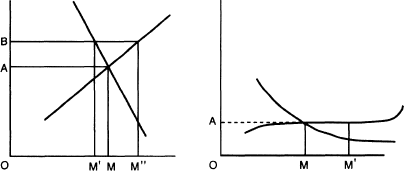
51Here the problem for economic theory is essentially no different than in the case in which a corresponding number of laborers is reduced—for example, by emigration. In the static system, a rise in wages is equivalent to a reduction in the number of laborers. Note in addition, that insofar as the unemployed are maintained “at the cost of the economy,” i.e., insofar as subsidies for the maintenance of the unemployed become production costs (the maintenance of the unemployed does not come out of other income), here, too, the incorporation of the situation into the static system is possible, although the rise in costs must again imply a restriction in production possibilities.
52To continue with the previously introduced examples: Measures which have restricted the division of labor are eliminated; the supply of capital rises, but the chance of this occurring in this connection is probably not very great.
53A complete equalization of prices will perhaps not occur if the necessity of employing a non-increasable specific factor of production in the production of A restricts the expansion of production. It is well-known that in such a case, the more expensive good can come to be considered a luxury without “objective” justification because of its higher price.
54There is, of course, also the substitution between labor and intermediary products: More expensive labor, or more labor, saves raw materials and vice versa.
55Their discounted return value would be equal to zero, and insofar as another use cannot be considered for them and no later output can be expected, they would have to be considered worthless. In other words, insofar as no change can be expected, the stocks of a firm operating with falling costs could only represent the “liquidation value” of the investments. In practice, however, one only too often makes the mistake of calculating with cost values instead of with the value of the discounted return.
56It is clear that there can be overcapitalization regarding a branch of industry, i.e., regarding a more or less large part of production, but never with regard to the whole production process. Overcapitalization means here that so much capital is invested in fixed equipment that full utilization of capacity, i.e., an expansion of production to the point where costs no longer fall, is not possible because in the entire economic system there is no cost covering demand, i.e., a demand which at this production level pays a price for every individual article thrown onto the market. Thus, here overcapitalization is an incorrect investment of capital in relation to the structure of demand. However, general overcapitalization is impossible as a result of the circulatory nature of the economy: Each productive achievement can expect a complementary return from the product and itself creates the demand for whatever it produces. It is only a question of whether what that demand is prepared to assume has been produced. That the product is often only finished long after the factor of production is employed plays no role here because with a “correct” structuring of production, a corresponding subsistence fund must be given for the interim. It can never become a problem that in general too much has been produced as long as an expansion of need satisfaction is possible. It is clear that the overcapitalization of an industry, of which we are speaking here, which can only be considered a relative one, may not be confused with an excessive tying up of free capital (overinvestment), i.e., with the direction of free capital into investments from which it cannot be freed in time, and hence, with the case where as a result of a lack of free capital, a production process cannot be completed.
57Both cases only mean roundabout methods of production of different lengths unless a larger firm can simply be considered as a multiplication of the small firm (with an equally long roundabout production process). The length of the roundabout production processes must naturally-via the link of prices, in particular the interest rate—be adjusted to the general structure of production with consideration for the profitability of an expansion of the roundabout method of production, especially in this line of production.
58In a private economy, an already made investment can occasionally be reversed by exchanging it for a liquid asset—for example, by selling individual machines—whereby in general significant losses will probably have to be incurred. With the dissolution of a firm, an “organizational value” is lost.
59The economic policy which attempts to protect firms with falling costs does not realize that reinvestment in such firms means tying up capital in investments in which the return will be lower than elsewhere. Let it be pointed out here that it is characteristic of a specific stage of the business cycle that the possibilities for investing free capital are unusually limited. We will deal with this problem later. Here we are only concerned—as emphasized explicitly—with the general question of the possibility of structuring production according to the principle of marginal productivity.
60This restriction finds its most important application in the law of population: An increasing population must lead to pressure on the food supplies because of the increase in production cost that results if production is expanded with the additional help of only one increased factor of production (human labor), unless technical progress makes an increase in output possible above and beyond the increase of this factor of production. Apart from technical progress the effect of the law of population naturally can be neutralized also by an increase in capital exceeding the size of the population increase. Here again, we have an example of the fact that a “correct law” of theory is only “applicable” if all of the theory’s assumptions are actually met.
61Whether a new technical method—for example, the introduction of electric power—means shortening or lengthening the roundabout method of production is a question which theory cannot answer definitively in advance. The answer will depend on whether the new production method saves more capital or more labor. Consequently, the effect of new technology must not be considered only for one single stage in the vertical production structure, but for the entire course of the roundabout method of creating finished consumer goods out of originary factors of production.
62One must refrain from confusing duration of production and length of the roundabout method of production. To again use a prior example, if an automobile factory is “modernized” with the effect of reducing the duration of production of an automobile from three months to a few days, then this is possible because machines are introduced to a greater extent. Hence, simultaneous to shortening the duration of production, an additional use of “previously done labor” takes place, and we will probably have to say that the roundabout method of production has been extended. This is so because it must be assumed that the attainment of an equivalent return with a reduced expenditure of labor has become possible because labor expenditures occur to a larger extent in preceding production stages. The temporal moving back of labor expenditure cannot be viewed solely in relation to the first finished product, but instead—with regard to the increased employment of more durable capital goods—also in relation to the products created later with this investment.
63It is hard to detect a shortening or lengthening of a roundabout production process in an individual case because it is difficult to evaluate the function of a single stage of production within the complex production process.
64Here a brief summary is due. Whenever several factors of production cooperate, in principle various kinds of changes in the size of the output are possible by changing their combination. The possibility relevant from the point of view of economic theory, however, must be that one which corresponds to the law of diminishing returns. This follows from the fact that we are only considering factors of production that are scarce and that as a result of their scarcity must be economized. Insofar as a factor of production’s cooperation in production would be subject as a rule to the principle of increasing returns, no portion of the returns could be attributed to this factor of production. For even a decrease in the quantity of this factor of production would have to be irrelevant for production. Earlier we tried to present this principle of the cooperation of scarce factors of production as the foundation of the “law of diminishing agricultural returns.” The principle must be generally valid for the combination of different kinds of factors of production, but in particular also for the employment of free capital (decreasing returns with a lengthening of the roundabout methods of production). From an economic point of view, then, that which can enter into an epistemological system of the static economy is of primary relevance. Other formations of the data of an economic process can at the most be regarded separately as variations of the static course. From this point of view it was necessary for us to first consider the supply of labor in the form of an upward sloping supply curve. We tried to justify this assumption earlier.
- 1Let us observe in this context that Strigl lacks a clear distinction between value and physical productivity in his discussion of the law of diminishing marginal productivity and of the law of costs. He sets out (on pp. 48ff.) to discuss marginal productivity exclusively in physical terms. But when it comes to stating the law of costs, he switches to value terms; for now he compares prices paid for marginal physical products with prices paid for factors of production (see pp. 51f.). However, we can exculpate Strigl since the first satisfying account of the relationship between marginal physical productivity and marginal value productivity (that is, marginal money-price productivity) was published almost thirty years later by Rothbard in Man, Economy, and State. Rothbard also emphasizes that factors of production earn the discounted value of their marginal product rather than, as Strigl (p. 72) asserts, the entire marginal product.
- 2See for example the studies by Murray N. Rothbard, America’s Great Depression, 5th ed. (Auburn, Ala.: Mises Institute, 2000) and Richard Vedder and Lowell Gallaway, Out of Work, 2nd ed. (New York: New York University Press, 1997).
- 3See Carl Menger, “Zur Theorie des Kapitals,” Gesammelte Werke, 2nd ed. (Tübingen: Mohr, [1888] 1970), vol. 3; and Mises, Human Action, chaps. 11–13, 26.
- 4The clarification of the role of expectations in Austrian business cycle theory starts with Ludwig von Mises, Nationalökonomie (Geneva: Editions Union, 1940), p. 696, and the exchange between Ludwig Lachmann, “The Role of Expectations in Economics as a Social Science,” Economica 10, no. 37 (1943): 12–23; and Ludwig von Mises, “‘Elastic Expectations’ and the Austrian Theory of the Business Cycle,” Economica 10, no. 39 (1943): 251–52.
- 5We leave aside the problem that all sums of money are “hoarded.” Any given unit of money can therefore not be hoarded more than it is already hoarded, and such fictional increased hoarding cannot be the cause of price changes. What is really at stake is that people choose to delay expenditures or to offer lower money prices in exchange for the goods and services they desire or offer more of their goods and services in exchange for the sums of money they desire. Yet such behavior does not cause prices to decrease; rather it is a manifestation of price decreases.
- 6See in particular Friedrich von Wieser, “Der Geldwert und seine Veränderungen,” Gesammelte Abhandlungen (Tübingen: Mohr, 1928); F.A. Hayek, Prices and Production, pp. 118ff.; Fritz Machlup, Börsenkredit, Industriekredit und Kapitalbildung; and J.G. Koopmans, “Zum Problem des ‘Neutralen’ Geldes,” in Beiträge zur Geldtheorie, F.A. Hayek, ed. (Vienna: Springer, 1933). Wieser was not the originator of these views, even though he was instrumental in spreading them among the younger Austrian economists. For a German predecessor of Wieser see Wilhelm Roscher, Die Grundlagen der Nationalökonomie, 6th ed. (Stuttgart, 1866), p. 446. Since we cannot go into much detail here, let us merely notice that the notion of a correspondence between money and other goods and the notion of compensatory transactions are fictitious stipulations; they have no basis in observed fact or other evidence. In particular, they both rely on the idea that economic calculation could be cast in terms other than in money prices. For only if there were such a tertium comparationis would it make sense to assert that a correspondence between money and other goods might or might not exist. However, since adding and subtracting money prices is the very essence of economic calculation (see Mises, Human Action, chaps. 11–13, and 26), this assertion is groundless. Moreover, the claim that money prices do not really correspond to the good bought, whereas correspondence always exists in barter transactions, implicitly denies that money is a good. Finally, as we have pointed out before, the success of market participants and, therefore, the equilibrium of the economy, exclusively depend on the correctness of their expectations about the future. These expectations do adapt to changes in conditions (like hoarding) and they can adapt instantaneously, and can even anticipate such changes in the future. It is thus unwarranted to claim that hoarding inherently entails a disruption of the equilibrium of the economy. See on this last point, for example, Mises, Human Action, p. 578; and Rothbard, America’s Great Depression, part 1.
- 7Hayek, Prices and Production, p. 130.
- 8Ibid., p. 124.
- 9Mises, Theorie des Geldes und der Umlaufsmittel, called this type of credit “Zirkulationskredit” (circulation credit or fiduciary credit) and rejected it in this and in all of his later writings, even though it was only in the 1940s that he thoroughly explained why there could be no such thing as a “compensatory credit.” See Joseph T. Salerno, “Mises and Hayek Dehomogenized,” Review of Austrian Economics 6, no. 2 (1993): 113–48 on this development of Mises’s monetary thought.
- 10Very similar views are still maintained today, for example, in the works of George Selgin, The Theory of Free Banking (Totowa, N.J.: Rowman and Littlefield, 1988); and Leland B. Yeager, The Fluttering Veil (Indianapolis, Ind.: Liberty Fund, 1997). Selgin is in fact the present-day intellectual heir to the Wieserian approach to the analysis of money and banking. His main thesis is that banking systems without a central bank are best suited to adjust the supply of money to the demand thereof. For criticisms of this thesis see J.G. Hülsmann, “Banks Cannot Create Money,” Independent Review 5, no. 1 (2000): 101–10 and the literature quoted there.
- 11Clearly, this expression is subject to misinterpretation as expressing a value-judgment (“just” wage). The more correct formulation would be: “economic successor of consumption sacrifices.”
- 12One is reminded here of the famous formulation of Thünen. If we interpret the quantity a in the sense of marginal analysis as the representation of the smallest wage (support) for which those of the employed laborers who are subject to the lowest social pressure are still willing to work, and if—again in line with marginal analysis—we interpret the quantity p as the product of the “last” laborer still employed (marginal product of labor), then a is equal to p and the height of the wage is determined by each of these quantities or also by the formula
- 13This is to say, ignoring that labor for which no “economically relevant” time-period passes between its employment and the attainment of a finished consumer good (see on this note 3). It should be clear that consideration of production then only excludes a relatively small sector of labor services from analysis.
- 14If the laborer himself possesses this subsistence fund, then in this respect he himself is, of course, a “capitalist.” The theoretical analysis must, however, set out from a consideration in which the various functions are differentiated, as only then will the function of each factor of production—and in roundabout production one of these is free capital—for structuring production be recognized correctly.
- 15One thing must be repeated here: It is not necessary for a capitalist whose capital is invested, for example, in a roundabout method of production lasting two years, to actually wait two years for his capital to be freed up. He can sell the produced capital good and receive in return free capital. However, the sale of a pre-product is, of course, only possible if another capitalist can spare free capital in payment and—taking the first capitalist’s place, so to speak—keep his capital tied up until production is completed or until a new sale is made. If invested capital becomes free in this way before production is completed, then from the point of view which looks beyond the situation of the individual, this is nothing but an “interpersonal change in the position of liquidity.” That such a change recurs, in particular with synchronized production processes—namely every time a capital good moves on from one stage of production to the next carried out by a different entrepreneur—must not distract from the fact that even in synchronized production the payment for a capital good with free capital is only possible because earlier, in another process of production, consumer goods already had been created that assumed the function of free capital. Not recognizing that the synchronization cannot change the essence of roundabout production and that with synchronized production, too, the implementation of roundabout methods of production is only possible if “free capital” has been made available, has led repeatedly to grave errors.
- 16The wage fund is thereby not only that part of the output of consumer goods which is newly saved, but also that part which was saved earlier and is now maintained.
- 17In my article mentioned on page 165, Number 1, I have presented these relationships in a formula. If W is the size of the wage fund, 1 the number of laborers, r the quantity of rations into which the wage fund is divided, p the number of payments which occur during the roundabout method of production (for example, wage weeks), and finally, m the size of the marginal product, the following equations can be formulated:
- 18In the first case, the price on the free market would be OA. At this price the supply would be equal to the demand (OM). The price tax of the height OB causes the demand to fall to OM’, while at this wage the supply of laborers is equal to OM”. In the second case, the wage on the free market would be determined by the intersection point of the supply and demand curve, but at this price there would be a supply OM’ as opposed to a demand OM, because the supply curve for labor to the right of the point of intersection moves horizontally.
- 19Here the problem for economic theory is essentially no different than in the case in which a corresponding number of laborers is reduced—for example, by emigration. In the static system, a rise in wages is equivalent to a reduction in the number of laborers. Note in addition, that insofar as the unemployed are maintained “at the cost of the economy,” i.e., insofar as subsidies for the maintenance of the unemployed become production costs (the maintenance of the unemployed does not come out of other income), here, too, the incorporation of the situation into the static system is possible, although the rise in costs must again imply a restriction in production possibilities.
- 20To continue with the previously introduced examples: Measures which have restricted the division of labor are eliminated; the supply of capital rises, but the chance of this occurring in this connection is probably not very great.
- 21A complete equalization of prices will perhaps not occur if the necessity of employing a non-increasable specific factor of production in the production of A restricts the expansion of production. It is well-known that in such a case, the more expensive good can come to be considered a luxury without “objective” justification because of its higher price.
- 22There is, of course, also the substitution between labor and intermediary products: More expensive labor, or more labor, saves raw materials and vice versa.
- 23Their discounted return value would be equal to zero, and insofar as another use cannot be considered for them and no later output can be expected, they would have to be considered worthless. In other words, insofar as no change can be expected, the stocks of a firm operating with falling costs could only represent the “liquidation value” of the investments. In practice, however, one only too often makes the mistake of calculating with cost values instead of with the value of the discounted return.
- 24It is clear that there can be overcapitalization regarding a branch of industry, i.e., regarding a more or less large part of production, but never with regard to the whole production process. Overcapitalization means here that so much capital is invested in fixed equipment that full utilization of capacity, i.e., an expansion of production to the point where costs no longer fall, is not possible because in the entire economic system there is no cost covering demand, i.e., a demand which at this production level pays a price for every individual article thrown onto the market. Thus, here overcapitalization is an incorrect investment of capital in relation to the structure of demand. However, general overcapitalization is impossible as a result of the circulatory nature of the economy: Each productive achievement can expect a complementary return from the product and itself creates the demand for whatever it produces. It is only a question of whether what that demand is prepared to assume has been produced. That the product is often only finished long after the factor of production is employed plays no role here because with a “correct” structuring of production, a corresponding subsistence fund must be given for the interim. It can never become a problem that in general too much has been produced as long as an expansion of need satisfaction is possible. It is clear that the overcapitalization of an industry, of which we are speaking here, which can only be considered a relative one, may not be confused with an excessive tying up of free capital (overinvestment), i.e., with the direction of free capital into investments from which it cannot be freed in time, and hence, with the case where as a result of a lack of free capital, a production process cannot be completed.
- 25Both cases only mean roundabout methods of production of different lengths unless a larger firm can simply be considered as a multiplication of the small firm (with an equally long roundabout production process). The length of the roundabout production processes must naturally-via the link of prices, in particular the interest rate—be adjusted to the general structure of production with consideration for the profitability of an expansion of the roundabout method of production, especially in this line of production.
- 26In a private economy, an already made investment can occasionally be reversed by exchanging it for a liquid asset—for example, by selling individual machines—whereby in general significant losses will probably have to be incurred. With the dissolution of a firm, an “organizational value” is lost.
- 27The economic policy which attempts to protect firms with falling costs does not realize that reinvestment in such firms means tying up capital in investments in which the return will be lower than elsewhere. Let it be pointed out here that it is characteristic of a specific stage of the business cycle that the possibilities for investing free capital are unusually limited. We will deal with this problem later. Here we are only concerned—as emphasized explicitly—with the general question of the possibility of structuring production according to the principle of marginal productivity.
- 28This restriction finds its most important application in the law of population: An increasing population must lead to pressure on the food supplies because of the increase in production cost that results if production is expanded with the additional help of only one increased factor of production (human labor), unless technical progress makes an increase in output possible above and beyond the increase of this factor of production. Apart from technical progress the effect of the law of population naturally can be neutralized also by an increase in capital exceeding the size of the population increase. Here again, we have an example of the fact that a “correct law” of theory is only “applicable” if all of the theory’s assumptions are actually met.
- 29Whether a new technical method—for example, the introduction of electric power—means shortening or lengthening the roundabout method of production is a question which theory cannot answer definitively in advance. The answer will depend on whether the new production method saves more capital or more labor. Consequently, the effect of new technology must not be considered only for one single stage in the vertical production structure, but for the entire course of the roundabout method of creating finished consumer goods out of originary factors of production.
- 30One must refrain from confusing duration of production and length of the roundabout method of production. To again use a prior example, if an automobile factory is “modernized” with the effect of reducing the duration of production of an automobile from three months to a few days, then this is possible because machines are introduced to a greater extent. Hence, simultaneous to shortening the duration of production, an additional use of “previously done labor” takes place, and we will probably have to say that the roundabout method of production has been extended. This is so because it must be assumed that the attainment of an equivalent return with a reduced expenditure of labor has become possible because labor expenditures occur to a larger extent in preceding production stages. The temporal moving back of labor expenditure cannot be viewed solely in relation to the first finished product, but instead—with regard to the increased employment of more durable capital goods—also in relation to the products created later with this investment.
- 31It is hard to detect a shortening or lengthening of a roundabout production process in an individual case because it is difficult to evaluate the function of a single stage of production within the complex production process.
- 32Here a brief summary is due. Whenever several factors of production cooperate, in principle various kinds of changes in the size of the output are possible by changing their combination. The possibility relevant from the point of view of economic theory, however, must be that one which corresponds to the law of diminishing returns. This follows from the fact that we are only considering factors of production that are scarce and that as a result of their scarcity must be economized. Insofar as a factor of production’s cooperation in production would be subject as a rule to the principle of increasing returns, no portion of the returns could be attributed to this factor of production. For even a decrease in the quantity of this factor of production would have to be irrelevant for production. Earlier we tried to present this principle of the cooperation of scarce factors of production as the foundation of the “law of diminishing agricultural returns.” The principle must be generally valid for the combination of different kinds of factors of production, but in particular also for the employment of free capital (decreasing returns with a lengthening of the roundabout methods of production). From an economic point of view, then, that which can enter into an epistemological system of the static economy is of primary relevance. Other formations of the data of an economic process can at the most be regarded separately as variations of the static course. From this point of view it was necessary for us to first consider the supply of labor in the form of an upward sloping supply curve. We tried to justify this assumption earlier.
- 33Furthermore, so far as the general procedure of the analysis is concerned, Strigl does in fact not heed his announced intention (p. xxx) to first analyze a barter economy and only then turn to dissect the impact of the “veil of money.” Rather, his discussion of the law of cost, crucial for his argument in chapter two, refers to money prices. He correctly states: “Each factor of production whose marginal product can obtain a price larger than the price of this factor will be employed up to the point at which these two prices are equal.” It follows that the two prices must be money prices since otherwise it would be impossible to tell whether they are equal or not. It is therefore best to read the second chapter, not as an account of the connectivity of prices in a barter economy, but as a description of the connectivity of money prices under the impact of nonmonetary factors. These are, for example, the supply of factors of production, the law of return, and interest.
- 34It also has to be observed that Strigl completely neglects the political factors determining economic growth and the formation of the economy’s structure of production. Apparently in the 1930s only Mises was courageous enough to point out that political organizations, like labor unions, were responsible for the unnecessary aggravation of the economic crisis of 1929. Strigl’s account of the Great Depression, and Striglian interpretations of similar situations, as pertinent as they might be on behalf of the relationships between money, prices, and production, thus need to be complemented by an analysis of such political factors.
- 35Strigl correctly notes that monetary calculation can enable market participants to gauge the quantity of the capital they own. However, in distinct contrast to Menger and Mises, who emphasize that a homogeneous and quantifiable capital exists only in the form of such aggregated money prices and has no counterpart in the physical world of heterogeneous goods, Strigl insists that money can “represent” or “correspond to” capital. In short, Menger and Mises see homogeneous units of capital as ontologically bound up with money prices and calculation, whereas Strigl perceives this link as merely nominal. For him, there are homogeneous units of “capital” out there in the physical world. He believes that the system of money prices is nothing but a veil layered over a barter economy (see pp. 20, 91, 98, 100, 142); and so is the capital sum that results from monetary calculation just a veil overlaying a sum of physical capital.
- 36Accounting for the fact that expectations are not static but free leads to a different picture. The monetary calculus of market entrepreneurs essentially depends on the selling prices that these entrepreneurs expect to realize in an uncertain future. Only if they underestimate the impact of credit expansion on these prices will credit expansion depress the rate of interest below its equilibrium level. Only then will more investment projects appear profitable than can be sustained with the available quantities of capital goods; and only then will an artificial “boom” be created which is doomed to burst in a crisis.
- 37The static-expectations theory of money’s impact on the structure of production is also the basis for Strigl’s analysis of money hoarding. From his perspective, increasing and decreasing money hoards both disrupt the representation of physical capital through money capital. Decreasing money hoards entail an economic upswing when the released money hoards first arrive on the credit markets and thus decrease interest rates below their equilibrium level. Increasing money hoards engender an economic downswing when the hoarded money is sucked out of the credit markets, thus pushing interest rates above their equilibrium level. Any change in money hoards is therefore bound to bring about booms and busts (see pp. 115ff., 140, 148f., 151).
- 38In this analysis of the effects of hoarding Strigl advocated an argument that was prominent with the Wieserian line of Austrian economists. In their eyes, hoarding is inherently disruptive of economic equilibrium since it destroys the “correspondence” between money and the nonmonetary (capital) goods. This correspondence is only given insofar as the monetary economy mimics a barter economy through “complementary transactions.”
- 39the identity of demand and supply, which must necessarily exist in the case of barter, ceases to exist as soon as money becomes the intermediary of the exchange transactions. [Problems will arise] when after the division of the barter transaction into two separate transactions, one of these takes place without the other complementary transaction. In this sense demand without corresponding supply, and supply without a corresponding demand, evidently seem to occur in the first instance when money is spent out of hoards (i.e., when cash balances are reduced), when money received is not immediately spent, when additional money comes on the market, or when money is destroyed.
- 40This is the basis for Hayek’s assertion that “any change in the velocity of circulation would have to be compensated by a reciprocal change in the amount of money in circulation if money is to remain neutral towards prices.”
- 41These views about the significance of money hoarding explain why Strigl did not share Ludwig von Mises’s categorical rejection of “additional credit,” that is, credit created by banks in the form of money titles that are not backed by money actually saved. Strigl points out that additional credit can involve a “credit expansion” which pushes interest rates below their equilibrium level and thus brings about a boom-bust cycle (pp. 114ff.). However, he thinks that additional credit can also have the healthy and even necessary function of compensating for those changes in monetary circulation that stem from money hoarding (pp. 117f.). These “compensatory credits” make the volume of credits “elastic” and thus help assure monetary equilibrium.
- 42These views about the significance of money hoarding explain why Strigl did not share Ludwig von Mises’s categorical rejection of “additional credit,” that is, credit created by banks in the form of money titles that are not backed by money actually saved. Strigl points out that additional credit can involve a “credit expansion” which pushes interest rates below their equilibrium level and thus brings about a boom-bust cycle (pp. 114ff.). However, he thinks that additional credit can also have the healthy and even necessary function of compensating for those changes in monetary circulation that stem from money hoarding (pp. 117f.). These “compensatory credits” make the volume of credits “elastic” and thus help assure monetary equilibrium.
- 43One more thing should be said here. Much energy has been spent attempting to present the formation of new capital in the form of a supply curve. Since what the saver receives as compensation for refraining from consumption and providing the capital—as a wage for the “act of saving”—is capital interest, a question must be raised regarding the relationship between the amount of savings and the height of capital interest. One must note that the argument to be applied in this case will hardly lead to a clear-cut result. It is probably justified to say that a higher interest rate will stimulate savings, and that consequently the supply of newly formed capital grows at a higher interest rate and that there will also be an increased incentive to maintain and avoid capital consumption, while on the other hand a lower interest rate will lead to a reduction in savings and—what is perhaps still more important—reduces the inhibitions which keep some individuals from consuming capital. One could then come to the conclusion that a drop in the interest rate below a certain minimum will not be possible because the lack of new formation of capital and the increased consumption of capital would so drastically reduce the supply of capital that the interest rate would in turn have to rise. Without disputing that these connections generally exist, we must point out here, however, that the opposite relationship can also exist: Whoever saves in order to achieve a certain income from interest will achieve this income earlier with higher interest and hence will cease to save sooner. Since one must undoubtedly consider this relationship as possible, it follows that a general proposition regarding a necessary relationship between savings and capital interest is not at all possible.
- 44The theoretical determination of the wage rate on the free market follows without difficulty from the application of the general law of prices and the principle of marginal productivity. The price will form at the level at which the supply of laborers is equal to the entrepreneurs’ demand. Since an entrepreneur must shape his demand according to the size of the marginal product—he cannot offer more or he would suffer a loss in hiring labor, he also will not be able to hire the laborer more cheaply since he would be able to find employment elsewhere at a wage equal to the size of the marginal product—the price of labor will coincide with the price of the marginal product. If one considers the supply of laborers as stratified according to its urgency, then the wage will be equivalent to the supply of the “most expensive” (that is, the one coming onto the market with the highest supply) of those laborers who are still employed. Thus, we have determined the principle according to which the laborers’ share in the product. In the case of momentary production this suffices. However, when considering a time consuming roundabout structure of production a complication results, because the size of the wage sum is also determined by the amount of wage capital or that portion of free capital which is available for the payment of wages.
- 45This is easy to see. Ignore the cooperating effect of the second originary factor of production of land and that part of human labor which is occupied exclusively with the immediate completion of consumer goods, so that the product can be completed without the laborer having to be paid a wage in advance. It is clear that all other laborers produce something that can only be enjoyed much later as a consumer good. The laborers must have some means of support while the fruits of their labor are developing into a consumer good. The necessary subsistence fund must be made available lest roundabout production be impossible. The function of whoever makes this fund available is that of the owner of capital; the one who makes present goods available in order to receive them back later.
- 46This is easy to see. Ignore the cooperating effect of the second originary factor of production of land and that part of human labor which is occupied exclusively with the immediate completion of consumer goods, so that the product can be completed without the laborer having to be paid a wage in advance. It is clear that all other laborers produce something that can only be enjoyed much later as a consumer good. The laborers must have some means of support while the fruits of their labor are developing into a consumer good. The necessary subsistence fund must be made available lest roundabout production be impossible. The function of whoever makes this fund available is that of the owner of capital; the one who makes present goods available in order to receive them back later.
- 47It is important here to keep in mind the integration of this process of investing capital in the course of the entire economy. The entrepreneur who pays laborers a wage in production processes that precede the production of consumer goods immediately receives a return value in the form of a finished article whose value is increased through processing and—with a vertical structuring of production in individual firms—can be sold on the market. Upon sale of the capital good, the entrepreneur immediately receives something of equivalent value in return. An “advance” for labor appears to be necessary primarily for the time between the payment to the laborer and the sale of the product; in no case, however, is this necessary for the time between the payment for labor and the creation of a consumer good produced by means of a capital good—which can often only be expected after a great length of time. So this situation appears in the entrepreneur’s calculation: his free capital must make production possible from the introduction of labor until the sale of his product. He is not further interested in whether what he has produced is a finished consumer good or a capital good that will perhaps only result in a consumer good after a long period of time. In particular, the real goods perspective shows that a subsistence fund functioning as capital is the prerequisite for the adoption of a time-consuming roundabout method of production. Payment for the result of preceding production processes can only occur in the form of means of subsistence; and this is so because an entrepreneur carrying out preceding production processes can support those who produce a product that is not yet ready for consumption only by using means of subsistence. If a subsistence fund is employed in this way, it means that it is invested in production, that it is only employed to produce finished consumer goods at a later time. Capital invested in this way will only become available again when at the completion of the production process it is freed up. During this entire time it remains tied up and this time between investment and release must be bridged. We have already seen that synchronization does not change anything concerning this relationship.
- 48If the payment for laborers employed in the roundabout method of production can only come from a subsistence fund functioning as capital, then from this follows a determination of the size of the wages. When we said that the laborers’ share in the product is determined by the size of the marginal product of labor, we stated that—in a certain sense—productivity of labor is the basis for determining the height of wages. We now see a very different determining cause for the labor wage: No more of the means of subsistence can be transferred over to laborers employed in a roundabout method of production than have been saved by the owners of capital and made available for the purpose of investing. The size of the sum of wages is hence identical to the size of the saved and invested share of the output of consumer goods.
- 49The wage fund must be sufficient to pay the laborers’ wages for the duration of the roundabout method of production. If it is not sufficient for this, then this is an indication that too lengthy roundabout production processes have been chosen. The insufficient supply of free capital must drive up the interest rate and thereby force a shortening of the roundabout production processes. Since a shortened roundabout production process is equivalent to a lower marginal product of labor, wages must fall. Simultaneously, the number of employed will go down (with a corresponding shape of the labor supply). Thus, we see that with an insufficient supply of wage funds the length of the roundabout production process goes down, wages drop and the number of laborers will become smaller. An adjustment of demand to the size of the wage fund is thereby brought about. One must keep in mind that this adjustment is required by the interest rate. We see the reverse case when the wage fund is greater than the demand arising from the given production structure. A lowering of the interest rate will lead to a lengthening of the roundabout production process, to a rise in wages and under certain circumstances to an increase in the number of employed persons. In both cases, a structure of production results in which the wage fund suffices to pay all employed persons according to the size of the marginal product of labor for the duration of the roundabout method of production.
- 50There are two cases, however, in which it is possible that at a given wage price the supply of laborers is greater than the demand for them. First, the wage price is fixed above the free-market price by wage decrees from outside the market economy. And second, the supply of laborers is such that at the wages formed on the free market a greater number of laborers are willing to work than the demand can assume. Let us initially consider the first of these two cases.
- 51Here one must briefly point out how these instances of unemployment must be classified in the historical process of economic development. An “artificial” wage increase will lead to problems of adjustment which under all circumstances will probably lead to the consumption of capital. This is so because the amount of capital already invested, i.e., the supply of capital goods—in particular of fixed capital—must be adjusted to new conditions. Practically speaking, this means that the capital invested cannot be freed up entirely without losses. Ignoring this transitional time period, too high a wage must be incorporated into the course of a static economic system. Naturally, the consequence of this will be the nonemployment of laborers. Doing away with unemployment will only be possible in two ways: Either the economic conditions will change in the direction of making production possibilities more favorable, or, and this is the only other possibility to eliminate unemployment, the level of wages will be reduced. Assuming that before, wages have been artificially raised, this can only happen if wage determination that takes place outside the free market adjusts to free-market pricing. However, where the structure of the supply of labor also leads to unemployment on the free market, a reduction in wages will only occur when increased social pressure brought about by persistent unemployment leads to a change in the structure of the supply of labor, to a reduction in the “aspirations” of the laborers.
- 52Here one must briefly point out how these instances of unemployment must be classified in the historical process of economic development. An “artificial” wage increase will lead to problems of adjustment which under all circumstances will probably lead to the consumption of capital. This is so because the amount of capital already invested, i.e., the supply of capital goods—in particular of fixed capital—must be adjusted to new conditions. Practically speaking, this means that the capital invested cannot be freed up entirely without losses. Ignoring this transitional time period, too high a wage must be incorporated into the course of a static economic system. Naturally, the consequence of this will be the nonemployment of laborers. Doing away with unemployment will only be possible in two ways: Either the economic conditions will change in the direction of making production possibilities more favorable, or, and this is the only other possibility to eliminate unemployment, the level of wages will be reduced. Assuming that before, wages have been artificially raised, this can only happen if wage determination that takes place outside the free market adjusts to free-market pricing. However, where the structure of the supply of labor also leads to unemployment on the free market, a reduction in wages will only occur when increased social pressure brought about by persistent unemployment leads to a change in the structure of the supply of labor, to a reduction in the “aspirations” of the laborers.
- 53If in a smoothly functioning market only one uniform price can arise for goods of the same kind, then it is not much more than a continuation of this thought if this principle is expanded to the law that goods which can be substituted for each other will attain the same price. It is clear that disparities in the prices of goods which can be substituted for each other will lead to changes in the form of supply and demand. This can be most simply explained with respect to the area of consumer goods. If two consumer goods A and B (for example, foods) can be put to essentially the same use, but good A is significantly more expensive than good B, then the demand for good A will fall whereas the demand for good B will rise, thus setting in motion a tendency towards equalizing both prices. This interconnectedness of product prices will also be reflected in a connectivity of prices of factors of production: Since the demand for A is co-determined by the price of B, the price of a factor of production suitable for product A will also be co-determined by the price of the factor of production suitable only for product B.
- 54Finally, the substitution of originary factors of production, primarily labor, and capital, is possible. The common point of view assumes that (relatively) more expensive labor will be replaced by cheaper machine power and vice versa. However, since every capital good is simply previously expended originary factors of production, here the substitution goes in this direction: The expenditure of more labor in a briefer roundabout production process or of less labor in a more lengthy roundabout production process (by employing more capital) and vice versa. The entrepreneur calculates the possibility of substituting when calculating costs. He will employ previously done labor in the form of capital goods to a greater extent if at the given prices, i.e., in particular at the going interest rate, the earlier expenditure of labor brings a better return. For the entrepreneur, earlier employment of labor means on the one hand, an increase in the cost burden (of the labor wage) due to interest; on the other hand, however, it means an increase in output equal to the difference between the productivity of an earlier labor expenditure and that of a later one. The result here is an interrelation of the price of labor employed in the realm of consumer goods production and the labor employed in much earlier production stages, even if, because of the friction associated with reallocating labor, an equalization of wages is not possible.
- 55Let us assume, using a highly “construed” example that in a closed economy in which falling costs normally do not occur and in which even those firms that have a span of falling costs in their cost structure are employed in a region of rising costs—that is, in an economy in which otherwise the law of costs functions smoothly—there are ten large automobile firms that have falling costs. These firms function such that a further expansion of production would reduce their costs. These firms assume thereby that the prices are already loss prices and that precisely because of the structure of costs, no firm is in the position of restricting production. By limiting production, each firm would only increase its costs. The other firms would not limit their production, and each firm which limited production would only benefit a competitor and hurt itself. Now, for the sake of theoretical analysis, let’s make an assumption which can never exist in reality. We will imagine that these firms are suddenly transformed such that in each firm the principle of marginal productivity can take effect immediately. As impossible as this is, it is not difficult to see what would have to happen. For it is characteristic of each of these firms that they work at a loss, but that limiting those factors of production which are in fact variable, i.e., limiting the use of “productive” labor and the raw material iron (ignoring the others) cannot help. Hence this limitation must be attempted regarding other factors of production, such as invested capital, machinery, “previous labor,” and previously invested iron. Now it is technically impossible to withdraw these factors of production—the machines cannot be transformed back into iron, into unexpended labor—at least not so that these factors of production are available in the form in which they previously had been. But let us imagine that a miracle had transformed the invested factors of production so that this industry’s situation would immediately change. Old investments would be withdrawn from the firms, for in these productive combinations they do not bring any return; they operate at a loss, while elsewhere in the economy they could bring a return. The invested capital in particular could be used at the current interest rate (or with practically insignificant pressure on this interest rate) by other firms. Production in this “overcapitalized” branch of industry would be changed by withdrawing fixed capital. Withdrawing previously invested capital is thereby possible with two different effects. Either the capital is withdrawn entirely from some of the ten automobile factories and fewer firms will then exist while others are dissolved, or in each of these firms a portion of the invested capital can be withdrawn so that all of the firms continue to operate on a more limited scale. Regardless of which of these paths is chosen, whether ten smaller firms or five large firms remain, the result will be a reduction of the supply of capital of these firms up to the point where falling costs no longer exist. For as long as the costs are falling, the withdrawal of fixed capital must still be profitable. It follows from our assumptions that in the end a situation in which rising costs occur throughout will be reached, and thus with regard to all factors of production the principle of marginal productivity is effective.
- 56Let us assume, using a highly “construed” example that in a closed economy in which falling costs normally do not occur and in which even those firms that have a span of falling costs in their cost structure are employed in a region of rising costs—that is, in an economy in which otherwise the law of costs functions smoothly—there are ten large automobile firms that have falling costs. These firms function such that a further expansion of production would reduce their costs. These firms assume thereby that the prices are already loss prices and that precisely because of the structure of costs, no firm is in the position of restricting production. By limiting production, each firm would only increase its costs. The other firms would not limit their production, and each firm which limited production would only benefit a competitor and hurt itself. Now, for the sake of theoretical analysis, let’s make an assumption which can never exist in reality. We will imagine that these firms are suddenly transformed such that in each firm the principle of marginal productivity can take effect immediately. As impossible as this is, it is not difficult to see what would have to happen. For it is characteristic of each of these firms that they work at a loss, but that limiting those factors of production which are in fact variable, i.e., limiting the use of “productive” labor and the raw material iron (ignoring the others) cannot help. Hence this limitation must be attempted regarding other factors of production, such as invested capital, machinery, “previous labor,” and previously invested iron. Now it is technically impossible to withdraw these factors of production—the machines cannot be transformed back into iron, into unexpended labor—at least not so that these factors of production are available in the form in which they previously had been. But let us imagine that a miracle had transformed the invested factors of production so that this industry’s situation would immediately change. Old investments would be withdrawn from the firms, for in these productive combinations they do not bring any return; they operate at a loss, while elsewhere in the economy they could bring a return. The invested capital in particular could be used at the current interest rate (or with practically insignificant pressure on this interest rate) by other firms. Production in this “overcapitalized” branch of industry would be changed by withdrawing fixed capital. Withdrawing previously invested capital is thereby possible with two different effects. Either the capital is withdrawn entirely from some of the ten automobile factories and fewer firms will then exist while others are dissolved, or in each of these firms a portion of the invested capital can be withdrawn so that all of the firms continue to operate on a more limited scale. Regardless of which of these paths is chosen, whether ten smaller firms or five large firms remain, the result will be a reduction of the supply of capital of these firms up to the point where falling costs no longer exist. For as long as the costs are falling, the withdrawal of fixed capital must still be profitable. It follows from our assumptions that in the end a situation in which rising costs occur throughout will be reached, and thus with regard to all factors of production the principle of marginal productivity is effective.
- 57Let us assume, using a highly “construed” example that in a closed economy in which falling costs normally do not occur and in which even those firms that have a span of falling costs in their cost structure are employed in a region of rising costs—that is, in an economy in which otherwise the law of costs functions smoothly—there are ten large automobile firms that have falling costs. These firms function such that a further expansion of production would reduce their costs. These firms assume thereby that the prices are already loss prices and that precisely because of the structure of costs, no firm is in the position of restricting production. By limiting production, each firm would only increase its costs. The other firms would not limit their production, and each firm which limited production would only benefit a competitor and hurt itself. Now, for the sake of theoretical analysis, let’s make an assumption which can never exist in reality. We will imagine that these firms are suddenly transformed such that in each firm the principle of marginal productivity can take effect immediately. As impossible as this is, it is not difficult to see what would have to happen. For it is characteristic of each of these firms that they work at a loss, but that limiting those factors of production which are in fact variable, i.e., limiting the use of “productive” labor and the raw material iron (ignoring the others) cannot help. Hence this limitation must be attempted regarding other factors of production, such as invested capital, machinery, “previous labor,” and previously invested iron. Now it is technically impossible to withdraw these factors of production—the machines cannot be transformed back into iron, into unexpended labor—at least not so that these factors of production are available in the form in which they previously had been. But let us imagine that a miracle had transformed the invested factors of production so that this industry’s situation would immediately change. Old investments would be withdrawn from the firms, for in these productive combinations they do not bring any return; they operate at a loss, while elsewhere in the economy they could bring a return. The invested capital in particular could be used at the current interest rate (or with practically insignificant pressure on this interest rate) by other firms. Production in this “overcapitalized” branch of industry would be changed by withdrawing fixed capital. Withdrawing previously invested capital is thereby possible with two different effects. Either the capital is withdrawn entirely from some of the ten automobile factories and fewer firms will then exist while others are dissolved, or in each of these firms a portion of the invested capital can be withdrawn so that all of the firms continue to operate on a more limited scale. Regardless of which of these paths is chosen, whether ten smaller firms or five large firms remain, the result will be a reduction of the supply of capital of these firms up to the point where falling costs no longer exist. For as long as the costs are falling, the withdrawal of fixed capital must still be profitable. It follows from our assumptions that in the end a situation in which rising costs occur throughout will be reached, and thus with regard to all factors of production the principle of marginal productivity is effective.
- 58The process of adapting the use of factors of production to a stratification corresponding to the principle of marginal productivity actually occurs in a real economy too. It cannot occur, as we presented it in our example, where we assumed the possibility of a retroactive transformation of investments that were made earlier. Even with frictionless movements it must occur more slowly, such that a successively progressing need for reinvestments brings about a reallocation of production factors in accordance with the law of costs. Once made investments can, of course, no longer be reversed. But invested capital is never tied up for such a long period that such an investment can never be reversed. Every machine will be used up and must be replaced if production is to be maintained. However, maintaining capital investments which do not bring a return by continually introducing new free capital will not be possible. Somewhere in the economy the owner of capital who wishes to expend free capital will find a possibility for an investment that will bring a profit, contrary to the presently maintained one with falling costs. An investment of durable capital that operates with falling costs will no longer be renewed once it is used up. Insofar as the entrepreneur who owns such an investment can produce any renewal fund, he will not be able to invest this in his own firm if he wishes to achieve a profit. Consequently, capital will be withdrawn from the firm and invested elsewhere. And here we see that what could happen immediately with a free convertibility of already invested factors of production—the adjustment of investments to the principle of marginal productivity—will come about slowly in the real world of restricted convertibilities in the course of the successively arising need for reinvestments to replace exhausted factors. The transformation will occur because these reinvestments are not made. Thus, the economy will move towards a state whose structure is in accordance with the principle of marginal productivity and in which the law of costs immediately takes effect through changes in the employment of factors of production. As a result of the frequent tying up of factors of production in fixed investments, the law of costs will probably not operate such that it immediately brings about an adjustment of production. But there will be a tendency in the economy to bring about this adjustment. We can thus summarize: Tying up capital in durable investments, and hence frequently occurring falling costs, imply an important friction in the operation of the law of costs based on the principle of marginal productivity. This friction does not suspend the effect of this law, but rather only results in this law’s taking effect in a process which requires a longer period of time because it can only be effected through successive reinvestments.
- 59The process of adapting the use of factors of production to a stratification corresponding to the principle of marginal productivity actually occurs in a real economy too. It cannot occur, as we presented it in our example, where we assumed the possibility of a retroactive transformation of investments that were made earlier. Even with frictionless movements it must occur more slowly, such that a successively progressing need for reinvestments brings about a reallocation of production factors in accordance with the law of costs. Once made investments can, of course, no longer be reversed. But invested capital is never tied up for such a long period that such an investment can never be reversed. Every machine will be used up and must be replaced if production is to be maintained. However, maintaining capital investments which do not bring a return by continually introducing new free capital will not be possible. Somewhere in the economy the owner of capital who wishes to expend free capital will find a possibility for an investment that will bring a profit, contrary to the presently maintained one with falling costs. An investment of durable capital that operates with falling costs will no longer be renewed once it is used up. Insofar as the entrepreneur who owns such an investment can produce any renewal fund, he will not be able to invest this in his own firm if he wishes to achieve a profit. Consequently, capital will be withdrawn from the firm and invested elsewhere. And here we see that what could happen immediately with a free convertibility of already invested factors of production—the adjustment of investments to the principle of marginal productivity—will come about slowly in the real world of restricted convertibilities in the course of the successively arising need for reinvestments to replace exhausted factors. The transformation will occur because these reinvestments are not made. Thus, the economy will move towards a state whose structure is in accordance with the principle of marginal productivity and in which the law of costs immediately takes effect through changes in the employment of factors of production. As a result of the frequent tying up of factors of production in fixed investments, the law of costs will probably not operate such that it immediately brings about an adjustment of production. But there will be a tendency in the economy to bring about this adjustment. We can thus summarize: Tying up capital in durable investments, and hence frequently occurring falling costs, imply an important friction in the operation of the law of costs based on the principle of marginal productivity. This friction does not suspend the effect of this law, but rather only results in this law’s taking effect in a process which requires a longer period of time because it can only be effected through successive reinvestments.
- 60Ever since economic science first mentioned a law of diminishing returns, it has been beyond doubt that this law is only valid rebus sic stantibus, and that the adoption of a new production technique interrupts the effectiveness of the law; and hence that there can be no explanation of the course of history, co-determined as it is by changes in technology in terms of the law of diminishing returns. Instead, there can only be an explanation of its effectiveness under the assumption of given data. Since we have characterized the principle of diminishing returns more generally as a principle of the cooperation between economic goods, in particular as the cooperation between free capital and originary factors of production then the restriction of rebus sic stantibus must naturally also be significant here. The simplest formulation would then be: As a rule, lengthening a roundabout method of production brings about a diminishing increase in output, but technical progress can lead to a situation in which even a shortening of the roundabout method of production leads to an increase in returns. The distinction between the two possibilities for changing output does not mean that we wish to develop a classification system, which can be applied without difficulty in each individual case to explain experience, but it means instead that we wish to understand the constructive principle underlying and directing economic processes. Where there is a possibility of increasing the output without lengthening the roundabout production process, the economy will take advantage of this possibility. This is naturally not limited solely by our technical knowledge, but also by the profitability of individual production methods: The entrepreneur will not be able to employ even the technically most satisfactory method if no favorable balance in the relation between cost expenditures and revenues exists. Nonetheless, wherever a technically new production method means a lengthened roundabout method of production, the calculation of costs—and in particular the calculation of interest—will cause the adoption of a technique to be adjusted to the economic possibilities. For us, however, it is significant that—entirely independent of the possibility of shortening roundabout production processes through technical inventions—with each given technology a lengthening of the roundabout production process with the effect of increasing output is possible. The problem of the structure of production, a problem which is of great importance for the economic process, lies in the limits of the economically possible length of the roundabout production processes; in the circumstances that restrict the economy in its possibility of utilizing the advantages of a lengthening of the roundabout production processes. Here lies the central significance of the problem of capital employment.
- 61Ever since economic science first mentioned a law of diminishing returns, it has been beyond doubt that this law is only valid rebus sic stantibus, and that the adoption of a new production technique interrupts the effectiveness of the law; and hence that there can be no explanation of the course of history, co-determined as it is by changes in technology in terms of the law of diminishing returns. Instead, there can only be an explanation of its effectiveness under the assumption of given data. Since we have characterized the principle of diminishing returns more generally as a principle of the cooperation between economic goods, in particular as the cooperation between free capital and originary factors of production then the restriction of rebus sic stantibus must naturally also be significant here. The simplest formulation would then be: As a rule, lengthening a roundabout method of production brings about a diminishing increase in output, but technical progress can lead to a situation in which even a shortening of the roundabout method of production leads to an increase in returns. The distinction between the two possibilities for changing output does not mean that we wish to develop a classification system, which can be applied without difficulty in each individual case to explain experience, but it means instead that we wish to understand the constructive principle underlying and directing economic processes. Where there is a possibility of increasing the output without lengthening the roundabout production process, the economy will take advantage of this possibility. This is naturally not limited solely by our technical knowledge, but also by the profitability of individual production methods: The entrepreneur will not be able to employ even the technically most satisfactory method if no favorable balance in the relation between cost expenditures and revenues exists. Nonetheless, wherever a technically new production method means a lengthened roundabout method of production, the calculation of costs—and in particular the calculation of interest—will cause the adoption of a technique to be adjusted to the economic possibilities. For us, however, it is significant that—entirely independent of the possibility of shortening roundabout production processes through technical inventions—with each given technology a lengthening of the roundabout production process with the effect of increasing output is possible. The problem of the structure of production, a problem which is of great importance for the economic process, lies in the limits of the economically possible length of the roundabout production processes; in the circumstances that restrict the economy in its possibility of utilizing the advantages of a lengthening of the roundabout production processes. Here lies the central significance of the problem of capital employment.
- 62Ever since economic science first mentioned a law of diminishing returns, it has been beyond doubt that this law is only valid rebus sic stantibus, and that the adoption of a new production technique interrupts the effectiveness of the law; and hence that there can be no explanation of the course of history, co-determined as it is by changes in technology in terms of the law of diminishing returns. Instead, there can only be an explanation of its effectiveness under the assumption of given data. Since we have characterized the principle of diminishing returns more generally as a principle of the cooperation between economic goods, in particular as the cooperation between free capital and originary factors of production then the restriction of rebus sic stantibus must naturally also be significant here. The simplest formulation would then be: As a rule, lengthening a roundabout method of production brings about a diminishing increase in output, but technical progress can lead to a situation in which even a shortening of the roundabout method of production leads to an increase in returns. The distinction between the two possibilities for changing output does not mean that we wish to develop a classification system, which can be applied without difficulty in each individual case to explain experience, but it means instead that we wish to understand the constructive principle underlying and directing economic processes. Where there is a possibility of increasing the output without lengthening the roundabout production process, the economy will take advantage of this possibility. This is naturally not limited solely by our technical knowledge, but also by the profitability of individual production methods: The entrepreneur will not be able to employ even the technically most satisfactory method if no favorable balance in the relation between cost expenditures and revenues exists. Nonetheless, wherever a technically new production method means a lengthened roundabout method of production, the calculation of costs—and in particular the calculation of interest—will cause the adoption of a technique to be adjusted to the economic possibilities. For us, however, it is significant that—entirely independent of the possibility of shortening roundabout production processes through technical inventions—with each given technology a lengthening of the roundabout production process with the effect of increasing output is possible. The problem of the structure of production, a problem which is of great importance for the economic process, lies in the limits of the economically possible length of the roundabout production processes; in the circumstances that restrict the economy in its possibility of utilizing the advantages of a lengthening of the roundabout production processes. Here lies the central significance of the problem of capital employment.
- 63Here, too, it can be seen that one must consider one’s assumptions when applying the principle of the greater productivity of roundabout production methods to reality. It is possible to observe an increase in production with shortened roundabout methods, just as one can frequently observe falling costs in modern firms. A theoretical analysis of the production process must isolate those elements from the multifarious possibilities of reality which can be used in constructing a system. The system will be applicable to, and able to offer an explanation of actual events, if it is constructed in such a way that it sets out from the principles that represent the conditions for attaining economic success which must be fulfilled in the world of experience.
- 64We have seen this clearly with regard to the principle of marginal productivity. It would be correct for one to believe that in each individual case—for the employment of any factor of production in each individual firm—a marginal product could be established. It is not this, but something else that is the issue there: That it is possible to structure the economy according to the principle of marginal productivity, and that a deviation from this structure must cause a tendency to adjust to this structure. And with respect to roundabout methods of production, it is not only that an extension of the roundabout methods of production can and does lead to an increase in output, but that this increase of returns is limited by the supply of capital in the economy.

